July “jug trap” run

You may recall in May I set out “jug traps” at several sites in northwestern Oklahoma stretching from Gloss Mountain State Park (just east of the panhandle) to near Kenton (extreme northwestern corner of the panhandle). I call them “jug traps” because they are made out of 1-G milk jugs. “Windows” cut into the upper part of the jug allow entry of beetles attracted to volatiles emanating from a wicked bait bottle suspended inside the upper part of the trap, and propylene glycol in the bottom part of the jug acts as a killing agent and preservative. (See this post for details about the traps and photos.) Six sets of traps were set out at five locations (two sets at Gloss Mountain, one at other locations)—each set consisting of three traps baited with sweet red wine, pure ethanol, or a 50:50 mixture of both. This is the second season of the study (the first was conducted last year at locations across southern Missouri) with the objective of evaluating the efficacy of the trap and baits for capturing various beetles. Longhorned beetles (family Cerambycidae) are the primary objective, but certain cetoniine scarabs (flower chafers in the genera Euphoria and Cotinus) and click beeltes (family Elateridae) are also highly attracted to the traps. I’m collecting data on all of these groups for analysis of relative bait efficacy and eventual publication of the results.

In addition to the jug traps, I also placed white “bottle traps” at each location with the objective of collecting beetles in the genus Acmaeodera (family Buprestidae). Finally, to round out the trapping effort I hung a Lindgren funnel trap (baited with a 50:50 mixture of ethanol and sweet red wine) at two of the locations (just for the heck of it!). All of the traps are being serviced and re-baited at ~5-week intervals—the first of these servicing runs done at the beginning of a 3-week collecting trip across the southwestern U.S. Additional collecting is done at each location as time permits. This post presents notes and photos from the second trap servicing run, which took place from 25–29 July 2023.


Day 1 — 25 July 2023
Alabaster Caverns State Park
Woodward County, Oklahoma

It’s been five weeks since I last checked the jug traps I placed in northwestern Oklahoma, so today begins a four-day run to take care of them. I’m alone this time (for the first time this year 😢), so instead of conversation I had to rely on a backlog of podcasts to keep me engaged during the 8-hour drive to this, the first of four stops. I got to here about the same time as last time—6 p.m., and it was just as hot (if not hotter—103°F) as last time; however, the heat did not seem to bother me this time. Perhaps all the collecting I’ve done over the past month has me now nicely acclimated. I set about to check the traps and was pleased to find all three hanging intact and apparently undisturbed (always a concern when I check traps). Similarly to last time, Euphoria fulgida was a dominant capture in all three traps, but a nice variety of Cerambycidae were captured as well (nine species total), including the very uncommon Trigonarthris atrata and the first capture of Clytoleptus albofasciatus. There wasn’t much going on in the shortgrass prairie above the canyon, so I headed down to the campground inside the canyon with hopes of a productive evening of blacklighting.
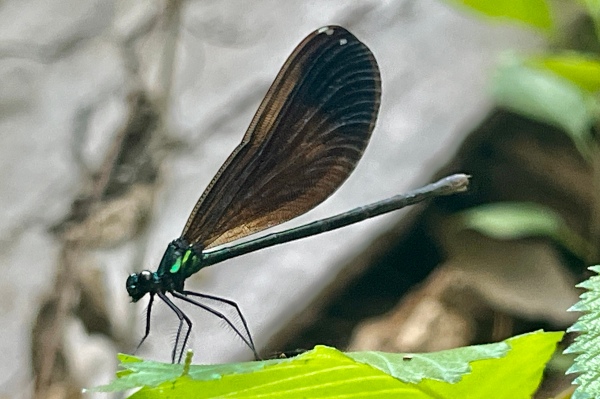
Calopteryx maculata (ebony jewelwing—family Calopterygidae) along canyon stream.
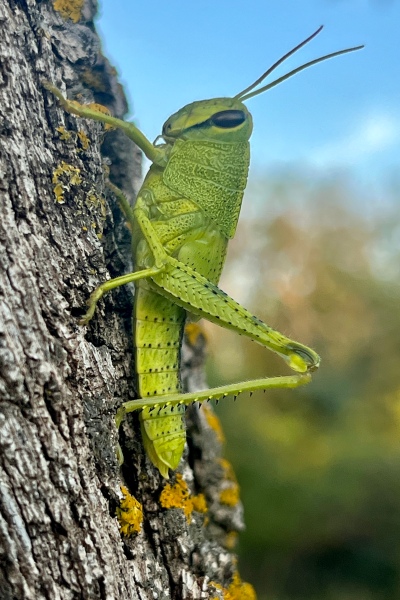
Schistocerca obscura (obscure bird grasshopper—family Acrididae) in shortgrass prairie.
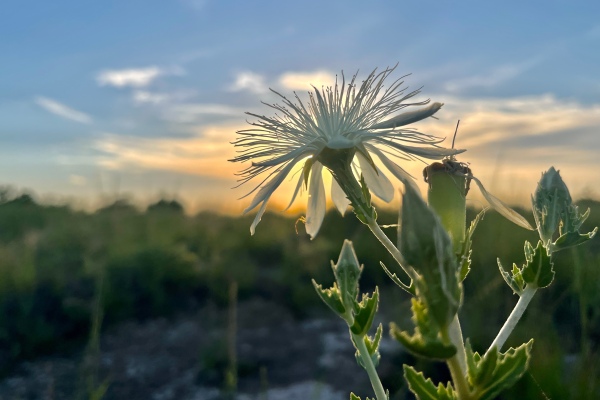
Mentzelia nuda (bractless blazingstar—family Loasaceae) in shortgrass prairie.

I still had about an hour of daylight left when I arrived at the campground, which gave me plenty of time to get coals going for dinner, set up camp, and set out the lights (both ultraviolet [UV] and mercury-vapor [MV]). For a while it was mostly hemipterans (leafhoppers, leaf-footed bugs, stink bugs, and Neotibicen superbus) coming to the lights (I collected a handful of the latter along with a single N. lyricens that also came), but later I started picking up a few interesting things including Eburia quadrigeminata (that answers my question as to whether E. haldemani might occur this far north to replace E. quadrigeminata from the east), a couple of Smodicum cucujiforme, a Telamona sp., and a handful of small Cleridae and Bostrichidae.
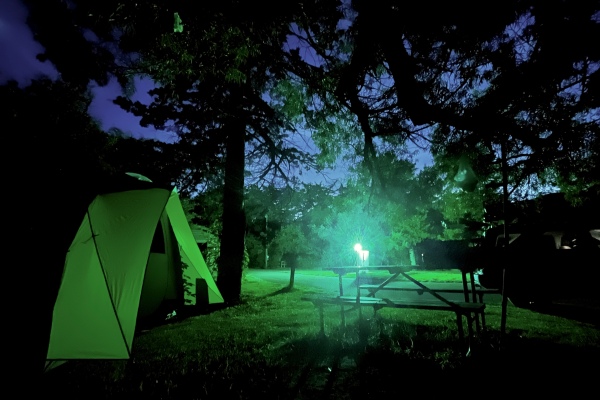
Light setup (ultraviolet plus mercury-vapor) in canyon riparian deciduous woodland.
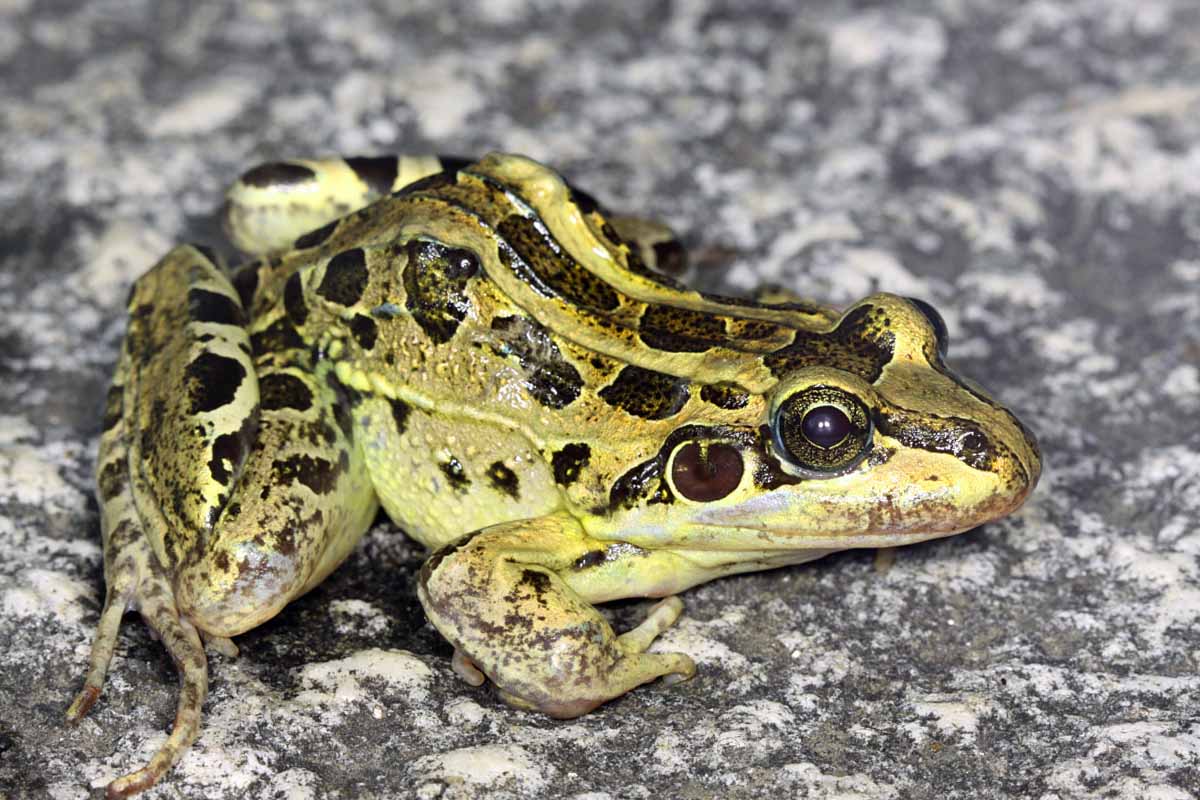
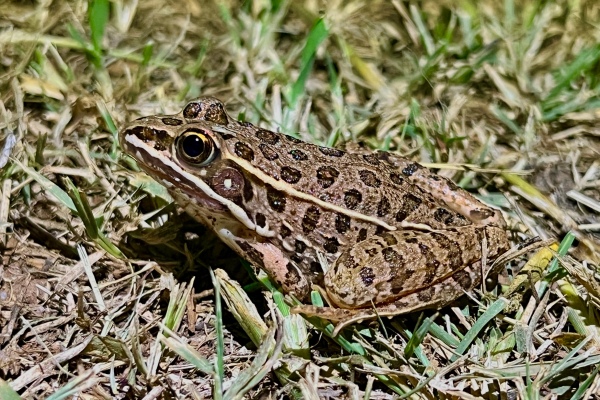
Lithobates blairi (plains leopard frog) comes to feast on insects attracted to the lights.

Day 2—26 July 2023

It was rather warm sleeping, but by the morning temperatures had cooled off nicely and a thin cloud layer promised to keep them from rising too rapidly. After breaking down camp (and coffee!), I checked the Lindgren funnel trap: it had a smattering of Cerambycidae and other insects, but nothing rare or in large numbers. I also noticed a rather large dead branch in the Salix nigra (black willow) tree overhanging the tent—recalling my capture last time of Poecilonota thureura on the tent, I thought perhaps this could have been the source of it and collected the branch for rearing. On the way out to my next locality, I checked the bottle trap that I placed last time and found only a single Acmaeodera sp. along with a Trichiotinus texanus and a few Meloidae (also 10 bees for Mike).

Neotibicen superbus (superb dog-day cicada—family Cicadidae) in riparian canyon woodland.

Gloss Mountain State Park
Major County, Oklahoma

I wasn’t quite prepared for what I found in the traps this time, although I should have had a clue considering how many Euphoria beetles that were in them last time. The Euphoria-overload has not subsided since then, and as well other insects—namely Plinthocoelium suaveolens and Elateridae—were trapped in overwhelming numbers. I didn’t think to bag the catch and wait for a more comfortable situation to count the specimens until I was already on top of the mesa and committed to filed-counts, and as a result it took me almost three hours to count just the first two traps (one of them had 750 Elateridae!). I finally got smart with the third trap and brought its contents down to the parking area to count at the table and shelter. The traps down below were not as overwhelmed by Elateridae as the traps above, but P. suaveolens were still quite abundant. I did get two new bait trap captures—Knulliana cincta and Plionoma suturalis. I also got a few Eburia that look like the eastern E. quadrigeminata rather than E. haldemani. The last trap (EtOH-only down below) was compromised—broken and with the contents dried to a crisp and unsalvageable. Since the lower set of traps was compromised last time (by wind), I decided not to replace the trap and will exclude the lower set of traps from the data analysis (a shame since there were two species in the traps this time that I have not gotten in any other trap—oh well, in science you live by the rules and you die by them!). In total, at least 14 species of Cerambycidae were present in the traps (including another Aethecerinus wilsonii, which I collected for the first time ever last month near Black Mesa). There were only a few Acmaeodera mixta/immaculata in the bottle traps, but since I have not collected this complex commonly here before and it seems to be a transition zone from one to the other any additional specimens are welcome. By the time I finished counting the last trap, it was almost 6 pm and temps had risen from 95°F at the start to 106°F! I knew it was hot and that I was getting quite dehydrated (despite a food/water break between the two sets of traps), but I didn’t realize just how badly until I started guzzling liquids non-stop after I got back to the vehicle and made a beeline for the nearest town to get even more cold liquids before heading off to the next location.

Diceroprocta eugraphica (family Cicadidae) male singing in mesquite grassland.
Microstylum morosum (giant prairie robber fly—family Asilidae) in mesquite grassland.

Beaver Dunes Park
Beaver County, Oklahoma

As with Alabaster Caverns the night before, I reached the campground with about an hour of daylight and set up camp, cooked dinner, and set up the lights (both ultraviolet and mercury-vapor). It was a good night for lighting, with still warm though not uncomfortable temps, although the now 1st-quarter moon was noticeably brighter than the night before. Right off the bat I got a Megatibicen dealbatus (plains cicada) and a couple of Polyphylla sp., and over the course of the evening I would get one more of the former and plenty of the latter. Cerambycid-wise, however, I got a single Eburia sp. and one elaphidiine, so not overwhelming. The Eburia looks like it could be E. haldemani, which would be interesting since at the two spots further east the Eburia I collected there look like E. quadrigeminata. The lights shut down a bit early, as the generator ran out of gas and I decided not to hook up the ultraviolet-only lights to the car. With the clatter of the generator suddenly gone, I was able to enjoy the nights sounds that I’d been missing to that point. The unusually wet year the area has been having meant not only that the landscape is unusually green, but the normally dry marsh behind the tent area is full of water—and bull frogs bleating their monotonous calls. Megatibicen dealbatus continued to sing in the taller cottonwoods around the campground—I wasn’t aware the song of this species was so similar to that of the more eastern M. pronotalis (Walker’s cicada), nor that they called as late into the night as this. In fact, few cicadas in my area call deep into the night, a notable exception being M. auletes. I guess it’s not surprising to learn that M. dealbatus does as well, as they are both in the same genus.

Everything you need in a campsite for light-collecting insects—except a 1st-quarter moon!

Day 3 — 27 July 2023

Lower temps and cloud cover were welcome developments this morning, and since I was already at the site where I would be checking traps I was able to get started earlier and be done before temps got too high. The area has evidently gotten a lot of rain recently, so much so that the 2-track shortcut to my traps was washed out and impassable (had to back up a long way… uphill!). I was glad to see the Euphoria extravaganza had ended with no consequent Eburia explosion like there would be in Missouri right now (although here I WANT to see Eburia as they are likely E. haldemani). Elaphidiines seem to rule the cerambycid diversity at this spot—I suppose most/all are associated with the Celtis reticulata that dominates the woodlands around the sand dune margins. Only a smattering of other Cerambycidae were present, none of which were especially unusual. There were about a dozen Acmaeodera in the bottle trap—they look mostly like A. immaculata in this area (along with a variety of bees for Mike).
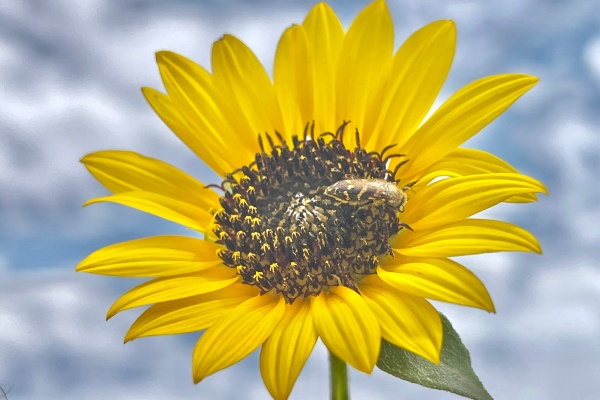
Acmaeodera mixta (family Buprestidae) on flower of Helianthus petiolaris (prairie sunflower) along margin of sand dunes/prairie.

Near Lake Etling
Cimmaron County, Oklahoma

After finishing at Beaver Dunes, I made the 3-hour drive to Black Mesa State Park (despite the worrying clouds in the direction I’m going!). Just before getting there, I stopped at this spot—given to me by fellow cicindeliphile Dan Duran, who a few days ago saw Cicindela nigrocoerulea, a species I have not yet collected. There was an abundance of grasshoppers and several different types of robber flies, but tiger beetle-wise the only species I saw/collected was the über-widespread Cicindelidia punctulata along with a ground nesting bee (for MIke).

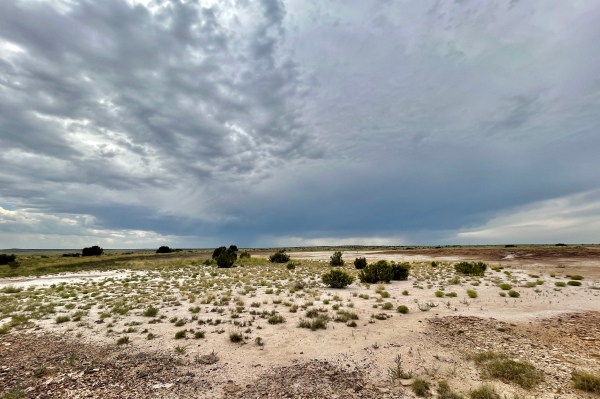
Canyonlands in miniature.
Ominous clouds to the west.

1.6 mi E Kenton
Cimmaron County, Oklahoma

The worrying clouds worsened, and by the time I arrived at this spot a few miles northwest of Black Mesa State Park (my ultimate destination) a steady roll of thunder could be heard in the near distance. I decided to bag it—not as in ‘give up,’ but to literally place the trap catch in bags for later counting. The dreaded Euphoria overrun did not materialize, but not did I see anything that looked beyond the usual (I’ll have to wait for the counts to know if I should be pleased or not). I worked with some urgency as the thunder grew nearer and light rain began to fall on me. The catch in the third trap was not overwhelming, so rather than bagging it I brought it back to the car and sorted it there as long as I could manage before the rain became too heavy. Only a handful of Cerambycidae were trapped, none uncommon or in large numbers, but the bottle trap contained more than a hundred Acmaeodera sp. (A. immaculata I suspect) and lots of bees (for Mike). The most exciting capture was not in the traps, but a male Prionus heroicus that I captured in flight (I saw two others, but they never approached closely enough).
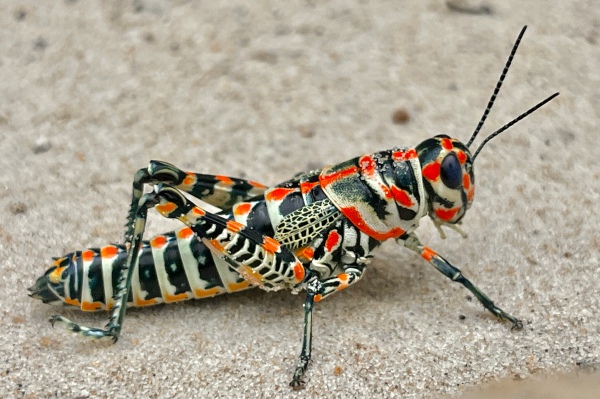
Dactylotum bicolor (rainbow grasshopper, painted grasshopper, or barber pole grasshopper—family Acrididae) in pinyon/oak/juniper woodland on sandstone outcrop.

Black Mesa State Park
Cimmaron County, Oklahoma

Before the rain hit too hard to continue, I managed to service the bottle and Lindgren funnel traps. The former was swamped by perhaps a couple hundred or more of a largish bee species (but curiously not a single Acmaeodera!), while the catch of the latter was in the early stages of decay and could not be salvaged (not sure why, the reservoir should have contained 50% propylene glycol just like all other traps set out this season). Once the rain really started falling, it did not stop. I took advantage of the opportunity to go into town and pick up supplies—perhaps hoping by the time I returned the rain would have stopped and I could proceed with checking the remaining traps or at least set up camp. Such was not the case, and eventually with impending darkness I went ahead and set up while it was still lightly raining. The tent suffered a bit of moisture inside but not too bad, and with the rain fly in place and room to spare inside it was a comfortable place to catch up on my notes. Briquettes were also started in the rain but, thankfully, proceeded to embers, helped along by the eventual end of rain. I would have preferred to have been setting up lights for night collecting—or at least sitting at the table outside so I could process the trap contents that I bagged, but I did enjoy spectacular views as the rain ended amidst dwindling daylight (the rainbow view from my tent was unsurpassed!). After dark, I took a short walk to the park showers to see if any nocturnal insects were walking the roads or had been attracted to the bathroom building lights. Sadly, the park utilizes “low bug” yellow bulbs, so it was a fruitless excursion other than fulfilling the need to move the legs once more before settling down for the evening.

Storm clouds seem to be breaking up.
Rainbow view from my tent after the storm.
1st-quarter moon at night after the storm.

Day 4 — 28 July 2023

I came back in the morning to finish the job with the three jug traps placed in the hackberry/soapberry woodland canyon below the overlook. Again, I bagged the catches from the three traps, not because they were overrun by the beetles that I’m counting, but because they were overwhelmed by hackberry butterflies and millions of tiny sap beetles that would have extended the counting time into the afternoon. Given the 11-hour drive I had to get back to St. Louis, I decided it was best to bag them and count them later so I could arrive home in the evening at a reasonable hour. Also, I ran out of propylene glycol after servicing the bottle and Lindgren funnel traps, so I used straight antifreeze (diluted ethylene glycol) purchased in town to refill the reservoirs of the three jug traps. Functionally it performs the same as diluted propylene glycol, but I prefer to avoid using it when possible since it could be toxic if ingested by wildlife.
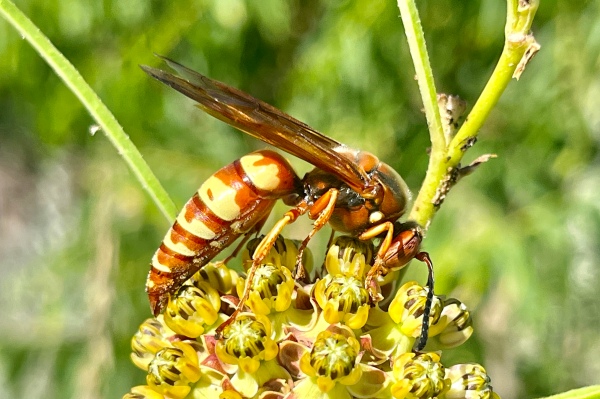
Sphecius grandis (western cicada killer—family Crabronidae) on flower of Asclepias engelmanniana (Engelmann’s milkweed) in hackberry/soapberry canyon woodland.

Elaphidiines were super abundant in all three traps—at least three species could be discerned, and Neoclytus mucronatus (apparently the “vogti” form) were also abundant. The most exciting find, however, was a Megacyllene sp. that looks distinctly like M. antennata—if this is the case, it would represent a significant northward extension to the known range!

©️ Ted C. MacRae 2023

Teeny, tiny, timid tot of a toad

I’ve been traveling across the southeastern U.S. for the past couple of weeks, during which time I had a chance to go polypipin’ at several of my destinations! For those of you who don’t know what polypipin’ is, it’s when you look for stuff under polypipe. What is polypipe? It’s a big tube of plastic with holes in it that farmers lay across one end of their field and then pump water into. The water leaks out of the holes and runs down the furrows between the rows, irrigating the crops. This is a popular method of irrigation in the Mississippi Delta because the super flat terrain allows the fields to be easily graded for such at much lower cost than the center pivot irrigation systems that are more often used in the rolling terrain of the Midwest and other areas. An unexpected side benefit of polypipe irrigation (at least for naturalist nerds like me) is that insects and all other manner of critters find the ground under polypipe to be a great place to hide. In a stroke of genius, friend and colleague Kent Fothergill used polypipin’ to confirm that Tetracha carolina (Carolina metallic tiger beetle), was not only a resident of the Mississippi Lowlands in southeast Missouri (there was some question as to whether the few existing records from that area represented vagrant individuals), but well established and abundant throughout the region (Fothergill et al. 2011). Ever since then I’ve gone polypipin’ whenever the opportunity presented itself, usually with good results.

Teeny tiny toad

Juvenile toad, but which one? | Starkville, Mississippi

This little toad was photographed in Starkville, Mississippi, where I had visited a soybean field and found polypipe stretched all along the north end of the field. He was clearly annoyed at being suddenly exposed to daylight when I lifted up the polypipe and immediately hopped over to the edge that was still contacting the ground and tried to crawl back in, but I can be persistent and finally ‘persuaded’ him to come back out and pose for this one shot before I felt sorry for him and let him finish his escape. This was one of the tiniest toads I’ve ever seen—no more than 2.5 cm snout to butt, and not being as well-versed in herps as I am in hexapods I didn’t really know what kind of toad he represented. Apparently there are a few different species in Mississippi, but the most common is Fowler’s toad (Bufo fowleri). Its size surely suggests it is a juvenile, which can be notoriously difficult to identify due to their still undeveloped cranial ridges and coloration. Considering the agricultural setting and location in northeastern Mississippi I think this is probably the most likely choice.

REFERENCE:

Fothergill, K., C. B. Cross, K. V. Tindall, T. C. MacRae and C. R. Brown. 2011. Tetracha carolina L. (Coleoptera: Cicindelidae) associated with polypipe irrigation systems in southeastern Missouri agricultural lands. CICINDELA 43(3):45–58.

Copyright © Ted C. MacRae 2013

La Reserva Ecologica Costanera Sur

Reserva Ecológica Costanera Sur, Buenos Aires, Argentina.

I spent this past weekend in Buenos Aires, Argentina before embarking on a one-week whirlwind tour to visit field sites in several other parts of the country.  It was supposed to be a short rest stop, but I can do nothing of the sort when there are exotic lands to explore.  Despite its rank as the fourth largest city in South America and the location of my hotel in the heart of downtown, only a short walk was needed to arrive at Reserva Ecológica Costanera Sur, a 350-hectare park located on the banks of the Rio de la Plata.  Originating as a debris field from construction during the 1970s, sedimentation and subsequent revegetation have created a naturalistic setting reminiscent of the original wet Pampas grasslands that occurred in the area.

A system of levees with trails courses through the wet grasslands.

Coursing through the area is a system of levees topped with gravel walking/biking trails that have become flanked with woody vegetation.  Native species such as ceibo (Erythrina crista-galli) and palo borracho (Chorisia speciosa) are common, although exotics such as Canary palms (above photo) have also become established.  In total, more than 11 km of trails are available, and having as much time as I desired on Sunday to explore the area, I walked every one of them once (and some twice) for a total hike of close to 15 km (not counting my morning walk to the area and then back to my hotel during late afternoon).  I wouldn’t say the area was teeming with insects, and those that I did encounter are not too dissimilar from those I am more familiar with in North America.  However, this is the southern Neotropics, so just about everything I encountered was something I had not seen before.  I went photography-crazy, snapping more than 250 shots on the day (and keeping about 100).

Leptodactylus ocellatus (rana criolla).

This frog was the first thing I encountered, even before walking through the Reserve gates.  Using the galleries at this fan site I believe it to represent Leptodactylus ocellatus (rana criolla, or “Creole frog”).  He was a sad sight when I first saw him – dry and dusty on the sidewalk outside of the Reserve.  I passed him by at first thinking he must be dead, then came back when my conscious started complaining, only to find him still alive.  I bathed him in water from my bottle, which perked him up rather quickly (not to mention making him much more photogenic!).  After a few photos, he revived sufficiently to jump off the stone wall bordering the Reserve into the grassy marsh.  I had done my good deed for the day.

Leptodactylus ocellatus (rana criolla) - my attempt at a natural light closeup.

Parabuteo unicinctus unicinctus (Gavilán Mixto) (I think!).

Also just before entering the Reserve gates, I scared up this hawk who flew a short distance ahead and landed on a post facing me.  Now, I have never once in my life attempted to photograph a bird, and with my longest lens being only my 100mm macro I’m ill-equipped for such even if I wanted to.  However, the hawk did not fly too quickly as I cautiously re-approached, and when I was within range I decided to give it a try.  I carefully crouched to ready my equipment and then cautiously rose to take a shot, and right then the hawk decided to take off.  Not a great shot, of course, but not bad either – especially for a first bird shot ever, and good enough to give me some amount of confidence in my ID as Parabuteo unicinctus (Gavilán Mixto, or “Mixed Hawk” – known in the U.S. as Harris’ Hawk).

Riodina lysippoides (Danzarina Chica)

Insect activity was rather light for the first couple hours after I arrived, but as the day began to heat up so did the number and diversity of the insects that I encountered.  While I waited for activity to pick up, I saw this pretty little butterfly that seemed surely a type of metalmark (family Riodinidae) and that I later identified as Riodina lysippoides (Danzarina Chica, or “Smaller Dancer”).  Shortly after taking this photo, I encountered another photographer who was obviously after insects.  I approached him and introduced myself to see what he was looking for, and it was butterflies.  I showed him my photo, but he did not know the name of the butterfly, only commenting that it was “bastante común” (common enough).  I’m confident in my ID, but this North American beetle collector won’t be too embarrassed if one of you lepidopterists needs to provide a correction.  I did see one other photographer that day as well, presumably after birds based on the yard-long lens he was carrying, but I did not talk to him.  Otherwise, I got plenty of strange looks from the hordes of walkers, runners, bikers, and picnickers that had come out to enjoy this Carnival weekend Sunday!

Copyright © Ted C. MacRae 2011


First tiger of the trip…

Tiger salamander, that is! Chris and I spent Thursday evening and all of Friday driving across Missouri, up along the Loess Hills into Iowa, across the Missouri River into Nebraska, and all the way through mile after surreal mile of the vast Sand Hills before dropping down the Pine Bluff escarpment into Chadron, Nebraska. We expected the fun would start the next morning, when we would meet up with Matt Brust and travel to ‘secret’ spots in the Badlands for our first tiger beetle target, the gloriously beautiful Cicindela pulchra. As we unloaded our bags from the truck and headed towards the motel entrance, we spotted this gorgeous tiger salamander (Ambystoma tigrinum) ambling across the parking lot. Wow – I had never seen a tiger salamander before now, but still there was no question in my mind what we had just found. Immediately we knew we wanted to get photographs, and the motel parking lot seemed the most inhospitable of places for this poor fellow, so I hurriedly made a makeshift terrarium using one of the containers I had brought along for keeping adult tiger beetles and placed him in it. He was dry, so as soon as we got in the room I wetted him down and added a petri dish of water to the habitat.

Actually, I knew I wanted more than photographs, as I had the impression that these largest of all North American salamanders are also among the easiest to keep as pets. I knew that my daughters would enjoy such an experience (not to mention myself!). First, however, I wanted to make sure that 1) tiger salamanders were not listed as a species of conservation concern in Nebraska, 2) my taking or possessing this individual was legal, and 3) I knew exactly what I would be getting into if I were to keep it. Google to the rescue! I found the Nebraska Game & Parks website, which states:

A fishing permit is required to take, or attempt to take, fish, bullfrogs, snapping turtles, tiger salamanders or mussels by any method.

A link at the site directed me to a page where I could purchase a 1-Day Nonresident Fishing Permits ($9.50 – proceeds go to support Nebraska Game and Fisheries programs) – enter my credit card number, download the PDF, and now I’m legal.

A little more Googling revealed this excellent series of videos with information on caring for tiger salamanders as pets , and I was sold. I’ll wait until I get home next week and let the kids decide what to name it, and I’m hopeful it will live a long, sluggish life getting fat on fall armyworms, corn earworms, and tomato hornworms.

Photo Details: Canon 50D w/ 100mm macro lens (ISO 100, 1/250 sec, f/11), Canon MT-24EX flash (F.E.C. -2/3) w/ Sto-Fen + GFPuffer diffusers. Typical post-processing (levels, minor cropping, unsharp mask).

Copyright © Ted C. MacRae 2010

Beetle Love

An Inordinate FondnessIt seems like it has been a long time coming, but the Inaugural Issue of An Inordinate Fondness, the monthly blog carnival for the world’s most diverse group of animals (um… beetles), has finally made its debut! I can’t tell you how much pondering, pleading, fretting, and tweaking went into bringing this newest of blog carnivals to fruition, but it was all worth it. My sincerest thanks to everyone who helped me along the way (especially Seabrooke, Amber, Jason, and Mike) and to all who contributed for this first issue. I hope you’ll take a moment to stop by and check out the many fine contributions. If you love beetles, you’ll love this issue. If beetles haven’t exactly turned you on before, maybe you’ll find a new appreciation for them after experiencing the collective passion of the contributors. If you’ve written a post about beetles, perhaps you’ll consider participating in AIF to be hosted by Amber at Birder’s Lounge. I recommend this handy submission form, or contact Amber directly if you prefer. The submission deadline for issue is March 15, 2010.

House of HerpsAlso, Jason over at xenogere has just released House of Herps #3- The Time Machine. Jason has shown himself to be a natural talent at blog carnival hosting, and this edition is no exception. In his unique, singular style, Jason guides you on a trip through time to visit reptiles and amphibians of the past, present, and future.
In celebration of the debut of An Inordinate Fondness, I close with this preview of a feature that CBS did on Christopher Marley for the program “Sunday Morning.” Here is a man who not only shows the same passion for these fascinating animals that many of us feel (though I’m not sure I would characterize Titanus giganteus as “dangerous”), but also has the talent to channel his passion into exquisite works of art (sorry about the commercials!).

Vodpod videos no longer available.
More about “Sunday Morning – Preview: Beetle Art“, posted with vodpod

Okay, after hosting three blog carnivals in the past 4 weeks, I think I’ll go hibernate for awhile!

Copyright © Ted C. MacRae 2010

Add to FacebookAdd to DiggAdd to Del.icio.usAdd to StumbleuponAdd to RedditAdd to BlinklistAdd to TwitterAdd to TechnoratiAdd to Yahoo BuzzAdd to Newsvine

Email to a friend

House of Herps #2

House of HerpsWelcome to the 2nd issue of House of Herps, the monthly blog carnival devoted exclusively to reptiles and amphibians.  The brainchild of Amber Coakley, (Birder’s Lounge), and Jason Hogle (xenogere), this new blog carnival had an auspicious start with the inaugural issue and its 21 contributions – an impressive level of participation for a new carnival.  This month the carnival moves off-site, and I am honored to serve as the first off-site host.  The enthusiasm continues with issue , for which I received 22 submissions from 18 contributors.  Ever the taxonomist, I present them to you below grouped by traditional classification¹.

¹ It should be noted that modern classification has “evolved” substantially from this traditional classification due to the advent of DNA molecular analyses. For example, lizards are a paraphyletic grouping, and even the class Reptilia has been subsumed within a broader class containing dinosaurs and birds. I stick with the traditional classification here for reasons of familiarity and convenience.

Class AMPHIBIA (Amphibians)
-Order CAUDATA (Salamanders)

California Giant Salamander (Dicamptodon ensatus).  At the nature of a man, Ken talks about not one, but two close encounters last fall with this otherwordly-looking creature.  The first one he saw was a monster of a salamander, measururing a whopping 12 inches (30 cm) in length as it brazenly lounged on a mountain bike trail.  Remaining docile for photographs, imagine Ken’s surprise when the salamander started barking at him when he picked it up to move it to safer ground!  In his second encounter, he got to watch one chomp down on a banana slug – mmm tasty! 

-Order ANURA (Frogs)

Upland Chorus Frog (Pseudacris feriarum).  At Anybody Seen My Focus?, Joan normally only gets to hear the breeding season calls of the chorus frog and his friends who have taken up residence in the water-filled bathtub that serves as a planter in her greenhouse, usually bobbing under the water upon any approach.  But on this occasion, he agreed to photographs, even allowing a final closeup.

Gulf coast toad (Bufo nebulifer).  At Dolittle’s Domain, Dr. Doolittle marvels at one of the many toads that she has found parked under the outside light all night (along with the bats and armadillos) during the cold darkness of December.  Rather than fleeing the camera flash in the face, he simply hunkered down trying to make himself flatter, apparently thinking that would make him invisible and not realizing that he just looked fatter!

Northern Cricket Frog (Acris crepitans).  HoH‘s own Jason weaves artful writing with stunning photographs to distinguish one of the smallest land vertebrates in North America at xenogere.  Despite their ubiquity, these little frogs often go unnoticed due to the smallness of their size, their impressive leap, and their extreme variability.  Get a good look at one, however, and you might notice a key feature or two.

American Bullfrog (Rana catesbeiana).  At Willow House Chronicles, barefootheart looks at frogs on the opposite end of the size spectrum, in fact North America’s largest frog living in an increasingly naturalized man-made pond in eastern Ontario.  These behemoths are more frequently heard than seen by their distinctive “yelp” and splash in response to being approached.  If you are lucky enough to get as good a look as barefootheart did, you might be able to distinguish male from female by looking at its eyes, ears, and throat.

Class REPTILIA (Reptiles)
-Order TESTUDINES (Turtles)

Common Snapping Turtle (Chelydra serpentina).  We have three contributions dealing with these grizzled, ancient, grotesquely beautiful reptiles.  The first one comes from Michelle at Rambling Woods, who shows us how it is possible to tame your pet common snapper (but only to a certain degree).  If her story isn’t enough, she also presents a short video clip on the common snapping turtle (Baby snapping turtleREMEMBER – don’t ever try to catch or hold a snapping turtle with your bare hands!).  In another post, HoH‘s own Amber talks about her attempts to rescue a snapping turtle at Birder’s Lounge.  Fortunately for Amber, the little guy was just a tot – not nearly big enough to prune a digit and thwart Amber’s display of compassion.  It’s amazing how a creature so dinosaurian at maturity can still be so cute as a youngster.  In the third contribution about these fascinating creatures, Marge at Space Coast Beach Buzz talks about her snap (get it?) decision to adopt one of these animals, only to change her mind after discovering its true identity (and before losing any fingers).

Green Sea Turtle (Chelonia mydas).  David at Living Alongside Wildlife notes that while green iguanas falling from trees were a popular news report from the unusual cold snap experienced in the southeatern U.S. last month, they were not the only reptiles so adversely affected.  Sea turtles, populations of which have already been compromised by loss of nesting sites, fishing practices, and trash pollution, also found the coastal waters too cold for normal function.  While natural hardships may be nature’s way, he argues (quite effectively) that it is our responsibility to help mitigate their effects considering the perilous position in which we’ve placed these majestic animals to begin with.

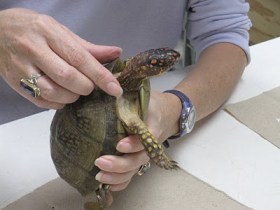
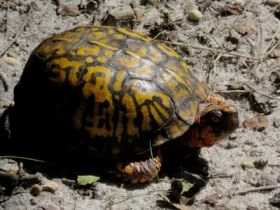
Eastern Box Turtle (Terrapene carolina).  Two contributors submitted posts about these lovable oafs.  At A DC Birding Blog, John posted a photo of a box turtle seen at Brigantine Beach.  He wonders if their always disgruntled look is a result of him disturbing from their activities.  These turtles are easily identified by their bright markings – usually dark brown or olive-colored with bright orange or yellow patterns, dome-shaped carapace, and hinged plastron (bottom part).  Individual turtles have unique designs on their shells, making them identifiable in the field.  Turtles can get worms, believe it or not, and Celeste at Celestial Ramblings adds them to the growing list of animals that she has had to de-worm (including herself, ick!).  Step-by-step instructions and explicit photos combine to show that this is not an easy job, requiring no less than three people – “just another day at the office.”  Hmm – cats look easier!

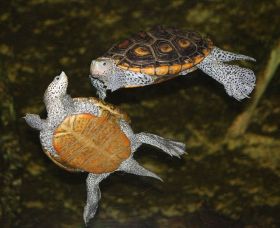
Diamondback terrapin (Malaclemys terrapin).  The diamondback terrapin is the only species of turtle in North America that spends its life in brackish water (salty but less so than sea water).  At Kind of Curious, John describes efforts by The Wetlands Institute to prevent vehicle mortality caused by terrapins crossing roads in their attempt to reach higher ground for laying eggs.

-Order SQUAMATA
–Suborder LACERTILIA (Lizards)

Common collared lizardCommon Collared Lizard (Crotaphytus collaris).  From Jill at Count Your Chicken!  We’re Taking Over! comes this delightful encounter with one of North America’s most charismatic lizards.  I’ve had my own experiences with these guys, but I’ve never gotten one to crawl on my hat or – even better – gotten one to pose with me for a photograph!

Prairie Lizard (Sceloporus consobrinus).  Near my backyard, Marvin at Nature in the Ozarks presents a nice compendium of this species complimented with beautiful photographs.  Marvin not only discusses identification, distribution, life cycle, habitat, and food, but also comments on the recent DNA molecular analyses that have resulted in a reclassification of the former polytopic “fence lizard” and split up the many subspecies into full-fledged species – a man after my taxonomic heart!

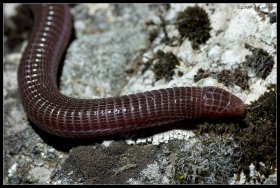
“Culebrilla ciega” (Iberian Worm Lizard) (Blanus cinereus).  Javier at macroinstantes writes an artful blog focusing on natural history of the Iberian Peninsula (it is written in Spanish, but Google can easily translate to English for those who need it).  In this post, he presents extraordinary photographs of this subterranean reptile that is endemic to the Iberian Peninsula.  Traditionally classified in the family Amphisbaenidae, it is now considered to belong to its own family the Blanidae.

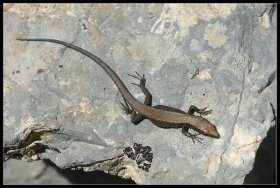
“Lagartija de Valverde” (The Spanish Algyroides) (Algyroides marchi).  Javier (macroinstantes) also writes about this small lizard that was only discovered in 1958.  With a global range limited to a few mountain streams in a mountainous area of southern Spain covering less than 2,000 km², it is clasified as endangered on the IUCN Red List.  Like so many of the world’s reptiles, its severely fragmented population is suffering declines due to continuing habitat degradation.

–Suborder SERPENTES (Snakes)

Western Rattlesnake (Crotalus viridis).  On the Colorado front range, Sally at Foothills Fancies had three encounters with this aggressive species on her property.  Fortunately, Sally has a “nonagression treaty” with rattlesnakes and allows them to go about their business as much as possible.  Those that get too close for comfort are humanely relocated rather than simply dispatched.  Sadly, many of Sally’s neighbors are not quite so understanding.

Texas Indigo Snake (Drymarchon corais erebennus).  These snakes do not have any such nonaggression treaty, and David at Living Alongside Wildlife contributes another piece illustrating the rattlenake-eating capabilities for which Indigo snakes are famous.  The photographs in the post show a large individual consuming a Western Diamondback Rattlesnake. David explains how these snakes are often identified as blacksnakes and reveals the characters visible on predator and prey that allow their correct identification.

Black Rat Snake (Elaphe obsoleta).  Right here in my home state, Shelly at Natural Missouri characterizes black rat snakes as one of the most commonly encountered snakes in Missouri.  Large snakes reaching up to 6 feet in length, they often end up in basements and cellars in the fall in search of a place to spend the winter – just in time for Halloween!  These snakes are often needlessly killed because of their resemblance to the venomous cottonmouth or water moccasin that they superficially resemble.  However, Shelly has the same nonaggression treaty with these snakes that Sally has with rattlesnakes (although her husband is not quite so sympathetic). 

-Order CROCODILIA (Crocodilians)

American Alligator (Alligator mississippiensis).  David at Living Alongside Wildlife also contributed two pieces on North America’s largest reptile.  In his post Gatorzilla, he examines commonly e-mailed pictures and text about so-called “giant” alligators, debunking myths about 25 foot long monsters, clarifying the identity of misidentified Nile crocodiles, and exposing cases of camera trickery.  In his post Mommy Dearest, he recounts his nervewracking experience when he stumbled upon an alligator nest while knee deep in a south Georgia swamp at night.  Worse, the babies had hatched!  Read the post to see if David got out of there with both of his legs.

GENERAL HERPETOLOGY

Sometimes simply the act of looking for herps is as enjoyable as the herps that are found.  However, it has been a tough January for Bernard at Philly Herping.  A particularly cold snap in the first half of what is already the coldest month of the year made herping at his favorite cemetary a lesson in futility.   I hope you notice the irony – cemetary?, no sign of life?, cold-bloodedness (okay, okay – ectothermic)?

I hope you’ve enjoyed this issue of House of Herps.  The February issue moves over to xenogere, where Jason’s considerable carnival hosting talents are sure to be on full display.  Submit your slimy, scaley, cold-blooded contributions by Febrary 15, and look for the issue to appear by February 18.

Copyright © Ted C. MacRae 2010

Add to FacebookAdd to DiggAdd to Del.icio.usAdd to StumbleuponAdd to RedditAdd to BlinklistAdd to TwitterAdd to TechnoratiAdd to Yahoo BuzzAdd to Newsvine

Email to a friend

Newest Blog Carnival: House of Herps

Invertebrates?  Check.
Moths?  Check.
Plants?  Check.
Trees?  Check.
Birds?  Check.
Marine life?  Check.
Reptiles and amphibians?… Um… Er…

Despite their popularity, charisma, and status as icons for global conservation, reptiles and amphibians have not enjoyed the same attention by blog carnivals that insects, birds, plants, and even ideas (e.g., evolution) have received.  House of Herps is about to change all that.  The brainchild of Amber Coakley and Jason Hogle, this newest of blog carnivals will fill the void in celebration of all things herpetological.  The inaugural issue is scheduled for the middle of this month, so here’s your chance to be a founding contributor:

So if you love herps—if you photograph them, write about them, sketch or paint artwork based on them, study them, or just happen to see one that you mention on your blog—we want to hear from you for House of Herps coming in mid-December. We also want to hear from you if you’re interested in hosting the carnival.  Please visit the House of Herps site for contact information or send your submission links to us at submissions [at] houseofherps.com.

Submissions for the first issue are due by December 15, but if you miss the deadline don’t despair—I’ll be hosting HoH in January 2010.

Hmm, this gives me an idea.  Moths have their own carnival, why not beetles?  After all, they are far and away the most diverse ordinal taxon on earth (22% of all described life forms are beetles).  What do you think?  Coleo-Carnival?  In Celebration of Elytra?  An Inordinate Fondness?  Beetle Bacchanal?

Copyright © Ted C. MacRae

Add to FacebookAdd to DiggAdd to Del.icio.usAdd to StumbleuponAdd to RedditAdd to BlinklistAdd to TwitterAdd to TechnoratiAdd to Yahoo BuzzAdd to Newsvine

Email to a friend