Bichos Argentinos #11 – I’m out’a here!

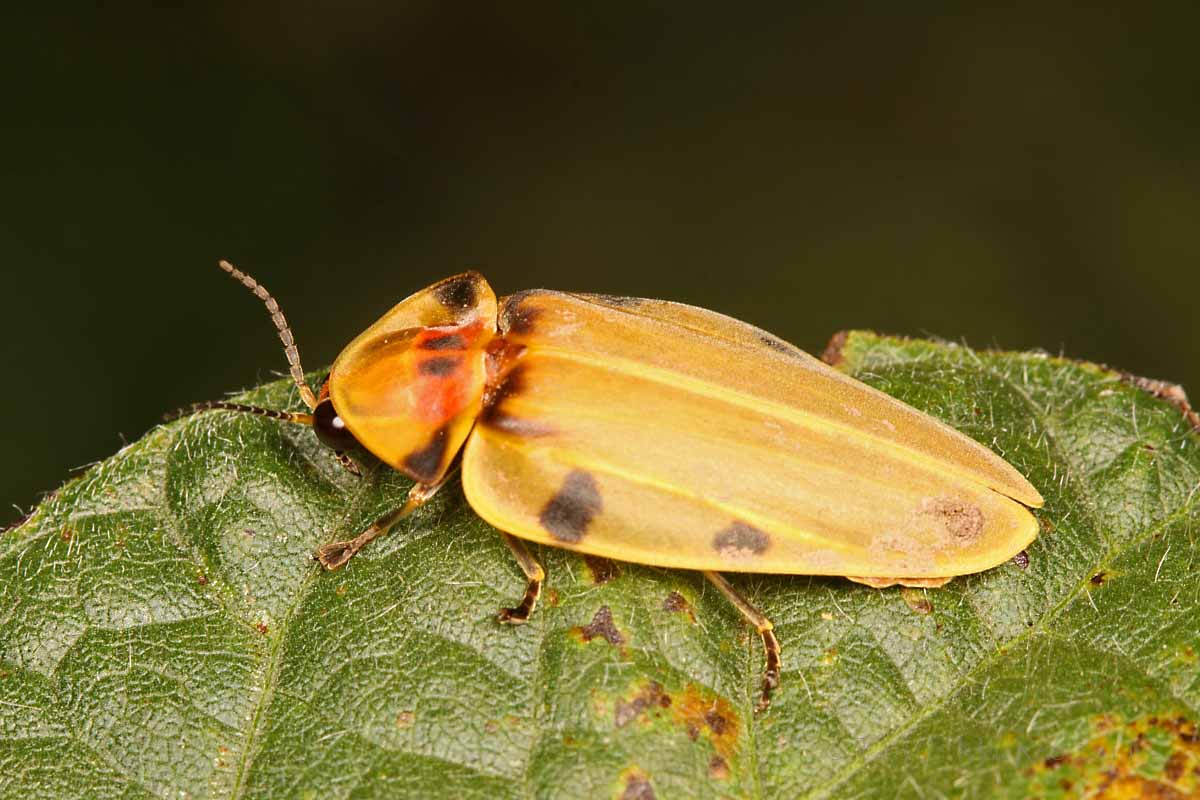
Neither of these photos are very good, but it’s the firefly’s fault.  I saw it last month in a soybean field in Buenos Aires Province, Argentina. I got off the first shot, but the flash disturbed it and it started walking around. I quickly set up for another shot, got it framed, fired the shot, and saw the second photo on the screen!

Everything about this firefly seems backwards – most fireflies are black with yellow, orange or red markings – this one is yellow with small black markings.  The terminal segments of the abdomen are dark while the rest are light – opposite of most other fireflies.  This one was out and about during the day, while most others are crepuscular or nocturnal.  Maybe it’s a result of being in the Southern Hemisphere – opposite of most other fireflies I’ve seen.

Copyright © Ted C. MacRae 2011

Bichos Argentinos #10 – Friday Formicine

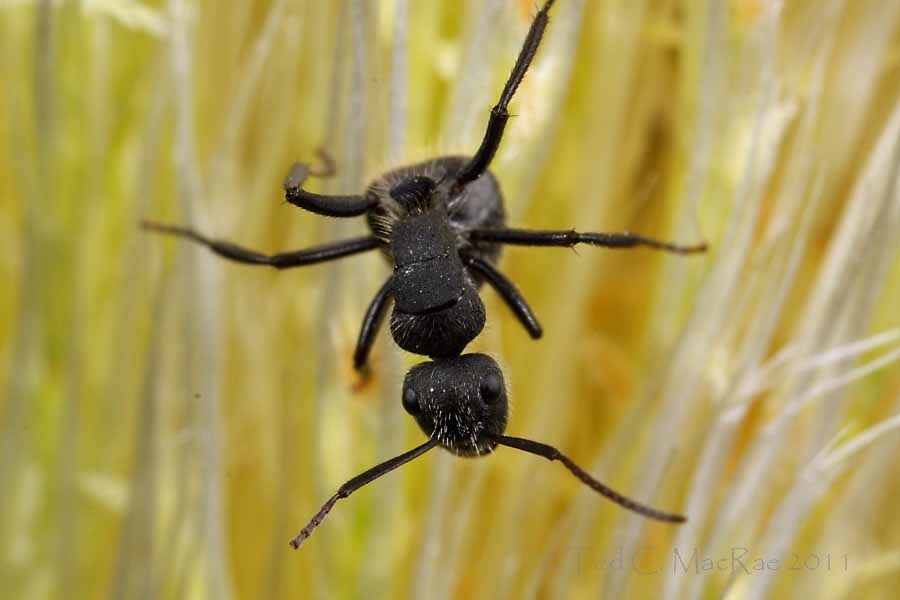
One of the insects I saw abundantly during my visit last month to La Reserva Ecológica Costanera Sur (Buenos Aires, Argentina) was this species of black ant that looks well enough like one of our typical North American species. They were quite common, seen on virtually every plant that I examined closely. I made a few feeble attempts at photographs in the early part of the day, but desire faded quickly in the face of their frenetic behavior and occurrence in exclusively tough-to-photograph situations.  I mean, they’re just ants!¹ Around midday I noticed that many of the flower heads of the pampas grass clumps in the area had at least one ant perched in this interesting head-down, abdomen-curled forward position – I tried to capture the situation, but even this best of the bunch turned out, well… boring!

¹ Just kidding Alex and James!

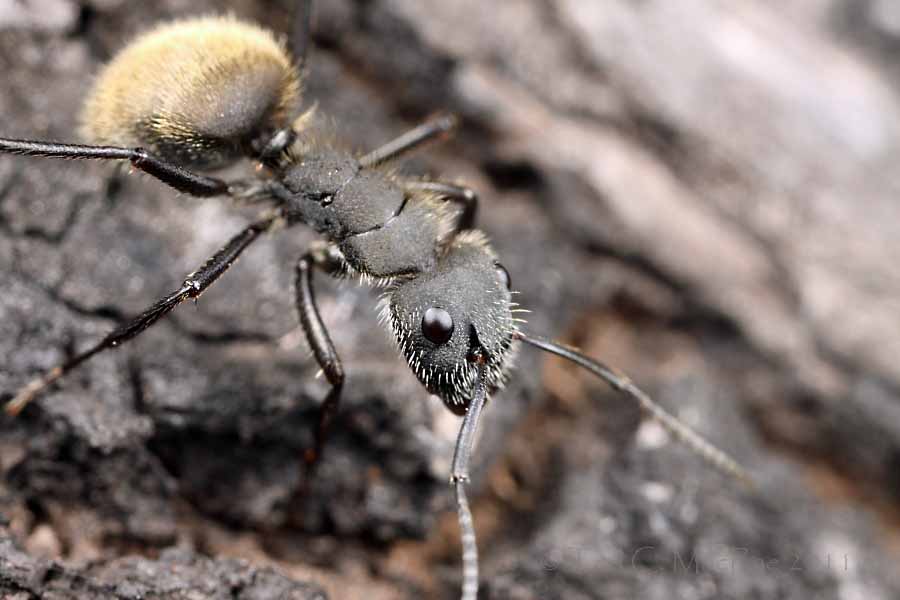
Finally, late in the day, I saw one crawling on the trunk of a recently fire-killed tree that I was inspecting in (futile) hopes of encountering adult jewel beetles or longhorned beetles that would have been attracted to this newly available resource.  This was the easy-to-photograph situation I was waiting for, and the dark color of the charred bark brought out nicely the hairs on the body despite both ant and bark being nearly the same color.

I’m a beetle guy, and normally I would be happy to just call this Formica nigra and move on.  Whatever possessed me to even begin the process of trying to identify this particular ant is beyond me (maybe I’ve actually learned something after a couple of years of reading Myrmecos!).  It had the look of our North American Camponotus, so I entered “Camponotus Argentina” into Google Images and found this photo of Camponotus mus, taken by our friend Alex in nearby Santa Fe, Argentina, near the top of the very first page.  Now, I realize that closely (and even distantly) related species can look quite similar (especially to the untrained eye), but everything about this ant looks right – the bulbous-abdomen, the shape of the thorax, the matt black color, and the velvety yellowish pilosity of the abdomen. A little searching on the name reveals this species to be quite abundant in Argentina, where it goes by the common names “hormiga de madera” (wood ant) and, not surprisingly, “hormiga carpintera” (carpenter ant). Alex? James? Did I get it right?

Copyright © Ted C. MacRae 2011

Bichos Argentinos #9 – Membracido

Enchenopa? sp. | Buenos Aires, Argentina

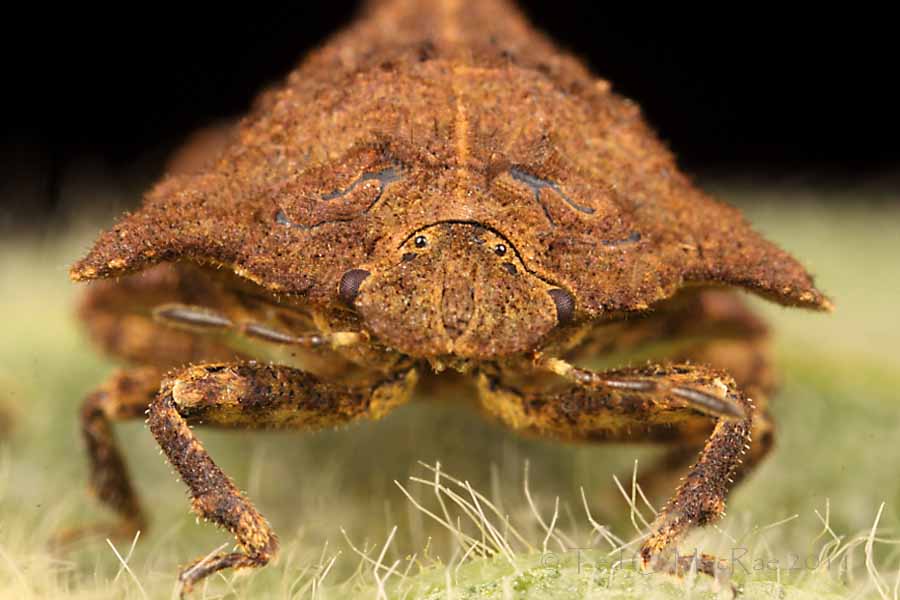
This treehopper that I photographed at La Reserva Ecológica Costanera Sur strongly resembles our North American species of Campylenchia due to the brown elytra and lack of any yellow markings on the pronotal crest.  However, the rounded lower margin of the frons (more apparent in the full-sized version of this photo) eliminates this genus as a possibility and suggests instead the closely related Enchenopa

I sent this and another photo to Andy Hamilton (Canadian National Collection of Insects, Arachnids and Nematodes) for his opinion.  Andy claims to be a hack when it comes to Neotropical Membracidae (focusing more on world Cercopidae and Holarctic Cicadellidae), but he is a much better hack than I!  In his reply, he mentions that a lot of work is still needed on tropical species and genera, and in fact none of our North American species of Enchenopa actually resemble the type-species from Brazil (Membracis monoceros).  Most of what we now consider Enchenopa will likely be referable back to the genus Membracis (type genus of the family), but where the species in the above photo will eventually fall remains anyone’s guess.

Copyright © Ted C. MacRae 2011

Friday Flower – Ceibo

Erythrina crista-galli (''ceibo'') | Buenos Aires, Argentina

One of the major flowering spectacles in Argentina is Erythrina crista-galli, or “ceibo” (also spelled “seíbo”).  So great is this spectacle that both Argentina and Uruguay have declared it their national flower.  I’ve seen only hints of it myself, as all of my trips to Argentina have been either before the peak bloom period from November to February or just after.  These blossoms were seen during my most recent trip last month in Buenos Aires at La Reserva Ecológica Costanera Sur, where for most of the day I saw only the occasional, single, straggling blossom before finally encountering the delightful trio near the end of the day.  The elegant simplicity of this photo contrasts starkly with the riotous quality that photographs of this tree in full bloom have (it may be one of the most photographed flowers on the web!).

Native also to Uruguay, Paraguay and Brazil, E. crista-galli has also been planted widely in warmer regions of the world (where it is generally known as cockspur coral tree or cry-baby tree).  Not everyone, however, is so enamored with this tree. In New South Wales, Australia, E. crista-galli has become abundant along several watercourses and is regarded locally as a significant invasive weed (Smith 1996). As in its native South America, its seeds are dispersed by floodwaters and germinate progressively over a period of three years, forming thickets (called “seibales” in Argentina) that can displace native vegetation.

The flaming red color of the flowers would suggest hummingbirds are the primary pollinators, and species in the genus Erythrina are generally characterized as hummingbird/passerine pollinated (Galetto 2000).  However, the broad, undulating “explanade” formed by the lower lip apparently serves as a landing platform for bee pollinators (Haene and Aparicio 2007).  Galetto et al. (2000) note that E. crista-galli is placed basally within the genus and suggest that it may represent an intermediate step in the shift from insect pollination to the bird pollination more typical within the genus. 

REFERENCE:

Galetto, L., G. Bernardello, I. C. Isele, J. Vesprini, G. Speroni and A. Berduc.  2000.  Reproductive biology of Erythrina crista-galli (Fabaceae).  Annals of the Missouri Botanical Garden 87(2):127–145.

Haene, E. and G. Aparicio.  2007.  100 Trees of Argentina. Editorial Albatros, Buenos Aires, República Argentina, 128 pp. [una foto de las floras de E. crista-galli aparece en la portada de este libro, un regalo que me dio mi colega y buen amigo, Guillermo Videla – muchas grácias!]

Smith, J. M. B.  1996.  Notes on Coral-Trees (Erythrina) in Australia with particular reference to E. crista-galli L. in New South Wales.  Australian Geographical Studies 34(2):225–236.

Copyright © Ted C. MacRae 2011

Bichos Argentinos #8 – “Mosca de la Carne”


Here is the full-sized photo from which the “super-crop” featured in Super Crop Challenge #4 was taken.  As many of you guessed, this is a higher fly (order Diptera, suborder Brachycera) in the family Sarcophagidae, with the photo crop showing frontal portion of the head and its associated structures.  While dubbed “flesh flies” due to the necrophagic habits of a few of its included species, sarcophagids actually display diverse life histories that include a wide variety of coprophagous and parasitic species (Mulieri et al. 2010).  The fly was one of the many insects I photographed in early March in Buenos Aires, Argentina at La Reserva Ecológica Costanera Sur, where it was found perched on dead wood (I found several individuals of apparently the same species perched on dead wood as well – whether this is significant or chance I don’t know).


The presence of a ptilinal fissure and lunule and a dorsal seam on the antennal pedicel identify this as one of the calyptrate “muscoid” (schizopheran to be more correct) flies.  Within that group, my determination as a member of the family Sarcophagidae is based on its fairly large size, dull gray coloration with three longitudinal black strips on the mesonotum, notopleuron with two strong and two small setae (Calliphoridae have only two setae), and meron with a row of setae (lacking in Muscidae and related families).  Admittedly these characters aren’t visible in the cropped photo that I presented, so guessing the proper family was a bit of a crap shoot.  As noted by (de Carvalho and de Mello-Patiu 2008), species determination of sarcophagid flies is complicated by their fairly uniform chaetotaxy and lack of useful external characters, leaving male genitalia as the only reliable characters for identification.  No suitable key for identifying Neotropical genera yet exists and the elaboration of one will be very difficult without analysis of the male terminalia.  Dr. Luciano Patitucci (Consejo Nacional de Investigaciones Científicas y Técnicas, Buenos Aires, Argentina) suggested this is perhaps a species of Sarcophaga; however, in a recent faunal study of Sarcophagidae at the reserve, two species – Tricharaea (Sarcophagula) occidua and Oxysarcodexia varia – comprised nearly 90% of the flesh flies encountered (Mariluis et al. 2007).

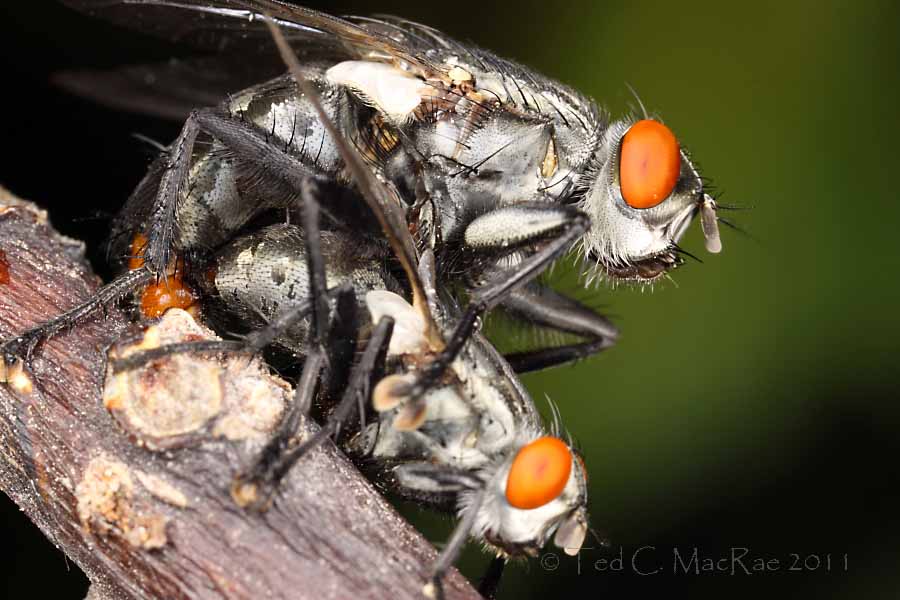
A single individual is shown in the first two photos, while this mating pair was seen a little later.  Although they seem to represent the same species, I can’t be certain of this, and the photo itself is not the greatest due to the female (bottom) being slightly off-focus.  Nevertheless, I had to show it, because – really – who can resist photographs of fly nookie?! 

REFERENCES:

de Carvalho, C. J. B. and C. A. de Mello-Patiu.  2008.  Key to the adults of the most common forensic species of Diptera in South America.  Revista Brasileiro de Entomologia 52(3):390–406.

Mariluis, J. C., J. A. Schnack, P. R. Mulieri and J. P. Torretta. 2007. The Sarcophagidae (Diptera) of the coastline of Buenos Aires City, Argentina. Journal of the Kansas Entomological Society 80(3):243–251.

Mulieri, P. B., J. C. Mariluis and L. D. Patitucci.  2010.  Review of the Sarcophaginae (Diptera: Sarcophagidae) of Buenos Aires Province (Argentina), with a key and description of a new species.  Zootaxa 2575:1–37.

Addendum:

This challenge concludes the 2nd BitB challenge session, with a record 17 participants in this final challenge.  For a while it looked like HBG Dave would become our newest champion, but Session #1 champ Ben Coulter swooped in, flogged us with terminology (all of it correct and undeniable), and won two of the last three challenges to edge out Dave and, once again, take the overall victory. Make no mistake – Ben knows how to play this game!  Morgan Jackson took second in this challenge and claimed the final spot on the overall podium, while Troy Barlett and newcomer Heath Blackmon tied for third.  Other strong contenders during Session #2 included JasonC and Tim Eisele.  Ben – contact me to claim your loot (and your loot from session #1 is in the mail).

Here is the final points tally for Session #2:

Place Commentor BB#10 IDC#5 Bonus
3/7
IDC#6 IDC#7 SCC#4 Total
1 Ben Coulter       10   41 51
2 HBG Dave   13 2 4 8 17 44
3 Morgan Jackson   2     4 29 35
4 Troy Bartlett 2 10 2     20 34
5 JasonC   8   4   18 30
6 Tim Eisele 1 8   6 6 8 29
7           20 20
8 TGIQ   2       17 19
9 Christopher Taylor   2       15 17
10 Dave Hubble   15         15
11 James Trager  1 1 2     9 13
12 Gunnar           12 12
13
        1 9 10
14
Dennis Haines 
          9 9
15 Max Barclay       3   5 8
            8 8
17 Charley Eiseman   6         6
18 biozcw           5 5
19 Brady Richards       4     4
  Henry         4   4
21 John Oliver     2       2
 
Mike
          2 2
23 Christy Bills       1     1
  Tucker Lancaster       1     1

Copyright © Ted C. MacRae 2011

Bichos Argentinos #7 – Naupactus xanthographus

Naupactus xanthographus (South American fruit tree weevil) | Buenos Aires, Argentina

This weevil (family Curculionidae) was one of just a few beetle species that I encountered earlier this month in Buenos Aires, Argentina at La Reserva Ecológica Costanera Sur.  Weevils are, of course, one of the most taxonomically diverse and difficult groups of Coleoptera, making species IDs based purely on photographs quite challenging.  Nevertheless, I am reasonably confident that this individual represents Naupactus xanthographus, or the South American fruit tree weevil.  This name, it seems, has also been applied to a variety of other weevils photographed in South America and posted on the web, but the images I found at a few seemingly more authoratative sites give me confidence that this is the true N. xanthographus.  The narrow form suggests this individual is a male.

The genus, known collectively as “white-fringed weevils” is a large genus of exclusively Neotropical species – several of which have been introduced to North America (e.g., N. cervinus, Fuller rose beetle, and N. leucoloma) and which were, until recently, placed in a separate genus Graphognathus (Lanteri and Marvaldi 1995) (apparently the reduced humeri and lack of metathoracic wings were deemed insufficient for generic distinction).  In South America some of the species have become pests as well, with N. xanthographus becoming a problem for growers of grapes and other fruits and, thus, earning the names “burrito de la vid” (Chile) and “mulita de la vid” (Argentina) (both roughly translating to “grapevine little donkey”).

This was not an easy photograph to get – I found the weevil clinging to the underside of a leaf above my head.  It was impossible to photograph it in situ, so I moved it to a low twig away from other foliage where I could get the black background I desired.  Once moved, however, the weevil just never… stopped… crawling.  Snapping shots of an actively crawling insect is a crap shoot at best – not only are focus and framing more difficult to nail, but subjects photographed while moving almost always have one or two “bum” legs (lifted or cocked out of position).  A number of attempts were required to get a photo I was happy with (save for the slightly clipped antennal tip).  In such situations, I’ve found it best to track the beetle as it moves and as soon as the center focus point of the lens flashes take the shot.  This at least gives the best chance for nailing the focus, and then it’s simply a numbers game to get a shot with good framing and composition and all the body parts well placed.  Of course, I could’ve zoomed out and just cropped to perfection, but this feels a little like cheating – I’d rather put in the time and practice perfecting my game out in the field as much as possible.  An occasional clipped antenna, tarsus, etc. now will lead to better results down the line.

REFERENCE:

Lanteri, A. A. and A. E. Marvaldi. 1995. Graphognathus Buchanan a new synonym of Naupactus Dejean and systematics of the N. leucoloma species group (Coleoptera: Curculionidae). Coleopterists Bulletin 49(3): 206-228.

Bichos Argentinos #6 – Jumping Spider

I photographed this jumping spider (family Salticidae) two weeks ago in Buenos Aires, Argentina at La Reserva Ecológica Costanera Sur. In gestalt it is very similar to our North American species of the genus Phidippus, but I can’t say for sure whether it actually belongs to that genus. I found it crawling on the foliage of a tree just about eye height, and I’m guessing from the muted markings and roundish shape to the abdomen that it is a female (I saw another individual later that I took to be a male of the same species – it was similarly but more boldly marked and with a much more tapered abdomen). I hope you’ll forgive my hubris, but I’m rather pleased with how these photographs turned out (although, admittedly, there were others that were not so good). In my opinion, they represent further improvement over my first two attempts at photographing jumping spiders (with the standard caveat that I am still no Thomas Shahan). These improvements involve primarily sharpness and detail but also composition, and I consider them to be largely due to lighting and learning how to handle the subject.
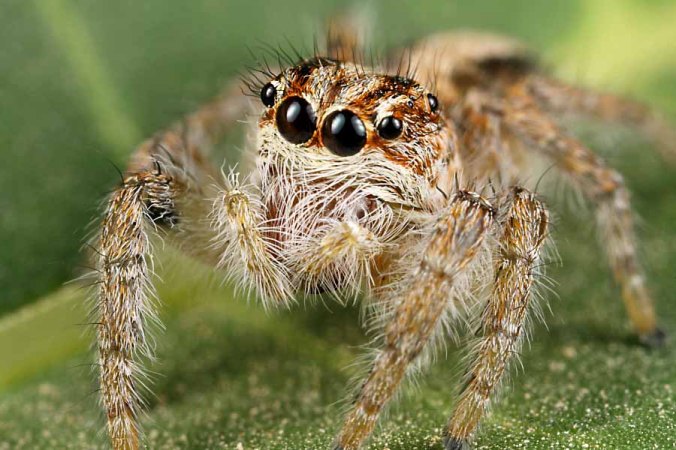
The detail in these photos results not only from proper focus, but also lighting techniques. All of these photos were taken hand-held using a Canon MP-E 65mm macro lens at f/13 with full flash lighting. Although I used an exposure setting of 1/200 sec, the actual exposure is determined strictly by the duration of the flash pulse, which is much shorter than 1/200 sec. While flash pulse duration can be set manually (and I started out doing so), I now prefer to use E-TTL mode (Evaluative Through The Lens), which adjusts the flash duration automatically based on the amount of light that the camera senses coming through the lens from a short pre-flash at the aperture chosen. The more light that is sensed, the shorter the flash pulse – the less light sensed, the longer the pulse. Obviously, with a shorter flash pulse there is less likelihood that image sharpness will be affected by movement – either by the subject or by the camera-holder. Since light intensity decreases in proportion to distance, it is desirable to get the light source as close to the subject as possible to achieve the highest intensity and, thus, shortest flash duration.

It’s not that simple, however. Most insect macrophotographers agree that diffused light gives better results than undiffused light, but no matter what diffuser one uses there will be loss of light. Loss of light leads to longer flash pulse duration and, thus, increased potential for movement during the flash pulse (especially in hand-held photography). The trick, then, is to diffuse the light as much as possible, while at the same time minimizing light loss. I continue to favor my Puffer+Sto-Fen double diffuser for use with the 65mm lens, because it places the outer diffuser almost right on top of the subject for maximal apparent light size. This is not to say that improvements still are not possible – the open-side design likely results in some loss of light, and a thin inner diffuser film to replace the Sto-Fens would probably further reduce light loss and allow for even shorter flash pulses (and probably also allow a bit more battery life). I’ll get around to effecting these improvements someday, but in the meantime the current setup is working pretty well.
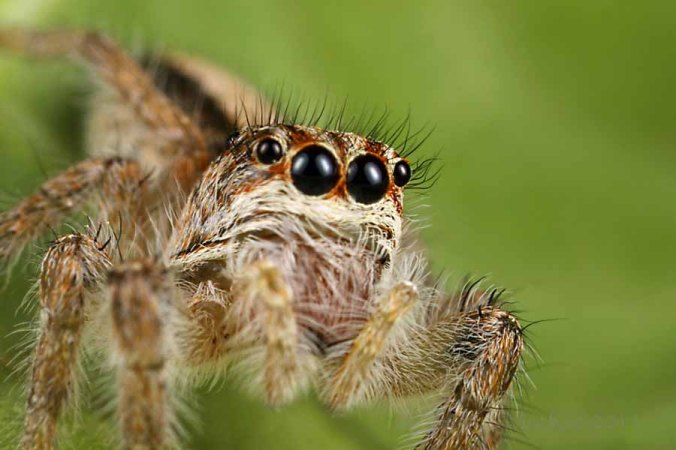
Compositionally, I like this last photo the best due to the placement of the subject within the frame (all photos are shown completely uncropped, although I’m not above doing so), its slight upward-looking pose, and the evenly-blurred light-green background. This was achieved by using my left hand to hold the leaf on which the spider was sitting and to also serve as a brace for resting the camera, which I held with the right hand. This minimizes wind-movement and fixes the distance between the subject and the lens (as long as the subject sits still!). By carefully twisting and turning the leaf as the spider moved upon it, I was able to turn the spider into the desired positions, and by paying attention to what was behind the spider I could compose a nicely colored blurred background. Understanding subject behavior was a tremendous advantage in this case, as it allowed me to predict and anticipate how the spider would move in response to my finger-prodding and leaf turning to get desirable poses. I tend to get my best compositions after I’ve worked the subject for awhile and taken several shots to learn its behavior and get it accustomed to my presences – this is reflected in the accompanying photos, which are posted in the order in which they were taken. Make no mistake – patience and practice are still required. However, it’s techniques such as these that can make the difference between good photographs and great ones!

Edit 3/30/11, 11:50am: My thanks to G. B. Edwards, Curator at the Florida State Collection of Arthropods, who just sent me the following message:

Hi Ted,
Nice photos.  Most likely it is a female “Euophryssutrix, which is not a Euophrys nor even a euophryine, but a freyine, so eventually will have another genus name. It is one of the larger species in the subfamily.

This species is called “aranhas papa-moscas” in southern Brazil, where it is a principal predator of fruit flies in peach orchards (Wikipedia).

Copyright © Ted C. MacRae 2011
Bichos Argentinos #5 – Cyrtocoris egeris

Cyrtocoris egeris | 15 km S Reconquista, Pcia. Santa Fe, Argentina

Despite its obvious membership in the order Hemiptera, I knew the insect featured in ID Challenge #7 would be a difficult subject to identify.  This bizarre bug is Cyrtocoris egeris, a member of the small pentatmoid family Cytocoridae (congratulations to HBG Dave, who was the only commenter to correctly identify not only the family, but the genus).  While their relationship to Pentatomidae (stink bugs) and Scutellaridae (shield-backed bugs) is obvious, hemipterist-great Carl Schaefer thinks these insects might actually be most closely related to the Cydnidae (burrowing bugs).  I encountered this individual a couple of weeks ago in a soybean field in Santa Fe Province, Argentina.  Now, I have to be honest here – I did not figure this one out on my own. Instead, I assumed it must be some bizarre member of the Pentatomidae or Scutellaridae, and it was only after my repeated searches in either of those two families failed to turn up anything promising did I throw up my hands and call for hired help. This time it was USDA Research Entomologist Don Thomas, a pentatomid specialist (and former co-alumnus at the University of Missouri) who responded to my query with a genus-level ID. Once I had that bit of information in hand I was able to locate the recent revision of the family (Packhauskas and Schaefer 1998) and identify the species.

Looks stink bugish enough in this head on view...

In addition to the expanded scutellum bearing a broad-based spine or hump, members of this exclusively Neotropical family are characterized by flattened expansions of the anterior part of the head, the covering of flattened scalelike setae, and a mediodistal tubercle on at least the foretibiae. Packauskas and Schaefer (1998) recognize only three genera and 11 species in the family, its members occurring from Argentina north through central Mexico.

...but there's some crazy stuff going on at the back end.

My ID as C. egeris is based on the very well-developed scutellar crest and my interpretation of the humeral projections not extending forward of the anterior angles next to the head. Packauskas and Schaefer (1998) recorded this wide-ranging species from Mexico to Argentina, with the southernmost specimens in extreme northeastern Argentina (Pcia. Missiones), but Schaefer et al. (2005) later recorded it from Reconquista – also on soybean. Cyrtocoris gibber is very similar to C. egeris and is also widespread from Costa Rica to Argentina (and also with the southernmost record in Pcia. Missiones, Argentina), but in that species the humeral expansions project forward nearly as far as the anterior angles of pronotum (strongly surpassing a line drawn through the bases of these angles).  Besides soybean for C. egeris, the only other host records I am aware of for any species in the family are by Costa Lima (1940), who reported C. gibbus on the branches of Mimosa scabrella (Leguminosae), and Schaeffer et al. (2005), who reported C. tigrinus on Sida rhombifolia (Malvaceae) (although nymphs could not be reared to adulthood on this plant).

REFERENCES:

Costa Lima, A. 1940. Insetos do Brasil. 2° Tomo, Capitulo XXII. Hemipteros. Escola Nacional do Agronomia, Rio de Janeiro.

Packauskas, R. J. and C. W. Schaefer. 1998.  Revision of the Cyrtocoridae (Hemiptera: Pentatomoidea).  Annals of the Entomological Society of America 91(4):363–386;

Schaefer, C. W., A. R. Panizzi and M. C. Coscarón. 2005.  New records of plants fed upon by the uncommon heteropterans Cyrtocoris egeris Packauskas & Schaefer and C. trigonus (Germar) (Hemiptera: Cyrtocoridae) in South America.  Neotropical Entomology 34(1):127-129.