
Soybean field, Tucumán Province, Argentina.

Feeding the world!
Copyright © Ted C. MacRae 2013
Soybean field, Tucumán Province, Argentina.
Feeding the world!
Copyright © Ted C. MacRae 2013

My colleagues and I greatly enjoyed our visit to the Salinas Grandes salt flats in Catamarca Province, but there was a moment of tension between Federico and Agustín. You see, Federico is only 12″ tall, so we have to keep a close eye on him to make sure he doesn’t get himself into any trouble. Apparently he had wandered off too far for Agustín’s comfort, leading to a bit of a scolding. Despite his small size, however, Federico took it all in stride and stayed close for the remainder of our visit.
Copyright © Ted C. MacRae 2013
Perhaps some have noticed that things have been relatively quiet of late here at Beetles in the Bush. I have been hard at work in South America for the past couple of weeks, first in Brazil and now in Argentina. Posting should return to normal when I return to the U.S. next week; however, in the meantime I thought it might be a good idea to show just how hard I have been working:

Salinas Grandes, Provincia de Catamarca, Argentina
Copyright © Ted C. MacRae 2013
Even though I pride myself as a fairly competent coleopterist, I occasionally run into beetles that—despite my best efforts—I just cannot identify them beyond the family level. I don’t feel too bad about that, as the group’s 350,000 to 400,000 described species represent more than a third of all described life forms! Still, with the amount of information now available online combined with traditional print literature, it’s frustrating when I photograph species that seem quite distinctive but fail to show up in any search result. Here are a couple of South American beetles that I’ve pondered over for a year or more now. If you have any thoughts on their identity I would appreciate hearing from you.
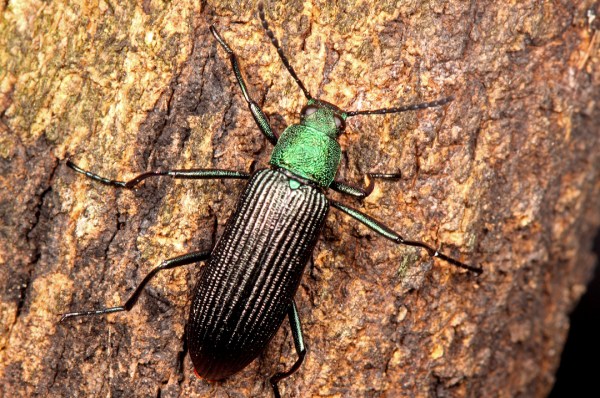
Tenebrionidae? | Campinas, São Paulo, Brazil.
This first beetle was encountered January 2011 on the trunk of a tree in the city of Campinas, southeastern Brazil (São Paulo State). I only got this one shot of it before it dropped and disappeared, and except for the bright green color of the head and pronotum it reminds me of some of the long-jointed beetles—formerly the family Lagriidae but now a subfamily of Tenebrionidae (darkling beetles).

Elateridae | Rt 16 nr. Rio Negro, Chaco Province, Argentina
This is without question a species of click beetle (family Elateridae), but despite its rather distinctive coloration I’ve not found any images that resemble it. I found these beetles fairly commonly on flowers of Solidago chilensis in April 2012 at several localities along Rt 16 in northern Argentina (Chaco Province).
Copyright © Ted C. MacRae 2013
I’m back in South America for the next 2+ weeks, and though it will be another week before I actually make it into Argentina, I am celebrating my return to that lovely country with photos of Argentinian insects taken during last year’s extended visit but that I haven’t had a chance to share before now. Earlier this week I featured Camponotus sericeiventris (though I prefer the literal translation, “silky-bellied humpbacked ant“)—easily among the most handsome ants that I’ve ever seen and which I encountered in the remnant quebracho forests at Chaco National Park in northern Argentina. Today’s feature is an equally handsome robber fly (order Diptera, family Asilidae), also seen at the park and which landed on a dead log just long enough to allow one good lateral profile shot of the beast in all its hairy splendidness! (Probably it zipped off to impale an Odontocheila tiger beetle in the back of the neck!)

Triorla sp. | Chaco National Park, Argentina
I sent this photo to a few fly guys looking for a more authoritative opinion about its identity, mentioning its resemblance to some of our North American species of Efferia. Herschel Raney agreed that it belonged to at least that group, while Eric Fisher suggested a species in the genus Triorla (an early segregate of Efferia that is now widely regarded as a valid genus). The most recent checklist of robber flies from Argentina (Artigas & Hengst 1999) lists three species in the Efferia group (all in the genus Nerax); however, both Herschel and Eric confirmed my suspicion that Argentina, and especially the north, is not well studied for Asilidae. Eric further suggested that there could be as many as several times the number listed, mainly undescribed but also described from adjacent countries and occurring in Argentina but not yet recorded from there. Also, I had presumed this individual to represent a female since it lacked the distinctly swollen genital capsule (e.g. see this post, presumably another Efferia-group species), but Herschel thought the terminal structure was odd and did not look female.
REFERENCE:
Artigas, J. N. & M. B. Hengst. 1999. Clave ilustrada para los géneros de asílidos argentinos (Diptera: Asilidae). Revista Chilena de Historia Natural 72:107—150.
Copyright © Ted C. MacRae 2013
Last year during my extended work stay in Argentina, I was able to slip away from my duties during the first week of April and spend some time in the city of Corrientes in the northeastern part of the country. The city is one of my favorites in Argentina, but what I love most about it is its convenience as a base camp for exploring some of the habitats in the Grand Chaco ecoregion of northern Argentina. One day I had a chance to visit Chaco National Park about 100 km northwest of the city, site of some of the last remnants of the great quebracho forests that once covered much of northern Argentina. The forest preserved at Chaco NP takes its name from the quebracho colorado chaqueño (Schinopsis balansae) trees that dominate it, standing in defiant contrast to the vast, hot sea of cotton fields and mesquite fence-rows that surrounds it. While hiking a trail through the heart of the forest, I looked down to see a most impressive ant crawling across the forest floor:

Camponotus sericeiventris | Chaco National Park, Argentina
Because of its black color and the striking, silky sheen of the abdomen, I was immediately reminded of the Camponotus mus ants that I had photographed a year earlier further south in Buenos Aires. However, this fellow (er, fella…) was considerably larger than that species, and looking at the photographs later I was also struck by the acute spines at the humeral angles of the pronotum (in C. mus the humeral angles were obtuse) and the flattened legs. All of this combined to make it one of the most handsome ants that I had ever seen! I posted the above photo on my Facebook page asking for ID help, and James Trager quickly responded that the ant represents Camponotus sericeiventris, which translates roughly to “silky-bellied humpbacked” ant. Now there’s a common name I can get behind.

Of course, it turns out that I could have easily determined the species on my own using the characters I had already noted—primarily the acute spines. Googling “camponotus acute spines” retrieves as its first result a paper by Wheeler (1931) that discusses this ant and a newly discovered (at the time) cerambycid beetle, Eplophorus velutinus [now Euderces velutinus] mimicking the ant (Fisher 1931). As soon as I read Wheeler’s first paragraph I knew I had the right species:
Camponotus (Myrmepomis) sericeiventris, owing to its size, wide distribution and dense covering of silver or golden pubescence, is one of the handsomest and most conspicuous ants of the American tropics.
Apparently this ant is a popular choice of models for mimics in a number of insect groups. Lenko (1964) reported another cerambycid beetle, Pertyia sericea, as a mimic of C. sericieventris (the similarity of species epithets being no coincidence), and friend and colleague Henry Hespenheide has not only described a zygopine weevil, Copturus paschalis, from Costa Rica as a mimic of this ant (Hespenheide 1984) but also postulated mimicry by Apilocera cleriformis [now Euderces cleriformis] and three other species of Cerambycidae collected by him in central Panama. Henry further noted mimics in the families Cleridae and Mutillidae and the fact that all of the beetle mimics of this arboreally foraging ant are themselves woodborers or predators of woodborers as larvae.
It is interesting that Fisher (1931), in his description of E. velutinus, made no mention of the mimicry, while Wheeler (1931) in his paper about C. sericeiventris discussed this in great detail. He further noted the diversity of cerambycids here in our North American fauna that mimic ants. These include species in the genera Clytoleptus, Euderces, Cyrtophorus, Tilloclytus and—most strikingly—Cyrtinus pygmaeus, our smallest species of Cerambycidae which occurs on dead wood among small ants such as Lasius americanus, and Michthisoma heterodoxum which resembles small Camponotus pennsylvanicus workers. I’ve not yet encountered M. heterodoxum, which seems restricted to the southeastern Coastal Plain, but I have beaten C. pygmaeus from dead branches and can personally attest to the effectiveness of their mimicry—some slight something about the way they moved made me question my immediate assumption that they were ants and caused me to take a closer look at them before I shook them off the beating sheet. I wonder how many times before that I collected this species without realizing it!
REFERENCE:
Fisher, W. S. 1931. A new ant-like cerambycid beetle from Honduras. Psyche 38:99–101.
Hespenheide, H. A. 1984. New Neotropical species of putative ant-mimicking weevils (Coleoptera: Curculionidae: Zygopinae). The Coleopterists Bulletin 38(4):313–321.
Lenko, K. 1964. Sobre o mimetismo do cerambicideo Pertyia sericea (Perty, 1830) com Camponotus sericeiventris (Guerin, 1830). Papéis Avulsos de Zoologia (São Paulo) 16:89–93.
Wheeler, W. M. 1931. The ant Camponotus (Myrmepomis) sericeiventris Guérin and its mimic. Psyche 38:86–98.
Copyright © Ted C. MacRae 2013
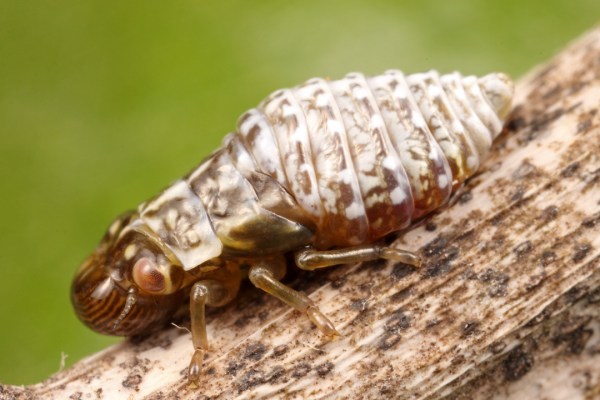
Cephisus siccifolia 3rd instar nymph | Buenos Aires, Argentina
Even though it was November (and thus spring in Argentina), conditions were already unusually dry—a portent of the worst drought that would hit Argentina in 70 years. Because of this, I found the occasional wet spot on the pavement as I walked the trails in La Reserva Ecológica Costanera Sur rather odd. At first I thought they were spit—the trails were popular on this day for runners and bike riders, but I quickly realized that those would have to be some truly ginormous spit wads based on the size of the splatter. It wasn’t long before I thought to look up, and this is what I saw on the branch directly above me:
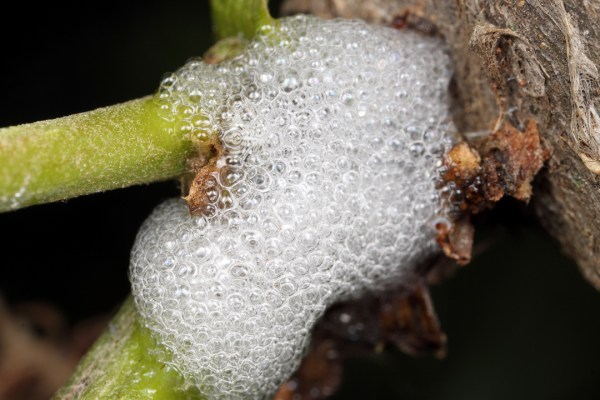
Cephisus siccifolia spittle mass on unknown species of tree.
I knew right away this was the work of a froghopper, or “spittlebug,” a true bug (order Hemiptera) in the family Cercopidae. Spittlebugs are common in the eastern U.S. where I live and are famous for the spit-like wads of froth (“cuckoo spit” to some) within which the nymphs conceal themselves until they reach adulthood. Our eastern U.S. species, however, are most commonly seen on herbaceous plants rather than in trees, and the frothy masses they produce are fairly small—about the size of a real wad of spit (at least, according to my direct comparison when I was 12 years old). The spittle masses I was seeing today were enormous, frothy, liquid masses that literally dripped from the trees by their own weight—raining spit!

Nymphs produce bubbles by siphoning air into a channel under the abdomen.
I was about to move on when I noticed some movement in the spittle mass. A closer look through the macro lens revealed the tip of the abdomen of a nymph slowly circling around near the surface of the spittle and creating new bubbles as it did this. As one can imagine, living inside a mass of bubbly liquid presents a challenge to breathing, and the nymphs get around this problem by protruding the tip of the abdomen outside the spittle mass and taking in air through a tubelike canal below the abdomen (Hamilton & Morales 1992). Strong contractions of the abdomen inside the spittle mass eject air from the canal, resulting in bubble formation.

Nymphs partially exposed by removal of spittle mass.
I sent these photos to Andy Hamilton (Canadian National Collection of Insects, Arachnids and Nematodes), specialist in world Cercopidae, to see if there was any chance he might recognize the genus or species based on these photos. I noted that these were the biggest spittlebug nymphs I had ever seen (the individual in the first photo measuring ~10mm in length). Not only did he recognize them as belonging to the genus Cephisus, but he was actually in the process of finishing up a revision of the New World members of the tribe Ptyelini—Cephisus being the sole New World genus to represent the tribe. Based on its white coloration and occurrence as far south as Buenos Aires, Argentina, he suggested this must be C. siccifolia—a species that can sometimes achieve economic pest status (Ribeiro et al. 2005) but which still apparently needs to be properly recorded from Argentina (Hamilton 2012). Based on degree of wing pad development, Andy surmises the individual in Photo #1 represents a 3rd instar (if the 3rd instar measures 10 mm, can you imagine the size of the 5th instars?!). Andy asked me if I would grant him use of the photos in his soon-to-be-published revision (of course I agreed), and here is the plate with the photos (as well as an adult photographed by someone else) as it appears in his paper:

As Andy notes in his paper, it seems rather unusual that Cephisus is the only tribal representative in the New World despite having successfully colonized all of its tropical and subtropical mainland areas. There are several other genera in the tribe in Africa, which would suggest that the Ptyelini arose prior to the late Cretaceous rifting that separated South America and Africa into two continents. It is thus puzzling why the tribe went on to further diversify in Africa but not in the New World.
A tight crop of Photo #3 above was featured in Super Crop Challenge #15, for which Ben Coulter was the hands-down winner. Honestly I thought this might end up being a slam dunk challenge—people have gotten very good at designing Google search strings to come up with answers that in pre-internet days might have been impossible to find. Nobody stumbled upon the magic search string for this challenge—”MacRae Cercopidae” which pulls up the Hamilton paper and above plate as the very first result. Still, Ben used good old fashioned intuition based on the locality tag to correctly surmise the species and take the early lead in BitB Challenge Session #7. Congratulations, Ben!
REFERENCES:
Hamilton, K. G. A. 2012. Revision of Neotropical aphrophorine spittlebugs, part 1: Ptyelini (Hemiptera, Cercopoidea). Zootaxa 3497:41–59.
Hamilton, K. G. A. & C. F. Morales. 1992. Cercopidae (Insecta: Homoptera). Fauna of New Zealand 25, 40 pages.
Ribeiro, G. T., M. da Costa Mendonça, J. Basílio de Mesquita, J. C. Zanuncio G. S. & Carvalho. 2005. Spittlebug Cephisus siccifolius damaging eucalypt plants in the State of Bahia, Brazil. Pesquisa Agropecuária Brasileira 40(7):unpaginated.
Copyright © Ted C. MacRae 2013
Can you identify the structure in the photo below (2 pts), what it is doing (2 pts), and the organism to which it belongs (order, family, genus, and species—2 pts each)? Comments will be held in moderation so everybody has a chance to participate, although there are early-bird bonus points on offer. Read the full rules for details on how (and how not) to earn points. Good luck!

Copyright © Ted C. MacRae 2013

