Best of BitB 2012

Welcome to the 5th Annual “Best of BitB”, where I pick my favorite photographs from the past year. 2012 was one of the most intensive travel years I’ve ever had—I spent 8 weeks in Argentina from February through April, made separate trips to Puerto Rico and Arkansas in May (bracketing a personal week in California), traveled almost weekly to Illinois and Tennessee from June to September (interrupted by a personal week in Florida in July), toured the southeastern U.S. (Arkansas, Louisiana, Mississippi and Georgia—great food!) in early September, chased tiger beetles in Oklahoma, Texas and Arkansas in late September, went back to Argentina for a week in October, and capped off the travel year by attending the Entomological Society of America Annual Meetings in Knoxville, Tennessee (for the first time in more than 10 years!)—whew! While many would cringe at such a travel load, I am among the lucky few who actually get paid for doing something that is also my hobby—entomology! This gives me ample opportunity to further hone my photography skills (nine of the 13 photos I’ve selected below were actually taken while I was on business travel), resulting in two key accomplishments this year—my first ever photography talk at the ESA’s insect photography symposium and my first commercial sales (look for the BitB commercial site to go online in 2013).

Enough blather! Here are my favorite BitB photographs from 2012. Click the link in the text below the photo to see the original post. I would greatly appreciate knowing if you have a favorite (and why)—your feedback will be enormously helpful to me as I continue to learn and develop as a photographer.  For those interested, here are my previous year picks for 2008, 2009, 2010 and 2011. And, as always, thank you for your readership!
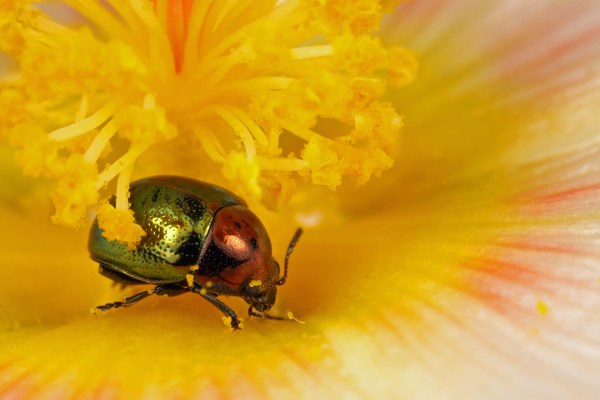

Spintherophyta (?) sp. in flower of Abutilon pauciflorum | Buenos Aires, Argentina

From  (posted 2 Feb). One of my 2012 learnings was that sometimes a photograph that is not so close is more effective than one that is as close as possible. In one of my earlier attempts at “not-so-close” macrophotgraphy, the soft colors of the flower compliment the brash shininess of the tiny leaf beetle that has been feeding on its pollen. Pink lines lead the eye directly to the subject and create a pleasing composition, and pollen grains stuck to the beetle—a distraction in some situations—add to the miniature natural history story of the photo.


Apiomerus flavipennis with stink bug prey and kleptoparasitic flies | Chaco Province, Argentina

From  (posted 11 Mar). I selected this photo solely for the complex natural history story drama it shows—stink bug (Piezodorus guildenii) feeding on soybean becomes prey of an assassin bug (Apiomerus flavipennis), with volatiles from the chemicals it emitted in a vain attempt to defend itself serving as cues to kleptoparasitic flies (families Milichiidae and Chloropidae) that benefit from the assassin bug’s labors.


Planthopper nymph | Buenos Aires Province, Argentina

From  (posted 26 Mar). Another learning that I began putting into practice in 2012 was the use of low perspective for compositional impact. The cryptic coloration of this planthopper nymph (family Fulgoridae) made it almost invisible on the branch on which it was sitting when viewed from a normal “top-down” human perspective. Getting “down under” it, however, brought the nymph to life and emphasized its unusual form.
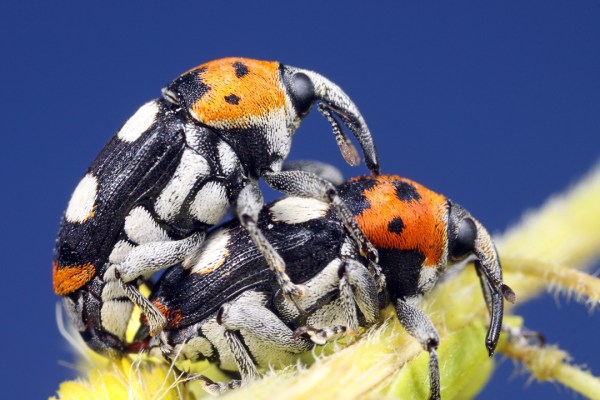

Megabaris quadriguttatus | Corrientes Province, Argentina

From  (posted 12 Apr). I spent much of 2012 working on the “blue sky background” technique, with these weevils from northern Argentina representing one of my better attempts. Macrophotography of insects with a blue sky background involves setting exposure, ISO, and aperture to achieve two separate exposures—full flash illumination of the subject for maximum depth-of-field, and ambient light from the sky to create a clean, uncluttered, natural-looking background. In this shot I managed to achieve an almost ideal shade of blue to compliment the wild black, white and red colors of the beetles. (My one criticism of the photo is having clipped one of the beetle’s feet.)


Bombylius sp. cf. mexicanus | Scott Co., Missouri

From  (posted 16 May). This photo is unusual if nothing else. Focus, lighting, depth-of-field, and composition are all better than can be hoped for in a single shot, but the subject—perfectly alive—is in a most unusual position. Read the original post to find out how this happened.


Perisphaerus sp. (a pill roach) | Vietnam (captive individual)

From  (posted 27 May). White-box photography is an excellent technique for clean, uncluttered photographs of insects, but it also isolates them from their natural surroundings and limits their natural history appeal. The best white-box photos are those that highlight a key feature or behavior of the subject—in this case a pill roach’s comically conglobulating defensive posture.


Micronaspis floridana (Florida intertidal firefly) larva | Pinellas Co., Florida

From  (posted 31 July). Here is another photo whose back story played a big part in its selection. This firefly larva not only represents a rare Florida-endemic species but was also first seen by my then 12-year old nephew, who willingly accompanied me through a dark, spooky salt marsh in the middle of a humid Florida night to see what he could learn. The lesson here for budding natural historians (and old-timers like me) cannot be overstated!


Arctosa littoralis (beach wolf spider) | Lewis Co., Missouri

From  (posted 23 Aug—prelude to  posted 28 Aug). Those who follow this blog know of my obsession with close-up portraits, and while tiger beetles are the subjects I most commonly photograph in this manner, I am always on the lookout for good subjects in other taxa. This wolf spider “face” almost looks human, with “two” eyes, two “nostrils” and a shiny upper lip above huge (albeit hairy) buck teeth! It’s enough fill-the-frame spidery goodness to melt (or explode) the heart of even the most ardent arachnophobe!
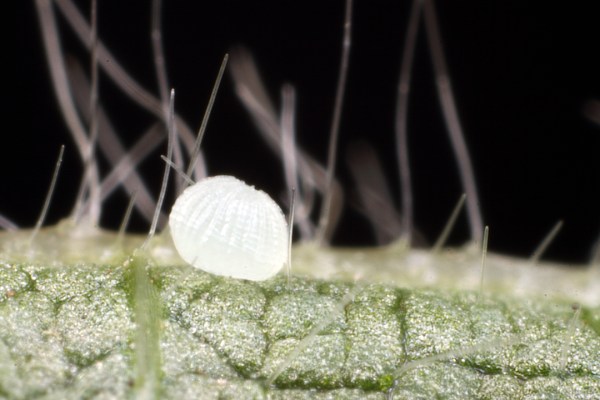

Anticarsia gemmatalis (velvetbean caterpillar) egg on soybean leaf

From Life at 8X—Guide to lepidopteran eggs on soybean (posted 3 Sep). “Life at 8X” was a new series I introduced this year, featuring insects photographed at magnifications testing the upper limit of my equipment and photographic skills. Diffraction is the chief difficulty with magnifications as high as this and is the primary flaw in the above photograph. Nevertheless, such view of a moth egg on the underside of a soybean leaf provides a spectacular view of the otherwise unseen micro-world that lives right beneath our noses.


Megacyllene decora (amorpha borer) on snakeroot flowers | Mississippi Co., Missouri

From  (posted 12 Sep). This second example of “blue sky background” was taken later in the year and was considerably more difficult to capture than the first because of the larger size of the subject and resulting need for a longer focal length macro lens. Getting a well-lit, focused, and composed image with a desirable shade of blue in the background depended not only on finding the proper camera settings, but also secure body and camera bracing techniques for this completely hand-held shot.


Cicindelidia politula politula (Limestone Tiger Beetle) | Montague Co., Texas

From  (posted 28 Sep). I will go ahead and say it—this is my favorite photograph of 2012. As discussed under the first entry, panning back from the subject can allow for some very interesting compositions. This photo combines charismatic pose by a wary subject with panning back and low perspective to create an image that scores high in both natural history and aesthetic appeal.


Calosoma sayi (black caterpillar hunter) | New Madrid Co., Missouri

From Black is beautiful! (posted 7 Nov). Of course, close-as-possible can also be used to create striking photos, especially if the subject exhibits features that are best seen up close. Anything with jaws fits the bill in my book, and highlighting the mandibular sculpturing of this caterpillar hunter (a type of ground beetle) required precise angling of the flash heads for maximum effect.


Cicindela repanda (Bronze Tiger Beetle) | St. Louis Co., Missouri

From  (12 Nov). This final selection is not a rare species, but it is as close as I have come to what I consider the “perfect” tiger beetle macrophotograph—a close, low angle, lateral profile of an adult in full-stilt posture (a thermoregulatory behavior), well lit, perfectly focused, and with a dynamic but pleasingly blurred background. It’s a perfect storm of a photo that took the better part of two hours to achieve—rarely do all of these elements come together in a hand-held photograph of an unconfined tiger beetle in its native habitat.


Well, there you have it. I hope you’ve enjoyed my selections, and again please do let me know if you have a personal favorite. See you in 2013!

Copyright © Ted C. MacRae 2012
A non-black background is better… often!

In my previous post, A black background is better… sometimes, I came to the defense of the oft-maligned pitch black background. Some macrophotographers studiously avoid black backgrounds (BBs), claiming that they look ‘unnatural’. However, as I discussed in my previous post, there are situations—primarily with light-colored or translucent subjects or those that are seen only at night—where BB can be aesthetically pleasing or more consistent with the subject’s natural history (or both, as in the case of the subject of my last post). On  the other hand I do agree that BBs are overused, showing up in many photos where a non-black background would have been a better choice. The reason for this is simple—BBs are easy! All one must do is ensure that the area behind the subject is clear of light-reflecting objects. While this is certainly preferable over cluttered backgrounds with random leaves, branches, grass stems, etc. that distract from the subject, a BB may nevertheless not be the most aesthetically pleasing  choice for the photo (I am guilty of this myself). Non-black backgrounds, on the other hand, require more forethought, not only about what color to use and how to achieve it, but also regarding camera and flash settings which can be a bit trickier due to the fact that both background and subject must be properly exposed.

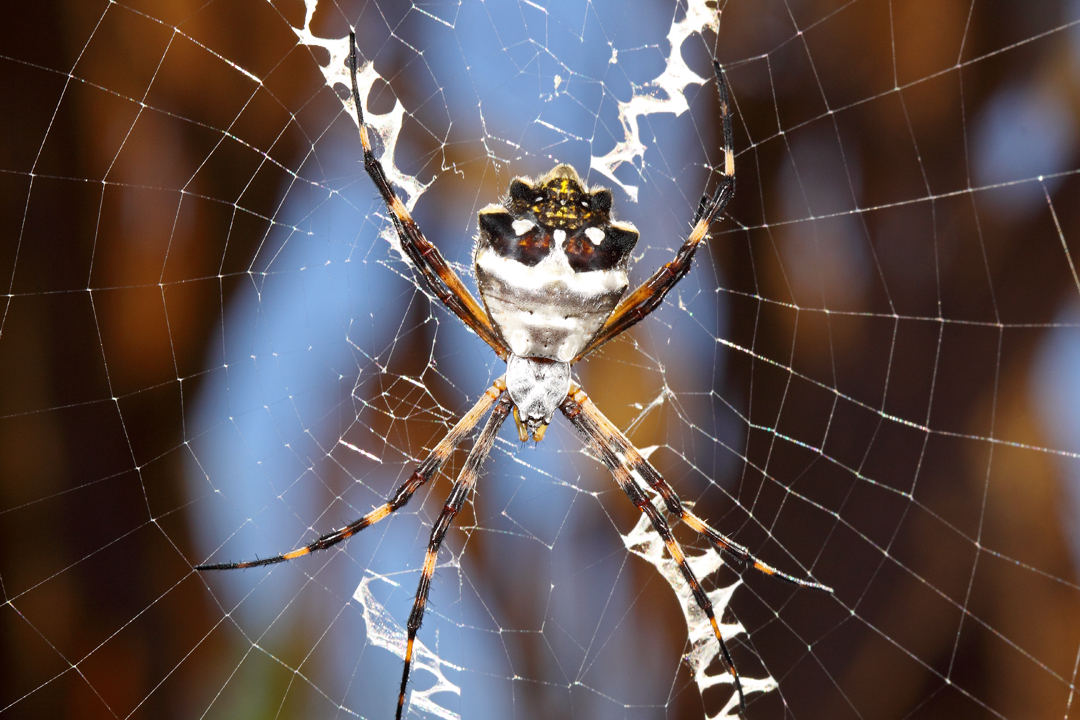
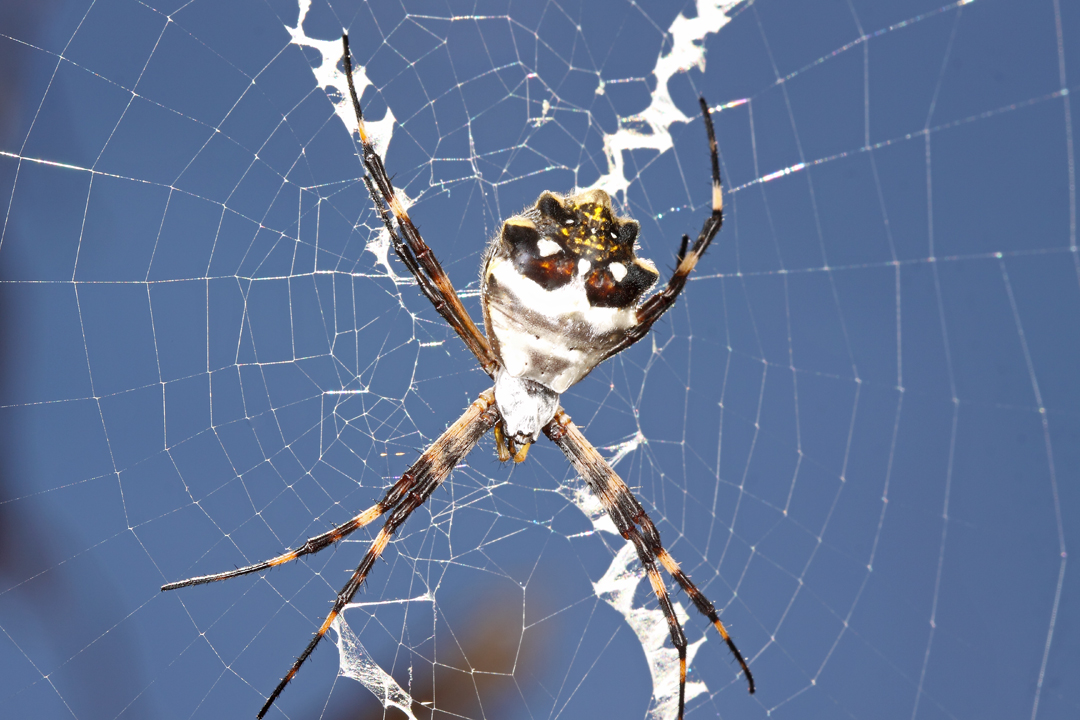
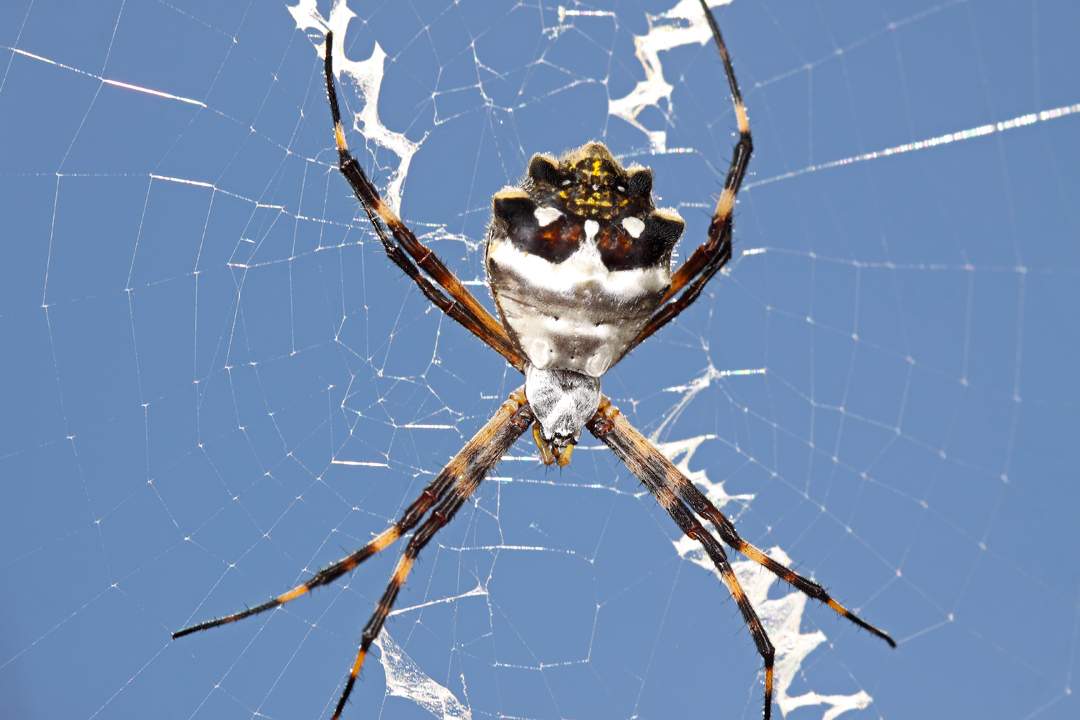
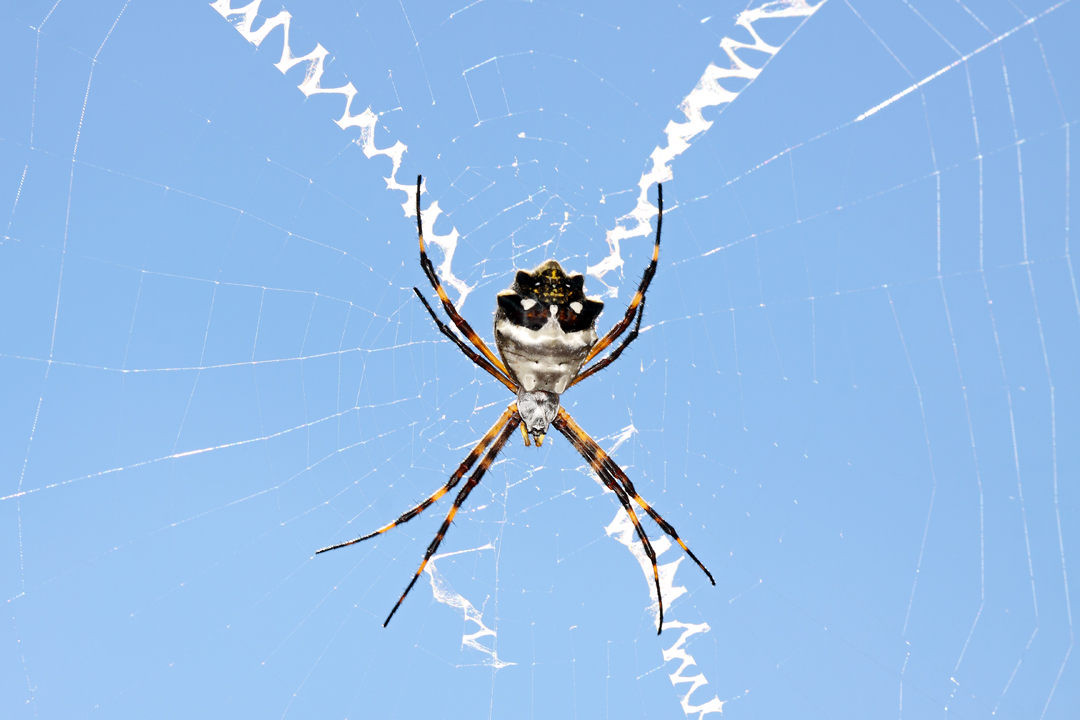
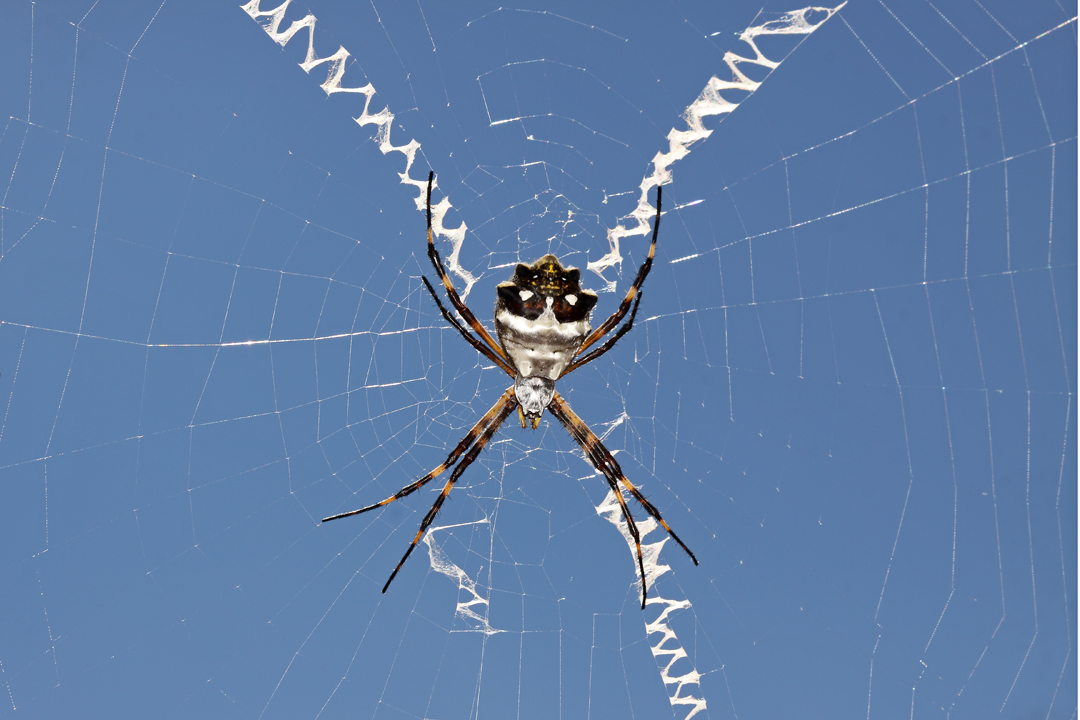
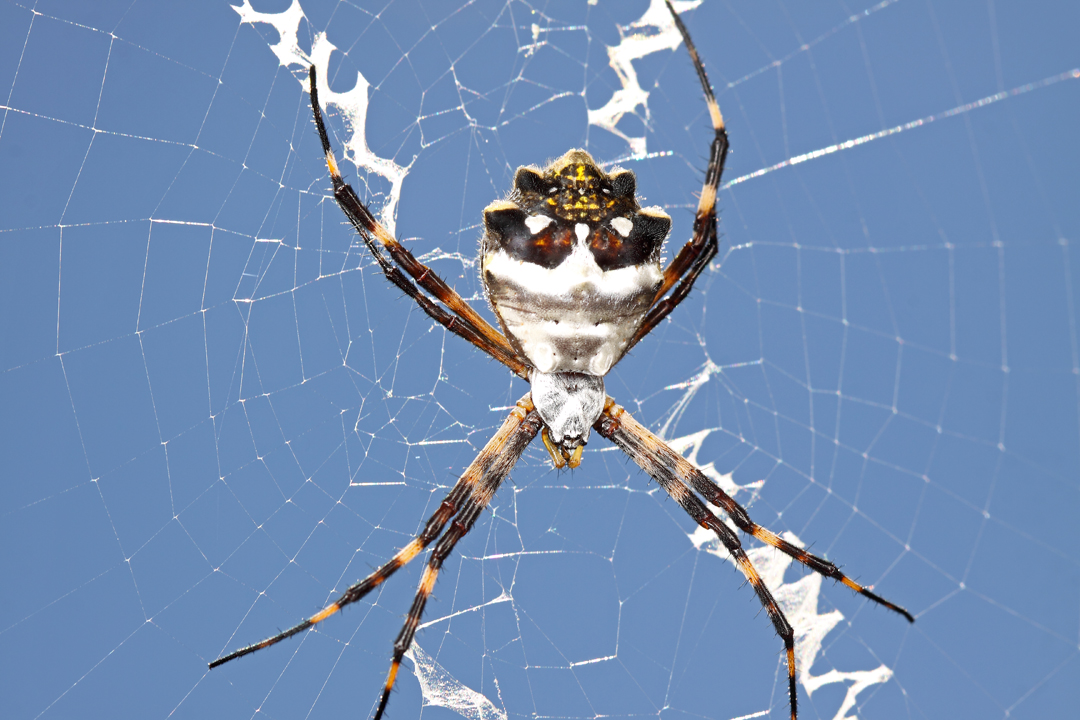
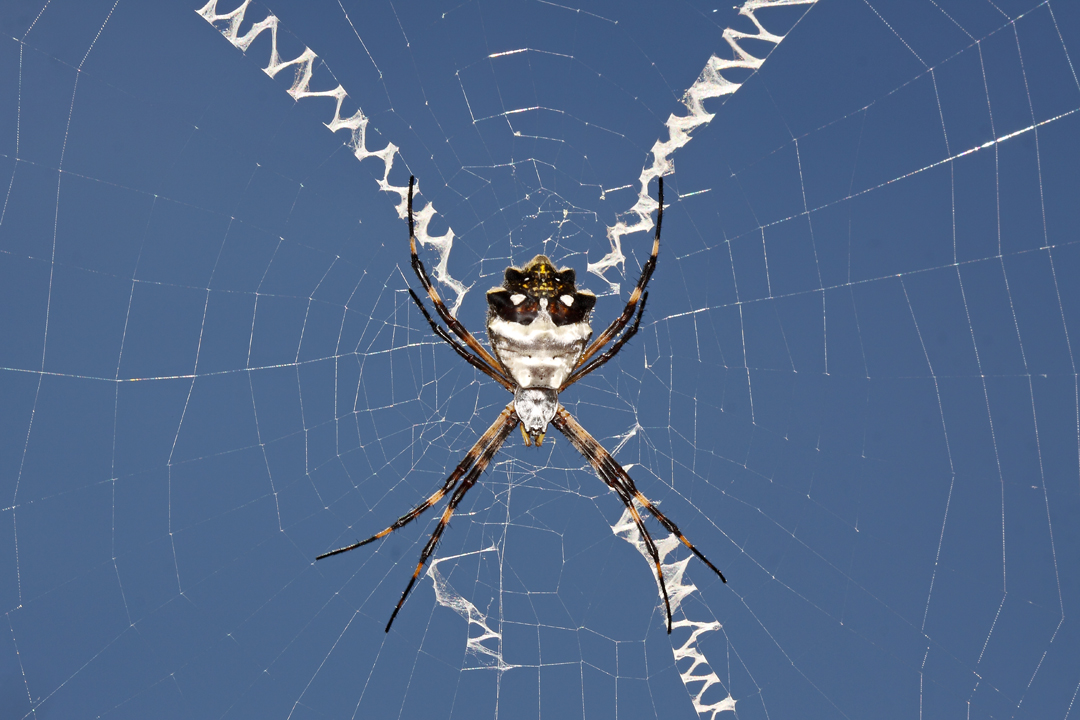
Argiope argentata (silvery argiope) | Santa Fe Province, Argentina

Choice of background to a large degree reflects the style of the photographer. Some may choose a particular color based purely on aesthetics, but as an in situ macrophotographer I prefer backgrounds that are consistent with the natural history of the subject—diffuse green for subjects typically seen on foliage, gray or brown for those typically found crawling on trunks and branches, and sky blue for those found out in the open (e.g., perched atop flowers). Each of these backgrounds requires different technique, and this large orb weaver, Argiope argentata (silvery argiope), which I encountered in a corn field near Villa Cañas (Santa Fe Province, Argentina) back in April, is an example of the latter. In contrast to the strictly nocturnal orb weaver (Eriophora ravilla) in my previous post, this species and its congeners are commonly seen suspended on their webs in broad daylight. BB worked well with E. ravilla, but it would not be a good choice for A. argentata due to the large amount of dark coloring on the subject. More importantly, it contradicts this spider’s diurnal nature. I could have used natural light, but the sun was shining on the other side of the spider. However, this actually made it easier to achieve the blue sky background while illuminating the subject with flash. The large size of the spider (the body alone measured ~35 mm in length) put a lot of distance between the subject and the lens, which allowed the use of a larger aperture (f/10) with still acceptable depth-of-field. With a bright sky and the sun nearly behind the spider, I was able to keep a low sensitivity setting (ISO 100) to prevent graininess and a fast shutter speed (1/250 sec) to prevent motion blur. The slightly larger aperture was all that was needed to achieve a natural blue sky color in the background. More difficult was actually clearing the background between the spider and the sky, as the web was slung low amongst the tall corn plants. The series of photos below (click to enlarge) shows the results of my earlier attempts to photograph the spider; at first not thinking about the distracting corn plants, and then trying to avoid them by angling myself lower relative to the spider, which ultimately resulted in a bad angle on the spider:

I finally decided to just break over the offending corn plants (above the ears!) to clear the background and give me the angle that I preferred. After that I was able to snap away to my heart’s content. Here is a closer view of the spider:

Lastly, I show the following series of photos to demonstrate the dramatic effect that aperture can have on a blue sky background. If you have a bright sky and don’t need a lot of DOF (e.g., you have a large subject-to-lens distance or a small subject lying within a narrow plane), adjusting the aperture up or down is a great way to achieve the precise color of blue desired. Larger apertures (lower f values) will result in a paler blue color, while smaller apertures (higher f values) create a deeper blue. In the photos below (click to enlarge), flash and camera settings are the same as those mentioned above except aperture: f/10 (left), f/13 (center) and f/16 (right).

Copyright © Ted C. MacRae 2012
Poised for the bounty

Misumenops pallidus on soybean | Santa Fe Province, Argentina

By mid-April I was near the end of my 8-week stay in Argentina. One of the more enjoyable tasks during this time was to go back out and visit some of the soybean fields that I had seen earlier in the season. I enjoy watching the progression of soybeans over time—both in plant phenology and in the guilds of insects present. Defoliating caterpillars like Rachiplusia nu (oruga medidora) and Anticarsia gemmatalis (oruga de las leguminosas) abound during the late vegetative and early to mid-reproductive stages of growth, feeding day and night on the lush, green foliage. As the days grow shorter and cooler, the soybean fields slowly morph from dark green to tawny-yellow, and leaf-feeding guilds give way to seed-feeding stink bugs like Piezodorus guildinii (chinche de las leguminosas) and Nezara viridula (chinche verde).

Ever present amongst the plant-feeding insects are their natural enemies, with spiders being among the more numerous predators. This small (~10 mm length) crab spider (family Thomisidae) was seen in a soybean field in Santa Fe Province with the plants at R6 stage of growth (pods completely filled). I’m fairly certain it represents Misumenops pallidus based on its close resemblance to the spider in this photo. Piezodorus guildinii stink bugs were especially abundant, and just as the crop of newly hatched nymphs was poised to take advantage of the fat, juicy seed pods, this spider seemed poised and ready to take advantage of the fat, juicy nymphs. In fact, M. pallidus is the most abundant crab spider in soybean agroecosystems in the Humid Pampas of Argentina (Liljesthröm et al. 2002), which as a group comprise nearly half of all spiders in those systems (González et al. 2009). Perhaps one reason for this is their generalist prey selection tendencies, feeding on prey species such as R. nu and P. guildenii when they are abundant and switching to non-pest prey species (except the heavily sclerotized weevils and the large and noxious adults of N. viridula) when they are absent (González et al. 2009).

REFERENCES:

González, A., G. Liljesthröm, E. Minervino, D. Castro, S. González & A. Armendano. 2009. Predation by Misumenops pallidus (Araneae: Thomisidae) on insect pests of soybean cultures in Buenos Aires Province, Argentina. The Journal of Arachnology 37:282–286.

Liljesthröm, G., E. Minervino, D. Castro & A. González. 2002. La comunidad de arañas del cultivo de soja en la provincia de Buenos Aires, Argentina. Neotropical Entomology 31:197–209.

Copyright © Ted C. MacRae 2012

Cosmetid harvestman with parasitic/phoretic mites in Argentina

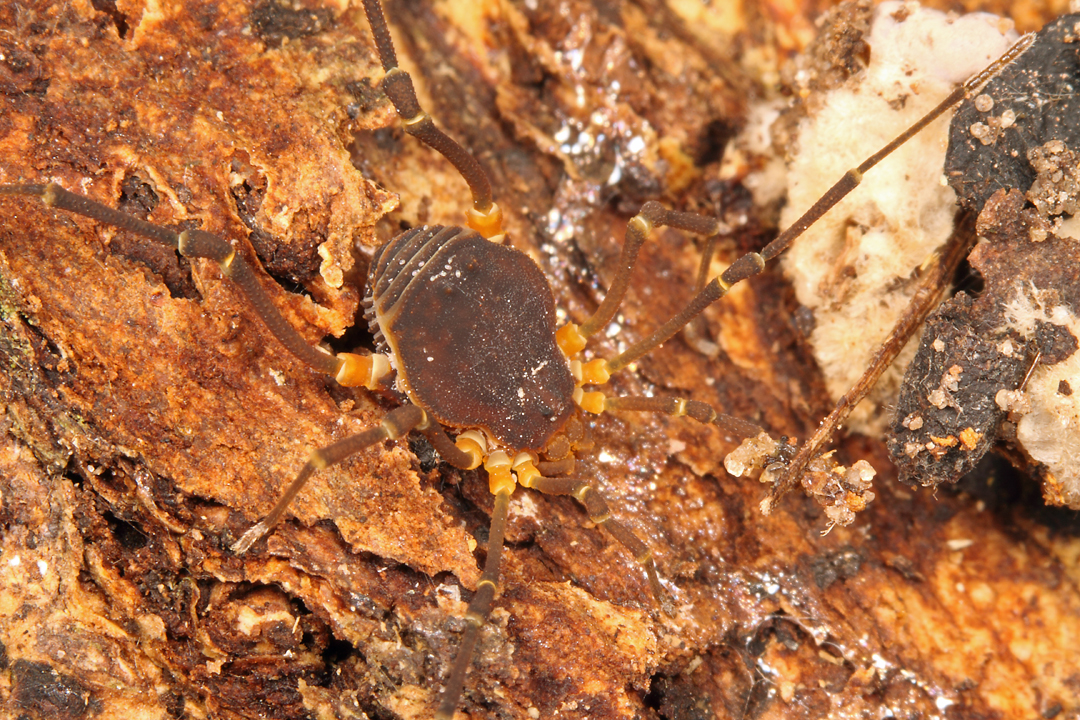
Metalibitia sp. poss. paraguayensis | Corrientes Province, Argentina

While searching logpiles last month in a relatively intact tract “Selva Paranaense” near Paso de la Patria (Corrientes Prov., Argentina), the most interesting find for me was , a bizarre longhorned beetle that is either amazingly cryptic or a curious mimic (I couldn’t decide). There wasn’t much else to be seen in the logpiles—it had been a very dry summer in northern Argentina, but I did find this interesting species of harvestman (class Arachnida, order Opiliones) huddled together in one of the punkier piles of wood.

Knowing little about harvestman taxonomy (but knowing of several specialists who do), I sent the photos around for expert opinion. Everyone responded with the same opinion—family Cosmetidae, apparently distinguished by its spoon-shaped pedipalps. Marshal Hedin compared them to this similar-looking species photographed in Bolivia, Christopher Taylor (Catalogue of Organisms) thought they might be a species of Metalibitia and Ricardo Pinto-da-Rocha suggested M. paraguayensis as having been recorded from the province of Corrientes (although a specimen would need to be examined to confirm the identification). My thanks to each of these gentlemen for weighing in on a possible ID.

Argentina represents the southernmost extent of this strictly New World family of harvestmen, while to the north the family extends up to the southern U.S. (genus Vonones). In between, the family is diverse and comprises up to one-third to one-half of the harvestman fauna (Kury & Pinto-da-Rocha 2007). Many species in the family are ornately marked, giving rise to the family name which is derived from the Greek kosmetós (= ornate)—check out this gallery of photos at Flickr to see some truly spectacular examples.

While I was photographing these individuals, and even when I first began processing the photos, I thought that they were quite dirty and debated whether to clean them in PhotoShop. Then I realized that the numerous white spots were not debris, but mites! Whether these represent a parasitic or phoretic relationship is not clear to me, however, and none of the gentlemen I sent the photos to offered any comment about them. Erythraeid and thrombidiid mites are well documented as harvestman ectoparasites during their larval stage, with recorded hosts including Neotropical species of Cosmetidae (Townsend et al. 2008). The tiny, white mites on these individuals, however, do not resemble the large, red erythraeid mites (probably genus Leptus) that I have seen parasitizing our North American harvestman species, and their numbers on multiple individuals is, to me, more indicative of a phoretic relationship. If you want to become thoroughly confused by the tremendous diversity of mites the parasitize harvestmen, see the comprehensive review by Cokendolpher (1993).

REFERENCES:

Cokendolpher, J. C. 1993. Pathogens and parasites of Opiliones (Arthropoda: Arachnida). The Journal of Arachnology 21:120–146.

Townsend, V. R., D. N. Proud, M. K. Moore, J. A. Tibbetts, J. A. Burns, R. K. Hunter, S. R Lazarowitz & B. E. Felgenhauer. 2008. Parasitic and phoretic mites associated with Neotropical harvestmen from Trinidad, West Indies. Annals of the Entomological Society of America 101(6):1026–1032.

Kury, A. B. & R. Pinto-da-Rocha. 2007. Cosmetidae Koch, 1839. Pp 182–185. In: R. Pinto-da-Rocha, G. Machado & G. Giribet (Eds.). Harvestmen: The Biology of the Opiliones. Harvard University Press, Cambridge and London, x + 597 pp.

Copyright © Ted C. MacRae 2012
Maddening mutillid

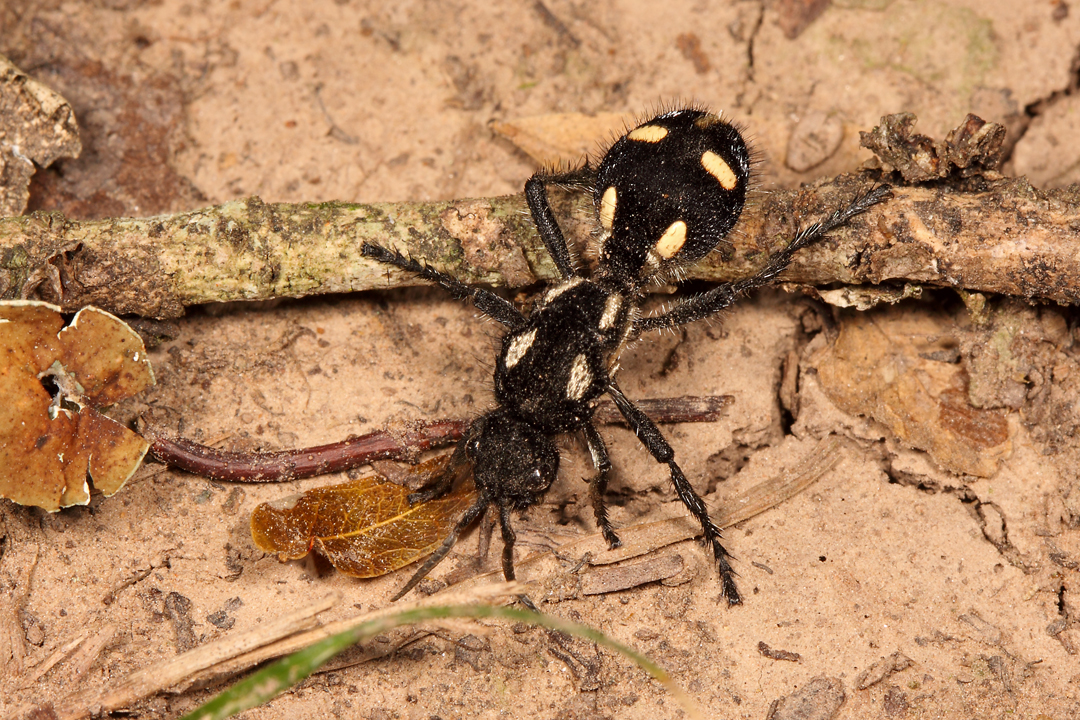
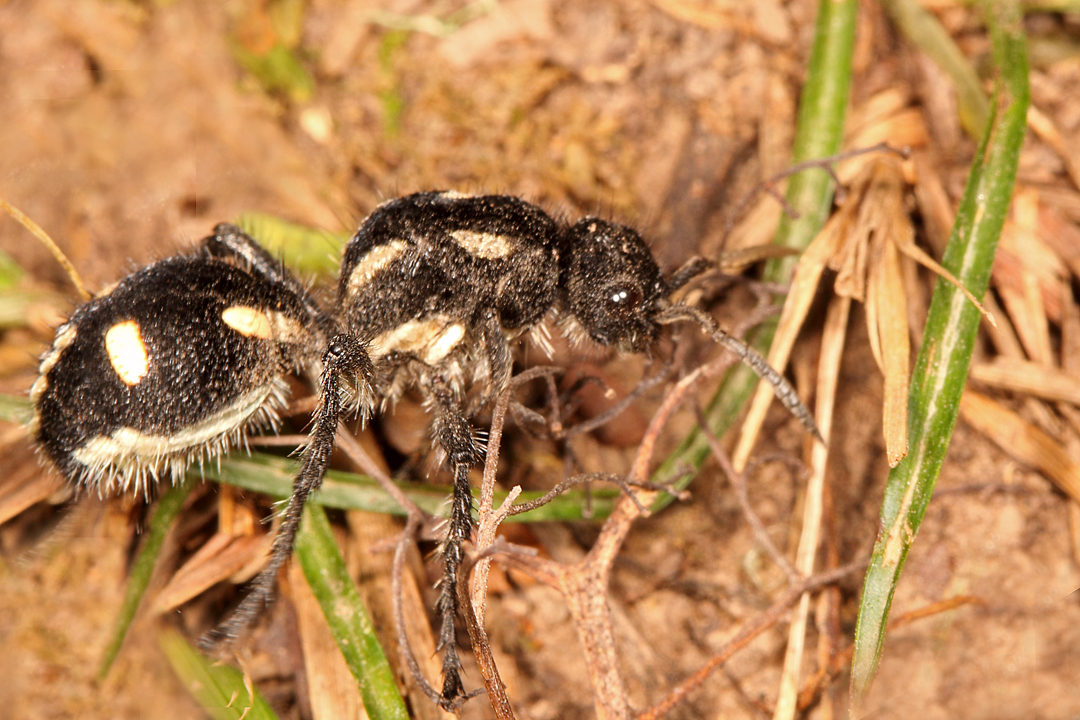
Traumatomutilla graphica (Gerstaecker, 1874) | Parque Nacional Chaco, Argentina

During my stay in Corrientes, Argentina, I had two distinct biomes to explore—the relatively moist “Selva Paraguayense” to the east in Corrientes Province (a southern adjunct to the Atlantic Forest of southeastern Brazil, and home to the cryptic longhorned beetle that I featured in Desmiphora hirticollis: Crypsis or Mimicry?), and the drier “Gran Chaco” to the west, home of the insect featured in today’s post. Precious few remnants remain of the original Gran Chaco, which once covered nearly 1 million square kilometers in northern Argentina, Paraguay and Bolivia and the best example of which can be found at Parque Nacional Chaco in north-central Argentina. I’ve already mentioned that conditions are typically quite dry by early April in northern Argentina, and this is especially true of Chaco Province, where droughts during the months of January through March are common. As a result, I didn’t expect to see much insect activity during my visit last month. For the most part this was true, but one insect I did see at several points along the trails through the park was this rather large velvet ant (order Hymenoptera, family Mutillidae). Not an ant, of course, but a true wasp, these insects must be treated with respect as they are capable of delivering a painful sting. This, combined with their ceaseless, erratic wanderings makes them incredibly difficult to photograph. However, with few other insects to see, I thought I would spend the time and effort to see if I could get some good field photographs of this very attractive species. I spent about half an hour attempting to photograph it by panning through the viewfinder while getting closer and adjusting the focus on the move, and then firing shots when I thought I might be close enough and had the individual more-or-less within the frame. This was wildly unsuccessful, as I had only a 3-ft wide path within which to work and had to constantly get up to block its escape into the adjacent vegetation. Moreover, it was exhausting! The constant moving and body contortions while in crouched or kneeling positions used muscles I didn’t even know I had (but was well aware of the following day by their soreness!). Out of the countless shots that I fired, these two photographs are the only ones that I consider worthy of posting—pretty good, but not great.

The distinctive color pattern is diagnostic for the species.

According to Kevin Williams (many thanks!), the distinctive color pattern readily identifies this individual as Traumatomutilla graphica (Gerstaecker, 1874). Nearly the size of our common eastern North American Dasymutilla occidentalis (a.k.a., cow killer), the bold, conspicuous patterning surely must serve as advertisement of its powerful defensive capabilities—I know I was deterred from trying to handle it. Kevin mentions it as a “great find!” and that the male of the species is still unknown, and I could find nothing about the biology of this species. However, mutillids in general are known to develop as external parasitoids of various wasps, bees, beetles and flies, the excessively long female ovipositor enabling piercing of host nest cells before injecting their powerful venom and placing the eggs (Hogue 1993).

REFERENCE:

Hogue, C. L. 1993. Latin American Insects and Entomology. University of California Press, Berkeley and Los Angeles, 536 pp.

Copyright © Ted C. MacRae 2012

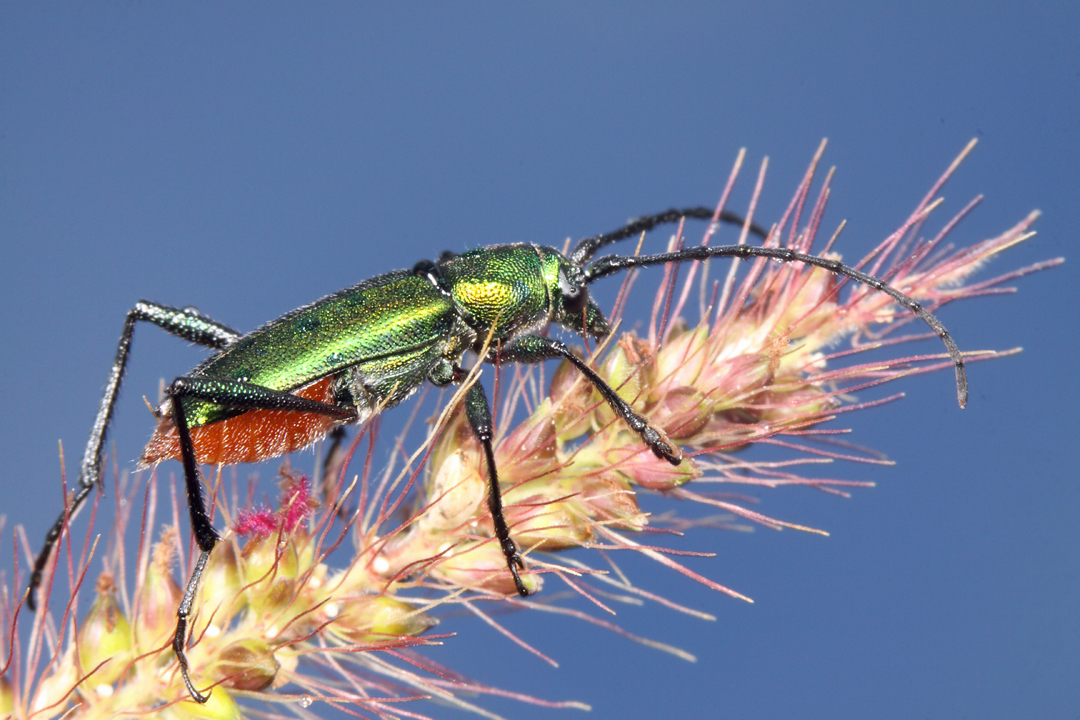
Aglaoschema rufiventre in Chaco, Argentina

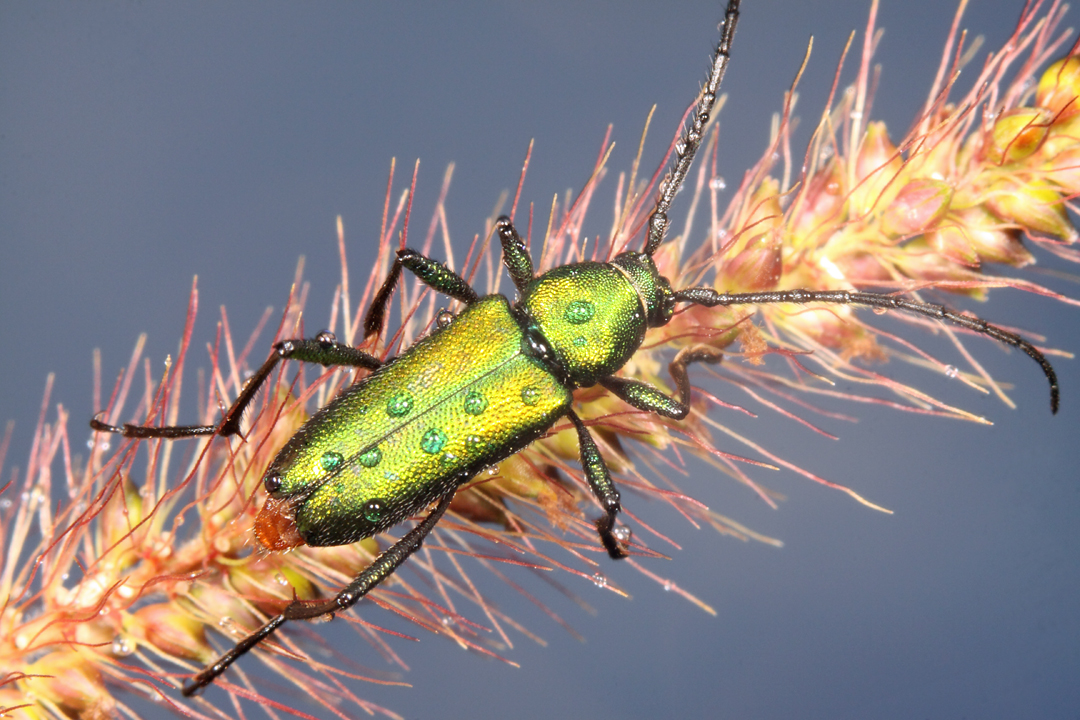
Aglaoschema rufiventre | Chaco Province, Argentina

I’ve mentioned a few times that April is not a very good time to look for beetles in northern Argentina, as the months preceding April are typically hot and dry. September through January would be a much better time, especially to look for the wood boring beetles (families Buprestidae and Cerambycidae) that I am so fond of. Still, if I am in Argentina in April then I must look for beetles in April, and while I didn’t see a single buprestid during my week in Corrientes and Chaco Provinces last month I did a fair number of cerambycid beetles on stands of goldenrod (Solidago chilensis) at a few localities in Chaco Province. One particularly common species was Aglaoschema rufiventre, a beautiful metallic green species with, you guessed it, a red abdomen. Aglaoschema is a rather large (27 species), exclusively Neotropical genus whose members superficially resemble the diurnal, brightly colored species of the tribe Trachyderini but actually belong to the tribe Compsocerini. Most of the species occur in Brazil, but six extend further south into Argentina. Of these, A. rufiventre most resembles A. haemorrhoidale and A. ventrale but is distinguished by its subcylindrical antennal scape—or first segment (clavate in A. ventrale) and non-roughened elytra (roughened—or “asperate”—in A. hemorrhoidale) (Napp 2007). No hosts have been reported for A. rufiventre (Monné 2001), so my finding of adults on flowers of S. chilensis seems to be the first reported host association for the species.

The species name refers to its “red belly”

I photographed several of these beetles on S. chilensis flowers at two locations in Chaco Province along Ruta 16 west of Resistencia, but I was generally unsatisfied with how the photos turned out. The combination of the beetles’ metallic sheen and the bright yellow color of the flowers made getting the right exposure and lighting difficult—I either blew out the yellow on the flowers or ended up with deep shadows on the beetles. One morning I encountered this female sitting on the seed head of an grass unidentified grass. Torpid from the cool temperatures and covered in morning dew, she was a most cooperative subject, and the colors of the seed head turned out to be much more complimentary for photographing the beetle that the bright yellow goldenrod flowers.

REFERENCES:

Monné, M. A. 2001. Catalogue of the Neotropical Cerambycidae (Coleoptera) with known host plant—Part I: Subfamily Cerambycinae, tribes Achrysonini to Elaphidiini. Publicações Avulsas do Museu Nacional 88:1–108.

Napp, D. S. 2007. Revisão do gênero Aglaoschema Napp (Coleoptera, Cerambycidae). Revista Brasileira de Zoologia 24(3):793–816.

Copyright © Ted C. MacRae 2012

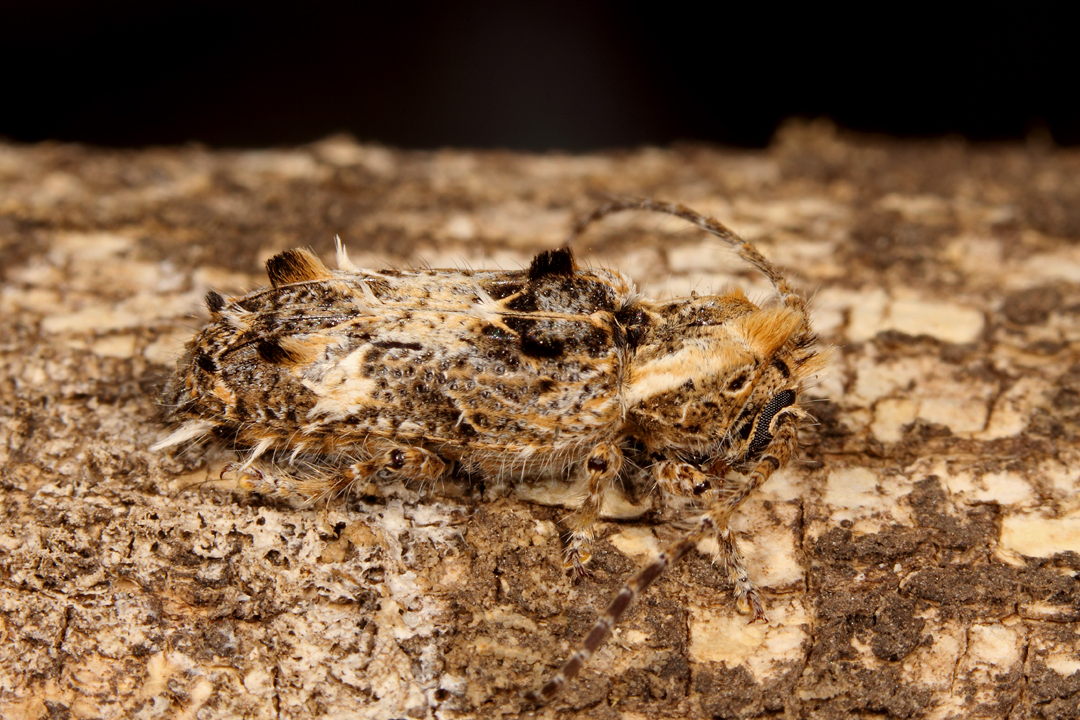
Desmiphora hirticollis: Crypsis or Mimicry?

During my stay in Corrientes, Argentina last month, I was invited to spend the day with a colleague at his “camp” in Paso de la Patria. Located on the banks of the massive Rio Paraná at its junction with the Rio Paraguay, this small resort community boasts large tracts of relatively intact “Selva Paranaense,” which together with the Atlantic Forest in southeastern Brazil forms the second largest forest ecozone in South America outside of the Amazon. As my colleague skillfully prepared matambre, chorizo, and vacío (typical cuts of meat in Argentina) on the parilla (wood grill) at his camp, I explored the surrounding forest for insects. Early April is late in the season, and with generally droughty conditions in the area for the past several months there were few insects to be found. My luck improved, however, when I came upon a small area with stacks of fresh cut logs from recent wood cutting operations scattered through the area. Wood boring beetles (families Buprestidae and Cerambycidae) are often attracted to such wood piles, so approached each one slowly to look for day-active species of these beetles. After inspecting several piles without seeing anything on them, I began carefully turning over the logs to look for nocturnal species that tend to hide on the undersides during the day. Shortly I came across this highly cryptic species of cerambycid, and further searching revealed a fair number of these beetles hiding within the dozen or so log piles that I examined.

Desmiphora hirticollis on freshly cut guayabi (Patagonia americana) | Corrientes Prov., Argentina

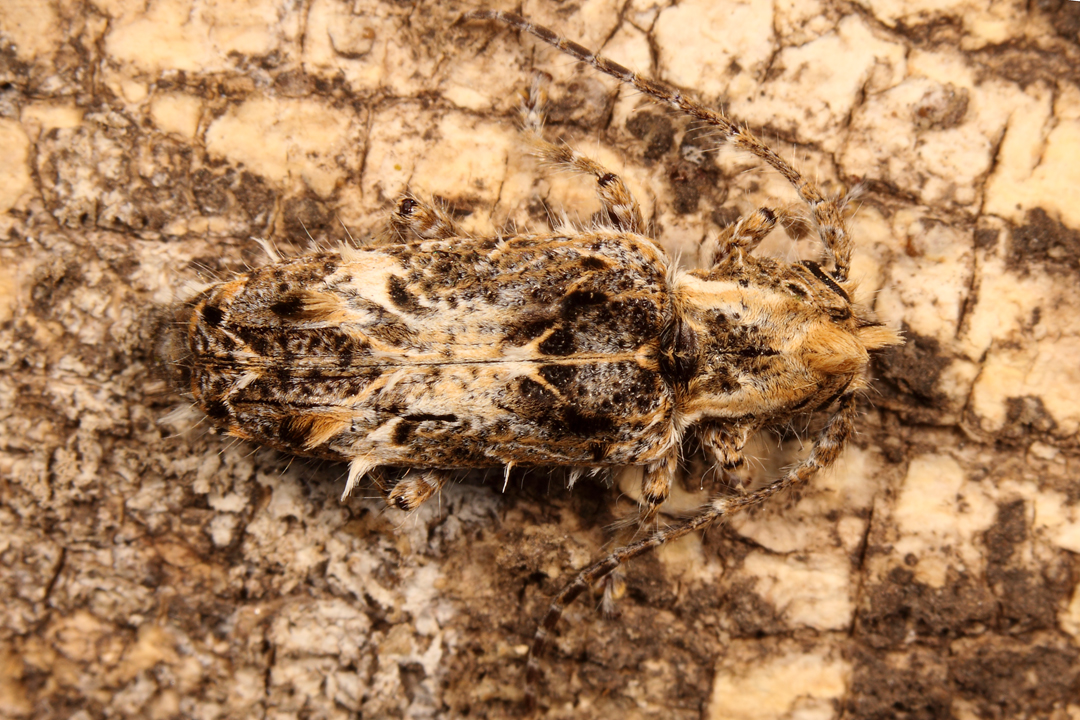
I instantly recognized the genus as Desmiphora, an exclusively New World genus characterized by the presence of fasciculate tufts (or “pencils”) of erect or suberect hairs. Most of its nearly 50 species occur in Brazil, but two species extend as far north as southern Texas (Giesbert 1998). One of these is Desmiphora hirticollis, a widespread species found as far north as Corpus Christi, Texas and as far south as Bolivia and Argentina. I thought these beetles looked an awful lot like that species, and I later confirmed its identity as such due to its piceous (glossy brownish black) integument and the presence of small black pencils just before the elytral apices.

Adults are nearly impossible to see from overhead due to cryptic coloration…

The wood piles contained logs from several tree species, but all of the beetles that I encountered were on logs of guayaibi (Patagonula americana), a member of the family Boraginaceae and a characteristic component of Selva Paranaense (also an important timber species in Argentina). The number of individuals that I found and their occurrence only on guayaibi suggests it serves as a larval host for the beetle. Duffy (1960) described the larva from specimens collected out of Sapium sp. (family Euphorbiaceae), but in Texas this species is collected most often on Cordia spp. and Ehretia anacua (Rice et al. 1985)—both in the family Boraginaceae—with adults having been reared from Cordia eleagnoides (Chemsak & Noguera 1993).

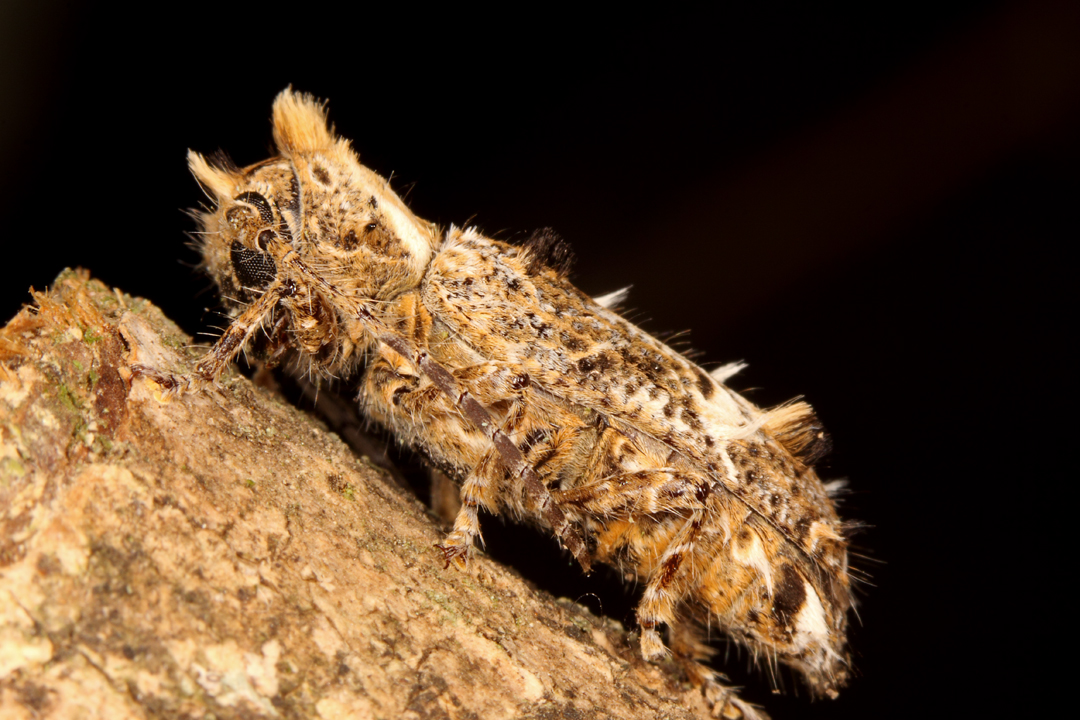
…while the hair tufts may function in obscuring the body outline…

It seems obvious that coloration of the beetle and its pencils of hair function in crypsis. From overhead the beetles are almost impossible to discern as they sit motionless on the similarly colored bark of their host trees. Even in profile or oblique views where the body becomes somewhat more visible, the pencils seem to break up and obscure the outline of the body. I wonder, however, if crypsis is the only function of the pencils—Belt (2004) described the strong resemblance of another species in the genus, D. fasciculata—a similarly penicillate species, to short, thick, hairy caterpillars (insectivorous birds often refuse to prey upon hairy species of caterpillars). That species can be seen sitting openly on foliage during the day, while D. hirticollis seems to be strictly nocturnal; however, cryptic and mimetic functions need not be mutually exclusive, so perhaps for this species the pencils function a little for both.

…or perhaps even mimicking ”hairy” caterpillars.

REFERENCES:

Belt, T. 2004. The Naturalist in Nicaragua. Project Guttenberg eBook.

Chemsak, J. A. & F. A. Noguera.  1993.  Annotated checklist of the Cerambycidae of the Estacion de Biologia Chamela, Jalisco, Mexico (Coleoptera), with descriptions of new genera and species.  Folia Entomológica Mexicana 89:55–102.

Duffy, E. A. J. 1960. A Monograph of the Immature Stages of Neotropical Timber Beetles (Cerambycidae). British Museum of Natural History, London. 327 p.

Giesbert, E. F. 1998. A review of the genus Desmiphora Audinet-Serville (Coleoptera: Cerambycidae: Lamiinae: Desmiphorini) in North America, Mexico and Central America. Occasional Papers of the Consortium Coleopterorum 2(1): 27–43.

Rice, M. E., R. H. Turnbow, Jr. & F. T. Hovore. 1985. Biological and distributional observations on Cerambycidae from the southwestern United States (Coleoptera). The Coleopterists Bulletin 39(1):18–24.

Copyright © Ted C. MacRae 2012

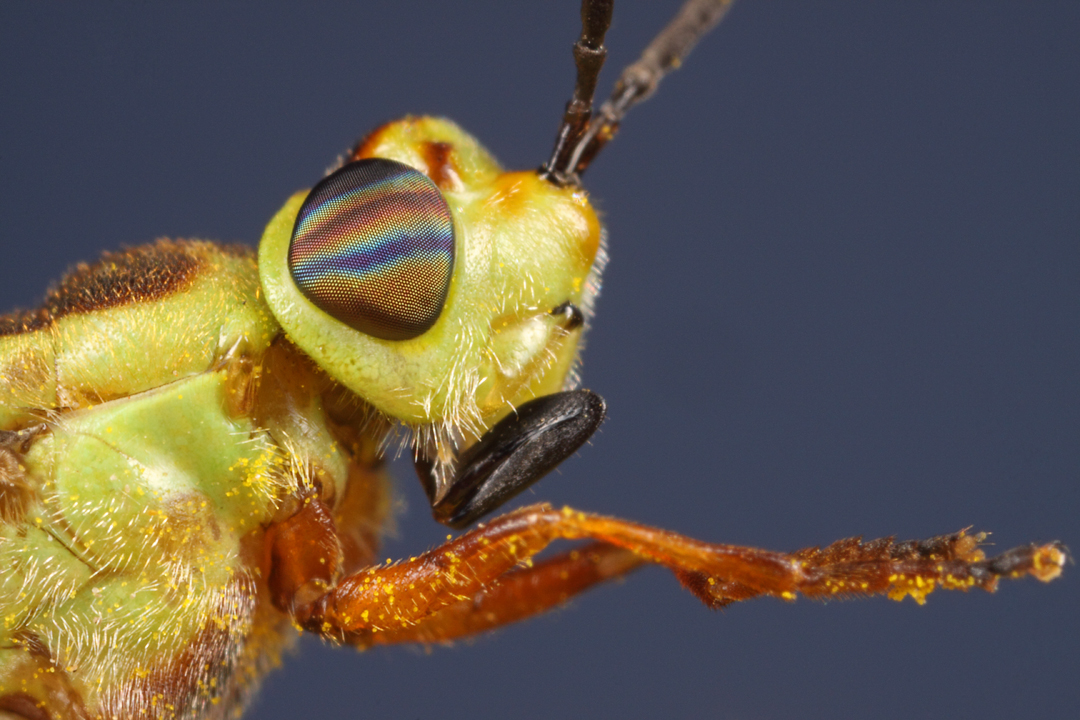
More fly got eye!

Here is another fly photographed during my recent visit to Argentina. I had little doubt when I saw it that it, too, was a member of the family Stratiomyidae; however, unlike the previous species this one was a far more cooperative subject for photographs. I have learned to carry a small utility tool in my pocket that contains an even smaller scissors—these have proven to be quite handy for gently snipping flowers or plant parts on which insects are perched without disturbing them. Holding these detached plant parts in front of the camera has several advantages, including the ability to photograph the subject while standing (or sitting) in a stable, comfortable position, providing more flexibility in choosing the background, and allowing me to “rest” some part of my hand or arm against some part of the camera or flash heads to “fix” the subject-to-lens distance. The fly remained quite calm through all these machinations, allowing me to focus on getting the composition, exposure, background, focus, and other technical aspects of the photos to my liking. Easier said than done of course, but a cooperative subject at least makes it more possible.

Psellidotus? sp. | Corrientes Prov., Argentina

I thought this fly looked an awful lot like our North American species of Odontomyia, so I sent the photos to stratiomyid expert Norman Woodley (Systematic Entomology Laboratory, Smithsonian Institution) for his opinion. Norm wrote back:

The stratiomyid fly…is in the subfamily Stratiomyinae, tribe Stratiomyini, which includes Odontomyia. I think that your fly is in the genus Psellidotus. Psellidotus is similar to another genus, Hedriodiscus…these two are easily separable in the Nearctic Region but the distinction becomes fuzzy in the Neotropics, especially in South America. We don’t have the species you photographed in the USNM collection. The majority of species in Psellidotus and Hedriodiscus in the Neotropics are very poorly known outside of their original descriptions.

Once again… fly got eye!

As before, this stratiomyid also exhibits stunningly patterned eyes, and like nearly all of the examples that I have seen the horizontal nature of the banding suggests an ability to see horizontally polarized light in similar fashion to many species of tabanids (Horváth et al. 2008). Again there seems to be a link between the ability to see horizontally polarized light and insects with aquatic lifestyles, as such visual capabilities have been demonstrated for a variety of other aquatic insects. While the biologies of most Neotropical stratiomyid species remain unknown, larvae of the subfamily Stratiomyinae are (like tabanid larvae) known to be aquatic (Brown 2009). Stratiomyine adults that exhibit these horizontal banding patterns may, like tabanids, also be able to see horizontally polarized light, which would be useful for finding mates and suitable sites for laying eggs.

REFERENCE:

Brown, V. B. 2009. Manual of Central American Diptera, Volume 1. NRC Research Press, 714 pp.

Horváth, G., J. Majer, L. Horváth, I. Szivák & G. Kriska. 2008. Ventral polarization vision in tabanids: horseflies and deerflies (Diptera: Tabanidae) are attracted to horizontally polarized light. Naturwissenschaften 95:1093–1100.

Copyright © Ted C. MacRae 2012