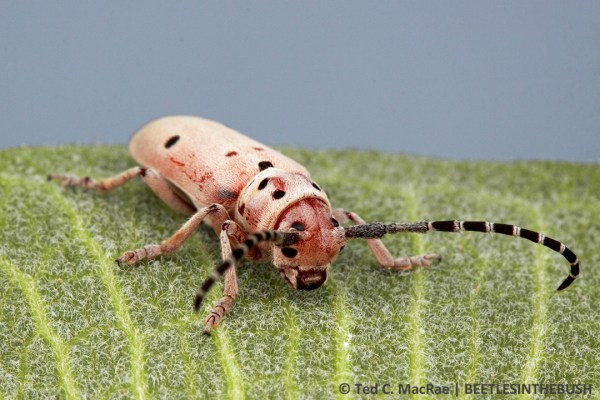
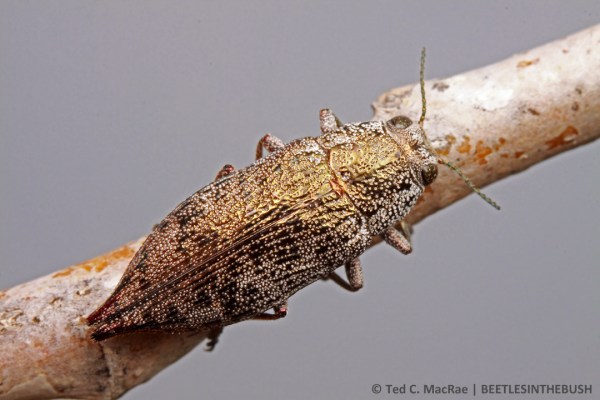
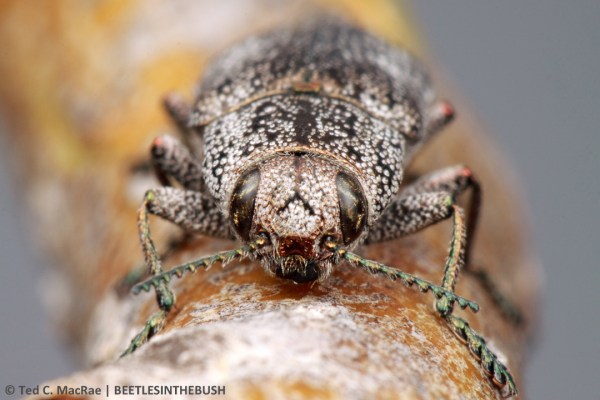
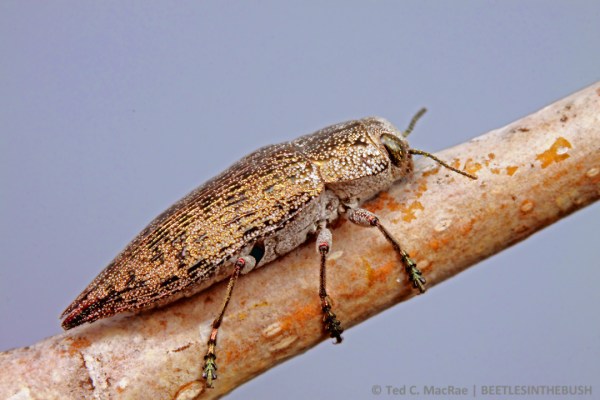
Review of North American Chalcophora

The latest issue of The Coleopterists Bulletin arrived in my mailbox recently, and among the several papers of interest to me is a review of the North American species of the jewel beetle genus Chalcophora¹ (family Buprestidae). This genus contains some of the largest jewel beetles in North America and, due to their surface sculpturing and strict association with pine trees, are commonly referred to as “sculptured pine borers.” Four of the five species occur in the eastern U.S. and Canada, while only one, C. angulicollis, is found in the western states and provinces.

¹ I’d be interested to know how people pronounce this name. I’ve always pronounced it “kal-koh-FOR-uh”, but I’ve heard others use “kal-KAW-for-uh” or even “chal-KAW-for-uh.”

The review, authored by Crystal Maier and Mike Ivie at Montana State University, should put to rest a long-standing debate on the validity of the single western species. The four eastern species are distinct and easily distinguished from each other by virtue of color, presence/absence of ridges on the front legs, presence/absence of spines at the elytral apices, and, of course, male genitalia. Chalcophora angulicollis, on the other hand, has drifted in and out of synonymy under C. virginiensis, the most widespread of the four eastern species. The most recent changes in status were Bright (1987), who regarded C. angulicollis a synonym and treated all Canadian populations as C. virginiensis, followed by Nelson et al. (2008), who reinstated the former as a valid species. Neither of these actions were supported by any discussion of characters or detailed justification.

Chalcophora spp. (Maier & Ivie 2013)

Figs. 1–5. Chalcophora species, habitus. 1) C. virginiensis, Arkansas; 2) C. angulicollis, Idaho; 3) C. liberta, Wisconsin; 4) C. georgiana, Florida; 5) C. fortis, New York. Source: Maier & Ivie (2013).

My impression has always been that the two species are distinct, and I have maintained specimens separately in my collection despite Bright’s synonymy. Chalcophora angulicollis always seemed to me a little more cupreous in coloration and a little more robust. I know that these are weak characters, and they can easily be a result of geographical variability within a species. However, considering the wide and nearly complete disjunction between the distributions of these two species across the nearly treeless Great Plains, it seemed to me prudent to consider them distinct until conclusively proven otherwise. I was therefore pleased to find out that my suspicions were correct when I visited Mike Ivie in Bozeman, Montana this past summer and learned of this manuscript in progress. Mike and his graduate student Crystal had found a morphological difference in the mouthparts that consistently distinguished the two species—C. angulicollis with the penultimate maxillary palpomere flattened and relatively shorter, while in C. virginiensis this structure is cylindrical and relatively longer. Correlated with these structural differences in the mouthparts are the relatively wider male genitalia of C. angulicollis (<3.3 times as long as wide, versus >3.9 times as long as wide for C. virginiensis) and its weakly serrate to crenulate posterolateral elytral margin (weakly to strongly serrate in C. virginiensis).

In addition to reevaluating the status of C. angulicollis and C. virginiensis, the paper provides high quality images of the dorsal habitus (see figure above), elytral apices, and male genitalia for all five North American species, a revised key to the species, and an updated distribution map showing locality/state records for the two aforementioned species in the context of forest cover in North America. Type material also was examined for all species, each of which is redescribed and annotated with abbreviated taxonomic synonymy (complete synonymies are available in other recent publications), notes on variation, comparisons with other species, and recorded hosts and distributions.

REFERENCE:

Bright, D. E. 1987. The Metallic Wood-Boring Beetles of Canada and Alaska. Coleóptera. Buprestidae. The Insects and Arachnids of Canada, Part 15. Agriculture Canada Publication 1810, NRC Research Press, Ottawa, 335 pp. [pdf].

Maier, C. A. & M. A. Ivie. 2013. Reevaluation of Chalcophora angulicollis (LeConte) and Chalcophora virginiensis (Drury) with a review and key to the North American species of Chalcophora Dejean (Coleoptera: Buprestidae). The Coleopterists Bulletin 67(4):457–469 [abstract].

Nelson, G. H., G. C. Walters, Jr., R. D. Haines, & C. L. Bellamy.  2008.  A Catalogue and Bibliography of the Buprestoidea of American North of Mexico.  Coleopterists Society Special Publication No. 4, The Coleopterists Society, North Potomac, Maryland, 274 pp. [description].

Copyright © Ted C. MacRae 2014

Best of BitB 2013

Welcome to the 6th Annual “Best of BitB”, where I pick my favorite photographs from the past year. Like last year, 2013 was another year of heavy travel. For work I did my annual tour of soybean field sites throughout Argentina during late February and early March, then cranked it up for my own field season with frequent travel to sites in Illinois and Tennessee from May to October. In the meantime I spent a week at company meetings in Las Vegas in August, toured field sites across the southeastern U.S. for two weeks in September, visited Argentina again in October to finalize research plans for their upcoming season, and finished off the travel year by attending the Entomological Society of America (ESA) Meetings in Austin, Texas during November. On top of all this, I managed to slip in two of the best insect collecting trips I’ve had in years, with 10 days in northwestern Oklahoma in early June and another 10 days in California, Nevada, Utah, and Colorado during late August, and I got to play “visiting scientist” during short trips to Montana State University in late July and the Illinois Natural History Survey in late October! Of course, during my brief interludes at home I wasn’t sitting still, giving entomology seminars to several local nature societies and hosting two ESA webinars on insect photography. Needless to say, come December I was more than ready to spend some quite time at home (well, except for hiking most weekends) and am happy to report that I’ve successfully become reacquainted with my family and office mates. It’s a peripatetic life—and I wouldn’t have it any other way!

Okay, let’s get down to business. Here are my favorite BitB photographs from 2013. This year was less about learning new techniques as it was about refining the techniques I’ve found most useful for the style I’ve chosen as a photographer, i.e., hand-held, in situ field shots that (hopefully) excel at both natural history and aesthetic beauty. Links to original posts are provided for each photo selection, and I welcome any comments you may have regarding which (if any) is your favorite and why—such feedback will be helpful for me as I continue to hone my craft. If you’re interested, here are my previous years’ picks for 2008, 2009, 2010, 2011, and 2012. Once again, thank you for your readership, and I hope to see you in 2014!


Tremex columba, female ovipositing | Sam A. Baker State Park, Missouri

Tremex columba female drilling for oviposition into hardwood trunk | Sam A. Baker State Park, Missouri

From Ovipositing Pigeon Horntail (posted 6 Jan). I like this photo for the combination of vibrant, contrasting colors between the wasp and moss-covered wood and the visualization it provides of the remarkable depth to which this wasp will insert its ovipositor into solid wood!


Eurhinus cf. adonis on Solidago chilensis | Chaco Province, Argentina

Eurhinus cf. adonis on Solidago chilensis flowers | Chaco Province, Argentina

From Giving me the weevil eye! (posted 28 Apr). While a little soft, the color combination is pleasing and the pose taken by the beetle almost comically inquisitive.


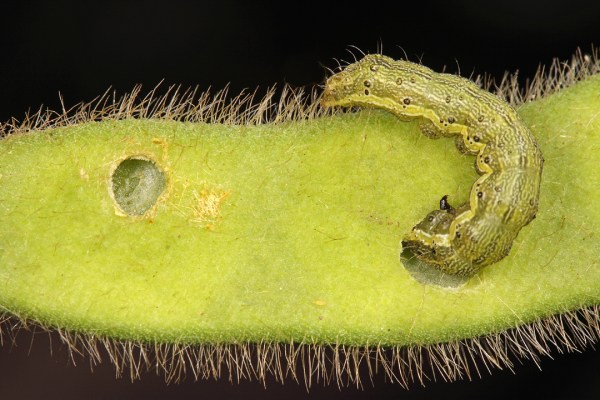
Helicoverpa gelotopeon feeding on soybean pod | Buenos Aires Prov., Argentina

Helicoverpa gelotopeon feeding on soybean pod | Buenos Aires Prov., Argentina

From Bollworms rising! (posted 30 Mar). This is the first photo of an economic pest that has made one of my “Best of BitB” lists. The two holes in the soybean pod, one with the caterpillar and its head still completely inserted, visualizes how the feeding habits of these insects can so dramatically affect yield of the crop.


cf. Eremochrysa punctinervis | Gloss Mountains, Major Co., Oklahoma

cf. Eremochrysa punctinervis | Gloss Mountains, Major Co., Oklahoma

From “Blue-sky” tips and tricks (posted 1 July). Insects with a lot of delicate detail and long, thin appendages are especially difficult to photograph against the sky due to wind movement. See how I dealt with the antennae of this delicate lacewing without resorting to the standard black background typical of full-flash macrophotography.


Cicindela scutellaris lecontei x s. unicolor

Cicindela scutellaris lecontei x s. unicolor intergrade | Holly Ridge Natural Area, Stoddard Co., Missouri

From The Festive Tiger Beetle in Southeast Missouri (posted 25 Oct). I like this photo a lot more now than I did when I first took it. Its shadowy feel and the beetle “peering” from behind a leaf edge give a sense of this beetle’s attempts to hide and then checking to see if the “coast is clear”


Batyle suturalis on paperflower (Psilostrophe villosa) | Alabaster Caverns State Park, Woodward Co., Oklahoma

Batyle suturalis on Psilostrophe villosa flowers | Alabaster Caverns State Park, Woodward Co., Oklahoma

From Tips for photographing shiny beetles on yellow flowers (posted 10 Aug). “Bug on a flower” photos are a dime a dozen, but shiny beetles on yellow flowers with natural sky background can be quite difficult to take. All of the techniques for dealing with the problems posed by such a photo came together nicely in this photo.


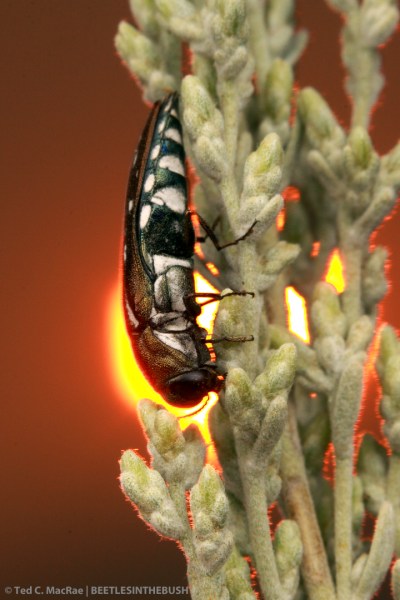
Agrilus walsinghami | Davis Creek Regional Park, Washoe Co., Nevada

Agrilus walsinghami | Davis Creek Regional Park, Washoe Co., Nevada

From Sunset for another great collecting trip (posted 1 Sep). This photo is not without its problems, with a little blurring of the backlit fuzz on the plant, but the placement of the sun behind the subject’s head and resulting color combination make it my favorite in my first attempts at achieving a “sun-in-the-sky” background with a true insect macrophotograph.


A tiny male mates with the ginormous female.

Pyrota bilineata on Chrysothamnus viscidflorus | San Juan Co., Utah

From Midget male meloid mates with mega mama (posted 8 Nov). Another blue-sky-background photograph with good color contrast, its real selling point is the natural history depicted. with some of the most extreme size dimorphism among mating insects that I’ve ever seen.


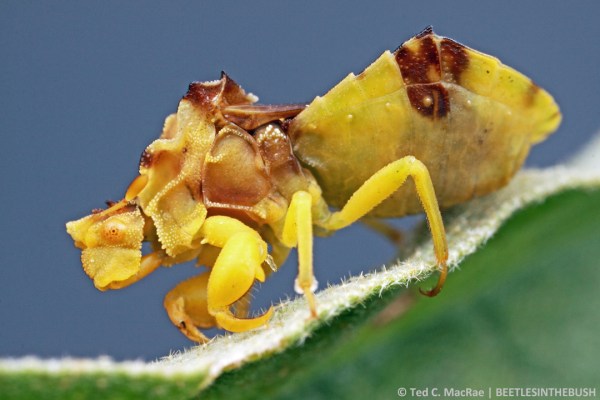
Phymata sp.

Phymata sp. on Croton eleagnifolium foliage | Austin, Texas

From ESA Insect Macrophotography Workshop (posted 13 Nov). The oddly sculpted and chiseled body parts of ambush bugs makes them look like they were assembled from robots. Contrasting the body against a blue sky gives a more unconventional view of these odd beasts than the typical top-down-while-sitting-on-a-flower view.


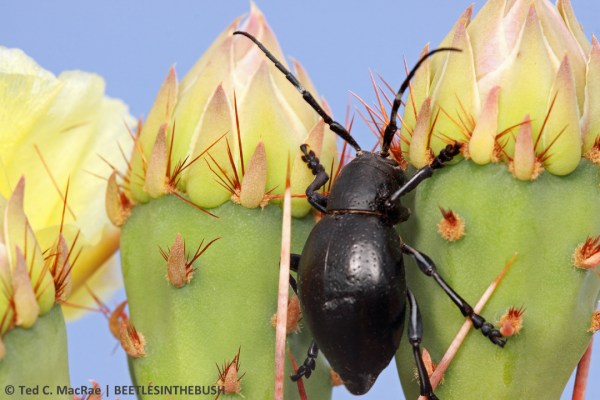
Fourth attempt - holding detached pad up against sky for cleaner background.

Moneilema armata on Opuntia macrorhiza | Alabaster Caverns State Park, Woodward Co., Oklahoma

From Q: How do you photograph cactus beetles? (posted 24 Nov). Photographing cactus beetles requires patience, persistence, long forceps, and strong forearms. Natural sky provides a much more pleasing background than a clutter of cactus pads and jutting spines.


I hope you’ve enjoyed this 2013 version of “Best of BitB” and look forward to seeing everyone in 2014.

Copyright © Ted C. MacRae 2013

Hairy milkweed beetle

Across the Great Plains of North America, sand dune fields dot the landscape along rivers flowing east out of the Rocky Mountains. Formed by repeated periods of drought and the action of prevailing south/southwest winds on alluvium exposed by uplifting over the past several million years, many of these dunes boast unique assemblages of plants and animals adapted to their harsh, xeric conditions. Some are no longer active, while others remain active to this day. Among the latter is Beaver Dunes in the panhandle of northwestern Oklahoma.

Beaver Dunes, Oklahoma

Beaver Dunes State Park, Beaver Co., Oklahoma

As I explored the more vegetated areas around the perimeter of the dunes, I spotted the characteristically hairy, fleshy, opposite leaves of Ascelpias arenaria. Known also as “sand milkweed,” this plant is associated with sand dunes and other dry sandy soil sites throughout the central and southern Great Plains. I always give milkweeds a second look whenever I encounter them due to the association with them by longhorned beetles in the genus Tetraopes. It wasn’t long before I spotted the black antennae and red head of one of these beetles peering over one of the upper leaves from the other side.

Tetraopes pilosus on Asclepias arenaria

Tetraopes pilosus on Asclepias arenaria | Beaver Dunes State Park, Oklahoma

This was no ordinary Tetraopes, however. Its large size, dense covering of white pubescence, and association with sand milkweed told me immediately that this must be T. pilosus (the specific epithet meaning “hairy”). Like its host, this particular milkweed beetle is restricted to Quaternary sandhills in the central and southern Great Plains (Chemsak 1963), and also like its host the dense clothing of white pubescence is presumably an adaptation to prevent moisture loss and overheating in their xeric dune habitats (Farrell & Mitter 1998).

Tetraopes pilosus

Species of Tetraopes have the eyes completely divided by the antennal insertions—thus, “four eyes.”

Tetraopes is a highly specialized lineage distributed from Guatemala to Canada that feed as both larvae and adults exclusively on milkweed (Chemsak 1963). Larval feeding occurs in and around the roots of living plants, a habit exhibited by only a few other genera of Cerambycidae but unique in the subfamily Lamiinae (Linsley 1961). Milkweed plants are protected from most vertebrate and invertebrate herbivores by paralytic toxins, commonly termed cardiac glycosides or cardenolides. However, a few insects, Tetraopes being the most common and diverse, have not only evolved cardenolide insensitivity but also the ability to sequester these toxins for their own defense. Virtually all insects that feed on milkweed and their relatives have evolved aposematic coloration to advertise their unpalatability, and the bright red and black color schemes exhibited by milkweed beetles are no exception.

Species of the genus Tetraopes are characterized by the completely divided eyes.

Adult beetles, like the leaves of their hosts, are clothed in white pubescence.

As  noted by Mittler & Farrel (1998), variation in coloration among the different species of Tetraopes may be correlated with host chemistry. Milkweed species vary in toxicity, with more basal species expressing simpler cardenolides of lower toxicity and derived species possessing more complex and toxic analogs. Most species of Tetraopes are associated with a single species of milkweed, and it has been noted that adults of those affiliated with less toxic milkweeds on average are smaller, have less of their body surface brightly colored, and are quicker to take flight (Chemsak 1963, Farrell & Mitter 1998). Thus, there seems to be a direct correlation between the amount of protection afforded by their host plant and the degree to which the adults advertise their unpalatability and exhibit escape behaviors. Asclepias arenaria and related species are the most derived in the genus and contain the highest concentrations of cardenolides. In fact, they seem to be fed upon only by Tetraopes and monarchs while being generally free from other more oligophagous insect herbivores such as ctenuchine arctiid moths and chrysomelid beetles that feed on less derived species of milkweed (Farrell & Mitter 1998). Accordingly, T. pilosus is among the largest species in the genus and has the majority of its body surface red. Also, consistent with it being more highly protected than others in the genus, I noted virtually no attempted escape behavior as I photographed this lone adult.

Asclepias arenaria

Asclepias arenaria (sand milkweed) growing at the base of a dune.

In addition to metabolic insensitivity to cardenolides, adult Tetraopes also exhibit behavioral adaptations to avoid milkweed defenses (Doussard & Eisner 1987). The milky sap of milkweed is thick with latex that quickly dries to a sticky glue that can incapacitate the mouthparts of chewing insects that feed upon the sap-filled tissues. Adult Tetraopes, however, use their mandibles to cut through the leaf midrib about a quarter of the way back from the tip. This allows much of the sticky latex-filled sap to drain from the more distal tissues, on which the beetle then begins feeding at the tip. Leaves with chewed tips and cut midribs are telltale signs of feeding by adult Tetraopes.

REFERENCES:

Chemsak, J. A. 1963. Taxonomy and bionomics of the genus Tetraopes (Coleoptera: Cerambycidae). University of California Publications in Entomology 30(1):1–90, 9 plates.

Doussard, D. E. & T. Eisner. 1987. Vein-cutting behavior: insect counterploy to the latex defense of plants. Science 237:898–901 [abstract].

Farrell, B. D. & C. Mitter. 1998. The timing of insect/plant diversification: might Tetraopes (Coleoptera: Cerambycidae) and Asclepias (Asclepiadaceae) have co-evolved? Biological Journal of the Linnean Society 63: 553–577 [pdf].

Linsley, E.G. 1961. The Cerambycidae of North America. Part 1. Introduction. University of California Publications in Entomology 18:1–97, 35 plates.

Copyright © Ted C. MacRae 2013

A polypipin’ we will go!

A polypipin’ we will go, a polypipin’ we will go
Heigh ho, the dairy-o, a polypipin’ we will go
A polypipin’ we will go, a polypipin’ we will go
We’ll catch a tiger beetle and put him in a vial
And then we’ll let him go (not!)

Okay, maybe my adaptation of the popular children’s song A Hunting We Will Go isn’t the best, but if you want to collect tiger beetles in the genus Tetracha then you’ve got to try the method that my friend Kent Fothergill has dubbed “polypipin’.”

The author polypipin’ in a soybean field in Starkville, Mississippi, September 2013. Photo by Lisa G. Ruschke.

What exactly is polypipin’? Well, it’s when you look for stuff under polypipe—a big plastic tube with holes in it that some farmers use to irrigate their crops. The tube is laid across one end of their field, and when water is pumped into it the water leaks out of the holes along the length of the tube and runs down the furrows between the rows. This is a popular method of irrigation in the Mississippi Delta because the terrain is flat and the equipment costs are much lower than center pivot irrigation systems. Of course, the tube also provides excellent cover for insects and other small critters that live in and around agricultural fields, and these include tiger beetles in the genus Tetracha.

Tetracha carolina under polypipe in a soybean field in Starkville, Mississippi

Tetracha carolina under polypipe in a soybean field in Starkville, Mississippi

I wish I could take the credit, but it was Kent who had the great idea to use polypipin’ as a way to survey for T. carolina (Carolina metallic tiger beetle) in the Mississippi Lowlands (“bootheel”) in southeast Missouri. This is a common species across the southern tier of the United States, but prior to this survey the occurrence of this species in Missouri was not well understood. While a number of specimens had been collected in the bootheel over the years prior to the survey, some regarded Missouri records of the species to be a result of vagrants migrating into the state rather than residents (Pearson et al. 2006). Tiger beetles in the genus Tetracha are nocturnal and take refuge during the day, so they are not often encountered unless one goes at at night with a flashlight. Kent was interested in determining the status of this species in Missouri and had noticed their tendency to take refuge under polypipe—where they could be easily found during the day by simply lifting up the pipe. Rather than give up on sleep, Kent and colleagues surveyed agricultural fields throughout the bootheel by looking under polypipe and demonstrated not only that T. carolina is well established in and a resident of the bootheel, but that it is actually quite abundant and may reside even further north in Missouri than just the bootheel (Fothergill et al. 2011).

Adults are amazingly calm if the polypipe is lifted carefully so as not to disturb them.

Adults are amazingly calm if the polypipe is lifted carefully so as not to disturb them.

I don’t know what it is, but there is just something really fun about polypipin’. Being an agricultural entomologist by day, I have ample opportunity to do a little polypipin’ of my own as I travel across the southern U.S. looking at soybean fields, including this past September when I found myself in fields with polypipe in Arkansas and Mississippi. These photos were taken in Starkville, Mississippi near the Mississippi State University campus, and as has happened in every other case where I’ve looked, I found adults of T. carolina quite abundant underneath the polypipe. Some were found simply resting on the soil surface beneath the pipe, but a great many were observed to have dug burrows under the pipe for added shelter.

Adults often construct burrows underneath the polypipe for additional refuge.

Adults often construct burrows underneath the polypipe for additional refuge.

Polypipin’ works as a survey tool for T. carolina because of that species’ propensity for agricultural fields and other moist, treeless habitats. I’ve not yet found T. virginica (Virginia metallic tiger beetle) under polypipe, but that species is more fond of forested rather than treeless habitats. Perhaps an agricultural field next to forest with polypipe laid on the side adjacent to the forest might produce this species. At any rate, polypipin’ might offer a tool to better define the entire northern distributional limit of T. carolina—all one has to do is look.

REFERENCE:

Fothergill, K., C. B. Cross, K. V. Tindall, T. C. MacRae and C. R. Brown. 2011.Tetracha carolina L. (Coleoptera: Cicindelidae) associated with polypipe irrigation systems in southeastern Missouri agricultural lands. CICINDELA 43(3):45–58 [pdf].

Pearson, D. L., C. B. Knisley & C. J. Kazilek. 2006. A Field Guide to the Tiger Beetles of the United States and Canada. Oxford University Press, New York, 227 pp. [Oxford description].

Copyright © Ted C. MacRae 2013

ID Correction: Megaloxantha bicolor palawanica

In a few previous posts (here and here), I used a particularly large jewel beetle specimen as a subject to test several different flash diffusers I was working on. I chose that particular specimen because of its large size (necessitating long subject-to-lens distance), bright colors, and brilliantly shiny surface—all features that complicate illumination with flash, thus revealing any weaknesses in the diffuser design. In those posts, I had used the name Megaloxantha pupurascens peninsulae, based on the identification label that was on the specimen when I received it; however, I recently received the following e-mail from Raymond “Ted” Frey:

Sir, This can not be Megaloxantha  purpurascens. The beautiful beetle shown  has  yellow/orange bulbous pronotal  areas. Purpurascens does not have these  yellow  ones.

A quick perusal of my limited literature on southeast Asian Buprestidae confirmed this to be the case—interesting, since I received the specimen (many years ago) from Yoshihiko Kurosawa of Japan. Kurosawa was a long-time buprestid worker who had described the subspecies indicated on the label in his revision of the genus Megaloxantha (Kurosawa 1978) (a paper which I did not know about before—but do now thanks to the internetz). Ted (not me, the other one) suspected that the beetle actually represented Megaloxantha bicolor palawanica, which he confirmed after I sent to him the dorsal habitus photograph shown below.

Megaloxantha bicolor palawanica (Kurosawa 1978b:215)

Megaloxantha bicolor palawanica Kurosawa 1978

This, too, is interesting, as M. b. palawanica was also described by Kurosawa in that very same work! Kurosawa was already at an advanced age when I had my exchange with him (early 1993) and is now deceased. I seriously doubt that Kurosawa actually misidentified the specimen, but rather committed a lapsus calami (“slip of the pen”) when preparing labels for the material he had assembled to send to me. We all do it—from a slip of the pen to an outright misidentification (and I wonder what future blog post will detail some error of mine!).

My thanks to Ted Frey for noticing the error and helping to correct it.

REFERENCE:

Kurosawa, Y. 1978. A revision of the buprestid beetles of the genus Megaloxantha Kerremans. Bulletin of the National Science Museum (Tokyo) series A, Zoology 4(3):207–232 [pdf].

Copyright © Ted C. MacRae 2013

Why did it take 30 years to collect these beetles?

Poecilonota cyanipes

Poecilonota cyanipes (eastern poplar jewel beetle) | Beaver Dunes State Park, Oklahoma

This is the best known of the American species of Poecilonota, and the one most commonly collected east of the Rocky Mountain.—Evans (1957)

I’ve been interested in insects since I was a kid, but I didn’t really become a dedicated coleopterist until after I’d finished graduate school and started working as a field entomologist with the Missouri Department of Agriculture. It was a perfect job for a young entomologist with a bent for collecting—being outside all day inspecting nursery stock and driving the back roads checking insect traps. It wasn’t long before I found myself focusing on wood-boring beetles, due initially to their horticultural importance but eventually to their astounding diversity and intrinsic beauty. So began my formal survey of the families Buprestidae and Cerambycidae in Missouri, and I spent the next eight years collecting them in all corners of the state and examining every insect collection, public and private, that I could find that might contain Missouri representatives of these families. In the end, I documented a cool 350 species and subspecies in the two families combined, more than a fifth of which represented new state records (MacRae 1991, 1994).

Poecilonota cyanipes

The specific epithet ‘cyanipes‘ refers to the blue feet

One species, however, that I had expected to find almost completely eluded me. This, despite the quote above by Evans (1957) in his revision of the genus Poecilonota in North America. Although it had been recorded from much of North America east of the Rocky Mountains in association with poplars (Populus spp.) and willows (Salix spp), I never actually encountered P. cyanipes in the field and found just two specimens labeled simply “Mo” in the insect collection at the University of Missouri in Columbia. This puzzled me, as I had beaten countless branches of cottonwood (Populus deltoides) and willow in search of this species and found many of the other known poplar/willow associates. I had even already collected two specimens of its much rarer congener, P. thureura, off of a redbud tree at the entrance to the Entomology Building on campus while still in graduate school!

Poecilonota cyanipes

This species can be recognized by its coppery color and elongate, distinctly reddish elytral apices,

As is often the case, good comes to those who wait, and I’ve finally gotten my chance during the past two seasons to encounter this species in numbers—last year as prey taken from nest sites of the buprestid-specialist crabronid wasp, Cerceris fumipennis, and this past June on cottonwood trees in northwestern Oklahoma at Beaver Dunes State Park. The individual in these photos was the first one I found—beaten from the lower branch of a small, living cottonwood exhibiting significant branch dieback, and over the course of the next two days I managed to beat close to three dozen specimens from the small, stunted cottonwoods that dotted the park. I suspect that the combination of good timing—buprestids of many types were common on a number of woody plant species in the area—and susceptible hosts with abundant branch dieback due to protracted drought conditions over the past few years was the reason I was able to find so many of the beetles. A perfect storm for wood-boring beetles, so to speak!

Poecilonota cyanipes

The non-angulate pronotal sides distinguish this species from another eastern species, P. ferrea.

As suggested above, larvae of this species are associated exclusively with dead or dying branches of Populus and Salix (both in the family Salicaceae), often in association with galls made previously by other species of wood-boring beetles, e.g., Saperda concolor in poplar (Knull 1920) and Agrilus criddlei in willow (Wellso et al. 1976). In fact, with one exception (P. viridicyanea on Chilopsis linearis) all members of the genus seem to be associated exclusively with plants in these two genera. However, in addition to these plants, Nelson et al. (2008), in their catalogue of the Buprestidae of the U.S. and Canada, also included black locust (Robinia pseudoacacia) in the family Fabaceae as a larval host for P. cyanea. I am convinced that this record represents at best a mere incidental adult association, and there are other examples of such in the catalogue (the final preparation of which was completed after the untimely death of the senior author). This is unfortunate, since erroneous records in such ‘standard’ references tend to be propagated in subsequent literature, which already seems to have happened in the case of black locust as a larval host for P. cyanipes (Paiero et al. 2012).

REFERENCES:

Knull, J. N. 1920. Notes on Buprestidae with description of a new species (Coleop.). Entomological News 31(1):4–12 [BioStor].

MacRae, T. C. 1991. The Buprestidae (Coleoptera) of Missouri. Insecta Mundi5(2):101–126 [pdf].

MacRae, T. C. 1994. Annotated checklist of the longhorned beetles (Coleoptera: Cerambycidae and Disteniidae) known to occur in Missouri. Insecta Mundi 7(4) (1993):223–252 [pdf].

Nelson, G. H., G. C. Walters, Jr., R. D. Haines, & C. L. Bellamy.  2008.  A Catalogue and Bibliography of the Buprestoidea of American North of Mexico.  Coleopterists Society Special Publication No. 4, The Coleopterists Society, North Potomac, Maryland, 274 pp. [description].

Paiero, S. M., M. D. Jackson, A. Jewiss-Gaines, T. Kimoto, B. D. Gill & S. A. Marshall. 2012. Field Guide to the Jewel Beetles (Coleoptera: Buprestidae) of Northeastern North America. 1st Edition. Canadian Food Inspection Agency, 411 pp. [pdf].

Wellso, S. G., G. V. Manley & J. A. Jackman. 1976. Keys and notes on the Buprestidae (Coleoptera) of Michigan. The Great Lakes Entomologist 9(1):1–22.

Copyright © Ted C. MacRae 2013

Stalking tigers in Argentina

Brasiella argentata

Brasiella argentata | banks of Rio Paraná, Corrrientes, Argentina

Most of you know that I have spent a lot of time in Argentina over the years, and while most of my time there has been for work I have had a fair bit of opportunity to collect insects as well. This includes tiger beetles, and in fact I recall one trip some years ago during which I spent the better part of a week chasing tigers in northeastern Argentina around Corrientes and west into Chaco Province. I think I collected maybe a dozen species or so—some in great numbers and others not, and with the help of tiger beetle expert David Brzoska I’ve managed to put names on most of the material. Despite this, however, I’ve never actually posted any photos of tiger beetles from Argentina here on BitB. I guess the main reason for this is that my efforts to photograph tiger beetles is still a relatively new pursuit (compared to the time that I’ve been going to Argentina), and most of my luck with tiger beetles in Argentina has preceded my time with a camera. The other reason for the delay is that, while I have managed to photograph a few tiger beetles in Argentina, I’ve only recently been able to determine their identity (and you all know how I dislike posting photos of unidentified insects). Well, time to change that, and for this post I am featuring the very first tiger beetle that I was able to photograph in Argentina—the aptly named Brasiella argentata.

Banks of Rio Paraná, habitat for Brasiella argentata.

Banks of Rio Paraná, habitat for Brasiella argentata.

The individuals in this post were photographed on 1 April 2011 during the early part of a week-long visit to Corrientes and neighboring Chaco Province in northern Argentina. Remember, this is the southern hemisphere, so early April is way late in the season and, in this part of Argentina, typically on the back end of a very long dry period. Still, it is far enough north to be borderline subtropical climate, and with the stifling heat it could, for all intents and purposes, have been the middle of summer. I knew tiger beetles could be found along the banks of the Rio Paraná, as I had collected them there during my trip some 10 years previous, so in late morning of my first day after arrival in the city I kitted up and walked down to the river. Sand and mud beaches are not plentiful along the mostly rocky shoreline, and I was perturbed to see the area where I had collected during my last visit had since been “developed.” Nevertheless, I found promising-looking habitat a short distance further north and walked to its moister edges (photo above). I saw nothing at first, but eventually I came to a small, moist drainage where the sand was mixed with more mud, and there they were! It took a little bit of looking, as this species is quite small—adults average only ~7 mm in length, and despite the impression you may get from these photos they are well camouflaged to match the color of the wet, muddy sand and, thus, difficult to see before they take flight and again after they land.

An individual sits long enough to allow a few close, lateral profile shots.

Brasiella argentata is one of the most widely distributed Neotropical species of tiger beetles, occurring from Panama and the West Indies south to Peru and Argentina (Cassola & Pearson 2001). Numerous subspecies have been described from throughout its range, but in truth it seems to actually be a “species swarm” comprised of multiple species, many of which can only be determined by examination of characters contained within the male aedeagus (Sumlin 1979). The genus Brasiella itself, like many others, was until recently considered to be a subgenus of Cicindela, but the distinctiveness of these mostly small (Pearson et al. 2007 refer to them as “Little Tiger Beetles”), cursorial (running) beetles has been recognized in most of the more recent comprehensive treatises (e.g., Cassola & Pearson 2001, Erwin & Pearson 2008). Unlike most of its related genera (subtribe Cicindelina), Brasiella is almost exclusively Neotropical in distribution—only one of its 45 species, B. wickhami, reaches the U.S. in southern Arizona (Pearson et al. 2007).

Brasiella argentata

The only photo I managed looking towards the front of an individual.

If their smallness must be recognized, so must their running abilities. This was one of the most difficult species I’ve ever attempted to photograph, and with those difficulties added to the heat of the day and its “perfect storm” habitat it’s a wonder I got any photographs at all. It was a good half hour before I even got the first photo (top), and another hour and a half of effort was required before I managed to get a selection of photos that included a good, close lateral profile shot (middle). As is often the case with very wary tiger beetles, frontal portraits were almost impossible due to their persistent efforts to flee, so I feel fortunate to have managed the last photo. It’s not as close as I typically like to get, but I am pleased with the composition and also the fact that it shows the species’ truncate labrum—a key character.

REFERENCES:

Cassola, F. & D. L. Pearson. 2001. Neotropical tiger beetles (Coleoptera: Cicindelidae): Checklist and biogeography. Biota Colombiana 2:3–24 [pdf].

Erwin, T. L. & D. L. Pearson. 2008. A Treatise on the Western Hemisphere Caraboidea (Coleoptera). Their classification, distributions, and ways of life. Volume II (Carabidae-Nebriiformes 2-Cicindelitae). Pensoft Series Faunistica 84. Pensoft Publishers, Sofia, 400 pp [Amazon description, book review].

Pearson, D. L., C. B. Knisley & C. J. Kazilek. 2006. A Field Guide to the Tiger Beetles of the United States and Canada. Oxford University Press, New York, 227 pp. [Oxford description].

Sumlin, W. D., III 1979. A brief review of the genus Cicindela of Argentina (Coleoptera: Cicindelidae). Journal of the New York Entomological Society 87(2):98–117 [JSTOR].

Copyright Ted C. MacRae 2013

Party on a pin oak

In September 2012 while collecting in western Oklahoma (Weatherford) I came across this interesting scene. It had been exceedingly dry in the area, and because of this few insects were out and about in the small city park that I stopped by to check for the presence of tiger beetles. I had nearly completed my circuit of the park when I came upon a moderate-sized pin oak (Quercus palustris) tree and noticed something on the lower trunk:

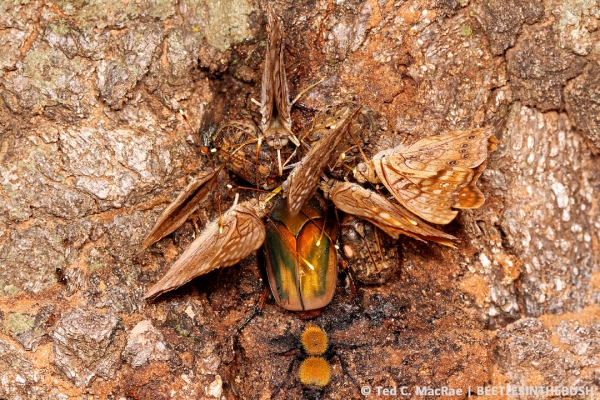
Six insect species representing five families in four orders share a sap flow.

Six insect species representing five families in four orders share a sap flow on the trunk of a pin oak.

No less than six insect species representing four orders were seen all huddled together at a darkly stained sap flow. This could be the result of slime flux, a bacterial disease that usually affects deciduous hardwoods that are under stress and results in darkly stained weeps on the trunk that are known to be attractive to a variety of insects. At the center sat a green June beetle (Cotinis nitida) and three bumble flower beetles (Euphoria inda)—all in the family Scarabaeidae (subfamily Cetoniinae). Covering the scarab beetles were half a dozen Texas Tawny Emperor (Asterocampa clyton texana) butterflies (family Nymphalidae, or Brushfooted Butterflies), and milling around the perimeter was a velvet ant (Dasymutilla creusa, I believe) in the family Mutillidae, an apparent flesh fly (family Sarcophagidae), and a true ant (family Formicidae). I guess this would be the equivalent to a watering hole in Africa with a lion, a hyena, a baboon, three vervet monkeys and six zebras all crouched shoulder-to-shoulder at its edge.

Euphoria sepulchralis feeds on a sap flow higher up on the trunk.

Euphoria sepulchralis feeds on a sap flow higher up on the trunk.

Further up on the trunk, yet another species of scarab beetle, a dark flower scarab (Euphoria sepulchralis) was found feeding on a smaller sap ooze. Unlike the diverse aggregation of insects on the lower ooze, this guy had managed to keep the ooze all to himself.

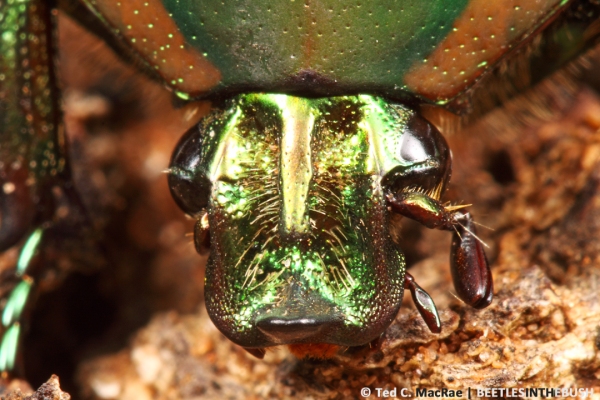
Cotinus nitidus | Weatherford, Oklahoma

Cotinis nitida | Weatherford, Oklahoma

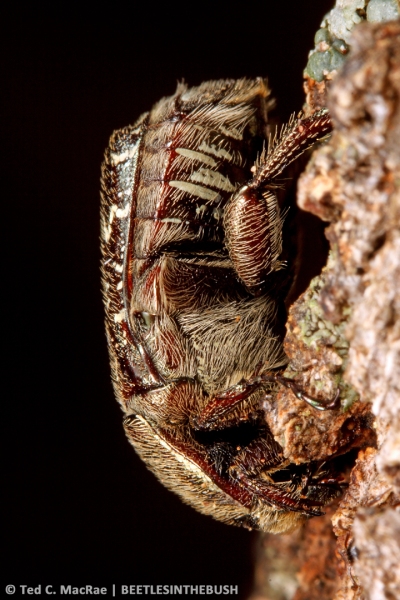
Green June beetles, especially, are known for their feeding on sap oozes. The beetles are actually attracted to the odors caused by fermentation of the sap rather than the sap itself. It has been reported that the presence of alcohol in fermenting sap can affect the behaviour of insects that feed upon it, causing them to act “stupid and lethargic.” I did not see any such behavior, but I did notice that the insects were not at all skittish and loath to leave the sap.

Copyright © Ted C. MacRae 2013