Big, Bold, and Beautiful

Cicindela formosa generosa | Castlewood State Park, Missouri.

Last fall I took my younger daughter to the Al Foster Trail on the western side of Castlewood State Park, just a few miles down the road from my house.  As we walked the trail through typical bottomland forest next to the Meramec River, I noticed what appeared to be open ground on a rise to the north of the trail.  When I went up to investigate, I saw a rare sight for Missouri—dry sand!  Obviously a deposit from some past flood event, the post oaks established around its perimeter and native warm season grasses sparsely dotting its interior suggested it had been laid down many years ago.  Such sights were likely common along the big river systems of pre-settlement Missouri, as natural flooding cycles laid sand deposits up and down the river courses, each deposit gradually succumbing to vegetation as new deposits were laid down elsewhere.  Today, with channelization and levees for flood control, the Missouri and Mississippi Rivers are just narrow, hemmed-in shadows of their former selves, unable to lay down such deposits in most years until, at last, catastrophic flooding occurs on a grand scale (as is occurring now).  Feeding into the Mississippi River just south of the Missouri River is the Meramec River—as the state’s only still-undamned undammed river system, it still has opportunity on occasion to lay down these interesting dry sand habitats.
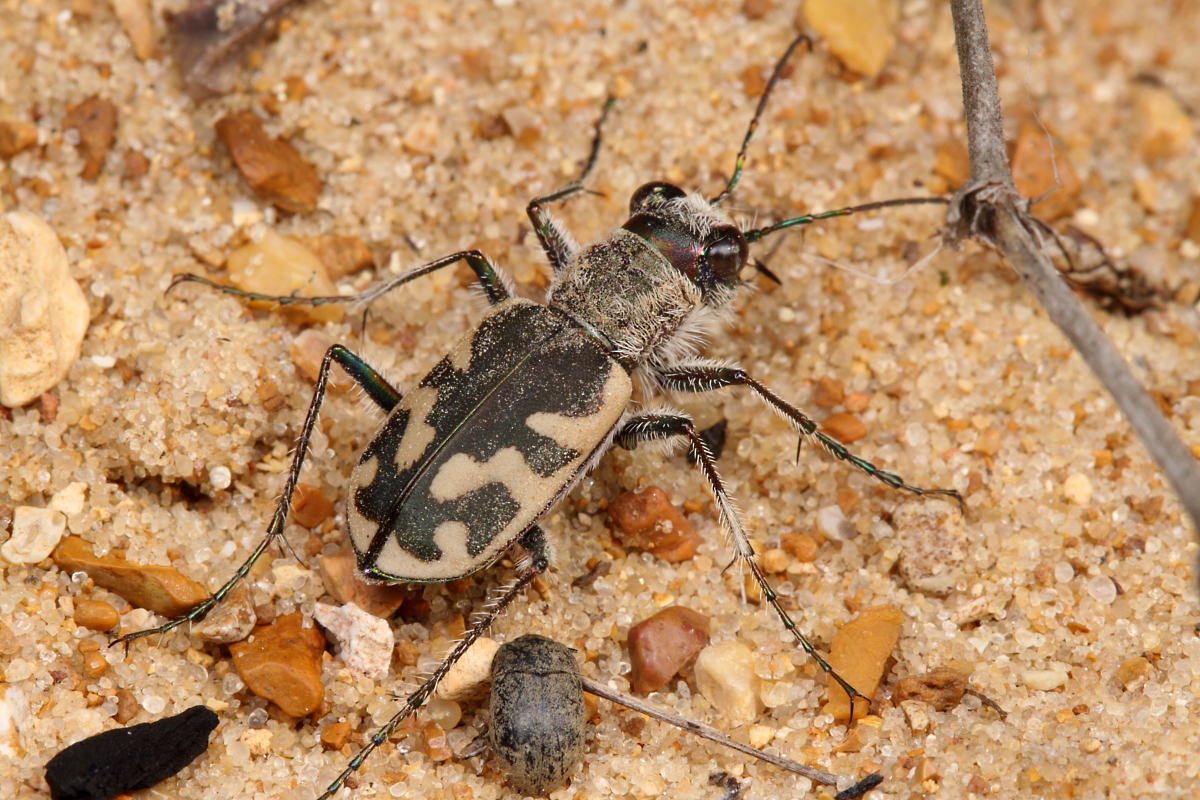
The dark brown coloration of this rather ''dirty'' individual is typical of most Missouri populations.

When I see dry sand habitats in Missouri, three tiger beetle species immediately come to mind—Cicindela formosa (big sand tiger beetle), C. scutellaris (festive tiger beetle), and Ellipsoptera lepida (ghost tiger beetle).  My colleague and co-cicindelophile Chris Brown and I have spent many a weekend traveling up and down the state’s river systems with these species in mind.  None of them are rare in the state, but their fidelity to deep, dry sand habitats also makes them by no means common.  It is always cause for celebration when a new site is discovered for one of these species somewhere in Missouri.  Thus, it was in anticipation of one (or more) of these species that I returned to the spot last week on the first truly gorgeous spring day of the season.  Could it really be that, after ten years of searching for these species throughout the state, I would find a population just a few miles down the road from my house?!
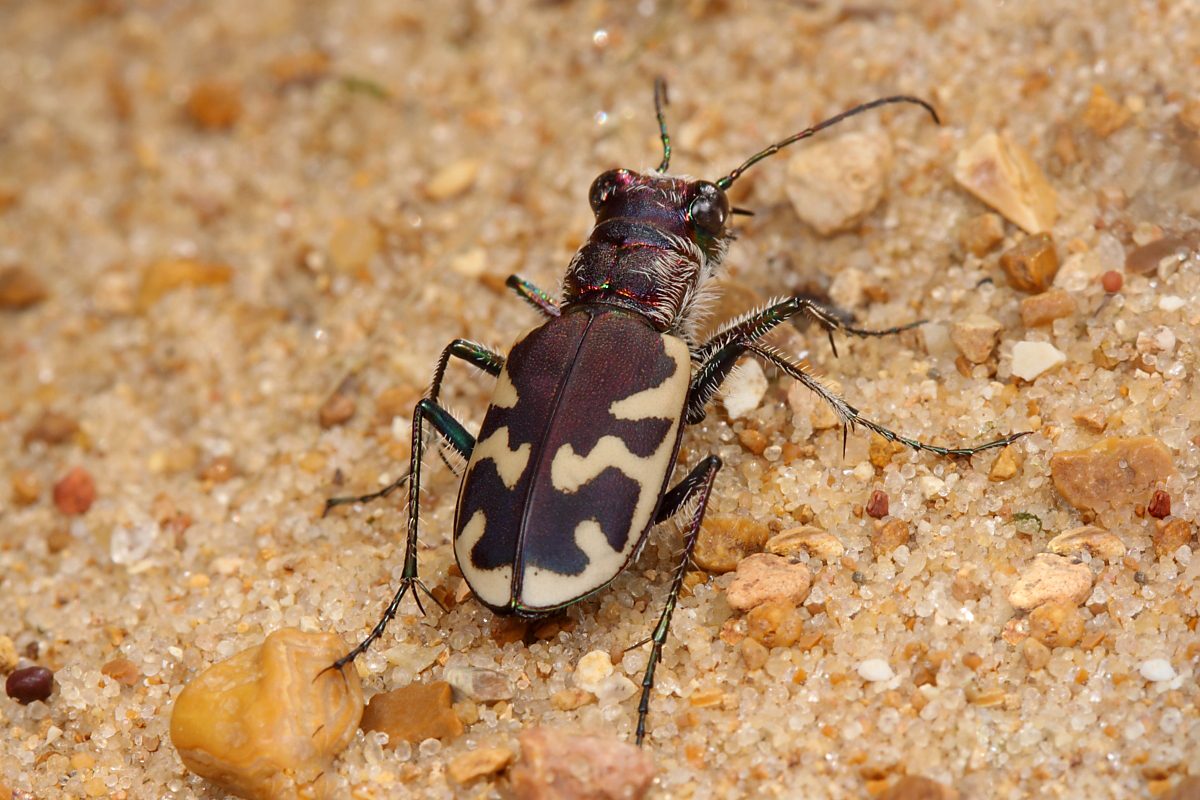
A number of individuals in this population show traces of the bright coppery red coloration more typical of nominotypical populations west of Missouri.

Walking onto the site, I began to see tiger beetles immediately.  However, they were Cicindela tranquebarica (oblique-lined tiger beetle), a common species in Missouri that enjoys not only dry sand habitats, but also wet sand, wet mud, dry clay, and even concrete habitats—hard to get excited about such a habitat slut!  Nevertheless, within minutes I began seeing more robust beetles that were unmistakably big sand tigers.  Big, bold, and beautiful, the beetles were wary in the late afternoon heat and quickly launched into their powerful escape flights that ended comically some 20 yards away with a characteristic bounce and a tumble.  Such behavior might seem to make them impossible to photograph, but I’ve been at this for awhile and know their behavior pretty well—a slow, cautious approach, crouching carefully at the right distance, and crawling deliberately on elbows and knees while peering from behind the camera until it shows up in the lens set to 1:3 (one-third life size).  Then it’s a matter of even more slowly closing the distance and scooting around to get the desired angles and composition.  Move slowly enough and they’ll forget you’re there and resume normal behavior—you’ll be richly rewarded with views of foraging, stilting, and other classic tiger beetle behaviors.
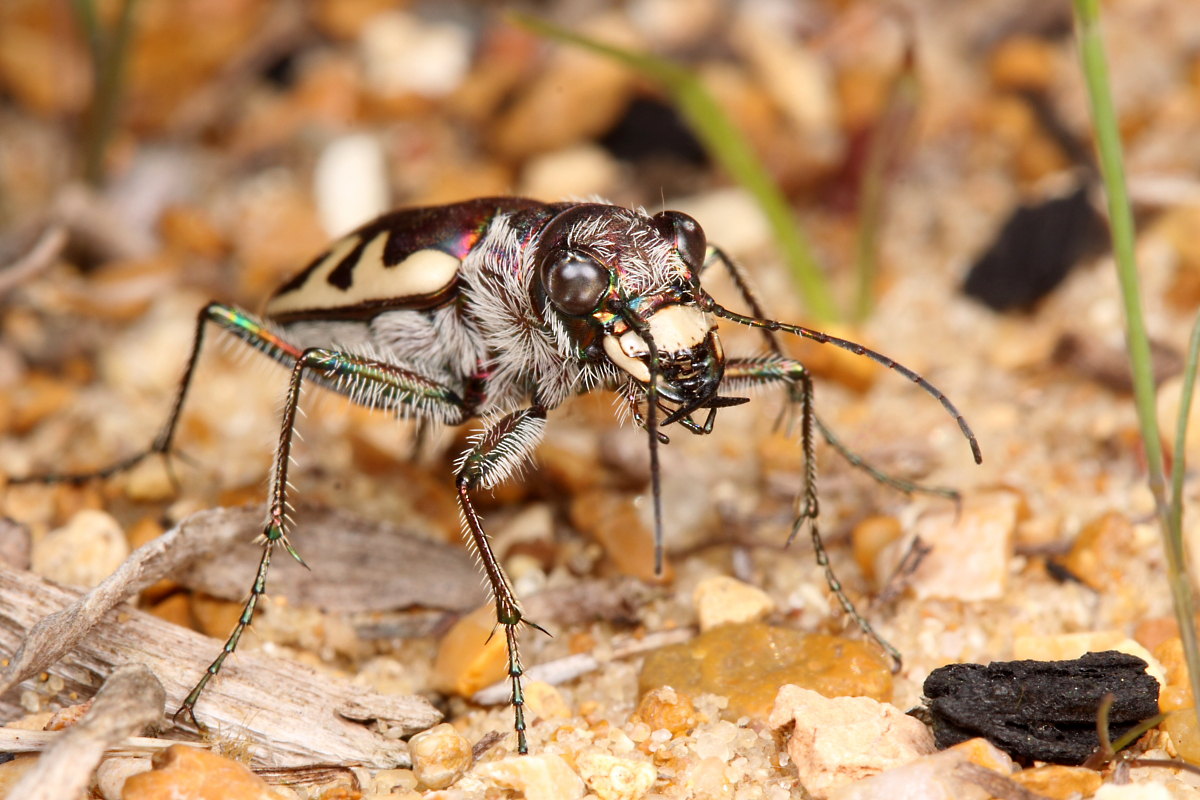
Coloration and markings may seem conspicuous but provide excellent camouflage against the pebbley-sand substrate.

Most of the big sand tiger beetle populations we have found in Missouri are typical of the eastern subspecies C. formosa generosa, distinguished from other named subspecies by the dark brown dorsal coloration and thick white markings that are separate dorsally and joined along the outer edges of the elytra (Pearson et al. 2006).  This subspecies is predominantly midwestern and northeastern in distribution, while the typically bright coppery-red individuals assigned to the nominotypical subspecies are found further west in the Great Plains.  There are, however, certain populations in Missouri that show more or less suffusion of coppery-red coloration.  This is typically explained as hybrid influence, as Missouri lies on the western edge of the distributional range of subspecies generosa.  However, we have only seen these coppery-red indications on the eastern side of Missouri, while populations on the western side of the state along the Missouri River exhibit typical dark brown coloration.  The population here in St. Louis Co. is the third population we have found to show this coppery-red influence, and in fact most of the individuals I saw exhibited greater or lesser amounts of this coloration.  My personal belief is that there is no genetic basis for this subspecific distinction, but that the differences in color are instead related to conditions of the soil in which they live—possibly pH.  Sand habitats in the eastern United States are typically acidic, while alkaline soils abound in the Great Plains (formerly a vast sea bottom).  Hey, it’s a thought!
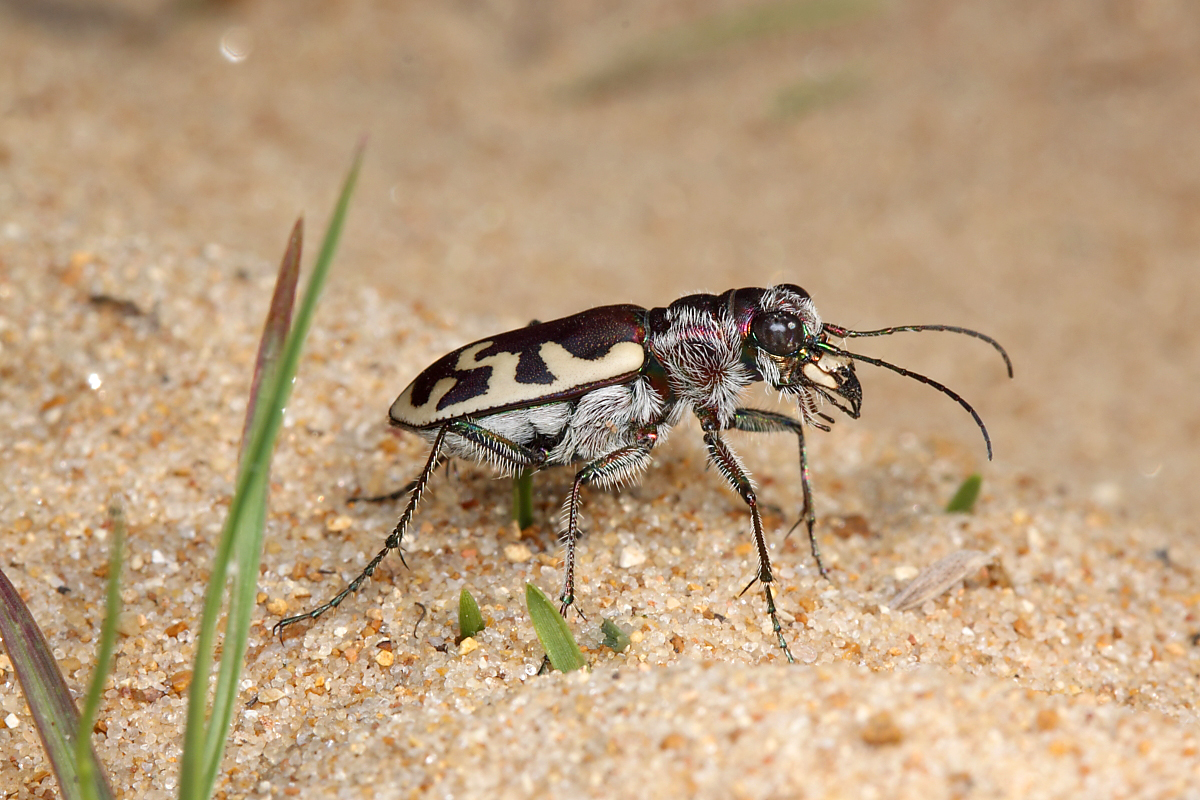
Big sand tiger beetles remain one of my favorite beetle species in Missouri.

The combination of striking coloration and bold white markings exhibited by big sand tiger beetles might seem to make them quite conspicuous and vulnerable to predation—especially in the open, sparsely vegetated areas that they inhabit; however, against the textured sandy substrates on which they are found they are almost impossible to detect until they move.  I’ve learned not to try to see them first and sneak up on them, as this is a lesson in futility.  Rather, I simply walk through an area and fix my sights on individuals as they take flight, watching them as they fly and eventually land and then sneaking up to the spot where I saw them land.  I generally need to stop about 8-12 feet out and study the spot carefully to pick them out, and then I can continue sneaking up on them.

Photo Details: Canon 50D w/ 100mm macro lens (ISO 160, 1/200 sec, f/16), Canon MT-24EX flash w/ DIY oversized concave diffuser. Typical post-processing (levels, minor cropping, unsharp mask).

REFERENCES:

Pearson, D. L., C. B. Knisley and C. J. Kazilek. 2006. A Field Guide to the Tiger Beetles of the United States and Canada. Oxford University Press, New York, 227 pp.

Copyright © Ted C. MacRae 2011

Feasting on the bounty

Brood XIX periodical cicadas were not the only insects appearing en masse last week at Sam A. Baker State Park in Missouri’s southeastern Ozark Highlands.  As I walked the upland trail, I thought I felt ‘raindrops’ for awhile before realizing that it was frass.  Little pieces of fresh young leaves littered the trail around me, and I realized that an outbreak of caterpillars was hammering the oak trees in this forest.  Unlike the cicadas, which were encountered primarily in the bottomland forest along Big Creek, the rain of poop was restricted to the uplands.  Not surprisingly, I saw caterpillar hunters, Calosoma spp. (family Carabidae—the real Carabidae, not the tiger beetle Carabidae that I’ve begrudgingly had to accept) about as abundantly as I’ve ever seen them.  At first I didn’t notice them until I would scare one up, then spend several frustrating minutes trying to photograph a beetle that just would not stop running.  I tried a few and gave up—after all, they’re just ground beetles (i.e., real ground beetles).  Eventually, I realized that if I noticed them before they noticed me, I could sneak up on them and have my way with them (photographically speaking, that is).  I even found that I could preen nearby leaves and sticks for composition if I did it carefully enough.  Here are a couple of my favorite shots on the day.

I would presume these to represent the fiery searcher, Calosoma scrutator, but apparently C. wilcoxi is similar in appearance.  According to comments by several BugGuide users, C. scrutator is larger (25mm or more in length), has more elongated mandibles and head, and the color of the central purple area of the pronotum is more intense.  Based on those comments, I would say the two individuals in these photographs are C. scrutator.  However, they also note some differences in temporal occurrence that don’t seem to support that.  Moreover, the many individuals I saw that day ranged in size from these larger individuals to some notably smaller ones.

Copyright © Ted C. MacRae 2011

Love is in the air!

My first tiger beetle photograph of the season. There’s nothing more adorable than Spring love!

Cicindela tranquebarica (oblique-lined tiger beetle) | St. Joe State Park, Missouri

Photo details: Canon 50D w/ 100mm f2.4 macro lens (ISO 160, 1/200 sec, f/16), Canon MT-24EX twin flash w/ DIY oversized concave diffuser.

Copyright © Ted C. MacRae 2011

Bichos Argentinos #11 – Takes Two to Tango

Epilachna vigintioctopunctata (vaquita de las solanáceas) | Buenos Aires, Argentina

Another of the insects that I photographed at La Reserva Ecológica Costanera Sur, Buenos Aires, Argentina during my early March visit.  I found quite a few of these beetles feeding on the newly sprouting growth from cut stumps of a small, multi-stemmed tree.  At first I thought they were leaf beetles of the family Chrysomelidae because of the way they were actively feeding on the fresh, succulent growth; however, a closer look quickly revealed them to be members of the family Coccinellidae (ladybird beetles).  Their phytophagous, gregarious behavior immediately identified them as members of the subfamily Epilachninae, and in fact they bear a remarkable resemblance to Epilachna varivestis (Mexican bean beetle) and E. borealis (squash lady beetle) – the best known examples of this subfamily in North America.

Armed with confidence in at least a subfamilial placement, I looked for references on the group and quickly found a reasonably recent revision of the subfamily for the entire Western Hemisphere (Gordon 1975) – jackpot!  I reasoned an abundant species seen in the heart of the 3rd largest city in South America would likely show up on page one, but after several increasingly careful passes through the entire revision, it became clear that whatever species this was, it was not among the nearly 300 species (2/3 of them in the genus Epilachna) treated in that work. 

Now, the exuberant, young, not-very-sage entomologist that I was 30 years ago would have immediately gotten all excited that I had found a new species, but the older, battle-tested, more cautious entomologist that I am now instead started suspecting I was dealing with an introduced species.  After all, some of the insects and plants I’ve already featured from this man-made nature reserve are introduced.  I figured as abundant as the beetles were, the species had to be featured on some website, so I started with the obvious and Googled “Coccinellidae Argentina,” clicked on the very first result (appropriately titled Coccinellidae of Argentina), and found a seemingly authoritative site with links to the different subfamilies.  Clicking on Epilachninae and scanning the photos, there it was – Epilachna vigintioctopunctata (28-spotted ladybird beetle).  Native to India and southeastern Asia, this species is well known for its attacks on numerous solanaeous and cucurbitaceous crops (Richards 1983).  It made its first appearance in the Western Hemisphere in southern Brazil (Schroder et al. 1993) and in 1994 was observed on experimental eggplant plots at the School of Agronomy, University of Buenos Aires (Folcia et al. 1996).  Poetically, those initial specimens were sent to Robert Gordon at the U.S. National Museum (and author of the Western Hemisphere revision), who confirmed their identity.  It seems that Argentinians are not the only ones that like to tango!

REFERENCES:

Folcia A. M., S. M. Rodriguéz and S. Russo. 1996. Aspectos morfológicos, biológicos y de preferencia de Epilachna vigintioctopunctata Fabr. (Coleoptera Coccinellidae). Boletin de Sanidad Vegetal Plagas 22:773–780.

Gordon, R. D. 1975. A revision of the Epilachninae of the Western Hemisphere (Coleoptera: Coccinellidae). U. S. Department of Agriculture, Technical Bulletin No. 1493, ii+409 pp.

Richards, A. M.  1983.  The Epilachna vigintioctopunctata complex (Coleoptera: Coccinellidae).  International Journal of Entomology 25(1):11–41.

Schroder, R. F. W., M. M. Athanas and C. Pavan. 1993. Henosepilachna vigintioctopuctata (Coleoptera-Coccinelidae), new record for Western Hemisphere, with a review of host plants. Entomological News 104(2):111–112.

Copyright © Ted C. MacRae 2011

Bichos Argentinos #11 – I’m out’a here!

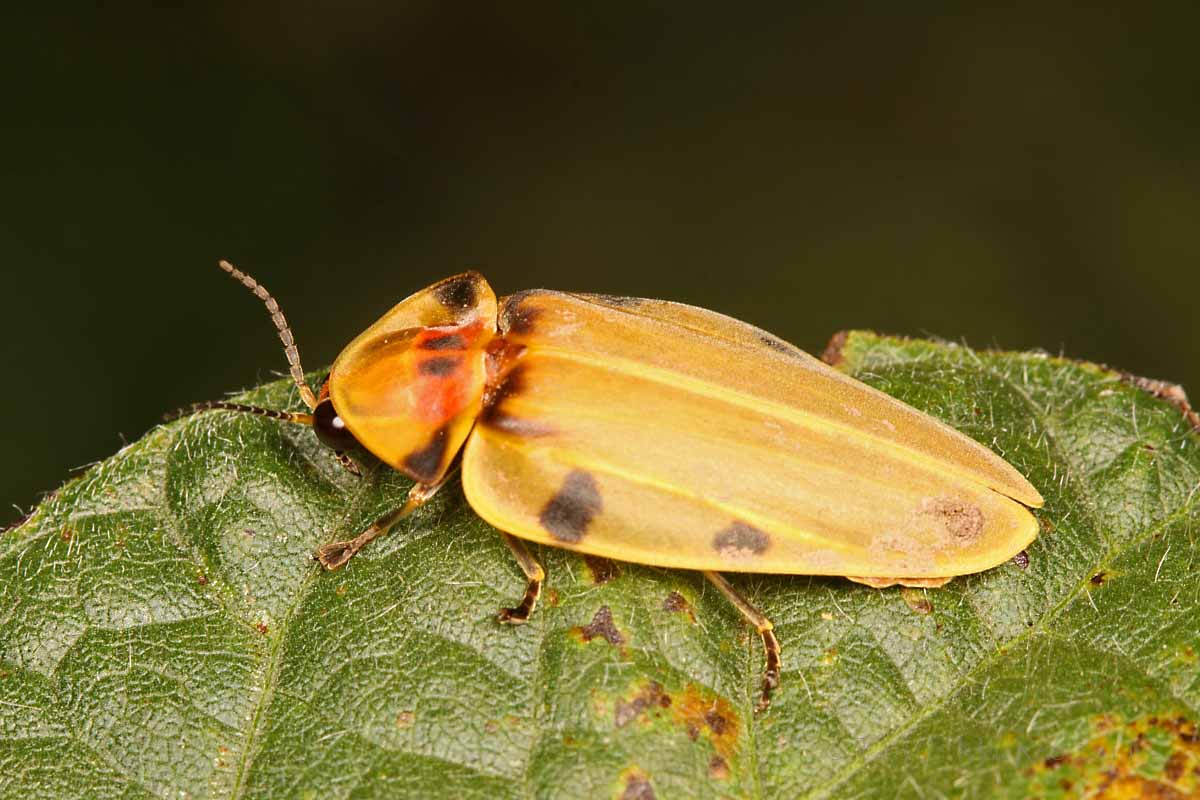
Neither of these photos are very good, but it’s the firefly’s fault.  I saw it last month in a soybean field in Buenos Aires Province, Argentina. I got off the first shot, but the flash disturbed it and it started walking around. I quickly set up for another shot, got it framed, fired the shot, and saw the second photo on the screen!

Everything about this firefly seems backwards – most fireflies are black with yellow, orange or red markings – this one is yellow with small black markings.  The terminal segments of the abdomen are dark while the rest are light – opposite of most other fireflies.  This one was out and about during the day, while most others are crepuscular or nocturnal.  Maybe it’s a result of being in the Southern Hemisphere – opposite of most other fireflies I’ve seen.

Copyright © Ted C. MacRae 2011

Rediscovery of Cicindela scabrosa floridana

ResearchBlogging.orgIn refreshing contrast to the more usually heard reports of declining and extinct species, a new paper by Dave Brzoska, Barry Knisley, and Jeffrey Slotten (Brzoska et al. 2011) announces the rediscovery of a tiger beetle previously regarded as probably extinct.  Cicindela scabrosa floridana was described from a series of unusually greenish specimens collected in Miami, Florida in 1934; however, no additional specimens turned up in the following 70+ years despite dedicated efforts in the late 1980s and early 1990s by Brzoska, Knisley, and Ron Huber to locate and search areas around the presumed type locality.  This paucity of specimens and occurrence of the type locality in highly urbanized Miami had caused most contemporary tiger beetle researchers to presume that the population had fallen victim to the ceaseless sprawl of urbanization and its attendant habitat destruction.  However, in September of 2007, co-author Jeff Slotten, working with David Fine, rediscovered a population of individuals matching the type series while surveying butterflies in pine rockland habitat in the Richmond Heights area of Miami.  Subsequent surveys of pine rockland habitat in surrounding areas revealed populations of the beetle at three sites – all in the Richmond Heights area. 

Source: Brzoska et al. (2011)

Cicindela scabrosa floridana was originally described by Cartwright (1939) as a variety of the broadly distributed southeastern U.S. species C. abdominalis.  In describing the closely related C. highlandensis (endemic to the Lake Wales Ridge of central Florida), Choate (1984) also elevated the peninsular Florida-endemic C. scabrosa (previously considered a subspecies of C. abdominalis) to full species status and treated floridana as a subspecies of scabrosa, apparently due to the similarity of their elytral sculpturing, occurrence in both of dense flattened setae on the pronotum, and their allopatric distributions.  The new availability of additional specimens of floridana, however, has allowed more detail comparisons of this form with scabrosa.   In addition to the markedly greener elytra, the great majority of floridana lack post-median marginal spots – found consistently in scabrosa, and the apical lunule is generally thinner in floridana than in scabrosa.  Moreover, no floridana were found to exhibit the vestigial middle band that scabrosa often exhibits, and the leg color of floridana also is lighter and more yellow than most scabrosa specimens.  Differences in habitat, distribution and seasonality were also noted – scabrosa occurs in sand pine scrub habitat throughout most of peninsular Florida north of Miami from late spring to mid-summer, while floridana occurs only in pine rockland habitats in southern Florida with adults active well into October.  These consistent differences in morphology, distribution, habitat, and seasonality led Brzoska et al. to elevate floridana to full species status.  According to the most recent classifications of North American and Western Hemisphere tiger beetles (Pearson et al. 2006, Erwin and Pearson 2008), the new name would be Cicindela (Cicindelidia) floridana.  However, Brzoska et al. follow the classification initially proposed by Rivalier (1954) and followed by Weisner (1992) in regarding Cicindelidia as a full genus, resulting in the new combination Cicindelidia floridana.  The character differences identified by Brzoska et al. are illustrated with detailed photographs and presented in a key to allow recognition of the now four species in the abdominalis group.

The rediscovery of a rare species thought to be extinct is always cause for celebration.  However, there is much work still to be done before prospects for the long-term survival of C. floridana can be considered secure.  Many potential scrub and pine rockland sites throughout Miami-Dade, Broward, and Palm Beach Counties were identified and surveyed after the initial discovery of C. floridana in the Richmond Heights area.  Unfortunately, to date the beetle has been found only at three sites in the Richmond Heights area.  This suggests that C. floridana populations are small, highly localized, and greatly restricted in distribution, making the species a likely candidate for listing as endangered by the U. S. Fish and Wildlife Service.   To their credit, the authors have not revealed the precise locations of these sites, which will hopefully reduce the temptation by those with more philatelic tendencies to undercut ongoing studies of the distribution, abundance, biology, and habitat of C. floridana.  These studies will be critical in the development of effective conservation strategies to ensure that this highly vulnerable representative of Florida’s natural heritage does not, once again, become regarded as extinct.

REFERENCES:

Brzoska, D., C. B. Knisley, and J. Slotten.  2011.  Rediscovery of Cicindela scabrosa floridana Cartwright (Coleoptera: Cicindelidae) and its elevation to species level. Insecta Mundi 0162:1–7.

Cartwright, O. L. 1939. Eleven new American Coleoptera (Scarabaeidae, Cicindelidae). Annals of the Entomological Society of America 32: 353–364.

Choate, P. M. 1984. A new species of Cicindela Linnaeus (Coleoptera: Cicindelidae) from Florida, and elevation of C. abdominalis scabrosa Schaupp to species level. Entomological News 95:73–82.

Erwin, T. L. and D. L. Pearson. 2008. A Treatise on the Western Hemisphere Caraboidea (Coleoptera). Their classification, distributions, and ways of life. Volume II (Carabidae-Nebriiformes 2-Cicindelitae). Pensoft Series Faunistica 84. Pensoft Publishers, Sofia, 400 pp.

Pearson, D. L., C. B. Knisley and C. J. Kazilek. 2006. A Field Guide to the Tiger Beetles of the United States and Canada. Oxford University Press, New York, 227 pp.

Rivalier, E. 1954. Démembrement du genre Cicindela Linne, II. Faune americaine. Revue Francaise d’Entomologie 21:249–268.

Wiesner, J. 1992. Checklist of the Tiger Beetles of the World. Verlag Erna Bauer; Keltern. 364 pp.

Copyright © Ted C. MacRae 2011
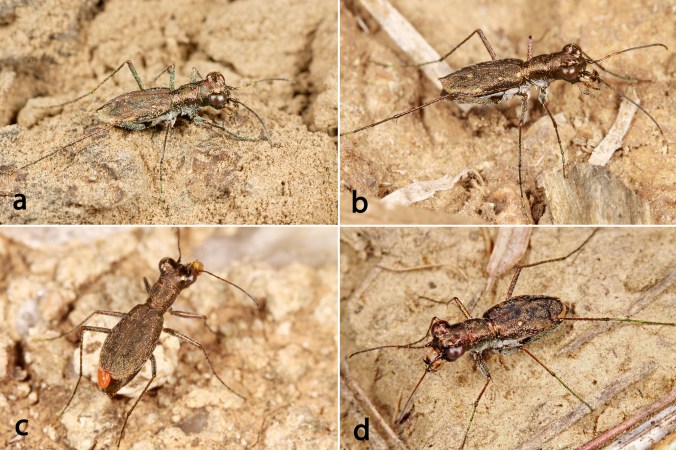
Cylindera celeripes – Fig. 1

One of the plates from our recently submitted manuscript on Cylindera celeripes (swift tiger beetle).¹  For the record, this is my first official attempt at assembling a plate in Photoshop for electronic submission – I sure hope I get quicker at this!

Fig. 1. Cylindera celeripes (LeConte) adults at: a) Hitchcock Nature Center, Pottawattamie Co., Iowa (13.vii.2008); b) Alabaster Caverns State Park, Woodward Co., Oklahoma (10.vi.2009); c) same locality as “b”, note parasite (possibly Hymenoptera: Dryinidae) protruding from abdomen and ant head attached to right antenna; d) Brickyard Hill Natural Area, Atchison Co., Missouri (27.vi.2009). Photos by C.R.Brown (a) and T.C.MacRae (b-d).

¹ “Historical and contemporary occurrence of Cylindera (s. str.) celeripes (LeConte) (Coleoptera: Carabidae: Cicindelitae) and implications for its conservation” – submitted to Journal of Insect Conservation.

Copyright Ted C. MacRae 2011

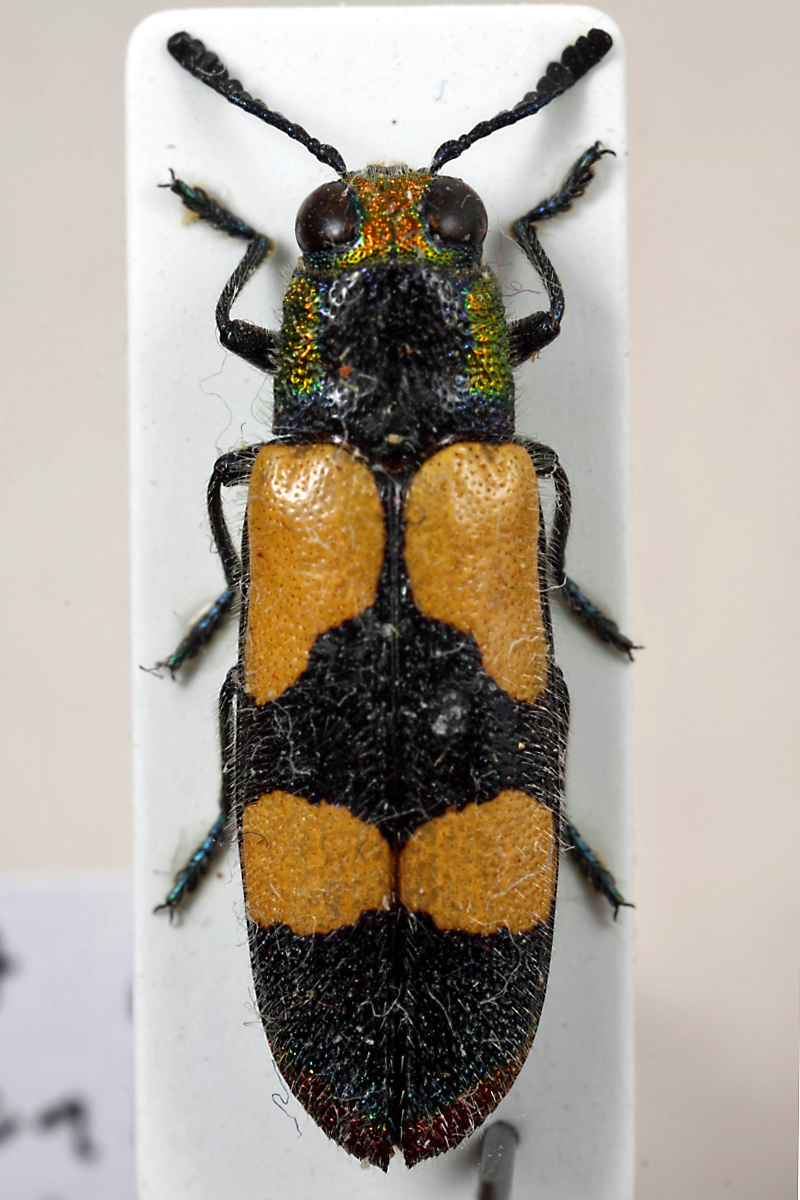
Agelia lordi (Walker)

Aegilia lordi (Walker) | Kenya

This pretty little beetle is Agelia lordi (Walker), a member of the jewel beetle family Buprestidae. I received this meticulously curated specimen – collected in Kenya – in a recent exchange with Stanislav Prepsl (Czech Republic). The species is found in Sub-Saharan east Africa and is the smallest of the nine recognized Agelia species. Two other species occur in eastern and southern Africa, including Agelia petalii (Gory) which I collected in South Africa (see Buppies in the bush(veld)), while the remaining six are found on the Indian subcontinent. The presence of two distinct and geographically isolated population centers, along with some seemingly common differences in the included species, begs the question of whether they may perhaps be subgenerically distinct. Gussmann (2002), however, regarded most of these differences to be simply a matter of degree and insufficient to warrant subgeneric separation.

Males of A. lordi are easily recognized by the orange-brown color of the last 2-3 sterna, in sharp contrast to the mostly strongly metallic integument of the rest of the ventral surface (females and both sexes of all other species have all sterna concolorous). The metallic reflections on the head, pronotal sides, and elytral apices – along with size – further distinguish A. lordi from other African species.

As is typical with so many tropical insects, little is known about the biology and lifestyle of species of Agelia. The bold, contrasting coloration of especially the African species would seem to make them conspicuous to predation, but this seems to be the result of a mimetic association with noxious species of blister beetles (family Meloidae) in the genus Mylabris. I saw one of these (see Mylabris oculatus in South Africa) in association with A. petalii during my 1999 visit to South Africa, and the resemblance was so strong that I had do a double-take every time I saw one to determine whether it was Agelia or Mylabris.

REFERENCE:

Gussmann, S. M. V. 2002. Revision of the genus Agelia Laporte and Gory (Coleoptera: Buprestidae). Annals of the Transvaal Museum 39:23–55.

Copyright © Ted C. MacRae 2011