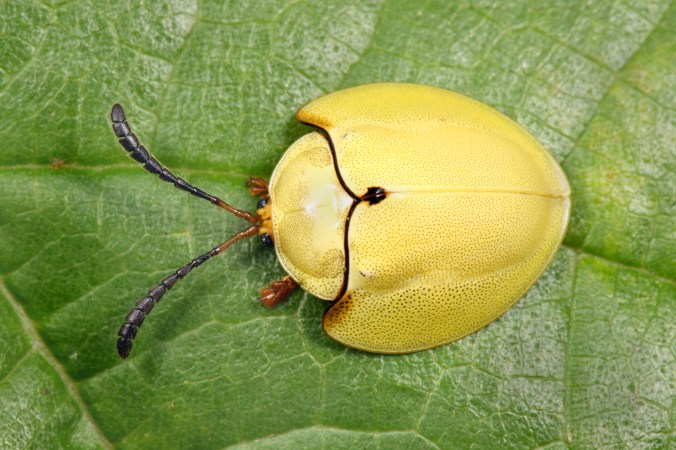
Despite their hyperdiversity, leaf beetles (family Chrysomelidae) as a group are for the most part among the most easily recognized of all beetle families, and within the family none are more recognizable than the tortoise beetles (subfamily Cassidinae). Named for their distinctively armoured elytra and prothorax and associated behavior of drawing the head and legs under them when threatened, they are worldwide in distribution and especially diverse in the New World tropics. Even though I know little about the group (chrysomelids as a whole are far too intimidatingly diverse a group for me to add to my already burgeoning list of interests), I can’t resist collecting them whenever I encounter them. Having traveled to Mexico and South America many times over the years, I’ve accumulated almost a full Schmidt box of these beauties – most of which remained unidentified, save for the well-known representatives from our relatively depauperate North American fauna.
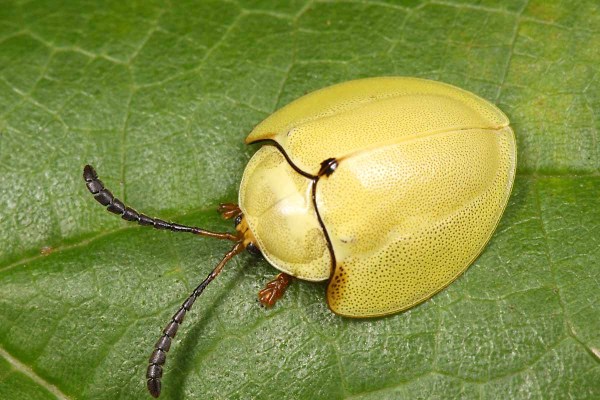
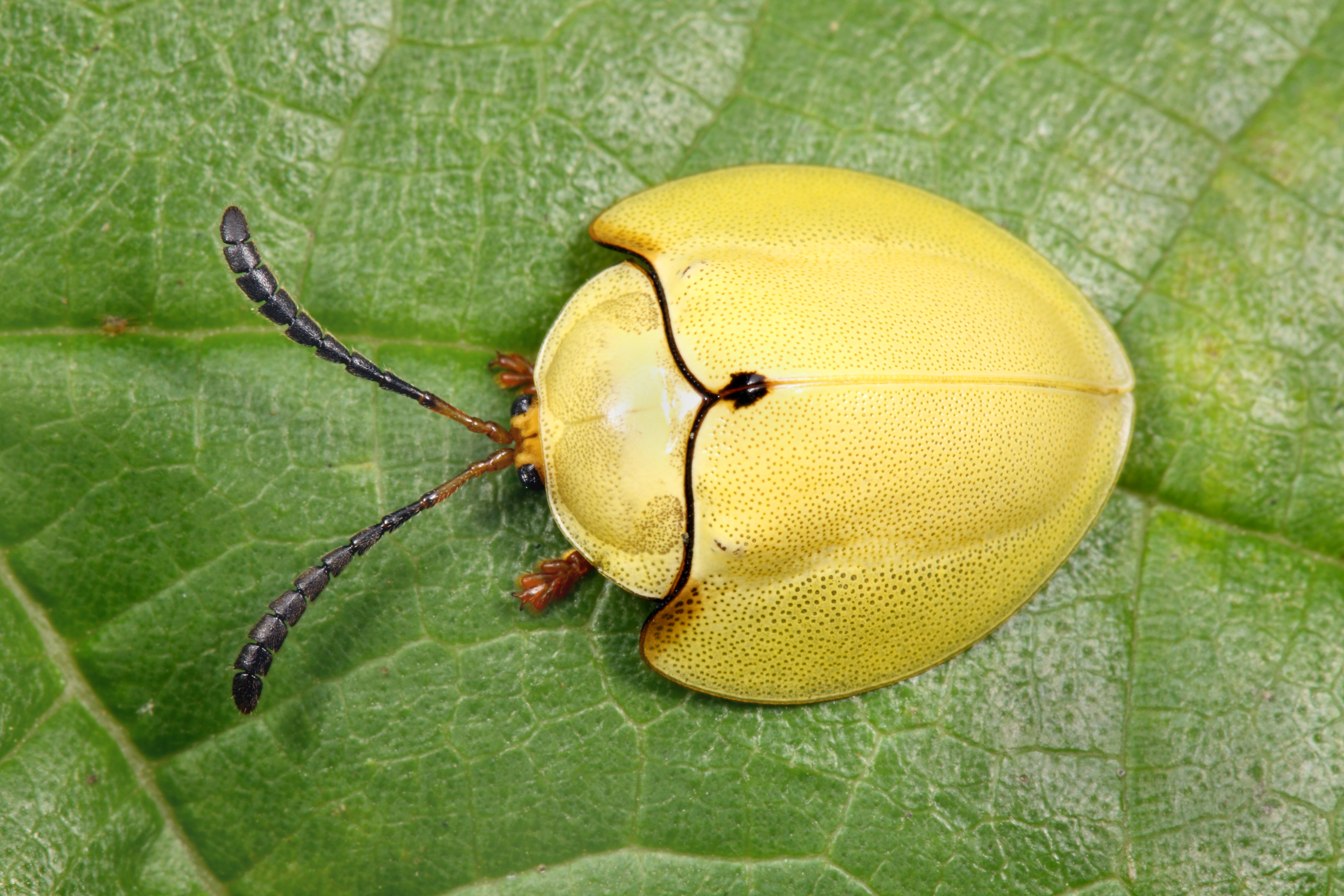
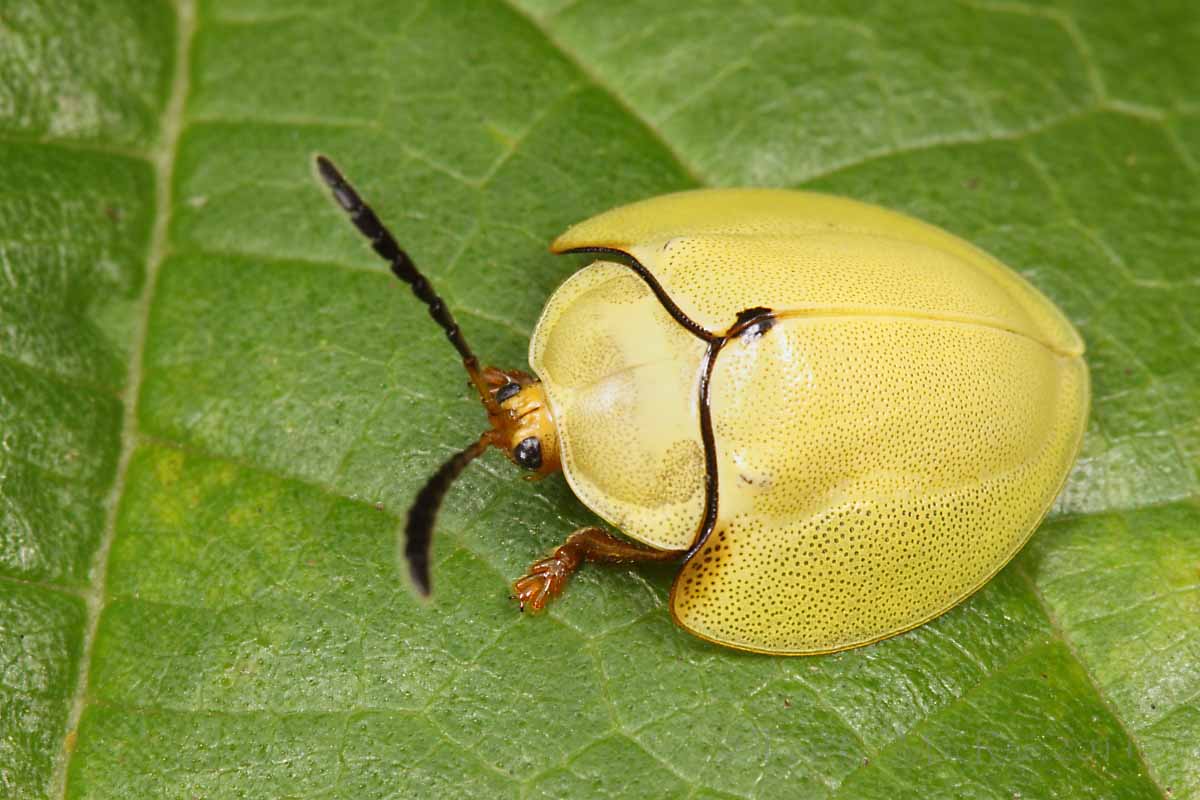
Thus, when I encountered this striking example on a leaf in the Barão Geraldo District near Campinas, Brazil, I figured the photos I took would go into one of those “Brazil Bugs” posts featuring a variety of pleasing to look at but otherwise unidentified insects. Still, after having had success identifying some other Brazilian insects using Google, Flickr, and carefully selected search terms, I figured I should at least give this one a try. It didn’t take long – searching on nothing more than “Cassidinae” in Flickr yielded a very similar looking beetle on page 6 from Panama identified by Rob Westerduijn as Paraselenis tersa. While not likely the same species, it seemed almost certain to represent the same genus, so further searching on the genus name eventually led me to the cassidine mother lode: Cassidinae of the World: An Interactive Manual. This web page, authored by Lech Borowiec, features species lists, identification keys and images of a large number of specimens, including nearly all of the 29 species currently placed in this exclusively Neotropical genus (you can bet I’m bookmarking this site – perhaps my Schmidt box of specimens will finally get some attention!). A quick perusal through the images yielded an ID: Paraselenis (Spaethiechoma) flava, recorded broadly across South America. Everything fit – the black scutellar marking, the elytra broader than the prothorax, the bicolored antennae, the thin black anterior elytral marginal band, and – appropriate for the species name – the even yellow coloration. My ID was confirmed when I found a key to all the species of Paraselenis (Borowiec 2003). I surmise this is a female based on the more rounded humeral elytral projections, which seem to be more strongly and angularly produced in the males based on the photos I looked at.

Interestingly, this particular species is considered a pest of sweet potato and commonly referred to as “fusquinha”¹ (Montes and Raga 2010). Many species of tortoise beetles, in fact, utilize as host plants members of the sweet potato family (Convolvulaceae). This individual was not on a convolvulaceous plant, but a small tree. I looked for additional individuals but didn’t find any, nor did I find larvae or any evidence of feeding, so this must have been a wayward individual – probably searching for a suitable host on which to oviposit.
¹ “Fusquinha” is the Brazilian Portuguese word for “Volkswagon Beetle”!
References
Borowiec, L. 2003. Two new species of the genus Paraselenis Spaeth, 1913 (Coleoptera: Chrysomelidae: Cassidinae). Genus 14 (3): 403-411.
Montes, S. M. N. M. and A. Raga. 2010. “Fusquinha” Paraselenis flava (L. 1758) praga da batata-doce. Instituto Biológico – APTA, Documento Técnico 004, 8 pp..
Copyright © Ted C. MacRae 2011