Au Bon Marché


Earlier this week a colleague in my lab presented me with this delightful print featuring beetle imagery.  A mutual acquaintance had encountered it while going through some items that had been in storage for many years, thought of me, and asked her to give it to me.  She couldn’t tell me anything more about its origins, but its whimsical, turn-of-the-century look and apparent age immediately captivated me.

I had originally intended to simply post this scan, say “Isn’t this cute?”, and leave it at that.  However, my compulsive side took over and before long I found myself in full bore Google search mode.  My initial desire was simply to translate the French text – the beetles were easy enough (1 _ Giant Borer.  2 _ Blister Beetle.  3 _ Rhinocerus Griffin¹) – but the title “Au Bon Marché” gave me a bit of trouble.  The translators I was using continually turned up results related to “cheap” and “inexpensive”, which just didn’t make sense. Eventually I figured out that it was a store name – specifically the oldest department store in Paris (dating from 1852). A bit more searching revealed it to be one of many trade cards lithographed for the store during the late 19th and early 20th centuries, presumably for promotional purposes.  Nowadays these cards seem to be popular collector’s items, especially in France.  Alas, I was not able to find an image of this specific card among the several hundred other Au Bon Marché trade card images I perused across the web – if anyone knows anything more about the history and use of these cards or about this card in particular, please do let me know.

¹ Apparently the scarab beetle version of a griffin, the mythological creature with the body of a lion and the head and wings of an eagle – wise and powerful characters who spent a good deal of time seeking out and guarding gold and treasures.

Considering its century or more of age, the print is in remarkably good condition. There is just a small amount of staining and glue residue on the backside of the mounting board – perhaps it was part of a treasured scrap book in days long gone. A glass frame should do a nice job of preserving it for another several decades or so.

Copyright © Ted C. MacRae 2011

Bichos Argentinos #7 – Naupactus xanthographus

Naupactus xanthographus (South American fruit tree weevil) | Buenos Aires, Argentina

This weevil (family Curculionidae) was one of just a few beetle species that I encountered earlier this month in Buenos Aires, Argentina at La Reserva Ecológica Costanera Sur.  Weevils are, of course, one of the most taxonomically diverse and difficult groups of Coleoptera, making species IDs based purely on photographs quite challenging.  Nevertheless, I am reasonably confident that this individual represents Naupactus xanthographus, or the South American fruit tree weevil.  This name, it seems, has also been applied to a variety of other weevils photographed in South America and posted on the web, but the images I found at a few seemingly more authoratative sites give me confidence that this is the true N. xanthographus.  The narrow form suggests this individual is a male.

The genus, known collectively as “white-fringed weevils” is a large genus of exclusively Neotropical species – several of which have been introduced to North America (e.g., N. cervinus, Fuller rose beetle, and N. leucoloma) and which were, until recently, placed in a separate genus Graphognathus (Lanteri and Marvaldi 1995) (apparently the reduced humeri and lack of metathoracic wings were deemed insufficient for generic distinction).  In South America some of the species have become pests as well, with N. xanthographus becoming a problem for growers of grapes and other fruits and, thus, earning the names “burrito de la vid” (Chile) and “mulita de la vid” (Argentina) (both roughly translating to “grapevine little donkey”).

This was not an easy photograph to get – I found the weevil clinging to the underside of a leaf above my head.  It was impossible to photograph it in situ, so I moved it to a low twig away from other foliage where I could get the black background I desired.  Once moved, however, the weevil just never… stopped… crawling.  Snapping shots of an actively crawling insect is a crap shoot at best – not only are focus and framing more difficult to nail, but subjects photographed while moving almost always have one or two “bum” legs (lifted or cocked out of position).  A number of attempts were required to get a photo I was happy with (save for the slightly clipped antennal tip).  In such situations, I’ve found it best to track the beetle as it moves and as soon as the center focus point of the lens flashes take the shot.  This at least gives the best chance for nailing the focus, and then it’s simply a numbers game to get a shot with good framing and composition and all the body parts well placed.  Of course, I could’ve zoomed out and just cropped to perfection, but this feels a little like cheating – I’d rather put in the time and practice perfecting my game out in the field as much as possible.  An occasional clipped antenna, tarsus, etc. now will lead to better results down the line.

REFERENCE:

Lanteri, A. A. and A. E. Marvaldi. 1995. Graphognathus Buchanan a new synonym of Naupactus Dejean and systematics of the N. leucoloma species group (Coleoptera: Curculionidae). Coleopterists Bulletin 49(3): 206-228.

Bichos Argentinos #3 – “Bicho Torito”

Diloboderus abderus, male | Buenos Aires, Argentina

In her appeal for submissions for her upcoming issue of An Inordinate Fondness, Susannah lamented the paucity of beetles in the closing weeks of her northern winter and mentioned in passing that even I had gone more than a week without posting about this great order.  I hadn’t realized that myself, so here I present Diloboderus abderus, one of the beetles that I encountered during my visit last weekend to La Reserva Ecológica Costanera Sur in Buenos Aires, Argentina.  This species, known commonly in Argentina as bicho torito (“little bull bug”) is common enough in Argentina and southern Brazil, where its white grub larvae have become somewhat of a pest in lawns, pastures, and grass crops such as wheat by way of feeding on the roots.  I first encountered this species during one of my previous trips to Argentina, where during a rain storm I saw literally hundreds of adults emerging from mowed grass medians in the city streets of Pergamino.  These photographs show two of numerous dead individuals that I found laying on the ground of similar medians just outside the reserve.  As with many scarab beetles in the subfamily Dynastinae (containing also the recently featured Dynastes tityus), males (above) are armed with pronotal and cephalic horns – presumably for use in sexual combat – while females (below) are unarmed.

Diloboderus abderus, female | Buenos Aires, Argentina

Copyright © Ted C. MacRae 2011

North America’s largest scarab beetle

Dynastes tityus male - USA: Missouri, Jefferson Co., DeSoto

As one of North America’s largest, most written about, and most photographed beetles, Dynastes tityus (eastern Hercules beetle) hardly needs an introduction.  I photographed this male specimen from my collection back in December while testing my DIY diffuser for the MT-24EX twin flash and 100mm macro lens.  It’s a good test subject for such – its glossy exoskeleton may be beauty to the eye but is the bane of flash photographers, and its nearly 60mm of length demand a huge subject-to-lens distance that gives even the largest lens-mounted flash a small apparent size.  Nevertheless, the diffuser did a pretty good job of creating even illumination and preventing harsh specular highlights, giving almost the effect of an indirect strobe in a white box.

Dense setae adorn the underside of the thoracic horn of the male.

I hadn’t really noticed until I took the photos the dense adornment of setae (hairs) on the underside of the thoracic horn.  While setae in insects most often perform a tactile function, the density and placement on the horns of the males of these beetles makes me wonder if they might serve more of a display function.

Despite the overwhelming popularity of this beetle amongst hobbyist breeders and its widespread occurrence across the eastern United States (and the internet), it is not one that I have encountered with much frequency myself.  I suspect this is due to the position of Missouri near its western limit of distribution – likely a function of the species’ preference for moist treehole cavities with rotting wood in which the larvae can develop.  This particular specimen was given to me many years ago by a nursery grower in Jefferson Co. during my first job out of graduate school – before I’d ever found one myself, but since then I’ve encountered perhaps half a dozen or so at blacklights in mesic forests across the eastern Ozark Highlands.  Most recently (last summer) I found a female sitting on my driveway, apparently attracted to the mercury vapor lamp above the garage that I leave on occasionally during the months of June and July just for such purpose.

Copyright © Ted C. MacRae 2011

Brazil Bugs #14 – Fusquinha


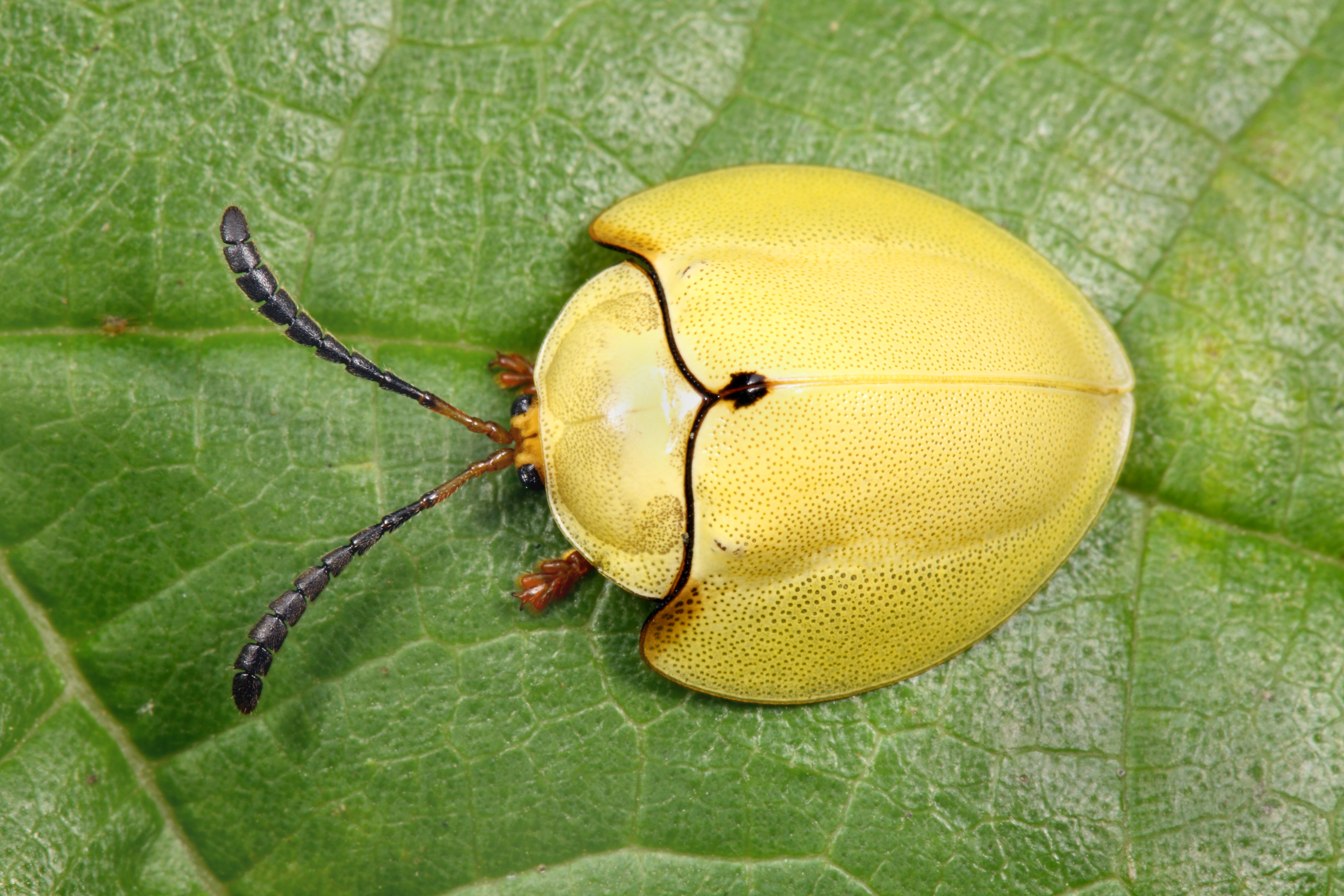
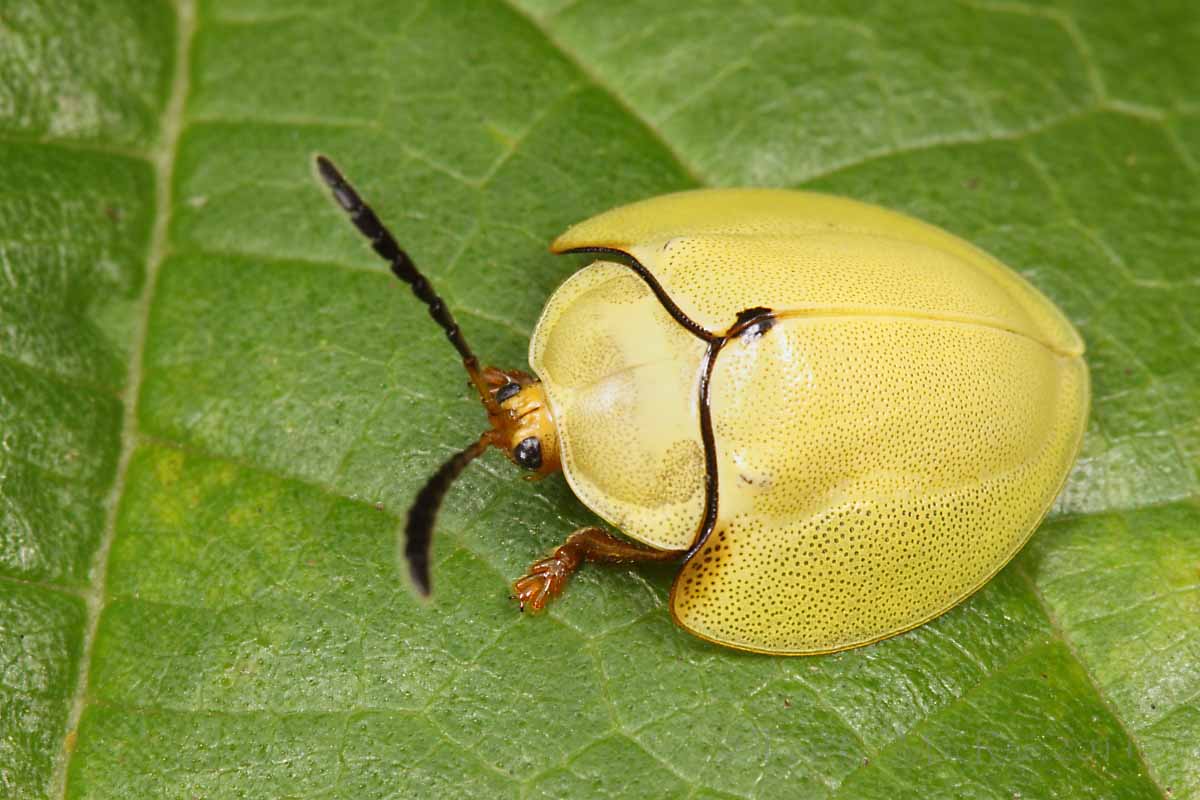
Despite their hyperdiversity, leaf beetles (family Chrysomelidae) as a group are for the most part among the most easily recognized of all beetle families, and within the family none are more recognizable than the tortoise beetles (subfamily Cassidinae).  Named for their distinctively armoured elytra and prothorax and associated behavior of drawing the head and legs under them when threatened, they are worldwide in distribution and especially diverse in the New World tropics.  Even though I know little about the group (chrysomelids as a whole are far too intimidatingly diverse a group for me to add to my already burgeoning list of interests), I can’t resist collecting them whenever I encounter them.  Having traveled to Mexico and South America many times over the years, I’ve accumulated almost a full Schmidt box of these beauties – most of which remained unidentified, save for the well-known representatives from our relatively depauperate North American fauna.


Thus, when I encountered this striking example on a leaf in the Barão Geraldo District near Campinas, Brazil, I figured the photos I took would go into one of those “Brazil Bugs” posts featuring a variety of pleasing to look at but otherwise unidentified insects.  Still, after having had success identifying some other Brazilian insects using Google, Flickr, and carefully selected search terms, I figured I should at least give this one a try.  It didn’t take long – searching on nothing more than “Cassidinae” in Flickr yielded a very similar looking beetle on page 6 from Panama identified by Rob Westerduijn as Paraselenis tersa.  While not likely the same species, it seemed almost certain to represent the same genus, so further searching on the genus name eventually led me to the cassidine mother lode: Cassidinae of the World: An Interactive Manual.  This web page, authored by Lech Borowiec, features species lists, identification keys and images of a large number of specimens, including nearly all of the 29 species currently placed in this exclusively Neotropical genus (you can bet I’m bookmarking this site – perhaps my Schmidt box of specimens will finally get some attention!).  A quick perusal through the images yielded an ID: Paraselenis (Spaethiechoma) flava, recorded broadly across South America.  Everything fit – the black scutellar marking, the elytra broader than the prothorax, the bicolored antennae, the thin black anterior elytral marginal band, and – appropriate for the species name – the even yellow coloration.  My ID was confirmed when I found a key to all the species of Paraselenis (Borowiec 2003).  I surmise this is a female based on the more rounded humeral elytral projections, which seem to be more strongly and angularly produced in the males based on the photos I looked at.


Interestingly, this particular species is considered a pest of sweet potato and commonly referred to as “fusquinha”¹ (Montes and Raga 2010).  Many species of tortoise beetles, in fact, utilize as host plants members of the sweet potato family (Convolvulaceae).  This individual was not on a convolvulaceous plant, but a small tree.  I looked for additional individuals but didn’t find any, nor did I find larvae or any evidence of feeding, so this must have been a wayward individual – probably searching for a suitable host on which to oviposit.

¹ “Fusquinha” is the Brazilian Portuguese word for “Volkswagon Beetle”!

References

Borowiec, L.  2003.  Two new species of the genus Paraselenis Spaeth, 1913 (Coleoptera: Chrysomelidae: Cassidinae).  Genus 14 (3): 403-411.

Montes, S. M. N. M. and A. Raga. 2010. “Fusquinha” Paraselenis flava (L. 1758) praga da batata-doce. Instituto Biológico – APTA, Documento Técnico 004, 8 pp..

Copyright © Ted C. MacRae 2011

Frenatae 2011 Calendar

Ralph Holzenthal - Tabanidae. Adobe Illustrator, gradient mesh/Adobe Photoshop.

Even though we’re now in the latter part of February, I wanted to spread the word about a cool insect-themed calendar shown to me by a colleague during my recent trip to Brazil. Produced by Frenatae, the Graduate Student Entomology Club at the University of Minnesota, the calendar features original work by students using computer illustration techniques taught in a UMN course titled, ENT 5051, Scientific Illustration of Insects. The mastermind behind this course is Dr. Ralph W. Holzenthal, who – as can be seen by the stunning image above of a female (L) and male (R) Tabanus lineola – knows a thing or two about insect illustration! While the course covers traditional techniques such as pen & ink, pencil, watercolor, etc., its major emphasis is on computer-assisted techniques using Adobe Illustrator® and Photoshop®. This includes instruction on preparing full habitus color illustrations of insects on the computer. How I wish a course such as this had been available when I was in graduate school (of course, how I wish computers had been available when I was in graduate school!).

While Dr. Holzenthal’s illustrative skills are obvious, it’s also clear that he excels at teaching these skills to his students, as evidenced by this selection of my favorite images (not surprisingly, all beetles!) from the course website galleries:

Caitlin Krueger - Scarabaeidae

Martha Megarry - Scarabaeidae

Heather Cummins - Zopheridae

.
It should be pointed out that all of these Photoshop illustrations represent original artwork and not modified photographs!

I ordered my copy of the calendar as soon as I returned home from my trip. You can order one too by sending a check for $12 to the following address:

Frenatae
1980 Folwell Ave Rm 219
St Paul, MN 55108

My thanks to Dr. Holzenthal for allowing me to post this small selection of images from his website.

Copyright © Ted C. MacRae 2011

Is Missouri’s disjunct population of Johnson’s tiger beetle extirpated?

ResearchBlogging.orgThe December 2010 issue of the journal CICINDELA came out a little over a week ago. Leading off inside is the first in a series of papers that I, along with colleagues Chris Brown and Kent Fothergill, have prepared detailing our work with several species of tiger beetles in Missouri of potential conservation interest. At the start of our surveys, Missouri’s tiger beetle fauna was already fairly well characterized, at least qualitatively, due to the efforts of heavy hitters Ron Huber and Dave Brzoska, who for many years lived in nearby eastern Kansas. Despite their attentions, however, questions lingered regarding the precise distribution and status of several species of restricted geographical occurrence within the state, and our surveys over the past 10 years have sought to resolve these questions and, if necessary, recommend conservation efforts to secure the long-term survival of these species within the state.

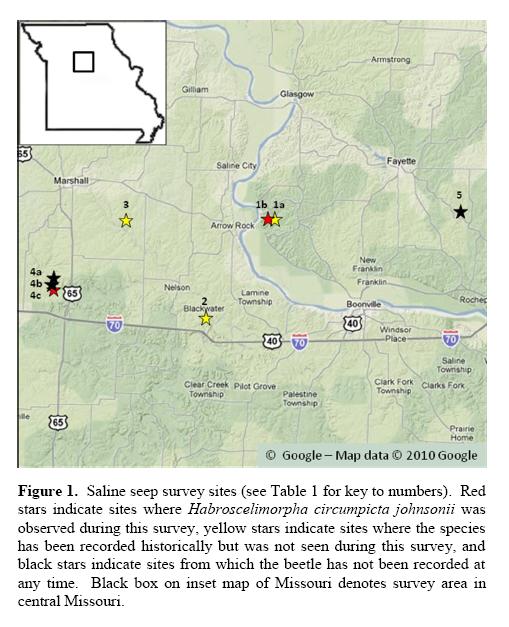
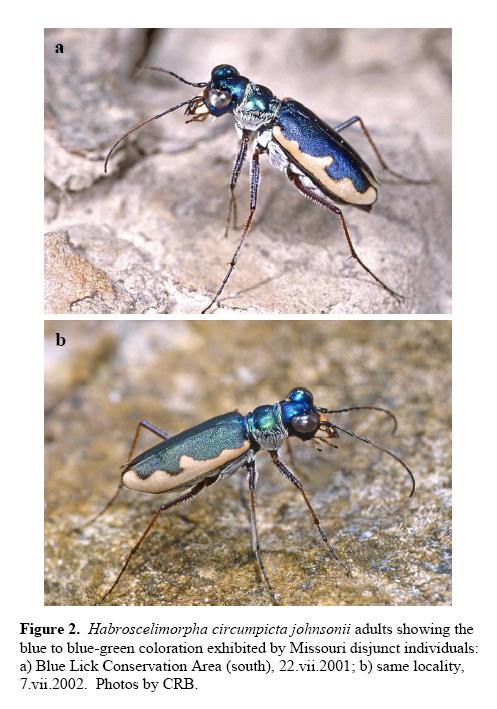
One of these species of interest is Habroscelimorpha circumpicta johnsonii (Johnson’s tiger beetle). This subspecies is widely distributed in inland areas of the central and south-central United States, where it is associated exclusively with barren areas surrounding saline seeps. Despite the broad occurrence of the main population, the Missouri population of this subspecies has long been of particular interest for several reasons: 1) its widely disjunct isolation, occurring several hundred miles east of the nearest populations in central Kansas, 2) its strict association with the highly restricted saline seeps of central Missouri (Fig. 1), and 3) the exclusive blue-green coloration of the adults (Fig. 2) that contrasts with the varying proportions of reddish and/or dark morphs, in addition to blue-green morphs, found in other populations. The highly disjunct and isolated occurrence of this population and its unique coloration have been considered by some workers as grounds for separate subspecific status. Another restricted, disjunct population of this species in North Dakota has already been accorded subspecific status – H. circumpicta pembina.
Despite its restricted occurrence in Missouri, a long history of collection records exist for the subspecies. Numerous specimens are housed in the Enns Entomology Museum in Columbia, Missouri, with a majority of these coming from a single location (Boone’s Lick Historic Site) and dating back as early as 1954. In more recent years (1985-1992), Ron Huber and Dave Brzoska found significant numbers of beetles at two additional locations near Boone’s Lick. Despite these numerous records, the subspecies was listed as a “Species of Conservation Concern” by the Missouri Natural Heritage Program with a status of “S2S3” (vulnerable or imperiled) due to the rarity of its required saline seep habitats in Missouri. Unfortunately, this alone did not appear to be sufficient protection for the species, as my own observations beginning in the mid-1990s suggested that populations of the beetle had declined significantly from their historical levels. Concomitant with these apparent declines was the observation that the sites supporting these beetles had themselves suffered severe degradation that reduced their apparent suitability as habitat for the beetle. As a result of these observations, Chris and I initiated comprehensive surveys during the 2001 field season to assess the conservation status of the Missouri population and identify potential new sites. Our first order of business was to petition a status change to “S1” (critically imperiled), and for the next three years we regularly visited the historical sites throughout the presumed adult activity period, noting occurrence of adults and recording their numbers and the circumstances of their habitat associations. Included in these surveys also were two new sites identified using the Missouri Natural Heritage Database.

The results were not good – during the 3-year survey, only a single beetle was observed at the historical location of Boone’s Lick, and none were observed at the two other locations discovered by Ron Huber and Dave Brzoska. More significantly, all three sites had suffered severe degradation due to vegetational encroachment, cattle trampling, or other anthropogenic disturbance. Moreover, of the two potential new sites identified, only one of these (Blue Lick Conservation Area) was found to support a small population of the beetle. Three apparently suitable saline seeps exist at this latter site; however, beetles were observed at only one of them. During the final year of the survey, prolonged flooding occurred at this site (frustratingly, a result of earth-moving operations by site personnel), which was followed in subsequent years by significant vegetational encroachment (Fig. 3). No beetles were observed at this site during the final year of the survey, nor has the species been seen there in multiple visits to the site in the years since.

Is the Missouri disjunct population of Johnson’s tiger beetle extirpated? There is little reason to be optimistic. What is clear is that the beetle is now below detectable limits, and with the loss of suitable habitat at all sites known to have supported the beetle in the past and little chance that new, high-quality sites will be identified, prospects for an unaided comeback are dim. The saline seep habitats at the three historic sites appear to have suffered irreparable degradation and offer little restoration potential to the degree required to support viable beetle populations; however, there are still two saline seeps at Blue Lick that do offer at least a semblance of suitable habitat. It is imperative that these last remaining examples of Missouri’s critically imperiled saline seeps habitats receive the highest priority for protection if the beetle (should it still exist) is to have any chance of surviving in Missouri. Johnson’s tiger beetle is only one of several tiger beetle species whose presence in Missouri appears to be in jeopardy (others being Dromochorus pruinina – loamy ground tiger beetle, and Cylindera celeripes – swift tiger beetle). I end this post with our closing admonition in the paper:

The loss of this beautiful and distinctive beetle from Missouri’s native fauna would represent a significant and tragic loss to this state’s natural heritage. We urge the Missouri Department of Conservation, the Missouri Department of Natural Resources, and other conservation organizations within the state to identify and allocate the resources needed to develop and implement a recovery plan for the species in Missouri.

REFERENCE:

Brown, C. R. and T. C. MacRae. 2011. Assessment of the conservation status of Habroscelimorpha circumpicta johnsonii (Fitch) in Missouri CICINDELA 42(4) (2010):77-90.

Postscript. On a happier note, I am pleased to be joining the editorial staff for CICINDELA. While my role as layout editor is more functional than academic, I am nevertheless thrilled with the chance to “rub shoulders” with the likes of Managing Editor Ron Huber and long-time cicindelid experts Robert Graves and Richard Freitag. I hope my contributions to the journal’s production on the computer end of things will be favorably received by its readership.

Copyright © Ted C. MacRae 2011

Brazil Bugs #13 – Gorgulho do fungo

Phaenithon semigriseus (Anthribidae) - Parque Municipal, Distrito Barão Geraldo, São Paulo, Brazil. ID by Jose Ricardo M. Mermudes.

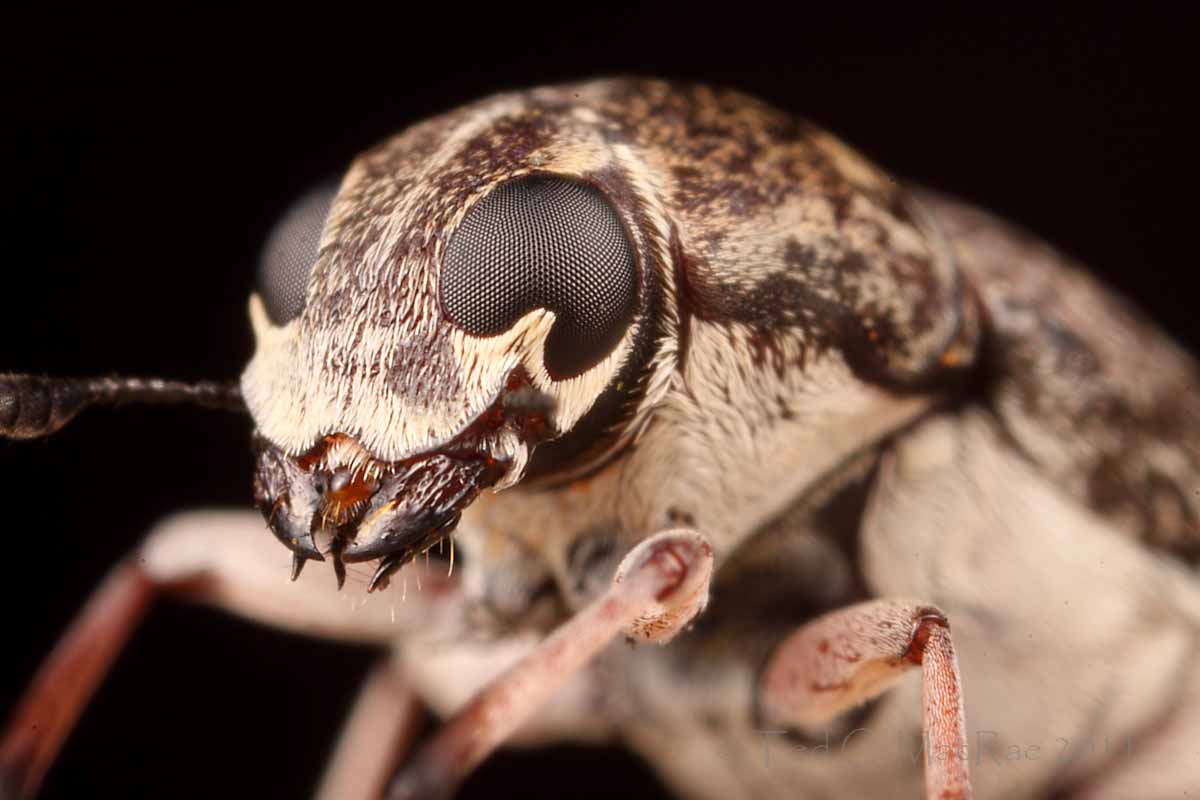
Over the weekend during my trip to Brazil last month, I took a walk in the municipal park near my colleague’s home in Barão Geraldo. There was a rather large lake with a walking trail going around it, and although much of the vegetation was planted, there were some less kempt and more native-looking sections along the trail where I hoped to find some insects to photograph. As it turned out, there weren’t a whole lot of interesting insects, but I did see a capybara (“capivara” in Portuguese) – the largest rodent species in the world (picture a guinea pig the size of a small real pig) – for a brief moment before it splashed in alarm into the lake and swam away. One of the few interesting insects I did see was this little fungus weevil (family Anthribidae) on the bark of a large, recently felled tree. At only ~3-4mm in length, it was a rather tiny species as anthribids go – especially in the tropics – and lacked the comically elongated face that some species possess. Still, there is something humorous in its portrait.

Fungus weevils differ from true weevils (family Curculionidae) by having the antennae unelbowed.  I have no clue about the identity of this individual below family level, and there don’t seem to be a whole lot of entomologists that study this group of weevils (should anybody have a clue, please do leave a comment).  I simply must post these photos, however, because I think it is the first time I actually nailed the focus right on the eye with a closeup of this magnitude (~3X).  I actually took some closer shots also (in the 4X range), but I really didn’t care for the composition with the lens zoomed in to that degree.

Update 02/17/11, 9:53 a.m.: I just received an email from Jose Ricardo M. Mermudes (Universidade Federal do Rio de Janeiro), who informs me that the species is Phaenithon semigriseus (Germar, 1824). It would seem that this photo at Coleoptera Neotropical has, until now, been the only image of this species on the web.

My thanks to Dr. Mermudes! 

Copyright © Ted C. MacRae 2011