Six beetles Ted still needs for his collection

Today’s guest blogger is longtime friend and insect collecting partner Rich Thoma. Rich and I first met nearly 30 years ago and have been collecting insects together ever since. Rich is a strong advocate for educating children about natural history and has developed some rather fun methods for doing this. His unique sense of humor in doing this is on display in this post.


While Ted’s away, he asked me to fill in for him with an article for Beetles in the Bush.  I thought I would take this opportunity to introduce you to some unique beetle species found in my collection.  All were caught long ago when I first started collecting insects.  Here they are for your enjoyment!

Colorado Mr. Potato Head Beetle (Leptinotarsa decimlineata potatoea)

The Colorado Mr. Potatoe Head Beetle was first discovered by Dan Quayle, ex vice president of the United States cleaning his son’s toy box when the family moved from the vice presidential mansion.  Most entomologists feel this beetle is a subspecies of the very common potato pest, the Colorado Potato beetle.  It has been speculated that a shipment of Mr. Potato Head toys was somehow mixed with a shipment of GMO modified sweet California Russet Potato’s.  The beetles needing a new food source found the hollow, interior of the Mr. Potato head toy to their liking.  Inedible plastics from the toy have been incorporated into the exoskeleton of the beetle.

Lawn Ornament Beetle (Prionus phaenicopterus)

Today the lawn ornament beetle is considered rare.  This insect’s population exploded in the mid- 1900’s when lawn ornaments, particularly pink flamingos were popular.  This Cerambycid was named P. phaenicopterus after the flamingo genus Phaenicopterus in recognition of its strong association with plastic pink flamingos.  Beetle populations have steadily declined as the pink flamingos have decreased in popularity.  There is hope this species may rebound with the increase in other plastic yard items such as lawn chairs and big wheels.

Styrofoam Beetle (Zopherus styrofoamensis)

A common denizen of landfills of the mid-western U.S.,  Z. styrofoamensis is considered a scavenger preferring party garbage, plastic and styrofoam plates and cups.  The white coloration is variable.  Some specimens have only a few small white patches whereas others are nearly all white.  In rare instances the white exoskeleton expands so much that it takes the shape of a packing peanuts.  This explains why this species was overlooked for so long.  Scientists performing landfill research were unaware this species was present due to its exact mimicry of the packing material so often discarded in today’s dumps.   Recent research has shown the white coloration can be directly correlated to the amount of styrofoam eaten.

G.I. Joe Bug (Powella shellensis)

A common denizen of battlefields and army bases around the world.  This dung beetle is known to lay its eggs inside empty bullet shells and then pack it with dung.  Inside the bullet shell, larvae are protected from being crushed by the heaviest of military equipment.  One is likely to find this species any place guns are fired.  Adults have four extremely sensitive, orange and yellow sound sensors on the elytra.  At the sound of a rifle shot, adults fly from miles away towards the sound.  Hundreds of this beetle species can be found, after an army platoon has taken target practice for the day.  The first male to arrive at a bullet shell, quickly rolls it as far away from the noise as possible.  Females are attracted to males that stridulate a sound something like “Ready, Aim, Fire”.

Goodyear Beetle (Ackron firestonei)

This is the first known, genetically enhanced species developed to combat one of the worlds growing refuse problems, tires.  Essentially scientists were able to cross a common scarab beetle with a Mexican jumping bean.  The combination produced a new species capable of consuming rubber.  Scientists quickly released thousands of these beetles into the ever growing, piles of old and used tires found in today’s junkyards.  The tire decomposition program was deemed a complete success.  As so often happens, however, when all the tires in landfills and dumps were consumed, the beetles switched to tires still in use.  There has been a rash of flat tires causing millions in damage.  At its worst, the Goodyear Beetle can consume all four wheels and the spare in less than a week.

Pokemon’s Delight (Picachu lightningae)

This species of beetle is only attracted to flashes of colorful lights such as at fireworks displays and Pokemon reruns.  In flight, the body absorbs the flashes of color and retransmits them, often in technicolor.  Some of the latest fireworks displays have been enhanced by releasing thousands of this beetle prior to the show.  Similar flashes have been observed if a beetle lands on a television screen during a Pokemon show.  The same flashes that cause epileptic seizures in some people, cause this beetle to buzz the national anthem of Mexico.

As with other insects, the species described above are easy to collect if you know how.  Searching museum specimens, one quickly realizes that the only people collecting these insects were all under 12 (as was I when I collected each species).  If you want to collect these beetles, the best opportunities will come if you take along a child.  Children seem to be the only ones who have the imagination to find these beetles.

This is an opportunity to point out that today’s children are being denied the chance to enjoy the outdoors and learn about the wonderful creatures that live there.  For the most part, our education system no longer devotes the time to teach about the plants and animals that occupy our planet.  Even at home, children now spend their free time playing video games and watching TV instead of being outdoors.  Few kids get the chance to walk on a dirt path in the woods or hold any living creature in the palm of their hand.

This is where you, the reader of this blog can make a difference.  You can give our next generation the chance to enjoy the wonders from the creatures that live all around us.  The next time you go out in the field to collect insects, take a kid with you.  Volunteer at a local library, school or park.  All these places cannot exist without volunteers and you have a lot to offer.  It is amazing how much kids will learn about the world around them given the chance.  The surprise in how much you learn in return from them!

Copyright © Richard S. Thoma 2010

Add to FacebookAdd to DiggAdd to Del.icio.usAdd to StumbleuponAdd to RedditAdd to BlinklistAdd to TwitterAdd to TechnoratiAdd to Yahoo BuzzAdd to Newsvine

Email to a friend

Guest Blogger: Dogbane for Dinner

Our guest blogger for today is Anne McCormack. I have known Anne (or known of her) for more than 25 years now, first as a long-time editor of Nature Notes, the journal of the Webster Groves Nature Study Society, and more recently on a personal basis as I, myself, have followed in her editorial footsteps. Anne is an astute naturalist whose breadth of knowledge spans not only botany but also entomology and ornithology, all of which she write about in her own blog at Gardening with Binoculars.


I planted Common Dogbane (Apocynum cannibinum) because some of my butterfly-watching friends reported numbers of juniper hairstreak butterflies on the patch of dogbane at Powder Valley Nature Center in Kirkwood. I assumed incorrectly that dogbane was a host plant for hairstreaks, and believing it to be little more than caterpillar food, I placed it in a hot, dry, narrow strip along the driveway. Ragged, caterpillar-chewed leaves wouldn’t be noticed there, and I forgot about it. After a few seasons, it was still a modest-sized clump, but the leaves were in great shape. In fact, it had grown into an attractive bush of airy, elegant lime-green foliage, wine-red stems, and tiny white flowers. It’s quite a contrast to its relative, Common Milkweed, growing next to it, which looks as if it were designed by Dr. Seuss—even before it gets chewed to bits. At this point I decided it was time to look it up and see why it had failed to support hordes of munching caterpillars. As you have already guessed, gentle reader, the Juniper Hairstreak’s host plant is juniper, not dogbane, but good old Common Dogbane is a great nectar plant. Now that Dogbane and I understand each other better, I can appreciate the amount of traffic its tiny white blooms bring in, like this Peck’s Skipper butterfly. Ants, butterflies, tiny native bees, honeybees, and this mason wasp are busy there all day long.

Along with several species of moth, it is the host plant for the Dogbane Beetle, which spends its larval stage devouring the roots and its adulthood dining on the leaves of Dogbane, and nothing but Dogbane. Dogbane Beetle can be confused with Japanese Beetle by beginners like myself, but unlike its fellow Coleopteran, Dogbane Beetle is harmless. That makes its iridescence all the more gorgeous, as shown in this wonderful photo by Courtnay Janiak. It’s a native insect that has shared a long evolutionary history with this under-appreciated native plant. American Indians valued it for its bark, which is tough but peels off in long strips. They plaited it for bowstrings and anything that called for twine; hence, its other common name, Indian Hemp. Don and Lillian Stokes, in their 2002 PBS show about bird watching, demonstrated how birds seek out the dry stems of this perennial, pulling off strips for nests in early spring. Nesting material can be hard to come by for birds in the tidy suburbs, so I don’t clean up the stems after frost. “Bane” in the name refers to the toxin cymarin in the plant’s leaves, though the plant would have to be covered in braunschweiger before my dog would be interested. Edgar Denison, in Missouri Wildflowers, translates the genus name Apocynum as “away dog.” The species name cannibinum refers to hemp. Its seedpods remind me of French green beans. These split at the end of the season, and the seeds fly away on fibers similar to milkweed seeds. Collect some and try this plant in your butterfly or native plant garden. Give it a spot where it’s easy to watch the colorful visitors.

Dogbane beetle (Chrysochus auratus) - Copyright © Courtnay Janiak

Copyright © Anne McCormack 2010

Add to FacebookAdd to DiggAdd to Del.icio.usAdd to StumbleuponAdd to RedditAdd to BlinklistAdd to TwitterAdd to TechnoratiAdd to Yahoo BuzzAdd to Newsvine

Email to a friend

Special Delivery

Entomology is, of course, a wide and varied discipline that touches any number of human endeavors – from the practical (agriculture, food production, public health) to the esoteric (genetics, ecology, cultural symbolism).  Despite this far-reach, however, entomologists themselves are not all that common, and the number of people who know a fair amount about insects without actually being an entomologist is rather small.  Compare this to ornithology, where the number of people who know a good deal about birds exceeds by great measure the number of actual ornithologists.  This is merely an observation and not a criticism – insects are just simply too small and too diverse for most lay people to even attempt identification.  That’s good for me, as those who have an interest in insects but not the expertise to identify them often turn to me for help.  For most of my adult life, I’ve been “the bug guy” at social gatherings, often leading to questions such as, “I’ve got this green bug on my bushes – what is it?”  Sometimes the insect or its situation are described well enough that I can offer a guess (just a guess!), more often I can only say, “I’d have to see it to know for sure.”  Despite not always being able to answer the question, I really do enjoy serving as this very direct link between the science of entomology and the general public, as it gives me a chance to present insects and their study in a favorable light and with a sense of passion.

The level of this interaction has increased greatly during the past two years since launching Beetles in the Bush.  Now, my “clients” include not just family, friends, their friends, etc., but an unrestricted internet audience.  I am regularly contacted by those who stumble upon this blog during a Google search in their attempt to identify some insect they’ve encountered.  Again, I’m not always able to answer their queries, but I do try to offer my best guess.  Such was the case recently when I was contacted by a resident of southwestern Missouri, who had this to say:

While messing around here in the yard this morning I came upon a beetle I thought interesting. First time I have seen one like this. I Have a Simon and Schusters Guide to insects guide and attempted to look up the beetle. Closest thing I could find was a flat-headed borer (BUPRESTIS GIBBSI) from the Pacific Northwest. Emerald green with yellow slash or stripe along the side of the head. four matching yellow spots on the wing covers, first pair closest to the front of the covers elongated. Second set smaller, third set smaller yet and then tiny sopts on the wing cover tips. Yellow center pattern along the bottom from head to tail. Bettle length almost 2.5 cm. I am not much of a insect man but when I get something stuck in my head I need to know what I have. Can you help me and if you do not have one in your collection do you want this one?

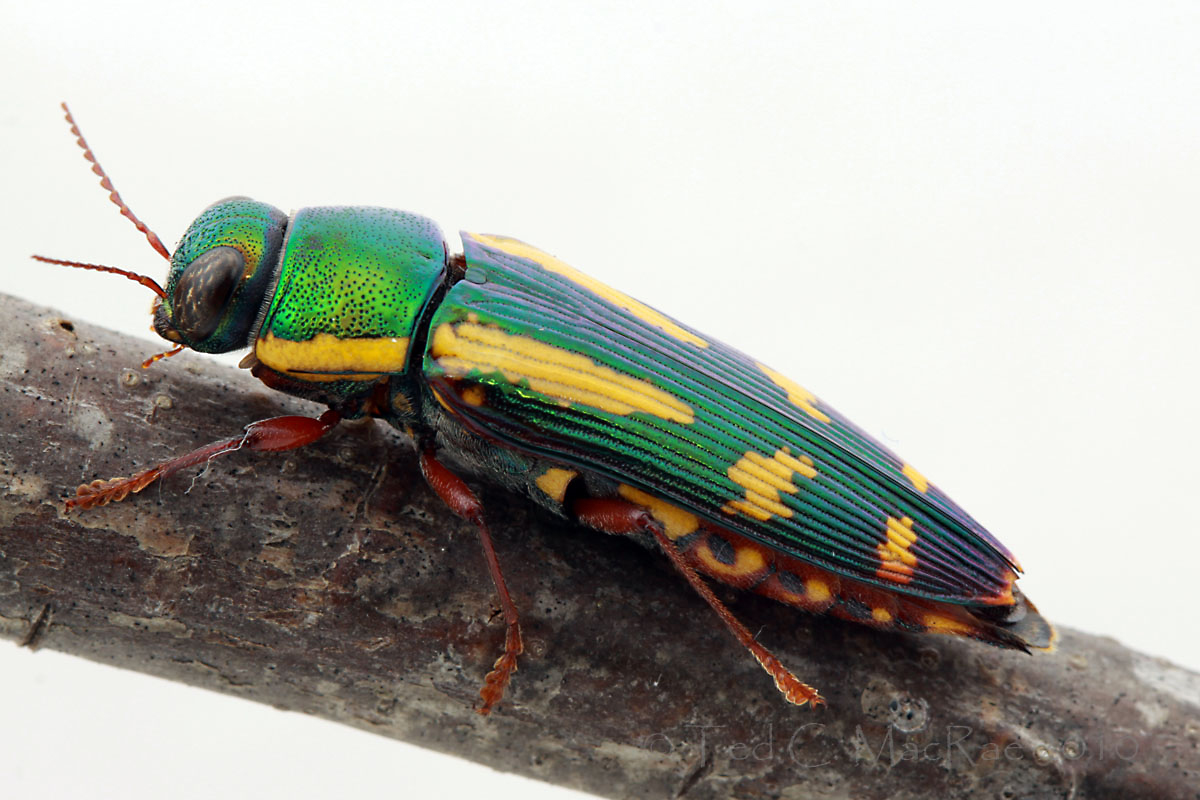
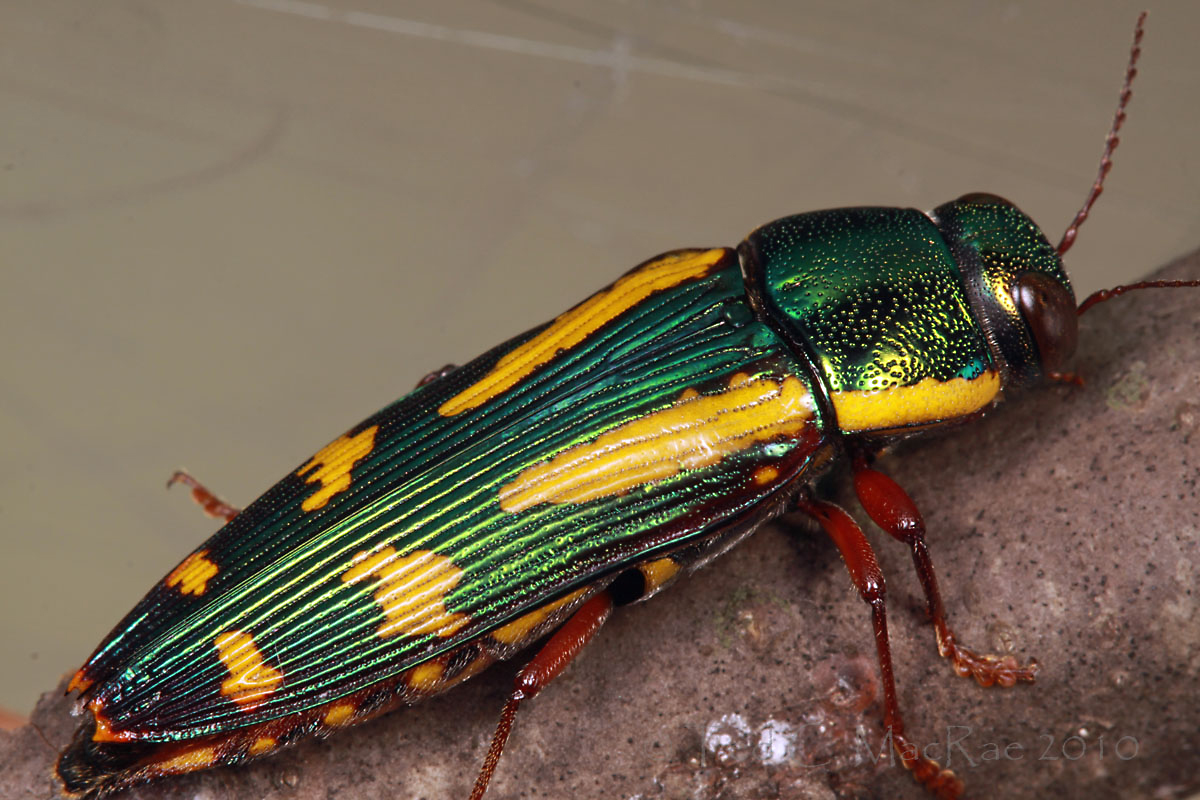
This is perhaps the best, most detailed description of an insect I’ve ever received from a non-specialist wanting an identification, but the reference to it resembling Buprestis gibbsii was enough to immediately bring to mind an eastern U.S. relative – B. rufipes.  I responded that it was likely the latter, and since they had offered to send it to me I would be happy to receive it and confirm its identity.  I instructed them to wrap the beetle loosely in a square of toilet paper, put that in a film canister or other small, sturdy box, and slip that inside a padded envelope and mail it to me.  A few days later a small padded envelope arrived at my office, and inside was a film canister.  I popped the lid to find it stuffed full with tissue paper, but I noted that the tissue seemed all chewed up.  I pulled out the tissue and unfolded it, and there was no beetle – oh no, was it alive, and did it chew it’s way out?  I looked inside the canister, almost expecting to see a hole chewed though it, and there at the bottom sat a most stunning example of B. rufipes (literally meaning red-legged buprestis).  I hadn’t expected the specimen to be sent alive when I gave my mailing instructions (but I did not, after all, specify that it should be otherwise), and I felt a little sorry for the beast when I saw it drinking eagerly after I put it in a terrarium with wood chips and a stick and misted it with water.  Once it was rehydrated, I was glad to have this unexpected opportunity to photograph a living individual of this beautiful species.

Buprestis rufipes is not a rare species, but it is certainly not very commonly encountered either.  For many years the only specimens in my collectioni were two dead adults that I found in Japanese beetle traps that I monitored during my early days with the Department of Agriculture.  I finally cued into this species when I chopped some big buprestid larvae out of the trunk sapwood of a very large, standing dead slippery elm (Ulmus rubra).  They resembled the larvae of Chrysobothris but were larger and not so flattened, so I retrieved my chain saw from the truck and extricated the lower 6ft of the 6-8″ diameter trunk from the swamp in which it was growing.  My efforts were rewarded with a nice series of this species, and I have since reared it from even larger trunk sections of Acer saccharum and Quercus palustris. In each case, the wood was in early stages of decay with the bark partly sloughed and the outer wood layer slightly softened (MacRae and Nelson 2003, MacRae 2006). Knull (1925) recorded this species breeding in a variety of other hardwoods, thus, it would seem that the size and condition of the wood are more important than the species.

Photo Details: Canon 50D (ISO 100, 1/250 sec), Canon 100mm macro lens, Canon MT-24EX flash (1/4 power).
Photos 1-2: f/13, indirect flash in white box.
Photo 3: f/16, double diffused flash.
Typical post-processing (minor cropping, levels and unsharp mask).

REFERENCES:

Knull, J. N. 1925. The Buprestidae of Pennsylvania (Coleoptera). Ohio State University Studies 2(2):1–71.

MacRae, T. C., and G. H. Nelson. 2003. Distributional and biological notes on Buprestidae (Coleoptera) in North and Central America and the West Indies, with validation of one species. The Coleopterists Bulletin57(1):57–70.

MacRae, T. C. 2006. Distributional and biological notes on North American Buprestidae (Coleoptera), with comments on variation in Anthaxia (Haplanthaxiaviridicornis (Say) and A. (H.) viridfrons Gory. The Pan-Pacific Entomologist 82(2):166–199.

Copyright © Ted C. MacRae 2010

Add to FacebookAdd to DiggAdd to Del.icio.usAdd to StumbleuponAdd to RedditAdd to BlinklistAdd to TwitterAdd to TechnoratiAdd to Yahoo BuzzAdd to Newsvine

Email to a friend

Vicarious Friday Beetle Blogging

Despite the fact that I have a beetle blog and Alex has an ant blog, it is the latter where the regular series Friday Beetle Blogging resides (hmm, I wonder if I should start a Myrmecine Monday series?).  Alex has perhaps the best science-based entomoblog out there, so I’m thrilled to contribute today’s edition – check it out: Friday Beetle Blogging – the Swift Tiger Beetle.

Copyright © Ted C. MacRae 2010

Add to FacebookAdd to DiggAdd to Del.icio.usAdd to StumbleuponAdd to RedditAdd to BlinklistAdd to TwitterAdd to TechnoratiAdd to Yahoo BuzzAdd to Newsvine

Email to a friend

Hunting the Great Plains giant tiger beetle

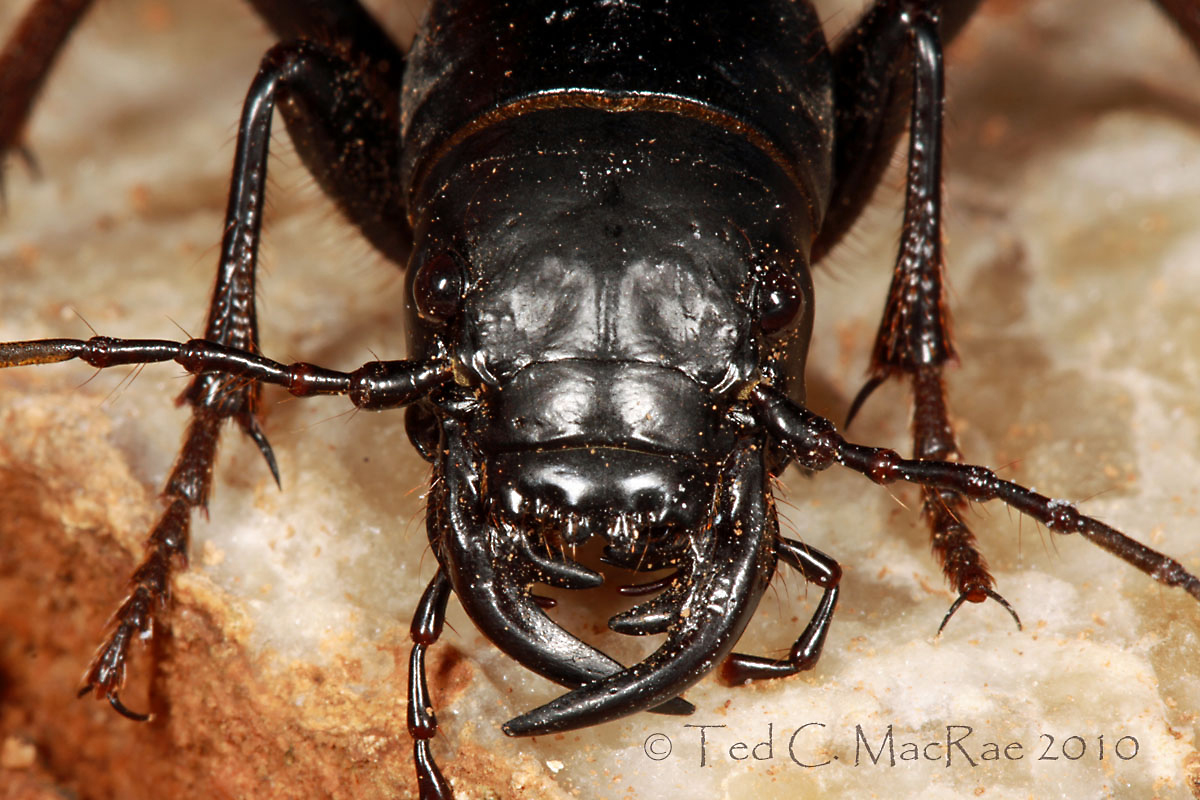
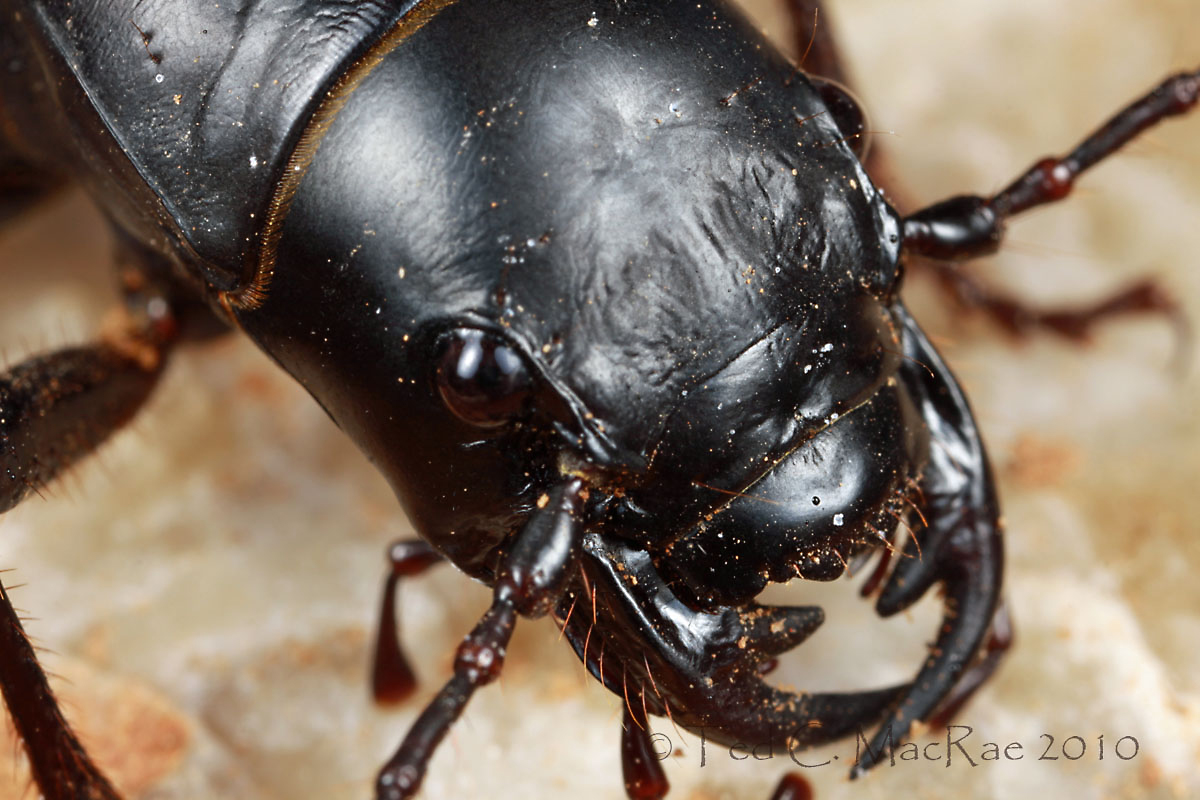
In the early 1980s, I was a young, green entomologist, fresh out of school with a budding interest in beetle taxonomy, a zeal for collecting, and a desire to meet other like-minded individuals. Among the first collectors I had the good fortune to meet was Ron Huber, one of the country’s leading tiger beetle experts and co-founder of the journal CICINDELA (now 42 years as co-editor). Although my interests had by then already begun narrowing to woodboring beetles, I liked tiger beetles well enough and managed to secure from him a single specimen of what Erwin and Pearson (2008) would later dub the “Great Plains giant tiger beetle,” Amblycheila cylindriformis – the largest tiger beetle in North America. I don’t remember what prompted Ron to part with this spectacular specimen – perhaps it was the lone Proserpinus gaurae (Lepidoptera: Sphingidae) adult that I possessed, which I had reared from a field-collected larva around that time, or maybe Ron had such a nice series of the species that making the day of a young collector was in itself reward enough. While clearly a tiger beetle, it was still so different by virtue of its enormous size (the species ranges from 25-38 mm in length), somber coloration, small eyes, and strictly nocturnal habit. For much of the past 25 years, that specimen has sat in my cabinet amongst a small assortment of other, mostly mundane tiger beetles that I had opportunistically taken on my woodboring beetle-focused collecting trips. While I longed to someday see the species for myself, to do that would mean making a special trip out to the Great Plains – woodboring beetle desert that it is – during the middle of summer and stumbling through the prairie in the dark with a flashlight. Such an effort always seemed too great for the sole purpose of finding a single species, and not even a woodboring beetle at that.

Interests evolve, however, and while I still consider woodboring beetles to be my primary interest, tiger beetles have increasingly occupied my attention over the past several years. Contrary to woodboring beetles, the Great Plains are a mecca for tiger beetle diversity, and in recent years I’ve made a number of trips to Nebraska, Kansas, South Dakota, and Oklahoma specifically to look for them. Such was the case in June of last year when I went to the Glass Mountains in northwestern Oklahoma on a hunch and found Cylindera celeripes, Dromochorus pruinina, and a large tiger beetle larva that I just recently concluded must represent A. cylindriformis. I had been rearing the larva for a year by the time I figured out its identity, and when I did I sudden found myself facing a “perfect storm” – an upcoming holiday weekend, adults presumably in peak adult activity, and I knew exactly where to look for them. Impulsively, I decided to use my July 4th weekend to make the 525-mile drive from St. Louis to the Glass Mountains – this would give me 2 nights to look for them and still allow me to make it back to work on Tuesday morning. Anything else I could find during the day would be icing on the cake, but even if I found nothing, the chance to see A. cylindriformis in the wild seemed worth the gamble.

I made it to Joplin, Missouri near the Oklahoma border by midnight on Friday but awoke to threatening skies the next morning. The threat of rain became a promise as I drove further west, and by the time I arrived in Enid, Oklahoma – just 30 miles from the Glass Mountains – it was raining heavily. I stopped at a coffee shop to access Wi-Fi, and checking the radar showed a line of storms moving up through Texas and western Oklahoma into Kansas – sitting right over the Glass Mountains! The forecast gave no reason for optimism, with a 50% chance of thunderstorms through the weekend. Smartly, I had recorded the locality of the Huber-specimen – collected in northwestern Kansas – and checked the forecast for that area, but it was even worse (50% chance of thunderstorms through Sunday and 80% Sunday night). Clearly this was not good, but I had made the drive and was determined to make something happen. I decided the best thing to do would be to just continue driving west – however far that was – until I got past the storm system and see what was around – wherever that might be. I gassed up amidst a gusty, torrential downpour and headed west out of town. As I drove, the rain lightened up and eventually ceased. The roads were wet, but at least it wasn’t raining, and when I arrived at the Glass Mountains even the roads seemed to be drying. Winds were still strong, but the clouds had broken somewhat, allowing brief periods of sun to further dry things out, and what followed was a most fascinating day on top of one of the Glass Mountain mesas (highlights include C. celeripes, D. pruinina, Microstylus morosus, Trichodes sp. – look for these in future posts). As dusk approached I searched the grasslands below hoping to see a rattlesnake or two – I had seen a western pygmy rattlesnake here last year, and western diamondbacks are also in the area, but I saw none.

Of course, all this was really just passing time – waiting for nightfall and hoping the rain continued to hold off so I could begin searching the prairie down below for A. cylindriformis. It had sprinkled once or twice during the day, and I couldn’t tell if the darkening western sky was truly rain or the just the coming dusk. At 9pm, with darkness fast approaching, I set out with my headlamp and made a beeline for the native prairie habitat on the lower talus slopes where I had last year collected the larva and observed additional larval burrows that I took to be the same species. I must admit that the thought of walking alone through the prairie at night in western diamondback rattlesnake habitat made me more than a little nervous, and I kept just as much an eye out for them as I did the tiger beetles that I was looking for. As the night wore on, my hopes began to dim – I had searched for almost an hour and had covered most of the area where I had seen larval burrows last year. With no sign of the beetle, the negative thoughts started to enter my head – did I make this drive for nothing? How sure was I that the larva really represented Amblycheila? Did I have the right search image? I mean, they’re huge black beetles – they should be easy to spot, right? Oh great, I made all this fuss on my blog about looking for the species – how embarrassing to have to say, “Uhm, well, I didn’t find it.” Just as I began wrapping back around the bottom of the talus slope, there it was – no doubt about it! I just watched it for a while and noted that it moved with some urgency, but it was not the speedy, jerking walk of ‘regular’ tiger beetles – rather, it was more lumbering, seeming to pick each foot up rather high, like a cat with rubber bands on its feet (how would I know about that?). There seemed little risk of it escaping me, so I got out the camera and began following it to take photographs – no way! While it may have lacked the speed of other tiger beetles, it also lacked their propensity to occasionally pause long enough to allow a shot or two. Add the darkness, fear of rattlesnakes, and constant bumping of the flash unit on my headlamp, and it was soon apparent that getting good field photographs was going to be a low percentage proposition. I resigned myself to taking photographs later in a terrarium (several shown here) and spend my time in the field more productively looking for additional individuals.

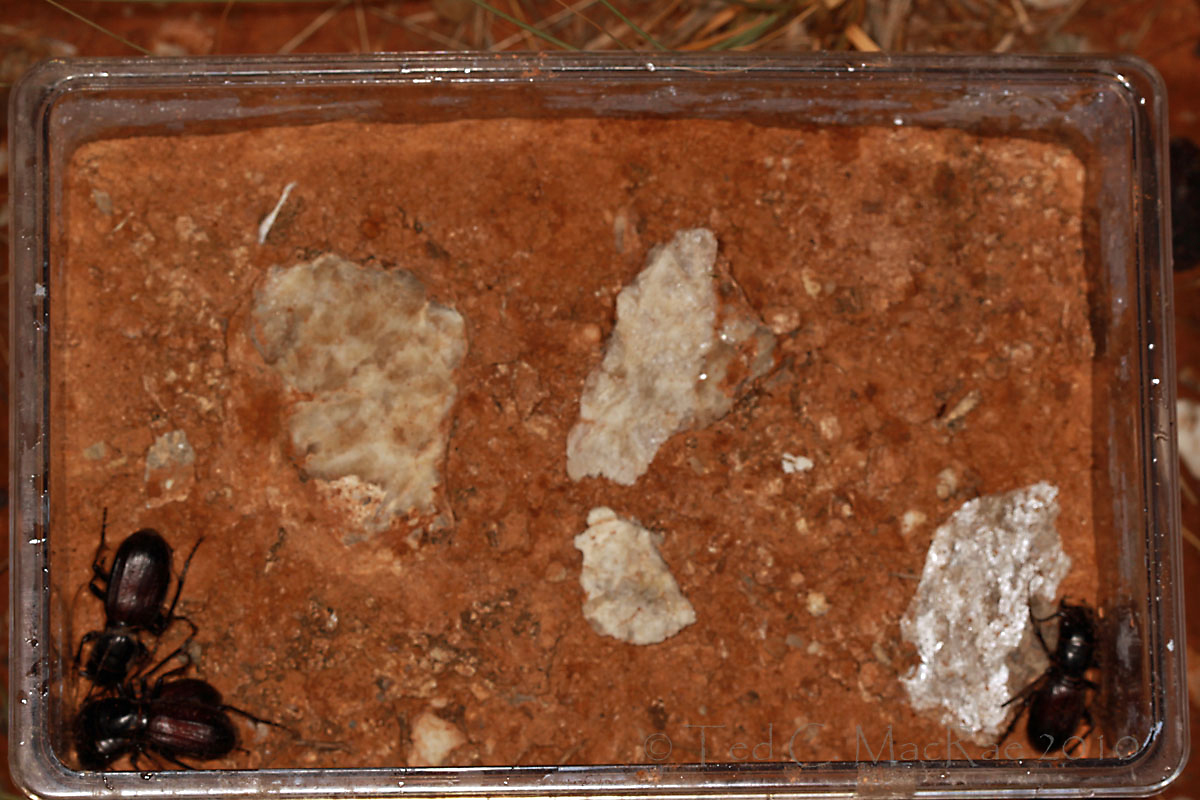
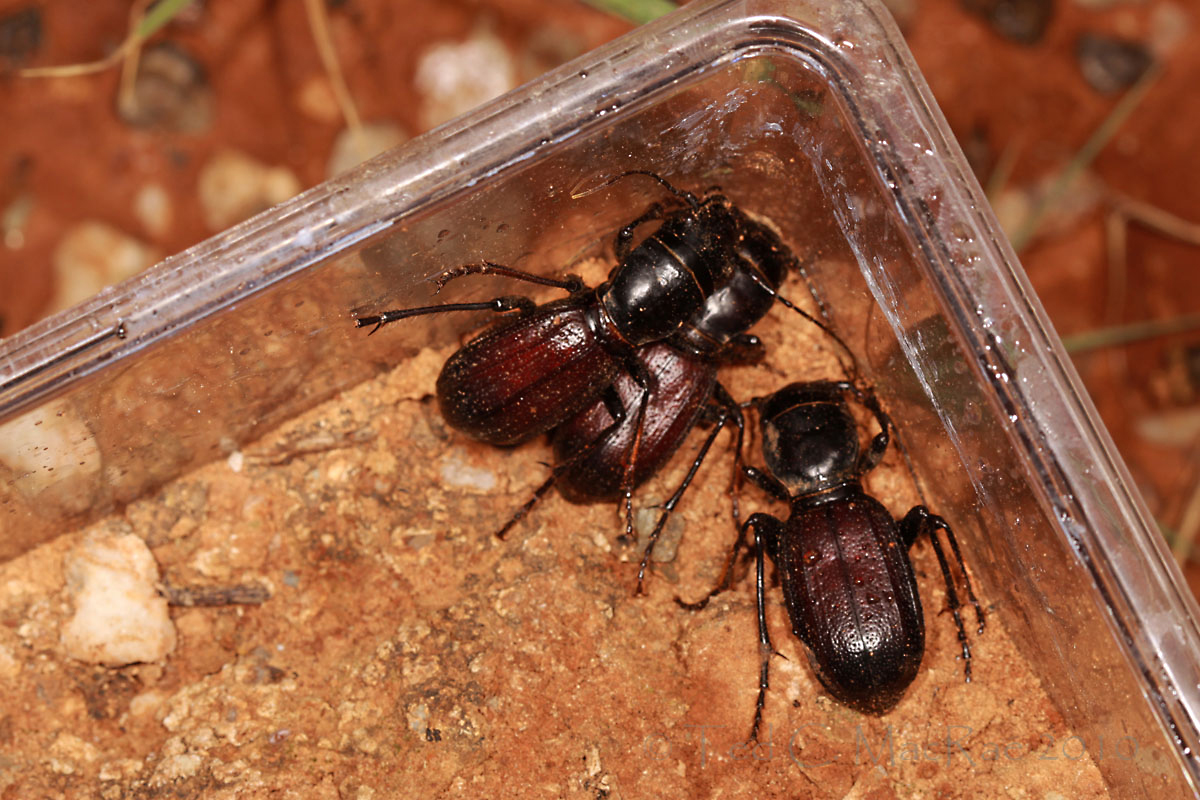
Finding the first individual did wonders for my motivation, and though still nervous about the potential for rattlesnakes I continued searching an ever-widening swath of the talus slope and adjacent areas. Another hour passed, and I had searched not only the native prairie below the talus slopes, but clay exposures on adjacent somewhat altered habitat. Again, the negative thoughts started creeping back into my mind – am I really gonna walk away from here with a single individual? I can say I found it, but that was a long drive for one beetle! I continued searching along an adjacent drainage ditch, and by 11:30pm I conceded that my victory was small and walked back to the truck to get a container to fill with native soil for a terrarium. Though it was a bit of a walk back up to the talus slope where I had seen the larval burrows, I wanted to take soil from that area specifically to give myself the best shot at obtaining eggs from my single (hopefully female) individual for an attempt at rearing more specimens from larvae. As I approached the exact spot where I had collected last year’s larva, I saw another, even larger adult! I don’t know which was greater – my excitement at finding such a large individual, or my relief in knowing that I would not go home with only one. Of course, with the second individual came a new shot of motivation, so once again I scanned across the talus slopes, and during the next half hour I found two more very near to where I had found the second one. By then it was past midnight, so I set about the business of digging soil for the terrarium. I finished the job (getting stung something terrible by three red, big-headed ants that had crawled up my pant leg while I was digging), took one last sweep across the immediate area, and turned to walk back to the truck when I saw the biggest one of all – I later determined it to be a male measuring 35 mm in length (that’s just about an inch and a half, folks!). With five individuals now, the urgency to find more was gone, and I decided I’d done what I needed to do and should get into town and find a hotel room. As I walked back to the truck, rain began to fall – lightly at first but ever increasing. Once back at the truck it was raining persistently enough that I could only hurriedly take some quick photographs of the beetles in their terrarium as in situ documentation of the momentous occasion!

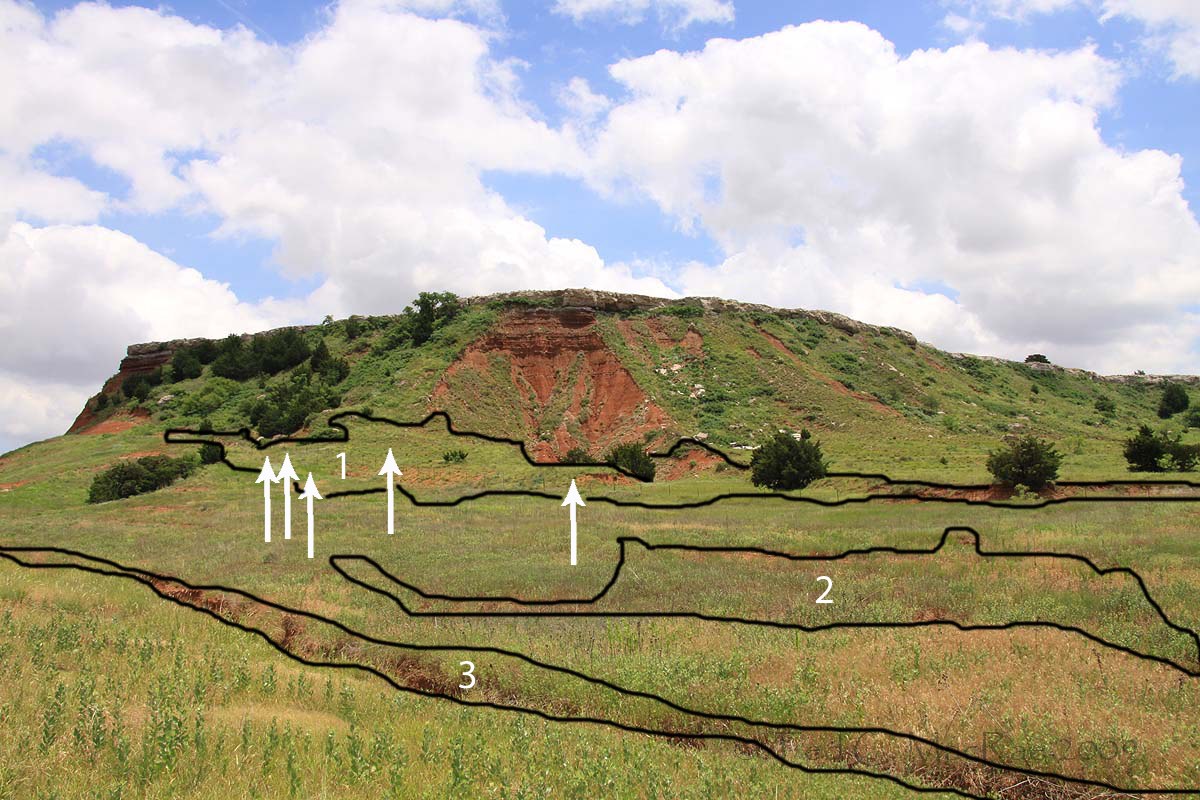
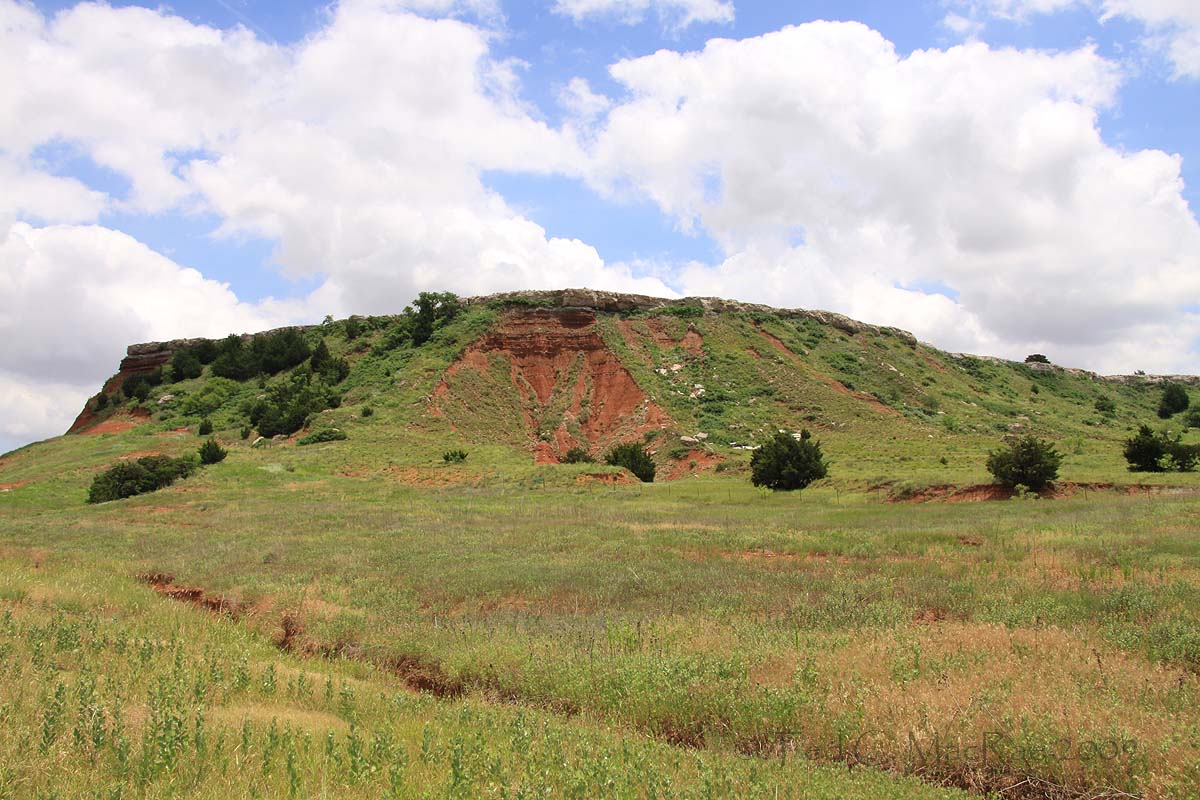
Occurrence of Amblycheila cylindriformis. White arrows indicate where adults were found, all of which were on red clay/gypsum exposures on lower talus slopes in native prairie habitat. No adults were seen in clay/gypsum exposures further below the slopes in either native (zone 1) or altered prairie (zone 2) or further down in roadside drainages (zone 3).

Although I had accomplished my main goal, I looked forward to the opportunity the next day to search for C. celeripes at other nearby sites to better understand the extent of the area’s population.  Sadly, the rain that had held off for nine hours before returning just after midnight was back for good, with radar the next morning showing a broad swath of rain extending across the entire western part of Oklahoma and north into Kansas.  There wasn’t much for me to do but savor the previous day’s experience while I made the 525-mile drive back east.  This may represent a significant record for the species – Vaurie (1955) in her review of the genus did not see any specimens from Oklahoma (although she did examine a few specimens from adjacent areas of Kansas), and Drew and Van Cleave (1962) reported only a single specimen from the state in nearby Woodward County.  Significant record or not, it was an experience that I’ll not soon forget.

Photo Details: Canon 50D (ISO 100, 1/250 sec), Canon MT-24EX flash.
Photos 1-3: Canon 100mm macro lens (f/14-20), flash 1/4 power w/ Sto-Fen diffusers.
Photo 4: Canon MP-E 65mm 1-5X macro lens (f/14), flash 1/8 power w/ Sto-Fen + Gary Fong Puffer diffusers.
Post-processing: levels, unsharp mask, slight cropping on photo 1.
Note to self: clean specimens with moist brush to remove dirt before photographing them!

REFERENCES:

Drew, W. A. and H. W. Van Cleave.  1962. The tiger beetles of Oklahoma (Cicindelidae). Proceedings of the Oklahoma Academy of Science 42:101–122.

Erwin, T. L. and D. L. Pearson. 2008. A Treatise on the Western Hemisphere Caraboidea (Coleoptera). Their classification, distributions, and ways of life. Volume II (Carabidae-Nebriiformes 2-Cicindelitae). Pensoft Series Faunistica 84. Pensoft Publishers, Sofia, 400 pp.

Vaurie, P. 1955. A review of the North American genus Amblycheila (Coleoptera, Cicindelidae). American Museum Novitates 1724:1–26.

Copyright © Ted C. MacRae 2010

Add to FacebookAdd to DiggAdd to Del.icio.usAdd to StumbleuponAdd to RedditAdd to BlinklistAdd to TwitterAdd to TechnoratiAdd to Yahoo BuzzAdd to Newsvine

Email to a friend

Amblycheila success!

I love it when a plan comes together!

Another one was caught after these photos for a total of five individuals. They’ve been setup for now in a container of native soil. I hope you’ll forgive these rather rushed photos – they were hurriedly taken at half past midnight with rain beginning to fall. Details and much better photographs will, of course, be forthcoming.

I don’t think I have ever worked as hard for five specimens as I did tonight!

Copyright © Ted C. MacRae 2010

Add to FacebookAdd to DiggAdd to Del.icio.usAdd to StumbleuponAdd to RedditAdd to BlinklistAdd to TwitterAdd to TechnoratiAdd to Yahoo BuzzAdd to Newsvine

Email to a friend

The Power of Impulse

Glass Mountains, Oklahoma

Since figuring out a couple weeks that I had the larva of North America’s largest tiger beetle (Amblycheila cylindriformis, or Great Plains giant tiger beetle) in a rearing tub in the lab, I haven’t been able to think about anything except how cool it would be to go back out to the Glass Mountains in northwest Oklahoma (where I collected the larva last June) and look for the adults.  I have every reason not to do this trip – I just spent a long weekend up in northwest Missouri on follow up surveys for our newly discovered population of Cylindera celeripes (swift tiger beetle) (my second such trip in the past three weeks¹), and in a mere week and a half I leave for a 2-week trip to France.  Bills need to be paid, the grass needs cutting, and (as of today) a broken spoke needs to be repaired.  My collecting trips are normally planned far in advance – their timing and frequency part of a delicate balance between the goals I set for the season and the responsibilities that go along with having a job and a family.

¹ More on this in an upcoming post.

But for Amblycheila, it’s now or never – at least for this season, and the thought of waiting until next year before I can take my first valid shot at finding this species in the wild (and perhaps a previously unrecorded population, at that²) is just too unbearable.  So here I am, halfway to the Glass Mountains on as impulsive a trip as I’ve taken in a long time, hoping that my hunch pays off and I’ll find the strikingly large adults of A. cylindriformis lumbering below the flat-topped mesas in the mixed grass prairie where a little more than a year ago I was collecting its enormous larva. It’s a drive-collect-drive trip, and if successful I won’t be the first person to photograph them, even well, but it will nevertheless fulfill my longtime desire to locate this species in the wild and see it with my own eyes – a far more gratifying experience than looking at the lone dead specimen acquired long ago through trade that sits in my cabinet. Wish me luck!

² Drew and Van Cleave (1962) saw only a single specimen from the state in neighboring Woodward Co., although this is now a rather old reference.

REFERENCES:

Drew, W. A. and H. W. Van Cleave.  1962. The tiger beetles of Oklahoma (Cicindelidae).  Proceedings of the Oklahoma Academy of Science 42:101–122.

Copyright © Ted C. MacRae 2010

Add to FacebookAdd to DiggAdd to Del.icio.usAdd to StumbleuponAdd to RedditAdd to BlinklistAdd to TwitterAdd to TechnoratiAdd to Yahoo BuzzAdd to Newsvine

Email to a friend

Call for paratypes!

Acmaeodera n. sp. (Santa Cruz Co., Arizona)

Earlier this year, I featured this small jewel beetle in the genus Acmaeodera (family Buprestidae).  It was collected a few years ago in southeastern Arizona by my hymenopterist friend Mike Arduser, who over the years has given me a great variety of buprestid and cerambycid beetles that he has encountered on flowers while collecting representatives of his chosen specialty – apoid bees (bee specialists are often great collectors of flower visiting insects across many taxa!).  This particular specimen is perhaps the most exciting of all of those, as it appears to represent an undescribed species.  Unfortunately, it is the only specimen known, and describing new species based on a single specimen in a genus such as Acmaeodera – diverse, variable, and with ill-defined species limits – is not advisable.  I have enlisted the help of a few insect collectors to try to find more specimens of this species to allow proper description; however, so far no additional specimens have turned up.  The summer monsoons have begun this season in southeast Arizona, thus the next few weeks will once again provide the opportunity to encounter this beetle.  I am hoping that this post, with precise locality data, information on the circumstances of its collection, and photographs of the beetle and its habitat, will prompt any entomologists reading this to scour the mountains of Arizona during the next month (or the accumulation of undetermined material in their collections) in the hopes of encountering additional specimens to allow formal description of this species.

Label data for the specimen are as follows: “ARIZONA Santa Cruz Co. | Atacosa Mountains | along Ruby Road [E of #100 Trailhead], 6,000 ft. | August 2, 2003 10-1200 [hrs] | Aloysia flwrs – Arduser”.  The first person to search for additional specimens was my friend Paul Kaufman, who searched for the beetle in August 2007.  Here is what he had to say afterwards:

Well, we found the site based on the GPS readings you gave me.  We could not find any of the Aloysia in that location, but there were some other leguminous plants with white flowers a-buzz with bees.  No beetles however.  The area has had a fire burn through it in fairly recent history – several years maybe?  It’s hard to tell, but that could have changed things a bit.  Anyway, we drove west on Ruby Rd a few tenths of a mile and did find a drainage full of Aloysia!  This was the only location along Ruby Rd where we found any growing.  Three of us checked it very carefully uphill and downhill from the road (rough scrambling).  There were lots of bees, flies and leps, but no beetles!

The following year, North American Acmaeodera guru Rick Westcott himself went to search for this species – also without success.  He wrote:

If you remain in touch with the collector of the latter, please ask him if he got it up on the pinyon-juniper zone, or were there just oaks and junipers?  If he was at 6000′, I am quite certain there had to be pinyon.  The trail (#100) starts on the Ruby Road at 4700′ and goes to the lookout that is at 6200′.  I decided not to go to the latter, but I was close.  I did not see any flowers that were suitable for Acmaeodera, let alone did I see an Aloysia bush.  Much of the area had been burnt, though some years ago.

I sent this information to Mike Arduser, who replied as follows:
It appears now that I  must have  misinterpreted the elevation on my topo map and carried that error onto the label, because though I walked up almost to the lookout I did not do any collecting up that high. My collecting (hand net and malaise traps) was done adjacent to Ruby Rd., then upslope approximately 100 meters or so, all of it east of the #100 trailhead (which is where I parked). The only woody plants in the immediate vicinity I noted were Aloysia (in narrow rocky drainages) and a legume (forget the genus at the moment). However, I think there were a few oaks scattered around (I believe there was one where I parked). There was no evidence of fire at the time I was there.

Mike also sent me the photo shown here taken near the collection site (if nothing else, the spectacular scenery makes a visit to this place seem like a good idea), noting:

Attached is a photo from the Atacosa Mtns. Area where the new buprestid was found – the photo was taken about 100ft. elev.  above the collection site and about a ¼ mile to the west.

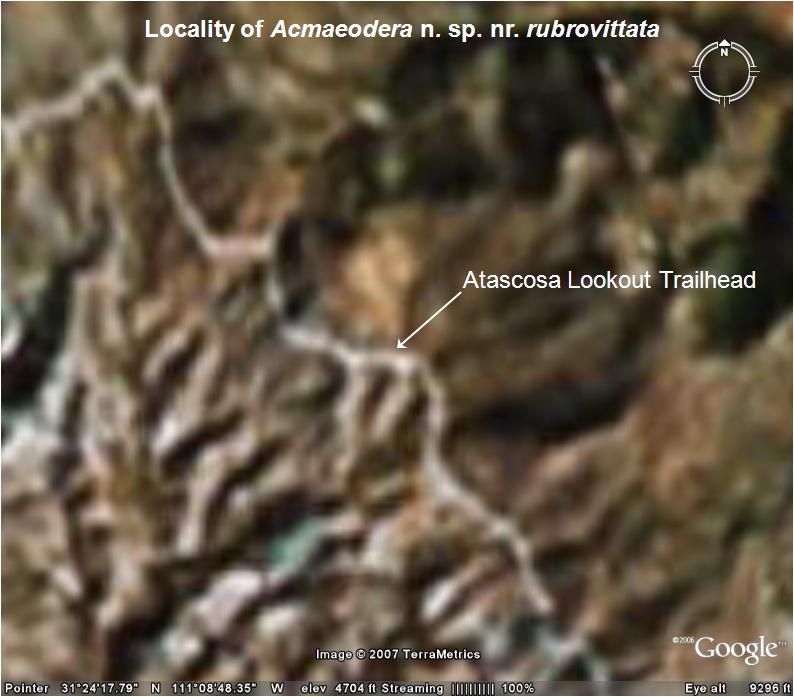
I’ve included a Google Map at left that shows the location of the Atascosa Lookout (#100) Trailhead.  It’s not the best overhead photo, but it does give an idea of the landscape relief and rather precisely pinpoints its location via GPS coordinates in the lower lefthand corner.  If the beetle truly does occur at lower elevations (~4,700′), then it is probably not terribly specific about this particular locality.  Perhaps it is a Mexican species that only occasionally makes it into the U.S. depending on the season. The repeated comments about apparent fire in the area by Paul and Rick suggest potential vegetational differences in the area from the time the beetle was collected compared to their subsequent visits. Although the single specimen was collected on Aloysia flowers, it is also possible that the species does not actually show a particular preference for this plant – although it does seem likely that it visits flowers of some type.  The only way to answer these questions is by finding more specimens!

Copyright © Ted C. MacRae 2010

Add to FacebookAdd to DiggAdd to Del.icio.usAdd to StumbleuponAdd to RedditAdd to BlinklistAdd to TwitterAdd to TechnoratiAdd to Yahoo BuzzAdd to Newsvine

Email to a friend