Typocerus lugubris

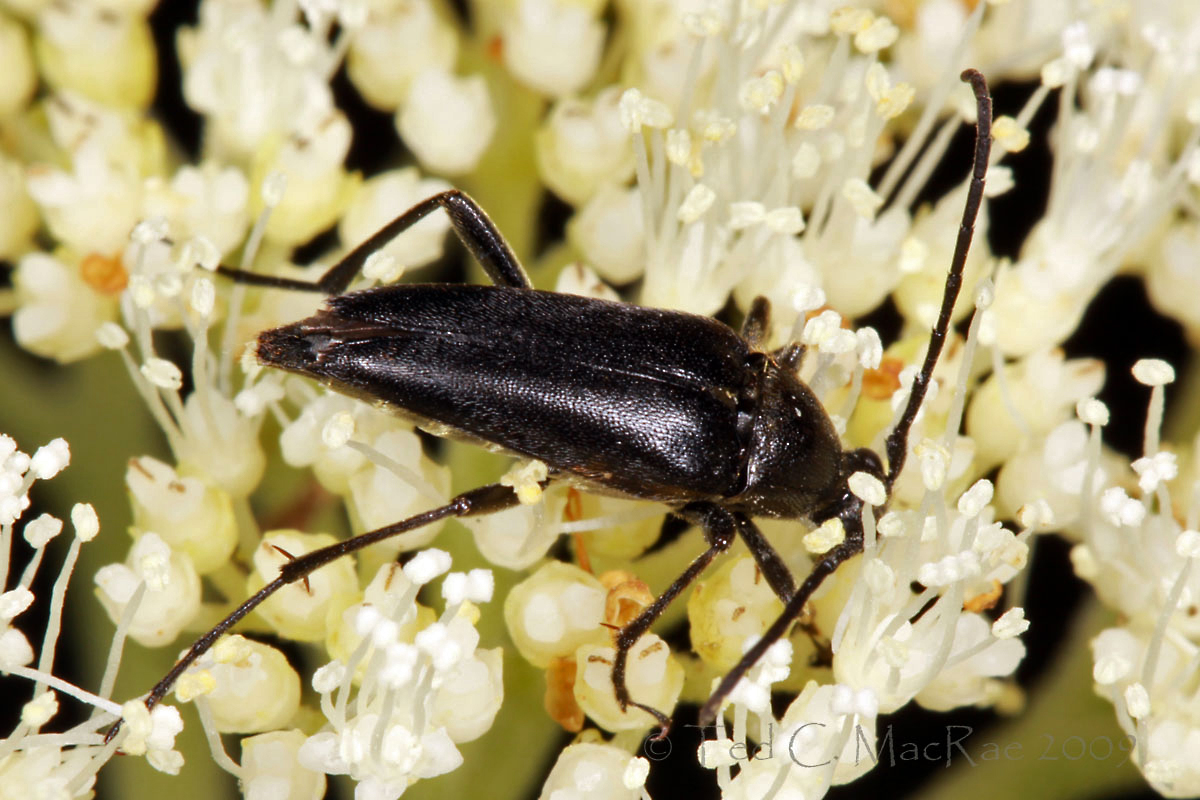
Typocerus lugubris on Hydrangea arborescens, Trail of Tears State Park, Missouri.

Members of the genus Typocerus are among the more commonly encountered species of the so-called “flower longhorns” (family Cerambycidae, subfamily Lepturinae) in eastern North America. In addition to the narrow-necked, broad-shouldered appearance characteristic for the subfamily, species in this genus are recognizable by their strongly tapering elytra, strongly basally depressed prothorax, and apically produced antennal segments with distinct poriferous areas (Linsley and Chemsak 1976).

Eight of the 15 species known from North America occur in Missouri, where they are commonly encountered on a variety of flowers during the months of June and July. Some of these species can be difficult to distinguish from each other – in fact, Missouri’s rarest species (Typocerus deceptus) is almost identical in appearance to one of Missouri’s commonest species (Typocerus velutinus), and several other species resemble them closely enough to require careful attention details of coloration when attempting identification.

Typocerus lugubris is not one of those species, its all-black coloration making it quite distinctive within the genus. Two other species in Missouri are mostly black, but unlike T. lugubris they always bear yellow blotches in the basal area of the elytra (T. lunulatus) or exhibit yellow transverse bands (T. zebra). Typocerus confluens also is a rather uncommon species in Missouri that varies from chestnut brown to nearly all black, but it is much more robust than T. lugubris (and also bears erect hairs on the pronotum and lacks poriferous areas on antennomere 6). The remaining species tend to be chestnut colored, at least in the basal area of the elytra, with more or less distinct transverse yellow banding.

Photo Details: Canon 50D (ISO 100, 1/250 sec, f/18), Canon 100mm macro lens, Canon MT-24EX flash (1/4 ratio) w/ Sto-Fen diffusers. Post-processing: levels, minimal crop, unsharp mask.

REFERENCES:

Linsley, E. G. and J. A. Chemsak.  1976. The Cerambycidae of North America.  Part VI, No. 2.  Taxonomy and classification of the subfamily Lepturinae. University of California Publications in Entomology 80:ix + 1–186.

Copyright © Ted C. MacRae 2010

Add to FacebookAdd to DiggAdd to Del.icio.usAdd to StumbleuponAdd to RedditAdd to BlinklistAdd to TwitterAdd to TechnoratiAdd to Yahoo BuzzAdd to Newsvine

Email to a friend

Nomenclatural changes in Phymatodes

ResearchBlogging.orgI’ve mentioned before the considerable taxonomic challenges facing students of the family Buprestidae (jewel beetles) in North America, owing largely to fact that more than half of its species are assigned to one of just three hyper-diverse genera (Acmaeodera, Agrilus, and Chrysobothris). New species continue to be described, but the most recent comprehensive treatments of these three genera were published more than 60 to 100 years ago (Fall 1899, Fisher 1928, Fisher 1945)! The situation is not as dire in the “other” major woodboring beetle family – the Cerambycidae (longhorned beetles), thanks in great part to the efforts of Gorton Linsley and John Chemsak and their monographic series of the family’s North American species (Linsley 1961-1964, Linsely and Chemsak 1972-1997). Although somewhat more speciose in North American than the Buprestidae, diversity in the Cerambycidae is more apparent at the generic level (1000+ species in 325 genera, compared to 787 species in only 54 buprestid genera). This does not mean, however, that the Cerambycidae lacks problematic, speciose genera, and in a recently published paper, Ian Swift and Ann Ray (2010) tackle one of these – the genus Phymatodes. While no new species are described, their treatment does propose numerous nomenclatural changes based on examination of type specimens that affect several North American species, including correcting misapplied names and recognizing multiple synonymies. These problems resulted from the practice of many earlier authors who did not examine type specimens when describing new species, relying instead only on written descriptions to compare taxa.

  • Phymatodes blandus is no longer divided into subspecies, with P. blandus concolor now being recognized as a full species.
  • The name Phymatodes decussatus has been used for the wrong species, which is actually P. obliquus. It is distinct from true P. decussatus, which has until now been called P. juglandis. The subspecies formerly placed under P. decussatus are also synonymized under P. obliquus.  Linsley (1964) confused things by applying the name decussatus to this common, oak-associated species and the name juglandis to the species associated with walnut. The type of decussatus, however, matches the walnut species and, since it is the older name, takes priority. The common oak species is thus left without a name, and obliquus is the oldest of the many synonyms created by Thomas Casey.
  • Phymatodes hirtellus is no longer divided into subspecies.
  • Phymatodes lecontei is synonymized under P. grandis.
  • Phymatodes mojavensis is synonymized under P. nitidus.
  • Phymatodes oregonensis is synonymized under P. nigrescens.
  • Phymatodes ursae is synonymized under P. hirtellus.

While this paper is not a full revision of the genus, it does include diagnostic and comparative notes, full color dorsal habitus photographs (example plate below), and an updated key to all of the species found in North America.

PLATE 1. 1) Phymatodes aeneus, male; 2) P. aereus, female; 3) P. amoenus, female; 4) P. amoenus, female ventral; 5) P. ater, female; 6) P. ater, female; 7) P. blandus, male; 8 ) P. concolor, male; 9) P. decussatus, male. © Swift & Ray 2010.

The genus Phymatodes is most diverse in the western states and provinces – I haven’t spent as much time out there as in other areas of North America, so representation of this genus in my collection is rather weak at only 10 of the 26 species currently recognized in North America. Missing from my cabinet are the following – if anyone is able to help me out with these I would be most grateful:

  • Phymatodes aeneus LeConte, 1854
  • Phymatodes ater LeConte, 1884
  • Phymatodes concolor Linsley, 1934
  • Phymatodes decussatus (LeConte, 1857)
  • Phymatodes fulgidus Hopping, 1928
  • Phymatodes infuscatus (LeConte, 1859)
  • Phymatodes lengi Joutel, 1911
  • Phymatodes lividus (Rossi, 1794) – introduced to eastern U.S.
  • Phymatodes maculicollis LeConte, 1878
  • Phymatodes nigerrimus Van Dyke, 1920
  • Phymatodes nigrescens Hardy & Preece, 1927
  • Phymatodes obliquus Casey, 1891
  • Phymatodes rainieri Van Dyke, 1937
  • Phymatodes shareeae Cope, 1984
  • Phymatodes tysoni Chemsak & Linsley, 1984
  • Phymatodes vulneratus LeConte, 1857

REFERENCES:

Fall, H. C.  1899. Synonpsis of the species of Acmaeodera of America, north of Mexico. Journal of the New York Entomological Society 7(1):1–37 [scroll to “Journal of the New York Entomological Society”, “v. 7 1899”, “Seq 12”].

Fisher, W. S.  1928. A revision of the North American species of buprestid beetles belonging to the genus AgrilusU. S. National Museum 145, 347 pp.

Fisher, W. S.  1942. A revision of North American species of buprestid beetles belonging to the tribe Chrysobothrini.  U. S. Department of Agriculture, Miscellaneous Publication 470, 275 pp.

Linsley, E. G.  1961. The Cerambycidae of North America.  Part I.  Introduction.  University of California Publications in Entomology 18:1–97.

Linsley, E. G.  1962. The Cerambycidae of North America.  Part II.  Taxonomy and classification of the Parandrinae, Prioninae, Spondylinae and Aseminae.  University of California Publications in Entomology 19:1–102.

Linsley, E. G.  1962. The Cerambycidae of North America.  Part III.  Taxonomy and classification of the subfamily Cerambycinae, tribes Opsimini through Megaderini.  University of California Publications in Entomology 20:1–188.

Linsley, E. G.  1963. The Cerambycidae of North America.  Part IV.  Taxonomy and classification of the subfamily Cerambycinae, tribes Elaphidionini through Rhinotragini.  University of California Publications in Entomology 21:1–165.

Linsley, E. G.  1964. The Cerambycidae of North America.  Part V.  Taxonomy and classification of the subfamily Cerambycinae, tribes Callichromini through Ancylocerini.  University of California Publications in Entomology 22:1–197.

Linsley, E. G. and J. A. Chemsak.  1972. The Cerambycidae of North America.  Part VI, No. 1.  Taxonomy and classification of the subfamily Lepturinae.  University of California Publications in Entomology 69:viii + 1–138.

Linsley, E. G. and J. A. Chemsak.  1976. The Cerambycidae of North America.  Part VI, No. 2.  Taxonomy and classification of the subfamily Lepturinae.  University of California Publications in Entomology 80:ix + 1–186.

Linsley, E. G. and J. A. Chemsak.  1984. The Cerambycidae of North America, Part VII, No. 1: taxonomy and classification of the subfamily Lamiinae, tribes Parmenini through Acanthoderini.  University of California Publications in Entomology 102:ix + 1–258.

Linsley, E. G. and J. A. Chemsak.  1995. The Cerambycidae of North America, Part VII, No. 2: taxonomy and classification of the subfamily Lamiinae, tribes Acanthocinini through Hemilophini.  University of California Publications in Entomology 114:xi + 1–292.

Linsley, E. G. and J. A. Chemsak.  1997. The Cerambycidae of North America, Part VIII: bibliography, index, and host plant index.  University of California Publications in Entomology 117:ix + 1–534..

Swift, I. P. & A. M. Ray. 2010. Nomenclatural changes in North American Phymatodes Mulsant (Coleoptera: Cerambycidae). Zootaxa 2448:35–52.

Copyright © Ted C. MacRae 2010

Add to FacebookAdd to DiggAdd to Del.icio.usAdd to StumbleuponAdd to RedditAdd to BlinklistAdd to TwitterAdd to TechnoratiAdd to Yahoo BuzzAdd to Newsvine

Email to a friend

North America’s largest tiger beetle (I think!)

The generous among us might call it serendipity, while the rest of us would just call it luck.  By whatever name, I had it in spades in June last year when I made my first visit to the Glass Mountains of northwestern Oklahoma.  My original plan was to go to Tallgrass Prairie Preserve in eastern Oklahoma at the end of what proved to be a resoundingly successful day at Alabaster Caverns State Park.  However, soaking rains moved into the area and continued rumbling eastward across the plains towards the preserve, forcing a quick change of itinerary.  I decided to wait it out in the state’s western reaches, a “hunch” telling me that the red clay/gypsum hills in nearby Major County might be a fruitful place for hunting tiger beetles.  Sunny skies the next morning were a good sign, and my hunch was rewarded later that day when I discovered a previously unknown (and fortunately robust) population of the rare Cylindera celeripes (swift tiger beetle), making not just the day but the entire trip more successful than I could have ever imagined.  Icing on the cake came when I found decent numbers of the more secure but nevertheless uncommon Dromochorus pruinina (frosted dromo tiger beetle) also in the area.

Another find I made that day that I’ve mentioned on occasion but not talked about at length was a single, rather large tiger beetle larva.  I found several burrows at the base of a talus slope at the edge of a small ravine where many adult C. celeripes were scurrying, and though I tried with many, out of only one did I manage to “fish” its occupant with a blade of grass.  I didn’t know which species it represented, but its large size and occurrence in clay soil brought to mind two species – Cicindela pulchra (beautiful tiger beetle) and C. obsoleta (large grassland tiger beetle).  Both of these Great Plains species reach their eastern limit of distribution in this part of Oklahoma (Pearson et al. 2006), and their status as the largest species of the genus (and its former subgenera) in North America seemed to make them the leading candidates for this enormous larva.  There was one other possibility – Amblycheila cylindriformis (Great Plains giant tiger beetle), another Great Plains species at its eastern limit in western Oklahoma and (as the common name implies) the largest tiger beetle in all of North America.  However, to consider that species seemed too much wishful thinking.  From my understanding, larvae of that elusive species reach an incredible 45 mm in length and dig burrows  on steep slopes or at the mouths of rodent burrows that extend vertically to depths of up to 1.5 m or more (Brust et al. 2005).  Surely I could not have so casually stumbled upon such a grand grub!

I placed the larva in a terrarium of native soil and brought it back with me, and for one year now I have waited – feeding it a regular diet of the fat noctuid caterpillars that we rear so abundantly in our lab.  For a full year, I’ve watched it nab caterpillar after caterpillar, disappearing mysteriously for days on end, and just as mysteriously reappearing at the top of its burrow.  I knew getting a closer look at it would help in my attempts to determine its identity, but every time I approached with a camera it dodged down into its burrow and beat my patience.  Sometimes I would see it sitting about a centimeter below the burrow entrance – just waiting for a caterpillar to crawl by but refusing to expose itself to the lens.  I gradually decided it was likely C. pulchra, as I had seen that species in similar habitat not too far north in Barber County, Kansas.  So strong was my suspicion that I even made another trip out to the Glass Mountains in October of last year, expecting to see the fall-active adults bejeweling the exposed flats below the red clay slopes, their wine-red elytra and purple-margined bodies all aglitter under the crisp, autumn sun.  No such sight was beheld, however – my hopes dashed by the season’s sudden cold and wet turn, and with the terrarium containing the larva by then tucked away in a cool incubator for a winter’s rest, it would be several months before I would see the larva once again sitting at the top of its burrow.

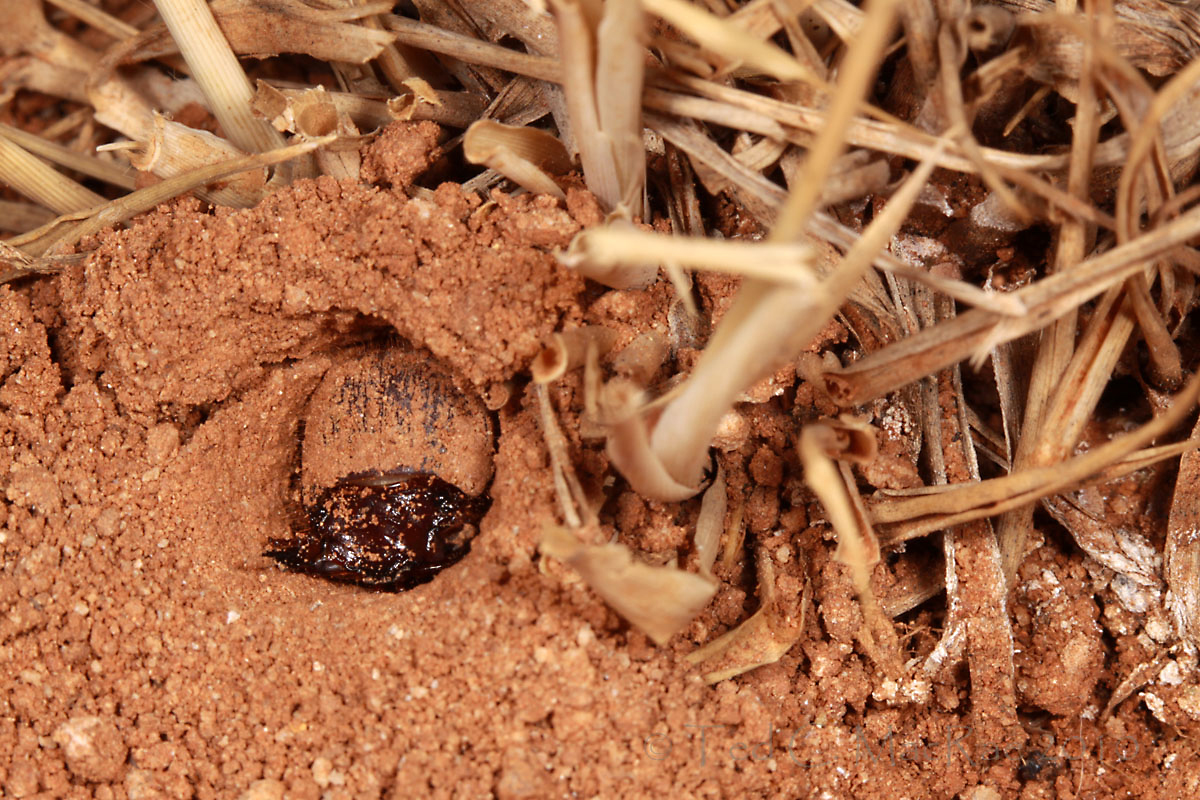
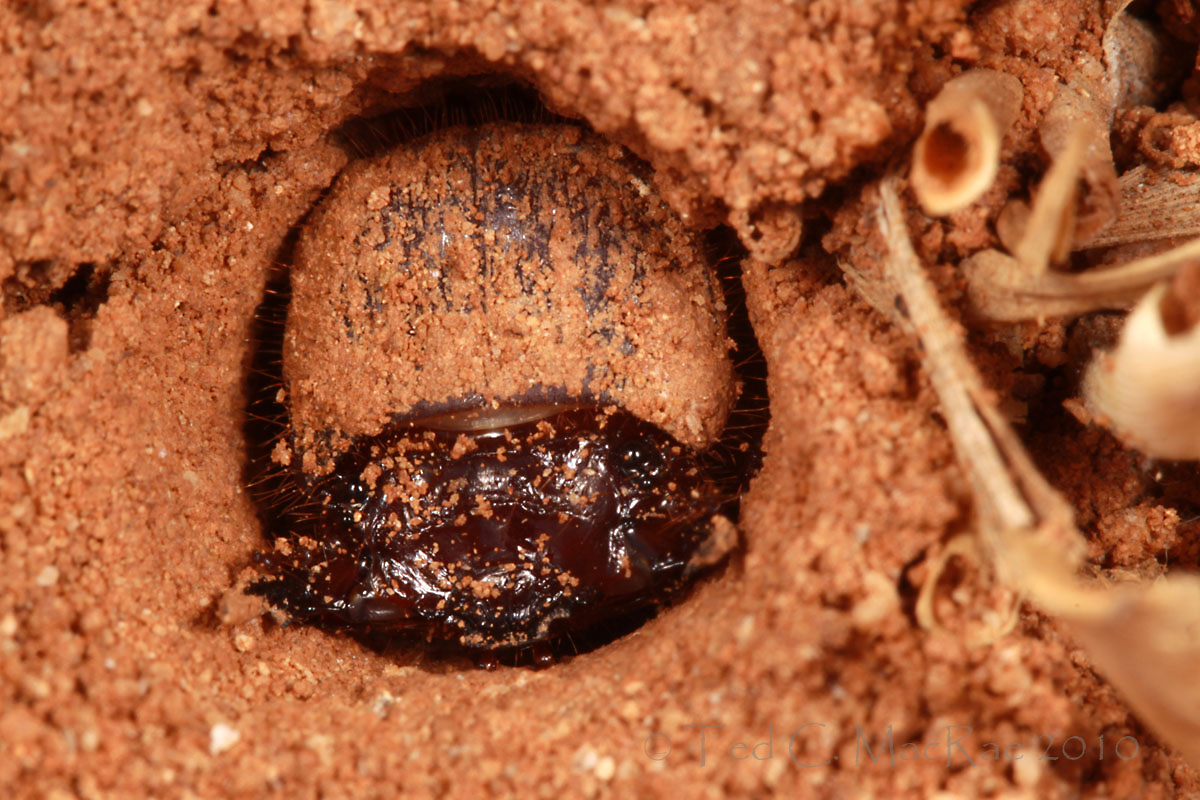
In late March I pulled the terrarium out of the incubator, and within a week the larva reopened its burrow.  I fed it a few times, and then one day I saw that it had dug a new, larger  burrow – measuring a full 10 mm in diameter!  This seemed extraordinarily large for any species of Cicindela, so I resolved once again to photograph it and determine its identity.  For days I stalked it, keeping the terrarium just outside my office door where I could keep an eye on it, yet every time I approached within two feet or so it would drop down out of sight.  I decided to stop feeding it – perhaps hunger would overwhelm its patience and prompt it to return to the top of its burrow more quickly after retreating.  That seemed to work, as one day the larva came back up after only a few minutes – and I was ready!  Already  in position, I flashed off multiple shots as soon as it reappeared, moving slowly and deliberately between shots to avoid spooking it again, and managed to get a nice series from varying distances.  As a testament to its enormous size, all of the photos shown here were taken with the standard 100mm macro lens (1X maximum) – not the 65mm 1-5X beast that I needed for these shots of the super-tiny C. celeripes.

Thinking that the larva likely represented C. pulchra, I compared the photos to this photo taken by Matt Brust of a 3rd-instar larva of C. pulchra and immediately noted the differently shaped pronotum of my larva and its distinctly projecting anterolateral angles.  Compare to C. pulchra, in which the angles are in line with the median part of the anterior margin – it is clearly not that species.  It isn’t C. obsoleta either, as that species has the anterolateral angles of the pronotum even less projecting than C. pulchra (Drew and Van Cleave 1962).  Apparently I needed to rethink my assumption that it belonged to Cicindela or its close relatives – none that occur in Oklahoma are simply large enough!  Tetracha virginica is large enough, but I knew it wasn’t that species since it lacked the white margined pronotum distinctive of species in that genus (as can be seen in this post on the larva of Tetracha florida).  That left only A. cylindriformis, distinguishable from all other tiger beetle genera occurring in Oklahoma by the second (lower) pair of eyes distinctly smaller than the first (Hamilton 1925, Drew and Van Cleave 1962, Pearson et al. 2006) – clearly seen in the third photo above.  Matt Brust has also photographed the larva of A. cylindriformis – it’s not a close shot of the head and pronotum, but in general aspect my larva seems to match it well enough.

All that is left is to actually succeed in rearing this larva to adulthood.  These beasts may require up to three to four years to develop (Brust et al. 2005), although this is likely influenced by latitude and prey abundance.  I suspect it was a second instar larva when I collected it, and that it dug its new burrow this spring after molting to the third (and final) instar.  Hopefully by keeping it in a nice, warm growth chamber and feeding it generously with fat caterpillars, I can minimize the time to pupation and perhaps see the adult sometime later this summer.  If/when that happens, you can be sure to see a follow up to this post.

Photo Details: Canon 50D (ISO 100, 1/250 sec, f/16-18), Canon 100mm macro lens, Canon MT-24EX flash (1/4 ratio) w/ Sto-Fen diffusers. Post-processing: contrast and unsharp mask (no cropping).

REFERENCES:

Brust, M. L., S. M. Spomer and W. W. Hoback.  2005. Tiger Beetles of Nebraska.  University of Nebraska at Kearney.  http://www.unk.edu (Version 5APR2005).

Drew, W. A. and H. W. Van Cleave.  1962. The tiger beetles of Oklahoma (Cicindelidae).  Proceedings of the Oklahoma Academy of Science 42:101–122.

Hamilton, C. C.  1925. Studies on the morphology, taxonomy, and ecology of the larvae of Holarctic tiger beetles (family Cicindelidae).  Proceedings of the U.S. National Museum 65 (Art. 17):1–87.

Pearson, D. L., C. B. Knisley and C. J. Kazilek. 2006. A Field Guide to the Tiger Beetles of the United States and Canada. Oxford University Press, New York, 227 pp.

Copyright © Ted C. MacRae 2010

Add to FacebookAdd to DiggAdd to Del.icio.usAdd to StumbleuponAdd to RedditAdd to BlinklistAdd to TwitterAdd to TechnoratiAdd to Yahoo BuzzAdd to Newsvine

Email to a friend

Swift Tiger Beetle – good news, bad news

Sorry about the noisy video – it was shot in one of our walk-in growth chambers with fans going full-bore! Anyway, the video shows a couple of mating pairs of Cylindera celeripes (swift tiger beetle) that I brought back from the Loess Hills of extreme northwest Missouri this past weekend.  Watch carefully and you’ll see the first pair actively copulating before they break apart. After that I pan over to the second pair, which is not actively mating but have remained coupled as an example of behavior called “mate guarding” You might also notice a few very small green “bugs” in the container – these are 2nd-instar Lygus nymphs, which I placed in the container earlier in the day as prey – it was quite a sight to see the tiger beetles immediately begin chowing down on them! At the end of the video, I poke at the second mating pair with my forefinger to give an indication of their tiny size – this flightless species is one of the smallest in all of North America! Knowing how tiny the beetles are and how well they blend into their surroundings (you’ll have to imagine the 1-2 ft of plant growth that was surrounding them in the field), you can appreciate just how difficult these beetles are to detect in their native habitat.

There is a “good news, bad news” aspect to the story behind these beetles. This rare Great Plains species was unknown from Missouri until last year, when we (Chris Brown and I) discovered it in loess hilltop prairie remnants at Brickyard Hill, Star School Hill Prairie, and McCormack Loess Mounds Conservation Areas. Loess hilltop prairie is among Missouri’s most critically endangered natural community due to its restricted occurrence at the southern tip of the Loess Hills landform and more than a century of overgrazing and relentless encroachment by woody vegetation and invasive exotics. The sites where we found the beetle last year contain the highest quality loess hilltop prairie remnants in Missouri, so we are now taking a more thorough look at some of the smaller remnants that still exist in the area. The most promising of these are at Squaw Creek National Wildlife Refuge and on several privately owned lands near the known sites, and these were the sites that I searched this past weekend. Some of these sites looked promising (one in particular looked excellent), but thorough searching at each revealed no beetles. By the time I finished searching the last of them I had begun to wonder if: 1) my “search image” for the species had gotten rusty, or 2) my timing was a bit too early (last year’s populations were discovered in late June). To test this, we (daughter Madison and I) returned to one of the known sites (McCormack) where we had seen only two beetles last year (unable to capture either one). As we hiked along the ridge top leading to the spot where we saw them, I kept a close watch on the narrow trail in front of me. Nothing. However, as soon as I came upon “the spot” I saw one! I dropped to my knees and slapped my hands down on the ground, forming an “arena” between my two thumbs and forefingers, but the beetle ran over my hand too quickly and escaped. No matter – in less than a minute I saw another one and successfully trapped it under my fingers as it ran over my other hand. During the next 15-20 minutes I would see at least eight individuals along the narrow trail in this single spot. While it was gratifying to see more individuals at this site than we had seen last year, it also meant that the timing of my searches at the other sites was fine and that I was not suffering from a rusty search image. The beetle could still be at those sites where I had failed to find it, but if it is then it certainly does not occur in very high numbers. It also bothers me that at this site the beetle seems to be restricted to one isolated ridge, which appears not to have been burned in recent years (in contrast to the rest of the preserve, which seems to have been burned within the past year or so). I searched all the remaining ridge top again thoroughly after finding the beetles again this year, but no beetles were seen anywhere except this tiny spot where we have now seen beetles in successive years.

Missouri’s few existing loess hilltop prairie remnants are not only small but highly disjunct, and the flightless nature of the beetle makes re-colonization of a remnant unlikely in the event of a localized extirpation. There is obviously much we still do not know about the impact of burning on the beetle and how best to devise management plans that consider both the habitat and the beetle. However, one thing is clear – both the habitat and the beetle are critically imperiled in Missouri, and the fate of both are in our hands, right here and right now! We’d better get this figured out quick if we’re going to save both, and there seems to be little room for error. For my part, in addition to pinpointing where our populations occur and precisely what habitats are supporting them, I am trying to develop an effective rearing technique for this never-before-reared species in the event that captive rearing becomes necessary for reintroduction or augmentation of native populations. The adults seem very delicate and do not travel well, but I have found that if I prepare a terrarium in the field for transporting the adults then they survive well – even when traveling for several days. The container measures 6 1/4” H x 8” L, and I’ve placed a chunk of native soil cut from the site where I found the beetles and kept intact. The debris on the soil surface is intact as well, but the plants growing in the soil have (obviously) been trimmed. I’ll collect eggs from these individuals and experiment with different methods that I’ve been working on for rearing the larvae to see which are the most efficient and effective.

Copyright © Ted C. MacRae 2010

Add to FacebookAdd to DiggAdd to Del.icio.usAdd to StumbleuponAdd to RedditAdd to BlinklistAdd to TwitterAdd to TechnoratiAdd to Yahoo BuzzAdd to Newsvine

Email to a friend

Where’s Ted now?

…in the Loess Hills of northwest Missouri, looking for additional sites for Cylindera celeripes (swift tiger beetle). Recall that we (Chris Brown and I) finally found this rarely collected species last year in Missouri (after many years of looking) in high quality remnants of loess hilltop prairie (a critically endangered natural community in Missouri).  The beetle was found at Brickyard Hill, Star School Hill Prairie, and McCormack Loess Mounds Conservation Areas, which combined contain nearly half of the 50 or so acres of loess hilltop prairie still existing in Missouri. The remaining acres are located at Squaw Creek National Wildlife Refuge and on private lands – my sincere appreciation goes out to Squaw Creek Refuge staff and three private landowners, who have all graciously extended to me (and my able field assistant Madison) access to the loess hilltop prairie remnants under their stewardship to better characterize the beetle’s distribution in the area. The sites I am visiting have varied burn histories, ranging from recent to 6 years or more since the previous burn, thus, I am also hoping to better understand the possible impact of prescribed burns on the species’ occurrence in loess hilltop prairie remnants. The beetle needs these remnants to survive, and prescribed burning is an important tool for helping to restore this natural community after decades of shrinkage due to woody encroachment. The trick will be to design management plans that accomplish these restoration objectives while at the same time minimizing possible negative impacts of the burns on existing beetle populations.

Copyright © Ted C. MacRae 2010

Add to FacebookAdd to DiggAdd to Del.icio.usAdd to StumbleuponAdd to RedditAdd to BlinklistAdd to TwitterAdd to TechnoratiAdd to Yahoo BuzzAdd to Newsvine

Email to a friend

An irresistible sight!

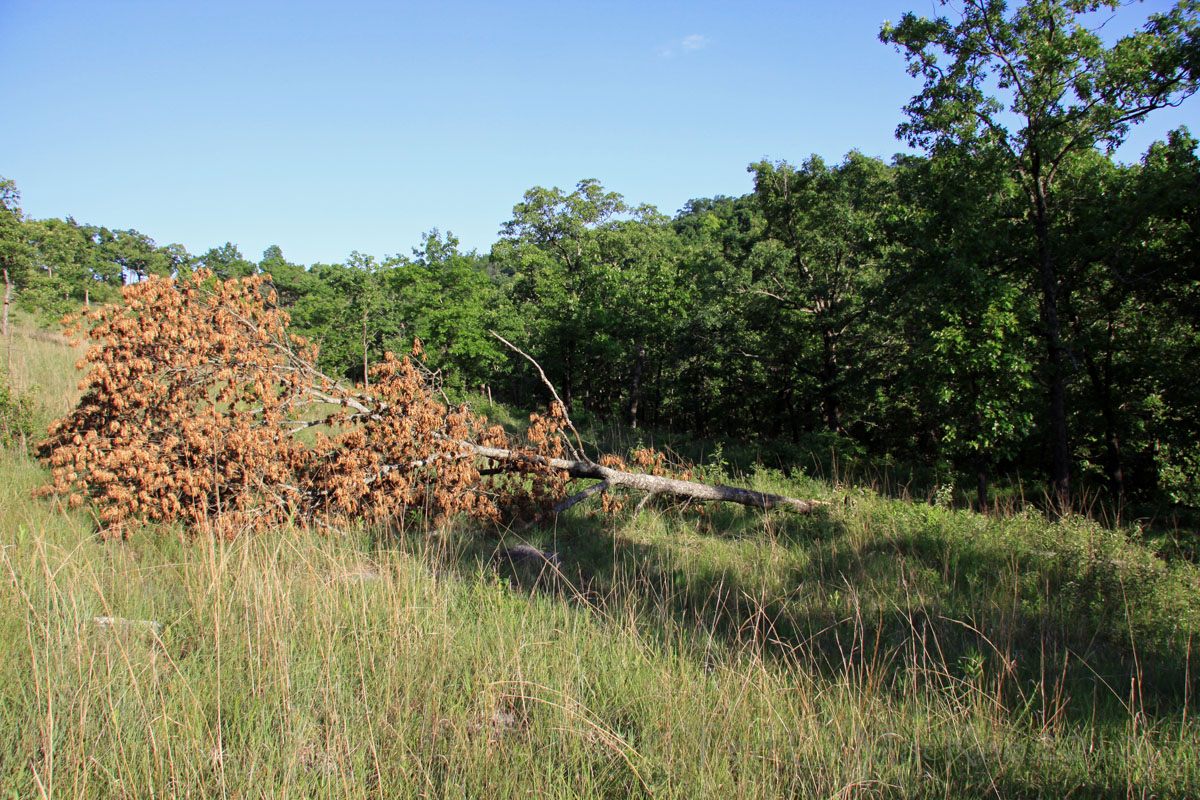
One of the few highlights of my Memorial Day weekend collecting trip came in the earliest moments of my visit to Ha Ha Tonka State Park.  My destination was Ha Ha Tonka Savanna Natural Area, and a short walk through fire-restored woodland led me to the open glade where just a few years earlier a UMC student had collected the rare and little-known Agrilus impexus.  Entering the glade, I was all set to begin sweeping the vegetation along the woodland/glade interface, paying special attention to any honey locust (Gleditsia triacanthos) that I might happen to find in the area as a potential host for the beetle.  What I saw instead as the glade opened up in front of me was a sight that any collector of wood-boring beetles will find almost irresistable – a recent wind-throw!  In this case, it was a black oak (Quercus velutina) laying in full sun – its bright brown leaves suggesting that it had fallen within the past few weeks (and would thus still be emitting the volatiles that wood-boring beetles find so attractive).  I wanted to begin looking for A. impexus, but I knew there would be beetles actively crawling on the trunk and branches of that tree.  I couldn’t resist it – I dropped my sweep net and beating sheet and made my way to the tree (in the end it didn’t matter, since no other beetles – including A. impexus – would be seen that day).

I already had an idea what I might find.  Recent wind-throws are the domain of Chrysobothris, and if the tree is a deciduous species then this means members of the Chrysobothris femorata species-group.  I recently featured one of six newly described members (C. caddo) of this taxonomically challenging group (Wellso and Manley 2007), providing a synopsis of the now twelve species in the group and their primarily host preferences.  Fully half of these are associated primarily or exclusively with oaks four occurring in Missouri (quadriimpressarugosiceps, shawnee, and viridiceps).  Of these, C. quadriimpressa is the most commonly encountered (although the others are by no means uncommon), and all of the nearly dozen or so beetles I found on this particular tree in fact represented that species. Confirmation of my ID would require microscopic examination of the female pygidium (which is shallowly impressed on each side of the middle) and male genitalia, but in general this species can be distinguished in the field by its smallish size (~10-12 mm in length – rugosiceps and shawnee tend to be larger) and the post-median pair of foveae (circular impressions) on the elytra being joined (they are distinctly separated in viridiceps).

As we’ve seen with other species of jewel beetles (e.g., C. caddo, Dicerca lurida, D. obscura), adults of C. quadriimpressa are incredibly cryptic and nearly impossible to see on the bark of their hosts – at least until they move.  They are notoriously difficult to approach – their large eyes and penchant for rapid escape flights suggesting excellent vision.  This is a useful capability for insects that must expose themselves to would-be predators (and beetle collectors) during daylight hours while actively searching dead trees for mates and oviposition sites.  One thing I can’t figure out, however, is the role of the intensely blue feet in this and other cryptically colored Chrysobothris species (see also C. caddo).  Any ideas?

Photo Details (insect): Canon 50D (ISO 100, 1/250 sec, f/16), Canon 100mm macro lens w/ Kenco extension tubes (68mm), Canon MT-24EX flash (1/4 ratio) w/ Sto-Fen diffusers.  Post-processing: levels, unsharp mask, minimal cropping.

REFERENCES:

Wellso, S. G. and G. V. Manley. 2007. A revision of the Chrysobothris femorata (Olivier, 1790) species group from North America, north of Mexico (Coleoptera: Buprestidae). Zootaxa 1652:1–26 (first page only).

Copyright © Ted C. MacRae 2010

Add to FacebookAdd to DiggAdd to Del.icio.usAdd to StumbleuponAdd to RedditAdd to BlinklistAdd to TwitterAdd to TechnoratiAdd to Yahoo BuzzAdd to Newsvine

Email to a friend

When is a locust borer not a locust borer?

…when it is a hickory borer!

Hickory borer (Megacyllene caryae) mating pair on trunk of fallen mockernut hickory (Carya alba).

The hickory borer, Megacyllene caryae, is perhaps the most frequently misidentified beetle in eastern North America due to its almost perfect resemblance to the closely related locust borer, M. robiniae.  Unlike the latter species, however, which is encountered abundantly during the fall on flowers of goldenrod (Solidago spp.) and attacks living black locust (Robinia pseudoacacia), the hickory borer is active only during the spring and breeds in the dead wood of hickories (Carya spp.).  Adults emerge from the wood as soon as temperatures begin to warm in early spring, a fact which causes it to be most frequently encountered during winter when it emerges indoors from firewood brought in from outdoors.  Many times this causes the alarmed homeowner to post a photo of the insect on BugGuide and ask if it will cause damage to their home.  So close is its resemblance to the locust borer that novice insect enthusiasts often identify it as such based on comparison to photos and refuse to believe it is not that species, even when told otherwise.

Of course, there are distinguishing characters that, with a little practice, become quite obvious – the legs of the hickory borer are often distinctly reddish (as seen in the above photo), and the bands of the elytra will many times show an alternating pattern of yellow and white (not quite so apparent in the above photo).  The elytral bands are also slightly narrower and often broken and incomplete in this species, while in the locust borer they are wider and nearly always extend completely across the elytra.  Lastly, the pronotum of the locust borer is narrowly margined with yellow on the anterior edge, while in the hickory borer the anterior margin is black.  That’s a tough character to see without magnification, and all of these characters really are only necessary when examining specimens in a collection (and even then only if there is no date on the collection label).  Season is the easiest distinguishing character – if it occurs during spring it is the hickory borer, and if it occurs during fall it is the locust borer.  There are several other species in the genus that can be confused with these two, but they do not occur in eastern parts of North America.

This mating pair was encountered on the trunk of a recently wind-thrown mockernut hickory (Carya alba) during our early April hike of the lower Wappapello Section of the Ozark Trail.

Photo Details: Canon 50D (ISO 100, 1/250 sec, f/14), Canon 100mm macro lens, Canon MT-24EX flash (1/4 ratio) w/ Sto-Fen diffusers. Typical post-processing (levels, unsharp mask).

Copyright © Ted C. MacRae 2010

Add to FacebookAdd to DiggAdd to Del.icio.usAdd to StumbleuponAdd to RedditAdd to BlinklistAdd to TwitterAdd to TechnoratiAdd to Yahoo BuzzAdd to Newsvine

Email to a friend

Are we loving our prairies/glades/woodlands to death?

I had such high hopes for last weekend’s collecting trip – late May is boom time for insects across Missouri, we have had good moisture this spring, and I would be visiting some high-quality natural communities that I had not visited for a long time.  My stated goals (the jewel beetles, Agrilus impexus and A. frosti) were long shots – I knew that and would have been fine coming home without those species (which I did) had the the collecting been otherwise productive (which it was not).  Still, I’ve been doing this for a long time now, and I’ve learned to draw on my accumulated experience when things don’t go as planned to give myself the best shot at turning a bad collecting trip into a decent one when things don’t go as planned.  The itinerary with which I start is rarely the one that I actually follow, and this past weekend was a good example of such.

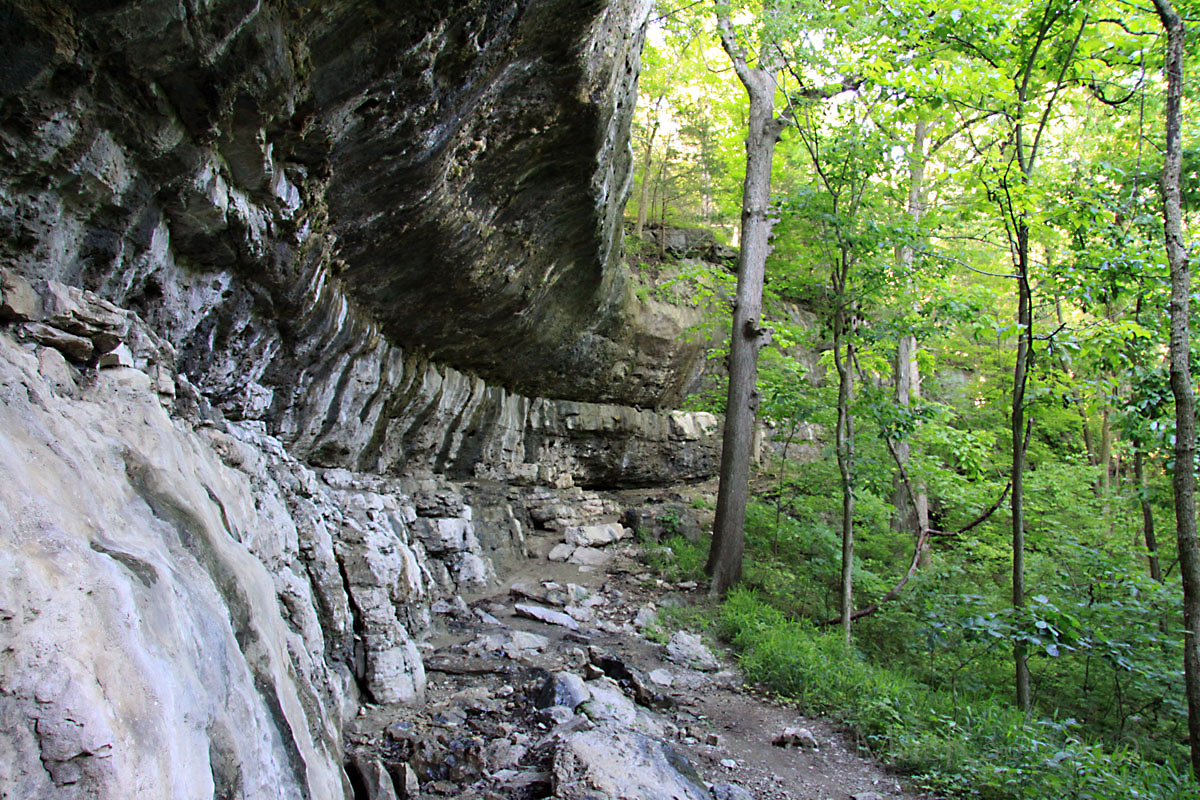
My first stop was Ha Ha Tonka State Park, one of Missouri’s premier parks, boasting high-quality chert, dolomite, and sandstone savanna interspersed with dolomite glades.  It is on these glades and savannas that I hoped to find Agrilus impexus, or failing that at least collect a nice diversity of other jewel beetles on the oaks and hickories of the savannas and surrounding woodlands.  However, it was with some reservation that I even came here after being told by my colleague at the Department of Natural Resources just 2 days before my trip that 75% of the park’s grasslands and woodlands had been burned within the past two years.  For an insect collector, this is never good news – in all my years of collecting insects, my experience in relatively recently-burned habitats has been consistent: collecting sucks!  I decided, however, to visit Ha Ha Tonka anyway because of the quality of the natural communities it contains, thinking perhaps I might be able to find pockets of unburned habitat supporting good insect populations.  This was not to be. I beat oak after oak in the savannas and woodlands – nothing!  I swept little bluestem and Indian grass in the glades – nothing!  The foliage was lush and green and the savanna and glade landscapes highly diverse – given the time of season the place should have been teeming with insect life, yet it almost seemed sterile. Were it not for a few Chrysobothris quadriimpressa jewel beetle adults that I found attracted to a recently wind-thrown black oak tree, I would not have seen any insects here at all.  It appeared my fears about park-wide depression of insect populations had been realized.  However, not one to waste a visit I decided to explore some of Ha Ha Tonka’s fascinating geological features.  Ha Ha Tonka contains one of Missouri’s best examples of karst geology, with complex structures formed from the collapse of a major cave system.  The Devil’s Promenade is one of the more spectacular examples of such, its horseshoe-shaped cliff representing the former interior walls of a now-collapsed cave.  As dusk approached, the day’s poor insect collecting caused me to abandon my plans to stay here and blacklight for nocturnal beetles.  Instead, I decided to break from the itinerary, drive further west and explore Lichen Glade Natural Area in the morning before heading to the Penn-Sylvania Prairie BioBlitz later that afternoon.

Devils Promenade, Ha Ha Tonka State Park

Lichen Glade Natural Area is a small area owned by The Nature Conservancy that boasts a high-quality sandstone glade surrounded by post oak/black jack oak forest.  My first visit to the area more than 20 years ago was during May, and it was one of the most productive collecting trips I’ve had with a number of Agrilus spp. (including A. frosti) beaten from post oak (Quercus stellata) along the woodland edge.  I didn’t visit again until fall of 2002, when Chris Brown, Rich Thoma and I found claybank tiger beetles (Cicindela limbalis) sunning on the exposed sandstone outcrops, and I made one more visit the following May to beat more insects off of post oak.  The Lichen Glade that I returned to this past weekend was a very different place from when I last visited – the surrounding woodlands had been extensively opened (I would guess within the past few years based on the size of the post oak resprouts), and fire had been used throughout the area.  Anticipation turned to frustration when no amount of beating of the woodland vegetation and sweeping of the glade vegetation turned up beetles in any appreciable numbers (or any insects for that matter) and two hours worth of effort yielded not a single buprestid beetle!

Sandstone glade community, Lichen Glade Natural Area

With resignation, I headed on over to Penn-Sylvania Prairie, where during the introduction to the BioBlitz I learned that nearly half of the 160-acre prairie was burned last December and all of it had been burned within the past few years.  I knew what I was going to find – nothing!  Okay, I shouldn’t say nothing, as there actually were some beetles present.  However, the numbers and diversity were low, with all of the species encountered representing common, widespread species.  Moreover, it was not just beetles – all of the invertebrate group leaders (which included experts on snails, ants, butterflies, and bees) reported low overall abundance and diversity in their groups of interest.  Only the vascular plants – the metric by which the value of prescribed burning is always assessed – showed high diversity, with 300 species of mostly native prairie plants recorded for the site.  It was a fun event, with probably ~75 attendees and a delicious pot luck dinner that evening; however, it would have been more enjoyable had there actually been a nice diversity of insects present to document for the preserve.

My comments may make it seem that I am against the use of prescribed burning.  This is not true – I understand the critical role that fire as a management technique plays in restoring and maintaining examples of Missouri’s historically fire-mediated landscape. Without fire and other processes to mimic natural disturbance factors, most of Missouri’s historical grasslands and woodlands suffer relentless encroachment by woody vegetation. However, the modern landscape is very different from the historical landscape, where fires of unpredictable scale, intensity, and frequency operated within a vastly larger scale to create a shifting mosaic of natural communities in various stages of ecological succession. Such processes cannot be recreated on today’s severely fragmented landscape, where the precious few remaining tracts of native habitat are relatively to extremely small and more often than not separated from each other by vast expanses of homogeneous and “inhospitable” habitat (e.g., agricultural, urbanized, or severely degraded lands).  It is in that context that I have great concerns about how aggressively fire has been used in recent years on our state’s natural areas and the impact this is having on insect populations – specialist and generalist alike.  Fire proponents will point to published studies that show little to no effect by the use of fire for managing small, isolated remnants on specialist insects (see review in Henderson 2010).  However, there are an equal number of studies that suggest such concerns are well-founded (see review in Panzer 2002). A consistent limitation in all of the studies that have been conducted is the lack of very large and long un-burned remnants.  Prescribed burning has been adopted so rapidly and pervasively that there just aren’t any significant un-burned remnants left to properly include as controls in such studies.  As a result, the insect fauna present at a given site at the start of such a study is already skewed towards those species that successfully recolonized the area post-burn.  At a minimum, the data to this point are inconclusive, and certainly the potential for impacts has not been given the consideration it warrants in designing fire-management plans for our own state’s prairies and glades. Furthermore, as rapidly and aggressively as fire has been adopted on our few, small, widely disjuct remnants, the opportunity for proper investigation of those potential effects may be gone.  A particularly egregious example of the lack of consideration being given to prairie invertebrates in designing fire management plans is shown in these photos of Iowa’s Sylvan Runkel State Preserve before and after a late May burn and the impact of that burn on a resident population of Nevada buck moths (Hemileuca nevadensis).

Here in Missouri, as in Iowa, it’s a problem of scale – the landscape is too fragmented and remnants too disjunct to manage based strictly on floristic response.   Populations of generalist insect species will recover, and even specialist species may be able to overcome such management practices if they are widely distributed and sufficiently mobile. But what about conservative species with low vagility, such as the swift tiger beetle (Cylindera celeripes) and our disjunct population of the frosted dromo tiger beetle (Dromochorus pruinina), flightless species restricted in Missouri to the few tiny remnants of loess hilltop prairie in northwestern Missouri and a single 2.5-mile stretch of roadside habitat in west-central Missouri?  Until directly relevant data, gathered here in Missouri, are forthcoming to suggest otherwise, I believe the most judicious use of fire possible should be practiced in restoring and maintaining our grasslands and woodlands.  In-season burns may have been a part of the historical landscape, but their use today has great potential to result in local extirpations and should be used only after the most careful consideration.  Leaving un-burned refugia within remnant habitats to accelerate recovery would also be prudent – yet many land managers disregard this practice because of its logistical difficulties. This is especially true in small parcels, yet it is precisely these remnants that have the most to gain from their use (or lose from not doing so!).  In the historical landscape, every burn was a patch burn – no matter what its size, there were always adjacent or proximal unburned habitat from which recolonization could occur.  Elk and bison, too, were integral components of the presettlement prairie landscape – their roamings caused intermittent, localized disturbances that were likely not only crucial to the tiger beetles that I study but may also have contributed to vegetational diversity through patch succession.  Techniques that mimic these natural disturbance factors include mowing, haying, and managed grazing.  They can be utilized to mimic those disturbances as well as delay woody encroachment, and their use in land management should be considered for their ecological value rather than deprioritized because of their relatively greater complexity and cost to implement. Mechanical removal and selective use of herbicides offer additional tools for addressing woody encroachment while minimizing potential impacts to insect populations. An effective management program that considers all of the flora and fauna of a remnant may not be possible unless all of these management tools are utilized, or at least properly considered. As my good friend James Trager said in a recent email (quoting Andrew Williams), habitat restoration “cannot rest on any single management practice, nor practicing it too extensively.”

REFERENCES:

Henderson, R. A.  2010. Influence of Patch Size, Isolation, and Fire History on Hopper (Homoptera: Auchenorrhyncha) Communities of Eight Wisconsin Prairie Remnants.  Wisconsin Department of Natural Resources, Research Report 189, 22 pp.

Panzer, R. 2002. Compatibility of prescribed burning with the conservation of insects in small, isolated prairie reserves. Conservation Biology, 16(5):1296-1307.

Copyright © Ted C. MacRae 2010

Add to FacebookAdd to DiggAdd to Del.icio.usAdd to StumbleuponAdd to RedditAdd to BlinklistAdd to TwitterAdd to TechnoratiAdd to Yahoo BuzzAdd to Newsvine

Email to a friend