2018 New Mexico/Texas Insect Collecting Trip “iReport”

This is the fifth in a series of Collecting Trip “iReports”—so named because I’ve illustrated them exclusively with iPhone photographs (see previous articles for 2013 Oklahoma2013 Great Basin, 2014 Great Plains, and 2015 Texas). Note that I continue to use my “big” camera for specific insect targets—and these will be featured from time to time on this site. However, I use my iPhone camera much more during these trips for general photography to document habitats, landscapes, and miscellaneous subjects because it is so small and handy and because it is also capable of capturing reasonably good photographs (see this post for tips on making the most of the iPhone camera’s capabilities). This allows me to spend more time looking for and collecting insects—usually my primary objective on these trips! Collectively, these iPhone photos and the short narratives accompanying them form a nice trip synopsis when assembled into a single post.

This report covers a collecting trip I made with Jeff Huether from June 2–9, 2018 to southeastern New Mexico and west Texas. I’ve dabbled in this area before, primarily just a quick stop at Mescalero Sand Dunes many years ago, but not specifically targeted this area for any systematic collecting. Thus, most of the locations that we visited were new to me, which automatically means that I would find at least a few things of interest—and more probably a lot (as long as the insects are active). We had great success at many localities, having found areas where sufficient rain had occurred to trigger insect emergence despite the drought that was plaguing much of the area. Highlights were the areas along Hwy 380 between San Antonio and Bingham, the Mescalero Sand Dunes, and the dunes near Kermit, Texas. I haven’t yet tallied the number of species collected, as much of the material is still waiting to be mounted and identified. However, I estimate that it is in the neighborhood of about three dozen buprestids and maybe half that many cerambycids, including some quite charismatic species that I’d not collected previously (e.g., Prionus arenarius and Tragidion armatum).

Stay tuned, because I made a second insect collecting trip during 2018, this one with Art Evans to southeast Arizona during late July and early August.


Day 1 – Sandia Mountains, New Mexico
We flew into Albuquerque this afternoon and, after getting the car, supplies, and something to eat we came up to Sandia Crest Recreation Area looking for Cicindela longilabris (long-lipped tiger beetle). This was the first place I stopped on the first day of the trip for the first species I wanted to look for, and I found it in the first five minutes I was here!

View from near the summit of Sandia Mountain.

We stopped at the Capulin Picnic Ground on the way down the mountain. There were some oaks with fresh-looking foliage that I beat – no Buprestidae but a nice series of a treehopper (Telamonthe?) and a few odds and ends. There was also Robinia off which I beat a series of what is surely Agrilus egenus.

Penstemon sp. ID by George Yatskievych.

Day 2 – Walking Sands Rest Area, New Mexico
Quick stop to check the lights – later in the season Jeff has collected Prionus palparis here, but this time we saw nothing. Also checked the nearby vegetation, there was Dalea in bloom but no beetles on the flowers.

Hwy 380 between San Antonio & Bingham, New Mexico
We saw a few things in bloom at the Rio Grande bridge crossing so decided to stop. I took a fair series of what must be Acmaeodera mixta off of the Thelesperma flowers (along with a few mordellids for Enrico and one meloid for Jeff). Otherwise not much activity at the spot.

Bone dry Rio Grande!

There were some cool looking red sand dunes on Hwy 380 east of San Antonio, so we stopped to see if there might be any tiger beetles. There weren’t any, but I found yucca stems infested with cerambycid larvae, likely Tragidion. I collected 6–8 stems to bring back and try to rear out the adults. Jeff also found a single Chrysobothris sp. on sage, otherwise we saw few beetles.

Going east on Hwy 380 we went into an area of higher elevation with junipers. We stopped to check the Thelosperma flowers, but there were no bups on them. I collected a few noisy cicadas and some Acmaeodera quadrivittatoides on Opuntia flowers. I then started beating the junipers, however, and got a fair series of a small green Gyascutus plus two tiny Chrysobothris. They were extremely difficult to collect – winds were very stiff and the beetles were very active. I probably lost as many as I collected. To finish off I found a mating pair of Moneilema sp. on cholla.

Acmaeodera quadrivittatoides in a flower of Opuntia sp.

Yours truly standing next to a cholla (Opuntia imbricata).

In addition the the Tragidion larvae that I collected two stops back, Jeff saw one adult at the previous stop. So, when we saw thick stands of yucca along the roadsides just a few miles down the road we stopped to take a look. They were out and not uncommon on the flower stalks and down in the basal rosettes. I collected about a dozen of them and also another Gyascutus.

A Tragidion female on a yucca flower stalk.
Tragidion sp. mating pair on yucca flower stalk.

Tarantula hawk (family Pompilidae) on yucca flower stalk. This must be a mimicry model for Tragidion.

I believe this is a cactus dodger cicada (Cacama sp.).

At the last stop we noticed a lot of emergency vehicles rushing to the east. Just a couple of miles down the road we ran into an accident blockade. Since we were stopped I was tempted to look at the rock shop, but then I started looking at the cholla and found several Moneilema sp. adults on the plants.

Walking Sands Rest Area, New Mexico
We came back up to the rest stop because of the dunes – there are Prionus spp. that live in the dunes, so we put out some pheromone to see if we could attract the males which fly at dusk and early nighttime. In the meantime we walked around looking for nocturnally active beetles – found a few skin beetles (Omorgus sp.) feeding in dried dog poop and a huge tenebrionid (Eleodes sp.) strangely perched up in a bush. Also photographed a cool little sun spider (Solifugida). When we went back to check the pheromone there was one male Prionus arenarius running around under the lure!

Skin beetle (Omorgus nodosus) feeding on dried dog poop at night. ID by Bill Warner.

A sun spider (Solifugida) pauses briefly from its frantic search for prey.

Day 3 – Valley of Fire National Recreation Area, New Mexico
We came over the hill and saw a huge black area in the valley below. I thought it was just an area of thick woody vegetation, but it was actually a lava field! Very cool. There were tons of cicadas, I think also cactus dodgers (Cacama spp.) but look different from the one we saw yesterday. I beat a lot of Celtis and only got one Chrysobothris sp. (looks like analis), and there was nothing on the junipers. We also didn’t see any Moneilema on the abundant cholla. I did catch two Acmaeodera mixta on an unidentified white flower. I think yesterday’s rains must have missed this area!

Malpais Lava Beds.

A tarantula hawk (family Pompilidae) on flowers of milkweed (Asclepias sp.).

I believe this is another species of cactus dodger cicada (Cacama sp.).

Malpais Lava Beds.

Lead-footed bugs (family Coreidae) on cholla cactus (Opuntia imbricata).

Malpais Lava Beds.
Cactus dodger cicada (Cacama sp.)?
Male cactus dodger (Cacama sp.) on cholla cactus in mid-song.

We drove a couple miles down the road and made just a quick stop to check flowers along the roadsides. No beetles seen – seems to be super dry, but I did photograph one of the tiniest butterflies (something in the family Lycaenidae) I’ve ever seen.

Western pygmy blue (Brephidium exilis). ID by Doug Taron.

Sierra Blanca Mountains, New Mexico
Jeff wanted to look for an Epicauta up here, but the whole drive up the mountain we could only comment on how dry it was and how extensively the area had burned. I only found two wood borers – an Anthaxia (Melanthaxia) and a lepturine cerambycid, both on iris flowers. We did find the Epicauta though, also on iris flowers.

Atop the Sierra Blanca.

Perhaps Erysimum capitatum (Brassicaceae). ID suggested by Erik Emanuelsson.

Flower longhorn (subfamily Lepturinae) on flower of iris.

Vicinity Sunset, New Mexico
There were some mallow in bloom along the roadsides, so we stopped to see if there were any Acmaeodera on them. There weren’t, just a few meloids that Jeff was interested in. I found a a single Euphoria kerni on a flower of Acacia greggii and, of course, large numbers of them on thistle flowers. The area seems to have gotten some rain, but not much activity to speak of yet.

Euphoria kernii in their typical “buried-butt-upwards” post on a thistle flowerhead.

Mescalero Sand Dunes, New Mexico
This area got rain last night, so we suspected there would be a lot of insect activity, and we were right! The place was alive when we got here at ~6 pm. I walked the area while we waited for dusk to set out pheromone. I collected a series of Enoclerus zonatus off of yucca blooms, beat an Actenodes sp. (something new for me), a Chrysobothris octocola, and a nice series of treehoppers off of mesquite, and found three Batyle suturalis ssp. on an unidentified yellow comp.

Mescalero Sands Recreation Area.

A skin beetle (Omorgus nodosus) makes tracks in the sand.

Enoclerus spinolae on yucca.

Another Enoclerus spinolae individual on yucca. Note the larger spots on this one compared to the other, an example of intraspecific variation.

As the sun began to sink lower in the sky, I hiked around to the backside of the dunes and then bushwhacked across them to get the perfect perspective for photographs when the sun hit the horizon – spectacular sunset!

Sunset on the dune.

What a sunset!

I’m happier than I look! 

By the time I got back to the car, Jeff had already placed three lures out, so we started making the rounds and found at least one or two Prionus arenarius males running frantically in circles under each one. At the second lure, I started searching the area nearby and found a female walking on the ground! (Females are very rarely encountered, and it seems a little more than coincidental to me that for each species of Prionus, whenever we have collected good numbers of males with lures we have also found at least one or a few females in the same area – maybe cheaters [in the ecological sense]?).

As we made the rounds we picked up an amazing diversity of tenebrionids and a few carabids walking in the sand, and we finished off by picking up Jeff’s light trap, which had attracted one more Prionus male and a very light-colored Polyphylla sp. male.

Incredible huge blue spider on the dune at night.

Day 4—Mescalero Sand Dunes, New Mexico

We noticed a stand of soapberry (Sapindus drumondii) along the sides of the road just west of the entrance to Mescalero Sands Recreation Area last night, and I immediately thought of Agrilus sapindi, so this morning on our our way to the dunes we stopped by. I started beating the flowering branches of the larger soapberry trees but wasn’t really getting anything. Then I noticed an A. sapindi flying to a low non-flowering plant, so I caught it and resumed beating – now with more gusto knowing they were here. I still wasn’t getting anything and, again, saw another adult fly and land on a low non-flowering plant. Lesson learned – I started sweeping the low plants and started getting them. I worked all five stands in the area and got about 3 dozen adults, plus a few A. ornatulus, one A. limpiae, and spectacular Neoclytus.

After finishing with the soapberry, Jeff had noticed some tiny Acmaeodera on an unidentified white-flowered composite. We started searching in earnest and collected several dozen adults. I’m not sure what they are, but they are tiny and vittate (maybe A. quadrivittatoides). We also did a lot of sweeping of the short shrubby oak also and came up with a couple of Brachys. Overall a great morning/early afternoon in the field!

The only thing cooler than this abandoned homestead was the squawking ravens hanging out on it!

Soapberry (Sapindus drummondii) stands along Hwy 380 – host for Agrilus sapindi.

Host for unidentified Acmaeodera sp.

We next went into the Recreation Area proper to each lunch, after which we explored the rest of the area accessible by vehicle and saw a stand of cottonwood back in the dunes. We got out to see if there might be any Buprestidae on them (e.g., Poecilonota), but they were devoid of insects. The midday heat on the dunes was extreme! I did find, however, a single Prionus elytron lying on the sand beneath the cottonwoods, so we know they are further back in the dunes as well.

Mescalero Sands Recreation Area.

Mescalero Sands Recreation Area.

We worked the variety of blooming plants in the vicinity of the entrance. I collected ~22 of the small Acmaeodera that were on the white-flowered plant at the soapberry spot on two blossoms of a single yellow-flowered pad Opuntia sp., a couple of Acmaeodera spp. on Gaillardia sp. flowers, a few more Acmaeodera spp. on Prosopis, and several Acmaeodera mixta on another as-yet-unidentified white flower. It was hotter than bejesus we later learned 103°F!) – I had wanted to check out one more stand of soapberry at the entrance, but we were exhausted and dehydrated and had to quit!

Some kind of wasp on some kind of flower.

There are four separate bird nests in the cholla plant – a veritable avian apartment!

Cholla (Opuntia imbricata) blossom.

Vicinity Hobbs, New Mexico
We got a hotel in Hobbs and grabbed a sandwich for dinner, then went out west of town to see if we could find some good habitat for evening collecting. We found a spot of open rangeland about 8–9 miles west of town, set out the pheromone lures, and began beating the mesquite (Prosopis glandulosa). We had high hopes because there was still standing water, meaning that the area had gotten good rains on Sunday night. Boy were we correct! Beating the mesquite was amazing. For buprestids I got 10 individuals of an Actenodes sp., 4 individuals of a Paratyndaris sp., 4 Chrysobothris spp., 4 Acmaeodera spp., and 1 Agrilus sp. I also got several tiny cicadas, a couple treehopper species, and a few clerids and other odds and ends. We setup a blacklight and the scarabs were quite diverse, but the only thing I took was a tiger beetle (Cylindera lemniscata). I also picked up a Phyllophaga cribrosa and a tenebrionid walking on the ground at night. No Prionus came to the lures, any my searches of the ground at night turned up no Amblycheila.

Tiny scarab beetles in the genus Diplotaxis congregate on low plants to “catch” pheromone trails in search of mates.

Giant millipedes (genus Orthoporus) were common at night, a sure sign of recent rains. ID by Derek Hennen.

Ted of Arabia and Jeff.

Day 5—Sand Dunes near Kermit, Texas
We stopped just outside the Kermit Sand Dunes to beat the mesquite (Prosopis glandulosa) to see what might be out. I collected 8 species of Buprestidae: nice series of an Acmaeoderopsis (hoping A. prosopis), 1 sp. Actenodes, 2 spp. Chrysobothris, 1 sp. Paratyndaris, 1 sp. Agrilus, and 2 Acmaeodera spp. We eventually gave up – the heat had not only wilted us, but the Acmaeoderopsis were flying away immediately upon hitting the sheet.

Updated field pic (the last one was taken in 1999!).

We drove a little further towards the heart of the dunes and found a spot where there were some blowouts and classic sand flora. Immediately upon starting out we noticed Acmaeodera mixta adults flying around commonly, so I swept through the vegetation a bit and collected a representative series. On Oenethera sp. flowers I found a single A. immaculata and later several A. mixta and a very small Acmaeodera (looked like the one we collected yesterday at Mescalero). In one spot I found a few plants of an unidentified yellow composite with a few more A. mixta, and on Baccharis I found one A. obtusa(?) along with A. mixta. Coming back to the car Jeff and I noticed huge numbers of A. immaculata flying to an unidentified shrub, from which we each swept a nice series. Eventually the heat (103°F) again overwhelmed us, and we had to get in the car, eat, and cool down for a bit on the way to another spot.

The dunes are part of an extensive series of dunes stretching from West Texas through southeastern New Mexico.

Acmaeodera mixta on flower of an unidentified yellow composite.

We returned to an area with stands of soapberry (Sapindus drummondii) that we had seen when we first arrived in the area. I swept all of the small plants on the east side of the highway and got a single Agrilus sapindi – not nearly as abundant as we had seen at Mescalero Sands.

On the west side of the highway there were some larger mesquite (Prosopis glandulosa). I found one Chrysobothris octocola on the trunk, then Jeff and I noticed Acmaeoderopsis flying to the tips of the high branches. I got my aerial net and just started betting them as they flew in while we stood and watched. I caught them from several trees, but a majority from a single tree. That worked much better than beating this morning – I probably lost as many as I collected because they flew so quickly upon hitting the sheet.

Underneath one large mesquite I found several prionid elytra – couldn’t tell if they were Prionus or Derobrachus, but then I noticed burrows in the ground very similar to those we saw for Prionus integer in Colorado (see photo). We dug a few out but found nothing. Something to keep in mind.

The high plains of west Texas.

Burrows like this one look suspiciously like those of Prionus integer in Colorado – did another Prionus make this one?

We returned to the dunes for some evening collecting. I beat the two large mesquite (Prosopis glandulosa) trees by the parking area and got an Actenodes and a few Chrysobothris octocola – no Acmaeoderopsis, I guess they hide elsewhere for the night. Once dusk fell we began checking the pheromones and light – only a single male Prionus arenarius came to the pheromone, but we got several individuals of two Polyphylla spp. (P. monahansensis – larger, and P. pottsorum – smaller) at the light. Walking around the dunes at night there were significantly fewer tenebrionids and other insects walking around, but I did pick up two cool “concave” tenebs and a Pasimachus ground beetle.

I’ve never seen a mourning dove make a nest in the ground before.
I always thought these oil pumps looked like dinosaurs bobbing up and down.

Bull nettle (Cnidoscolus texanus)—something tells me I should not touch this plant!

A very small (<1.5” in length) scorpion visits the light looking for a meal.

Face-to-face with a scorpion!

Day 6—I-10 Rest Area at mile marker 162, Texas
Just a quick stop to use the facilities, but I couldn’t resist the temptation to photograph these three Reakirts blues all on one flower (a fourth flew away before I could snap).

Reakirts blue (Echinargus isola). ID by Doug Taron.

San Felipe Park, near Fabens, Texas
We took a chance on going further west to the dunes near Fabens, since we’ve had such good luck with rains in the area. However, when we got here and started looking around it was apparent that nothing was happening here – dry, dry, dry with temps just over 100°F. I saw a few insects but only a single buprestid – Acmaeodera quadrivittatoides, and I missed it! We decided to cut bait and head back east and north towards Carlsbad – we should be able to get to the area in time for some late afternoon and evening collecting. You can’t win ‘em all!

This roadrunner was rather annoyed with us for intruding in his spot of shade under a Siberian elm.

A broad-nosed weevil.

A mating pair of walkingsticks. Note the great size difference between the male (smaller) and female (larger).

I think I found our retirement home!

Vicinity Carlsbad, New Mexico
After getting lost in the Fabens Sand Dunes and then a whole lot of driving back east into New Mexico, we arrived in Carlsbad with just enough time to grab a sandwich and head out to some promising habitat we’d noticed on the way in for some evening/night collecting.

The area contained a ribbon of woodland with mesquite (Prosopis glandulosa), black acacia (Acacia rigida), and catclaw acacia (A. greggii). I beat only one tiny Chrysobothris sp. off the mesquite, but off the black acacia I beat three individuals (four actually, one got away) of a large, chunky Chrysobothris sp. that I do not recognize, plus an undetermined cerambycid and a few clytrines. Actually, before I collected the Chrysobothris I had given up on the lack acacia until I was walking by one plant and saw the first one sitting on a branch. I popped it in the vial and started beating the other plants in the area with renewed enthusiasm the find the other two (three!).

We setup the lights and the pheromones, but not much came to the former and nothing to the latter (expected, since there was no sand habitat nearby). The sunset beforehand, however, was magnificent, and I did find a couple of miscellaneous beetles walking around at night.


Day 7—vicinity Loco Hills, New Mexico
We saw an area with stands of soapberry (Sapindus drummondii) alongside the road so stopped to sample it for Buprestidae. I got 3 Agrilus limpiae on trees right around the car but nothing on all the rest of the three stands nearest the car on either side of the road. I hope the south area of Mescalero Sands is not as dry as it still appears around here.

Soapberry (Sapindus drummondii).

Mescalero Sand Dunes, New Mexico
We found the central dunes of the southern area and immediately found several Acmaeodera mixta adults on mesquite (Prosopis glandulosa) flowers. I started beating the mesquite and picked up a nice series of Acmaeoderopsis, one Actenodes, and a few other miscellaneous Acmaeodera off the larger trees. There was some soapberry (Sapindus drummondii) in bloom around the dunes, but beating it produced no Buprestidae.

A lone windswept soapberry tree hangs on precariously to life in the dunes.

Acmaeodera mixta on flowers of mesquite (Prosopis glandulosa).

We stopped at a spot outside the dunes because it looked pretty green with a number of plants in bloom suggesting recent rain. I saw but did not take Acmaeodera mixta on white flowers of undetermined composite. I did collect a small series of bright red and black clerids on a small blue-green euphorbiaceous plant. Also saw a little horned lizard, who cooperated just enough to get a few snaps!

A young Texas horned lizard (Phrynosoma cornutum) tries to make himself look big!

White-flowered composite blooming in the desert.

Vicinity Carrizozo, New Mexico
We stopped at a thick stand of yucca that we’d noted on the way past here earlier in the week, the hope being that we would find Tragidion armatum on the stems. Sadly we did not see any, nor did we see more than just a couple of the pompilid wasps that the beetles mimic. Surely this is a result of the lack of rain in the area, which the hotel clerk confirmed during our earlier check in. Cicadas, on the other hand, were everywhere!

The low sun illuminates the yuccas, while the higher clouds shade the mountains behind.

The low sun illuminates the yuccas, while the higher clouds shade the mountains behind.

How many cicadas do you see on this single yucca stem?

Promising clouds tease a thirsty landscape.

For the final stop for the day we returned to Valley of Fire Recreation Area – not really to collect insects, but to look about this fascinating landscape. The Lava Beds are thought to be 5,000 years old, having formed over a 30-year period when lava poured from Black Peak to the north (not a volcano, but a volcanic vent) at a rate that would fill 15 bathtubs every second! It was a serene and otherworldly walk in the falling darkness – nice way to cap off an evening.

Towering clouds try to squeeze out some moisture.

Lots of virga, little rain.

A 400-year old juniper watches another sunset.

Day 8—vicinity Bingham, New Mexico and west on Hwy 380
We stopped at another yucca stand very near where we’d found the Tragidion armatum last weekend – no problem finding them here either. I got plenty of photographs of the beetles (despite having to go ‘au natural’ with the lighting – my flash unit had died!), as well as of cicadas, wasps, and other insects on the yucca stems and pods. Otherwise I only collected two Acmaeodera (looks like A. immaculata) on flowers of Sphaeralcea sp., what looks to be A. disjuncta/paradisjuncta on Ephedra sp., and a single Moneilema sp. on Opuntia imbricata. Nice stop!

Variety of wasps on yucca.

We then stopped by “the juniper spot” again to see if I could get a better series of the Gyascutus (G. carolinensis?) that we found on the junipers (Juniperus monosperma). Boy, did I ever! I collected about 30 specimens this time, made easier by the fact that it was cooler and not nearly as windy! I also again collected two small Chrysobothris sp. on the juniper, a single Moneilema sp. on cholla (Opuntia imbricata), and a single Acmaeoderopsis sp. beating mesquite (Prosopis glandulosa).

One of the more exciting finds of the trip – a jewel beetle in the genus Gyascutus on Juniperus monosperma (I believe this is G. carolinensis).
The greenish waxy bloom that covers the body must help the beetle blend into the foliage on which they perch.

A cactus beetle in the genus Moneilema on its host, cholla (Opuntia imbricata).

A multi-tool comes in very handy for collecting cactus beetles!

We stopped at another spot further west on Hwy 380, where last weekend when we were here we saw few beetles but I did collect yucca stems infested with Tragidion armatum larvae. It rained here later that day, so we stopped by again on our way back to see if the rains had prompted more insect activity. It didn’t seem to, but I did find a Tragidion armatum adult feeding on a yucca flower and photographed a big-as-heck katydid.

Tragidion armatum adult female feeding on a yucca flower.

Big katydid. You can tell this is a brachypterous adult because the anterior wings are on top and their costal margins oriented outside (in nymphs the posterior wings are on top and their costal margins oriented inside).

Perfect camouflage!

“The Box”, vicinity Socorro, New Mexico
Last stop of the trip – we just wanted to find some habitat to beat around in before finding a hotel in Socorro for the night. I beat a couple of small Chrysobothris sp. from the Juniperus monosperma – no Gyascutus – and a couple of treehoppers from Prosopis glandulosa – no Acmaeoderopsis, then turned my attention to the cholla (Opuntia imbricata), in what must have been the thickest stand of this plant I’ve ever seen. There were two species of cactus beetles on them – Moneilema sp. and Coenopoeus palmeri, the latter a first for the trip. After hiking up to the canyon overlook, I realized that the collecting and fun were finally over (until Arizona in August!).

“The Box.”

Cactus beetle (Moneilema sp,) on a cholla (Opuntia imbricata) skeleton.

The “other” cactus beetle (Coenopoeus palmeri).

How many cactus beetles can you count?

Last selfie of the trip. That wry smile is the satisfaction of knowing that the trip was success, I collected lots of great beetles, and I learned a ton!

© Ted C. MacRae 2019
“Highlights from Nearly 20 Years of Chasing Tiger Beetles in Missouri”

Last night, Chris Brown—my longtime field companion and fellow tiger beetle aficionado—and I gave a presentation to the Entomology Group of the Webster Groves Nature Study Society at Shaw Nature Reserve in Gray Summit, Missouri, giving highlights from our nearly 20 of “chasing” tiger beetles in Missouri. Our work not only revealed two new state records (Cicindelidia trifasciata ascendens and Cylindera celeripes), bringing to 24 the total number of tiger beetle species known from the state, but also featured intensive surveys for several species of conservation interest.

It was a fun, lighthearted presentation that emphasized the experiences we had while conducting these surveys and our growth as natural historians as a result of them. Of course, beautiful photographs of tiger beetles were used liberally throughout the presentation (for those who do not know, Chris was my early mentor in the area of insect macrophotography!). While we had a nice local turnout, I realize most of the readership of this blog could not have attended this event in person. Never fear, however, for I have saved the slide deck as a PDF document* that you can download and peruse at your convenience.

* All content is copyrighted and may not be reproduced or distributed without written consent.

© Ted C. MacRae 2019
 

Cover Photo—The Coleopterists Bulletin 71(4)

The December 2017 issue of The Coleopterists Bulletin (vol. 71, no. 4) is hitting mailboxes now, and once again I have the honor of providing the cover photo. This one features an adult of the cactus beetle, Moneilema armata (Coleoptera: Cerambycidae) on its host, cholla (Opuntia imbricata). I photographed this beetle in June 2014 near Vogel Canyon in Otero Co., Colorado. Cactus beetles are notorious for hiding deep within the mass of spiny stems and branches of their hosts, making long forceps an absolute necessity for collecting them. Occasionally, however, they venture out onto more exposed parts of the plant—in this case, up near the tip of a stem and onto a nearly open flower bud, and the value contrast between the black beetle, green stem, pink flower, gold spines, and blue sky made for a truly lovely composition. If I have only one regret about the photo, it was the stiff southerly wind that kept blowing the beetle’s left antenna and preventing it from matching the perfectly symmetrical arc of the right antenna—a small complaint.

This is another example of the flash-illuminated subject with natural blue sky background technique that I have become so fond of, at least for diurnal insects resting on flowers and foliage. I learned this technique from John Abbott a few years earlier at the inaugural BugShot Workshop in Gray Summit, Missouri (just 15 miles from my home), and it has since become my default background and part of my signature style.

This is the fourth issue of The Coleopterists Bulletin to feature one of my photographs on the cover. The first was the June 2013 (vol. 67, no. 2) issue, featuring the stunning green weevil Eurhinus cf. adonis, and the very next issue (September 2013, vol. 67, no. 3) featured the jewel beetle Chrysobothris octocola. Two years later I had a photo on the cover of the March 2015 (vol. 69, no. 1) issue, a striking red and black longhorned beetle Crossidius coralinus fulgidus.

If you’re not one already, consider becoming a member of The Coleopterists Society (I’ve been one for 36 years now!). Their flagship journal, The Coleopterists Bulletin, is your one-stop shop for all things beetley—a quarterly fix of pure elytral ecstacy! Membership also includes online access to archives of past issues via JSTOR and BioOne.

© Ted C. MacRae 2018

Ellipsoptera lepida – ghost tiger beetle

In the early 2000s, Chris Brown and I were beginning our general survey of Missouri tiger beetles. Our goal was to characterize the occurrence and distribution of all species within the state. At the time, 22 species were known to occur in Missouri, and our work would uncover the presence of two more—one being a vagrant occurrence of the widespread Cicindelidia trifasciata ascendens (ascendent tiger beetle) (Brown & MacRae 2005); the other being the rare Cylindera celeripes (swift tiger beetle) (MacRae & Brown 2011). Of the species already known from the state, however, some were known from only a few records and hadn’t been seen in the field by either Chris or myself. One such species was Ellipsoptera lepida (ghost tiger beetle), an almost pure white species known to occur in deep, dry sand habitats over most of central North America (Pearson et al. 2015). At that time, I had still seen only the more common species in Missouri, and the combination of its name and unusual, mostly-white color put this species high on my “must see” list.

Ellipsoptera lepida (ghost tiger beetle)

My first experience would come quickly. In June 2001, Chris and I visited a recent addition to Weldon Spring Conservation Area on the north side of the Missouri River in St. Charles Co. called Darst Bottoms. The area at one time was productive farmland, but the “Great Floods” of 1993 and 1995 left deep deposits of sand over the area. While no longer suitable for agriculture, the process of succession allowed valuable wildlife habitat to develop, and the area was purchased and added to the Conservation Area. By the time of our visit in 2001, early succession had resulted in young forests of mostly eastern cottonwood (Populus deltoides) surrounding a vast central plain of white sand. Chris and I didn’t know what to expect on that first visit, both of us being in the early stages of our survey of Missouri tiger beetles, but we figured we would find something interesting.

Ellipsoptera lepida (ghost tiger beetle)

I still remember the moment I first saw E. lepida and realized what it was. We had already found Cicindela formosa generosa (eastern big sand tiger beetle)—the first time I had seen that species in Missouri outside the southeastern lowlands (we would eventually find it at many sites along the Missouri and Mississippi Rivers and a few smaller interior rivers)—and were searching for additional specimens. We were in a small opening adjacent to the larger central plain when I thought I saw something move near my feet. I stopped to look down but didn’t see anything, so I began walking again while scanning the ground ahead of me. Again, I thought I saw movement nearby and stopped to look, this time pausing a little longer and doing so a little more carefully. That’s when I saw it, and even though I had seen only photographs of the species and museum specimens I recognized it instantly for what it was and yelled out “lepida!” Chris came over to see for himself, and we marveled at the effectiveness of their camouflage—they seemingly were able to disappear right before our eyes even though we were looking right at them.

Sand plain habitat for Ellipsoptera lepida (ghost tiger beetle).

Over the next few years, Chris and I found the species at several sites along or not too distant from the Missouri and Mississippi Rivers—always on sand deposits deep enough to become dry. We never found them in great numbers, sometimes just single individuals while other sand residents were abundant, and not at all sites where we did find more reliable species such as C. f. generosa and C. tranquebarica (oblique-lined tiger beetle). Pearson et al. (2015) mention that despite the broad distribution of this species across central North America that its actual occurrence is rather spotty and localized and that it has disappeared from many sites where it was previously known to occur. This was our experience in Missouri as well, as many of the museum records we had gleaned for the species no longer appeared to support populations of the beetle. This is likely due, at least in part, to the ephemeral nature of the habitats on which the species depends, at least those along the big rivers that are vulnerable to revegetation and succession back to bottomland forest.

Ellipsoptera lepida (ghost tiger beetle)

Of course, all of this occurred long before I took up insect macrophotography in 2009, and while I had managed to photograph most of the tiger beetle species in Missouri in the years that followed, E. lepida was one that I continued to lack. In the summer of 2015 I decided to rectify that situation and, when the time was right, returned to Darst Bottoms in hopes of finding and photographing this species. Imagine my surprise when I hiked into the area and, instead of young cottonwood stands surrounding a vast, barren sand plain, I found mature cottonwood forests surrounding a thickly vegetated sand prairie with only isolated patches of barren sand. Needless to say, with such little suitable habitat for the beetles they were neither abundant nor even common. In fact, the only evidence I found that told me they were still there at all was coyote scat containing unmistakable remains of the adult beetles. Skunked on my first effort, I decided to try another spot where we had seen good populations of the beetle—Overton Bottoms Conservation Area along the Missouri River in Cooper and Monteau Counties in central Missouri, now Overton Bottoms South Unit and part of the Big Muddy National Wildlife Area. Like Darst Bottoms, this area had experienced revegetation and succession in the decade+ since my previous visit; however, unlike the former there still remained a vast central plain that, while vegetated, was sparsely vegetated enough to continue providing suitable habitat for the beetle. It took some work, but I eventually found the beetles localized in one part of the sand plain (see photograph ), and there were enough of them out at the time of my visit that I succeeded in getting the series of photographs shown in this post.

Ellipsoptera lepida (ghost tiger beetle)

I have fond memories of all 24 tiger beetle species in Missouri—each one presenting a unique collection of experiences that will fuel my love affair with the group for years to come. With E. lepida, the jubilance and excitement of that first, unexpected encounter remains near the top of the list for me.

REFERENCES:

Brown, C. R. & T. C. MacRae. 2005. Occurrence of Cicindela (Cicindelidia) trifasciata ascendens (Coleoptera: Cicindelidae) in Missouri. Cicindela 37(1–2):17–19 [pdf].

MacRae, T. C. & C. R. Brown. 2011. Historical and contemporary occurrence of Cylindera (s. str.) celeripes (LeConte) (Coleoptera: Carabidae: Cicindelinae) and implications for its conservation. The Coleopterists Bulletin 65(3):230–241 [pdf].

Pearson, D. L., C. B. Knisley, D. P. Duran & C. J. Kazilek. 2015. A Field Guide to the Tiger Beetles of the United States and Canada. 2nd Edition. Oxford University Press, New York, 264 pp. [Oxford description].

© Ted C. MacRae 2017

Cicindela scutellaris flavoviridis (chartreuse tiger beetle)

In previous posts I have discussed some Texas subspecies of Cicindela scutellaris (festive tiger beetle) and C. formosa (big sand tiger beetle)—two widespread and geographically variable species that occur broadly across eastern North America and that segregate into several distinctive and geographically restricted subspecies (Pearson et al. 2006). With the former species, I actually found two of its Texas subspecies, the second being C. s. flavoviridis (dubbed the “chartreuse tiger beetle” by Erwin & Pearson, 2008). This subspecies occurs in a narrow band from north-central Texas south to central Texas and apparently does not intergrade with rugata (which I featured previously) to the east (Pearson et al. 2006) and minimally with subspecies lecontei to the north (Vaurie 1950).

Cicindela scutellaris flavoviridis

Cicindela scutellaris flavoviridis

This beautiful subspecies usually lacks maculations, at most possessing two tiny ivory white spots along the outer edge of the elytra, and the shining metallic upper body surface is the most stunning shade of greenish-yellow, or chartreuse, color that I have ever seen. It shares with C. s. rugata a more wrinkled pronotum and smoother head than other C. scutellaris subspecies, but the latter is distinguished by its darker blue to blue-green dorsal coloration. Vaurie (1950) regarded C. s. flavoviridis to be intermediate between rugata and scutellaris but more closely related to the latter due to their shared yellow/coppery reflections on the elytra. Cicindela s. flavoviridis can also be confused with immaculate forms of C. sexguttata (six-spotted tiger beetle), but the latter is less robust with a more tapered posterior, and both sexes of C. sexguttata have a whitish labrum—in all C. scutellaris subspecies only males have a white labrum and females have a dark/black labrum.

Cicindela scutellaris flavoviridis

Cicindela scutellaris flavoviridis

Like all of the other C. scutellaris subspecies, this one occurs in deep, dry sand habitats such as dunes, blowouts, and road cuts. I found this population along a tributary of the Red River known as Cobb Hollow” in Montegue Co., Texas in early October 2015, where they occurred in small numbers on deep sand bars alongside the small creek. I actually made two visits to this site one week apart—failing the first time in my efforts to obtain good, in situ field photographs but succeeding on the second visit.

Cicindela scutellaris flavoviridis

Cicindela scutellaris flavoviridis

I am quite satisfied with these photos, especially the first one above that gives a good lateral view of an adult striking an interesting pose on sloped sand, although I would have liked to have gotten at least one with some foliage in the photo to add a bit of perspective. Nevertheless, having now succeed in photographing the four “western” subspecies of C. scutellaris (rugata and flavoviridis in Texas, nominate scutellaris in the Great Plains, and yampae in northwestern Colorado), I am now motivated to get good photographs of the three “eastern” subspecies: lecontei proper (there are populations in northern Missouri), rugifrons along the North Atlantic coast, and unicolor in the southeastern U.S. (although I have photographed an interesting lecontei × unicolor intergrade population in southern Missouri).

REFERENCES:

Erwin, T. L. & D. L. Pearson. 2008. A Treatise on the Western Hemisphere Caraboidea (Coleoptera). Their classification, distributions, and ways of life. Volume II (Carabidae-Nebriiformes 2-Cicindelitae). Pensoft Series Faunistica 84. Pensoft Publishers, Sofia, 400 pp [Amazon descriptionbook review].

Pearson, D. L., C. B. Knisley & C. J. Kazilek. 2006. A Field Guide to the Tiger Beetles of the United States and Canada. Oxford University Press, New York, 227 pp. [Oxford description].

Vaurie, P. 1950. Four new subspecies of the genus Cicindela (Coleoptera, Cicindelidae). American Museum Novitates 1458:1–6 [AMNH Digital Library pdf].

© Ted C. MacRae 2017

Cicindela scutellaris rugata (the “wrinkled tiger beetle”)

During last year’s Fall Tiger Beetle Collecting Trip, I visited several rural cemeteries in northeastern Texas. No, this was not a diversion from my beetle collecting—cemeteries in rural areas can be great places to look for tiger beetles because they tend to be lightly managed parcels of land of low agricultural value, thus retaining to some degree the character of the original landscape. In this case, the cemeteries I visited were located in the northern part of Texas’ Post Oak Savannah, a transitional ecoregion with uplands characterized by deep sandy soils supporting native bunchgrasses and scattered post oaks. It is the open, sandy areas in this region where distinctive subspecific populations of two more broadly distributed tiger beetles can be found—Cicindela scutellaris rugata and Cicindela formosa pigmentosignata. One location where I looked for them was an old cemetery in Henderson County. Within minutes of stepping out of the car, I found the first subspecies—unmistakable by its solid shiny blue coloration.

Cicindela scutellaris rugata

Cicindela scutellaris rugata Vaurie, 1950—Henderson Co., Texas

Cicindela scutellaris rugata, dubbed the “wrinkled tiger beetle” by Erwin & Pearson (2008), is one of seven recognized subspecies of this widely distributed species that shows greater geographical variation than any other species of tiger beetle in North America (Pearson et al. 2006). Across its range the species is found in deep, dry sand habitats that are fully exposed to the sun and lack any standing water. Except in the far southeastern U.S., this species is often found in association with C. formosa (although in Missouri I have noted that C. scutellaris occurs slightly earlier in the spring and slightly later in the fall—perhaps at least in part to avoid direct competition with and possibly even predation by that larger species).

Cicindela scutellaris rugata

The “wrinkled tiger beetle” exhibits solid blue to blue-green coloration with no maculations.

This subspecies is similar in appearance to C. s. unicolor, distributed across the southeastern U.S. and separated from C. s. rugata by the Mississippi River floodplain—both are shiny blue to blue-green in coloration and exhibit no maculations on the elytra. However, C. s. rugata has a more wrinkled pronotum (hence, the subspecific epithet) and smoother head, while C. s. unicolor has a smoother pronotum and more wrinkled head. Another subspecies, C. s. flavoviridis, shares this surface sculpturing but differs in having the elytra colored lighter yellow-green—in this sense C. s. rugata can be considered intermediate between C. s. unicolor to the east and C. s. flavoviridis to the west (Vaurie 1950). Cicindela s. rugata can also be confused with immaculate forms of C. sexguttata (six-spotted tiger beetle), but the latter is less robust with a more tapered posterior, and both sexes of C. sexguttata have a whitish labrum (in all subspecies of C. scutellaris only males have a white labrum, while females have a dark to black labrum).

Cicindela scutellaris rugata

The more wrinkled pronotum and smoother head distinguishes C. s. rugata from C. s. unicolor.

As I have noted for other C. scutellaris subspecies that I have encountered (nominate as well as C. s. leconteiC. s. yampae, and Missouri’s intergrade population of C. s. unicolorC. s. lecontei), adults were fairly abundant during the late morning hours but largely disappeared during the afternoon, probably having dug into their burrows to escape the midday heat (although I did not search for the burrows and dig them out as I have done for the other mentioned subspecies). I did see a very few individuals at another sandy cemetery in neighboring Van Zandt Co. that I visited later in the afternoon (and at both locations I found the stunning C. formosa pigmentosignata—that will be the subject of another post).

REFERENCES:

Erwin, T. L. & D. L. Pearson. 2008. A Treatise on the Western Hemisphere Caraboidea (Coleoptera). Their classification, distributions, and ways of life. Volume II (Carabidae-Nebriiformes 2-Cicindelitae). Pensoft Series Faunistica 84. Pensoft Publishers, Sofia, 400 pp [Amazon descriptionbook review].

Pearson, D. L., C. B. Knisley & C. J. Kazilek. 2006. A Field Guide to the Tiger Beetles of the United States and Canada. Oxford University Press, New York, 227 pp. [Oxford description].

Vaurie, P. 1950. Four new subspecies of the genus Cicindela (Coleoptera, Cicindelidae). American Museum Novitates 1458:1–6 [AMNH Digital Library pdf].

© Ted C. MacRae 2016

Fun with eucraniines! My hi

During my February/March 2015 visit to Argentina, I had the opportunity to travel to west-central provinces of San Juan and San Luis with Federico Ocampo for a weekend of insect collecting. Up to that point most of my collecting in Argentina had been limited to the northeastern provinces (Chaco, Corrientes, and Misiones), so I was excited for the chance to explore a radically different biome. West-central Argentina represents a transition zone from the flat, wet, treeless plains of the Humid Pampas in east-central Argentina (Buenos Aires, Santa Fe, and Córdoba Provinces) to the massive Andes Mountains running along the western edge of South America. This area is home to the Monte, a desert biome characterized by volcanic sediments, piedmont plains, large mountain blocks and dry salt lakes. Conditions in the Monte are generally more hospitable than in the neighboring Atacama and Patagonian Deserts lying north and south of the Monte, respectively. As a result, the flora and fauna in the Monte is relatively rich and characterized by a diversity of shrubs, grasses, and cacti.

Dunas de Encón

Encón Dunes, San Luis Province, Argentina

Of the several sites we visited in the area, the most remarkable was “Las Dunas de Encón” (the Encón Sand Dunes) in San Luis Province. Belonging to a larger system covering some 250,000 hectares—the largest in South America (and, thus, sometimes called the “Argentinian Sahara”)—the dunes are thought to have formed some 100–200K years ago as a result of dry conditions brought on by Quaternary glaciations. I find sand dune systems endlessly fascinating due to their unique and often endemic plants and animals and have visited many systems in North America (Bruneau, Coral PinkGlamisGreat, Medora, St. Anthony, and others), but this was the first sand dune system I’ve had the opportunity to see outside of the U.S. Federico, a scarab specialist, shares that fascination and has, in fact, described a number of species in the scarabaeine tribe Eucraniini—endemic to South America—that utilize these very sand dunes (Ocampo 2005, 2007, 2010). He was hoping one or more of them might be out and about; I was hoping to see anything, really.

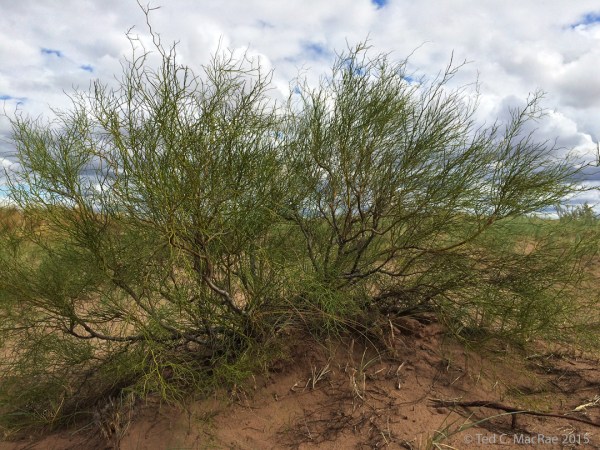
Host for Lampetis spp.

Bulnesia retama – adult host plant for Lampetis baeri and L. corinthia.

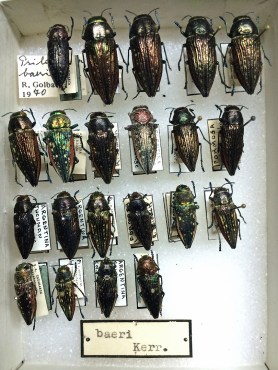
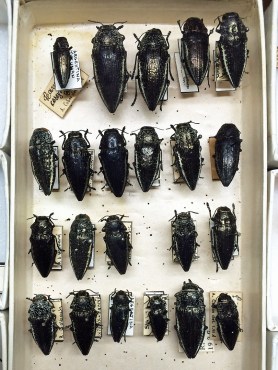
One of the first plants that caught my attention was a woody, fabaceous shrub that looked very much like what I would have previously called Cercidium, now Parkinsonia, and which after a bit of digging I conclude is likely Parkinsonia praecox. [Edit 12/15/25: This plant has been identified from a photograph posted to iNaturalist as Bulnesia retama—ID .] Woody, fabaceous shrubs in desert habitats are a sure bet to host jewel beetles, so I began paying special attention to each shrub as I wandered by. It wasn’t long before I saw a large, brilliant metallic green jewel beetle sitting on an outer branch of one of the shrubs—it was one of the most beautiful jewel beetles I have ever seen out in the field with my own eyes! I managed to catch it, and over the next few hours I collected not only several more of this species but also several individuals of an even larger, more somber-colored species. I was able to identify them as Lampetis baeri (Kerremans, 1910) and L. corinthia (Fairmaire, 1864), respectively, when I compared them to material in the collections at Fundacion Miguel Lillo, Instituto de Entomologia, Tucuman, Argentina [IFML]) during my visit there the following week (see photos below).

Lampetis baeri (Kerremans, 1910)

Lampetis baeri (Kerremans, 1910) [IFML]


Lampetis corinthia (Fairmaire, 1864)

Lampetis corinthia (Fairmaire, 1864) [IFML]

As a jewel beetle enthusiast, you would think that was the highlight of my day. In fact, the fun had only started. For a time after our arrival, Federico pointed out burrows likely made by eucraniine adults, but we didn’t see any evidence of activity at first. It wasn’t long, however, before we found the first adult—a fine Eucranium beleni Ocampo, 2010, the largest of the three species occurring at this site (about the size of our North American Deltochilum). One of the more obvious features of eucraniines is their enormously enlarged forelegs and pronotum to hold the musculature required to carry—that’s right, carry!—provisions to the larval burrow (in contrast with the more commonly seen habit among members of the subfamily of using the hind legs to push provisions to the burrow). This unusual morphology gives these beetles not only an amusing, shuffling gait but also a rather comical method for turning themselves upright (as seen in this video narrated by Federico). There are other dung beetles that pull, rather than push, larval provisions (e.g., Sisyphus spp., which stand on highly elongate hind legs and walk backwards while pulling the dungball), but eucraniines seem to be the only ones that actually lift provisions off the ground to carry them. In the case of E. beleni, this involves carrying pieces of dung with the forelegs held out in front of the head while walking forward on the middle and hind legs (Ocampo 2010). I didn’t get to see that behavior with E. beleni, but I did see it with one of another of the eucraniines we found that day (see below). In the E. beleni photo below, note the brushy middle and hind tarsi—an adaptation for walking on loose sand.

Eucranium belenae

Eucranium belenae Ocampo, 2010 walks on its middle/hind legs while holding its forelegs aloft.

Eucranium belenae burrow

Eucranium belenae burrow plugged with a piece of dung.

The second species in the group that we encountered was Anomiopsoides cavifrons (Burmeister, 1861). This species is much smaller than E. beleni (about the size of a large Onthophagus), and unlike E. beleni—and, in fact, most other dung beetles—the larvae of A. cavifrons develop on plant matter rather than dung. Both males and females provision the larval burrows with pieces of plant debris that they pick up with their front legs and carry back to the burrow while walking on their other four legs. This rather amusing video shows a male bringing a piece of debris back to his burrow, then exiting to find and retrieve another piece of debris to bring back to the burrow. The molar region of their mandibles is heavily sclerotized for masticating the plant fibers in preparation for the larvae. There are a couple of other species in the tribe that opportunistically include plant matter in their diet, but A. cavifons seems to be the only one known to utilize dry plant matter in desert habitats almost exclusively (Ocampo 2005). Anomiopsoides cavifrons was far more abundant in the dunes than E. beleni, and by early to mid-afternoon they were encountered with such regularity that I stopped even looking at them.

Anomiopsoides cavifrons male at burrow

Anomiopsoides cavifrons (Burmeister, 1861) male at burrow entrance.

We also were fortunate to see a few individuals of the third species known from these dunes, Anomiopsoides fedemariai Ocampo, 2007. This species is intermediate in size between the extremes represented by E. beleni and A. cavifrons and utilizes pellets of the plains viscacha (Lagostomus maximus), a species of rodent in the family Chinchillidae, for food (Ocampo 2007).

REFERENCE:

Ocampo, F. C. 2005. Revision of the southern South American endemic genus Anomiopsoides Blackwelder, 1944 (Coleoptera: Scarabaeidae: Scarabaeinae: Eucraniini) and description of its food relocation behavior. Journal of Natural History 39(27):2537–2557 [pdf via DigitalCommons].

Ocampo, F. C. 2007. The Argentinean dung beetle genus Anomiopsoides (Scarabaeidae: Scarabaeinae: Eucraniini): description of a new species, and new synonymies for A. heteroclytaRevista Sociedad Entomología Argentina 66(3–4):159–168 [pdf via SciELO Argentina].

Ocampo, F. C. 2010. A revision of the Argentinean endemic genus Eucranium Brullé (Coleoptera: Scarabaeidae: Scarabaeinae) with description of one new species and new synonymies. Journal of Insect Science 10:205, available online: insectscience.org/10.205 [pdf via DigitalCommons].

© Ted C. MacRae 2016

Super duper June bugs

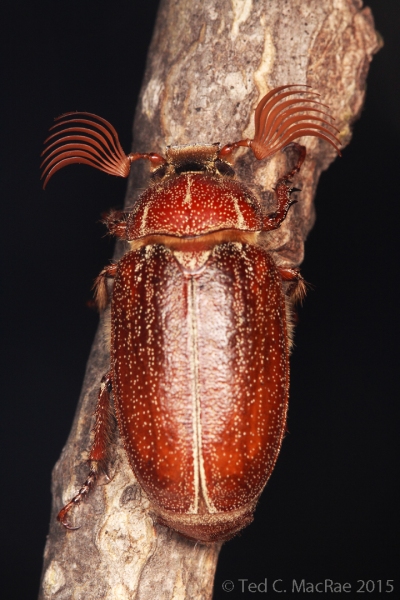
Last June, after spending the day collecting insects at Sand Hills State Park in south-central Kansas with Mary Liz Jameson, Jeff Huether and I setup our blacklights at the edge of the dunes. We were hoping to attract males of the genus Prionus, following a hunch that maybe the dunes—a popular historical collecting site—would prove to be the habitat for the enigmatic Prionus simplex (known only from the type specimen labeled simply “Ks.”). We knew it was a long shot, made even longer by a bright moon and the unseasonably cool temperatures that settled over the dunes as the sun dipped below the horizon, and in the end no Prionus would be seen. We did see, however, some other interesting insects, one of the more interesting being males of Hammond’s lined June beetle—Polyphylla hammondi. Almost immediately after sunset a number of these large, chunky-bodied beetles resembling super-sized versions of their far more diverse and commonly encountered relatives in the genus Phyllophaga (May beetles) began arriving at the lights—each one noisily announcing its visit by its loud, buzzing, flight and bumbling thud onto the ground nearby.

Polyphylla hammondi

Polyphylla hammondi | Sand Dunes State Park, Kansas

I’ve encountered beetles in the genus Polyphylla only occasionally over the  years, almost always at night as a result of their attraction to lights. The genus is most diverse in the southwestern U.S., and many species are found only in specific sand dune habitats (Young 1988, LaRue 1998). Their large size, relatively more restricted distributions, and less common occurrence make them interesting enough, but what made this encounter particularly interesting for me was the way the beetles—all males—held their fan-like antennae splayed out. Male Polyphylla have greatly enlarged antennae that they use to detect sex pheromones emitted by the female (Lilly and Shorthouse 1971). Many female Polyphylla are flightless, especially those restricted to sand habitats, and are rarely collected, and for some species they still remain unknown. In fact, the best way to find females is to listen for the sound of the males hitting the ground or vegetation once they have located a female (Skelley 2009).

Polyphylla hammondi

Male with antennae splayed to detect female pheromone.

It was clear to me that these males were actively searching for females. The greatly elongated antennomeres provide lots of surface area for sensory pores to detect female pheromones at low concentrations. I’d not seen this before and didn’t know how long it would last—many beetles have narrow windows of activity for mating that can be affected or restricted further by environmental cues such as temperature. I figured I’d better get some photographs on the spot while I could, and this was a smart decision as it wasn’t too long after I took these photos that the males stopped coming to the lights and those that were already there became inactive and no longer held their antennae so impressively splayed.

Polyphylla hammondi

Males cease activity after sunset.

In a recent paper describing a new western species of the genus, La Rue (1998) provided detailed notes on behavior that probably pertain to other sand dune inhabiting species as well. Males were observed to begin flying in late afternoon, making rapid, irregular flights several meters above the sand surface. However, as dusk approached, their flights became less erratic and more purposeful as they flew rapidly upwind and then returned in a slow zig-zag flight (indicative of osmoclinotaxic orientation). Mating occurred after they located a female sitting on the sand and alighted within a few centimeters of her. Several males were attracted to each female, further supporting the use of pheromones by the female to attract males. Males were also attracted abundantly to lights after dusk and ceased activity shortly to several hours after sunset, presumably because females cease releasing pheromone to attract them and burrow back into the sand.

REFERENCES:

LaRue, D. A. 1998. Notes on Polyphylla Harris with a description of a new species (Coleoptera: Scarabaeidae: Melolonthinae). Insecta Mundi 12(1–2):23–37 [pdf].

Lilly, C. E. & J. D. Shorthouse. 1971. Responses of males of the 10-lined June beetle, Polyphylla decemlineata (Coleoptera: Scarabaeidae), to female sex pheromone. The Canadian Entomologist 103:1757–1761 [abstract].

Skelley, P. E. 2009. A new species of Polyphylla Harris from peninsular Florida (Coleoptera: Scarabaeidae: Melolonthinae) with a key to species of the pubescens species group. Insecta Mundi 0085:1–14 [pdf].

Young, R. M. 1988. A monograph of the genus Polyphylla Harris in America north of Mexico (Coleoptera: Scarabaeidae: Melolonthinae). Bulletin of the University of Nebraska State Museum 11(2):vi+115 pp. [BioQuip preview].

© Ted C. MacRae 2016