Brazil Bugs #11 – Formigas cortadeiras

This week is Army Ant Week, and while Alex Wild’s stunning photographs of this diverse and charismatic group reign supreme, some of the cooler bug bloggers are nevertheless getting into the spirit of things with army ant posts of their own.  I have no such photos, but I’m hoping I can sneak onto the bandwagon with these images of leafcutting ants that I photographed last month in Campinas, Brazil.

These were among the first insects I saw during the trip once I got a bit of free time to walk the hotel grounds.  Watching them crawl along the lower edge of the hotel wall was a welcome sight, as nothing says “tropics” to me more than columns of these ants carrying their bits of leaves back to the nest for use in their hidden fungus farms.  While taxonomically they may be unrelated to army ants, their precise single file marches in dutiful service to the colony are as military as it gets.  Army ants may have the jaws, but leaf-cutters have spines – they don’t just carry weapons, they are the weapons!

The thing I like most about leaf-cutter ants is that they are one of the few ant groups that I feel confident enough to hazard an attempt at identification.  Several genera comprise the group, and most people who are at all familiar with them think of the genus Atta first.  However, I recalled reading something on Alex’s blog about spines as a diagnostic character for attine ant genera – sure enough, in this post Alex explains how species in the genus Atta have two pairs of spines on the promesonotum, while those in the genus Acromyrmex bear three pairs.  On this basis, I’ll go out on a limb and declare the individuals in these photos as Acromyrmex sp. (of course, which species is another story – James?  Alex?).  If I’m proved right, it will confirm the worthwhileness of all my blog trolling.  If I am wrong – well, there’s still nothing wrong with idle entertainment.

Copyright © Ted C. MacRae 2011

Brazil Bugs #10 – A mosca mais legal que eu já vi!

Nerius sp. (Diptera: Neriidae) - Campinas, São Paulo state, Brazil. ID by Fernando Carvalho-Filho.

I found this bizarre-looking fly outside of Campinas, Brazil (on the same tree as the Aetalion reticulatum that I showed earlier).  There were a few of them, and although they weren’t especially flighty they did have the annoying habit of constantly moving to the backside of whatever branch I tried to photograph them sitting on.  The tree (a small one with green, flexible wood and short, stout spines along the branches) was hanging on the edge of a hillside itself, so a period of careful branch-bending and precarious body-contortioning was required before I finally got one of the flies suitably placed within the viewfinder.  At the start and before all of my disturbance, they were perched head-downward and outward on the more vertically-oriented branches.

This fly is unlike any I’ve ever seen (or at least noticed), and I really had no clue to the family (or even superfamily).   I wish I could be happy just posting photos of interesting, though unidentified insects and be done with it, but something inside me doesn’t get much enjoyment out of that – I’m compelled to at least attempt an identification.  For my recent Brazilian exploits, I’ve found Flickr to be a useful tool in the identification arsenal – enter a search phrase such as “Brasil Diptera” and scan the results for any possible matches.  I don’t remember which particular phrase finally brought up a hit, but eventually I was clued into marsh flies of the family Sciomyzidae.  Another search for all Flickr photos tagged as such brought up several pages of more or less similar looking flies, including more than a few that were indeed very close matches.  My work seemed to be done.

Still, something about Sciomyzidae bothered me.  We’ve got sciomyzids here in the Midwest, and while there is certainly a resemblance, the overall gestalt of this and the similar appearing Flickr-ID’d flies just didn’t seem right.  So I opened up a broader search on Google images looking for more authoritative confirmation of the ID.  Eventually, I happened upon this photo by Brazilian photographer Enio Branco of a fly that, for all intents and purposes, looks exactly like mine.  The fly in that photo had been assigned to the family Neriidae (cactus flies), and further searching for information on the family in South America quickly turned up a recent faunal treatment of the family in the Brazilian Amazon (Carvalho-Filho and Esposito 2008).  According to that work, these distinctive flies can be distinguished from nearly all other acalyptrate flies by the antennal arista being situated apically on the postpedicel (third segment).  This character is readily visible on the fly in this photo and also on the similar appearing and apparently misidentified flies in the Flickr photos.¹  I figured I’d give the Amazonas key a go to see if an ID might be possible, but I immediately ran into trouble at the first couplet trying to decide if the antennal pedicel was elongate (Odontoloxozus peruanus), or if not whether the forecoxae were dark brown (Glyphidops spp.) or yellow (Nerius spp.) – they look light brown to me!  It’s entirely possible that this fly, photographed in southeastern Brazil, represents a species (or even genus) not included in the Amazonas key – hopefully one of the dipterophiles out there will be able to provide some insight.

¹ This could be an example of how one misidentified photo can create a growing pool of misidentified photos.  It serves to caution against accepting apparently solid IDs from open sources too quickly.

The most interesting feature of this fly (IMO) are the elongate head and legs with spinose forefemora.  Although appearing raptorial in design, apparently the males of this family engage in rather spectacular sexual combat, rearing up on their hind legs and striking each other with their forelegs or the ventral surfaces of their heads, even attempting to place each other in a head-lock.  I regret that I didn’t get the chance to witness such behavior.

Photo Details: Canon 50D w/ MP-E 65mm 1-5X macro lens (ISO 100, 1/200 sec, f/13), Canon MT-24EX flash w/ DIY oversized concave diffuser. Typical post-processing (levels, minor cropping, unsharp mask).

Update 02/07/11: I just received the following message from Fernando Carvalho-Filho, lead author of the Amazonas paper referenced above. Dr. Carvalho-Filho was kind enough to reply to my query regarding the identity of this fly as follows:

Dear Dr. Ted,

Thanks for the message. Congratulations, your photo is marvelous! Great macro. The best photo of a Neriidae that I have seen. Your webpage is very cool and has good pictures. In my opinion, the fly is a Nerius. It is difficult to determine the species, since they are separated based on the thorax color pattern.

Regards,
Fernando

My appreciation to Dr. Carhalho-Filho for his identification.

REFERENCE:

Carvalho-Filho, F. S. and M. C. Esposito.  2008.  Neriidae (Diptera: Schizophora) of the Brazilian Amazon: New records of genera and species, and key to species. Neotropical Entomology 37(1):58–62.

p.s. An early 2-pt lead in the new BitB Challenge series to whoever provides the most correct translation of the title – your prize for making it through the whole post!

Copyright © Ted C. MacRae 2011

Brazil Bugs #9 – Formiga hostil


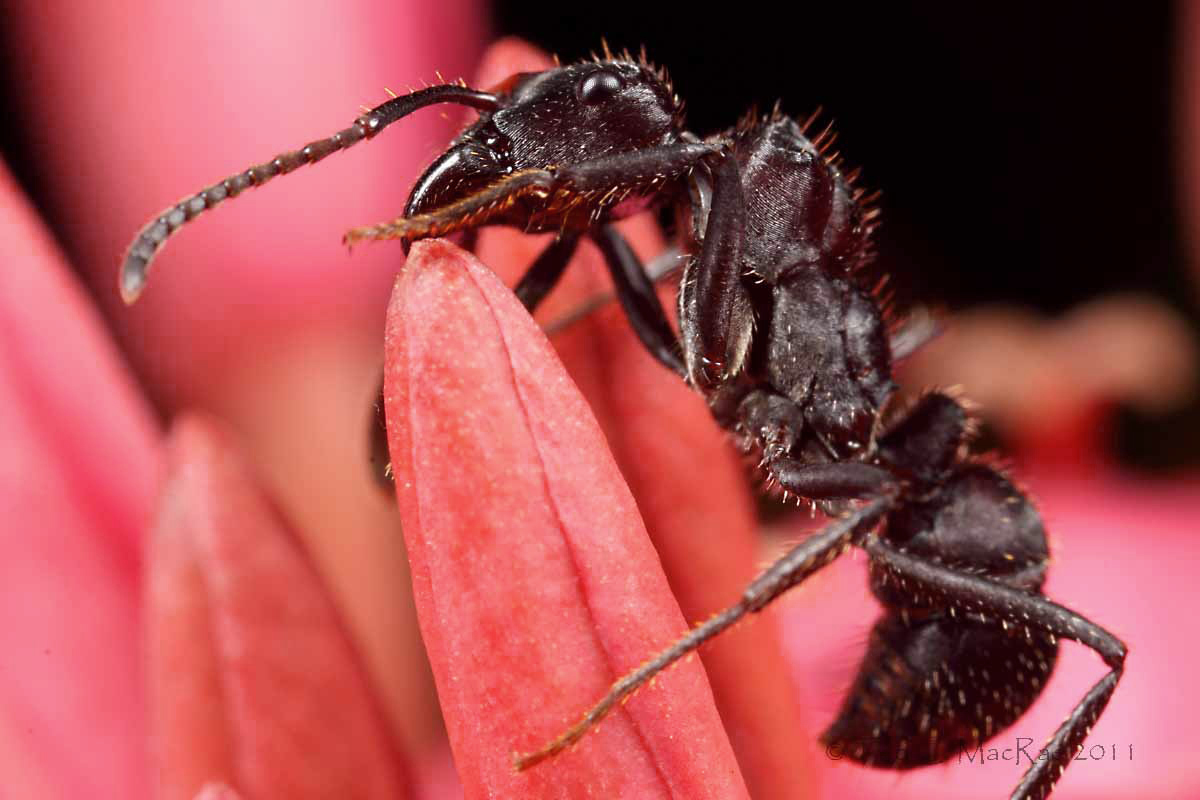
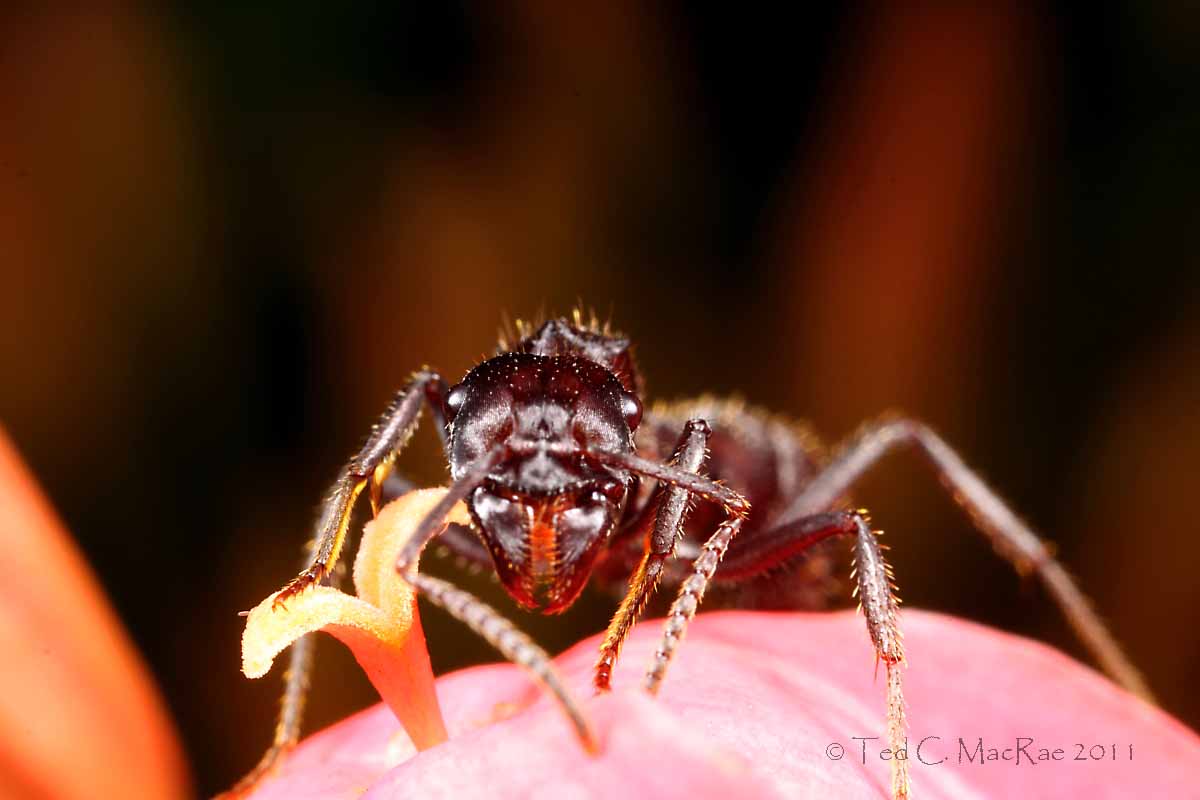
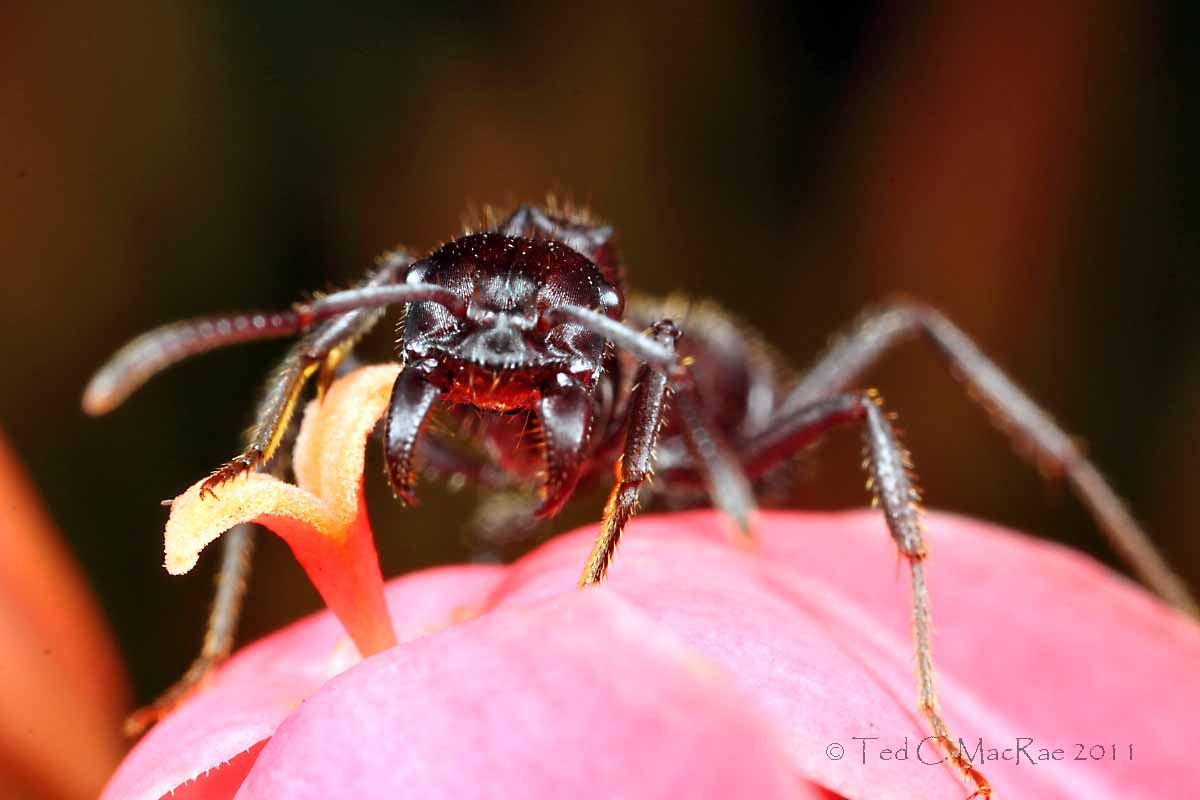
I found this ant crawling over the blossoms of the Ixora shrubs on the grounds of my hotel in Campinas (São Paulo state). Normally I wouldn’t even try to identify a South American ant, but the individual quickly and easily keyed out in the recent revision of North American Formicidae to Formica nigra – apparently a very wide-ranging species!¹

¹ Seriously, I would welcome input from any myrmecophiles out there on the actual identity of this species.

As I started taking some photographs, she seemed to take note of my presence.
With each shot, she seemed to become increasingly more irritated.
Irritation soon gave way to outright hostility.
In short order, the meaning was all too clear – “Stay away from my flower!”
Copyright © Ted C. MacRae 2011

Answer to ID Challenge #4 – Aetalion reticulatum

Aetalion reticulatum female guarding her egg mass - São Paulo state, Brazil.

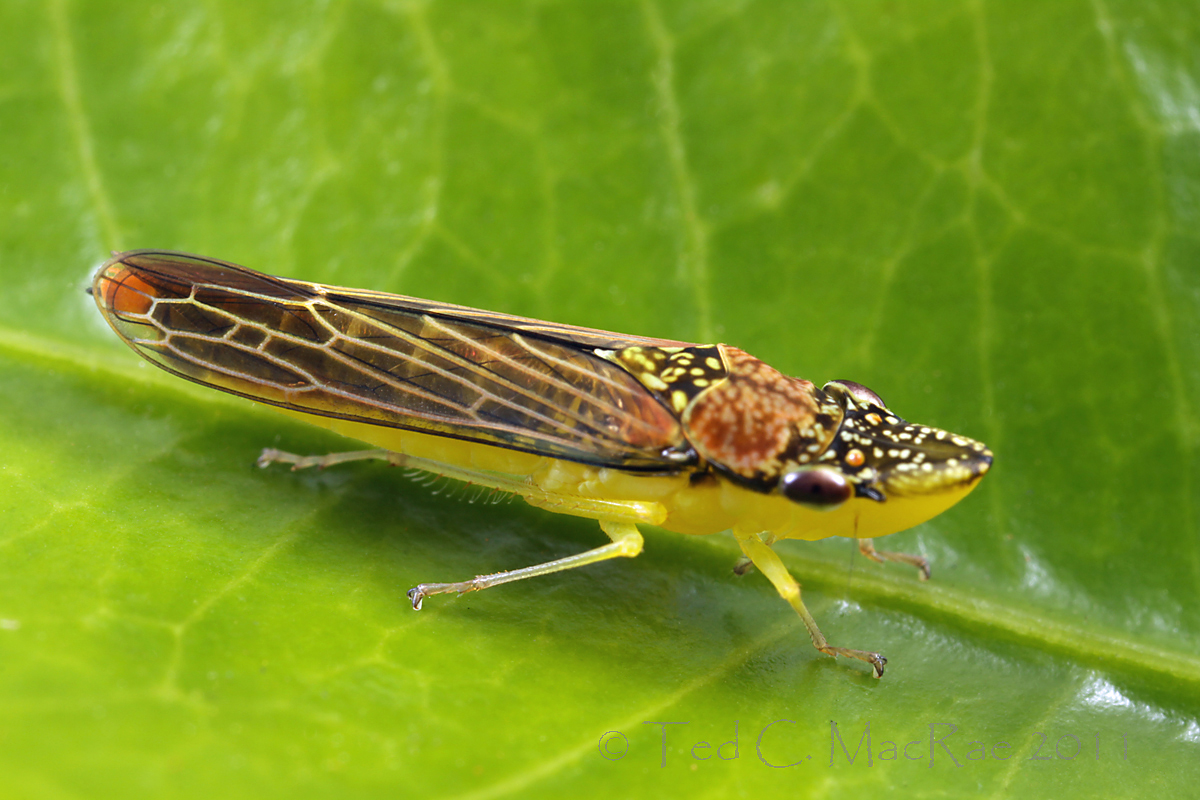
ID Challenge #4 seems to have been a little more difficult than I anticipated – only a few people mustered the courage to even hazard a guess, of whom TGIQ emerged with maximum points to take the win.  Looking sort of like a cross between a leafhopper (family Cicadellidae) and a treehopper (family Membracidae), Aetalion reticulatum is one of a few species and the only genus comprising the family Aetalionidae.  While lacking the pronotal processes that characterize species in the much more diverse and better known Membracidae, aetalionids are nevertheless considered treehoppers as well, along with another little-known family Melizoderidae.  As a whole, the Aetalionidae + Melizoderidae + Membracidae form a sister group to the Cicadellidae (Deitz and Dietrich 1993), which combine to form the most diverse and successful lineage of sap-sucking phytophagous insects. 

Like many treehoppers, A. reticulatum exhibits ant-mutualistic and presocial behaviors; however, it remains unclear whether these behaviors were acquired separately by each treehopper lineage or if they represent retention of a more primitive condition (sorry, Alex – it’s just easier to say it that way than deal with terms such as ‘retained plesiomorphy’ and ‘phylogenetic conservatism’).  Aetalion reticulatum occurs broadly in the New World tropics, where females can often be found perched on top of their egg masses.  Some (but not all) guarding females make periodic sweeps of the hing legs down the sides of the egg mass, apparently to dislodge egg parasitoids and discourage further attack (Preston-Mafham & Preston-Mafham 1993).  Ant-mutualistic relationships and the tendency to form colonies provide additional protection from predators.

Now is a good opportunity to summarize the ‘1st BitB Challenge Series’ overall standings – Ben Coulter maintains his overall lead by gaining points in every challenge.  TGIQ climbs into 2nd place with this week’s win, and tceisele leap frogs over several contestants to tie Janet Creamer for the 3rd podium spot (and gets the nod for more frequent participation).  It’s no real surprise that the most frequent players took the top spots.  At this point, I’m going to call a close to the 1st series and declare Ben Coulter the overall series winner – contact me for your loot!  To the rest, thanks for playing, and now that you know how this game works maybe you’ll think about making a move for the 2nd series win!

Place Commenter IDC SSC IDC IDC IDC #4 Total
1 Ben Coulter 9 14 9 4 4 40
2 TGIQ 8 5 10 23
3 tceisele 3 8 3 14
4 Janet Creamer 14 14
5 James Trager  6 5 11
6 Dave 11 11
7 Christopher Taylor 7 3 10
8 Dave Hubble 6 2 8
  JasonC 5 3 8
10 Charley Eiseman 7 7
  Delbert La Rue 7 7
  jason 7 7
  Techuser 7 7
14 Richard Waldrep  6 6
15 Alex/Watcher 2 2
  dragonflywoman 2 2
  nellie 2 2
16 Brady Richards  1 1
  Francis 1 1
  macroinstantes 1 1
  Margarethe 1 1
  Mark Deering  1 1
  Andrew 1 1

REFERENCES:

Deitz, L. L. and C. H. Dietrich.  1993.  Superfamily Membracoidea (Homoptera: Auchenorrhyncha). I. Introduction and revised classification with new family-group taxa.  Systematic Entomology 18(4):287–296.

Preston-Mafham, R. and K. Preston-Mafham.  1993.  The Encyclopedia of Land Invertebrate Behaviour.  The MIT Press, 320 pp.

Copyright © Ted C. MacRae 2011

Brazil Bugs #8 – Desafio de identificação #4

It’s time for a new ID Challenge, this one from my recent trip to Brazil.  I don’t expect this to be a terribly difficult challenge, so whoever wins is going to do so by gaining bonus points for providing detail about what is shown here in addition to correct taxonomic assignments.

See ID Challenge #2 for a detailed explanation of the rules

Copyright © Ted C. MacRae

Brazil Bugs #7 – Cigarrinhas

It seems that North American entomologists have returned en masse from their various tropical winter travels – Alex and Brigette have returned from their respective trips to Ecuador, Troy has come back from Costa Rica, and I am now back home after my recent business trip to São Paulo, Brazil.  I’m anxious to see the photos and read the tales that the others will no doubt be posting in the coming weeks regarding their visits to cloud forests, research stations, and nature preserves.  My insect hunting activities were limited to municipal parks and hotel grounds, but I still have a decent variety of insect encounters to share (along with many pleasant memories of churrasco, cerveja, e novos amigos).

Acrogonia citrina

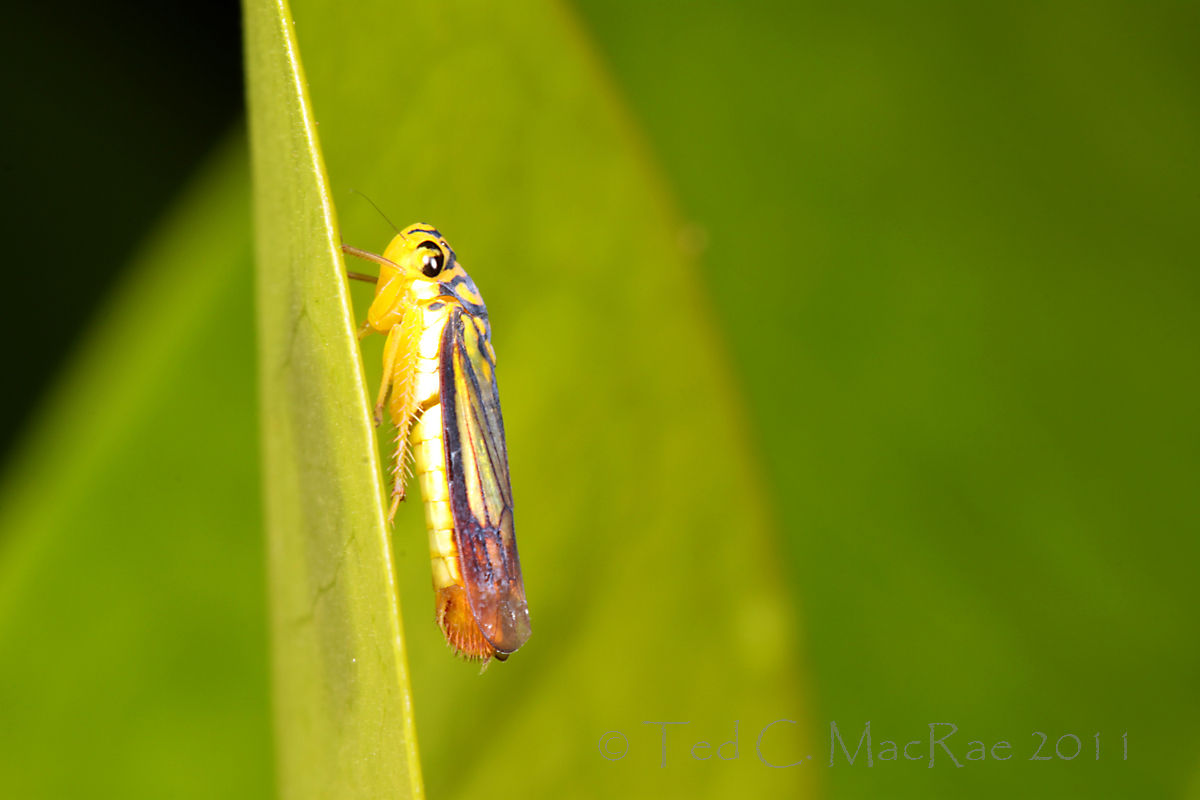
Thanks to Ani, I think we now agree that the pink-flowered shrub on the grounds of my hotel in Campinas that attracted such a nice diversity of insects belongs to the genus Ixora (family Rubiaceae).  Included in this post are a few leafhoppers (order Hemiptera, family Cicadellidae) in a group known as ‘sharpshooters’ (subfamily Cicadellinae) that I found also attracted to this shrub.  Leafhoppers are, of course, a hugely diverse family, but because of the generally small size and cryptic coloration of most North American species, it is a group that often goes unnoticed.  In the tropics, however, it’s a different story, with not only a number of larger forms but also a multitude of brightly colored species.

Acrogonia citrina at 5X life size

The diversity of species present in a place like southern Brazil might seem to preclude any possibility of identification without consulting a specialist, but the individual in these first two photos looks very much like Acrogonia citrina.  This species has become a major pest of citrus in São Paulo state during the past two decades, its importance driven not so much by direct damage, but rather by vectoring a bacterial disease of citrus called Citrus Variegated Chlorosis (Xylella fastidiosa) – or CVC (Lopes 2007).  Of the 12 sharpshooter species identified as vectors of CVC, A. citrina is among the most important due to its abundance in citrus groves (an important agricultural crop in São Paulo state) and high degree of polyphagy.  The disease affects mainly fruit quality, reducing their size and making them unsuitable to be sold fresh, and by decreasing yield when processed for juice.

Dilobopterus costalimai

Dilobopterus costalimai is another important vector of CVC, again primarily as a result of its abundance on citrus in São Paulo state and polyphagous nature.¹  At this point, CVC has not been found outside of South America; however, California and Florida citrus growers are understandably nervous about the potential for its eventual occurrence in the U.S. due to the presence here of leafhopper species that are confirmed vectors of the disease and the ease with which the disease can be transported in infected nursery stock.  There is no cure for CVC, and chemical control of vectors is both costly and difficult, leaving nursery certification, protection of nursery stock from infection, pruning of symptomatic parts of trees to remove inoculum sources, and other such labor intensive methods as the only options for managing CVC (Chung and Brlansky 2009).

¹ I originally attempted to photograph this individual because it appeared to have been parasitized by what I suspect is a dryinid (order Hymenoptera, family Dryinidae).  Unfortunately the parasitoid is on the right side of the abdomen of this individual and can’t really be seen in this view, and I didn’t get any other shots besides this one.

REFERENCE:

Chung, K.-R. and R. H. Brlansky.  2009.  Citrus Diseases Exotic to Florida: Citrus Variegated Chlorosis (CVC).  University of Florida, Institute of Food and Agricultural Sciences Fact Sheet PP-223, 4 pp.

Lopes, J. S.  2007.  Vector ecology and implications on epidemiology of citrus variegated chlorosis.  Proceedings of the 2007 Pierce’s Disease Research Symposium, California Department of Food and Agriculture.

Copyright © Ted C. MacRae 2011
Brazil Bugs #6 – A mosca

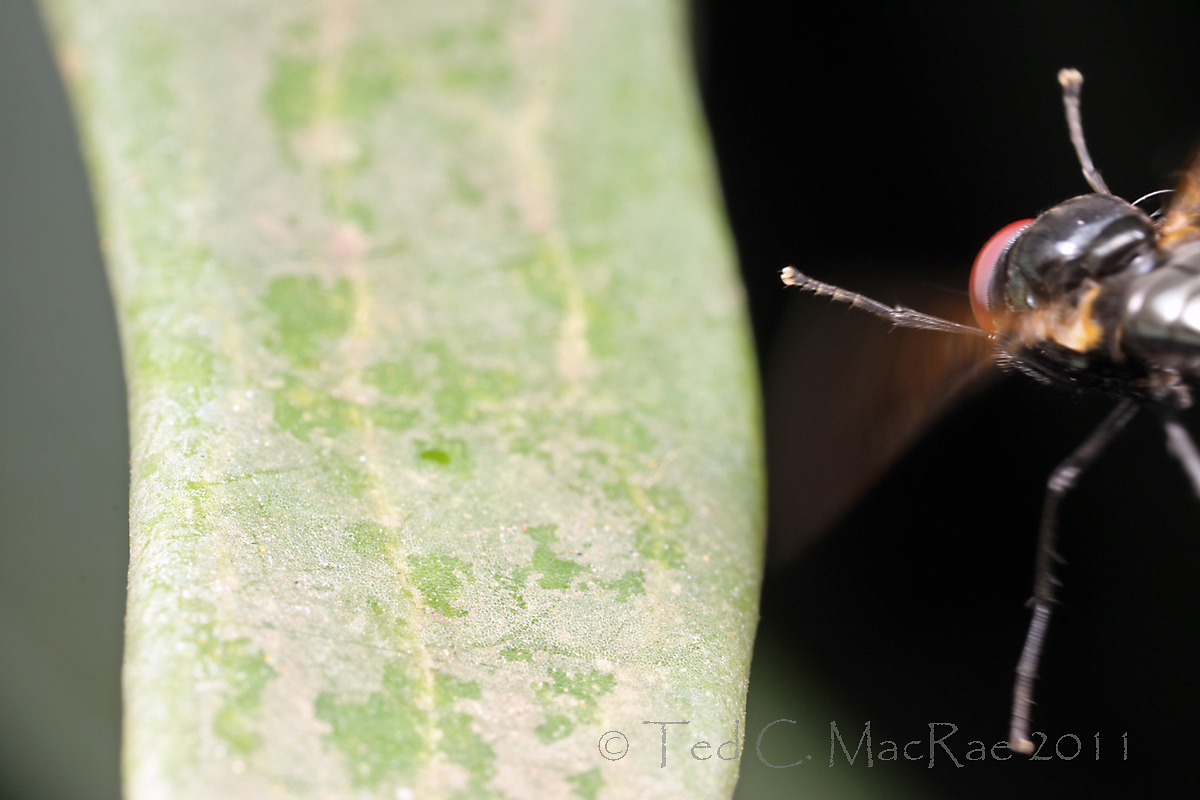
As I strolled the hotel grounds here in Campinas after work one day last week, I came upon a tree with several epiphytic orchids and a large staghorn fern (Platycerium sp.) mounted to its trunk.  On the tips of several of the fern’s leaves sat these peculiar looking flies – shining dark blue-black in color with a prominent red head.  I’m just guessing that they were some sort of blow fly (family Calliphoridae), although something about the look doesn’t seem quite right for the family (maybe because I’ve never seen Brazilian calliphorids before).  I found it interesting that they all oriented themselves head downward at the tip of the leaf on which they were sitting.  When I get intrigued by something, I want to photograph it, but in this case it was easier said than done.  They were small enough to require the 65mm lens, which means getting quite close, and every time I approached one it would fly away.  There were enough of them, however, that when one flew away I would just try another, and each fly would eventually return to the same leaf on which it had previously been sitting.  I spent some minutes scaring away fly after fly before I finally figured out the approach.  That, however, was only half the battle! 

When I finally started trying to take some shots, the pre-flash on the ETTL flash setting would scare the fly before I could complete the shutter snap, and I was getting only an empty frame where the fly had been sitting.  I thought about switching to manual flash but decided to keep working the fly and just see if I could get it accustomed to the flash.  The first photo in the series posted here is the first one in which I actually got part of the fly in the frame (I think he did a quick loop out and was actually returning to his spot when the shutter snapped).

I got closer in this one – the fly was just starting to take off as the shutter snapped (too bad I didn’t have better focus, or this could’ve been an interesting view).

Finally, I got the fly sitting still at the tip of the leaf.  This is when I started to get picky – I wasn’t too satisfied with the composition in this photo, and since he seemed to have become accustomed to the flash, I decided to take a few more shots to try to make sure I get one with good composition and focus.

Better composition this time, but the focus is still a bit off.  Unfortunately, this was my last shot at this guy, as he took off right afterward.  The thought taking the time to work another fly and get him accustomed first to me and then the flash didn’t appeal to me by this point – I was in Brazil, and there are so many other insects to photograph.  I decided good enough was good enough and continued my searches…

Copyright © Ted C. MacRae 2011

Brazil Bugs #5 – Lagartixa

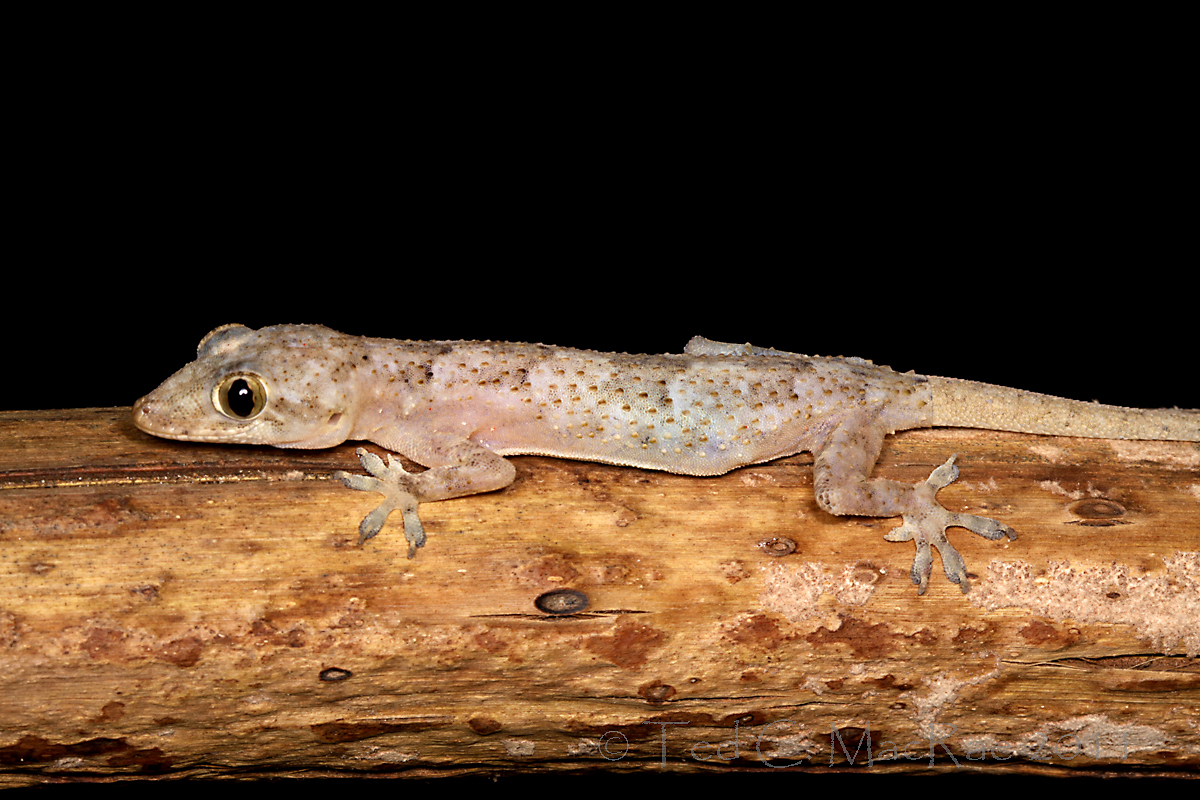
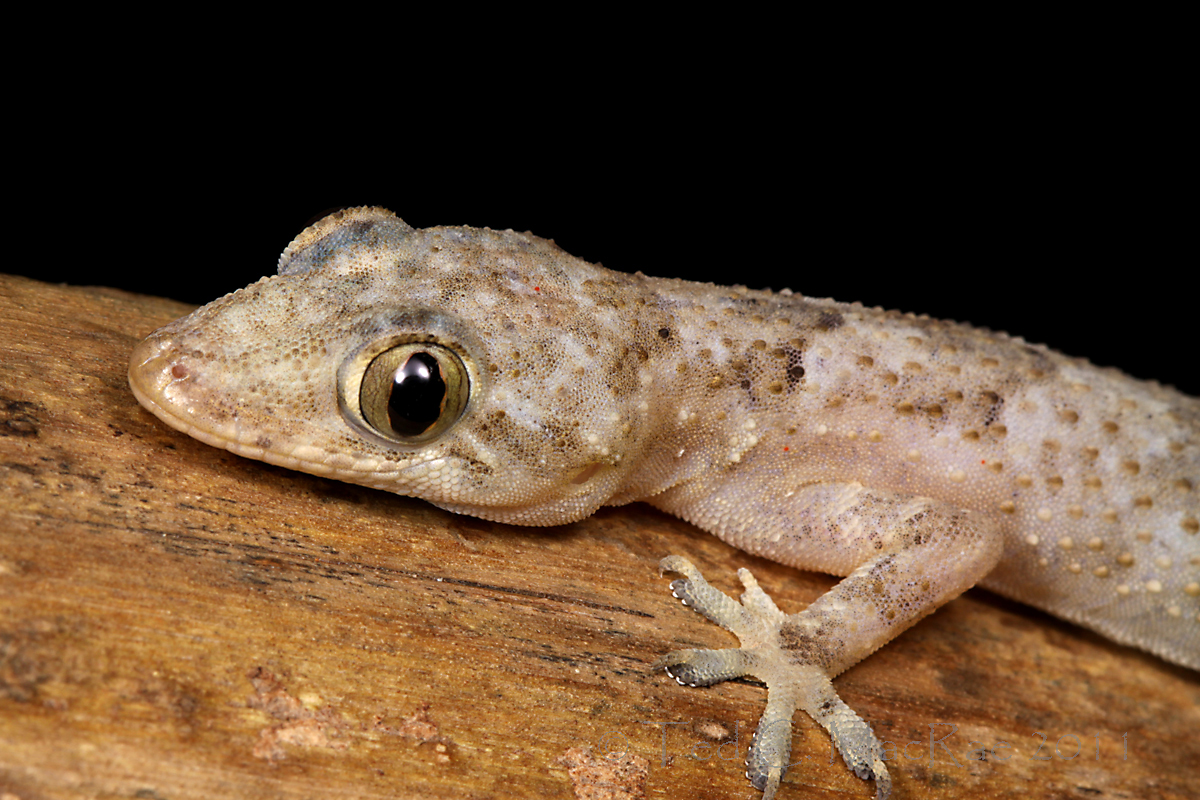
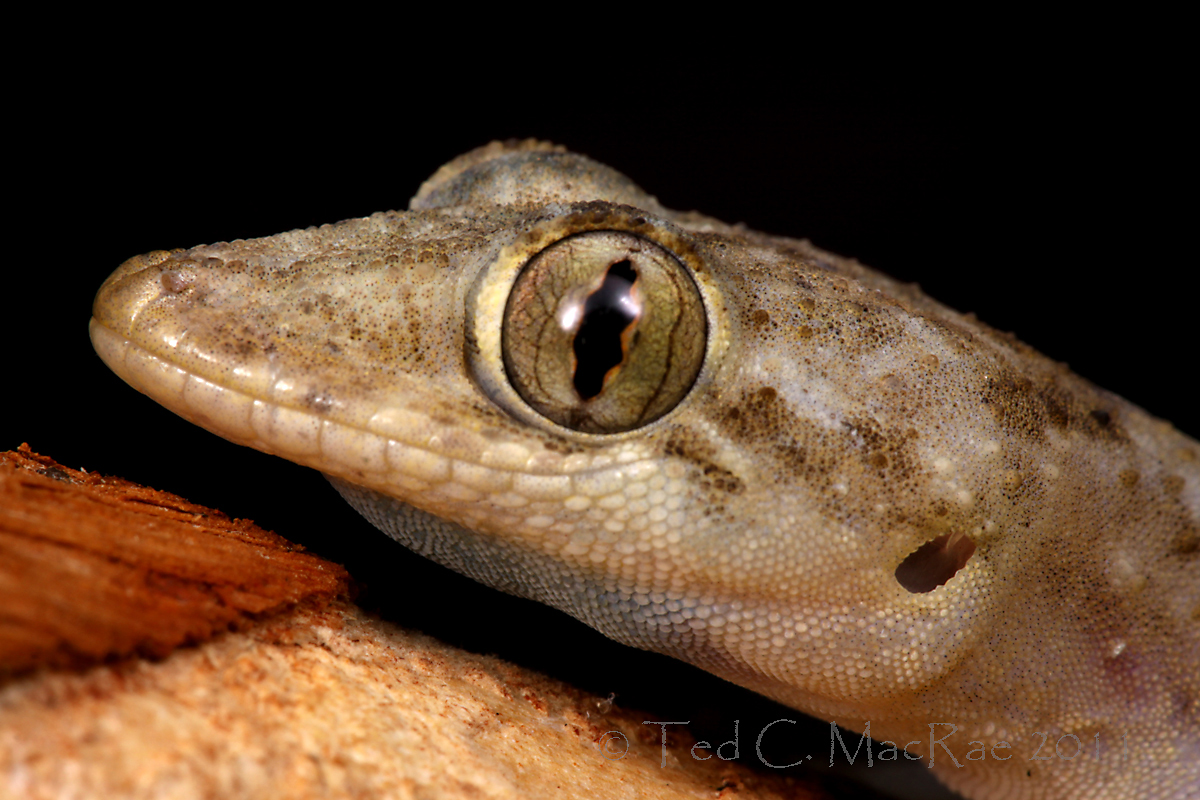
On my third night here in Campinas last week, I went out to check the building lights around the hotel grounds.  Surely a fantastical assortment of gaudy, tropical insects would be awaiting me on this hot, humid, summer night in southern Brazil.  Alas, virtually no insects were to be found anywhere – on the walls, in the window sills, under the street lights, or crawling on the sidewalks.  A disappointment, although I’m loathe to complain too much considering the number of insects I’ve encountered during the daylight hours.  I did find a gecko on the hotel wall, however, and although it is not a “bug” the lack of insects at the lights made a photography subject by default.

I’m not at all an expert on reptiles, and certainly those in South America, but I can’t help wondering if this is Hemidactylus mabouia – the tropical house gecko, or lagartixa-doméstica-tropical – an African species introduced to the New World and now widespread from the southern U.S. through much of South America and the Caribbean.

Copyright © Ted C. MacRae 2011