Recent literature – The Coleopterists Bulletin

Volume 64, No. 4 - December 2010

I returned to the office this week after spending two weeks in Brazil to find the December 2010 of The Coleopterists Bulletin in my inbox.  I don’t think there is another journal that I look forward to more eagerly than this one (with the possible exception of CICINDELA) – with each issue, I know that regardless of whether it contains any papers in my priority groups of interest (jewel beetles, longhorned beetles, and tiger beetles), it will nevertheless contain well-written articles presenting results of high-quality research on nothing but beetles – pure elytral ecstasy!  This latest issue, however, is a real keeper.  Gracing the cover is a stunning image of the South African jewel beetle species Julodis viridipes, photographed by my good friend and world jewel beetle expert Chuck Bellamy, and inside are three tiger beetle papers and two longhorned beetle papers – it’s almost as if the issue were produced just for me.

Friend and colleague Mathew Brust takes credit for two of the three tiger beetle papers.  In the first (Brust et al. 2010), he compares the efficiency of the three main methods for collecting tiger beetle larvae: fishing, stab-and-grab, and excavation. They found fishing to be the most efficient and least damaging of the three methods, an important finding for tiger beetle conservation where the availability of efficient, non-lethal survey methods is critical.  (What are “fishing” and “stab-and-grab” you ask?  Read the paper.)  In the second paper (Brust and Hoback 2010), Matt teams up with University of Nebraska entomologist Wyatt Hoback to provide new distributional records and larval descriptions of Nebraska’s tiger beetle, Cicindela nebraskana.  Ironically, this species is quite rare in it’s namesake state, and their findings give clues about the habitats in which it is most likely to occur (I had the good fortune to contribute a small amount of data).  In the third tiger beetle paper, Robert Richardson (2010) notes an overwhelming preponderance of left-superior mandibles in two species of Omus and speculates on the selective pressures that might operate on different tiger beetle clades to produce such a finding – a truly interesting read.

As for longhorned beetles, Sánchez-Martínez et al. (2010) report the utilization of living oaks by an apparently disjunct population of the marvelously beautiful Crioprosopus magnificus in central Mexico, complete with photographs of the larval workings and detailed emergence data.  (I am also reminded that I have a post on this very species that I need to put up).  Closer to home, Terence Schiefer and Patricia Newell (2010) independently recognized the existence of an undescribed subspecies of the red-edged saperda, Saperda lateralis, in the lower Mississippi Delta Region of the southeastern U.S., which together they describe as S. lateralis rileyi (named for Edward Riley, indefatigable collector of beetles, and collector of much of the type material).  Okay, I know what you’re thinking – “A new subspecies of S. lateralis? No way!”  Well, I was skeptical also when I first saw the title – several untenable and no longer recognized subspecies have already been described for this broadly distributed and variable species.  However, after noting the nature of the diagnostic characters, seeing the photographs, and studying their partially allopatric distributions, I was convinced.

In addition to the above papers, there were also a number of interesting book reviews in the issue, including The Chiasognathinae of the Andes, reviewed by M. J. Paulsen, A Field Guide of the Dynastidae Family of the South of South Americano access, reviewed by Ronald M. Young, and three book reviews by our beloved Art Evans: Illustrated Identification Guide to Adults and Larvae of Northeastern North American Ground Beetles (Coleoptera: Carabidae) [including tiger beetles]; The African Dung Beetle Genera; and Weevils of South Carolina (Coleoptera: Nemonychidae, Attelabidae, Brentidae, Ithyceridae, Curculionidae)no access.

REFERENCES:

Brust, M. L. and W. W. Hoback. 2010. Larval description and new Nebraska distribution records for Nebraska’s tiger beetle, Cicindela nebraskana Casey (Coleoptera: Carabidae). The Coleopterists Bulletin 64(4):341-346.

Brust, M. L., W. W. Hoback, and J. J. Johnson. 2010. Fishing for tigers: A method for collecting tiger beetle larvae holds useful applications for biology and conservation. The Coleopterists Bulletin 64(4):313-318.

Richardson, R. K. 2010. Mandibular chirality in tiger beetles (Carabidae: Cicindelinae). The Coleopterists Bulletin 64(4):386-387.

Sánchez-Martínez, G., O. Moreno-Rico, and M. E. Siqueiros-Delgado. 2010. Crioprosopus magnificus Leconte (Coleoptera: Cerambycidae) in Aguascalientes, Mexico: Biological observations and geographical distribution. The Coleopterists Bulletin 64(4):319-328.

Schiefer, T. L. and P. Newell. 2010. A distinctive new subspecies of Saperda lateralis F. (Coleoptera: Cerambycidae) from the southeastern United States. The Coleopterists Bulletin 64(4):329-336.

Copyright © Ted C. MacRae 2011

North America’s most beautiful tiger beetle

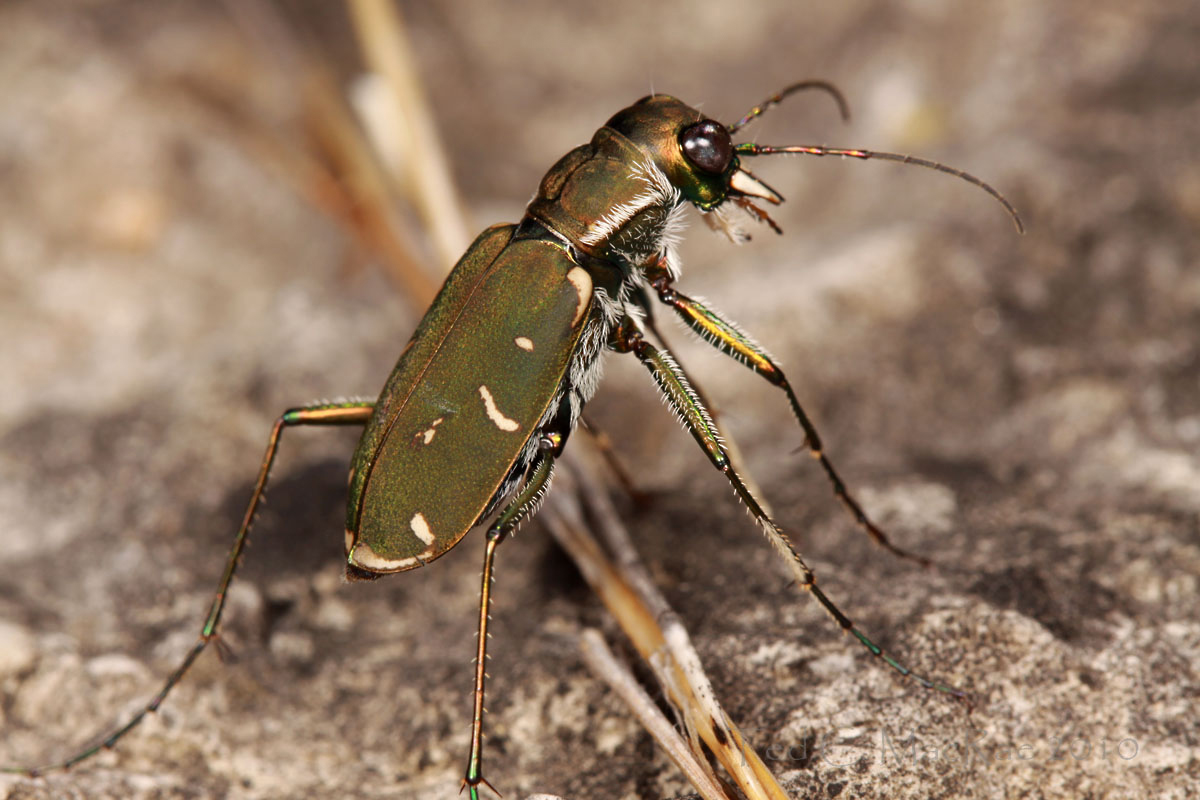
Cicindela pulchra pulchra (beautiful tiger beetle) - Fall River Co., South Dakota.

Five years ago this month, I got my first glimpse of North America’s most beautiful tiger – Cicindela pulchra.  This is not just my opinion – its name, given to it by Father-of-North-American-entomology Thomas Say, literally translates to “beautiful tiger beetle.”  Like Amblycheila cylindriformis, it was a species that I longed to see in the field ever since receiving a single specimen from tiger beetle guru Ron Huber.  That specimen came from the Gypsum Hills of Barber Co. in south-central Kansas – a known “hot spot” for the species.  For years I stared at that spectacular specimen as it sat in my cabinet, and in September 2004 Chris Brown and I finally made our first attempt to see it in the field for ourselves.  Unfortunately, we arrived ahead of the fall rains that seem to trigger emergence of this species, and C. pulchra would not be among the few species that we saw on that trip.  I don’t handle defeat very well, so the very next fall I resolved to try again – this time waiting until early October and also enlisting the assistance of local entomologist “Beetle Bill” Smith for access to better sites than what are available along the roadsides.  That trip was a tremendous success and was detailed in one of my Nature Notes articles (MacRae 2006), but Chris, unfortunately, was unable to join me on that second attempt.  He couldn’t join me last year, either, for my search of the species in the nearby Cimarron Gypsum Hills of northwestern Oklahoma.  Good thing, however, as a turn of the weather left me just cold and wet (although I do remain convinced that the species will eventually be found on those red clay slopes that have so far produced such prizes as Cylindera celeripes, Dromochorus pruinina, and Amblycheila cylindriformis).

Matt Brust (L) and Chris Brown (R). Matt discovered this site for Cicindela pulchra in 2009.

Fortunately, while I was getting skunked in Oklahoma, Matt Brust was discovering new populations of the species further north in the southwestern corner of South Dakota.  These discoveries were prompted by the initial discovery of the species on Pierre Shale exposures at a single site near the Black Hills (Larsen and Willis 2008).  The soft, dark gray soils of the Pierre Shales are in distinct contrast to red clay exposures with which the species has been typically associated further south, and by scouting a broader area for similar exposures Matt was able to find the species at six new sites during late summer 2009 (Brust 2010).  He found them associated not only with the Pierre Shale but also the Mowry Shale formation (and suspects they may eventually be found on Belle Fourche Shale formations as well).  When I learned of these discoveries, I decided I just had to see them for myself.  I had enjoyed my Fall 2008 trip to northwestern Nebraska and southwestern South Dakota, and the thought of seeing these beetles while spending time in the field with Matt once again seemed the perfect basis for another trip to the area.  It didn’t take much convincing for Chris to agree, thus, C. pulchra became goal of the 2010 Fall Tiger Beetle Trip™.

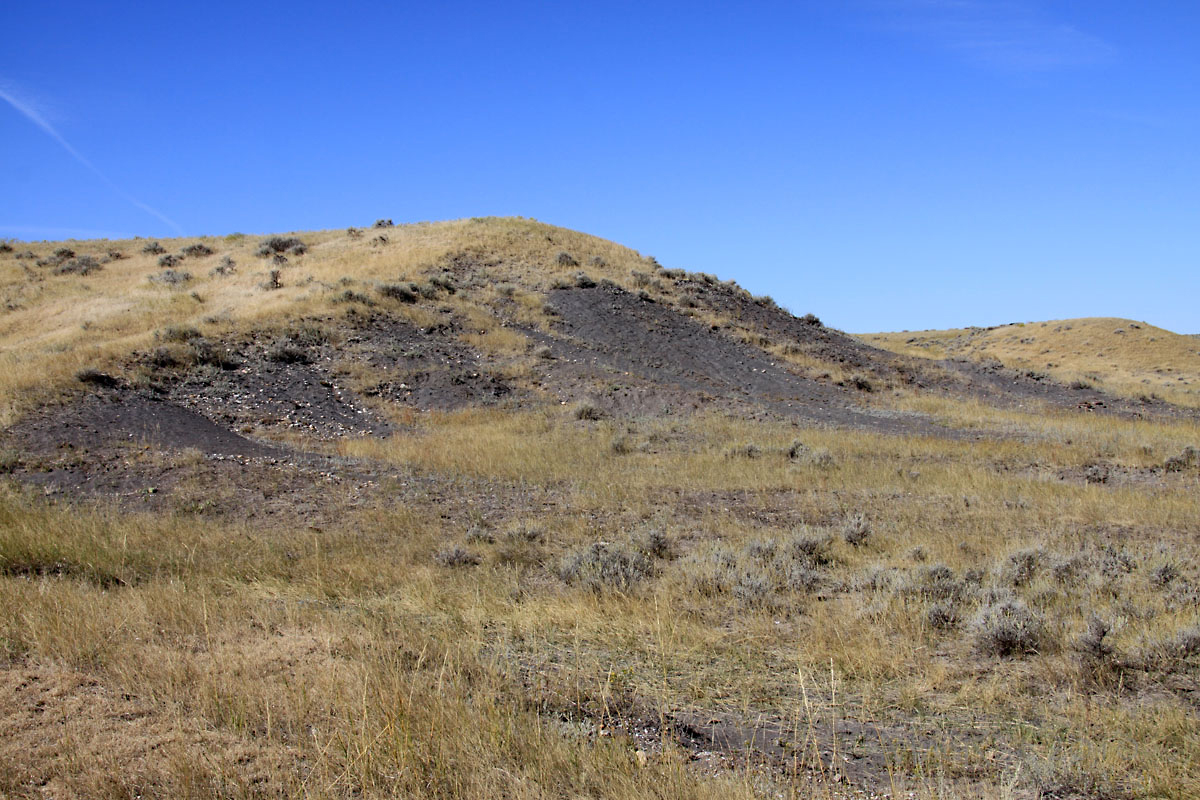
Habitat for Cicindela pulchra in Fall River Co., South Dakota. Adults and larval burrows are found in sparsely vegetated gray shale slopes and open flats beneath.

As we drove to the site that Matt had selected for us to explore, I felt nothing but optimism.  The skies were clear and the temperature was already nearing 70°F.  Matt, however, was hedging his bets – “I hope they’re still out, I’ve never seen them this late!”  Still, I wasn’t worried.  We were two weeks earlier in the season than the 2005 Kansas trip, and the weather was simply spectacular – it just had to be a good tiger beetle day!  My optimism was justified, as within minutes of arriving at the site we saw the first individual.  I collected this one alive as a backup for photographs in the studio should that be the last one we saw, but no such contingencies were necessary – we began seeing individual after individual as we trolled across the barren gray slopes.

Adult male Cicindela pulchra taking in the morning sun.

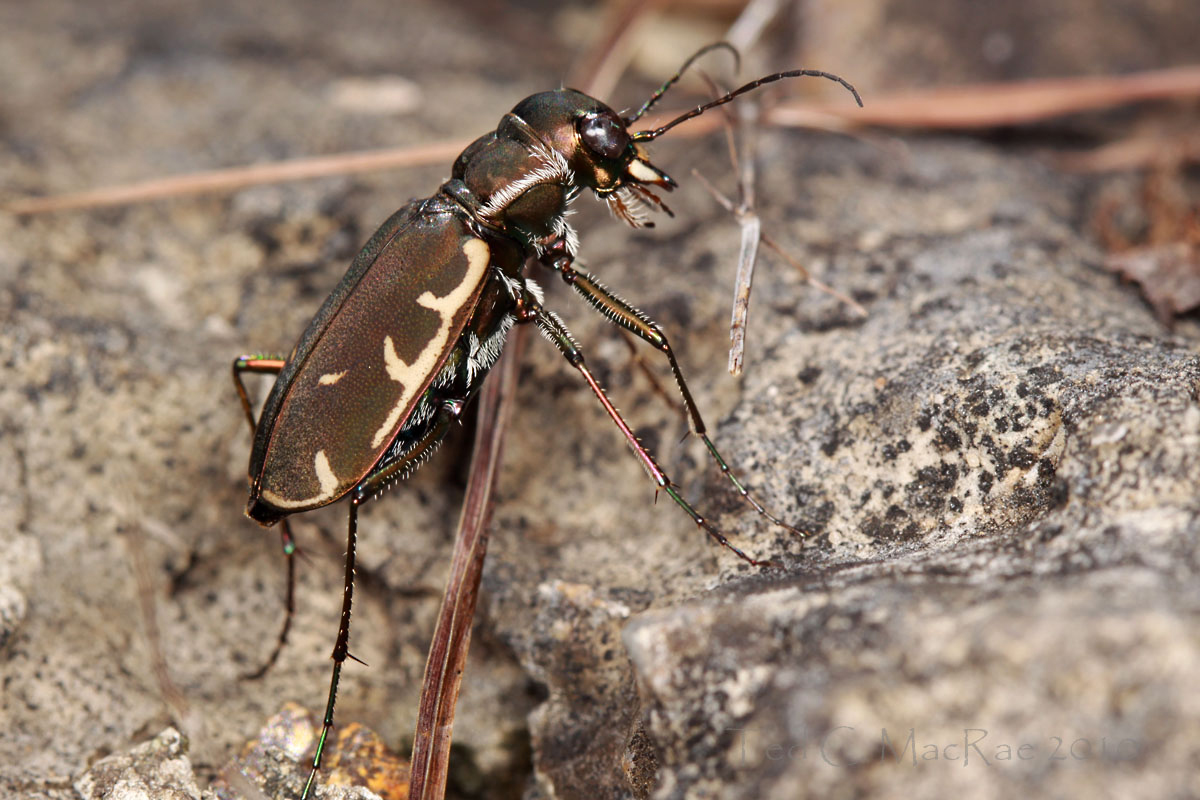
These beetles are simply a marvel to see in the field.  Brilliant dark red with metallic green, blue, and purple borders on the head, thorax, and elytra, this relatively large tiger beetle (certainly among the largest in the genus) can be confused with no other tiger beetle in North America.  Unlike adults of most other species, which exhibit color patterns resembling the texture and hue of the soil substrate on which they occur, C. pulchra adults are obvious and non-cryptic.  It apparently mimics the large, similarly colored velvet ants of the genus Dasymutilla with which they are sympatric – even exhibiting similar behavior when alarmed such as stridulating (creating vibrations by scraping body parts across one another) and giving off defense chemicals (Pearson 1988).  Adults are powerful fliers that can fly long distances when alarmed (Spomer et al. 2008), but in the still relatively cool morning air Chris and I had relatively (emphasis on relatively!) little trouble getting close enough to attempt those coveted field photographs.  This, however, was a double-edged sword – the same cool temperatures that allowed us to get close enough for photographs also caused to the beetles to assume the most non-photogenic poses as they sprawled torpidly on the ground, sometimes hugging it closely in an attempt to conserve heat until incident radiation from the sun warmed them sufficiently to go about the day’s activities.  Once this did happen, we found getting close enough for photographs nearly impossible.  In the 2+ hours that we chased after them, we took many shots but failed to get that “perfect” shot of a brilliant beetle standing tall and alert.

Adult male Cicindela pulchra hugs the ground during the cool morning hours.

Cicindela pulchra is a “spring/fall” species – i.e., sexually immature adults emerge during fall to feed, then return to their burrows to overwinter before emerging again in spring to mate and lay eggs.   Pearson et al. (2006) state the fall period lasts from July to September; however, as I observed in Kansas in 2005 adults can remain active well into October as long as suitable weather prevails.  Larvae hatch shortly after eggs are laid in the spring, but larval burrows can be seen during the entire season since they require 2-3 to complete development.  It was actually the presence of the large larval burrows (see photo below) that alerted Matt to the occurrence of the species at this site.  Several other tiger beetle species are also found here, e.g. C. purpurea (cow path tiger beetle) and C. tranquebarica (oblique-lined tiger beetle); however, these species – and hence their larval burrows – are considerably smaller than C. pulchra.  The only other species of Cicindela in North America that matches C. pulchra in size is C. obsoleta (large grassland tiger beetle), a southwestern species that is not known to range as far north as Nebraska and South Dakota, and the slightly smaller C. formosa (big sand tiger beetle) larval burrow has a distinctive “pitfall trap” with the burrow opening situated horizontally above it (it is also restricted to dry sand rather than clay habitats).  We saw several C. pulchra larval burrows during our visit but no active larvae, and none of my attempts to “fish” them out of their relatively shallow burrows met with success.  I could have tried digging them out, but that is a time-intensive activity, and I decided instead to bring a few live adults back in a terrarium of native soil and see if I could rear the species from egg.

Despite the presence of at least two other tiger beetle species at the site, this can only be that of a 3rd-instar Cicindela pulchra due to its large size.

I had tried persistently during the last hour we were there to get a good field photograph of an active adult beetle standing tall and alert, but the following is the closest I was able to achieve.  Leaving the site without that “perfect” shot was difficult – as Matt put it, we had “pulchra fever”!  Still, there were other tiger beetles – e.g. C. nebraskana (prairie long-lipped tiger beetle) and C. decemnotata (badlands tiger beetle) – that we wanted to find in the limited time we had to explore the region, so I prepared a terrarium for the live adults I was bringing back with me and chalked up our first big success of the trip as we headed towards the shortgrass prairie sitting atop the nearby Nebraska Pine Ridge.

I chased this adult female for some time trying to get a closer photograph, but warming temperatures made this impossible.

In addition to attempting to rear the species,  bringing live adults back with me also gave me more opportunity to photograph them.  In addition to the native crumbly shale soil that I used to fill the terrarium, I placed in it one of the nicely colored, presumably volcanic, rocks that littered the slopes on which the beetles occurred.  The dark color of the rock makes a nice backdrop to really show off the extraordinary colors of this species – especially the bright white labrum and mandibles of the particularly impressive male in the following photograph.  The beetles are all now sound asleep for the winter in a 10°C incubator.  Hopefully, when I move the terrarium back into warm temperatures next spring they will re-emerge, mate, and lay eggs (hmm, photographs of a mating pair would be really nice!).

The all-white labrum and mandibles of this male Cicindela pulchra are displayed nicely in this terrarium photograph.

Photo Details:
Insects: Canon 50D w/ 100mm macro lens (ISO 100, 1/250 sec, f/16), Canon MT-24EX flash w/ Sto-Fen + GFPuffer diffusers.
Habitat: Canon 50D w/ 17-85mm wide-angle lens (ISO 100, 1/160 sec, f/11), natural light.
Matt and Chris: Canon 50D w/ 17-85mm wide-angle lens (ISO 100, 1/250 sec, f/11), natural light.
All photos w/ typical post-processing (levels, minor cropping, unsharp mask).

REFERENCES:

Brust, M. L.  2010. New distribution records for Cicindela pulchra pulchra Say in South Dakota and notes on habitat use and natural history.  Cicindela 42:1–10.

Larsen, K. J. and H. L. Willis.  2008. Range extension into South Dakota for Cicindela pulchra (Coleoptera: Carabidae).  The Coleopterists Bulletin 62(4):480.

MacRae, T. C. 2006. Beetle bits: The “beautiful tiger beetle”. Nature Notes, Journal of the Webster Groves Nature Study Society 78(4):9–12.

Pearson, D. L.  1988. Biology of tiger beetles.  Annual Review of Entomology 33:123–147.

Pearson, D. L., C. B. Knisley and C. J. Kazilek. 2006. A Field Guide to the Tiger Beetles of the United States and Canada. Oxford University Press, New York, 227 pp.

Spomer, S. M., M. L. Brust, D. C. Backlund and S. Weins.  2008. Tiger Beetles of South Dakota & Nebraska.University of Nebraska, Department of Entomology, Lincoln, 60 pp.

Copyright © Ted C. MacRae 2010

Missouri’s disjunct population of Cicindela obsoleta vulturina

Although I’ve been collecting insects since I was a kid (and seriously for nearly three decades), it has only been in more recent years that fall has become an important part of the collecting season for me. With the notable exception of Fall 1978, when the Systematic Entomology course I was enrolled in sent me on a frantic quest to become one of the few undergraduate members of the exclusive “200 family” club (I got 205!), I long viewed fall as a time to hang up the net and begin the winter-long process of mounting, labeling, and curating the hundreds – sometimes thousands – of specimens I had collected earlier in the year during spring and summer.  This has primarily been a reflection of my taxonomic interest – woodboring beetles in the families Buprestidae and Cerambycidae, which occur at their overwhelmingly greatest abundance and diversity throughout most of North America during spring and summer but are found only sparingly later in the season.  Tiger beetles (family Cicindelidae) changed all that, and when I first began serious study of the group around 10 years ago, I found the combination of gorgeous weather and multitude of “spring/fall” species that emerge briefly during fall an irresistible siren call to the field. I’ve not looked back, and the Annual Fall Tiger Beetle Collecting Trip™ is now an established and eagerly anticipated event.

Cicindela obsoleta vulturina - the prairie tiger beetle (Blackjack Knob, Taney Co., Missouri).

No species embodies all that I love about fall tiger beetle collecting more than Cicindela obsoleta vulturina, the prairie tiger beetle. I first learned of the occurrence in Missouri of this large, dark green species back in 2000, when I saw a single specimen in the Enns Entomology Museum collected in Protem, Taney Co.  I was just beginning my tiger beetle studies and would later learn what the Tiger Beetle Guild already knew – that the occurrence of this species in Missouri was restricted to cedar glade habitats in the White River Hills region in the extreme southwestern part of the state, and that the population occurring there and in adjacent northern Arkansas was disjunct by 300+ miles from the main population in Texas and Oklahoma.  I couldn’t wait to see it for myself and eventually enlisted the help of Eric Eaton, living in the area at the time, and asked him to let me know if he saw a large green tiger beetle after the late summer rains began.  That September, I got a message from Eric saying that he had seen just such a beast not far from his home, and the following weekend he and I would enjoy the chance to meet each other in person and the splendor of the season while finding this marvelous species at several locations in the area.  Thus began my love affair with this species, and for several years I returned to the area each fall to document additional localities for this and other tiger beetle species occurring in the area.
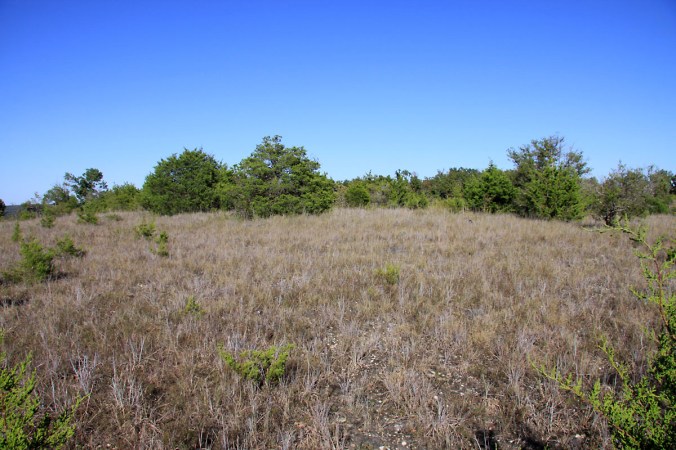
Blackjack Knob is part of an extensive xeric dolomite prairie complex (commonly referred to as cedar glades, though the term is not precisely accurate) in the White River Hills subsection of the Ozark Highlands, providing habitat for prairie tiger beetles and other typically southwestern plants and animals.

In fact, until a few weeks ago it had been several years since I had last seen this species in the field.  I did make an attempt to see it again last year but returned home from that early October trip unsuccessful, cold and wet.  Thus, when tiger beetle enthusiast Steve Spomer mentioned to me earlier this summer that he wanted to see our Missouri population, I jumped at the chance to coordinate our visits this fall and show him some of my favorite sites.  The Patron Saint of Cicindela was smiling down upon us that day, as perfect timing and sunny skies combined to bring adults out in an abundance that I’d not seen in any of my previous visits.  I would take advantage of this rare opportunity and spend the next day in the area as well, documenting a number of new localities along the northern and eastern edge of its known distribution, including a far eastern extension of its range to Caney Mountain Conservation Area in Ozark Co. where we had long suspected the beetle to occur but failed in all previous attempts to find it.

Steve Spomer and yours truly at Cane Creek Rd. site.

The prairie tiger beetle is the easternmost subspecies of the large grassland tiger beetle, which along with its other included subspecies covers a geographic range covering most of Texas, New Mexico, and eastern Arizona and extending up through western Oklahoma and Kansas into eastern Colorado.  Individuals of subspecies vulturina, occurring primarily in eastern/central Texas, are distinguished from the other subspecies (nominate in western Texas and eastern New Mexico north into Colorado, santaclarae in New Mexico and Arizona, and neojuvenilis in south Texas) by their generally black to olive-green coloration and reduced, narrow elytral markings, typically with an inverted “V” at mid-elytron.  The Missouri/Arkansas disjunct population is interesting from several standpoints:

  • Individuals mostly dark olive-green – no black individuals.
  • Elytral maculations more completely developed.
  • Adults active in late summer/early fall rather than summer.

These features, in particular coloration and maculation, have fueled speculation that this isolated population might be subspecifically distinct (Pearson et al. 2006).  A recent review of material from throughout its range found these color characters of limited use in unequivocally diagnosing individuals from the Missouri and Arkansas population as a separate subspecific taxon (Mawdsley 2009); however, a molecular systematics approach ultimately may be needed to resolve the status of this population.  Presumably, the Missouri/Arkansas disjunct population represents a hypsithermal relict, left behind when the return of cooler, moister conditions caused a retreat of the formerly more expansive grasslands to their current position.  If true, then the Missouri/Arkansas population has been isolated from the parent population for ~6,000 years.  I suspect that the late summer/early fall adult phenology is an adaptation to local precipitation patterns, relying on more predictable late summer rains to trigger adult emergence after the generally droughty months of July and August.  In this regard it differs fundamentally from the true “fall” species, which emerge briefly in the fall as sexually immature adults before overwintering and re-emerging in the spring for mating and oviposition.  These Missouri/Arkansas disjuncts do not re-emerge in spring, but instead mate and lay eggs in the fall before the onset of cold weather.  The eggs hatch as well (based on my growth chamber observations of this species), so winter also is passed as a larva – either as newly-hatched 1st instars, or as later instars that hatched during the previous year(s) – rather than as adults.

I have noted considerable variation in the coloration and maculations of individuals in this population.  The individual in the first photograph above is typical of the population – dark olive-green with thin but nearly complete maculations.  That individual comes from Blackjack Knob (Taney Co.), which is near the heart of the White River Hills region.  However, the degree to which the maculations are developed is variable, ranging from rather incomplete to even more fully developed due to the presence of a marginal connection.  Additionally, a few individuals can be found that show greater or lesser suffusion of brown on the head, pronotum, and elytra.  At another location in the county closer to the northern distributional limit (Hwy 160/Cane Creek Rd.), this brown suffusion is more common and variably expressed from minimal to nearly complete.  The photographs below show five individuals from this site expressing differing degrees of brown as well as the variable macular development seen throughout the population:
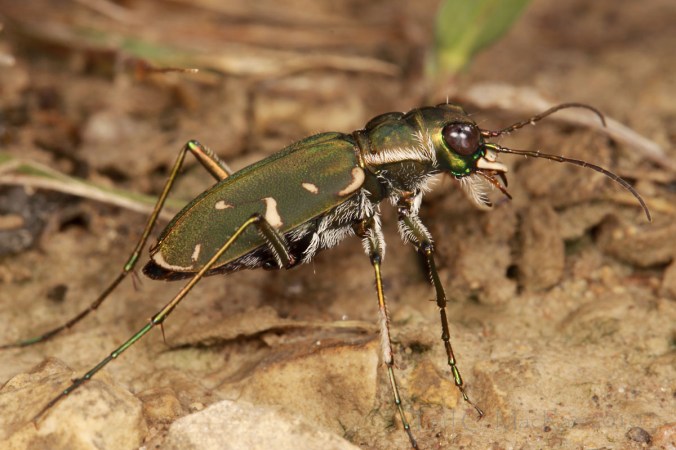
Male (Hwy 160/Cane Creek Rd.) - green w/ trace brown, marginal band incomplete, median band complete.


Female (Hwy 160/Cane Creek Rd.) - green w/ slight brown, marginal band complete, median band incomplete.


Male (Hwy 160/Cane Creek Rd.) - green w/ moderate brown, marginal band incomplete, median band incomplete.
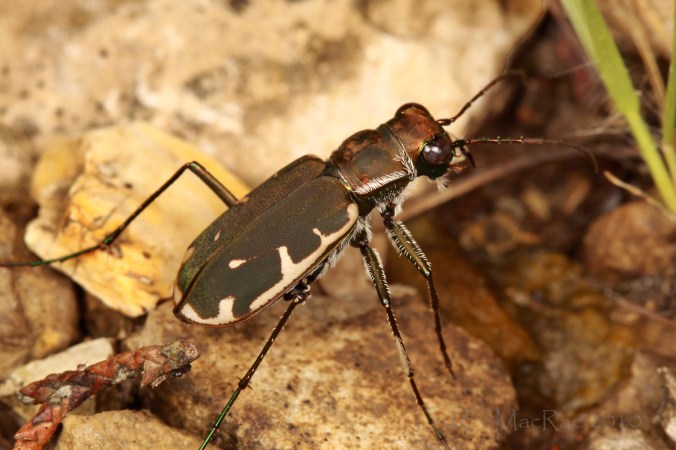

Male (Hwy 160/Cane Creek Rd.) - green w/ heavy brown, marginal band complete, median band complete.
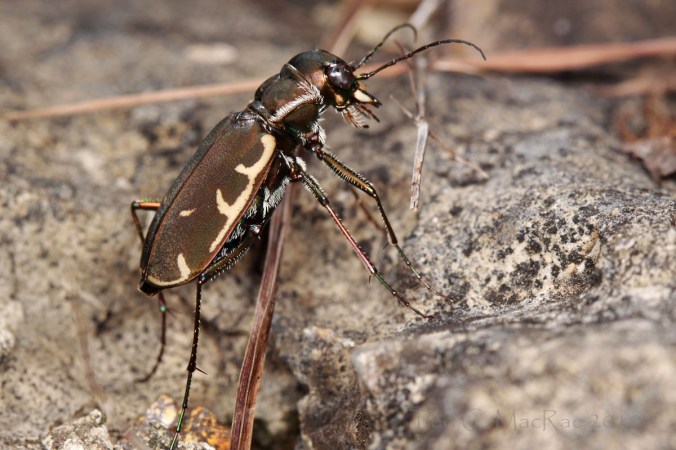

Female (Hwy 160/Cane Creek Rd.) - completely brown, marginal band complete, median band incomplete.

There is another site even further north in the county (Merriam Woods), which I found for the first time on this trip and, to my knowledge, represents the northernmost extent of the population in Missouri.  At this site, nearly all of the individuals show coppery-brown coloration with almost no hint of green.  These fully brown individuals seem to represent an appearance that is completely unlike that seen in any other part of the range of the species.  The individual in the photo below typifies the appearance of the beetles seen at this site:

Male (Merriam Woods) - brown, marginal band incomplete, median band complete.

I’m less familiar with coloration of the population further south in Arkansas, although in my limited collecting in that area I recall that most individuals I encountered exhibited the dark olive-green coloration typical of individuals at Blackjack Knob and other more southern sites in Missouri.  Thus, there seems to a clinal element to variability in coloration in the Missouri/Arkansas disjunct population.  I suspect that the unique coloration of the beetles in this population is related to the soils with which they are associated.  Light gray Jefferson City-Cotter dolomite bedrock forms the core of the White River Hills landscape and is exposed extensively in the glades that dominate its knobs and slopes.  These exposures are weather-stained black and overlain by thin, black soils that support dark, green-black lichens amongst the sparse vegetation, as seen in the following photographs taken at the newly identified northeasternmost site at Caney Mountain Conservation Area:

Thinly soiled dolomite exposures punctuate the glades in the White River Hills. Prairie tiger beetles are found in these exposures.
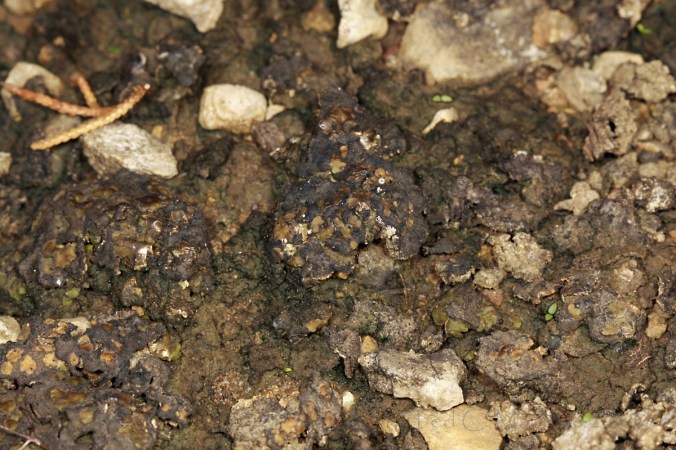

Dark green-black lichens encrust the thin black soils overlaying the dolomite exposures. Prairie tiger beetle adult coloration closely matches the coloration of the lichens and soil.

The glades and dolomite exposures where these beetles are found in the White River Hills and the dry oak woodlands that surround them have a characteristic look that is not seen once one leaves the area, and I have found many new sites for the beetle in the northern and eastern fringes of the region by stopping at locations where the roadside exposures had the right “look.”  The variation in maculation and coloration seen in this population may be an indication that the population is still adapting to local conditions since becoming isolated from main population.

Currently, I have 3rd-instar larvae that I collected from their burrows at Blackjack Knob (adults mostly green) and Merriam Woods (adults mostly brown) and hope the rear them to adulthood next year.  If I succeed in getting virgin adults from the two sites, I think it would be interesting to do some single-pair crossings and rear the progeny to see how coloration is expressed.  A long term project, for sure, as these beetles probably require at least two seasons to reach adulthood, but rearing them is fun!  A more difficult, yet far more interesting, project would be to secure virgin adults from the mostly black main population in Texas – or even the bright green, thickly-maculated santaclarae subspecies from Arizona – to see how interbreeding them with these Missouri disjuncts would affect coloration and maculation in their progeny – they could be some of the most unusual appearing large grassland tiger beetles ever seen (not to mention their tongue-twisting taxonomic moniker of Cicindela (Cicindelidia) obsoleta vulturina [Missouri disjunct] x obsoleta santaclarae!).  Timing would be a difficulty, since the Texas and Arizona populations exhibit a more normal summer adult phenology, but it would be worth a try if I could secure a source of larvae for rearing.  Anybody?

A male sports his impressive pair of choppers.

Photo Details (insects): Canon 50D w/ 100mm macro lens (ISO 100, 1/250 sec, f/13-22), Canon MT-24EX flash (1/4-1/2 ratio) w/ Sto-Fen + GFPuffer diffusers. Typical post-processing (levels, minor cropping, unsharp mask).

REFERENCES:

Mawdsley, J. R.  2009. Geographic variation in U. S. populations of the tiger beetle Cicindela obsoleta Say (Coleoptera: Cicindelidae).  Insecta Mundi 0094:1–10.

Pearson, D. L., C. B. Knisley and C. J. Kazilek. 2006. A Field Guide to the Tiger Beetles of the United States and Canada. Oxford University Press, New York, 227 pp.

Copyright © Ted C. MacRae 2010

Reunion in the Badlands… and beyond

Two years ago I targeted Nebraska and South Dakota for that year’s Fall Tiger Beetle Trip. I had gotten my first experience with what Nebraska had to offer with a long weekend trip to the Nebraska Sand Hills during the previous fall, and with my appetite fully whetted as a result of that trip, I made a full-blown week-long trip through not only the Sand Hills, but further west to the Pine Ridge area in northwestern Nebraska and the Black Hills of South Dakota. It was a phenomenal trip that featured not only tiger beetles (13 species in all), but rare longhorned beetles, aggressive rattlesnakes, and a stunning array of autumn-flavored Great Plains landscapes.

Ted MacRae and Matt Brust stand in Cicindela nebraskana habitat (northwestern Nebraska).

Probably the species that I was happiest to encounter on that trip were Cicindela nebraskana (prairie long-lipped tiger beetle), C. lengi (blowout tiger beetle), and C. limbata (sandy tiger beetle).  I can’t claim sole credit for those finds, since I had made arrangements to meet Nebraska tiger beetle expert Matt Brust and have him show me some of his favorite sites. With Matt’s help, both in taking me to localities and directing me to others, I found nearly every species that I was hoping to see. Nearly, but not every species that is. The one species I really hoped to see but knew was a long shot was Cicindela decemnotata (Badlands tiger beetle). It’s right at the easternmost limit of its distribution in northwestern Nebraska, and only a handful of individuals have been seen in the state. Another species I did not see was Cicindela pulchra (beautiful tiger beetle). You’ve heard me talk about this species on several occasions, referring to my experience with it in south-central Kansas (written up in this little note) and my later obsession – so far unfulfilled – with finding it in nearby northwestern Oklahoma. I didn’t even try to look for this species… because nobody knew it was there! It was not until the following year that Matt found it in the Badlands of South Dakota, and since then he has located a number of populations in that area.

It is with C. decemnotata and C. pulchra in mind that I make return trip to the South Dakota Badlands for the Annual Fall Tiger Beetle Trip™. This time I am accompanied by fellow cicindelophile and field companion Chris Brown, and by the time you read this we will be on our way to meet up with Matt once again and focus our efforts on finding these two species. In this far northern area, it is already late in the season, so success is not assured. However, with Matt showing or directing us to some of the localities where he’s found these species, we’ve got the biggest bullets in our guns possible. Since I’ve already seen many of the other interesting tiger beetle species up that way (C. nebraskana, C. lengi, C. limbata, etc.) from the previous trip, we will be free to devote all of our attention to finding these two species – including driving even further west into the heart of Wyoming, where C. decemnotata occurs a little more reliably. If I come back from this trip with nothing more than some great photos of one of these species, the trip will have been a success. If I come back with photos of both of them, the trip will have been a huge success. Along the way, I’ll still keep an eye out for other tiger beetles – especially C. nebraskana, C. lengi, and C. limbata, because about the only thing I would wish for on top of success as photographing C. decemnotata and C. pulchra is nicer photographs of these other species as well to replace the dreadful point-and-shoot versions that I have from my 2008 trip.

Copyright © Ted C. MacRae 2010

“A good photographer is invisible…”

Yesterday I shot down to the southeastern lowlands of Missouri to spend some quality time in the field with friend and fellow cicindelophile Kent Fothergill. We were primarily looking for migrants of the Ascendent Tiger Beetle (Cicindela trifasciata ascendens), a Gulf Coast species that doesn’t normally occur in Missouri but is well known for its vagility and late-season northward migrations and which has been seen in the state once before (Brown and MacRae 2005).  No such individuals were found, but no matter – the day was really about just getting out and enjoying the camaraderie.  Nevertheless, there were some successes.  We located burrows of 1st- and  2nd-instar larvae of the Ant-like Tiger Beetle (Cylindera cursitans) at a site along the Mississippi River where Rich Thoma and I found adults last year.  Previous attempts to rear this species from larva to adult have not succeeded (Brust et al. 2005), but I collected a number of larvae and transferred them to a rearing container anyway in hopes that the techniques I’ve developed for rearing the closely-related Swift Tiger Beetle (Cylindera celeripes) might work also with this species.  We also found the beast that I am photographing above – I’ll leave it to your imagination for now to figure out what it is.

In between stops there was plenty of time for discussion on subjects entomological and non.  One thing Kent knows a thing or two about is insect photography, and during a discussion about such he made an interesting comment. Beyond focus, exposure, and composition, he noted that good insect photographers have the ability to become invisible – i.e., they combine patience and persistence with knowledge of the subject’s behavior to make it forget about the big glass eye staring at them from 6 inches away and return to going about their business.  It brought some clarity to my mind about the things I’ve tried in my own attempts to photograph insects that really did not want to be photographed (and there have been many).  The point was emphasized when I came into the office this morning and found the above photograph in my email inbox – Kent had taken it yesterday while I was photographing the bug-to-be-named-later, and I was completely unaware that I was being photographed!  Yes, a good photographer is invisible…

REFERENCES:

Brown, C. R. and T. C. MacRae. 2005. Occurrence of Cicindela (Cicindelidia) trifasciata ascendens (Coleoptera: Cicindelidae) in Missouri. Cicindela 37(1–2):17–19.
Brust, M. L., W. W. Hoback, and C. B. Knisley. 2005. Biology, habitat preference, and larval description of Cicindela cursitans LeConte (Coleoptera: Carabidae: Cicindelinae). The Coleopterists Bulletin 59(3):379–390.

Copyright © Ted C. MacRae 2010

Add to FacebookAdd to DiggAdd to Del.icio.usAdd to StumbleuponAdd to RedditAdd to BlinklistAdd to TwitterAdd to TechnoratiAdd to Yahoo BuzzAdd to Newsvine

Email to a friend

Beetle Collecting 101: Dress for Success

For most of the nearly 3 decades that I’ve been collecting insects, beetles have been my primary interest – first longhorned beetles, then jewel beetles, and now more recently tiger beetles (each taxon an addition, not a replacement!). During that time, I’ve learned a thing or two about the art of collecting – some of which I’ve figured out for myself, much more a result of my good fortune to have spent time in the field with the likes of Gayle NelsonChuck Bellamy, and a number of other learned entomologists.  In view of this, I thought there might be interest in an occasional post on some aspect of my approach to collecting beetles. With that, I introduce my new series, “Beetle Collecting 101,” and since it all starts in the field, this first installment will consider my basic outfit for field collecting. Although my focus is beetles (and specific groups of beetles at that), this basic outfit is widely applicable across most insect groups. There are a number of additional items that I can and do bring into the field with me at various times depending on location and season or for specific collecting techniques (e.g., beating, blacklighting, pitfall/bait trapping, etc.) that won’t be covered here – these additional items could be covered in future posts if this post indicates sufficient interest. Other future post ideas I had include rearing, specimen processing (everything from pinning and labeling to batch processing and storage methods), and collection organization/curation. Comments and suggestions welcome.

Beetle Collecting 101: Dress for Success

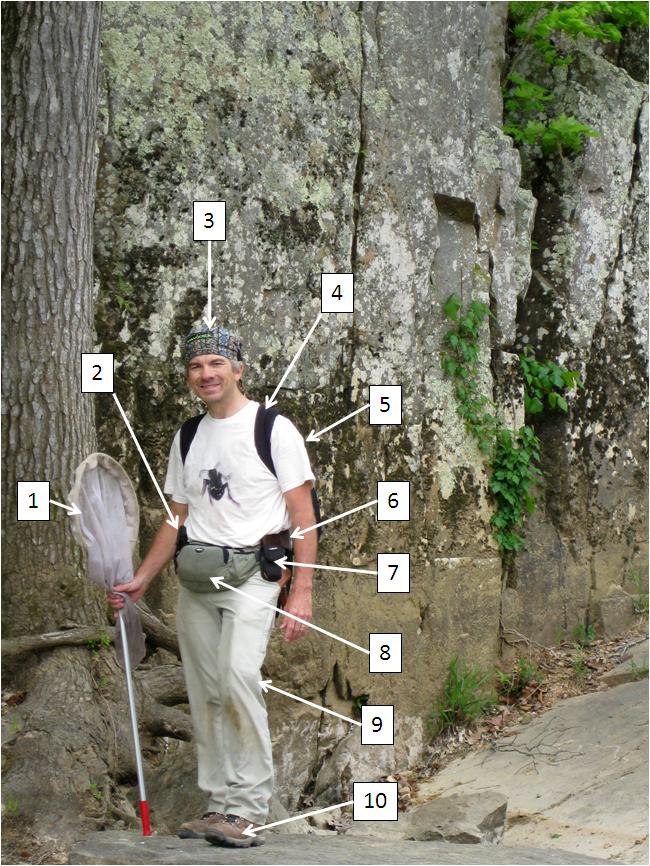
A well-dressed entomologist. Photo by Rich Thoma.

Beyond the needed equipment, the primary considerations for my field outfit are lightweight, comfortable, and protective.  I can spend hours away from the truck in extreme conditions or rugged terrain (or both!), so I want clothing that stays comfortable no matter how much I exert myself.  It is also tempting to carry more equipment than is necessary – this only adds weight and limits the ground that can be covered.

  1. Insect net – duh!  This is an absolute necessity for nearly all but the purely flightless species.  I highly recommend an extendable net handle – I keep mine collapsed (3′ length) for normal use and extend it out to 6′ when stalking tiger beetles or other wary, flighty species.  The collapsed net handle is also a good length and weight to serve as a beating stick when I am carrying a beating sheet (not shown).  I use an aerial net bag, since I don’t do much sweeping anymore – match the bag to your interests.  Of the three common ring diameters for aerial nets, I find the 15″ to be more effective than the 12″, while the 18″ is a little unwieldy.  Green fabric is said to be not as visible to insects as white, thereby allowing closer approach before they attempt to flee, but I do not have any experience with this.  I have collected quite a lot of beetles with my white net bag and appreciate the ability to see the contrast of the insect inside the bag when attempting to remove it.
  2. Hunting knife.  If you’re interested in wood-boring beetles, you’ll want to be able to slice into dead branches suspected of harboring insects.  I like the classic folding Buck Knives Ranger and attach it to the strap of my waist pack (#8) rather than my belt so that it will move with the pack when I swing the pack around backside.
  3. Hat.  If the sun doesn’t bother you, the flies will.  Wear something light and comfortable that will absorb sweat – I like my 2-decades old Mombosok for this (and because I be stylin’!), but those with greater sun sensitivity (or who live in tropical environments) might do better with a brimmed hat.
  4. Backpack.  Before my camera carrying days, this was a Camelbak hydration pack with a good-sized but not overly large water reservoir and zippered pouches with newspaper for placing host plant samples for pressing.  A backpack isn’t really necessary for short forays or mild conditions but is essential for hiking longer distances in hot/dry climates where there is real risk of dehydration.  Many regard backpacks as uncomfortable; however, I find slinging water containers attached to the waist equally annoying and also cumbersome to deal with when crouching or laying.  These days, however, I carry full camera gear in my backpack (camera body, multiple lenses, extension tubes, flash unit).  This adds weight, but it only took a day or two during my first field trip to get used to it.  I still use the camera pack for carrying water, as the front compartment has room for two water bottles or a Camelbak bladder, and my pack also contains a separate zippered compartment where I can still place plant samples for pressing.
  5. Lightweight t-shirt.  I used to wear buttoned fishing shirts over an undershirt, thinking the undershirt would keep perspiration off my skin, while the pockets on the outer shirt would come in handy for holding small items.  In reality, things fall out of the front pockets, and both under- and outer layers would become soaked with sweat.  Now I wear simple 100% cotton t-shirts – artfully emblazoned with an image of Cicindela ancosisconensis by Kirk Betts at The Wild Edge (and leaving no doubt to curious onlookers as to what I am up to).  I find these simple  shirts to be the most comfortable in the most extreme conditions.
  6. Hand axe.  Again, if you’re interested in beetles that live in wood, an axe will be handy for chopping into wood too large or hard to sample with a hunting knife.  Smaller is better (to limit weight), and rather than using a leather holster (which will become soaked with sweat and stretched out), I simply slip the handle under the strap of my waist pack and let the head of the axe rest on the strap to hold it in place.
  7. GPS Unit.  You do record GPS coordinates for your specimens, don’t you?!  I just got a new one for my birthday (Garmin Oregon 450t) with computer download capabilities – no more manual transcribing of data!  Again, I attach it to my waist pack strap rather than my belt.
  8. Waist pack.  I use the very compact Eagle Creek Wayside, with two zippered pouches and an unzippered side pouch to hold all my vials and small tools.  I’ve tried a number of different methods for holding these items – they fall out of shirt pockets whenever you bend over, are not readily accessible when in a backpack, and do not stay organized in a non-compartmented pack.  I have developed a system of vials that serve as both killing bottles and storage containers (this alone could be the subject of another post) – 4-dram vials for most specimens and 8-dram for larger ones.  This waist pack holds 8 small and 6 large vials in the front pouch – with the two sizes kept separate by a divider.  Being able to carry numerous vials allows me to segregate insects by host plant or ecological association, and most importantly, vials in this pouch stay organized so I can easily find the proper vial when I need it.  The larger rear pouch is roomy enough to hold two small olive bottles (for the occasional behemoths or blacklighting), forceps, aspirator, and miscellaneous other items – or, if I’m in the mood to collect wood for rearing (also could be the subject of another post), pruning shears, small folding saw, twine, flagging tape, and permanent marker.  A small side pouch is perfect for keeping a hand lens and an eye dropper bottle of ethyl acetate killing agent at the ready.  Also, the pack easily swings around to my backside when I need to crouch or lay prostrate (e.g., when photographing tiger beetles).
  9. Lightweight polyester/cotton outdoor pants.  I’m fond of the Columbia line of products, but whatever brand you choose, make sure they are lightweight, have a relaxed fit (to allow crouching) and dry quickly (no denim jeans for me!).  The last thing I want is chafing from sweat-soaked pants – yikes!  (Let’s just say lesson learned the hard way).
  10. Hiking boots.  Again, lightweight and comfortable are key, and because of the sometimes rugged terrain I traverse I like mid-ankle support so I can watch for bugs instead of constantly watching my feet.  The lighter the boot, the longer you’ll be able to hike with comfort, and leather uppers will provide greater protection from thorns.

I hope you’ve found some useful tips here.  If you have your own techniques or experiences with field outfits, I’d love to hear them.  Also, if you have subjects that you would like covered in future issues of “Beetle Collecting 101,” please do let me know.

Copyright © Ted C. MacRae 2010

Add to FacebookAdd to DiggAdd to Del.icio.usAdd to StumbleuponAdd to RedditAdd to BlinklistAdd to TwitterAdd to TechnoratiAdd to Yahoo BuzzAdd to Newsvine

Email to a friend

Josef Knull was wrong!

A few weeks ago I received an email from Kyle Schnepp, an entomology student at Purdue University.  Kyle has taken on the rather ambitious project of developing an illustrated key to the Buprestidae of eastern North America, for which he has been spending the past year acquiring material for photographs.

During his examination of specimens in the Field Museum of Natural History, Kyle came across two examples of an extraordinarily rare species of Buprestidae, Agrilus audax Horn.  Although described more than 100 years ago from specimens collected in Texas (Horn 1891), few records have been published in the years since.  Chamberlin (1926) reported the species also from Arizona and Illinois but without further details, causing Fisher (1928), in his revision of the genus (woefully out-of-date now, but still the only comprehensive resource for identifying the North American species), to regard at least the Illinois record as probably erroneous (common for many of Chamberlin’s records).  The first undisputed report of this species from outside of Texas was by Josef Knull (1934), who reported the species emerging from living, wind-thrown branches of slippery elm (Ulmus rubra) collected in western Missouri.  More than half a century would pass before the species would turn up again – first in Oklahoma (Nelson and MacRae 1990) and twice again in Missouri through the efforts of Gayle Nelson and myself (MacRae 1991, MacRae and Nelson 2003). All but one of these specimens were beaten from bur oak (Quercus macrocarpa).

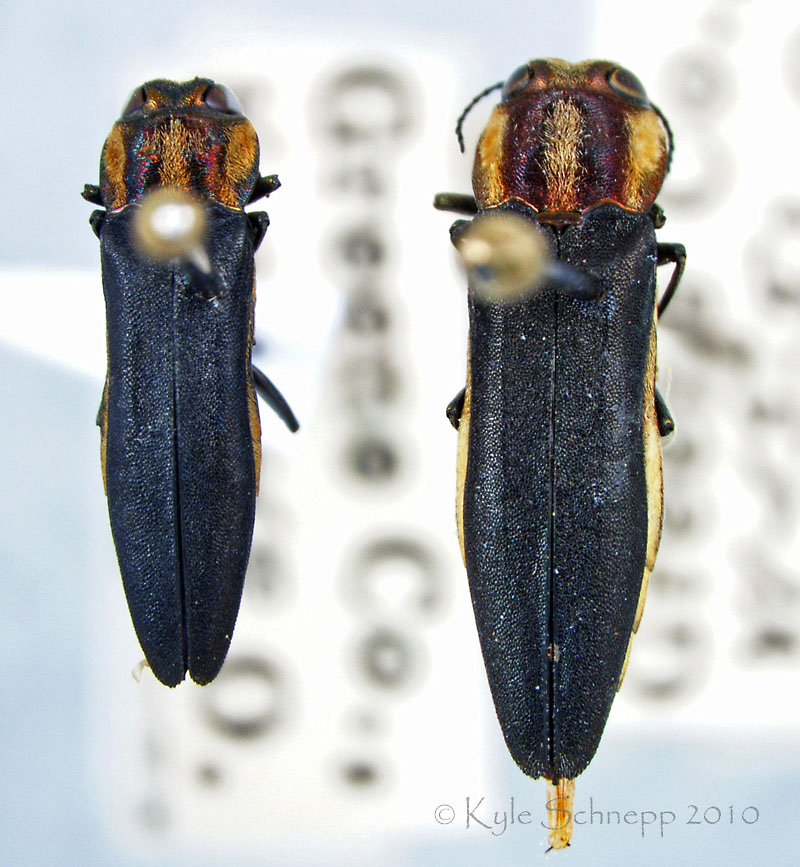
Agrilus audax Horn, 1891 – male (L) and female (R)

While the rarity of this species makes Kyle’s find significant enough, there is an even more significant – and interesting – aspect to his discovery.  Both of the specimens, one male and one female, were collected in Ohio, which is a rather extraordinary geographical range extension. Additionally, the specimens were collected by none other than Josef Knull.  To students of North American Buprestidae, the name Josef Knull is as familiar as Carl Linnaeus, Charles Darwin, or Thomas Say. A Professor of Entomology at The Ohio State University from 1934-1962, Knull published nearly 200 papers on the taxonomy, biology, and distribution of these and other families of beetles (Davidson and Bellamy 2002).  Although he lacked a Ph.D., he was an indefatigable collector and describer of beetles – to his fellow colleagues and students, he was known as “Professor” or “Doctor” as a show of respect.  He spent many of his summers traveling through the southwestern U.S. with his wife Dorothy Knull (herself an entomologist specializing in leafhoppers), and by the time he died in 1975 he had described 233 species and subspecies of beetles (as well as one species of Fulgoridae).  He was, and is, an icon among North American beetle collectors.

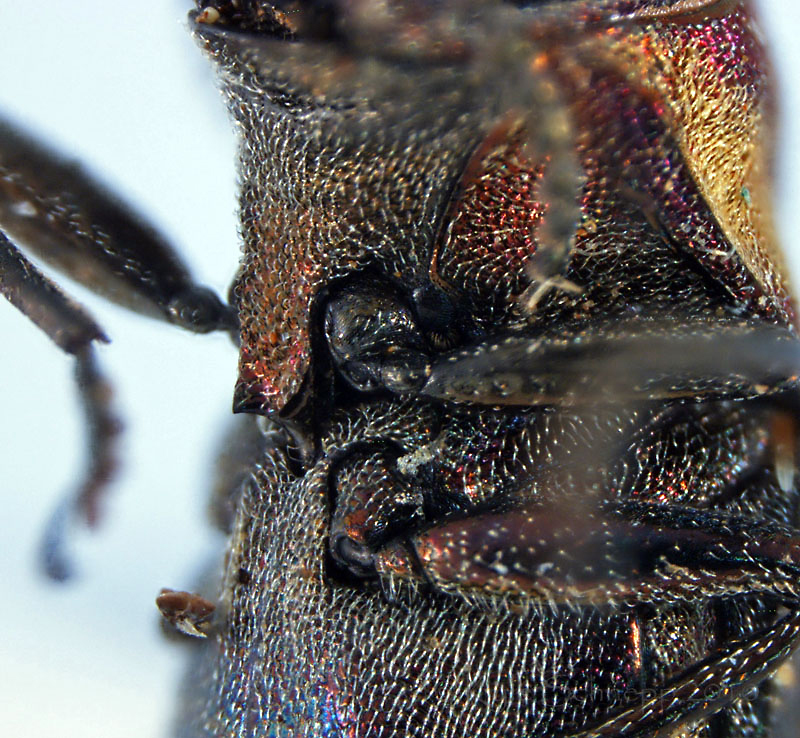
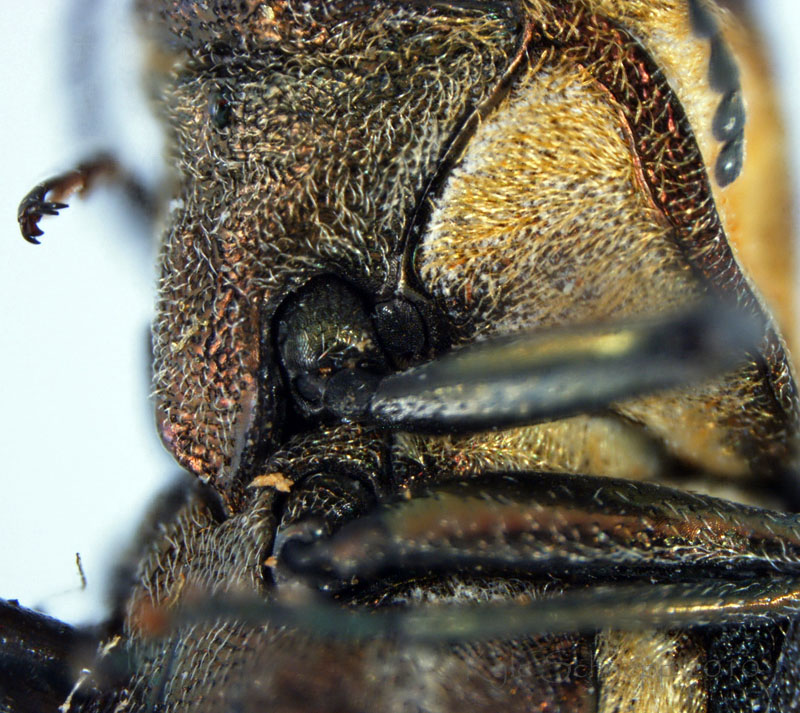
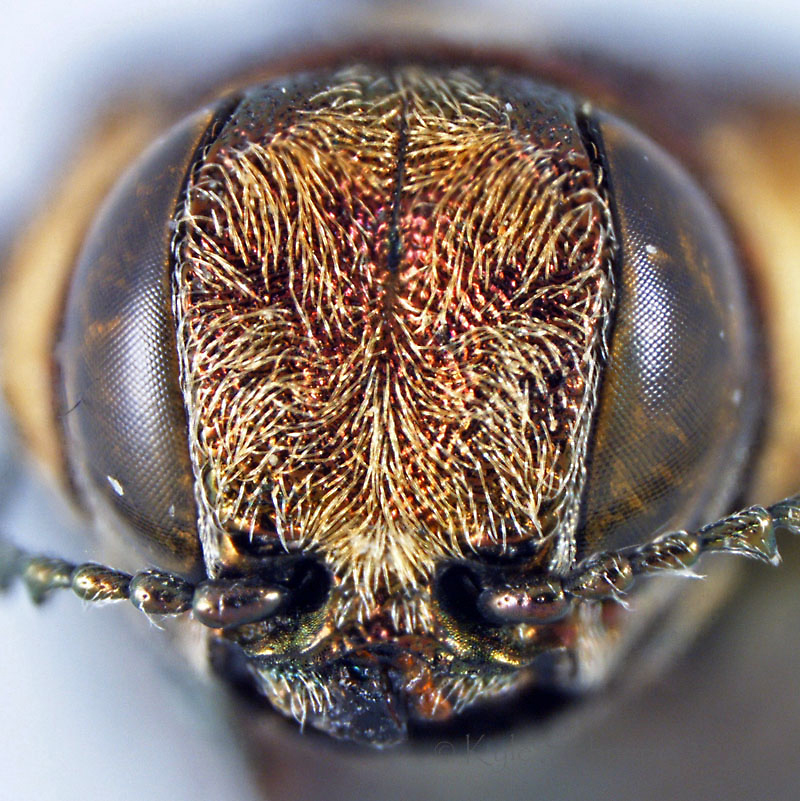
Curiously, Knull did not recognize these specimens for what they were, instead identifying them as the similar and much more widespread species, Agrilus vittaticollis.  Curious, because Knull collected these specimens in 1949 and 1953 – after first reporting the species in Missouri.  Agrilus audax belongs to a small group of species that look very similar to each other by way of their large size and striking coloration – black elytra and a red pronotum with a densely pubescent median channel.  Agrilus vittaticollis is the most common of these (though still not as commonly encountered as many other species in the genus), and the much less common A. benjamini also belongs to this group.  Kyle had sent me the above photo in an attempt to confirm their identity, but true confirmation would require examination of characters of the face and ventral surface.  Kyle quickly took additional photographs of these characters and sent them to me – they are shown below and leave no doubt as to the identity of these specimens.

Agrilus vittaticollis prosternum – note sides bent downward to sharp points.

Agrilus audax prosternum – sides normal, not bent downward to sharp points.


Agrilus audax frons is moderately depressed and uniformly pubescent (deeply depressed & pubescent only on lower half in A. benjamini).

Agrilus audax male sternite – the deep, smooth, elongate depression is diagnostic (A. benjamini males have only an obsolete depression).


Finding a new state record buprestid in Ohio – the land of Knull – based on specimens collected by Knull himself is nothing short of remarkable (almost like proving E. O. Wilson wrong¹). The occurrence of A. audax in Ohio also lends some credibility to Chamberlin’s record of the species in Illinois. Kyle is graciously allowing me to include these new records in a forthcoming publication; my thanks to him for this and also for allowing me to use his fine photographs in this post.  Kyle did also mention that these were the only misidentified specimens he saw in the Knull collection at the Field Museum of Natural History. For those interested in acquiring reprints of Knull’s papers, pdfs of the 50 papers he published in the Ohio Journal of Science may be found at this link.

¹ The title of this post is a play on the title of a recent post by Alex Wild at Myrmecos. No true disrespect is intended to Josef Knull, who’s legacy (with the possible exception of his frustratingly vague label data) is rightfully held in high regard by all who knew him or know of his work.

REFERENCES:

Chamberlin, W. J. 1926. The Buprestidae of North America, exclusive of Mexico, a catalogue including synonymy, bibliography, distribution, type locality and hosts of each species. W. J. Chamberlin, Corvallis.

Davidson, J. M., and C. L. Bellamy.  2002. The entomological contributions of Josef Nissley Knull (1891-1975).  Zootaxa 37:1-24.

Horn, G. H. 1891. The species of Agrilus of Boreal America. Transactions of the American Entomological Society 18:277-366.

Knull, J. N. 1934. Notes on Coleoptera, No. 4. Entomological News 45(10):207-212.

MacRae, T. C. 1991. The Buprestidae (Coleoptera) of Missouri. Insecta Mundi 5(2):101–126.

MacRae, T. C., and G. H. Nelson. 2003. Distributional and biological notes on Buprestidae (Coleoptera) in North and Central America and the West Indies, with validation of one species. The Coleopterists Bulletin 57(1):57–70.

Nelson, G. H., and T. C. MacRae. 1990. Additional notes on the biology and distribution of Buprestidae (Coleoptera) in North America, III. The Coleopterists Bulletin 44(3):349–354.

Copyright © Ted C. MacRae 2010

Add to FacebookAdd to DiggAdd to Del.icio.usAdd to StumbleuponAdd to RedditAdd to BlinklistAdd to TwitterAdd to TechnoratiAdd to Yahoo BuzzAdd to Newsvine

Email to a friend