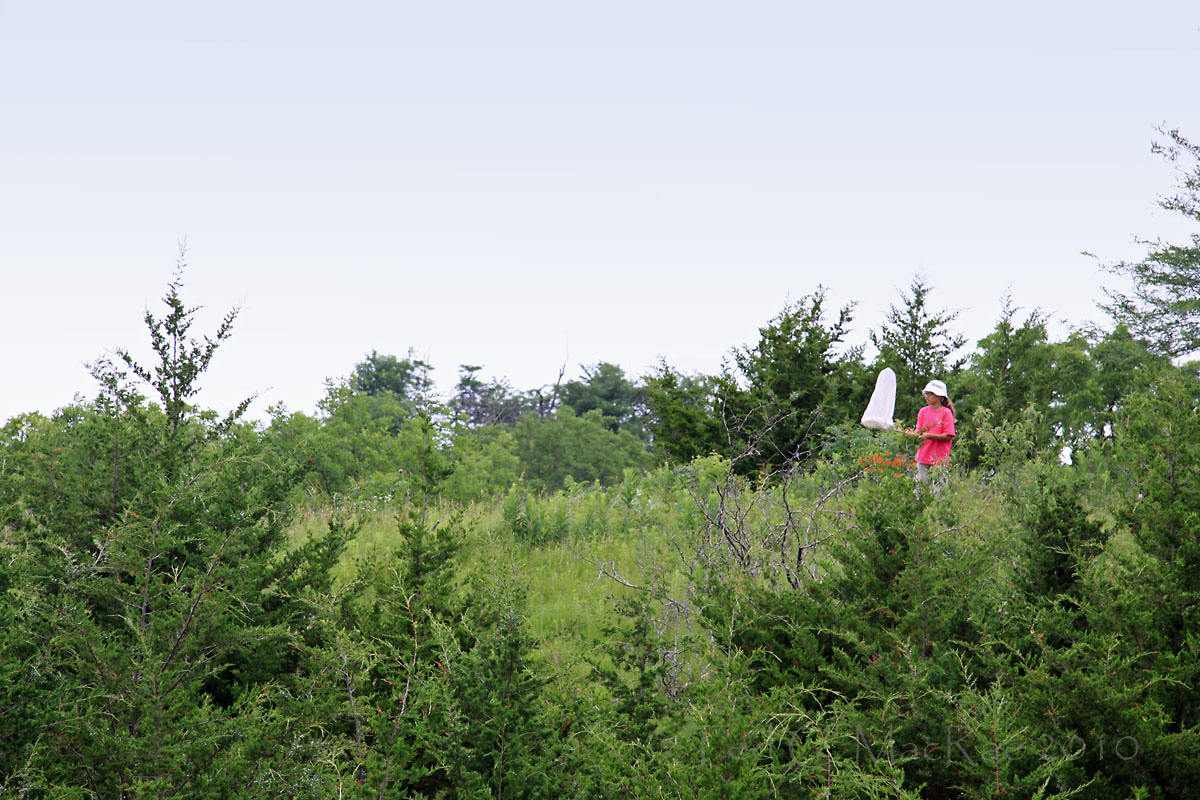
Madison MacRae collects butterflies from Asclepias tuberosa in a native loess hilltop prairie remnant in northwestern Missouri.
Copyright © Ted C. MacRae 2010


Madison MacRae collects butterflies from Asclepias tuberosa in a native loess hilltop prairie remnant in northwestern Missouri.
Copyright © Ted C. MacRae 2010
Sorry about the noisy video – it was shot in one of our walk-in growth chambers with fans going full-bore! Anyway, the video shows a couple of mating pairs of Cylindera celeripes (swift tiger beetle) that I brought back from the Loess Hills of extreme northwest Missouri this past weekend. Watch carefully and you’ll see the first pair actively copulating before they break apart. After that I pan over to the second pair, which is not actively mating but have remained coupled as an example of behavior called “mate guarding” You might also notice a few very small green “bugs” in the container – these are 2nd-instar Lygus nymphs, which I placed in the container earlier in the day as prey – it was quite a sight to see the tiger beetles immediately begin chowing down on them! At the end of the video, I poke at the second mating pair with my forefinger to give an indication of their tiny size – this flightless species is one of the smallest in all of North America! Knowing how tiny the beetles are and how well they blend into their surroundings (you’ll have to imagine the 1-2 ft of plant growth that was surrounding them in the field), you can appreciate just how difficult these beetles are to detect in their native habitat.
There is a “good news, bad news” aspect to the story behind these beetles. This rare Great Plains species was unknown from Missouri until last year, when we (Chris Brown and I) discovered it in loess hilltop prairie remnants at Brickyard Hill, Star School Hill Prairie, and McCormack Loess Mounds Conservation Areas. Loess hilltop prairie is among Missouri’s most critically endangered natural community due to its restricted occurrence at the southern tip of the Loess Hills landform and more than a century of overgrazing and relentless encroachment by woody vegetation and invasive exotics. The sites where we found the beetle last year contain the highest quality loess hilltop prairie remnants in Missouri, so we are now taking a more thorough look at some of the smaller remnants that still exist in the area. The most promising of these are at Squaw Creek National Wildlife Refuge and on several privately owned lands near the known sites, and these were the sites that I searched this past weekend. Some of these sites looked promising (one in particular looked excellent), but thorough searching at each revealed no beetles. By the time I finished searching the last of them I had begun to wonder if: 1) my “search image” for the species had gotten rusty, or 2) my timing was a bit too early (last year’s populations were discovered in late June). To test this, we (daughter Madison and I) returned to one of the known sites (McCormack) where we had seen only two beetles last year (unable to capture either one). As we hiked along the ridge top leading to the spot where we saw them, I kept a close watch on the narrow trail in front of me. Nothing. However, as soon as I came upon “the spot” I saw one! I dropped to my knees and slapped my hands down on the ground, forming an “arena” between my two thumbs and forefingers, but the beetle ran over my hand too quickly and escaped. No matter – in less than a minute I saw another one and successfully trapped it under my fingers as it ran over my other hand. During the next 15-20 minutes I would see at least eight individuals along the narrow trail in this single spot. While it was gratifying to see more individuals at this site than we had seen last year, it also meant that the timing of my searches at the other sites was fine and that I was not suffering from a rusty search image. The beetle could still be at those sites where I had failed to find it, but if it is then it certainly does not occur in very high numbers. It also bothers me that at this site the beetle seems to be restricted to one isolated ridge, which appears not to have been burned in recent years (in contrast to the rest of the preserve, which seems to have been burned within the past year or so). I searched all the remaining ridge top again thoroughly after finding the beetles again this year, but no beetles were seen anywhere except this tiny spot where we have now seen beetles in successive years.
Missouri’s few existing loess hilltop prairie remnants are not only small but highly disjunct, and the flightless nature of the beetle makes re-colonization of a remnant unlikely in the event of a localized extirpation. There is obviously much we still do not know about the impact of burning on the beetle and how best to devise management plans that consider both the habitat and the beetle. However, one thing is clear – both the habitat and the beetle are critically imperiled in Missouri, and the fate of both are in our hands, right here and right now! We’d better get this figured out quick if we’re going to save both, and there seems to be little room for error. For my part, in addition to pinpointing where our populations occur and precisely what habitats are supporting them, I am trying to develop an effective rearing technique for this never-before-reared species in the event that captive rearing becomes necessary for reintroduction or augmentation of native populations. The adults seem very delicate and do not travel well, but I have found that if I prepare a terrarium in the field for transporting the adults then they survive well – even when traveling for several days. The container measures 6 1/4” H x 8” L, and I’ve placed a chunk of native soil cut from the site where I found the beetles and kept intact. The debris on the soil surface is intact as well, but the plants growing in the soil have (obviously) been trimmed. I’ll collect eggs from these individuals and experiment with different methods that I’ve been working on for rearing the larvae to see which are the most efficient and effective.
Copyright © Ted C. MacRae 2010


…in the Loess Hills of northwest Missouri, looking for additional sites for Cylindera celeripes (swift tiger beetle). Recall that we (Chris Brown and I) finally found this rarely collected species last year in Missouri (after many years of looking) in high quality remnants of loess hilltop prairie (a critically endangered natural community in Missouri). The beetle was found at Brickyard Hill, Star School Hill Prairie, and McCormack Loess Mounds Conservation Areas, which combined contain nearly half of the 50 or so acres of loess hilltop prairie still existing in Missouri. The remaining acres are located at Squaw Creek National Wildlife Refuge and on private lands – my sincere appreciation goes out to Squaw Creek Refuge staff and three private landowners, who have all graciously extended to me (and my able field assistant Madison) access to the loess hilltop prairie remnants under their stewardship to better characterize the beetle’s distribution in the area. The sites I am visiting have varied burn histories, ranging from recent to 6 years or more since the previous burn, thus, I am also hoping to better understand the possible impact of prescribed burns on the species’ occurrence in loess hilltop prairie remnants. The beetle needs these remnants to survive, and prescribed burning is an important tool for helping to restore this natural community after decades of shrinkage due to woody encroachment. The trick will be to design management plans that accomplish these restoration objectives while at the same time minimizing possible negative impacts of the burns on existing beetle populations.
Copyright © Ted C. MacRae 2010


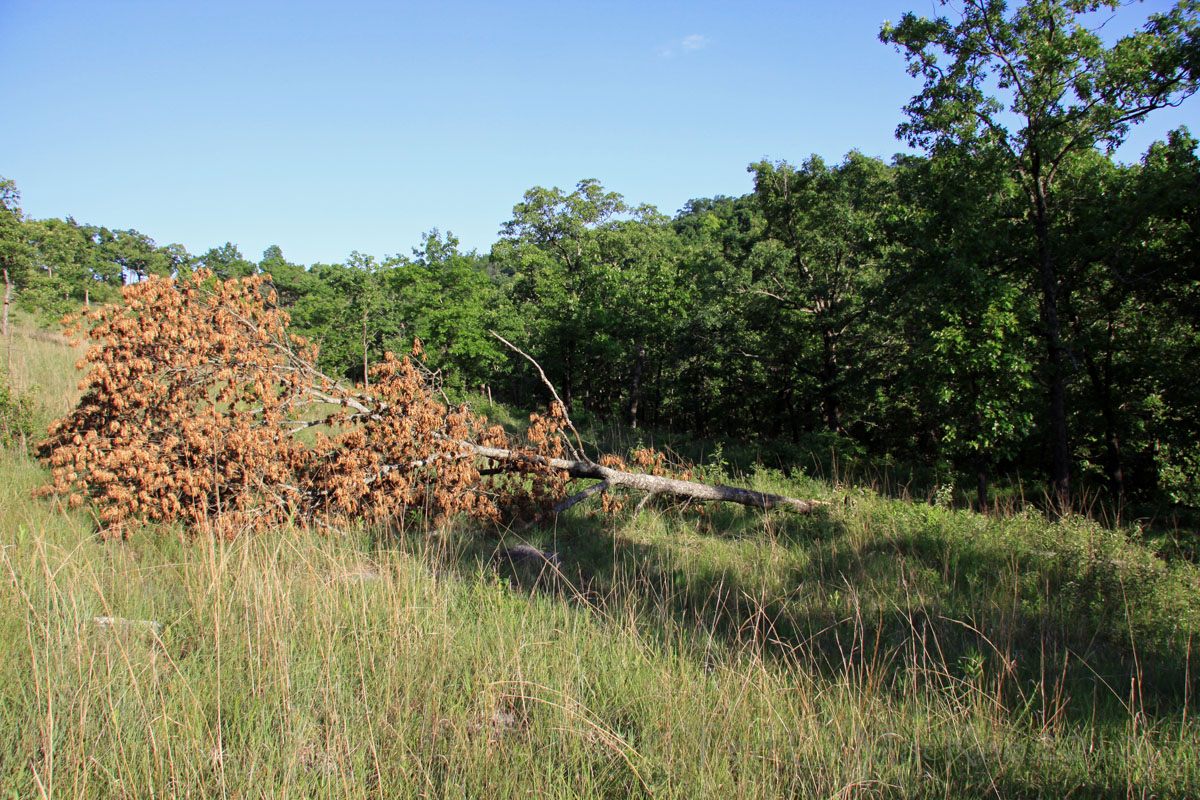
One of the few highlights of my Memorial Day weekend collecting trip came in the earliest moments of my visit to Ha Ha Tonka State Park. My destination was Ha Ha Tonka Savanna Natural Area, and a short walk through fire-restored woodland led me to the open glade where just a few years earlier a UMC student had collected the rare and little-known Agrilus impexus. Entering the glade, I was all set to begin sweeping the vegetation along the woodland/glade interface, paying special attention to any honey locust (Gleditsia triacanthos) that I might happen to find in the area as a potential host for the beetle. What I saw instead as the glade opened up in front of me was a sight that any collector of wood-boring beetles will find almost irresistable – a recent wind-throw! In this case, it was a black oak (Quercus velutina) laying in full sun – its bright brown leaves suggesting that it had fallen within the past few weeks (and would thus still be emitting the volatiles that wood-boring beetles find so attractive). I wanted to begin looking for A. impexus, but I knew there would be beetles actively crawling on the trunk and branches of that tree. I couldn’t resist it – I dropped my sweep net and beating sheet and made my way to the tree (in the end it didn’t matter, since no other beetles – including A. impexus – would be seen that day).

I already had an idea what I might find. Recent wind-throws are the domain of Chrysobothris, and if the tree is a deciduous species then this means members of the Chrysobothris femorata species-group. I recently featured one of six newly described members (C. caddo) of this taxonomically challenging group (Wellso and Manley 2007), providing a synopsis of the now twelve species in the group and their primarily host preferences. Fully half of these are associated primarily or exclusively with oaks – four occurring in Missouri (quadriimpressa, rugosiceps, shawnee, and viridiceps). Of these, C. quadriimpressa is the most commonly encountered (although the others are by no means uncommon), and all of the nearly dozen or so beetles I found on this particular tree in fact represented that species. Confirmation of my ID would require microscopic examination of the female pygidium (which is shallowly impressed on each side of the middle) and male genitalia, but in general this species can be distinguished in the field by its smallish size (~10-12 mm in length – rugosiceps and shawnee tend to be larger) and the post-median pair of foveae (circular impressions) on the elytra being joined (they are distinctly separated in viridiceps).
As we’ve seen with other species of jewel beetles (e.g., C. caddo, Dicerca lurida, D. obscura), adults of C. quadriimpressa are incredibly cryptic and nearly impossible to see on the bark of their hosts – at least until they move. They are notoriously difficult to approach – their large eyes and penchant for rapid escape flights suggesting excellent vision. This is a useful capability for insects that must expose themselves to would-be predators (and beetle collectors) during daylight hours while actively searching dead trees for mates and oviposition sites. One thing I can’t figure out, however, is the role of the intensely blue feet in this and other cryptically colored Chrysobothris species (see also C. caddo). Any ideas?
Photo Details (insect): Canon 50D (ISO 100, 1/250 sec, f/16), Canon 100mm macro lens w/ Kenco extension tubes (68mm), Canon MT-24EX flash (1/4 ratio) w/ Sto-Fen diffusers. Post-processing: levels, unsharp mask, minimal cropping.
REFERENCES:
Wellso, S. G. and G. V. Manley. 2007. A revision of the Chrysobothris femorata (Olivier, 1790) species group from North America, north of Mexico (Coleoptera: Buprestidae). Zootaxa 1652:1–26 (first page only).
Copyright © Ted C. MacRae 2010


…when it is a hickory borer!

Hickory borer (Megacyllene caryae) mating pair on trunk of fallen mockernut hickory (Carya alba).
The hickory borer, Megacyllene caryae, is perhaps the most frequently misidentified beetle in eastern North America due to its almost perfect resemblance to the closely related locust borer, M. robiniae. Unlike the latter species, however, which is encountered abundantly during the fall on flowers of goldenrod (Solidago spp.) and attacks living black locust (Robinia pseudoacacia), the hickory borer is active only during the spring and breeds in the dead wood of hickories (Carya spp.). Adults emerge from the wood as soon as temperatures begin to warm in early spring, a fact which causes it to be most frequently encountered during winter when it emerges indoors from firewood brought in from outdoors. Many times this causes the alarmed homeowner to post a photo of the insect on BugGuide and ask if it will cause damage to their home. So close is its resemblance to the locust borer that novice insect enthusiasts often identify it as such based on comparison to photos and refuse to believe it is not that species, even when told otherwise.
Of course, there are distinguishing characters that, with a little practice, become quite obvious – the legs of the hickory borer are often distinctly reddish (as seen in the above photo), and the bands of the elytra will many times show an alternating pattern of yellow and white (not quite so apparent in the above photo). The elytral bands are also slightly narrower and often broken and incomplete in this species, while in the locust borer they are wider and nearly always extend completely across the elytra. Lastly, the pronotum of the locust borer is narrowly margined with yellow on the anterior edge, while in the hickory borer the anterior margin is black. That’s a tough character to see without magnification, and all of these characters really are only necessary when examining specimens in a collection (and even then only if there is no date on the collection label). Season is the easiest distinguishing character – if it occurs during spring it is the hickory borer, and if it occurs during fall it is the locust borer. There are several other species in the genus that can be confused with these two, but they do not occur in eastern parts of North America.
This mating pair was encountered on the trunk of a recently wind-thrown mockernut hickory (Carya alba) during our early April hike of the lower Wappapello Section of the Ozark Trail.
Photo Details: Canon 50D (ISO 100, 1/250 sec, f/14), Canon 100mm macro lens, Canon MT-24EX flash (1/4 ratio) w/ Sto-Fen diffusers. Typical post-processing (levels, unsharp mask).
Copyright © Ted C. MacRae 2010
Nobody figured out exactly what I was doing in the photograph shown in the previous post (does anybody now see the whirligig beetles in the lower left corner of the photo?), but I sure enjoyed the guesses. Several people alluded to dropping the camera or falling into the water, while others mentioned my heretofore unrevealed contortionist abilities. However, Morgan Jackson‘s tale of trying to photograph Platypsyllus castoris has it all – rarely photographed species and the inordinate lengths we go through to get the shot.
Of course, whirligig beetles (family Gyrinidae) are much more commonly encountered than Platypsyllus castoris, but they can’t be any easier to photograph. I spotted them as Rich and I balanced our way across a massive sycamore tree trunk while crossing the Black River during our early April hike of the lower Wappapello Section of the Ozark Trail. I don’t know much more about whirligig beetles (or aquatic insects in general) than your average land-lubbin’ entomologist (in fact, I don’t think I’ve collected any since college systematics – yes, that long ago!), but for some reason I felt the need to try to photograph them. Sure, the fallen tree provided a rare opportunity to get reasonably close to these very skittish insects without having to wade, but I think it was actually just the challenge of trying to photograph something in constant zigzagging motion that appealed to me. Rich’s warnings that I would drop my camera were not enough to dissuade me, and after reaching the other side I ditched the backpack and tiptoed out with just my camera.
It seems like I’ve said this often in recent months, but these are my new hardest insect to photograph. Not only are there the usual difficulties of framing and focusing a subject that is always in motion, but that motion is fast, erratic, and unpredictable, making tracking through the lens an extraordinary challenge. Moreover, balancing precariously on a debris pile in the middle of the river strains the body and adds an element of danger (yes, I would be in deep doodoo if I dropped that camera). I kept my eye on one particular individual that was swimming nearest to me, and after watching for a bit I saw that it was making a relatively predictable circuit that passed fairly close to me each time around. I started trying to follow it through the lens and snap shots as it passed by – most of them turned out like this (actually, most of them turned out worse than this):

However, with each pass I got better, and I started getting shots with at least part of the beetle in focus. So intent I was on what I was doing that I didn’t even know Rich had taken the photograph of me in the previous post until he showed it to me afterwards (he said he wanted to document the camera drop!). Eventually I got this shot:

It’s far from a perfect photo – I had to adjust the levels because I hadn’t figured out the best lighting to use for something on the water’s surface, and the specular highlights from the flash on the forward elytron are rather extreme. But the entire beetle is in focus, and we can make a reasonable guess as to its identity. There are only two genera of whirligig beetles in Missouri – Dineutus and Gyrinus – and the large size (~12 mm in length) and hidden scutellum clearly identify this individual as something in the former genus. Moreover, the rounded elytral apices (seen on other individuals as well) narrow it down even further to just a few possible species. Unfortunately, they are distinguished primarily by ventral coloration; however, the bad first photo clearly does show dark legs, suggesting this may be D. ciliatus and not the orange-legged D. emarginatus. I don’t even really care what species it is (did you ever think you’d hear me say that?), I’m just happy to have gotten a reasonably good photograph of an insect that surely few people have photographed well.
Copyright © Ted C. MacRae 2010
On Saturday, I’ll be joining a number of other Missouri biologists as a Group Leader for a BioBlitz at Penn-Sylvania Prairie (“C” on the map above). Penn-Sylvania Prairie is a 160-acre tract of native tallgrass prairie in southwestern Missouri owned by the Missouri Prairie Foundation. I’ll be leading the “Beetles” group (of course), and as far as I can tell there has been little to no work done to survey beetles in this prairie. Late May is an awesome time to look for beetles in southwestern Missouri, and with the forecast calling for sunny skies with highs in the mid-80’s, what better opportunity to add an extra day to an already long holiday weekend and do a…
The BioBlitz is not until Saturday afternoon, so I’ve padded the itinerary with a few nearby southwestern Missouri spots that I’ve wanted to visit for some time now. The first stop will be Ha Ha Tonka State Park (“B”) and its mosaic of dolomite glades and post oak savanna. My interest in this area stems from two jewel beetle specimens collected there by a student at the University of Missouri, who gave them to me for identification. These two specimens caused a stir when I first saw them, as I could not definitely ID them – they resembled Agrilus impexus, a common inhabitant of the desert southwest and Mexico, but they were much larger and, of course, were found in Missouri. These specimens played a key role in clearing up a case of taxonomic confusion on the identity of Agrilus impexus when I sent them to U.S. Agrilus-guru Henry Hespenheide. Through comparison with type specimens, he determined that these were among a smattering of specimens collected across the Great Plains that represent the true A. impexus, while the common southwestern U.S. species to which the name had long been applied was actually an undescribed species. He described the latter as Agrilus paraimpexus (Hespenheide 2007), and the true A. impexus remains rare and little known. Obviously, my two specimens are the only ones known from Missouri, and indeed only one other specimen of this species has been collected in the past 60 years! I know that makes finding it a long shot, but the student who collected them told me he swept them from woody vegetation along the edge of a glade at Ha Ha Tonka Savanna Natural Area. I suspect they may be associated with honey locust (Gleditsia triacanthos), thus, I will have my beating sheet and will be beating lots of honey locust on Friday – wish me luck!
On Sunday, I’ll work my way slightly northeast to some of the sandstone glades that are found in St. Clair Co. where the Osage Plains to the west transition into the Ozark Highlands to the east. The two most interesting of these are Lichen Glade Natural Area (“D”) and Dave Rock Natural Area (“E”). Here, sandstone glades and bluffs are surrounded by dry and dry mesic sandstone woodlands dominated by post oak (Quercus stellata) and blackjack oak (Quercus marilandica). Many years ago, I beat a single specimen of Agrilus frosti off of post oak at Lichen Glade. I have not collected the species since, and I know of only one other Missouri specimen collected by state agriculture personnel in a malaise trap in central Missouri. I also hope to photograph the lichen grasshopper (Trimerotropis saxatilis), which I have seen commonly at both of these sites. This Great Plains species is at its eastern limit of distribution in Missouri, occurring exclusively on sandstone and igneous glades where its cryptic coloration makes it nearly invisible against the acidic, lichen-covered rocks that dominate these habitats.
Otherwise, I have no specific goals for the trip, but as late May is prime time in this area for jewel beetles, I’ll be doing lots of general beating on the oaks and hickories that many species in this family favor as hosts for larval development.
REFERENCE:
Hespenheide, H. A. 2007. The identity of Agrilus impexus Horn, a new species, and taxonomic notes and records for other Agrilus Curtis species (Coleoptera: Buprestidae). Zootaxa 1617:57–66.


 Beetles In The Bush