Friday Flower – Pawpaw

As my friend Rich and I stood in the verdent understory admiring the spectacular panicles of red buckeye punctuating the green lushness, a small brown flower on a leafless branch above me caught my eye.  “Pawpaw!” I exclaimed, perhaps partly in amazement that it took us awhile to notice the trees that were, in fact, all around us.  Pawpaw (Asimina triloba) is a member of the only temperate genus in the otherwise exclusively tropical and subtropical family Annonaceae (Custard Apple Family).  Although not nearly as restricted in occurrence in Missouri as the red buckeyes with which they were growing, they are nevertheless always a treat to see. Scattered throughout the state, they can be found growing in bottomland forests, ravines in mesic upland forests, along woodland streams, and at bases of bluffs (Yatskievych 2006).

Pawpaws are, of course, famous for their large edible fruits, sometimes called Indian bananas, Missouri bananas, Michigan bananas, [insert eastern state here] bananas, etc.  Technically, however, the pawpaw fruit is a berry, since it is derived from a single pistil and has multiple seeds embedded within the pulpy matrix.  I’ve not tried the fruit myself, not for lack of desire but rather an inability to find them when they ripen in fall before the birds and mammals get to them.  Some effort has been made to cultivate the plant for fruit production, but low fruit set seems to be a persistent problem due to reproductive self-incompatibility.
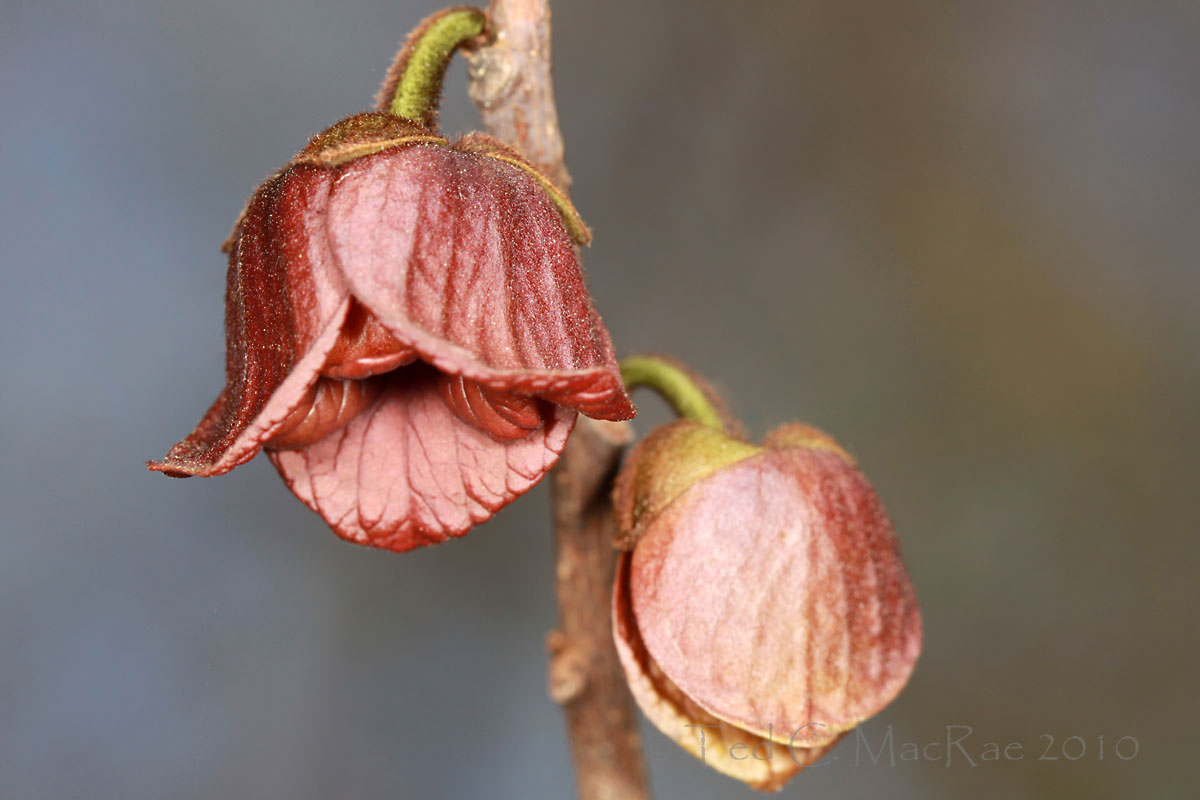
Pawpaw also famously serves as the larval food plant for the zebra swallowtail butterfly, Eurytides marcellus (family Papilionidae).  Beyond this, however, there seem to be not many insects associated with the plant.  I have collected dead wood of pawpaw in an effort to determine the species of wood-boring beetle species that are associated with it.  The only species I’ve reared is the longhorned beetle, Elaphidion mucronatum (whose common name “spined oak borer” belies the fact that it is one of the most polyphagous of all North American species), and two other longhorned beetles, Eupogonius pauper and Urgleptes querci (also highly polyphagous), have also been reported being reared from dead wood of this plant.  I have not associated any jewel beetles with pawpaw, nor have any such associations been reported in the literature.  It would appear that woodboring beetles are not fond of the soft, weak wood of pawpaw, perhaps due to the plant’s annonaceous acetogenins with known pesticidal qualities (Ratnayake et al. 1993) (acetogenins are also under investigation as anti-cancer drugs).  Other poisonous compounds, chiefly alkaloids, are found in various parts of the plant, especially the seeds and bark, and likely play a role in herbivore defense. Insect pollinators also seem to be infrequent, as I have not noted any insects on its flowers. Most members of the family are pollinated by beetles (Yatskievych 2006), but the meat-colored, downward-facing, not-so-sweet-smelling flowers of pawpaw suggest pollination by flies, perhaps those attracted to carrion.

REFERENCE:

Ratnayake, S., J.K. Rupprecht, W.M. Potter, and J.L. McLaughlin. 1993. Evaluation of the pawpaw tree, Asimina triloba (Annonaceae), as a commercial source of the pesticidal annonaceous acetogenins. p. 644-648. In: J. Janick and J.E. Simon (eds.), New Crops. Wiley, New York.

Yatskievych, G. 2006. Steyermark’s Flora of Missouri, Volume 2. The Missouri Botanical Garden Press, St. Louis, 1181 pp.

Copyright © Ted C. MacRae 2010

Add to FacebookAdd to DiggAdd to Del.icio.usAdd to StumbleuponAdd to RedditAdd to BlinklistAdd to TwitterAdd to TechnoratiAdd to Yahoo BuzzAdd to Newsvine

Email to a friend

Beetle Collecting 101: Dress for Success

For most of the nearly 3 decades that I’ve been collecting insects, beetles have been my primary interest – first longhorned beetles, then jewel beetles, and now more recently tiger beetles (each taxon an addition, not a replacement!). During that time, I’ve learned a thing or two about the art of collecting – some of which I’ve figured out for myself, much more a result of my good fortune to have spent time in the field with the likes of Gayle NelsonChuck Bellamy, and a number of other learned entomologists.  In view of this, I thought there might be interest in an occasional post on some aspect of my approach to collecting beetles. With that, I introduce my new series, “Beetle Collecting 101,” and since it all starts in the field, this first installment will consider my basic outfit for field collecting. Although my focus is beetles (and specific groups of beetles at that), this basic outfit is widely applicable across most insect groups. There are a number of additional items that I can and do bring into the field with me at various times depending on location and season or for specific collecting techniques (e.g., beating, blacklighting, pitfall/bait trapping, etc.) that won’t be covered here – these additional items could be covered in future posts if this post indicates sufficient interest. Other future post ideas I had include rearing, specimen processing (everything from pinning and labeling to batch processing and storage methods), and collection organization/curation. Comments and suggestions welcome.

Beetle Collecting 101: Dress for Success

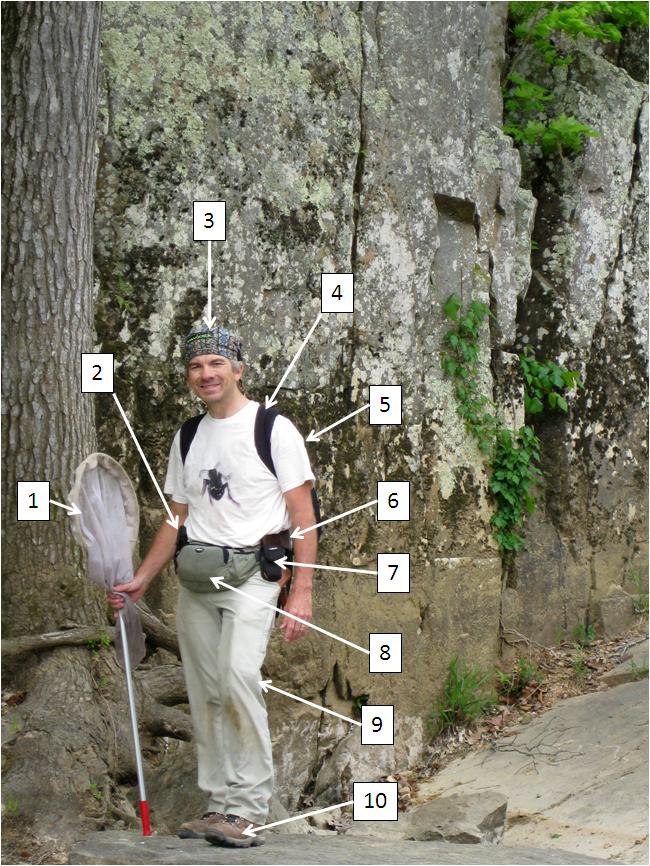
A well-dressed entomologist. Photo by Rich Thoma.

Beyond the needed equipment, the primary considerations for my field outfit are lightweight, comfortable, and protective.  I can spend hours away from the truck in extreme conditions or rugged terrain (or both!), so I want clothing that stays comfortable no matter how much I exert myself.  It is also tempting to carry more equipment than is necessary – this only adds weight and limits the ground that can be covered.

  1. Insect net – duh!  This is an absolute necessity for nearly all but the purely flightless species.  I highly recommend an extendable net handle – I keep mine collapsed (3′ length) for normal use and extend it out to 6′ when stalking tiger beetles or other wary, flighty species.  The collapsed net handle is also a good length and weight to serve as a beating stick when I am carrying a beating sheet (not shown).  I use an aerial net bag, since I don’t do much sweeping anymore – match the bag to your interests.  Of the three common ring diameters for aerial nets, I find the 15″ to be more effective than the 12″, while the 18″ is a little unwieldy.  Green fabric is said to be not as visible to insects as white, thereby allowing closer approach before they attempt to flee, but I do not have any experience with this.  I have collected quite a lot of beetles with my white net bag and appreciate the ability to see the contrast of the insect inside the bag when attempting to remove it.
  2. Hunting knife.  If you’re interested in wood-boring beetles, you’ll want to be able to slice into dead branches suspected of harboring insects.  I like the classic folding Buck Knives Ranger and attach it to the strap of my waist pack (#8) rather than my belt so that it will move with the pack when I swing the pack around backside.
  3. Hat.  If the sun doesn’t bother you, the flies will.  Wear something light and comfortable that will absorb sweat – I like my 2-decades old Mombosok for this (and because I be stylin’!), but those with greater sun sensitivity (or who live in tropical environments) might do better with a brimmed hat.
  4. Backpack.  Before my camera carrying days, this was a Camelbak hydration pack with a good-sized but not overly large water reservoir and zippered pouches with newspaper for placing host plant samples for pressing.  A backpack isn’t really necessary for short forays or mild conditions but is essential for hiking longer distances in hot/dry climates where there is real risk of dehydration.  Many regard backpacks as uncomfortable; however, I find slinging water containers attached to the waist equally annoying and also cumbersome to deal with when crouching or laying.  These days, however, I carry full camera gear in my backpack (camera body, multiple lenses, extension tubes, flash unit).  This adds weight, but it only took a day or two during my first field trip to get used to it.  I still use the camera pack for carrying water, as the front compartment has room for two water bottles or a Camelbak bladder, and my pack also contains a separate zippered compartment where I can still place plant samples for pressing.
  5. Lightweight t-shirt.  I used to wear buttoned fishing shirts over an undershirt, thinking the undershirt would keep perspiration off my skin, while the pockets on the outer shirt would come in handy for holding small items.  In reality, things fall out of the front pockets, and both under- and outer layers would become soaked with sweat.  Now I wear simple 100% cotton t-shirts – artfully emblazoned with an image of Cicindela ancosisconensis by Kirk Betts at The Wild Edge (and leaving no doubt to curious onlookers as to what I am up to).  I find these simple  shirts to be the most comfortable in the most extreme conditions.
  6. Hand axe.  Again, if you’re interested in beetles that live in wood, an axe will be handy for chopping into wood too large or hard to sample with a hunting knife.  Smaller is better (to limit weight), and rather than using a leather holster (which will become soaked with sweat and stretched out), I simply slip the handle under the strap of my waist pack and let the head of the axe rest on the strap to hold it in place.
  7. GPS Unit.  You do record GPS coordinates for your specimens, don’t you?!  I just got a new one for my birthday (Garmin Oregon 450t) with computer download capabilities – no more manual transcribing of data!  Again, I attach it to my waist pack strap rather than my belt.
  8. Waist pack.  I use the very compact Eagle Creek Wayside, with two zippered pouches and an unzippered side pouch to hold all my vials and small tools.  I’ve tried a number of different methods for holding these items – they fall out of shirt pockets whenever you bend over, are not readily accessible when in a backpack, and do not stay organized in a non-compartmented pack.  I have developed a system of vials that serve as both killing bottles and storage containers (this alone could be the subject of another post) – 4-dram vials for most specimens and 8-dram for larger ones.  This waist pack holds 8 small and 6 large vials in the front pouch – with the two sizes kept separate by a divider.  Being able to carry numerous vials allows me to segregate insects by host plant or ecological association, and most importantly, vials in this pouch stay organized so I can easily find the proper vial when I need it.  The larger rear pouch is roomy enough to hold two small olive bottles (for the occasional behemoths or blacklighting), forceps, aspirator, and miscellaneous other items – or, if I’m in the mood to collect wood for rearing (also could be the subject of another post), pruning shears, small folding saw, twine, flagging tape, and permanent marker.  A small side pouch is perfect for keeping a hand lens and an eye dropper bottle of ethyl acetate killing agent at the ready.  Also, the pack easily swings around to my backside when I need to crouch or lay prostrate (e.g., when photographing tiger beetles).
  9. Lightweight polyester/cotton outdoor pants.  I’m fond of the Columbia line of products, but whatever brand you choose, make sure they are lightweight, have a relaxed fit (to allow crouching) and dry quickly (no denim jeans for me!).  The last thing I want is chafing from sweat-soaked pants – yikes!  (Let’s just say lesson learned the hard way).
  10. Hiking boots.  Again, lightweight and comfortable are key, and because of the sometimes rugged terrain I traverse I like mid-ankle support so I can watch for bugs instead of constantly watching my feet.  The lighter the boot, the longer you’ll be able to hike with comfort, and leather uppers will provide greater protection from thorns.

I hope you’ve found some useful tips here.  If you have your own techniques or experiences with field outfits, I’d love to hear them.  Also, if you have subjects that you would like covered in future issues of “Beetle Collecting 101,” please do let me know.

Copyright © Ted C. MacRae 2010

Add to FacebookAdd to DiggAdd to Del.icio.usAdd to StumbleuponAdd to RedditAdd to BlinklistAdd to TwitterAdd to TechnoratiAdd to Yahoo BuzzAdd to Newsvine

Email to a friend

Monday Moth – Trichaeta pterophorina

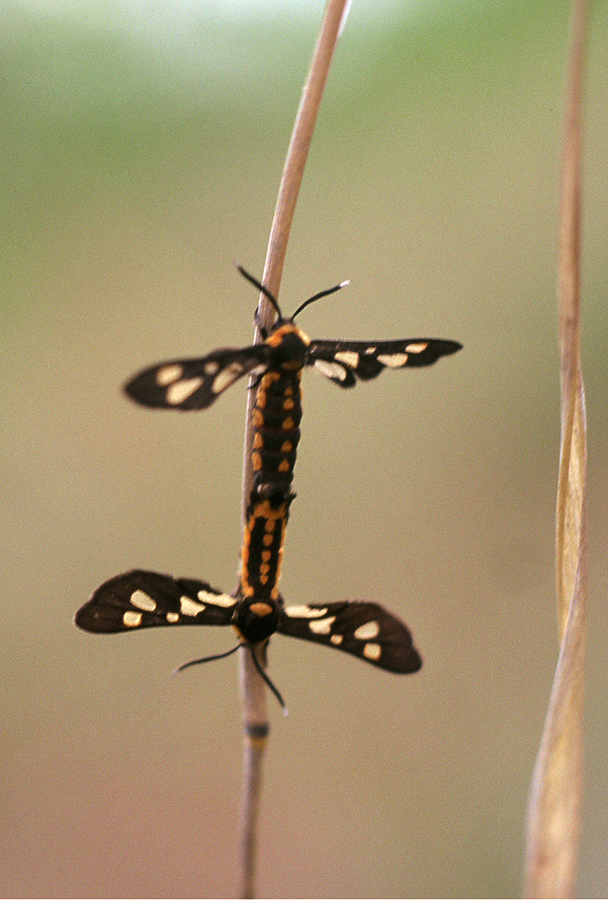
 Trichaeta pterophorina – Borakalalo National Park, South Africa

Another photo from the South Africa files, and one that continues the mimicry theme that has been featured in several recent posts. It’s not a great photograph – the focus is off – but the colors these moths sport are dazzling, and there is a nice symmetry to their tail-to-tail mating position.

Roy Goff, author of the website African Moths, tells me this species is the Simple Maiden (Amata simplex) in the family Arctiidae (whose ~2,000 species worldwide are increasingly considered a subfamily of the already enormous Noctuidae) [update 6/20/2012—Martin in a comment considers these moths to actually represent Trichaeta pterophorina in the same subfamily].  Its gestalt – greatly resembling a stinging wasp – brings to mind the so-called “wasp moths” of North America (subtribe Euchromiina); however, maidens belong to the exclusively Old World Syntomina.  Like the wasp moths, most maidens are exceptionally colorful and exhibit clearly aposematic patterns.  While these might seem to be textbook examples of Batesian mimicry, most species in this group are also protected by distasteful secondary plant compounds that they sequester through feeding, making them Mullerian rather than Batesian mimics.  These compounds are not only acquired by larvae from their food plants, but also by adult moths who imbibe them from fluid regurgitated through their proboscis onto dried parts of plants containing the compounds and into which they dissolve.

Their aposematism is not limited to strictly visual cues.  An Australian species, Amata annulata, is known to regularly emit ultrasonic clicks when flying, thought to be aposematic behavior to warn bats of its distastefulness in the same way that that its coloration warns daytime predators. Additional defensive characters that have been described for species in the group include frothing and extrusion of defensive processes. Clearly, maidens are leaders in the arms race among the insects!

Copyright © Ted C. MacRae 2010

Add to FacebookAdd to DiggAdd to Del.icio.usAdd to StumbleuponAdd to RedditAdd to BlinklistAdd to TwitterAdd to TechnoratiAdd to Yahoo BuzzAdd to Newsvine

Email to a friend

My first jumping spider

As a long-time professional and avocational entomologist, I find beauty and fascination in all manner of joint-legged creatures. Of course, beauty is in the eye of the beholder, and most people don’t exactly share my passion for these animals. Sure, butterflies enjoy almost universal approval, but beetles are just too crunchy, flies too filthy, wasps too aggressive, and cockroaches… well, eww! Even crabs and lobsters, tasty as they are, just move too robotically to engender any feelings of affection. None of these groups, however, seem to be as universally reviled as spiders – scuttling blurs of leg and fur with beady little eyes, just waiting to launch a sneak attack with their venomous gnashers. Few other coin-sized animals can cause an otherwise lucid adult to run screaming from their bathroom with such terror.

Except jumping spiders! Jumping spiders (family Salticidae) possess many of the same traits that condemn other spiders to the ranks of the creepy – hair and venom and lots of eyes; yet they have other unique qualities that make them nevertheless endearing, almost cuddly, to all but the most ardent of arachnophobes. Their human-like “face” featuring two large, forward-facing eyes and inquisitive nature give them a charisma that almost invites interaction. Approach any other spider, and it scampers back into the nearest crevice. Jumping spiders, on the other hand, turn and face the intruder – you can almost see them sizing you up – perhaps even moving forward a little to have a better look. It makes them seem, well… intelligent. Add to that their stunning diversity (~5,000 species), dazzling colors, and the sometimes impressively elongated choppers of the males, and you’ve got the perfect recipe for charm. Bouncy, furry, smart, cute, and big bright eyes – almost sounds like a kitten!

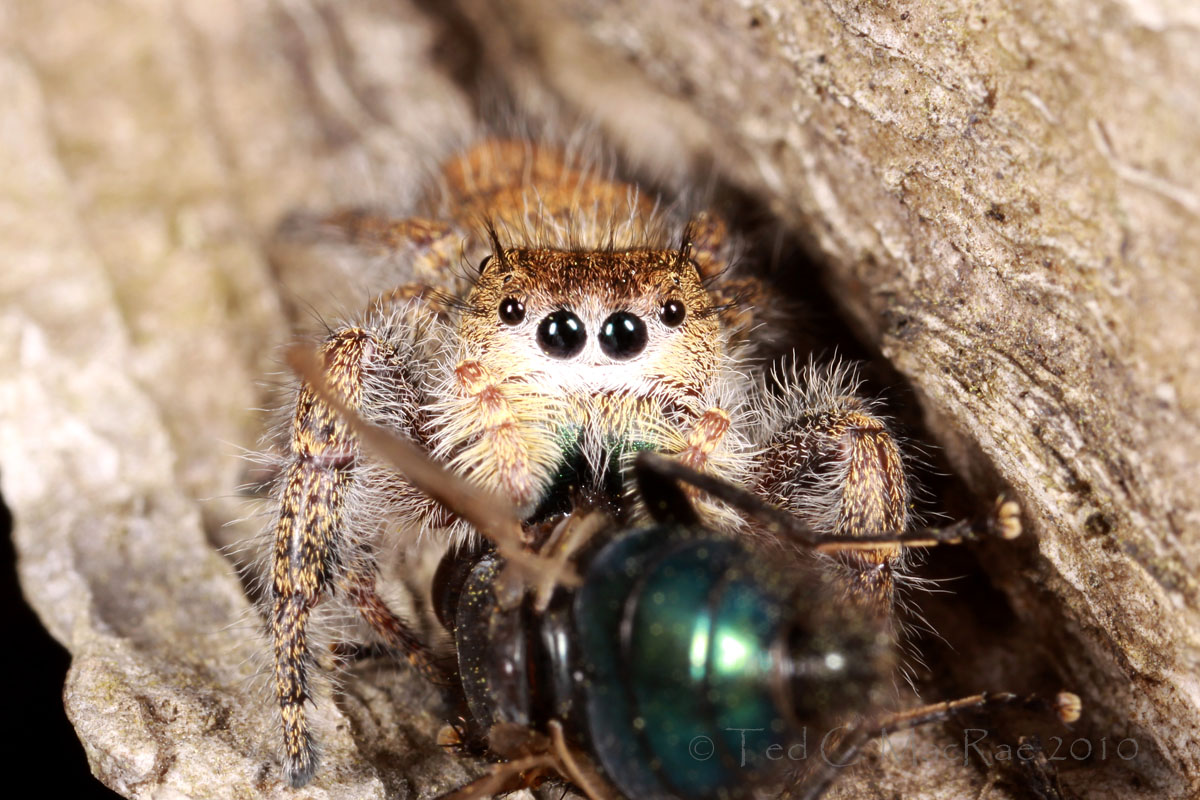
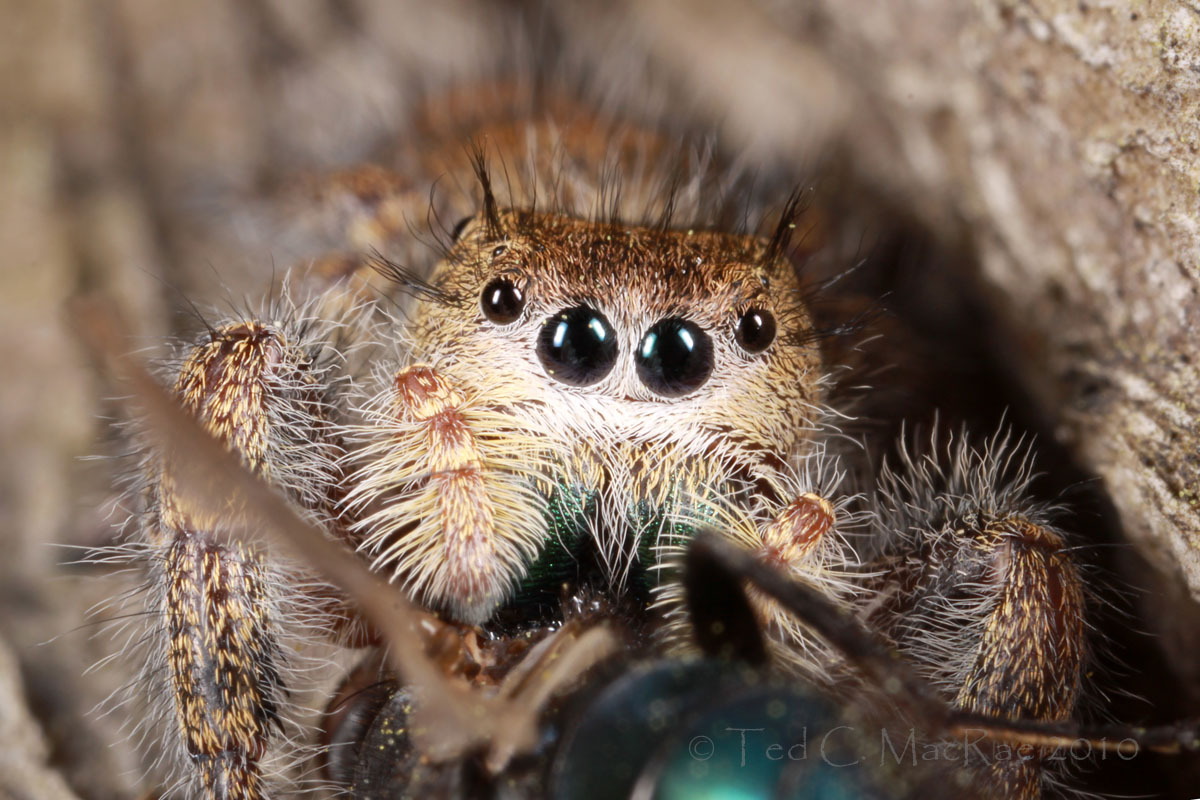
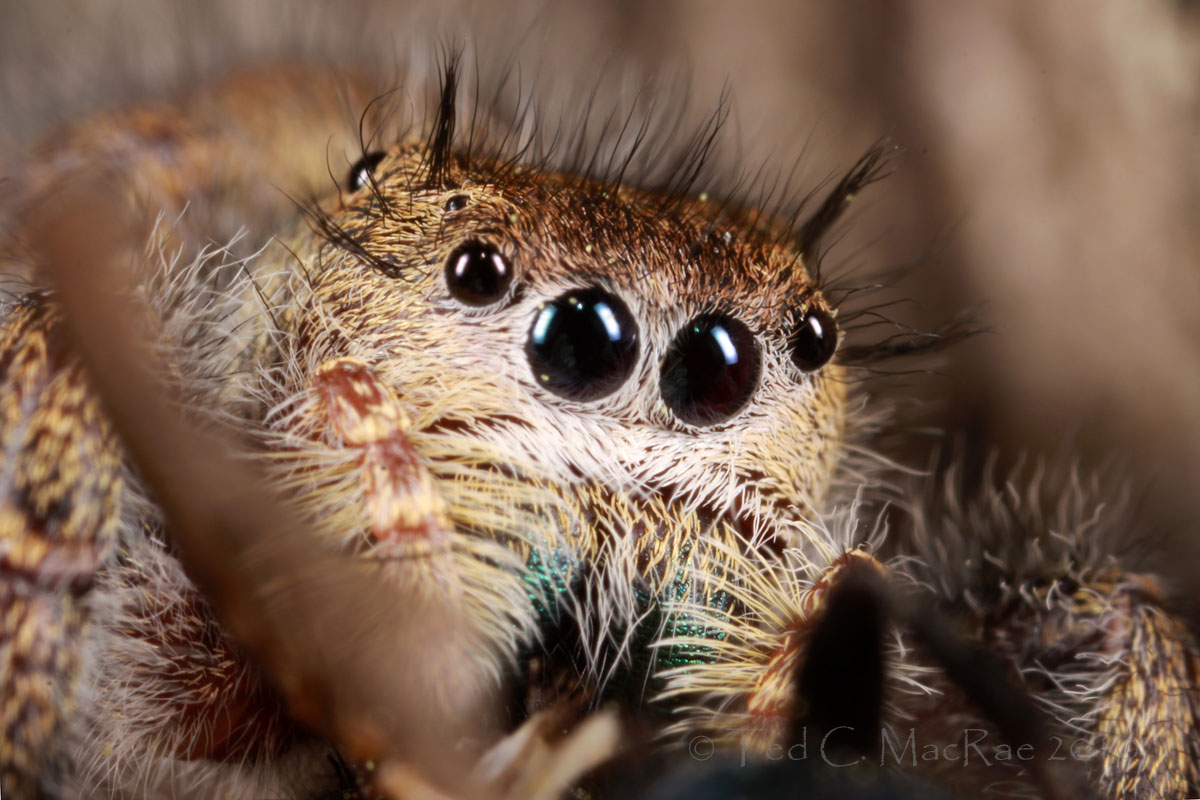
The result of all this charm is that jumping spiders are wildly popular subjects for macrophotography. Accordingly, there has been a veritable explosion of online photographs of jumping spiders, dominated by close-ups of that irresistible face. These shots here represent my first attempt to photograph one of these endearing creatures, and while I’m happy with them considering my relative newness to the field, they are a far cry from the spectacular images being produced by some other photographers. Perhaps the best of these is Thomas Shahan, whose focus-stacked facial shots of these spiders are among the most stunning that you will find. Another photographer who has produced some excellent photographs of Malaysian jumping spiders is Kurt at Up Close with Nature. Perhaps someday my jumping spider photographs will be considered on par with those that these two gentlemen are producing – if that day comes, you can say it began right here!

I’m a beetle-man, so except for a brief attempt at ant taxonomy my area of expertise lies with the Coleoptera. Nevertheless, perusing the well-stocked archives at BugGuide leads me to believe that the individual I photographed is a subadult female in the genus Phidippus – perhaps something in the putnami species-group.  I found her on a lower branch of sweetgum (Liquidamber styraciflua) in a wet-mesic bottomland forest along the Black River in Missouri’s southeastern Ozarks feeding on a blow fly (family Calliphoridae).  While relatively drably-colored compared to many other species in the family, a glimpse of her bright blue-green chelicerae (fangs) can still be seen.  I tried to get her to drop her prey to get a better look at the fangs, but she wasn’t having anything to do with that – mealtime is mealtime!

Photo Details: Canon MP-E 65 mm 1-5X macro lens on Canon 50D, ISO 100, 1/250 sec, f/13-14, MT-24EX flash 1/8 power w/ Sto-Fen diffusers. Minimal cropping and post-processing.

Copyright © Ted C. MacRae 2010

Add to FacebookAdd to DiggAdd to Del.icio.usAdd to StumbleuponAdd to RedditAdd to BlinklistAdd to TwitterAdd to TechnoratiAdd to Yahoo BuzzAdd to Newsvine

Email to a friend

Pseudomethoca simillima – a model for Enoclerus ichneumoneus?

Pseudomethoca simillima (family Mutillidae) - the model?

Enoclerus ichneumoneus (family Cleridae) - the mimic?

Last week, I posted the above photograph of Enoclerus ichneumoneus (orange-banded checkered beetle) and mentioned its possibly mimetic appearance to velvet ants in the family Mutillidae (order Hymenoptera).  By some stroke of serendipity, I encountered a species of Mutillidae the very next day in Missouri’s southeastern lowlands that seems to be a good candidate for one of, if not the, model species that E. ichneumoneus might have evolved to resemble.  Several individuals were encountered as they zigzagged urgently on dry sand deposits along the Mississippi River (where I had hoped, unsuccessfully, to find another locality for our intergrade population of Cicindela scutellaris).  Comparison of the individual in the photo with specimens in my collection (all identified by mutillid expert Kevin Williams, Utah State University) suggests this is Pseudomethoca simillima, and the photo is also a good match with other photographs of the species at BugGuide.  One thing that bothers me with the idea of this being a model for E. ichneumoneus is that I have not seen P. methoca commonly in Missouri (I have only three specimens in my collection), while E. ichneumoneus is one of our most common clerids.  There is another mutillid species in Missouri – Dasymutilla quadriquttata – that also seems to have potential as a model for E. ichneumoneus and that I have encountered much more commonly in the state.  However, D. quadriguttata is somewhat larger than E. ichneumoneus.  At any rate, other than the statement by Mawdsley (1994) that E. ichneumoneus seems to mimic mutillids, I can’t find that any more specific information has been recorded about the possible model(s) for that species.

As a caveat, I shall add that this mutillid was the… most… uncooperative… insect… that I have ever tried to photograph!  They really never stop moving, so you have to track the moving insect through the lens and fire shots when you think you’ve got it centered and focused.  Most of the time you don’t!  Using the Canon 1-5X macro lens for this did not make things any easier.  I tracked this female for quite a while and fired off a number of shots, only to get this one that I thought was fairly decent (and still just missed the focus on the near side of the pronotum).

Speaking of mutillids, I simply must photograph my specimen of Dasymutilla gloriosa (sometimes called the thistledown velvet ant) – you will not believe it!

Photo Details:
Pseudomethoca simillima: Canon MP-E 65 mm 1-5X macro lens on Canon 50D, ISO 100, 1/250 sec, f/14, MT-24EX flash 1/8 power w/ Sto-Fen diffusers. Minimal cropping and post-processing.
Enoclerus ichneumoneus: Canon 100mm macro lens on Canon 50D, ISO 100, 1/250 sec, f/14, MT-24EX flash 1/4 power w/ Sto-Fen diffusers. Minimal cropping and post-processing.

REFERENCE:

Mawdsley, J. R. 1994. Mimicry in Cleridae (Coleoptera).  The Coleopterists Bulletin 48(2):115-125.

Copyright © Ted C. MacRae

Add to FacebookAdd to DiggAdd to Del.icio.usAdd to StumbleuponAdd to RedditAdd to BlinklistAdd to TwitterAdd to TechnoratiAdd to Yahoo BuzzAdd to Newsvine

Email to a friend

Revision of the Formicidae of North America

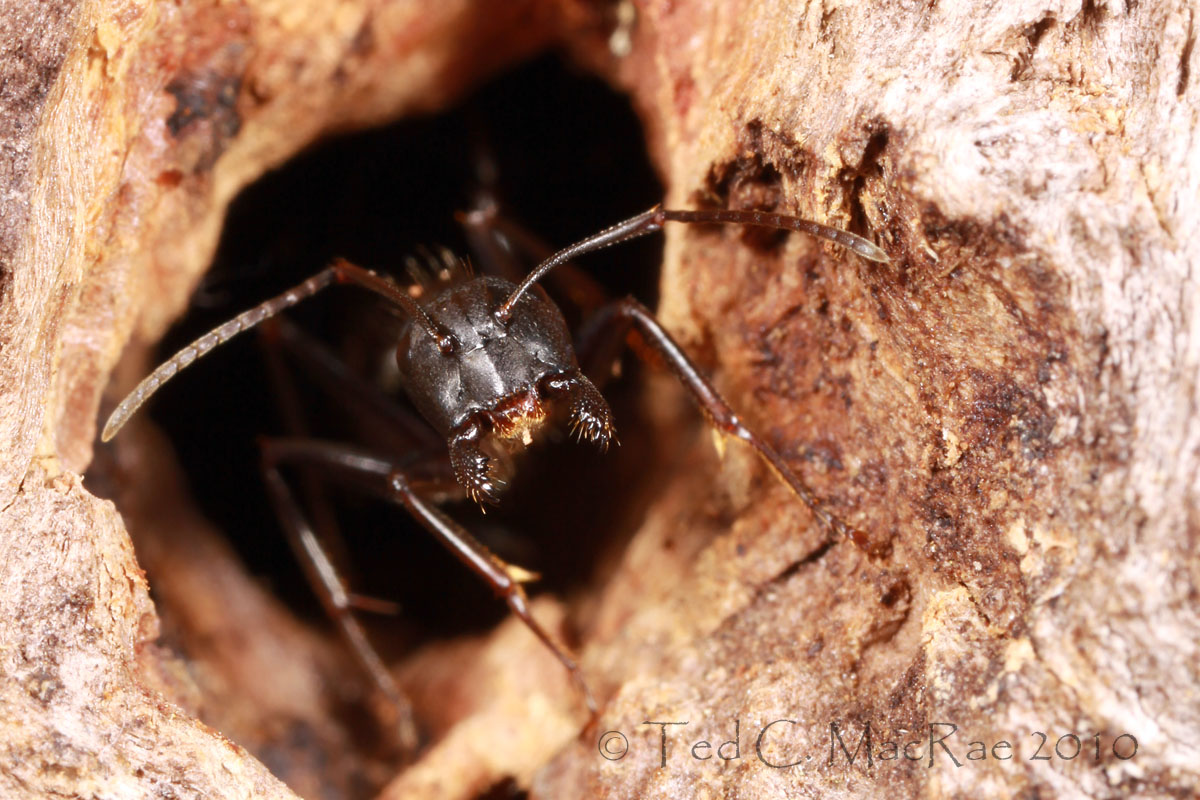
Formica meganigra guarding a nest entrance.

I recently came across this ant in the southeastern Missouri Ozarks sitting in a hole in the trunk of a standing dead black oak (Quercus velutinus) tree, apparently guarding the entrance to its nest. This big black ant is frequently associated with dead wood; however, this is the first time I’ve noticed one guarding the entrance to its nest. Other workers coming back to the nest were greeted by this individual by a quick rubbing of antennae and then allowed to pass. The close approach of my camera apparently was not very welcome by the ant, who responded by showing off his *her* impressive choppers.

In trying to determine the species name for this ant, it became clear to me that myrmecologists have made things far more complicated than they really need to be. When I was a kid, ant identification was easy – there were black ants and red ants, and within those two main guilds some were big, some were not so big, and some were really small.  Peter Yeeles alluded to this traditional classification in a recent comment at Fall to Climb, which the Geek herself later modified to recognize ants that were neither black nor red.  In that classification, this is clearly a big black ant; however, the myrmecologists have unnecessarily split this species up into multiple genera and species based on inconsequential characters such as punctures on the head, clypeal notches, hairy scapes, etc.  I propose to bring a measure of sanity back to ant identification in North America with a revised key to the family (below).  It is based on the traditional classification but also recognizes the introduction in recent years of an alien species that stings and has colonized a large part of the southern United States (we didn’t have those when I was a kid).  In offering this simplified classification, it is my hope that school children across the country – naturally curious about ants and other insects – will no longer have their budding interest squashed by the ponderous, complex ant identification system that has become so fashionable in recent years.

Photo Details: Canon MP-E 65mm 1-5X macro lens on Canon 50D, ISO 100, 1/250 sec, f/14, MT-24EX flash 1/8 power w/ Sto-Fen diffusers.

Revised Key to Formicidae of North America

.
1 Color black . . . . . . . . . . . . . . . . . . . . . . . . . . . . . . . . . . . . . . . . . . . . . . 2
1′ Color not black . . . . . . . . . . . . . . . . . . . . . . . . . . . . . . . . . . . . . . . . . . . 4
2 (1) Enormous. . . . . . . . . . . . . . . . . . . . . . Formica meganigra (big black ant)
2′ Not enormous. . . . . . . . . . . . . . . . . . . . . . . . . . . . . . . . . . . . . . . . . . . . 3
3 (2′) Regular size . . . . . . . . . . . . . . . . . . . . . . . . . . . Formica nigra (black ant)
3′ Tiny. . . . . . . . . . . . . . . . . . . . . . . . . . Formica micronigra (little black ant)
4 (1′) Color red. . . . . . . . . . . . . . . . . . . . . . . . . . . . . . . . . . . . . . . . . . . . . . . . 5
4′ Color yellow . . . . . . . . . . . . . . . . . . . . . . . . . . . . . . . . . . . . . . . . . . . . . 6
5 (4) Can sting. . . . . . . . . . . . . . . . . . . . . . . . . . . . Solenopsis invicta (fire ant)
5′ Can’t sting. . . . . . . . . . . . . . . . . . . . . . . . . . . . . . Formica rubra (red ant)
6 (4′) Regular size. . . . . . . . . . . . . . . . . . . . . . . . . . . Formica flava (yellow ant)
6′ Tiny . . . . . . . . . . . . . . . . . . . . . . . . . Formica microflava (little yellow ant)

Copyright © Ted C. MacRae 2010

Add to FacebookAdd to DiggAdd to Del.icio.usAdd to StumbleuponAdd to RedditAdd to BlinklistAdd to TwitterAdd to TechnoratiAdd to Yahoo BuzzAdd to Newsvine

Email to a friend

Orange-banded checkered beetle

As a student of woodboring beetles for more than a quarter-century now, I’ve had occasion to encounter a goodly number of checkered beetles (family Cleridae) – both in the field and as a result of rearing them from dead wood.  Checkered beetles are not as commonly encountered as other woodboring beetle families such as Buprestidae and Cerambycidae, and they also generally lack the size, diversity, and popularity with coleopterists that those aforementioned beetle families enjoy.  However, despite these shortcomings as a group, checkered beetles are among the most brightly colored and boldly patterned of beetles.  Unlike the beetles with which they often found, checkered beetles are not actually themselves woodboring beetles, but rather predators of such (particularly bark beetles in the weevil subfamily Scolytinae).

This particular species, Enoclerus ichneumoneus, is one of the more conspicuous members of the family in eastern North America.  Although the genus to which it belongs is the largest of the family (32 species in North America north of Mexico), the wide orange band across the middle of the elytra and elongate scutellum make this species distinctive and unlikely to be confused with any other.  I found this individual along the Ozark Trail in southern Missouri on a recently fallen mockernut hickory (Carya alba) – a number of other adult buprestid and cerambycid species were also found on this tree, all of which were mating, searching for mates, or laying eggs within the cracks and fissures on this new-found resource.  In the past I have encountered large numbers of adults of this species on dead willow (Salix caroliniana) from which I later reared an even larger number of a small willow-associated buprestid, Anthaxia viridicornis.  Whether the buprestid larvae served as prey for E. ichneumoneus is difficult to say, but no other potential prey beetle species were reared from the wood.

The bright, distinctive colors exhibited by many checkered beetles might seem to suggest aposematic, or warning, coloration to discourage predation; however, the question of checkered beetle palatability to predators has not been adequately studied (Mawdsley 1994).  The colors and patterns of many species, especially in the genus Enoclerus, seem to mimic species of velvet ants (family Mutillidae) and true ants, but other beetles (e.g. species of Chrysomelidae and Tenebrionidae) and even flies have also been suggested as models.  Still other checkered beetle species seem to be more cryptically than mimetically marked, and there are several tribes whose members seem to be chiefly nocturnal and are thus mostly somber-colored.

Of the 37 genera occurring in North America north of Mexico, I have in my collection representatives of more than 100 species in 23 of those genera.  The majority of that material has been reared from dead wood collected for rearing Buprestidae and Cerambycidae – much of it coming from Texas and Arizona as well as here in Missouri.

Photo Details: Canon 100mm macro lens on Canon 50D, ISO 100, 1/250 sec, f/14, MT-24EX flash 1/4 power w/ Sto-Fen diffusers, photo lightly cropped.

REFERENCE:

Mawdsley, J. R. 1994. Mimicry in Cleridae (Coleoptera).  The Coleopterists Bulletin 48(2):115-125.

Copyright © Ted C. MacRae

Add to FacebookAdd to DiggAdd to Del.icio.usAdd to StumbleuponAdd to RedditAdd to BlinklistAdd to TwitterAdd to TechnoratiAdd to Yahoo BuzzAdd to Newsvine

Email to a friend

Hello World!

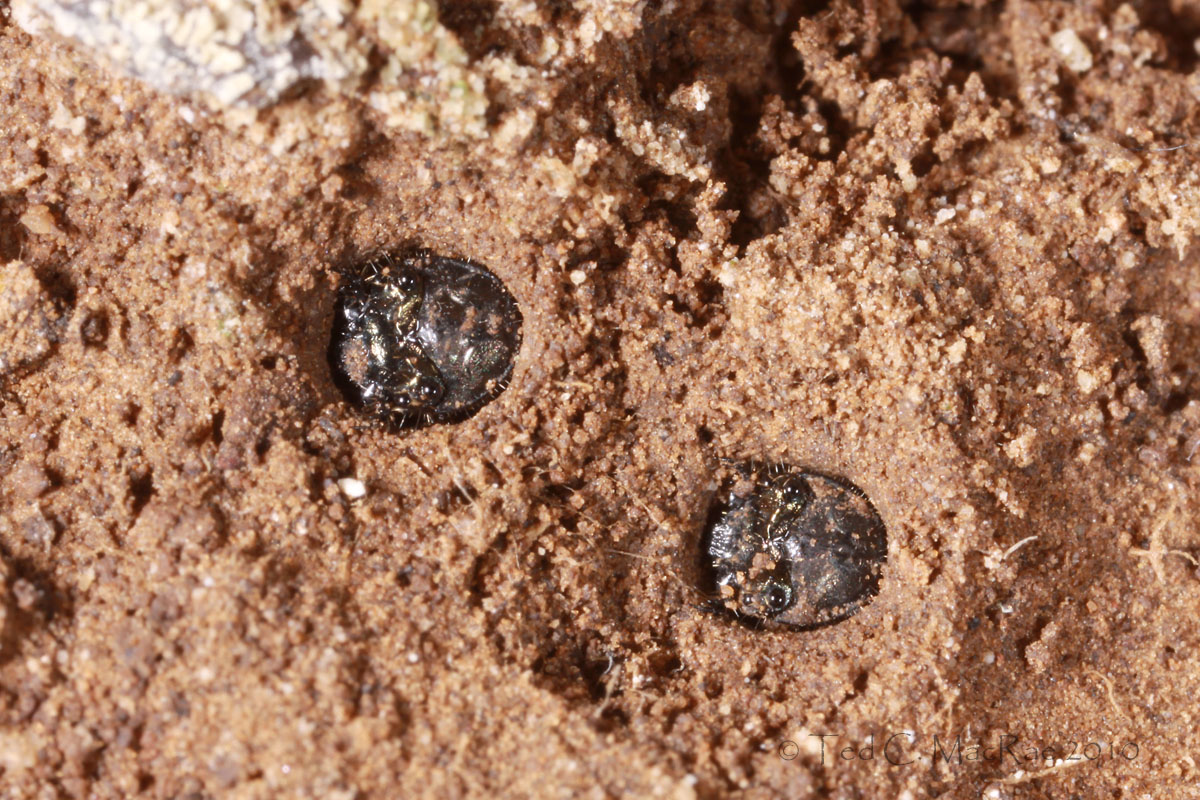
These are two of the Cylindera celeripes (swift tiger beetle) larvae that I’m rearing.  Note: nobody has ever reared this species before!  Nobody has ever even seen its larvae (before now, that is).

These larvae hatched from eggs that were laid by adults I brought back from northwestern Oklahoma last summer.  I placed the adults in a small terrarium of native soil – at first just to see if I could keep them alive, and then to see if I could get them to lay eggs.  The adults lived for about 4 weeks, and a short time later larval burrows started appearing in the soil.  I fed them once or twice a week by placing 2nd instar corn rootworm larvae in the open burrows or dumping Lygus nymphs into the terrarium and letting them catch them naturally.  I wasn’t sure this was working, because as the summer progressed I saw fewer and fewer open burrows.  By October, there were no open burrows, and I feared none had survived.  Nevertheless, I placed the terrarium in a cool (10°C, or 50°F) incubator for the winter and pulled it back out in late March.  Within one week ten larvae had reopened their burrows – I believe all but one of them are 3rd instars, which is the last instar before pupation, and since they have awoken they have fed voraciously on 3rd instar fall armyworm larvae, which I dangle above their burrow.  I love watching them snatch the armyworm from my forceps and drag the hapless prey down into their burrow.  I’ve already preserved examples of the three larval instars and will describe it shortly (although truth be told, the 2nd and 3rd instars are from larvae I found in the field – but that is a post for another day).  However, I’m keeping my fingers crossed for the piece de resistance – successfully rearing the species from egg to adult!

Photo Details: Canon MP-E 65mm 1-5X macro lens on Canon 50D, ISO 100, 1/250 sec, f/13-16, MT-24EX flash 1/8 power w/ Sto-Fen diffusers.

Copyright © Ted C. MacRae 2010
Add to FacebookAdd to DiggAdd to Del.icio.usAdd to StumbleuponAdd to RedditAdd to BlinklistAdd to TwitterAdd to TechnoratiAdd to Yahoo BuzzAdd to Newsvine

Email to a friend