Although the beetles I photographed for my springtime Acmaeodera post are among the smaller buprestids occurring in Missouri, they are by no means the smallest. That honor belongs to the curious little genus Mastogenius, measuring only around 2 mm in length and, thus, looking for all intents and purposes like little black dots. Slightly larger, but still smaller than our smallest Acmaeodera, are members of the tribe Trachyini. Adults in this group exhibit a highly derived morphology compared to other groups of jewel beetles – flat, compact, and wedge-shaped rather than the elongate, cylindrical form more commonly associated with the family. This seems in part due to their unique larval habits – mining within the leaves of their host plants rather than boring through the wood. Three genera in this tribe occur in the U.S.¹, all of which are found in Missouri. These include: 1) Taphrocerus, which mine the leaves of sedges (family Cyperaceae); 2) Pachyschelus, which mine the leaves of herbaceous plants in several families – primarily Fabaceae; and 3) Brachys, which mine the leaves of hardwoods, chiefly oaks (Quercus). It was two species in this latter genus (out of three that occur in Missouri) that I encountered a couple weekends ago at Reifsnider State Forest in Warren County (noted for its high quality example of a mature white oak forest).
¹ A species in the Old World genus Trachys was introduced to North America from Europe and is established in New Jersey.
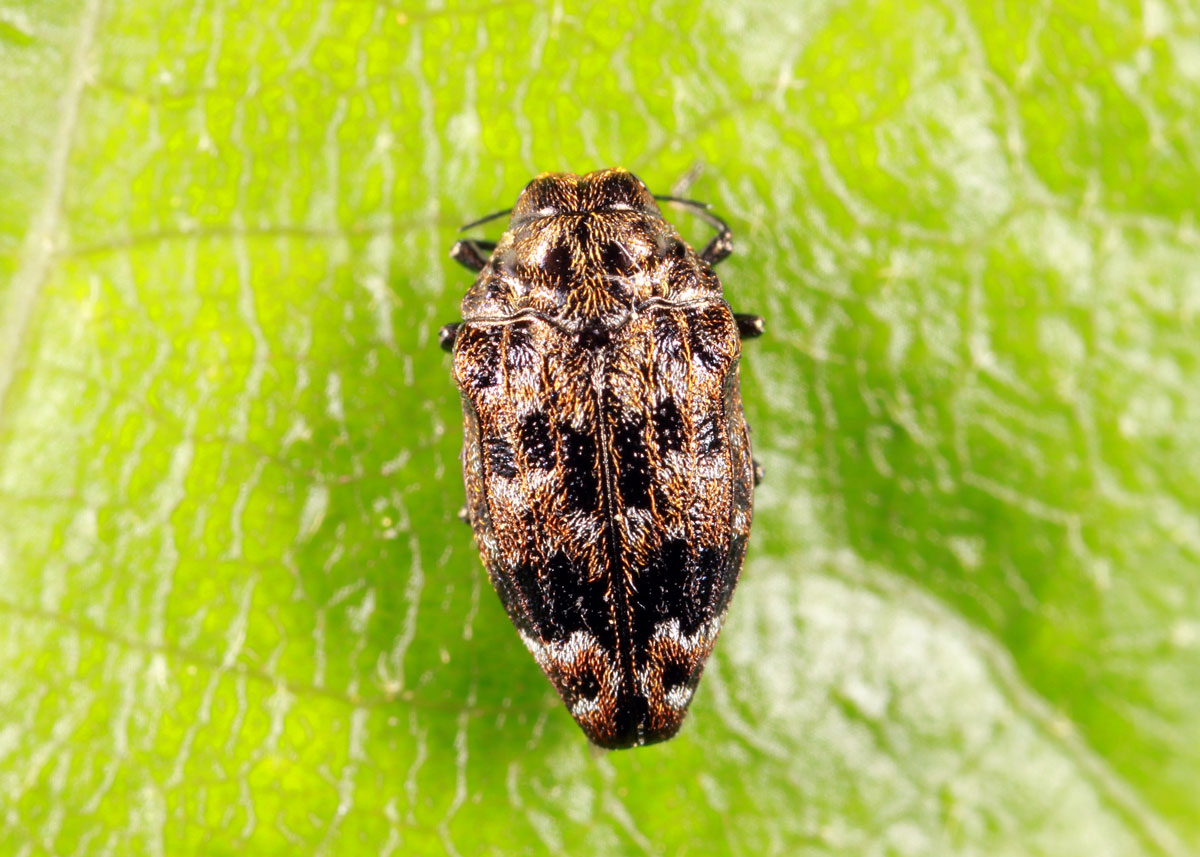
Photo details: Canon MP-E 65mm 1-5X macro lens on a Canon EOS 50D, ISO 100, 1/200 sec, f/10, MT-24EX flash 1/8 power through diffuser caps
Brachys ovatus is the largest of the three species, usually measuring a little more than 5 mm in length. In addition to size, it can also be distinguished from Missouri’s two other species of Brachys by the dense row of long hairs occurring along the apex of the last abdominal sternum. For those of you who prefer not to have to look at the underside of its butt, the white-margined band of bronze pubescence before the apex of the elytra and longitudinal rows of bronze setae in the basal half of the elytra are usually sufficient for distinguishing this species. Brachys ovatus is a common associate of oaks throughout Missouri during spring – I have collected it on ten of Missouri’s 21 oak species, including both ‘white oaks’ and ‘red oaks’. Despite its common occurrence on oak and the frequent reference to it in the literature as a leaf-miner of oaks, few reliable rearing records exist to document the range of hosts it actually utilizes. There are older reports of this species mining the leaves of other hardwoods such as beech (Fagus), elm (Ulmus), hickory (Carya), and hornbeam (Carpinus); however, the veracity of these reports is questionable, and they may refer only to incidental adult associations.

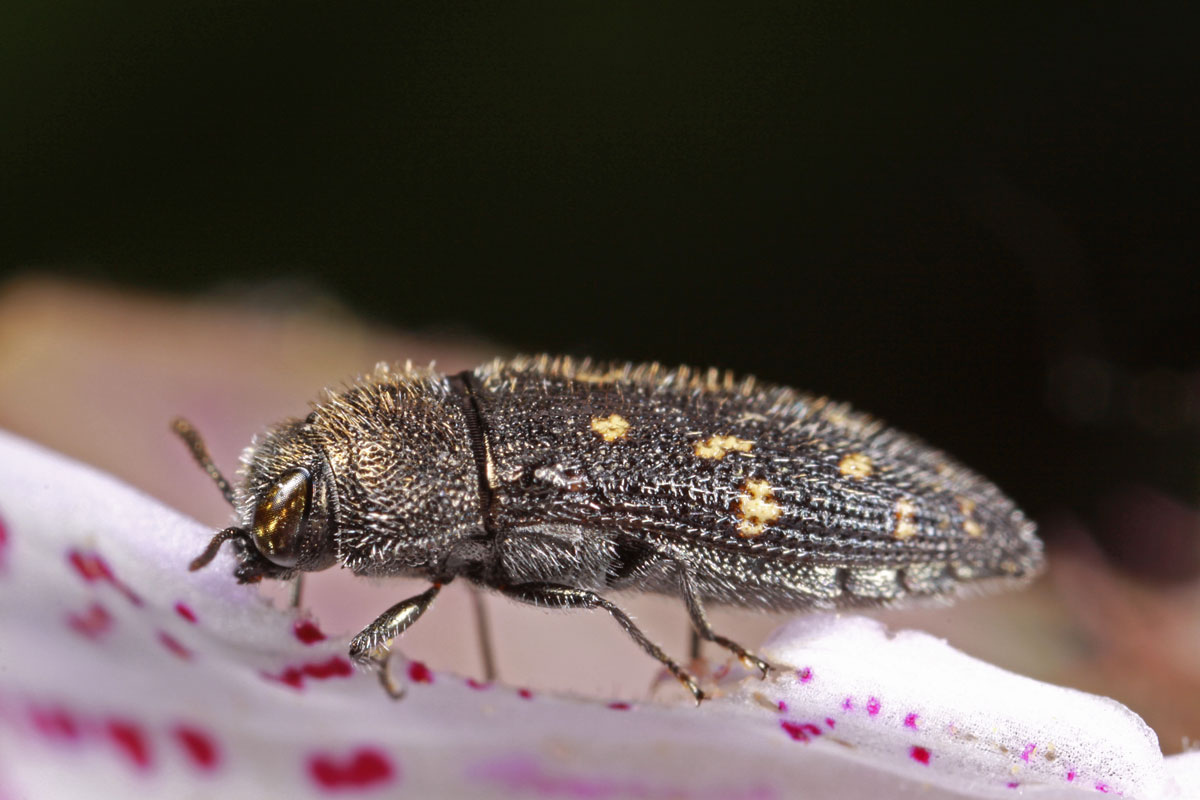
Photo details: Canon EF 100mm f/2.4 Macro Lens with Kenco extensions on a Canon EOS 50D, ISO 100, 1/200 sec, f/11, MT-24EX flash 1/8 power through diffuser caps
Brachys aerosus is another commonly encountered species. This is a highly variable and hard-to-define species, but in general it can be recognized by the basal region of the elytra largely lacking pubesence and with a purple, blue, or green luster, and by the predominantly gold to bronze pubescence covering the apical area of the elytra. Adult length is generally from 3 to 5 mm – somewhat smaller than B. ovatus, and differing also in that it is commonly associated with a variety of hardwoods besides oak. In Missouri, I have primarily collected it on oaks and elms. Literature reports – mostly old and unreliable – record as larval hosts many other hardwood genera such as chesnut (Castanea), beech, hazel (Corylus), hickory, hornbeam, linden (Tilia), poplar (Populus), and even such unlikely genera as huckleberry (Vaccinium) and grape (Vitis). Because of its variability and the broad diversity of hosts with which it has been associated, this species is suspected of acutally being a species complex. The late George Vogt spent many years making careful observations with reared material in an effort to determine species boundaries and their host associations. Unfortunately, Vogt passed away before publishing his observations, and his eccentric record keeping with cryptic notes (Anderson et al. 1991) makes it unlikely that they ever will be published. It will take some enthusiastic sole to repeat his work and publish it before we can ever know the true identity of the species hiding under this name.
A third species in the genus, Brachys aeruginosus, is smaller than either of the two above species – generally measuring only 3 to 4 mm in length. This rather uncommonly encountered species is most similar to B. aerosus in appearance but can be distinguished, in addition to its generally smaller size, by the predominantly light gold to silver setae that cover the apical area of the elytra. As with the two above species, it is most often associated with oaks but is occasionally collected on other hardwoods as well. Whether it utilizes species beside oak for larval development is unknown. I hope to find and photograph this species in the near future.
REFERENCE:
Anderson, D., C. L. Bellamy, H. A. Howden, and C. Quimby. 1991. George Britton Vogt (1920–1990). The Coleopterists Bulletin 45(1):93–95.
Copyright © Ted C. MacRae 2009









 Beetles In The Bush