A “Really” Big-headed Tiger Beetle

Megacephala megacephala 3rd-instar larva. Photo © Artur M. Serrano.

In my recent summary of the latest issue of the journal Cicindela, I included a scan of the cover of that issue and its stunning image of the 3rd-instar larva of Megacephala megacephala¹ from Africa.  This otherwordly-looking, four-eyed beast was photographed with jaws agape at the entrance to its burrow in Guinea Bissau by Dr. Artur M. Serrano (University of Lisbon, Portugal).  I was grateful for his permission to post a scan of this spectacular image; however, he did even better and sent me high-resolution images of not only the larva (above) but the adult (below) as well.  This species is one of 13 assigned to the genus—presently restricted to Africa (though not always, see discussion below), where they are usually found in savanna-type habitats and are active during the crepuscular and nocturnal periods (Werner 2000).

¹ An example of a tautonym, i.e. a scientific binomen in which the genus and species names are identical. Familiar tautonymic binomina include the gorilla (Gorilla gorilla), green iguana (Iguana iguana), and European toad (Bufo bufo). Tautonyms are expressly prohibited in plant nomenclature (see Article 23.4 of the International Code of Botanical Nomenclature) but are permitted and, in fact, quite common in zoological nomenclature; Wikipedia lists 51 mammals, 82 birds, 15 reptiles & amphibians, 54 fish, and 33 invertebrates (though not Megacephala megacephla!).

Megacephala megacephala adult. Photo © Artur M. Serrano.

For those of you who see a strong resemblance by this species to another tiger beetle I featured recently, Tetracha floridana (Florida Metallic Tiger Beetle), this is not merely a coincidence.  Megacephala and Tetracha are quite closely related, and in fact the two genera, along with a handful of other closely related genera, are at the center of one of the longest-standing disputes in tiger beetle taxonomy (Huber 1994).  The genus Megacephala was established by Latreille (1802) for the species pictured here (originally described as Cicindela megacephala Olivier).  As additional taxa were found in Africa, Australia and the Western Hemisphere and assigned to Megacephala, several workers attempted to divide the genus into multiple genera (with New World taxa being assigned to Tetracha and a few other mostly South American genera); however, there was little agreement on how these genera should be defined and on what characters they should be based.  The debate was effectively swept under the rug in the early 20th Century when Walter Horn, one of the most influential cicindelophiles of all time, accepted a monotypic Aniara based on the strange South American species A. sepulcralis but reunited the world’s remaining taxa within the single genus Megacephala in his world catalogue (Horn 1910).  Horn’s use of Megacephala as a catch-all genus was followed by subsequent workers for almost a full century until Huber (1994) once again proposed restricting Megacephala to certain of the African species and resurrecting the genus Tetracha for the bulk of the New World fauna.  He also urged additional analyses to resolve the status of the remaining generic names and their composition, which subsequently saw increasing use as subgenera of Megacephala² and later as genera.

² Thus, as type-species for the genus, the species featured here became known as Megacephala (Megacephala) megacephala (Werner 2000)—a triple tautonym that translates to the “Big-headed, Big-Headed, Big-Headed” tiger beetle!  Perhaps it’s best that I’m not an African tiger beetle specialist; I probably would have been unable to resist the temptation to resurrect M. senegalensis and assign it as a subspecies of M. megacephala, just so I could refer to the nominate form as Megacephala (Megacephala) megacephala megacephala!

The reversal of Horn’s concepts now appears to be complete, with all seven former subgenera of Megacephala formally being accorded full generic status (Naviaux 2007). This classification is strongly supported by molecular analysis of nuclear 18S and mitochondrial 16S and cytochrome oxidase gene sequences (Zerm et al. 2007), with the resulting dendrogram indicating three monophyletic clades corresponding to the African/Palearctic (Megacephala and Grammognatha, respectively),  Western Hemisphere (Aniara, Metriocheila, Phaeoxantha and Tetracha) and Australian (Australicapitona and Pseudotetracha) genera³.  The African/Palearctic clade was found to occupy a basal position in the tree, while the Western Hemisphere and Australian clades were more derived.  These data support the hypothesis that the early evolution of the megacephalines took place during the break-up of the ancient Gondwana megacontinent, which began about 167 million years ago (middle Jurassic period) and sequentially disconnected Africa from South America and Australia.

³ One striking deviation from the current classification, however, was the support for nesting the single Aniara species within Tetracha, a placement that renders Tetracha paraphyletic and, thus, requires either its division into multiple genera or the sinking of Aniara as a distinct genus. The support for this placement was quite strong and mirrored the results of a broader molecular phylogenetic study of tiger beetles based on full-length 18s RNA data (Galian et al. 2002). The authors concede that this puzzling placement is not corroborated by numerous morphological, ecological and ethological characters that distinguish Aniara from all known Tetracha species.

REFERENCES

Galián J., J. E. Hogan and A. P. Vogler. 2002. The origin of multiple sex chromosomes in tiger beetles. Molecular Biology and Evolution 19:1792–1796.

Horn, W.  1910.  Coleoptera Adephaga, Fam. Carabidae, Subfam. Cicindelinae.  In P. Wytsman (editor).  Genera Insectorum.  Fascicle 82a.  Desmet-Vereneuil, Brussels, Belgium, pp. 105–208.

Huber, R. L.  1994.  A new species of Tetracha from the west coast of Venezuela, with comments on genus-level nomenclature (Coleoptera: Cicindelidae).  Cicindela 26(3/4):49–75.

Latreille, P. A. 1802. Histoire Naturelle, Générale et Particulière des Crustacés et des Insectes. Paris: F. Dufart 3 xii 13 + 467 pp.

Naviaux R. 2007. Tetracha (Coleoptera, Cicindelidae, Megacephalina): Revision du genre et descriptions de nouveaus taxons. Mémoires de la Société entomologique de France 7:1–197.

Werner, K.  2000.  The Tiger Beetles of Africa (Coleoptera: Cicindelidae).  Volume 1.  Taita Publishers, Hradec Kralove, Czech Republic, 191 pp., 745 figures.

Zerm, M., J. Wiesner, J. Ledezma, D. Brzoska, U. Drechsel, A. C. Cicchino, J. P. Rodríguez, L. Martinsen, J. Adis and L. Bachmann.  2007.  Molecular phylogeny of Megacephalina Horn 1910 tiger beetles (Coleoptera: Cicindelidae).  Studies on Neotropical Fauna and Environment 42(3):211–219.

Copyright © Ted C. MacRae 2009

Add to FacebookAdd to NewsvineAdd to DiggAdd to Del.icio.usAdd to StumbleuponAdd to RedditAdd to BlinklistAdd to TwitterAdd to TechnoratiAdd to Furl

Ship-timber beetle

Atractocerus brevicornis

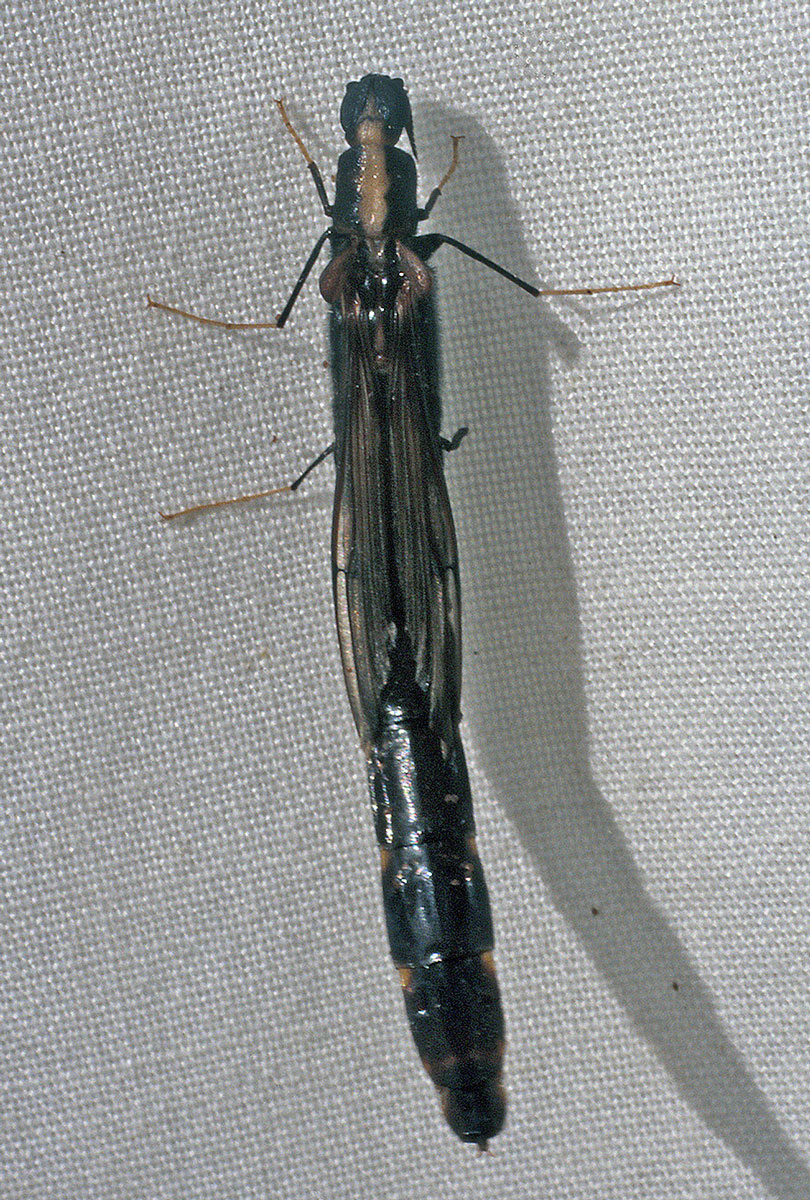
One of the more unusual, and enigmatic, beetles that I encountered in South Africa was this beetle in the pantropical genus Atractocerus.  Placed in the family Lymexylidae (ship-timber beetles), species in this genus look less like beetles than they do large flying ants or strange damselflies due to their highly reduced elytra that expose their greatly elongated abdomen and leave the hind wings uncovered.  The hind wings also are unusual in that they are held fan-like in repose rather than folded as in most other beetles.  Atractocerus brevicornis is the only species in the genus found in Africa (Scholtz & Holm 1985).

Adults are attracted to light at night, as was this individual that came to our ultraviolet light at Geelhoutbos farm below the Waterberg Range in Limpopo Province. Nothing is known about the biology of Atractocerus, but larvae of other genera are reported to bore into hardwoods and palm stems (Picker et al. 2002). Larvae of the genera Lymexylon and Melittomma are believed to form symbiotic associations with ambrosia fungi that grow on the walls of their galleries (Young, 2002).  Adult females deposit fungal spores in a sticky matrix when they lay their eggs, and the hatching larvae carry the spores into wood on their bodies.  The large eyes of Atractocerus, however, suggest a predatory lifestyle. The common name of the family originates from a northern European species that has in the past been a destructive pest of ship timbers.

Atractocerus species are rarely encountered and therefore, not well studied. Their evolutionary history is still unknown; however, the oldest known lymexylid fossil is a very primitive member of the genus Atractocerus preserved in 100 myo Burmese amber (Grimwold & Engel 2005). Thus, the lineage containing these beetles had already appeared by the mid-Cretaceous and may have originated as early as the Jurassic, a fact that has earned them the moniker “living fossils.” These beetles were once thought to be among the most primitive of all Coleoptera – their simple wing venation, almost undifferentiated antennae and tarsi, and naked abdomen being likened to a supposed neuropteran common ancestor. Most authors now consider the family to be most closely related to the cucujiform groups Cleroidea and Cucujoidea (Wheeler 1986, Young 2002), although some have placed it in the Elateriformia near the Lampyridae based on wing venation. Scholtz and Holm (1985) accepted a cucujiform placement but related the group to the Styopidae (twisted-winged parasites), apparently due to the similarity of their highly reduced forwings.  At the same time, they acknowledged the many morphological and behavioral differences between the two groups, the latter itself being the subject of much evolutionary debate due to disagreement about whether the reduced forwings of male stylopids are truly homologous to the elytra of Coleoptera (some have even suggested homology with the halteres of Diptera that were switched from the metathorax to the mesothorax as a result of homeotic mutation). Most authors now place this latter group in the separate order Strepsiptera.

REFERENCES:

Grimaldi, D. and M. S. Engel. 2005. Evolution of the Insects. Cambridge University Press, New York, xv + 755 pp.

Picker, M., C. Griffiths and A. Weaving. 2002. Field Guide to Insects of South Africa. Struik Publishers, Cape Town, 444 pp.

Scholtz, C. H. and E. Holm (eds.). 1985. Insects of Southern Africa. Butterworths, Durbin, South Africa, 502 pp.

Wheeler, Q. D. 1986. Revision of the genera of Lymexylidae (Coleoptera: Cucujiformia). Bulletin of the American Museum of Natural History 183:113-210.

Young, D. K.  2002. 71. Lymexylidae Fleming 1821, pp. 261-262.  In: R. H. Arnett and M. C. Thomas [eds.], American Beetles, Volume 2, Polyphaga: Scarabaeoidea Through Curculionoidea, CRC Press, Boca Raton,880 pp.

Copyright © Ted C. MacRae 2009

Add to FacebookAdd to NewsvineAdd to DiggAdd to Del.icio.usAdd to StumbleuponAdd to RedditAdd to BlinklistAdd to Ma.gnoliaAdd to TechnoratiAdd to Furl

Done with dung, meat please!

ResearchBlogging.orgNo feces for this species.” “Carnivorous dung beetle shuns dung and decapitates millipede.” “Little dung beetle is big chopper.” “Dung beetle mistakes millipede for dung.” These were some of the clever headlines that I had to compete with in coming up with my own opener for a remarkable beetle that titillated the science blogosphere last week. At the risk of being redundant, I’d like to revisit that beetle and offer a few (hopefully novel) thoughts of my own. I can say that I have a unique and special treat for those willing to read further.

First the background. Deltochilum valgum is a so-called “dung beetle” in the family Scarabaeidae that lives in the lowland rain forests of Peru. As suggested by its common name, it belongs to a group of beetles that are well known for their dung feeding habits. Over 5,000 species of dung beetles are known throughout the world, all of which carve out balls of dung and bury them as provisions for larval development – or so it was thought.  As reported by Trond Larsen of Princeton University and colleagues in Biology Letters, D. valgum has apparently abandoned its ancestral dung ball-rolling behavior in favor of a predatory lifestyle. Its prey – millipedes! Moreover, the species exhibits several distinct morphological traits that appear to have evolved as a direct result of their predatory behavior. Adult beetles were repeatedly observed killing and eating millipedes, and their disdain for dung was rather conclusively demonstrated by an exhaustive, year-long trapping program in which pit-traps were baited with a variety of bait types known to attract dung beetles (e.g., various kinds of dung, carrion, fungus and fruit) – and millipedes.  In all, over 100,000 dung beetles representing 132 species were trapped (what a nice collection!), 35 of which were found to scavenge on dead millipedes, but only five of these dared tackle live millipedes.  Of these, only D. valgum ignored all other foods – it only came to traps baited with live millipedes.

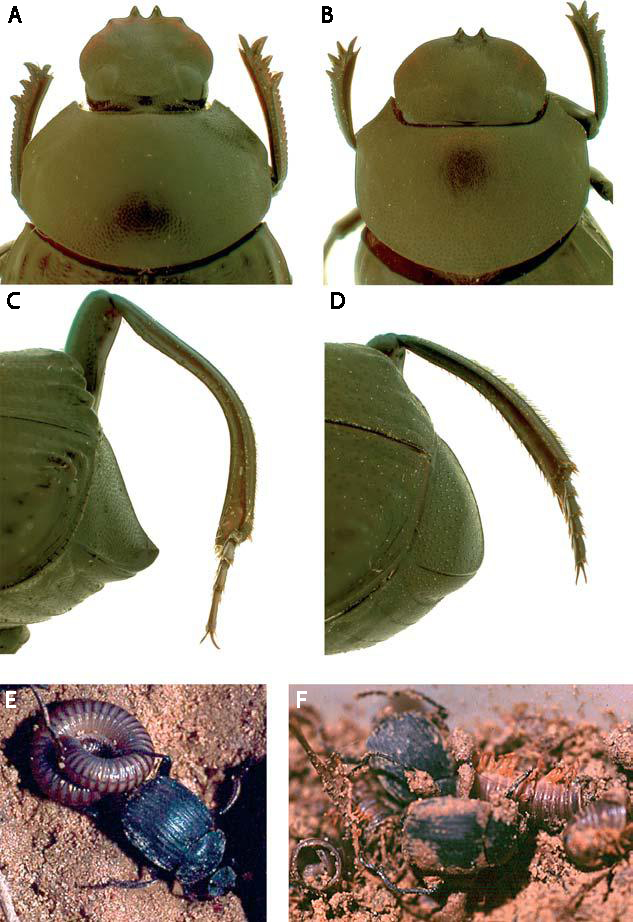
Larsen et al. determined that adults of D. valgum are opportunistic hunters and were much more likely to attack injured millipedes than healthy ones, even those weighing 14 times as much as the beetle.  Ball rolling behavior was never observed by D. valgum.  Most dung beetles have wide, shovel-shaped heads used to scoop and mold dung balls, but D. valgum has a much narrower head with sharp “teeth” on its clypeus (Fig. 1A vs. 1B).  The teeth apparently aid in killing the millipede by piercing the ventral surface behind the head and prying upwards (decapitating it), and the narrow, elongate head facilitates insertion into the millipede body for feeding.  Further, the hind tibia are elongate and curved, which are used to “grip” millipedes by holding them up against the dorsally reflexed pygidium (Fig. 1C vs. 1D).  This allows the beetle to drag its coiled up victim with one hind leg while walking forward on the other five (Fig. 1E).  Once killed, the beetles proceeded to break their prey into pieces and consume their meaty innards, leaving the disarticulated millipede exoskeletons licked clean (Fig. 1F).  One of these “attack” episodes was filmed (using infrared lighting so as not to affect their nocturnal behavior) and can be seen in this BBC News video.

Deltochilum valgum

Figure 1. (a) Dorsal view of D. valgum head. Sharp clypeal teeth and angled clypeus act as a lever to disarticulate millipede. Narrow, elongate head permits feeding inside millipede; (b) dorsal view of Deltochilum peruanum head, lacking characters described in (a), head used to mould dung balls; (c) lateral view of D. valgum pygidium and hind tibia. Dorsally reflexed pygidial lip is used to support millipede during transport. Elongate, strongly curved hind tibia is used to grip millipede. (d ) Lateral view of D. peruanum pygidium and hind tibia, lacking characters described in (c), hind tibia used for rolling dung balls. (e, f ). Predation strategy by D. valgum. (e) Dragging live, coiled millipede with one hind leg, walking forwards; ( f ) feeding on killed millipede with head inside
segments; disarticulated empty millipede pieces nearby.
Credit: Larsen et al. (2009).

Much has been made about this remarkable shift from coprophagy to predation, which Larsen et al. speculate was driven by competition for limited resources with the many other dung beetle species that occur in the Peruvian rainforests. In fact, adult dung beetles are known to feed on a variety of resources besides dung, as exemplified by the range of baits used in their survey. Thus, my first thought after reading the coverage was actually a question: “Has this species abandoned dung provisioning completely as a reproductive strategy?” Everything I had read focused exclusively (quite understandably) on the bizarre feeding habits of the adults, but there was no mention of what the species’ larval provisioning strategies were. Wanting more information about this, I contacted Trond Larsen, who graciously sent me a PDF of the paper. Unfortunately (though not a criticism of the paper), no further insight about this was found in the paper either. Indeed, in all of the observations recorded by Larsen et al., millipedes killed by D. valgum were consumed entirely by the adults, and no mention was made of how or whether millipedes were utilized for larval provisioning. I wondered if D. valgum had truly abandoned dung provisioning for larval development (a remarkable adaptive switch), or if in fact the species might still utilize the strategy for reproduction (perhaps having specialized on a dung type not included in their survey), while also exploiting millipede predation as adults for a nutritional advantage. I asked Trond about this, to which he replied with this juicy tidbit (I told you I had a special treat!):

Yes, I would very much like to know what the reproductive/nesting behavior of D. valgum is. My best guess is that they also use millipedes as a larval food source, but as you say, we haven’t observed that behavior yet. I have observed other generalist dung beetle species rolling balls out of dead millipedes, presumably to bury for the larvae, so I certainly think it would be an adequate food source. Many dung beetle species use carrion for their larvae.

I am quite confident that D. valgum does not use any kind of dung. I have sampled these dung beetle communities very thoroughly, with many dung types and other bait types, and also with passive flight intercept traps that catch all beetles. Every dung beetle species that feeds on dung is at least sometimes attracted to human dung (this is not the case in African savannahs though, but is in neotropical forests – that is a whole different story). There are still a small handful of species we catch in flight intercept traps that we don’t know what they eat, although some of these mysteries have recently been solved – many of them live in leaf-cutter ant nests for example.

While predation of millipedes by a dung beetle is itself a fascinating observation, demonstrating the abandonment of dung provisioning in favor of captured prey for larval development would be a truly remarkable example of an ecological transition to exploit a dramatically atypical niche. I hope Trond (or anybody for that matter) actually succeeds in observing millipede/prey utilization for larval provisioning by this species.

Many thanks to Trond Larsen for his delightful correspondence.

SOURCE:
Larsen, T. H., A. Lopera, A. Forsyth and F. Génier. 2009. From coprophagy to predation: a dung beetle that kills millipedes. Biology Letters DOI: 10.1098/rsbl.2008.0654.

Copyright © Ted C. MacRae 2009

Add to FacebookAdd to NewsvineAdd to DiggAdd to Del.icio.usAdd to StumbleuponAdd to RedditAdd to BlinklistAdd to Ma.gnoliaAdd to TechnoratiAdd to Furl