T.G.I.Flyday – Triorla interrupta

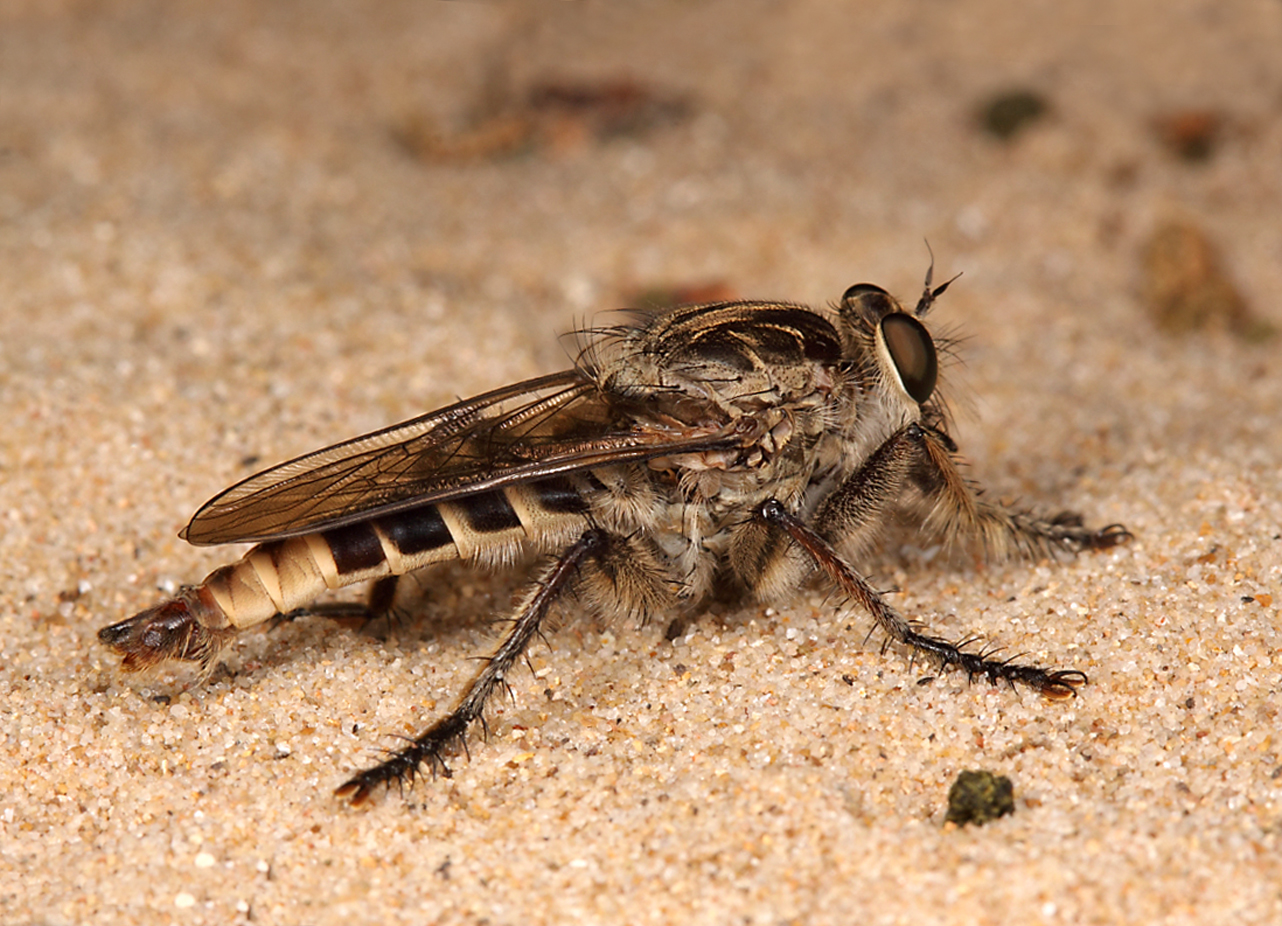
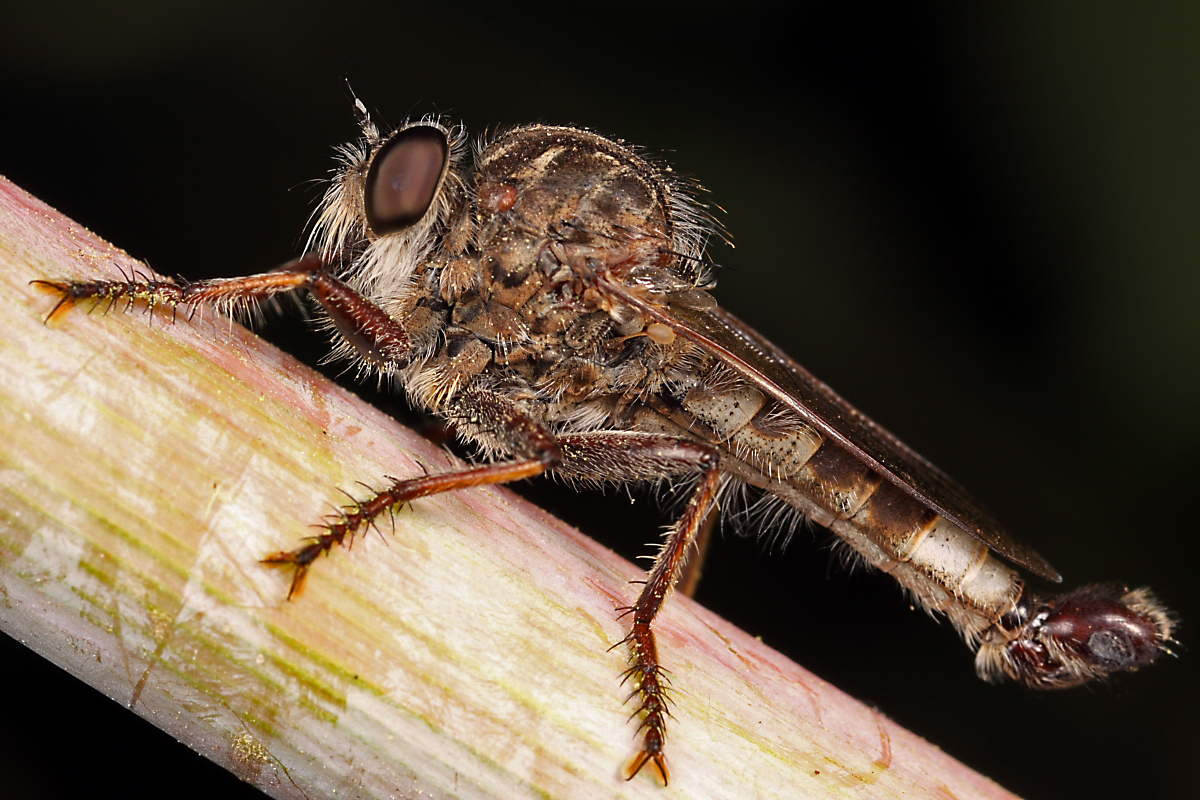
Triorla interrupta (male) | Calico Rock, Arkansas

While I was visiting the glades near Calico Rock, Arkansas this past June, I went into town to look along the White River.  With the amount of sandstone bedrock in the area, I thought there I might find sandy loam deposits along the river of the type preferred by Cylindera cursitans (ant-like tiger beetle).  While I didn’t find any of the beetles, I did see this robber fly (managing only this single shot before it flew off), which I take to be the male of Triorla interrupta based on the pattern of abdominal coloration (the first two segments partially black, followed by two almost wholly black segments).  According to BugGuide, this is the only North American species of the genus (a second occurring from Panama to Argentina), and Herschel Raney considers it to be the most common robber fly in Arkansas.

Copyright © Ted C. MacRae 2011
T.G.I.Flyday – Andrenosoma fulvicaudum

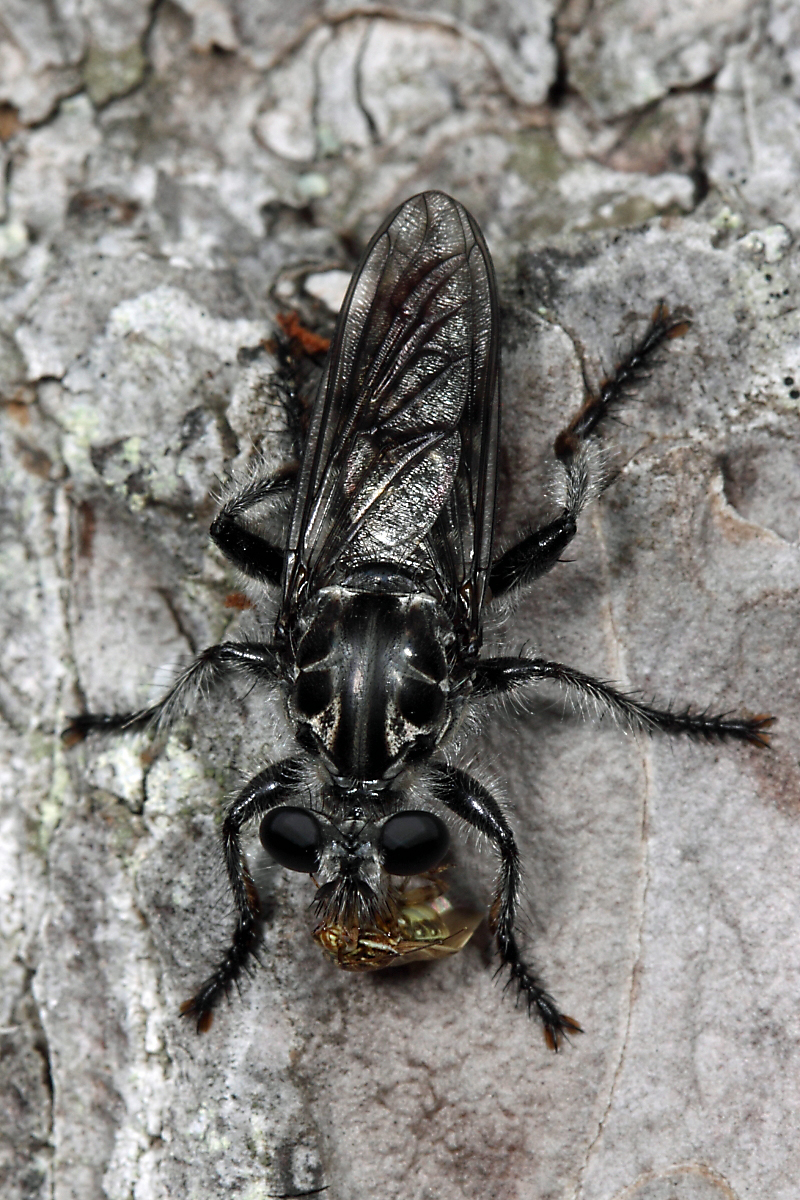
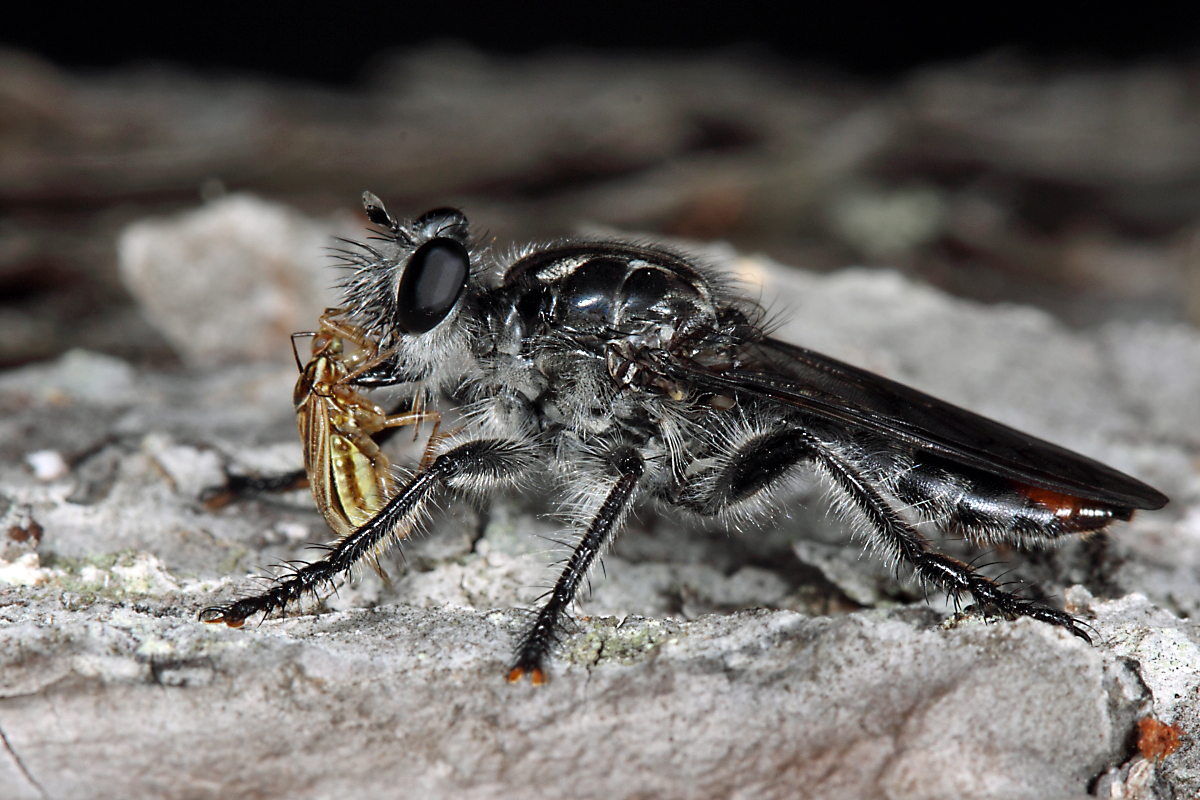
Andrenosoma fulvicaudum | Stone Co., Arkansas

First, about the name. T.G.I.Flyday is my contribution to a collusional triad between dipterist Morgan Jackson, myrmecologist Alex Wild, and myself (uhm, beetles).  Although Alex blogs primarily about ants, he has long featured a “Friday Beetle Blogging” series.  I’ve also occasionally stepped on their toes with an ant or fly post, so Morgan and I thought it would be fun to complete the Friday switcheroo with a post about ants on his blog and one about flies on mine. Get it?… Oh well, it made me chuckle when we thought it up.  Anyway, here is my first T.G.I.Flyday contribution.

Among the flies (order Diptera), it is hard to pick anything but robber flies (family Asilidae) as the most charismatic group.  Several subfamilies of robber flies have candidates that vie for the most impressive species, mostly due to their enormous size combined with striking green eyes (e.g., Microstylum morosum, Diogmites neoternatus) or vivid, aposematic / mimetic coloration (e.g., Archilestris magnificus, Eccritosia zamon, Wyliea mydas).  However, my favorite subfamily is the Laphriinae—not because of the amazing bumble bee-like appearance of the nominate genus, but rather the larval food of all species in the subfamily; wood-boring beetle larvae.  Over the years, I have put up hundreds of batches of dead wood for rearing wood-boring beetles in the families Buprestidae and Cerambycidae, and not uncommonly do I find in one of the emergence containers—especially those containing dead pine—an adult of one of these impressive flies. Oftentimes their characteristic pupal cases will be found protruding from the emergence hole, in which case I pin it underneath the fly (just in case some ambitious dipterist examines my collection after I’m gone and finds that the pupal case of xx species is not yet described).  I’ve by now accumulated a rather decent little robber fly collection (especially considering that I’m really a coleopterist), graciously identified for the most part by world robber fly expert Dr. Eric Fisher (California Department of Food and Agriculture).

Last weekend I made the second in a series of trips I’ll be taking to the White River Hills region of north-central Arkansas in an effort to confirm the occurrence there of Cylindera celeripes (swift tiger beetle).  My efforts are focused on the area around Calico Rock, a marvelous system of acidic sandstone barrens interspersed amongst shortleaf pine and oak forests.  The occasional dead pines found in such areas are highly attractive to a variety of pine-associated buprestids and cerambycids (my first loves), and whenever I see a standing dead tree I make a beeline straight for it (the tiger beetles can wait).

This individual was sitting on the trunk of a dead shortleaf pine with a mirid bug for prey.

On this day, sitting on the trunk of the first dead pine that I approached was not a buprestid or cerambycid, but rather this laphriine robber fly.  Based on the reddish posteriodorsal markings of the abdomen and general gestalt, I take this to be Andrenosoma fulvicaudum, a widespread though never very abundant species that occurs across most of North America.  According to Bromley (1934), the species frequents dry, sandy locations where it rests on logs, stumps, or tree trunks exposed to the bright sunlight and is commonly observed preying on small hymenopterans.  These observations are quite consistent with mine, except this one was feeding on a true bug in the family Miridae (perhaps distracting it just enough to allow me these photographs).  Cannings (1998) notes that A. fulvicaudum is attracted to recently burned forests, which will provide a fresh supply of wood-boring beetle larvae on which its larvae can prey.  This is the only species of Andrenosoma occurring in eastern North America; four additional species are restricted to Texas and a fifth occurs only in the western U.S., but the genus reaches its greatest diversity in the Neotropics.

REFERENCES:

Bromley, S. W. 1934. The Laphriine Robber Flies of North America.  Ph.D. dissertation, Ohio State University, 358 pp.

Cannings, R. A. 1998. Robber flies (Insecta: Diptera: Asilidae), In I. M. Smith and G. G. E. Scudder [Eds.], Assessment of Species Diversity in the Montane Cordillera Ecozone, Burlington: Ecological Monitoring and Assessment Network.

Copyright © Ted C. MacRae 2011
Bichos Argentinos #14 – Flies!

A few miscellaneous fly photos from La Reserva Ecológica Costanera Sur (Buenos Aires, Argentina)  taken last March.  I don’t have IDs except provisionally to family (let’s face it—flies are hard!).

I suppose something in the Tachinidae, based on the black and white striped coloration and distinct abdominal setae.


Definitely a robber fly (family Asilidae), but which one?


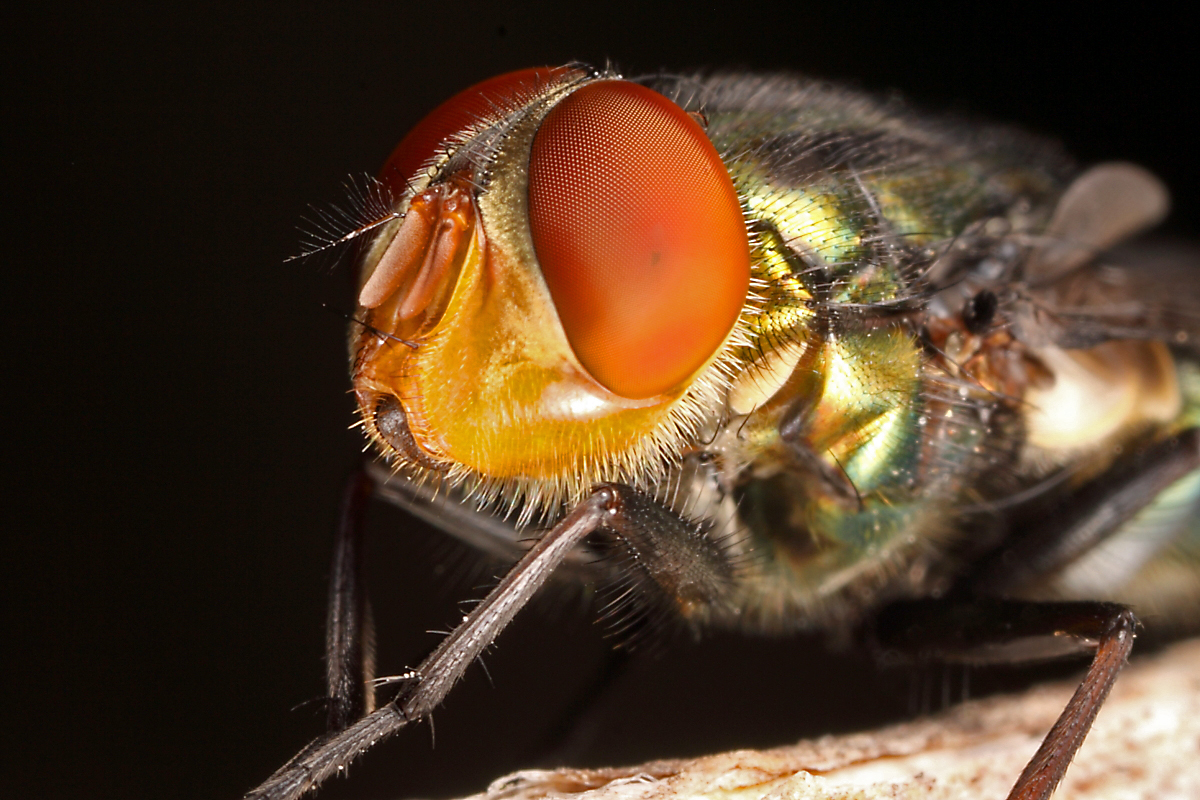
I suppose this is some kind of bottle fly (family Calliphoridae).


Nice eyes!


Copyright © Ted C. MacRae 20011

Forgotten Foto Friday: Eudioctria sp.

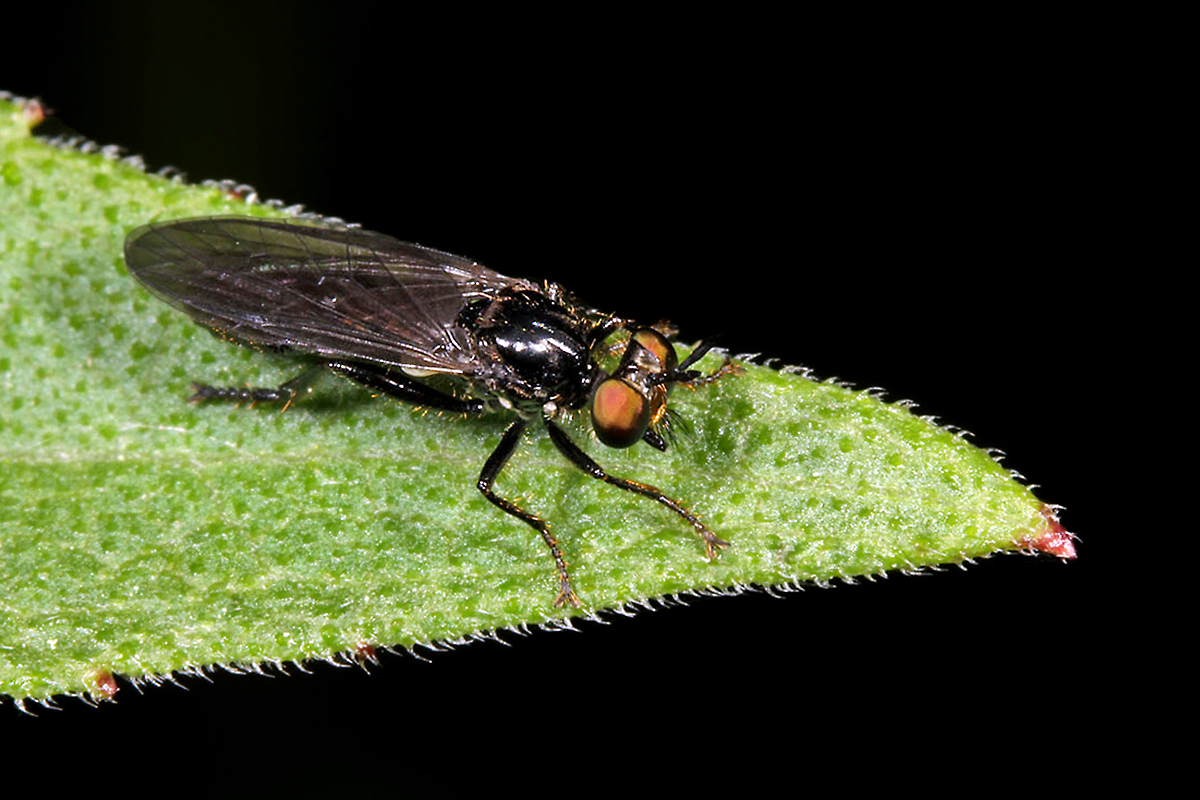
Eudioctria sp. | Shaw Nature Reserve, Gray Summit, Missouri

In keeping with my recent theme featuring insects from Shaw Nature Reserve, I present here a long-forgotten photograph that I took back in May 2009.  In fact, not only was this photo taken on the maiden voyage of my Canon dSLR setup, but it is the very first photograph of an insect that I took with the camera—image #19 (1-18 were the initial test shots and a few immediately discarded photos).  It won’t win any awards, but it’s not a bad photo, and the fact that I immediately began attempting shots with the lens dialed all the way up to 1:1 shows I had no qualms about going for broke.

As best I can tell, this is a member of the robber fly genus Eudioctria in the subfamily Stenopogoninae.  Species in this genus are among the tiniest of North American robber flies,  measuring only 6–8 mm in length (compare this with the spectacular 35–40 mm length of North America’s largest robber fly).  They superficially resemble species of the unrelated genus Cerotainia (subfamily Laphriinae) but lack the extra-long antennae. According to Norman Lavers (The Robber Flies of Crowley’s Ridge, Arkansas), Eudioctria can also be distinguished behaviorally, as it prefers flat leaves at the top of small shrubs, while Cerotainia tends to perch on twig-ends.  Eudioctria is primarily a western U.S. genus, although four of its 14 species (albius, brevis, propinqua, tibialis) occur in the eastern states (Adisoemarto and Wood 1975).  I can’t possibly determine which of those four species this individual represents, as to do so requires examination of facial gibbosities and judgements about the degree to which various body parts are pollinose(?)—perhaps I should stick with beetles!

REFERENCE:

Adisoemarto, S. and D. M. Wood.  1975.  The Nearctic species of Dioctria and six related genera (Diptera, Asilidae).  Questiones Entomologica 11:505–576.

Copyright © Ted C. MacRae 2011

Itty bitty tiny little flies

Saturday was my birthday, and for most of my adult life it has been tradition to take the day off for the Annual-Birthday-First-Bug-Collecting-Trip-of-the-Year™.  At Missouri’s middlin’ latitudes, late April is normally a tad early—at least for the groups that interest me, but it’s less about serious bug collecting and more about kicking off the season in a bit of a special way.  Normally if my birthday falls on a weekend, as it did this year, I’ll take off the adjacent weekday instead (it’s not special if you can’t take off any time from work).  However, this year that wasn’t possible due to events at work far beyond my little sphere of influence (conspiracy #1), thus Saturday itself became the planned day.  My family and I celebrated Friday evening so I could have the whole day on Saturday, and as we ate we watched news reports of suspected tornadoes ripping through St. Louis just to our north and a little further south (conspiracy #2).  Forecasts called for rain continuing well into the following week (conspiracy #3), and for the first time in… well… ever, I had the feeling the ABFBCTOTY might be cancelled due to weather.  Waking the next morning, I turned on the television to see precipitation forecasts across the state (1″ in northwest Missouri to 6″ in southeast Missouri) amidst stunning chopper video footage of neighborhoods destroyed and lives turned upside down.

I stopped counting conspiracies and hugged my girls!

That evening, I turned on the mercury vapor lamp over the garage door for the first time since last year to see if anything might show up.  We live in a heavily wooded area of western St. Louis Co. featuring relatively intact mesic upland forest dominated by several oaks, hickories, and sugar maples that harbor a nice diversity of woodboring beetles and treehoppers (though I didn’t expect to see these on this night).  The night was cool and clammy—nothing but a few moths and flies showing up.  Some of the flies were quite small, and some were extraordinarily small—not more than 1 or 2 mm in length.  Tiny little specks of life!  I thought it might be fun to get in some practice time with the 65mm lens, and the sampling shown below represents a few of those taken with the lens maxed out at 5X (resulting in a frame width of ~5mm):

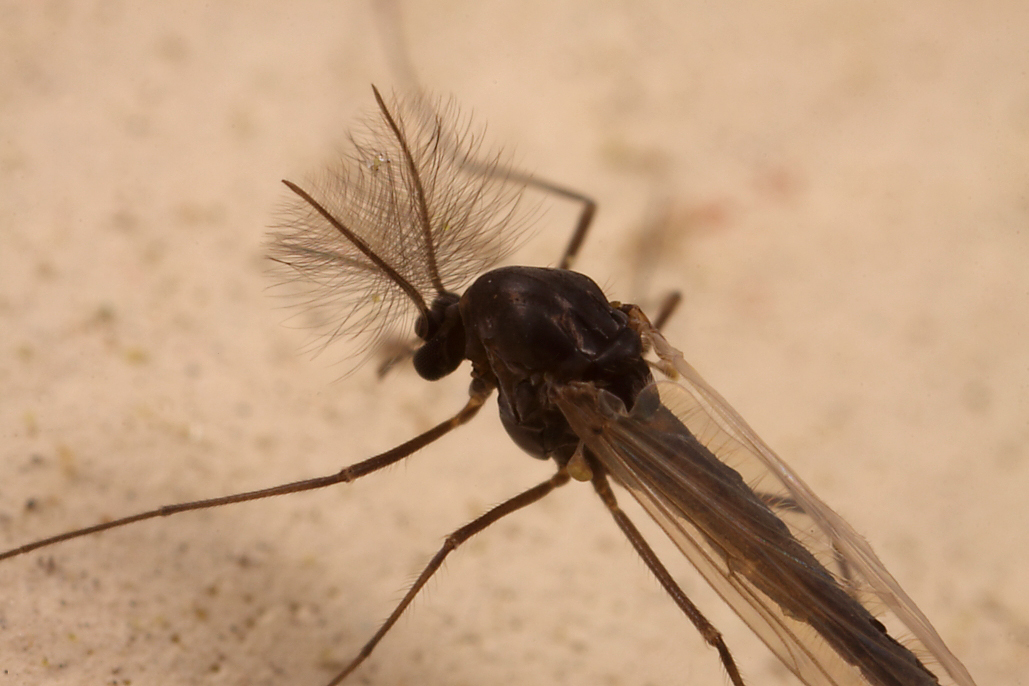
Male non-biting midge (Chironomidae) | St. Louis Co., Missouri

Female non-biting midge (Chironomidae) | St. Louis Co., Missouri

Moth fly (Psychodidae) | St. Louis Co., Missouri

Same individual as above, chased onto a finished wooden table to highlight its dense pilosity

Copyright © Ted C. MacRae 2011

Bichos Argentinos #8 – “Mosca de la Carne”


Here is the full-sized photo from which the “super-crop” featured in Super Crop Challenge #4 was taken.  As many of you guessed, this is a higher fly (order Diptera, suborder Brachycera) in the family Sarcophagidae, with the photo crop showing frontal portion of the head and its associated structures.  While dubbed “flesh flies” due to the necrophagic habits of a few of its included species, sarcophagids actually display diverse life histories that include a wide variety of coprophagous and parasitic species (Mulieri et al. 2010).  The fly was one of the many insects I photographed in early March in Buenos Aires, Argentina at La Reserva Ecológica Costanera Sur, where it was found perched on dead wood (I found several individuals of apparently the same species perched on dead wood as well – whether this is significant or chance I don’t know).


The presence of a ptilinal fissure and lunule and a dorsal seam on the antennal pedicel identify this as one of the calyptrate “muscoid” (schizopheran to be more correct) flies.  Within that group, my determination as a member of the family Sarcophagidae is based on its fairly large size, dull gray coloration with three longitudinal black strips on the mesonotum, notopleuron with two strong and two small setae (Calliphoridae have only two setae), and meron with a row of setae (lacking in Muscidae and related families).  Admittedly these characters aren’t visible in the cropped photo that I presented, so guessing the proper family was a bit of a crap shoot.  As noted by (de Carvalho and de Mello-Patiu 2008), species determination of sarcophagid flies is complicated by their fairly uniform chaetotaxy and lack of useful external characters, leaving male genitalia as the only reliable characters for identification.  No suitable key for identifying Neotropical genera yet exists and the elaboration of one will be very difficult without analysis of the male terminalia.  Dr. Luciano Patitucci (Consejo Nacional de Investigaciones Científicas y Técnicas, Buenos Aires, Argentina) suggested this is perhaps a species of Sarcophaga; however, in a recent faunal study of Sarcophagidae at the reserve, two species – Tricharaea (Sarcophagula) occidua and Oxysarcodexia varia – comprised nearly 90% of the flesh flies encountered (Mariluis et al. 2007).

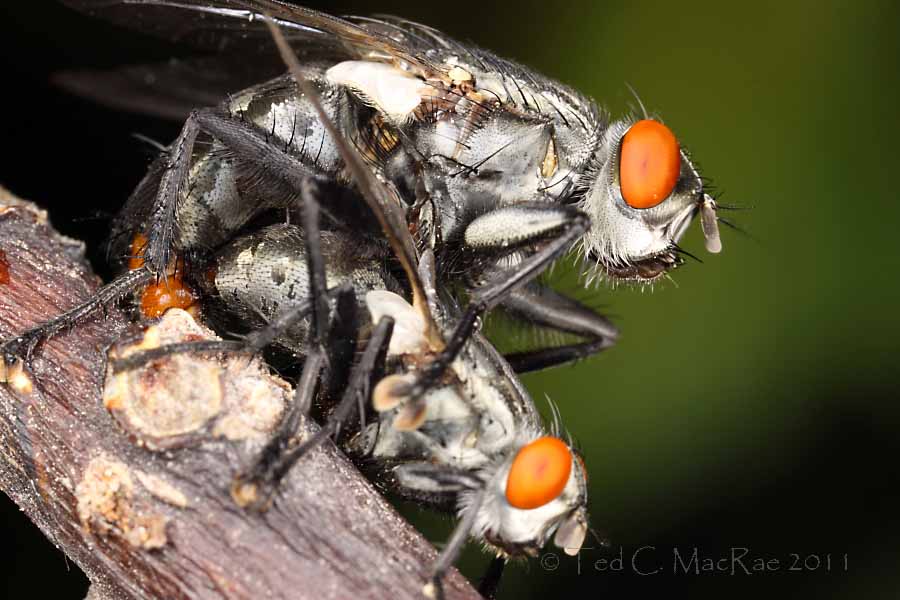
A single individual is shown in the first two photos, while this mating pair was seen a little later.  Although they seem to represent the same species, I can’t be certain of this, and the photo itself is not the greatest due to the female (bottom) being slightly off-focus.  Nevertheless, I had to show it, because – really – who can resist photographs of fly nookie?! 

REFERENCES:

de Carvalho, C. J. B. and C. A. de Mello-Patiu.  2008.  Key to the adults of the most common forensic species of Diptera in South America.  Revista Brasileiro de Entomologia 52(3):390–406.

Mariluis, J. C., J. A. Schnack, P. R. Mulieri and J. P. Torretta. 2007. The Sarcophagidae (Diptera) of the coastline of Buenos Aires City, Argentina. Journal of the Kansas Entomological Society 80(3):243–251.

Mulieri, P. B., J. C. Mariluis and L. D. Patitucci.  2010.  Review of the Sarcophaginae (Diptera: Sarcophagidae) of Buenos Aires Province (Argentina), with a key and description of a new species.  Zootaxa 2575:1–37.

Addendum:

This challenge concludes the 2nd BitB challenge session, with a record 17 participants in this final challenge.  For a while it looked like HBG Dave would become our newest champion, but Session #1 champ Ben Coulter swooped in, flogged us with terminology (all of it correct and undeniable), and won two of the last three challenges to edge out Dave and, once again, take the overall victory. Make no mistake – Ben knows how to play this game!  Morgan Jackson took second in this challenge and claimed the final spot on the overall podium, while Troy Barlett and newcomer Heath Blackmon tied for third.  Other strong contenders during Session #2 included JasonC and Tim Eisele.  Ben – contact me to claim your loot (and your loot from session #1 is in the mail).

Here is the final points tally for Session #2:

Place Commentor BB#10 IDC#5 Bonus
3/7
IDC#6 IDC#7 SCC#4 Total
1 Ben Coulter       10   41 51
2 HBG Dave   13 2 4 8 17 44
3 Morgan Jackson   2     4 29 35
4 Troy Bartlett 2 10 2     20 34
5 JasonC   8   4   18 30
6 Tim Eisele 1 8   6 6 8 29
7           20 20
8 TGIQ   2       17 19
9 Christopher Taylor   2       15 17
10 Dave Hubble   15         15
11 James Trager  1 1 2     9 13
12 Gunnar           12 12
13
        1 9 10
14
Dennis Haines 
          9 9
15 Max Barclay       3   5 8
            8 8
17 Charley Eiseman   6         6
18 biozcw           5 5
19 Brady Richards       4     4
  Henry         4   4
21 John Oliver     2       2
 
Mike
          2 2
23 Christy Bills       1     1
  Tucker Lancaster       1     1

Copyright © Ted C. MacRae 2011

Bichos Argentinos #1 – Eristalinus taeniops

Eristalinus taeniops - a hover fly in the family Syrphidae

It figures that perhaps the most striking insect I saw at La Reserva Ecológica Costanera Sur in Buenos Aires, Argentina would be an introduced species, as the area itself is a man-made reconstruction of the wet Pampas grasslands endemic to coastal areas of the Rio de la Plata.  My identification of this fly as Eristalinus taeniops is based on its great resemblance to the many online photographs that exist from both South America and the U.S. and also the Old World where it is apparently native.  I found no more authoritative sources with which to confirm the ID, so this online comparative will have to do (muscophiles feel free to comment or correct). 

According to BugGuide, E. taeniops is a recent import to the U.S. from Africa, and in fact it has apparently successfully invaded much of the world.  I suppose most folks will be inclined to forgive the fly for all this because of its strikingly patterned eyes, which I would have dearly loved to have gotten in tight for a closeup.  This shot with the 100mm lens dialed in to the max (and only slightly cropped for composition), however, was the only one I managed – the fly bolted as I quickly tried to switch to the 65mm lens, and although I saw two more individuals afterwards, I couldn’t get anywhere close to them in the day’s heat.  Eyes notwithstanding, the species is a near perfect mimic of a honey bee, making one wonder what selective pressures drove the development of these fantastically contrasting eyes.

Copyright © Ted C. MacRae 2011

Frenatae 2011 Calendar

Ralph Holzenthal - Tabanidae. Adobe Illustrator, gradient mesh/Adobe Photoshop.

Even though we’re now in the latter part of February, I wanted to spread the word about a cool insect-themed calendar shown to me by a colleague during my recent trip to Brazil. Produced by Frenatae, the Graduate Student Entomology Club at the University of Minnesota, the calendar features original work by students using computer illustration techniques taught in a UMN course titled, ENT 5051, Scientific Illustration of Insects. The mastermind behind this course is Dr. Ralph W. Holzenthal, who – as can be seen by the stunning image above of a female (L) and male (R) Tabanus lineola – knows a thing or two about insect illustration! While the course covers traditional techniques such as pen & ink, pencil, watercolor, etc., its major emphasis is on computer-assisted techniques using Adobe Illustrator® and Photoshop®. This includes instruction on preparing full habitus color illustrations of insects on the computer. How I wish a course such as this had been available when I was in graduate school (of course, how I wish computers had been available when I was in graduate school!).

While Dr. Holzenthal’s illustrative skills are obvious, it’s also clear that he excels at teaching these skills to his students, as evidenced by this selection of my favorite images (not surprisingly, all beetles!) from the course website galleries:

Caitlin Krueger - Scarabaeidae

Martha Megarry - Scarabaeidae

Heather Cummins - Zopheridae

.
It should be pointed out that all of these Photoshop illustrations represent original artwork and not modified photographs!

I ordered my copy of the calendar as soon as I returned home from my trip. You can order one too by sending a check for $12 to the following address:

Frenatae
1980 Folwell Ave Rm 219
St Paul, MN 55108

My thanks to Dr. Holzenthal for allowing me to post this small selection of images from his website.

Copyright © Ted C. MacRae 2011