A black background is better… sometimes

Eriophora ravilla (a tropical orb weaver) | Pinellas Co., Florida

If there is one subject that causes more disagreement among macrophotographers, it is the pitch black background. Granted, black backgrounds are common—almost ubiquitous in macrophotography, since they are easily created by using full flash illumination and ensuring that nothing lies behind the subject close enough to reflect the light from the flash. Detractors, however, claim that it gives subjects an ‘unnatural’ look, as they are rarely seen this way in nature. This may be true, but I still believe that for some subjects the black background simply cannot be beat for its aesthetics, even if the subject is not normally seen in this manner. Take, for example, the Great Plains ladies’-tresses orchid—nothing but a pitch black background could better showcase the delicate, white blossom and its almost crystalline lower lip!

That said, however, there are some subjects for which a pitch black background actually can be considered a ‘normal’ background. This tropical orb weaver spider (Eriophora ravilla) is one example. Unlike many other members of the family Araneidae (orb weavers), species in this genus are strictly nocturnal and not seen hanging on a web during daylight hours. Hiding in a curled leaf during the day, they emerge at night and build a large web (up to 1 meter wide), only to consume it by morning and return to their hiding place until the next evening. My nephew Jack and daughter Madison and I first saw this spider during our nighttime foray into the intertidal mangrove marsh behind my sister-in-law’s condominium in Seminole, Florida last month while discovering rare, endemic beetles and their larvae. Knowing that it would likely build its web in the same place on subsequent evenings, I went out a few nights later with my camera and took a few shots.

Some claim that black backgrounds are undesirable for even nocturnal subjects; that there is nothing ‘natural’ about an artificial, narrow beam of light illuminating a single subject at night since no animal other than a person with a flashlight would see something like this. This contention seems a little strained, as one could take such a stance on illumination of any kind. Technically speaking even colors don’t actually exist, so the rendering of subject images on camera film/sensor, whether by natural or artificial illumination,  is itself biased towards human sensibilities. Regardless, the sight of an eerily glowing spider hanging in the blackness strikes a familiar chord with anyone who has wandered the bush by night. A black background not only recreates that human experience, but also emphasizes the subject’s (in this case strictly) nocturnal nature with stark elegance.

At first I took this spider to represent the very common barn spider, Neosona crucifera—widespread across North America. However, after noting the dark femora and yellow “shoulders” of the abdomen I began to rethink that ID. Fortunately, I took one photo of the ventral side (not shown) that shows well the color pattern diagnostic for the circum-Caribbean species E. ravilla.

Copyright © Ted C. MacRae

Even a 12-year old can discover the larva of a rare, endemic species!

Since discovering the larva of the rare, endemic Florida metallic tiger beetle (Tetracha floridana) in the small, intertidal mangrove marsh behind my sister-in-law’s condominium in Seminole, Florida three years ago, I’ve looked forward to subsequent visits to see the adults (they’re nocturnal) and gather additional material needed to write the larval description. I had to wait a few days on this year’s trip due to rain (it is Florida, after all), but eventually a dry evening came along and I began “suiting up” for my nighttime foray. Much to my delight, my 12-year old nephew Jack wanted to come with me. Jack had never been in the field with me before, but according to his mom he has become quite interested of late in science and biology. My daughter Maddie, also 12 years old (and a veteran of many trips to the field with me), also wanted to go, so together the three of us slathered on the insect repellent and headed into the dark towards the marsh.

Larva of Micronaspis floridana (Florida intertidal firefly) | Pinellas Co., Florida

We had only my headlamp as a light source, so the kids trailed behind me as I picked a line through the brush, across a small creek, and onto a ridge that snakes through the marsh that marked one of the areas where I had seen good numbers of the beetles last year. We collected a small number to keep alive and place in a terrarium of native soil, the hope being that they would lay eggs so I could obtain some 1st-instar larvae for the formal description, but what I was really looking for were larval burrows. As we (well, I) searched the ground in front of me with the lamp and the kids trailed behind me in the dark, Jack suddenly stopped and said, “What’s that?” I shone my light to where he was pointing but didn’t see anything and so resumed my search. Right away he said, “There it is again.” I asked if it was a rabbit (we’d seen them at the edge of the marsh during the day), and he said, “No, it’s like a light or something.” I turned off the lamp, and gradually the faint, green glow reappeared. I recognized the source of the light instantly as that of a larval firefly, although truthfully I have never actually seen an actual firefly larva. Seeing a great teaching moment for the kids, we walked to the light, knelt down, and shone the lamp directly on the ground from where the light was coming to find the small (~10 mm long) larva moving slowly through the moist, algae-covered rocks. It had the classic, retractable firefly head and curiously quadruply-spined tergites. I congratulated Jack on finding the larva, emphasizing that I would have never seen it myself had he not been there and been so observant despite not having a lamp.

Larvae of this species exhibit the retractable head characteristic of firefly larvae.

I went back a few nights later by myself so I could concentrate on photographing some of the things we saw in the marsh the previous night, including the firefly larva. I had no problem relocating one in the same place we found it before (I just turned off my headlamp and waited for the green glow). I’m generally not keen on posting photographs of unidentified insects (just me, but I find photos much more interesting when accompanied by the natural history back story), and I was sure this larva would remain unidentified (I have little knowledge of adult fireflies, much less their larvae). This seemed even more likely after perusing the few identified and many unidentified firefly larvae photographs on BugGuide and finding nothing even remotely similar. I was about to give up when I decided to try the search term “Lampyridae Florida Pinellas” (“Pinellas” being the county where we found the larvae—my thinking being that maybe there was a Florida firefly checklist that could narrow down to the county level the possible species), and high in the results was a page titled Florida intertidal firefly (fiddler crab firefly). On that page was a photo of the larva, although not nearly large and detailed enough to be sure it was the same, but still in my mind almost surely this species because of the stated restricted habitat—intertidal zone of Florida coastal salt marshes! I sent these photographs to lampyroid aficionado Joe Cicero, who kindly confirmed my identification. 

Restricted to intertidal marshes in coastal Florida.

Because it occurs only at the edges of salt water marshes around the peninsular coast of Florida, M. floridana is a classic example of shoestring geographic isolation and, thus, serves as a good model for studies of genetic isolation and its impact on speciation (Lloyd 2001). Along with T. floridana, it now makes at least two rare, Florida-endemics occurring in the small private, preserve behind my sister-in-law’s condominium (both of which were first found as larvae rather than adults). Although the larva of M. floridana is already known—albeit by a rough black and white photograph (McDermott 1954)—it’s rarity and restricted habitat nonetheless make it an exciting find well deserving of the more detailed color photographs shown here. However, as I told Jack after receiving confirmation of its identity, he gets full credit for the discovery. I took him into the field with me with the intention of showing him some new things, and he turned the tables on me! Yes, even a 12-year old can discover the larva of a rare, endemic species!

REFERENCES:

Lloyd, J. E. 2001. On research and entomological education V: a species concept for fireflyers, at the bench and in old fields, and back to the Wisconsian Glacier. Florida Entomologist 84(4):587–601.

McDermott, F. A. 1954. The larva of Micronaspis floridana Green. The Coleopterists Bulletin 8(3/4):59–62.

Copyright © Ted C. MacRae 2012

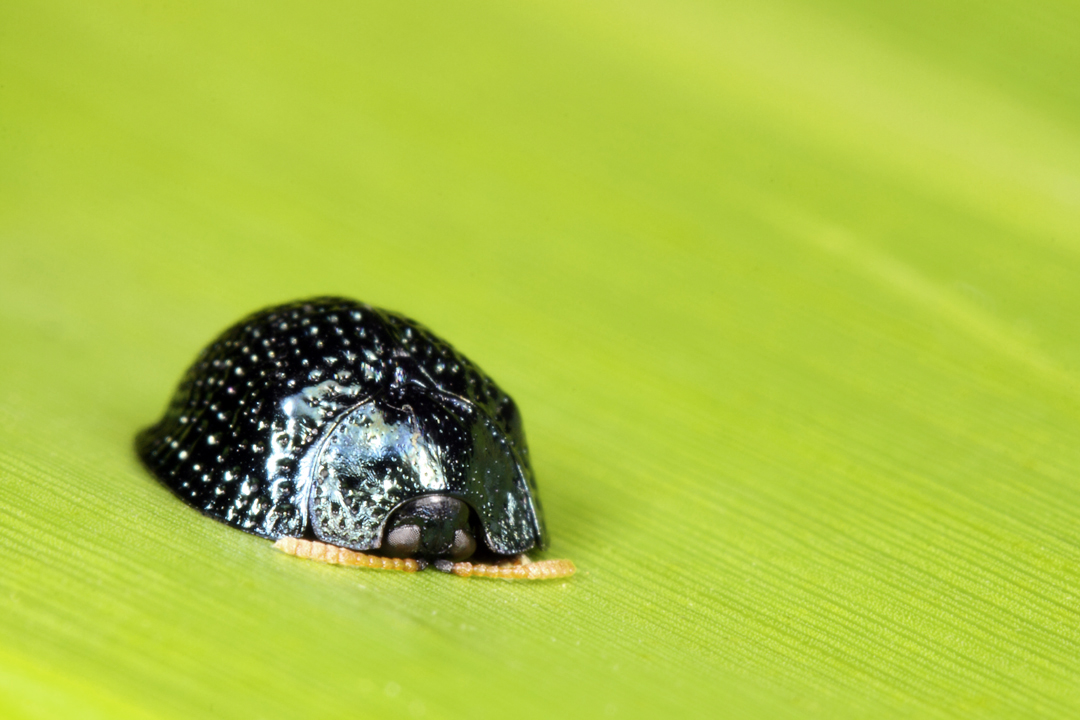
Palmetto Tortoise Beetle, Hemisphaerota cyanea

Hemisphaerota cyanea (palmetto tortoise beetle) on saw palmetto (Serenoa repens)| Levy Co., Florida

While most leaf beetles (family Chrysomelidae) are found associated with herbaceous plant species, many members of the subfamily Hispinae—which includes leaf mining beetles and tortoise beetles—are found on the foliage of woody plants. In North America the most distinctive of tortoise beetles found on trees is the palmetto tortoise beetle, Hemisphaerota cyanea. These distinctive dark blue, hemispherical-shaped (hence, the genus name) beetles with yellow antennae are found in the deep southeastern U.S. on the fronds of saw palmetto, Serenoa repens, and other native and introduced palms. I found the beetles in these photographs near Cedar Key Scrub State Preserve in Levy Co., Florida while searching white sand 2-tracks through sand scrub habitat for the Florida-endemic Cicindelidia scabrosa (Scabrous Tiger Beetle).

Beetles scarify the leaf epidermis, leaving trough-like feeding marks.

I first saw this species during my first insect collecting trip to Florida back in 1986. I didn’t know much then (other than that I really, really enjoyed traveling to different parts of the county to collect insects!). I was in Everglades National Park (with a permit) when I first noticed them dotting saw palmetto fronds. I think I had actually noticed them for some time but thought they were some type of scale insect before eventually realizing it was actually not only a beetle, but a tortoise beetle (one of the many groups of insects in which I was interested during those early, formative days).

Specially modified tarsi and a hemispherical shape allow the beetle to clamp itself tightly against the leaf to repel attack by ants and other insect predators.

I also remember being struck by how difficult it was to pry the adults off of the leaves on which they were sitting. It turns out that these leaf beetles have specially modified tarsi with thousands of bristles tipped with adhesive pads on the undersides. Normally only a few of the pads contact the leaf surface, but when the beetle is threatened it clamps all of them against the leaf and secretes an oil that strengthens the adhesive capabilities of the pads. Thus secured, the beetle clamps its hemispherical-shaped body down tightly against the leaf and is able to resist the efforts of ants and other predators to pry it from the leaf.

Copyright © Ted C. MacRae 2012
One-Shot Wednesday—Proctacanthus fulviventris ovipositing

Proctacanthus fulviventris | Dixie Co., Florida

Today I spent the day just south of Florida’s “arm pit” to look for the state’s near-endemic tiger beetle Cicindelidia scabrosa (Scabrous Tiger Beetle). I first found this species last August on a white-sand 2-track through sand pine scrub habitat near Cedar Key Scrub State Preserve (Levy Co.). Although I was happy enough with the photographs that I got that day, the small spot of habitat that I found them in had yielded only a few specimens. My goal this time was to find the species in additional localities  to get a better idea of its precise habitat preferences and obtain a better series of specimens that more fully represents the range of variability exhibited by the species in its pubescence, color and elytral markings. By day’s end I would meet this goal, having found the species at four locations in Levy Co. and further north in Dixie Co. My first stop was actually in Dixie Co. near Lower Suwannee National Wildlife Refuge, where I found good numbers of individuals on a white-sand 2-track through pine scrub. A variety of robber flies (family Asilidae) were also seen along the 2-track, but I resisted the urge to photograph them because of the task at hand. Eventually, however, I came upon a female of this rather large species with her abdomen deeply inserted into the loose sand, surely in the act of oviposition. This was too much to pass up, so I set down the net, took off the backpack, and put the camera together. Unfortunately, in the time it took to do this, the fly had already withdrawn her abdomen and was rapidly “sweeping” the tip of the abdomen back and forth over the hole—I presume to cover and hide it. I snapped this first frame (the little bit of motion blur can be seen at the tip of the abdomen), but then I moved carelessly (not my usual habit) when scooting in for a closer shot. This spooked the fly and caused it to fly off, and I was left with this single image.

As much as I like robber flies, I can’t say that I’m well versed in their taxonomy. However, the large size (25–30 mm in length) and overall gestalt suggested to me that it belonged to the nominate subfamily, and cruising through online photographs eventually led me to Proctacanthus fulviventris. The individual seems to agree well with the description of this species provided by Hine (1911), including the bright yellow beard, black femora and red tibiae, and reddish abdominal terga. If my identification is correct, this species—like C. scabrosa—is also a Florida near-endemic whose distribution extends barely into southern Georgia. It’s dark coloration and light brown wings, combined with its large size, surely make it one of the more impressive-looking robber flies, and I’m sorry that I did not attempt to get more photographs of this species while I had the chance, as I did not see it at any of the other locations that I visited on the day.

Incidentally, by my interpretation the scientific name of this species translates to “yellow-bellied spiny-butt”!

REFERENCE:

Hine, J. S. 1911. Robberflies of the genera Promachus and Proctacanthus. Annals of the Entomological Society of America 4(2):153–172.

Copyright © Ted C. MacRae

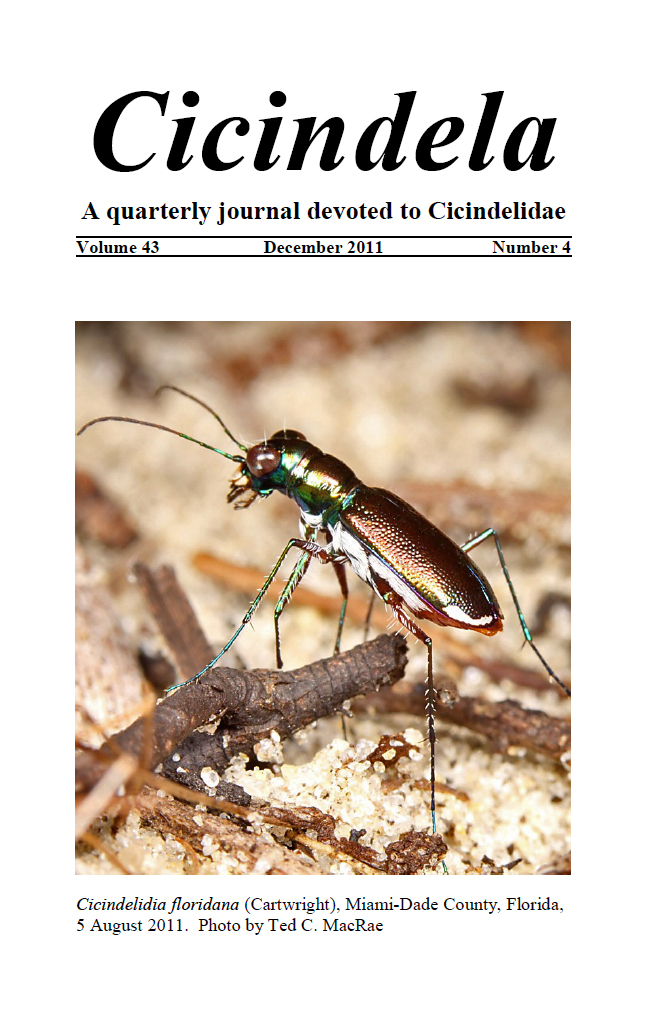
Another cover photo

Issue 43(4) of Cicindela (A quarterly journal devoted to Cicindelidae) is now hitting mailboxes (my copy arrived earlier this week), and for the second issue in a row the cover features one of my tiger beetle photos. Gracing the cover this time is the recently rediscovered Cicindelidia floridana, known only from a small area in the Miami metropolitan area of south Florida, and which I was fortunate to have the opportunity to see this past summer. Because the species is regarded as critically imperiled and a likely candidate for listing as an endangered species, the precise whereabouts of its habitat have not been disclosed. So far I am one of only a few people who have had the chance to photograph it in the field.

Now, some of you may think that because I serve as Layout Editor for the journal that I can horn in and put one of my own photographs on the cover whenever I want. This is not the case, and it was only because Managing Editor Ron Huber asked me if I had anything for the issue that I supplied the photo after having just done so for the previous issue. In actuality, we encourage others to submit their tiger beetle photographs for consideration, and since a majority of U.S. species have already been featured at some point over the years we especially encourage ex-U.S. photographers to submit their photos so that we can limit repetition. Obviously, C. floridana has never been featured on the cover before now, so it was a no-brainer choice for this issue.

The issue contains two delightful papers. The first is another by Mathew Brust on the stunningly gorgeous Cicindela pulchra that discusses not only additional northern range extensions in South Dakota and Wyoming, but also the rediscovery of the species in Nebraska far from the single previously known collection record in the state nearly 100 years ago! It is amazing to me that one of North America’s most conspicuously beautiful tiger beetle species has gone undetected for so long in such a large part of its range. The second paper by Dave Brzoska and Ron Huber is a long overdue biography of tiger beetle icon Norman Rumpp, who in his professional life was a rocket scientist (literally!) and as an avocation became one of North America’s leading authorities on tiger beetles (I am proud to claim ownership of Rumpp’s nearly complete set of The Coleopterists Bulletin). In addition to numerous publications and unpublished reports on tiger beetles in the western U.S., Rumpp described 12 species and subspecies of tiger beetles—including three of the western sand dune endemics that I have featured in recent weeks (Cicindela scutellaris yampae, C. arenicola, and C. albissima). What may not be appreciated is Rumpp’s sense of humor—well, just read the paper and see!

Copyright © Ted C. MacRae 2012
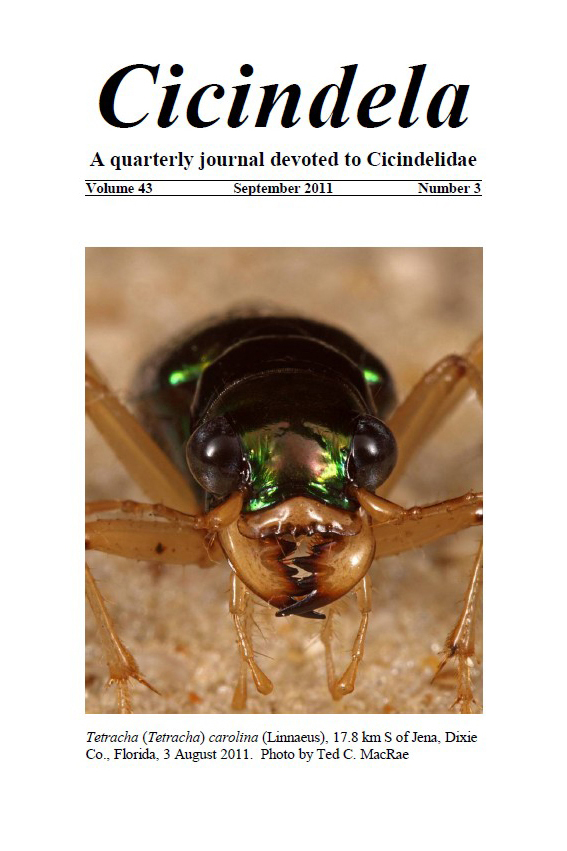
Arriving now in a mailbox near you…


The latest issue of Cicindela (A quarterly journal devoted to Cicindelidae) has just been issued. My copy arrived yesterday and features on the cover a photograph that I took of Tetracha carolina in Florida this past August (original photo and more can be seen in my post ).

I’m also happy to report that I was lead author and co-author on the two papers included this issue. I’ll provide a more detailed summary of those papers in another post—look for it in the near future, or better yet contact Managing Editor Ron Huber to begin receiving your own copies of this fine journal (subscription and contact information here).

Copyright © Ted C. MacRae 2011

Not all Florida tiger beetles are rare

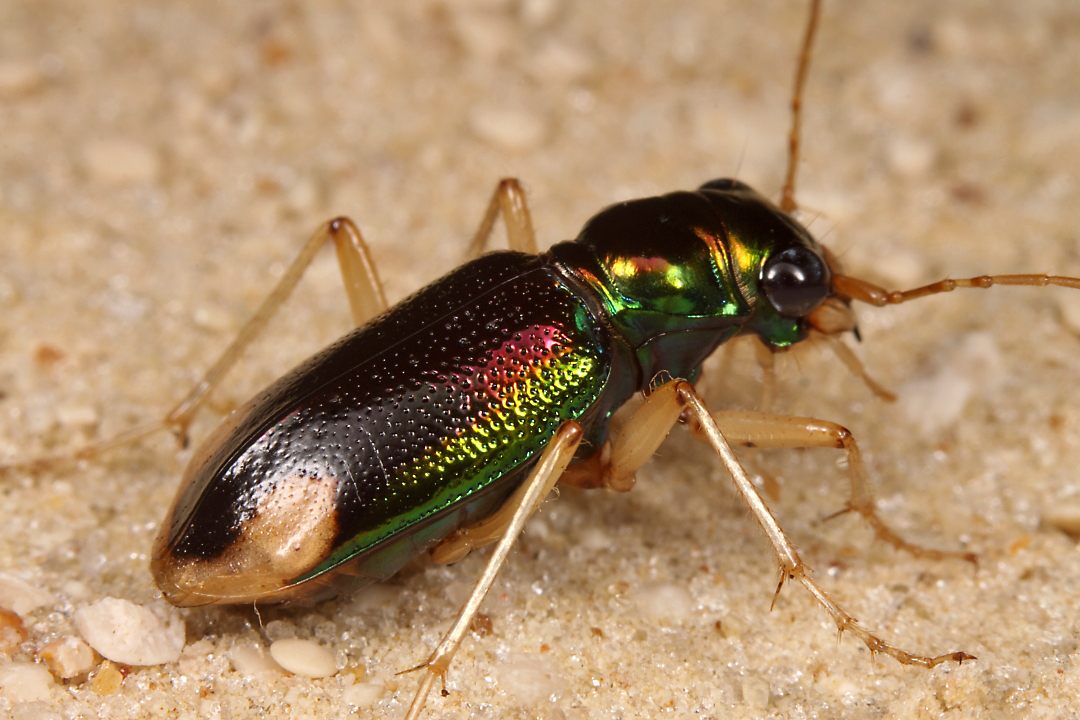
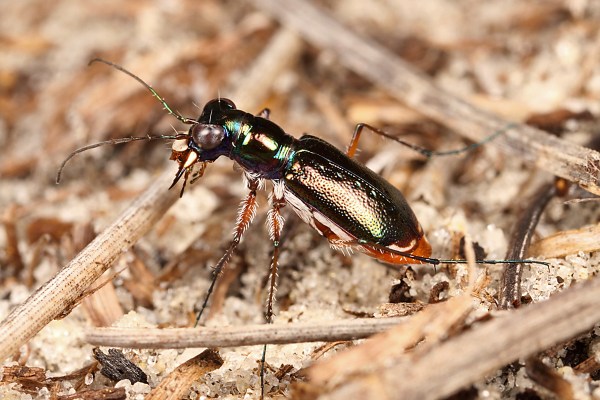
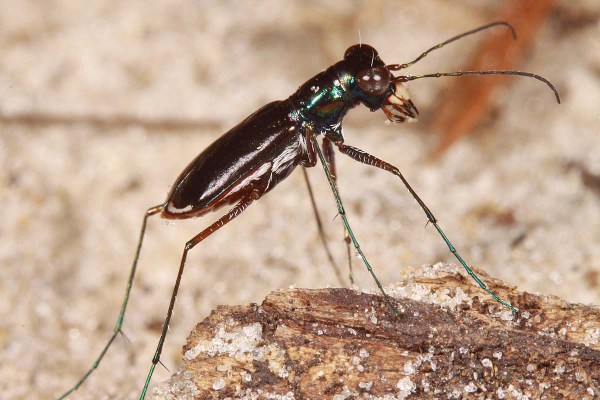
Tetracha carolina (Carolina Metallic Tiger Beetle) | Dixie Co., Florida

I fear my recent series of posts from Florida might leave readers with the impression that all of that state’s tiger beetle species are rare endemics occurring in tiny remnants of relictual habitats and encountered only by the most intrepid collectors enduring the harshest of conditions.  While it’s true that Florida has its share of such species (perhaps more than any other state in the country), it is also home to numerous species that most cicindelophiles would consider rather common—even pedestrian.  “Common” is a relative term, however, depending on where you live, and featured here is a species that until recently would have been for me just as exciting a find as Cicindelidia scabra or Habroscelimorpha striga.

Purple reflections and expanded apical lunules on the elytra distinguish this species from T. floridana

Tetracha carolina (Carolina Metallic Tiger Beetle) is one of the most widely distributed tiger beetle species in the Western Hemisphere, occurring not only across the southern U.S. but also the West Indies and south through Mexico, Central America, and the west coast of South America to Chile.  It was only during the past 10 years, however, that I actually saw the species for myself in Missouri, as it is restricted to the Mississippi Alluvial Plain in the extreme southeastern corner of the state (the so-called “Bootheel”).  Not much was known about the status of this species in Missouri the first time I encountered it under building lights at the University of Missouri Delta Research Center in Portageville.  It was my first experience with “nocturnal tiger beetling,” and you can imagine my excitement at seeing these green and purple beauties glittering in the light of my headlamp.  We now know that the species, despite its restricted occurrence in Missouri, is actually quite common in a variety of habitats in that part of the state, including even agricultural fields where they hide during the day under irrigation pipes (Fothergill et al. 2011).

I simply can't resist these tiger beetle face shots!

The individual in the photographs shown here was seen at the famed “Road to Nowhere” site in a remote part of the Florida Gulf Coast—one of eight total species of tiger beetles that I’ve seen at this site during my two August visits (2009 and this year).  This site is actually one of a few places in Florida where this species co-occurs with T. floridana (Florida Metallic Tiger Beetle), an endemic species restricted to estuarian habitats in the southern half of the Florida peninsula, and until recently considered a subspecies of T. carolina (Naviaux 2007).  The brilliant purple reflections in the basal half of the elytra clearly distinguish this individual as T. carolina, as did its occurrence up on the drier sandy roadside rather than down in the salty mud flats preferred by T. floridana.  Also seen at this site up along the road were numerous adults of the broadly distributed T. virginica (Virginia Metallic Tiger Beetle), making this one of the few sites in the country where three of the four U.S. species of Tetracha can be found (the fourth, T. impressa—Upland Metallic Tiger Beetle, is a Neotropical species that reaches the U.S. only in the Lower Rio Grande Valley of south Texas).

REFERENCE:

Fothergill, K., C. B. Cross, K. V. Tindall, T. C. MacRae and C. R. Brown. 2011. Tetracha carolina L. (Coleoptera: Carabidae: Cicindelitae) associated with polypipe irrigation systems in southeastern Missouri agricultural lands. Cicindela 43(3): in press.

Naviaux R. 2007. Tetracha (Coleoptera, Cicindelidae, Megacephalina): Revision du genre et descriptions de nouveaus taxons. Mémoires de la Société entomologique de France 7:1–197.

Copyright © Ted C. MacRae 2011

Mini-review of the Cicindelidia abdominalis species-group

Now that I have seen and photographed in the field all four species of the Cicindelidia abdominalis species-group, I thought some might find it useful to have a summary of each species with comparisons, photographs and a key to distinguish the four species. The key presented below is based on that found in Brzoska et al. (2011), which itself is a modification of couplet 8 in the key to the species of Common Tiger Beetles (Cicindela) found in Pearson et al. (2006). Following the key are comparative notes for each species that discuss key characters and give specific information about their distribution, along with field photographs to illustrate the distinguishing characters.

Key to the Cicindelidia abdominalis species-group

1. Elytral surface covered with deep punctures, pronotum with dense decumbent setae (old specimens may have the setae rubbed off and the presence of setal punctures should be checked), usually with 6 labral setae . . . . . . . . . . . . . . . . . . . . . . . . . . . . . . . . . . . . . . . . . . . 2

— Elytral surface (excluding presutural foveae) relatively smooth, with shallow punctures, pronotum glabrous or with fine pronotal setae, usually with 4 pronotal setae . . . . . . . . . . . . . . . . . . . . . . . . . . . . . . . . . . . . . . . . . . . . . . . . . . . . . . . . . . . . . . . . . . . . . . . . . . . . . . . . . . . . . 3

2(1) Elytra black, with a post median marginal spot, usually with a vestige of a middle band, restricted to peninsular FL north of Miami-Dade County . . . . . . . . . . . . . . . . . . . . . . . . . . . . . . . . . . . . . . . . . . . . . . . . . . . . . . . . . . . . . . . . . . . . . . . . . . . C. scabrosa (Schaupp)

— Elytra green or bronze-green, rarely with a post median marginal spot, and without evidence of a middle band, restricted to Miami-Dade County, FL . . . . . . . . . . . . . . . . . . . . . . . . . . . . . . . . . . . . . . . . . . . . . . . . . . . . . . . . . . . . . . . . . . . . . . C. floridana (Cartwright)

3(1) Pronotum, and mes- and metepisternum glabrous, restricted to Polk and Highlands Counties, FL . . . . . . . . . . . . . . . . . . . . . . . . . . . . . . . . . . . . . . C. highlandensis (Choate)

— Pronotum with fine decumbent setae, and mes- and metepisternum with decumbent setae, widespread across southeastern U.S. Coastal Plain . . . . . . . . . . . . . . . . . . . . . . . . . . . . . . . . . . . . . . . . . . . . . . . . . . . . . . . . . . . . . . . . . . . . . . . . . . . C . abdominalis (Fabricius)

Cicindelidia scabrosa—Scabrous Tiger Beetle

This species is largely limited to oak/pine scrub habitats in peninsular Florida north of Miami-Dade Co., although it does just sneak north of the border into souutheastern Georgia. From Cicindelidia abdominalis and C. highlandensis it can be distinguished by the distinctly punctured rather than smooth elytra and the presence of dense white setae along the lateral margins of the pronotum. From C. floridana it can be distinguished by the black rather than coppery-green coloration and the usual presence of a post-median spot along the lateral elytral margins. More information about this species can be found in my post, “The (almost) Florida-endemic Cicindelidia scabrosa.”

Cicindelidia scabrosa
Cicindelidia scabrosa | Levy Co., Florida

Cicindelidia floridana—Miami Tiger Beetle

Only recently rediscovered after being thought extinct for nearly a century, this species is most similar to C. scabrosa but is restricted to pine rockland habitat in Miami-Dade Co. where C. scabrosa does not occur. Like that species it exhibits the distinctly punctured rather than smooth elytra and dense white setae along the lateral margins of the pronotum that distinguish both species from C. abdominalis and C. highlandensis; however, its coloration is brilliant coppery green rather than black like C. scabrosa, especially in living individuals seen in the wild. More information about this species can be found in my posts, “Rediscovery of Cicindela scabrosa floridana” and “Photographing the Newly Rediscovered Cicindelidia floridana.”

Cicindelidia floridana
Cicindelidia floridana | Miami-Dade Co., Florida

Cicindelidia highlandensis—Highlands Tiger Beetle

This species is most similar to C. abdominalis, sharing with it the smooth elytra and glabrous pronotum that distinguish both species from C. scabrosa and C. floridana. Unlike that more widespread species, however, C. highlandensis is found only along a narrow band of sand scrub habitats on the Lake Wales Ridge in Polk and Highland Cos., central Florida, and it can be distinguished from it by the lack of white setae on the pronotum and mes- and metepisterna (lateral portions of the thorax above the middle and hind legs). More information about this species can be found in my post, “Highlands Tiger Beetle.”

Cicindelidia highlandensis
Cicindelidia highlandensis | Polk Co., Florida

Cicindelidia abdominalis—Eastern Pine Barrens Tiger Beetle

This is the only relatively broadly distributed species of the group, occurring in a variety of dry sand habitats along the southeastern U.S. Coastal Plain from New Jersey west to Louisiana and south into the northern half of Florida. Aside from its non-endemic distribution, this species can be distinguished from C. scabrosa and C. floridana by its smooth elytra and lack of dense white setae along the lateral pronotal margin, and from it’s most similar relative C. highlandensis by the presence of fine, decumbent (lying down) setae on the pronotum and on the mes- and metepisterna above the middle and hind legs. More information about this species can be found in my post, “Tiger Beetles Agree—It’s Hot in Florida!.”

Cicindelidia abdominalis
Cicindelidia abdominalis | Withlacoochee Co., Florida

REFERENCES:

Brzoska, D., C. B. Knisley, and J. Slotten. 2011. Rediscovery of Cicindela scabrosa floridana Cartwright (Coleoptera: Cicindelidae) and its elevation to species level. Insecta Mundi 0162:1–7.

Pearson, D. L., C. B. Knisley and C. J. Kazilek. 2006. A Field Guide to the Tiger Beetles of the United States and Canada. Oxford University Press, New York, 227 pp.

Copyright © Ted C. MacRae 2011