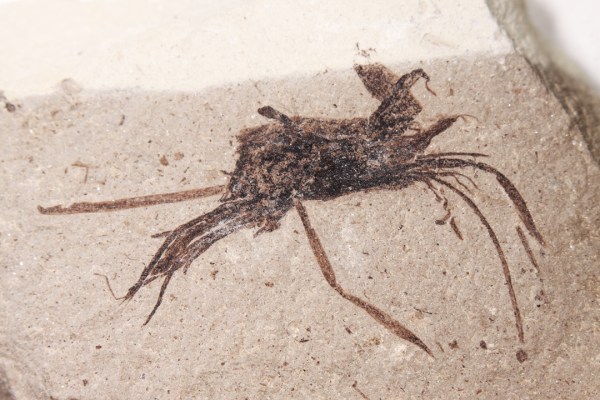
I had such helpful participation with my first fossil ID request that I thought I would go to the well again. This one is not so enigmatic as the first—it is clearly an insect, but it’s the only insect fossil among the batch that I haven’t settled on at least an order-level identification. Again, this is one of a set of 20 fossils loaned to me by a local collector for photographs and possible identifications, all coming from the Green River Formation in Colorado and dating back to the early to mid-Eocene (45–50 mya).

USA: Colorado, Rio Blanco Co., Parachute Creek Member. Body length = 11.05 mm.
The label for this fossil indicates “Planthopper; Homoptera; Fulgoridae”; however, the short, robust legs and overall gestalt do not look right for either a planthopper or really any of the other hemipteran groups. What I see is an indistinct (mandibulate?) head, a distinct and well-developed pronotum, mes0- and metathoracic segments that are not nearly as heavily sclerotized as the pronotum but also lacking any sign of wings, a distinctly segmented abdomen with 9 or 10 segments, and short robust legs. I’m thinking an apterous/brachypterous coleopteran (Staphylinidae?) or a wingless member of one of the orthopteroid orders (although size alone excludes many of the latter—at more than 11 mm in length it is too large for something like Zoraptera). At first I thought the extension near the apex of the abdomen was a cercus, but I now think this is part of the piece of debris over the abdomen as there is no evidence of a cercus on the left side—another knock against something orthopteroid. Still, the lack of any trace of elytra—however shortened—keeps me from fully endorsing Coleoptera. Okay, so what do you guys think?
Copyright © Ted C. MacRae 2012

 Beetles In The Bush