Up the Glacial Staircase

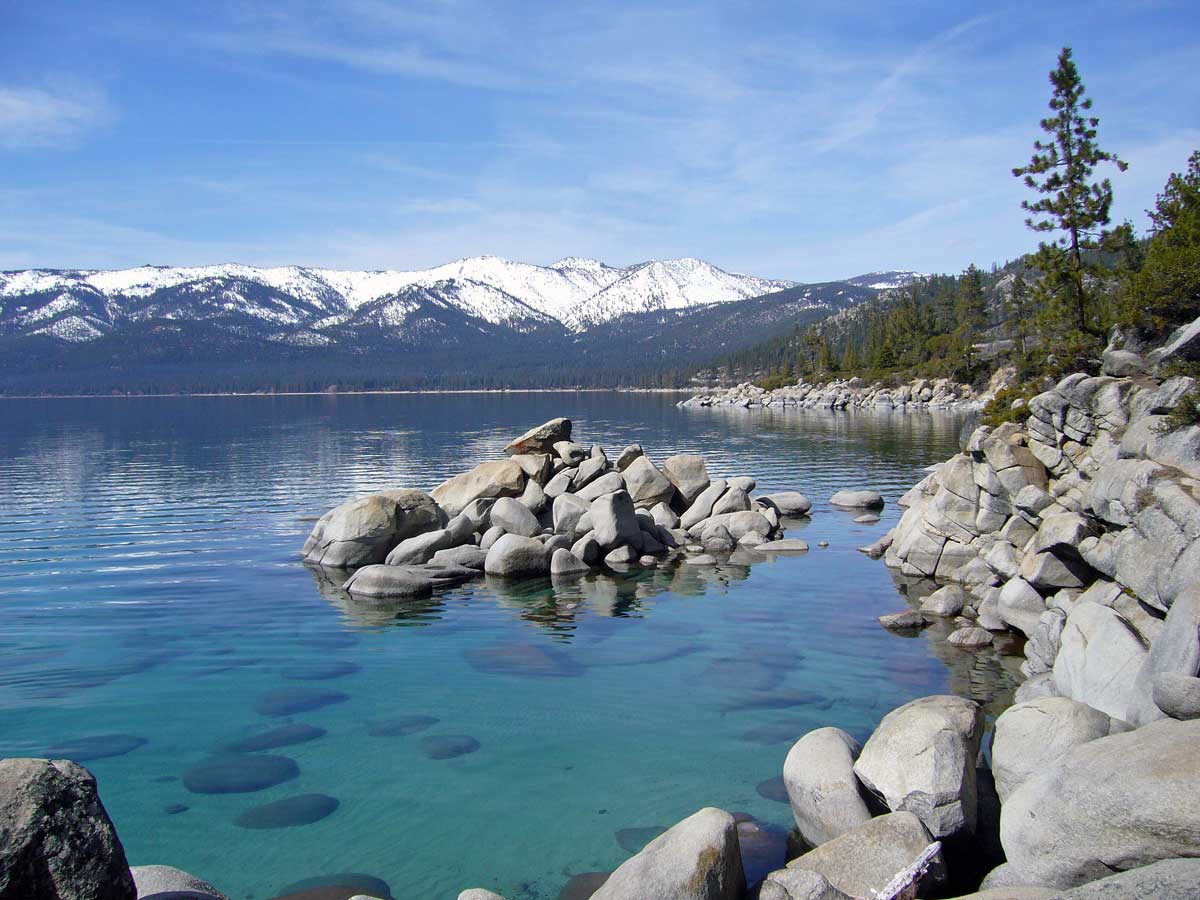
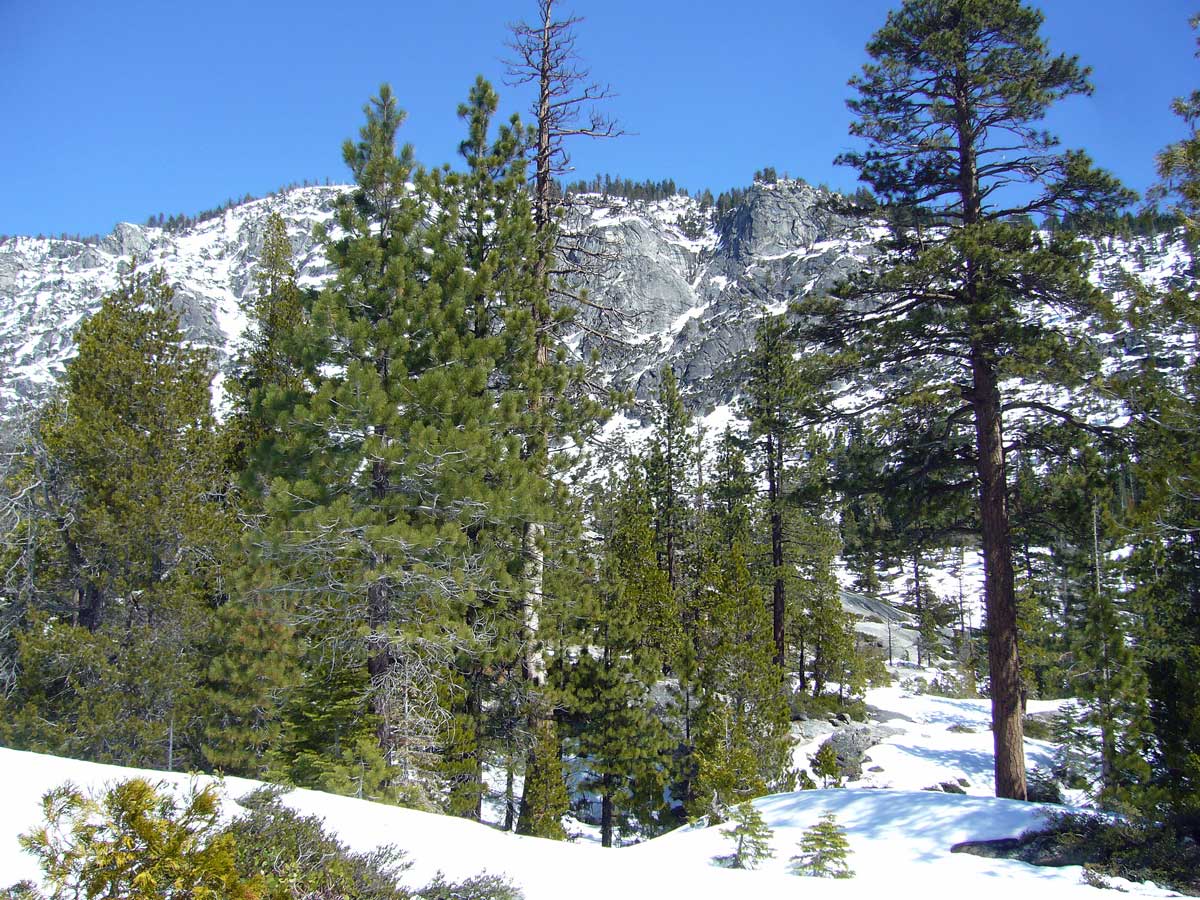
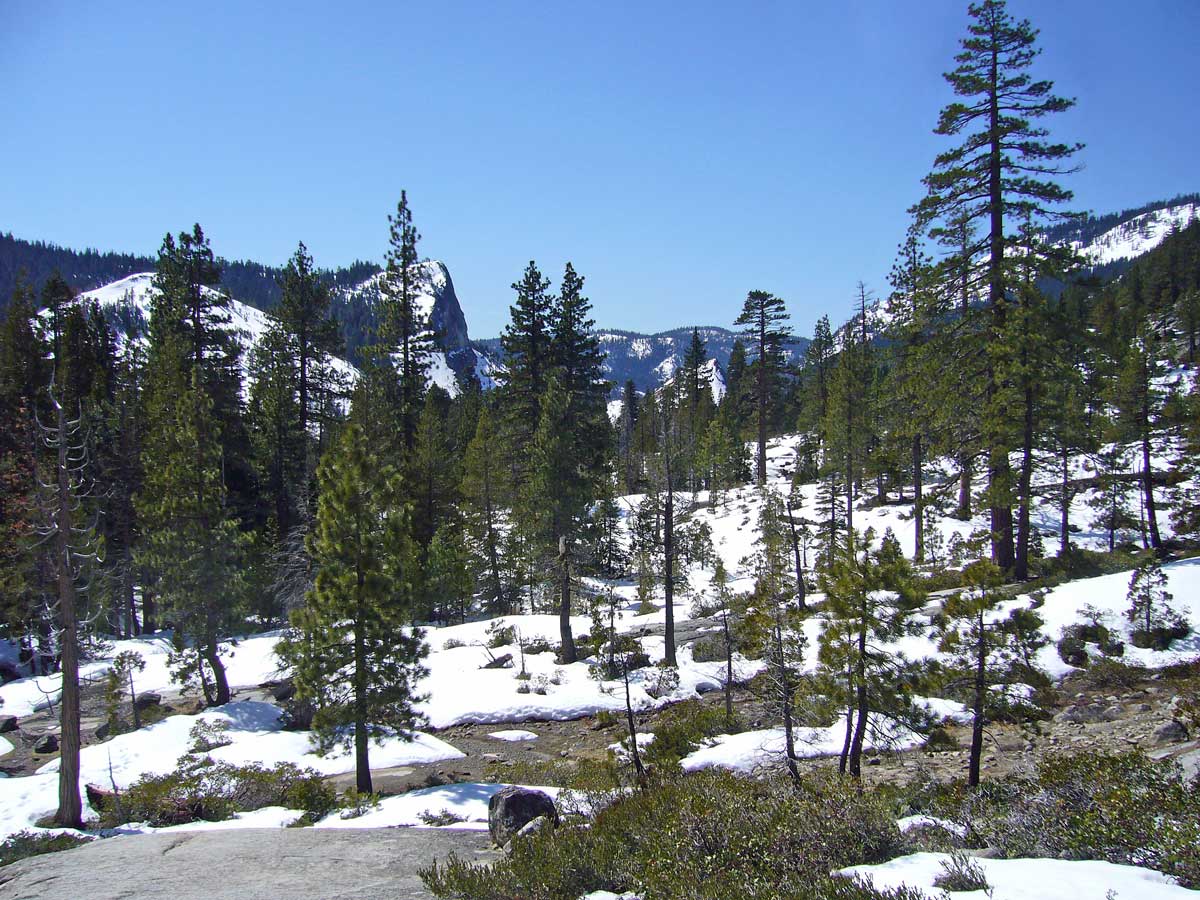
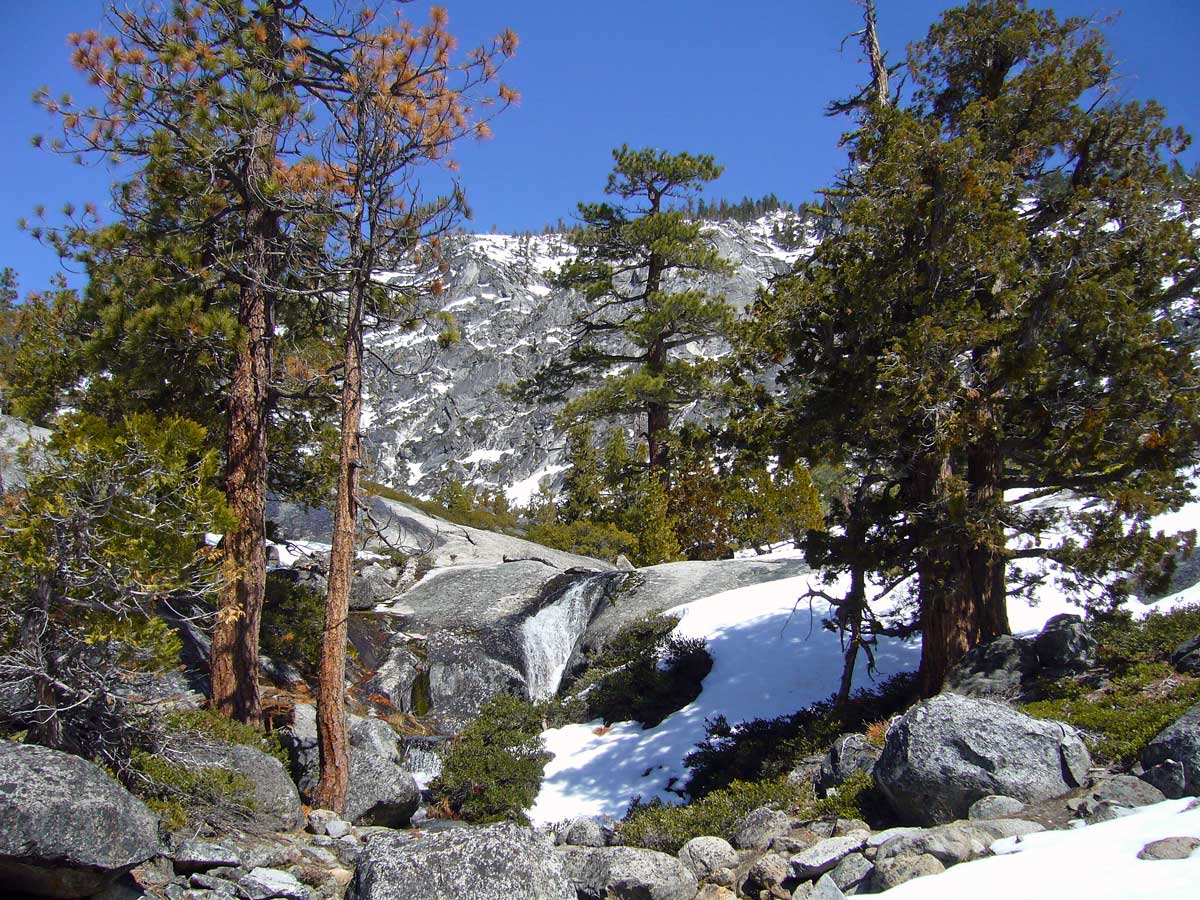
During last year’s visit to Lake Tahoe, we attempted to hike Eagle Falls Trail, one of Lake Tahoe’s most scenic and popular trails.  Beginning at the Hwy 89 trailhead above Emerald Bay, this trail climbs a dramatic ‘glacial staircase’ with steep, narrow gorges connecting a series of deep lakes and meadows.  Each of these lakes, and indeed Emerald Bay itself, was formed as a result of glaciers that carved Lake Tahoe’s granite shores until as recently as 10,000 years ago – leaving behind scars of incomparable beauty.  Eagle Lake perches atop one of these steps – only a short, one-mile hike up the trail but rising nearly 2,000 feet above the trailhead.  Summer hikers have trouble enough dealing with this elevation gain, but winter hikers – as we learned last year –  find it impossible without the assistance of snowshoes.  The first steep section just short of Upper Eagle Falls would prevent any further progress, leaving me with only a teasing view up the gorge and a commitment to try again on our next visit.

There was even more snow this year than last – a good 4-6′ it appeared, but our rented snowshoes made this irrelevant (even desirable), and the four of us began the arduous task of climbing the snow-laden slopes all the way up to Eagle Lake.  It was a family affair, so the pace was dictated by 10-yr old Madison, who got us to Eagle Lake – serenely beautiful and frozen solid – in a leisurely 1 hour 45 minutes.  The hike back down the gorge passed more quickly (almost too quickly) but provided spectacular views of Emerald Bay and Lake Tahoe below. Those of you with an interest in the geological history of Lake Tahoe may refer to my earlier posts, Lake Tahoe, California (Mar 2008) and Born of Glaciers (Mar 2009).  The rest of you may just enjoy these pretty pictures.

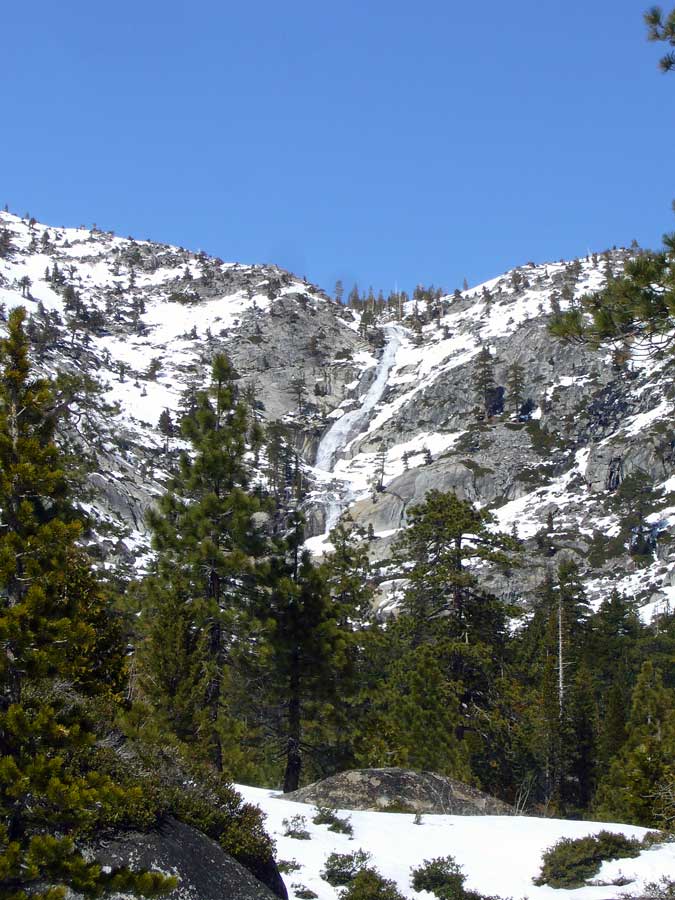
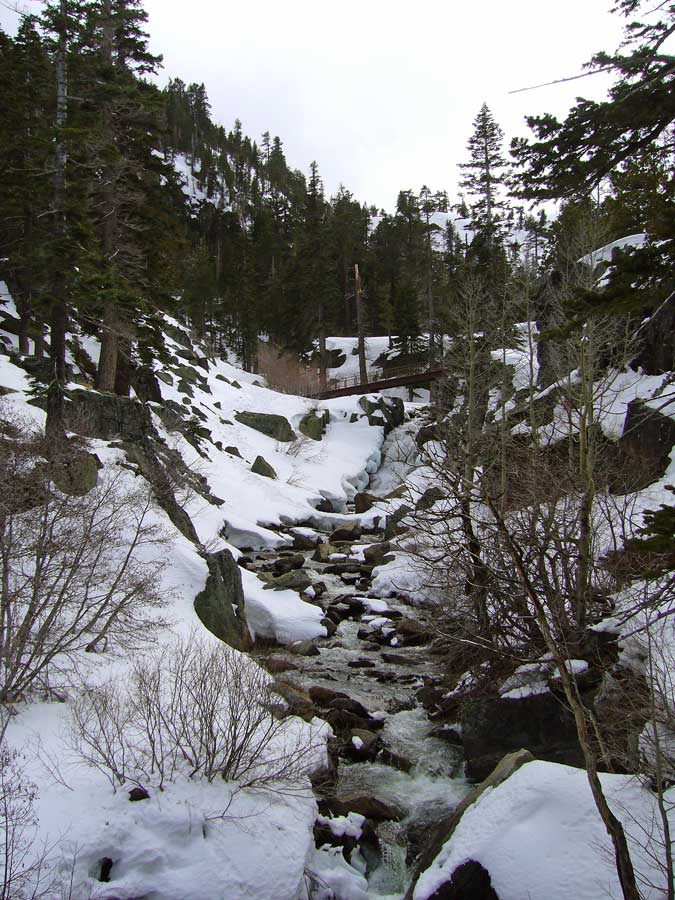
View of Upper Eagle Falls - it was here where our hike last year would end.

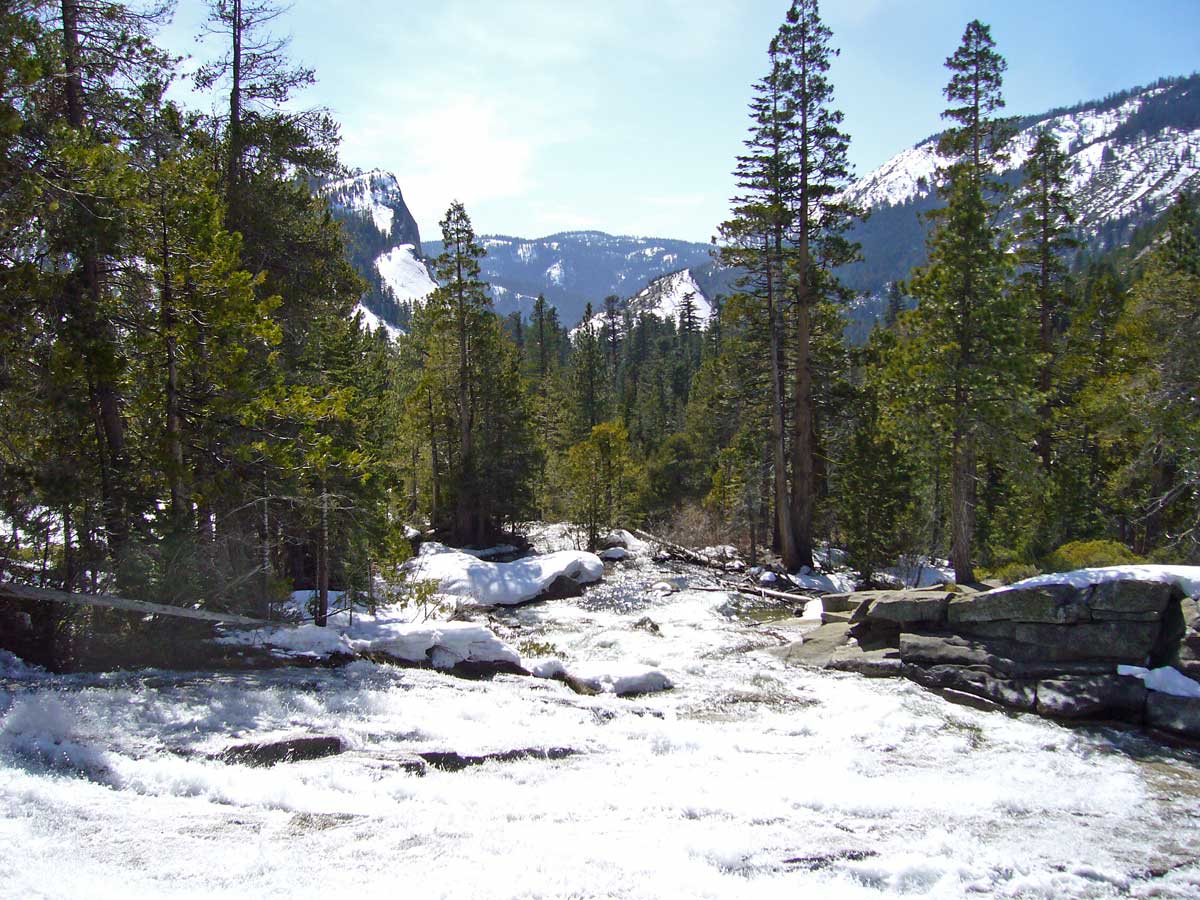
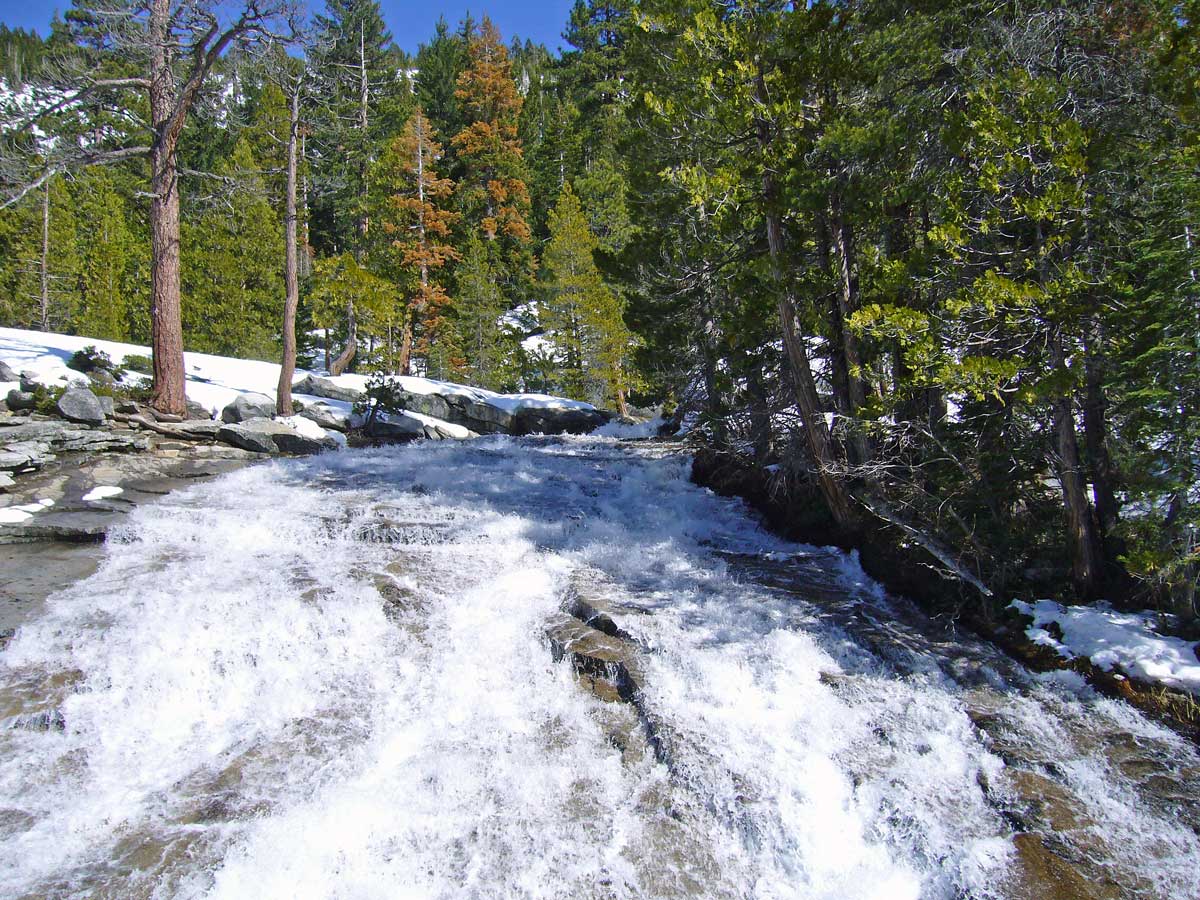
View back down the gorge from bridge over Upper Eagle Falls.

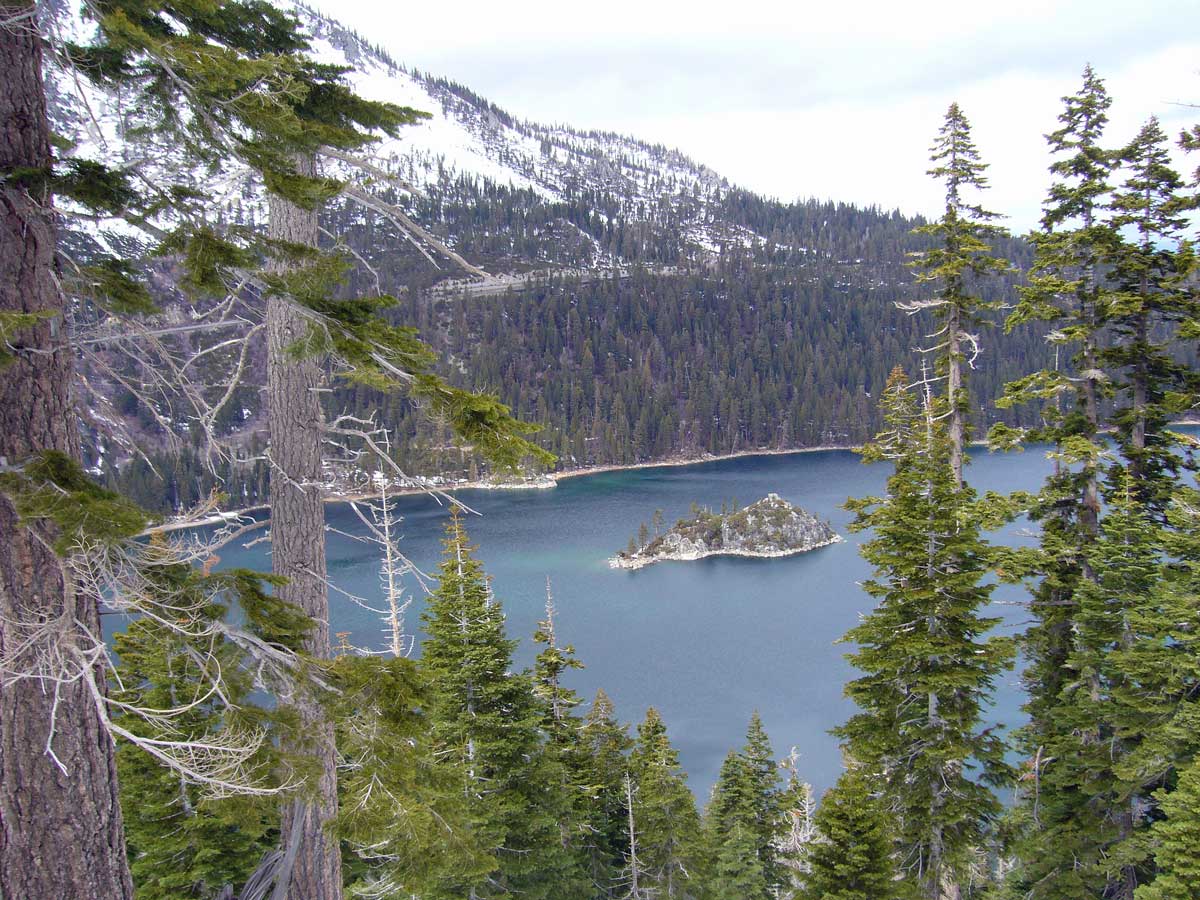
Looking back down at Emerald Bay from Eagle Falls Trail.

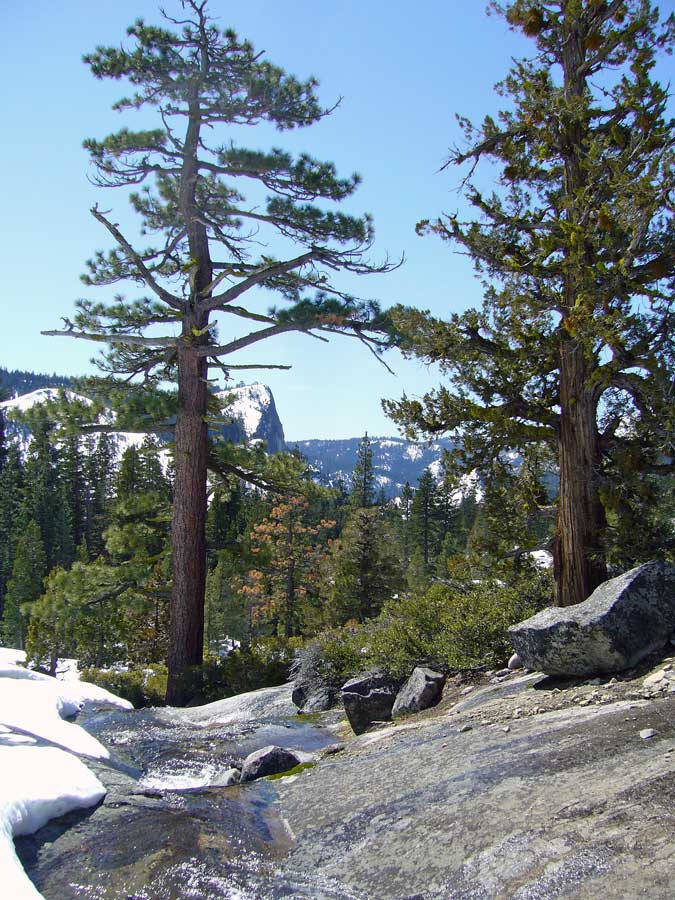
Further up the trail, one looks back upon this spectacular view of Jake's Peak.

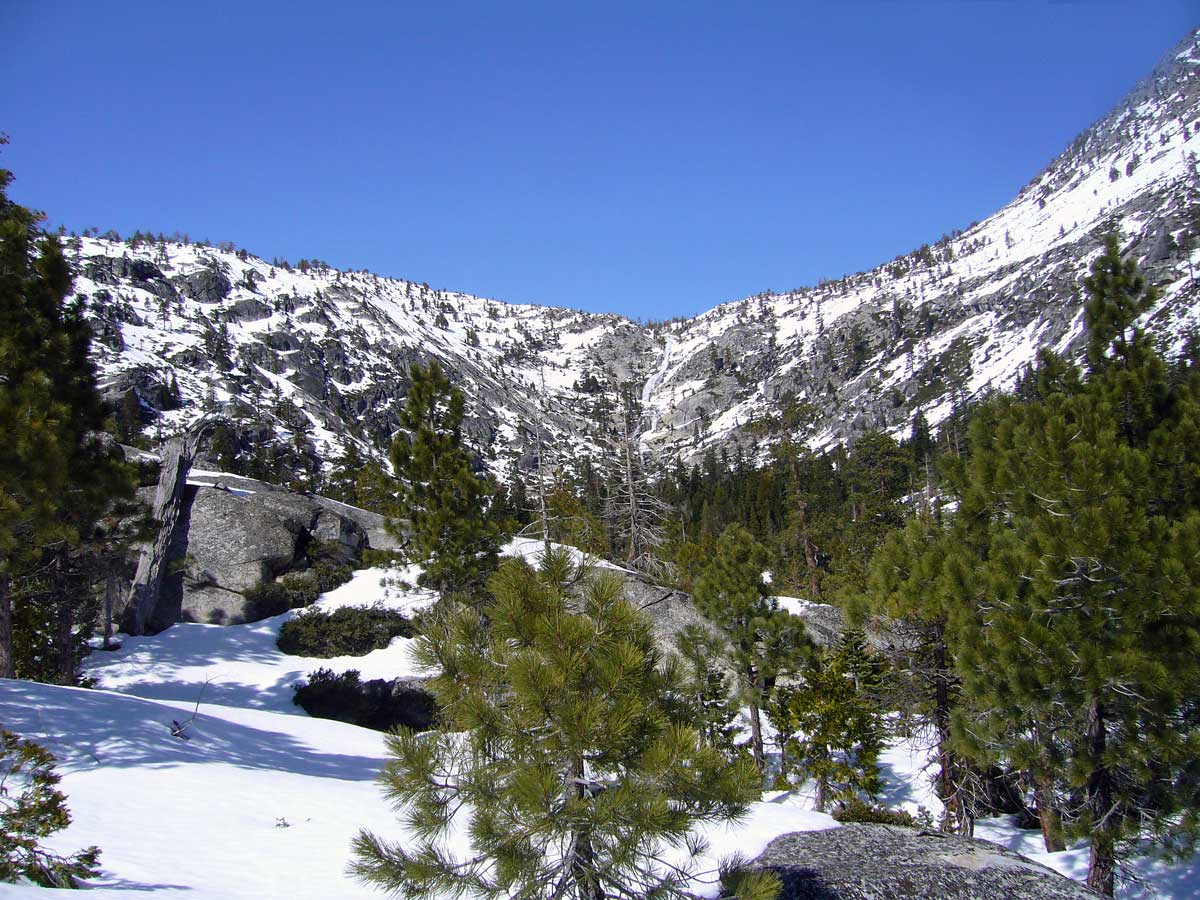
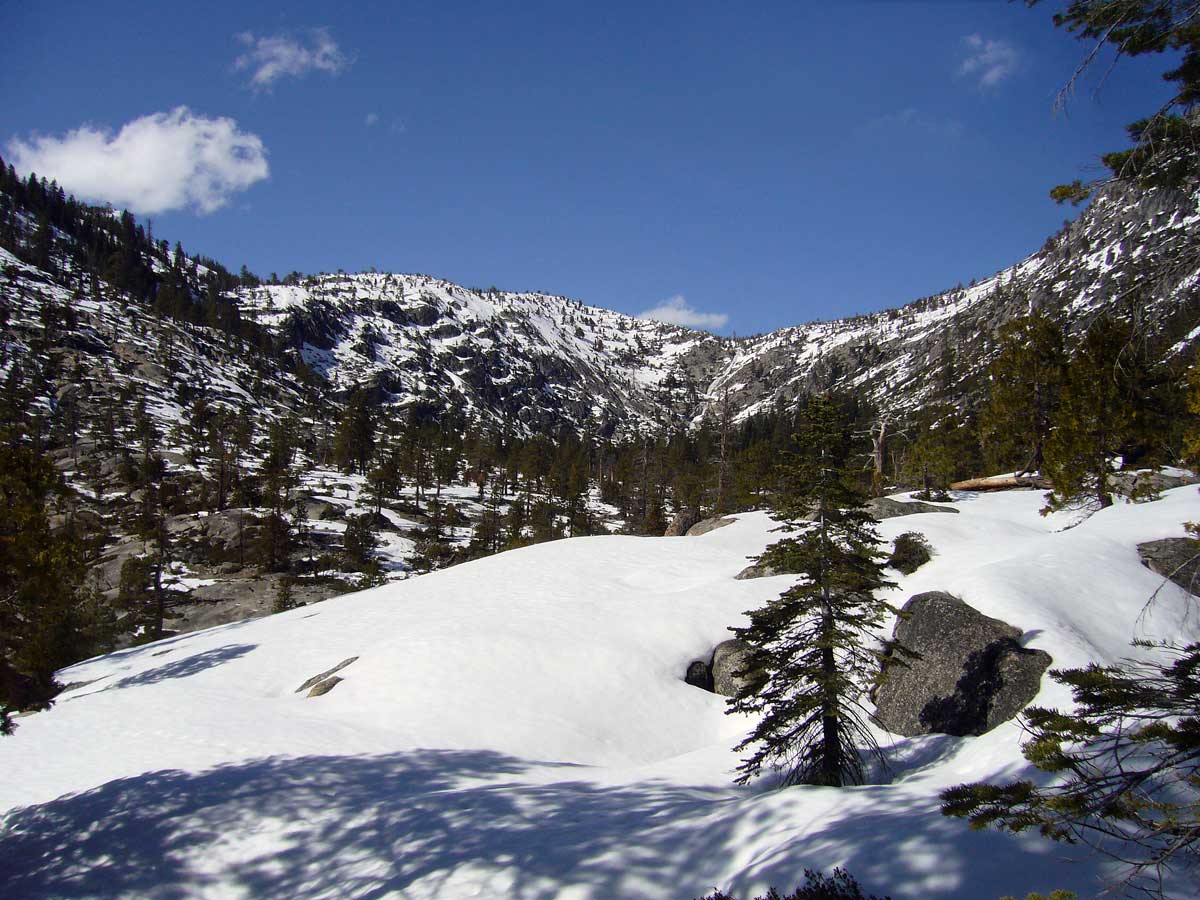
Eagle lake lies at 8,500' elevation (frozen lake surface visible through trees left).

Copyright © Ted C. MacRae 2010

Add to FacebookAdd to DiggAdd to Del.icio.usAdd to StumbleuponAdd to RedditAdd to BlinklistAdd to TwitterAdd to TechnoratiAdd to Yahoo BuzzAdd to Newsvine

Email to a friend

Hawn State Park – Winter Hiking at its Finest

Two weekends ago we received another wave in what has been an unusually frequent series of snow events. I’m sure my northern (and Patagonian) friends are not impressed, but at our middlin’ latitudes snow falls rather infrequently and rarely sticks around for long when it does. This winter has been different, with snowfall almost every week, it seems like, and temperatures that have remained cold enough to keep it around for awhile. While this latest snowfall measured only a modest 1-2 inches here in the St. Louis area, a 7-inch blanket (as measured by my hiking stick) fell in the Ozark Highlands just south of here. Coming as it did at the start of the weekend, I welcomed the opportunity to go for a hike — among my favorite wintertime activities — in a landscape that is rarely seen covered in deep, newly-fallen snow. My daughter Madison loves hiking as much as I do (even in deep snow), so the two of us headed off to perhaps my favorite of Missouri’s public areas, Hawn State Park.  I have long adored Hawn for its premier hiking, facinating geology, and unusual flora, and everytime I visit Hawn I find something new to love about it.  

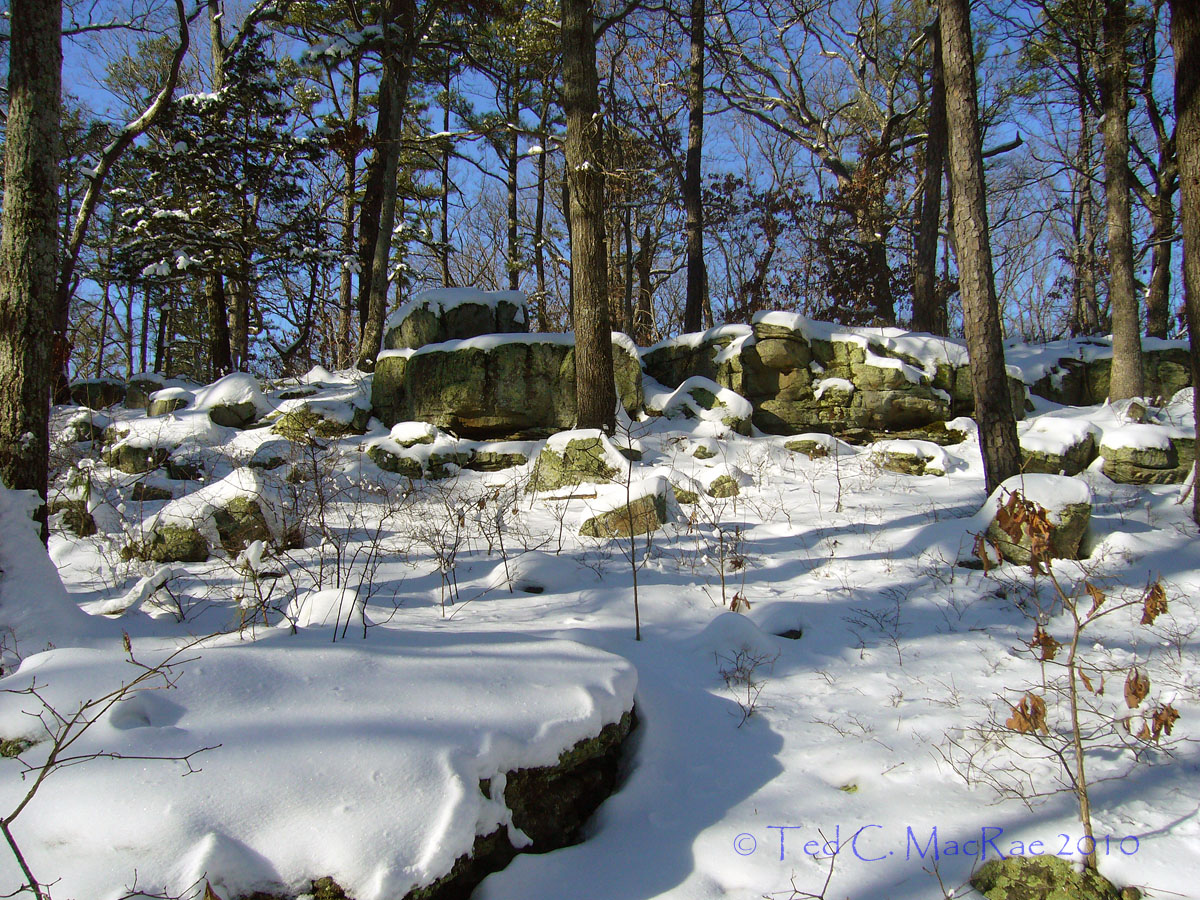
Lamotte sandstone outcrops on the White Oaks Trail


Such was the case on this visit, when Madison and I decided to explore the White Oaks Trail, a newer trail that I had not yet hiked.  I was a little concered whether we would even be able to get to the park, as the road leading into it had only been partially plowed (and we had already seen one car off the road, causing me to reach down and switch on the 4-wheel drive).  Most of the park was snowed in, but we were able to reach the uppermost parking area, leaving our snow-covered trail-finding abilities as the last obstacle to overcome.  After studying the trail map and looking at different route options, I asked Madison if she wanted to hike 2 miles, 4 miles, or 6 miles.  She immediately blurted out “6 miles!”, so off we went.  I was disappointed to see that we were not the first persons to have the idea, as we entered the trail only to find two sets of footprints (one human, one canid) leading off in front of us.  It did, however, make following the trail easier, and in fact I’ve had enough experience finding trails through the Ozark Highlands that I never felt like I needed the footprints in front of us to point the direction.  

Madison next to the root wad of an 83-yr old wind-thrown oak tree.


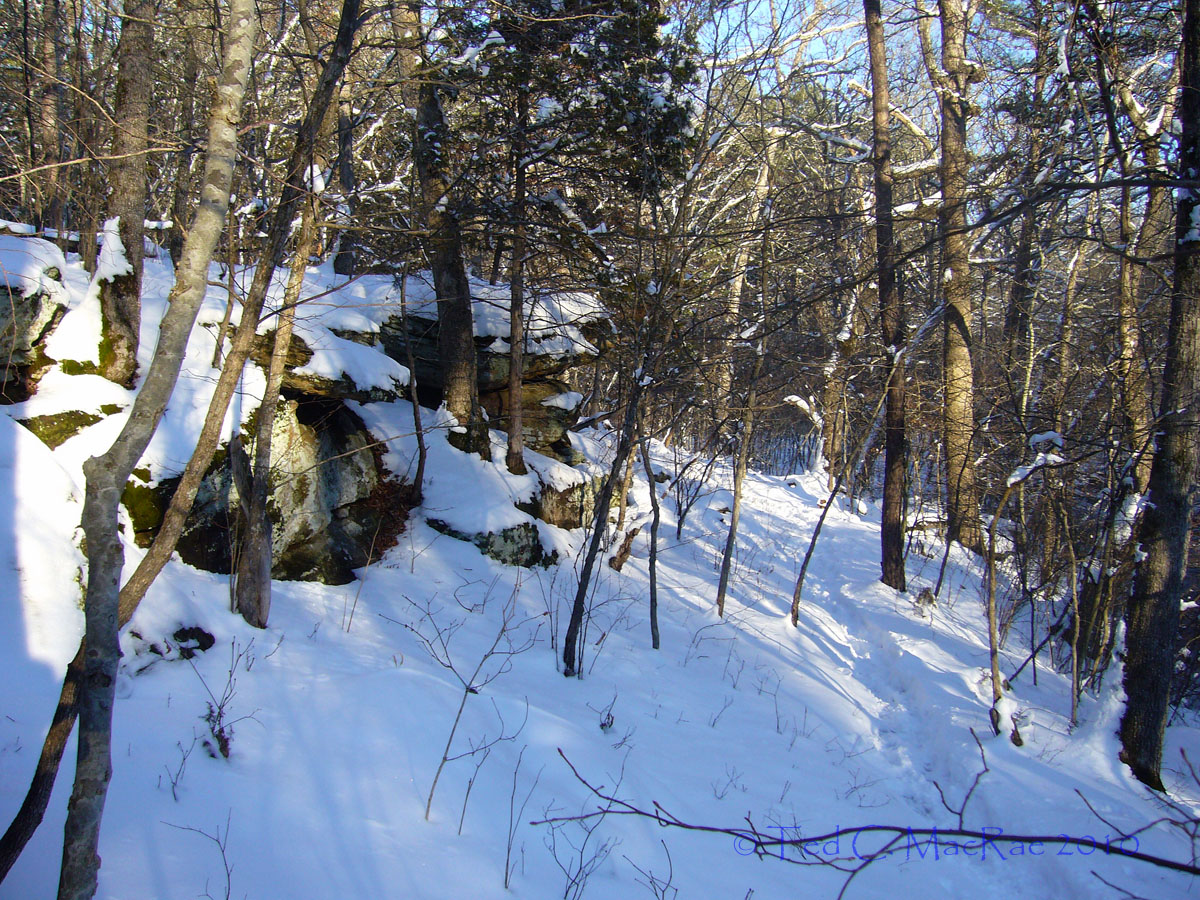
The White Oaks Trail followed nicely up-and-down terrain through mature white oak (Querucs alba) (appropriately) upland forest dissected by small riparian valleys before settling into relatively mild terrain through monotonous black oak forest.  Just when I thought the trail wouldn’t match the splendor of Hawn’s Whispering Pines and Pickle Creek Trails, it wrapped around to the south at the far end and passed by a beautiful hoo-doo complex of Lamotte sandstone outcroppingss supporting majestic, widely-spaced, mature shortleaf pines (Pinus echinata).  The rock outcrops provided a perfect spot to break for lunch while looking out on the deep, snow-covered valley in front of us.  

More Lamotte sandstone exposures along Pickle Creek, Whispering Pines Trail.


After counting a cut, wind-thrown black oak (Quercus velutinus) and determining a lifespan of 83 years, we took a connector trail down to the Whispering Pines Trail where it ran alonside the incomparably beautiful Pickle Creek.  Our hope was to hike down to the igneous shut-ins, where hard, pink rhyolites channeled the creek’s clear, spring-fed waters through narrow chutes and miniature gorges.  Upstream from the shut-ins, Pickle Creek runs lazily through the softer Lamotte sandstones that overlay those ancient rhyolites, combining with the snow cover to create a scene as peaceful and serene as any I’ve ever witnessed.

Pickle Creek meanders lazily through Whispering Pines Wild Area.

  
Just above the shut-ins, Pickle Creek bends to the west, carving deeply into the soft sandstone.  The porous nature of the rock allows moisture to trickle through and between the strata from the hillside above, creating seep zones that weaken underlying layers and lead to their collapse.  The abundant moisture this winter and continuous cycles of daytime thawing and nighttime freezes have resulted in extraordinary ice formations along the bluff face and underneath the overhanging layers, the likes of which are rarely seen in our normally more open winters.  Compare the scene in the first photo below with that in the second, taken at almost exactly the same spot one year ago in February 2009.  

Icicle formations along Pickle Creek, Whispering Pines Trail.


Same place as above in February 2009.


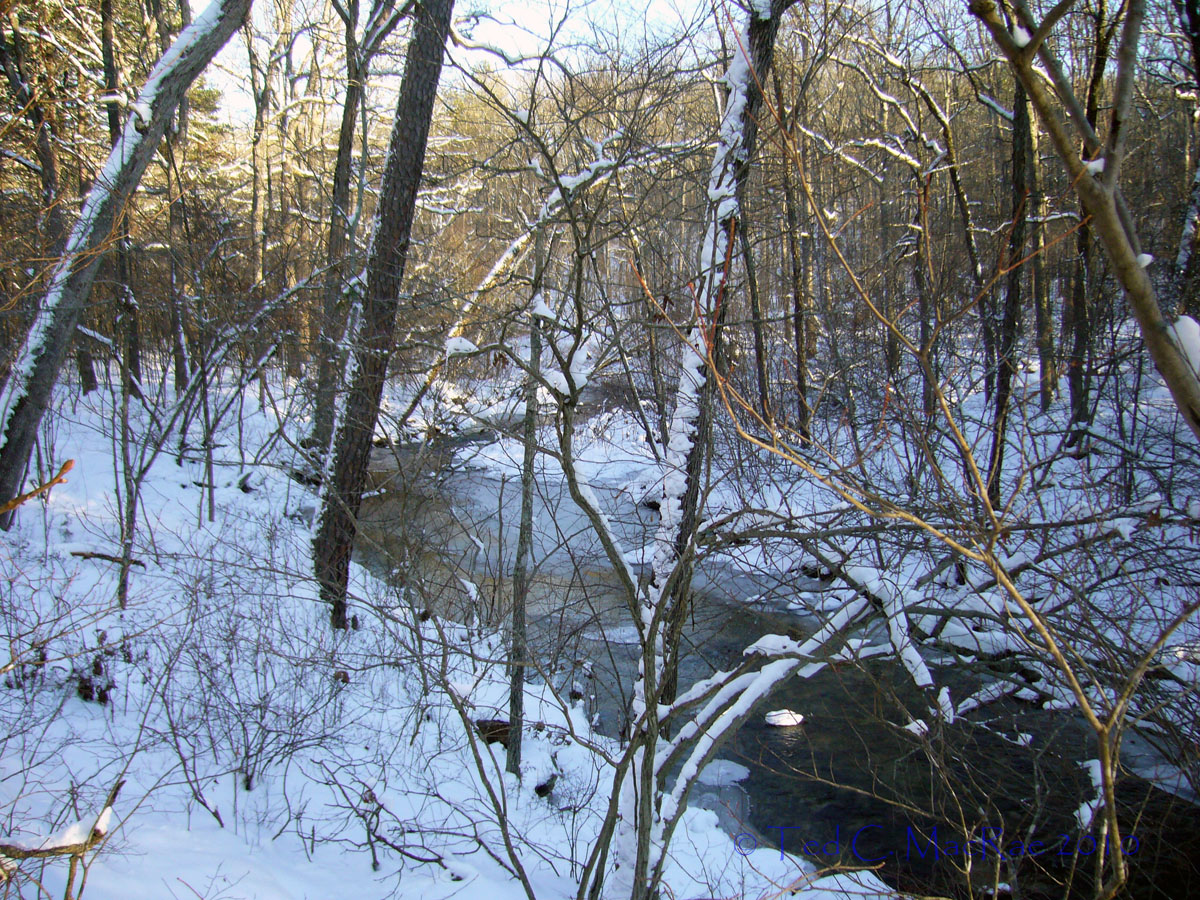
Ice rarely forms over the small ponds and lakes that dot the Ozark Highlands, much less its creeks and other moving waters.   The scene below of Pickle Creek as it exits the sandstone gorge is a testament to the slowness of its movements and the unusually consistent cold temperatures experienced during the past several weeks.  Only a short distance downstream, however, these lazy waters reach the bottommost layers of the erodable sandstones and encounter the hard rhyolites below.  These half-a-billion year old layers of igneous rock are much more resistant to the wearing action of water, which rushes noisily through narrowly-carved chutes before fanning out in broad sheets over smooth, steep slopes below.  

Pickle Creek along Whispering Pines Trail.


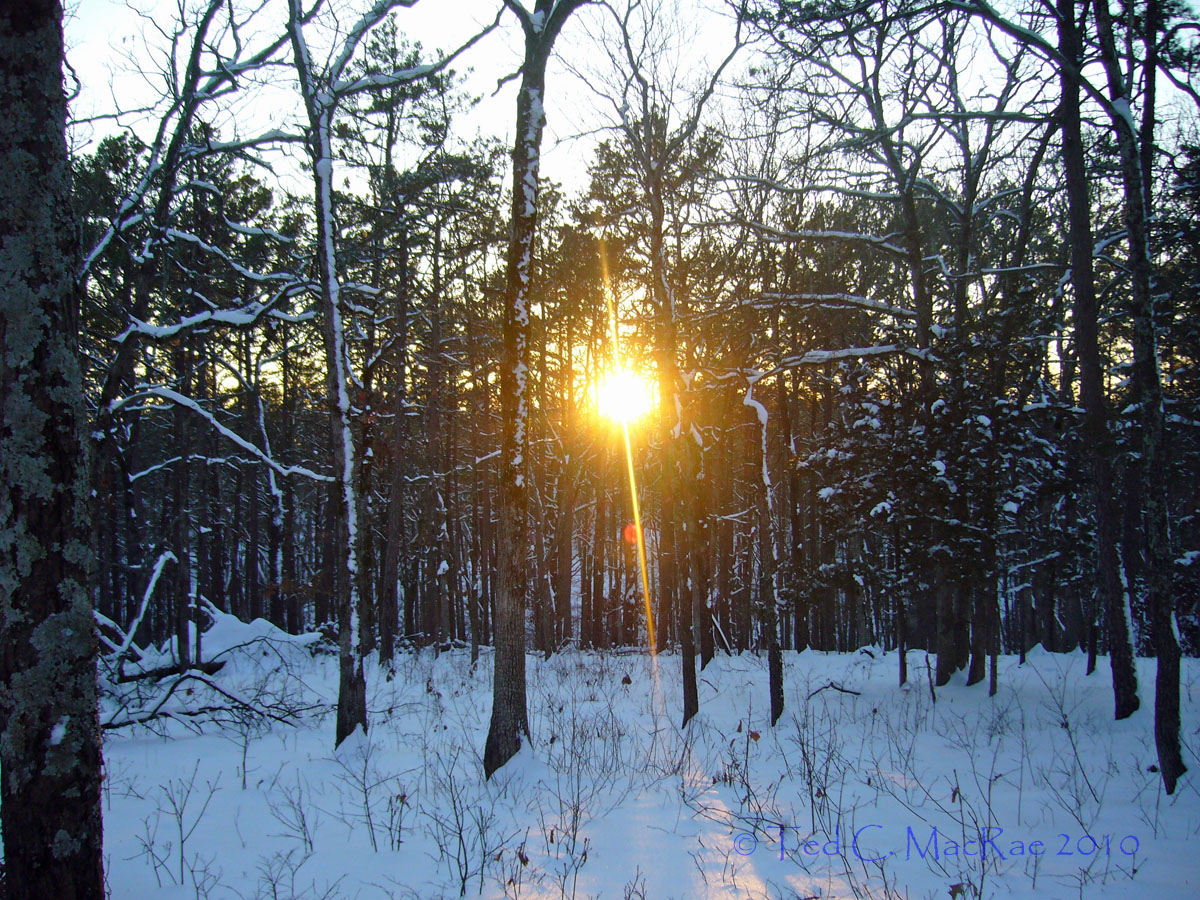
Sadly, there would not be time to visit the shut-ins.  The short February day conspired with our snow-slowed pace to leave us with a too-low-sun by the time we reached the fork in the trail that led to the shut-ins, a mile in one direction, and our car, a mile in the other.  Although we (both) had thought to carry flashlights (just in case), the last thing I really wanted to do was find myself stumbling over snow-covered trails through the dark with my 10-yr old daughter. Even had we survived the nighttime winter woods, I might not have survived the inevitable maternal reaction to such an escapade.

Arriving back at White Oaks Trailhead with a few minutes to spare.


Copyright © Ted C. MacRae 2010  

Add to FacebookAdd to DiggAdd to Del.icio.usAdd to StumbleuponAdd to RedditAdd to BlinklistAdd to TwitterAdd to TechnoratiAdd to Yahoo BuzzAdd to Newsvine  

Email to a friend

Myths about why Lake Tahoe does not freeze

p1020598_2In my recent post, Born of glaciers, I touched on the formation of Lake Tahoe and discussed the glacial origins of Emerald Bay and nearby Fallen Leaf and Donner Lakes.  At the end of that post, I listed some interesting facts about Lake Tahoe, including the fact that Lake Tahoe does not freeze over.  That last fact was linked to one of the many internet sources explaining that Lake Tahoe’s massive size and the fact that its waters are always in motion prevent it from freezing. Sounded good to me.

Fortunately, my post drew the attention of David C. Antonucci, an environmental and civil engineer and author of the website TahoeFacts.com. David pointed out that this widely circulated explanation for why Lake Tahoe doesn’t freeze (repeated even by the U.S.D.A. Forest Service, Lake Tahoe Basin Management Unit FAQ website) is, in fact, wrong. David is currently updating his TahoeFacts.com website to include a more detailed explanation about this, but he sent me a draft of his update and has graciously given me permission to quote from it in order to help clear up some of the confusion.

As David points out, size is not the reason – Lake Baikal has more than three times the depth of Lake Tahoe and 160 times the volume, yet is freezes over to a thickness sufficient to support a railway. Nor is it the motion of the water – the Bering Sea is rocked all winter long by violent storms but still forms thick ice cover. The real reason results from a combination of three basic scientific principles:

  1. Freshwater has the unique property of reaching its maximum density at about 39°F – that is, water is densest at a temperature 7°F above the temperature at which it freezes.    For any lake to freeze, its surface waters must cool to 39°F, at which time they become denser than the underlying waters and sink beneath them.  This process continues until the water at all depths is a uniform 39°F, after which the surface waters can continue cooling down to 32°F and begin freezing.
  2. Freshwater bodies gain heat during summer when air temperatures exceed the temperature of the water at the surface and lose it during winter when air temperatures are below the water surface temperature.  The rate at which stored heat is lost during winter depends upon the surface area/volume ratio – lakes with a higher ratio (i.e., they have a large surface area compared to their volume) lose heat quickly, while those with a smaller ratio (small surface area compared to their volume) lose it more slowly.
  3. The rate at which heat is lost is also affected by climate.  Freshwater bodies in colder climates will lose heat more quickly than those with the same surface area and volume in a milder climate.

These three principles combine to explain why Lake Tahoe does not freeze over.  Lake Tahoe has a very small surface area/volume ratio due to its great depth but relatively small circumference.  This limits the rate at which stored heat is lost from the lake during the colder winter months.  The relatively mild climate that occurs in the Tahoe Basin, due to its proximity to the warm Pacific Ocean, further limits the rate at which stored heat is transferred to the air above it.  The result of all this is that the surface temperature of Lake Tahoe never reaches 39°F.  The lake is coldest in late March with a temperature of 41°F at the surface and gradually decreasing to 39°F at a depth of 500-600 ft and below.  Before the surface of the lake has a chance to cool further, increasing sunlight and air temperatures start raising the temperature at the surface.  By early May, surface temperatures reach 50°F, and they peak at 65°F to a depth of 15 ft by mid-August.  However, the summer warming penetrates only to a depth of about 375 ft – where the temperature has remained at 41°F.  Since the upper layers of water never cool below this temperature, they never sink below this depth and allow further cooling to take place.  It is, ironically, a lack of movement that prevents Lake Tahoe from freezing. In order for Lake Tahoe to freeze over, climatic conditions would have to become much colder, or the lake would have to fill in and decrease its depth enough to achieve a sufficiently high surface area/volume ratio.

David also points out that Emerald Bay has formed complete ice cover at least three times during the 20th Century and partial cover in more years. The reason for this is that Emerald Bay lacks the same depth of the main lake – its surface area/volume ratio is high enough to lose its accumulated heat and reach the required 39°F top to bottom during particularly cold winters.

Copyright © Ted C. MacRae 2009

Add to FacebookAdd to NewsvineAdd to DiggAdd to Del.icio.usAdd to StumbleuponAdd to RedditAdd to BlinklistAdd to Ma.gnoliaAdd to TechnoratiAdd to Furl

Sand Harbor Overlook, Nevada

Lake Tahoe is fabulously beautiful from almost any perspective. There are certain places around the lake, however, whose beauty is so striking, so stunning, that one begins to believe they must have been copied from a starving artist’s painting or some inspirational poster. I have already highlighted one of these places – Emerald Bay, sitting at the lake’s southeastern corner on the California side. Emerald Bay is, in fact, the most dramatic example of the beauty that characterizes Lake Tahoe’s entire western shore – a boulder-strewn landscape sprouting rich forests of white fir, pine, and incense-cedar, massively trunked and often draped with lime-green mosses and lichens.

p1020749_2

Nevada’s eastern shore, in contrast, has a different feel – its forests more open and dominated by Jeffrey pine due to the relatively lower amounts of rain and snow that reach the eastern shore. I do not mean to imply, however, that the eastern shore is any less beautiful than the western shore – far from it, and after a day of cross-country skiing at Spooner Lake (just below Spooner Summit, elevation 7,200′), my family and I discovered an eastern shore jewel with as much raw, overwhelming beauty as any of Lake Tahoe’s other premier scenic vantage points – Sand Harbor Overlook.

p1020741_2

While the views from Sand Harbor Overlook may not match the grandeur of Emerald Bay, they certainly equal (and perhaps surpass) its more famous landmark in their intimacy and varied perspectives. Whether viewed from high atop the granite point that jutts out into shallow, sandy-bottomed bay, or from lake level atop one of the half-submerged granite boulders, no other vista around the lake shows off Lake Tahoe’s famously clear waters better than Sand Harbor Overlook. Moreover, unlike most of scenic points around the lake, views of the vantage point itself are as dramatic as the views from it.

p1020743_2

I suspect that during the summer months, Sand Harbor Overlook is trampled daily by an unending stream of sightseers, many of whom quickly jump out of their cars and briskly search for a spot or two from which they can take photographs before jumping back into their cars and rushing off to the next scenic spot. Such “power” sightseers rarely experience the full beauty offered by Sand Harbor Overlook – their photographs cluttered by strangers in bright clothes, and their memories of what they saw limited to an instant in time. Similar to our experience at Pyramid Creek Geological Area, we had the good fortune to experience the beauty of Sand Harbor Overlook in complete solitude – able to slowly imbibe the subtlties of scale and nuances of each vantage as we explored the area with leisure and reverence. Unmolested by strangers, our contemplations were free to meander slowly, unintruded by persistent background chatter and adolescent shouting. While I came to Lake Tahoe this winter to enjoy the skiing, I walk away with renewed awe at its extraordinary, unending beauty.

Copyright © Ted C. MacRae 2009

Add to FacebookAdd to NewsvineAdd to DiggAdd to Del.icio.usAdd to StumbleuponAdd to RedditAdd to BlinklistAdd to Ma.gnoliaAdd to TechnoratiAdd to Furl

Pyramid Creek Geological Area

On the western slopes of the Sierra Nevada, Hwy 50 follows the American River Valley on its way up to Echo Summit before dropping precipitously into Lake Tahoe Basin. A few miles from the summit and 13 miles east of the quaint mountain town of Strawberry lies a spectacular gorge – born of glaciers and boasting one of California’s top ten waterfalls. During the warmer months, the small Forest Service parking lot that provides access to the gorge is constantly choked with cars, and throngs of people can be seen milling about. I have passed this place many times during the five years I lived in Sacramento, and though the crowds suggest that the area truly is spectacular, the idea of sharing a visit with so many strangers and their dogs was always out of the question. Yesterday, as daughter Madison and I drove down Hwy 50 to that very spot, I wondered what crowds we might encounter, hopeful that during this winter “off-season” we might luck out and enjoy at least some fragments of the kind of solitude that befits such a magnificent example of California wilderness.

At 6,200 feet elevation, there was still plenty of snow on the ground, and unbeknown to me this USDA Recreation Site is officially closed during the winter months. The parking lot gates were locked, and there was not a car nor a person to be seen anywhere in the vicinity. That did not deter us – despite the many “No Parking” signs along each side of the highway – necessary during the summer months to prevent the throngs from creating chaos – we found a small turnoff in which we were able to tuck away the car and begin our little adventure to see Pyramid Creek Geological Area and its main attractions – Horsetail Falls and Cascade Vista. The gorge – named for the creek that originates at the base of the falls – was formed during the same late Pleistocene glaciations that formed Emerald Bay in Lake Tahoe. Vertical cliffs of granite tower above the U-shaped gorge, whose smooth granite domes remain littered with glacial scree (boulders and smaller rocks of assorted sizes). We lost the trail almost immediately due to snow, but since we knew we could not get lost (with a mountain on each side of us) we decided to bushwhack as far as we could. It was rough going, and with a hiking partner only 4′ in height the deep snow was a formidable obstacle. Still, we soldiered on, zigzagging from this granite exposure to that, testing (and often sinking) into the snow-covered plains between them, and splashing along the many meltwater streams that were gushing on this warm, early-spring day, until finally we could go no further. We were still a quarter mile from the falls (only a 1.25-miles hike from the trailhead if one uses the established trail), yet still the view was mesmerizing! As a father, I should probably be glad we did not make it all the way to the falls, as a number of people have been killed over the years when they got too close to the edge of the constantly wet rocks. On the way back, we spotted some granite exposures that we hadn’t seen earlier that suggested we might be able to get all the way up next to the Cascade Vista, and in this we were successful. We scrambled over the rocks and snow, ever careful but proud for giving the effort, before retracing our tracks back to a clear shot out of the gorge.

Words cannot express the overwhelming beauty of the landscape we explored, the joy in doing so without ever encountering another human being and the expansive feeling of solitude that that allows, and the exhausted satisfaction that results from hiking over rough, snowy terrain for more than 5 hours. Daughter Madison did great, and I almost had to rip her from the area she was having so much fun. She asked question after question as I showed her cracks in the rocks and explained the carving actions of water over the millennia, how water can create such a landscape. “Water always wins,” I told her. My botanizing trip to Emerald Bay two days before had also prepared me well for this trip, as I was able to recognize every single woody plant I encountered in the gorge (the mosses and ferns will have to wait for another day).

Of the many photographs I took during the day, I share with you here some of my favorites:

p1020760_2

Jeffrey pine and white fir soften the stark, towering granite walls

p1020761_2

Evidence of glacial carvings can be seen in the American River valley below.

p1020763_2

A small waterfall flanked by Jeffrey pine and Sierra juniper previews what is still to come.

p1020765_2

Another view south into the American River valley from a little higher up.

p1020769_2

Horsetail Falls is gushing from the snowmelt.

p1020771_2

A distant view of Horsetail Falls.

p1020773_2

Looking down on the Cascade Vista and the American River valley.

p1020777_2

A distant view of Horsetail Falls from the Cascade Vista.

p1020780_2

Pyramid Creek sheets in a continuous cascade over the granite bedrock.

p1020782_3

Deep snow was a continuous obstacle for myself, and for 4'-tall Madison.

Copyright © Ted C. MacRae 2009

Add to FacebookAdd to NewsvineAdd to DiggAdd to Del.icio.usAdd to StumbleuponAdd to RedditAdd to BlinklistAdd to Ma.gnoliaAdd to TechnoratiAdd to Furl

Born of glaciers

Three months of camp life on Lake Tahoe would restore an Egyptian mummy to his pristine vigor, and give him an appetite like an alligator.–Mark Twain, Roughing It (1872)

p1020578_2 When Mark Twain first laid eyes upon Lake Tahoe in 1861, he thought it “must surely be the fairest picture the whole earth affords.” More than a century and a half later, that opinion is still shared by another Missouri boy, and though I would gladly welcome three months of camp life over one week at a ski resort, I nevertheless remain confident that my vigor will be fully restored by the time I return to work next Monday. The journey that began some days ago in the foothills of my beloved, ancient Ozark Highlands has today taken me to one of the youngest of landscapes to grace Lake Tahoe – Emerald Bay. I have written previously about Lake Tahoe (one year ago almost to the day) in a post that also featured photos of Emerald Bay and its only island, the iconic Fannette Island. p1020596_2 The Tahoe Basin itself is a relatively young landscape, forming within the last 5-10 million years as the basin floor dropped between two uplifted blocks. Volcanic flows in the valley on the north side of the present lake dammed the valley to form the lake, whose level has fluctuated drastically over time during the past 2 million years as Pleistocene glaciations have repeatedly damned the Truckee River that drains the lake into the lowlands of Nevada. At maximum, the level of the lake approached 7,000 feet in elevation – nearly 800 feet higher than today. p1020577_2 It was the last of these glacial events – near the end of the Pleistocene just 10,000 years ago – that gave birth to Emerald Bay. Unlike the “ice sheets” that spread out across much of the continent, the ice age here manifested itself as individual glaciers that formed at the highest elevations and carved out individual valleys as their crushing weight ground them inexorably downward. The elongated shape characteristic of such glacial valleys is seen not only in Emerald Bay, but in the adjacent Fallen Leaf Lake and Donner Lake in the north as well. John Muir alludes to this glacial birth in a description of Emerald Bay that he wrote in his private journal in 1888:

Emerald Bay is about two miles long. Its mouth is nearly closed by a terminal moraine; the sides are formed by lateral moraines. The left lateral is very striking, well formed, three or four hundred feet high where it joins the shoulder of the mountain, timbered with pine and spruce¹ sparsely on the grayish slopes.

¹ Actually firs, of the genus Abies.

Upper Eagle Falls from Eagle Lake - part of a ''glacial staircase'' above Emerald Bay

Upper Eagle Falls from Eagle Lake - part of a

Unfortunately, the very existence of Lake Tahoe is under threat. While the mountain building processes that created the Sierra Nevada have ceased for now, the erosive forces caused by weathering continue unabated. The Sierra Nevada range is being gradually worn down, and Lake Tahoe is filling with sediment at an average rate of about 1/10th of a millimeter per year. At this rate, Lake Tahoe will become a meadow in just over 3 million years.[/humor]

Lake Tahoe facts:

  • It is 22 miles long, 12 miles wide, and holds about 40 trillion gallons of water – enough to cover the entire state of California to a depth of 14.5 inches!
  • Maximum elevation of the lake surface is about 6,229 feet above sea level.
  • The lake is drained by the Truckee River, one of a few rivers that run inland to the desert rather than towards the ocean.
  • It is the third deepest lake in North America, with an average depth of 989 feet. However, the deepest point is about 1,645 feet.  It is the largest lake in North America above 600 feet elevation.
  • Surface temperatures can reach as high as 75°F in summer, but at depths below 600 feet the water remains a constant 40°F.
  • Lake Tahoe does not freeze over, although Emerald Bay has formed complete ice cover at least three times during the 20th Century and partial cover in more years.

More Lake Tahoe facts can be found at the U.S.D.A. Forest Service, Lake Tahoe Basin Management Unit FAQ site and at Tahoe Topics and FAQ’s, by David C. Antonucci (2004).

Copyright © Ted C. MacRae

Add to FacebookAdd to NewsvineAdd to DiggAdd to Del.icio.usAdd to StumbleuponAdd to RedditAdd to BlinklistAdd to Ma.gnoliaAdd to TechnoratiAdd to Furl

A journey through time

hole_in_the_mountain

East Humbolt Range, northeastern Nevada

During the past two days, my family and I made the long drive from St. Louis, Missouri to Lake Tahoe, California to enjoy a week of skiing (both alpine and cross-country), snow-shoeing, hiking (at lower elevations), and decompression.  At 1,990 miles, it’s not a drive for the pampered or easily bored (and for those with children, thank goodness for in-car DVD players). Yet, for those willing to explore the little seen wonders of a landscape that most people see only from 30,000 feet, driving cross-country can be a richly rewarding experience.  I have traveled through many parts of the U.S., but this was my first time experiencing the “northern route” between Missouri and California along I-80.  Along the way, I saw:

  • Massive flocks of snow geese roosting in wetlands along the Platte River Valley, rising up at morning’s light in swirling clouds and stringing across the sky in vast, intersecting “V”s as they begin another day on their journey northward.
  • Sandhill cranes in the Nebraska Sand Hills, dropping down from the sky like miniature parachutes as they congregated in fallow corn fields to feed amongst the stubble.
  • The vast, high, arid, lonely expanses of the Wyoming Basin, transitioning from mixed-grass prairie in the east to sagebrush steppe in the west.
  • The stunningly spectacular descent down the western escarpment of the Wasatch Range, where the eastern edge of the Great Basin laps against the western edge of the Rocky Mountains.  (Nightfall unfortunately deprived me of my chance to see the vast Great Salt Lake and the even more expansive stretches of its associated salt flats.)
  • The magnificent Great Basin landscape and its alternating basin and range theme – its broad basins of salt lakes, marshes and mud flats interrupted at regular intervals by craggy, north to south mountain ranges formed as a result of strike-slip faulting during the past 30-50 million years as the thin Basin crust continues to crack and stretch even thinner.
  • The dramatic eastern face of the Sierra Nevada Range, its snow-capped peaks rising massively as a single granite block at the western edge of the Great Basin, and the equally dramatic, tortuous climb up to Spooner Pass at 7,200′ elevation before the 1,000′ drop down into the majestic Lake Tahoe Basin.

Driving across such a vast expanse of North America, especially in the west with its endless vistas and majestic landscapes, invites contemplation about earth and time.  Starting out in the foothills of my beloved Ozark Highlands – born before life itself and weathered for a billion and a half years, driving through the upstart Rocky Mountains – mere babies at only 50-100 million years of age, and finally arriving at the truly young Lake Tahoe – whose mere few million years of age make it a mere infant in geological time, I realized that the vastness of these landscapes, and of the countless tectonic, erosional and sedimentary episodes that shaped them, is surpassed only by the vastness of the time it took to create them.  For those willing to make the investment, driving through these landscapes is more than a trip across the country – it is a journey through time.

Copyright © Ted C. MacRae 2009

Add to FacebookAdd to NewsvineAdd to DiggAdd to Del.icio.usAdd to StumbleuponAdd to RedditAdd to BlinklistAdd to Ma.gnoliaAdd to TechnoratiAdd to Furl

Sanctuary for the Betulaceae

Nestled on the eastern side of the St. Francois Mountains, where the craggy exposures of the Ozarks most ancient rocks begin to subside underneath the Cambrian sandstones laid down over them, lies Hawn State Park – considered by many to be the loveliest of Missouri’s state parks. I have written previously about Hawn – in fact, it was the subject of my very first post on this blog. I have long treasured Hawn for its excellent insect collecting, diversity of plants and habitats, and unbridled beauty. I have hiked the incomparable Pickle Creek and Whispering Pine Trails many times – far more than any other trail in the state, and each time I fall more deeply in love with what, to me, represents the essence of the Missouri Ozarks in their most pristine state.

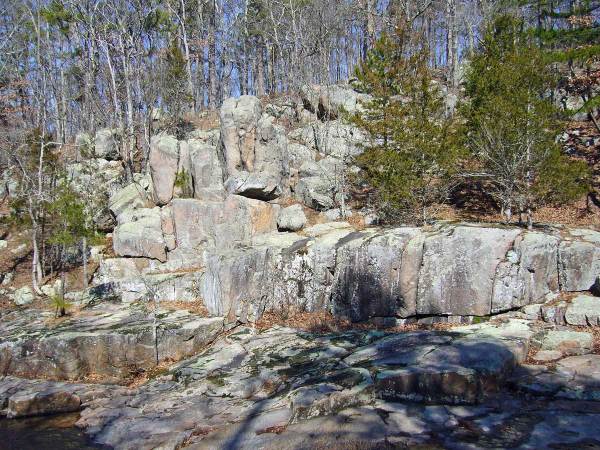
Lamotte sandstone cutThe charm of Hawn results from a unique combination of geological features. The Lamotte sandstone outcrops that dominate Hawn’s landscape are the oldest sedimentary rocks in the state, formed from coarse sand deposits that were laid down over the Precambrian rhyolites and granites that form the core of the St. Francois Mountains. These sand deposits were themselves buried under limestone and dolomite layers formed at the bottom of vast seas that later covered much of the interior of the continent. Subsequent periods of uplift and erosion once again exposed these sandstones, whose unique ability to hold groundwater has resulted in the formation of spring-fed streams that have cut deep into their soft layers to create canyon-rimmed valleys with tall vertical cliffs. rhyolite shut-ins One of these streams is Pickle Creek, which is fed throughout the year by Pickle Spring and has in some places cut all the way down to the underlying igneous rock to form “shut-ins.” In contrast to the slow, sandy bottomed stretches where Pickle Creek is still cutting through sandstones, the water in these igneous shut-ins rushes through narrow openings in the highly resistant rock. The igneous and sandstone exposures found in Hawn are spectacularly beautiful and support a unique flora due to the acid soils they produce. One group of plants that have taken sanctuary in these moist, acid soils is the Betulaceae, or birch family. Missouri is home to five native species of Betulaceae¹, and while none of them are extraordinarily uncommon they are limited in their occurrence to natural communities with sufficient moisture and exhibit a clear preference for acidic soils. This confluence of conditions occurs perfectly along Pickle Creek, allowing all five native species to grow here side-by-side – a betulaceous “hot spot” that represents not only the full diversity of the family in Missouri, but also the total generic diversity of the family in North America. In fact, only one other genus (Ostryopsis, shrubs related to Corylus and restricted to China) is assigned to the family on a global basis (Furlow 2004).
¹ Dr. George Yatskievych, in his recently published Steyermark’s Flora of Missouri (2006), regarded the presence of Corylus cornuta in Missouri as unlikely despite earlier reports of such. Dr. Yatskievych also recorded a single escape of the European species Alnus glutinosa from Springfield, Missouri.

The Betulaceae are deciduous trees and shrubs that occur primarily in the boreal and cool temperate zones of the Northern Hemisphere, although outposts are also known from high elevations in the Neotropics and, as mentioned above, China. Fossils of this ancient lineage of flowering plants are traceable to the late Mesozoic (upper Cretaceous), and the family appears to form a clade with hamamelidaceous plants. As would be expected from a group with boreal affinities, most species exhibit adaptations for survival in cold climates, such as small stature, shrubby growth habits, and small leaves. Several of Missouri’s species have performed well and gained acceptance as ornamental trees and shrubs, while others are important as sources of hazelnuts (genus Corylus) or ecologically for their ability to fix nitrogen (genus Alnus). My interest in these plants has nothing to do with their economic importance, but rather in their role as host plants for several rarely encountered species of woodboring beetles. Often, insects in this group may be collected on foliage of their hosts during the summer, making host identification fairly easy due to the presence of leaves. This is not always possible, however, due to limited periods of adult activity or low population densities. Rearing these insects from their hosts provides additional opportunity to document their occurrence, and winter is often the best time to collect the dead branches in which they breed, since by that time they have nearly completed their development and will be ready to emerge as soon as temperatures rise during spring. Identifying woody plants without foliage can be a challenge, but the ability to distinguish host plants by non-foliage characters such as bark, growth habit, bud shape, etc. greatly facilitates studies of wood boring beetles through rearing. In the past I have relied heavily on Cliburn and Klomps’ (1980), A Key to Missouri Trees in Winter, which utilizes mostly details of the twigs and buds to discriminate among Missouri’s 160+ species of trees. However, after a certain level of familiarity is gained, one eventually learns to recognize winter trees and even downed logs or fallen branches simply by their “look”.

Betula nigra - habit

Betula nigra - habit

Betula nigra - old bark

Betula nigra - old bark

Betula nigra - sapling

Betula nigra - sapling

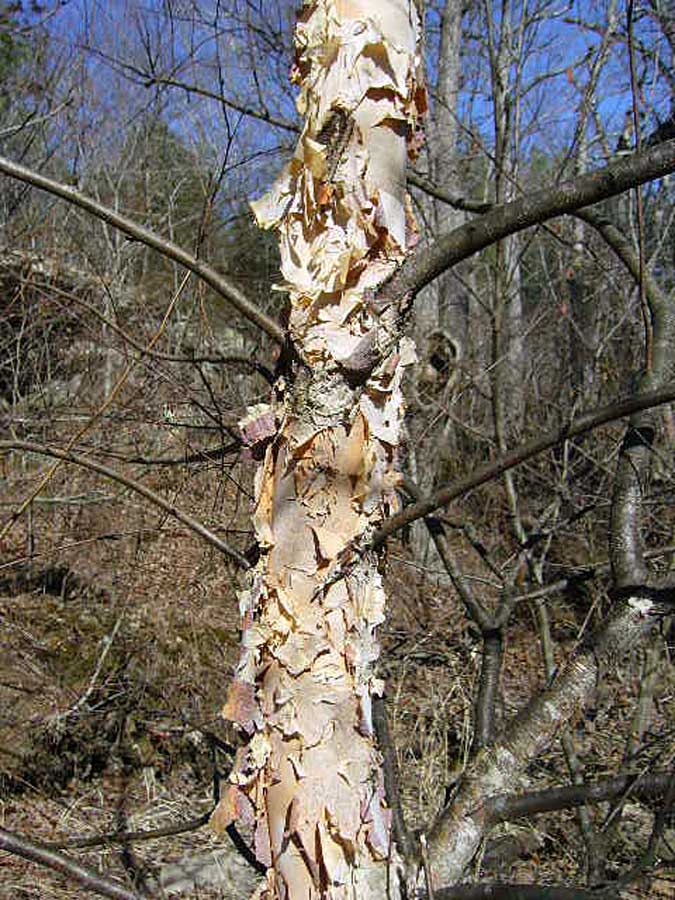
Betula nigra (river birch) is the only member of this largely boreal genus found in the middle and southern latitudes of the U.S. and, thus, cannot be confused with any of Missouri’s other betulaceous species². It is the largest of the five and, along with the following species, is the most demanding in terms of keeping its “feet” wet. Trees are usually encountered right at the water’s edge, with tall, slender, often twisted or leaning trunks. Young trees and large branches on older trees exhibit gorgeous reddish brown bark peeling in thin, papery sheets, becoming thick and scaly on the main trunks of older trees. Small branches are dark, purplish brown in color with smooth bark and distinctly horizontal lenticels.  I have reared a small jewel beetle from fallen, dead branches of this tree collected at several locations in Missouri – this beetle turned out to be new to science, which I described and named Agrilus betulanigrae in reference to its (then) only known host (MacRae 2003).  I have also reared tremendous series of another jewel beetle, Anthaxia cyanella, which at the time was not known to utilize this host and was considered uncommon.  As it turns out, Betula nigra is its preferred host, and the rearing of large series from many locations resulted in improved knowledge about color forms and variability in this species (MacRae & Nelson 2003).

² The widely planted but dreadfully non-adapted Betula pendula (European white birch) and B. papyrifera (paper birch) can be recognized by their distinctly white bark. These species are limited to urban landscapes where they rarely achieve significant stature before declining and eventually succumbing to insect pests such as Agrilus anxius (bronze birch borer). River birch provides an equally attractive and much more durable choice!

Alnus serrulata - habit
Alnus serrulata - habit

Alnus serrulata - sapling
Alnus serrulata - sapling

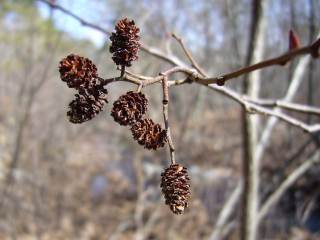
Alnus serrulata - old cones

Alnus serrulata - old cones

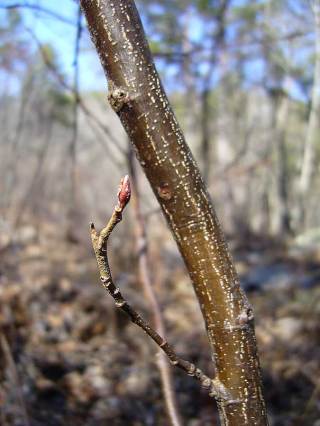
Alnus serrulata (common alder, hazel alder, smooth alder, tag alder…) also demands to be next to (or even in) the water.  Unlike B. nigra, however, this species rarely reaches true tree status, instead usually forming shrubby thickets along the water’s edge.  Saplings can resemble those of B. nigra due to their smooth brownish bark, but the latter is usually more purplish, and the lenticels of A. serrulata are not distinctly horizontal as in B. nigra. The large purple-red buds also differ from the small brown buds of B. nigra, and during winter A. serrulata is adorned with numerous staminate catkins.  The persistent woody cones also cannot be mistaken for those of any other species of Betulaceae in Missouri. Associated with this plant is the longhorned beetle, Saperda obliqua, which reaches its southwesternmost distributional limit in Missouri on the basis of a single specimen collected some 25 years ago right here along Pickle Creek and given to me by lepidopterist George Balogh. Numerous attempts to find this species here since then have not (yet!) been successful.

Carpinus caroliniana - habit

Carpinus caroliniana - habit

Carpinus caroliniana (blue beech, hornbeam, musclewood) is one of my favorite betulaceous species. The beautifully fluted trunks and smooth, light gray bark are remniscent of the limbs of a sinewy, muscular person – every time I see this tree I cannot resist the temptation to grab and stroke the hard limbs (should I be admitting this?). This character begins to show even in very young trees, making its identification during winter quite easy. These trees also like to be near water, but they are not so demanding to be right at the water’s edge as are the previous two species. They usually form small trees, often in clumps with multiple trunks.  There are some notable insect associations that I’ve found with this plant.  One is a small jewel beetle, Agrilus ohioensis, which I reared from dead branches of this plant collected along Pickle Creek (Nelson & MacRae 1990), and which after more than 20 years still remain the only known Missouri specimens of this species.  Another is the longhorned beetle, Trachysida mutabilis, a single adult of which I reared from a dead (almost rotting) branch of this plant collected not too far from Pickle Creek in Iron Co.  This beetle also is the only representative of its species known from Missouri (MacRae & Rice 2007).

Ostrya virginiana - habit

Ostrya virginiana - habit

Ostrya virginiana - trunk

Ostrya virginiana - trunk

Ostrya virginiana (hop hornbean, American hornbeam) has a form and growth habit very similar to C. caroliniana, but its leaves that persist through the winter make it instantly recognizable from afar.  In Missouri, this habit is most often seen with the oaks (Quercus spp.).  This species can be found even further away from the water than the previous species, and its small stature combines with the orangish, persistent leaves to form a distinctive understory layer during winter.  Also, in contrast to the smooth gray bark of Carpinus, this species exhibits scaly, light reddish brown to brownish gray bark.  I have succeeded in rearing one of the two known Missouri specimens of another jewel beetle, Agrilus champlaini, from O. virginiana collected along Pickle Creek (the other specimen was reared from wood collected at Graham Cave State Park, another site where sandstone bedrocks favor an O. virginiana understory).  Unlike most other jewel beetles, A. champlaini forms galls in small living branches of its host.  I have collected the distinctive swellings during winter on many occasions but managed to rear only these two individuals (plus one ichneumonid parasitoid).  I have also noted similar swellings on Carpinus but have not yet managed to definitely associated them with this beetle.

Corylus americana (hazelnut, American hazelnut) is the smallest of Missouri’s five betulaceous species, always forming shrubs, sometimes in thickets, and never assuming the form of a tree. Its staminate catkins present during winter immediately identify plants of this species as Betulaceae, but the small, globe-shaped buds are unlike the more pointed buds of Ostrya and the elongated, reddish buds of Alnus. This species is the least demanding in terms of being near water and can be found even in upland prairies and glades. I haven’t yet associated any woodboring beetles with this plant in Missouri, but there are several jewel beetles known from the eastern U.S. that utilize Corylus (Agrilus corylicola, A. fulgens, and A. pseudocoryli) and could occur in Missouri.

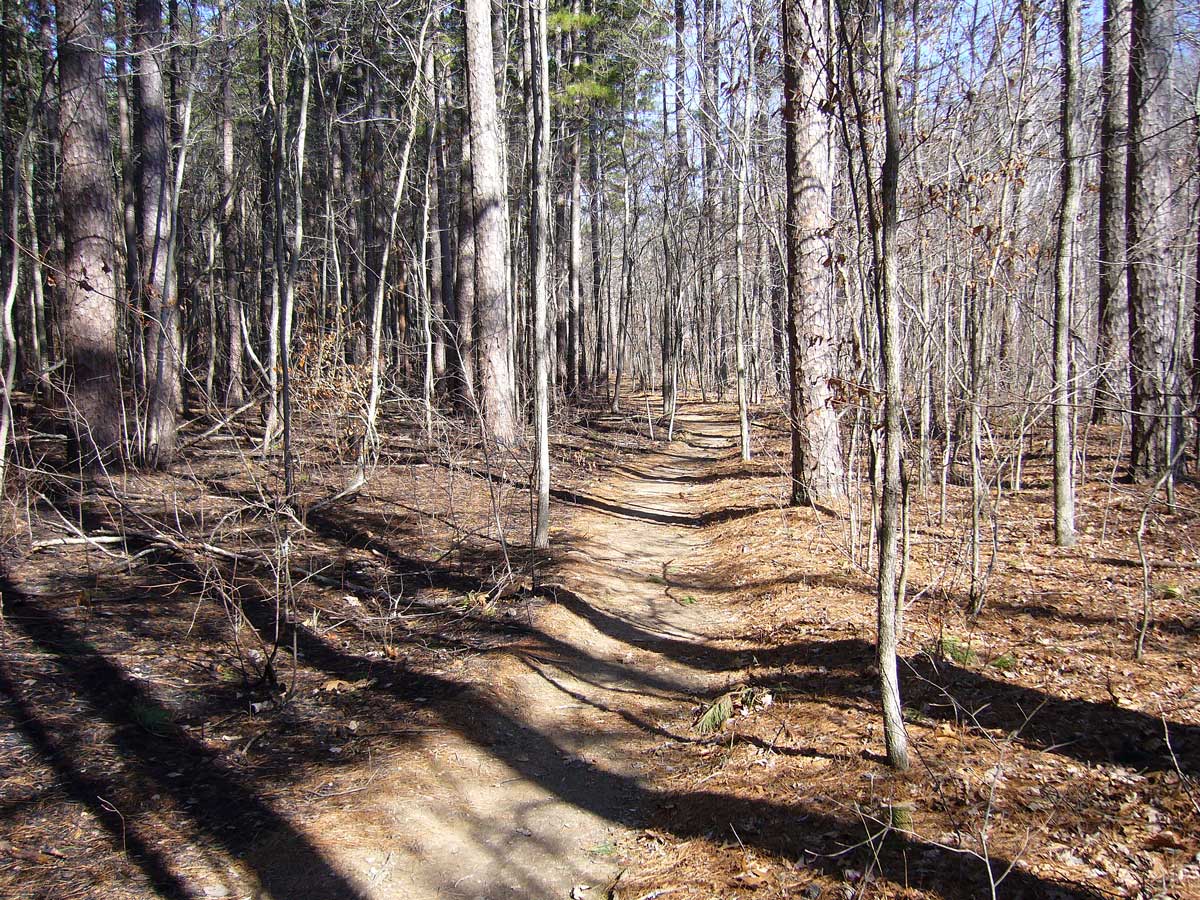
pine savanna - fire managementThe upland habitats at Hawn are of interest as well. Lamotte sandstones are the dominant bedrock, creating acid soils that support a canopy dominated by Missouri’s only native species of pine, Pinus echinata (shortleaf pine), several species of oak, and a diversity of acid-loving shrubs primarily in the family Ericaceae (including the stunningly beautiful Rhododendron prinophyllum, or wild azalea). Historically, so-called “pine savanna” was prevalent in this area, a natural community in which periodic fires maintained an open structure amongst the fire-adapted pines and allowed a diverse herbaceous layer beneath the open canopy. Much of Hawn has closed up after decades of fire suppression; trail through pine savannahowever, the Department of Natural Resources has implemented a rotational burn management regime to recreate pine savanna habitat within Hawn’s Whispering Pines Wild Area. Evidence of what appeared to be very recent burns could be seen at several places as I hiked along the Whispering Pines Trail, and while many visitors might have been alarmed at the apparent “damage” they were observing, my heart sang with the prospect of seeing mature pine savanna communities taking hold throughout my beloved Hawn. As I stood atop this ridge and looked back down from where I had come, I could almost see Henry Schoolcraft and Levi Pettibone in the distance on horseback, perhaps pausing to gaze at an elk.

REFERENCES:

Cliburn, J. and G. Klomps. 1980. A Key to Missouri Trees in Winter, 2nd edition. Missouri Department of Conservation, Jefferson City, 43 pp. (subsequently revised)

Furlow, J. J.  2004. Betulaceae in Flora of North America @ efloras.org. http://www.efloras.org/florataxon.aspx?flora_id=1&taxon_id=10101.

MacRae, T. C. 2003. Agrilus (s. str.) betulanigrae MacRae (Coleoptera: Buprestidae: Agrilini), a new species from North America, with comments on subgeneric placement and a key to the otiosus species-group in North America. Zootaxa 380:1–9.

MacRae, T. C., and G. H. Nelson. 2003. Distributional and biological notes on Buprestidae (Coleoptera) in North and Central America and the West Indies, with validation of one species. The Coleopterists Bulletin 57(1):57–70.

MacRae, T. C. and M. E. Rice. 2007. Distributional and biological observations on North American Cerambycidae (Coleoptera). The Coleopterists Bulletin 61(2):227–263.

Nelson, G. H. and T. C. MacRae. 1990. Additional notes on the biology and distribution of Buprestidae (Coleoptera) in North America, III. The Coleopterists Bulletin 44(3):349–354.

Yatskievych, G. 2006. Steyermark’s Flora of Missouri, Volume 2. The Missouri Botanical Garden Press, St. Louis, 1181 pp.

Copyright © Ted C. MacRae 2009

Add to FacebookAdd to NewsvineAdd to DiggAdd to Del.icio.usAdd to StumbleuponAdd to RedditAdd to BlinklistAdd to Ma.gnoliaAdd to TechnoratiAdd to Furl