The one that got away!

It was disappointing to reach Black Mesa, the furthest west destination for my June collecting trip through northwestern Oklahoma, only to discover that the whole region was dry as a bone. I spent an hour or so sweeping yellow roadside composites and got a few Typocerus confluens—a reasonably uncommon longhorned beetle, and another hour’s worth of beating oaks and junipers in the area produced a grand total of three Chrysobothris ignicollis, a very common jewel beetle associated with junipers in the southern Great Plains. This in glaring contrast to the veritable smörgåsbord of jewel and longhorned beetles I had encountered earlier in the week at Beaver Dunes, Alabaster Caverns, and Gloss Mountain State Parks. I had planned to spend at least a full day in the Black Mesa area—maybe two if the collecting was good, but as it was I couldn’t justify spending even another minute in the area. Unable to resist the siren call of more productive areas back to the east, I decided to cut my losses and return to those areas to close out the week. It was still early afternoon, and if I left immediately I would arrive back at Beaver Dunes (from where I had left just the previous evening) with at least a few hours to pad my series and perhaps even find something new.

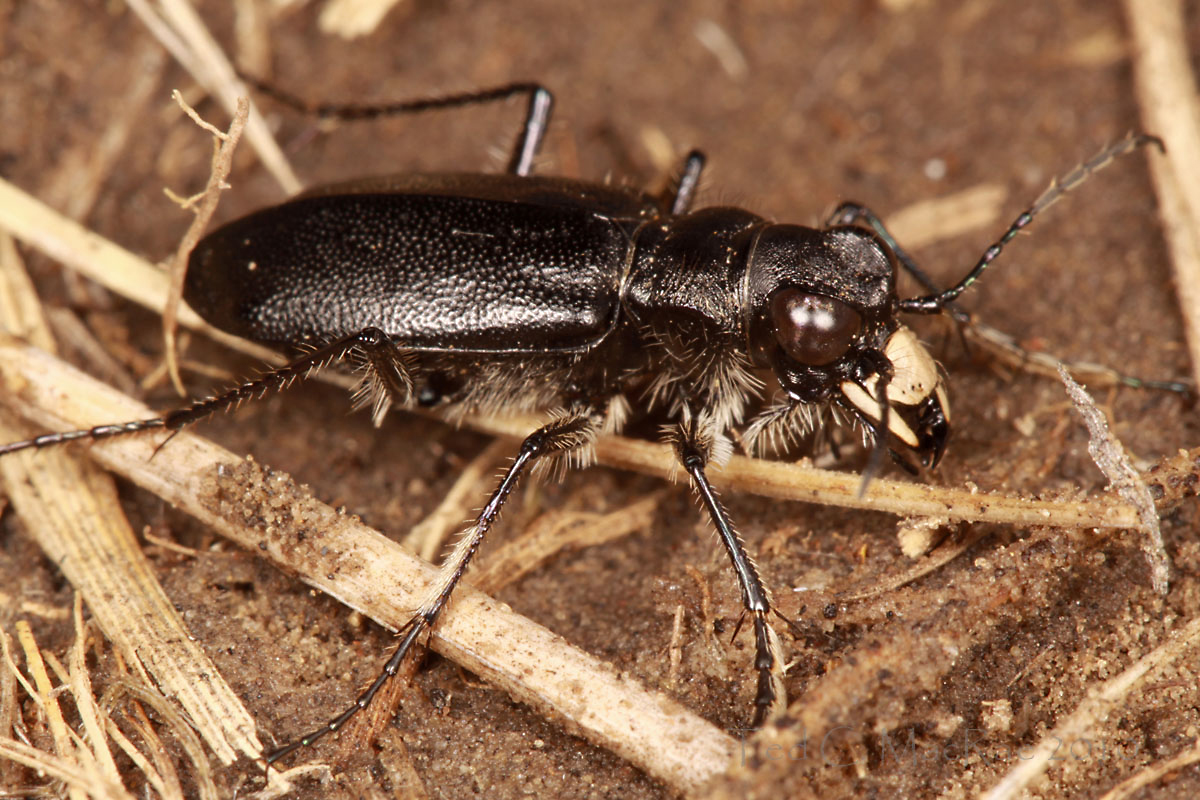
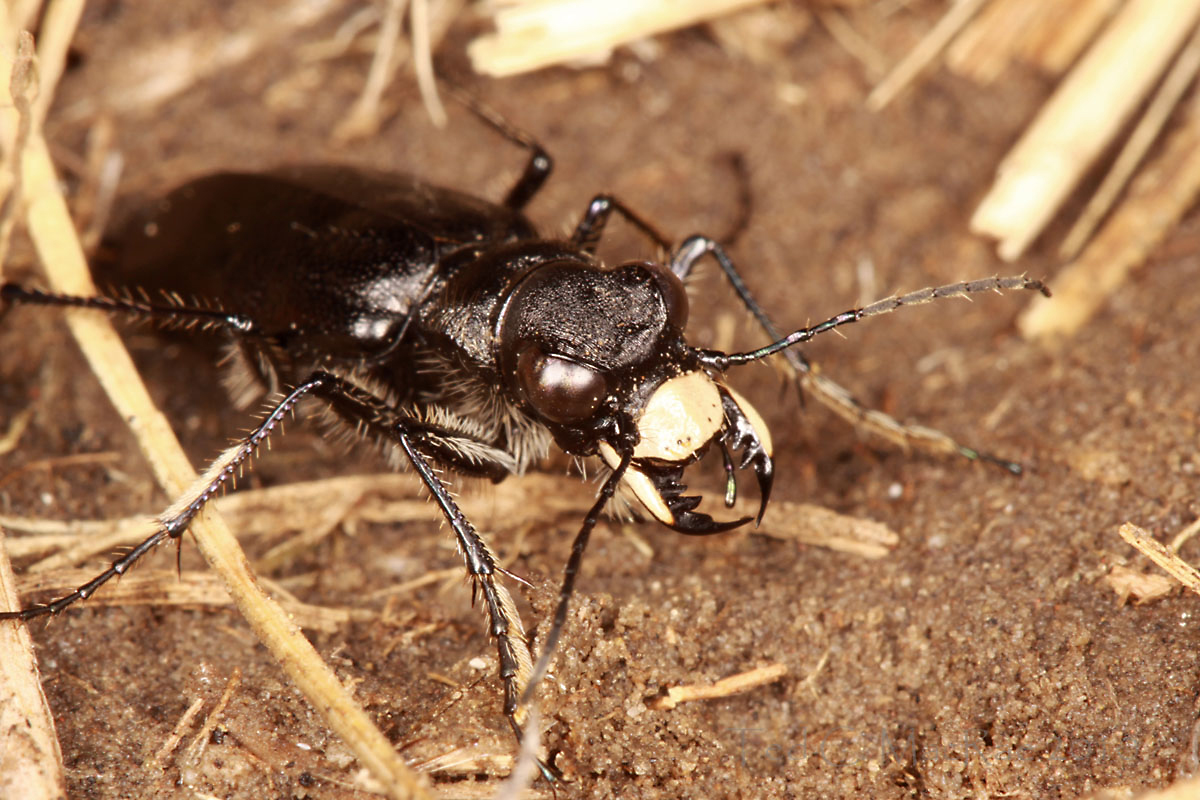
Oberea oculaticollis Say 1824 | Beaver Dunes State Park, Beaver Co., Oklahoma

Oberea oculaticollis Say 1824 | Beaver Dunes State Park, Beaver Co., Oklahoma

One area I wanted to take another look at was the small lake near the campground. I had beaten a few willow-feeding Agrilus spp. from the black willow (Salix nigra) and Poecilonota cyanipes from the cottonwoods (Populus deltoides) surrounding the reservoir. I desired better series of what I had collected the previous day, so I retraced my steps and beat most of the same trees I had beaten before. While I did quite well with P. cyanipes on the cottonwoods, again only a few Agrilus were beaten from the willows. I had nearly completed the circuit around the lake when I walked up to a small willow sapling that I had not sampled the previous day, gave it a whack over my sheet, and onto the sheet fell a nice longhorned beetle that I didn’t immediately recognize. At first I thought it was a species of Mecas due to the dense covering of gray pubescense, but the long and narrow form seemed much more agreeable with the genus Oberea. At any rate, seeing that it was something new for me I placed it back on a willow branch and began taking photos of it.

The dark integument and dense, grayish pubescence distinguish this species.

The dark integument and dense, grayish pubescence distinguish this species.

It was late in the day, and the beetle was unusually calm and cooperative and allowed me to take a number of shots, from which I have selected a few to show here. Once I had my fill of photographs, I slipped it into a vial for safe-keeping while I disassembled and stowed my camera equipment, and after I was finished I pulled out the vial with one hand and reached for my bottle dropper of ethyl acetate with the other. I have a technique to unscrew both the vial and the bottle with the fingers of the hand that is holding them, lifting both caps simultaneously, dropping a few drops of ethyl acetate into the vial, and again simultaneously placing both caps back in place and screwing them shut. This minimizes the time the cap is off the vial while the insect is in it, thus minimizing the chance of the insect escaping during the process. In this case, however, as I was trying to do this a dog-pecker gnat flew right at my eye, and I instinctively swiped at it with my left hand—the one holding the vial with the beetle in it! Of course, the cap was off, and the beetle when sailing out of the vial and immediately took flight. All I could do is just stand there dumbfounded at my stupidity. I did go back and beat the same sapling (and every other willow tree) on my way back in a last ditch effort to recollect the species, but fortune was not with me at this time.

This adult on black willow (Salix nigra) is the first indication of its host plant.

This adult on black willow (Salix nigra) is the first indication of its host plant.

Once I returned home and had a chance to examine the photos more carefully, I learned that I had photographed Oberea oculaticollis Say 1824, a longhorned beetle distributed in central North America from Manitoba to Texas and distinguished, not surprisingly, by its dark integument and dense, grayish pubescence (Chemsak & Linsley 1995). Not only have I never before encountered this species, but it is also completely lacking in my collection. As far as I can tell, no host information has been recorded for this species, so my collection of an adult on willow might be the first clue as to its host plant. Without a voucher specimen, however, I am reluctant to publish the record and will have to keep this spot in mind for possible future collection of the species.

REFERENCE:

Linsley, E. G. & J. A. Chemsak.  1995. The Cerambycidae of North America. Part VII, No. 2: Taxonomy and classification of the subfamily Lamiinae, tribes Acanthocinini through Hemilophini. University of California Publications in Entomology 114:1–292.

Copyright © Ted C. MacRae 2013

Rattlesnakes may be present!

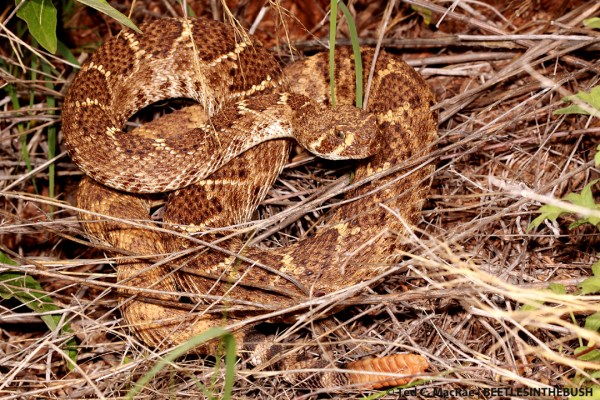
I don’t know what it is, but even though I am first an entomologist I am also a sucker for snakes. Well, not just any snakes, but rattlesnakes. It must have something to do with my psyche—my favorite color is black, when it comes to music I choose metal (Slayer, anyone?), and I have a collection of replica fossil hominid skulls… in my office! At any rate, when I decided to return to Gloss Mountain State Park near the end of my early June collecting trip to Oklahoma, I also decided to make a real effort to find an adult western diamondback rattlesnake. Why did I decide to do this (other than my psyche)? Because I had seen a juvenile there earlier in the week but still hadn’t seen an adult, and there is an area in the park surrounded by signs that read “CAUTION. Rattlesnakes may be present! Stay out of the tall grass. Don’t reach into holes. Stay on marked trails. Be observant.” So, what did I do? I went in, of course!

Western diamondback rattlesnake (Crotalus atrox) | Gloss Mountain State Park, Major Co., Oklahoma

Western diamondback rattlesnake (Crotalus atrox) | Gloss Mountain State Park, Major Co., Oklahoma

Actually, I had been in the area several times already on previous visits looking for these snakes, but for some reason—perhaps the juvenile from across the road still fresh in my mind, I just had the feeling that this time I was going to find one. One always enters cautiously at first, watching their every step as they wade through the waist high grasses while straining to see any sign of the diamondback pattern between the clumps of vegetation or on the steeply eroding red clay slopes above. Caution eventually subsides, however, and after about 15 minutes my attentions started drifting back to looking for beetles. I had walked along most of the southern perimeter of the area when I crested a small rise and my heart was jolted by the sudden and distinctive “buzz” of a full-sized rattlesnake. I couldn’t see it, but the sound was coming from about 10 yards in front of me, so I cautiously crept forward, moving from side to side bit as I did to help me triangulate the precise location of the sound. Within a few steps I finally saw it—a nice, adult western diamondback rattlesnake! It was largely hidden from view within a heavy jumble of vegetation—no hope for useful photographs, so I extended the telescoping handle of my insect net to its full 7-ft length and used it to carefully move away as much of the screening vegetation as I could. The snake rattled vigorously as I did this, its head always following the red grip at the end of the handle but never striking. That 7-ft distance was about as close I could comfortably get, and my 100-mm macro lens is the longest lens I have in the kit, so the full snake shot shown above and some similar shots were all I could really get. How I would have loved to have had a 200-mm or 300-mm lens to get some really close head shots!

I’ll admit that I tip-toed out of the area much more cautiously than I entered, but I did so with my held-held high and chest puffed out a bit knowing that, once again, persistence had paid off.

Copyright © Ted C. MacRae 2013

Another new record for northwestern Oklahoma

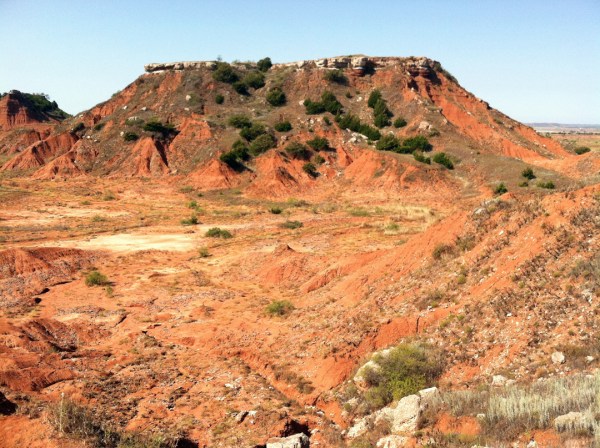
You would think that finding two new state records on the first day of my June collecting trip to northwestern Oklahoma would be fortune enough—it is rare to get two new state records on an entire trip even! As a result, I spent all morning and the early part of the afternoon working the mesquite (Prosopis glandulosa) and red-cedar (Juniperus virginiana) that dotted the barren flats at Gloss Mountain State Park to ensure good voucher series of Plionoma suturalis and Chrysobothris quadrilineata. Around 2 pm I decided I’d worked the flats as well as I could and turned my attention to the park’s main attraction, a large, gypsum-capped, red clay mesa rising 150 to 200 feet above the flats below.

Paratyndaris prosopis on dead hackberry (Celtis sp.) | Gloss Mountain State Park, Oklahoma

Paratyndaris prosopis on dead hackberry (Celtis sp.) | Gloss Mountain State Park, Major Co., Oklahoma

Red-cedar occurs on top of the mesa as well as the flats¹, but otherwise the mesa top supports a different assemblage of woody vegetation. Gone is the mesquite, a relatively “thirsty” plant that uses extraordinarily long taproots to reach subterranean water tables. In its place are western soapberry (Sapindus saponaria), hackberry (Celtis sp., poss. C. laevigata var. texana), and American elm (Ulmus americana). The soapberry was what I was most interested in, as this plant is a known host for several very uncommonly encountered species of jewel beetles in the genus Agrilus that are more commonly encountered in Texas. Hackberry also is a good host for a variety of jewel beetles, with somewhat different species occurring in Texas versus more eastern areas in the country. Perhaps, I thought, some of these Texas species could be found here as well.

¹ While native to Oklahoma, eastern red-cedar was restricted in pre-settlement times to areas not subject to fire. It is now considered an invasive species in many areas as a result of long-term fire suppression and the effects of intense cattle grazing. In the morning while I was collecting in the flats (and before I had started working the red-cedars to see what beetle was causing the branch dieback), a park ranger stopped by and asked if I knew of any way to “get rid of the cedars.” He didn’t seem very satisfied with my standard answer of mechanical removal and prescribed burning at regular intervals. He then asked about the branch dieback that was so common in the trees, and I told him I thought it was a beetle. With almost desperate optimism he said, “maybe the beetle can finish them off.” I didn’t share his optimism but didn’t say anything either.

Paratyndaris prosopis

I focused most of my early efforts on the soapberry, but nothing was landing on the beating sheet, so I then turned my attention to the hackberry. Most branches were yielding a few Agrilus spp. with each whack, but they seemed to be only commonly occurring species such as A. paracelti and A. lecontei (in this area the population should be assignable to subspecies lecontei). One can almost get “lulled to sleep” in such situations, eventually not expecting to see something different, but after working a number of trees I whacked a particularly “punky” dead branch of a tree and saw the unmistakable outline of a chunky little jewel beetle that I immediately recognized as Paratyndaris prosopisParatyndaris is a largely southwestern and Mexican genus of beetles that are often not well represented in collections. Paratyndaris prosopis is the only species known to venture north and east beyond Texas, but this is based on only three records: one in Red Oak, Oklahoma by the late Karl Stefan (an indefatigable collector of beetles in Latimer Co.), another at Magazine Mountain, Arkansas (a single specimen given to me by my friend Doug LeDoux), and a third from Oktibbeha Co., Mississippi (Nelson & Bellamy 2004). While not a new state record, I knew its occurrence in Major Co., Oklahoma represented a northward extension to its known range (and also opening the possibility that it might even occur as far north as Kansas). They were not common—I worked every hackberry tree I could find on the mesa and got just three specimens on the first day and a few more when I went back the next morning. However, at the end of the trip I returned to Gloss Mountain and managed to get a nicer series of close to a dozen specimens. While hackberry trees can be found in several patches on the mesa, the beetles seemed to be limited to one small area.

Paratyndaris prosopis

The occurrence of this species on hackberry and not mesquite is interesting. The type specimen was cut from a dead branch of mesquite (Skinner 1903)—hence, the species epithet, but all subsequently recorded host associations have been on oak (Quercus spp.) (Nelson 1987, Nelson & Westcott 1976), including a single specimen that I reared from a dead Q. vaseyana branch collected in the Davis Mountains, Texas. No oak occurs in the Gloss Mountains, but mesquite is common in the flats, yet it is clear from the number of specimens collected on hackberry and nothing else that the species, at least in this area, is utilizing that plant as a host. Also of interest is the date of collection—June 2, which is a full week earlier than the previous early record of June 9 (especially interesting when one considers that these are the northernmost specimens known).

REFERENCE:

Nelson, G. H. 1987. Additional notes on the biology and distribution of Buprestidae (Coleoptera) in North America, II. The Coleopterists Bulletin 41(1):57–65.

Nelson, G. H. & C. L. Bellamy. 2004. A revision of the genus Paratyndaris Fisher, 1919 (Coleoptera: Buprestidae: Polycestinae). Zootaxa 683:1–80.

Nelson, G. H. & R. L. Westcott. 1976. Notes on the distribution, synonymy, and biology of Buprestidae (Coleoptera) of North America. The Coleopterists Bulletin 30(3):273–284.

Skinner, H. 1903. Notes on Buprestidae (Coleoptera) with descriptions of new species. Entomological News 14:236–239.

Copyright © Ted C. MacRae 2013

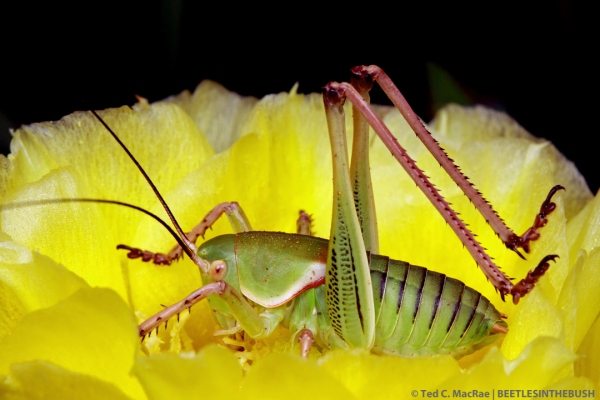
Haldeman’s shieldback katydid (Pediodectes haldemani)

During my visit to Gloss Mountain State Park (Woodward Co., Oklahoma) this past June, I found an area of prickly pear cactus (Opuntia macrorhiza) on the west flats below the main mesa. A few days earlier I had seen cactus beetles in the genus Moneilema (family Cerambycidae) associated with these plants at another nearby location, so I began checking the plants to look for any sign of these beetles. Sadly I did not find any, but the plants were in full bloom and were being visited by flower longhorns in the genus Typocerus (mostly just T. octonotatus). After having collected a small series, I approached one particular cactus plant and found this enormous katydid sitting inside the flower. Katydids normally secrete themselves in a more cryptic manner, using foliage backdrops with which they can blend owing to their green coloration. This particular katydid, however, not only lacked the leaf-like wings that many species possess but also exhibited rather strikingly contrasting dark red markings over its body that made it quite conspicuous as it sat in the yellow flower. I approached carefully so as not to spook it and took a few photographs, but as I did so it became apparent to me that it did not find my actions alarming and would allow me to take whatever photographs I wished.

Pediodectes haldemani in flower of Opuntia phaecantha | Gloss Mountains State Park, Woodward Co., Oklahoma

Pediodectes haldemani on Opuntia macrorhiza | Gloss Mountain State Park, Woodward Co., Oklahoma

Almost whatever photographs, that is. I really wanted to get a super-close, full-frontal shot of the face, but it sat unbudgingly in the flower with its face buried in the stamens and masked by the inner petals of the flower. I could have tried peeling away the petal, but I was sure that fiddling my fingers that close to its face would spook it, and even if I did manage to peel back the petal then I would still have stamens blocking the view that I wanted. In the end, I decided that this slightly more distant shot of the whole body was a pleasing enough composition.

Pediodectes haldemani

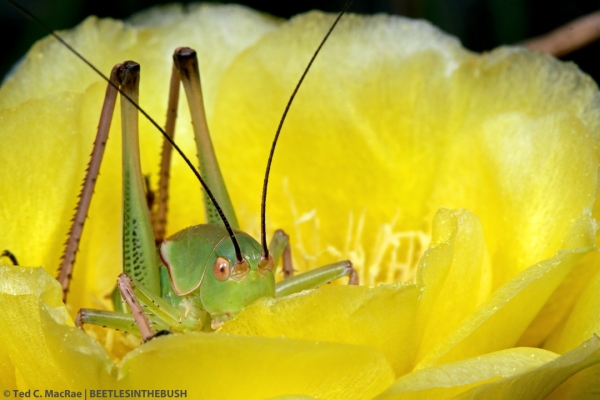
Peek-a-boo!

I presume this individual represents Haldeman’s shieldback katydid (Pediodectes haldemani) in the family Tettigoniidae. This is not surprising, since the type locality of the species (Barber Co., Kansas) is just a few miles to the north and right smack dab in the middle of the Great Plains distribution of the species. BugGuide mentions that species identification from photos alone can be difficult in the genus Pediodectes, as color patterns vary individually and with age, and also since adults are wingless it can be difficult to tell if an individual is a nymph or adult. Nevertheless, distribution maps in Singing Insects of North America show three species that can potentially occur in this part of Oklahoma, and the photos shown here are a dead ringer for P. haldemani. I am also apparently not the first person to photograph this species at Gloss Mountain State Park.

Copyright © Ted C. MacRae 2013

“Blue-sky” tips and tricks

For the past two years I’ve been working to refine my “blue-sky” technique for insect macrophotographs. This refers to careful balancing of camera and flash settings to achieve full-flash illumination of the subject while still allowing enough ambient illumination from the sky to produce a natural looking blue background. The use of flash, of course, is almost a necessity in insect macrophotography, as it’s nearly impossible to take hand-held photographs of insects, especially small ones, using only ambient light—there just isn’t enough of it to adequately illuminate the subject while using fast shutter speeds to prevent motion blur and high aperture settings to achieve acceptable depth-of-field. Flash illumination, however, has a drawback (actually several, but let’s focus on one)—if there isn’t something else close enough behind the subject to reflect light from the flash, the background will be jet black. In some cases this is perfectly fine, and it is almost always preferred over a cluttered background of jumbled branches and foliage. However, it usually doesn’t work well with darkly colored insects, and to me it gives the undesirable impression that the photo was taken at night. I suppose I could carry around colored cards to place behind the subjects that I photograph, but as a photographer who prides himself on the ability to take in situ field photographs of insects in their native habitats, something about the ‘artificiality’ of colored cards prevents me from resorting to them. A leaf placed behind the subject may be an acceptable alternative, but is usually possible only with quite small subjects (due to the size of the leaf needed) and is virtually impossible in dry, western habitats.

cf. Eremochrysa punctinervis | Gloss Mountains, Major Co., Oklahoma

cf. Eremochrysa punctinervis | Gloss Mountains, Major Co., Oklahoma

It’s hard to recommend specific camera settings for blue sky background, as they must be determined experimentally in each situation. The above photo of what I take to be Eremochrysa punctinervis (a green lacewing in the family Chrysopidae—identification via Frank & Slosser 1996) was taken with a 100mm macro lens set at f/16 and with ISO bumped up slightly to 320 (I normally use ISO 100–200) and shutter speed decreased slightly to 1/160 sec (I normally use 1/200 to 1/250 sec). The higher ISO makes the camera sensor more sensitive to light and the slower shutter speed allows more time for ambient light to reach the sensor. When aimed at the brightest part of the sky (next to but not right at the sun), these settings allowed sufficient light to register this beautiful shade of blue on the camera sensor. The ambient light alone is still not sufficient to illuminate the subject—if the photograph had been taken with these settings but without flash, the background would still be blue, but the subject and branch on which it is sitting would be nearly black! Only a flash pulse occurring while the shutter is open can provide enough light to fully illuminate the subject when the aperture setting is that high. In essence, the photo combines two exposures—a flash-illuminated subject and an ambient-illuminated sky.

Eremochrysa punctinervis | Gloss Mountains, Major Co., Oklahoma

Same photo before cloning out antennal shadowing

One problem that can be encountered when using this technique is the effect of wind. Holding the subject up against the sky exposes it to even the slightest of breezes, which can cause movement of delicate body parts such as the long antennae of this subject. What looks like blurring of the antennae is actually shading of the sky by the antennae as they fluttered in the wind. The antennae themselves were “frozen” by the very short flash pulse—much shorter than the 1/160 sec exposure, but they blocked enough light from the sky during the 1/160 sec exposure to darken the part of the background over which they moved. In the case of the finished photo shown at the beginning of the post, it was a relatively simple matter to use Photoshop’s cloning tool to remove the shadowing. Nevertheless, even more desirable is to avoid the need for such post-processing manipulations to begin with—waiting for a pause in the wind or moving to a more protected location would have obviated the need for PS cleanup.

REFERENCE:

Frank, W. A. & J. E. Slosser. 1996. An Illustrated Guide to the Predaceous Insects of the Northern Texas Rolling Plains. Texas Agricultural Experiment Station, Cotton DVD, Publication #MP-1718, 24 pp.

Copyright © Ted C. MacRae 2013

2013 Oklahoma Collecting Trip iReport

I’m back home after my week-long collecting trip to western Oklahoma, and at the risk of sounding hyperbolous I can only describe it as one of the most successful collecting trips I’ve ever had. Seriously! These kinds of trips don’t happen all that often for a variety of reasons—timing is off, rains didn’t happen, weather was uncooperative, etc. etc. Once in a while, though, everything comes together, and this was one of those times. The trip was also a return to my roots so to speak—I’ve been rather distracted in recent years with tiger beetles, but jewel beetles (family Buprestidae) and, to a lesser extent longhorned beetles (family Cerambycidae), are really the primary focus of my taxonomic studies. It had been several years since I’d had a good “jewel beetle trip,” so that was the focus of this trip. In planning the trip, I recalled seeing jewel beetle workings in several woody plant species in the same area during last September’s trip, and the occurrence of May rains seemed to bode well for my early June timing.

Gloss Mountains State Park, Major Co., Oklahoma

Gloss Mountains State Park, Major Co., Oklahoma

My instincts proved to be justified—in seven days in the field I collected an estimated 1000–1500 specimens representing at least two dozen species of Buprestidae and a dozen or more Cerambycidae. More important than the numbers, I collected a number of species in good series that I have either not or only rarely collected before, and in fact the second beetle that I collected turned out to be a new state record! Of course, I also brought along my full-sized camera and associated gear and photographed many of the species that I collected. I will feature these photos in future posts, but for this post I thought it might be fun to give a high level view of the trip illustrated only with photos taken with my iPhone (which I also carry religiously in the field with me). The iPhone is great for quick snaps of scenery and miscellaneous plants and animals for which I don’t feel like breaking out the big camera, or as a prelude to the big camera for something I’d like to share right away on Facebook. Moreover, there are some types of photos (landscapes and wide-angles) that iPhones actually do quite well (as long as there is sufficient light!).

Gloss Mountains State Park, Major Co., Oklahoma

Atop the main mesa at Gloss Mountains State Park, Major Co., Oklahoma

My first destination was Gloss Mountains State Park (Major Co.), a stunning system of gypsum-capped, red-clay mesas. I’ve already found a number of rare tiger beetles here such as Cylindera celeripes (Swift Tiger Beetle), Amblycheila cylindriformis (Great Plains Giant Tiger Beetle) and Dromochorus pruinina (Frosted Dromo Tiger Beetle), and in the past two falls I’ve found two interesting jewel beetle records: Chrysobothris octocola as a new state record, and Acmaeodera macra as a northern range extension. On this trip, I started out beating the mesquite  (Prosopis glandulosa) and immediately got the longhorned beetle Plionoma suturalis—a new state record! They were super abundant on the mesquite, and I collected several dozen specimens along with numerous C. octocola as well. I then moved over to the red-cedar (Juniperus virginiana), which was showing a high incidence of branch dieback, and collected nice series of several buprestids, including what I believe to be Chrysobothis ignicollis and C. texanus. Up on top of the mesa there are small stands of hackberry (Celtis laevigata) and soapberry (Sapindus saponaria), both of which are very good hosts for Buprestidae. Not much was on the soapberry, but I beat large series of several Buprestidae from the hackberry, including what I believe to be Chrysobothris caddo and—the real prize—Paratyndaris prosopis! My old friend C. celeripes was also out in abundance, so I collected a series to add to my previous vouchers from this site. Back down below, I marveled at a juvenile western diamondback rattlesnake (Crotalus atrox) in the area where I found some more A. cylindriformis larval burrows. Daylight ran out before I could dig them up, and after 11 hours in the field I was exhausted, so I returned the next morning and got one 1st- and two 3rd-instar larvae and went back up on top of the mesa and beat several more P. prosopis from the hackberry.
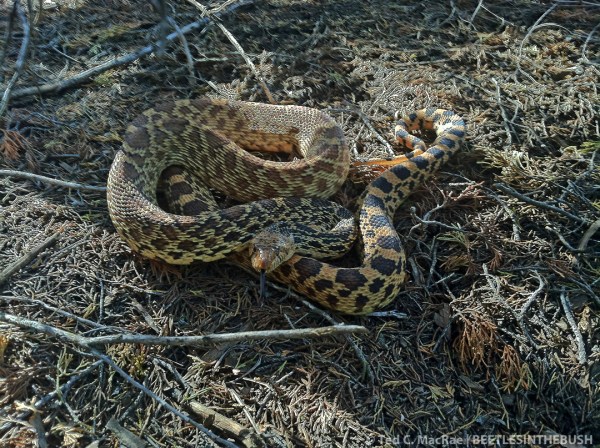
Bullsnake (Pituophis catenifer sayi) | Alabaster Cavern State Park, Woodward Co., Oklahoma

Bullsnake (Pituophis catenifer sayi) | Alabaster Cavern State Park, Woodward Co., Oklahoma

My second stop was at Alabaster Cavern State Park (Woodward Co.), where C. celeripes was again abundant on the gypsum-clay exposures surrounding an impressive gorge thought to be a collapsed cave complex. I focused on beating hackberry because of the success with buprestids on this plant at Gloss Mountains SP, and although they were not quite as abundant here as at Gloss Mountains I still managed to end up with good series of C. caddo and several species of Agrilus. Because I had spent the morning at Gloss Mountains, I had only a partial day to explore Alabaster Caverns and, still getting used to the weight of the camera bag on my back, decided to leave the big camera in the car. This was a mistake, as I encountered my first ever bullsnake (Pituophis catenifer sayi) and had to settle for iPhone photos of this species—the photo above being the best of the bunch. An approaching storm put an end to my second day after another 10 hours in the field, and I drove an hour to Woodward.

Moneilema sp. on Opuntia phaecantha | Alabaster Cavern State Park, Woodward Co., Oklahoma

Moneilema sp. on Opuntia macrorhiza | Alabaster Cavern State Park, Woodward Co., Oklahoma

My third day started out at nearby Boiling Springs State Park, a riparian oasis on sandy alluvium alongside the nearby Cimarron River. The woodlands are dominated by hackberry and American elm, and although a few buprestids were beaten from hackberry and honey locust (Gleditisia triacanthos), the numbers and diversity were not enough to hold my interest in the spot. After lunch, I decided to return to Alabaster Caverns SP and explore some other areas I had not had a chance to explore during the previous partial day. It’s a good thing that I did, as I ended up finding a nice population of longhorned cactus beetles in the genus Moneilema associated with prickly pear cactus (Opuntia macrorhiza). I collected a nice series of adults and also learned a few lessons in how to photograph these beetles on their viciously protective host plants. The photo above gives a taste of what will come in the photos that I took with the big camera. After eight hours in the field and darkness falling, I drove two hours to Forgan in Beaver Co.

Beaver Dunes State Park, Beaver Co., Oklahoma

Beaver Dunes State Park, Beaver Co., Oklahoma

Day 4 in the field started out cold and ominous, having stormed heavily during the previous night and with thick clouds still hanging in the sky. I feared the day might be a wash but decided to venture to Beaver Dunes State Park anyway and take my chances (beating can still be productive even in cold weather as long as the foliage is not wet). It’s a good thing that I did, as the buprestids were as numerous as I’ve ever seen them. The park’s central feature is a system of barren sand dunes that are frequented by ORV enthusiasts and surrounded by hackberry woodlands. The park also has a reservoir and campground, around which are growing a number of cottonwoods (Populus deltoides).

Hackberry Bend Campground, Beaver Dunes State Park, Beaver Co., Oklahoma

Hackberry Bend Campground, Beaver Dunes State Park, Beaver Co., Oklahoma

These hackberrys and cottonwoods proved to be extraordinarily productive. On the former I collected large series of several species of Chrysobothris and Agrilus, and while I collected fewer Buprestidae on the latter, these included Agrilus quadriguttatus and Poecilonota cyanipes! The latter species I had never collected until last year (from Cerceris fumipennis wasps), and beating the lower branches of the declining cottonwoods produced a series of about a dozen specimens. I also got one specimen on black willow (Salix nigra), along with a few Chrysobothris sp. and what I take to be Agrilus politus. Also in a low branch of one of the cottonwoods was a bird’s nest with a single egg that, according to Facebook comments, either represents the American Robin or a Gray Catbird. (I returned the next day and saw two eggs in the same nest.)
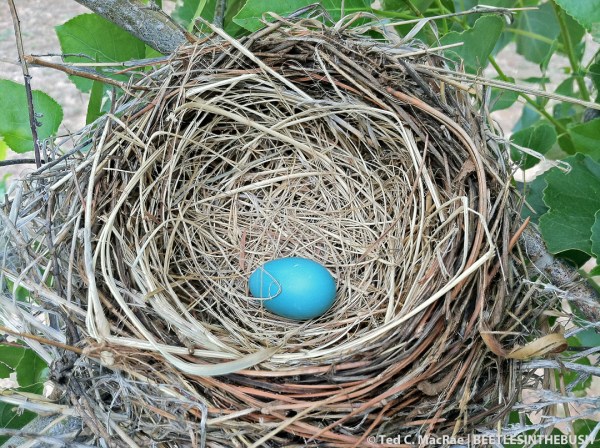
American Robin or Gray Catbird nest w/ egg | Beaver Dunes State Park, Beaver Co., Oklahoma

American Robin or Gray Catbird nest w/ egg | Beaver Dunes State Park, Beaver Co., Oklahoma

As the day drew to a close, I found two interesting longhorned beetle species at the edge of the dunes: one large, powdery gray Tetraopes sp. on milkweed (Asclepias sp.), and huge numbers of Batyle ignicollis evidently perched on the yellow spiked inflorescence of an as yet undetermined plant. I have seen this species on many occasions, but always in low numbers, yet here were literally hundreds of individuals on the plants, all having assumed a characteristic pose on the inflorescence suggesting that they had bedded down for the night. I only spent eight hours in the field on this day because of the late start, and as darkness approached I began the two-hour drive to Boise City.

Black Mesa landscape

Sculpted sandstone landscape in the vicinity of Black Mesa State Park, Cimarron Co., Oklahoma

The final two days in the field were supposed to be spent exploring the area around Black Mesa in the extreme northwest corner of Oklahoma, and another hour of driving was needed to get to the area from Boise City. I first went to Black Mesa State Park, and while the landscape was stunning (see above) the area was extremely dry. I feared the collecting would not be at all productive in this area but wanted to give the area a good effort before making a call. As I approached the entrance to the park, I saw a jeep parked by the side of the road with a license plate that read “Schinia,” which I recognized as a genus of noctuid moths that are very popular with collectors. I pulled over and talked to the driver, who was indeed a lepidopterist from Denver and had just arrived himself. We talked and exchanged contact information, and learning of my interest in beetles he directed me to a small stand of Gambel oak (Quercus gambelii) and one-seed juniper (Juniperus monosperma) on a sculpted sandstone escarpment not far from the park. I found the spot, and although I beat three Chrysobothris sp. from the first juniper tree that I whacked, another hour of beating produced only one more beetle from the juniper and nothing from the oak. I returned to the spot where we had met and encountered him again on his way out! We stopped and chatted again and found a few specimens of what I take to be Typocerus confluens on the yellow asters, but by then I was having my doubts about staying in the area. I told him I was going to check out a ravine in the park and then decide.

Petrified forest | Black Mesa State Park, Cimarron Co., Oklahoma

Petrified forest | Black Mesa State Park, Cimarron Co., Oklahoma

The petrified forest ended up being the only interesting thing I found in the ravine—the area was so dry that I think even the real trees were almost petrified! At any rate, it was clear that I was not going to have much success in this area. I looked at my watch, knowing that it would take three hours to drive back to Beaver Dunes, and estimated that if I left now I could get in about three hours of collecting at Beaver Dunes where I’d had so much success the previous day. Thus, I did what I rarely do on a collecting trip—drive during the afternoon!
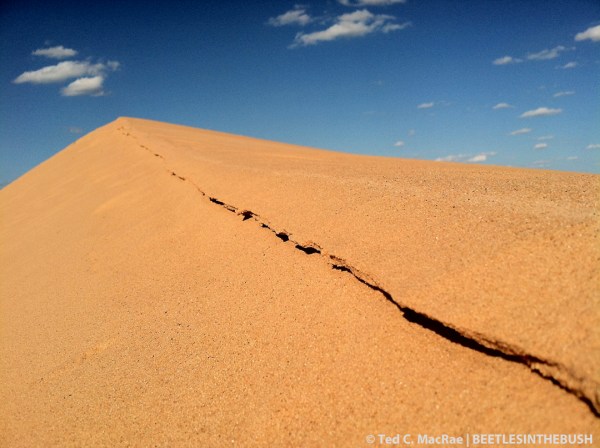
Beaver Dune

The main dune at Beaver Dunes State Park, Beaver Co., Oklahoma.

A chunky grasshopper nymph inhabiting the dune

A chunky grasshopper nymph inhabiting the main dune.

I arrived back at Beaver Dunes with several hours of daylight still remaining, so I decided to take a look around the main dunes before heading towards the woody plants. I’ve actually visited Beaver Dunes previously, on the tail end of a fall tiger beetle trip in 2011. At that time I had seen only the rather common and widespread species Cicindela formosa (Big Sand Tiger Beetle) and C. scutellaris (Festive Tiger Beetle), but I thought there could still be a chance to see the much less common C. lengi (Blowout Tiger Beetle). Early June, however, is a little late to see the spring tigers, and in fact I saw only a single C. formosa. Nevertheless, I find dune habitats irresistible—alien habitats occupied by strange plants and animals, and I spent a bit of time exploring the main dune before heading back towards where I had collected so many Buprestidae the previous day.

Low water levels in the reservoir at Beaver Dunes are a result of three years of drought.

Low water levels in the reservoir at Beaver Dunes are a result of three years of drought.

Western Oklahoma, like many parts of the central U.S., has suffered rather severe drought conditions for the past several years. This was evident not only in the large amount of branch dieback seen in the woody vegetation of the area (and probably a contributor to my success at collecting Buprestidae) but also the very low water level in the park reservoir. In the photo above the small cottonwood saplings in the foreground and large cottonwood trees in the left background indicate the normal water level. Cottonwoods, of course, like to keep their feet wet, and the trees around this reservoir—left high and dry by the drought—have responded with major branch dieback and lots of subsequent adventitious sprouting at the bases of the main branches. It was from this adventitious growth that I had beaten most of the Poecilonota cyanipes that I collected the previous day, so I repeated the cottonwood circuit in the hopes of collecting more. Not only did I collect more, but I collected twice as many as the previous day, so I ended up with a very nice series of more than two dozen individuals of the species from the two days collecting. I also did a little more beating of the hackberry trees which had produced well the previous day and collected several more Chrysobothris caddoC. purpureovittata, and Agrilus spp. such as A. leconteiA. paracelti, and perhaps others. When I arrived I was unsure whether I would stay here the following day, but eventually I decided I had sampled the area about as well as I could and that I would go back to the Gloss Mountains for my last day in Oklahoma. Thus, as the day began to wane I began hiking back to the car and spent the next two hours driving back to Woodward to spend the night.

Steep slope below the main mesa | Gloss Mountains State Park, Major Co., Oklahoma

Steep slope below the main mesa | Gloss Mountains State Park, Major Co., Oklahoma

Echinocereus sp. | Gloss Mountains State Park, Major Co., Oklahoma

Echinocereus sp. | Gloss Mountains State Park, Major Co., Oklahoma

Arriving at the Gloss Mountains the next morning was like coming home! I’ve spent so much time at this place and found so many great insects, yet every time I come here I find something new. Today, however, my goals were more modest—I wanted to improve on my series of Paratyndaris prosopis and Chrysobothris texanus, so I focused most of my time beating the hackberry and juniper on top of the mesa and continued beating the juniper down below as well. Success! I collected four more Paratyndaris off of the hackberry, but the C. texanus were far more abundant on this day than they were earlier in the week—I probably got another two dozen individuals of this species. Of course, I also got distracted taking photographs of a number of things, so the day went far more quickly than I realized. I wanted to leave around 6 pm and get in about three hours of driving so that I would have time to make it into Missouri the next morning and have a nice chunk of time to collect before finishing the drive and arriving home on Saturday night. It was actually closer to 7:30 pm before I hit the road, the reason for the delay being the subject of a future post (I will say that BioQuip’s extendable net handle comes in handy for much more than collecting tiger beetles!).
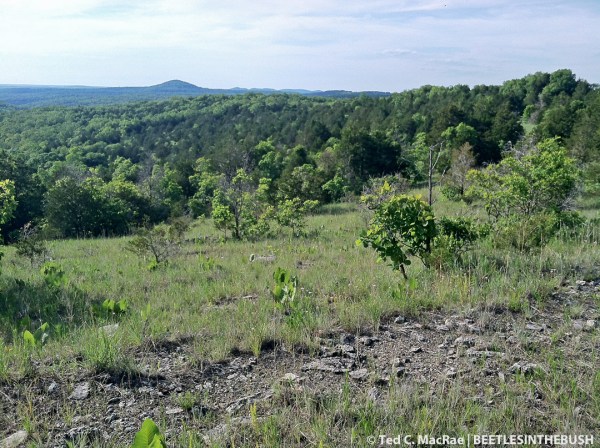
Dolomite glades | Hercules Glades Wilderness, Taney Co., Missouri

Dolomite glades | Hercules Glades Wilderness, Taney Co., Missouri

Long Creek | Hercules Glades Wilderness, Taney Co., Missouri

Long Creek | Hercules Glades Wilderness, Taney Co., Missouri

For my last day of collecting, I decided to stop by at one of my favorite spots in the White River Hills of extreme southwestern Missouri—Hercules Glades Wilderness in the Mark Twain National Forest. I’ve been to this place a number of times over the years, but in recent years my visits have usually been late in the season to look for the always thrilling to see Cicindelidia obsoleta vulturina (Prairie Tiger Beetle). It had actually been about 25 years since I’d visited these glades during the spring, and because of the success I’d had collecting in Oklahoma I was really optimistic that I would find the same here. Sadly (and inexplicably), insect activity was very low, and it didn’t take long for this to become apparent as branch after branch that I beat along the trail through the dry-mesic forest down to Long Creek yielded nothing. By the time I got to the creek I still had not collected a single beetle. A consolation prize was found along the creek, as beating the ninebark (Physocarpos opulifolius) produced a few specimens of the pretty little Dicerca pugionata, and a couple more consolation prizes were found further up the trail approaching the main glade when I saw a Cylindera unipunctata (One-spotted Tiger Beetle) run across the trail and then beat a single Agrilus fuscipennis from a small persimmon (Diospyros virginiana) tree at the edge of the glades. It had been about 25 years since I last collected the latter species, so I was very happy to see it, but no more were seen despite beating every persimmon tree that I saw during the rest of the day. At the end of the day, I had hiked seven miles and collected only six beetles—a rather inauspicious ending to what was otherwise a wonderfully successful trip.

A rare ''selfie''

The author takes a rare ”selfie” at Gloss Mountains State Park.

Arriving back at the car at the end of the day on the last day of an extended collecting trip is always a little depressing—despite the vagaries of travel, cheap hotel beds, meals on the go, and general exhaustion, I’m never happier than I am when I am in the field. Still, the success that I’d had during this trip did much to ease my depression, and arriving home late that night and seeing my girls again (who waited up for me!) finished off any remaining depression.

© Ted C. MacRae 2013

9th Annual Fall Tiger Beetle Trip: Day 2

I didn’t mind my late start to the 9th Annual Fall Tiger Beetle Trip—my first stop on Day 1 was only ~30 miles south of St. Louis, so I would get in a good chunk of collecting on the day even though I didn’t leave the house until after noon. I didn’t find the longhorned beetle, Ataxia hubbardi, that I was looking for (and haven’t seen now for more than 23 years), but I did manage to see good numbers of the always impressive jewel beetle, Dicerca pugionata, and a very large, impressive male tarantula (walking on water!). After that, however, the trip would make a very early diversion from its original itinerary. The light drizzle that pestered me all day at Victoria Glades steadily turned to rain as I traveled south towards northern Arkansas, and checking the weather forecast further reduced my optimism as rain was predicted for the next two days. The tiger beetles that I so enjoy are creatures of the sun, and rather than spend the next two days being chased around the Ozark Highlands looking for dry ground, I made a snap call and bolted straight for northwestern Oklahoma, where I had planned to go after two days in northern Arkansas and southwestern Missouri (collecting populations of the disjunct Prairie Tiger Beetle, Cicindelidia obsoleta vulturina, for molecular analysis by a collaborator). It was hard driving—five hours on dark, rainy roads to get to Springfield for the night, and another six hours to get to my first destination; Gloss Mountains State Park. I have been here several times over the past few years, discovering resident populations of three very interesting tiger beetles: Cylindera celeripes (Swift Tiger Beetle), Dromochorus pruinina (Frosted Dromo Tiger Beetle), and Amblychelia cylindricollis (Great Plains Giant Tiger Beetle). I did not expect to see any of these species on this trip, as they are all summer species (although I did hold out hope that I might find a few stragglers, especially of the last one). Instead, I was playing a hunch that Cicindela pulchra (Beautiful Tiger Beetle) might be found here because of the similarity of the Red Hills habitat to that just north in south-central Kansas where the species famously occurs (MacRae 2006).

Gloss Mountains State Park, Major Co., Oklahoma

It was worth the drive, as driving west got me out of rain and once past Enid, OK the cloud cover began to break up. By the time of my early afternoon arrival at Gloss Mountains State Park, skies were blue and temps were in the low 70s. Unfortunately, despite these perfect conditions my hunch that C. pulchra might occur here did not prove to be true. Nevertheless, it was a fruitful day as I collected two larvae each of all three of the above tiger beetle species (including 2nd instars of the presently undescribed C. celeripes and 3rd instars of the frightfully enormous A. cylindriformis—what an impressive creature!), photographed several beetles on yellow asteraceous flowers—two of which I show below, saw another male tarantula, and found an adult female of the truly impressive lubber grasshopper, Brachystola magna, that will become my daughters’ newest pet and has already been named ‘Bertha’ by them. My wanderings through the prairie at night with a lamp on my head did not produce any A. cylindricollis adults, but the views of the Milky Way in the dark, cloudless sky above amidst the overwhelming silence of a vast prairie cloaked in darkness were nothing short of spectacular.

Caps of gypsum over soft red clay have resulted in a landscape of flat-topped mesas.

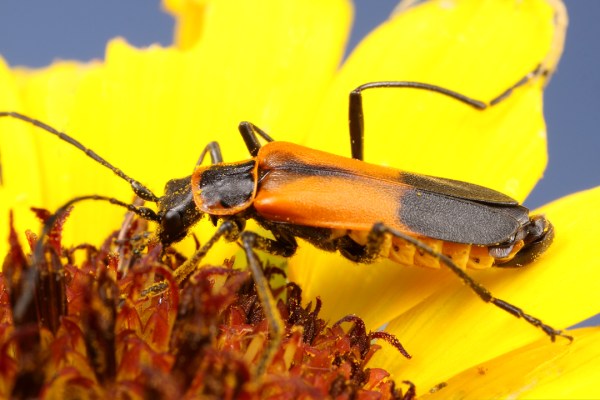
Here are two of the beetles that I photographed on the day. This first one is a soldier beetle (family Cantharidae) that is a dead ringer for Chauliognathus limbicollis. I couldn’t find any indication that this species is known from Oklahoma—all of the BugGuide photos of this species were taken in Arizona, while the admittedly outdated key to species in the tribe Chauliognathini (Fender 1964) gives only more western states (Arizona, Colorado, New Mexico and Texas) in its distribution. Still, I saw the species not uncommonly as it fed on yellow asteraceous flowers.

Chauliognathus limbicollis on yellow asteraceous flower | Glass Mountains, Oklahoma

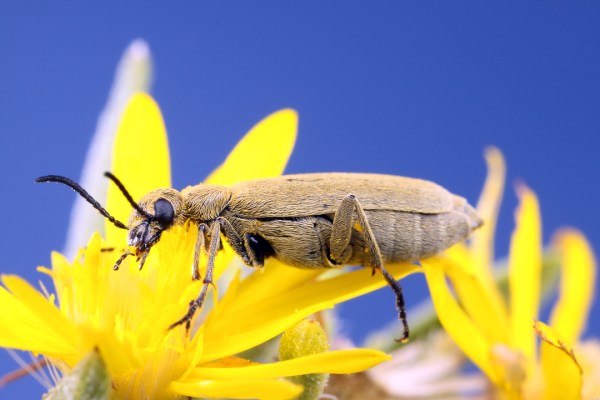
Another beetle that I photographed on flowers of Heterotheca subaxillaris (stiffleaf false goldenaster) was this small blister beetle (family Meloidae) that seems to be a member of the great genus Epicauta. I won’t even attempt a species ID due to the size and difficult taxonomy of this genus; however, this was the only example of this species that I saw amidst abundant individuals of another solid gray species that seemed to prefer the flowers of Gutierezzia sarothrae (broom snakeweed) over H. subaxillaris.

Epicauta sp. on Heterotheca subaxillaris flower | Glass Mountains, Oklahoma

During the day, I found some trees infested with jewel beetle larvae (presumably in the genus Chrysobothris), so I will return in the morning of Day 3 to harvest the wood and bring it back to put up in rearing containers in an attempt to rear out the adults. Afterwards, I will be off to my next destination—Alabaster Caverns State Park.

REFERENCES:

Fender, K. M. 1964. Tbe Chauliognathini of America North of Mexico (Coleoptera—Cantharidae), Part 2. Northwest Science 38(3):95–106.

MacRae, T. C. 2006. Beetle bits: The “beautiful tiger beetle”. Nature Notes, Journal of the Webster Groves Nature Study Society 78(4):9–12.

Copyright © Ted C. MacRae 2012

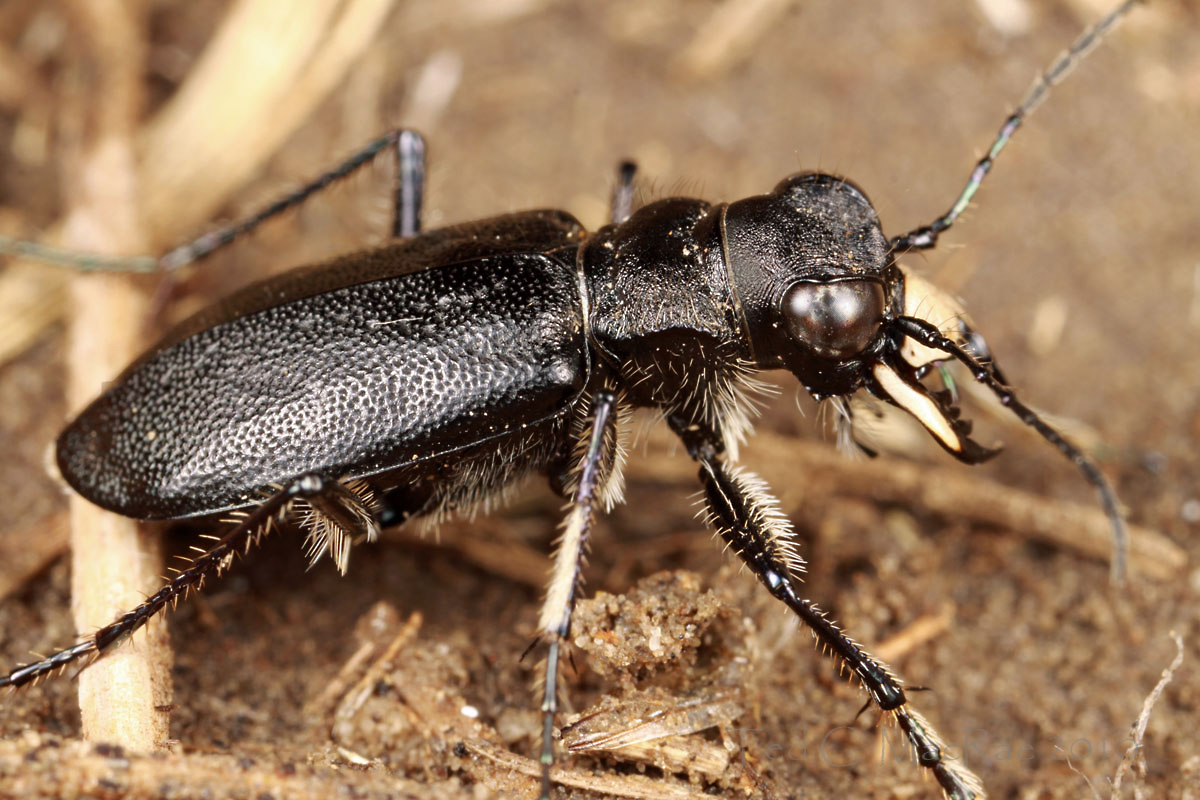
Cicindela nebraskana – Prairie Long-lipped Tiger Beetle

Cicindela nebraskana - the prairie long-lipped tiger beetle

We were only halfway through Day of five days in the field and had already achieved Goal of the trip.  Despite that, it took a few hours before Chris and I were ready to tear ourselves away from our first stop in Fall River Co., South Dakota, where we were treated to the sight of glittering, wine-red adults of Cicindela pulchra bejeweling the charcoal-colored shale slopes.  However, the list of species that we wanted to see over the next several days was long, and eventually our pulchra-fever abated (barely) enough to head south to the Pine Ridge in Sioux Co., Nebraska to look for A-list Species Cicindela nebraskana.  Sioux Co., Nebraska is the type locality for this species (thus the name), but in reality it is a more western species whose distribution just barely sneaks into the northwestern corner of Nebraska (Pearson et al. 2006, Spomer et al. 2008).  I first saw this species at this very site two years ago, seeing only a handful of individuals and managing one harshly-sunlit, point-and-shoot image of one of them.  To my knowledge, this remains the only known field photograph of this species.

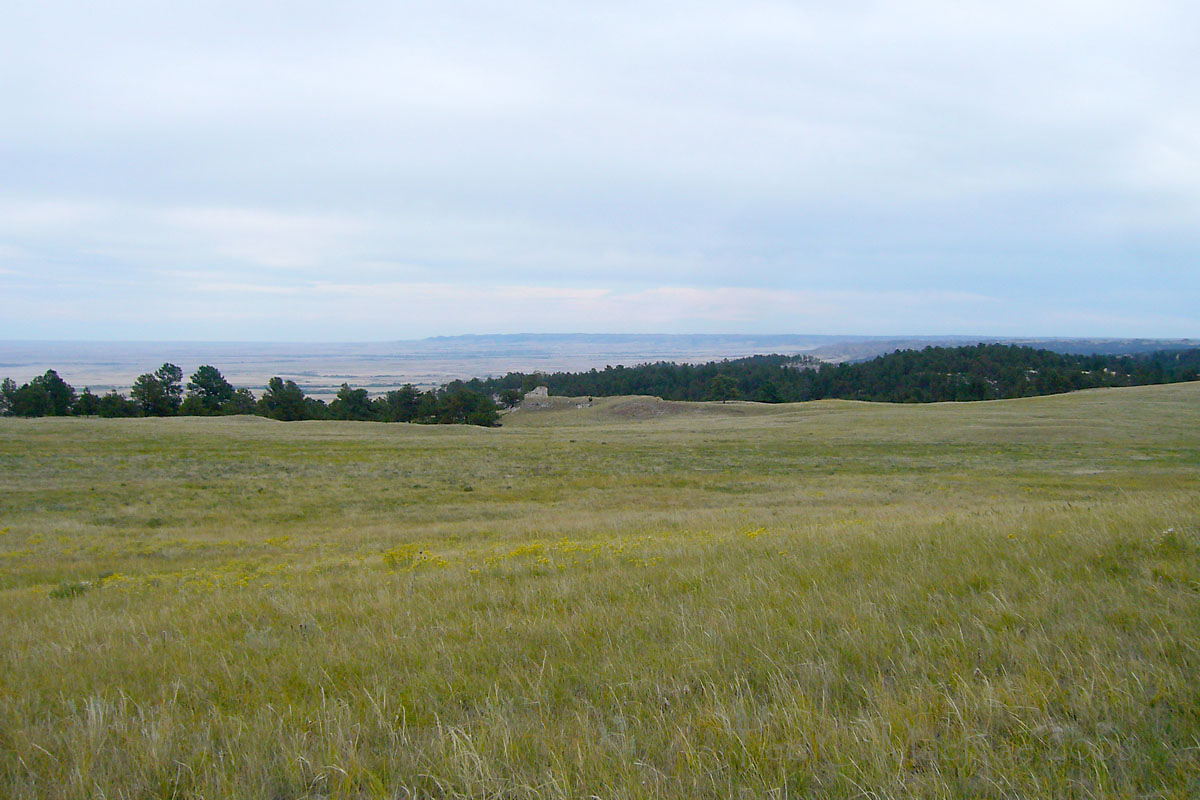
Shortgrass prairie atop the Pine Ridge, Sioux Co., Nebraska (photo taken September 2008).

This time, with a Canon 50D camera and 100mm macro lens in my backpack, I was much better equipped for vastly improved field photographs, but in contrast to the numerous individuals of C. pulchra that we saw earlier in the day, only a single C. nebraskana would turn up after intensive searching by Chris, Matt Brust, and myself in the vast shortgrass prairie sitting at the type locality atop the Pine Ridge.  I didn’t find it – Matt did – and the general rule with rare tigers is to capture the first individual rather than try to photograph it.  If no others are seen, photographing it later in a terrarium of native soil is better than trying to photograph it in the field and risk letting it escape.  Matt gave it to Chris, and at the end of the day when we realized we were not going to see another one, we prepared a terrarium of native soil, taking care to keep the surface as intact as possible so that an accurate replication of the field situation could be created when we photographed it later.

Tiger beetles "hunker down" when fatigued.

Although I prefer actual field photographs, the nice thing about photographing tiger beetles in confinement is… well, they don’t run away!  That’s not to say it is easy.  While they do settle down if left undisturbed for a while, once you start messing with them they quickly become agitated and start running in circles around the terrarium perimeter.  Much finger prodding is necessary to get them away from the edge and into a good spot for photographs, and rarely do they stay put for long.  When they finally do settle down, they tend to “hunker down” in a most unflattering pose (as above) – lacking the appearance of alertness that gives the true field photos their life.

A ferocious pose is struck after judicious prodding of the face and touching of the antennae.

I’m a persistent (syn. stubborn) sort, however, and I’ve learned that I can wear them down and poke and prod them out of their hunker.  Just a light poke at the face will often make them back up and lift their front slightly – poke again and they often open their jaws half-cocked – a light touch on the tip of one antennae and they’ll turn slightly.  With practice and patience, hunkered down beetles can be coaxed into some remarkably aggressive-looking poses.  I like the last of these photos in particular because the oblique, jaws half-cocked pose shows off two nice features of this species – the quite long labrum (upper lip) compared to most other tiger beetle species, and the bright white labrum and mandibles of the males of this species (in females they are partially or completely dark).  The long labrum and jaws give this species a very long-faced appearance that distinguishes it immediately from the black morphs of Cicindela purpurea audubonii that occur with much greater frequency in the same habitats as C. nebraskana.

Photo Details:
1: Canon 50D w/ MP-E 65mm 1-5X macro lens (ISO 100, 1/250 sec, f/13), Canon MT-24EX flash w/ Sto-Fen + GFPuffer diffusers.
2: Panasonic DMC-FX3 (ISO 100, 1/400 sec, f/5.6), natural light.
3-4: Canon 50D w/ 100mm macro lens (ISO 100, 1/250 sec, f/16), Canon MT-24EX flash w/ Sto-Fen + GFPuffer diffusers.
All photos: Typical post-processing (levels, minor cropping, unsharp mask).

REFERENCES:

Pearson, D. L., C. B. Knisley and C. J. Kazilek. 2006. A Field Guide to the Tiger Beetles of the United States and Canada. Oxford University Press, New York, 227 pp.

Spomer, S. M., M. L. Brust, D. C. Backlund and S. Weins.  2008. Tiger Beetles of South Dakota & Nebraska.University of Nebraska, Department of Entomology, Lincoln, 60 pp.

Copyright © Ted C. MacRae 2010