Four Canyon Preserve, Oklahoma

IMG_0295_1200x800

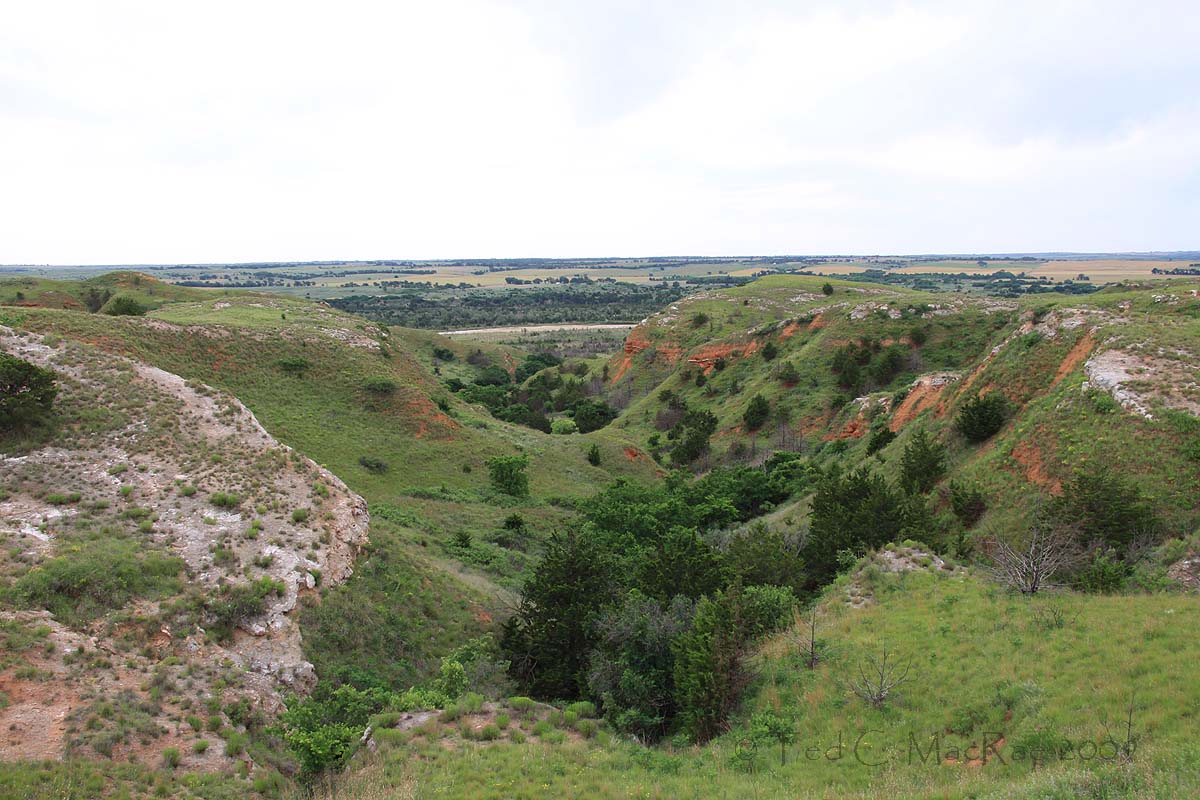
Looking SE into lower Horse Canyon towards Canadian River

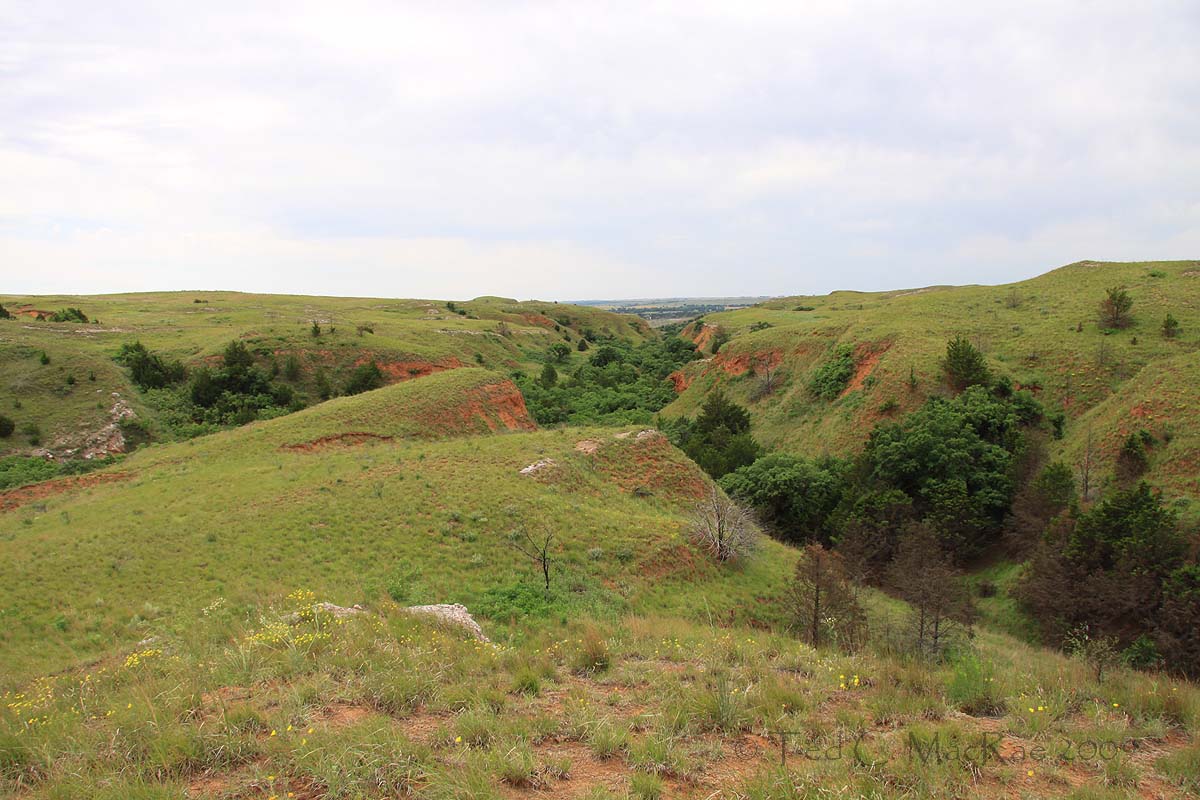
On my recent week-long collecting trip, the first three days were spent at Four Canyon Preserve in far northwestern Oklahoma.  This nearly 4,000-acre preserve features a stunning landscape of rugged, wooded canyons dissecting ridges of mixed-grass prairie which provide critical habitat for several rare plants and animals.  Despite years of overgrazing, fire suppression, and invasion by exotic plants, The Nature Conservancy (TNC) recognized the restoration potential of this landscape and began management practices to restore its ecological function and integrity after acquiring it in 2004.  The land was rested until April 2008, at which time a wildfire swept through the area and burned approximately 90% of the property.  This event was actually welcomed by TNC, who was already in the process of initiating a prescribed burn – they simply pulled back and let it rip!  The burn, combined with mechanical removal of eastern redcedar (Juniperus virginiana) that had invaded many areas of the preserve, did much to confine woody growth to the canyons proper, and good rains during the past two springs following that burn have resulted in a lush, green, diverse landscape brimming with prairie wildflowers.  The vivid contrast between the green vegetation and the red clay canyons with their white gypsum exposures has created spectacular vistas of a rugged landscape.  This year, cattle have been reintroduced at low levels to simulate the irregular, patchy disturbance experienced in pre-settlement times when native grazers (bison and elk) dotted the landscape.

The flora (Hoagland and Buthod 2007) and avifauna (Patten et al. 2006) of the preserve are well characterized, but (as nearly always seems the case) arthropod and other micro faunas need much additional study.  My hymenopterist colleagues and I were welcomed enthusiastically by TNC staff, who are anxious to incorporate the results of our insect surveys into an overall fauna.  Apoid hymenopterans appear to have benefited greatly from the recent rejuvenation of the preserve’s floral character.  Results for the beetle populations that I encountered, however, were more mixed. Certain groups, such as scarabaeine dung beetles, were quite abundant and diverse (due to the reintroduction of cattle), but others, including the tiger beetles, jewel beetles, and longhorned beetles that I was most interested in finding, existed at rather low and not very diverse levels.  I had hoped to find the very rare Cylindera celeripes (swift tiger beetle) running amongst the clumps of vegetation on the preserve’s red clay exposures but instead saw only the ubiquitous Cicindela punctulata (punctured tiger beetle), and the few jewel beetles that I managed to beat off the lower branches of hackberry (Celtis laevigata) and soapberry (Sapindus saponaria var. drummondii) trees were found only in the small parts of the preserve that escaped last year’s burn.  This seems fairly typical – I generally don’t find many insects in these groups whenever I survey areas that have experienced a significant amount of recent burning.  Some ecologists might take exception to this statement, and they would have little difficulty citing studies that show rapid recolonization of prairies by a majority of prairie insect specialists within two years after a prescribed burn.   Nevertheless, the impact of prescribed burning on invertebrate populations and its potential for causing local extirpations has become a contentious issue among ecologists and entomologists in recent years.  While my experience hardly passes for rigorous investigation, I am becoming increasingly convinced that a certain amount of caution is warranted when designing burn management plans for prairie relicts.

I’ll discuss more about the beetles and other insects (and even some vertebrates) that I saw during my three-day visit to Four Canyon Preserve in future posts.  In the meantime, I share with you some of my photos of this spectacularly beautiful landscape (note the abundance of woody cadavers from last year’s burn in some of the photos).
IMG_0382_1200x800

Looking S into upper reaches of Mulberry Canyon

IMG_0384_1200x800

Looking S into upper reaches of Mulberry Canyon

IMG_0399_1200x800

Looking E across upper Harsha Canyon

IMG_0402_1200x800

Looking SE into Harsha Canyon towards Canadian River

IMG_0403_1200x800

Looking E across lower Harsha Canyon

View of Mulberry Canyon bluffs from Canadian River valley

Looking NE towards Mulberry Canyon bluffs from Canadian River valley

REFERENCES:

Hoagland, B. W., and A. K. Buthod.  2007.  Vascular flora of the Four Canyons Preserve, Ellis County, Oklahoma.  Journal of the Botanical Research Institute of Texas 1(1):655–664.

Patten, M. A., D. L. Reinking, and D. H. Wolfe.  2006.  Avifauna of the Four Canyon Preserve, Ellis County, Oklahoma.  Publications of the Oklahoma Biological Survey (2nd Series) 7:11-20.

Copyright © Ted C. MacRae 2009

Add to FacebookAdd to NewsvineAdd to DiggAdd to Del.icio.usAdd to StumbleuponAdd to RedditAdd to BlinklistAdd to Ma.gnoliaAdd to TechnoratiAdd to Furl

The “obscure” Dicerca

IMG_0533_1200x800

Photo details (first 2 photos): Canon 100mm macro lens on a Canon EOS 50D, ISO 100, 1/250 sec, f/13, MT-24EX flash 1/4 power through diffuser caps

During my recent trip to northwestern Oklahoma, we visited Packsaddle Wildlife Management Area, a 17,000-acre chunk of land containing mixed-grass prairie, shinnery oak (Quercus havardii) shrublands, and mesic woodlands along the South Canadian River.  In one of these woodlands, I encountered a small grove of persimmon (Diospyros virginiana) trees – some of which had recently died.  Whenever I see dead persimmons, I immediately think of the jewel beetle species, Dicerca obscura (family Buprestidae).  This attractive species is one of the larger jewel beetles occurring in our country, and although it is fairly commonly encountered in collections, seeing the living beetles in the field is always a treat.  Dicerca obscura is most commonly associated with persimmon, from which I have reared it on several occasions, but Knull (1920) also recorded rearing it from staghorn sumac (Rhus typhina).

IMG_0534_1200x800I began inspecting the dead trees for the presence of the beetles but didn’t see any at first.  Then, I saw something moving right where I had been looking.  I had, in fact, looked right over this beetle without seeing it – even though I knew what could be there and what it looked like.  I don’t know if the species name (from the Latin obscurus, meaning indistinct) was actually given because of its marvelous cryptic abilities, but it certainly could have been.  As I continued to inspect the trees more closely, I found several additional adults – all sitting on trunks that I had just inspected a few minutes prior.  I couldn’t help but think of the irony – in collections, Dicerca beetles are quite gaudy and conspicuous appearing, with their shiny, brassy colors and exquisite surface sculpturing (as exemplified by Dicerca asperatathis photo of a pinned specimen in my collection of a similar species, D. asperata).  However, in the context of their environment, their coloration and sculpturing helps them blend in and become almost invisible.

Dicerca obscura occurs across the eastern U.S. but is absent from much of New England, the Appalachian Mountains, the Allegheny Plateau, and the upper Midwest – apparently due to the absence of persimmon in those regions.  It has been been recorded in Oklahoma as far west as Oklahoma City (Nelson 1975), so my record from Ellis Co. in far northwestern Oklahoma represents a bit of a range extension.  This is not surprising – the species will probably be found wherever persimmon grows.  You’ll just have to look carefully if you want to find it!

REFERENCES:

Knull, J. N.  1920.  Notes on Buprestidae with descriptions of new species.  Entomological News 31:4-12.

Nelson, G. H.  1975.  A revision of the genus Dicerca in North America (Coleoptera: Buprestidae).  Entomologische Arbeiten aus dem Museum G. Frey tutzing bei München 26: 87-180.

Copyright © Ted C. MacRae 2009

Add to FacebookAdd to NewsvineAdd to DiggAdd to Del.icio.usAdd to StumbleuponAdd to RedditAdd to BlinklistAdd to Ma.gnoliaAdd to TechnoratiAdd to Furl

On the road again!


IMG_3397_0006_006_enh

By the time you read this, I’ll be on the road again for yet another extended bug collecting trip.  I don’t think I am ever happier than when I am on one of these trips – whether it be a once-in-a-lifetime visit to Africa or a one-week jaunt to the nearby plains.  With so many places to see – each with their own unique story – I don’t understand how anyone ever ends up getting bored.  The main destination for this trip is the Nature Conservancy’s recently established Four Canyon Preserve in northwestern Oklahoma.  This nearly 4,000-acre preserve contains a stunning assemblage of rugged, mixedgrass prairie ridges dissected by deep, chinquapin oak-lined canyons that drain into the Canadian River in southern Ellis County.  Although past grazing and fire suppression have reduced shrub cover, lowered vegetation complexity and promoted expansion of eastern redcedar (Juniperus virginiana) throughout the area, the preserve nevertheless supports a number of species of conservation concern such as Cassin’s sparrow, Swainson’s hawk, least tern, and Arkansas River shiner.

IMG_3285_0024_024_enh

As is typical with many protected areas, studies of the biotic diversity of this preserve have dealt primarily with its flora (Hoagland and Buthod 2007) and avifauna (Patten et al. 2006). Arthropods and other microfauna, on the other hand, remain essentially unknown.  I’ll be joining a group of entomologists – primarily hymenopterists – who began conducting surveys of the preserve’s insect fauna last fall.  While my colleagues gaze at the hyperdiversity of asteraceous flowers looking for things with stings, I’ll be staring at the red Permian sandstone and shale exposures – watching for any darting movement between clumps of grama and little bluestem that might indicate the presence of the enigmatic Cicindela celeripes (swift tiger beetle).  I’ve written previously about the occurrence of this rare, flightless tiger beetle in the Loess Hills of Iowa and our ongoing search for this species in northwestern Missouri in my post The Hunt for Cicindela celeripes.  Although this beetle has not yet been recorded at the preserve, it was seen very recently in nearby Alabaster Caverns – some 60 miles to the north, and a historical record is known from just south of the preserve.  My optimism is bolstered by the fact that the Alabaster Caverns individual was observed in late May – much earlier than the typical late June and early July records for this species further north in its stronghold in the Flint Hills of Kansas.  Of course, I will be looking for other things as well – other species of tiger beetles are likely to occur on the reddish loamy upland soils and quaternary alluvial deposits along the Canadian River, and any number of woodboring beetle species are likely to be found on herbaceous flowers and dead branches of the 51 species of woody plants recorded in the preserve.

After getting our fill of Four Canyon Preserve, we’ll visit the world’s largest remaining tract of tallgrass prairie, Tallgrass Prairie Preserve in northeastern Oklahoma.  Encompassing nearly 40,000 acres, we can do nothing more than only scratch its surface.  However, the tallgrass prairie habitat should provide a nice contrast to the mixedgrass prairie of Four Canyon Preserve, and it will be interesting to compare and contrast these two distinctive plant communities and their associated insect faunas.  After a week on the road¹, I’ll return to St. Louis for a brief respite before beginning a hectic four-week survey in northwestern Missouri for – you guessed it – Cicindela celeripes!

¹ I’ll be without internet access, so please forgive my nonresponsiveness to comments. I do have a couple of posts scheduled to appear during my absence.

My thanks to Mike Arduser, an expert hymenopterist and also a good friend, for bringing Four Canyon Preserve to my attention.  His spectacular photographs that I share here were all I needed to convince me to join him on his return trip this season.

REFERENCES:

Hoagland, B. W., and A. K. Buthod.  2007.  Vascular flora of the Four Canyons Preserve, Ellis County, Oklahoma.  Journal of the Botanical Research Institute of Texas 1(1):655–664.

Patten, M. A., D. L. Reinking, and D. H. Wolfe.  2006.  Avifauna of the Four Canyon Preserve, Ellis County, Oklahoma.  Publications of the Oklahoma Biological Survey (2nd Series) 7:11-20.

Copyright © Ted C. MacRae 2009

Add to FacebookAdd to NewsvineAdd to DiggAdd to Del.icio.usAdd to StumbleuponAdd to RedditAdd to BlinklistAdd to Ma.gnoliaAdd to TechnoratiAdd to Furl