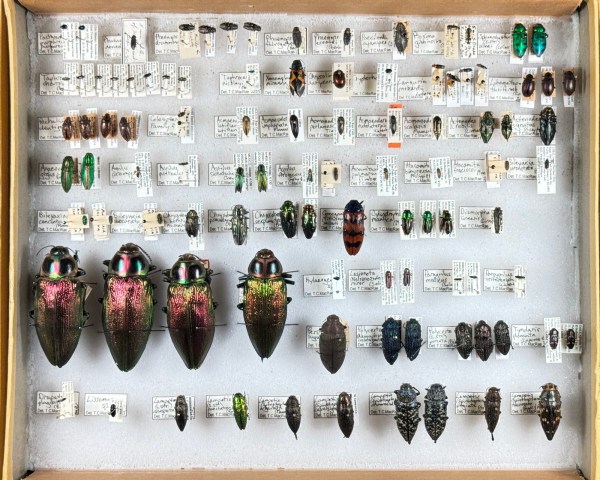
Buprestidae (plus one Elateridae) selected from specimens in the insect collection at the Illinois Natural History Survey sent for identification.
I’ve been working hard the past couple of weeks on one of three batches of Buprestidae in the insect collection at the Illinois Natural History Survey sent to me for identification. I’ve already completed one of these batches, which included all specimens strictly from Illinois. This second batch includes specimens from the not only the rest of North America (sensu lato), but South America and the West Indies as well. Out of ~450 total specimens, in this batch, I identified 167 species, with eight new state and two new country records.
Why do I do it? While I’d like to say it’s because I’m just a nice guy, and I do genuinely enjoy helping to improve the level to which public insect collections are curated, my motives aren’t completely unselfish. First, it is a chance for me to glean the specimens for new data in the form of unknown distributional and host plant records. This is a main area of interest for me, and the data provide fuel for my publications on the subject. Second, and perhaps, it is a chance to encounter species that are absent or poorly represented in my cabinets. Most public collections allow specialists to retain a certain number of duplicates of the species they identify. This allows me to increase the representation of species in my collection, which in turn increases its usefulness as a resource for even further identifications. (In this particular case, the INHS collection manager graciously allowed me even to retain a handful of singletons in exchange for some other species that helped to improved the representation in their collection.) Finally (and perhaps most importantly), regularly examining new material helps to continually refine my understanding of species concepts. Sometimes this causes me to reassess a previous identification in light of an improved understanding (a reference collection is only useful if its representatives are correctly identified).
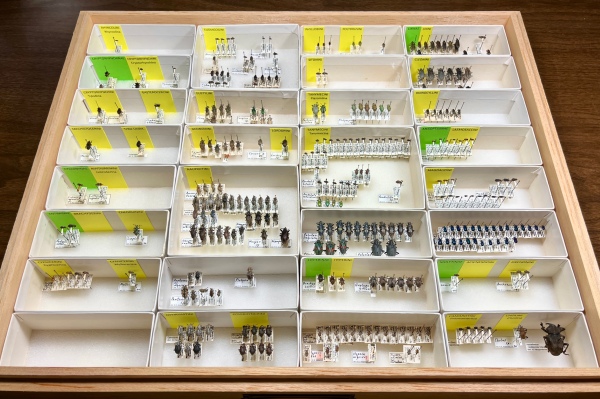
For those wondering, here is what 165 species of Buprestidae looks like:
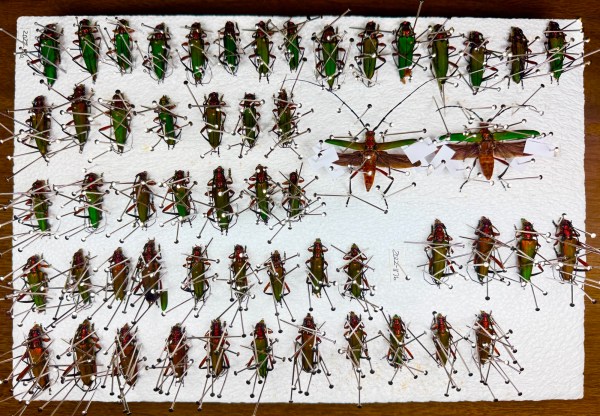
Because space is such a premium in my insect collection, I like to mount specimens with the legs and antennae positioned closely against the body. This enables the most efficient use of space and minimizes the chance of breakage when positioning specimens next to each other in the collection. This can be a challenge, however, with specimens that have unusually long legs and/or antennae, and large, gangly longhorned beetles—like Plinthocoelium suaveolens—present the biggest challenge of all. For those interested in knowing how I deal with such species, I find the following technique to be most effective:
Start with a fully relaxed specimen. Hold it with one hand and use the other to gently “work” all the legs and antennae, ensuring they are loose and pliable enough to move into the desired position for mounting. (For smaller species, grabbing the tibiae with fine-tipped forceps [FTFs] is helpful, but don’t pull too hard as this risks pulling the tarsus off the leg.)
Pull the middle legs so that they extend out perpendicular to the body, then grasp the specimen by the metathorax (behind the middle pair of legs).
If the hind wings are sticking out from under the elytra, use FTFs to grab the costal area of the wing and “stuff” it back under the elytron. If the wing tips protrude from under the tips of the elytra, stuff them back underneath with FTFs. If the elytra don’t lay flat over the abdomen, work them back in place using the FTFs, then squeeze squeeze the metathorax to keep the elytra in place.
While still holding by the metathorax, push a #2 insect pin through the right elytron so that it exits the body through the middle of the right metasternum (i.e., halfway between the right meso- and metacoxa, and halfway between the central midline and right side of the specimen—be careful to move your finger out of the way as the pin pushes through!). It may take some practice to get good at inserting the pin so that it is positioned perfectly vertical.
Push the pin into a styrofoam block until the ventral surface of the specimen rests on the surface of the block. If the left elytron does not lay flat over the abdomen, insert brace pins into the styrofoam next to the body on each side of the body just behind the hind femora and angle them inwards and forward until both elytra lay flat and meet along the midline. This also braces the specimen itself to keep it from moving while attempting to position the legs and antennae.
Position the legs, starting at the front. This can often be done using a brace pin, but sometimes FTFs will be necessary if the leg resists moving into the desired position. In such cases, grab the base of the tarsus with the FTFs and position the leg in the desired position, then, while still holding the leg in position, push a brace pin into the styrofoam right next to the leg to keep it into position. A single brace pin on the outer side at the base of the tarsus and angled towards the body is usually sufficient to hold the leg in position, but additional pins on the inside of the tarsus angled away from the body (to keep the tarsus in place) or against the backside of the femur and angled towards it (to “lift” the femur) may be needed.
After all legs are positioned, gently pull on the distal portion of the antennae with FTFs to straighten them out, then use brace pins to hold them in place close to the body (and, for males, arrange the portion extending beyond the body). I generally place one brace pin near the base of each antennae and one near the middle (in front of the hind legs). For males with highly elongated antennae, I use a brace pin to wrap the portion extending beyond the body around the hind leg on the opposite side of the body. If this is not sufficient to hold them in place, another brace pin can be placed behind both antennae just beyond the tips of the elytra.
You can position the legs and antennae in a more life-like position if desired. This generally requires more brace pins, especially for the male antennae. Posing the elytra and wings outstretched also requires not only more brace pins, but strips of thick paper to support the wings from beneath and clamp down on them from above (see photo).
In the end, around 15–20 brace pins will be needed for each specimen (twice that if the antennae and wings are posed outstretched). It generally takes up to a week for the specimens to dry sufficiently. Note: resist the temptation to remove the pins too soon, as even though the legs and antennae may appear to hold position, they will still gradually sag out of position if they are not completely dry (for those of you who are in a hurry, low heat from an incandescent bulb positioned immediately above the specimens can help speed the drying process!).
Alternate title: “The importance of authoritative identification and voucher specimen information when documenting a new occurrence of an exotic species.”
For many years now (indeed, decades!), I have been assembling a “Catalogue of Buprestoidea of North America, Mexico, Central America, and the West Indies.” Still a work in progress, it serves as a personal database of literature citations for all species of Buprestoidea occurring in that region—both native and introduced, along with full synonymies, information on type specimens and repositories, distributions, host plants (larval, adult, and flower), natural enemies, and attractants, and comments on erroneous reports and taxonomic issues. The relatively recent appearance of two other catalogues for this superfamily—one by Nelson et al. (2008) for North America north of Mexico, the other by Bellamy (2008–2009) and worldwide in scope—might seem to render this effort duplicative. Nevertheless, both catalogues contain errors and omissions that should be corrected, and numerous additional papers on the taxonomy, nomenclature, and biology of species of Buprestoidea have been published in the years since the appearance of these catalogues. Additionally, my vision of the eventual published version of my catalogue includes full synonymies and more detail in the aforementioned sections. Don’t look for it to be published anytime soon, as it is nowhere close to ready—perhaps it will prove to be my final magnus opus, much as the Nelson et al. and Bellamy catalogues capped the careers of their respective authors.
Last December, whilecomparing provincial records in my database with the second edition of Checklist of Beetles (Coleoptera) of Canada and Alaska (Bousquet et al. 2013), I encountered in the latter an entry for the Palearctic (Europe and Asia) species Buprestis haemorrhoidalis in British Columbia. This was news to me, and I quickly checked the Nelson et al. and Bellamy catalogues, neither of which included North America in the reported distribution of this species (the Bellamy catalogue did report an introduction of the species to South America). The Bousquet et al. checklist post-dates the Nelson et al. and Bellamy catalogues by five years, so I assumed the supporting record would be found within one of the papers from within that time period that I had not yet databased; however, no such paper was found.
I then turned to my old friend Google and searched “Buprestis haemorrhoidalis British Columbia”, and the very first result was a placeholder page for the species at the popular insect website BugGuide (Belov 2017–2023). No North American observations had yet been posted to the page, but two references were cited—the aforementioned Bousquet et al. checklist, and a paper by Humble & Allen (2006). The link to the paper was nonfunctional, but I found a PDF at the Purdue University website (see link in citation below). In the paper, B. haemorrhoidalis was included in a list of invasive species reported to be “established” in Canada, giving 1992 as the date of introduction. No information regarding the source of the record or the existence of voucher specimen(s) was given, but the authors’ affiliation with the Pacific Forestry Centre in Victoria, British Columbia hinted at this being the basis of the listing in the Bousquet et al. catalogue. Neither the Nelson et al. nor Bellamy catalogues cited this reference, but its publication date (2006) is close enough to the two catalogues (2008) and the venue obscure enough (not an entomology journal) that the omission is not unexpected. A more exhaustive literature search turned up nothing but a single more recent summary listing of the record by Ruzzier et al. (2023), citing Humble & Allen (2006).
Unable to find anything online, I emailed the corresponding author (Leland Humble), but the message bounced back as undeliverable. This prompted me to reach out to several current buprestid workers, all of whom concurred with my presumption that this must—in the absence of any supporting evidence to the contrary—represent a non-established interception or a misidentification of a native species. One of them, Eduard “Edo” Jendek (Bratislava, Slovakia), an expert in invasive Buprestidae, contacted Jon Sweeney (Canadian Forest Service, Atlantic Forestry Centre), who informed him that Humble was deceased and suggested sending an inquiry to Meghan Noseworthy, currently research manager at the Pacific Forestry Centre arthropod reference collection (PFCARC). In response to my inquiry, Meghan informed me that a specimen under the name B. haemorrhoidalis was, indeed, listed in their collection database. She was able to locate the specimen and graciously arranged to have it sent to me on loan so I could examine it and confirm or correct its identity. When the shipment arrived, I opened the box and saw this:
Unit tray from the Pacific Forestry Centre arthropod reference collection containing putative voucher specimen of “Buprestis haemorrhoidalis.”
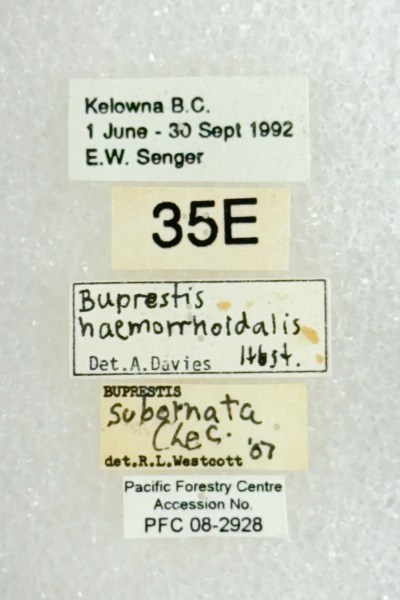
Comparison of the specimen to a series of B. haemorrhoidalis in my collection quickly revealed it is not that species. This was no longer an ID confirmation, but an ID correction—almost surely a native North American species. Remarkably, the first clue to its true identity was found on the labels attached to the specimen itself—the initial identification label by “A.Davies” (undated) as “Buprestis haemorrhoidalis” had been repositioned upside-down on the pin, and a second identification label by “R.L.Westcott ‘07” as “Buprestis subornata (LeC.” [closing parenthesis missing] was placed beneath it. As expected, the specimen agrees in all respects with a series of B. subornata in my collection. While B. haemorrhoidalis superficially resembles B. subornata, it differs in its well-defined, serially punctate elytral intervals (B. subornata has poorly-defined, impunctate intervals) and its smoother, shinier elytral surface compared to the latter species. Indeed, the two are placed in separate subgenera—B. haemorrhoidalis in Ancylocheira, and B. subornata in Buprestis s. str.
Putativevoucher specimen of “Buprestishaemorrhoidalis.” In reality, the specimen represents the North American native species Buprestis subornata (LeConte, 1860).
Examination of the specimen labels leaves little doubt that this specimen is the basis of the Humble & Allen (2006) report of B. haemorrhoidalis in Canada—the specimen resides in the PFCARC (the institute with which L. Humble and E. Allen were affiliated), and the reported date of introduction (1992) matches the specimen date of collection. There also can be little doubt that this specimen is the basis of the Bousquet et al. (2013) report of B. haemorrhoidalis in British Columbia—the label indicates collection in “Kelowna B.C.”, and the initial identifier (A. Davies) is the author of the Buprestidae chapter in the first edition of the Canada checklist (Davies 1991) and a coauthor of the second edition.
Labels that had been placed on the voucher specimen show that its identity was corrected shortly after the record was published (the Davies label was repositioned upside-down on the pin). 
This examination refutes any notion that B. haemorrhoidalis has ever been introduced to or established within North America. However, it also highlights the problems that allowed a misidentification to not only be reported in the literature, but also accepted and propagated. The initial erroneous identification by Davies is puzzling—not so much because it happened (erroneous identifications happen all the time), but because it was identified as an exotic species with no known prior occurrence in North America. The identification of any exotic species for the first time is a significant finding that should raise alarms and be immediately confirmed by a recognized specialist with taxonomic expertise in the group to which it belongs. While this did eventually happen with Westcott’s corrected identification in 2007, it was not before the erroneous identification had already been introduced to the literature by Humble & Allen (2006).
The fact that the erroneous identification was even published at all is itself problematic—there was no prior, peer-reviewed publication to support its summary listing in a review article published in a non-entomology journal, nor was there any citation of specimen data or voucher location to address the absence of such. The use of the word “established” to characterize the presence of the species in Canada is also curious, although I note that the authors were mycologists, not entomologists, and may not have appreciated the significance of that term in the context of invasive exotic insects. (The more appropriate term, erroneous ID notwithstanding, would have been “apparently introduced or mislabeled”.)
The acceptance of the erroneous report by Bousquet et al. (2013) is yet another puzzle, as the identification had been corrected by Westcott—a recognized expert of Buprestidae—six years earlier. Obviously, the PFCARC neglected to correct the listing of the specimen under B. haemorrhoidalis—both in their collection database and in the collection itself—despite this correction (now 17 years ago!). I also note that the Canadian National Collection website lists a specimen (record #CNCCOLEO00091957) with identical label data, but again only the initial identification as B. haemorrhoidalis is mentioned—the corrected identification as B. subornata is not. Since Davies (a coauthor of the second edition) made the initial identification, perhaps the remaining authors had no reason to doubt it. Nonetheless, the reported occurrence of an exotic, apparently invasive species with no supporting reference documenting the circumstances of its collection should have triggered confirmatory follow-up before its inclusion in the updated version of the checklist.
Had any of the above circumstances been avoided, the erroneous report of an exotic invasive species established in North America would not have been propagated in subsequent literature (i.e., Ruzzier et al. 2023) or on a popular insect website (i.e. BugGuide). Let this serve as a cautionary tale to current and future entomologists, especially those with an interest in invasive species and cataloguing efforts. I have a (much shorter) corrective note about this in a soon-to-be-published paper that will likely set the record straight among most North American buprestid workers. However, the erroneous record could still be propagated by those not interested explicitly in Buprestidae (e.g., invasive species specialists) and, thus, may be unlikely to encounter my corrective note. As they say, it’s hard to unring the bell.
Literature Cited
Bellamy, C. L. 2008–2009.A World Catalogue and Bibliography of the Jewel Beetles (Coleoptera: Buprestoidea). Vols. 1–4 (2008), Vol. 5 (2009). Pensoft Series Faunistica No. 76. Pensoft Publishers, Sofia, Moscow, 3264 pp. [Description]
Bousquet Y., P. Bouchard, A. E. Davies & D. S. Sikes. 2013. Checklist of beetles (Coleoptera) of Canada and Alaska. Second edition. ZooKeys 360:1–402. [PDF of original work no longer available; see Introduction and Data Paper]
Davies, A. 1991. Family Buprestidae: metallic wood-boring beetles, pp. 160–168. In: Y. Bousquet (Ed.), Checklist of beetles of Canada and Alaska. Research Branch, Agriculture Canada, Publication 1861/E, 440 pp. [PDF]
Humble, L. M. & E. A. Allen. 2006. Forest biosecurity: alien invasive species and vectored organisms. Canadian Journal of Plant Pathology 28:S256–S269. [PDF]
Nelson, G. H., G. C. Walters, Jr., R. D. Haines & C. L. Bellamy. 2008.A Catalog and Bibliography of the Buprestoidea of America North of Mexico. The Coleopterists Society, Special Publication No. 4, iv + 274 pp. [PDF]
Ruzzier, E., R. A. Haack, G. Curletti, A. Roques, M. G. Volkovitsh & A. Battisti. 2023. Jewels on the go: exotic buprestids around the world (Coleoptera, Buprestidae). NeoBiota 84:107‒135. [Full text, PDF]
As a writer of an entomology blog, I don’t normally get hate mail—at most a critical comment about the way my specimens are curated or labeled, or perhaps an opposing thought regarding application of the subspecies concept. But recently, I got a doozy! I was going to respond privately but didn’t want to reveal to them my private e-mail address. Then I was going to respond in a public post (and there is much to respond to), but I decided their position is so hardened that any response is pointless. Ultimately, I decided just to share the hate (sender’s name redacted to protect their privacy) as an example of how not to engage me in a discussion. We can (and should) debate the ethics of insect research, but equating entomologists who do collections-based research to depraved mass murderers doesn’t do much to promote rational and constructive dialogue.
Intentionally killing beetles is killing a sentient, conscious, and extremely refined competent life. That others before you have done it is no excuse nor a valid precedent for mimicking them. Todays imaging techniques can photograph molecules. There are techniques of photographing with layered depth of field images combined into one image that has clarity of all insect parts at their scale. Moreover there are 3D microscopes at that scale as well including capture of motion. Killing insects to collect is a macabre, harmful, antiquated and unnecessary. Today it is a pathological fetish to kill and display bodies of once sentient and conscious beings. When the world was large with only wooden boats scientists did that to record far away places. This is no longer necessary. Your collection is an example of how proficient your are at killing sentient beings within the synergistic wholes we call natural habitats. Nothing more. This is not research, kind nor has any inkling of respect for the insect. An excuse to kill based on populations is complete pathological rubbish and part of you knows this is true.
Finally, after nearly 40 years, I’ve gotten my weevil collection organized and inventoried—nearly 1,000 specimens representing 160 species from the USA, Mexico, Brazil, Argentina, and South Africa. My sincere thanks to Bob Anderson, weevil specialist at the Canadian National Collection, for looking at my specimens and providing identifications.
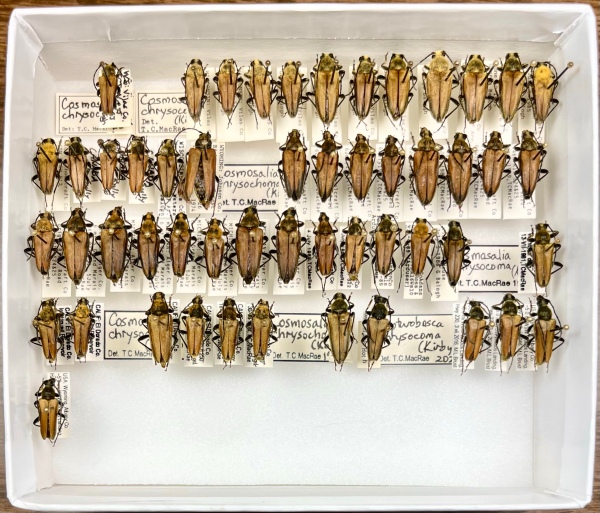
Unit tray of Lepturobosca chrysocoma (formerly Cosmosalia chrysocoma).
I belong (or used to belong) to several Facebook groups frequented by insect collectors—both professional and amateur. One question that frequently comes up—primarily for collections with species organized by unit trays—is how to deal with species identification labels. Not surprisingly, the opinions are as varied as the collectors. Some like to put a label on each specimen, while others put a label only on the lead specimen of a series. Some also print or write a separate header label that is placed in the unit tray. What about when names change? Or when reexamination of the specimen(s) reveals an erroneous ID? Should you remove outdated or erroneous identification labels? Fold them? Turn them upside down? Remove them altogether? These questions may seem trivial if one deals only with their own personal collection, but they become much more important when identifying specimens in institutional collections accessible to the public.
Here is my philosophy: an identification is a hypothesis, not data. As a result, ID labels are fundamentally different from labels indicating locality, date, ecological information, and collector, which are data—immutable and unchanging. Identifications can be “wrong” or may change over time, but regardless they merely reflect an individual’s opinion based on their level of expertise and familiarity with state of taxonomy and nomenclature at the time the identification was made. It then follows that identification labels do not need to be placed on every specimen—if a specimen without an ID label gets separated from the series, it does not result in a loss of data in the way it does for a specimen without a locality label, nor do old ID labels need to be changed as a result of nomenclatural changes or corrected identifications—a new label may be added (especially if it is an ID correction), but the old label should not be removed.
Almost as bad as removing old ID labels is folding them, which not only makes them difficult to read but results in mutilation—not just from the fold itself but also from the additional pin holes that are added when re-pinning the folded label. Old ID labels, even if incorrect or out-if-date, represent a historical record of opinion regarding the identity of the specimen, and degrading the labels obscures that history. If one simply must do something to denote a corrected ID, the old label may be turned over, but even then every effort should be made to reuse existing pinholes—just flatten with a fingernail before reusing so the label doesn’t spin. Seriously, however, this simply isn’t necessary—just add the new ID label beneath the old one, which denotes it as the more recent ID (another reason why year should be included on ID labels). Some people don’t like the way this looks, but to do otherwise is to greater priority on visual aesthetics than the integrity of the scientific data represented by the specimen.
As for dealing with nomenclatural changes—I don’t, at least not with already labeled specimens. That old ID label is not “wrong”—it accurately reflects the ID that was given to the series at the time the specimens were identified. Of course, any additional specimens that are added to the unit tray will receive an ID label the reflects the newer nomenclature. Case in point is the above photo, which contains longhorned beetles known for many years as Cosmosalia chrysocoma but recently reassigned to the genus Lepturobosca. You’ll note the older series of specimens bear ID labels with the older name, but the most recently added series contains an ID label with the newer name. There is no reason to go back and change or add ID labels for the older specimens, especially since newer specimens reflecting current nomenclature have been placed in the same unit tray with them. The mix of ID labels representing past and present nomenclature is not problematic—in fact, it adds historical perspective to the series as a whole. On the other hand, were I to receive a series of specimens labeled with an older name from another collection, I would be inclined to add my own, more current ID label (and would certainly do so if the ID—current nomenclature or not—was incorrect), since it was the result of subsequent examination by a different specialist.
Lastly, I don’t waste time creating header labels for unit trays—the ID labels on the specimens themselves are enough to indicate the identity of the species, and the time required to update header labels when nomenclature changes is just that much less time that I have to pin, label, and identify additional specimens being added to the collection.
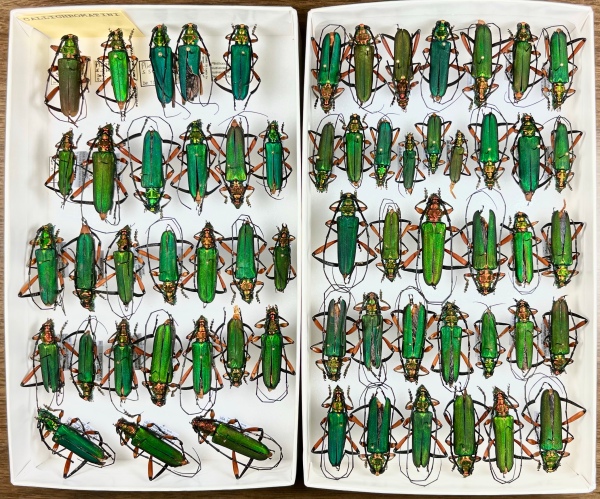
In any insect collection, space is expensive and, thus, almost always at a premium—especially a large, self-funded, private collection such as mine. As a result, I am constantly looking for creative ways to maximize space efficiency. The photo here shows a technique I’ve adopted that works especially well for “leggy” beetles. Rather than lining them up “knee-to-knee” and wasting space between the specimens, I line them up “knee-to-elbow” by orienting every other specimen head downward. Of course, one can always simply tuck the legs and antennae underneath the body. However, this manner of mounting not only obscures the underside, but, in my opinion, looks rather sloppy and aesthetically unpleasing.
Unit trays of Plinthocoelium suaveolens.
I have a few other tricks I use to maximize not only space in my collection but also its athletics that I may show here in future posts. However, if you have tips and tricks of your own, I’d love to hear them in the comments below.
I’ve been collecting insects for a long time. A really long time… like, almost my whole life! In the beginning, as a child and adolescent, I collected everything—a so-called “general collector.” Sadly, none of the collections I made during those formative years survived—lost to curious cats and benign neglect. I loved hunting for insects but hadn’t yet learned the importance of collection maintenance and preservation. This changed once I began taking entomology courses in college, and in fact the oldest personally-collected insects in my present collection are from my Entomology 201 “Introduction to Entomology” course taken during my junior year in 1978.
Entering graduate school in 1980 began my next phase as a collector—learning to specialize. With more than three-quarters of known life on earth being represented by insects (and perhaps, conservatively, 95% when considering all the not yet discovered species of insects), attempting to build a collection focused on all groups of insects is barely less ambitious—or feasible—than attempting to build a collection representing all life on earth!* If one wishes—as I did—to make meaningful contributions to insect taxonomy, they must specialize in a particular group—typically a family but sometimes even more restricted to certain subfamilies, tribes, or even genera. Although I was still not quite ready to narrow my focus to that degree, I was already leaning towards beetles, especially longhorned beetles (family Cerambycidae) (this despite the fact that leafhoppers were my thesis subject).
* I am reminded at this point of the quote by Oliver Wendell Holmes, who, when asked if he was an entomologist, replied “No man can be truly called an entomologist, sir; the subject is too vast for any single human intelligence to grasp.” In ‘The Poet at the Breakfast Table: II’, The Atlantic Monthly (Feb 1872), 29, 231.
My interest in longhorned beetles grew even stronger after I finished my degree and began working as a field entomologist for the Missouri Department of Agriculture. Part of my responsibilities included detecting, identifying, and providing recommendations for control of insect infestations in commercial nurseries. Woodboring beetles—primarily longhorned beetles but also jewel beetles (family Buprestidae)—were among the most difficult to control and, to me, interesting of the nursery pests that I encountered. These quickly gelled as my focus groups, and nearly 40 years later I still study them seriously, although for various reasons I eventually began focusing my primary efforts on jewel beetles while working on longhorned beetles as a secondary interest.
If, by now, you have the impression that I stopped collecting insects in other groups, you would be mistaken. While I may have been (somewhat) successful in focusing my studies on woodboring beetles (let’s forget for now my later diversions into tiger beetles—family Cicindelidae), I have been spectacularly unsuccessful in restricting my collecting activities just to those groups of insects. For years after I ‘supposedly’ specialized in woodboring beetles, I continued collecting insects in other groups—primarily but not exclusively beetles, and the farther afield I go from my home state of Missouri, the less discriminating I become when it comes to deciding what insects to place in the bottle. Of course, while I pin and label all the specimens I collect in these other groups, I cannot effectively work with them; with rare exceptions, I lack the knowledge, literature, and reference materials necessary to identify the specimens or, more importantly, synthesize and disseminate the findings to the broader scientific community. Thus, the specimens accumulate in my cabinet—waiting to be seen by somebody with the knowledge to determine their significance. Until that happens, the knowledge they represent is locked away; hidden.
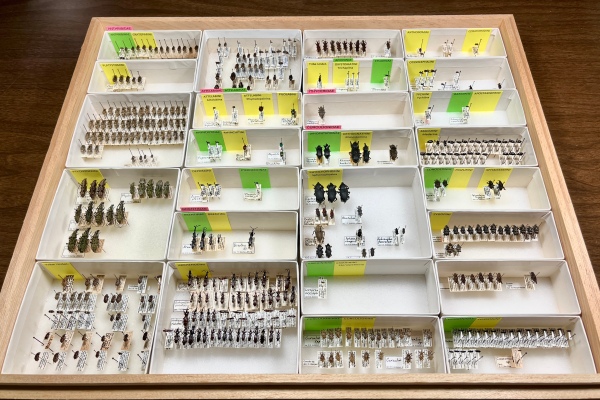
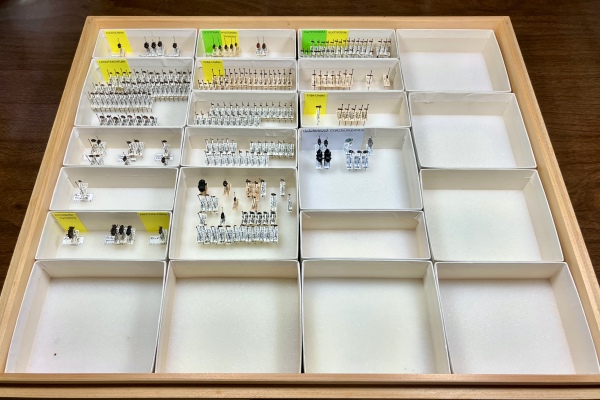
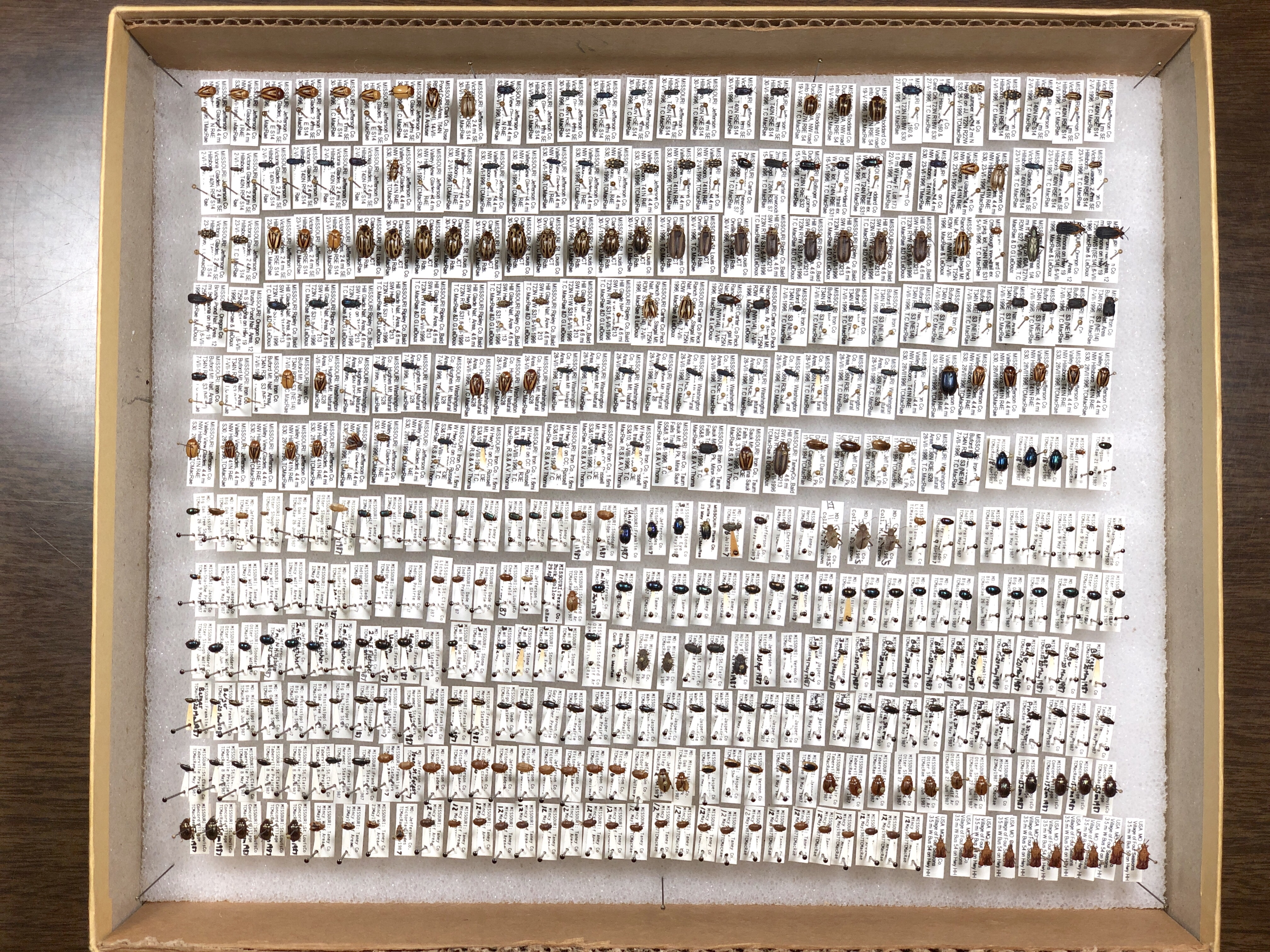
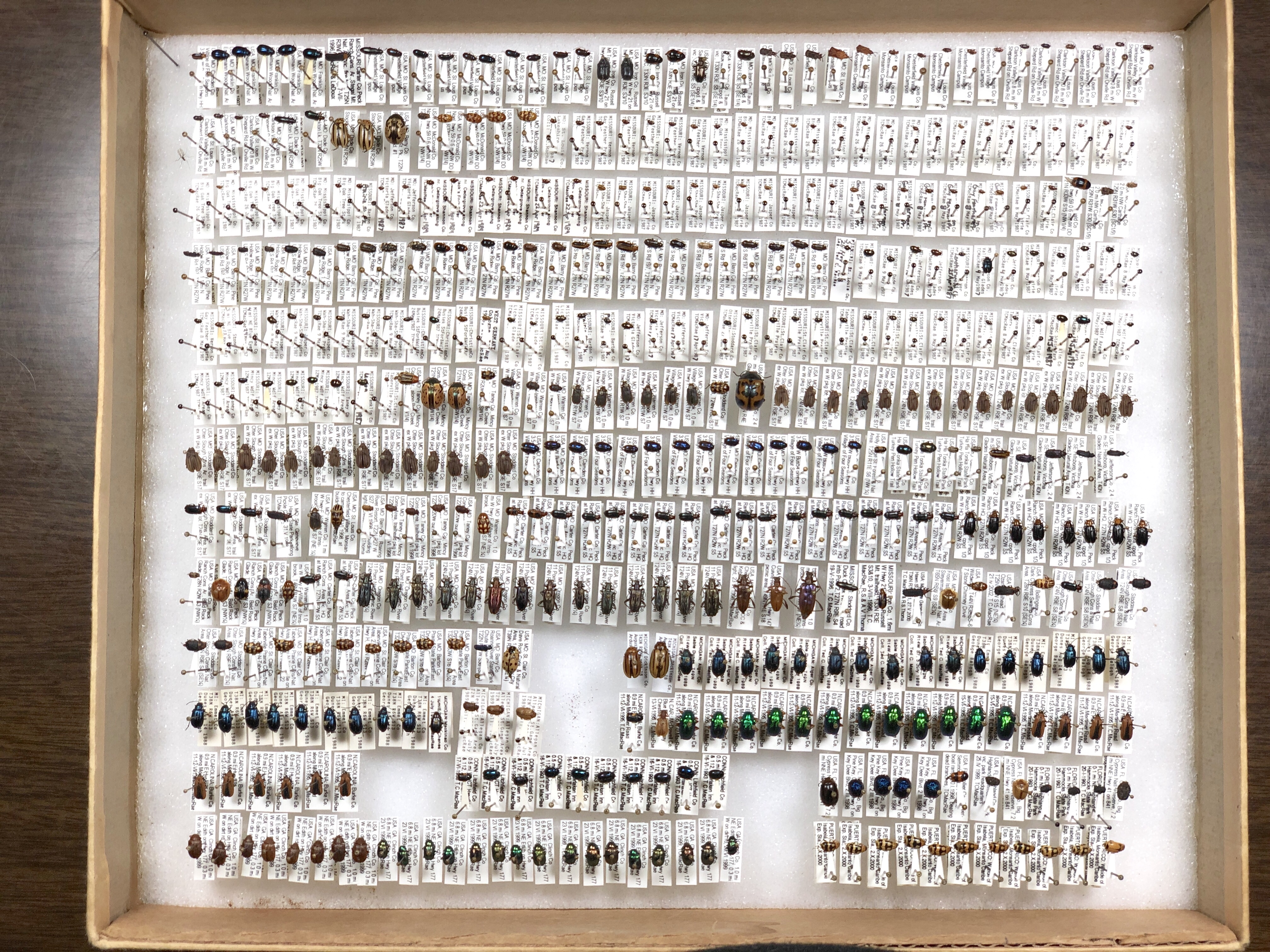
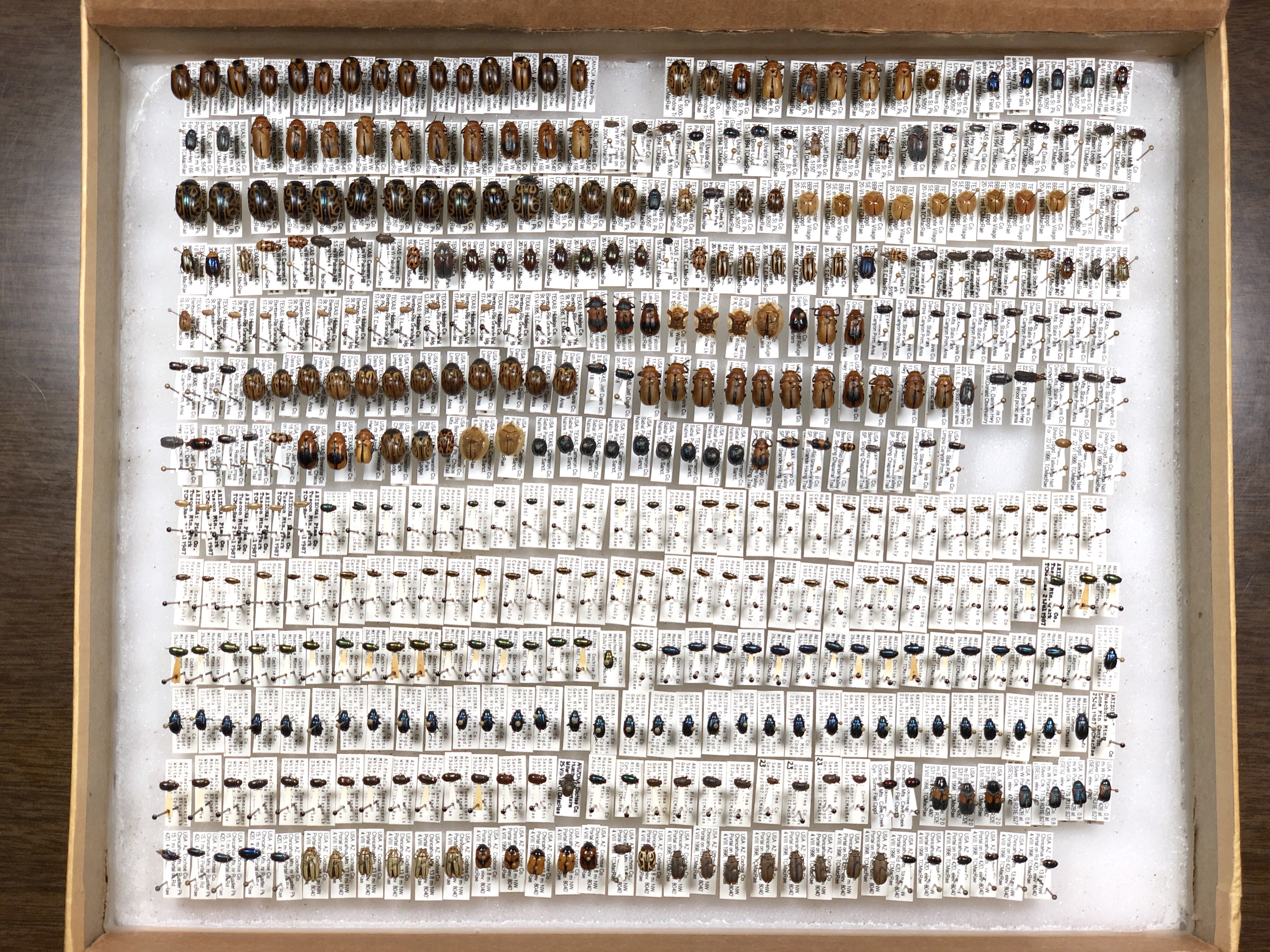
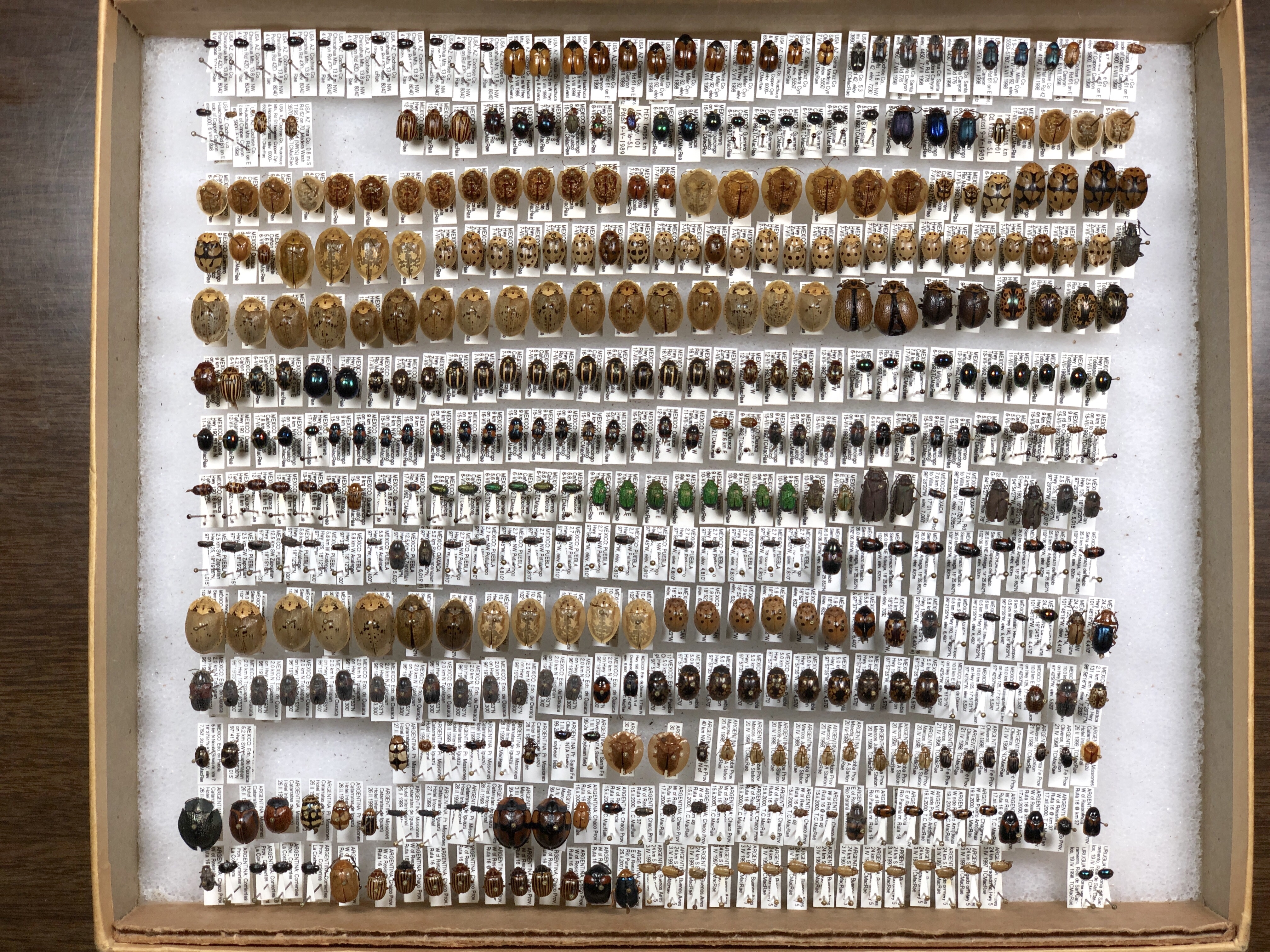
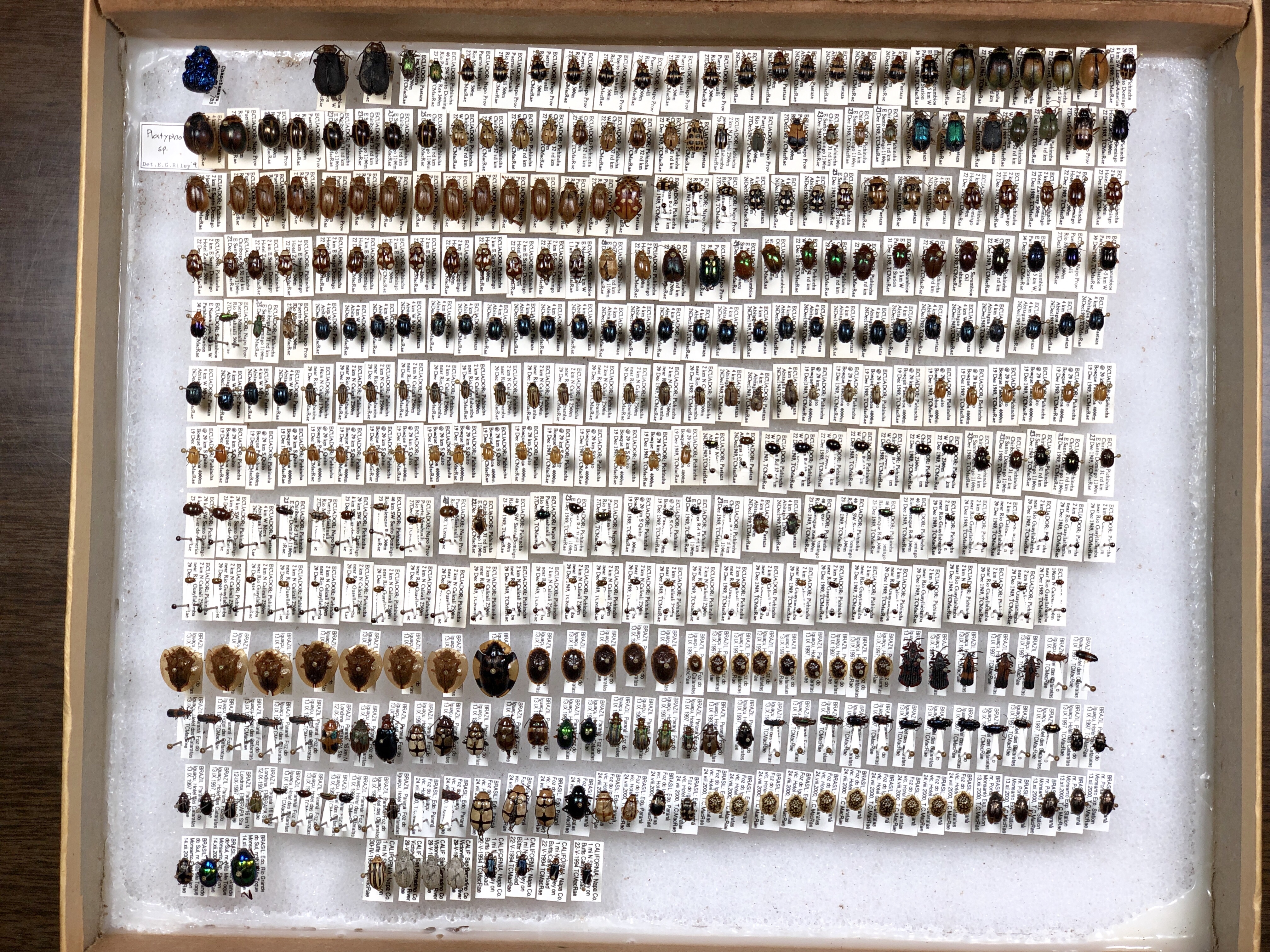
In recent years, I have begun making an effort to change that. Four+ decades of being a serious insect collector has given me the opportunity to establish relationships with entomologists whose specializations run the gamut. Each of them could make far greater use of the specimens I have collected in these other groups than I ever will, and I have begun reaching out to them offering access. The photos shown here represent one such group—the leaf beetles (family Chrysomelidae). It has been more than 30 years since anybody specializing in this group has looked at the specimens I’ve collected, and in that time I’ve not only collected numerous specimens from my home state of Missouri but also from extensive collecting trips across the U.S., Mexico, South America, and even Africa—enough to fill six Schmidt-sized boxes! Surely, within this amount of material, there are specimens representing significant records or possibly even new species and just waiting for a discerning eye to spot them. Shawn Clark at Brigham Young University graciously identified the specimens in these boxes, and in return for his efforts he was allowed to retain anything of interest to his research.
A similar situation exists for other groups of insects that I have accumulated a wealth of specimens over the past several decades: click beetles (family Elateridae), currently being examined by Paul Johnson at South Dakota State University; darkling beetles (family Tenebrionidae), currently being examined by Aaron Smith at Purdue University; and weevils (family Curculionidae), currently being examined by Robert Anderson at the Canadian National Collection.
It should be noted that, eventually, my entire collection will end up in a public research collection, where it will be accessible at any time to any researcher. Nevertheless, I still take satisfaction in knowing that I don’t have to die before significant specimens in my collection belonging to groups that I don’t study can come to light.
Chrysomelidae Box 1—Missouri 1.
Chrysomelidae Box #2—Missouri 2, Michigan, Connecticut, North Carolina, Georgia.





 Beetles In The Bush