Bichos Argentinos #7 – Naupactus xanthographus

Naupactus xanthographus (South American fruit tree weevil) | Buenos Aires, Argentina

This weevil (family Curculionidae) was one of just a few beetle species that I encountered earlier this month in Buenos Aires, Argentina at La Reserva Ecológica Costanera Sur.  Weevils are, of course, one of the most taxonomically diverse and difficult groups of Coleoptera, making species IDs based purely on photographs quite challenging.  Nevertheless, I am reasonably confident that this individual represents Naupactus xanthographus, or the South American fruit tree weevil.  This name, it seems, has also been applied to a variety of other weevils photographed in South America and posted on the web, but the images I found at a few seemingly more authoratative sites give me confidence that this is the true N. xanthographus.  The narrow form suggests this individual is a male.

The genus, known collectively as “white-fringed weevils” is a large genus of exclusively Neotropical species – several of which have been introduced to North America (e.g., N. cervinus, Fuller rose beetle, and N. leucoloma) and which were, until recently, placed in a separate genus Graphognathus (Lanteri and Marvaldi 1995) (apparently the reduced humeri and lack of metathoracic wings were deemed insufficient for generic distinction).  In South America some of the species have become pests as well, with N. xanthographus becoming a problem for growers of grapes and other fruits and, thus, earning the names “burrito de la vid” (Chile) and “mulita de la vid” (Argentina) (both roughly translating to “grapevine little donkey”).

This was not an easy photograph to get – I found the weevil clinging to the underside of a leaf above my head.  It was impossible to photograph it in situ, so I moved it to a low twig away from other foliage where I could get the black background I desired.  Once moved, however, the weevil just never… stopped… crawling.  Snapping shots of an actively crawling insect is a crap shoot at best – not only are focus and framing more difficult to nail, but subjects photographed while moving almost always have one or two “bum” legs (lifted or cocked out of position).  A number of attempts were required to get a photo I was happy with (save for the slightly clipped antennal tip).  In such situations, I’ve found it best to track the beetle as it moves and as soon as the center focus point of the lens flashes take the shot.  This at least gives the best chance for nailing the focus, and then it’s simply a numbers game to get a shot with good framing and composition and all the body parts well placed.  Of course, I could’ve zoomed out and just cropped to perfection, but this feels a little like cheating – I’d rather put in the time and practice perfecting my game out in the field as much as possible.  An occasional clipped antenna, tarsus, etc. now will lead to better results down the line.

REFERENCE:

Lanteri, A. A. and A. E. Marvaldi. 1995. Graphognathus Buchanan a new synonym of Naupactus Dejean and systematics of the N. leucoloma species group (Coleoptera: Curculionidae). Coleopterists Bulletin 49(3): 206-228.

Bichos Argentinos #5 – Cyrtocoris egeris

Cyrtocoris egeris | 15 km S Reconquista, Pcia. Santa Fe, Argentina

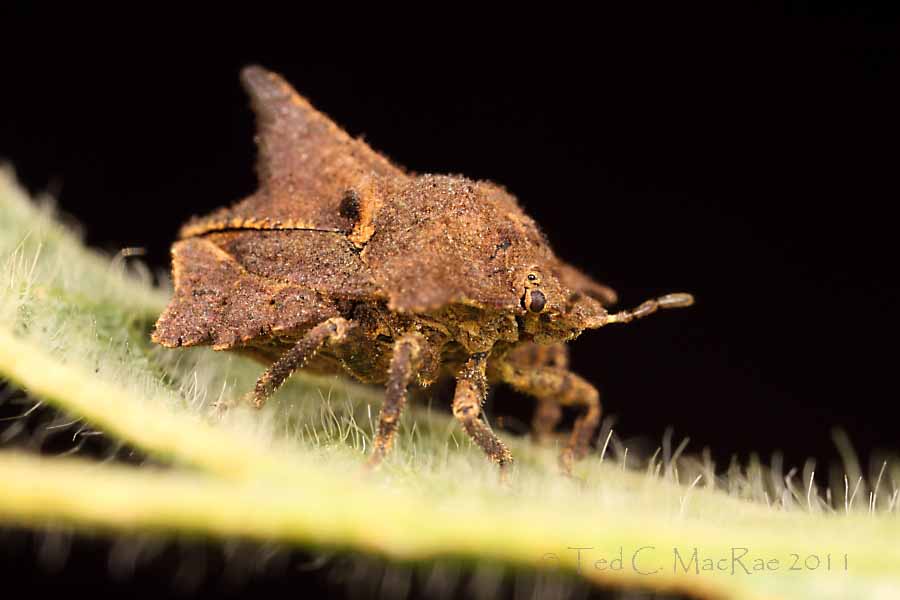
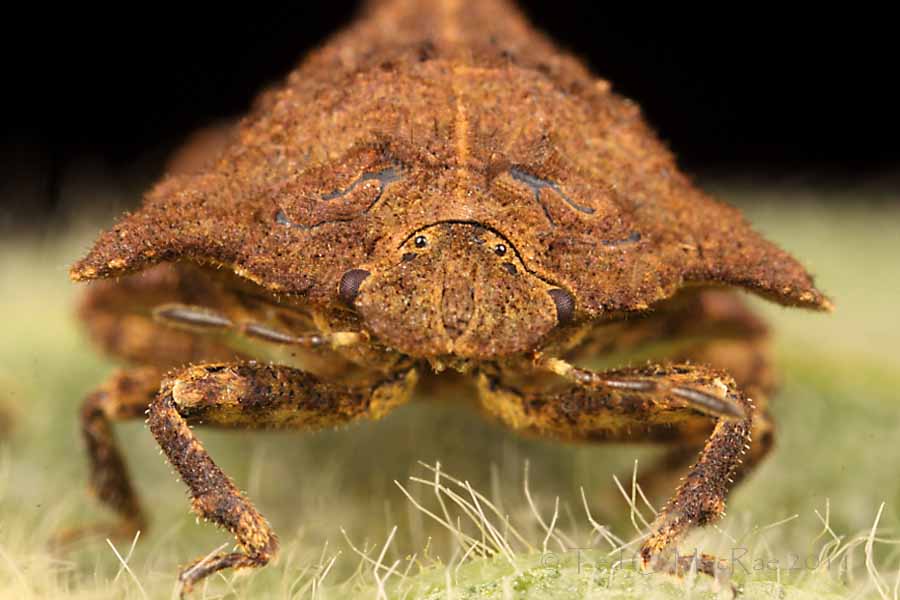
Despite its obvious membership in the order Hemiptera, I knew the insect featured in ID Challenge #7 would be a difficult subject to identify.  This bizarre bug is Cyrtocoris egeris, a member of the small pentatmoid family Cytocoridae (congratulations to HBG Dave, who was the only commenter to correctly identify not only the family, but the genus).  While their relationship to Pentatomidae (stink bugs) and Scutellaridae (shield-backed bugs) is obvious, hemipterist-great Carl Schaefer thinks these insects might actually be most closely related to the Cydnidae (burrowing bugs).  I encountered this individual a couple of weeks ago in a soybean field in Santa Fe Province, Argentina.  Now, I have to be honest here – I did not figure this one out on my own. Instead, I assumed it must be some bizarre member of the Pentatomidae or Scutellaridae, and it was only after my repeated searches in either of those two families failed to turn up anything promising did I throw up my hands and call for hired help. This time it was USDA Research Entomologist Don Thomas, a pentatomid specialist (and former co-alumnus at the University of Missouri) who responded to my query with a genus-level ID. Once I had that bit of information in hand I was able to locate the recent revision of the family (Packhauskas and Schaefer 1998) and identify the species.

Looks stink bugish enough in this head on view...

In addition to the expanded scutellum bearing a broad-based spine or hump, members of this exclusively Neotropical family are characterized by flattened expansions of the anterior part of the head, the covering of flattened scalelike setae, and a mediodistal tubercle on at least the foretibiae. Packauskas and Schaefer (1998) recognize only three genera and 11 species in the family, its members occurring from Argentina north through central Mexico.

...but there's some crazy stuff going on at the back end.

My ID as C. egeris is based on the very well-developed scutellar crest and my interpretation of the humeral projections not extending forward of the anterior angles next to the head. Packauskas and Schaefer (1998) recorded this wide-ranging species from Mexico to Argentina, with the southernmost specimens in extreme northeastern Argentina (Pcia. Missiones), but Schaefer et al. (2005) later recorded it from Reconquista – also on soybean. Cyrtocoris gibber is very similar to C. egeris and is also widespread from Costa Rica to Argentina (and also with the southernmost record in Pcia. Missiones, Argentina), but in that species the humeral expansions project forward nearly as far as the anterior angles of pronotum (strongly surpassing a line drawn through the bases of these angles).  Besides soybean for C. egeris, the only other host records I am aware of for any species in the family are by Costa Lima (1940), who reported C. gibbus on the branches of Mimosa scabrella (Leguminosae), and Schaeffer et al. (2005), who reported C. tigrinus on Sida rhombifolia (Malvaceae) (although nymphs could not be reared to adulthood on this plant).

REFERENCES:

Costa Lima, A. 1940. Insetos do Brasil. 2° Tomo, Capitulo XXII. Hemipteros. Escola Nacional do Agronomia, Rio de Janeiro.

Packauskas, R. J. and C. W. Schaefer. 1998.  Revision of the Cyrtocoridae (Hemiptera: Pentatomoidea).  Annals of the Entomological Society of America 91(4):363–386;

Schaefer, C. W., A. R. Panizzi and M. C. Coscarón. 2005.  New records of plants fed upon by the uncommon heteropterans Cyrtocoris egeris Packauskas & Schaefer and C. trigonus (Germar) (Hemiptera: Cyrtocoridae) in South America.  Neotropical Entomology 34(1):127-129.


ID Challenge #7

I hadn’t planned on doing another ID Challenge so quickly after the previous one¹; however, this critter is just too cool to keep in my pocket any longer.  Order-level identification shouldn’t be too much of a challenge, but I’ll be impressed with anyone who drills down much deeper than that – 2 pts each for correct order-, family-, genus-, and species-level identifications.  What the heck – I’ll go ahead and throw in superfamily as a points-earner as well.  Supporting information for your IDs will help your cause, and we all know my predilection for handing out bonus points on the most subjective of bases.  As always, standard ID Challenge rules apply.

¹ For those of you wondering about the recent flurry of posts, I’m on a well-earned vacation right now and have pledged to fritter away as much time on idle pursuits as possible rather than fret about accomplishing anything constructive.

Copyright © Ted C. MacRae 2011

A thrips is a thrips…

Caliothrips phaseoli (bean thrips) - adults | Fontezuela, Pcia. Buenos Aires, Argentina

The critter in ID Challenge #6 is, as most surmised, a thrips¹, and although the black-and-white banding of the elytra make the predaceous “banded thrips” (Aeolothrips sp. of the family Aeolothripidae) a logical ID choice, the species in the photograph is actually the phytophagous “bean thrips” (Caliothrips phaseoli of the family Thripidae).  The individuals in that photo and the additional photos shown here were encountered in several soybean fields during my visit to Argentina last week.  The species seems to be having a bit of a population surge on soybeans in the Humid Pampas – Argentina’s main soybean growing region – due to the dry conditions they’ve had as of late.  Their short life cycle (egg to egg in 2 weeks) and preference for generally protected lower leaf surfaces, along with the lack of any registered chemical insecticides labeled for their use on soybean, makes control of this insects especially problematic.

¹ Yes, that’s “a thrips” – not “a thrip” (similar to deer, species, sheep, etc.).  Personally, I’ve always had trouble with singular use of this definitely plural-looking word – it must be the “s” at the end and the completely natural sound of the word “thrip” in singular use.  Then again, one “specie” doesn’t sound right, so who knows?  At any rate, I’ve managed to force myself to say “a thrips” (although I still wince a little bit inside whenever I do).

Caliothrips phaseoli (bean thrips) - nymphs | Oliveros, Pcia. Santa Fe, Argentina

Thrips are tiny – the adults in the above photo (only slightly cropped) measure no more than ~1 mm in length, testing the limits even of my MP-E 65mm 1-5X macro lens at full magnification.  There are some interesting features about the morphology and life history of thrips – namely their “rasping-sucking” mouthparts and life history that seems somewhat intermediate between the incomplete metamorphosis exhibited by other exopterygote insects (egg, nymph, adult) and the complete metamorphosis of the endopterygotes (egg, larva, pupa, adult).  Thrips actually have only a single mandible (the other aborting development during embryogenesis), which they use to “rasp” a hole into the plant tissues upon which they feed.  The remaining mouthparts then form a sort of siphon, that is used to imbibe the liquids that accumulate within the hole.  This seems to represent – at least functionally – an intermediate step in the evolution of the true piercing/sucking mouthparts exhibited by other hemipteroid insects.  Life history-wise, only the first- and second-instar nymphs (2nd photo above) feed, the third- and fourth-instars becoming quiescent stages termed the propupa and the pupa, respectively.

Reader question: I presume the shiny, black globs on the hairs of the plant are fecal deposits, but why are they placed as such? Does it help avoid spoilage of the leaf feeding surface – I’m not aware of any other insects that are so fastidious (except perhaps ants). Maybe there is a defensive function? I’ve searched and found nothing about this, so please let me know if you have any insight.

There seems to be some difference of opinion regarding the actual species name for these insects.  Most applied economic literature dealing with thrips in soybeans calls these Caliothrips phaseoli – a widespread species occurring in North, Central, and South America.  However, a number of references (both economic and taxonomic) recognize South American populations as a distinct species, C. brasiliensis (or C. braziliensis, depending on the source), based on the solid dark rather than medially lightened elytral band.  I also found some references that seem to regard C. phaseoli as s a synonym of C. fasciatus (although this comparison at Pests and Diseases Image Library seems to show distinct differences in abdominal sculpturing between the two species).  I’m going with C. phaseoli over C. brasiliensis based on a checklist of Brazil Thysanoptera (Monteiro 2001) and the Argentina checklist at the World Thysanoptera website, and the general lack of mention of C. fasciatus as a pest of soybean in Argentina in the literature also makes me go with C. phaseoli.  Congratulations to Ben Coulter, who wins this challenge with a clean sweep of the ID and host plant, and to HBG Dave, whose 4 pts moves him into the lead in the current BitB Challenge session.
 
REFERENCE:

Monteiro RC. 2001. The Thysanoptera fauna of Brazil. Pp. 325–340 in Marullo, R. & Mound, L.A. (eds) Thrips and Tospoviruses: Proceedings of the 7th International Symposium on Thysanoptera. Australian National Insect Collection, Canberra.

Copyright © Ted C. MacRae 2011

ID Challenge #6

It’s been awhile since our last ID Challenge.  I’ll give 2 pts each for correctly naming the order, family, genus, and species and whatever supporting information you can provide.  Bonus points if you can surmise host plant, location, etc.  Standard ID Challenge rules apply.  No trick questions this time – it’s just about the bug!

Copyright © Ted C. MacRae 2011

Brazil Bugs #16 – Outro Percevejo

Proxys sp. | Barão Geraldo, Campinas, Brazil

Another stink bug (family Pentatomidae) from my recent travels to South America, but this one from southeastern Brazil rather than Argentina.  Although the white spot at the apex of the scutellum is a common theme across the family, the jet black coloration and strongly acute clypeus (“nose”) immediately reminded me of Proxys punctulatus from eastern North America. Although that species does also occur south through Mexico and Central America into northern South America, the lack of distinctively black femoral apices (“knees”) on this individual suggest it is likely a different species.  I’ve not found much information on other species in this genus, as my old standby Flickr repeatedly proffers images of P. punctulatus in its Pentatomidae pages but not other species in the genus.  Grazla and Campos (2010) list P. hastator from “Cayenna” (likely French Guiana) and P. victor from “Brésil,” and an illustration of the latter in the monumental Biologia Centrali-Americana (Distant 1880-1893) agrees reasonably well (but not completely) with this individual.  For now, this will have to stand as Proxys sp.

REFERENCES:

Distant, W. L.  1880-1893.  Biologica Centrali-Americana. Insecta. Rhynchota. Hemiptera-Heteroptera. Volume I.  London: published for the editors by R. H. Porter, 462 pp.

Grazia, J. and L. A. Campos. 2010. Neotropical Pentatomidae (Insecta: Hemiptera: Heteroptera) of the collection of Massimiliano Spinola preserved in the “Museo Regionale de Scienze Naturali”, Turin, Italy. ZOOLOGIA 27(3):413–424.

Copyright © Ted C. MacRae 2011

Bichos Argentinos #4 – Balancing Act

Nezara viridula (southern green stink bug) | Pergamino, Pcia. Buenos Aires, Argentina

I encountered this adult Nezara viridula (southern green stink bug) (Hemiptera: Pentatomidae) in a soybean field in Buenos Aires Province, Argentina.  I liked the way it balanced itself on the leaf on which it was sitting to keep its body level.

Copyright © Ted C. MacRae 2011

Bichos Argentinos #3 – “Bicho Torito”

Diloboderus abderus, male | Buenos Aires, Argentina

In her appeal for submissions for her upcoming issue of An Inordinate Fondness, Susannah lamented the paucity of beetles in the closing weeks of her northern winter and mentioned in passing that even I had gone more than a week without posting about this great order.  I hadn’t realized that myself, so here I present Diloboderus abderus, one of the beetles that I encountered during my visit last weekend to La Reserva Ecológica Costanera Sur in Buenos Aires, Argentina.  This species, known commonly in Argentina as bicho torito (“little bull bug”) is common enough in Argentina and southern Brazil, where its white grub larvae have become somewhat of a pest in lawns, pastures, and grass crops such as wheat by way of feeding on the roots.  I first encountered this species during one of my previous trips to Argentina, where during a rain storm I saw literally hundreds of adults emerging from mowed grass medians in the city streets of Pergamino.  These photographs show two of numerous dead individuals that I found laying on the ground of similar medians just outside the reserve.  As with many scarab beetles in the subfamily Dynastinae (containing also the recently featured Dynastes tityus), males (above) are armed with pronotal and cephalic horns – presumably for use in sexual combat – while females (below) are unarmed.

Diloboderus abderus, female | Buenos Aires, Argentina

Copyright © Ted C. MacRae 2011