Flaming the debate

Eastern redcedar encroaching loess hilltop prairie, a critically imperiled natural community in Missouri.

ResearchBlogging.orgAs my interest in prairie insects has increased over the past few years, so has my interest in their conservation. Many insects are restricted to prairies through dependence upon prairie plants or their unique physical and trophic characteristics. Thus, preservation of not only prairie plants but their insect associates as well is a major goal of conservationists.  The task is daunting – for example only ~1% of tallgrass prairie remains in the central U.S., the rest long ago converted to agriculture or otherwise irreparably altered.  Prairies are dynamic natural communities that rely upon disturbance – this need to “disturb to preserve” creates an oxymoronic conundrum for restoration ecologists that is made even more difficult by the fragmented nature of today’s prairie landscape.  The situation here in Missouri is even more difficult, as nearly all of our grassland preserves (tallgrass prairie, sand prairie, loess hilltop prairie and glades) are exceedingly small and highly disjunct relicts not connected as parts of larger systems.

In recent years, prescribed burning has become the management tactic of choice for restoring and maintaining grassland preserves.  There are good reasons for this – not only are increased floral diversity and reversal of woody encroachment well-documented responses to fire, but burning is also highly cost-effective (a critical consideration in today’s climate of shrinking public budgets).  As the use of prescribed burning on grassland preserves has become widely adopted, however, concerns about the impacts of fire on invertebrate populations have been raised.  The subject is now an area of intense research, but studies are hampered by the limited availability of large, long-unburned tracts of native prairie, and no scientific consensus has yet emerged.  Regrettably, the debate has polarized into “pro-” and “anti-fire” camps that seem unable to communicate with each other constructively.  This is unfortunate, since both ends of the spectrum offer ideas that could be used to achieve the goal of preserving prairie remnants while mitigating concerns about invertebrate impacts.  I have previously expressed my own views on the subject, a position that I suspect some might mistakenly characterize as “anti-fire.”  While I do support the use of prescribed burning, I do not support its use with no consideration of other prairie management strategies such as haying and light grazing (not to be confused with the heavy, abusive, unmanaged kind of grazing that has degraded so much of our landscape).  All of these tools (as well as parcels that receive no management at all) have potential value in prairie management and should be considered.

Those interested in potential fire impacts on prairie invertebrates will be interested in this latest salvo by Scott Swengel and colleagues, who used metadata analysis to correlate declines of prairie butterflies in the Midwest with the widespread adoption of prescribed burning as a management tactic.  The authors present convincing evidence that tallgrass prairie butterfly populations are not co-evolved with fire regimes currently used for prairie management, although their conclusions will no doubt be challenged.  Nevertheless, until a firmer scientific consensus can be achieved, prudence should dictate some measure of caution in the use of fire as an exclusive prairie management tactic.

Dear Colleagues:

We are pleased to announce a new article by Scott Swengel, Dennis Schlicht, Frank Olsen, and Ann Swengel, based on long-term data that has just been published online,  Declines of prairie butterflies in the midwestern USA.  This paper is available free from Springer Open Choice at http://www.springerlink.com/content/l732444592662434/fulltext.pdf or by going to the Journal of  Insect Conservation Online First section and scanning through the articles in ascending number order until getting to articles posted 13 August 2010.

The trends of tallgrass prairie skippers shown here, although disastrous, underestimate the decline in Iowa and Minnesota for several reasons:

  1. In statistical testing we only include sites with adequate data for testing, which eliminates many sites from inclusion that had 100% declines of a specialist we know about.
  2. Nearly all sites with long time series were the top sites to begin with, which are likely to take a longer time to show large declines than medium or low-quality sites.
  3. Recent government sponsored surveys not included here show another round of huge declines for Poweshiek Skipperling in Iowa and Minnesota.
  4. Some species went undetectable by the late 1980s and early 1990s, so didn’t register as a presence when the study began.  Hence, they cannot show a decline since then.

Some good news is that conservation based on existing knowledge of specialists’ management responses gets far better results (as shown by Regal Fritillaries and Karner Blues in Wisconsin than typical management.  So declines like this are not inevitable.

The Ecological Interpretations and Conservation Conclusion section of Discussion contain some of our new insights explaining the observed about land-use effects on prairies and butterflies.

Scott Swengel

My thanks to Scott Swengel for giving me permission to reprint his introduction.

REFERENCE:

Swengel, S. R., D. Schlicht, F. Olsen & A. B. Swengel. 2010. Declines of prairie butterflies in the midwestern USA Journal of Insect Conservation: DOI 10.1007/s10841-010-9323-1.

Copyright © Ted C. MacRae 2010
Trichodes bibalteatus in Oklahoma

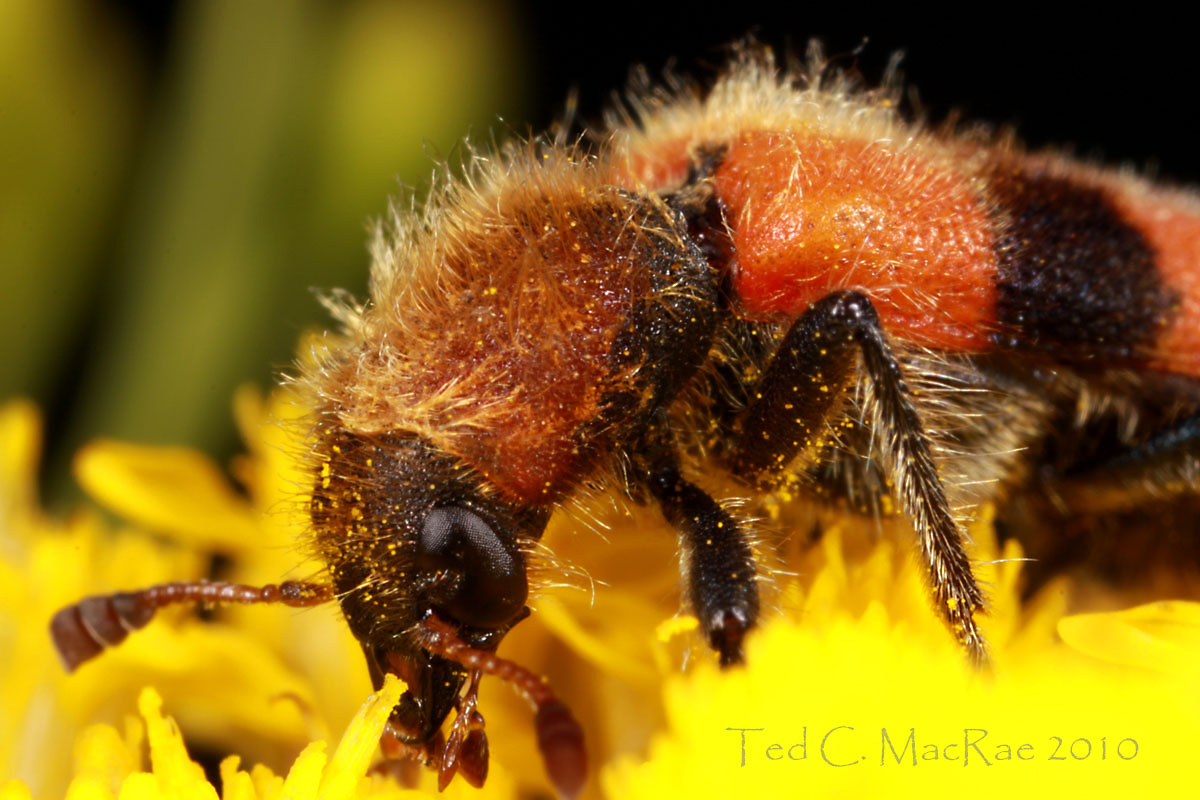
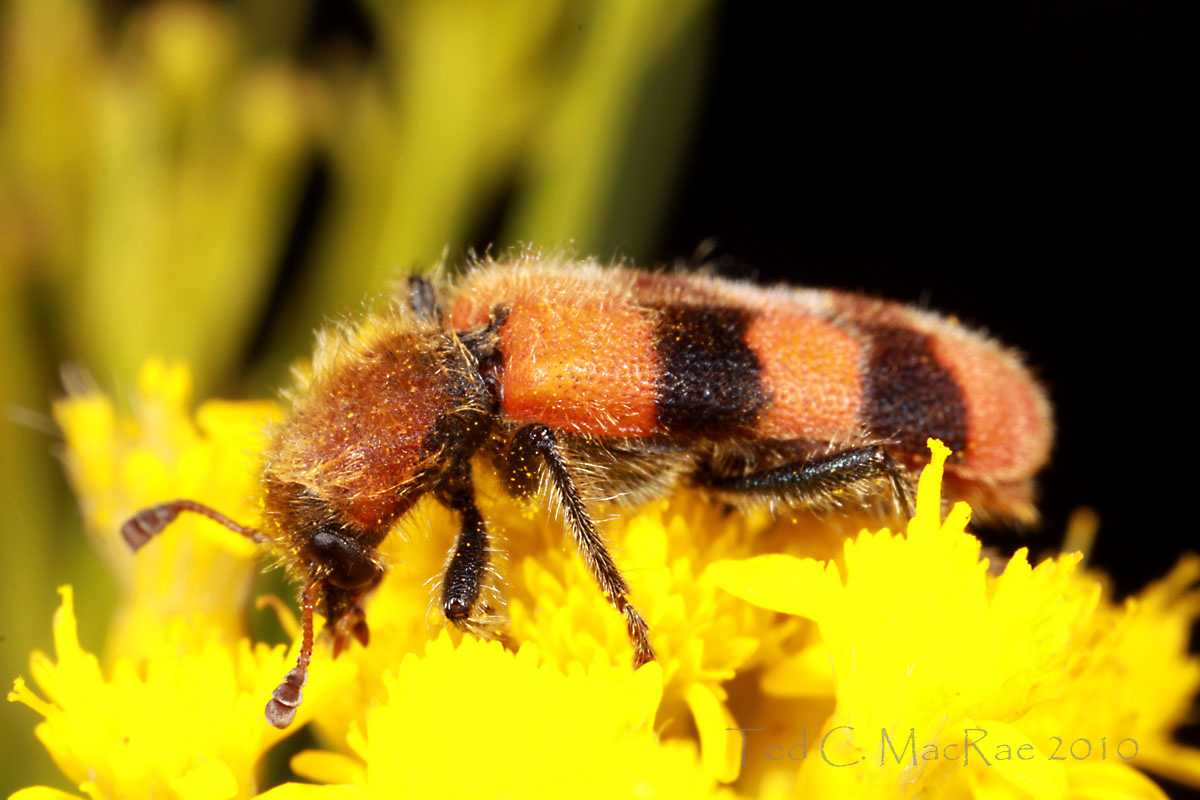
Among checkered beetles (family Cleridae), the genus Trichodes contains among the largest and most strikingly-colored species.  The 11 North American species of this predominantly Holarctic genus are primarily western in distribution, although two species (T. nuttalli and T. apivorus) do occur in the eastern U.S.  The individual in these photos was one of several I encountered feeding on the flowers of a yellow composite in the Gloss Mountains of northwestern Oklahoma during early July.  I take them to represent the species T. bibalteatus based on their close resemblance to the holotype of that species from the LeConte Collection in the Museum of Comparative Zoology at Harvard University.  While these photographs are admittedly far from perfect, they were about the best I could manage at the time considering the gusty post-storm winds that I encountered atop the mesa where these beetles were found (along with my continuing difficulty in achieving proper exposure with subjects on bright yellow flowers).

The striking colors of adult Trichodes and their frequent association with flowers for feeding and mating belies a more treacherous aspect of their life history.  While adults may serve as important pollinators of native plant species (Mawdsley 2004), they also lay their eggs on flowers.  The larvae that hatch from these eggs don’t eat the flower itself, but rather attach themselves to bees and wasps that visit the flower as they gather pollen for provisioning their own nests (Linsley & MacSwain 1943).  The larvae hitch a ride back to the hymenopteran’s nest, where they then prey on the developing brood and usurp pollen provisions for themselves.

Photo Details: Canon 50D w/ MP-E 65mm 1-5X macro lens (ISO 100, 1/250 sec, f/16), Canon MT-24EX flash (1/8 ratio) w/ Sto-Fen + GFPuffer diffusers. Typical post-processing (levels, minor cropping, unsharp mask).

REFERENCE:

Linsley, E. G. & J. W. MacSwain. 1943. Observations on the life history of Trichodes ornatus (Coleoptera, Cleridae), a larval predator in the nests of bees and wasps. Annals of the Entomological Society of America 36:589–601.

Mawdsley, J. R. 2004. Pollen transport by North American Trichodes Herbst (Coleoptera: Cleridae). Proceedings of the Entomological Society of Washington 106(1):199-201.

Copyright © Ted C. MacRae 2010

Clown beetle surprise

As I slowly scanned my flashlight through the darkness across the mixed-grass prairie in the Glass Mountains of northwestern Oklahoma last July, there was one thing that I hoped not to see (prairie rattlesnake, unless from afar) and one thing that I hoped more than anything to see (Great Plains giant tiger beetle, Amblycheila cylindriformis). Fortunately, I encountered none of the former and found several of the latter.  It took awhile before I saw the first one, but in the meantime I saw all too abundantly the clown beetle, Eleodes suturalis.  A member of the family Tenebrionidae, this species is one of the most conspicuous components of the Great Plains beetle fauna.  Adults are commonly encountered walking about the grasslands or crossing roads, especially after summer rains.  I recall my first encounter with this species when I made my first insect collecting trip to the Great Plains in 1986, marveling as I literally watched hundreds of individuals crossing a remote highway in southwestern Kansas.  Now, they were just an annoyance – close enough in size and appearance to the object of my search that I had to pause and look at each one I encountered to verify its identity.¹

¹ In fact, a mimetic association has been suggested for Amblycheila cylindriformis and Eleodes suturalis due to their similarity in size, shape and coloration (black with a reddish-brown sutural stripe) (Wrigley 2008).  This may be true, as Eleodes suturalis is an abundant species capable of defending itself with noxious sprays that contain benzoquinone and other hydrocarbons, while Amblycheila cylindriformis is a much rarer species (as mimics tend to be) that lacks defensive compounds.

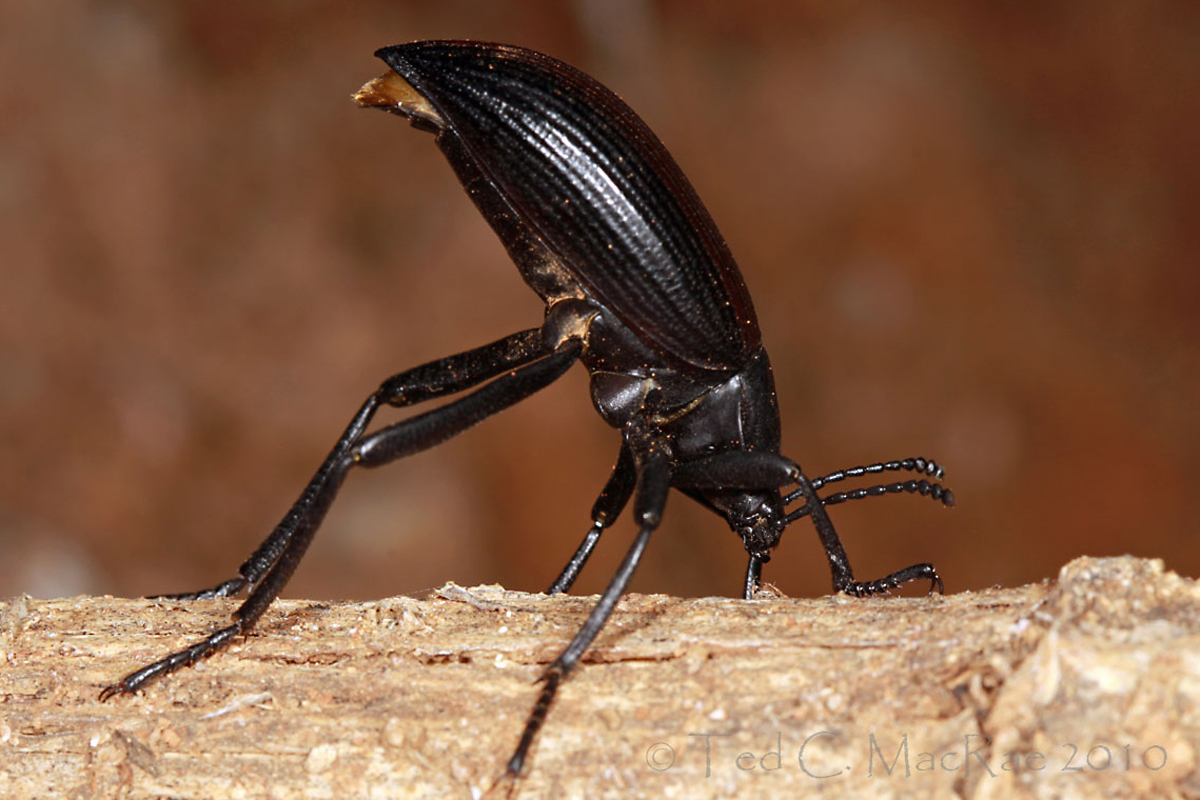
After finding a few of the Amblycheila, I encountered this particular individual clinging to a root sticking out of the side of a wash.  My closer look caused it to immediately assume its characteristic defensive headstand pose (from which the name ‘clown beetle’ comes), so I decided to take a few photographs (not an easy task at night).  The photos have been sitting on my hard drive since, but in examining them more closely, I realized that this particular beetle is not E. suturalis.  Rather, it is one of several similar appearing species that co-occur with E. suturalis in the Great Plains and sometimes resemble it due to their large size, sulcate elytra, and occasional presence of a similar reddish-brown sutural stripe.  From these species, E. suturalis is at once distinguished by its broadly explanate (flanged) pronotum and laterally carinate, distinctly flattened elytra.  This individual clearly exhibits more rounded elytra and as best as I can tell keys to E. hispilabris – distinguished from E. acuta and E. obscurus by possessing a normal first tarsal segment (not thickened apically) on the foreleg (Bennett 2008).  Presumably this and the other related species of Eleodes also possess chemical defenses similar to E. suturalis – an example of Müllerian mimicry where multiple species exhibit similar warning coloration or behavior (in this case headstanding) along with genuine anti-predation attributes.

Photo Details: Canon 50D (ISO 100, 1/250 sec, f/14), Canon 100mm macro lens, Canon MT-24EX flash (1/4 ratio) w/ Sto-Fen diffusers. Post-processing: levels, unsharp mask, slight cropping.

REFERENCES:

Bernett, A. 2008. The genus Eleodes Eschscholtz (Coleoptera: Tenebrionidae) of eastern Colorado. Journal of the Kansas Entomological Society 81(4):377–391.

Wrigley, R. A.  2008. Insect collecting in Mid-western USA, July 2007.  The Entomological Society of Manitoba Newsletter 35(2):5–9.

Copyright © Ted C. MacRae 2010

“A good photographer is invisible…”

Yesterday I shot down to the southeastern lowlands of Missouri to spend some quality time in the field with friend and fellow cicindelophile Kent Fothergill. We were primarily looking for migrants of the Ascendent Tiger Beetle (Cicindela trifasciata ascendens), a Gulf Coast species that doesn’t normally occur in Missouri but is well known for its vagility and late-season northward migrations and which has been seen in the state once before (Brown and MacRae 2005).  No such individuals were found, but no matter – the day was really about just getting out and enjoying the camaraderie.  Nevertheless, there were some successes.  We located burrows of 1st- and  2nd-instar larvae of the Ant-like Tiger Beetle (Cylindera cursitans) at a site along the Mississippi River where Rich Thoma and I found adults last year.  Previous attempts to rear this species from larva to adult have not succeeded (Brust et al. 2005), but I collected a number of larvae and transferred them to a rearing container anyway in hopes that the techniques I’ve developed for rearing the closely-related Swift Tiger Beetle (Cylindera celeripes) might work also with this species.  We also found the beast that I am photographing above – I’ll leave it to your imagination for now to figure out what it is.

In between stops there was plenty of time for discussion on subjects entomological and non.  One thing Kent knows a thing or two about is insect photography, and during a discussion about such he made an interesting comment. Beyond focus, exposure, and composition, he noted that good insect photographers have the ability to become invisible – i.e., they combine patience and persistence with knowledge of the subject’s behavior to make it forget about the big glass eye staring at them from 6 inches away and return to going about their business.  It brought some clarity to my mind about the things I’ve tried in my own attempts to photograph insects that really did not want to be photographed (and there have been many).  The point was emphasized when I came into the office this morning and found the above photograph in my email inbox – Kent had taken it yesterday while I was photographing the bug-to-be-named-later, and I was completely unaware that I was being photographed!  Yes, a good photographer is invisible…

REFERENCES:

Brown, C. R. and T. C. MacRae. 2005. Occurrence of Cicindela (Cicindelidia) trifasciata ascendens (Coleoptera: Cicindelidae) in Missouri. Cicindela 37(1–2):17–19.

Brust, M. L., W. W. Hoback, and C. B. Knisley. 2005. Biology, habitat preference, and larval description of Cicindela cursitans LeConte (Coleoptera: Carabidae: Cicindelinae). The Coleopterists Bulletin 59(3):379–390.

Copyright © Ted C. MacRae 2010

Add to FacebookAdd to DiggAdd to Del.icio.usAdd to StumbleuponAdd to RedditAdd to BlinklistAdd to TwitterAdd to TechnoratiAdd to Yahoo BuzzAdd to Newsvine

Email to a friend

Cicindela – A quarterly journal devoted to Cicindelidae

Being a cicindelophile (i.e., a tiger beetle enthusiast), I have on occasion highlighted articles published in the journal Cicindela (“A quarterly journal devoted to Cicindelidae”) (see previous post – also here, here and here).  This delightful little journal is the now 42-year old brainchild of Ronald L. Huber, among North America’s foremost experts of the group (and still serving as Managing Editor for the journal).  With Robert C. Graves and Richard Freitag also serving as Editors, the journal publishes four issues per year – each containing a variety of articles dealing with the taxonomy, biology, faunistics, and conservation of this captivating group.  More recent years have also seen the inclusion of color photographs.  For serious students of the group, the journal is an indispensable resource – its issues containing a significant portion of the recent tiger beetle taxonomic literature (indeed, I am fortunate to possess in my own library a complete and nicely bound set of this journal).  However, even those with only casual interest in the group can appreciate the journal’s informal, enthusiast-centric tone.  A remarkably longstanding labor-of-love, Ron himself lays out and delivers each issue to the printer, then mails copies to the journal’s few hundred subscribers.

One thing that the journal has lacked is a web presence.  This has becomes all too clear with each article that I’ve featured, each prompting requests for subscription information by readers whose interest in the journal was piqued but were then unable to find such information on the web.  All of that is about to change – with Ron’s permission, the journal’s editorial policy and subscription information are being reproduced here to make them more widely available to those who might wish to contribute or subscribe.  The cost of the journal is nominal (only $10 in the U.S.), so even the most casually interested person should be able to justify a subscription.

Editorial Policy

Manuscripts dealing with any aspect of the study of Cicindelidae will be considered from any author.  All manuscripts should be submitted to the Managing Editor via email or on diskette [see inside back cover for conventions and format].  Papers dealing with areas other than the Nearctic are especially solicited but should be in English.  Translations are also very welcome.  All manuscripts will be acknowledged upon receipt.  Proofs-for-correction will be emailed to authors for quality control.  Illustrations, charts, graphs, etc., are encouraged.  Authors that have institutional support or other funds available for publication purposes are importuned to arrange for at least partial payment of publication costs.  Current page charges are shown inside the back cover.

Subscriptions

The subscription price for each annual volume of four numbers is currently $10.00 (domestic) and $13.00 outside the U.S.  All subscriptions begin with the first issue of the year.  Back issues of prior volumes, if still available, are priced according to age.  Inquire for prices.  All requests for subscriptions and back issue availability should be addressed to the Managing Editor: Ronald L. Huber, 2521 Jones Place West, Bloomington, Minnesota 55431-2837, U.S.A.

My appreciation to Ron for allowing me to post this information, and also to Ken Allen, for permitting me to reproduce the cover of the latest issue of Cicindela, graced with a gorgeous variant of Cicindela longilabris that he photographed in Glacer National Park.

Copyright © Ted C. MacRae 2010

Add to FacebookAdd to DiggAdd to Del.icio.usAdd to StumbleuponAdd to RedditAdd to BlinklistAdd to TwitterAdd to TechnoratiAdd to Yahoo BuzzAdd to Newsvine

Email to a friend

Bruneau Sand Dune tiger beetles caught in the act!

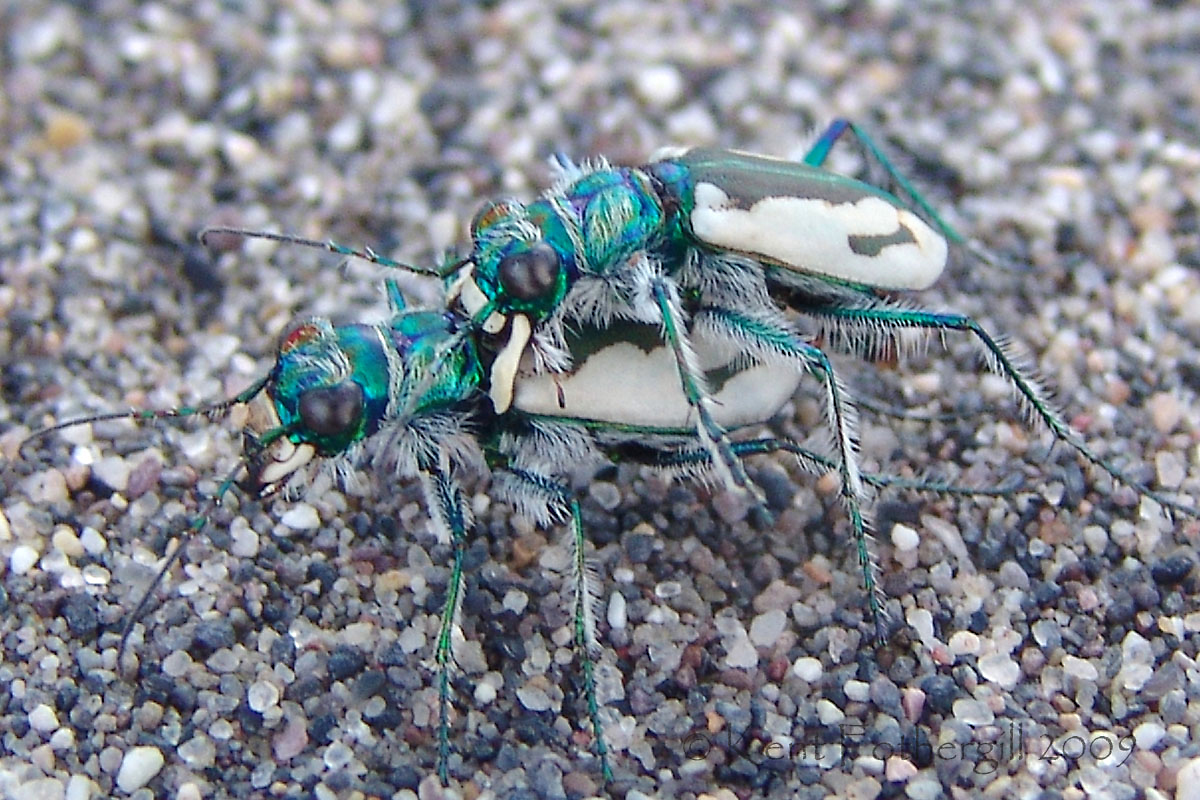
ResearchBlogging.orgThe newest issue of CICINDELA (“A quarterly journal devoted to Cicindelidae”) contains an interesting article by my good friend and fellow tiger beetle enthusiast Kent Fothergill, who presents a fascinating sequence of photos documenting a field encounter with a mating pair of the endangered Bruneau Sand Dune tiger beetle (Cicindela waynei) (Fothergill 2010).  This is one of several tiger beetle species in the C. maritima species group that inhabit sand dunes in central and western North America – others include the Coral Pink Sand Dune tiger beetle (C. albissima), the St. Anthony Sand Dune tiger beetle (C. arenicola), the Colorado dune tiger beetle (C. theatina), and the sandy tiger beetle (C. limbata).  With the exception of the latter, these species show highly restricted distributions in their preferred sand dune habitats, and because their populations are so small they are especially vulnerable to drought and ever-increasing anthropogenic pressures (i.e., invasive plants, motorized vehicular traffic, overzealous collectors).  While the Bruneau Sand Dune tiger beetle has not been accorded status on the Endangered Species List, the Idaho Department of Fish and Game and the Bureau of Land Management have classified it as globally imperiled.

Bruneau Sand Dune tiger beetle, Bruneau Sand Dune State Park, Idaho. Photo © Kent Fothergill 2009.

Kent was observing these beetles in Bruneau Dune State Park in southwestern Idaho – the main habitat for this species – when he encountered several pairs of C. waynei in the process of mating.  Photographs were taken of one mating pair, revealing a fascinating sequence of behaviors that included vigorous but unsuccessful attempts by the female to dislodge the male, eversion and penetration of the female by the male aedeagus, and subsequent mate guarding (see photo above).  It is, in fact, this latter behavior that is most often observed among tiger beetle mating pairs and not actual mating itself, which is only rarely observed.  Kent noted the uniquely modified male mandibles (see photo below) and their possible role in preventing the male from being dislodged during the female’s initial protestations.

Male Bruneau Sand Dune tiger beetles sport impressive choppers! Photo © Kent Fothergill 2009.

This apparently is the first documented report of mating in this species, and its occurrence in May is considerably later in the season than Baker et al. (1997) speculated – significant because protection of 1st instar larvae is a management priority for conservation of this species.  The potential occurrence of 1st instars during a longer period of time is an important consideration for continued management of this species, as the Bruneau Sand Dune population continues to show evidence of decline despite the prohibition of insect collecting, cattle grazing, and off-road vehicles within the park (Bosworth et al. 2010).  Human trampling and pesticide applications to adjacent rangelands are continuing threats that have proven more difficult to manage.

My sincerest thanks to Kent Fothergill for presenting me the opportunity to review his manuscript prior to publication and allowing me to reproduce here two of his spectacular photographs of this gorgeous and rare species.

REFERENCES:

Baker, C. W., J. C. Munger, K. C. Cornwall and S. Staufer.  1997. Bruneau Dunes tiger beetle study 1994 and 1995.  Idaho Bureau of Land Management, Technical Bulletin 97-7, 52 pp.

Bosworth, W. R., S. J. Romin and T. Weekley.  2010. Bruneau Dunes tiger beetle assessment.  Idaho Department of Fish and Game, Boise, Idaho, 36 pp.

Fothergill, K.  2010. Observations on mating behavior of the Bruneau Dune tiger beetle, Cicindela waynei Leffler (Coleoptera: Carabidae: Cicindelinae).  CICINDELA 42(2):33–45, 7 color plates.

Copyright © Ted C. MacRae 2010

Add to FacebookAdd to DiggAdd to Del.icio.usAdd to StumbleuponAdd to RedditAdd to BlinklistAdd to TwitterAdd to TechnoratiAdd to Yahoo BuzzAdd to Newsvine

Email to a friend

What’s so special about this beetle?

Regular readers of this blog might recognize this as the swift tiger beetle, Cylindera celeripes. This tiny, flightless beetle was once common in the central Great Plains; however, the species has experienced dramatic declines over the past century due to near complete destruction of its preferred prairie habitats.  By the time I first became interested in this species a few years ago, the Flint Hills of Kansas were its last known stronghold.

But that’s not what’s so special about this beetle.

My colleague Chris Brown and I began looking for this species as part of a survey of Missouri tiger beetles.  Although not previously known from the state, historical records from loess hilltop prairie habitats in southwestern Iowa suggested that it might be found in extreme northwestern Missouri at the southern terminus of the Loess Hills landform.  Earlier searches in this part of the state by us and others had turned up empty; however, it was easy to imagine that the beetles had eluded detection due to their small size, cryptic resemblance to ants, and limited temporal occurrence.  In an effort to understand more specifically its habitat preferences and gain a better search image for the species, we visited one of the historical Iowa localities in 2008 and succeeded in finding the species ourselves for the first time.

But that’s not what’s so special about this beetle.

Armed with this experience, Chris and I conducted another dedicated search for this species in Missouri during 2009, targeting the largest and highest quality loess hilltop prairie remnants remaining in the state.  At last, our efforts were rewarded when we found beetles in several loess hilltop prairie remnants in Atchison and Holt Counties.  Their numbers were not high at any of the sites, but the finds nevertheless represented a new state distribution for a species that has only seen contractions to its known range for many years now.

But that’s not what’s so special about this beetle.

A few weeks before finding the beetle in Missouri, I had an opportunity to visit Alabaster Caverns State Park in northwestern Oklahoma, where BugGuide contributor Charles Lewallen had photographed the species in 2003.  I not only succeeded in finding the species at the original locality but determined also that its population there was quite robust.  Indeed, on the same trip I discovered robust populations at several nearby localities, suggesting that the species occurrs commonly throughout the red clay/gypsum hills of northwestern Oklahoma.  Further observations of the species in northwestern Oklahoma last month seem to confirm this.  The beetle in these photographs comes from Alabaster Caverns, but that’s not what’s so special about it.

What is so special about it is that it’s the first ever reared individual of this species!  For those of you wondering why this is significant, until now the immature stages of this species have remained completely unknown.  A few contemporary students of the group have tried to rear the species, but the adults are delicate and do not travel well – indeed, my own first attempt to rear the species when I found it in Iowa was not successful.  However, when I found the Alabaster Caverns population, I placed ~12 adults in a small terrarium into which I had placed a chunk of native soil and moistened with water.  The adults survived well in this terrarium over several days of travel, and once back in the lab I kept them alive for several weeks by feeding them small caterpillars and fruit flies.  When larval burrows began to appear I fed them periodically with very small caterpillars and rootworm larvae, inserting them into individual burrows and sealing the burrow entrance to prevent their escape.  Additional prey larvae were inserted into burrow entrances as they were reopened, and the soil in the terrarium was moistened whenever its surface became quite dry.  By late October, all of the burrows had become inactive, and I wasn’t sure if the larvae had died or were just overwintering.  Nevertheless, I placed the terrarium in a cool (10°C) incubator, where it remained until this past March when I pulled it out of the incubator and returned it to warmer temperatures.  Within days, larval burrows reappeared, and I knew then that I had a decent chance of rearing the species to adulthood.  In early July, the beetle in these photographs emerged from its burrow – the first ever reared swift tiger beetle!  Several more adults emerged during the following 2-3 weeks.

While this rearing was in progress, I managed to find larvae of this species on a return trip to Alabaster Caverns last October.  Both 2nd- and 3rd-instar larvae were collected and preserved to go along with the preserved 1st-instar larva that I had extracted from the rearing container when larvae first began to appear.  While these preserved specimens are all that I need to complete a manuscript describing the larval instars, having reared the species completely from egg to adult as well will provide a most gratifying conclusion for that manuscript.

Copyright © Ted C. MacRae 2010

Add to FacebookAdd to DiggAdd to Del.icio.usAdd to StumbleuponAdd to RedditAdd to BlinklistAdd to TwitterAdd to TechnoratiAdd to Yahoo BuzzAdd to Newsvine

Email to a friend