The marvelously monstrous Microstylum morosum

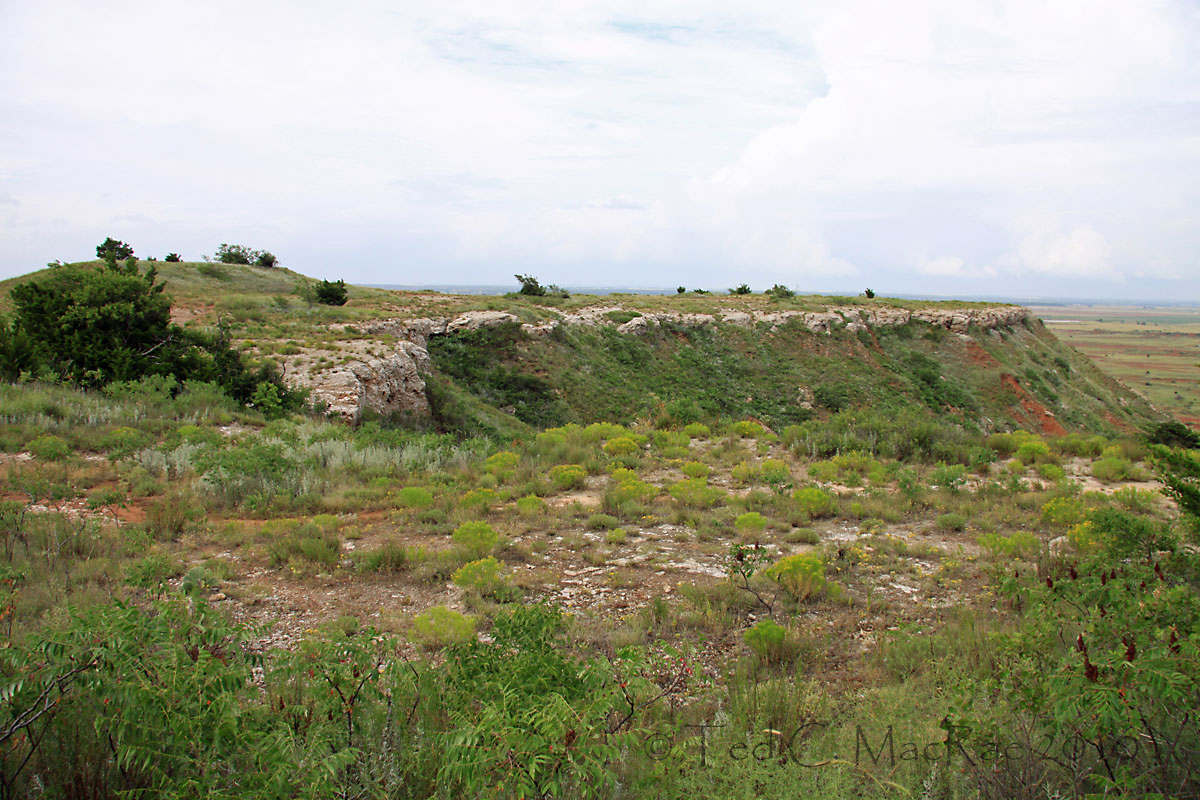
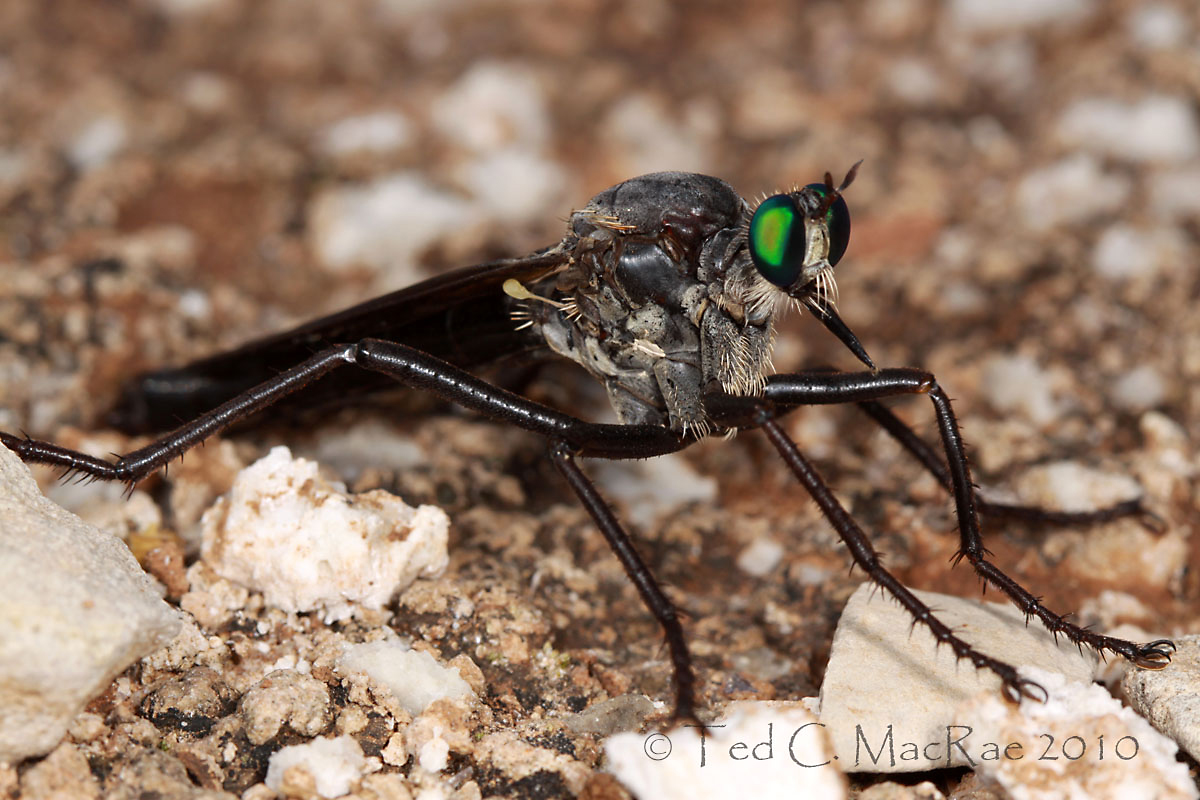
A few weeks ago, while waiting to begin my nocturnal hunt for the Great Plains giant tiger beetle (Amblycheila cylindriformis) in northwestern Oklahoma, I spent the daytime atop one of the red flat-topped mesas that meander through the area in nearby Gloss Mountain State Park.  Although my trip was all about seeing this giant of a tiger beetle in the wild for the first time (I could hardly wait for dusk to begin my search), I found enough splendid insects of other types atop the mesa to occupy my interest until that time.  One of these was the still-robust population of the Swift Tiger Beetle (Cylindera celeripes) that I discovered last summer and delighted in photographing yet again, while another was North America’s largest robber flyMicrostylum morosum!  I had just finished photographing one of the tiger beetles near the edge of the mesa when I turned and saw one of these impressively large flies sitting calmly on the ground nearby.

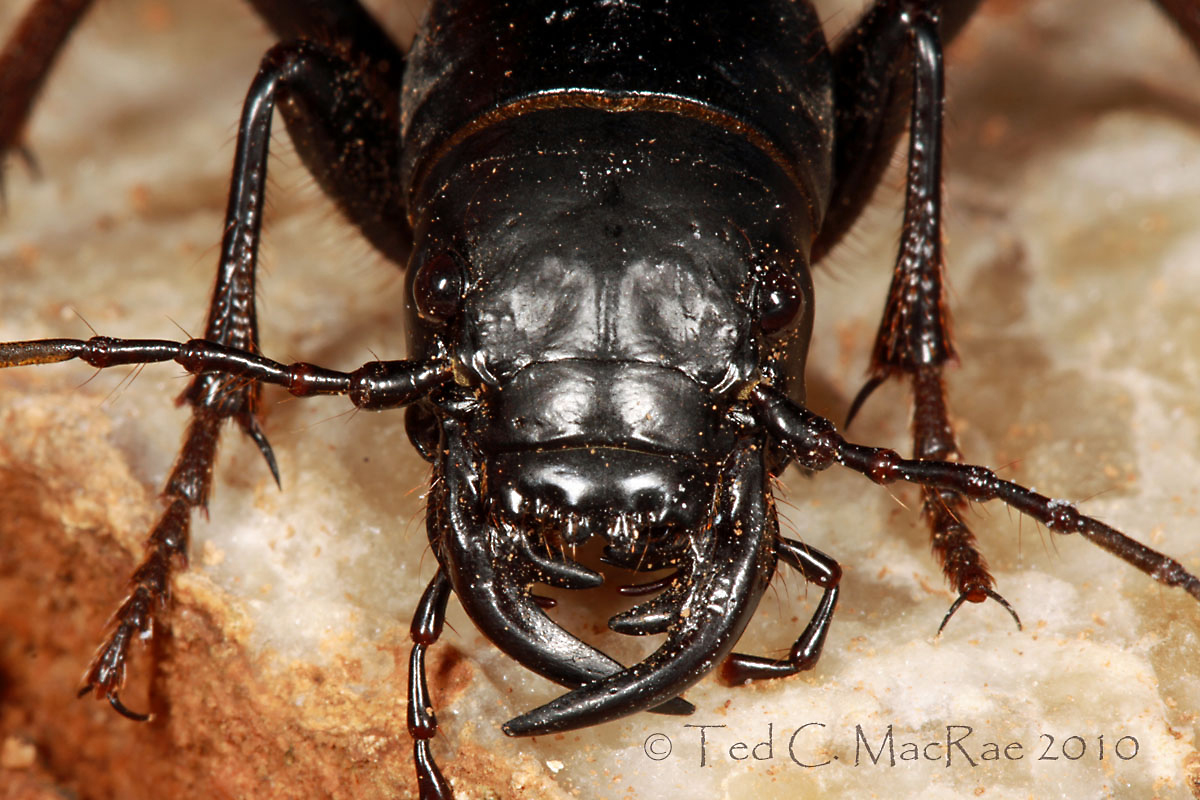
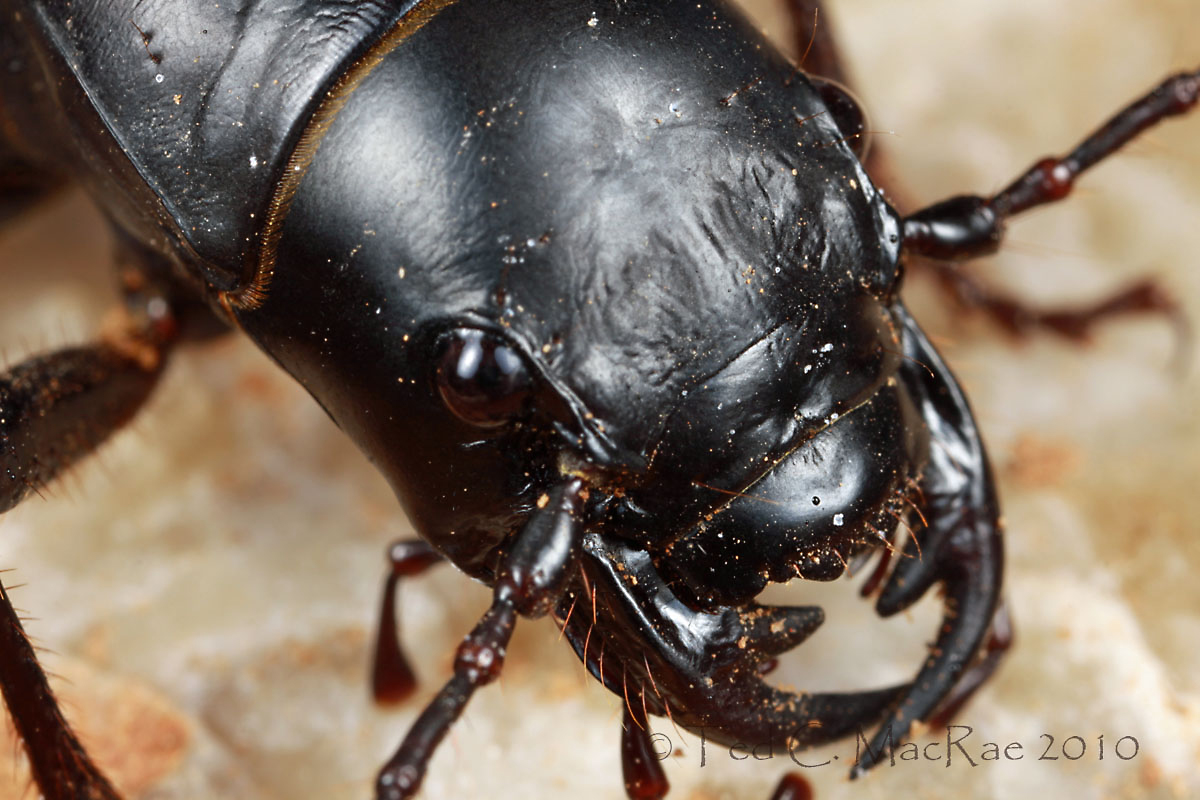
I first encountered this species last year in southwestern Missouri (a new state record!), so there was no question about its identity.  I also remembered how skittish they were and how difficult it was to get even the two mediocre photographs that I included in the resultant post.  Expecting the same, I kept my eye on the ground-sitter while preparing the camera and approached it with extreme caution.  To my surprise, it showed no sign of being alarmed or wanting to take flight.  I crouched down low and marveled at its monstrous impressiveness as I took frame after ever closer frame – eventually zeroing in on the head and its stunningly magnificent emerald-green eyes.

Satisfied that somewhere in the dozen and a half frames that I shot was at least one or two winners, I sat up and probed towards it with my finger to see how quickly it took flight.  It just sat there tenaciously until my touch caused it to finally take wing.  Winds were gusty atop the mesa, which may have accounted for its cooperativeness.  Standing up, I noted a few scattered eastern redcedars (Juniperus virginiana) in the mixed-grass prairie at the highest point of the mesa.  I recalled that robber flies are fond of “hilltopping” – a mating strategy whereby males fly to the highest point in their immediate landscape to defend a small territory or perch that provides a good vantage for spotting females and competing males (see Hilltopping by Eric Eaton at Bug Eric for a good discussion about this) – and my own experience with this species in Missouri and the way it tended to perch in the trees scattered across the upper part of the rocky, dolomite glade where I found them.  I wandered up to the redcedars, and as soon as I came close enough to one of them I saw another individual take flight – looking like some super-sized mosquito with it’s long legs spread wide as it clumsily flew to another tree.  As it turned out, I saw a number of individuals and mating pairs perching and flying among the trees on top of the mesa, each more spectacular than the previous.

Until recently, Microstylum morosum was considered a Texas-endemic.  However, Beckemeyer and Carlton (2000) documented this species to be much more broadly distributed in the southern Great Plains (from Texas up into Oklahoma and Kansas and west into New Mexico, Arizona, and Colorado), and Warriner (2004) recorded it shortly afterwards in Arkansas.  Although the species apparently occurs throughout Oklahoma (Beckemeyer and Carlton recorded from 13 counties across the state), my observation of it in Major County does seem to represent a new county record for the species.  There is another U.S. species in the genus, M. galactodes, and it has also been recorded from Oklahoma (the closest record is in nearby Woodward County).  However, it is easily distinguished by its generally smaller size, milky white wing membranes, reddish-brown body, and head and thoracic dorsum evenly covered with whitish pruinescence, while M. morosum has the wings and body black to brown and thoracic pruinescence restricted to the lateral margins (Beckemeyer and Carlton 2000).  I’m not sure I would have recognized that species for what it was had I seen it, but if it is anywhere near as impressive as M. morosum then I hope I have the fortune to find it someday as well.

Photo Details:
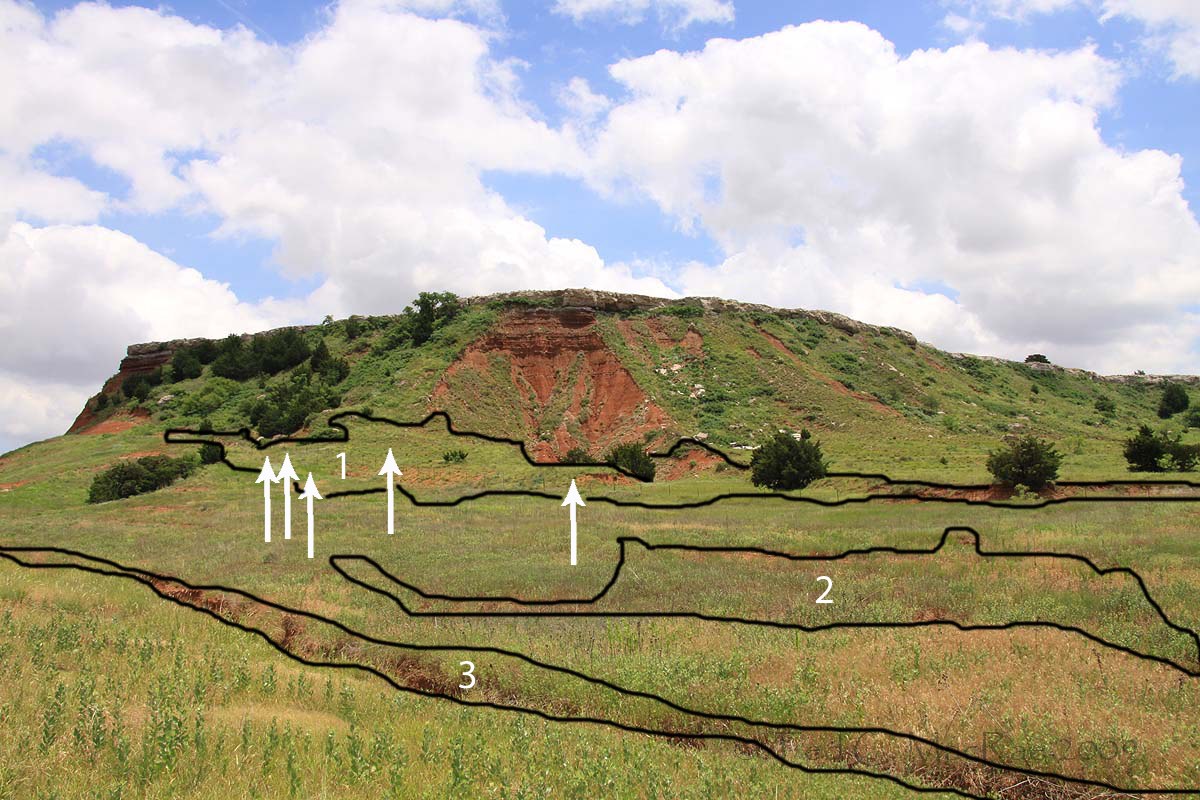
Landscape: Canon 50D w/ 17-85mm wide-angle lens (17mm), ISO 100, 1/100 sec, f/10, ambient light. Typical post-processing (levels, unsharp mask).
Insects: Canon 50D w/ 100mm macro lens, ISO 100, 1/250 sec, f/10 (photo 1), f/18 (photo 2), Canon MT-24EX flash (1/4 ratio) w/ Sto-Fen diffusers. Typical post-processing (levels, minor cropping, unsharp mask).

REFERENCES:

Beckemeyer, R. J. and R. E. Carlton.  2000. Distribution of Microstylum morosum and M. galactoides (Diptera: Asilidae): significant extensions to previously reported ranges.  Entomological News 111(2):84–96.

Warriner, M. D.  2004. First Arkansas record of the robber fly Microstylum morosum (Diptera: Asilidae).  The Southwestern Naturalist 49(1):83–84.

Copyright © Ted C. MacRae 2010

Add to FacebookAdd to DiggAdd to Del.icio.usAdd to StumbleuponAdd to RedditAdd to BlinklistAdd to TwitterAdd to TechnoratiAdd to Yahoo BuzzAdd to Newsvine

Email to a friend

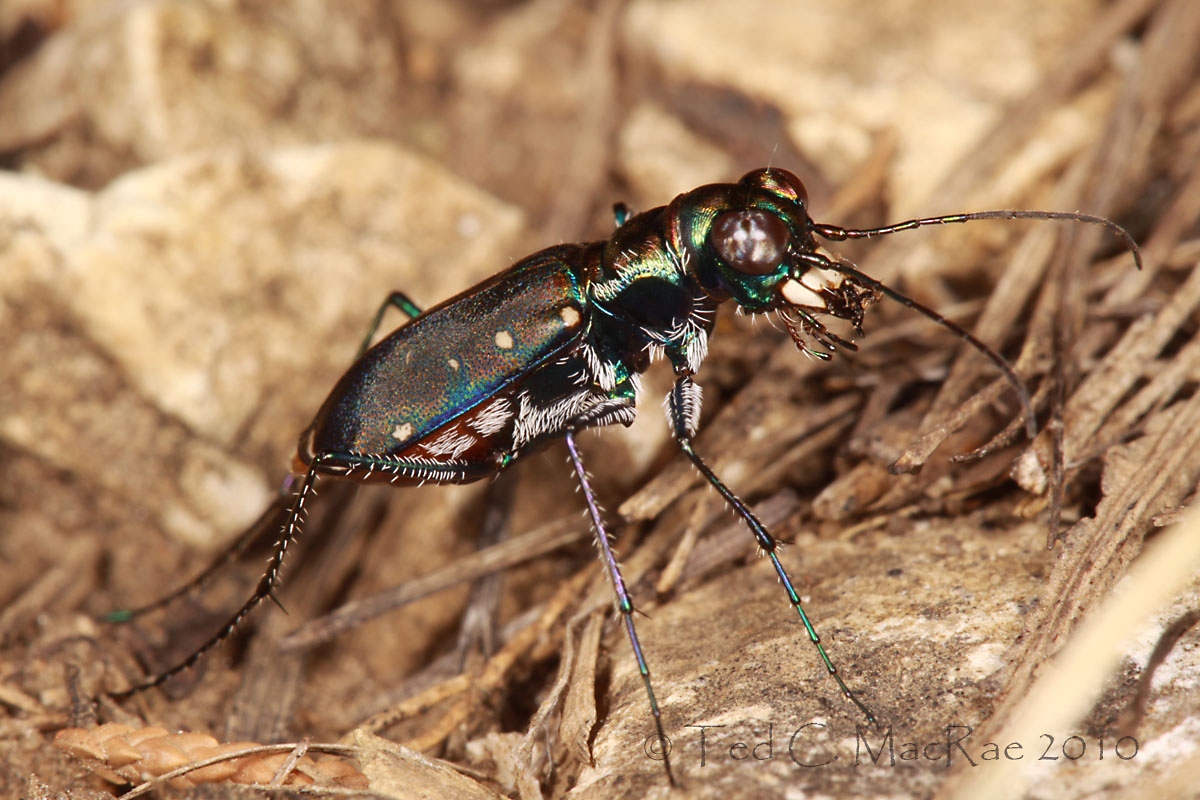
Eastern Red-Bellied Tiger Beetle

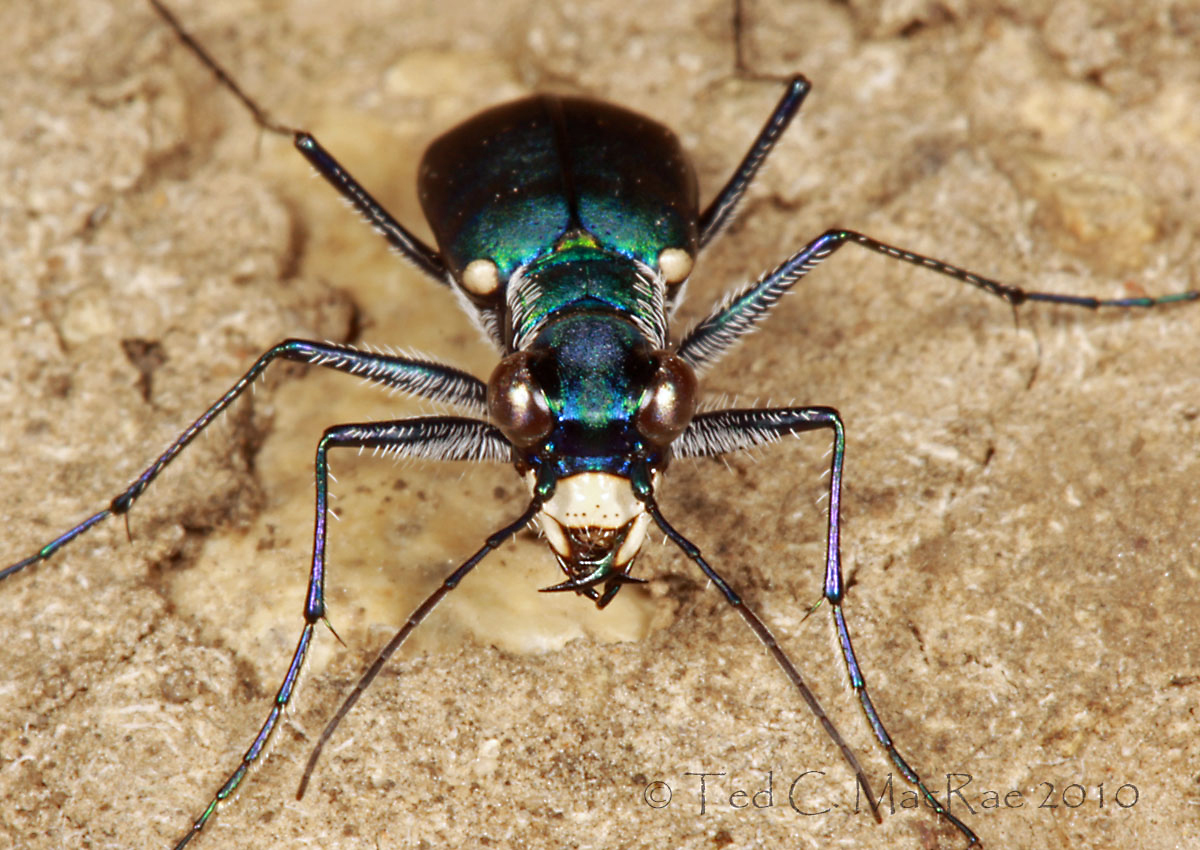
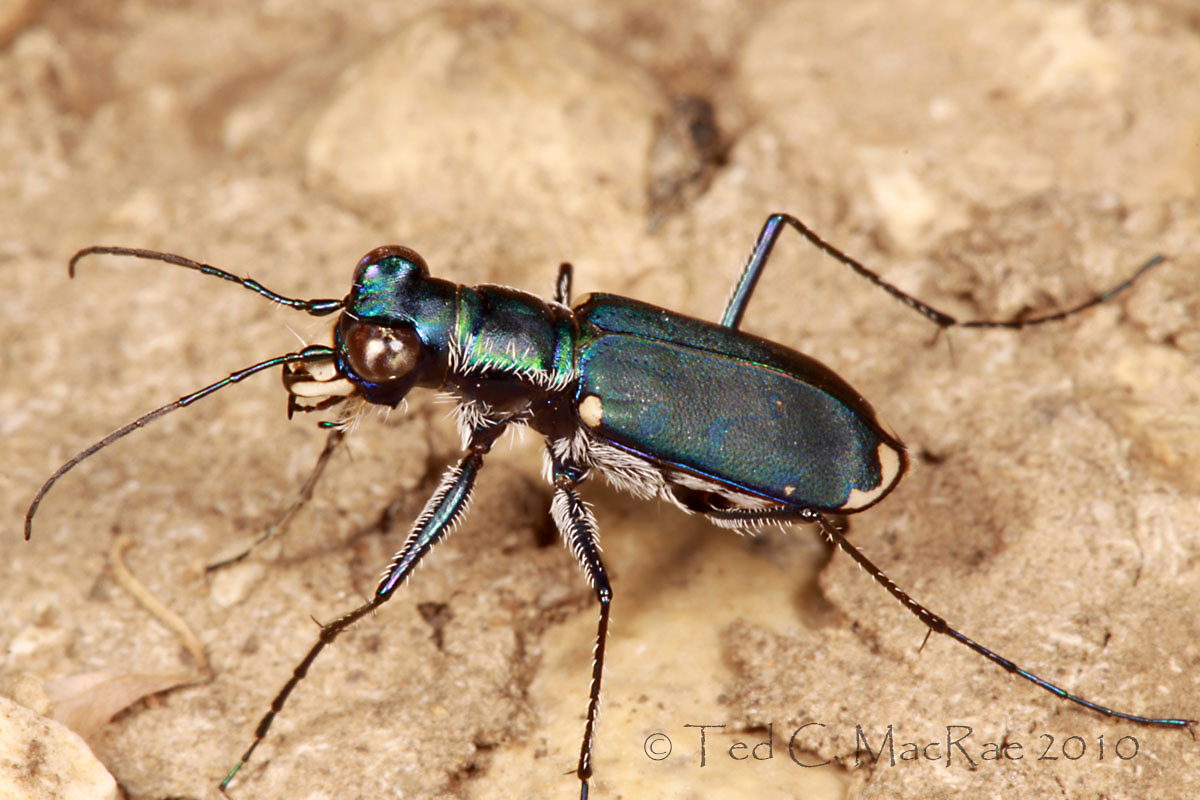
Last summer, while looking for North America’s most beautiful longhorned beetle in the dolomite glades of southwest Missouri’s White River Hills, I also came across good numbers of a tiger beetle species that I had previously considered rather uncommon in the state – Cicindela rufiventris (eastern red-bellied tiger beetle).  While I have seen this species at numerous localities throughout the Ozark Highlands, I had not seen them in such numbers as were present along a rocky 2-track leading through one of the glades and into the adjacent dry upland forest.  I had intended to post about them much sooner than now, but they took a backseat to the photos I obtained of the stunning Plinthocoelium suaveolens and the fantastic diversity of Floridian tiger beetles that I encountered in the following weeks.  I had, in fact, completely forgotten that I had these photos until Steve Willson, author of Blue Jay Barrens, presented two posts with some excellent behavioral observations of this species in Ohio (see his posts Eastern Red-Bellied Tiger Beetle and Tiger Beetle Behavior).

In Missouri, I have found this species exclusively in the Ozark Highlands region, primarily along rocky clay exposures along roadsides and on trails and 2-tracks through open pine forests on sandstone substrates.  As I mentioned, however, I never saw large numbers of individuals – just a few here and there.  On this rocky, dolomite 2-track though, the species was quite abundant, to the point that I was able to pick and choose the more “cooperative” subjects for photography instead of stalking interminably behind a precious skittish few.  In my second trip to the region two weeks later, I would find the species again abundant along trails winding through the region’s finest and most extensive dolomite glade systems at Hercules Glades Wilderness.  In previous years I haven’t spent much time in the extreme southern Ozarks during July and August, since by then most woodboring beetle activity has largely ceased – this probably explains why I’ve not seen this summer active species more abundantly before now.

Cicindela rufiventris is quite closely related to C. ubiquita¹, both of which are included in the subgenus Cicindela (Cicindelidia), dubbed the “American Tiger Beetles” by Pearson et al. (2006).  It is immediately recognizable, however, by its red-orange abdomen – hints of which can be seen in these photos and which is fully exposed during flight.  It also lacks the distinct sutural row of green punctures on the elytra exhibited by the latter, and the upper body coloration tends to be a little more variable in Missouri, ranging from dull dark brown or black to dark blue.  According to Pearson et al. (2006), populations in southern Missouri represent the northern fringe of an intergrade between the nominate subspecies to the east and subspecies cumatilis ranging from southwestern Louisiana into eastern Texas.  The distinction between these two subspecies is a matter of degree, with the latter exhibiting reduced maculations and a blue rather than brown or black upper body.  The influence of cumatilis can be clearly seen in the individual shown in the first three photographs, while the individual in the photo below is much more “nominate” in appearance. For taxonomic purposes, individuals from these populations are probably best classified as “Cicindela (Cicindelidia) rufiventris rufiventris x rufiventris cumatilis intergrades.” Such nomenclature implies that these individuals represent hybrids between two geographically distinct populations, since subspecies in the strictest sense represent genetically divergent populations made allopatric or near-allopatric as a result of isolating geographical barriers. However, tiger beetle taxonomy is replete with “subspecies” that more likely represent extremes of clinal variation, of which cumatilis appears to be one example. The opposite expression of this cline can be found in a few isolated populations near Boston, in which the elytral maculation is at its most developed – these populations have been designated as subspecies hentzi.

¹ Referred to by most authors as Cicindela punctulata.

Photo Details: Canon 50D w/ 100mm macro lens, ISO 100, 1/250 sec, f/25 (photos 1-2), f/29 (photo 3), f/18 (photo 4),  Canon MT-24EX flash (1/4 ratio) w/ Sto-Fen diffusers. Typical post-processing (contrast and unsharp mask).

REFERENCES:

Pearson, D. L., C. B. Knisley and C. J. Kazilek. 2006. A Field Guide to the Tiger Beetles of the United States and Canada. Oxford University Press, New York, 227 pp.

Copyright © Ted C. MacRae 2010

Add to FacebookAdd to DiggAdd to Del.icio.usAdd to StumbleuponAdd to RedditAdd to BlinklistAdd to TwitterAdd to TechnoratiAdd to Yahoo BuzzAdd to Newsvine

Email to a friend

The joys of ecological restoration

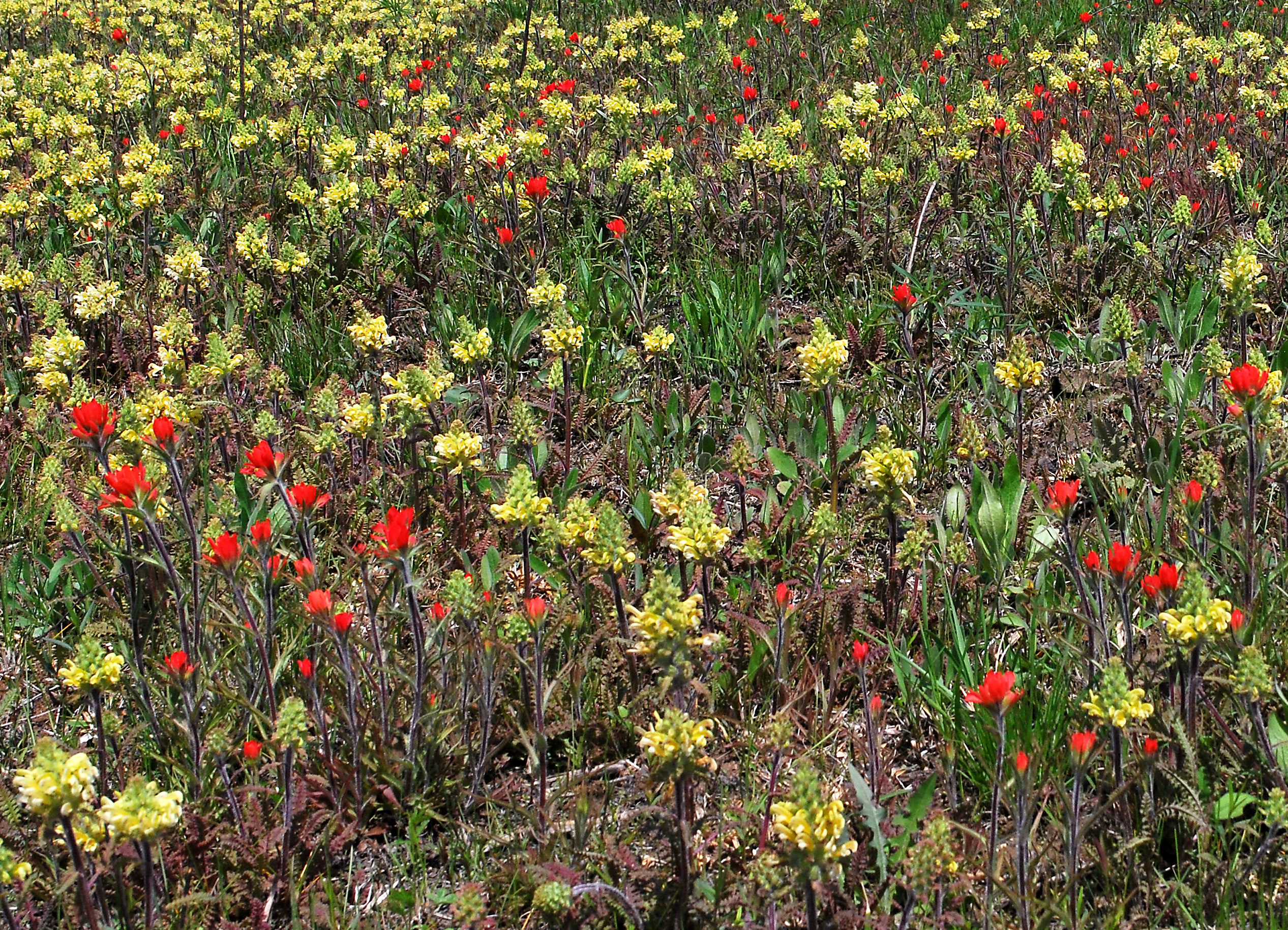
Indian paintbrush and lousewort now dominate patches of SNR

I moved to Missouri in the summer of 1988, having experienced 8 years of generous support of my family’s livelihood by my research on the infamous imported fire ants of the US Southeast, and their relatives in South America. When I arrived in the Midwest, I  hoped to land a job as an insect taxonomist in a university or museum, a goal of mine since before entering college. But this dream was one that even before moving to Missouri was dimming, and then receded ever further from the realm of possibility for me (and for traditionally trained taxonomists, generally), once here. So, I began to re-think what I might do with my work life. It would be something, I hoped, that would make some use of all the course work (mostly in entomology and botany) and research (on ant systematics) I had done during my 24 years (!) of getting educated and four additional years as a post-doc. As or more important, whatever job I ended up in would somehow have to allow me to share my life-long love of nature with others.

A museum drawer of ant specimens mounted for taxonomic study, the ants no doubt frustrated by the years of inattention they have received as I have tended to the duties of my day job.

Early in my residence in eastern Missouri, I made the acquaintance of the naturalist at a 2500-acre (1000-hectare) nature reserve outside of St. Louis. Shaw Arboretum, as it was then known, is country cousin to the world-renowned Missouri Botanical Garden, and is named after the Garden’s founder Henry Shaw. Long story short, in the summer of 1990 the naturalist mentioned to me that he would soon retire, the position would become available, and that I ought to apply. So I applied, and was hired as the arboretum’s naturalist in January 1991.

A dolomite glade plant endemic to a few counties in eastern Missouri, this leatherflower was established at SNR in the 1930s, but expanded exponentially after prescribed fire was introduced in the 1990s. Here, an ant characteristic of glades and dry prairies forages on the flower.

When I came on board, the “Arboretum” had mostly ceased to be an arboretum (a formal collection of trees for display, breeding and research), and most folks seemed unable to either pronounce or define the word. Indeed we learned, through a public survey, that the strange name and the stone wall in the front actually dissuaded people unfamiliar with it from entering! Yes, there were a few patches of exotic trees scattered around the property, especially in the conifer collection near the front entrance know as the “Pinetum”, but ever since the Garden had decided around 1930 that it would not, afterall move all of its horticultural operations to this then very rural site (the original intent of its purchase), formal arboretum and botanical garden type activities had been few and far between, and the site began gradually reverting from abandoned farmland to a wilder sort of place, as well as a haven for native biota. Thus, on its 75th anniversary in the year 2000, Shaw Arboretum was renamed Shaw Nature Reserve.

Colony-founding queen bumblebees are the primary actors in loosening pollen with ultrasound from shootingstar anthers, and distributing it about the plant population.

Around that time, my title changed too, to “Restoration Biologist”. The job is multifaceted; presenting public programs and classes on various aspects of the site’s natural history, writing and reviewing articles, acting as liaison to the vigorous regional group of academic ecologists who use the site for research and teaching, a very intermittent personal research program on ants resulting in sporadic publications, and last but certainly not least, ecological restoration.

Ecological restoration, in the broad sense, consists of  two primary practices:

  • Restoration of a natural community to structure and species composition presumed characteristic of an  ;;earlier condition (however arbitrary or ill-defined).
  • Reconstruction of regional, native-like habitats, de novo, using locally acquired native plant propagules in the appropriate settings of soil, hydrology,  slope aspect and climate.

Both  require essentially perpetual, follow-up maintenance, including invasive species control, mowing, haying, grazing, selective timber removal, species richness enhancements, and prescribed burning. All of these have many variations and nuances in application, and there can be impassioned arguments about their implementation in the literature, at conferences, and in forums and blogs on ecological restoration, native plants, butterflies, beetles, etc..

An ecologically conservative lily ally of undisturbed moist soil habitats now thrives in prairie plantings at the Reserve.

Attitudes about ecological restoration vary, among practitioners, among sociologists and philosophers, and in the general public. One broad attitudinal schism lies along the lines of  whether ecological restoration activities are some sort of primitivist, grand-scale gardening, or do they represent ecologically valid landscape conservation? Another question some pose is to what extent we should interfere with “natural successsion”? Be this as it may be, most people with functioning sensory perception agree the results can be very beautiful. The loveliness of the mosaic of colors in the herb layer of a spring woodland is inarguable, especially so after it has had its woody stem density reduced, and had the leaf litter burned off, to allow more light, rain and seeds to the soil surface — even where there is genuine concern about damage to invertebrate assemblages residing in forest duff. A waving meadow of grasses and flowers in a tallgrass prairie planting, intended to replace just a few of the tens of millions of acres of this ecosystem that have succumbed to the plow, has its own grand beauty, though its per-square-meter species density of plant species remains less than half that of a native prairie remnant and it is dominated mainly by habitat-generalist insect species rather than prairie specialists, even after 30 or more years.

A self-introduced grassland ant forages among a thriving, human-introduced population of this wet prairie gentian.

The smaller, daily rewards of restoration, to the practicing ecological restorationist and to those who visit his or her work, are many. Over 20 years, in the opened-up woods, restored glades and prairie and wetland plantings at SNR, I repeatedly have enjoyed the “sudden appearance” and increase in populations of ant species (of course) that I never observed during my early years of working at SNR (then scouring it for purposes of preparing an annotated ant list). The feeling I get upon discovering that a grouping of shooting star, royal catchfly, bunch flower or bottle gentian plants, are in bloom at a site where I spread their seeds five, seven, or even ten years earlier is a bit like that one feels when a child is born. The spontaneous colonization of SNR grassland plantings by prairie ragged orchid never fails to amaze me. Bird, or frog, or katydid and cricket songs in a former crop field or pasture, as the “restored” vegetation fills in and matures, is as pleasing to my ear as it is to my soul.

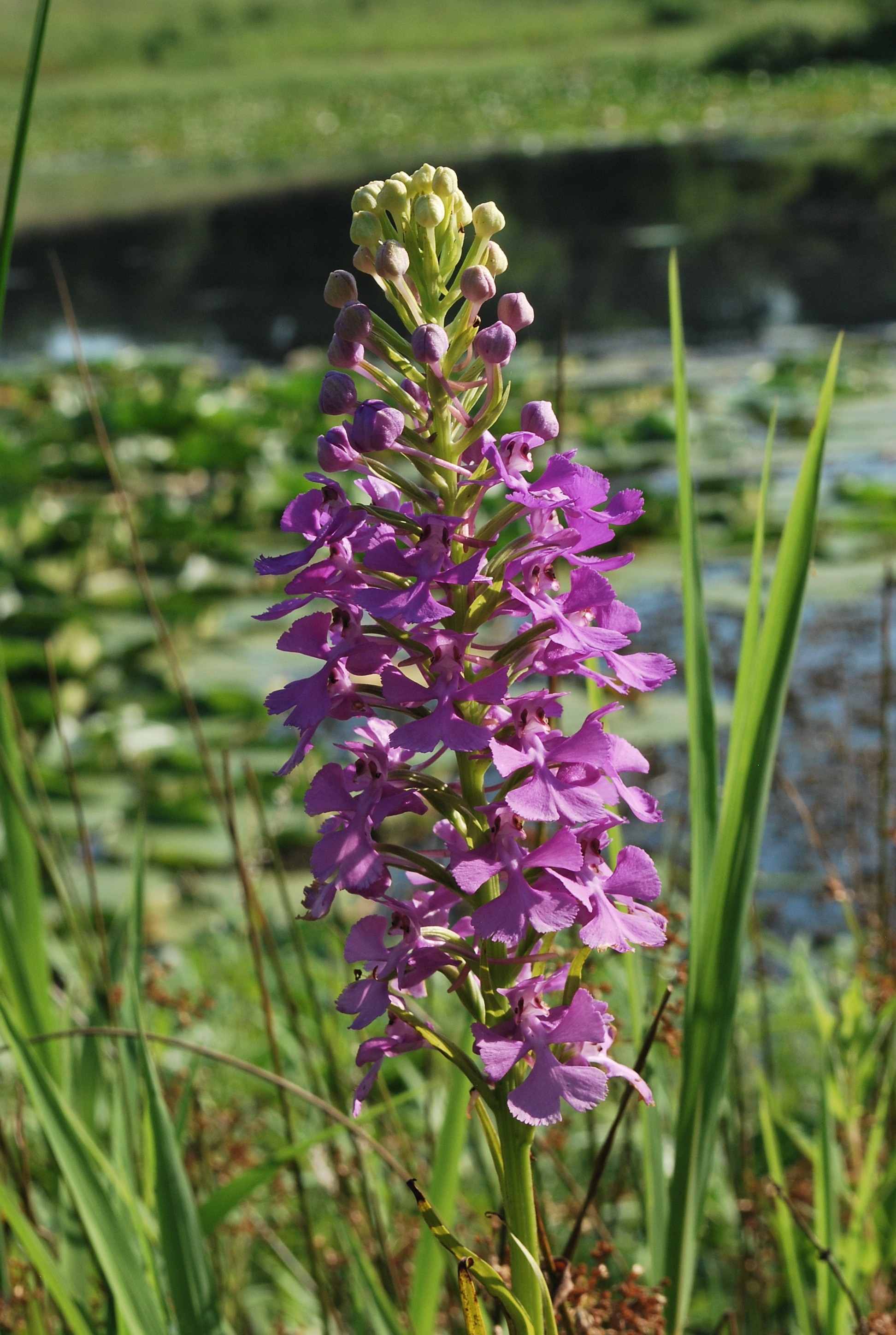
A few days ago (in early July), the director of the Reserve came to my office asking if I had noticed a purply pink, “possibly orchid” flower growing on a section of a berm (planted with native vegetation) in our 32-acre wetland complex. I had not been in the area recently, but headed right out to see what it was. Joyously, and not a little surprised, I learned that seeds of the purple fringeless orchid, sowed at a location nearby 17 years previously, had washed to this site, taken root, and as terrestrial orchids are wont to do, flowered after so many years!

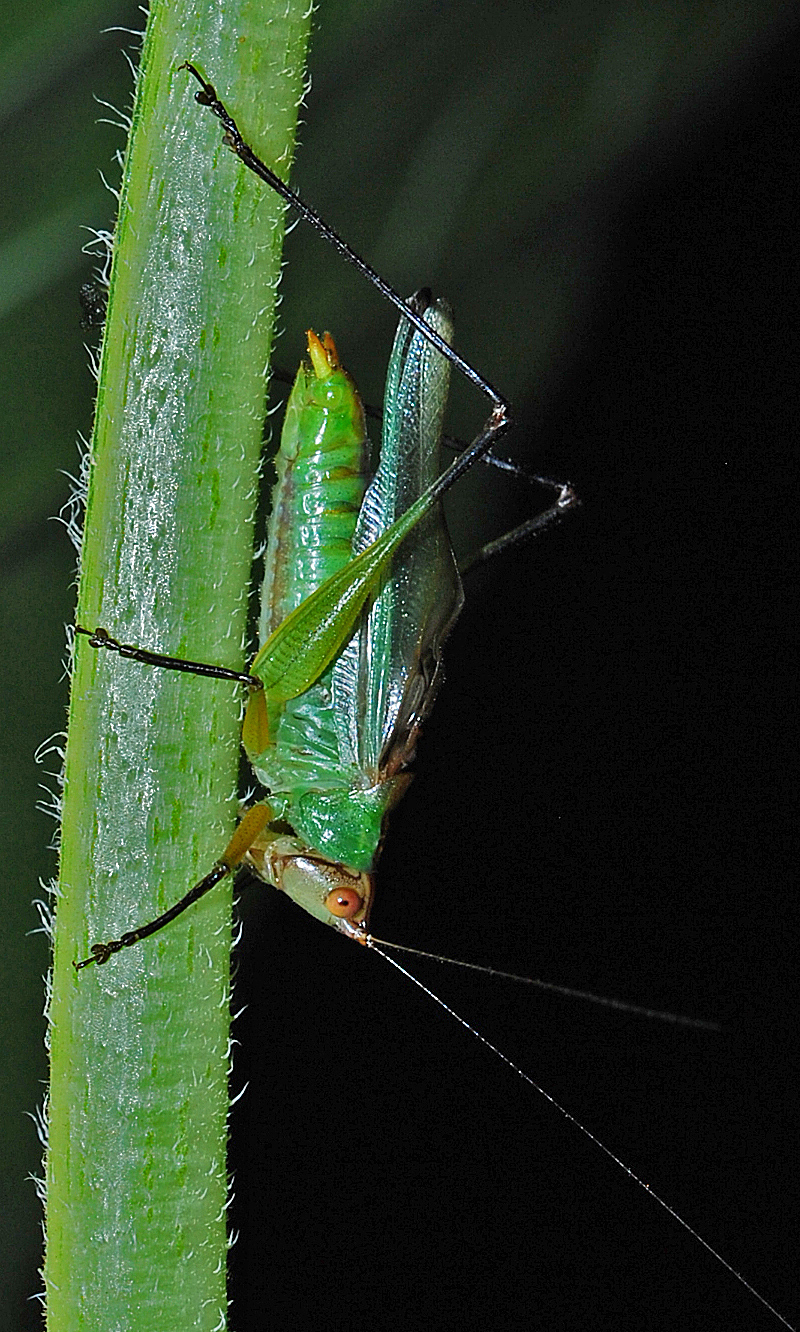
The black-legged greater meadow katydid thrives in low areas and near bodies of water in SNR

The prairie ragged orchid began to appear in old fields and prairie plantings where prescribed burning occurs at SNR. It has not been seen in fields maintained exclusively by mowing or haying.

The purple fringeless orchid surprised the restorationist and St. Louis area botanists by flowering in the SNR wetland area 17 years after the original sowing.

Copyright © James Trager 2010

Add to FacebookAdd to DiggAdd to Del.icio.usAdd to StumbleuponAdd to RedditAdd to BlinklistAdd to TwitterAdd to TechnoratiAdd to Yahoo BuzzAdd to Newsvine

Email to a friend

Collecting in Australia’s remote McIlwraith range

The following is an invited post by Alex Wild of Myrmecos Blog:

Myrmecologists Gary Alpert & Phil Ward mucking about with magnetic termites. Cape York Peninsula, Australia, 2004.

Ted MacRae so graciously guest blogged for me last week, so I figured it’s time to turn this around and send one Ted’s way. One of the great joys of Beetles in the Bush is Ted’s photojournalistic coverage of various insect collecting adventures. In that vein, I will recount an Australian expedition with famous ant guys Gary Alpert and Phil Ward from back in 2004. I never blogged the trip because, hey, I didn’t blog back then.

Continue reading

Guest Blogger: Dogbane for Dinner

Our guest blogger for today is Anne McCormack. I have known Anne (or known of her) for more than 25 years now, first as a long-time editor of Nature Notes, the journal of the Webster Groves Nature Study Society, and more recently on a personal basis as I, myself, have followed in her editorial footsteps. Anne is an astute naturalist whose breadth of knowledge spans not only botany but also entomology and ornithology, all of which she write about in her own blog at Gardening with Binoculars.


I planted Common Dogbane (Apocynum cannibinum) because some of my butterfly-watching friends reported numbers of juniper hairstreak butterflies on the patch of dogbane at Powder Valley Nature Center in Kirkwood. I assumed incorrectly that dogbane was a host plant for hairstreaks, and believing it to be little more than caterpillar food, I placed it in a hot, dry, narrow strip along the driveway. Ragged, caterpillar-chewed leaves wouldn’t be noticed there, and I forgot about it. After a few seasons, it was still a modest-sized clump, but the leaves were in great shape. In fact, it had grown into an attractive bush of airy, elegant lime-green foliage, wine-red stems, and tiny white flowers. It’s quite a contrast to its relative, Common Milkweed, growing next to it, which looks as if it were designed by Dr. Seuss—even before it gets chewed to bits. At this point I decided it was time to look it up and see why it had failed to support hordes of munching caterpillars. As you have already guessed, gentle reader, the Juniper Hairstreak’s host plant is juniper, not dogbane, but good old Common Dogbane is a great nectar plant. Now that Dogbane and I understand each other better, I can appreciate the amount of traffic its tiny white blooms bring in, like this Peck’s Skipper butterfly. Ants, butterflies, tiny native bees, honeybees, and this mason wasp are busy there all day long.

Along with several species of moth, it is the host plant for the Dogbane Beetle, which spends its larval stage devouring the roots and its adulthood dining on the leaves of Dogbane, and nothing but Dogbane. Dogbane Beetle can be confused with Japanese Beetle by beginners like myself, but unlike its fellow Coleopteran, Dogbane Beetle is harmless. That makes its iridescence all the more gorgeous, as shown in this wonderful photo by Courtnay Janiak. It’s a native insect that has shared a long evolutionary history with this under-appreciated native plant. American Indians valued it for its bark, which is tough but peels off in long strips. They plaited it for bowstrings and anything that called for twine; hence, its other common name, Indian Hemp. Don and Lillian Stokes, in their 2002 PBS show about bird watching, demonstrated how birds seek out the dry stems of this perennial, pulling off strips for nests in early spring. Nesting material can be hard to come by for birds in the tidy suburbs, so I don’t clean up the stems after frost. “Bane” in the name refers to the toxin cymarin in the plant’s leaves, though the plant would have to be covered in braunschweiger before my dog would be interested. Edgar Denison, in Missouri Wildflowers, translates the genus name Apocynum as “away dog.” The species name cannibinum refers to hemp. Its seedpods remind me of French green beans. These split at the end of the season, and the seeds fly away on fibers similar to milkweed seeds. Collect some and try this plant in your butterfly or native plant garden. Give it a spot where it’s easy to watch the colorful visitors.

Dogbane beetle (Chrysochus auratus) - Copyright © Courtnay Janiak

Copyright © Anne McCormack 2010

Add to FacebookAdd to DiggAdd to Del.icio.usAdd to StumbleuponAdd to RedditAdd to BlinklistAdd to TwitterAdd to TechnoratiAdd to Yahoo BuzzAdd to Newsvine

Email to a friend

Vicarious Friday Beetle Blogging

Despite the fact that I have a beetle blog and Alex has an ant blog, it is the latter where the regular series Friday Beetle Blogging resides (hmm, I wonder if I should start a Myrmecine Monday series?).  Alex has perhaps the best science-based entomoblog out there, so I’m thrilled to contribute today’s edition – check it out: Friday Beetle Blogging – the Swift Tiger Beetle.

Copyright © Ted C. MacRae 2010

Add to FacebookAdd to DiggAdd to Del.icio.usAdd to StumbleuponAdd to RedditAdd to BlinklistAdd to TwitterAdd to TechnoratiAdd to Yahoo BuzzAdd to Newsvine

Email to a friend

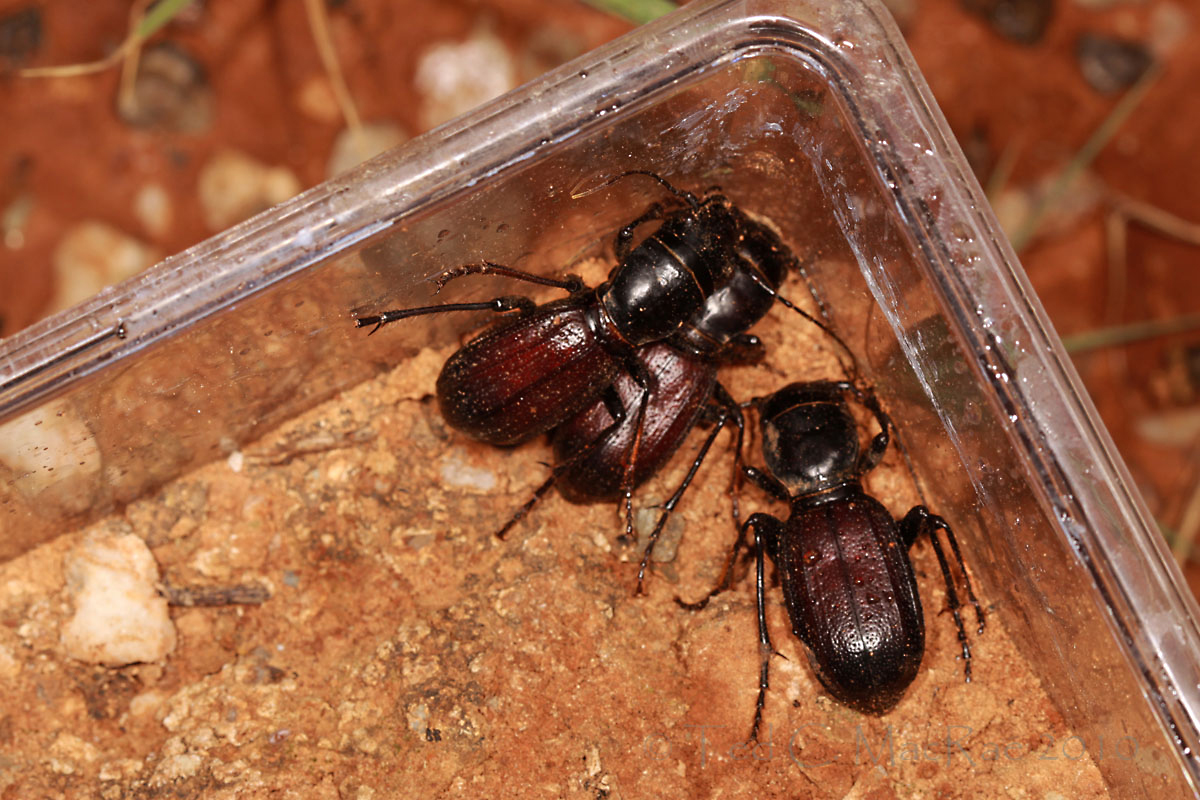
Hunting the Great Plains giant tiger beetle

In the early 1980s, I was a young, green entomologist, fresh out of school with a budding interest in beetle taxonomy, a zeal for collecting, and a desire to meet other like-minded individuals. Among the first collectors I had the good fortune to meet was Ron Huber, one of the country’s leading tiger beetle experts and co-founder of the journal CICINDELA (now 42 years as co-editor). Although my interests had by then already begun narrowing to woodboring beetles, I liked tiger beetles well enough and managed to secure from him a single specimen of what Erwin and Pearson (2008) would later dub the “Great Plains giant tiger beetle,” Amblycheila cylindriformis – the largest tiger beetle in North America. I don’t remember what prompted Ron to part with this spectacular specimen – perhaps it was the lone Proserpinus gaurae (Lepidoptera: Sphingidae) adult that I possessed, which I had reared from a field-collected larva around that time, or maybe Ron had such a nice series of the species that making the day of a young collector was in itself reward enough. While clearly a tiger beetle, it was still so different by virtue of its enormous size (the species ranges from 25-38 mm in length), somber coloration, small eyes, and strictly nocturnal habit. For much of the past 25 years, that specimen has sat in my cabinet amongst a small assortment of other, mostly mundane tiger beetles that I had opportunistically taken on my woodboring beetle-focused collecting trips. While I longed to someday see the species for myself, to do that would mean making a special trip out to the Great Plains – woodboring beetle desert that it is – during the middle of summer and stumbling through the prairie in the dark with a flashlight. Such an effort always seemed too great for the sole purpose of finding a single species, and not even a woodboring beetle at that.
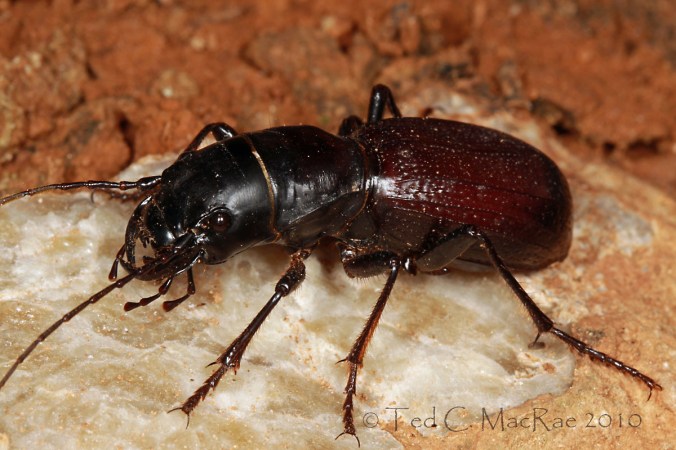
Interests evolve, however, and while I still consider woodboring beetles to be my primary interest, tiger beetles have increasingly occupied my attention over the past several years. Contrary to woodboring beetles, the Great Plains are a mecca for tiger beetle diversity, and in recent years I’ve made a number of trips to Nebraska, Kansas, South Dakota, and Oklahoma specifically to look for them. Such was the case in June of last year when I went to the Glass Mountains in northwestern Oklahoma on a hunch and found Cylindera celeripes, Dromochorus pruinina, and a large tiger beetle larva that I just recently concluded must represent A. cylindriformis. I had been rearing the larva for a year by the time I figured out its identity, and when I did I sudden found myself facing a “perfect storm” – an upcoming holiday weekend, adults presumably in peak adult activity, and I knew exactly where to look for them. Impulsively, I decided to use my July 4th weekend to make the 525-mile drive from St. Louis to the Glass Mountains – this would give me 2 nights to look for them and still allow me to make it back to work on Tuesday morning. Anything else I could find during the day would be icing on the cake, but even if I found nothing, the chance to see A. cylindriformis in the wild seemed worth the gamble.
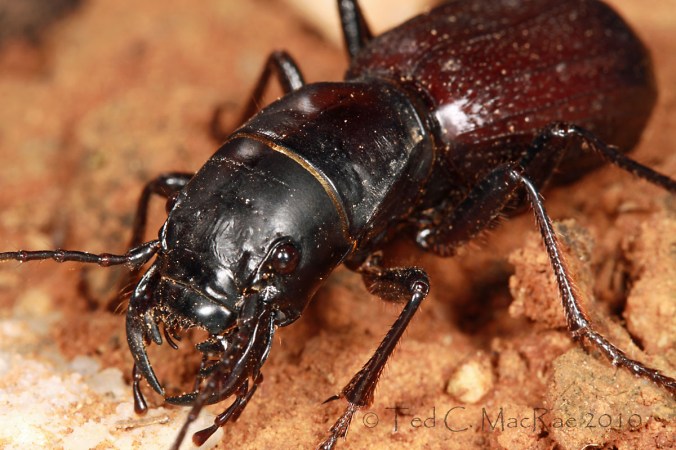
I made it to Joplin, Missouri near the Oklahoma border by midnight on Friday but awoke to threatening skies the next morning. The threat of rain became a promise as I drove further west, and by the time I arrived in Enid, Oklahoma – just 30 miles from the Glass Mountains – it was raining heavily. I stopped at a coffee shop to access Wi-Fi, and checking the radar showed a line of storms moving up through Texas and western Oklahoma into Kansas – sitting right over the Glass Mountains! The forecast gave no reason for optimism, with a 50% chance of thunderstorms through the weekend. Smartly, I had recorded the locality of the Huber-specimen – collected in northwestern Kansas – and checked the forecast for that area, but it was even worse (50% chance of thunderstorms through Sunday and 80% Sunday night). Clearly this was not good, but I had made the drive and was determined to make something happen. I decided the best thing to do would be to just continue driving west – however far that was – until I got past the storm system and see what was around – wherever that might be. I gassed up amidst a gusty, torrential downpour and headed west out of town. As I drove, the rain lightened up and eventually ceased. The roads were wet, but at least it wasn’t raining, and when I arrived at the Glass Mountains even the roads seemed to be drying. Winds were still strong, but the clouds had broken somewhat, allowing brief periods of sun to further dry things out, and what followed was a most fascinating day on top of one of the Glass Mountain mesas (highlights include C. celeripes, D. pruinina, Microstylus morosus, Trichodes sp. – look for these in future posts). As dusk approached I searched the grasslands below hoping to see a rattlesnake or two – I had seen a western pygmy rattlesnake here last year, and western diamondbacks are also in the area, but I saw none.

Of course, all this was really just passing time – waiting for nightfall and hoping the rain continued to hold off so I could begin searching the prairie down below for A. cylindriformis. It had sprinkled once or twice during the day, and I couldn’t tell if the darkening western sky was truly rain or the just the coming dusk. At 9pm, with darkness fast approaching, I set out with my headlamp and made a beeline for the native prairie habitat on the lower talus slopes where I had last year collected the larva and observed additional larval burrows that I took to be the same species. I must admit that the thought of walking alone through the prairie at night in western diamondback rattlesnake habitat made me more than a little nervous, and I kept just as much an eye out for them as I did the tiger beetles that I was looking for. As the night wore on, my hopes began to dim – I had searched for almost an hour and had covered most of the area where I had seen larval burrows last year. With no sign of the beetle, the negative thoughts started to enter my head – did I make this drive for nothing? How sure was I that the larva really represented Amblycheila? Did I have the right search image? I mean, they’re huge black beetles – they should be easy to spot, right? Oh great, I made all this fuss on my blog about looking for the species – how embarrassing to have to say, “Uhm, well, I didn’t find it.” Just as I began wrapping back around the bottom of the talus slope, there it was – no doubt about it! I just watched it for a while and noted that it moved with some urgency, but it was not the speedy, jerking walk of ‘regular’ tiger beetles – rather, it was more lumbering, seeming to pick each foot up rather high, like a cat with rubber bands on its feet (how would I know about that?). There seemed little risk of it escaping me, so I got out the camera and began following it to take photographs – no way! While it may have lacked the speed of other tiger beetles, it also lacked their propensity to occasionally pause long enough to allow a shot or two. Add the darkness, fear of rattlesnakes, and constant bumping of the flash unit on my headlamp, and it was soon apparent that getting good field photographs was going to be a low percentage proposition. I resigned myself to taking photographs later in a terrarium (several shown here) and spend my time in the field more productively looking for additional individuals.
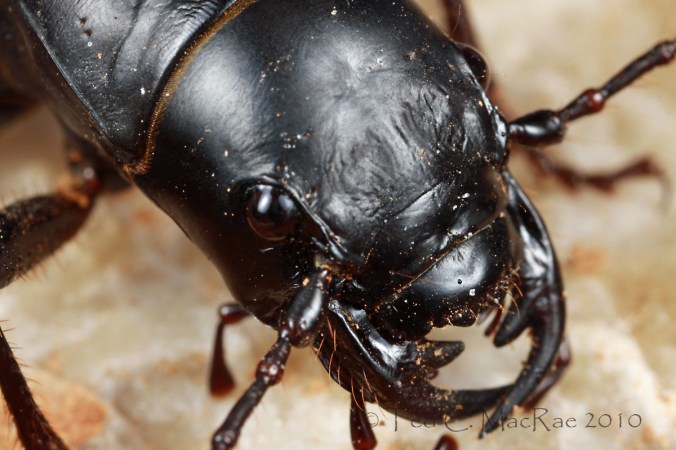
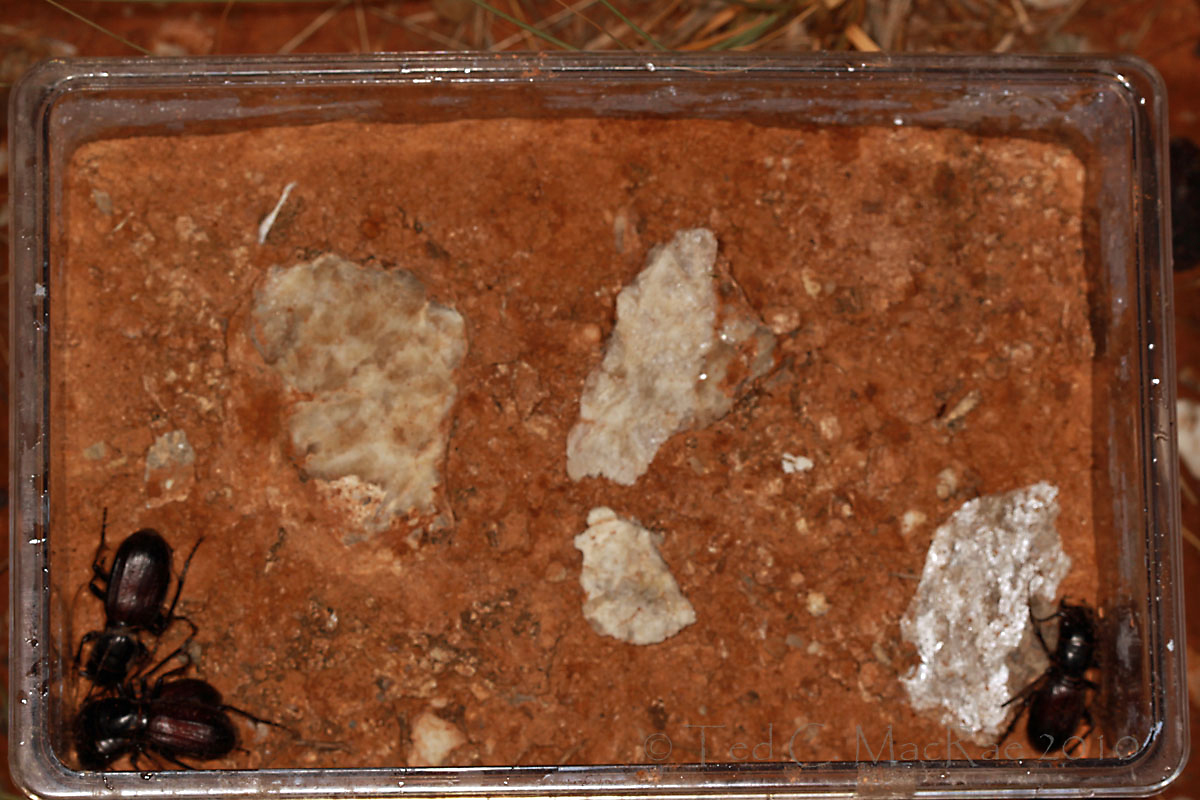
Finding the first individual did wonders for my motivation, and though still nervous about the potential for rattlesnakes I continued searching an ever-widening swath of the talus slope and adjacent areas. Another hour passed, and I had searched not only the native prairie below the talus slopes, but clay exposures on adjacent somewhat altered habitat. Again, the negative thoughts started creeping back into my mind – am I really gonna walk away from here with a single individual? I can say I found it, but that was a long drive for one beetle! I continued searching along an adjacent drainage ditch, and by 11:30pm I conceded that my victory was small and walked back to the truck to get a container to fill with native soil for a terrarium. Though it was a bit of a walk back up to the talus slope where I had seen the larval burrows, I wanted to take soil from that area specifically to give myself the best shot at obtaining eggs from my single (hopefully female) individual for an attempt at rearing more specimens from larvae. As I approached the exact spot where I had collected last year’s larva, I saw another, even larger adult! I don’t know which was greater – my excitement at finding such a large individual, or my relief in knowing that I would not go home with only one. Of course, with the second individual came a new shot of motivation, so once again I scanned across the talus slopes, and during the next half hour I found two more very near to where I had found the second one. By then it was past midnight, so I set about the business of digging soil for the terrarium. I finished the job (getting stung something terrible by three red, big-headed ants that had crawled up my pant leg while I was digging), took one last sweep across the immediate area, and turned to walk back to the truck when I saw the biggest one of all – I later determined it to be a male measuring 35 mm in length (that’s just about an inch and a half, folks!). With five individuals now, the urgency to find more was gone, and I decided I’d done what I needed to do and should get into town and find a hotel room. As I walked back to the truck, rain began to fall – lightly at first but ever increasing. Once back at the truck it was raining persistently enough that I could only hurriedly take some quick photographs of the beetles in their terrarium as in situ documentation of the momentous occasion!
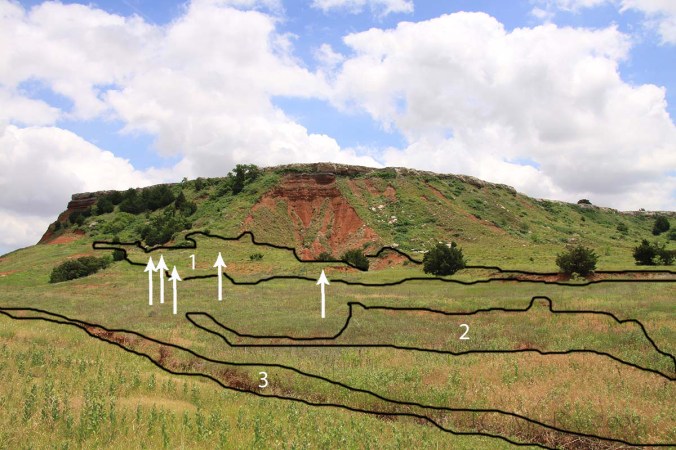
Occurrence of Amblycheila cylindriformis. White arrows indicate where adults were found, all of which were on red clay/gypsum exposures on lower talus slopes in native prairie habitat. No adults were seen in clay/gypsum exposures further below the slopes in either native (zone 1) or altered prairie (zone 2) or further down in roadside drainages (zone 3).

Although I had accomplished my main goal, I looked forward to the opportunity the next day to search for C. celeripes at other nearby sites to better understand the extent of the area’s population.  Sadly, the rain that had held off for nine hours before returning just after midnight was back for good, with radar the next morning showing a broad swath of rain extending across the entire western part of Oklahoma and north into Kansas.  There wasn’t much for me to do but savor the previous day’s experience while I made the 525-mile drive back east.  This may represent a significant record for the species – Vaurie (1955) in her review of the genus did not see any specimens from Oklahoma (although she did examine a few specimens from adjacent areas of Kansas), and Drew and Van Cleave (1962) reported only a single specimen from the state in nearby Woodward County.  Significant record or not, it was an experience that I’ll not soon forget.

Photo Details: Canon 50D (ISO 100, 1/250 sec), Canon MT-24EX flash.
Photos 1-3: Canon 100mm macro lens (f/14-20), flash 1/4 power w/ Sto-Fen diffusers.
Photo 4: Canon MP-E 65mm 1-5X macro lens (f/14), flash 1/8 power w/ Sto-Fen + Gary Fong Puffer diffusers.
Post-processing: levels, unsharp mask, slight cropping on photo 1.
Note to self: clean specimens with moist brush to remove dirt before photographing them!

REFERENCES:

Drew, W. A. and H. W. Van Cleave.  1962. The tiger beetles of Oklahoma (Cicindelidae). Proceedings of the Oklahoma Academy of Science 42:101–122.

Erwin, T. L. and D. L. Pearson. 2008. A Treatise on the Western Hemisphere Caraboidea (Coleoptera). Their classification, distributions, and ways of life. Volume II (Carabidae-Nebriiformes 2-Cicindelitae). Pensoft Series Faunistica 84. Pensoft Publishers, Sofia, 400 pp.

Vaurie, P. 1955. A review of the North American genus Amblycheila (Coleoptera, Cicindelidae). American Museum Novitates 1724:1–26.

Copyright © Ted C. MacRae 2010

Add to FacebookAdd to DiggAdd to Del.icio.usAdd to StumbleuponAdd to RedditAdd to BlinklistAdd to TwitterAdd to TechnoratiAdd to Yahoo BuzzAdd to Newsvine

Email to a friend

Amblycheila success!

I love it when a plan comes together!

Another one was caught after these photos for a total of five individuals. They’ve been setup for now in a container of native soil. I hope you’ll forgive these rather rushed photos – they were hurriedly taken at half past midnight with rain beginning to fall. Details and much better photographs will, of course, be forthcoming.

I don’t think I have ever worked as hard for five specimens as I did tonight!

Copyright © Ted C. MacRae 2010

Add to FacebookAdd to DiggAdd to Del.icio.usAdd to StumbleuponAdd to RedditAdd to BlinklistAdd to TwitterAdd to TechnoratiAdd to Yahoo BuzzAdd to Newsvine

Email to a friend