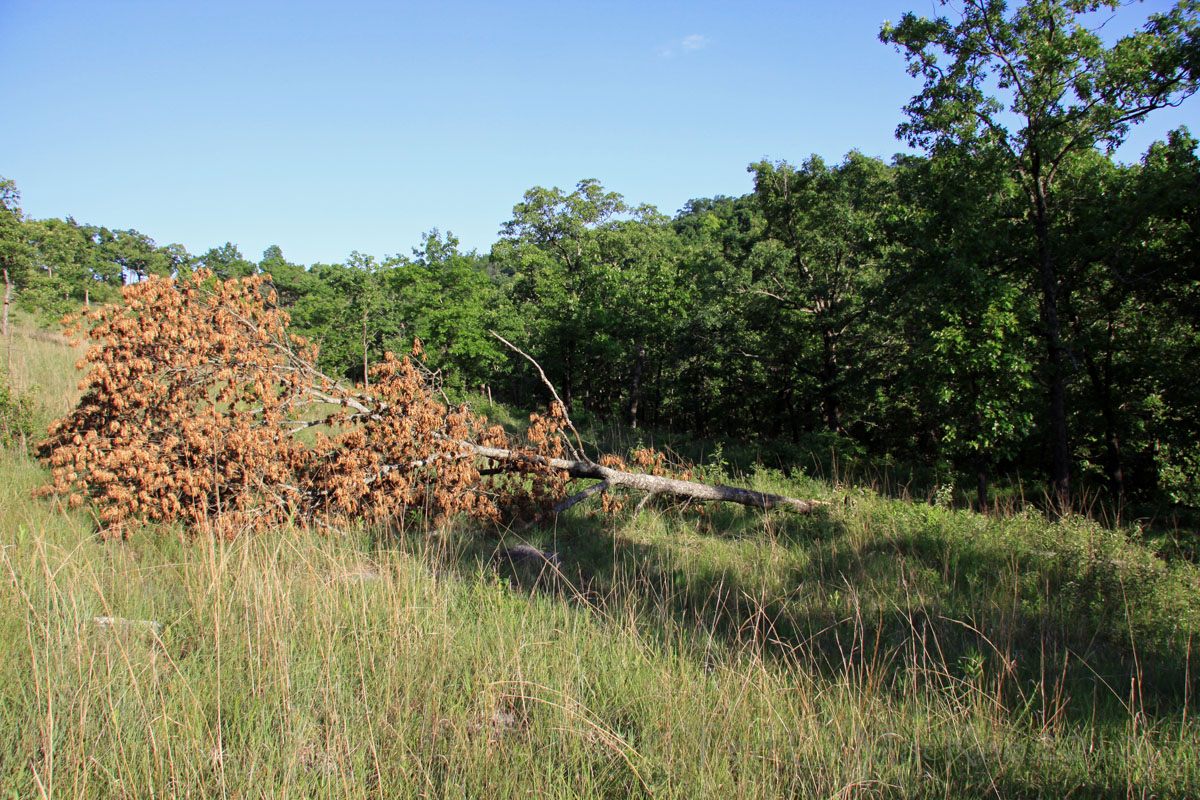
One of the few highlights of my Memorial Day weekend collecting trip came in the earliest moments of my visit to Ha Ha Tonka State Park. My destination was Ha Ha Tonka Savanna Natural Area, and a short walk through fire-restored woodland led me to the open glade where just a few years earlier a UMC student had collected the rare and little-known Agrilus impexus. Entering the glade, I was all set to begin sweeping the vegetation along the woodland/glade interface, paying special attention to any honey locust (Gleditsia triacanthos) that I might happen to find in the area as a potential host for the beetle. What I saw instead as the glade opened up in front of me was a sight that any collector of wood-boring beetles will find almost irresistable – a recent wind-throw! In this case, it was a black oak (Quercus velutina) laying in full sun – its bright brown leaves suggesting that it had fallen within the past few weeks (and would thus still be emitting the volatiles that wood-boring beetles find so attractive). I wanted to begin looking for A. impexus, but I knew there would be beetles actively crawling on the trunk and branches of that tree. I couldn’t resist it – I dropped my sweep net and beating sheet and made my way to the tree (in the end it didn’t matter, since no other beetles – including A. impexus – would be seen that day).

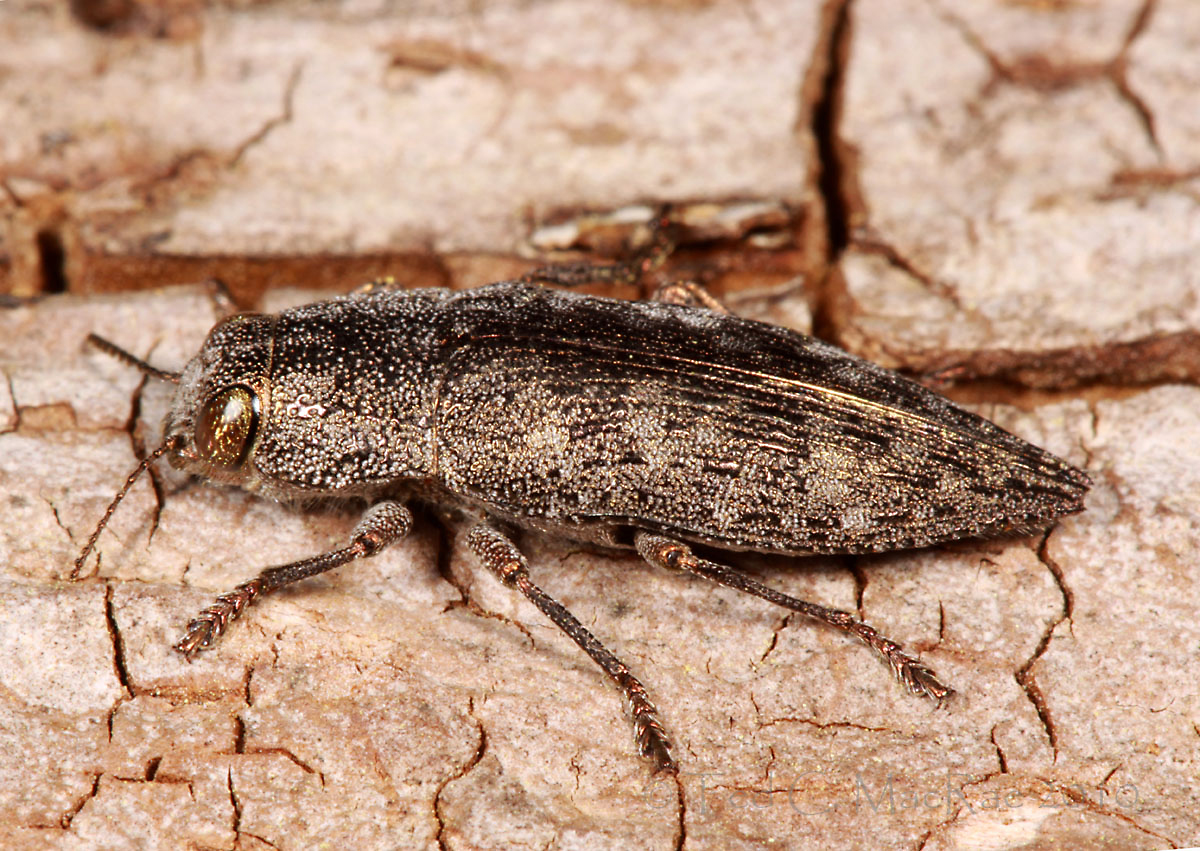
I already had an idea what I might find. Recent wind-throws are the domain of Chrysobothris, and if the tree is a deciduous species then this means members of the Chrysobothris femorata species-group. I recently featured one of six newly described members (C. caddo) of this taxonomically challenging group (Wellso and Manley 2007), providing a synopsis of the now twelve species in the group and their primarily host preferences. Fully half of these are associated primarily or exclusively with oaks – four occurring in Missouri (quadriimpressa, rugosiceps, shawnee, and viridiceps). Of these, C. quadriimpressa is the most commonly encountered (although the others are by no means uncommon), and all of the nearly dozen or so beetles I found on this particular tree in fact represented that species. Confirmation of my ID would require microscopic examination of the female pygidium (which is shallowly impressed on each side of the middle) and male genitalia, but in general this species can be distinguished in the field by its smallish size (~10-12 mm in length – rugosiceps and shawnee tend to be larger) and the post-median pair of foveae (circular impressions) on the elytra being joined (they are distinctly separated in viridiceps).
As we’ve seen with other species of jewel beetles (e.g., C. caddo, Dicerca lurida, D. obscura), adults of C. quadriimpressa are incredibly cryptic and nearly impossible to see on the bark of their hosts – at least until they move. They are notoriously difficult to approach – their large eyes and penchant for rapid escape flights suggesting excellent vision. This is a useful capability for insects that must expose themselves to would-be predators (and beetle collectors) during daylight hours while actively searching dead trees for mates and oviposition sites. One thing I can’t figure out, however, is the role of the intensely blue feet in this and other cryptically colored Chrysobothris species (see also C. caddo). Any ideas?
Photo Details (insect): Canon 50D (ISO 100, 1/250 sec, f/16), Canon 100mm macro lens w/ Kenco extension tubes (68mm), Canon MT-24EX flash (1/4 ratio) w/ Sto-Fen diffusers. Post-processing: levels, unsharp mask, minimal cropping.
REFERENCES:
Wellso, S. G. and G. V. Manley. 2007. A revision of the Chrysobothris femorata (Olivier, 1790) species group from North America, north of Mexico (Coleoptera: Buprestidae). Zootaxa 1652:1–26 (first page only).
Copyright © Ted C. MacRae 2010


 Beetles In The Bush