Animals Alarmed!

''La Costanera'' | Corrientes, Argentina

Today was my first full day of vacation in Corrientes, Argentina. It was great! I slept late, drank coffee on the balcony, frittered a while on the computer, and then headed for the “Costanera”—a beautiful stretch of green space along the banks of the massive Rio Paraná. I first visited Corrientes in 2000, spending a week collecting insects in Corrientes and neighboring Chaco Provinces on the front end of a business trip, and I’m thrilled to be back in this, one of my favorite cities in Argentina.

Of course, change is inevitable, and not everything has changed for the better since I was last here. The southern coast has been developed (photo above), so gone is a wet, muddy area above the beach where I fondly remember two local boys “helping” me collect tiger beetles (one actually caught one!). Still, the area had a few surprises in store for me, one of which was the presence of a small zoological park that I had somehow missed on my previous visit. I have mixed feelings about zoos—their mission in promoting conservation and providing refuge for rescued animals is beyond reproach, but somehow I always feel a little sad (and guilty) when I visit one. I can’t escape the feeling that I’m looking at prisoners. US zoos have done much to minimize this quandary by providing spacious, naturalized habitats and minimizing the use of or visibility of bars and cages. Still, watching the polar bear relentlessly pacing back and forth on its well-practiced path reminds you of just how bored the animals get even in these modern confines. A cage is a cage. Nevertheless, animals are always interesting to look at, and seeing animals in a Southern Hemisphere zoo is a unique opportunity that most Americans never experience. Predictably, the zoo harkened back to the older zoos of the US, with animals confined in small spaces enclosed prominently with bars and chain link fencing. There is actually an upside to this, as it allows one to get extraordinarily close to the animals. Ever try to photograph a lion in a US zoo? Maybe with an 800mm telephoto lens you can get a shot that looks like more than a little brown blob in a sea of brown, and even then the elevated position looking down into the “den” makes for very unspectacular views (getting down on the same level as your subject, or even lower, results in much more interesting views). I never even think about taking photos of animals at US zoos for this reason. Today’s experience, however, was much more intimate despite the chain links and even provided for some comical reactions by the animals as I lifted to glass to within a few feet of their faces. I present here a few of the more interesting ones:

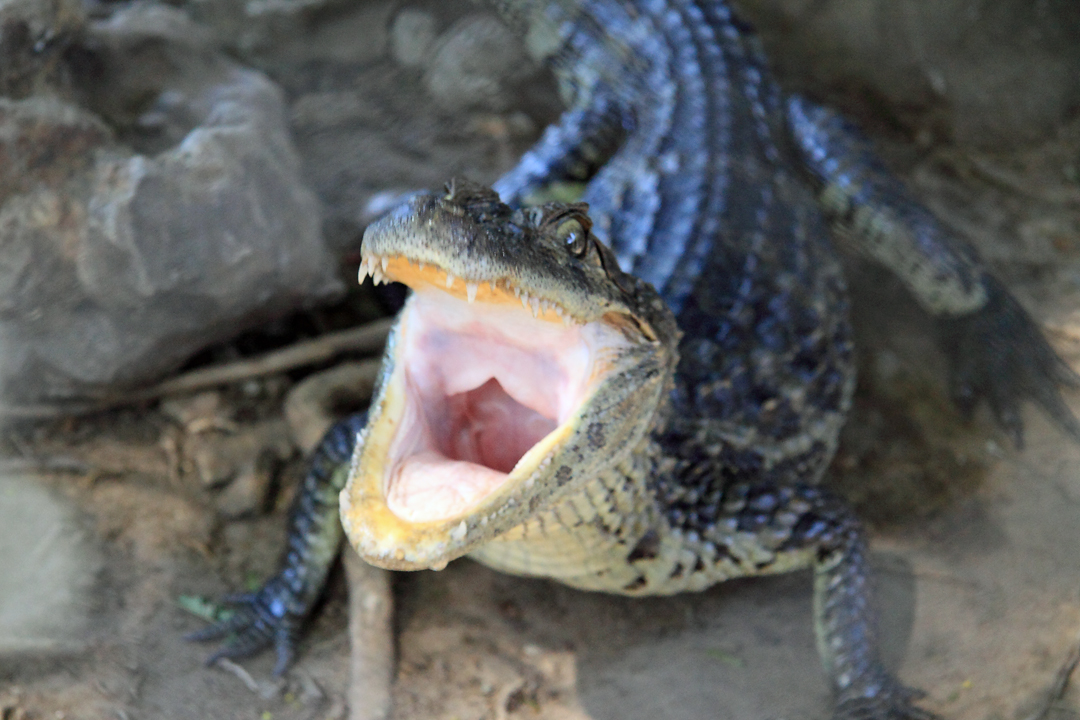
Yacaré Caimen (Caiman yacare)

Normally when you see this, you’ve already screwed up!

Burrowing owl, or ''Lechuza'' (Athene cunicularia)

The closer I got, the lower he got—spreading his wings and “snapping” his beak.

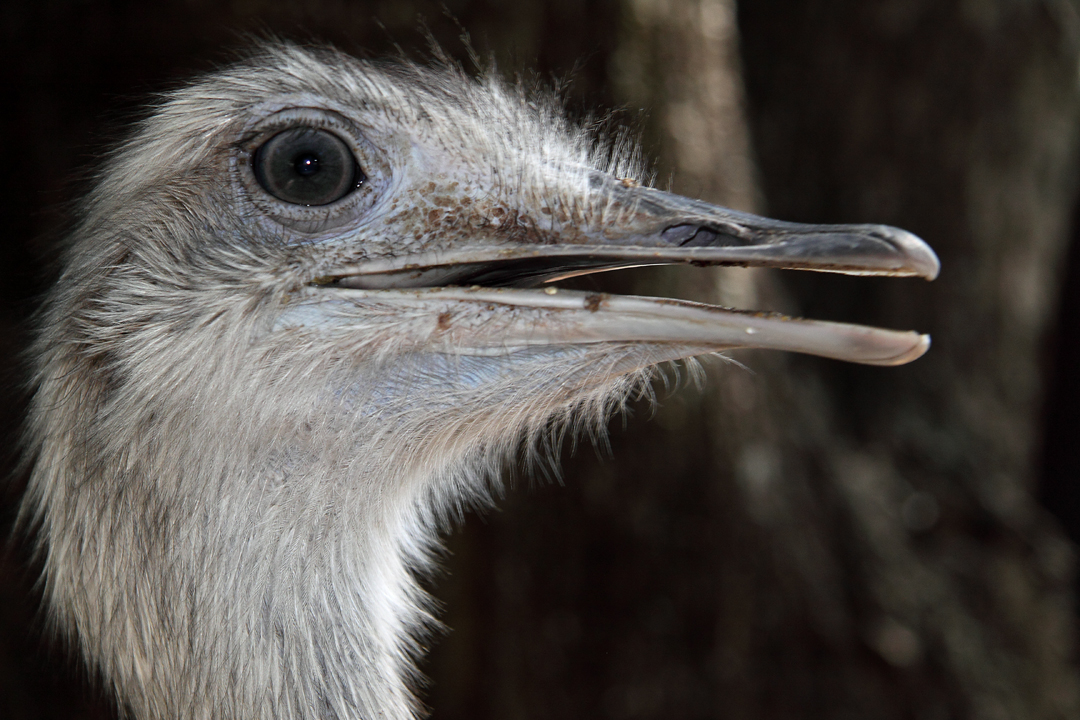
Greater Rhea (Rhea americana)

That moment of indecision between “fight” or “flight” (I’m talking about me, not the bird!).

Copyright © Ted C. MacRae 2012

Me encanta Argentina!

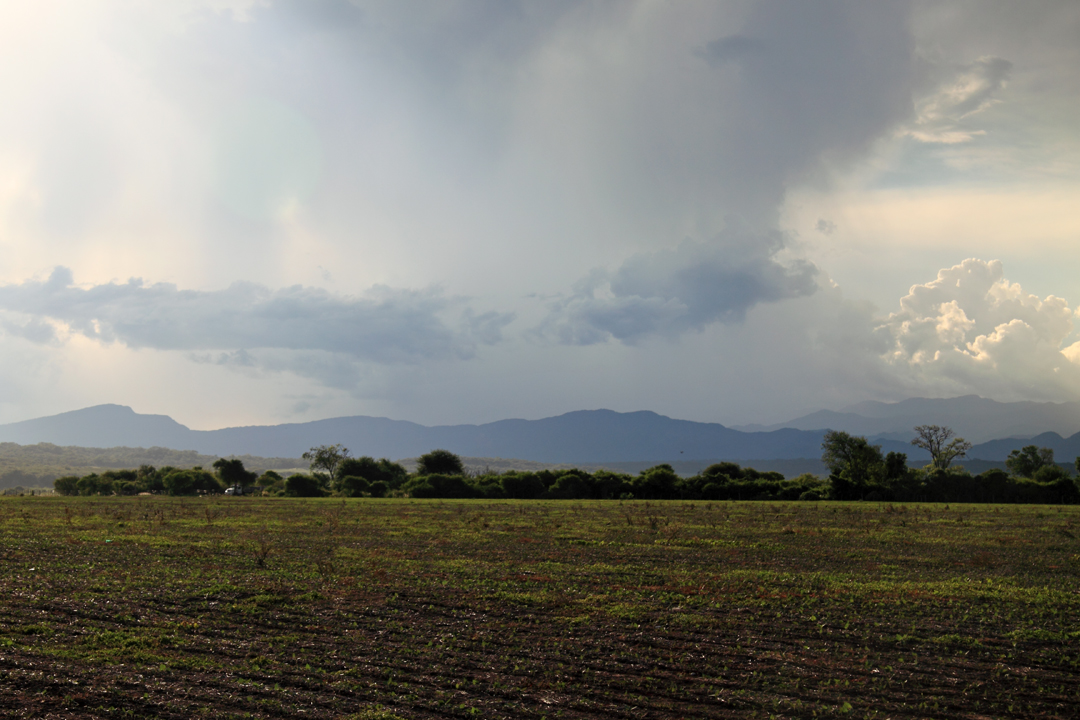
Agriculture and mountains come together in Salta Province, northwestern Argentina

For the past week or so I’ve been on a “trip within a trip.” After a few days at my home base for the next eight weeks in western Buenos Aires Province, I transferred back to the capitol and boarded a flight to the northern city of Salta. Since then I’ve covered nearly 2,000 km across northern Argentina by truck while visiting research locations. I’ve had precious little time for anything but driving, examining soybean fields, and catching a bite to eat before going to bed—only to awake the next morning and start all over again. Nevertheless, I find myself increasingly enchanted with the land and its culture and feeling more and more “Argentino” every day! By week’s end I’ll be back at my home base and ready to settle down a bit, but for now I thought I would leave you with this image captured near the northernmost extent of my trip (just a few km shy of the border with Bolivia). Ciao!

Copyright © Ted C. MacRae 2012

Return to Calico Rock

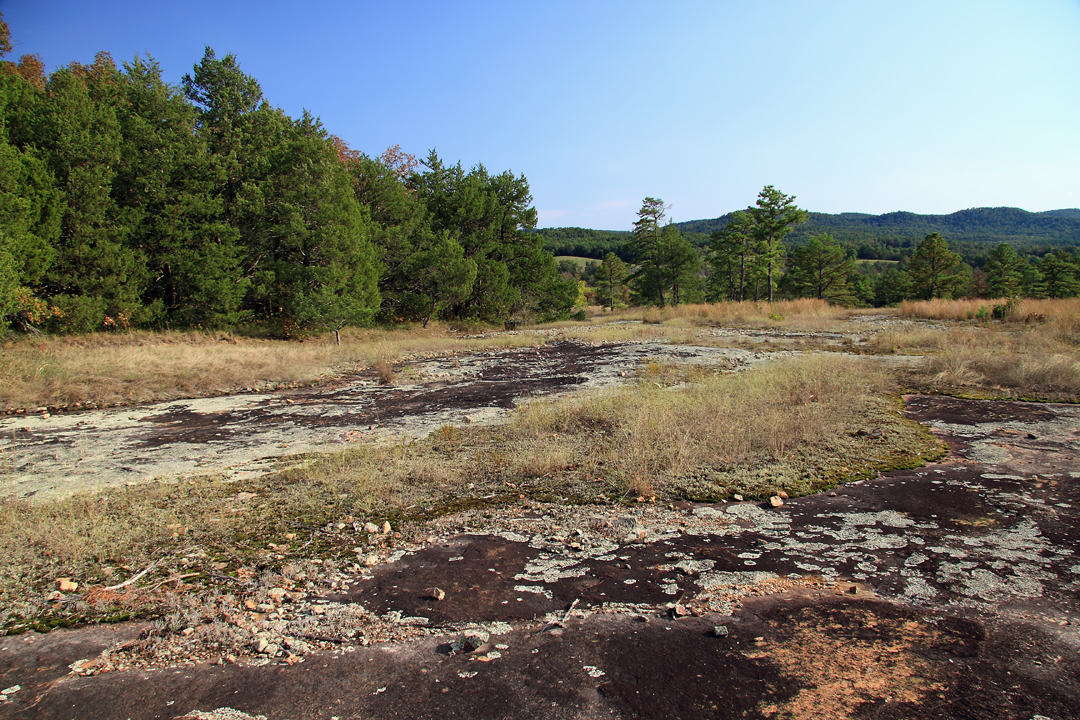
Sandstone glade | nr. Calico Rock, Arkansas.

Although western sand dune endemics were the top goals on my  during last fall’s Annual Tiger Beetle Trip, I started the trip by leaving St. Louis in the most unlikeliest of directions—south! No, I wasn’t trying to get to Denver without having to drive the tedious stretch of I-70 through Kansas. Rather, I wanted to take advantage of the chance to witness active adults of the Missouri/Arkansas disjunct population of Cicindelidia obsoleta vulturina (prairie tiger beetle)—perhaps my favorite of all tiger beetle species—on the sandstone glades near Calico Rock in north-central Arkansas. Widely disjunct from the main population’s eastern limit of distribution in central Texas, I’ve seen them at many locations in the White River Hills of southwestern Missouri and adjacent Arkansas over the past ten years, but never in the area around Calico Rock where they are best known from the state. I already had precise localities where I knew I could see them, as I had found 3rd-instar larvae earlier in the year (some of which had already emerged as adults), so I wanted see them and document the range of variability exhibited by adults at this southeasternmost known extent of the disjunct population’s distribution.

Cicindelidia obsoleta vulturina | nr. Calico Rock, Arkansas.

Although the adults were not quite as numerous as I have found them at certain sites in Missouri, I had no trouble finding them once I got to the area where I had collected the larvae this past June. While showing Steve Spomer our Missouri population last year, he commented that our Missouri adults seemed much less flighty than adults he had seen at Calico Rock. I must say that I agree with him, as I found the adults much more difficult to photograph than those in Missouri. To be honest, I had to stalk nearly ten individuals before the male in the photo above finally allowed me to get close to him. When adults are numerous this is not a problem, but in this case every failed attempt required several more minutes of searching for the next subject. Eventually, however, I got my mojo and started having success with the photographs.

Unlike true spring-fall species, mating occurs in fall instead of spring.

In the main population, and like other members of the genus Cicindelidia, adults are active during the summer months and exhibit the classic “summer” species life history. The Missouri/Arkansas disjunct population, however, shows a phenologic shift in adult activity to the cooler fall months—perhaps in response to the generally droughty conditions that prevail during the summer in this part of the country followed by rains during late summer and into fall. (This is one reason why I think this population may be deserving of separate subspecific status.) In this regard they appear to be “spring-fall” species, but their life history does not match true members of that group, which emerge during fall as sexually immature adults, hibernate during winter, and re-emerge during spring for mating and oviposition. Thus, one never sees adults of classic spring-fall species like Cicindela limbalis mating during the fall. In contrast, adults of this disjunct population emerge, mate, and lay eggs all during the fall before the onset of winter, then they’re done. The eggs hatch during fall and require another season or two to reach 3rd-instar and pupate during the summer for fall emergence.

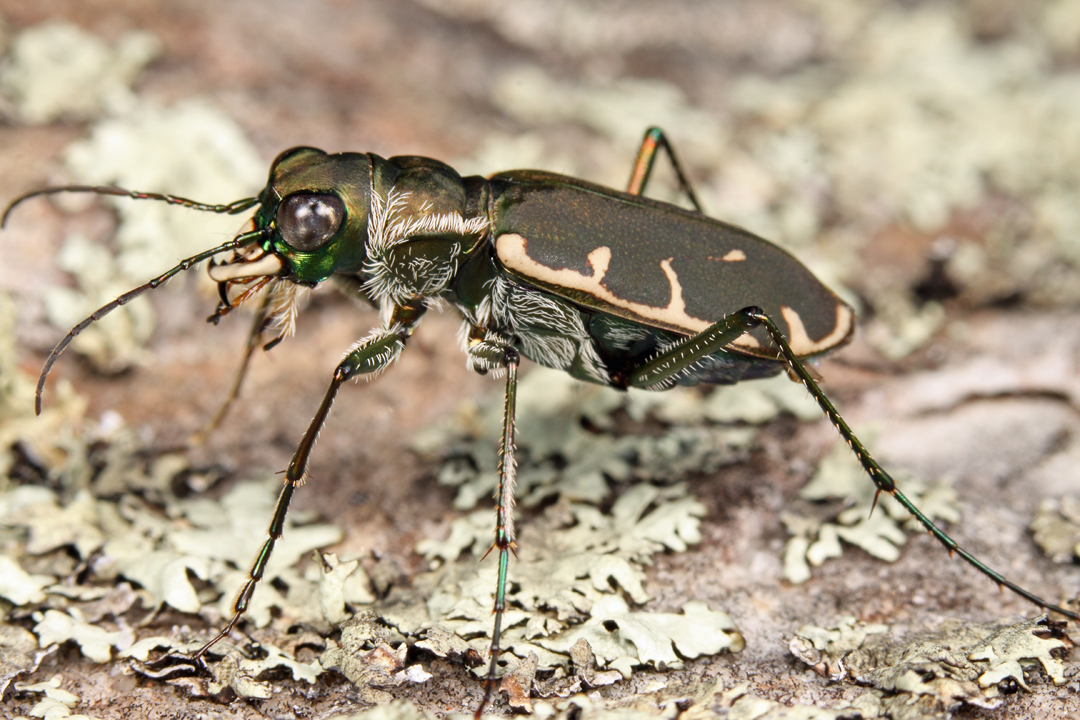
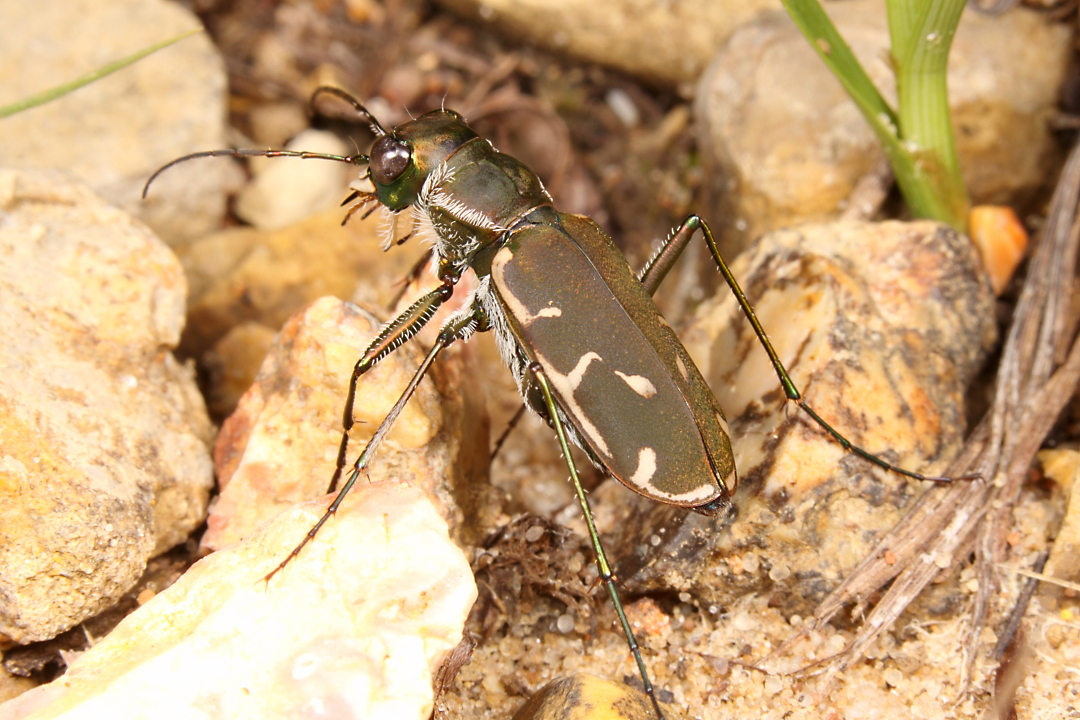
Coloration likely functions in crypsis, as shown by this individual nestled in amongst moss and lichens.

When viewed as prepared specimens in a cabinet, C. obsoleta and its subspecies are among the most conspicuous of species due to their large size (in Missouri and Arkansas only Tetracha virginica is larger), olive green coloration, and bold white maculations. More than likely, however, the combination of color and markings serve a crypsis function in their native habitat. This is clearly evident with the individual in the above photograph, who had retreated to a moss- and lichen-covered rock crevice in his efforts to evade my lens. Squint your eyes a little bit, and he almost disappears! It must be similar for visually based predators such as birds and lizards.
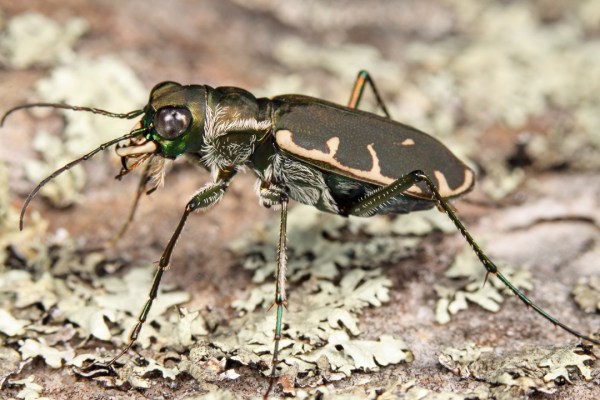
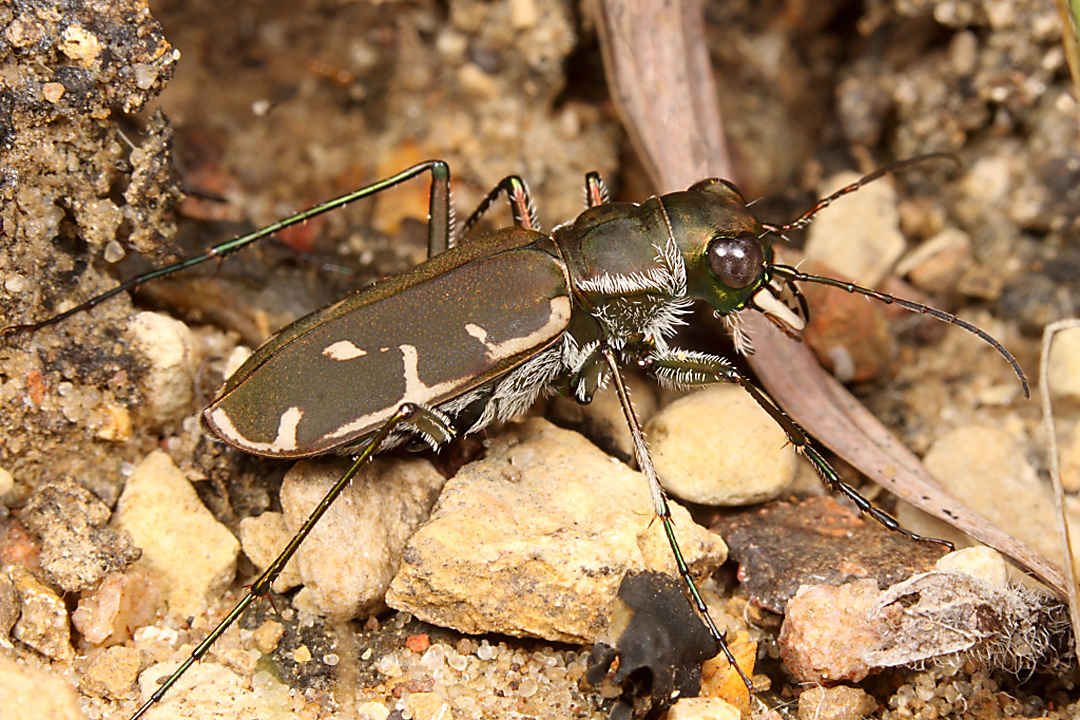
On more open ground and from a lower angle, the beetle is much more visible.

This same individual, however, becomes quite visible when chased onto more open rock surfaces (and viewed more laterally than from above). It is common to see individuals out in the open such as this, but more often than not when alarmed they fly or run to less exposed areas, relying on their cryptic coloration to avoid detection. In fact, when I follow beetles that have evaded me to the spot where I am sure they must have landed, I often fail to see them even though I am looking almost exactly in the area where they are sitting until they start to crawl and their movement catches my attention.
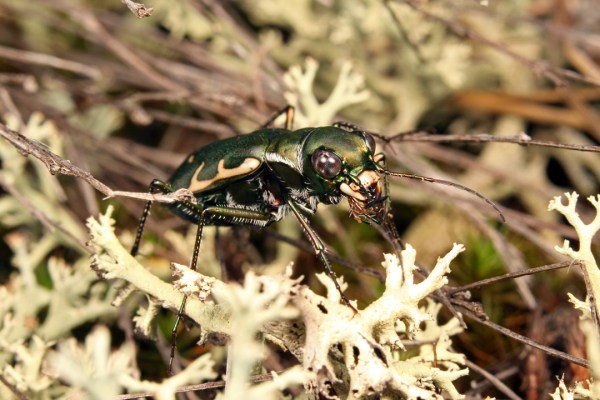
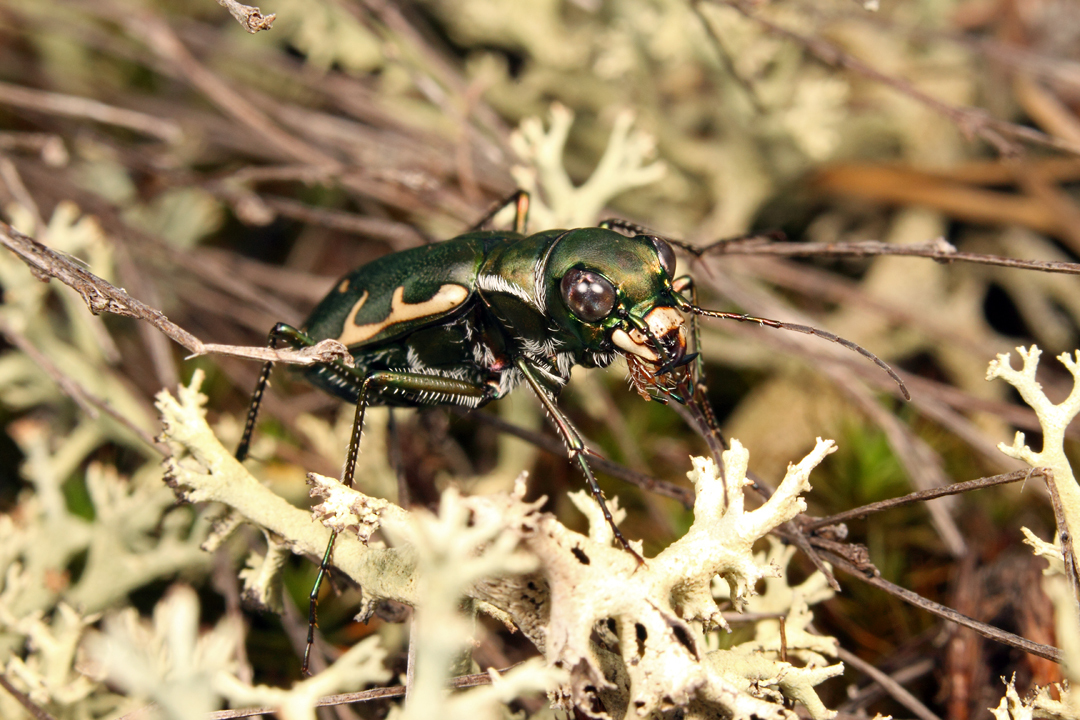
A rather greenish individual tries to hide amongst lichens and shortleaf pine duff.

I have observed a great deal of variability in coloration and maculation at locations in Missouri, with individuals ranging from bright green to dull olive-green to dark green and even brown, and the markings ranging from complete to interrupted. I saw a similar amount of variability in the Calico Rock population, with the exception of brownish (which I have only seen at the northernmost localities in Missouri) and fully maculated individuals. Most of the Calico Rock individuals were dull olive-green, but the female in the above photo (trying to evade my attentions by hiding amongst lichens and pine duff) was as bright a green as I’ve seen in any individual.

A very weakly maculate individual.

As mentioned above, I didn’t seen any individuals that I would consider fully maculated, and several that I saw were more weakly maculated than any I’ve seen in Missouri. The female in the photograph above was the most weakly-marked individual that I saw, with the lateral and median bands greatly interruped—the latter nearly reduced to small discal spots.
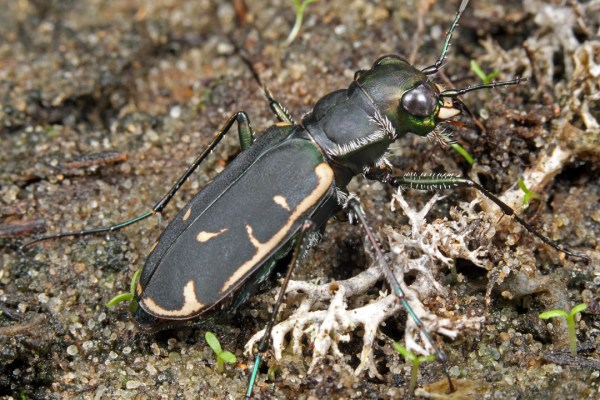
A dark, almost blackish female.

While I did not see brownish individuals as I have seen at the northernmost localities in Missouri, I did see the occasional blackish individual—the one in the above photograph also exhibiting about the greatest degree of macular development that I observed among the adults seen. My impression now is that there are clinal patterns to the coloration and macular development in this disjunct population, with markings tending to be more developed in northern localities. With the specimens collected from this and the many other locations throughout the disjunct population’s range that I have now sampled, a more critical assessment of variability in this population may now be possible.

Beetle's-eye view of sandstone glade habitat.

It has become standard practice for me to photograph tiger beetle habitats whenever I can. However, I’ve become interested recently in trying to understand how tiger beetles perceive their own habitats. While this isn’t possible to know precisely, ground level photographs can provide at least a clue into seeing the world from a beetle’s eye. I almost find this perspective of the glade habitat more interesting than the human perspective shown in the first photograph.
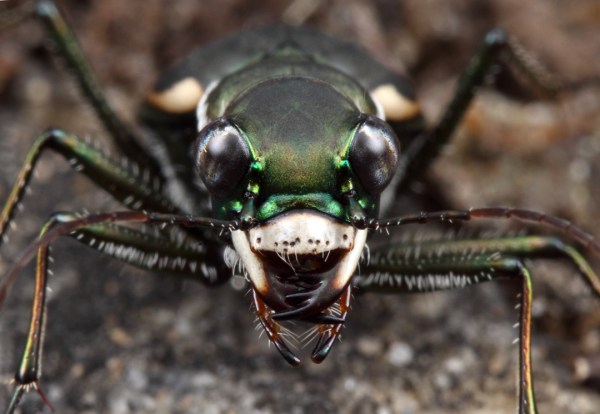
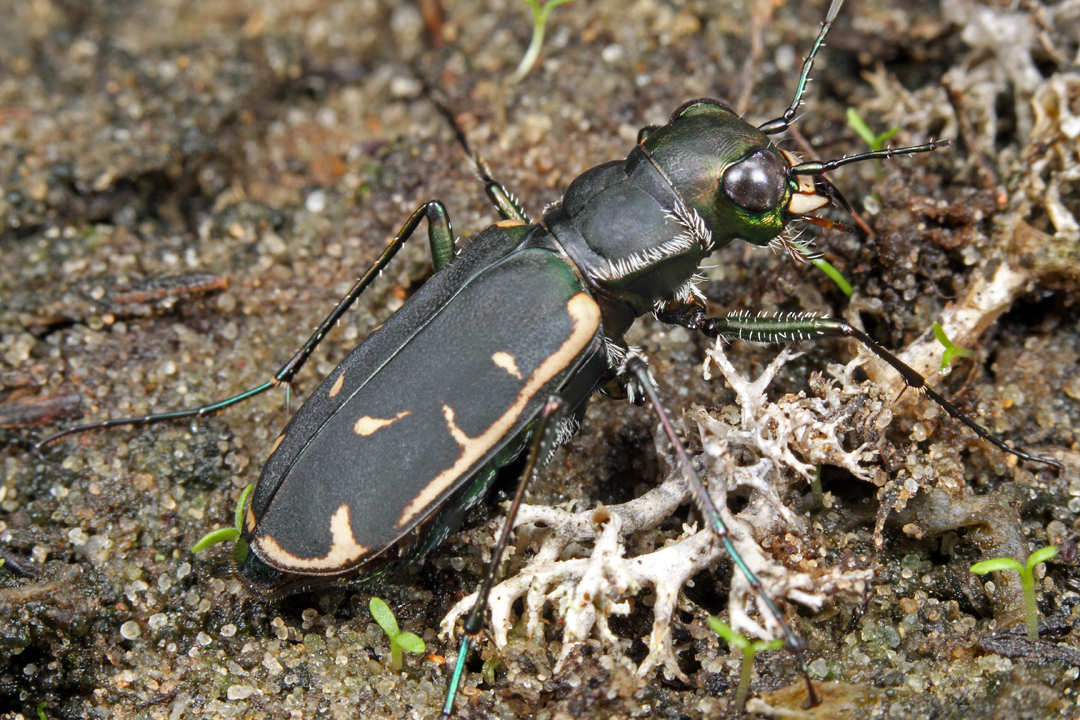
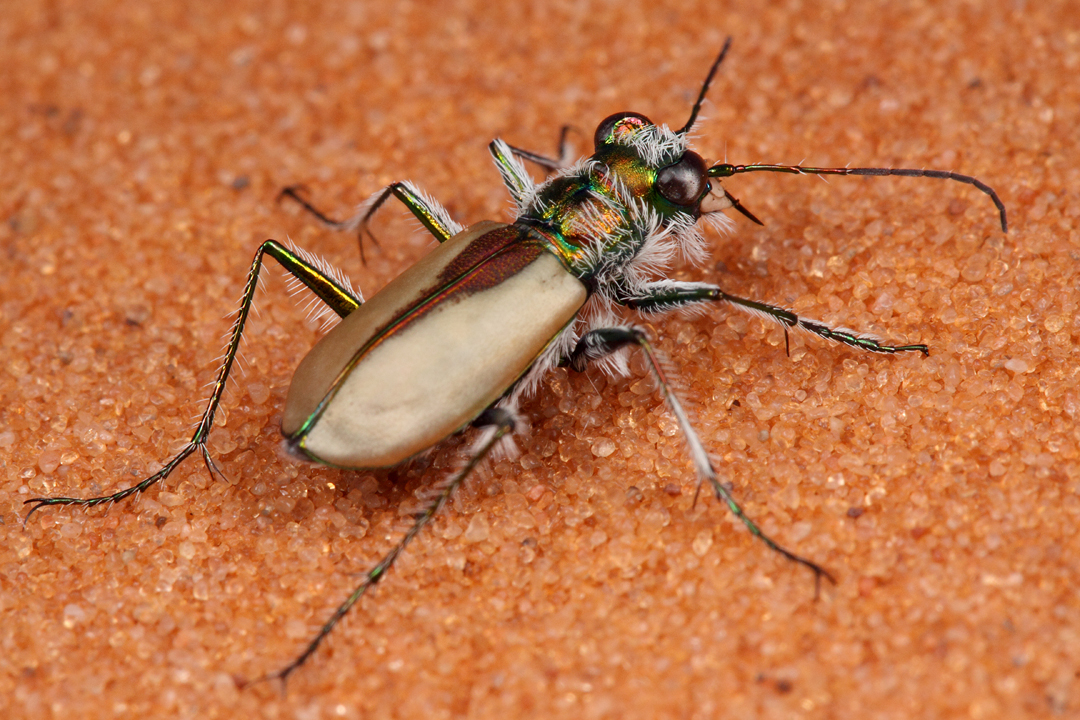
The last sight that their prey sees.

There can be little doubt about what the beetles themselves look like from the perspective of their prey. The photograph above may not properly represent the image generated by an insect’s collective ommatidia, but it certainly must be just as frightening!

Copyright © Ted C. MacRae 2012

Cicindela albissima—The Coral Pink Sand Dunes Tiger Beetle

Coral Pink Sand Dunes State Park, Utah

The week had started off good, with three species of western sand dune endemic tiger beetles (Cicindela formosa gibsoni, C. scutellaris yampae, and C. arenicola) and a variety of sometimes spectacular Crossidius longhorned beeltes having been encountered.  Mid-week, however, had brought a lull in our success—the long drive to southwestern Idaho was not rewarded with finding C. waynei, endemic only to Bruneau Sand Dunes State Park, and an even longer drive was required to backtrack and then drop down to the southwestern corner of Utah in hopes of finding the equally rare and restricted C. albissima.  Had it not been for our continued success with different species and subspecies of Crossidius longhorns the drive might have felt like a lesson in futility.  Still, on a collecting trip a new day and new locality brings new hope, and anticipation grew as we passed through lodgepole pine forests on stunning black lava fields and wind-carved red sandstones on the final approach to Coral Pink Sand Dunes State Park.

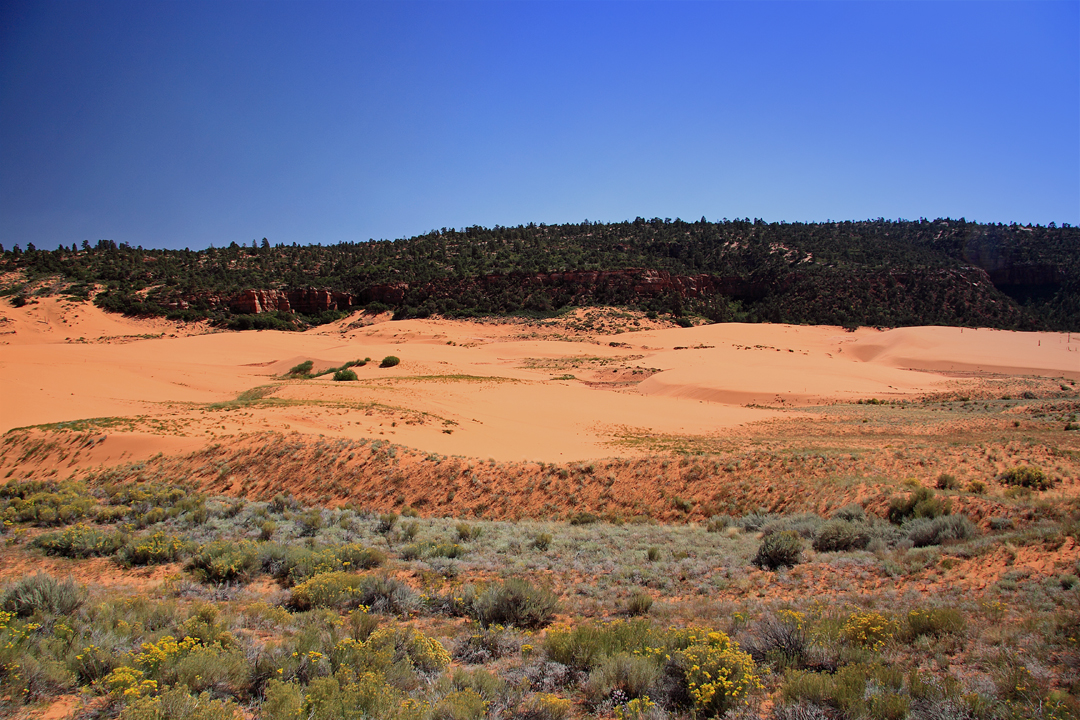
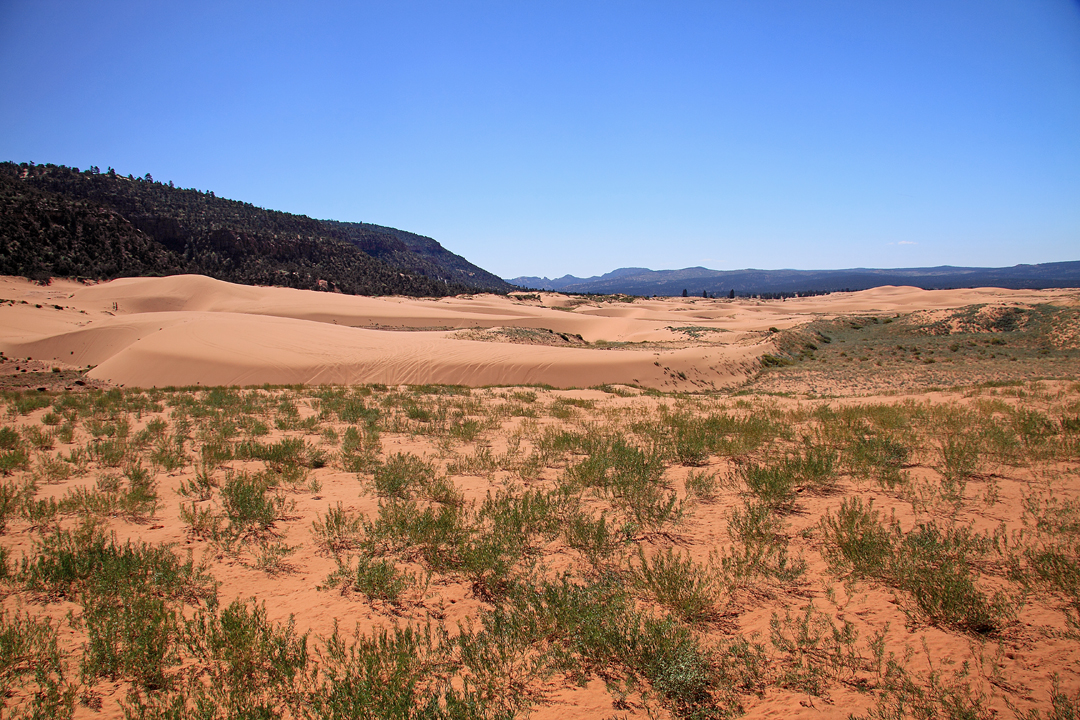
Colored pink by iron oxide minerals, the dunes are estimated at 10,000 to 15,000 years old.

Words cannot describe the stunningly spectacular landscape that unfolded before us as we entered the park.  The scenery alone makes Coral Pink Sand Dunes worthy, in my humble opinion, of National Park status, but it is C. albissima—occurring only on the park’s vivid pink dunes and nowhere else in the world—that makes this place truly special.  Precisely where in the park the beetle lives is a matter of public record, as Chris Wirth (author of the intermittent but highly focused blog Cicindela) and Randolph-Macon College Professor Emeritus Barry Knisley have produced a wonderfully detailed and well illustrated brochure about the beetle and its life history, population trends, and limiting factors.  What remained to be determined was whether the beetles would be active during the brief window of time available to look for it.  Cicindela albissima is a so-called “spring-fall” species in reference to the bimodal adult activity period, but activity in the fall is much less predictable than in the spring depending on moisture availability.  The day was perfect—temperatures in the 70s by mid-morning, only a light breeze, and a sharp, blue, cloudless sky.  All we could do was look.

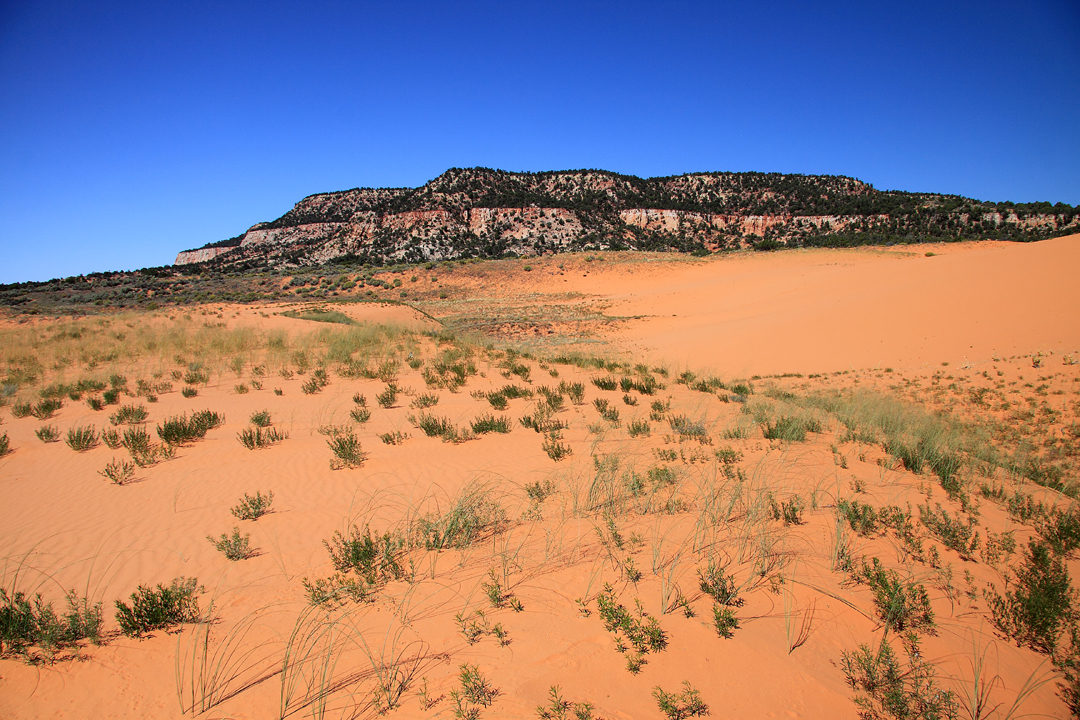
Adult beetles were found on the northern edge of this dune. A majority were seen amongst sparse vegetation rather than barren areas.

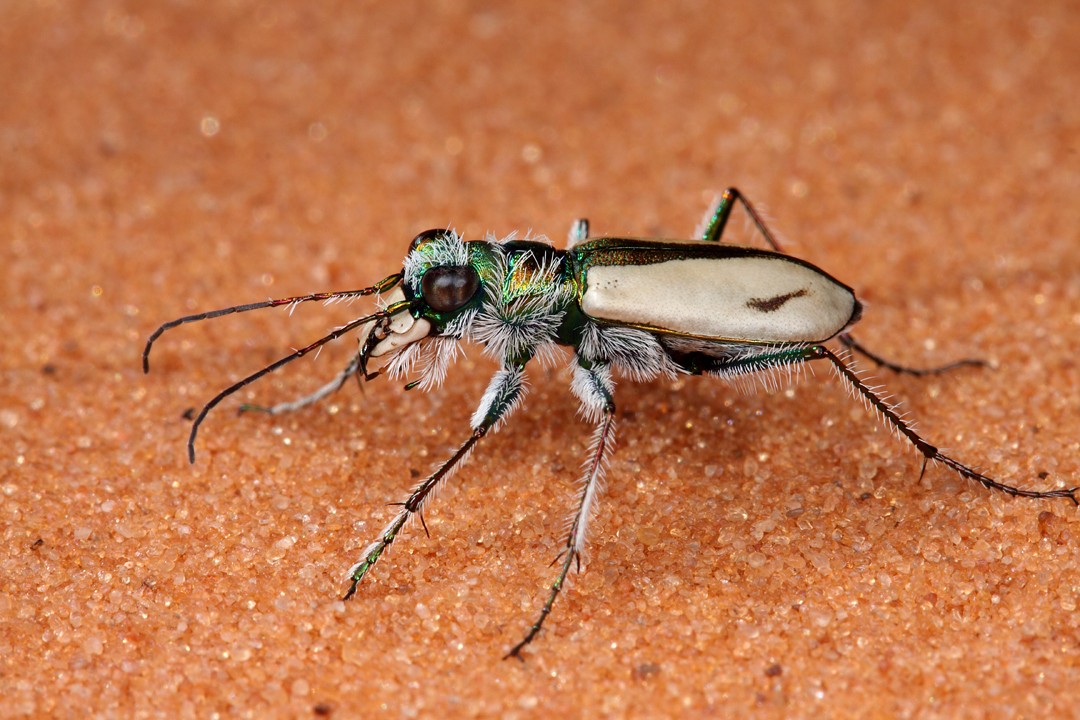
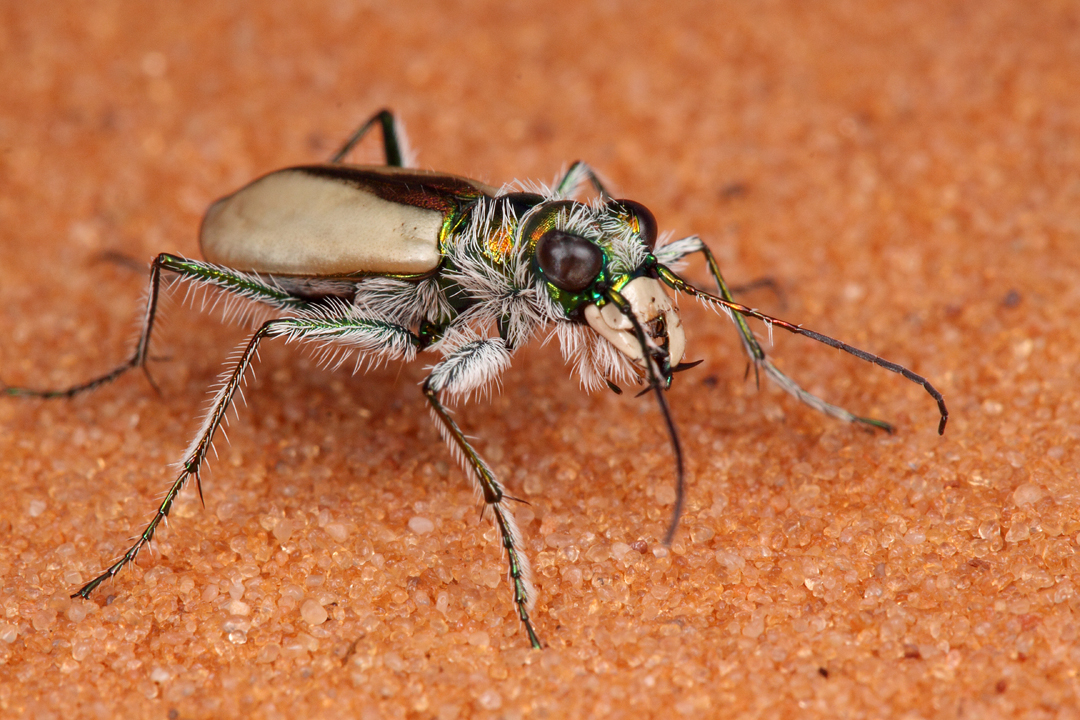
It didn’t take long really to find them, as the adults were already out in encouragingly strong numbers. Of the several dozen adults we saw, all but one were seen atop the northern edge of one particular sparsely vegetated dune.  I suspect the larval burrows were at the bottom of the steep northern dune escarpment in the more stable wind-scoured sandstone clays that lay between individual dunes.  Vivid white and floating across the sand on long delicate legs, the elegance of their beauty was a stark contrast to the harshness of the surrounding landscape.  With a miniscule range of only 400 hectares, C. albissima is one of North America’s rarest tiger beetles, and I felt truly priviledged to join the small ranks of those who have seen this beetle alive in its native habitat and could appreciate the significance of the event.  Of course, the sense of accomplishment would not be complete unless I also succeeded in photographing the species in the field, and although the adults were quite wary and active, I was happy with several of the photos that I ended up with.  Similar to what I observed with C. arenicola, adults amongst the vegetation seemed slightly less skittish than those out in the open, so it was in the vegetated areas that I concentrated my efforts.  My only regret was not adding extension tubes to allow some real closeup portraiture, but the beetles seemed far too wary to have put up with the decrease in working distance that would have entailed.  At any rate, here are some of my favorites:


What the future holds for C. albissima remains unclear.  Designation of the beetle’s home range as a preserve (albeit tiny) would seem to offer long term protection, but a  large portion of this area is open to off-road vehicular traffic (although not a single one was seen during the time that we were there).  An even greater threat exists in the potential for extended drought affecting the entire population, and as greenhouse gases continue to accumulate in the atmosphere the chance of impacts from unusual weather events only grows. I feel lucky to be among the few that have witnessed this beautiful species in nature, but I sincerely hope I am not among the last.

ORV tracks can be seen just outside the conservation area boundary

Copyright © Ted C. MacRae 2011

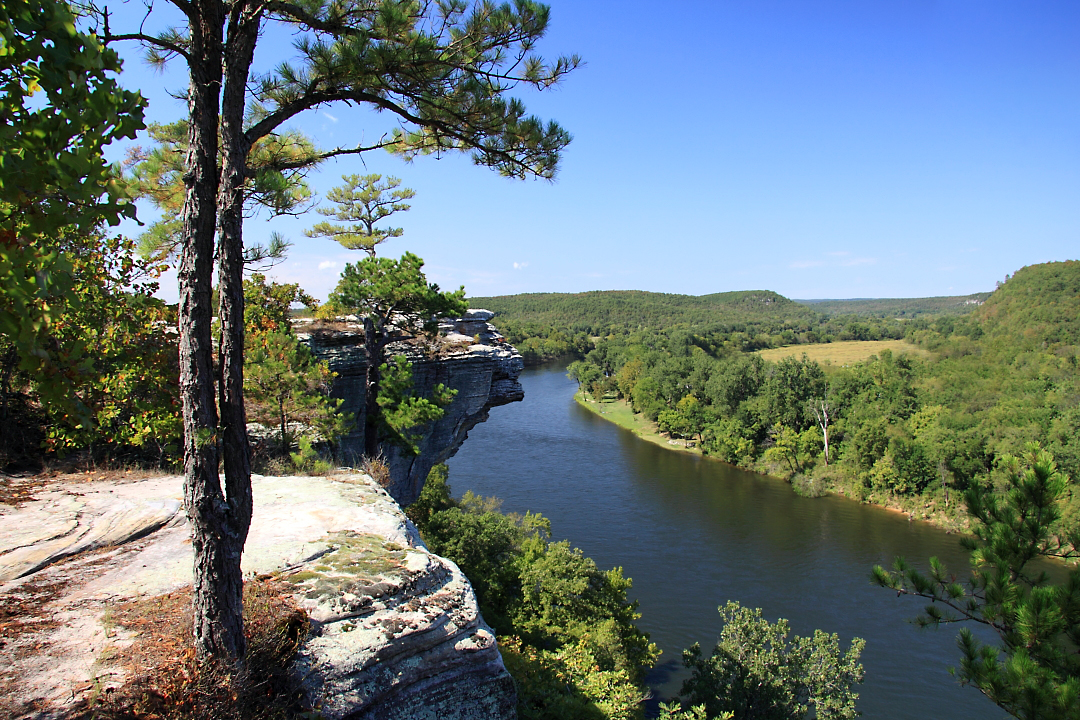
Ozark Landscapes – White River in northern Arkansas

White River near Calico Rock, Arkansas

One of my favorite insect collecting sites is a system of sandstone glades in the White River Hills of north-central Arkansas. Overlooking the White River as it courses past the quaint little town of Calico Rock, the glades atop these towering bluffs host a rich diversity of insects—some attracted from the surrounding woodlands, others restricted only to the glades. I had not visited the area before this year but went there five times this season—twice in June, once in July, once in August, and once in September.  Of the many insect species I found here this season, some of the more interesting include:

Copyright © Ted C. MacRae 2011

Two things I love about glades during fall…

…prairie dock (Silphium terebinthinaceum) in bloom…

Prairie dock (Silphium terebinthinaceum) in bloom | Caney Mountain Cons. Area, Ozark Co., Missouri

…and prairie tiger beetles (Cicindelidia obsoleta vulturina) on the prowl…

Prairie tiger beetle (Cicindelidia obsoleta vulturina) | Caney Mountain Cons. Area, Ozark Co., Missouri

On the last weekend of August I made another trip to the White River Hills of north-central Arkansas in a last gasp effort to confirm the occurrence in the area of the swift tiger beetle (Cylindera celeripes).  Records of this species include a single individual collected in 1996 at a site near Calico Rock, but two trips to the area this past June had already failed to reveal its presence.  I didn’t really expect that I would find it this time either, and such was the case.  However, what I was expecting/hoping to see was the beginning of the fall emergence of the prairie tiger beetle.  The Missouri/Arkansas disjunct population of this handsome species is perhaps my favorite tiger beetle of all, not only because of its good looks but because of the many spectacular fall collecting trips I’ve taken through the White River Hills to look for it.  In this regard I had success, although only two individuals were seen all day long.  The area around Calico Rock seemed dry, apparently having been missed by the thunderstorms that rolled through the area a week earlier and that would have surely triggered full bore adult emergence. 

Long Bald Glade Natural Area, Caney Mountain Cons. Area, Ozark Co., Missouri

The following day I returned to Caney Mountain Conservation Area on the Missouri side, where last fall I had finally found prairie tiger beetles after years of searching what must be the extreme northeasternmost limit of its distribution.  Fresh evidence of recent rains was seen, and accordingly the beetles were out in fairly decent numbers in the same area where I found them last fall.  I took the opportunity to photograph a few individuals (which I had not done last year) and then turned my attention to looking for other insects.  I had my eye out for the spectacularly beautiful bumelia borer (Plinthocoelium suaveolens) and eventually found one.  I hoped also to see the marvelously monstrous Microstylum morosum (North America’s largest robber fly), which I found at this site in 2009 as a new state record and was rewarded with two individuals (these will serve as vouchers for the state record, since I didn’t collect it in 2009).  Temperatures were rather warm and both of these latter species are traditional “summer” species; however, the presence of prairie tiger beetles, the tawny tinge to the prairie grasses, and the noticeably longer shadows under a deep blue sky told me that fall was, indeed, on the way.

Prairie tiger beetle (Cicindelidia obsoleta vulturina) | Caney Mountain Cons. Area, Ozark Co., Missouri

While prairie tiger beetles are (at least for me) the most iconic harbinger of fall in the White River Hills, another classic fall sight was the thick stands of prairie dock plants with their tall, bolting flower spikes.  In Missouri this plant serves as a larval host for the longhorned beetle Ataxia hubbardi.  In my early years of collecting in Missouri’s glades, I delighted in finding adults of these beetles clinging to the flower stalks during fall—presumably laying eggs from which larvae would hatch and bore down into the tap-root.  Although commonly regarded as a pest in sunflower in the southern Great Plains, individuals associated with prairie dock in Missouri’s glades seem different—smaller, narrower, and darker—than those found on sunflower and other more common hosts.  Additional material will be needed to make a final assessment on whether these individuals represent a distinct taxon; however, I have not been able to find this species on prairie dock in Missouri since I moved back to the state nearly 16 years ago.  The reason for this sudden disappearance remains a mystery, and perhaps it is purely coincidental that the Missouri Department of Conservation began managing all of their glades with prescribed burns during my previous 5-year absence from the state.  In the meantime, I will continue to examine prairie dock stems every fall in the hopes that once again I will find the beetles and be able to come to a decision about their taxonomic status.  Perhaps I should re-focus my efforts in “low quality” (i.e., never-burned) gladey roadsides rather than our state’s “high quality” (i.e., high floral diversity) natural areas.

Copyright © Ted C. MacRae 2011

Oedipodine Rex

Sandstone glade habitat for Trimerotropis saxatilis | vic. Calico Rock, Arkansas

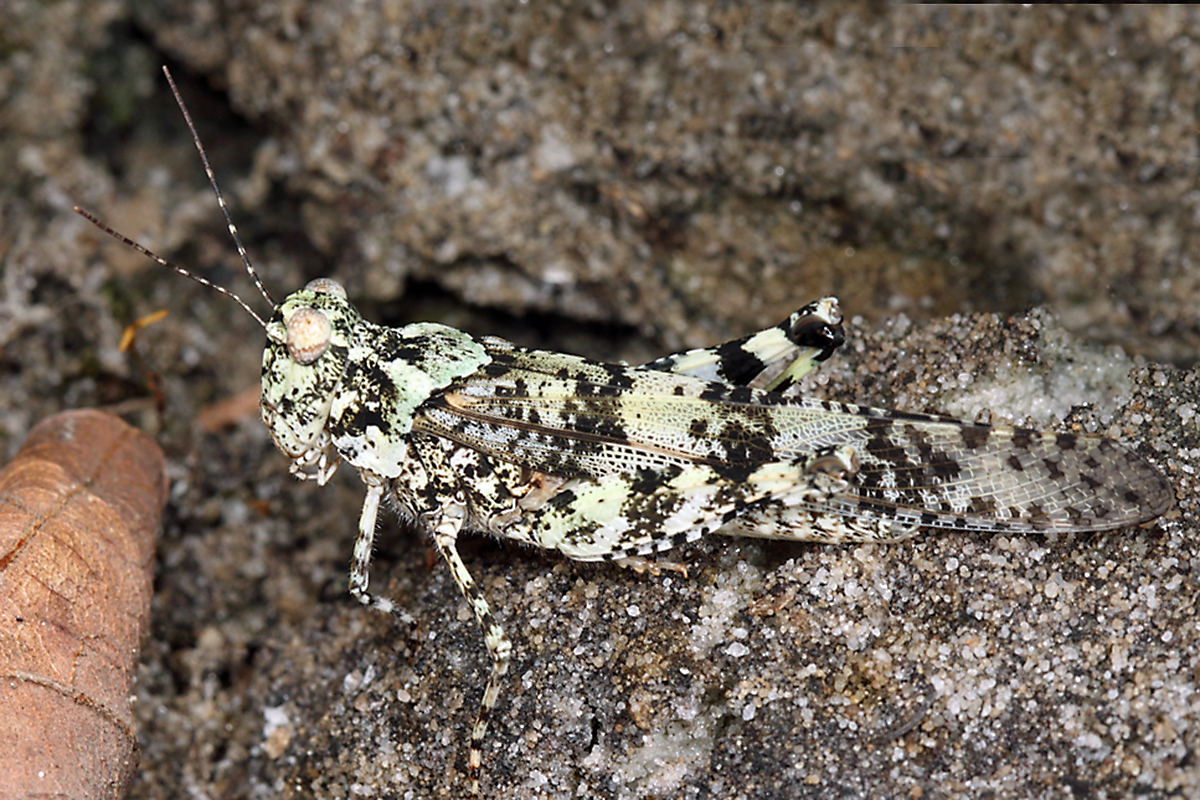
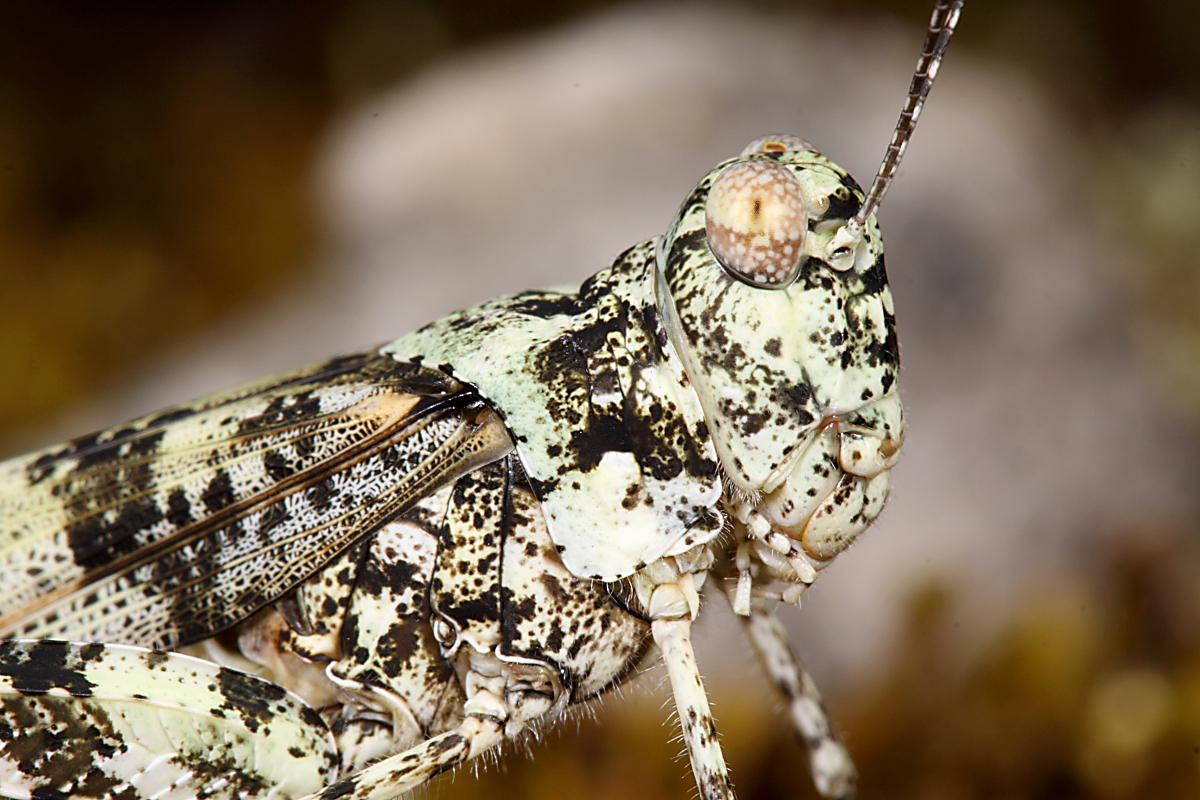
Ever since my current fascination with band-winged grasshoppers (family Acrididae, subfamily Oedipodinae) began, I have been obsessed with photographing one species above all others—Trimerotropis saxatilis, the lichen grasshopper. Like most species in the group, lichen grasshoppers utilize an interesting survival strategy that I call “conspicuous crypsis”—the use of stunning colors and contrasting markings to help them blend into the mottled and variably-colored environments that they inhabit.  Lichen grasshoppers take this strategy to the extreme, culminating in some individuals with the most gorgeous shade of blue-green in perfect match to the crustose lichens that cover the rock outcroppings of their preferred glade habitats.  In my opinion, they are the kings of the oedipodines!  I have seen them before in past years in the igneous and sandstone glades that dot the Ozark Highlands of southern Missouri.  Crustose lichens abound in these acid environments, providing the perfect backdrop to make invisible these otherwise conspicuous grasshoppers. This past June during a couple of visits to a marvelous sandstone glade complex near Calico Rock in north-central Arkansas I got my wish, and shown here are some of my favorites from the many, many photographs I took during those sessions.

Trimerotropis saxatilis with classic lichen-green coloration.

Lichen grasshoppers are actually quite variably colored—not all individuals exhibit the green coloration for which they are so famous.  Despite this, they are the only member of the genus occurring in the eastern U.S. and, thus, are immediately recognizable.  While they are beautiful in all of their color variations, I cannot lie—it is the green individuals that I constantly find myself admiring the most.  While many other grasshoppers are green, only a handful (themselves members of the same subfamily) exhibit the same stunning shade of blue-green that this one does.  Add to that an abundance of black speckling and contrasting bands, and you’ve got one gorgeous grasshopper.  Yet, for all their overt beauty, they are absolutely impossible to see in their native habitat until they take flight when approached.  Fortunately, their escape flights are short and not terribly erratic—with a little practice it becomes rather easy to track them in flight (aided by their interrupted buzzing crepitation) and watch where they land.  They may not be immediately visible after landing, but with careful study of the landing area they are usually quickly relocated.  Once detected, slow deliberate movements are all that are needed to allow a close approach and a good look (and photographs if desired).

The stunning green contrasts starkly against a dark moss backdrop.

Of course, the problem with ‘conspicuous crypsis’ (or any form of crypsis, for that matter) is that it only works when in the right environment.  I chased the above lichen-colored individual onto this patch of dark moss while trying to photograph it, at which point it became overtly visible.

The mottling of the colors is almost as fascinating as the colors themselves.

As previously mentioned, lichen grasshoppers come in a variety of colors and shades.  While the green individuals may be the most stunning, I was captivated also by the below individual, darker brown and black, with the most beautiful, contrastingly colored orange eyes.  This individual may not blend in as well as the green individuals when sitting on lichen-encrusted rocks; however, its coloration and patterning seem perfectly adapted to the more barren, darkly colored rock exposures.  This helps explain why not all lichen grasshoppers are green—the rock exposures in the glades that they inhabit are not uniformly lichen-encrusted, but rather consist of both encrusted and barren expanses of rock, with diverse coloration being a result of multiple and sometimes conflicting selective pressures.

A darker brownish individual with spectacular orange eyes.

A third individual, shown in the photograph below, resembles the second in that it is more brown than green.  However, the base coloration is lighter with greater contrast to the dark bands.  Like the second individual the eyes are spectacular orange, but it also exhibits a green shading on the back of the head behind the eyes not seen in the second individual.

Another brownish individual, this one more contrastingly marked.

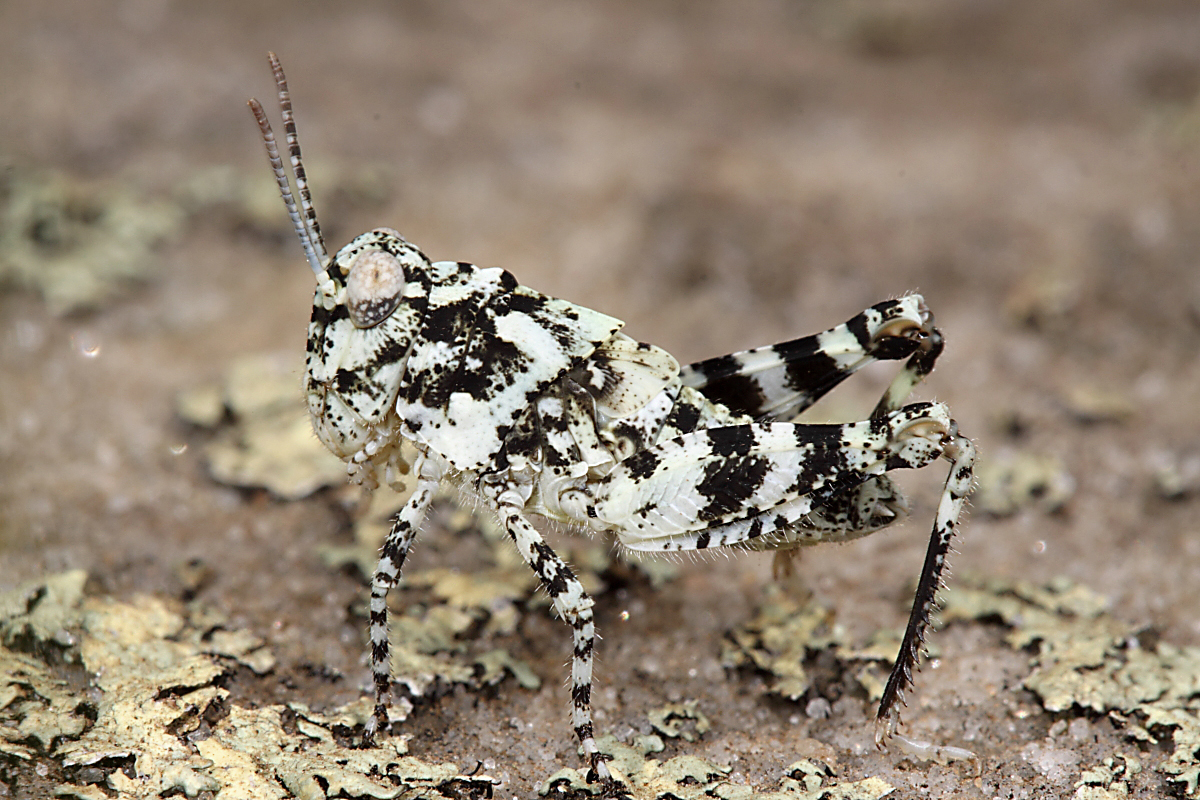
Not only did I find the adults, but I also found a rather young nymph that certainly represents this species (I’m guessing maybe 3rd instar based on the degree of wing pad development).  This nymph exhibits the same stunning green coloration that the first individual above shows, and its fortuitous occurrence on both lichen-encrusted and (relatively) barren rocks provide an excellent demonstration of the effectiveness of its coloration in achieving crypsis—now you see me…

The lichen-colored nymph is easily seen against barren rock...

…now you don’t!

...but blends in marvelously amongst the lichens.

Copyright © Ted C. MacRae 2011

My Dad (reprise)

I first wrote this post on Father’s Day 2008. It didn’t appear on Beetles in the Bush, but rather my other blog, the now largely defunct Bikes Bugs and Bones.  My dad is my hero, my confidant, and my best friend.  It’s hard watching him age, but it would be even harder not to.  I repost on this day in his honor and urge everyone to honor their own father is some small way.  Happy Father’s Day!

Me and my dad | Pickle Springs Natural Area, St. Genevieve Co., Missouri, Dec. 2007

My dad had knee replacement surgery a couple days ago. The surgery went off without a hitch, and he’s doing very well. All signs are that he will bounce back quickly and suffer few, if any, complications. I’ve spent much of the past three days here at the hospital—sometimes providing support and encouragement, other times just keeping him company. He should be released tomorrow, and I’ll spend the rest of the week with him at his house—hopefully he’ll be able to get around okay by then.

Some thirty years ago, my dad got an infection that settled in his left hip. By the time doctors found it and figured out what was going on, his left hip socket had degenerated badly, and the only medical option after cleaning up the infection was a year in a full body cast that resulted in fusion of the socket with the femoral head. This left him with a left leg two inches shorter than his right, a bad limp, and a lifetime of pain medications. His right leg became his ‘good leg’ and his left became the ‘bad.’ Decades of walking with a cane and favoring his bad leg put a lot of pressure on his good leg, and at age 73 his right leg had had enough. Now, his good leg is his bad leg, and his bad leg is, well, still his bad leg. This will add a wrinkle to his recovery, since he won’t have a healthy leg to carry the load while his good leg recovers. But I will be there to help, if needed, and in a few weeks his good leg should be good as new.

My dad is not only my dad, but also my best friend. We have a relationship that is based on mutual love and respect, and I don’t know which of us appreciates more what we have with each other. It wasn’t always this way—my dad and I were estranged for 25 years starting when I was 10 years old. My parents married far too young, and each had their own issues—they were but children themselves. Having first me, then my brother and sister, only delayed but could not prevent the inevitable break up that resulted in my fathers absence. I paid a heavy price by not having a father during those crucial, formative years as I finished growing up, but I seem to have turned out okay regardless. It would take many years before I would be ready for something so bold as reconciliation, but maturity and the support of a loving wife eventually made it possible. There were difficult questions to answer, but through it I realized that my father had paid a heavy price as well. Not the selfish irresponsible man I had been taught about, instead I saw a sensitive, deeply introspective man who had lived a life of hard knocks, suffered the consequences, learned from his mistakes and turned his life around.

My dad loves to ride bikes. I do too, but I did not learn the love of cycling from him. My dad is simple yet elegant, with an understated class that people adore. I, too, try to show respect and modesty, but I did not learn these things from my father. We both love classical music (he can live without the metal), listen to NPR, and enjoy humor with more than a touch of irreverence—tastes acquired by each of us before we knew each other. What I have learned from my father during these past 15 years is why I am me—a gift I didn’t know I lacked. I don’t mourn the loss of those 25 years spent without my father, rather I rejoice at the very special relationship that we now have—perhaps possible only because of our separate pasts. My father describes that year in a body cast as the darkest period of his life. I did not know him then, so I could not be there to help him through it. While his recovery from knee replacement will not be near that ordeal, neither will it be easy. But I am here with him, and I know in my heart that whatever difficulties he faces during his recovery, he will look back on this as a small part of the best time of his life.

Copyright © Ted C. MacRae 2008