Hawn State Park – Winter Hiking at its Finest

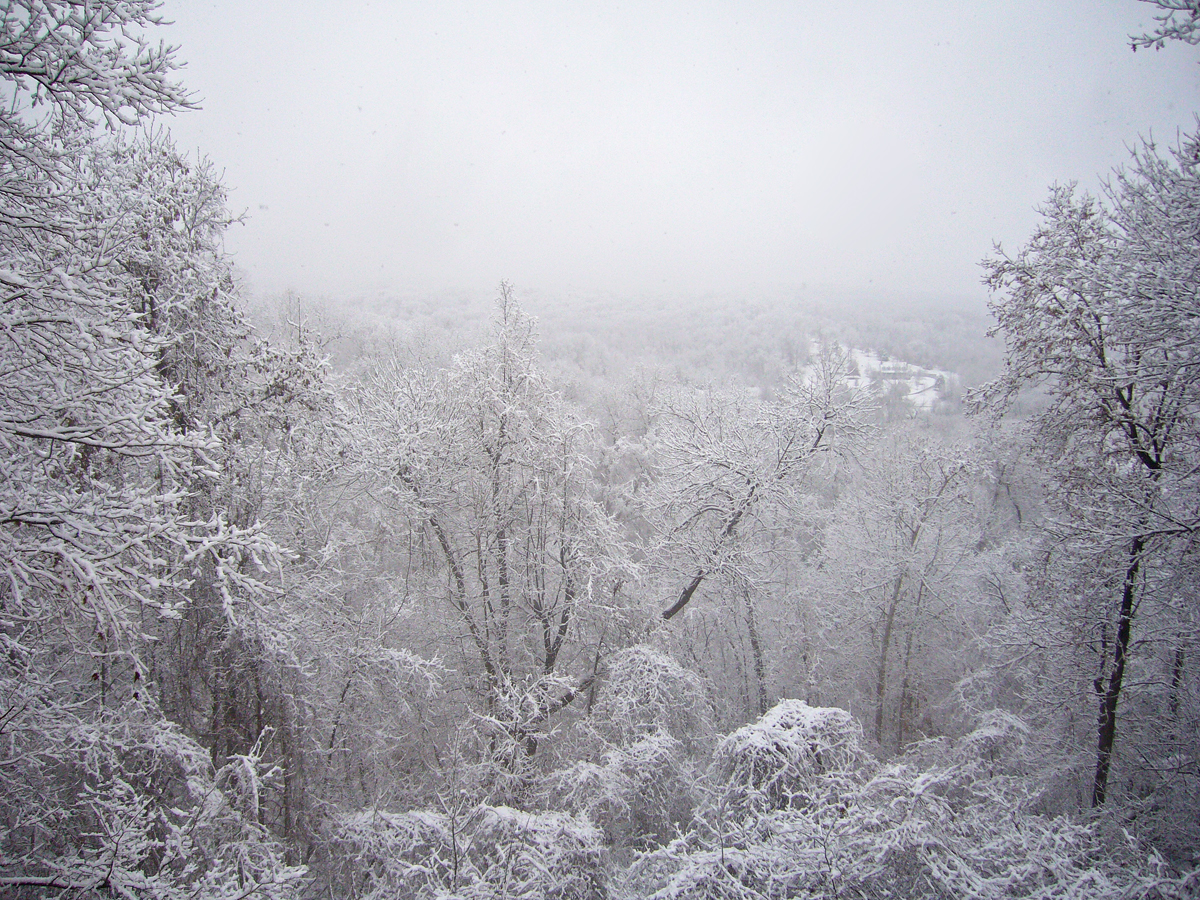
Two weekends ago we received another wave in what has been an unusually frequent series of snow events. I’m sure my northern (and Patagonian) friends are not impressed, but at our middlin’ latitudes snow falls rather infrequently and rarely sticks around for long when it does. This winter has been different, with snowfall almost every week, it seems like, and temperatures that have remained cold enough to keep it around for awhile. While this latest snowfall measured only a modest 1-2 inches here in the St. Louis area, a 7-inch blanket (as measured by my hiking stick) fell in the Ozark Highlands just south of here. Coming as it did at the start of the weekend, I welcomed the opportunity to go for a hike — among my favorite wintertime activities — in a landscape that is rarely seen covered in deep, newly-fallen snow. My daughter Madison loves hiking as much as I do (even in deep snow), so the two of us headed off to perhaps my favorite of Missouri’s public areas, Hawn State Park.  I have long adored Hawn for its premier hiking, facinating geology, and unusual flora, and everytime I visit Hawn I find something new to love about it.  
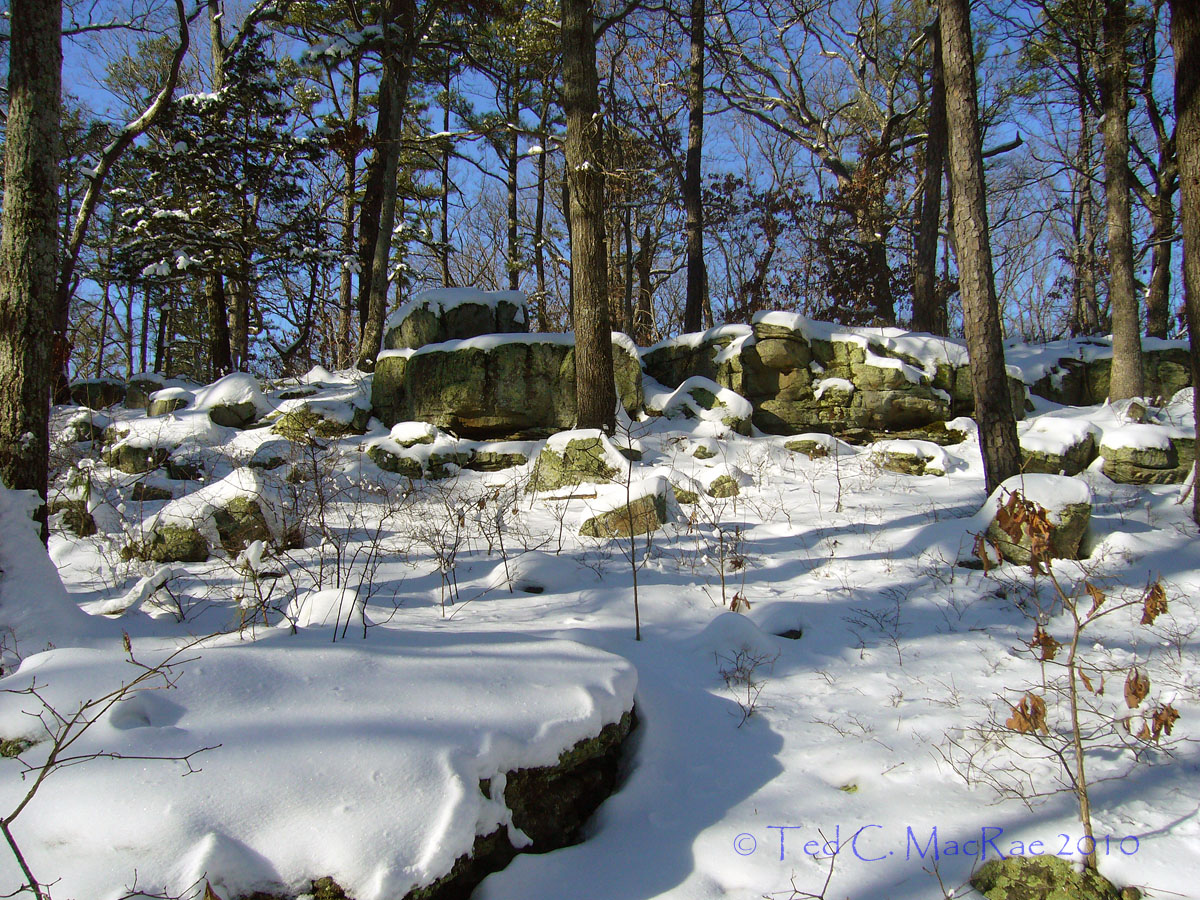
Lamotte sandstone outcrops on the White Oaks Trail


Such was the case on this visit, when Madison and I decided to explore the White Oaks Trail, a newer trail that I had not yet hiked.  I was a little concered whether we would even be able to get to the park, as the road leading into it had only been partially plowed (and we had already seen one car off the road, causing me to reach down and switch on the 4-wheel drive).  Most of the park was snowed in, but we were able to reach the uppermost parking area, leaving our snow-covered trail-finding abilities as the last obstacle to overcome.  After studying the trail map and looking at different route options, I asked Madison if she wanted to hike 2 miles, 4 miles, or 6 miles.  She immediately blurted out “6 miles!”, so off we went.  I was disappointed to see that we were not the first persons to have the idea, as we entered the trail only to find two sets of footprints (one human, one canid) leading off in front of us.  It did, however, make following the trail easier, and in fact I’ve had enough experience finding trails through the Ozark Highlands that I never felt like I needed the footprints in front of us to point the direction.  

Madison next to the root wad of an 83-yr old wind-thrown oak tree.


The White Oaks Trail followed nicely up-and-down terrain through mature white oak (Querucs alba) (appropriately) upland forest dissected by small riparian valleys before settling into relatively mild terrain through monotonous black oak forest.  Just when I thought the trail wouldn’t match the splendor of Hawn’s Whispering Pines and Pickle Creek Trails, it wrapped around to the south at the far end and passed by a beautiful hoo-doo complex of Lamotte sandstone outcroppingss supporting majestic, widely-spaced, mature shortleaf pines (Pinus echinata).  The rock outcrops provided a perfect spot to break for lunch while looking out on the deep, snow-covered valley in front of us.  
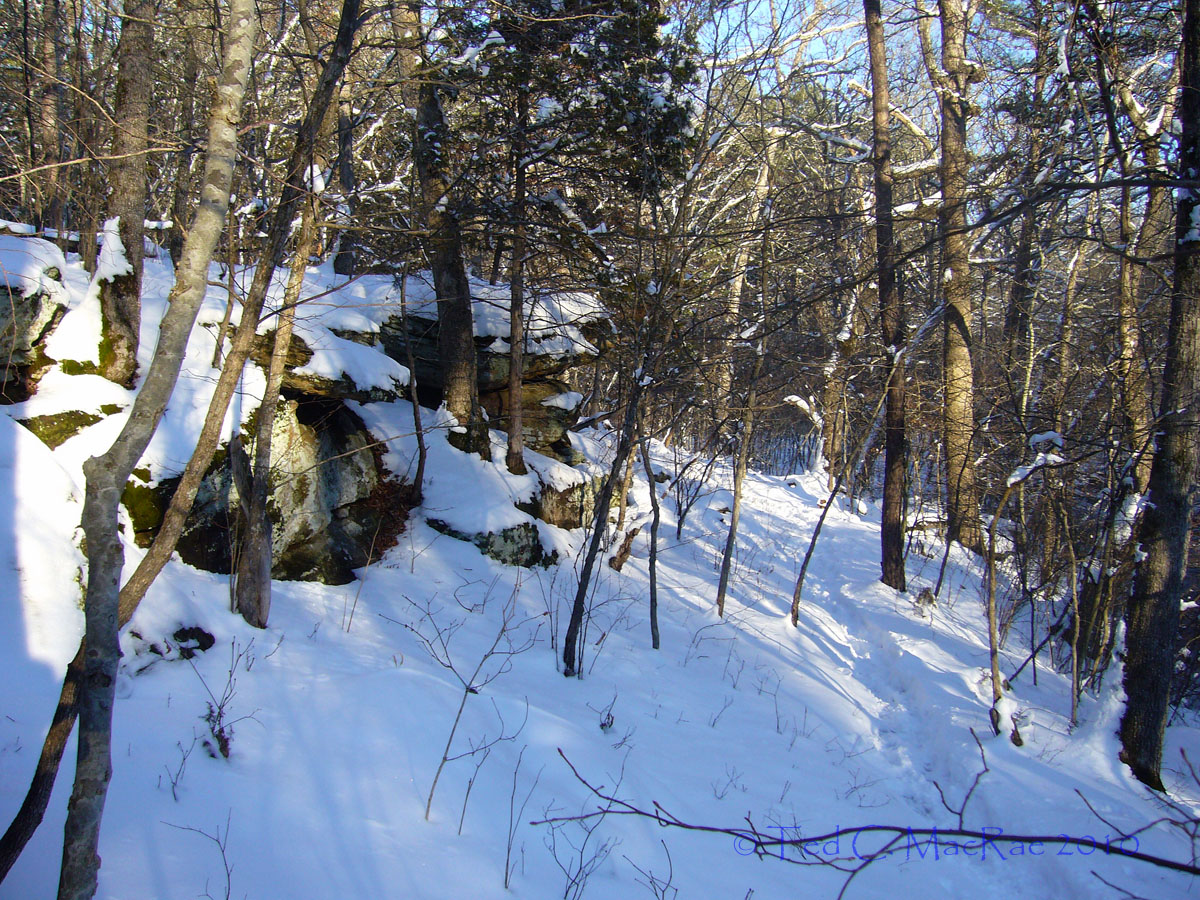
More Lamotte sandstone exposures along Pickle Creek, Whispering Pines Trail.


After counting a cut, wind-thrown black oak (Quercus velutinus) and determining a lifespan of 83 years, we took a connector trail down to the Whispering Pines Trail where it ran alonside the incomparably beautiful Pickle Creek.  Our hope was to hike down to the igneous shut-ins, where hard, pink rhyolites channeled the creek’s clear, spring-fed waters through narrow chutes and miniature gorges.  Upstream from the shut-ins, Pickle Creek runs lazily through the softer Lamotte sandstones that overlay those ancient rhyolites, combining with the snow cover to create a scene as peaceful and serene as any I’ve ever witnessed.
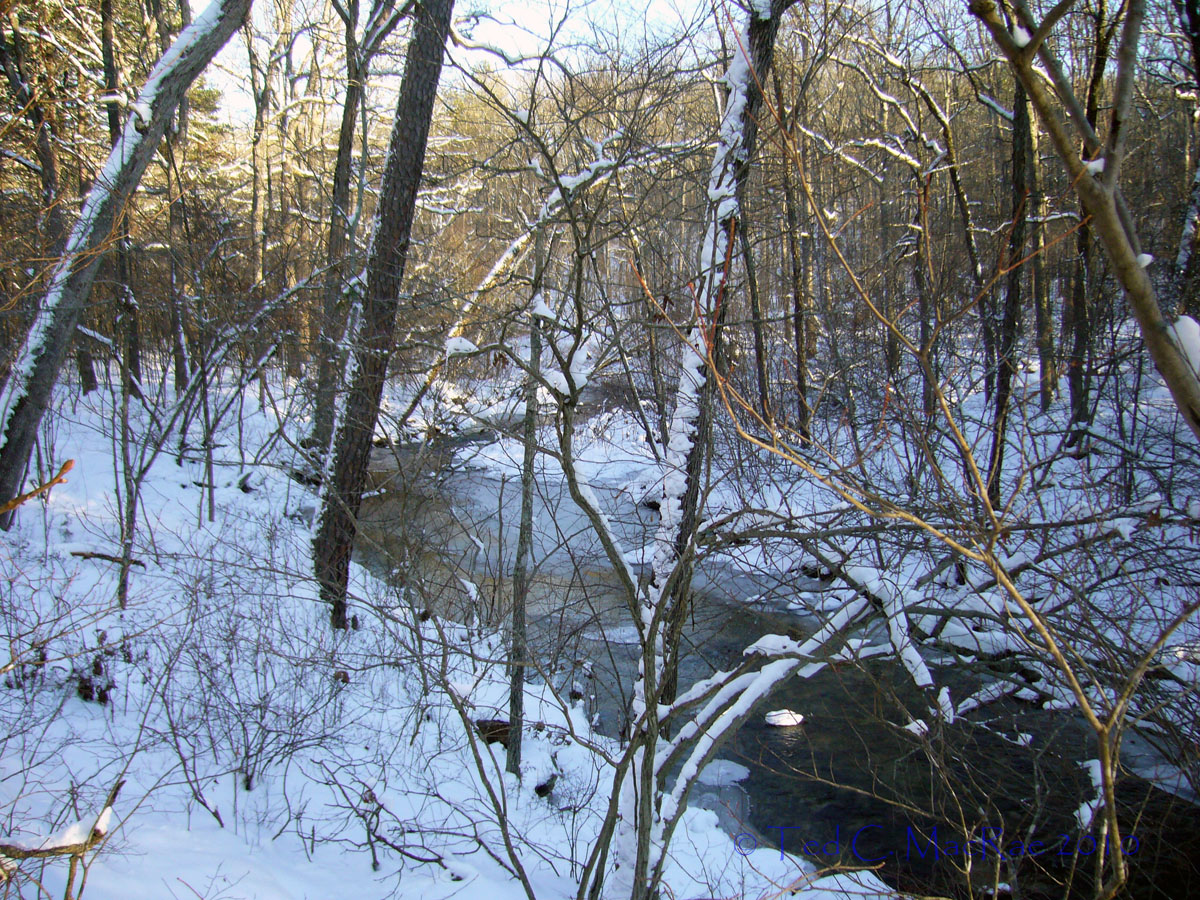
Pickle Creek meanders lazily through Whispering Pines Wild Area.

  
Just above the shut-ins, Pickle Creek bends to the west, carving deeply into the soft sandstone.  The porous nature of the rock allows moisture to trickle through and between the strata from the hillside above, creating seep zones that weaken underlying layers and lead to their collapse.  The abundant moisture this winter and continuous cycles of daytime thawing and nighttime freezes have resulted in extraordinary ice formations along the bluff face and underneath the overhanging layers, the likes of which are rarely seen in our normally more open winters.  Compare the scene in the first photo below with that in the second, taken at almost exactly the same spot one year ago in February 2009.  

Icicle formations along Pickle Creek, Whispering Pines Trail.


Same place as above in February 2009.


Ice rarely forms over the small ponds and lakes that dot the Ozark Highlands, much less its creeks and other moving waters.   The scene below of Pickle Creek as it exits the sandstone gorge is a testament to the slowness of its movements and the unusually consistent cold temperatures experienced during the past several weeks.  Only a short distance downstream, however, these lazy waters reach the bottommost layers of the erodable sandstones and encounter the hard rhyolites below.  These half-a-billion year old layers of igneous rock are much more resistant to the wearing action of water, which rushes noisily through narrowly-carved chutes before fanning out in broad sheets over smooth, steep slopes below.  

Pickle Creek along Whispering Pines Trail.


Sadly, there would not be time to visit the shut-ins.  The short February day conspired with our snow-slowed pace to leave us with a too-low-sun by the time we reached the fork in the trail that led to the shut-ins, a mile in one direction, and our car, a mile in the other.  Although we (both) had thought to carry flashlights (just in case), the last thing I really wanted to do was find myself stumbling over snow-covered trails through the dark with my 10-yr old daughter. Even had we survived the nighttime winter woods, I might not have survived the inevitable maternal reaction to such an escapade.
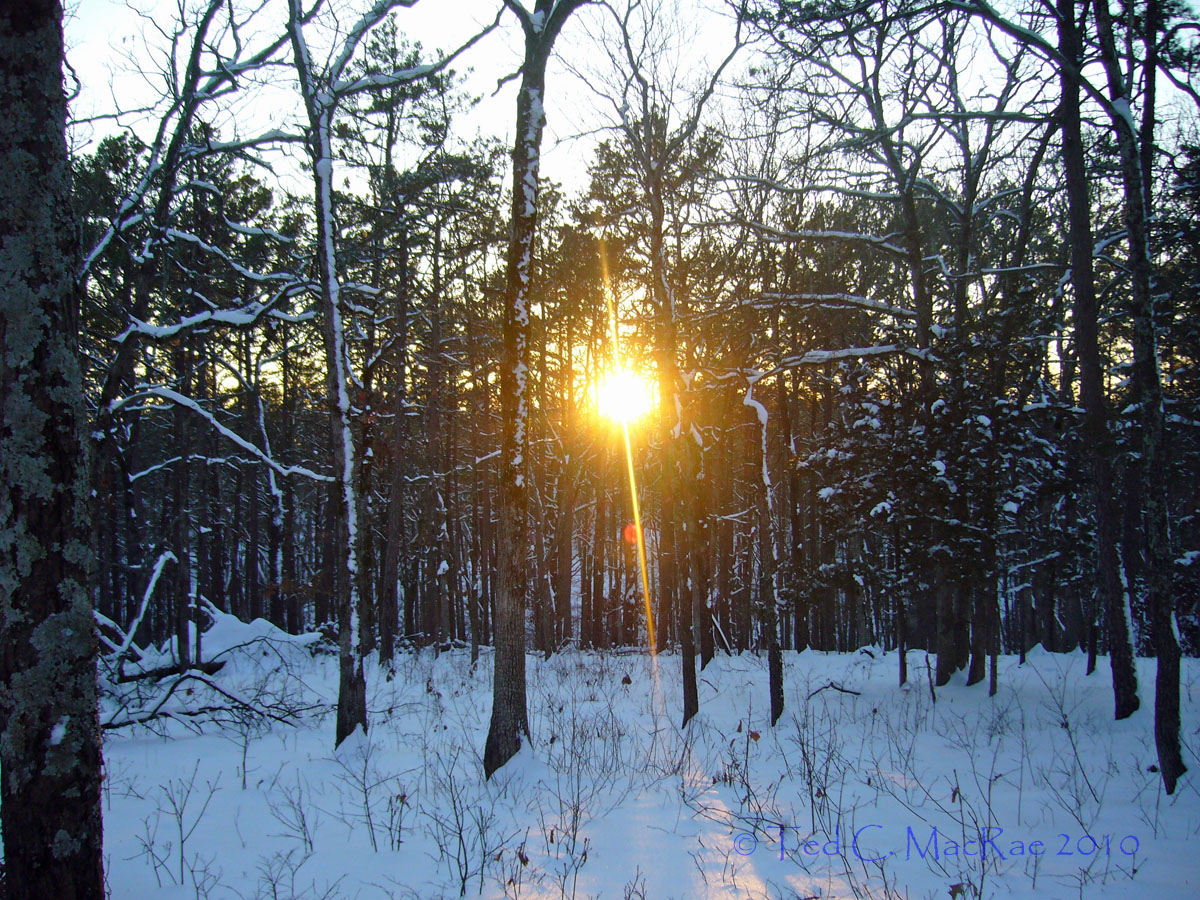
Arriving back at White Oaks Trailhead with a few minutes to spare.


Copyright © Ted C. MacRae 2010  

Add to FacebookAdd to DiggAdd to Del.icio.usAdd to StumbleuponAdd to RedditAdd to BlinklistAdd to TwitterAdd to TechnoratiAdd to Yahoo BuzzAdd to Newsvine  

Email to a friend

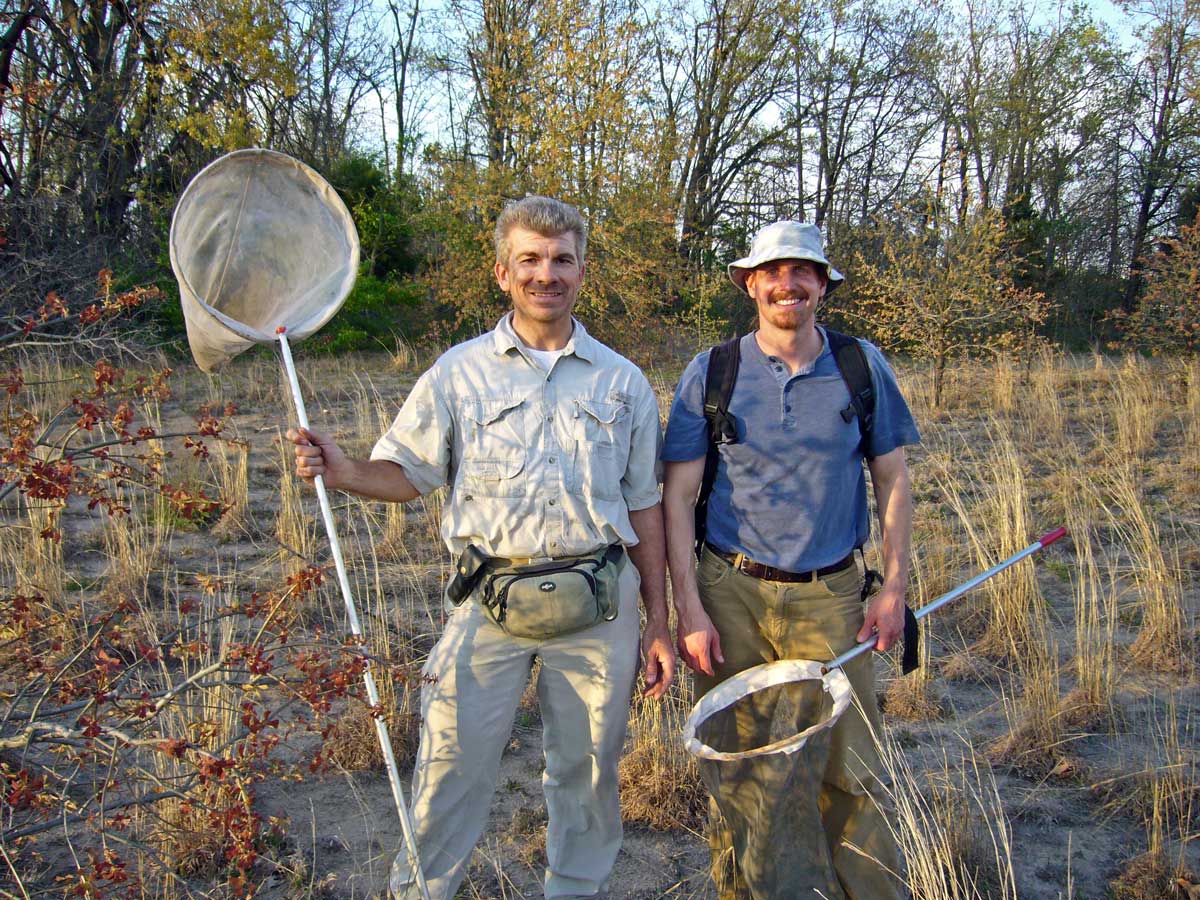
Me and my buds!

Those of you who have followed this blog for any length of time have seen repeated references to my friends and colleagues, Chris Brown and Rich Thoma. Rich and I have been collecting insects together for almost 25 years now (since shortly after we bothed first moved to the St. Louis area), and Chris has joined us in the fun for the past ten years as well. It is rare when all three of us can get out in the field together – meshing hectic professional and family lives with the sometimes coincident, sometimes divergent insect collecting goals of three fathers can be challenging. Nevertheless, at least once or twice a year we manage to converge on a date and enjoy each other’s company out in the field. I don’t think I’m ever happier than when I’m in the field (well, except when one of my daughter’s nestles into my lap to watch a movie!), and the chance to share that experience with close friends of like interest is especially gratifying.

Chris is quite an accomplished insect photographer himself, having been at it for much longer than I’ve known him and providing me great coaching as I’ve begun testing the waters myself. Recently, he sent me some photos from our 2009 field trips to the lowlands of southeastern Missouri and the Loess Hills of northwestern Missouri. Those were two exciting trips, revealing new localities for Cicindela scutellaris, the discovery of Cylindera celeripes in Missouri, the rediscovery of Ellipsoptera macra, and even a new state record robber fly.  The sharing kind of guy he is, he’s granted me permission to post them here (plus one taken by Rich Thoma).

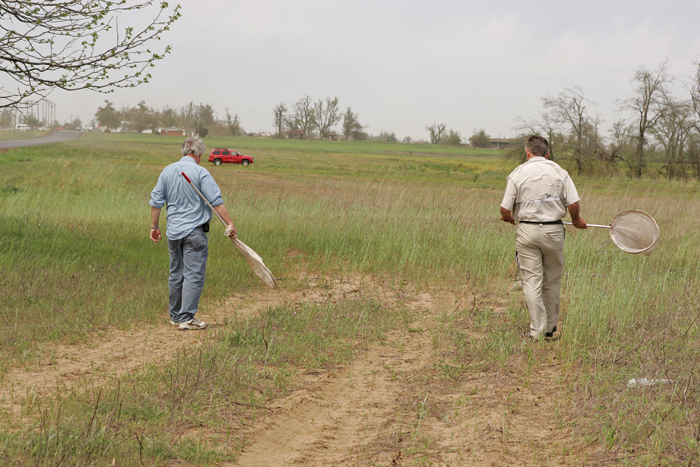
Rich (left) and Ted scan 2-track through sandy ground in the southeastern lowlands looking for tiger beetles.

Ted and Chris take a break from looking for tiger beetles in a sand prairie relict. Photo by Rich Thoma.

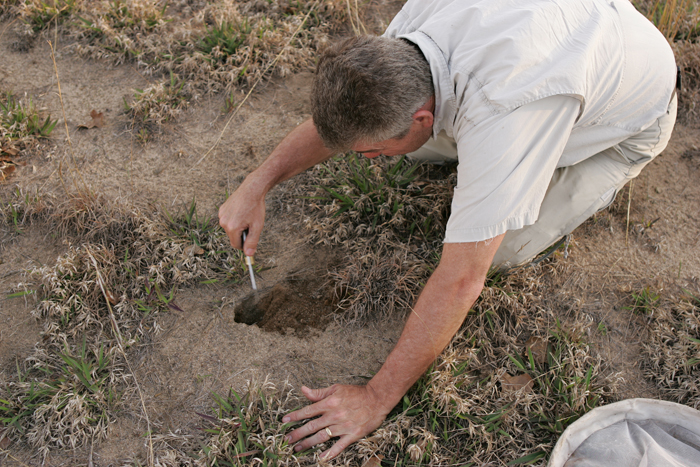
Ted attempts to extract an adult tiger beetle from its daytime burrow in a sand prairie relict.

Ted scans the open sand in a sand prairie relict for adult tiger beetles.

Ted fishes for a tiger beetle larva in a sand prairie relict.

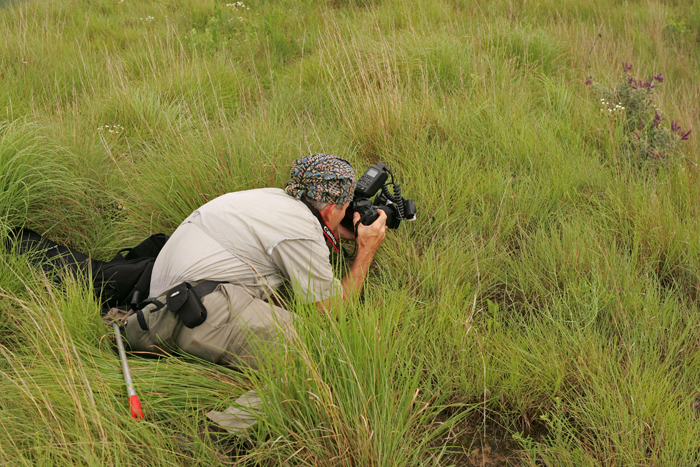
Ted photographing the robber fly, Ospriocerus abdominalis, at Star School Hill Prairie in the Loess Hills of northwest Missouri.

Distant view of Ted (small spot in center) photographing Ospriocerus abdominalis at Star School Hill Prairie.

Copyright © Ted C. MacRae 2009

Add to FacebookAdd to DiggAdd to Del.icio.usAdd to StumbleuponAdd to RedditAdd to BlinklistAdd to TwitterAdd to TechnoratiAdd to Yahoo BuzzAdd to Newsvine

Email to a friend

BitB Best of 2009

In my first post of 2009, I looked back at the photographs I had posted during 2008 and picked some of my personal favorites. I hesitated then to call myself a photographer (and still do), but I at least now have suitable equipment to aid in my progress toward that eventual goal. I have learned much over the past six months in my first attempt at serious insect macrophotography (prioritizing in situ field photographs of unmanipulated subjects as a matter of personal choice).  Through this, I’ve come to realize the following skills to be the most important for success:  

  1. Composition
  2. Understanding lighting
  3. Knowing how to use a flash
  4. Knowledge of the subject

I’ll give myself a “A” in the last of these, but in the other areas I still have much to learn. With this caveat, and for the last post of 2009, I offer the following twelve photographs as my final choices for the 2nd Annual “Best of BitB”:  

Best beetle

Cylindera celeripes (swift tiger beetle), Woodward Co., Oklahoma

From Revisiting the Swift Tiger Beetle – Part 1 (June 30).  A decent enough photograph, especially considering that I’d had my camera for about a month when I took it.  However, the discovery of robust populations of this formerly rare and enigmatic species throughout northwestern Oklahoma (and later also in northwestern Missouri) was the most significant find of the 2009 field season, and this photograph is the best capture of that moment.

Best fly

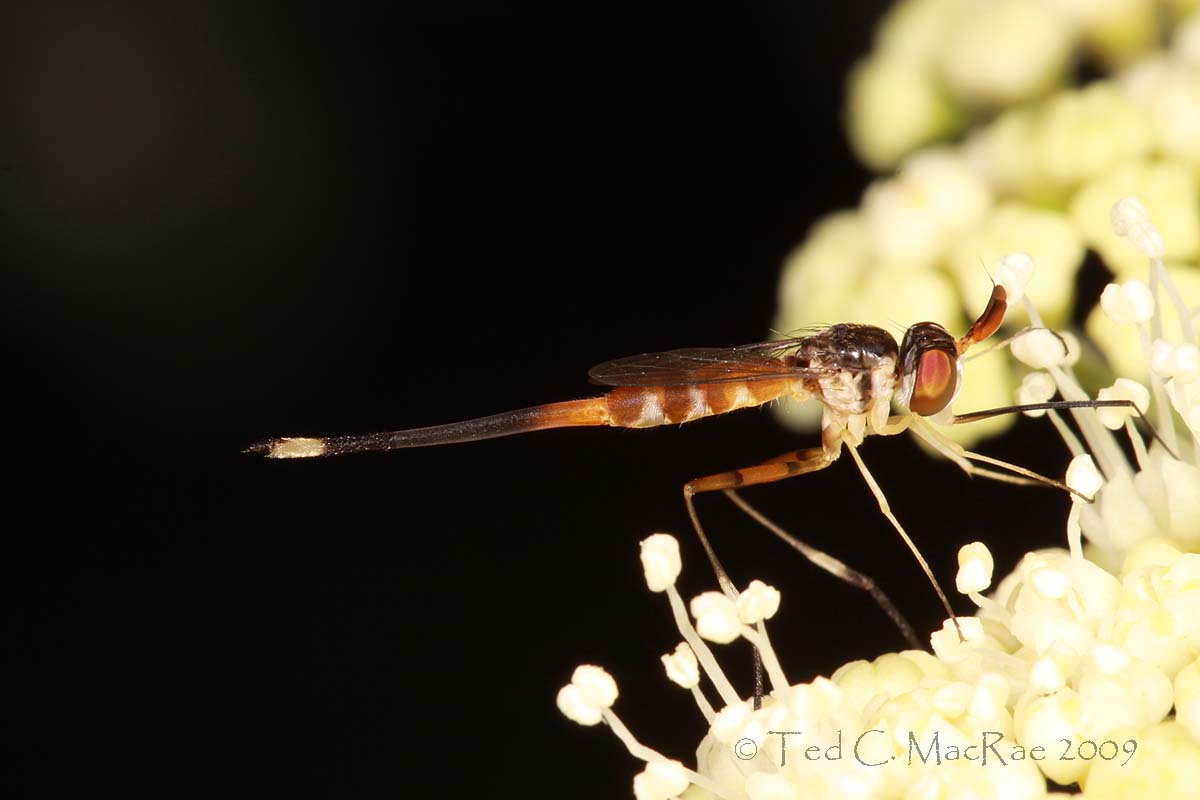
Stylogaster neglecta, a species of thickheaded fly

From Overlooked, needle-bellied, thick-headed fly (Aug 14).  One of my first good “black background” shots.  The white tip of the abdomen compliments the white flower stamens against the background.

Best “true” bug

Beameria venosa, a prairie obligate cicada

From North America’s smallest cicada (Aug 4).  So many different shades of green with white frosting on the bug’s body.  I tried taking this shot in portrait and it just didn’t work—I liked this landscape shot much better.

Best predator

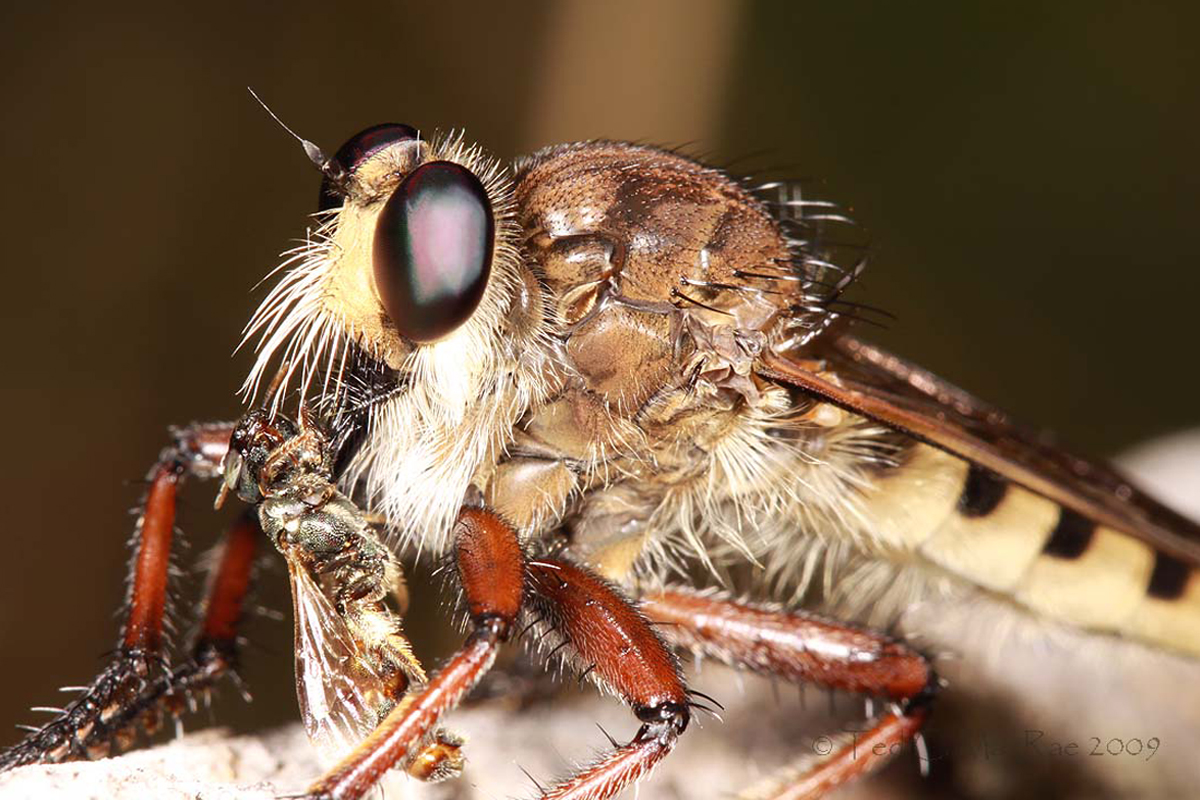
Promachus hinei (Hines giant robber fly) & Ceratina sp. (small carpenter bee) prey

From Prey bee mine (Sept 14).  Robber flies are immensely photogenic, especially those in the genus Promachus due to their prominent “beards.”

Best camoflauge

Dicerca obscura on bark of dead persimmon

From The “obscure” Dicerca (June 19).  Sparkling and gaudy as specimens in a cabinet, the coloration of many jewel beetles actually helps them blend almost perfectly with the bark of their preferred tree hosts.

Best immature insect

Tetracha floridana (Florida metallic tiger beetle) 3rd-instar larva

From Anatomy of a Tiger Beetle Larva (Oct 22).  “Otherwordly” is invariably the first word that comes to mind when someone sees a tiger beetle larva for the first time.  I was lucky enough to get this one in profile with a nice view of its abdominal hump and its curious hooks.

Best arachnid

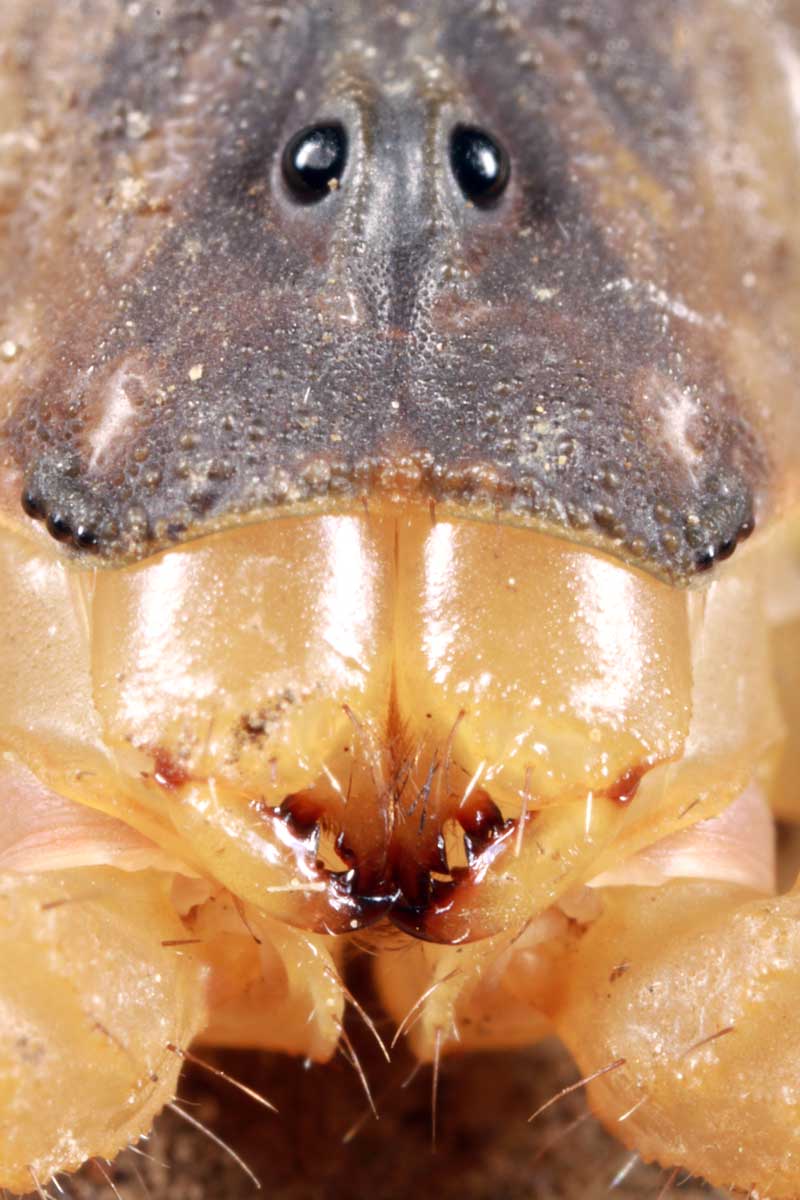
Centruroides vittatus (striped bark scorpion)

From A face only a mother could love (Oct 6).  Despite some minor depth-of-field problems with this photograph, I’m fascinated by its “smile.”

Best reptile

Eastern collared lizard (Crotaphytus collaris collaris) adult male

From North America’s most beautiful lizard (July 10).  A simply spectacular lizard—all I had to do was frame it well and get the flash right.

Best wildflower

Spiranthes magnicamporum (Great Plains ladies

From Great Plains Ladies’-tresses (Dec 7).  Few flowers are as photogenic as orchids, even native terrestrials with minute flowers such as this one.  I like the frosty texture of the lip and the starkness of the white flower on the black background.

Best natural history moment

Thermoregulatory behavior by Ellipsoptera hirtilabris (moustached tiger beetle)

From Tiger Beetles Agree—It’s Hot in Florida! (Dec 18). I chose this photo for the classic “stilting” and “sun-facing” thermoregulatory behaviors exhibited by this tiger beetle on a blistering hot day in Florida.

Best closeup

Megaphasma denticrus (giant walkingstick)

From North America’s longest insect (Aug 21).  I haven’t tried a whole lot of super close-up photographs yet.  I liked the combination of blue and brown colors on the black background.

Best Landscape

Sand Harbor Overlook, Lake Tahoe, Nevada

From Sand Harbor Overlook, Nevada (March 23).   My choice for “best landscape” again comes from Lake Tahoe.  This is not a great photo technically—I was still using a point-and-shoot and had to deal with foreground sun.  However, none of the other photos I took during my March visit to the area captivate me like this one.  I like the mix of colors with the silhouetted appearance of the trees on the point.

Copyright © Ted C. MacRae 2009

Add to FacebookAdd to DiggAdd to Del.icio.usAdd to StumbleuponAdd to RedditAdd to BlinklistAdd to TwitterAdd to TechnoratiAdd to Yahoo BuzzAdd to Newsvine

Email to a friend

The 12 Years of Christmas

This post first appeared on Beetles in the Bush on Christmas Day last year.  One year has passed, but the sentiment remains stronger than ever.  I reprint it here as BitB‘s first evergreen post. Merry Christmas!

p1020457_2

Merry Christmas - from our backyard to yours!

They came from completely different backgrounds. She had grown up in a middle class family, her father an educated professional, her mother a professional homemaker – “Ward and June”, as their now-grown children jokingly call them. He grew up on welfare, the family breaking up while he was still in elementary school. She was a popular student – cheerleader, debate team, gymnastics. He was the introverted science nerd, invisible to the popular, living quietly with his books. Religion was an important part of her life, growing up Catholic and remaining devoted to the church. He grew up Catholic but knew even as a child that religion would not provide the answers he was looking for, eventually finding a private spirituality in the Creation itself.

Despite these separate paths they found each other and fell in love, and despite their different lives they both wanted the same thing – a family. Such a simple desire, however, would prove to be difficult to achieve. When fertility drugs didn’t work, they turned to adoption. The first match failed. So did the second. They understood completely how the birth mothers could change their minds, but that didn’t ease their pain or calm their fears. Ultimately, they looked to Russia, a new democracy with old attitudes about orphans. In the fall of their 6th year of marriage, they learned that little Anastasia was waiting for them. They traveled to Russia before Christmas and became a family after New Years. In between, they visited little Anastasia every day – one hour at a time – and experienced the joy of being a parent, a feeling they had feared would ever elude them. On Christmas Day, they could not see little Anastasia, but in a small, gray apartment on the outskirts of Moscow, they celebrated her coming with their gracious host family. Ten days later, their family was born, and twelve months later they celebrated their first Christmas together at home.

Christmas meant little to me for much of my life. Yes, it was a time to relax and enjoy the company of family and friends, and the presents were nice. But my own approach to spirituality has little in common with traditional reflections of the season. Tonight, as I watched 12-year old Mollie Anastasia laughing with her cousins, hugging her nanny and papa, and teasing her uncle and his partner, I thought back to those cold, snowy days in Russia when my heart became warm for the first time. I recalled our second trip to Russia six years later, when she and little Madison Irina each met their sister for the first time. On this Christmas Day, as I have done for 12 years now, I thought about how lucky we are to have these two beautiful little girls that are unquestionably our own. Christmas means a lot to me now, and that is a gift that not even five golden rings could beat.

Copyright © Ted C. MacRae 2009

Add to FacebookAdd to NewsvineAdd to DiggAdd to Del.icio.usAdd to StumbleuponAdd to RedditAdd to BlinklistAdd to TwitterAdd to TechnoratiAdd to Furl

Tiger Beetles at Florida’s “Road to Nowhere”

(continued from the previous post, Tiger Beetles Agree—It’s Hot in Florida!)

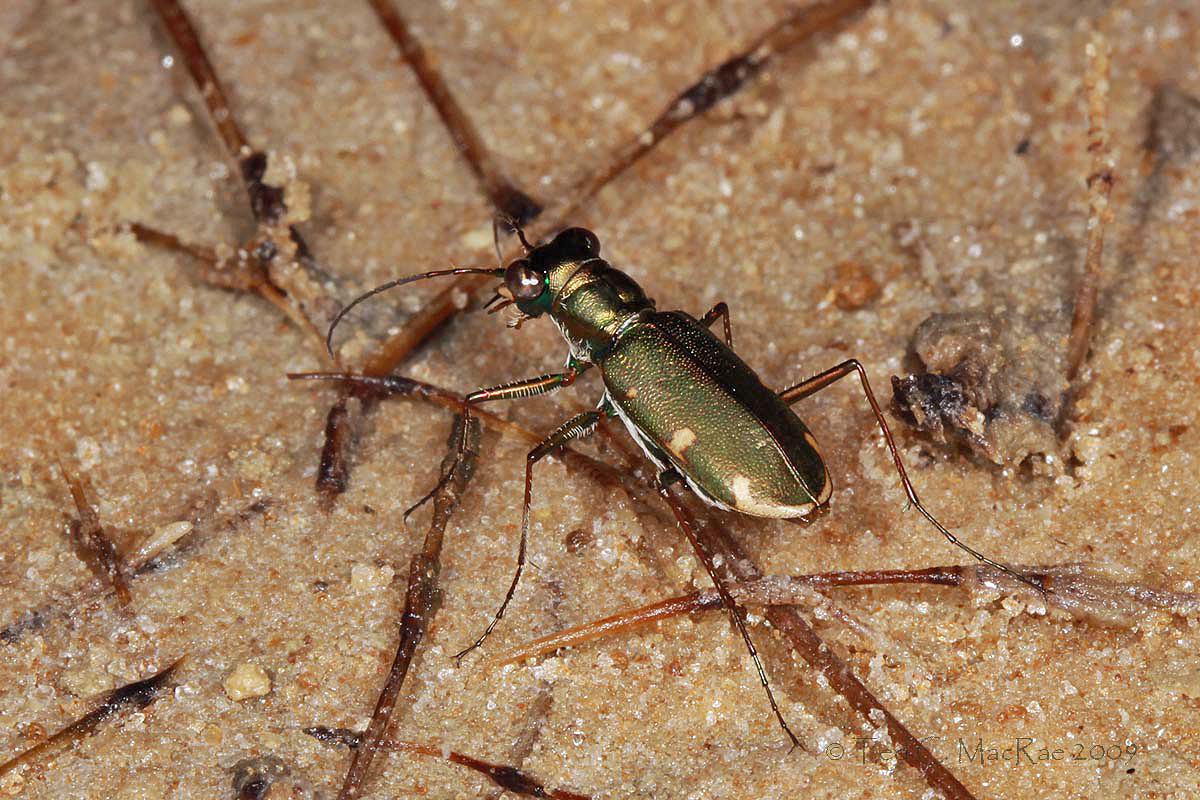
During the time that I explored the pine sandhill habitat at Withlacoochee State Forest in Citrus County, I kept close watch for any individuals amongst the dozens and dozens of Cicindela abdominalis (Eastern Pinebarrens Tiger Beetle) that I encountered that might exhibit the deeply pitted rather than smooth elytral surface that would identify it as the closely related Florida-endemic, Cicindela scabrosa (Scabrous Tiger Beetle).  However, no such individuals would be seen (my first tiger beetle failure of the trip), and having already spent more than two hours at the site I decided it was time to move on the the “Road to Nowhere.”

"Road to Nowhere," 11.1 mi S Jena on Hwy 361, Dixie Co., Florida

The Road to Nowhere is a tidal marsh (also known as “coastal salt marsh”) near Steinhatchee in Dixie County (11.1 mi S Jena on Hwy 361).  Although I was not aware of it prior to my August visit, this locality has achieved legendary status among tiger beetle enthusiasts because of the great number of species that can be seen there—as many as 6–10 species in the right season.  Being a coastal wetland with moist, saline substrates, these would include such species as Cicindela trifasciata ascendens (Ascendent Tiger Beetle), Habroscelimorpha severa (Saltmarsh Tiger Beetle), the rarely collected H. striga (Elusive Tiger Beetle), and Eunota togata togata (White-cloaked Tiger Beetle), in addition to Ellipsoptera marginata (Margined Tiger Beetle) and E. hamata lacerata (Gulf Beach Tiger Beetle) which I had already found a few days earlier.  As I found the highway leading to the spot and begain to drive its upper reaches, I looked longingly at the barren sand exposures along the sides of the road thinking that C. scabrosa, already known from the area (Choate 2003) must be there.  However, it was well into the afternoon hours by then, and having already failed to find the species at Withlacoochee State Forest, I decided I should press on and see what the Road to Nowhere had to offer.

Cicindela (Cicindelidia) trifasciata ascendens—Ascendent Tiger Beetle

Almost immediately I began seeing tiger beetles.  The first species I saw was C. trifasciata ascendens—rather common on areas of the flats close to the water’s edge.  I recognized them instantly, as I had not only seen this species some years ago in south Texas, but also in southern Missouri as a lone vagrant (Brown and MacRae 2005).  The dark brown dorsal coloration and thin, sinuous, S-shaped middle maculation are diagnostic for the species (Pearson et al. 2006).  While it was by now late afternoon, the heat of the day had not yet begun to subside, and the beetles were extremely active and flighty.  The difficulty in approaching them closely enough for photographs was exacerbated by the wet, muddy substrate and incessant drone of tenacious mosquitoes intent on breaching my invisible shield of DEET.  Eventually, however, and only due to one decidedly more cooperative individual (above), I succeeded in getting a few shots with which I was happy. 

Habroscelimorpha severa—Saltmarsh Tiger Beetle

Far less common than C. trifasciata ascendens, but equally skittish, was the impressive H. severa.  I have also seen this species before in south Texas, though not in great numbers, and its shiny green surface with maculations reduced to small spots at the middle and rear of the elytra are unmistakealbe.  It was the hardest to approach of the species I saw, and the above (only slightly cropped) photograph is as close as I was able to get (it is also the only photograph from the field session that was good enough and close enough to keep).  This species tends to be most active in the morning and again in the evening, so most of my late-day efforts focused on this species—in fact, it was almost too dark to see by the time I finally quit my attempts at photographing the species.  I brought back one live individual and took some “studio” photographs after I returned home, but I’m still not any happier with them than this lone field shot.

Ellipsoptera hamata lacerata—Gulf Beach Tiger Beetle (reduced maculations)

When I first saw the species represented by the individual in the above photograph, I had not a clue as to its identity—the dark elytra with only a marginal band was unlike anything I would have expected to see.  Quickly thumbing through my “bible” (Pearson et al. 2006), I kept stopping at the plate containing Cicindela marginipennis (Cobblestone Tiger Beetle).  I knew this was impossible, as that species is restricted to several disjunct cobblestone habitats further north.  I collected the specimen for a voucher, keeping it alive for studio photographs, but it wasn’t long before I saw another similar-looking individual.  I decided I must be overlooking something, so after getting photographs and collecting the specimen for another voucher I went back through Pearson.  This time I focused only on the species that could possibly occur here, and realized that it was simply E. hamata lacerata with its normally diffuse middle elytral maculations highly reduced (traces of the middle band can be seen in the photograph).

Ellipsoptera marginata—Margined Tiger Beetle

Ellipsoptera marginata was the most abundant species at this location, and on this day I succeeded in getting a nice photograph of a female with her distinctively downbent elytral apices (see closeup photograph in this post).  This species is very similar to E. hamata, with which it co-occurs along the Gulf Coast of peninsular Florida, but can be immediately recognized by the bent elytral apices (female) or distinct tooth on the underside of the right mandible (male).  Both of these species are distinguished from all other species in the genus by the diffuse middle maculation of the elytra. 

At least two additional species occur at this site, one of which (E. togata) I saw but a single individual of and was unable to photograph, and the other (H. striga) which I did not see.  In fact, the Road to Nowhere is apparently “the” spot for finding the latter species, which occurs predominantly at night and is seen primarily by its attraction to ultraviolet lights.  While I would have liked to stay after dark and setup lights to see this species, I had neither the time nor the equipment to do this.  It may, after all, have been too late in the season anyway—since my visit I’ve heard stories from other tiger beetle aficionados who say the whole area can be filled with collectors from all over the country with their blacklights and bucket traps and someone yelling “striga!” every hour or so.  No such scene developed during my visit, so I suspect my visit was on the late side of the season and that the 5 species I did see represents a pretty good day regardless.  The long drive back to St. Petersburg marked the end of my tiger beetle exploits in Florida, at least for this year.

For another tiger beetling experience at Road to Nowhere, read this post by Doug Taron, who visited the site even later in the season (October).  Although he didn’t see as many tiger beetles, he does provide some interesting details regarding the shady origins of this place.

Photo Details: Canon EOS 50D, ISO 100, 1/250 sec.
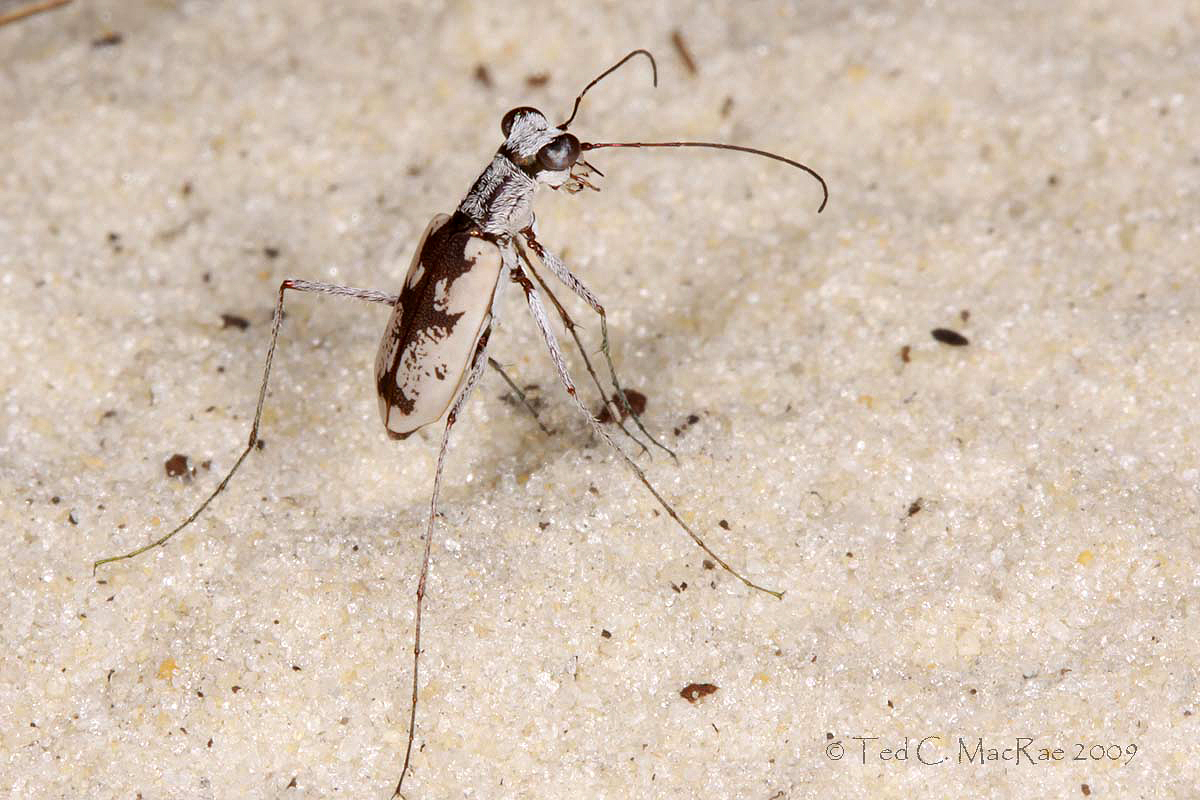
Habitat: Canon 17-85mm zoom lens (landscape, 66mm), f/9, natural light.
Insects (except E. marginata): Canon 100mm macro lens (manual), f/22–25, MT-24EX flash w/ Sto-Fen diffusers.
E. marginata: Canon MP-E 65mm 1–5X macro lens (manual), f/16, MT-24EX flash w/ Sto-Fen diffusers.

REFERENCES:

Brown, C. R. and T. C. MacRae. 2005.  Occurrence of Cicindela (Cicindelidia) trifasciata ascendens (Coleoptera: Cicindelidae) in Missouri. Cicindela 37(1–2):17–19.

Choate, P. M., Jr. 2003. A Field Guide and Identification Manual for Florida and Eastern U.S. Tiger Beetles.  University Press of Florida, Gainesville, 224 pp.

Pearson, D. L., C. B. Knisley and C. J. Kazilek. 2006. A Field Guide to the Tiger Beetles of the United States and Canada. Oxford University Press, New York, 227 pp.

Copyright © Ted C. MacRae 2009

Add to FacebookAdd to DiggAdd to Del.icio.usAdd to StumbleuponAdd to RedditAdd to BlinklistAdd to TwitterAdd to TechnoratiAdd to Yahoo BuzzAdd to Newsvine

Email to a friend

Tiger Beetles Agree—It’s Hot in Florida!

Florida is known for its rich assemblage of tiger beetles—27 species in all, including four endemics (Choate 2003).  However, late summer is generally considered not the best time of year for seeing this diversity, since adult populations of most species begin to wane as the intensity of the summer heat reaches its peak.  I knew the timing of my family vacation in early August might be a bit off; however, considering I had never looked for tiger beetles in Florida before, I remained optimistic that I still might encounter some interesting species.  My optimism was quickly rewarded—in one afternoon of exploring the small coastal preserve just outside the back door of my sister-in-law’s condo, I found Ellipsoptera marginata (Margined Tiger Beetle), its sibling species E. hamata lacerata (Gulf Beach Tiger Beetle), and several 3rd-instar larvae in their burrows that proved to be the Florida endemic Tetracha floridana (Florida Metallic Tiger Beetle).  Good fortune would continue when I made a one-day trip to the interior highlands in a successful bid to find Florida’s rarest endemic, Cicindela highlandensis (Highlands Tiger Beetle), finding also as a bonus the splendidly camouflaged and also endemic Ellipsoptera hirtilabris (Moustached Tiger Beetle).  Five species, including three endemics, in just over a day of searching!  I had one more day to sneak off and do what I love most, and I wanted to make the most of it. 

Pine sandhill habitat, Withlachoochee State Forest—Citrus Tract

Among the suggestions given to me by my colleagues, the most promising-sounding was the “end of the road,” a Gulf Coast salt marsh near Steinhatchee in Dixie County where I was told as many as 6-10 species of tiger beetles could be seen at once.  I didn’t know it at the time, but this particular location has achieved legendary status among tiger beetle enthusiasts (Doug Taron recently wrote about his experience, calling it the Road to Nowhere).  A 200+ mile drive from my base near St. Petersburg, it would take the better part of 5 hours to drive there, and not wanting to put all of my eggs in one basket, I looked for potential stops along the way.  About midway along the drive was Withlacoochee State Forest, where one of my colleagues had told me I might still find the fairly widespread Cicindela abdominalis (Eastern Pinebarrens Tiger Beetle) and its close relative, C. scabrosa (Scabrous Tiger Beetle)—the fourth Florida endemic.  My plan was to leave early in the morning and spend a few hours at Withlacoochee before driving the rest of the way to finish out the day at Steinhatchee. 

"Stilting" by Cicindela abdominalis (Eastern Pinebarrens Tiger Beetle)

It took some time to find my bearings upon arriving, but after some discussion with the decidedly forestry-oriented staff at the headquarters, it seemed that the Citrus Tract was where I wanted to be.  I was looking for the sand barren and pine sandhill habitats that these species require, and the staff’s description of the northern edge of the tract as having lots of sand and “not very good for growing trees” suggested this might be the place.  Pine sandhill (also called “high pine”) is a pyrophytic (fire-dependent) plant community characterized by sandy, well-drained soils, a widely-spaced longleaf pine (Pinus palustris) and turkey oak (Quercus laevis) canopy, and an herbaceous layer dominated by wiregrass (Aristida stricta).  I quickly found such habitat in the area suggested, and it wasn’t long before I found the first of the two species—C. abdominalis—rather commonly along a sandy 2-track leading through the area.  For those of you who see a distinct resemblance of this species to the rare C. highlandensis that I highlighted from my trip to the central highlands, this is no coincidence.  Cicindela abdominalis is very closely related to that species, the latter distinquished by an absence of flattened, white setae on the sides of the prothorax and the abdomen and by the highly reduced or absent elytral maculations (Choate 1984).  Dense white setae and distinct apical elytral maculations are clearly visible in the individuals shown in these photographs. 

Stilting is often accompanied by "sun-facing" for additional thermoregulation

It was a blistering hot day (just as every other day on the trip had been so far), and it wasn’t only me who felt that way.  Tiger beetles, of course, are ectothermic and rely upon their environment for their body temperature.  Despite this, they are able to regulate body temperatures to some degree by using a range of behavioral adaptations intended to mitigate the effects of high surface temperatures and intense sunlight.  The photos above show one of these behaviors, known as stilting.  In this behavior, the adult stands tall on its long legs to elevate its body above the thin layer of hotter air right next to the soil surface and as far off the sand as possible (Pearson et al. 2006).  As the heat of the day intensifies and the zone of hot air at the soil surface broadens, stilting alone may be insufficient to prevent overheating. When this happens, the beetles combine stilting with sun-facing, a behavior in which the front part of the body is elevated with the head oriented towards the sun. This position exposes only the front of the head to the sun’s direct rays, thus minimizing the body surface area exposed to incident radiation.

Stilting and sun-facing by Ellipsoptera hirtilabris (Moustached Tiger Beetle)

I was also fortunate to have another chance at photographing the beautiful and marvelously-camouflaged Ellipsoptera hirtilabris (Moustached Tiger Beetle), which, in similar fashion to C. highlandensis, I found co-occurring with C. abdominalis in rather low numbers. As before, they were extremely wary and difficult to approach, especially in the extreme heat of the day, and all of my best efforts to get a good shot of the species in its “classic” pose were frustrated. The photo above was about as close as I could get to any of these beetles when they were out in the open before they would flee; however, it nicely demonstrates the use of stilting combined with sun-facing during the hottest part of the day.

"Shade seeking" is another behavioral response to intense heat.

Another behavioral response to extreme heat is shade-seeking—adults may either remain active, shuttling in and out of shaded areas, or avoid exposed areas altogether and become inactive.  One thermoregulatory behavior for extreme heat that I did not observe was daytime-burrowing, in which adults construct temporary shallow burrows during the hottest hours of the day. Although I did not observe this behavior by either species at Withlacoochee, I have seen it commonly among several species in sandy habitats here in Missouri and in the Sandhills of Nebraska (e.g., Cicindela formosa, Cicindela limbata, Cicindela repanda, Cicindela scutellaris, Cicindela tranquebarica, Ellipsoptera lepida).

There was one disappointment on the day—I did not see C. scabrosa.  However, I still had the “end of the road” to explore, so I remained happy with the now six species I had encountered and optimistic about finding additional species later in the day… 

Photo Details: Canon EOS 50D, ISO 100.
Habitat: Canon 17-85mm zoom lens (landscape, 17mm), 1/100 sec, f/10, natural light.
Insects: Canon 100mm macro lens (manual), 1/250 sec, f/16–18 (C. abdominalis) or f/20–22 (E. hirtilabris), MT-24EX flash w/ Sto-Fen diffusers.

REFERENCES: 

Choate, P. M., Jr.  1984.  A new species of Cicindela Linnaeus (Coleoptera: Cicindelidae) from Florida, and elevation of C. abdominalis scabrosa Shaupp to species level.  Entomological News 95:73–82.

Choate, P. M., Jr. 2003. A Field Guide and Identification Manual for Florida and Eastern U.S. Tiger Beetles.  University Press of Florida, Gainesville, 224 pp.

Pearson, D. L., C. B. Knisley and C. J. Kazilek. 2006. A Field Guide to the Tiger Beetles of the United States and Canada. Oxford University Press, New York, 227 pp.

Copyright © Ted C. MacRae 2009

Add to FacebookAdd to DiggAdd to Del.icio.usAdd to StumbleuponAdd to RedditAdd to BlinklistAdd to TwitterAdd to TechnoratiAdd to Yahoo BuzzAdd to Newsvine

Email to a friend

Moustached Tiger Beetle

Lake Wales Ridge

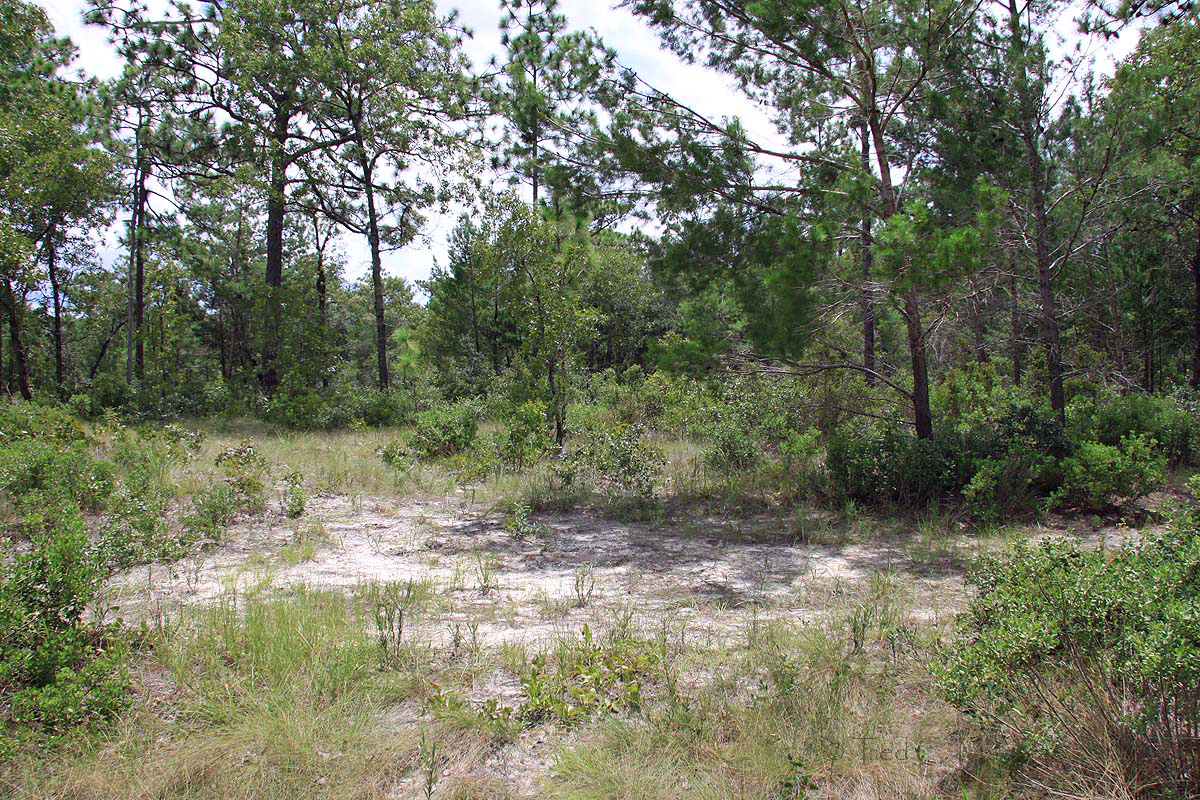
Dry sand scrubland on Lakes Wales Ridge in central Florida—home to Cicindela highlandensis and Ellipsoptera hirtilabris

In my previous post, I featured the rare Cicindela highlandensis (Highlands Tiger Beetle), restricted entirely to sand scrubland and pine woodland habitats along the Lake Wales Ridge in central Florida (Choate 2003).  However, that would not be the only Florida endemic tiger beetle that I would encounter during my early August visit.  Another of the several tiger beetle species that I’d hoped to see would also be found that day, although in much lower numbers.  Ellipsoptera hirtilabris (Moustached Tiger Beetle) is so named¹ because of the dense covering of prostrate hairs on its labrum that distinguish it from the closely related E. gratiosa (Whitish Tiger Beetle). Both of these species exhibit striking white maculations that cover almost the entire elytral surface and dense white pubescence covering the head, thorax, underside and legs.  They are the only species of the genus occurring in Florida, but their ranges do not overlap (Pearson et al. 2006)—E. gratiosa occurs in the coastal pine barrens of Virginia, the Carolinas, southern Georgia and the Florida panhandle, while E. hirtilabris is restricted to peninsular Florida in pine woodlands, sand hills and other habitats with open white sand.  Although the latter is considered a Florida endemic, it has been found just outside of Florida in extreme southeastern Georgia on St. Simon’s Island (Choate 2003)In addition to the pubescence of the labrum and their allopatric distributions, the two species may further be distinguished by the slightly less expanded markings and more diffuse edges where they contact the central bronze area in E. hirtilabris and the slightly larger size of E. gratiosa.    Like C. highlandensis and C. abdominalis, it seems likely that E. hirtilabris and E. gratiosa evolved from a common ancestor, diverging in isolation from each other during the pre-Pleistocene separation of peninsular Florida from the North American mainland.   

¹ The species epithet is derived from the Latin words hirtum meaning “hairy” and labrum meaning “lip”.

Ellipsoptera_hirtilabris_IMG_1091_1200x800_enh

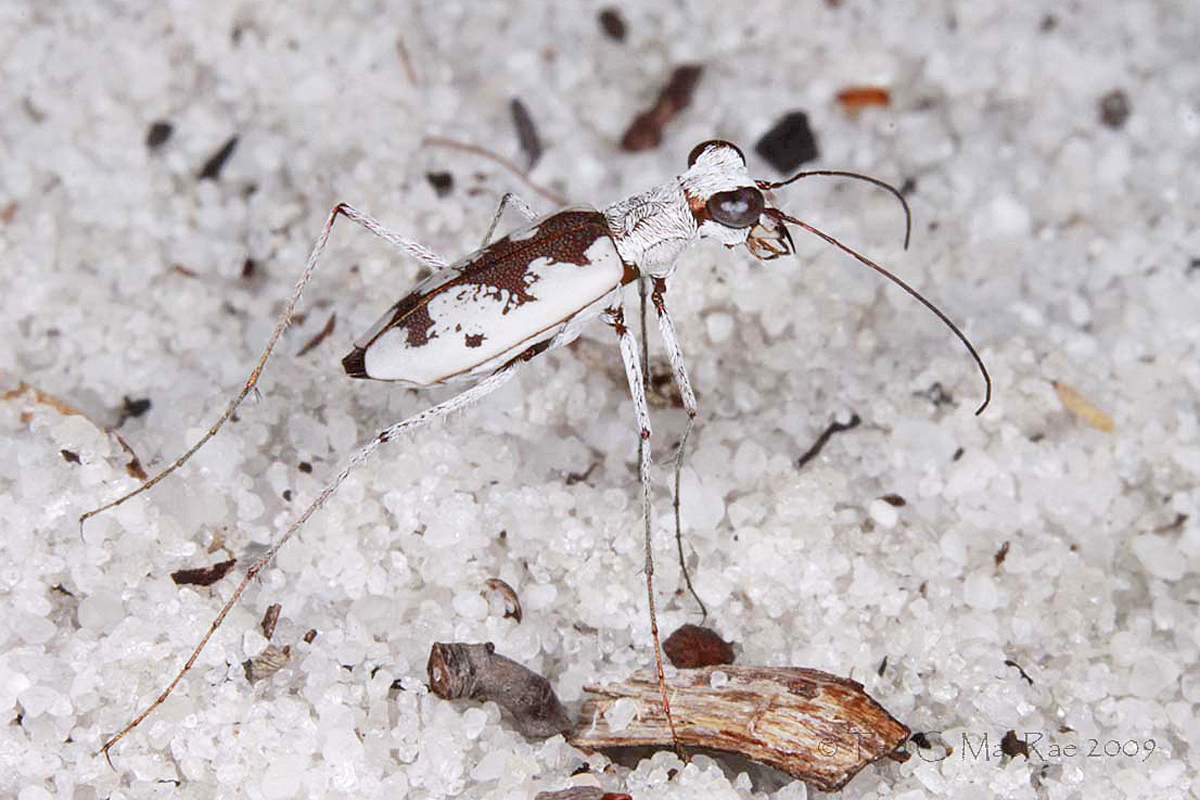
Ellipsoptera hirtilabris in the alert position

I found E. hirtilabris to be exceedingly difficult to see and photograph.  Unlike C. highlandensis, which resemble bits of debris laying on the surface of the white sands where it lives, the largely white E. hirtilabris blend into the white sand itself and are almost impossible to see until they move.  The small bronze-colored patches along the elytral suture augment their cryptic capabilities by resembling small bits of debris, which is especially evident in the photo below.  Both Pearson et al. (2006) and Erwin and Pearson (2008) state that adults of this species freeze in position when approached, which may be the reason why I saw so few individuals.  Once I did see them, they were extremely wary and difficult to photograph no matter how cautiously I approached.  The photos shown here represent the only two individuals that I succeeded in photographing, and in neither case did I succeed in getting a frontal perspective to show the pubescent labrum (stifling heat and oppressive humidity during the photo session did not help matters, either).

Ellipsoptera_hirtilabris_IMG_1131_1200x800_enh

The white coloration with small brown markings helps adults blend in perfectly in their white sand habitats

Photo details:
Photo 1: Canon 100mm macro lens on Canon 50D (landscape mode) ISO-100, 1/250 sec, f/16, natural light.
Photos 2 & 3: Manual mode, f/25, MT-24EX flash w/ Sto-Fen diffusers @ 1/8 ratio.

REFERENCES:

Choate, P. M., Jr. 2003. A Field Guide and Identification Manual for Florida and Eastern U.S. Tiger Beetles.  University Press of Florida, Gainesville, 224 pp.

Erwin, T. L. and D. L. Pearson. 2008. A Treatise on the Western Hemisphere Caraboidea (Coleoptera). Their classification, distributions, and ways of life. Volume II (Carabidae-Nebriiformes 2-Cicindelitae). Pensoft Series Faunistica 84. Pensoft Publishers, Sofia, 400 pp.

Pearson, D. L., C. B. Knisley and C. J. Kazilek. 2006. A Field Guide to the Tiger Beetles of the United States and Canada. Oxford University Press, New York, 227 pp.

Copyright © Ted C. MacRae 2009

Add to FacebookAdd to NewsvineAdd to DiggAdd to Del.icio.usAdd to StumbleuponAdd to RedditAdd to BlinklistAdd to TwitterAdd to TechnoratiAdd to Furl

Highlands Tiger Beetle

When my wife and I made plans to spend a week at her sister’s condominium in Florida this past summer, I began making a list of the tiger beetle species that I wanted to see.  I would be happy to see anything, since I had never before tiger beetled in Florida, but early August was looking to be on the late side for many things.  In addition, since this was a family vacation, I would only have a couple days at most to sneak off on my own and immerse myself in bug hunting.  All this meant that I would have to be very judicious about where I went and what I looked for.  I sought advice from a few other cicindelophiles on species and localities, and by the time we made the 16-hour drive from St. Louis to Seminole (near St. Petersburg) I had settled on two destinations—the Lake Wales Ridge of central Florida to look for Cicindela highlandensis (Highlands Tiger Beetle), and the so-called “Road to Nowhere” near Steinhatchee where as many as 10 species of tiger beetles can be seen when the season is right.  Things started out well when, before even looking for any of these species, I stumbled upon Ellipsoptera marginata (Margined Tiger Beetle), its sibling species E. hamata lacerata (Gulf Beach Tiger Beetle), and some 3rd-instar larvae in their burrows that proved to be the Florida endemic Tetracha floridana (Florida Metallic Tiger Beetle) in the small coastal preserve just outside the back door of my sister-in-law’s condo.

Lake Wales Ridge_IMG_1128_1200x800_enh

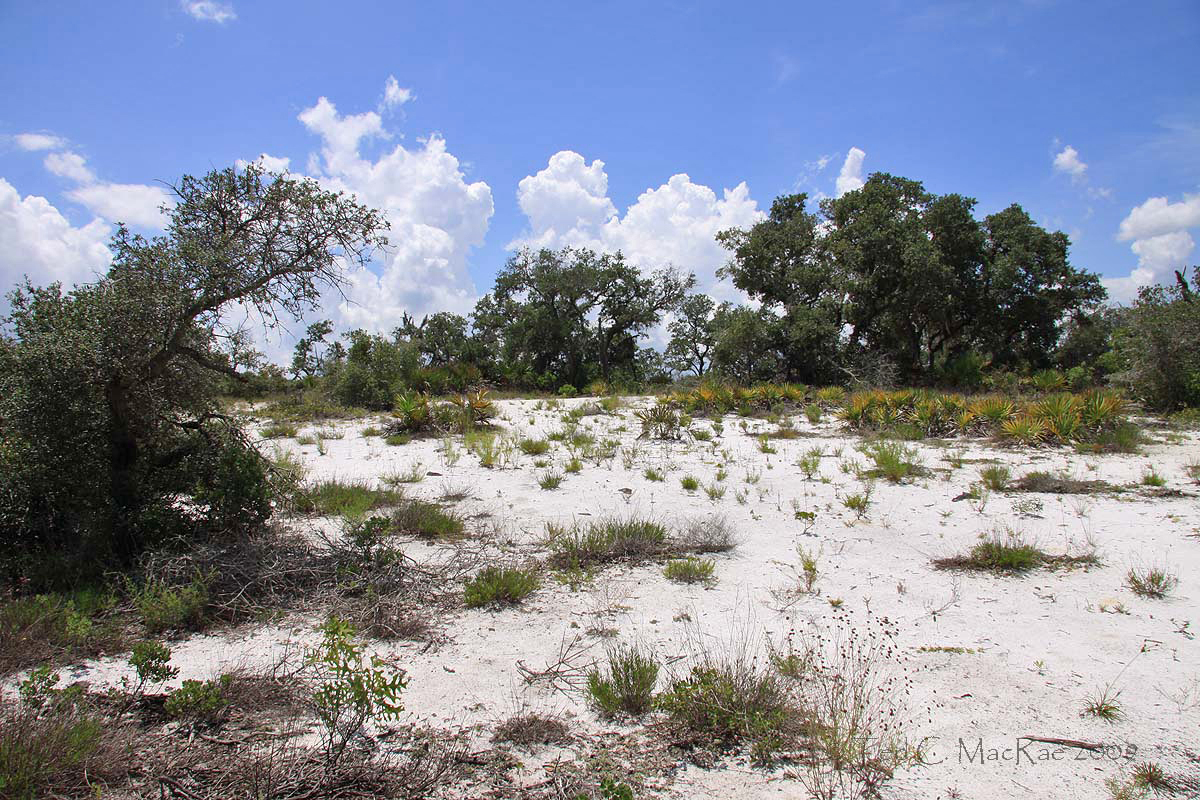
Dry sand scrubland on Lakes Wales Ridge in central Florida

The big target of the trip, however, was not so straightforward.  Cicindela highlandensis is one of Florida’s rarest endemic tiger beetles, being restricted entirely to remnant sand scrubland and pine woodland habitats along the Lake Wales Ridge of Polk and Highlands Counties in central Florida (Choate 2003).  The Lake Wales Ridge represents former shorelines deposited when the rest of peninsular Florida was covered by seas.  The quick draining sands have created desert-like open habitats dominated by oaks, pines, and other drought-tolerant species.  Cicindela highlandensis is one of many plants and animals endemic to the Lake Wales Ridge, which has the highest concentration of endangered plants in the continental U.S.  Unfortunately, the natural communities found on the Lake Wales Ridge have suffered severe reductions from their historical occurrence.  An estimated 85% of the scrub and sandhills has been converted to citrus groves and urban developments, and the few remaining tracts face not only continued development pressure, but also the threat of degradation from reductions in the frequency and extent of the wildfires that are essential for their maintenance (Turner et al. 2006).  NatureServe (2009) estimates that C. highlandensis populations have declined by as much as 90%, and only a few of the sites where it is known to occur are large enough to sustain viable populations.  While the species has a global status of G1 (critically imperiled) due to its limited range, restricted habitat, and very small population size, and is a candidate for listing as an endangered species by the U.S. Fish & Wildlife Service (Pearson et al. 2006), it remains—bafflingly—unlisted even as threatened by the State of Florida.  As a result, there is no formal conservation management plan for this species to ensure its survival.  Fortunately, the largest populations of C. highlandensis occur on an assemblage of public and private lands that are under partial to full conservation ownership, and preservation/management activities are taking place at most of these.

Cicindela_highlandensis_IMG_1126_1200x800_enh

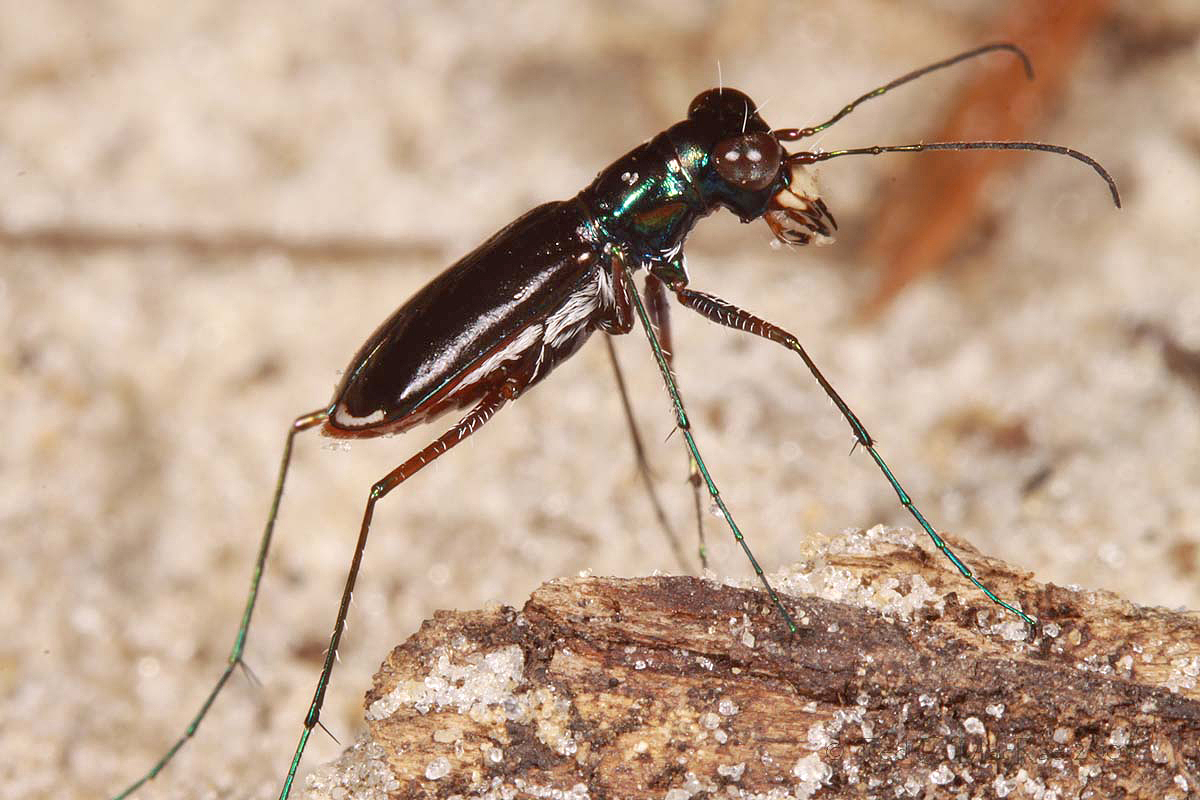
Cicindela highlandensis, Highlands Tiger Beetle, in alert position

I had debated whether to look for Cicindela highlandensis at all—not because I wasn’t anxious to see it, but because I lacked confidence that I would be able find it.  A late season search for a rare species had all the hallmarks of a potential wild goose chase.  Nevertheless, I like a good challenge, and I had succeeded in obtaining information about specific locations for the species (a matter of public record; however, I prefer to maintain some discretion in this venue).  Although I began my search with tempered optimism, it didn’t take long for me to acheive my goal.  Similar to my experience with Cylindera celeripes in Oklahoma, I had barely walked ten yards into a gorgeous sand scrub habitat at the first site I had planned to search before I saw an individual.  The dark metallic blue coloration of the species would seem to make it easily seen in its white sand environs; however, in reality it is almost impossible to see until it moves.  Some have suggested that its coloration functions to make the beetle resemble the many small pieces of debris that litter the sand surface—perhaps the bits of charred wood that are common in open, fire-mediated environments.  Its dependence upon natural disturbance factors such as fire was made apparent to me by the distinct preference I noted for adults to congregate along trails kept open by human disturbance, and to a lesser degree in the larger, naturally open scrub areas.  The adults made very short escape flights and were easy to follow but difficult to approach closely enough for photographs due to extreme wariness—their long legs giving some indication of their highly cursorial capabilities.

Cicindela highlandensis

Cicindela highlandensis - note absence of setae on thorax and abdomen

Cicindela highlandensis is closely related to two other species of tiger beetles in Florida—C. abdominalis (Eastern Pinebarrens Tiger Beetle), widely distributed throughout the Atlantic and Gulf Coastal Plain, and C. scabrosa (Scabrous Tiger Beetle), confined to the Florida Peninsula and adjacent southeastern Georgia.  Both of these species are absent from the Lake Wales Ridge and, thus, do not co-occur with C. highlandensis. It is likely that C. highlandensis evolved from isolated populations of the widespread C. abdominalis that diverged during pre-Pleistocene separation of the Lake Wales Ridge from the mainland (Choate 1984).  Despite its resemblance to both C. abdominalis and C. scabrosa, C. highlandensis can be distinguished from both of those species by the complete absence of flattened, white setae on the sides of the prothorax and the abdomen and by the highly reduced or absent elytral maculations (note the very small apical markings on the individuals in these photographs).  All three of these species belong to the subgenus Cicindelidia (American Tiger Beetles) and possess red adominal coloration that is prominent during flight.

Photo details:
Photo 1: Canon 17-85mm zoom lens on Canon 50D (landscape mode), ISO-100, 1/160 sec, f/13, natural light.
Photos 2–3: Canon 100mm macro lens on Canon 50D (manual mode), ISO-100, 1/250 sec, f/14 (photo 2) or f/20 (photo 3), MT-24EX flash w/ Sto-Fen diffusers.

REFERENCES:

Choate, P. M., Jr.  1984.  A new species of Cicindela Linnaeus (Coleoptera: Cicindelidae) from Florida, and elevation of C. abdominalis scabrosa Shaupp to species level.  Entomological News 95:73–82.

Choate, P. M., Jr. 2003. A Field Guide and Identification Manual for Florida and Eastern U.S. Tiger Beetles.  University Press of Florida, Gainesville, 224 pp.

NatureServe.  2009.  NatureServe Explorer: An online encyclopedia of life [web application].  Version 7.1.  NatureServe, Arlington, Virginia.  Available at: http://www.natureserve.org/explorer (accessed: November 12, 2009).

Pearson, D. L., C. B. Knisley and C. J. Kazilek. 2006. A Field Guide to the Tiger Beetles of the United States and Canada. Oxford University Press, New York, 227 pp.

Turner, W. R., D. S. Wilcove and H. M. Swain.  2006.  State of the scrub: conservation progress, management responsibilities, and land acquisition priorities for imperiled species of Florida’s Lake Wales Ridge.  Archbold Biological Station, Lake Placid, Florida, iii + 44 pp.

Copyright © Ted C. MacRae 2009

Add to FacebookAdd to NewsvineAdd to DiggAdd to Del.icio.usAdd to StumbleuponAdd to RedditAdd to BlinklistAdd to TwitterAdd to TechnoratiAdd to Furl