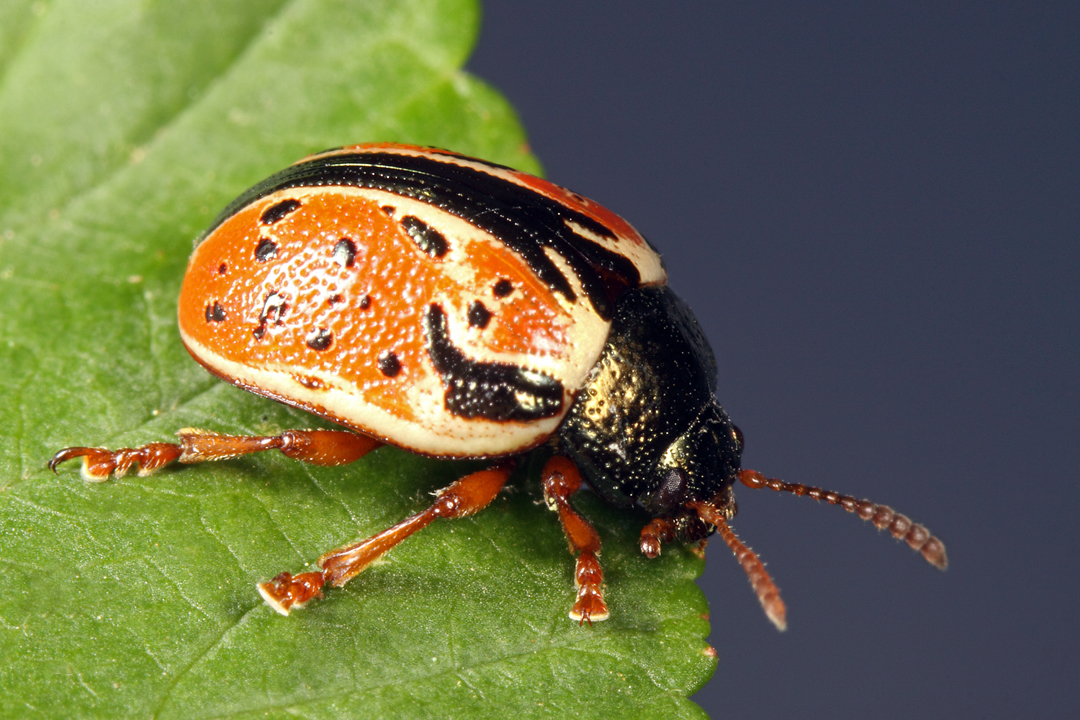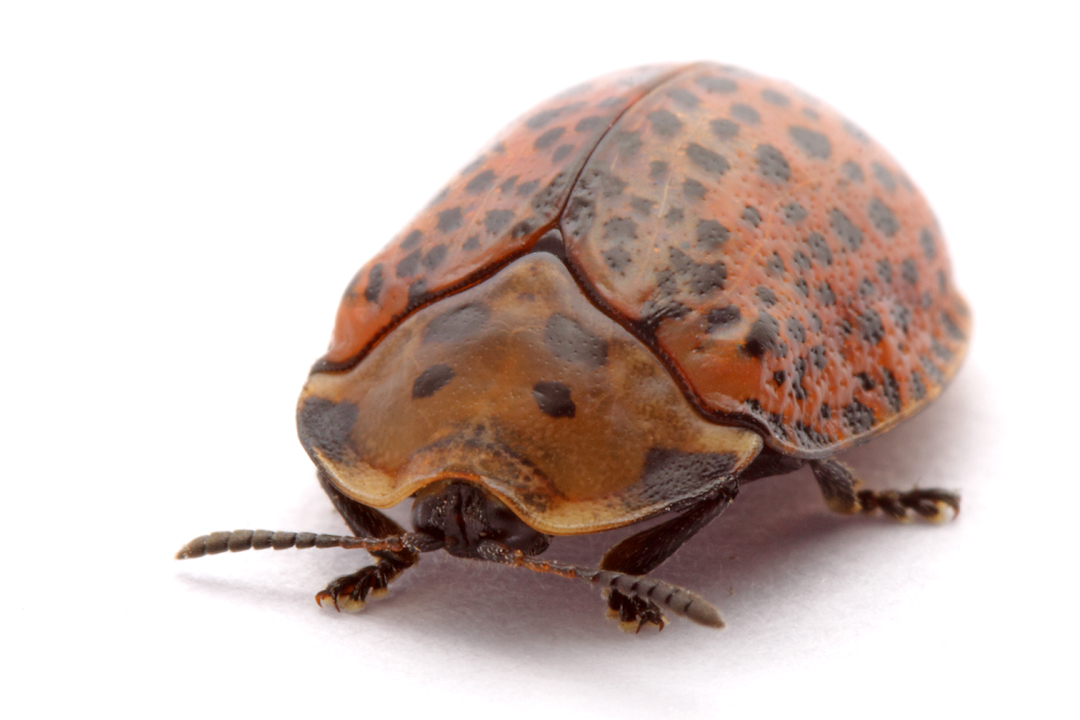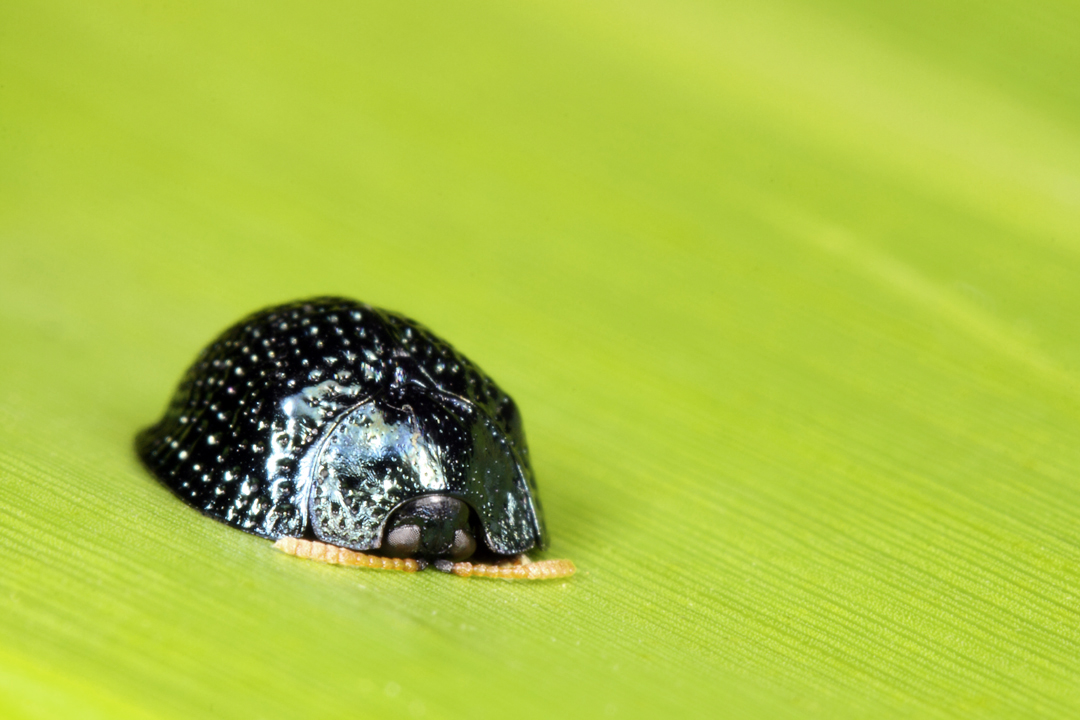
Palmetto Tortoise Beetle, Hemisphaerota cyanea

Hemisphaerota cyanea (palmetto tortoise beetle) on saw palmetto (Serenoa repens)| Levy Co., Florida

While most leaf beetles (family Chrysomelidae) are found associated with herbaceous plant species, many members of the subfamily Hispinae—which includes leaf mining beetles and tortoise beetles—are found on the foliage of woody plants. In North America the most distinctive of tortoise beetles found on trees is the palmetto tortoise beetle, Hemisphaerota cyanea. These distinctive dark blue, hemispherical-shaped (hence, the genus name) beetles with yellow antennae are found in the deep southeastern U.S. on the fronds of saw palmetto, Serenoa repens, and other native and introduced palms. I found the beetles in these photographs near Cedar Key Scrub State Preserve in Levy Co., Florida while searching white sand 2-tracks through sand scrub habitat for the Florida-endemic Cicindelidia scabrosa (Scabrous Tiger Beetle).

Beetles scarify the leaf epidermis, leaving trough-like feeding marks.

I first saw this species during my first insect collecting trip to Florida back in 1986. I didn’t know much then (other than that I really, really enjoyed traveling to different parts of the county to collect insects!). I was in Everglades National Park (with a permit) when I first noticed them dotting saw palmetto fronds. I think I had actually noticed them for some time but thought they were some type of scale insect before eventually realizing it was actually not only a beetle, but a tortoise beetle (one of the many groups of insects in which I was interested during those early, formative days).

Specially modified tarsi and a hemispherical shape allow the beetle to clamp itself tightly against the leaf to repel attack by ants and other insect predators.

I also remember being struck by how difficult it was to pry the adults off of the leaves on which they were sitting. It turns out that these leaf beetles have specially modified tarsi with thousands of bristles tipped with adhesive pads on the undersides. Normally only a few of the pads contact the leaf surface, but when the beetle is threatened it clamps all of them against the leaf and secretes an oil that strengthens the adhesive capabilities of the pads. Thus secured, the beetle clamps its hemispherical-shaped body down tightly against the leaf and is able to resist the efforts of ants and other predators to pry it from the leaf.

Copyright © Ted C. MacRae 2012
Beetle botanists

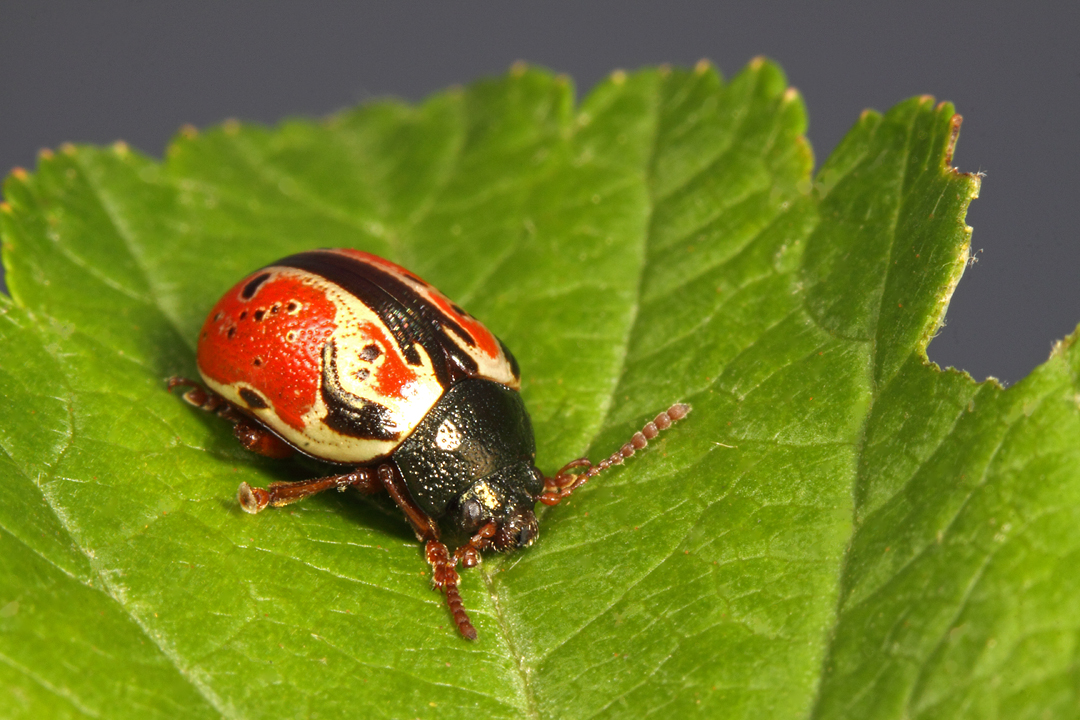
Calligrapha spiraeae on Physocarpus opulifolius | Jefferson Co., Missouri

While Dicerca pugionata (family Buprestidae) is, for me, the most exciting beetle species that I’ve found in Missouri associated with ninebark (Physocarpus opulifolius). it is not the only one. The beetles in these photographs represent Calligrapha spiraeae, the ninebark leaf beetle (family Chrysomelidae). Unlike D. pugionata, however, I almost never fail to find C. spiraeae on ninebark, no matter when or where I look, and whereas D. pugionata has been recorded in the literature associated with a few other host plants like alder (Alnus spp.) and witch-hazel (Hamamelis virginiana), C. spiraeae is not known to utilize any other plant besides ninebark as its host.

Beetles in the genus Calligrapha are among the most host-specific of all phytophagous beetles, with most of the 38 species in this largely northeastern North American genus relying upon a single plant genus as hosts (Gómez-Zurita 2005). The genus as a whole is fairly recognizable by its dome-like shape and black and white or red coloration, with the black markings on the elytra varying from coalesced to completely broken into small spots. The species, however, are another matter, with several groups of species that are quite difficult to distinguish morphologically. Fortunately most of them can be easily distinguished by their host plant (although such information is rarely recorded on labels attached to museum specimens). Calligrapha spiraeae, for example, with its reddish coloration and small black spots, looks very much like two other species in the genus—C. rhoda and C. rowena. Those latter species, however, are restricted to hazel (Corylus spp.) and dogwood (Cornus spp.); as long as the host is known, the species can be readily identified in the field.

At this point you may be wondering why the species name refers to the plant genus Spiraea rather than Physocarpus. In fact, ninebark was already known as the host plant when Say (1826) described the species, but the name spiraeae was given because at the time ninebark was included in the genus Spiraea (Wheeler & Hoebeke 1979).

REFERENCE:

Gómez-Zurita, J. 2005. New distribution records and biogeography of Calligrapha species (leaf beetles), in North America (Coleoptera: Chrysomelidae, Chrysomelinae). Canadian Field-Naturalist 119(1): 88–100.

Say, T. 1826. Descriptions of new species of coleopterous insects of North America. Journal of the Academy of Natural Sciences of Philadelphia 5:293–304.

Wheeler, A. G., & E. R. Hoebeke. 1979. Biology and seasonal history of Calligrapha spiraeae (Say) (Coleoptera: Chrysomelidae), with descriptions of the immature stages. The Coleopterists Bulletin 33:257–267. 

Copyright © Ted C. MacRae 2012
A tortoise beetle gift

Chelymorpha varians | northwestern Buenos Aires Province, Argentina

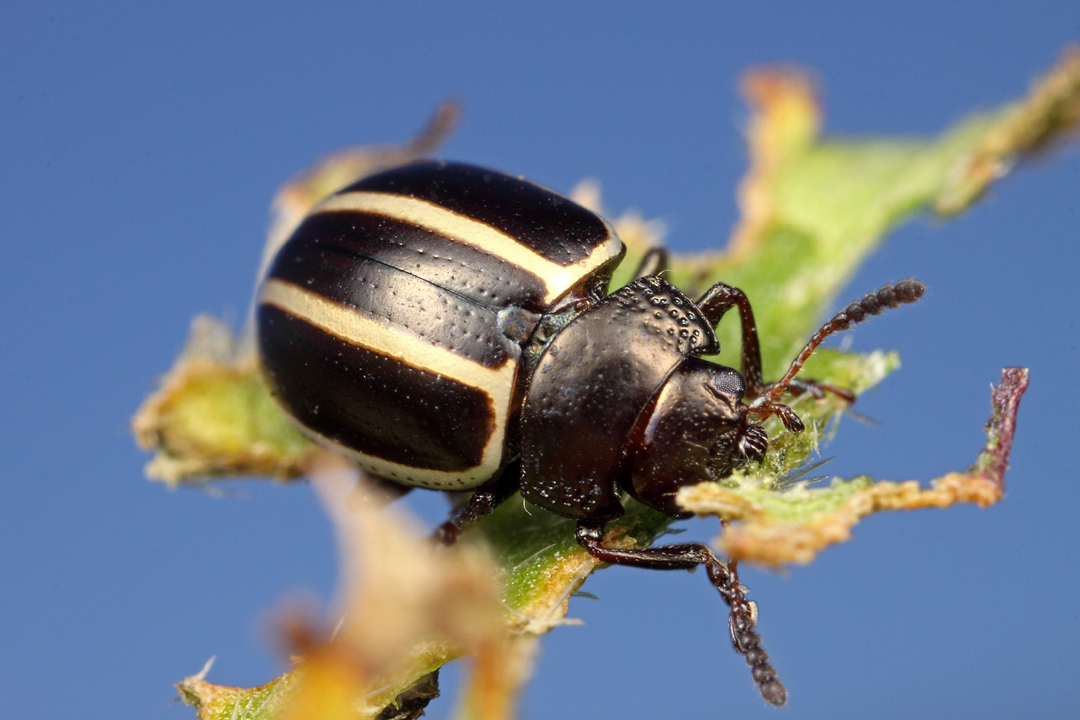
A few days after returning from travel through northern Argentina, I found a jar on my desk with this beetle in it. One of my colleagues has seen it in the field while I was away and figured I would be interested in seeing it. Although I’m half-a-world away from home, I immediately thought of our North American species Chelymorpha cassidea when I saw it. Armed with this hunch, I typed “Chelymorpha Argentina” into Google, and the first result that came up was a paper by Hamity & Neder de Román (2008) about the species Chelymorpha varians in Argentina and its potential as a biocontrol agent for the widespread weed Convolvulus arvensis. Included in the paper was a plate showing variability of coloration and maculation in the adults, and my individual was a dead ringer for the species. Still, getting a species ID on the very first hit of the very first search attempt just seemed too easy, so I consulted the wonderfully comprehensive Cassidinae of the world – an interactive manual. This site, too, contained multiple images of Chelymorpha varians showing an extraordinary range of variability in color (from yellow to red) and degree of maculation (from immaculate to heavily maculated). A quick perusal of other species indicated as similar or also occurring in Argentina turned up nothing nearly as similar and convinced me that I had, indeed, arrived at a correct ID.

As the name suggests, markings are highly variable in shape and degree of development.

As indicated in the above cited paper, and like our own C. cassidea, species in the genus Chelymorpha are associated almost exclusively with plants in the genus Convolvulus. I would have preferred to photograph the beetle on foliage of this plant, but not knowing precisely where I might find it I decided to do white box instead. I got some printer paper and was looking for a cardboard box to line the inside with it when I spotted a styrofoam cooler of just the right size.

The scientific name translates literally to ''variable turtle-body''

These are okay white box photos, but I’ve decided if I want to do white box right I need to get a larger flash unit that is a little easier to work with off the camera. Right now I have only the small twin-flash heads from my MT-24EX—their small size makes them difficult to manipulate off the camera, and leaving them attached to their bracket limits the directions in which they can be oriented relative to the subject. As a result, I had to use more heavy-handed post-processing in these photos than I normally like to do in order to get the levels right. Hmm, I have a birthday coming up in about a month…

REFERENCE:

Hamity, V. C. & L. E. Neder de Román. 2008. Aspectos bioecológicos de Chelymorpha varians Blanchard (Coleoptera: Chrysomelidae, Cassidinae) defoliador de convolvuláceas. Idesia 26(2):69–73.

Copyright © Ted C. MacRae 2012

Pollen Bath

Spintherophyta (?) sp. in flower of Abutilon pauciflorum | Buenos Aires, Argentina

One of the smallest insects I saw during my latest visit to  (Buenos Aires, Argentina) was this tiny leaf beetle (family Chrysomelidae) feeding in the flower of a malvaceous plant that I take to be Abutilon pauciflorum. At only ~4 mm in length, it could have easily gone unnoticed had I not noticed there were several feeding in flowers in a small, localized area. The best I could come up with for an ID was subfamily Chrysomelinae due to their globular shape, although the small size didn’t seem right. Turns out I’d forgotten to consider the Eumolpinae, which also contains globular species that are usually much smaller than those in the Chrysomelinae, and according to leaf beetle specialists Shawn Clark and Ed Riley this is likely a member Spintherophyta or a closely related genus.

Covered with tasty, sticky pollen!

Although there are only four species of Spintherophyta in North America (Schultz 1976), and of those only S. globosa is widespread and commonly encountered, the diversity of the genus explodes in the Neotropics (Blackwelder 1946 lists 71 species). Accordingly, neither Shawn nor Ed were brave enough to venture a guess as to which species this might represent. I should probably defer to their good sense, but part of me wonders if that coppery pronotum might suggest S. cupricollis—one of only two species in the genus listed by Blackwelder (1946) for Argentina.

REFERENCE:

Blackwelder, R.E. 1946. Checklist of the coleopterous insects of Mexico, Central America, the West Indies, and South America. Bulletin of the U. S. National Museum 185:551-1492.

Schultz, W. T. 1976. Review of the genus Spintherophyta (Coleoptera: Chrysomelidae) in North America north of Mexico. Annals of the Entomological Society of America 69(5):877–881.

Copyright © Ted C. MacRae 2012

Zygogramma Desmogramma leaf beetles in Argentina


The east end of  in Buenos Aires offers a quiet contrast to the more populated central and western areas. Few people leave the levee-trail system that surrounds the famous wetlands and pampas grass stands in those latter areas; however, those that do find in the east a mosaic of pastures and young woodlands that offer a greater diversity of sights and invite a more leisurely pace. November is spring in Buenos Aires, and as such there were a number of plants beginning to bloom in the Reserve. One plant I found blooming in abundance in one small part of the east area was a member of the family Malvaceae that I take to be Abutilon pauciflorum, a few of which were being devoured by these leaf beetles (family Chrysomelidae).


These beetles are clearly members of the subtribe Doryphorina within the nominate subfamily, looking very similar to the North American species Zygogramma suturalis (ragweed leaf beetle) or the vittate species of Calligrapha (subgenus Bidensomela), e.g. Calligrapha bidenticola. Both of these genera are represented in Argentina, and at first I was inclined to believe the beetles belonged to the latter genus since its Central and South American members are associated almost exclusively with malvaceous plants (North American species of Calligrapha have adapted to plants in several other families). However, a view of the tarsus in the last photo suggests that the claws are joined at the base, a character that immediately separates members of the genus Zygogramma from the genus Calligrapha (species of Doryphora also have fused tarsal claws but exhibit a completely different gestalt). Eight species of Zygogramma have been recorded from Argentina, but I wasn’t able to find photographs of any that look reasonably similar to the individuals in these photos.  The identification will have to remain, frustratingly, non-specific.

Update 12/6/11: I just received an email from Shawn Clark (Brigham Young University, Provo, Utah) saying that he suspects the beetles belong to the genus Desmogramma. This genus is distinguished from both Zygogramma and Calligrapha by having the prosternum sharply angled upward anterior to fore coxae or mesosternum with a distinct horn directed anteriorly (Flowers 2004) and the claws widely separated and unarmed. Unfortunately, neither character is visible in these photos. Three species of Desmogramma are recorded from Argentina, and the coloration of these individuals resembles that described by Stål (1862) for D. striatipennis (D. semifulva and D. nigripes have the 3rd, 5th and 9th elytral interstices light).


These photographs represent continued efforts with the so-called ‘blue sky background’ technique that I’ve been trying to perfect as an alternative to the black background one typically gets in insect macrophotography with full-flash illumination of the subject. All of these photos were taken at ISO 640 using an MP-E 65mm lens at f/13 with 1/160 sec (1st photo) or 1/125 sec (2nd and 3rd photos) exposure and F.E.C. -1. These are similar settings to those used in my previous and not as satisfactory attempt, but this time the results were much better. Not only is the color of the sky spot-on blue, but these photos have much better detail than the previous. In this case, I believe “locking'” the subject relative to the lens to prevent motion blur was the key—I used my left hand to hold the leaf with the beetle towards the bluest area of the sky, rested the camera lens on my left wrist, used my fingers to fine tune the leaf position as I looked through the viewfinder, and held my breath!

REFERENCE:

Flowers, R. W. 2004. The genera of Chrysomelinae (Coleoptera: Chrysomelidae) in Costa Rica. Revista de Biología Tropical 52(1):77–83.

Stål, C. 1862. Monographie des Chrysomélides l’Amérique. C. A. Leffler, Upsal, 365 pp.

Copyright © Ted C. MacRae 2011

Guest Blogger: Dogbane for Dinner

Our guest blogger for today is Anne McCormack. I have known Anne (or known of her) for more than 25 years now, first as a long-time editor of Nature Notes, the journal of the Webster Groves Nature Study Society, and more recently on a personal basis as I, myself, have followed in her editorial footsteps. Anne is an astute naturalist whose breadth of knowledge spans not only botany but also entomology and ornithology, all of which she write about in her own blog at Gardening with Binoculars.


I planted Common Dogbane (Apocynum cannibinum) because some of my butterfly-watching friends reported numbers of juniper hairstreak butterflies on the patch of dogbane at Powder Valley Nature Center in Kirkwood. I assumed incorrectly that dogbane was a host plant for hairstreaks, and believing it to be little more than caterpillar food, I placed it in a hot, dry, narrow strip along the driveway. Ragged, caterpillar-chewed leaves wouldn’t be noticed there, and I forgot about it. After a few seasons, it was still a modest-sized clump, but the leaves were in great shape. In fact, it had grown into an attractive bush of airy, elegant lime-green foliage, wine-red stems, and tiny white flowers. It’s quite a contrast to its relative, Common Milkweed, growing next to it, which looks as if it were designed by Dr. Seuss—even before it gets chewed to bits. At this point I decided it was time to look it up and see why it had failed to support hordes of munching caterpillars. As you have already guessed, gentle reader, the Juniper Hairstreak’s host plant is juniper, not dogbane, but good old Common Dogbane is a great nectar plant. Now that Dogbane and I understand each other better, I can appreciate the amount of traffic its tiny white blooms bring in, like this Peck’s Skipper butterfly. Ants, butterflies, tiny native bees, honeybees, and this mason wasp are busy there all day long.

Along with several species of moth, it is the host plant for the Dogbane Beetle, which spends its larval stage devouring the roots and its adulthood dining on the leaves of Dogbane, and nothing but Dogbane. Dogbane Beetle can be confused with Japanese Beetle by beginners like myself, but unlike its fellow Coleopteran, Dogbane Beetle is harmless. That makes its iridescence all the more gorgeous, as shown in this wonderful photo by Courtnay Janiak. It’s a native insect that has shared a long evolutionary history with this under-appreciated native plant. American Indians valued it for its bark, which is tough but peels off in long strips. They plaited it for bowstrings and anything that called for twine; hence, its other common name, Indian Hemp. Don and Lillian Stokes, in their 2002 PBS show about bird watching, demonstrated how birds seek out the dry stems of this perennial, pulling off strips for nests in early spring. Nesting material can be hard to come by for birds in the tidy suburbs, so I don’t clean up the stems after frost. “Bane” in the name refers to the toxin cymarin in the plant’s leaves, though the plant would have to be covered in braunschweiger before my dog would be interested. Edgar Denison, in Missouri Wildflowers, translates the genus name Apocynum as “away dog.” The species name cannibinum refers to hemp. Its seedpods remind me of French green beans. These split at the end of the season, and the seeds fly away on fibers similar to milkweed seeds. Collect some and try this plant in your butterfly or native plant garden. Give it a spot where it’s easy to watch the colorful visitors.

Dogbane beetle (Chrysochus auratus) - Copyright © Courtnay Janiak

Copyright © Anne McCormack 2010

Add to FacebookAdd to DiggAdd to Del.icio.usAdd to StumbleuponAdd to RedditAdd to BlinklistAdd to TwitterAdd to TechnoratiAdd to Yahoo BuzzAdd to Newsvine

Email to a friend

Goldenrod Leaf Miner

Microrhopala_vittata_IMG_0183_enh2

Photo details: Canon MP-E 65mm macro lens on a Canon EOS 50D, ISO 100, 1/200 sec, f/16, MT-24EX flash 1/8 power through diffuser caps

While photographing Acmaeodera tubulus and A. ornata a couple of weekends ago (see Springtime Acmaeodera), I came across this leaf beetle (family Chrysomelidae) of the genus Microrhopala¹.  When I took Systematic Entomology (so many moons ago), beetles in this and related genera were placed in the subfamily Hispinae.  That taxon has since been subsumed by a more broadly defined Cassidinae (Staines 2002), which also includes the delightfully odd tortoise beetles.  There are several species of Microrhopala in North America – this individual can be diagnosed as M. vittata by means of its dull reddish elytral stripes, eight-segmented antennae, and smooth (not serrate or toothed) elytral margins (Clark 1983). 

¹ Derived from the Greek micr (small) and rhopal (a club) – presumably a reference to its small-clubbed antennae.

Many leaf beetles are expert botanists, restricted to and able to discriminate a single plant species or group of closely related species for hosts.  Microrhopala vittata is no exception, specializing on true goldenrods (Solidago spp.) and flat-topped goldenrod (Euthamia graminifolia) (family Asteraceae).  Adults feed on leaves in the upper part of the plant, leaving numerous small holes, but it is the larvae that have the biggest impact on their host by mining within the leaves between the upper and lower surfaces.  Larval mining eventually causes the leaves to turn brown and shrivel up. 

This species has been widely studied by ecologists interested in understanding the impacts of herbivorous insects on their host plants and associated changes to plant communities that result from their feeding.  While population densities of M. vittata are normally low, they occasionally reach densities that result in severe damage to their host plants.  Such effects are not limited to the host plants themselves – Carson and Root (2000) found that outbreaks of this species on stands of tall goldenrod (Solidago altissima) in an old field dramatically reduced the biomass, density, height, survivorship, and reproduction of tall goldenrod, resulting in higher abundance, species richness, and flowering shoot production among other plant species as a result of increased light penetration.  Conversely, in experimental plots where the beetles were removed, tall goldenrod developed dense stands that inhibited the growth of many other plants.  These effects lasted for several years after the outbreak.  Thus, the beetle can act as a keystone species² in old field communities, indirectly promoting woody plant invasion and speeding the transition of the old field to a tree-dominated community.

² A keystone species is one whose impacts on its community or ecosystem are large and greater than would be expected from its relative abundance or total biomass (Paine 1969).  Popular examples include the beaver, which transforms stream communities to ponds or swamps, and elephants, which prevent grasslands from converting to woodlands through destructive tree removal.  In contrast, trees, giant kelp, prairie grasses, and reef-building corals all have impacts that are large but not disproportionate to their also large total biomass and, thus, are not considered keystone species.

REFERENCES:

Carson, W. P. and R. B. Root.  2000.  Herbivory and plant species coexistence: Community regulation by an outbreaking phytophagous insect.  Ecological Monographs 70(1):73-99.

Clark, S. M. 1983. A revision of the genus Microrhopala (Coleoptera: Chrysomelidae) in America north of Mexico. The Great Basin Naturalist 43(4):597-617.

Paine, R. T. 1969. A note on trophic complexity and community stability. The American Naturalist 103(929):91–93.

Staines, C. L. 2002. The New World tribes and genera of hispines (Coleoptera: Chrysomelidae: Cassidinae). Proceedings of the Entomological Society of Washington 104(3): 721-784.

Copyright © Ted C. MacRae 2009

Add to FacebookAdd to NewsvineAdd to DiggAdd to Del.icio.usAdd to StumbleuponAdd to RedditAdd to BlinklistAdd to Ma.gnoliaAdd to TechnoratiAdd to Furl