Dromochorus pruinina is not extirpated in Missouri… yet!

ResearchBlogging.orgWhen Chris Brown and I began our study of Missouri tiger beetles back in 2000, our goal was simply to conduct a faunal survey of the species present in the state.  Such studies are fairly straightforward—examine specimens in the major public and private collections, and do lots and lots of collecting, especially in areas with good potential for significant new records.  Over the next 10 years, however, our study morphed from a straightforward faunal survey to a series of surveys targeting a number of species that seemed in need of special conservation attention.  We were no longer just collecting tiger beetles, but trying to figure out how to save them.

There were good reasons for this—Missouri’s tiger beetle fauna is rather unique due to the state’s ecotonal position in the North American continent.  While its faunal affinities are decidedly eastern, there are also several Great Plains species that range into the state’s western reaches.  Even more interestingly, these western species occur in Missouri primarily as relict populations—widely disjunct from their main geographic ranges further west, and limited in Missouri to small geographical areas where just the right conditions still exist.  These include the impressive (and thankfully secure) Cicindela obsoleta vulturina (prairie tiger beetle), the likely extirpated Habroscelimorpha circumpicta johnsonii (Johnson’s tiger beetle, with Missouri’s disjunct population often referred to as the ‘saline spring tiger beetle’), Cylindera celeripes (swift tiger beetle)—still clinging precariously to existence throughout much of its former range, and the subject of our newest publication, Dromochorus pruinina (frosted dromo tiger beetle) (MacRae and Brown 2011).

We were first made aware of the occurrence of this species in Missouri when Ron Huber (Bloomington, MN) sent us label data from 7 specimens in his collection.  One was labeled from Columbia, Missouri—location of the University of Missouri, and source of many a mislabeled specimen culled from collections of entomology students.  The other specimens, however, collected in 1975 and labeled “10 miles W of Warrensburg” in western Missouri, seemed legit, and in 2003 we began searching in earnest for this species.  Our searches in the vicinity of 10 miles W of Warrensburg were not successful (and, in fact, we had difficulty even locating habitat that looked suitable), but on 15 July 2005 Chris found the species on eroded clay roadsides along County Road DD in Knob Noster State Park—precisely 10 mi east of Warrensburg.  With this collection as a starting point, we began an intense pitfall trapping effort in 2006 to more precisely define the geographical extent of this population in Missouri.  The Knob Noster population was confirmed at several spots along the 2.5-mile stretch of Hwy DD that runs through Knob Noster State Park, but we were surprised to find no evidence of this species at any other location throughout a fairly broad chunk of west-central Missouri (see Fig. 1 above).  We examined the area thoroughly in our search to find suitable habitats for placing pitfall traps, and it became quite obvious that the eroding clay banks that harbored the species in Knob Noster State Park were not extensive in the area.  This observation also seemed to further confirm our suspicion that the label data for the original 1975 collection were slightly erroneous, and that the Knob Noster population was, in fact, represented by that original 1975 collection.

In 2008, we conducted additional pitfall trapping surveys tightly concentrated in and around Knob Noster State Park.  Again, we only found the beetle along the same 2.5-mile stretch of Hwy DD, despite the presence of apparently suitable eroded clay roadsides in other parts of the park.  These other areas were either disjunct from the Hwy DD sites, separated by woodlands that this flightless species likely is not able to traverse, or were fairly recently formed through road construction activities.  These newly formed bare clay roadsides were quite close to the beetle sites, and we are still hard pressed to explain why the beetle has apparently not yet colonized them—perhaps there is some physical or chemical property that the beetle requires that is not present in these more anthropogenically formed habitats.  Whatever the explanation, the result is the same—the entire Missouri population of D. pruinina appears to be restricted to a scant 2.5-mile stretch of roadside habitat in west-central Missouri, disjunct from the nearest population further west (Olathe, Kansas) by a distance of 75 miles.  The highly restricted geographical occurrence of this species in Missouri is cause enough for concern about its long-term prospects, but the relatively low numbers of adults that were encountered—38 throughout the course of the study—is even more troubling.  Dromochorus pruinina is not extirpated in Missouri, but the prospect of such is a little too real for comfort.

As a result of our studies, D. pruinina is now listed as a state species of conservation concern with a ranking of “S1” (critically imperiled)—the highest possible ranking (Missouri Natural Heritage Program 2011).  Despite its highly restricted range in Missouri, the occurrence of this population entirely within the confines of Knob Noster State Park under the stewardship of the Missouri Department of Natural Resources (MDNR) provides some measure of optimism that adequate conservation measures will be devised and implemented to ensure the permanence of this population.  Chief among these is the maintenance of existing roadside habitats, which are kept free of woody vegetation by a combination of mowing and xeric conditions.  True conservation of the beetle, however, can only occur if the area of suitable habitat is significantly expanded beyond its present extent.  Much of the park and surrounding areas are heavily forested and, thus, do not provide suitable habitat for the beetle.  Significant areas within the park have been converted in recent years to open woodlands and grasslands; however, these areas still possess a dense ground layer and lack the patchwork of barren slopes that seem to be preferred by the beetle.  Further conversion of these areas to grasslands with more open structure will be required to create additional habitats attractive to the beetle.  Until this is done, D. pruinina is at risk of meeting the same fate that has apparently befallen the Missouri disjunct population of H. circumpicta johnsonii (Brown and MacRae 2011).

REFERENCES:

Brown, C. R. and T. C. MacRae.  2011.  Assessment of the conservation status of Habroscelimorpha circumpicta johnsonii (Fitch) in Missouri.  CICINDELA 42(4) (2010):77–90.

MacRae, T. C. and C. R. Brown. 2011. Distribution, seasonal occurrence and conservation status of Dromochorus pruinina (Casey) in Missouri CICINDELA 43(1):1–13.

Missouri Natural Heritage Program.  2011.  Species and Communities of Conservation Concern Checklist.  Missouri Department of Conservation, Jefferson City, 52 pp.

Copyright © Ted C. MacRae 2011

Rediscovery of Cicindela scabrosa floridana

ResearchBlogging.orgIn refreshing contrast to the more usually heard reports of declining and extinct species, a new paper by Dave Brzoska, Barry Knisley, and Jeffrey Slotten (Brzoska et al. 2011) announces the rediscovery of a tiger beetle previously regarded as probably extinct.  Cicindela scabrosa floridana was described from a series of unusually greenish specimens collected in Miami, Florida in 1934; however, no additional specimens turned up in the following 70+ years despite dedicated efforts in the late 1980s and early 1990s by Brzoska, Knisley, and Ron Huber to locate and search areas around the presumed type locality.  This paucity of specimens and occurrence of the type locality in highly urbanized Miami had caused most contemporary tiger beetle researchers to presume that the population had fallen victim to the ceaseless sprawl of urbanization and its attendant habitat destruction.  However, in September of 2007, co-author Jeff Slotten, working with David Fine, rediscovered a population of individuals matching the type series while surveying butterflies in pine rockland habitat in the Richmond Heights area of Miami.  Subsequent surveys of pine rockland habitat in surrounding areas revealed populations of the beetle at three sites – all in the Richmond Heights area. 

Source: Brzoska et al. (2011)

Cicindela scabrosa floridana was originally described by Cartwright (1939) as a variety of the broadly distributed southeastern U.S. species C. abdominalis.  In describing the closely related C. highlandensis (endemic to the Lake Wales Ridge of central Florida), Choate (1984) also elevated the peninsular Florida-endemic C. scabrosa (previously considered a subspecies of C. abdominalis) to full species status and treated floridana as a subspecies of scabrosa, apparently due to the similarity of their elytral sculpturing, occurrence in both of dense flattened setae on the pronotum, and their allopatric distributions.  The new availability of additional specimens of floridana, however, has allowed more detail comparisons of this form with scabrosa.   In addition to the markedly greener elytra, the great majority of floridana lack post-median marginal spots – found consistently in scabrosa, and the apical lunule is generally thinner in floridana than in scabrosa.  Moreover, no floridana were found to exhibit the vestigial middle band that scabrosa often exhibits, and the leg color of floridana also is lighter and more yellow than most scabrosa specimens.  Differences in habitat, distribution and seasonality were also noted – scabrosa occurs in sand pine scrub habitat throughout most of peninsular Florida north of Miami from late spring to mid-summer, while floridana occurs only in pine rockland habitats in southern Florida with adults active well into October.  These consistent differences in morphology, distribution, habitat, and seasonality led Brzoska et al. to elevate floridana to full species status.  According to the most recent classifications of North American and Western Hemisphere tiger beetles (Pearson et al. 2006, Erwin and Pearson 2008), the new name would be Cicindela (Cicindelidia) floridana.  However, Brzoska et al. follow the classification initially proposed by Rivalier (1954) and followed by Weisner (1992) in regarding Cicindelidia as a full genus, resulting in the new combination Cicindelidia floridana.  The character differences identified by Brzoska et al. are illustrated with detailed photographs and presented in a key to allow recognition of the now four species in the abdominalis group.

The rediscovery of a rare species thought to be extinct is always cause for celebration.  However, there is much work still to be done before prospects for the long-term survival of C. floridana can be considered secure.  Many potential scrub and pine rockland sites throughout Miami-Dade, Broward, and Palm Beach Counties were identified and surveyed after the initial discovery of C. floridana in the Richmond Heights area.  Unfortunately, to date the beetle has been found only at three sites in the Richmond Heights area.  This suggests that C. floridana populations are small, highly localized, and greatly restricted in distribution, making the species a likely candidate for listing as endangered by the U. S. Fish and Wildlife Service.   To their credit, the authors have not revealed the precise locations of these sites, which will hopefully reduce the temptation by those with more philatelic tendencies to undercut ongoing studies of the distribution, abundance, biology, and habitat of C. floridana.  These studies will be critical in the development of effective conservation strategies to ensure that this highly vulnerable representative of Florida’s natural heritage does not, once again, become regarded as extinct.

REFERENCES:

Brzoska, D., C. B. Knisley, and J. Slotten.  2011.  Rediscovery of Cicindela scabrosa floridana Cartwright (Coleoptera: Cicindelidae) and its elevation to species level. Insecta Mundi 0162:1–7.

Cartwright, O. L. 1939. Eleven new American Coleoptera (Scarabaeidae, Cicindelidae). Annals of the Entomological Society of America 32: 353–364.

Choate, P. M. 1984. A new species of Cicindela Linnaeus (Coleoptera: Cicindelidae) from Florida, and elevation of C. abdominalis scabrosa Schaupp to species level. Entomological News 95:73–82.

Erwin, T. L. and D. L. Pearson. 2008. A Treatise on the Western Hemisphere Caraboidea (Coleoptera). Their classification, distributions, and ways of life. Volume II (Carabidae-Nebriiformes 2-Cicindelitae). Pensoft Series Faunistica 84. Pensoft Publishers, Sofia, 400 pp.

Pearson, D. L., C. B. Knisley and C. J. Kazilek. 2006. A Field Guide to the Tiger Beetles of the United States and Canada. Oxford University Press, New York, 227 pp.

Rivalier, E. 1954. Démembrement du genre Cicindela Linne, II. Faune americaine. Revue Francaise d’Entomologie 21:249–268.

Wiesner, J. 1992. Checklist of the Tiger Beetles of the World. Verlag Erna Bauer; Keltern. 364 pp.

Copyright © Ted C. MacRae 2011

The Pan-Pacific Entomologist

It’s official – I am the new Managing Editor of The Pan-Pacific Entomologist (PPE).  Managing editor of a widely known entomology journal is a role that I have long thought I would like to do, and hopefully my five years as the journal’s Coleoptera Subject Editor have prepared me well for assuming this role and its attendant challenges. 

I can’t think of a better journal to start with.  Published by the Pacific Coast Entomological Society, PPE was formally adopted as its official journal at the Society’s 95th meeting on September 13, 1924.  Browsing through the minutes of those early meetings reads like a “Who’s Who?” of some of the early 20th century’s most recognized entomologists: E. C. Van Dyke, E. P. Van Duzee, V. M. Tanner, E. O. Essig, E. G. Linsley, R. Blackwelder, R. Usinger, and F. E. Blaisdell, Sr., just to name a few.  I am honored and excited to carry on a tradition begun so many years ago by such well-known pioneers of North American entomology.

I now face two orders of business.  First, we are looking for somebody to take on the now vacant role of Coleoptera Subject Editor.  If you have expertise in the Coleoptera and an interest in serving as Subject Editor for manuscripts dealing with this order, please contact me.  Second, please consider submitting your manuscript to The Pan-Pacific Entomologist for publication.   Manuscripts dealing with any aspect of the biosystematics of insects and their relatives  are desired.  Further details are given below from the Society website:

The Pan-Pacific Entomologist (ISSN 0031-0603) is published quarterly (January, April, July and October) by the Pacific Coast Entomological Society, in cooperation with the California Academy of Sciences. The journal serves as a refereed publication outlet and accepts manuscripts on all aspects of the biosystematics of insects and closely related arthropods, especially articles dealing with their taxonomy, biology, behavior, ecology, life history, biogeography and distribution. Membership in the Pacific Coast Entomological Society includes subscription to The Pan-Pacific Entomologist, and Society Proceedings typically appear in the October issue of each volume. The Contents of Recent Volumes are posted here on the Pacific Coast Entomological Society’s website, as is the journal’s Information for Contributors (PDF).

Copyright © Ted C. MacRae 2011

Is Missouri’s disjunct population of Johnson’s tiger beetle extirpated?

ResearchBlogging.orgThe December 2010 issue of the journal CICINDELA came out a little over a week ago. Leading off inside is the first in a series of papers that I, along with colleagues Chris Brown and Kent Fothergill, have prepared detailing our work with several species of tiger beetles in Missouri of potential conservation interest. At the start of our surveys, Missouri’s tiger beetle fauna was already fairly well characterized, at least qualitatively, due to the efforts of heavy hitters Ron Huber and Dave Brzoska, who for many years lived in nearby eastern Kansas. Despite their attentions, however, questions lingered regarding the precise distribution and status of several species of restricted geographical occurrence within the state, and our surveys over the past 10 years have sought to resolve these questions and, if necessary, recommend conservation efforts to secure the long-term survival of these species within the state.

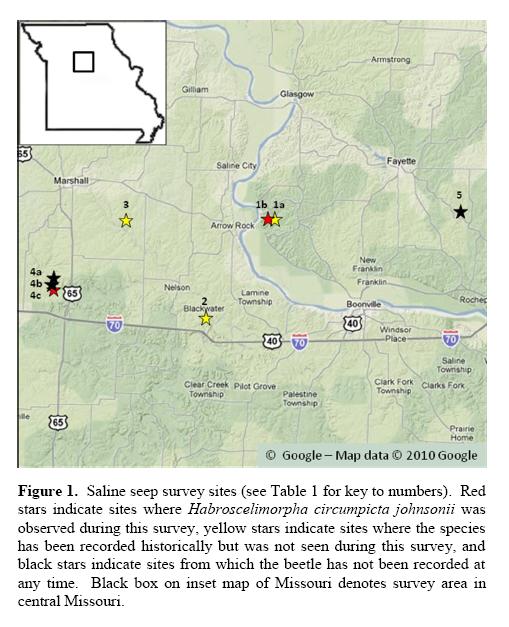
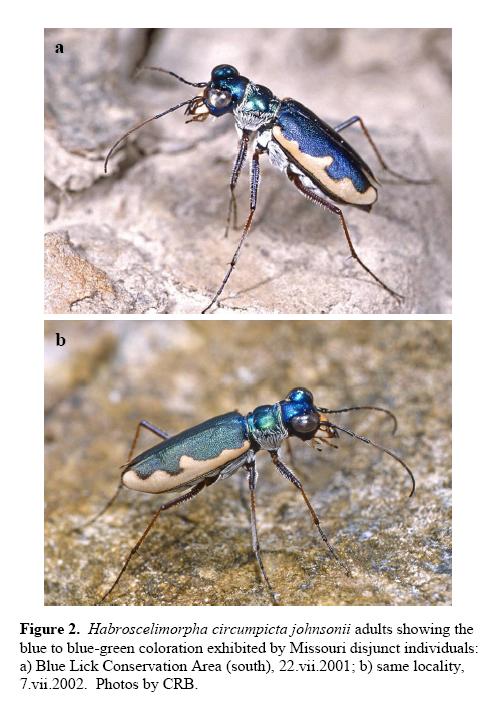
One of these species of interest is Habroscelimorpha circumpicta johnsonii (Johnson’s tiger beetle). This subspecies is widely distributed in inland areas of the central and south-central United States, where it is associated exclusively with barren areas surrounding saline seeps. Despite the broad occurrence of the main population, the Missouri population of this subspecies has long been of particular interest for several reasons: 1) its widely disjunct isolation, occurring several hundred miles east of the nearest populations in central Kansas, 2) its strict association with the highly restricted saline seeps of central Missouri (Fig. 1), and 3) the exclusive blue-green coloration of the adults (Fig. 2) that contrasts with the varying proportions of reddish and/or dark morphs, in addition to blue-green morphs, found in other populations. The highly disjunct and isolated occurrence of this population and its unique coloration have been considered by some workers as grounds for separate subspecific status. Another restricted, disjunct population of this species in North Dakota has already been accorded subspecific status – H. circumpicta pembina.

Despite its restricted occurrence in Missouri, a long history of collection records exist for the subspecies. Numerous specimens are housed in the Enns Entomology Museum in Columbia, Missouri, with a majority of these coming from a single location (Boone’s Lick Historic Site) and dating back as early as 1954. In more recent years (1985-1992), Ron Huber and Dave Brzoska found significant numbers of beetles at two additional locations near Boone’s Lick. Despite these numerous records, the subspecies was listed as a “Species of Conservation Concern” by the Missouri Natural Heritage Program with a status of “S2S3” (vulnerable or imperiled) due to the rarity of its required saline seep habitats in Missouri. Unfortunately, this alone did not appear to be sufficient protection for the species, as my own observations beginning in the mid-1990s suggested that populations of the beetle had declined significantly from their historical levels. Concomitant with these apparent declines was the observation that the sites supporting these beetles had themselves suffered severe degradation that reduced their apparent suitability as habitat for the beetle. As a result of these observations, Chris and I initiated comprehensive surveys during the 2001 field season to assess the conservation status of the Missouri population and identify potential new sites. Our first order of business was to petition a status change to “S1” (critically imperiled), and for the next three years we regularly visited the historical sites throughout the presumed adult activity period, noting occurrence of adults and recording their numbers and the circumstances of their habitat associations. Included in these surveys also were two new sites identified using the Missouri Natural Heritage Database.

The results were not good – during the 3-year survey, only a single beetle was observed at the historical location of Boone’s Lick, and none were observed at the two other locations discovered by Ron Huber and Dave Brzoska. More significantly, all three sites had suffered severe degradation due to vegetational encroachment, cattle trampling, or other anthropogenic disturbance. Moreover, of the two potential new sites identified, only one of these (Blue Lick Conservation Area) was found to support a small population of the beetle. Three apparently suitable saline seeps exist at this latter site; however, beetles were observed at only one of them. During the final year of the survey, prolonged flooding occurred at this site (frustratingly, a result of earth-moving operations by site personnel), which was followed in subsequent years by significant vegetational encroachment (Fig. 3). No beetles were observed at this site during the final year of the survey, nor has the species been seen there in multiple visits to the site in the years since.

Is the Missouri disjunct population of Johnson’s tiger beetle extirpated? There is little reason to be optimistic. What is clear is that the beetle is now below detectable limits, and with the loss of suitable habitat at all sites known to have supported the beetle in the past and little chance that new, high-quality sites will be identified, prospects for an unaided comeback are dim. The saline seep habitats at the three historic sites appear to have suffered irreparable degradation and offer little restoration potential to the degree required to support viable beetle populations; however, there are still two saline seeps at Blue Lick that do offer at least a semblance of suitable habitat. It is imperative that these last remaining examples of Missouri’s critically imperiled saline seeps habitats receive the highest priority for protection if the beetle (should it still exist) is to have any chance of surviving in Missouri. Johnson’s tiger beetle is only one of several tiger beetle species whose presence in Missouri appears to be in jeopardy (others being Dromochorus pruinina – loamy ground tiger beetle, and Cylindera celeripes – swift tiger beetle). I end this post with our closing admonition in the paper:

The loss of this beautiful and distinctive beetle from Missouri’s native fauna would represent a significant and tragic loss to this state’s natural heritage. We urge the Missouri Department of Conservation, the Missouri Department of Natural Resources, and other conservation organizations within the state to identify and allocate the resources needed to develop and implement a recovery plan for the species in Missouri.

REFERENCE:

Brown, C. R. and T. C. MacRae. 2011. Assessment of the conservation status of Habroscelimorpha circumpicta johnsonii (Fitch) in Missouri CICINDELA 42(4) (2010):77-90.

Postscript. On a happier note, I am pleased to be joining the editorial staff for CICINDELA. While my role as layout editor is more functional than academic, I am nevertheless thrilled with the chance to “rub shoulders” with the likes of Managing Editor Ron Huber and long-time cicindelid experts Robert Graves and Richard Freitag. I hope my contributions to the journal’s production on the computer end of things will be favorably received by its readership.

Copyright © Ted C. MacRae 2011

Recent literature – The Coleopterists Bulletin

Volume 64, No. 4 - December 2010

I returned to the office this week after spending two weeks in Brazil to find the December 2010 of The Coleopterists Bulletin in my inbox.  I don’t think there is another journal that I look forward to more eagerly than this one (with the possible exception of CICINDELA) – with each issue, I know that regardless of whether it contains any papers in my priority groups of interest (jewel beetles, longhorned beetles, and tiger beetles), it will nevertheless contain well-written articles presenting results of high-quality research on nothing but beetles – pure elytral ecstasy!  This latest issue, however, is a real keeper.  Gracing the cover is a stunning image of the South African jewel beetle species Julodis viridipes, photographed by my good friend and world jewel beetle expert Chuck Bellamy, and inside are three tiger beetle papers and two longhorned beetle papers – it’s almost as if the issue were produced just for me.

Friend and colleague Mathew Brust takes credit for two of the three tiger beetle papers.  In the first (Brust et al. 2010), he compares the efficiency of the three main methods for collecting tiger beetle larvae: fishing, stab-and-grab, and excavation. They found fishing to be the most efficient and least damaging of the three methods, an important finding for tiger beetle conservation where the availability of efficient, non-lethal survey methods is critical.  (What are “fishing” and “stab-and-grab” you ask?  Read the paper.)  In the second paper (Brust and Hoback 2010), Matt teams up with University of Nebraska entomologist Wyatt Hoback to provide new distributional records and larval descriptions of Nebraska’s tiger beetle, Cicindela nebraskana.  Ironically, this species is quite rare in it’s namesake state, and their findings give clues about the habitats in which it is most likely to occur (I had the good fortune to contribute a small amount of data).  In the third tiger beetle paper, Robert Richardson (2010) notes an overwhelming preponderance of left-superior mandibles in two species of Omus and speculates on the selective pressures that might operate on different tiger beetle clades to produce such a finding – a truly interesting read.

As for longhorned beetles, Sánchez-Martínez et al. (2010) report the utilization of living oaks by an apparently disjunct population of the marvelously beautiful Crioprosopus magnificus in central Mexico, complete with photographs of the larval workings and detailed emergence data.  (I am also reminded that I have a post on this very species that I need to put up).  Closer to home, Terence Schiefer and Patricia Newell (2010) independently recognized the existence of an undescribed subspecies of the red-edged saperda, Saperda lateralis, in the lower Mississippi Delta Region of the southeastern U.S., which together they describe as S. lateralis rileyi (named for Edward Riley, indefatigable collector of beetles, and collector of much of the type material).  Okay, I know what you’re thinking – “A new subspecies of S. lateralis? No way!”  Well, I was skeptical also when I first saw the title – several untenable and no longer recognized subspecies have already been described for this broadly distributed and variable species.  However, after noting the nature of the diagnostic characters, seeing the photographs, and studying their partially allopatric distributions, I was convinced.

In addition to the above papers, there were also a number of interesting book reviews in the issue, including The Chiasognathinae of the Andes, reviewed by M. J. Paulsen, A Field Guide of the Dynastidae Family of the South of South Americano access, reviewed by Ronald M. Young, and three book reviews by our beloved Art Evans: Illustrated Identification Guide to Adults and Larvae of Northeastern North American Ground Beetles (Coleoptera: Carabidae) [including tiger beetles]; The African Dung Beetle Genera; and Weevils of South Carolina (Coleoptera: Nemonychidae, Attelabidae, Brentidae, Ithyceridae, Curculionidae)no access.

REFERENCES:

Brust, M. L. and W. W. Hoback. 2010. Larval description and new Nebraska distribution records for Nebraska’s tiger beetle, Cicindela nebraskana Casey (Coleoptera: Carabidae). The Coleopterists Bulletin 64(4):341-346.

Brust, M. L., W. W. Hoback, and J. J. Johnson. 2010. Fishing for tigers: A method for collecting tiger beetle larvae holds useful applications for biology and conservation. The Coleopterists Bulletin 64(4):313-318.

Richardson, R. K. 2010. Mandibular chirality in tiger beetles (Carabidae: Cicindelinae). The Coleopterists Bulletin 64(4):386-387.

Sánchez-Martínez, G., O. Moreno-Rico, and M. E. Siqueiros-Delgado. 2010. Crioprosopus magnificus Leconte (Coleoptera: Cerambycidae) in Aguascalientes, Mexico: Biological observations and geographical distribution. The Coleopterists Bulletin 64(4):319-328.

Schiefer, T. L. and P. Newell. 2010. A distinctive new subspecies of Saperda lateralis F. (Coleoptera: Cerambycidae) from the southeastern United States. The Coleopterists Bulletin 64(4):329-336.

Copyright © Ted C. MacRae 2011

Quick Business…

I’ll have a “real” post ready shortly, but I wanted to make a quick note of a few items that have popped up recently:

  • Cylindera celeripes – this, of course, is the swift tiger beetle, a quite rare species of tiger beetle that I’ve been studying for the past two years.  I am preparing a manuscript (now in its final stages) that will review the species’ historical occurrence, document the new records I’ve accumulated for it, and discuss its potential conservation status.  I’ve gotten specimen label data from university collections in IA, KS, NE, OK, and TX (known range of the beetle) and from a number of private tiger beetle collectors.  However, I would like to make the story as complete as possible and am looking for any other repositories that might contain additional specimens.  If you know of such in your local university museum (other than those in the states listed above), I would appreciate knowing about them and getting ahold of their label data.
  • The Southern Fried Science Network has just launched a new group blog called Journeys, which they hope will serve as a central hub for writing about scientific field work and expeditions.  It’s a unique concept where contributors will post updates, stories, discoveries, and observations in the course of conducting their fieldwork.  The site has already been populated with a number of expedition logs (including a couple of my own).  I’m anxious to see if this takes off, as its field-work focus is right up my alley.  A link has been added to my sidebar under the heading “Field Work”.
  • Every now and then, someone asks me why I collect insects.  More specifically, they want to know why I must collect the insects that I find, rather than simply observing them in the field, making notes, and then letting them go on their merry ways.  Some are truly curious, while others adopt the more judgmental stance that collecting insects now is akin to the days of ornithology when birds were observed not through binoculars, but through rifle scopes before being shot!  I have a standard set of responses to this question, mostly dealing with difficulty of field identification, incomplete taxonomy, vouchering of scientific data, etc.  However, next time I am asked the question, I am going to provide a link to this post, a guest contribution by myrmecologist Benoit Guenard on Alex Wild’s Myrmecos.  I can only imagine what Benoit is going through, now realizing that he had found and photographed just the second and third known specimens of a truly rare North American ant, only to let them go because he didn’t realize what they were at the time.

Copyright © Ted C. MacRae 2010

Cicindela – A quarterly journal devoted to Cicindelidae

Being a cicindelophile (i.e., a tiger beetle enthusiast), I have on occasion highlighted articles published in the journal Cicindela (“A quarterly journal devoted to Cicindelidae”) (see previous post – also here, here and here).  This delightful little journal is the now 42-year old brainchild of Ronald L. Huber, among North America’s foremost experts of the group (and still serving as Managing Editor for the journal).  With Robert C. Graves and Richard Freitag also serving as Editors, the journal publishes four issues per year – each containing a variety of articles dealing with the taxonomy, biology, faunistics, and conservation of this captivating group.  More recent years have also seen the inclusion of color photographs.  For serious students of the group, the journal is an indispensable resource – its issues containing a significant portion of the recent tiger beetle taxonomic literature (indeed, I am fortunate to possess in my own library a complete and nicely bound set of this journal).  However, even those with only casual interest in the group can appreciate the journal’s informal, enthusiast-centric tone.  A remarkably longstanding labor-of-love, Ron himself lays out and delivers each issue to the printer, then mails copies to the journal’s few hundred subscribers.

One thing that the journal has lacked is a web presence.  This has becomes all too clear with each article that I’ve featured, each prompting requests for subscription information by readers whose interest in the journal was piqued but were then unable to find such information on the web.  All of that is about to change – with Ron’s permission, the journal’s editorial policy and subscription information are being reproduced here to make them more widely available to those who might wish to contribute or subscribe.  The cost of the journal is nominal (only $10 in the U.S.), so even the most casually interested person should be able to justify a subscription.

Editorial Policy

Manuscripts dealing with any aspect of the study of Cicindelidae will be considered from any author.  All manuscripts should be submitted to the Managing Editor via email or on diskette [see inside back cover for conventions and format].  Papers dealing with areas other than the Nearctic are especially solicited but should be in English.  Translations are also very welcome.  All manuscripts will be acknowledged upon receipt.  Proofs-for-correction will be emailed to authors for quality control.  Illustrations, charts, graphs, etc., are encouraged.  Authors that have institutional support or other funds available for publication purposes are importuned to arrange for at least partial payment of publication costs.  Current page charges are shown inside the back cover.

Subscriptions

The subscription price for each annual volume of four numbers is currently $10.00 (domestic) and $13.00 outside the U.S.  All subscriptions begin with the first issue of the year.  Back issues of prior volumes, if still available, are priced according to age.  Inquire for prices.  All requests for subscriptions and back issue availability should be addressed to the Managing Editor: Ronald L. Huber, 2521 Jones Place West, Bloomington, Minnesota 55431-2837, U.S.A.

My appreciation to Ron for allowing me to post this information, and also to Ken Allen, for permitting me to reproduce the cover of the latest issue of Cicindela, graced with a gorgeous variant of Cicindela longilabris that he photographed in Glacer National Park.

Copyright © Ted C. MacRae 2010

Add to FacebookAdd to DiggAdd to Del.icio.usAdd to StumbleuponAdd to RedditAdd to BlinklistAdd to TwitterAdd to TechnoratiAdd to Yahoo BuzzAdd to Newsvine

Email to a friend

Nomenclatural changes in Phymatodes

ResearchBlogging.orgI’ve mentioned before the considerable taxonomic challenges facing students of the family Buprestidae (jewel beetles) in North America, owing largely to fact that more than half of its species are assigned to one of just three hyper-diverse genera (Acmaeodera, Agrilus, and Chrysobothris). New species continue to be described, but the most recent comprehensive treatments of these three genera were published more than 60 to 100 years ago (Fall 1899, Fisher 1928, Fisher 1945)! The situation is not as dire in the “other” major woodboring beetle family – the Cerambycidae (longhorned beetles), thanks in great part to the efforts of Gorton Linsley and John Chemsak and their monographic series of the family’s North American species (Linsley 1961-1964, Linsely and Chemsak 1972-1997). Although somewhat more speciose in North American than the Buprestidae, diversity in the Cerambycidae is more apparent at the generic level (1000+ species in 325 genera, compared to 787 species in only 54 buprestid genera). This does not mean, however, that the Cerambycidae lacks problematic, speciose genera, and in a recently published paper, Ian Swift and Ann Ray (2010) tackle one of these – the genus Phymatodes. While no new species are described, their treatment does propose numerous nomenclatural changes based on examination of type specimens that affect several North American species, including correcting misapplied names and recognizing multiple synonymies. These problems resulted from the practice of many earlier authors who did not examine type specimens when describing new species, relying instead only on written descriptions to compare taxa.

  • Phymatodes blandus is no longer divided into subspecies, with P. blandus concolor now being recognized as a full species.
  • The name Phymatodes decussatus has been used for the wrong species, which is actually P. obliquus. It is distinct from true P. decussatus, which has until now been called P. juglandis. The subspecies formerly placed under P. decussatus are also synonymized under P. obliquus.  Linsley (1964) confused things by applying the name decussatus to this common, oak-associated species and the name juglandis to the species associated with walnut. The type of decussatus, however, matches the walnut species and, since it is the older name, takes priority. The common oak species is thus left without a name, and obliquus is the oldest of the many synonyms created by Thomas Casey.
  • Phymatodes hirtellus is no longer divided into subspecies.
  • Phymatodes lecontei is synonymized under P. grandis.
  • Phymatodes mojavensis is synonymized under P. nitidus.
  • Phymatodes oregonensis is synonymized under P. nigrescens.
  • Phymatodes ursae is synonymized under P. hirtellus.

While this paper is not a full revision of the genus, it does include diagnostic and comparative notes, full color dorsal habitus photographs (example plate below), and an updated key to all of the species found in North America.

PLATE 1. 1) Phymatodes aeneus, male; 2) P. aereus, female; 3) P. amoenus, female; 4) P. amoenus, female ventral; 5) P. ater, female; 6) P. ater, female; 7) P. blandus, male; 8 ) P. concolor, male; 9) P. decussatus, male. © Swift & Ray 2010.

The genus Phymatodes is most diverse in the western states and provinces – I haven’t spent as much time out there as in other areas of North America, so representation of this genus in my collection is rather weak at only 10 of the 26 species currently recognized in North America. Missing from my cabinet are the following – if anyone is able to help me out with these I would be most grateful:

  • Phymatodes aeneus LeConte, 1854
  • Phymatodes ater LeConte, 1884
  • Phymatodes concolor Linsley, 1934
  • Phymatodes decussatus (LeConte, 1857)
  • Phymatodes fulgidus Hopping, 1928
  • Phymatodes infuscatus (LeConte, 1859)
  • Phymatodes lengi Joutel, 1911
  • Phymatodes lividus (Rossi, 1794) – introduced to eastern U.S.
  • Phymatodes maculicollis LeConte, 1878
  • Phymatodes nigerrimus Van Dyke, 1920
  • Phymatodes nigrescens Hardy & Preece, 1927
  • Phymatodes obliquus Casey, 1891
  • Phymatodes rainieri Van Dyke, 1937
  • Phymatodes shareeae Cope, 1984
  • Phymatodes tysoni Chemsak & Linsley, 1984
  • Phymatodes vulneratus LeConte, 1857

REFERENCES:

Fall, H. C.  1899. Synonpsis of the species of Acmaeodera of America, north of Mexico. Journal of the New York Entomological Society 7(1):1–37 [scroll to “Journal of the New York Entomological Society”, “v. 7 1899”, “Seq 12”].

Fisher, W. S.  1928. A revision of the North American species of buprestid beetles belonging to the genus AgrilusU. S. National Museum 145, 347 pp.

Fisher, W. S.  1942. A revision of North American species of buprestid beetles belonging to the tribe Chrysobothrini.  U. S. Department of Agriculture, Miscellaneous Publication 470, 275 pp.

Linsley, E. G.  1961. The Cerambycidae of North America.  Part I.  Introduction.  University of California Publications in Entomology 18:1–97.

Linsley, E. G.  1962. The Cerambycidae of North America.  Part II.  Taxonomy and classification of the Parandrinae, Prioninae, Spondylinae and Aseminae.  University of California Publications in Entomology 19:1–102.

Linsley, E. G.  1962. The Cerambycidae of North America.  Part III.  Taxonomy and classification of the subfamily Cerambycinae, tribes Opsimini through Megaderini.  University of California Publications in Entomology 20:1–188.

Linsley, E. G.  1963. The Cerambycidae of North America.  Part IV.  Taxonomy and classification of the subfamily Cerambycinae, tribes Elaphidionini through Rhinotragini.  University of California Publications in Entomology 21:1–165.

Linsley, E. G.  1964. The Cerambycidae of North America.  Part V.  Taxonomy and classification of the subfamily Cerambycinae, tribes Callichromini through Ancylocerini.  University of California Publications in Entomology 22:1–197.

Linsley, E. G. and J. A. Chemsak.  1972. The Cerambycidae of North America.  Part VI, No. 1.  Taxonomy and classification of the subfamily Lepturinae.  University of California Publications in Entomology 69:viii + 1–138.

Linsley, E. G. and J. A. Chemsak.  1976. The Cerambycidae of North America.  Part VI, No. 2.  Taxonomy and classification of the subfamily Lepturinae.  University of California Publications in Entomology 80:ix + 1–186.

Linsley, E. G. and J. A. Chemsak.  1984. The Cerambycidae of North America, Part VII, No. 1: taxonomy and classification of the subfamily Lamiinae, tribes Parmenini through Acanthoderini.  University of California Publications in Entomology 102:ix + 1–258.

Linsley, E. G. and J. A. Chemsak.  1995. The Cerambycidae of North America, Part VII, No. 2: taxonomy and classification of the subfamily Lamiinae, tribes Acanthocinini through Hemilophini.  University of California Publications in Entomology 114:xi + 1–292.

Linsley, E. G. and J. A. Chemsak.  1997. The Cerambycidae of North America, Part VIII: bibliography, index, and host plant index.  University of California Publications in Entomology 117:ix + 1–534..

Swift, I. P. & A. M. Ray. 2010. Nomenclatural changes in North American Phymatodes Mulsant (Coleoptera: Cerambycidae). Zootaxa 2448:35–52.

Copyright © Ted C. MacRae 2010

Add to FacebookAdd to DiggAdd to Del.icio.usAdd to StumbleuponAdd to RedditAdd to BlinklistAdd to TwitterAdd to TechnoratiAdd to Yahoo BuzzAdd to Newsvine

Email to a friend