🌿 Botanizing w/ the Webster Groves Nature Study Society (WGNSS) Botany Group at Fults Hill Prairie Nature Preserve — 27 Oct 2025

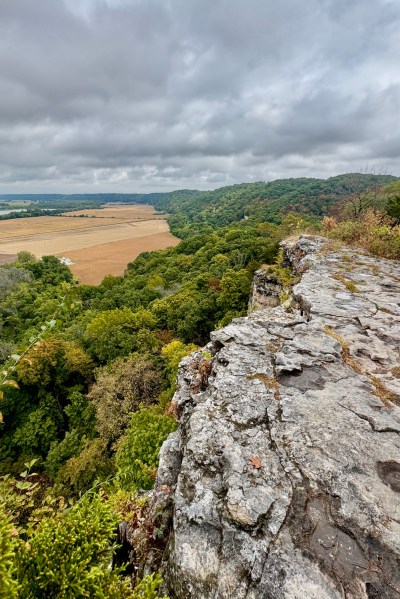
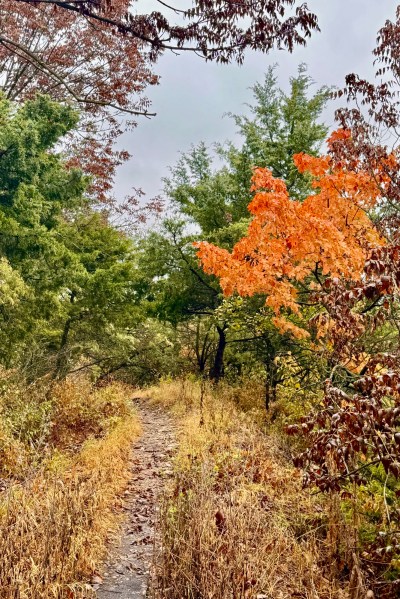
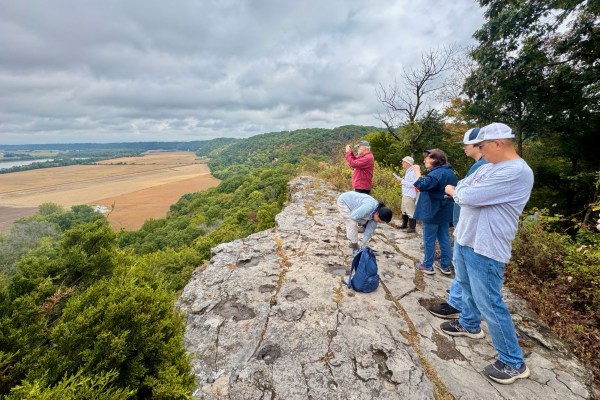
After visiting Salt Lick Point Land & Water Preserve a few weeks ago, the WGNSS Botany Group continued its exploration of the Mississippi River bluffs in southern Illinois by visiting Fults Hill Prairie, a 532-acre preserve 13 miles south of Salt Lick Point. In addition to upland forests and glades, Fults Hill Prairie features the largest complex of high-quality loess hill prairie still existing in the state. This diversity of habitats correlates with a rich diversity of plants, which at this time of year is exemplified by the classic fall genera Solidago (goldenrods) and Symphyotrichum (true asters). While late October is a bit past peak bloom and the persistent precipitation that only began a few days earlier after an extraordinarily dry previous three months further dampened expectations, a decent-sized group of intrepid explorers nevertheless defied the forecast, steep wooden stairway, and slippery final ascent (along with the subsequent descent) to explore the area’s diversity and admire its bluff-top views.

View of the Mississippi River valley from Fults Hill Prairie Nature Preserve.

Some of the same goldenrods and asters that the group saw a few weeks ago at Salt Lick Point were again seen during the initial ascent. Among the more conservative of these were Solidago buckleyi (Buckley’s goldenrod), Solidago drummondii (cliff goldenrod), and Symphyotrichum anomalum (many-rayed aster). Less conservative (i.e., more commonly encountered) counterparts also were seen such as Solidago ulmifolia (elm-leaved goldenrod) and Symphyotrichum patens (spreading aster). In all cases, the plants exhibited precious few pitiful flowers due to the combination of late season and the drought-compromised display, but this didn’t prevent the group from practicing their identification skills based on non-floral characters.

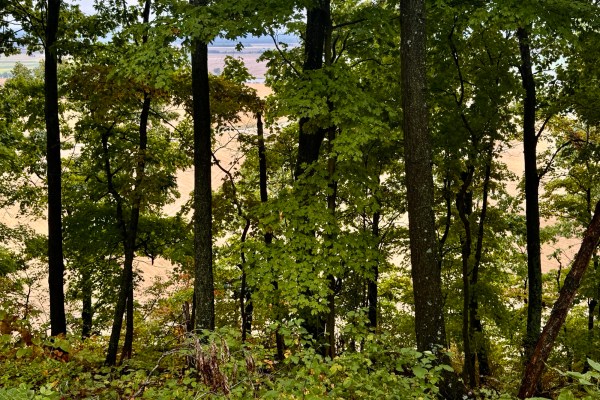
Ascending the steep rocky slopes, the canopy was dominated by Quercus muhlenbergii (chinquapin oak)—an indicator of the thin, rocky soils underfoot. As the group continued to ascend, Quercus alba (white oak) also began to appear and eventually replaced Q. muhlenbergii as the dominant oak, signaling the presence of deeper deposits of the wind-blown loess soils that characterize the hilltops. Further up, on the south- and west-facing slopes at the top, such soils are unable to hold sufficient moisture to support the growth of trees. As a result, despite the presence of deep soils, the forest gives way to the first of two large hilltop prairie remnants featured in the preserve. A lone, Quercus stellata (post oak) stood sentry atop the prairie, adding to the diversity of oaks seen and framing a gorgeous view from the prairie across the valley below.

A lone Quercus stellata (post oak—family Fagaceae) stands sentry atop a loess hill prairie.

Entering the woodlands along a remnant 2-track belying the past presence of a farm, the group encountered a third species of blue-flowered aster whose cordate, scabrous leaves, pubescent stems, and distinctly winged leaf petioles identified it as Symphyotrichum drummondii (Drummond’s aster). This and another more commonly encountered aster, Symphyotrichum lateriflorum (calico aster), were found scattered along the sides of the 2-track until the group began its descent down into the second large loess prairie remnant.

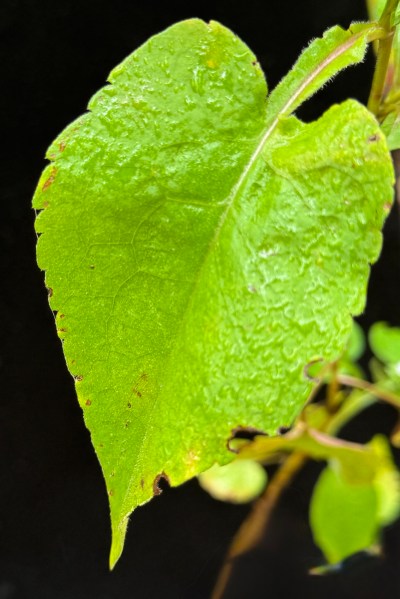
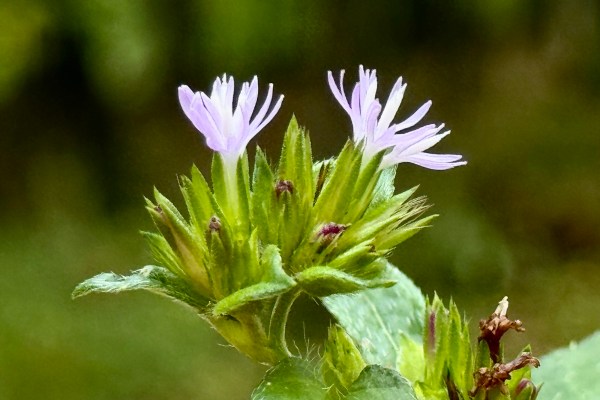
Symphyotrichum drummondii (Drummond’s aster—family Asteraceae) inflorescence.
Symphyotrichum drummondii (Drummond’s aster—family Asteraceae) leaf and petiole.

Also along the 2-track, but only in one small area, the group observed Sceptridium dissectum (cut-leaf grape fern, formerly Botrychium dissectum) in “flower” with mature fertile fronds. The finely divided leaves identified the plants as var. dissectum, which is a bit less common than var. obliquum.
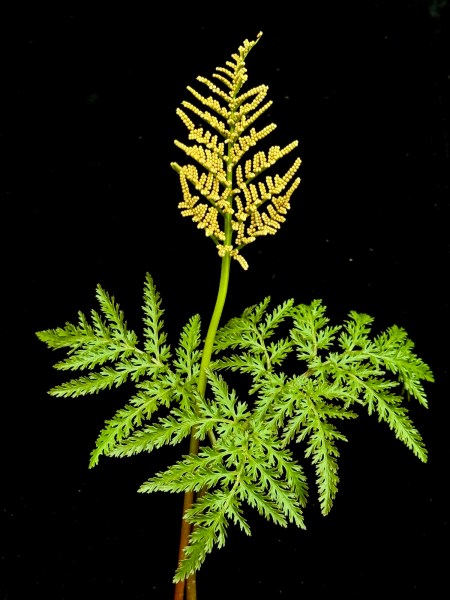
Sceptridium dissectum var. dissectum (cutleaf grapefern—family Ophioglossaceae).

The diversity of oaks seen increased as the group traversed the forests along the 2-track, with Quercus velutina (black oak) becoming co-dominant with Q. alba. Numerous freshly-fallen twigs littered the 2-track due to the recent rains, and the shapes of some of the leaves seemed to suggest they might be from the more southerly Quercus falcata (southern red oak); however, careful examination of their lobes along with newly-formed buds and fully-developed acorns confirmed them, nevertheless, to be Q. velutina.

Quercus velutina (black oak—family Fagaceae) leaf.
Quercus velutina (black oak—family Fagaceae) buds.
Quercus velutina (black oak—family Fagaceae) acorn.

Still, the diversity observed oaks increased to five species when we began encountering Quercus shumardii (Shumard’s oak), including one particularly grand old tree whose spreading main branches and broadly-formed crown whispered stories about the more open conditions that must have occurred around it during its youth.
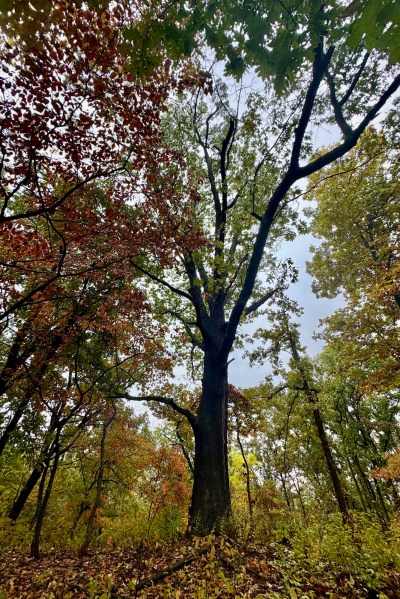
Quercus shumardii (Shumard’s oak—family Fagaceae).

Nearby, a rusty farm implement, actively being engulfed by trees that sprouted after the last time it saw any movement, further attested to the area’s long-forgotten days as a farm.
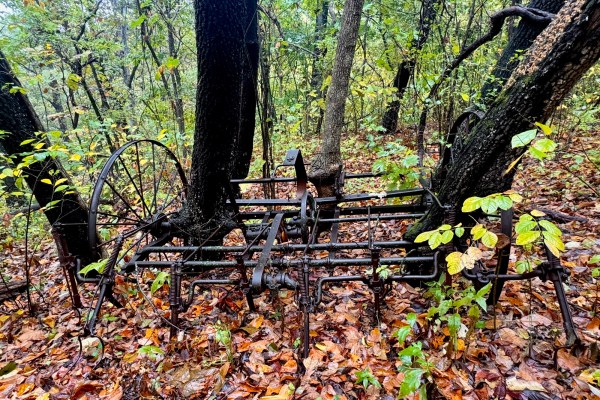
Old farm implement taken over by trees.

The diversity of goldenrods seen also continued to tick upwards along the 2-track as we encountered what was either Solidago atltissima (tall goldenrod) or Solidago canadensis (Canadian goldenrod). These two species are difficult to distinguish, especially when the foliage is wet since leaf pubescence is a key distinguishing characteristic, but the upland habitat initially suggested the latter since S. altissima prefers more mesic habitats. A number of other more mesic-preferring plant species were also noticed in the area, however, perhaps a result of the underlying deep loess soils, so a final determination was not made. It was upon the final approach towards and down onto the second main loess prairie remnant, however, that the diversity of goldenrods and asters really began to skyrocket. Near the edge of the prairie but still in the forest, we saw Symphyotrichum oolentangiense (pronounced oh-OH-len-tang-ee-IN-say) (azure aster)—easily identifiable by its blue flowers and long, narrow, arrowhead-shaped lower leaves that are rough and sandpapery to the touch. At the prairie edge Symphyotrichum turbinellum (prairie aster), identifiable by its many-branched growth habit, elliptic leaves with tapered bases, and long vase-shaped involucres, began to appear. Symphyotrichum sericea (silky aster) further padded the diversity totals, a small patch of plants with their distinctive silvery leaves occupying the farthest (and possibly driest) extent of the loess prairie ridge before it began dropping precipitously towards the towering limestone blufftop.
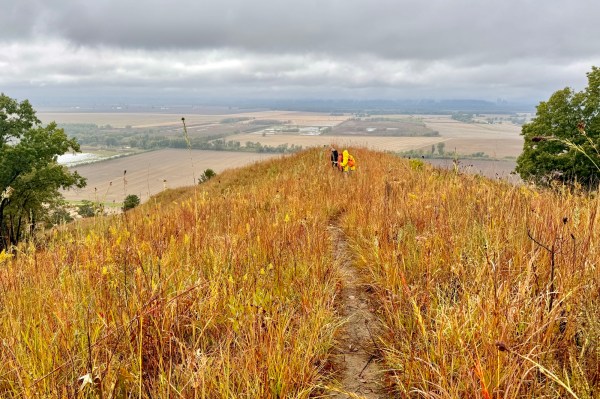
Kathy, Michael, and John examine plants in a loess hill prairie.

The most dazzling addition to the diversity, however, was Solidago rigidiuscula (stiff-leaved showy goldenrod). Until recently considered to be a variety of Solidago speciosa (showy goldenrod), the large showy inflorescences of this species are every bit as attractive as the latter, but the plants feature narrower leaves, and while the flowers had largely faded by this late date, the lower foliage turning brilliant red provided stunning contrast with the still-green upper leaves and more muted colors of the surrounding vegetation.
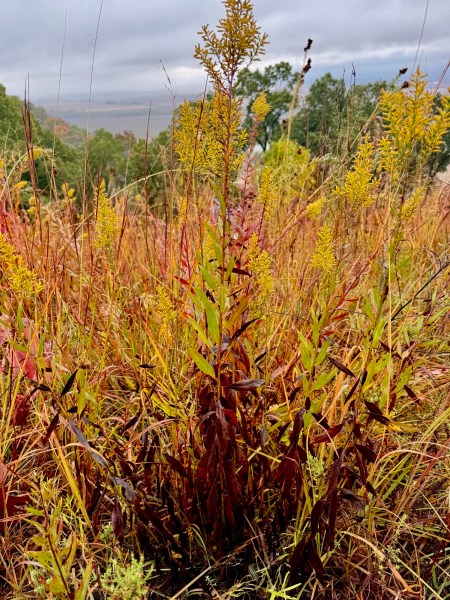
Solidago rigidiuscula (stiff-leaved showy goldenrod—family Asteraceae).

The group then began its long, slow, careful descent off the prairie and through the lower woodlands back to the parking lot. Separating the two, however, is a limestone glade that features a slightly different flora of prairie-associated species than the hilltop prairie due to its thin, rocky versus deep loess soils, and it was in these glades where the group saw the day’s ninth and final species of aster—Symphyotrichum oblongifolium (aromatic aster), distinctive by its branched growth with numerous small leaves amongst normal-sized leaves (and if there is still any doubt, a quick crush-and-smell of the latter reveals its highly aromatic nature). A sixth and final goldenrod also was seen on the rocky slopes just below the glade—Solidago radula (rough goldenrod), its short, clump-like stature and densely numerous, heavily scabrous, serrate leaves confirming its identity.

As the lone entomologist in the group, I had been keeping my eye out for any insect activity—particularly Oncideres cingulata (twig girdler), a longhorned beetle (family Cerambycidae) that appears only during fall and “girdles” twigs of hickory and certain other trees before laying eggs in them. Numerous such twigs were seen, and I picked up several in hopes of finding females still upon them—unfortunately, to no avail. In fact, but a single insect was seen all day, and even it was not until I had returned to the parking lot—a nymph of the distinctively green Zelus luridus (pale green assassin bug).

Zelus luridus (pale green assassin bug—family Reduviidae) nymph.

©️ Ted C. MacRae 2025

Botanizing w/ the WGNSS Botany Group at Salt Lick Point

After missing the last three weeks, I was happy to rejoin the WGNSS botanists on their regular weekly outing this past Monday. This week’s destination—Salt Lick Point Land & Water Reserve in western Monroe Co., Illinois—features a mosaic of loess hill prairie and limestone glades amidst dry to dry-mesic upland forest atop limestone bluffs towering up to 400 feet above the Mississippi River valley below.

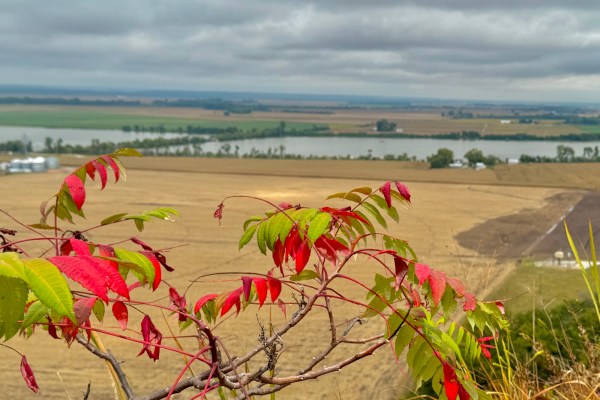
View from the Newman Trail at Salt Lick Point.

It has been an exceptionally dry August and September, so much that fall blooming plants are noticeably delayed and sparse in their blooms. Nevertheless, welcome rains just in the past few days have breathed some “fall life” into the woods and brought with them the pungent, earthy aromas that one expects to accompany a landscaping morphing from the dull greens of summer to the vibrant ambers, tawnies, and golds of fall.

View from the Salt Lick Trail at Salt Lick Point.

The group first explored the upland and blufftop habitats along the challenging terrain of the Salt Lick and Newman Trails, then returned through flat lowlands along the bluff bottoms via the Johnson Trail. Although still just beginning to bloom, a diverse palette of “fall asters” gave us an opportunity to reacquaint ourselves with the characters that distinguish these often “easy-to-identify-to-genus but difficult-to-identify-to-species” plants. The bulk of these fell into one of two groups—the true asters (genus Symphyotrichum) and the goldenrods (genus Solidago).

Salt Lick Trail at Salt Lick Point.

Symphyotrichum patens (late purple aster) was the first true aster that we noticed, a rather common species distinguished by its purple (of course) flowers with loose but not recurved phyllaries and leaves broadly clasping the stem. It wasn’t long before we had a chance to test our knowledge when we encountered the similar appearing Symphyotrichum anomalum (manyray aster), also with purple flowers but distinguished from S. patens by its distinctly recurved phyllaries and petiolate rather than clasping leaves. Eventually, we would encounter a third species of the genus—Symphyotrichum lateriflorum (calico aster), distinguished by its numerous small white flowers at the tips of numerous lateral branches rather than the terminus of the stem.

View from the Newman Trail at Salt Lick Point.

Goldenrods, on the other hand, were not only more diverse but also comprised some quite conservative species. The first of these was Solidago drummondii (Drummond’s goldenrod). This near-endemic species is restricted to eastern Missouri and adjacent parts of Illinois and Arkansas and grows almost exclusively on limestone or dolomite bluffs. However, we found it growing on limestone boulders placed at the trailhead next to the parking lot. Its wide, toothed leaves on short petioles (along with habitat) make this species easy to identify. Another quite conservative goldenrod was found as we entered the dry to dry-mesic forest further up the trail—Solidago buckleyi (Buckley’s goldenrod). Restricted to the Ozarks and adjacent areas, it is a showy species with relatively large flowers and spready phyllaries. In this and other respects, it greatly resembles the much more common Soldago petiolaris (downy goldenrod); however, it differs from that species by its narrower leaves that lack distinct teeth. A third species was seen as we approached one of the larger loess hilltop prairie remnants—Solidago altissima (tall goldenrod). Unlike the previous two species, this is one of the commonest and weediest species of goldenrod in the region. Relatively tall and with pyramidal inflorescences, this species often aggressively monopolizes roadsides and fallow fields. It greatly resembles another fairly common species—Solidago gigantea (late goldenrod), which we would later see during the return hike along the edge of the river valley. Leaf texture, however, differs between these two species—S. altissima has leaves with rough surfaces (caused by stiff, unidirectionally recurved hairs that cause the leaf to move only one direction when rubbed between the thumb and forefinger), while S. gigantea has smooth leaves (that move in any direction when rubbed).

Elephantopus carolinianus (Carolina elephantsfoot, leafy elephant’s foot—family Asteraceae).

The group not only spent its time with its eyes down, but also out—across the vast Mississippi River valley spread out below the several lookout points dotting the trails. Tawny fields of near-ready-to-harvest corn provided a beautiful backdrop against the resplendent red sumacs and brilliant orange maples lining the blufftops.

Members of the WGNSS Botany Group admire the view from the Newman Trail at Salt Lick Point.
View from the Newman Trail at Salt Lick Point.

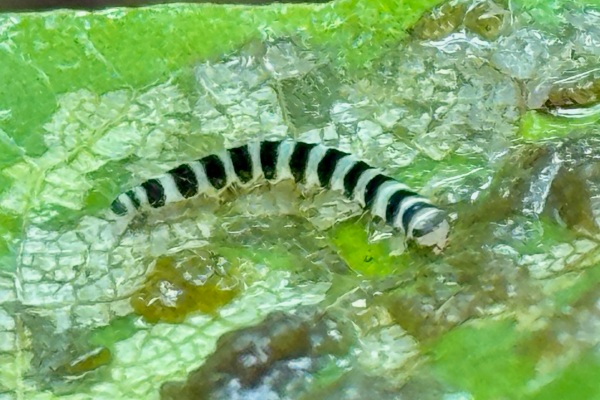
As the group’s lone entomologist/botanist (“entomotanist”?), I also kept an eye out for insects and was richly rewarded. A tiny “thorn” on the stem of S. buckleyi proved to be Enchenopa latipes (wide-footed treehopper), and unfolding the “folded” leaves of Cercis canadensis (eastern redbud) revealed the culprits—zebra-striped caterpillars of Fascista cercerisella (redbud leaffolder moth).

Enchenopa latipes (wide-footed treehopper—family Membracidae) on stem of Solidago buckleyi (Buckley’s goldenrod).
Fascista cercerisella (redbud leaffolder—family Gelechiidae) on Cercis canadensis (eastern redbud).

A spectacular earth boring beetle, Geotrupes splendidus, was seen lumbering clumsily along the trail in its endless quest for mammal dung to bury and lay an egg upon, while Bombus impatiens (common eastern bumble bee) worked the flowers of Eupatorium altissimum (tall boneset) and Eupatorium serotinum (late boneset).

Geotrupes splendidus (splendid earth-boring beetle—family Geotrupidae) on trail through dry-mesic loess woodland.
Bombus impatiens (common eastern bumblebee—family Apidae) on flower of Eupatorium altissimum (tall boneset).

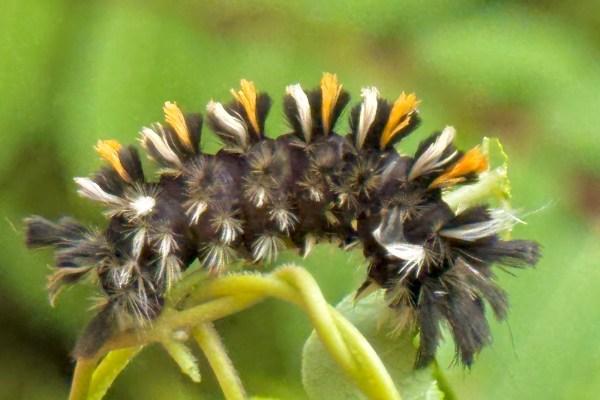
A nearly mature Euchaetes egle (milkweed tussock moth) consumed the dwindling foliage of Cynanchum laeve (climbing milkweed), and Piezogaster calcarator (leaf-footed bugs) congregated on the inflorescences of Verbesina alternifolia (yellow ironweed).

Euchaetes egle (milkweed tiger moth, milkweed tussock—family Erebidae) on Cynanchum laeve (climbing milkweed).
Piezogaster calcarator (leaf-footed bug—family Coreidae) on flower of Verbesina alternifolia (yellow ironweed).

Nowhere, however, was insect activity more abundant than on the goldenrods, particularly the abundant stands of S. altissima in the uplands and S. gigantea below. Overwhelming numbers of Chauliognathus pennsylvanicus (goldenrod soldier beetles) and Lycomorpha pholus (black and yellow lichen moths) were accompanied by a cacophony of bees, wasps, and flies—a situation tailor made for Phymata sp. (jagged ambush bugs) to lay in wait while Epargyreus clarus (silver-spotted skipper) flew erratically overhead.

Phymata sp. (jagged ambush bug—family Reduviidae) mating pair on flower of Solidago altissima (tall goldenrod).
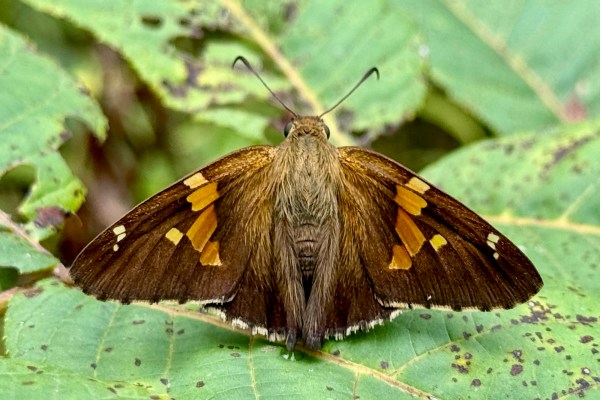
Epargyreus clarus (silver-spotted skipper—family Hesperiidae) perched on Solidago altissima (tall goldenrod).

Even in the deeply shaded mesic forest, Cyllopsis gemma (eastern gemmed satyrs) flitted deftly through the undergrowth.

Cyllopsis gemma (eastern gemmed satyr—family Nymphalidae) in mesic riparian forest.

The most unusual find, however, was a bizarre, green, jewel of a caterpillar found crawling on the forest floor—Isa textula (crowned slug moth or skiff moth), fringed with lacy projections that make it look more like a sea slug than an insect!

Isa textula (crowned slug moth, skiff moth—family Limacodidae) in leaf litter of mesic riparian forest.

Of course, a Monday WGNSS Botany Group outing isn’t truly consummated until it has enjoyed lunch at a local establishment—the choice this time being Tequila Mexican Restaurant in nearby Waterloo (best fish tacos I’ve ever had!).

©️ Ted C. MacRae 2025
Rush skeletonplant pea gall wasp

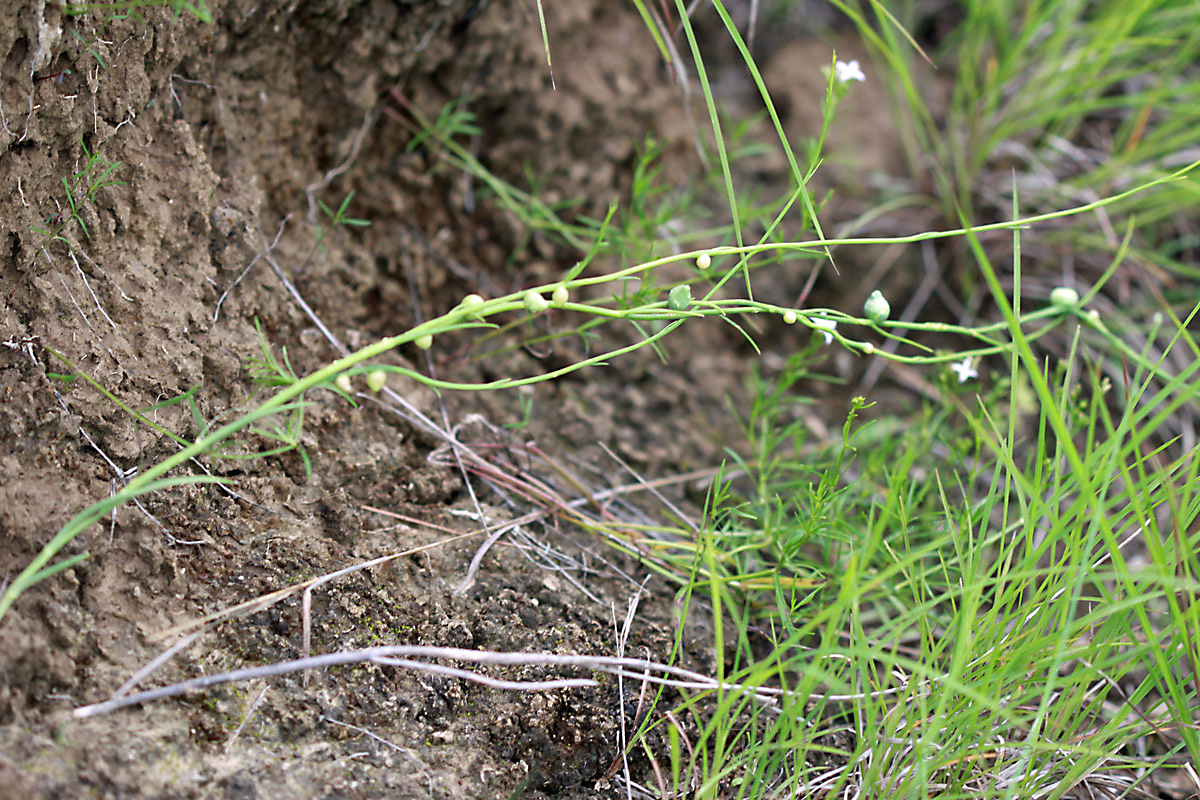
Lygodesmia juncea with galls of Antistrophus lygodesmiaepisum (Hymenoptera: Cynipidae) on stem.

The Loess Hills landform along the western edge of Iowa and extreme northwestern Missouri is home to a unique assemblage of plants and animals.  The majority of these are associated with loess hilltop prairies – grassland remnants that have their origins in the hypsithermal maximum of several thousand years ago and that persist as small relicts on the landform’s steep, dry, south- and west-facing slopes.  Many of the plants and animals found in these grassland remnants are more typically found further west in the Great Plains, but hang on in the Loess Hills as hypsithermal relicts.

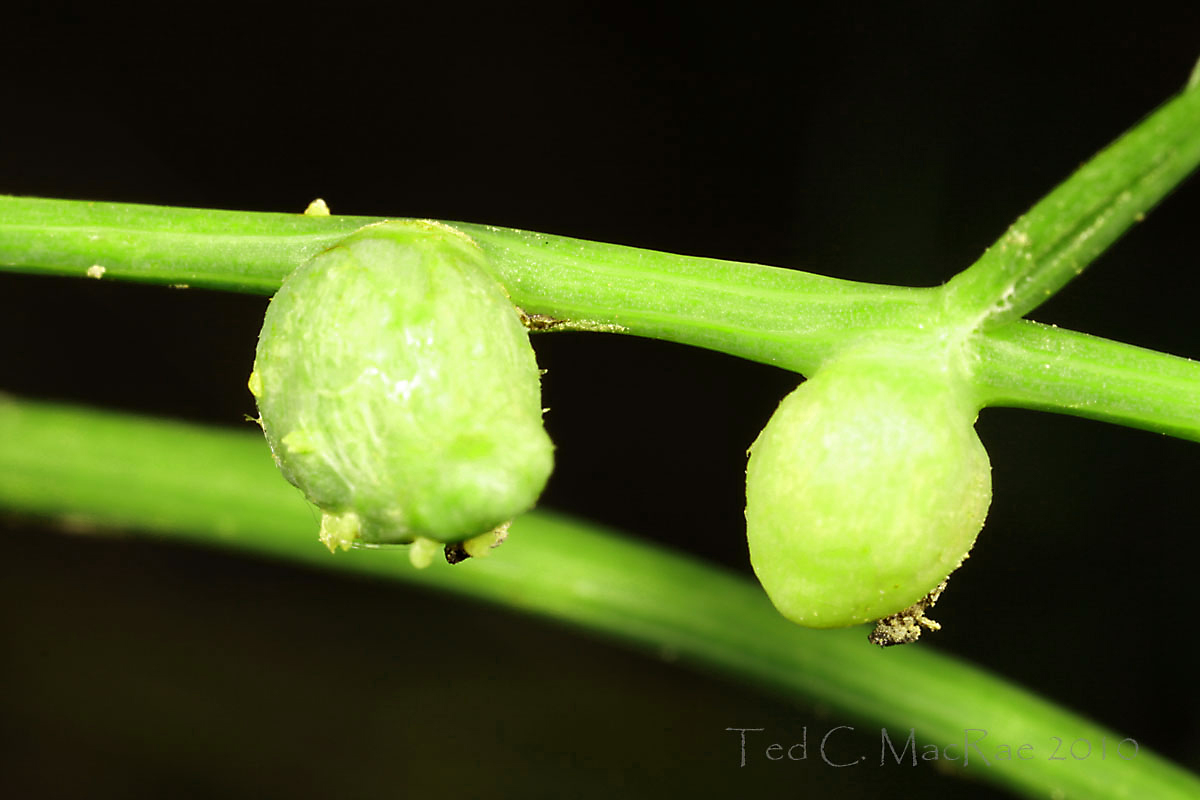
Antistrophus lygodesmiaepisum galls on stem of Lygodesmia juncea.

One such hypsithermal relict is rush skeletonplant, Lygodesmia juncea, a wirey, leafless-looking plant in the family AsteraceaeÂą.  More common in the Great Plains, this plant occurs in Missouri only on these loess hilltop prairie remnants.  The first time one encounters this plant, they are left with the impression that the plant bears small, pea-like fruiting structures along the length of its stem.  These are not fruiting structures, however, but galls made by the cynipid wasp Antistrophus lygodesmiaepisum.  Although this insect does not have a common name, it is associated exclusively with L. juncea, as suggested by its specific epithet (which also alludes to the pea-like galls with the suffix -pisum), so I see no reason why this wasp cannot be called the “rush skeletonplant pea gall wasp.”  Some sources variably misspell the genus as Anistrophus (without the first “t”) or the species name as simply pisum, a synonym first introduced by Ashmead in the late 19th century a few years after the species was described (I made both mistakes [and also erroneously referred to L. juncea as skeletonweed] in one of my earliest posts: The Loess Hills in Missouri).  It would seem that Antistrophus lygodesmiaepisum is the correct name, according to Pickering (2009).

Âą Not to be confused with rush skeletonweed, Chondrilla juncea – also in the Asteraceae, which despite the similarity of common names, specific epithet, and general appearance (except with yellow flowers) is an altogether different plant that was introduced from the Mediterranean Region and is now considered an invasive weed in much of the Great Plains.

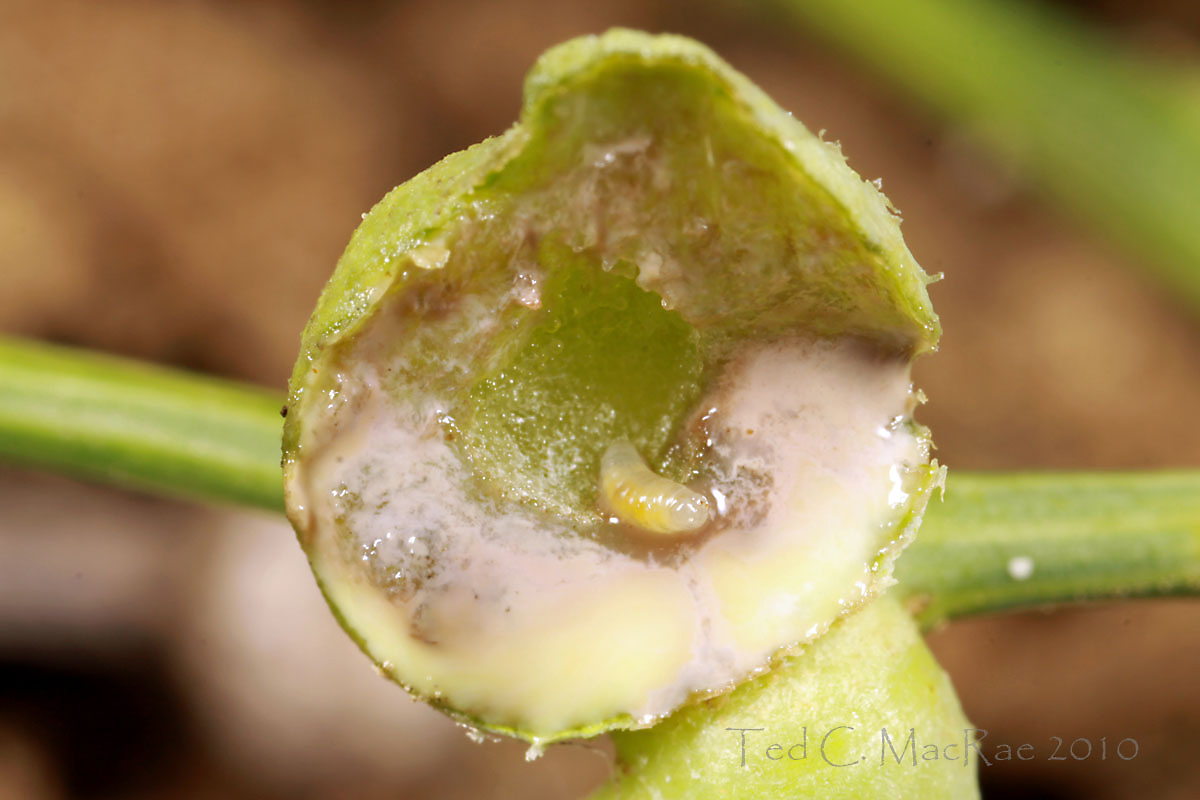
Antistrophus lygodesmiaepisum larva in gall on stem of Lygodesmia juncea.

Rush skeletonplant exudes a latex-like sap when damaged, making it unpalatable to most grazers – this latex-like sap can be seen when the galls made by the wasps are cut open.  Cynipid wasps are the second most diverse group of gall-making insects behind the gall midges, and many species are mono- or oligophagous (Ronquist and Liljeblad 2001), meaning that they are associated exclusively with a single plant species or group of closely related species.  Antistrophus lygodesmiaepisum is one such monophagous species, thus its occurrence in Missouri, like that of L. juncea, is restricted to the tiny loess hilltop prairie remnants in extreme northwestern Missouri.  In recent years, these prairie relicts have suffered heavily from conversion to agriculture, abusive grazing, and suppression of fire that has led to invasion by woody and exotic plants.  In Missouri, only about 50 acres of loess hilltop prairie remain, and only half of these are in conservation ownership, making it among the most critically imperiled of natural communities in Missouri.  While lacking the conservation charisma of L. juncea and the dozen or so other plants and vertebrates that are restricted in Missouri to these prairie remnants, A. lygodesmiaepisum nevertheless deserves equal consideration as a Missouri species of conservation concern.

I knew this would be a difficult ID Challenge and am quite impressed that at least a few people figured out at least the correct genus.  Tim Eisele scored 8 points in this challenge to not only take the win but also move way up into a 3-way tie for 4th place in the overalls.  Ben Coulter continues to be Mr. Consistency, earning 4 points for 2nd place and retaining his overall lead by an almost insurmountable margin (see what happens when you play every game!).  JasonC beat out the other contenders for the final podium spot on the basis of a bonus point, but the hot contest continues to be the battle for 2nd place overall.  Janet Creamer still holds it at 14 pts, but there is a veritable gaggle of contenders nipping at her heals – the next few challenges could be interesting.

Photo 1: Canon 100mm macro lens (ISO 100, 1/250 sec, f/2.8).
Photos 2-3: Canon MP-E 65mm 1-5X macro lens (ISO 100, 1/250 sec, f/14).
All photos: Canon 50D , Canon MT-24EX flash w/ Sto-Fen + GFPuffer diffusers. Typical post-processing (levels, minor cropping, unsharp mask).

REFERENCES:

Pickering, J.  2009.  Database of Hymenoptera in America north of Mexico. http://www.discoverlife.org/proceedings/0000/6/html/Cynipidae (accessed 20 Jan 2011).

Ronquist, F. and J. Liljeblad.  2001.  Evolution of the gall wasp-host plant association.  Evolution 55(12):2503–2522.

Copyright © Ted C. MacRae 2011

Swift Tiger Beetle – good news, bad news

Sorry about the noisy video – it was shot in one of our walk-in growth chambers with fans going full-bore! Anyway, the video shows a couple of mating pairs of Cylindera celeripes (swift tiger beetle) that I brought back from the Loess Hills of extreme northwest Missouri this past weekend.  Watch carefully and you’ll see the first pair actively copulating before they break apart. After that I pan over to the second pair, which is not actively mating but have remained coupled as an example of behavior called “mate guarding” You might also notice a few very small green “bugs” in the container – these are 2nd-instar Lygus nymphs, which I placed in the container earlier in the day as prey – it was quite a sight to see the tiger beetles immediately begin chowing down on them! At the end of the video, I poke at the second mating pair with my forefinger to give an indication of their tiny size – this flightless species is one of the smallest in all of North America! Knowing how tiny the beetles are and how well they blend into their surroundings (you’ll have to imagine the 1-2 ft of plant growth that was surrounding them in the field), you can appreciate just how difficult these beetles are to detect in their native habitat.

There is a “good news, bad news” aspect to the story behind these beetles. This rare Great Plains species was unknown from Missouri until last year, when we (Chris Brown and I) discovered it in loess hilltop prairie remnants at Brickyard Hill, Star School Hill Prairie, and McCormack Loess Mounds Conservation Areas. Loess hilltop prairie is among Missouri’s most critically endangered natural community due to its restricted occurrence at the southern tip of the Loess Hills landform and more than a century of overgrazing and relentless encroachment by woody vegetation and invasive exotics. The sites where we found the beetle last year contain the highest quality loess hilltop prairie remnants in Missouri, so we are now taking a more thorough look at some of the smaller remnants that still exist in the area. The most promising of these are at Squaw Creek National Wildlife Refuge and on several privately owned lands near the known sites, and these were the sites that I searched this past weekend. Some of these sites looked promising (one in particular looked excellent), but thorough searching at each revealed no beetles. By the time I finished searching the last of them I had begun to wonder if: 1) my “search image” for the species had gotten rusty, or 2) my timing was a bit too early (last year’s populations were discovered in late June). To test this, we (daughter Madison and I) returned to one of the known sites (McCormack) where we had seen only two beetles last year (unable to capture either one). As we hiked along the ridge top leading to the spot where we saw them, I kept a close watch on the narrow trail in front of me. Nothing. However, as soon as I came upon “the spot” I saw one! I dropped to my knees and slapped my hands down on the ground, forming an “arena” between my two thumbs and forefingers, but the beetle ran over my hand too quickly and escaped. No matter – in less than a minute I saw another one and successfully trapped it under my fingers as it ran over my other hand. During the next 15-20 minutes I would see at least eight individuals along the narrow trail in this single spot. While it was gratifying to see more individuals at this site than we had seen last year, it also meant that the timing of my searches at the other sites was fine and that I was not suffering from a rusty search image. The beetle could still be at those sites where I had failed to find it, but if it is then it certainly does not occur in very high numbers. It also bothers me that at this site the beetle seems to be restricted to one isolated ridge, which appears not to have been burned in recent years (in contrast to the rest of the preserve, which seems to have been burned within the past year or so). I searched all the remaining ridge top again thoroughly after finding the beetles again this year, but no beetles were seen anywhere except this tiny spot where we have now seen beetles in successive years.

Missouri’s few existing loess hilltop prairie remnants are not only small but highly disjunct, and the flightless nature of the beetle makes re-colonization of a remnant unlikely in the event of a localized extirpation. There is obviously much we still do not know about the impact of burning on the beetle and how best to devise management plans that consider both the habitat and the beetle. However, one thing is clear – both the habitat and the beetle are critically imperiled in Missouri, and the fate of both are in our hands, right here and right now! We’d better get this figured out quick if we’re going to save both, and there seems to be little room for error. For my part, in addition to pinpointing where our populations occur and precisely what habitats are supporting them, I am trying to develop an effective rearing technique for this never-before-reared species in the event that captive rearing becomes necessary for reintroduction or augmentation of native populations. The adults seem very delicate and do not travel well, but I have found that if I prepare a terrarium in the field for transporting the adults then they survive well – even when traveling for several days. The container measures 6 1/4” H x 8” L, and I’ve placed a chunk of native soil cut from the site where I found the beetles and kept intact. The debris on the soil surface is intact as well, but the plants growing in the soil have (obviously) been trimmed. I’ll collect eggs from these individuals and experiment with different methods that I’ve been working on for rearing the larvae to see which are the most efficient and effective.

Copyright © Ted C. MacRae 2010

Add to FacebookAdd to DiggAdd to Del.icio.usAdd to StumbleuponAdd to RedditAdd to BlinklistAdd to TwitterAdd to TechnoratiAdd to Yahoo BuzzAdd to Newsvine

Email to a friend

Where’s Ted now?

…in the Loess Hills of northwest Missouri, looking for additional sites for Cylindera celeripes (swift tiger beetle). Recall that we (Chris Brown and I) finally found this rarely collected species last year in Missouri (after many years of looking) in high quality remnants of loess hilltop prairie (a critically endangered natural community in Missouri).  The beetle was found at Brickyard Hill, Star School Hill Prairie, and McCormack Loess Mounds Conservation Areas, which combined contain nearly half of the 50 or so acres of loess hilltop prairie still existing in Missouri. The remaining acres are located at Squaw Creek National Wildlife Refuge and on private lands – my sincere appreciation goes out to Squaw Creek Refuge staff and three private landowners, who have all graciously extended to me (and my able field assistant Madison) access to the loess hilltop prairie remnants under their stewardship to better characterize the beetle’s distribution in the area. The sites I am visiting have varied burn histories, ranging from recent to 6 years or more since the previous burn, thus, I am also hoping to better understand the possible impact of prescribed burns on the species’ occurrence in loess hilltop prairie remnants. The beetle needs these remnants to survive, and prescribed burning is an important tool for helping to restore this natural community after decades of shrinkage due to woody encroachment. The trick will be to design management plans that accomplish these restoration objectives while at the same time minimizing possible negative impacts of the burns on existing beetle populations.

Copyright © Ted C. MacRae 2010

Add to FacebookAdd to DiggAdd to Del.icio.usAdd to StumbleuponAdd to RedditAdd to BlinklistAdd to TwitterAdd to TechnoratiAdd to Yahoo BuzzAdd to Newsvine

Email to a friend

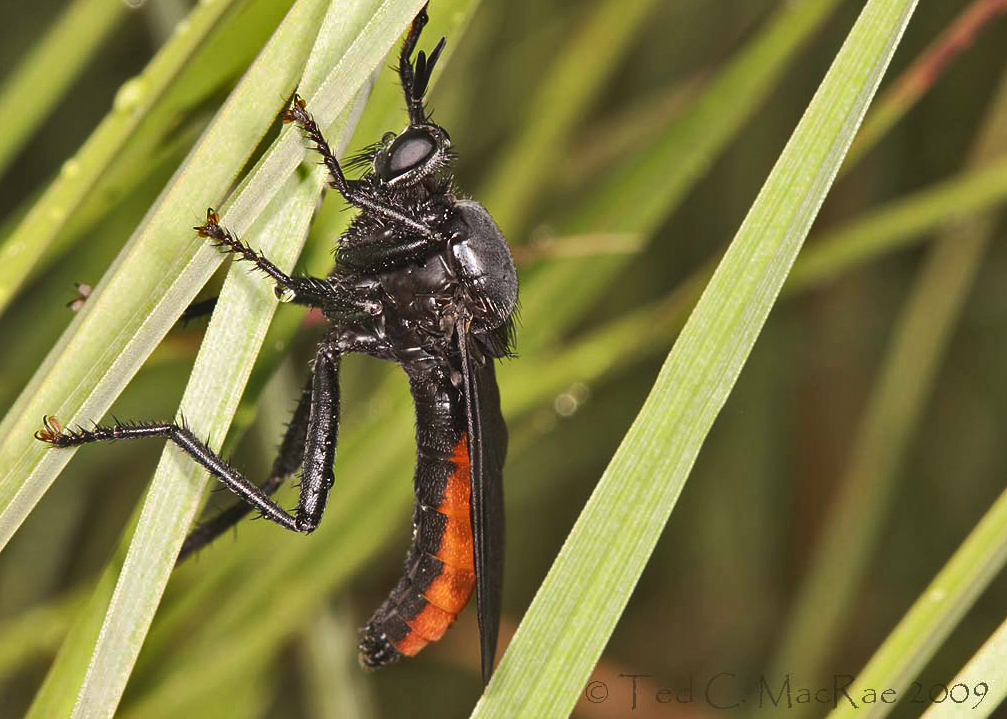
Ospriocerus abdominalis

Photo details: Canon 100mm macro lens on Canon EOS 50D, ISO 100, 1/250 sec, f/14, MT-24EX flash 1/4 power w/ diffuser caps.

Photo details: Canon 100mm macro lens on Canon EOS 50D, ISO 100, 1/250 sec, f/14, MT-24EX flash 1/4 power w/ diffuser caps.

My dipteran digression continues with this photograph of the robber fly, Ospriocerus abdominalis (Diptera: Asilidae).  More than just a pretty picture, this represents yet another apparently new state record that I and my colleague Chris Brown discovered a few weeks ago during our 2-day survey of Missouri’s critically imperiled hilltop prairies in the extreme northwest corner of the state.  Like the previously discussed Cylindera celeripes (swift tiger beetle) and Beameria venosa (a prairie-obligate species of cicada), O. abdominalis has not previously been recorded further east than Nebraska, Kansas, Oklahoma and Texas. This large fly is a grassland denizen that ranges over western North America and into Mexico (Cannings 1998, as Ospriocerus aeacus). It is somewhat suggestive of a mydas fly, although its short antennae immediately identify it as a robber fly (mydas flies have elongate clubbed antennae).  It also reminds me of the magnificent western robber fly Wyliea mydas by its mimetic, wasp-like coloration – presumably modeled after spider wasps of the genus Pepsis and Hemipepsis (Hymenoptera: Pompilidae) – but is distinguished by its black body and wings with red dorsal coloration on the abdomen (W. mydas has the abdomen wholly black and the wings red).  While not quite as handsome as W. mydas, it is impressive nonetheless.

The dry hilltop prairie remnants in which O. abdominalis, B. venosa, and C. celeripes were found are associated with the Loess Hills, a unique landform along the western edge of Iowa that reaches its southern terminus in extreme northwest Missouri.  Due to their extreme rarity and vulnerability to woody encroachment and anthropogenic degradation, these remnant habitats are considered one of Missouri’s most critically imperiled natural communities. Only about 50 acres of original habitat remain, and of this only half is in public conservation ownership.  Many of the plants and animals found in these habitats represent hypsithermal relicts that migrated eastward during a dry and warm period after the last ice age and were then “left behind” in pockets of relictual habitat as a return to cooler, wetter conditions forced the main populations back to the west.  More than a dozen plants and two vertebrates occurring in these prairies are listed as species of conservation concern.  As is typically the case, the flora and vertebrate fauna of these remnant habitats have been fairly well characterized, while precious little attention has been given to the vastly more diverse invertebrate fauna.  As we begin to study the insects of these habitats more carefully, we are almost sure to find a great many species that are more typically found further to the west and that live nowhere else in Missouri.  Their continued presence in the state will be wholly dependent upon the critically imperiled habitats in which they live, making conservation and restoration of the remaining loess hilltop prairie remnants in Missouri all the more important.

My thanks to Eric Fisher and Herschel Raney for confirming the identity of O. abdominalis.

REFERENCES:

Cannings, R. A. 1998. Robber Flies (Insecta: Diptera: Asilidae), in Smith, I. M., and G. G. E. Scudder, eds. Assessment of species diversity in the Montane Cordillera Ecozone. Burlington: Ecological Monitoring and Assessment Network.

Copyright © Ted C. MacRae 2009

Add to FacebookAdd to NewsvineAdd to DiggAdd to Del.icio.usAdd to StumbleuponAdd to RedditAdd to BlinklistAdd to Ma.gnoliaAdd to TechnoratiAdd to Furl

North America’s smallest cicada

Photo details: Canon 100mm macro lens on Canon EOS 50D, ISO 100, 1/250 sec, f/18, MT-24EX flash 1/2 power w/ diffuser caps.

Photo details: Canon 100mm macro lens on Canon EOS 50D, ISO 100, 1/250 sec, f/18, MT-24EX flash 1/2 power w/ diffuser caps.

While searching the hilltop prairies for Cylindera celeripes (swift tiger beetle) at McCormack Loess Mounds Natural Area in northwestern Missouri, I ran across a species of cicada that I’d not yet encountered in the state – Beameria venosa.  Cicadas as a rule are quite large insects, but with a body measuring only 16 mm (well under an inch) in length, B. venosa is one of – if not the – smallest species of this group in all of North America.  Had it not been for its distinctly cicada-esque call I might have thought it was some sort of fulgoroid planthopper (albeit a rather large one).  But a cicada it is, and a beautiful one at that despite its small size.

Beameria venosa is a prairie obligate species occurring from Nebraska and Colorado south to Texas and New Mexico.  To my knowledge, it has not been formally recorded from Missouri, although it is certainly already known from the state (it is listed in the 2009 issue of Missouri Species and Communities of Conservation Concern Checklist as “vulnerable” due to the restricted occurrence in Missouri of the prairie habitats in which it lives).  Froeschner (1952) listed 14 species of cicadas from Missouri but did not include this species even among those of possible occurrence in the state.  In my younger days, I managed not only to find all 14 of those species, but also a fifteenth species – the magnificent Tibicen superbus – in the southwestern corner of the state (formally recorded from the state some years later by Sanborn and Phillips 2004).  The occurrence of B. venosa in Missouri now brings to 16 the number of cicada species known from Missouri.

Despite its small size, the calling song of B. venosa is quite audible.  In fact, it was only due to its call that I noticed and began looking for this individual.  This brings up an interesting point regarding conspicuous insect songs and their role in enhancing predation risk.  Many predators are known to orient to the calls of cicadas (Soper et al. 1976), which in turn exhibit a variety of predator avoidance behaviors such as high perching, hiding, fleeing, and perhaps even mass emergence in the periodical cicadas.  Beameria venosa appears to avoid predators by producing its continuous train of sound pulses at a very high frequency.  Although audible to humans, the high frequency call apparently is not audible to birds and lizards – their chief predators (Sanborn et al. 2009).  In the open, treeless prairies where B. venosa lives, high frequency calling appears to provide the selective advantage for predator avoidance that fleeing, hiding, and high perching cannot.

REFERENCES:

Froeschner, R. C.  1952. A synopsis of the Cicadidae of Missouri. Journal of the New York Entomological Society 60:1–14.

Sanborn, A. F., J. E. Heath and M. S. Heath.  2009.  Long-range sound distribution and the calling song of the cicada Beameria venosa (Uhler) (Hemiptera: Cicadidae).  The Southwestern Naturalist 54(1):24-30.

Sanborn, A. F. and P. K. Phillips.  2004.  Neotype and allotype description of Tibicen superbus (Hemiptera: Cicadomorpha: Cicadidae) with description of its biogeography and calling song.  Annals of the Entomological Society of America 97(4):647-652.

Soper, R. S., G. E. Shewell and D. Tyrrell. 1976. Colcondamyia auditrix nov. sp. (Diptera; Sarcophagidae), a parasite which is attracted by the mating song of its host, Okanagana rimosa (Homoptera: Cicadidae).  The Canadian Entomologist 108:61-68.

Copyright © Ted C. MacRae 2009

Add to FacebookAdd to NewsvineAdd to DiggAdd to Del.icio.usAdd to StumbleuponAdd to RedditAdd to BlinklistAdd to Ma.gnoliaAdd to TechnoratiAdd to Furl

Revisiting the Swift Tiger Beetle – Part 3

…continued from Revisiting the Swift Tiger Beetle – Part 2.

The Oklahoma trip had been an unqualified success. Not only had I managed to find the rare Cylindera celeripes (swift tiger beetle) at Alabaster Caverns, I had also determined the population there was healthy and, in fact, occurred robustly across a large swath of red clay/gypsum hill habitat in the vicinity of the Cimarron River (Woodward and Major Counties) in northwestern Oklahoma. This is good news for the species, who some have regarded as a potential candidate for federal listing on the endangered species list. There is no doubt that the species has suffered greatly in many parts of its range during the past century – most likely due to loss of habitat; however, the presence of a strong population in Oklahoma gives reason for optimism about its long-term prospects. It would have been even better had I found the species at the two Nature Conservancy preserves (Four Canyon and Tallgrass Prairie) that I had targeted, and the reasons for its apparent absence at those two sites despite an abundance of apparently suitable habitat remain a mystery to me (although I have my suspicions). Nevertheless, I returned to St. Louis happy, with new localities in my database and live individuals in containers of native soil for another attempt at rearing.

Our work with this species was not done, however. While C. celeripes has never been recorded in Missouri, my colleague Chris Brown and I have long suspected that it might occur here – most likely, we felt, in extreme northwestern Missouri where the Loess Hills landform reaches its southern terminus. We had looked for it in this area a few times before on the few remaining dry, hilltop prairie relicts that are so common further north in Iowa, and we had also looked for it in the larger tallgrass prairie remnants of west-central Missouri. None of these searches were successful, and with each unsuccessful effort it seemed less and less likely that the species actually occurred within the state – especially considering the declines that the species has experienced throughout its range. However, when we managed to find a small, newly discovered population of the species last summer in the Loess Hills of southwestern Iowa, just 60 miles north of Missouri (see The Hunt for Cicindela celeripes), we decided that one more thorough effort to locate the species in Missouri was in order.

Star School Hill Prairie Natural Area (north tract), Atchison Co., Missouri.

Star School Hill Prairie Natural Area (north tract), Atchison Co., Missouri.

Our plan was straightforward – we would travel to northwestern Missouri each weekend beginning in late June and search the most promising hilltop prairie relicts that still remain in Missouri. There aren’t many of these, so I contacted Tom Nagel of the Missouri Department of Conservation – who probably knows more about Missouri’s hilltop prairie relicts than anyone else – for assistance in identifying these parcels. Tom graciously sent me descriptions and aerial photographs of the highest quality relicts still remaining in Missouri. None of these are large (12 contiguous acres or less), and all have been impacted to some degree by woody encroachment and are in various stages of restoration. We had already searched one of these tracts (Star School Hill Prairie) a few times, but two others were new to us. So, on a Friday evening before the first of three planned weekends for our study (and only two weeks after returning from Oklahoma), Chris and I made the long drive across Missouri and north along the Missouri River and began our search the next morning.

Fieldmate Chris Brown surveys loess hilltop prairie habitat at Star School Hill Prairie Natural Area, Atchison Co., Missouri

Fieldmate Chris Brown surveys loess hilltop prairie habitat at Star School Hill Prairie Natural Area (south tract), Atchison Co., Missouri

Our first stop was High Creek Hill Prairie in Brickyard Hill Conservation Area (Atchison Co.). We had been to Brickyard Hill a few times but had not previously found this particular hilltop prairie. We found the tract, a long, narrow series of ridge tops and southwest-facing slopes, thanks to Tom Nagel’s map and began searching with all the enthusiasm and optimism that accompanies any new search. Our optimism waned with each hilltop ridge that we traversed not seeing the beetle, until we reached the easternmost ridge amidst a jumble of eastern red-cedar cadavers that halted any further progress or promise. As we stood atop that last hill, we debated our next move. Chris had noted apparently good habitat on the lower slopes below us, while I had spotted another very small hilltop tract across a wooded ravine and disjunct from the main prairie. We decided these areas should be explored before moving on to the next site, but as we searched those lower slopes our optimism continued to wane. The habitat was perfect based on what we had seen in Iowa last year and what I had seen in Oklahoma earlier in the month – small clay exposures amongst clumps of undisturbed little bluestem and grama, but still no beetles. Chris, refusing to accept defeat, continued to search the slope, while I worked my way over to the smaller hilltop tract I had seen from above. After crossing through the wooded ravine, I found an old 2-track running along the base of the tract and began walking along it. The small slope above the 2-track was littered with large cadavers of the invasive eastern red-cedar (Juniperus virginiana), apparently left in place after chainsawing to provide fuel for a planned, future burn. As I walked, a white-tailed deer bolted from a nearby cadaver, giving me a bit of a start, and I veered towards the cadaver to have a look at where it had bedded down. By this time I almost wasn’t even really thinking about C. celeripes anymore – we had been there for about an hour and a half and searched the most promising habitats without success – the small tract where I was now working was almost a last gasp before moving on. As I approached the deer’s bedding site, a “flash” in the thick vegetation caught my eye, and I knew instantly what it was. Immediately I dropped to my knees and tried to “trap” the evasive little beetle (I’ve found that forming a “trap” between the crotches of my hands and gradually closing my hands together forces the beetle to run up and over one of my hands, at which time I can try to pin it down with my other). The beetle behaved exactly as expected, running over my left hand – but I missed it. I trapped it again, and once again it ran over my hand too fast to pin down. I tried to follow it as it zigzagged erratically through the thick vegetation, but in the blink of an eye it was gone. I spent the next several minutes frantically pulling apart the vegetation in a 2-foot radius around the spot in what I knew was a vain attempt to relocate the beetle before ultimately accepting that I had missed it. No matter – I had seen it and had absolutely no doubt about what it was – C. celeripes does indeed occur in Missouri! Wow – big news! I knew if I had seen one, I had a good chance of seeing another, so I began searching the area again – now with much more deliberation. I walked back and forth along the old 2-track, up and down the cadaver-littered slope, and back to the original spot several times. As time passed, a gnawing fear began to grow inside me that this new state record might lack a voucher. Suddenly, very near the original spot, I saw another. This time I pounced with authority and made no mistakes, and after securing the live beetle in a vial I gloated and congratulated myself unabashedly inside while bursting to give the news to Chris. I searched the slope some more, but I couldn’t take it anymore – I had to tell someone. I pulled out my cell phone and began texting a message to my daughter Mollie (who really doesn’t care about beetles but loves to receive text messages). As I was texting, Chris appeared on the lower slope, obviously noting that my net had been left on the ground purposely to mark a spot. As I finished texting I told Chris to come here, I wanted to show him something, and then non-chalantly handed him the vial. I would give anything to have a video of the look on Chris’ face as it changed from quizzical dumbfoundedness to shocked elation. Chris, too, had reached a low point in his optimism after thoroughly searching the previous slope without success, but now we were both as giddy as school boys – our long efforts had finally paid off with a new state record for one of North America’s rarest tiger beetles (the way we were acting, you’d have thought we’d just discovered plutonium!). We searched the slope for another half hour or so, with Chris seeing one more individual very close to where I had seen the first one. Whether it was the same or a different individual is unknown, so we decided that we had seen at least two individuals at this site. The discovery of C. celeripes here caused us to once again search the lower slope that Chris had previously searched so thoroughly, but again the beetle was not seen. Our giddiness was beginning to give way to concern over the few individuals we had seen and how localized they seemed to be. We had been at the site now for about three hours, and I was famished. I hiked back to the truck, noting some habitat at the far western end of the main prairie where we had begun our search that looked like it deserved another search. As I ate, Chris worked his way over to that spot, and after a period of time I heard him yell down to me and give me the “thumbs up.” I hurriedly finished eating and worked my way up to where he stood, and together we located two more individuals – taking one as a voucher for the site and ganging up on the other to keep it pinned into an open area where each of us could take field photographs before we finally let it “escape.” Seeing the species on the larger parcel had relieved our concern a little bit, and we felt a little less worried about its status here now.

Cylindera celeripes - High Creek Hill Prairie, Brickyard Hill Conservation Area, Atchison Co., Missouri (new state record)

Cylindera celeripes - High Creek Hill Prairie, Brickyard Hill Conservation Area, Atchison Co., Missouri (new state record)

Later in the day we would see the species again at Star School Hill Prairie Natural Area , the northernmost substantial loess hilltop prairie within Missouri, and one that we had searched at least twice previously for the species. Again, we saw only two individuals in almost three hours of searching, confirming the impression first gained at Brickyard Hill that the species is not present in very high densities. Like Brickyard Hill, the beetles at this site were found in areas of undisturbed hilltop prairie with moderately thick shortgrass vegetation and were seen only when they IMG_0789_1200x800ran from one grass clump to another after being disturbed by our approach. We also looked for it at a smaller disjunct parcel just to the north, but the lateness of the hour limited the time we had to explore this site. Star School Hill Prairie is some 6 miles north of Brickyard Hill, thus, finding C. celeripes at two sites not in close proximity increased our optimism that the species might actually occur in many of the loess hilltop prairie remnants still remaining in northwestern Missouri. This optimism was further increased the next day when we saw two more individuals at one of Missouri’s southernmost hilltop prairie relicts at McCormack Loess Mounds Natural Area in Holt Co. However, our optimism is tempered by the fact that, again, we saw only two individuals, both of which were seen in a small, unburned spur extending northward off the main prairie, while none were seen in the much larger main parcel that appeared to have been recently burned in its entirety.

Cylindera celeripes macrohabitat at Star School Hill Prairie.  Beetles were seen along the narrow trail in the foreground and on the mild upper slopes (below bur oak in upper left).

Cylindera celeripes macrohabitat at Star School Hill Prairie. Beetles were seen along the narrow trail (foreground) and on the mild upper slopes (below bur oak, upper left).

The presence of this rare Great Plains species in Missouri’s critically imperiled hilltop prairies is cause for both excitment and concern. Cylindera celeripes represents a unique and charismatic addition to the state’s rich natural heritage. However, like soapweed yucca (Yucca glauca var. glauca), skeletonweed (Lygodesmia juncea), and the dozen or so other plant and animal species of conservation concern found within the hilltop prairies of IMG_0774_1200x800Missouri’s Loess Hills, C. celeripes appears to be entirely dependent upon these habitats for its survival within the state. Ensuring its continued survival will require careful reconsideration of the management approaches used for these rapidly shrinking natural communities. Prescribed burning has been and will continue to be an important tool in restoring our hilltop prairies; however, nonjudicious use of fire could lead to local extirpaton of C. celeripes within these habitats. Should that occur, recolonization from nearby parcels is unlikely due to the small, highly disjunct, and upland character of Missouri’s hilltop prairie remnants and the flightless nature of C. celeripes. As a result, rotational cool-season burns should be utilized as much as possible to avoid localized extirpations, especially on smaller parcels (Panzer 2002).

Hilltop prairie at McCormack Loess Mounds Natural Area, Holt Co., Missouri.  The main tract (pictured) was recently burned - beetles were found in a small unburned spur (off left center).

Hilltop prairie at McCormack Loess Mounds Natural Area, Holt Co., Missouri. The main tract (pictured) was recently burned - beetles were found in a small unburned spur (off left center).

Photo details:
Beetles: Canon 100mm macro lens w/ 68mm extension on Canon EOS 50D, ISO 100, 1/250 sec, f/18, MT-24EX flash 1/2 power through diffuser caps.
Landscapes: Same except Canon 17-85mm zoom lens (17mm at Star School, 20 mm at McCormack), 1/60 sec, f/8-9 (Star School) or f/13 (McCormack), natural light.

REFERENCE:

Panzer, R. 2002. Compatibility of prescribed burning with the conservation of insects in small, isolated prairie reserves. Conservation Biology , 16(5):1296-1307.

Copyright © Ted C. MacRae 2009

Add to FacebookAdd to NewsvineAdd to DiggAdd to Del.icio.usAdd to StumbleuponAdd to RedditAdd to BlinklistAdd to Ma.gnoliaAdd to TechnoratiAdd to Furl