North America’s itsiest bitsiest longhorned beetle

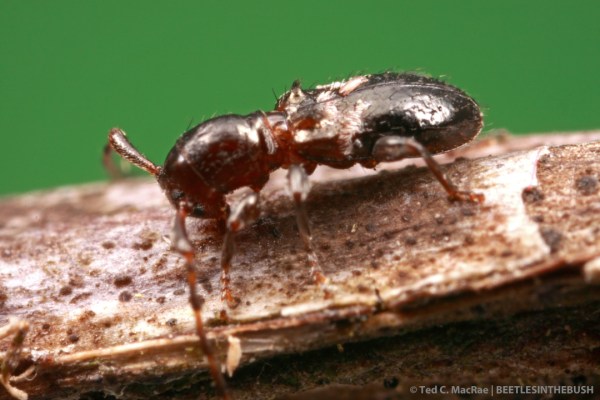
Longhorned beetles (family Cerambycidae) are generally regarded as medium to large-sized beetles, but that doesn’t mean the family is without its pip-squeeks! There are a number of species, primarily in the tribes Tillomorphini, Anaglyptini, and Clytini (all in the subfamily Cerambycinae) that are remarkably effective mimics of ants. Some of these, especially members of the genus Euderces, are quite small, but none are smaller than the absolutely diminutive Cyrtinus pygmaeus. Measuring only 2–3 millimeters in length, the adult beetles can be found on dead twigs and branches among equally small ants such as Lasius americanus.

Cyrtinus pygmaeus | Stoddard Co., Missouri

Cyrtinus pygmaeus | Stoddard Co., Missouri

The species is said to be widespread across eastern North America, having been recorded on a number of hardwood trees (Lingafelter 2007). I have no reason to doubt this, having reared a number of individuals from dead branches of river birch (Betula nigra), chinquapin oak (Quercus muhlenbergii), willow oak (Q. phellos) and black oak (Q. velutina) (MacRae & Rice 2007), but in the wild I have only encountered the species three times—each time as a single specimen that I noticed crawling on my arm after a bout of beating a variety of dead branches. The most recent occasion was two weekends ago during a visit to the Mississippi Lowlands of southeastern Missouri. I had done a bit of beating in a forest dominated by black oak, blackjack oak (Q. marilandica), and southern red oak (Q. falcata) and not found much when I felt a “tickle” on my right forearm. I looked down and was just about to flick the “ant” off my arm when something about the way it moved gave me pause. I stopped and looked closer, then recognizing what it was, instinctively called out “Oh cool, Cryrtinus pygmaeus!” My field partners for the day had never seen the species, so I let them look before I placed it in a vial. I was sure they would ogle at the incredibly tiny longhorned beetle, but their subdued “Hmm”s makes me think they were less impressed with the find than I was.

Cyrtinus pygmaeus

Like other ant-mimicking genera, the elytra of this species bear two prominent humps near their bases.

If the species is so common, why have I not seen them more commonly or on the beating sheet proper as soon as I beat them from their host plant? The answer, I believe, is that they are such effective mimics of the tiniest of ants that I simply overlook them! The series of specimens retrieved from my rearing cans could not be missed, as I combed through the contents every week during the beetle emergence period to make sure I found anything—longhorned beetle or otherwise—that emerged from the wood inside. In the field, however, my search image is queued for more “normal-sized” beetles and especially movement. Most other ant-mimicking longhorned beetles, even though they look very much like ants, still run like longhorned beetles—swiftly, almost frenetically, looking for the earliest opportunity to spread their elytra and take wing. Cyrtinus pygmaeus, on the other hand, is slow and clumsy, not a runner at all (slower even than the ants they mimic). If the three individuals I’ve encountered in the wild to date hadn’t happened to fall on my arm rather than the beating sheet and gotten stuck in my hair and perspiration I may never have noticed them.

Cyrtinus pygmaeus

Bands of white pubescence on the bases of the elytra give the illusion of a narrow-waisted ant.

I considered putting the beetle on a branch for photographs as soon as I found it, but since I had already pulled it off my arm I had already lost the chance to take true field photographs. Instead, I placed the beetle live in a vial and photographed it the next day at home. All of the photos were taken hand-held with an MP-E 65 mm macro lens at the upper end of its magnification capabilities. The green background is simply a colored file folder placed about four inches behind the beetle as I photographed it.

p.s. can you tell me what unusual feature this particular individual exhibits?

REFERENCES:

Lingafelter, S. W. 2007. Illustrated Key to the Longhorned Woodboring Beetles of the Eastern United States. Coleopterists Society Miscellaneous Publications, Special Publication No. 3, 206 pp.

MacRae, T. C. and M. E. Rice. 2007. Distributional and biological observations on North American Cerambycidae (Coleoptera). The Coleopterists Bulletin 61(2): 227–263.

Copyright © Ted C. MacRae 2013

The Texas Prick

Recently my friend Kent Fothergill launched a series of posts ranting about discussing the difficulties associated with common names. The inaugural post featured the insect I show here, Dectes texanus, a member of the family Cerambycidae (longhorned beetles) that has gained attention in recent years as an occasional pest of soybeans, especially in the upper Mississippi Delta (Tindall et al. 2010). As is usual, when an otherwise obscure little insect suddenly begins costing somebody money people feel compelled to give it a common name. Rather than the uninspired “soybean stem borer” or ironically Latin-ish “Dectes stem borer” monikers that seem to have taken hold for this species, Kent jokingly suggested that if people were serious about common names, this insect should actually be called the “Texas prick” as a direct translation of the scientific name.¹

¹ Actually, I couldn’t find any reference to the word “Dectes” as a Latin word or “prick” as its English translation. Rather, my copy of Brown (1956) lists dectes as a Greek word meaning “biter.” I think this must be what LeConte (1852) had in mind when he first coined the genus name, since he mentions among the characters that define the genus several features of the mandibles. If that is the case, then to be accurate the alternate common name for this beetle should be the “Texas biter.” However, that name causes nothing like the snicker that “Texas prick” elicits, and since common names are bound by no rules whatsoever, I choose levity over accuracy and stick with Kent’s proposed name.

Dectes texanus (dectes stem borer) | Washington Co., Mississippi

Dectes texanus | Washington Co., Mississippi

Being the pedantic, anal retentive, taxonomist-type that I am, it may surprise you to learn that I actually don’t have a problem with common names. To be honest, however, I will admit that this is a fairly recent change-of-mind for me—for many years I was a die-hard “scientific-names-only” type of guy. I not only thought common names were useless (for all the reasons listed by everybody who opposes them), but I even refused to learn them—my geek passive aggression, I guess. In the years since I started this blog, however, I’ve not only grown less oppositional in my stance, but have actually learned to embrace common names for what they are—comfortable names that don’t intimidate the taxonomically disinclined. Labels is all they are, and if one common name can refer to several species or several common names refer to one species, it’s not the end of the world. Common names aren’t meant to replace scientific names—how could they? Scientific names fulfill a special set of needs for a select group of people (i.e., to reflect phylogeny), and despite its flaws the Linnaean system of nomenclature that has been in use for the past several hundred years has served this purpose better than any other system devised. The reason for this is because genus and species names also provide a convenient and relatively easily memorizable system of labels that allow scientists to actually talk about organisms in a way that makes sense. This is an advantage that the Linnaean system has over any numerical phylogenetic system, no matter how much more precisely the latter can indicate phylogeny. For scientists, scientific names, in effect, serve a dual purpose. Non-taxonomists, however, don’t need dual purpose names—they just want easy-to-say and easy-to-remember labels, and if common names engage more people in a discussion about nature and its inhabitants then I’m all for it.

a.k.a. ''The Texas Prick''

Accepted common name: Dectes stem borer; BitB common name: ”Texas Prick”

This is not to say that I will ever give up scientific names. I love scientific names, and it is my goal in life to know as many of them as possible—even synonyms (I know, sick!). I also think that scientific names are not as scary as some people believe. Boa constrictor, for example (yes, that is both its common and scientific name), or gorilla (Gorilla gorilla)… or Dectes stem borer! To help bridge the gap, I have taken to mentioning, as a matter of practice, both the scientific name and—when one exists—the common name for the insects and other organisms featured on this blog. This applies not only at the species level, but families and other higher taxa also (e.g., “jewel beetles, family Buprestidae”). It is my way of talking science in a way that welcomes the interested lay person. Considering the increasingly anti-science din in our country by creationists, climate change denialists, knee-jerk GM critics, etc., I think the more we can get scientists and non-scientists comfortable talking to each other the better off we will be.

The insect featured in this post was found and photographed in a field of cultivated soybeans in northeastern Mississippi. It’s identification as Dectes texanus (other than its association with soybean) is based on the face being only slightly protruding and the relatively large lower lobe of the eye. There is one other species in the genus, D. sayi, also broadly distributed in the U.S. but distinguished from D. texanus by its distinctly more protruding face and small lower eye lobe (giving the impression of “tall cheeks”). This species, too, is known to bore in the stems of soybean but is much happier doing so in common ragweed (Ambrosia artemisiifolia) (Piper 1978). The species name—sayi—was given to honor the 19th century entomologist Thomas Say, regarded by many as the ‘Father of American entomology.’ This species also has been called “soybean stem borer” by some, which doesn’t do much to alleviate concerns about common names referring to multiple species. I am reluctant, however, for reasons of respect, to use the common name for D. sayi that results if one uses the same rationale used by Kent in coining his common name for D. texanus

REFERENCES:

Brown, R. W. 1956. Composition of Scientific Words. Smithsonian Institution Press, Washington, D.C., 882 pp.

LeConte, J. L. 1852. An attempt to classify the longicorn Coleoptera of the part of America north of Mexico. Journal of the Academy of Natural Sciences Philadelphia (series 2) 2(1):99–112.

Piper, G. L. 1978. Biology and immature stages of Dectes sayi Dillon and Dillon (Coleoptera: Cerambycidae). The Coleopterists Bulletin 32(4):299–306.

Tindall K. V., S. Stewart, F. Musser, G. Lorenz, W. Bailey, J. House, R. Henry, D. Hastings, M. Wallace & K. Fothergill. 2010. Distribution of the long-horned beetle, Dectes texanus, in soybeans of Missouri, Western Tennessee, Mississippi, and Arkansas. Journal of Insect Science 10:178 available online: insectscience.org/10.178.

Copyright © Ted C. MacRae 2013

It’s always a happy day…

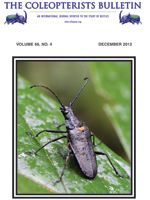
072_066_0400_cover…when the latest issue of The Coleopterists Bulletin arrives in my mailbox. On this occasion it was the December issue of Volume 66—nine papers and eight scientific notes filling 84 pages of beetle awesomeness. It’s pure elytral ecstasy! I presume I am like most subscribers—rapidly scanning the Table of Contents on the back cover to see if any deal directly with my preferred taxa. Yes! Two papers dealing with Buprestidae (jewel beetles), one on Cerambycidae (longhorned beetles), and one on Cicindelinae (tiger beetles)—a real bonanza. After that, a more cursory look through the rest of the Table of Contents to see what other papers look interesting enough to at least scan through.

For me the most interesting are the two Buprestidae papers, with Hansen et al. documenting new state records, larval hosts, and biological notes for 47 North American species and Westcott & Murray reporting the introduction into the U.S. of yet another Eurasian exotic (Trachys minutus) and its apparent establishment in Massachusetts. As the current “keeper” of distributional records and host plant associations for North American jewel beetles (along with Rick Westcott, Salem, Oregon), I will be busily updating my database over the next few days to reflect these new records. I am a great fan of “notes” papers such as these (and am, in fact, currently finishing a similar manuscript with co-author Joshua Basham, who is also a co-author on the Hansen et al. paper). However, I do have a few quibbles—Hansen et al. report Agrilus  quadriguttatatus as a new record for Tennessee, but it is already known from that state, and Cercis canadensis (eastern redbud) is reported as a new larval host for Anthaxia (Haplanthaxia) cyanella despite the prior records from that host by Knull (1920) and Hespenheide (1974). More puzzlingly, the authors record Agrilus lecontei celticola from locations in eastern Tennessee despite guidance from me on several occasions that this subspecies, while perhaps distinctive in Texas, transitions broadly across Louisiana and Mississippi  with the nominate subspecies. As such, material from eastern Tennessee cannot be regarded conclusively to represent this subspecies (and I remain unconvinced even that the subspecific distinction is warranted). Lastly, in recording Actenodes simi from Tennessee, the authors mention that the closest previous record is from Missouri with no specific locality mentioned (Fisher 1942), even though I recently recorded several specific locations for the species in eastern and southern Missouri (MacRae & Nelson 2003). The overall impression is that the authors are not fully versed in recent literature on Buprestidae and have instead relied exclusively on the recent Nelson et al. (2008) catalogue—known amongst buprestid workers to be incomplete and with errors—as the only source for determining the status of their records.

Among Cerambycidae, Raje et al. report the results of molecular analyses on two color forms of Sternidius alpha. This broadly distributed and highly variable species exhibits multiple color variants across its range, leading to the description of multiple subspecies that were eventually synonymized under the current name. Their analysis of the barcoding region of the cytochrome oxidase I gene, however, revealed three distinct clades among the two color forms, suggesting the potential for taxonomic significance. More work, of course, is needed from additional color morphs from different localities.

Finally, my friend Matt Brust and colleagues discuss the ovipositional behavior of numerous species of North American tiger beetles, unexpectedly finding that many oviposit only after digging some distance below the surface of the soil. This information is extremely valuable for those interested in rearing tiger beetles for description of larval stages, expanding the window of survey for species with limited temporal occurrence, and cross-breeding studies. To that end, and of greatest interest to me, they have included numerous observations from their own studies that have resulted in the development of successful protocols and rapid rearing of large numbers of larvae to adulthood.

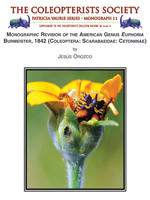
cso 66-4Mco14.qxdActually, there is one more thing… For several years now the December issue, as a bonus, has been accompanied by the Patricia Vaurie Series Monograph as a supplement to that year’s volume. This year’s issue features a revision of the scarab genus Euphoria by Jesús Orozco, and although I have not studied it carefully it looks like a robust treatment of the group. Yes, I know that scarabs are not one of my primary interest groups, but show me a coleopterist that—regardless of the group they work on— does not stop and collect these gorgeous, colorful, flower-loving beetles whenever they encounter them and I’ll show you a coleopterist that is far too restrictive in their natural history interests! Based on examination of nearly 19,000 specimens from 67 collections, the work considers 59 valid species (ten of which are described as new) distributed throughout the Western Hemisphere. Complete with keys to species and, for each, synonymy, description, diagnosis, taxonomic history, natural history, temporal occurrence geographic distribution, and—of critical importance in my opinion—full data for all specimens examined, it is everything a good revision should be. Then there are the color plates—one full page for each species—with a large dorsal habitus view, closeups of the head, male genitalia, and color variants, a temporal distribution chart, and a map of its geographical distribution. Again, while I may not be a serious student of scarabs, you can bet that I’ll be going back through my holdings of Euphoria beetles and checking them to make sure they conform to this new standard of knowledge on the group.

REFERENCES:

Brust, M. L., C. B. Knisley, S. M. Spomer & K. Miwa. 2012. Observations of oviposition behavior among North American tiger beetle (Coleoptera: Carabidae: Cicindelinae) species and notes on mass rearing. The Coleopterists Bulletin 66(4):309–314.

Fisher, W. S. 1942. A revision of North American species of buprestid beetles belonging to the tribe Chrysobothrini. U. S. Department of Agriculture, Miscellaneous Publication 470, 1–275.

Hansen, J. A., J. P. Basham, J. B. Oliver, N. N. Youseef, W. E. Klingeman, J. K. Moulton & D. C. Fare. 2012. New state and host plant records for metallic woodboring beetles (Coleoptera: Buprestidae) in Tennessee, U.S.A. The Coleopterists Bulletin 66(4):337–343.

Hespenheide, H. A. 1974.  Notes on the ecology, distribution, and taxonomy of certain Buprestidae.  The Coleopterists Bulletin 27(4) [1973]:183–186.

Knull, J. N. 1920. Notes on Buprestidae with description of a new species (Coleop.). Entomological News 31(1):4–12.

MacRae, T. C. and G. H. Nelson. 2003. Distributional and biological notes on Buprestidae (Coleoptera) in North and Central America and the West Indies, with validation of one species. The Coleopterists Bulletin 57(1):57–70.

Nelson, G. H., G. C. Walters, Jr., R. D. Haines, & C. L. Bellamy.  2008.  A Catalogue and Bibliography of the Buprestoidea of America North of Mexico.  Coleopterists Society Special Publication No. 4, The Coleopterists Society, North Potomac, Maryland, 274 pp.

Orozco, J. 2012. Monographic revision of the American genus Euphoria Burmeister, 1842 (Coleoptera: Scarabaeidae: Cetoniinae). Coleopterists Society Monographs, Patricia Vaurie Series No. 11, 182 pp.

Raje, K. R., V. R. Ferris & J. D. Holland. 2012. Two color variants of Sternidius alpha (Say) (Coleoptera: Cerambycidae) show dissimilar cytochrome oxidase I genes. The Coleopterists Bulletin 66(4):333–336.

Westcott, R. L. & T. C. Murray. 2012. An exotic leafminer, Trachys minutus (L.) (Coleoptera: Buprestidae), found in Massachusetts, U.S.A. The Coleopterists Bulletin 66(4):360–361.

Copyright © Ted C. MacRae 2013

The ultimate jaws on a longhorned beetle!

Some 23 years ago, I departed on my first ex-U.S. insect collecting trip. I was still a youngster—barely into my 30s—but had by then a well developed interest in woodboring beetles of the families Buprestidae and Cerambycidae. I had spent the previous eight years since graduate school collecting these beetles throughout Missouri, work that led to the publication of my faunal treatments of the two families for the state (MacRae 1991, 1994), and even begun collecting insects outside of Missouri in other states such as Texas, Arizona and Florida. Although I was still cutting my teeth as a collector, I yearned for the tropical experience, and in December 1989 to January 1990 I got the chance to spend three weeks in one of the most tropical localities I could imagine—Ecuador! I’ve collected in many countries since then, but that first tropical collecting trip remains one of my most cherished experiences.

Criodion rhinoceros Bates 1870 | Sucumbios Province, Ecuador (New Country Record)

Of course, being as young and green as I was, I didn’t really know what any of the insects I was collecting were beyond family level (if that!), and the numbers were so overwhelming compared to anything I had experienced previously that all I could do was collect as much as I could using the techniques I had figured out to that point, process them all when I got back, and then hold them for the future when I would either study them myself or make them available to other specialists. In the years since, Buprestidae have become the primary focus of my studies, relegating any non-Nearctic Cerambycidae in my collection to the sidelines. Since I don’t now and probably will never do serious work on Neotropical Cerambycidae, I’ve begun sending them to specialists who do work on them for identification or to be utilized as desired in their research. Much of the Cerambycidae were sent to Frank Hovore, an expert of Ecuadorian Cerambycidae who kindly identified them for me before tragically passing away while on a collecting trip to that very country. Some of the larger specimens were not sent, however, because I had used them to create an “Oh wow!” drawer (see photo on My Collection page). After Frank’s passing, I decided to try identifying the longhorned beetles in that drawer, most of which I was able to identify using Larry Bezark’s incredible website, A Photographic Catalogue of the Cerambycidae of the [New] World. There was one, however, that I was not able identify, despite the fact that it seemed to be the most easily identifiable of all due to remarkable horn-like processes arising from the top of the mandibles. I scanned repeatedly through the photos of species in all genera that looked even remotely similar. Criodion seemed most likely, but none of the species photographed sported such unique mandibular armature.

Males sport remarkable horn-like processes arising from the mandibles.

Stumped, I emailed the top photo to Brazilian coleopterist and cerambycid specialist Antonio Santos-Silva (Universidade de São Paulo) and asked for his opinion. He replied that it seemed to be a species of Criodion, noting that the only species of Criodion with this kind of mandible is C. rhinoceros—known only from the Brazilian state of Pará, and a species completely lacking in their collection. I sent him the other photos in this post to give him a better view of the mandibles, and Antonio replied back that both he and colleague Ubirajara Martins agree with the initial ID. My failure to match the specimen with this species in the photographic catalogue was understandable, as this was one of the few species for which no photographs were available. That situation has since been corrected, and the site now features photographs of both male and female specimens—the latter exhibiting quite chunky but not nearly as grossly developed mandibles as the former.

Another view of the male's remarkable mandibular armature

A lateral view of the head resembles that of a rhinoceros!

Bates’ (1870) original description, based only on the male, notes that the spines arise from the upper edge of the mandibles near the middle and incline towards each other, crossing at the apices and giving the head of the beetle, viewed in profile, the curious resemblance to that of a rhinoceros. Certainly no other species in the genus bears such extraordinary modifications of the mandibles, and if there are others in the family, I am not aware of them and they must be very few in number. One can only speculate on the function of such a modification, but since they are present only on the males a sexual or mating-related function could be considered likely. If any reader has information or thoughts about extreme mandibular modifications such as this and their possible functional significance please let me know.

Males sport remarkable horn-like processes arising from the base of the mandibles

And of course, the BitB face shot!

The collection of this species in Ecuador adds another species to that countrys’ already rich cerambycid fauna (Antonio confirmed that it is a new record for Ecuador). I’ve picked up a smattering of other Cerambycidae from South America over the past ten years, so I’m going to send them all to Antonio for ID and allow him to keep whatever is interesting for his research or the University’s collection. I will include this remarkable species in the package as a gift—considering its status as the only known voucher for the species in Ecuador, I think his institution’s collection will be a more appropriate repository for it than my “Oh wow!” drawer.

REFERENCE:

Bates, H. W. 1870. Contributions to an insect fauna of the Amazon Valley (Coleoptera, Cerambycidae). Transactions of the Entomological Society of London 1870:243–335, 391–444.

MacRae, T. C. 1991. The Buprestidae (Coleoptera) of Missouri.  Insecta Mundi 5(2):101–126.

MacRae, T. C. 1994. Annotated checklist of the longhorned beetles (Coleoptera: Cerambycidae and Disteniidae) known to occur in Missouri. Insecta Mundi 7(4) (1993):223–252.

Copyright © Ted C. MacRae 2013

Let’s make a deal!

buprestid

Image source unknown

I recently conducted a complete reorganization of the jewel beetles (superfamily Buprestoidea) in my collection (TCMC). The primary purpose of this was to bring the nomenclature and arrangement of the collection into agreement with the recently published World Catalogue of Buprestoidea (Bellamy 2008) and accurately document the taxa represented in the collection and their numbers. In the short term this will be helpful not only in visualizing what is represented but also what is missing (particularly in North America), while longer term it lays the groundwork for the eventual donation of my collection to a public institution.

In an active, working collection, no inventory is ever fully up-to-date. In my case, the inventory includes only completely curated material that has been incorporated into the main cabinets. I still have several years worth of material in various states of curation—i.e., unmounted, mounted but unlabeled, or labeled but unidentified. That said, the main collection now contains more than 23,000 specimens of Buprestoidea representing 1,500+ species worldwide. Of the species represented, 37% are Nearctic (U.S./Canada), 22% Palearctic (Europe, North Africa, temperate Asia), 19% Neotropical (Latin America), 10% Afrotropical (Subsaharan Africa), 7% Indomalayan (tropical Asia) and 6% Australian (Australia/New Zealand). The collection also contains 492 paratype specimens representing 77 species. The inventory has been converted to  PDF and uploaded for access by the link below. It lists all of the species represented, with nomenclature updated and taxa arranged according to Bellamy (2008) and number of specimens  indicated for each. Also indicated are higher taxa not yet represented in the collection (shown in gray rather than black text) so that the collection holdings can be placed in context of a complete higher classification for the superfamily.

 Click to see full inventory of TCMC Buprestoidea

Of course, as a North American, the Nearctic fauna is the primary focus of my taxonomic and biological studies. As a result, I am keen to have the Nearctic fauna represented as completely as possible in my collection. Currently I have 75% (595) of the 790 species and non-nominate subspecies currently recognized in North America. Obviously, by now I’ve picked most of the low-hanging fruit, and the last 25% will be much more difficult to get. Many of these are truly rare species that I may never find (some are known only by the holotype), while others are more common but occur in areas that I have limited opportunity to visit. These species are also indicated in the above inventory (again, in gray text) but are also listed below for easy reference. If you have any of the species on this list, please let me know and also what you might like to receive in exchange for them. I have not only many species of Buprestidae from around the world to offer, but also beetles in other families such as longhorned beetles (Cerambycidae), tiger beetles (Cicindelinae), scarabs (Scarabaeoidea), and even non-beetles such as treehoppers (Membracidae) and cicadas (Cicadoidea). Let’s make a deal!

REFERENCE:

Bellamy, C. L. 2008. World Catalogue and Bibliography of the Jewel Beetles (Coleoptera: Buprestoidea),  Volumes 1–5. Pensoft Series Faunistica, 3125 pp.

Copyright © Ted C. MacRae 2013


T.C.MacRae Collection Desiderata

Family SCHIZOPODIDAE LeConte 1859
Subfamily SCHIZOPODINAE LeConte 1859
Tribe SCHIZOPODINI LeConte 1859

Genus Schizopus LeConte 1858
sallei ssp. sallei Horn 1885
sallei ssp. nigricans Nelson 1991
Genus Dystaxia LeConte 1866
elegans Fall 1905

Family BUPRESTIDAE Leach 1815
Subfamily POLYCESTINAE Lacordaire 1857
Acmaeoderioid lineage sensu Volkovitsh 2001
Tribe HAPLOSTETHINI LeConte 1861

Genus Mastogenius Solier 1849
arizonicus Bellamy 2002
puncticollis Schaeffer 1919

Tribe ACMAEODERINI Kerremans 1893
Subtribe ACMAEODEROIDINA Cobos 1955

Genus Acmaeoderoides Van Dyke 1942
cazieri Nelson 1968
depressus Nelson 1968

Subtribe ACMAEODERINA Kerremans 1893

Genus Acmaeodera Eschscholtz 1829
— Subgenus Acmaeodera (s. str.)
audreyae Westcott & Barr 2007
bryanti Van Dyke 1953
comata LeConte 1858
consors Horn 1878
cubaecola Jaquelin du Val 1857
discalis Cazier 1940
dolorosa ssp. liberta Fall 1922
fattigi Knull 1953
flavosticta Horn 1878
horni Fall 1899
inyoensis Cazier 1940
laticollis Kerremans 1902
morbosa Fall 1899
pubiventris ssp. panocheae Westcott 2001
recticolloides Westcott 1971
starrae Knull 1966
subbalteata LeConte 1863
thoracata Knull 1974
tildenorum Nelson & Westcott 1995
wheeleri Van Dyke 1919

Genus Acmaeoderopsis Barr 1974
prosopis Davidson 2006
rockefelleri (Cazier 1951)
varipilis (Van Dyke 1934)

Genus Anambodera Barr 1974
nebulosa (Horn 1894)
santarosae (Knull 1960)

Polyctesioid lineage sensu Volkovitsh 2001
Chrysophana generic group [tribal level] sensu Volkovitsh 2001

Genus Beerellus Nelson 1982
taxodii Nelson 1982

Polycestioid lineage sensu Volkovitsh 2001
Tribe POLYCESTINI Lacordaire 1857

Genus Polycesta Dejean 1833
— Subgenus Polycesta (s. str.)
angulosa Jacquelin du Val 1857
— Subgenus Polycesta (Arizonica) Cobos 1981
arizonica ssp. acidota Cazier 1951
— Subgenus Polycesta (Tularensia) Nelson 1997
crypta Barr 1949

Tribe TYNDARINI Cobos 1955
Subtribe TYNDARINA Cobos 1955

Genus Paratyndaris Fisher 1919
— Subgenus Paratyndaris (s. str.)
anomalis Knull 1937
crandalli Knull 1941
grassmani Parker 1947
quadrinotata Knull 1938

Subfamily CHRYSOCHROINAE Laporte 1835
Chrysochroid lineage sensu Bellamy 2003
Nanularia generic group [tribal level] sensu Volkovitsh 2001

Genus Nanularia Casey 1909
cupreofusca Casey 1909
pygmaea (Knull 1941)

Tribe CHRYSOCHROINI Laporte 1835
Subtribe CHALCOPHORINA Lacordaire 1857
Texania generic group sensu Volkovitsh 2001

Genus Texania Casey 1909
langeri (Chevrolat 1853)

Tribe POECILONOTINI Jakobson 1913
Subtribe POECILONOTINA Jakobson 1913

Genus Poecilonota Eschscholtz 1829
ferrea (Melsheimer 1845)
montana Chamberlin 1922
viridicyanea Nelson1997

Dicercioid lineage sensu Bellamy 2003
Tribe DICERCINI Gistel 1848
Subtribe HIPPOMELANINA Holynski 1993

Genus Hippomelas Laporte & Gory 1837
martini Nelson 1996
parkeri Nelson 1996

Genus Gyascutus LeConte 1858
— Subgenus Gyascutus (s. str.)
jeanae (Nelson 1988)
pacificus (Chamberlin 1938)

Genus Barrellus Nelson & Bellamy 1996
femoratus (Knull 1941)

Subtribe DICERCINA Gistel 1848
Dicerca generic group sensu Volkovitsh 2001

Genus Dicerca Eschscholtz 1829
dumolini (Laporte & Gory 1837)
hornii nelsoni Beer 1974
lugubris LeConte 1860
mutica LeConte 1860
sexualis Crotch 1873
spreta (Gory 1841)
tuberculata (Laporte & Gory 1837)

Subfamily BUPRESTINAE Leach 1815
Buprestioid lineage sensu Volkovitsh 2001
Buprestinioid branch sensu Volkovitsh 2001
Tribe BUPRESTINI Leach 1815
Subtribe TRACHYKELINA Holynski 1988

Genus Trachykele Marseul 1865
fattigi Knull 1954
opulenta Fall 1906

Subtribe BUPRESTINA Leach 1815

Genus Buprestis Linnaeus 1758
— Subgenus Buprestis (Cypriacis) Casey 1909
intricata Casey 1909
prospera Casey 1909
— Subgenus Buprestis (Knulliobuprestis) Kurosawa 1988
fremontiae Burke 1924
— Subgenus Buprestis (Stereosa) Casey 1909
apricans Herbst 1801
decora Fabricius 1775

Anthaxioid lineage sensu Volkovitsh 2001
Anthaxiinioid branch sensu Volkovitsh 2001
Tribe ANTHAXIINI Gory et Laporte 1839

Genus Anthaxia Eschscholtz 1829
— Subgenus Anthaxia (Haplanthaxia) Reitter 1911
carya Wellso & Jackman 2006
caseyi ssp. sublaevis Van Dyke 1916
— Subgenus Anthaxia (Melanthaxia) Rikhter 1944
barri Bílý 1995
californica Obenberger 1914
cupriola Barr 1971
emarginata Barr 1971
embrikstrandella Obenberger 1936
exasperans Cobos 1958
furnissi Barr 1971
helferiana Bílý 1995
hurdi Cobos 1958
nanula Casey 1884
neofunerula Obenberger 1942
nevadensis Obenberger 1928
oregonensis Obenberger 1942
porella Barr 1971
sculpturata Barr 1971
serripennis Obenberger 1936
strigata LeConte 1859
subprasina Cobos 1959
tarsalis Barr 1971
wallowae Obenberger 1942

Tribe XENORHIPIDINI Cobos 1986
Subtribe XENORHIPIDINA Cobos 1986

Genus Hesperorhipis Fall 1930
hyperbola ssp. californica Knull 1947
jacumbae Knull 1954
mirabilis ssp. mirabilis Knull 1947

Chrysobothrioid lineage sensu Volkovitsh 2001
Melanophilinioid branch sensu Volkovitsh 2001
Tribe MELANOPHILINI Bedel 1921
Subtribe MELANOPHILINA Bedel 1921

Genus Phaenops Dejean 1833
carolina (Manee 1913)
caseyi (Obenberger 1944)
obenbergeri (Knull 1952)
vandykei Obenberger 1944

Chrysobothrinioid branch sensu Volkovitsh 2001
Tribe ACTENODINI Gistel 1848

Genus Actenodes Dejean 1833
arizonicus Knull 1927
mimicus Knull 1964

Tribe CHRYSOBOTHRINI Gory et Laporte 1838

Genus Chrysobothris Eschscholtz 1829
— Subgenus Chrysobothris (s. str.)
aeneola LeConte 1860
bacchari Van Dyke 1923
bicolor Horn 1894
bisinuata Chamberlin 1938
bispinosa Schaeffer 1909
boharti Van Dyke 1934
breviloboides Barr 1969
caurina Horn 1886
chamberliniana Fisher 1948
costifrons ssp. costifrons Waterhouse 1887
culbersoniana Knull 1943
cupressicona Barr & Westcott 1976
deserta Horn 1886
dolata Horn 1886
fragariae Fisher 1930
grindeliae Van Dyke 1937
helferi Fisher 1942
hidalgoensis Knull 1951
horningi Barr 1969
hubbardi Fisher 1942
idahoensis Barr 1969
kelloggi Knull 1937
knulli Nelson 1975
nelsoni Westcott & Alten 2006
oregona Chamberlin 1934
orono Frost 1920
paragrindeliae Knull 1943
potentillae Barr 1969
pseudacutipennis Obenberger 1940
pubilineata Vogt 1949
purpurata Bland 1864
roguensis Beer 1967
schaefferi Obenberger 1934
schistomorion Westcott & Davidson 2001
scitula Gory 1841
sexfasciata ssp. sexfasciata Schaeffer 1919
sloicola Manley & Wellso 1976
smaragdula Fall 1976
socialis ssp. apache Westcott & Barr 2007
speculifer Horn 1886
subopaca Schaeffer 1904
vivida Knull 1952
westcotti Barr 1969
wickhami Fisher 1942

Genus Knowltonia Fisher 1935
alleni (Cazier 1938)
atrifasciata (LeConte 1878)

Subfamily AGRILINAE Laporte 1835
Tribe AGRILINI Laporte 1835
Subtribe AGRILINA Laporte 1835

Genus Agrilus Curtis 1825
— Subgenus Agrilus (s. str.)
hazardi Knull 1966
— Subgenus Agrilus (Engyaulus) Waterhouse 1889
inhabilis ssp. cuprinus Nelson 1996
utahensis Westcott 1996
— Subgenus Agrilus (Quercagrilus) Alexeev 1998
derasofasciatus Boisduval & Lacordaire 1835
— Subgenus Agrilus (Uragrilus) Semenov-Tian-Shanskij 1935
granulatus ssp. mojavei Knull 1952
sayi Saunders 1871
— Subgenus undefined
amelanchieri Knull 1944
arizonus Knull 1934
audax Horn 1891
aurilaterus Waterhouse 1889
bespencus Barr 2008
burkei Fisher 1917
catalinae Knull 1940
cercidii Knull 1937
cochisei Knull 1948
criddlei Frost 1920
davisi Knull 1941
delicatulus Waterhouse 1889
dozieri Fisher 1918
exiguellus Fisher 1928
floridanus Crotch 1873
funestus Gory 1841
geronimoi Knull 1950
gillespiensis Knull 1947
hazardi Knull 1966
horni Kerremans 1900
jacobinus Horn 1891
langei Obenberger 1935
latifrons Waterhouse 1889
montosae Barr 2008
neabditus Knull 1935
nevadensis Horn 1891
nigricans Gory 1841
obscurilineatus Vogt 1949
olivaceoniger Fisher 1928
ometauhtli Fisher 1938
palmerleei Knull 1944
parabductus Knull 1954
pilosicollis Fisher 1928
pseudocoryli Fisher 1928
pubifrons Fisher 1928
restrictus Waterhouse 1889
shoemakeri Knull 1938
sierrae Van Dyke 1923
snowi Fall 1905
torquatus LeConte 1860
waltersi Nelson 1985
wenzeli Knull 1934

Tribe TRACHYINI Laporte 1835
Subtribe BRACHYINA Cobos 1979

Genus Taphrocerus Solier 1833
floridanus Obenberger 1934

Subtribe PACHYSCHELINA Böving et Craighead 1931

Genus Pachyschelus Solier 1833
fisheri Vogt 1949
schwartzi Kerremans 1892
vogti Hespenheide 2003
Best of BitB 2012

Welcome to the 5th Annual “Best of BitB”, where I pick my favorite photographs from the past year. 2012 was one of the most intensive travel years I’ve ever had—I spent 8 weeks in Argentina from February through April, made separate trips to Puerto Rico and Arkansas in May (bracketing a personal week in California), traveled almost weekly to Illinois and Tennessee from June to September (interrupted by a personal week in Florida in July), toured the southeastern U.S. (Arkansas, Louisiana, Mississippi and Georgia—great food!) in early September, chased tiger beetles in Oklahoma, Texas and Arkansas in late September, went back to Argentina for a week in October, and capped off the travel year by attending the Entomological Society of America Annual Meetings in Knoxville, Tennessee (for the first time in more than 10 years!)—whew! While many would cringe at such a travel load, I am among the lucky few who actually get paid for doing something that is also my hobby—entomology! This gives me ample opportunity to further hone my photography skills (nine of the 13 photos I’ve selected below were actually taken while I was on business travel), resulting in two key accomplishments this year—my first ever photography talk at the ESA’s insect photography symposium and my first commercial sales (look for the BitB commercial site to go online in 2013).

Enough blather! Here are my favorite BitB photographs from 2012. Click the link in the text below the photo to see the original post. I would greatly appreciate knowing if you have a favorite (and why)—your feedback will be enormously helpful to me as I continue to learn and develop as a photographer.  For those interested, here are my previous year picks for 2008, 2009, 2010 and 2011. And, as always, thank you for your readership!


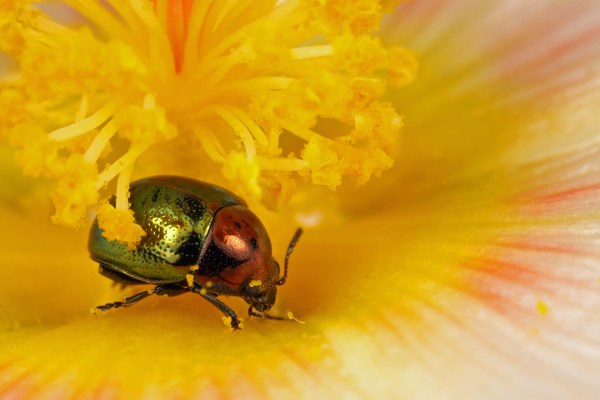
Spintherophyta (?) sp. in flower of Abutilon pauciflorum | Buenos Aires, Argentina

From  (posted 2 Feb). One of my 2012 learnings was that sometimes a photograph that is not so close is more effective than one that is as close as possible. In one of my earlier attempts at “not-so-close” macrophotgraphy, the soft colors of the flower compliment the brash shininess of the tiny leaf beetle that has been feeding on its pollen. Pink lines lead the eye directly to the subject and create a pleasing composition, and pollen grains stuck to the beetle—a distraction in some situations—add to the miniature natural history story of the photo.


Apiomerus flavipennis with stink bug prey and kleptoparasitic flies | Chaco Province, Argentina

From  (posted 11 Mar). I selected this photo solely for the complex natural history story drama it shows—stink bug (Piezodorus guildenii) feeding on soybean becomes prey of an assassin bug (Apiomerus flavipennis), with volatiles from the chemicals it emitted in a vain attempt to defend itself serving as cues to kleptoparasitic flies (families Milichiidae and Chloropidae) that benefit from the assassin bug’s labors.


Planthopper nymph | Buenos Aires Province, Argentina

From  (posted 26 Mar). Another learning that I began putting into practice in 2012 was the use of low perspective for compositional impact. The cryptic coloration of this planthopper nymph (family Fulgoridae) made it almost invisible on the branch on which it was sitting when viewed from a normal “top-down” human perspective. Getting “down under” it, however, brought the nymph to life and emphasized its unusual form.


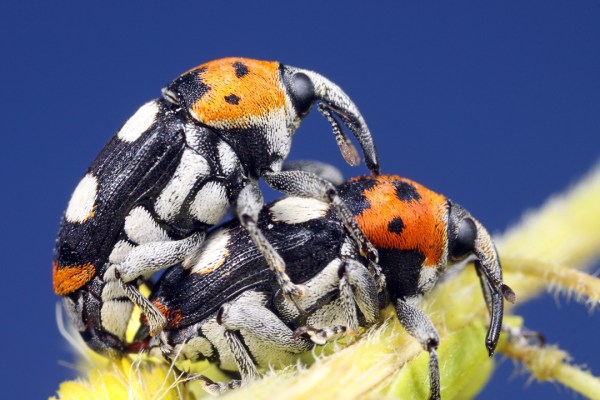
Megabaris quadriguttatus | Corrientes Province, Argentina

From  (posted 12 Apr). I spent much of 2012 working on the “blue sky background” technique, with these weevils from northern Argentina representing one of my better attempts. Macrophotography of insects with a blue sky background involves setting exposure, ISO, and aperture to achieve two separate exposures—full flash illumination of the subject for maximum depth-of-field, and ambient light from the sky to create a clean, uncluttered, natural-looking background. In this shot I managed to achieve an almost ideal shade of blue to compliment the wild black, white and red colors of the beetles. (My one criticism of the photo is having clipped one of the beetle’s feet.)


Bombylius sp. cf. mexicanus | Scott Co., Missouri

From  (posted 16 May). This photo is unusual if nothing else. Focus, lighting, depth-of-field, and composition are all better than can be hoped for in a single shot, but the subject—perfectly alive—is in a most unusual position. Read the original post to find out how this happened.


Perisphaerus sp. (a pill roach) | Vietnam (captive individual)

From  (posted 27 May). White-box photography is an excellent technique for clean, uncluttered photographs of insects, but it also isolates them from their natural surroundings and limits their natural history appeal. The best white-box photos are those that highlight a key feature or behavior of the subject—in this case a pill roach’s comically conglobulating defensive posture.


Micronaspis floridana (Florida intertidal firefly) larva | Pinellas Co., Florida

From  (posted 31 July). Here is another photo whose back story played a big part in its selection. This firefly larva not only represents a rare Florida-endemic species but was also first seen by my then 12-year old nephew, who willingly accompanied me through a dark, spooky salt marsh in the middle of a humid Florida night to see what he could learn. The lesson here for budding natural historians (and old-timers like me) cannot be overstated!


Arctosa littoralis (beach wolf spider) | Lewis Co., Missouri

From  (posted 23 Aug—prelude to  posted 28 Aug). Those who follow this blog know of my obsession with close-up portraits, and while tiger beetles are the subjects I most commonly photograph in this manner, I am always on the lookout for good subjects in other taxa. This wolf spider “face” almost looks human, with “two” eyes, two “nostrils” and a shiny upper lip above huge (albeit hairy) buck teeth! It’s enough fill-the-frame spidery goodness to melt (or explode) the heart of even the most ardent arachnophobe!


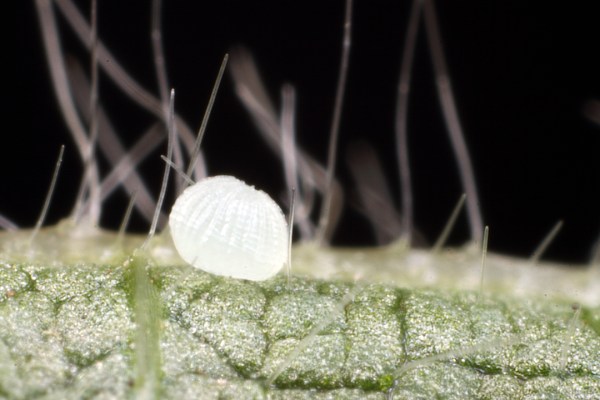
Anticarsia gemmatalis (velvetbean caterpillar) egg on soybean leaf

From Life at 8X—Guide to lepidopteran eggs on soybean (posted 3 Sep). “Life at 8X” was a new series I introduced this year, featuring insects photographed at magnifications testing the upper limit of my equipment and photographic skills. Diffraction is the chief difficulty with magnifications as high as this and is the primary flaw in the above photograph. Nevertheless, such view of a moth egg on the underside of a soybean leaf provides a spectacular view of the otherwise unseen micro-world that lives right beneath our noses.


Megacyllene decora (amorpha borer) on snakeroot flowers | Mississippi Co., Missouri

From  (posted 12 Sep). This second example of “blue sky background” was taken later in the year and was considerably more difficult to capture than the first because of the larger size of the subject and resulting need for a longer focal length macro lens. Getting a well-lit, focused, and composed image with a desirable shade of blue in the background depended not only on finding the proper camera settings, but also secure body and camera bracing techniques for this completely hand-held shot.


Cicindelidia politula politula (Limestone Tiger Beetle) | Montague Co., Texas

From  (posted 28 Sep). I will go ahead and say it—this is my favorite photograph of 2012. As discussed under the first entry, panning back from the subject can allow for some very interesting compositions. This photo combines charismatic pose by a wary subject with panning back and low perspective to create an image that scores high in both natural history and aesthetic appeal.


Calosoma sayi (black caterpillar hunter) | New Madrid Co., Missouri

From Black is beautiful! (posted 7 Nov). Of course, close-as-possible can also be used to create striking photos, especially if the subject exhibits features that are best seen up close. Anything with jaws fits the bill in my book, and highlighting the mandibular sculpturing of this caterpillar hunter (a type of ground beetle) required precise angling of the flash heads for maximum effect.


Cicindela repanda (Bronze Tiger Beetle) | St. Louis Co., Missouri

From  (12 Nov). This final selection is not a rare species, but it is as close as I have come to what I consider the “perfect” tiger beetle macrophotograph—a close, low angle, lateral profile of an adult in full-stilt posture (a thermoregulatory behavior), well lit, perfectly focused, and with a dynamic but pleasingly blurred background. It’s a perfect storm of a photo that took the better part of two hours to achieve—rarely do all of these elements come together in a hand-held photograph of an unconfined tiger beetle in its native habitat.


Well, there you have it. I hope you’ve enjoyed my selections, and again please do let me know if you have a personal favorite. See you in 2013!

Copyright © Ted C. MacRae 2012

Beetle Collecting 101: How to pin a beetle

It has been a long time since I initiated my Beetle Collecting 101 series (more than two years!), and to date the first issue—Beetle Collecting 101: Dress for Success—remains the one and only lesson that I’ve posted. I really had intended to follow that up with nittier-grittier posts on the actual mechanics of collecting beetles and processing the specimens for long-term preservation, but I didn’t and don’t know why other than to say, well… life happens. It’s never too late to fix something, however, so as a long overdue follow up I thought I would give a short video lesson on how to pin a beetle—specifically a cerambycid (longhorned) beetle. Featured in this short (4:31) video is the lovely Megacyllene decora (amorpha borer), which I found back in early September at a site in Missouri’s southeastern lowlands. Click the image to be directed to the video.

Copyright © Ted C. MacRae 2012