A winter longhorned beetle

According to the calendar it’s still autumn; however, in practical terms winter has settled in across much of the U.S. For those of us who study wood-boring beetles in the families Buprestidae (jewel beetles) and Cerambycidae (longhorned beetles), our time for collecting ended long ago. Adults of most species are active in spring and early summer, although some species don’t really make their appearance until summer is in full swing and a few rather distinctive species in genera such as Crossidius and Megacyllene make their appearance exclusively during fall. There is one longhorned beetle, however, that can actually be encountered in its greatest numbers during the dead of winter—Rhagium inquisitor, or the “ribbed pine borer.”

Rhagium inquisitor | Reynolds Co., Missouri

Rhagium inquisitor overwintering adult | Reynolds Co., Missouri

Rhagium inquisitor is unique among North American cerambycids in several respects. Most species in the family overwinter as mature or immature larvae, the former triggered to pupation by the first warm days of late winter and early spring in preparation for emergence as adults a few weeks later. Rhagium inquisitor, on the other hand, pupates during late summer and fall and then transforms to the adult before winter sets in (Linsley & Chemsak 1972), passing the winter in this stage and emerging during the earliest days of spring. Also unique among North American cerambycids is the place of pupation—directly under the bark. This contrasts with most other species, which either feed and pupate within the sapwood or feed under the bark but then bore into the sapwood for pupation. The species breeds exclusively in the trunks of dead conifers, with pines (Pinus spp.) especially favored, and as a result one can easily encounter the adults by peeling back the bark of dead pines during winter. Pupation takes place within distinctive rings of frass and coarse, fibrous wood shavings, prepared by the larva prior to pupation, so even when adults and larvae are not present the occurrence of this species can be determined by the occurrence of their pupation rings.

Adults overwinter in cells lined with frass and fibrous wood shavings.

Adults overwinter in cells lined with frass and fibrous wood shavings.

Not only are the overwintering and pupation habits of this species unique, but the adults themselves are distinctive from all other North American cerambycids (Yanega 1996) in their appearance—”big-shouldered” build, heavily “ribbed” elytra, and unusually short antennae (that are anything but “longhorned”). Lastly, the species is distributed not only in the boreal forests of North America, but Europe and Asia as well. The species is extremely variable in size and sculpturing, which combined with its Holarctic distribution has led to an unusually high number of synonyms. In fact, much of the North American literature prior to Linsley & Chemsak (1972) concluding that the North American and Eurasian forms represented the same species refers to this species as R. lineatum.

REFERENCES:

Linsely, E. G. & J. A. Chemsak. 1972. Cerambycidae of North America, Part VI, No. 1. Taxonomy and classification of the subfamily Lepturinae. University of California Publications in Entomology 69:viii + 1–138, 2 plates.

Yanega, D. 1996. Field Guide to Northeastern Longhorned Beetles (Coleoptera: Cerambycidae). Illinois Natural History Survey Manual 6: x + 1–174 [preview].

Copyright © Ted C. MacRae 2013
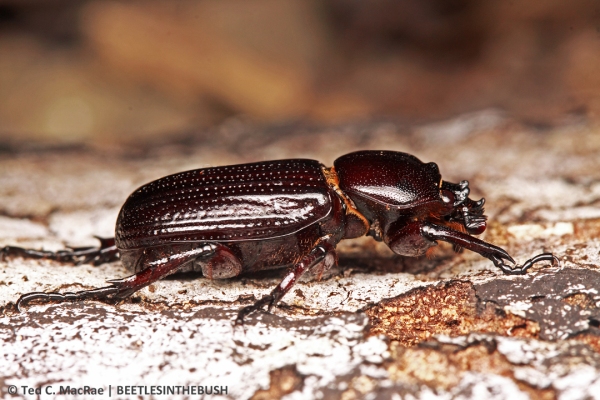
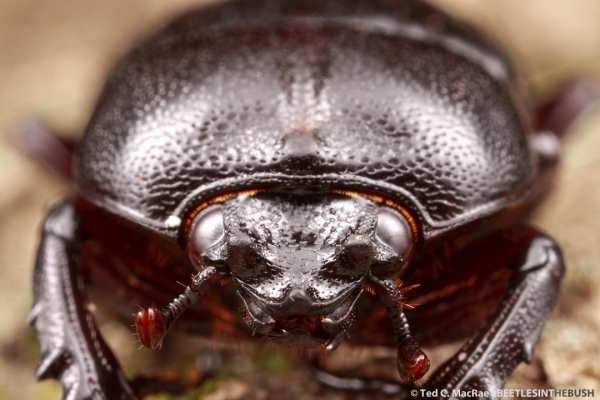
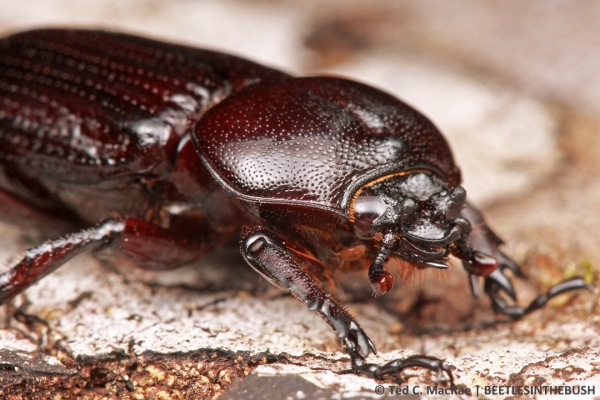
Sunday scarab: Phileurus valgus

Phileurus valgus (Linnaeus) | Otter Slough Conservation Area, Stoddard Co., Missouri

Phileurus valgus (Linnaeus) | Otter Slough Conservation Area, Stoddard Co., Missouri

Few beetles enjoy more popularity than the scarabs (family Scarabaeidae)¹, and within that group certainly the members of the subfamily Dynastinae are the most popular of all due to their often enormous size and presence of highly developed horns on the head and pronotum. The largest beetles in the U.S. (at least, by weight)—the Hercules beetles, genus Dynastes—belong to this subfamily, and in the tropical regions of the New World members of the genus Megasoma (literally meaning “giant body”) are among the heaviest-bodied beetles in the world (ironically, the title spot goes to members of the genus Goliathus in the subfamily Cetoniinae). Of course, almost without exception in the insect world exceptions apply, and not all dynastine scarabs are large, heavy-bodied beetles. In fact, members of the genus Cyclocephala are often mistaken for May beetles (subfamily Melolonthinae), while members of the genus represented by the species featured in this post—Phileurus—are sometimes mistaken for smallish “bess beetles” (Odontotaenius disjunctus) in the family Passalidae due to their flattened and parallel-sided body.

¹ Except maybe tiger beetles, jewel beetles, and longhorned beetles (wink!).

This species resembles and is sometimes mistaken for the common "bess bug."

This species resembles and is sometimes mistaken for the common “bess bug.”

Phileurus is a primarily Neotropical genus, with only two species ranging north into the United States and one, P. valgus, occurring broadly in the eastern United States. Despite its broad distribution, P. valgus seems to be more common in the southern part of the country and has been recorded under bark of decaying wood and attracted to lights. Saylor (1948) notes that Richter reared a specimen from a larvae collected in a cavity of a dead basswood (Tilia sp.) tree, and adults have also been reared from larvae collected in a blackjack oak (Quercus marilandica) snag (Taber & Fleenor 2005). The individual featured here was one of several that I found under the lower trunk bark of a large, standing, dead pin oak (Q. palustris) tree growing in a wet, bottomland forest in the Mississippi Alluvial Plain of extreme southeastern Missouri. I have seen this species from time to time over the years—never abundantly—but these are the first that I have seen in a situation other than being attracted to lights. The bark was quite loose and covered wood that was soft and well-decayed, and three adults were found embedded within a granular frass-filled gallery directly beneath the bark. One can presume that larvae could also have been found within the wood had I done a little digging.

The head of this species is adorned with three small cephalic tubercles.

The head of this species is adorned with three small cephalic and one pronotal tubercles.

Taber & Fleenor (2005) also note that adults of this species possess structures known to be used by other beetles for sound production, but they did not say whether they have heard this beetle making sounds. I have never heard sounds from these beetles when handling them, either. This contrasts with true bess beetles, which stridulate to make a “kissing” sound when handled.

REFERENCES:

Saylor, L. W. 1948. Synoptic revision of the United States scarab beetles of the subfamily Dynastinae, No. 4: Tribes Oryctini (part), Dynastini, and Phileurini. Journal of the Washington Academy of Sciences 38(5):176–183.

Taber, S. W. & S. B. Fleenor. 2005. Invertebrates of Central Texas Wetlands. Texas Tech University Press, Lubbock, 322 pp. [preview].

Copyright © Ted C. MacRae 2013
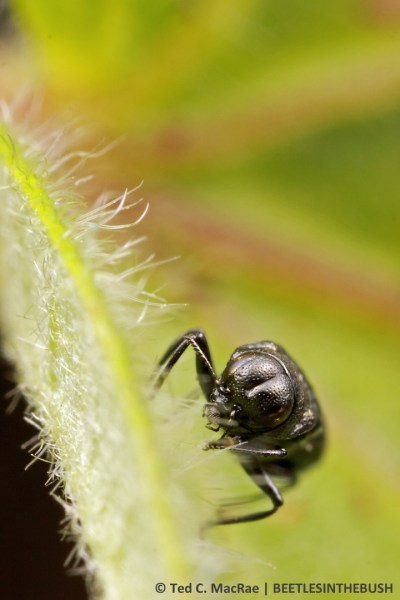
One-shot Wednesday: The “other” hibiscus jewel beetle

Paragrilus tenuis | Stoddard Co., Missouri

Paragrilus tenuis (LeConte) | Stoddard Co., Missouri

This past summer I visited Otter Slough Conservation Area in southeast Missouri in an effort to find and photograph the stunningly beautiful Agrilus concinnus Horn, or “hibiscus jewel beetle” (MacRae 2004). I was not successful in that quest, but I did manage to snap a single photo of another jewel beetle also associated exclusively with hibiscus, Paragrilus tenuis (LeConte). This species belongs to a much smaller genus of mostly Neotropical jewel beetles that resemble the related and much more speciose genus Agrilus but differ significantly by their antennae being received in grooves along the sides of the pronotum and, for the most part, their association as larvae with stems of living, herbaceous plants rather than dead branches and twigs of deciduous trees. Only four species of Paragrilus occur in the U.S. (Hespenheide 2002), and of these only Ptenuis is known to occur in the eastern U.S. where it has been reported breeding in Hibiscus moscheutos (including ssp. lasiocarpos). I have also collected adults on H. laevis (MacRae 2006), but to my knowledge it has not yet been reared from that plant.

These tiny little beetles (~ 5 mm in length) are normally seen resting on the terminal leaves of their host plants, but they are extremely wary and quick to take flight. As a result, photographing them in situ with a short macro lens in the heat of the day is rather challenging, especially when they are not numerous. I only saw perhaps half a dozen individuals during the visit, and the photo shown here represents the only shot that I even managed to fire off. While I would have liked to have gotten a dorsal view of the beetle, this single shot is nevertheless well-focused and a rather interesting composition.

REFERENCES:

Hespenheide, H. A. 2002. A review of North and Central American Paragrilus Saunders, 1871 (Coleoptera: Buprestidae: Agrilinae). Zootaxa 43:1–28 [pdf].

MacRae, T. C. 2004. Beetle bits: Hunting the elusive “hibiscus jewel beetle”. Nature Notes, Journal of the Webster Groves Nature Study Society 76(5):4–5 [pdf].

MacRae, T. C. 2006. Distributional and biological notes on North American Buprestidae (Coleoptera), with comments on variation in Anthaxia (Haplanthaxiaviridicornis (Say) and A. (H.) viridfrons Gory. The Pan-Pacific Entomologist 82(2):166–199 [pdf].

Copyright © Ted C. MacRae 2013

The Festive Tiger Beetle in Southeast Missouri

Cicindela scutellaris lecontei x s. unicolor

Cicindela scutellaris lecontei x scutellaris unicolor (male) | Holly Ridge Conservation Area, Missouri

This past spring I returned to the lowlands of southeastern Missouri in an effort to find and photograph a population of tiger beetles that seems to be unique to the area. The beetles represent Cicindela scutellaris (Festive Tiger Beetle), a widespread species that is common in dry sand habitats across the central and eastern U.S. It is also one of North America’s most polytopic species, with populations in the Great Plains, eastern U.S., Atlantic Coast, southeastern Coastal Plain, and several isolated populations on the western and southwestern peripheries of the species’ range of distribution recognized as distinct subspecies. In Missouri the species is known only from the extreme northwestern, northeastern, and southeastern corners of the state. In all of these areas the populations are found on alluvial sand deposits associated with the Missouri and Mississippi Rivers. Additional sand deposits are found in the areas between these three widely disjunct areas, but curiously the species has not yet been found in them, despite the presence of other species that occupy these same habitats such as Cicindela formosa (Big Sand Tiger Beetle).

Cicindela scutellaris lecontei x s. unicolor

Cicindela scutellaris lecontei x scutellaris unicolor (male) | Holly Ridge Conservation Area, Missouri

The populations in northern Missouri fall well within the distributional range of subspecies C. s. lecontei and are readily assignable to that taxon based on their wine-red coloration and well developed elytral markings. The population in southeastern Missouri, however, cannot be assigned either to that subspecies or to the more southern subspecies C. s. unicolor, which occurs along the southeastern U.S. Coastal Plain and is characterized by solid green coloration and no elytral markings. Individuals from southeastern Missouri are typically green, as in C. s. unicolor, but usually exhibit a distinct wine overtone from C. s. lecontei that varies greatly in its degree of development. Like C. s. lecontei, the elytra are usually marked, but never as strongly as in C. s. lecontei and sometimes not at all (as in C. s. unicolor). The two individuals shown in these photos represent the typical condition—wine blushing and elytral markings only moderately developed; however, more extreme examples can be seen in photos from fall 2008 and spring 2009 (taken during my “point-and-shoot” days, which explains my desire to photograph these beetles again). The intergradation of characters, their variable development, and the apparent presence of a wide disjunction zone between this population and C. s. lecontei to the north suggest to me that it originated from a relatively recent hybridization event between C. s. lecontei and C. s. unicolor—perhaps during the post-glacial hypsithermal that ended some 5,000 years ago.

Cicindela scutellaris lecontei x s. unicolor

Cicindela scutellaris lecontei x scutellaris unicolor (female) | Sand Prairie Conservation Area, Missouri

While I am happier with these photos than I am with those taken earlier, they don’t represent either the full range of variability seen in the population or the most aesthetically pleasing tiger beetle photographs I’ve ever taken. I made two trips to the southeast this past spring, and on each trip I was successful in finding and photographing only a single, very skittish individual—one on a sandy trail through upland forest (Holly Ridge Conservation Area) and the other along the margin of a sand blowout in a native sand prairie remnant (Sand Prairie Conservation Area). I’ll try again this coming spring and hopefully will be able to show some better photographs.

p.s. Can you tell the difference in the type of flash diffuser I used between these two trips? If so, which one do you like better?

Copyright © Ted C. MacRae 2013

INHS Seminar: Tiger Beetles of Missouri

If you are in the Champaign, Illinois area on Tuesday, 29 October 2013, I will be giving a seminar as part of the Illinois Natural History Survey Fall 2013 Seminar Series. I hope to see you there!

My thanks to Dr. Sam Heads for extending to me the invitation and to Jennifer Mui for preparing the very nice poster and attending to travel details.

INHS-Seminar-MacRae_2013-10-29
Copyright © Ted C. MacRae 2013

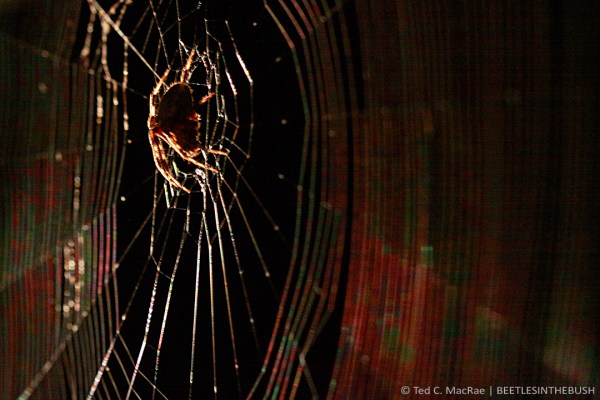
Sunday Spider: Backlit Araneus

Araneus sp. | Wildwood, St. Louis Co., Missouri

Araneus sp. | Wildwood, St. Louis Co., Missouri

Letting the dog out tonight, I encountered this spider—presumably in the genus Araneus—who had strung up her web in the corner of the doorway and was eerily backlit when I turned on the porch light. Without a tripod that would allow me to position the camera about 7′ above the floor and make use of a super long exposure, my only option for capturing the scene hand-held was to crank the ISO all the way up to 3200, ratchet down the shutter speed to 1/20th sec, and open up the aperture to f/5.6 (any lower and the shallow depth of field would have been unacceptable). Heavy-handed processing to reduce noise and increase sharpness yielded a serviceable photo; however, I’ve been thinking about getting a tripod lately, and the chance to produce much better versions of scenes like this only strengthen those thoughts.

Copyright © Ted C. MacRae 2013

Observation and Bias in Biology

The following is a guest post by my friend Kent Fothergill. Read more of Kent’s musings at his blog, biologistsoup.


Observation is a key activity in scientific inquiry. People who work with insects can make many interesting observations from collected insects: distribution, phenology, etc. Observations can be documented and analyzed later from photographs. A collection of photographs can also yield information about: associations with other species, behavior, while providing the same information as collected specimens – as such photography is a new tool changing entomology. Of course, most observations are made using only human senses without photographic or specimen documentation, but all observations can be subject to biases.

Observer biases are our evolutionary legacy. Our brains evolved to process and interpret data based on patterns observed in previously processed data. Because of the vast amount of data flowing in from our five senses and our limited ability to focus on data, our brains let most data be background. Even the subset of data that we focus our attention on is filtered, who hasn’t taken a photograph and found something much more interesting in the photograph than the original subject (e.g., these mites on harvestmen)? All data, even the data subset we are focused on can be misinterpreted. When teaching scientific methods, my students always enjoyed the optical illusion exercises to demonstrate why objective analyses and accurate measurement are important.

Remember, that the brain also compares incoming data to previous data. This allows pattern recognition. Recently, Ted and I were blacklighting along the Mississippi River in Southeast Missouri. We found a pair of Elaphidion mucronatum (spiny oak borer) a very common insect in Southeast Missouri. So common that many would move on to other more interesting subjects at that point. The insects were in a mate guarding situation.  Because I had a name for the behavior, my brain put my observation in the mate guarding category. At this point I would have moved on, except Ted wished to document the subject with his camera rig, which meant I would do what any friend should: watch the insects while Ted ran to vehicle to get his camera so he would be able to photograph them. While Ted was gone things got interesting. The male was positioned above the female, who was more or less caged between his legs. The pair was moving in unison on the tree trunk with very little actual contact between the pair. This was interesting, but when the female E. mucronatum suddenly shot out from under the male ending up 10’ vertical below him on the side of the tree trunk I was stunned. The male covered this distance with amazing speed and recaptured the female. After a couple minutes the female again shot out from under went down a few feet and doubled back ending out of sight above the male. At this point the male remained motionless for a brief period. When Ted came back with his camera, I took my eyes off of the male to tell him about what I had seen, and the male had vacated the area. Later, on the very same tree, we saw a mate guarding pair (presumably the same individuals) coming down towards us.

I have viewed many mate guarding insects. Mate guarding is a male insect using its body to prevent other males from mating with this female. Evolutionary biologists will explain mate guarding behavior in terms of enhanced male reproductive success, and that is why mate guarding persists. I never questioned this explanation, but should have. The E. mucronatum observation caused me to see mate guarding in a new way and realize that mate guarding involves a male and female component – I know this seems obvious, but I had my own cultural bias to overcome in this regard. I had never considered that mate guarding could involve non-willing females.

Based on a 10 minute observation of a very common insect my new understanding of mate guarding now recognizes that mate guarding influences female fitness also. Mate guarding persists when it creates a change in fitness in the male and female such that there is a positive net change in fitness for reproductive output for all individuals involved. In the case I witnessed, there may actually be a reproductive cost for the female and that is why she tried to avoid/escape the mate guarding. I have much more to learn about mate guarding.

Science is a way of objectively seeing the world and testing what you have seen to approach truth. This observation of E. mucronatum was also a mirror that showed my cultural bias and how that bias influenced my interpretation of my observations. For me, this observation could be a watershed event.

The moral(s) of this story:

  1. Life is short: enjoy time in the field with friends.
  2. Pay attention. There are new and wonderful things to observe even in the common and mundane.
  3. Be aware of the biases that can keep you from the truth.
  4. Have fun out there!

Copyright © Kent Fothergill 2013

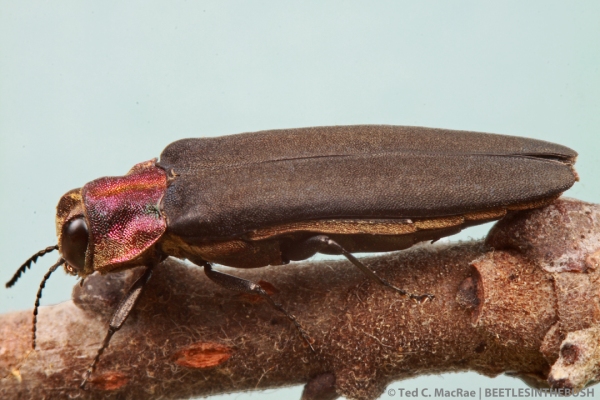
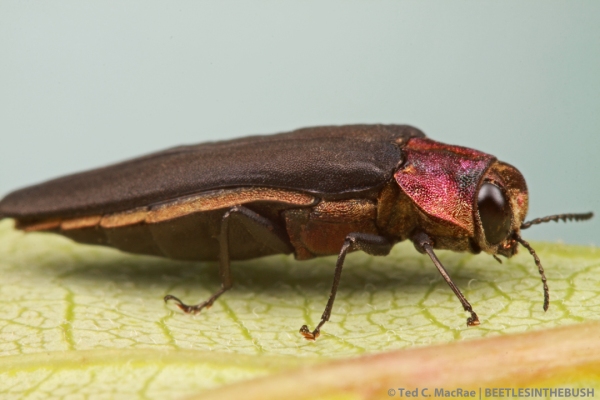
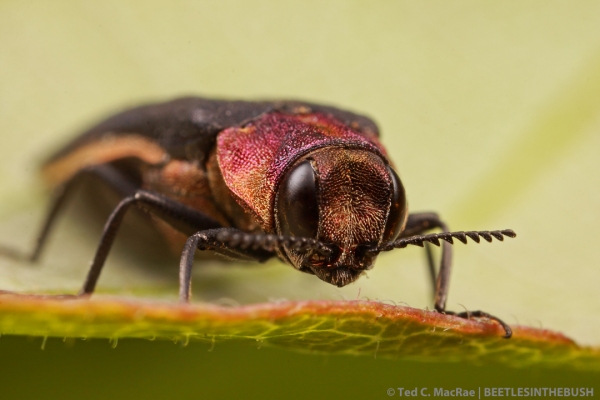
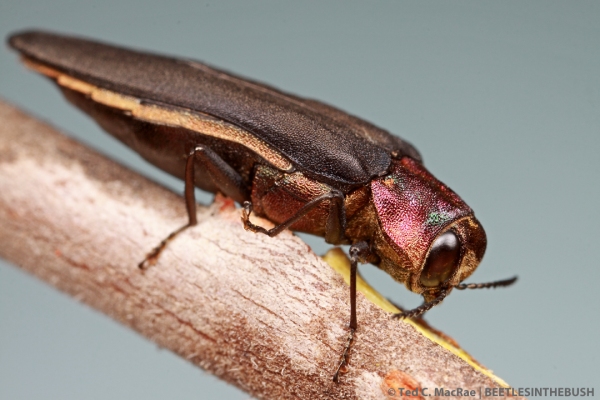
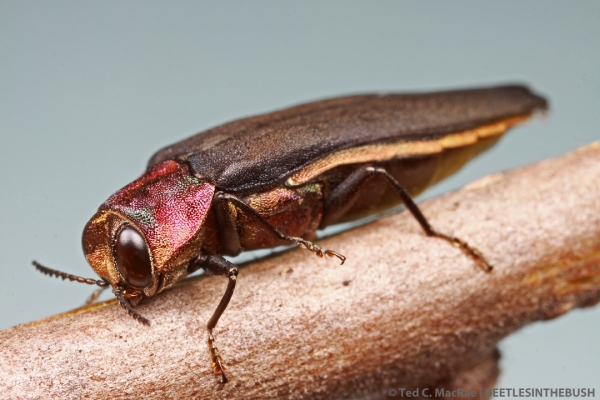
Agrilus fuscipennis on Persimmon

Agrilus fuscipennis

Agrilus fuscipennis may not be the largest or the prettiest member of the genus occurring in Missouri (that honor is reserved for Agrilus concinnus, or “hibiscus jewel beetle”—MacRae 2004). Nevertheless,  it comes pretty darned close! Add to that the fact that it is among our most seldom encountered jewel beetles, and you can understand how excited I was to see this species on my sheet after beating a small persimmon (Diospyros virginiana) tree last weekend at Hercules Glades Wilderness in the White River Hills of extreme southwestern Missouri. In fact, I have only collected this species three times previously—all single specimens beaten from persimmon, and all back in the 1980s!

Agrilus fuscipennis

Jewel beetles are unquestionably popular among insect collectors, due no doubt in large part to their vivid, metallic colors. I think the family, however, would be even more popular were it not for the genus Agrilus. Fully one in five species of jewel beetles belongs to this genus, which at nearly 3,000 described species and counting (Bellamy 2008) is perhaps the largest genus in the entire animal kingdom. As might be expected, such hyperdiversity has resulted in taxonomic quagmire, with species limits difficult to define and many hardly distinguishable except by examination of male genitalia (MacRae 2003). Additionally, in contrast to the rest of the family which is generally recognized as containing some of the most spectacularly beautiful beetles in the world, the most species of Agrilus are small, usually less than 8 mm in length and often as small as only 4–5 mm, and also lack the vivid colors (at least, to the naked eye) for which the rest of the family is so noted.

Agrilus fuscipennis

Agrilus fuscipennis is one of several species that buck this general Agrilus theme. While not forming a discrete taxonomic group within the genus, they are all unified by the following characteristics: 1) relatively large for the genus (A. fuscipennis measures 12–14 mm length), 2) vivid red pronotum and black elytra, and 3) mine the lower trunks, crown and main roots of living rather than dead host plants. For A. fuscipennis the larval host is persimmon, and other similar species include A. vittaticollis on serviceberry (Amelanchier) and A. concinnus on wild hibiscus (Hibiscus). These other species also are not very commonly encountered, at least in my experience, perhaps partly because they are not as easily reared from their hosts as species that develop as larvae in dead wood (the latter can be easily reared by retrieving infested wood from the field and placing in containers to trap emerging adults).

Agrilus fuscipennis

In the interest of full disclosure, these photos were taken in the studio after returning home. Although the persimmon branch is real, the “blue sky” is actually just a colored index card. I prefer to photograph insects in the field, especially with insects such as tiger beetles where it is desirable to include elements of the insect’s natural habitat in the photograph. However, I don’t have a problem with studio photography if field photographs prove too difficult or time-consuming or present too high a risk of escape by a prize specimen. My normal protocol for the latter is to place the first individual in a vial and continue to search for another that I will then try to photograph in the field. If that doesn’t work then I still have the first individual as a backup for studio photographs. In the case of this beetle, I found it on the very first clump of persimmon that I beat but never saw another despite beating persimmon for the rest of the afternoon (just like the three I found separately back in the 80s)! I have plans to photograph A. concinnus later this summer on its Hibiscus host plant in southeastern Missouri—hopefully I will succeed in getting true field photographs of that species.

Agrilus fuscipennis

REFERENCES:

Bellamy, C. L. 2008. World catalogue and bibliography of the jewel beetles (Coleoptera: Buprestoidea), Volume 4: Agrilinae: Agrilina through Trachyini. Pensoft Series Faunistica 79:1–722.

MacRae, T. C. 1991. The Buprestidae (Coleoptera) of Missouri.  Insecta Mundi 5(2):101–126.

MacRae, T. C. 2004. Beetle bits: Hunting the elusive “hibiscus jewel beetle”. Nature Notes, Journal of the Webster Groves Nature Study Society 76(5):4–5.

Copyright © Ted C. MacRae 2013