An elegant living fossil…

In the insect world, hyperdiversity is the norm. More than a million species are known, and perhaps several million more await discovery. Beetles alone represent nearly a quarter of the earth’s described biota, with one genus (Agrilus in the family Buprestidae) bursting at the seams with more than 3,000 described species (Bellamy 2008). Biodiversity gone wild! While birders routinely field identify (and list) a majority of the birds they see to species, most insect enthusiasts are happy if they can simply identify their subjects to family—in most cases still leaving several hundred to several thousand possibilities for species identification. Even trained entomologists usually can identify only a tiny fraction of the insects they see and remain just as clueless about the vast majority of insects they encounter that don’t represent one of their limited number of study groups.

Pelecinus polyturator female | Wayne Co., Missouri

Pelecinus polyturator female | Wayne Co., Missouri

 Of course, that doesn’t mean field identification is impossible for all insects—certain groups such as butterflies, dragonflies, and tiger beetles lend themselves to field identification due to their relatively large size, bright colors, and distinctive markings. Many would also include the aculeate hymenopterans (i.e., “stinging” wasps and bees) among those groups for these same reasons. However, the vast majority of hymenopterans belong to a multitude of families characterized by tiny, parasitic species that seem (to this coleopterist’s eyes) to differ only in bafflingly minute details of wing venation and tibial spurs. (Honestly, I couldn’t tell you the difference between Tanaostigmatidae and Tetracampidae if my life depended on it!) Nevertheless, there are a small handful of parasitic hymenopterans in North America that are instantly recognizable due to their giant size (2 or more inches in length)—namely, Megarhyssa spp. (giant ichneumons) and the species shown in this post, Pelecinus polyturator (American pelecinid). Pelecinus polyturator is the only North American member of the family Pelecinidae, which itself contains only two additional species that are restricted to Mexico and Central/South America. It wasn’t always this way—fossils assignable to the family and representing 43 species in a dozen genera have been found as far back as the early Cretaceous (121–124 mya) across North America, Europe, and Asia (Grimaldi & Engel 2005). Surely this represents just the tip of the iceberg of Mesozoic and early Cenozoic pelecinid diversity, making today’s three species the last representatives of a once great lineage—”living fossils”¹ some might say.

¹ To ward off any scolding I might get from evolutionary purists, I get it; there is no such thing as a living fossil (except the T. rex skeleton in the movie “Night at the Museum”). I know that all species alive today have the same amount of evolutionary history behind them and are, if not from more immediate ancestors, highly derived compared to earlier life forms. I will admit that the term has become a bit overused as pseudoscientific shorthand for branding an organism as ‘primitive’ (another term which tends to raise hackles); however, I don’t see the problem with its use as informal reference to relatively ancient groups, usually more diverse in the past and now represented by only a few species. Innocuous shorthand is all it is.

This elegant female, recognizable by her extraordinarily narrowly elongate abdomen (males have a somewhat shorter abdomen that is widened at the end), was seen back in July 2011 as she flew to a blacklight and landed on nearby foliage in a mesic bottomland forest in southeastern Missouri’s Ozark Highlands. I have seen females on occasion over the years but have not yet seen a male, which are increasingly rare in more northern latitudes of the species distribution. I missed the focus a bit on this photo (and also the other half-dozen or so shots that I took)—photographing an active subject at night on elevated foliage without a tripod is difficult to say the least! Nevertheless, after post-processing it’s a decent photograph. If you are wondering why it took me so long to post it, that’s because only recently have I gained the confidence to “clean up” poorly exposed photos where the subject and/or substrate on which they are resting is so distractingly littered with debris as this:

Yuk!!!

Yuk!!!

Compare the original photo here to the final photo above it—how many post-processing tools can you detect the use of? 🙂

REFERENCES:

Bellamy, C. L. 2008. World catalogue and bibliography of the jewel beetles (Coleoptera: Buprestoidea), Volume 4: Agrilinae: Agrilina through Trachyini. Pensoft Series Faunistica 79:1–722.

Grimaldi, D. and M. S. Engel. 2005. Evolution of the Insects.Cambridge University Press, New York, xv + 755 pp.

Copyright © Ted C. MacRae 2013
Ovipositing Pigeon Horntail

Tremex columba (pigeon horntail) | Wayne Co., Missouri

Tremex columba (pigeon horntail) | Wayne Co., Missouri

By early July, woodboring beetle activity is at its peak in southern Missouri. Even though many of the smaller species of jewel beetles (family Buprestidae) and longhorned beetles (family Cerambycidae) have already come and gone, bigger species in genera such as Buprestis, Acanthocinus, Enaphalodes, etc. are ripe for the picking. All one has to do is travel for hours to high-quality forest (upland or lowland—either is fine depending on what you wish to find), hike for additional hours through stifling mid summer heat and humidity, and carefully search the trunks and branches of any declining or recently downed tree (don’t forget to look along the undersides) while dodging deer flies (if ever a creature sprang from the pit of hell!) and slapping mosquitos! Sure, you can cheat and just drive along National Forest roads looking for recent logging operations—it’s a good way to get large series of common, widespread species; however, if you want to get the good stuff you’ve got to seek out the high-quality forests—those not managed for timber—and look for declining trees and natural wind-throws.

Of course, not all wood borers are beetles. Among the more spectacular non-beetle wood borers are the horntails (order Hymenoptera, family Siricidae), represented in this post by one of its more commonly encountered species, Tremex columba (pigeon horntail). That is not to say that they are frequently encountered, at least in my experience, but I do remember the first time I saw one of these as a boy. I knew in my heart that they were harmless—my already tattered copy of The Golden Guide to Insects said so; yet I could not bring myself to actually grab what would become the latest prize specimen in my insect collection with my bare fingers, instead sneaking a jar over it and sliding the lid underneath.  I’ve seen them a few times since, but until recently I had never seen what must be considered their most remarkable feature—the ability to thrust a needle-thin ovipositor several cm into solid wood! While hiking the Shut-Ins Trail at Sam A. Baker State Park last year, I spotted a large, recently wind-thrown tree off the trail and picked my way over to see what woodboring beetles I might find. As I approached the horntail in these photos took flight, but I stood still and watched her settle back onto the trunk and resume searching activities. Using all the stealth I could muster, I made my approach—hoping to get at least one good shot of this spectacular insect. I would have been happy if I had walked away with nothing more than the first photo in the sequence below. What happened next, however, was icing on the cake. As the remaining photo sequence shows, she suddenly arched her abdomen high and began probing the wood with the tip of her ovipositor, then bracing it at a precise 90° angle relative to the lower abdomen, slowly thrust it deep into the wood until her abdomen was completely level above the trunk.

I never cease to be amazed by insects, but sometimes their capabilities just seem incomprehensible. If you disagree, just imagine trying to insert an insect pin deep into solid wood with nothing but your bare hands (or, more precisely, pushing only with your butt) and see if you don’t change your mind!

T
T
T
T
T
T
Copyright © Ted C. MacRae 2013
Best of BitB 2012

Welcome to the 5th Annual “Best of BitB”, where I pick my favorite photographs from the past year. 2012 was one of the most intensive travel years I’ve ever had—I spent 8 weeks in Argentina from February through April, made separate trips to Puerto Rico and Arkansas in May (bracketing a personal week in California), traveled almost weekly to Illinois and Tennessee from June to September (interrupted by a personal week in Florida in July), toured the southeastern U.S. (Arkansas, Louisiana, Mississippi and Georgia—great food!) in early September, chased tiger beetles in Oklahoma, Texas and Arkansas in late September, went back to Argentina for a week in October, and capped off the travel year by attending the Entomological Society of America Annual Meetings in Knoxville, Tennessee (for the first time in more than 10 years!)—whew! While many would cringe at such a travel load, I am among the lucky few who actually get paid for doing something that is also my hobby—entomology! This gives me ample opportunity to further hone my photography skills (nine of the 13 photos I’ve selected below were actually taken while I was on business travel), resulting in two key accomplishments this year—my first ever photography talk at the ESA’s insect photography symposium and my first commercial sales (look for the BitB commercial site to go online in 2013).

Enough blather! Here are my favorite BitB photographs from 2012. Click the link in the text below the photo to see the original post. I would greatly appreciate knowing if you have a favorite (and why)—your feedback will be enormously helpful to me as I continue to learn and develop as a photographer.  For those interested, here are my previous year picks for 2008, 2009, 2010 and 2011. And, as always, thank you for your readership!


Spintherophyta (?) sp. in flower of Abutilon pauciflorum | Buenos Aires, Argentina

From  (posted 2 Feb). One of my 2012 learnings was that sometimes a photograph that is not so close is more effective than one that is as close as possible. In one of my earlier attempts at “not-so-close” macrophotgraphy, the soft colors of the flower compliment the brash shininess of the tiny leaf beetle that has been feeding on its pollen. Pink lines lead the eye directly to the subject and create a pleasing composition, and pollen grains stuck to the beetle—a distraction in some situations—add to the miniature natural history story of the photo.


Apiomerus flavipennis with stink bug prey and kleptoparasitic flies | Chaco Province, Argentina

From  (posted 11 Mar). I selected this photo solely for the complex natural history story drama it shows—stink bug (Piezodorus guildenii) feeding on soybean becomes prey of an assassin bug (Apiomerus flavipennis), with volatiles from the chemicals it emitted in a vain attempt to defend itself serving as cues to kleptoparasitic flies (families Milichiidae and Chloropidae) that benefit from the assassin bug’s labors.


Planthopper nymph | Buenos Aires Province, Argentina

From  (posted 26 Mar). Another learning that I began putting into practice in 2012 was the use of low perspective for compositional impact. The cryptic coloration of this planthopper nymph (family Fulgoridae) made it almost invisible on the branch on which it was sitting when viewed from a normal “top-down” human perspective. Getting “down under” it, however, brought the nymph to life and emphasized its unusual form.


Megabaris quadriguttatus | Corrientes Province, Argentina

From  (posted 12 Apr). I spent much of 2012 working on the “blue sky background” technique, with these weevils from northern Argentina representing one of my better attempts. Macrophotography of insects with a blue sky background involves setting exposure, ISO, and aperture to achieve two separate exposures—full flash illumination of the subject for maximum depth-of-field, and ambient light from the sky to create a clean, uncluttered, natural-looking background. In this shot I managed to achieve an almost ideal shade of blue to compliment the wild black, white and red colors of the beetles. (My one criticism of the photo is having clipped one of the beetle’s feet.)


Bombylius sp. cf. mexicanus | Scott Co., Missouri

From  (posted 16 May). This photo is unusual if nothing else. Focus, lighting, depth-of-field, and composition are all better than can be hoped for in a single shot, but the subject—perfectly alive—is in a most unusual position. Read the original post to find out how this happened.


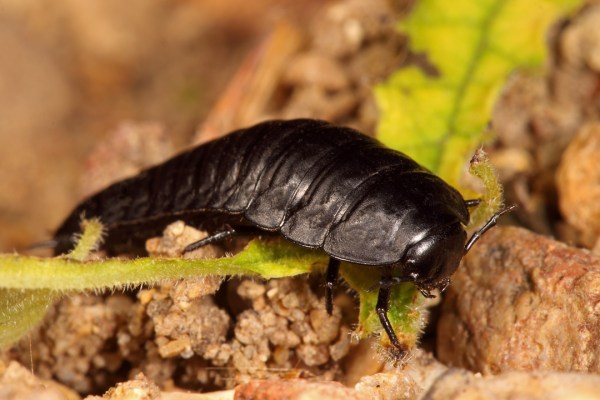
Perisphaerus sp. (a pill roach) | Vietnam (captive individual)

From  (posted 27 May). White-box photography is an excellent technique for clean, uncluttered photographs of insects, but it also isolates them from their natural surroundings and limits their natural history appeal. The best white-box photos are those that highlight a key feature or behavior of the subject—in this case a pill roach’s comically conglobulating defensive posture.


Micronaspis floridana (Florida intertidal firefly) larva | Pinellas Co., Florida

From  (posted 31 July). Here is another photo whose back story played a big part in its selection. This firefly larva not only represents a rare Florida-endemic species but was also first seen by my then 12-year old nephew, who willingly accompanied me through a dark, spooky salt marsh in the middle of a humid Florida night to see what he could learn. The lesson here for budding natural historians (and old-timers like me) cannot be overstated!


Arctosa littoralis (beach wolf spider) | Lewis Co., Missouri

From  (posted 23 Aug—prelude to  posted 28 Aug). Those who follow this blog know of my obsession with close-up portraits, and while tiger beetles are the subjects I most commonly photograph in this manner, I am always on the lookout for good subjects in other taxa. This wolf spider “face” almost looks human, with “two” eyes, two “nostrils” and a shiny upper lip above huge (albeit hairy) buck teeth! It’s enough fill-the-frame spidery goodness to melt (or explode) the heart of even the most ardent arachnophobe!


Anticarsia gemmatalis (velvetbean caterpillar) egg on soybean leaf

From Life at 8X—Guide to lepidopteran eggs on soybean (posted 3 Sep). “Life at 8X” was a new series I introduced this year, featuring insects photographed at magnifications testing the upper limit of my equipment and photographic skills. Diffraction is the chief difficulty with magnifications as high as this and is the primary flaw in the above photograph. Nevertheless, such view of a moth egg on the underside of a soybean leaf provides a spectacular view of the otherwise unseen micro-world that lives right beneath our noses.


Megacyllene decora (amorpha borer) on snakeroot flowers | Mississippi Co., Missouri

From  (posted 12 Sep). This second example of “blue sky background” was taken later in the year and was considerably more difficult to capture than the first because of the larger size of the subject and resulting need for a longer focal length macro lens. Getting a well-lit, focused, and composed image with a desirable shade of blue in the background depended not only on finding the proper camera settings, but also secure body and camera bracing techniques for this completely hand-held shot.


Cicindelidia politula politula (Limestone Tiger Beetle) | Montague Co., Texas

From  (posted 28 Sep). I will go ahead and say it—this is my favorite photograph of 2012. As discussed under the first entry, panning back from the subject can allow for some very interesting compositions. This photo combines charismatic pose by a wary subject with panning back and low perspective to create an image that scores high in both natural history and aesthetic appeal.


Calosoma sayi (black caterpillar hunter) | New Madrid Co., Missouri

From Black is beautiful! (posted 7 Nov). Of course, close-as-possible can also be used to create striking photos, especially if the subject exhibits features that are best seen up close. Anything with jaws fits the bill in my book, and highlighting the mandibular sculpturing of this caterpillar hunter (a type of ground beetle) required precise angling of the flash heads for maximum effect.


Cicindela repanda (Bronze Tiger Beetle) | St. Louis Co., Missouri

From  (12 Nov). This final selection is not a rare species, but it is as close as I have come to what I consider the “perfect” tiger beetle macrophotograph—a close, low angle, lateral profile of an adult in full-stilt posture (a thermoregulatory behavior), well lit, perfectly focused, and with a dynamic but pleasingly blurred background. It’s a perfect storm of a photo that took the better part of two hours to achieve—rarely do all of these elements come together in a hand-held photograph of an unconfined tiger beetle in its native habitat.


Well, there you have it. I hope you’ve enjoyed my selections, and again please do let me know if you have a personal favorite. See you in 2013!

Copyright © Ted C. MacRae 2012

T.G.I.Flyday: Tachinomyia sp.

You would think that somebody with enough patience to photograph tiger beetles would be equally patient with “calyptrate” flies, but for me such is not the case. It’s not that I don’t find them interesting (although, really, what insect group can match the diversity, polytopism, ecological extremism and behavioral charisma of tiger beetles?), but their flighty, frenetic behavior and difficult taxonomy are just a bit too much for me. After all, why invest the time it would take to get a good photograph of something that, in the end will probably be unidentifiable.

IMG_9659_enh_1080x720

Tachinid fly (prob. Tachinomyia sp.) | Wayne Co., Missouri

Last April as I was hiking a woodland trail in Sam A. Baker State Park in southeastern Missouri’s Ozark Highlands, I saw this decent-sized fly bumbling across the trail. I knelt to look at it more closely, and though it tried to flee, it seemed too weak and uncoordinated to take flight. It was in beautiful condition—a perfect specimen, and I surmised that it represented a newly emerged adult that had not yet hardened sufficiently to withstand the rigors of flight. I was fascinated by its distinctive, orange tarsal pads and the white “beard” around its head, and the ability to coax the fly onto a leaf and hold the leave in whatever position I desired was all the enticement I needed to spend a little time with it. Out of the several shots that I took, these two are my favorites.

IMG_9683_enh_1080x720

You got it—the BitB face shot!

Of course, just being able to photograph the fly was only half the battle—there still remained the matter of its identification. It seemed “tachinidish” to me at the time, but a little digging revealed that there are species of Sarcophagidae look very similar to tachinids, the difference being the presence or absence of a visible postscutellum. My photos don’t show this character, and I quickly became overwhelmed when I tried scanning through BugGuide photos for these two families. Nevertheless, I’m a persistent sort, and after winnowing out the numerous unlikely choices I finally settled on not only family Tachinidae, but possibly Tachinomyia sp. (tribe Exoristini). I was tempted to go out on a limb and post the ID here unvetted, but I chickened out and and sent the photos to fly guy Norman Woodley at the Systematic Entomology Lab in Washington, DC. Norm supported my identification and wrote back:

I think it is probably Tachinomyia.  It would be better to have a wing view as well as the hind end to be absolutely positive, but I’m reasonably sure that’s what it is.  It’s a male.  Some species are active in the spring, so that fits with your data as well.

Copyright © Ted C. MacRae 2012

Eye to eye to eye to eye with a tiger beetle larva

After the past few years of hunting tiger beetles, I’ve learned not only how to find the larval burrows but—at least for most of the species occurring in Missouri—how to identify the larvae in the field. While conclusive identifications rely upon morphological characters, a preliminary field ID is often possible based on a combination of burrow size, placement, soil type and knowledge of which species are likely to occur in a given habitat. Tiger beetle larvae don’t have the same aesthetic appeal to many people that the adults have, and for this reason many species remain undescribed in the larval stage—even the well-studied North American fauna has only about 60% of its species with the larval stages described (Pearson et al. 2006). Nevertheless, the ability to find, collect and rear tiger beetle larva remains an important part of my studies because it not only expands my survey power (most tiger beetles have more restricted temporal occurrence as adults than as larvae) but can also lead to novel findings such as previously undescribed larvae and unknown parasitoid associations.

Tetracha virginica 3rd instar larva | Mississippi Co., Missouri

Tetracha virginica 3rd instar larva | Mississippi Co., Missouri

This larva was dug from its burrow in bottomland forest habitat in the southeastern lowlands of Missouri. However, before I even saw the larva I knew it belonged to the genus Tetracha and probably represented the species T. virginica (Virginia Metallic Tiger Beetle, according to Erwin & Pearson 2008). How did I know this? First, the size of the burrow (~8 mm in diameter) excluded all but one other non-Tetracha species known to occur in Missouri—Cicindelidia obsoleta vulturina (Prairie Tiger Beetle), a species known to occur only in the dry, rocky, dolomite glades in the White River Hills region of extreme southwestern Missouri. Secondly, while T. carolina (Carolina Metallic Tiger Beetle) is also found in southeastern Missouri, that species has been associated almost exclusively with treeless habitats—at least in southeastern Missouri (K. Fothergill, personal communication). Since the burrow from which this individual was dug was found in wet, bottomland forest, chances were high that it instead represented T. virginica.

Simple, thorn-like outer hooks with much smaller inner hooks distinguish Tetracha larvae from other tiger beetle genera.

Simple, thorn-like outer hooks with much smaller inner hooks distinguish larvae of Tetracha.

Notwithstanding the circumstantial evidence, there are morphological characters that also distinguish both the genus and the species of this larva. Of primary importance are the hooks and setae on the prominent “hump” of the fifth abdominal segment. This hump is braced against the vertical wall of the larval burrow as it sits at the entrance waiting for passing prey. Once the prey is seized, the hump armature provides traction against the burrow wall, preventing the struggling prey from pulling the tiger beetle larva out of its burrow (where it would not only be ineffectual as a predator but also highly vulnerable to predation itself). Tiger beetle larvae can often be distinguished at the generic level by the shape and size of the main hooks. Tetracha larvae have four hooks—two outer and two inner—that are simple and thorn-like, with the inner hooks much smaller than and placed much closer to the outer hooks than to each other (other genera either have six hooks, or they have the outer pair 1) highly curved or 2) the inner pair larger and nearly as close to each other as to the outer hooks). There are also fine details of the pattern of the setae (smaller hairs) on the hump that identify this larva as T. virginica, but the presence of numerous hairs over the surface of the abdominal segments is a much easier character to see in the field (see first photo).

Note the white-margined pronotum and nearly equal sized simple eyes.

Note also the white-margined pronotum and nearly equal sized simple eyes.

Finally, there is that head—two pairs of large, simple eyes sitting behind gaping, cocked jaws that give them an oh so alien aspect! An often metallic, shield-like pronotum sitting behind the head, both used in concert to seal the burrow entrance as the larva lies in wait, serve to complete the alien ensemble but also offer clues to the larva’s identity. All larvae of Tetracha and closely related genera bear a distinctive rim of white around the pronotal margin, making them instantly recognizable even while still sitting in their burrow. Also useful is the relative size of the eyes, which in the case of Tetracha the second pair of eyes are nearly as large as the first pair (Amblycheila and Omus have the second pair distinctly smaller than the first, while Cicindela and related genera also have the eyes more nearly equal-sized).

P.S. This is what I was photographing when my friend Kent Fothergill surreptitiously took this photograph of me!

REFERENCES:

Erwin, T. L. and D. L. Pearson. 2008. A Treatise on the Western Hemisphere Caraboidea (Coleoptera). Their classification, distributions, and ways of life. Volume II (Carabidae-Nebriiformes 2-Cicindelitae). Pensoft Series Faunistica 84. Pensoft Publishers, Sofia, 400 pp.

Pearson, D. L., C. B. Knisley and C. J. Kazilek. 2006. A Field Guide to the Tiger Beetles of the United States and Canada. Oxford University Press, New York, 227 pp.

Copyright © Ted C. MacRae 2012

Dainty, delicate, little fairies

Adela caeruleella | Wayne Co., Missouri

Ever since I saw Chris Grinter’s beautiful photographs, I have wanted to see (and possibly photograph) the tiny little moths known as fairy moths (family Adelidae, formerly considered a subfamily of Incurvariidae). These dainty, delicate, little moths are characterized by their unusually long antennae—especially the males, which can have their antennae up to three times the length of the forewings. This past April I got my wish as my father and I hiked the Shut-ins Trail at Sam A. Baker State Park in Missouri’s southeastern Ozark Highlands.

Females have the antennae ”only” twice as long as the forewings…

Chris was fortunate to see a number of individuals representing at least two species, presumably all males (based on the extraordinary length of their antennae) that were engaged in some rather interesting territorial behaviors. I, on the other hand, saw only this single individual (presumably a female) who seemed content enough to calmly nectar the golden Alexander, Zizia aurea (Apiaceae), flowers on which I found it. This was fine by me, as the dense woodland setting where I saw it wasn’t very conducive to photographing the moth. I wanted a clean, bright background to highlight the moths dark metallic luster, so I snipped the flower (carefully!) on which the moth was nectaring and held it up to the small patch of bright blue sky visible from the trail to take these photos.

…and the basal half distinctly thickened.

I presume this individual represents the species Adela caerueleella based on comparison with online photos. According to Powell (1969) this species is widespread across the eastern U.S. and has been recorded on flowers of American bittersweet, Celastrus scandens (Celastraceae). Microleps.org notes the species is most frequently found along deciduous forest trails and shows a preference for flowers of black snakeroot, Sanicula marilandica (Apiaceae). My late April observation is consistent with the April and May activity period noted by Powell (1969) and late May period for central Illinois noted by Microleps.org.

REFERENCE:

Powell, J. A. 1969. A synopsis of Nearctic adelid moths, with descriptions of new species (Incurvariidae). Journal of the Lepidopterists’ Society 23:211–240.

Copyright © Ted C. MacRae 2012

Araneus marmoreus encore

Araneus marmoreus adult female—ventral view showing epigyne.

Here is the full-sized photo from which the crop shown in Super Crop Challenge #14 was taken. The small finger-like structure in the upper right of the photo—the object of the challenge—is the epigyne (or epigynum) of Araneus marmoreus (marbled orb weaver spider). Spiders have a rather unusual mating strategy—rather than possessing genitalia that couple for insemination, male spiders first form a packet of sperm (spermatophore) and transfer the packet to an enlarged segment (tarsus) at the end of their pedipalps. During mating, the male inserts the tarsus into the female genital opening, thereby effecting sperm transfer. The female genital opening and associated structures, located on the underside near the front of the abdomen, are called the epigyne and function to direct the male pedipalps during sperm transfer. The shape of the epigyne varies greatly and uniquely among species—probably serving as an isolating mechanism that prevents interspecific mating and also providing a good diagnostic character for species recognition among even very closely related species (similarly to the hardened male genitalia of many insect groups). An even closer view of the epigyne of A. marmoreus can be seen in this BugGuide photo.

Araneus marmoreus (marbled orb weaver) | Washington Co., Missouri

This is actually the second time I’ve featured A. marmoreus in a quiz—the intricate pattern of the dorsal abdomen being the subject of Super Crop Challenge #2. Folks had an easier time identifying the critter in that challenge than this one, which I guess is not surprising since people tend to know animals more by their color patterns than the structures of their genitalic openings. As in that first challenge, I encountered this adult female during a hike along the Ozark Trail, this time in Washington County in east-central Missouri. Unlike before, however, I found this spider crawling on a fallen log in the dark forest floor rather than resting in her web. The colors of this species are diverse and spectacular—a recipe that makes them almost irresistible to insect macrophotographers. That this is true is demonstrated by the 360! photos of this species posted to BugGuide.

Hot orange and yellows glow against the dark, moist wood of a fallen tree trunk.

While my previous photos of this species were colorful, these simply glow due to the more orange coloration of this individual and its contrast with the darkened color of the moist wood. It’s a November color scheme if there ever was one—appropriate since I took them exactly one year ago today on November 23, 2011. She was a lot more cooperative than the first subject, and because of this and the stable substrate on which she was sitting I was able to get my favorite shot of all—the face portrait! Not quite as endearing as a jumping spider face (with its large, anthropomorphic median eyes), but striking nevertheless.

The obligatory BitB face shot!

A word about the challenges—I’m not sure if the lack of response to this one is an indication of difficulty or further evidence of declining relevance of blogs as an interactive social medium. I can’t help but notice that blog commenting in general has dropped with the rise of more functionally interactive media such as Twitter and Google+. What do you think—was this challenge too hard, or has the concept of challenge posts lost its appeal?

Copyright © Ted C. MacRae 2012

Super Crop Challenge #14

Wow, has it really been five months since the last Super Crop Challenge?! Well, it’s time to start a new BitB Challenge Session (this will be #7), so what better way to start? Can you name the structure shown in the photo below (2 pts), the organism to which it belongs (order, family, genus, and species—2 pts each), and its significance (2 pts)?

Note: If you are not completely familiar with them, please read the full rules for details on how and how not to earn points. Good luck!

Copyright © Ted C. MacRae 2012