Grampus and go-devil

Corydalus cornutus | Wayne Co. Missouri


Ever taken a close look at a female dobsonfly’s head? Female dobsonflys don’t get nearly as much attention as the males due to the latter’s ridiculously elongated mandibles. While female mandibles are more modestly proportioned, don’t think they’re ineffectual—females are quite capable of inflicting a blood-letting nip if one is not careful. Certainly the female head is no less dinosaurian in appearance than the male’s, and while I know that Corydalus cornutus is the product of the same amount of evolutionary time as any other species on earth today, I can’t help but think they look so “primitive.”

While dobsonfly is the commonest name applied to these insects, I much prefer “go-devil” (not sure of the origin) and “grampus” (from “Krampus”—a mythical horned, creature in Alpine countries). The latter name in particular pays more appropriate homage to the monstrous appearance of these insects.

Photographed July 2011 at a blacklight sheet in Sam A. Baker State Park, Wayne Co., Missouri.

Copyright © Ted C. MacRae 2012

Tiger beetles in southeast Missouri

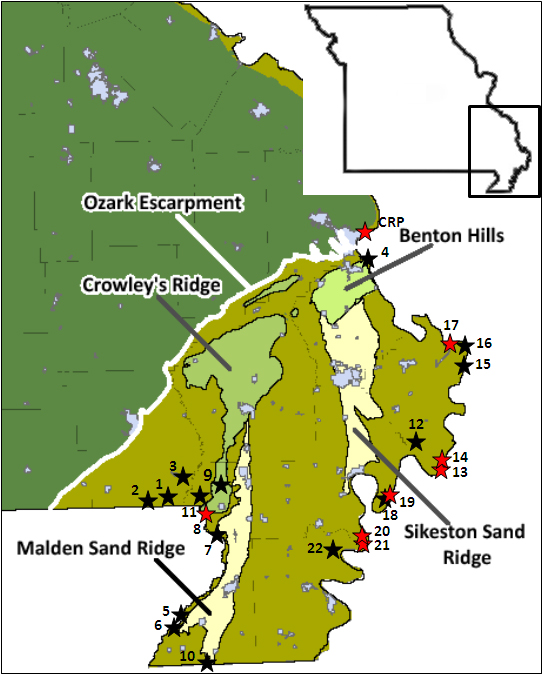
Figure 1. Sites surveyed in southeastern Missouri for Cylindera cursitans during 2007–2010. Site numbers are referenced in Table 1 (CRP = Cape Rock Park), with red stars indicating sites where C. cursitans was observed. Black box on inset map of Missouri denotes main map area (bordering states include AR to the south and TN, KY, and IL to the east).

ResearchBlogging.orgVolume 43(3) of the journal CICINDELA was published a few weeks ago, and I can truly lay more claim to the issue than anybody else (except perhaps Managing Editor Ron Huber). In addition to having one of my photos (a face-on shot of Tetracha carolina) featured on the cover, I was coauthor on the first of two papers included in the issue and lead author on the second. (And to complete my stamp of ownership, I did the final assembly of the issue as the journal’s Layout Editor.) The two included papers each report the results of surveys conducted in the Mississippi Alluvial Plain of southeastern Missouri (also called the “bootheel” in reference to its shape—see Fig. 1) for tiger beetles whose occurrence in that part of the state was previously not well known. In the first, Fothergill et al. (2011) used a novel survey technique that involved searching beneath irrigation polypipe in agricultural fields to find Tetracha carolina (Carolina Metallic Tiger Beetle); while the second paper (MacRae et al. 2011) reports the results of a multi-year survey to characterize the distribution, habitat associations and conservation status of Cylindera cursitans (Ant-like Tiger Beetle). Together with our three papers on Habroscelimorpha circumpicta johnsonii (Saline Spring Tiger Beetle), Dromochorus pruinina (Loamy Ground Tiger Beetle) and Cylindera celeripes (Swift Tiger Beetle)—all published in the past year—these two papers officially complete the battery of publications that describe our survey efforts for the five tiger beetle species considered of potential conservation concern in Missouri when Chris Brown and I began our faunal studies of the group more than ten years ago.

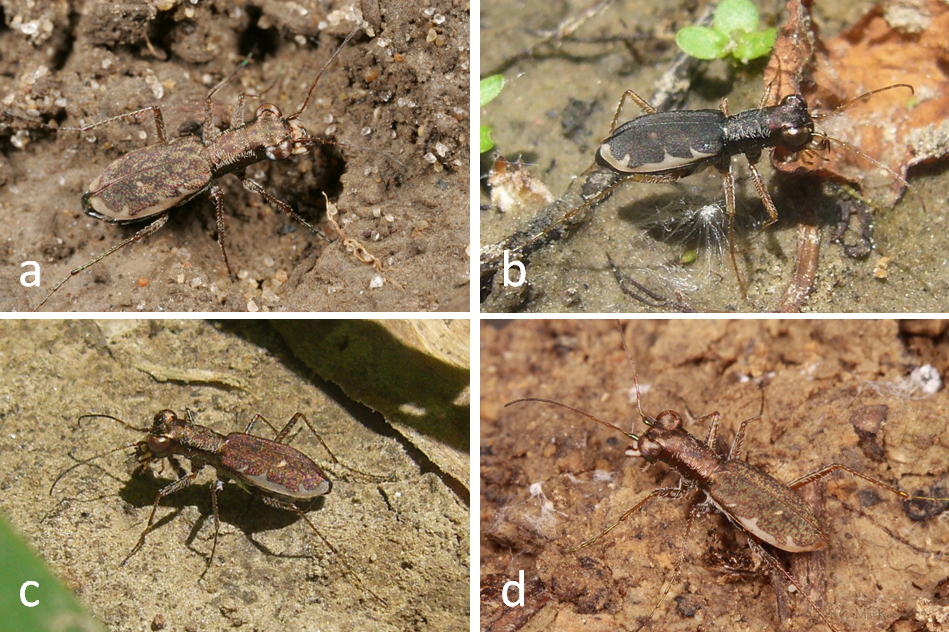
The first three papers clearly painted a rather gloomy picture—H. circumpicta johnsonii is possibly extirpated from saline spring habitats in central Missouri, D. pruinina is limited to a 2.5 mile stretch of roadside habitat in western Missouri, and C. celeripes is restricted to a few patches of critically imperiled loess hill prairie habitat in extreme northwestern Missouri. Happily, prospects for T. carolina and C. cursitans in Missouri are much better. While both are limited in the state to the southeastern lowlands, our surveys indicated that populations are sufficiently robust and widespread in the area to alleviate any concerns about the potential for extirpation. Tetracha carolina in particular was found abundantly in agricultural habitats and appears to have adapted well to the extensive modifications caused by conversion of the cypress-tupelo swamps that formerly covered the region. Cylindera cursitans (Fig. 2) hasn’t shown nearly the same adaptive capability as T. carolina; however, it has nevertheless found suitable refuge in the ribbons of wet, bottomland forest that persist between the Mississippi River and the levee systems that protect the region’s farmland. For a time it seemed that the same habitats along the St. Francois River that bound the western side of the region weren’t suitable for the species, but after much searching (in often tough conditions!) Kent finally managed to locate a population on the Missouri side of the river opposite a known population in Arkansas.

Figure 2. Cylindera cursitans in southeast Missouri: a) New Madrid Co., Girvin Memorial Conservation Area, 6.vii.2007; b-c) Mississippi Co., Dorena Ferry Landing, 6.vii.2008; d) Mississippi Co., Hwy 60 at Mississippi River bridge, 20.vi.2009. Photos by CRB (a) and TCM (b-d).

Both of these species illustrate how healthy populations of insects are able to hide right beneath our noses. Previous to our surveys, records of T. carolina and C. cursitans in southeastern Missouri were scarce (the latter consisting of a single specimen in the Enns Entomology Museum at the University of Missouri in Columbia, and with considerable searching required before the first field population was finally located). In both cases, perceived rarity was a result not of actual rarity, but rather specific habitat requirement or unusual behavior. While I get great satisfaction out of finding populations of “rare” species and increasing our understanding of their habitat requirements, I also can’t help but wonder if they truly are rare and how many populations I might still have missed—populations that I would have found had I searched in a slightly different manner or at a slightly different time.

REFERENCES:

Fothergill, K., C. B. Cross, K. V. Tindall, T. C. MacRae and C. R. Brown. 2011. Tetracha carolina L. (Coleoptera: Cicindelidae) associated with polypipe irrigation systems in southeastern Missouri agricultural lands. CICINDELA 43(3):45–58.

MacRae, T. C., C. R. Brown and K. Fothergill. 2011. Distribution, seasonal occurrence and conservation status of Cylindera (s. str.) cursitans (LeConte) (Coleoptera: Cicindelidae) in Missouri. CICINDELA 43(3):59-74

Copyright © Ted C. MacRae 2012

Of Bots and Warbles

As an undergraduate at Truman State University during the mid-90’s I was part of a small mammal research group led by Dr. Scott Ellis.  My focus was on flying squirrels, but others in the group studied mice.  There were always opportunities to help my colleagues trap mice, and that is where I first encountered bot flies (Oestridae: Cuterebra spp.).  It was common for the live trapped mice to be infected with bot fly larvae, or bots, developing just under the skin of the host.  You might expect a fly parasite of a mouse to be relatively small but that is not the case with bot flies.  The bots cause a grotesquely large growth (or warble), and Cramer and Cameron (2006) report that a single bot can weigh as much as 5% of the host body weight.  That’s like a 150 lb guy having a 7.5 lb growth!  One unfortunate mouse that comes to mind had a warble on its head which caused its eye to bulge out.  I hate to make light of that poor mouse’s condition, but I distinctly recall that the bulging eye made it look as if it was continually surprised.  That said, Cuterebra fontinella infections are not thought to have a negative impact on white-footed mice, and in fact some studies have found that infected mice actually live longer than their non-infected neighbors (Cramer and Cameron 2006).  This relatively benign relationship between host and parasite is also the case in general with other species of Cuterebra, which is attributed to the long evolutionary history shared between the parasite and a single or very few closely related hosts (Catts 1982).  Negative impact or not, I was glad that I didn’t have to worry about bot flies infecting me, at least while I was in temperate Missouri.  Of course I had heard plenty of stories of humans being parasitized in the tropics by the human-attacking Dermatobia hominis, and they didn’t sound like very pleasant experiences.  My favorite story involved the person that had a bot in their ear that just about drove them crazy because they could hear the bot any time it changed positions.  Actually the Slansky article discusses the more negative interaction between D. hominis and its host, and this has been attributed to the less specialized relationship between the parasite and any one host because D. hominis has a broad range of hosts. 

Dermatobia hominis actually employ another insect to deliver its eggs to the host!  They lay eggs on mosquitoes or other blood-feeding Diptera for subsequent transfer to the host.  This makes a lot of sense from my point of view as a potential host—the adults are huge (bumble bee size), and I sure would be wary of one approaching me.  But mosquitoes, now there’s an idea—they are very adept at finding their hosts and are inconspicuous enough that they just might be able to get in close enough to allow the body heat of the host to stimulate the hatching and deposition of a bot.

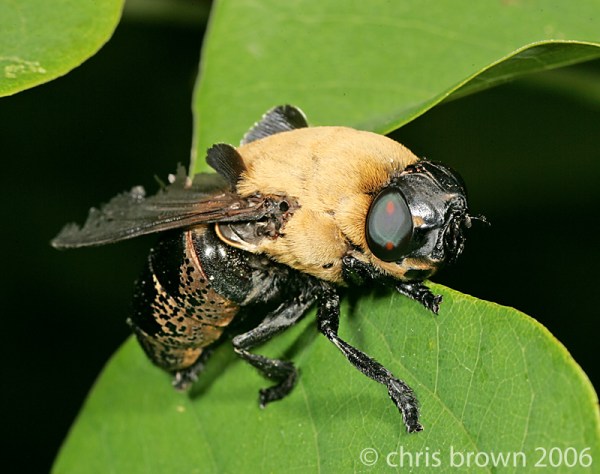
There are other species of Cuterebra, and each is host specific to some degree.  Cuterebra abdominalis (Fig. 1) and Cuterebra buccata are both specific to lagomorphs (rabbits).  No doubt male tree squirrels and chipmunks get a little nervous every time they hear the species name of their bot fly—“emasculator”.  The species name originated from the observation that the warbles were often located near the genitalia of the squirrels, which prompted the idea, given the impressive size of the warble, that there must be an impact on the reproductive ability of the afflicted squirrels.  Luckily for the squirrels, research has demonstrated that the species name is a misnomer (Catts 1982).

Figure 1. Cuterebra abdominalis, a rabbit bot fly

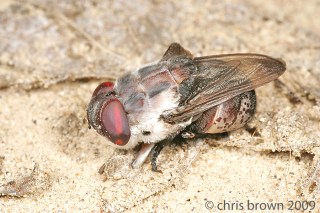
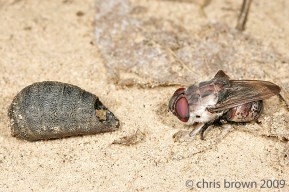
I knew nothing of the adult Cuterebra at the time I saw the parasitized mice, but that changed when Ted MacRae netted an adult rabbit bot fly, Cuterebra buccata, while we were looking for tiger beetles in northeastern Missouri.  In May of 2006, my wife Jess and I came across an adult C. abdominalis on the edge of a glade at Shaw Nature Reserve near St. Louis, and it is this photo that I discuss more below (Fig. 1).  The only other encounter was from southeastern Missouri in April of 2009 when Ted again found a rabbit bot fly, and this individual had only recently emerged from its puparium (Figs. 2 and 3– See Ted MacRae’s previous post from 2009 on this exact same fly).  All told, that’s only three encounters with adult bot flies from countless hours spent in the field, so my experience is that adult bot flies are rarely encountered.

Figure 2. Newly emerged rabbit bot fly, Cuterebra buccata

Figure 3. Newly emerged C. buccata with shed puparium


The image in Figure 1 represents well the type of photographic opportunity that I look for because it readily leads into various side stories.  Here are some examples: 

1) Amazing natural history—you just can’t make this stuff up.  The Catts review article cited discusses numerous other aspects of bot fly natural history in addition to the discussion above.  For example:

  1. Cuterebra spp. are thought to oviposit in the host habitat where the eggs await close passage of a host.  As with the D. hominis, the body heat of the host stimulates the eggs to hatch. The first instar larvae enter the host through an existing orifice or wound and then travel through the host to find a suitable subcutaneous location to create a warble.  Here, the larva molts to the second instar and continues to draw nourishment from the host.  Cuterebra larvae feed on fluids of the host as opposed to feeding on actual tissue, which would be more damaging to the host.
  2. The larvae spend roughly one month in the host.  Upon completion of the third instar, the larva exits the host, digs into the soil, and pupates.  Bot flies overwinter as pupae.
  3. Adults do not feed and are relatively short-lived.  Their attention is focused on the serious business of reproduction. 

2) Mimicry.  As you can see from the image, C. abdominalis very much resembles a bumble bee.  This image is great for presentations because it captures the attention of grade school kids.  I include this image at the end of a series of slides containing images of bees and wasps alongside the flies that mimic them.  Kids become very engaged and have a lot of fun trying to guess which images represent the models and which represent the mimics.  By the end of the series the kids have become pretty savvy about picking out the imposters but I present this image last and C. abdominalis is so bizarre that it always stumps the audience.  The kids become even more captivated by the discussion of how bot flies make a living.

3) Insect photography technique.  It’s thrilling to find new insects, but the experience can quickly turn disappointing if the insect flies off never to be seen again just as you begin to approach it for a photograph. That would have been the case with my encounter with C. abdominalis if I didn’t have a companion with me in the field.  I was lucky to have my wife, Jess, with me on this hike.  She kept an eye on the fly as I moved in for pictures.  Once or twice it flew at my approach, and Jess was able to keep track of it so I could try again.  Ted and I have also acted as spotters for one another, and this has made the difference between getting the pic or not.

4) Great location.  We encountered C. abdominalis on the edge of the scenic glade that slopes away from the Trail House at Shaw Nature Reserve in Franklin County, Missouri.  It’s always fun to revisit certain places and get to know them and the photographic opportunities they provide.  The Nature Reserve is one such place for me.  It offers countless opportunities for insect photography close to St. Louis due to a wide variety of habitats including prairie, glade, forest, wetland, and riparian areas. 

REFERENCES:

Catts E. 1982. Biology of New World bot flies: Cuterebridae. Annual Review of Entomology 27:313–338.

Cramer J. and G. Cameron. 2006. Effects of bot fly (Cuterebra fontinella) parasitism on a population of white-footed mice (Peromyscus leucopus). Journal of Mammalogy 86:1103–1111.

Slansky, F. 2007. Insect/mammal associations: Effects of cuterebrid bot fly parasites on their hosts. Annual Review of Entomology 52:17–36.

Copyright © Christopher R. Brown 2012

A Modest Model for Mimicry

Spring is still a long way off but it’s times like these that I draw on past experiences so I can continue to be thrilled by insect natural history even during the coldest of months.  In this case I am thinking back seven years ago to my first encounter with a warty leaf beetle.  These beetles are certainly unremarkable for their size or coloration but the “set-up” shot below attempts to illustrate what is amazing about warty leaf beetles.  Can you pick out the single individual warty leaf beetle (Exema sp.) among caterpillar frass (aka caterpillar poop)? 

Figure 1. Set-up shot with Exema sp. and caterpillar frass

If you had trouble finding the beetle in the above image then check out the next image and you’ll see the beetle has “sprouted” a head, legs, and antennae.

Figure 2. Set-up shot with Exema sp. and caterpillar frass

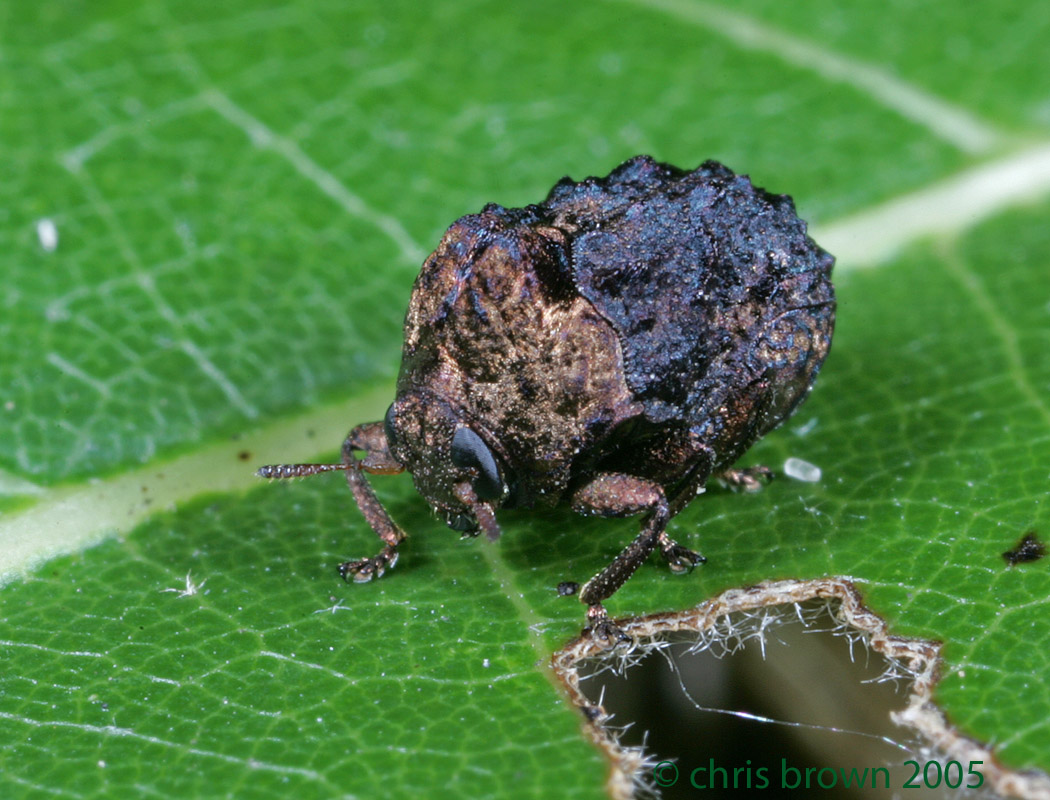
I don’t know what caught my eye the first time I encountered a warty leaf beetle on the foliage of a small shingle oak while exploring a woodland edge in Perry Co., MO.  It probably helped that it was one of the larger species of the genus Neochlamisus but it still only measured about 3-4 mm.  One thing I do remember about the encounter, though, is that there was something about it that made me do a double take.  My first thought was exactly what the beetle might have hoped, that it was caterpillar frass.  But this frass had legs (Figs. 3 and 4)!  I was at first incredulous but soon became enthralled as I beheld something that I had never noted while flipping through field guides.  I had once again stumbled across something that I would never have imagined—a beetle that mimics caterpillar poop!

Figure 3. Neochlamisus sp. on shingle oak

Figure 4. Neochlamisus from the perspective of a short distance away

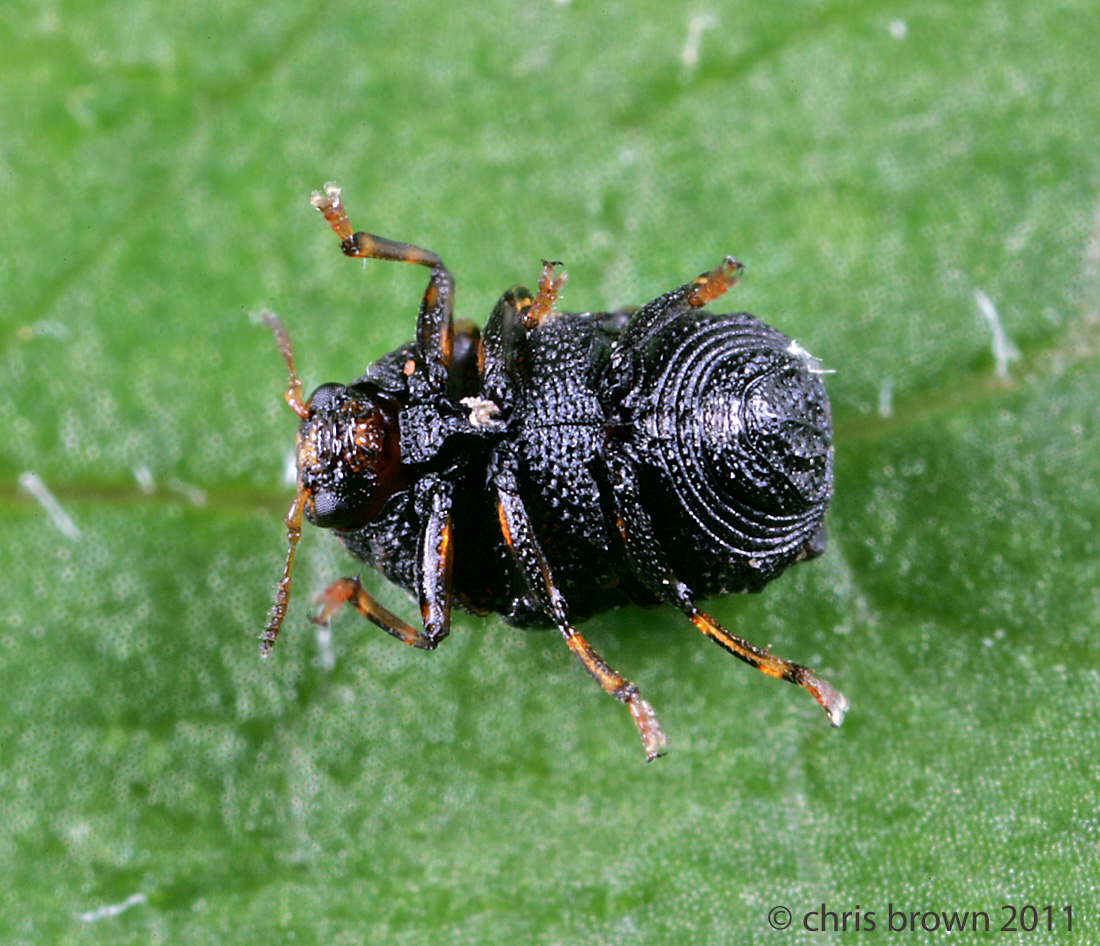
The beetles in the tribe Chlamasini were apparently not at the table the day decisions were made on what model they would mimic.  These guys at best mimic small bits of debris but are dead ringers for the frass of lepidopteran larvae (i.e., caterpillars).  Then as if to add insult to injury, we dubbed the tribe the warty leaf beetles!  The Chlamasini may humbly mimic excreta but what they lack in a flashy model they make up for with absolutely superb mimicry.  The Chlamasini are remarkably similar to the frass of lepidopteran larvae in size, shape, texture, and color but the aspect that really completes the mimicry is that, upon disturbance, the head is retracted and the legs and antennae are neatly folded into precisely matched grooves leaving no indication that this was once a beetle (Figs. 5 and 6).  Even the finer details of coloration were not overlooked as some warty leaf beetle species are variably colored, including an almost metallic sheen in some places that closely resembles the coloration of some caterpillar frass.  In fact the mimicry of warty leaf beetles is so convincing that I recently dropped a piece of suspect frass in a vial in hopes that it might sprout legs and represent a new species of warty leaf beetle for me.

Figure 5. Exema sp. with appendages extended

Figure 6. Exema sp. with appendages retracted

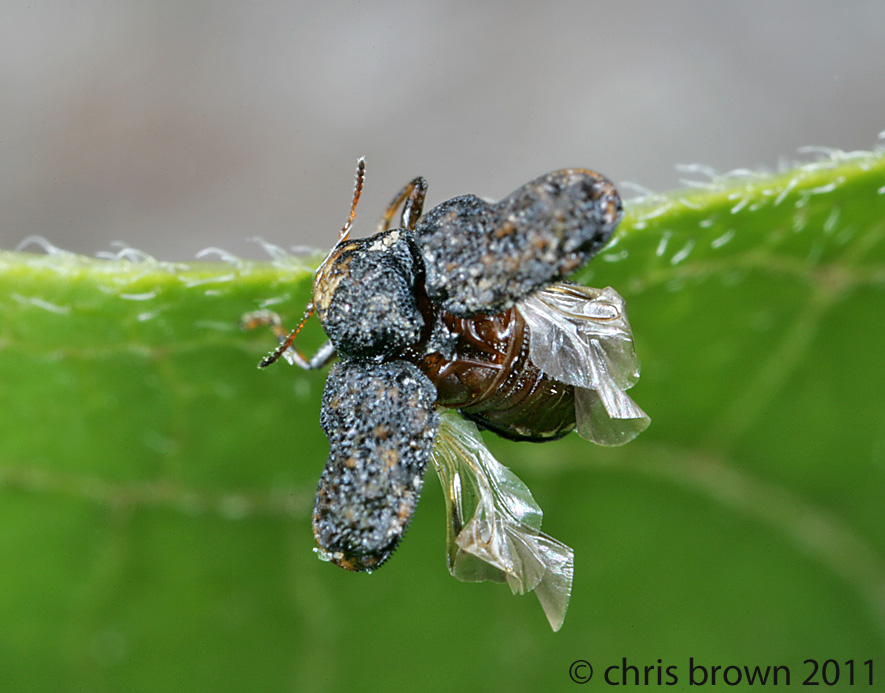
If the disturbance is sufficient to cause the beetle to completely retract these appendages, they will likely roll off the leaf and fall out of harms way.  Though these beetles can be relatively common, occurring even in my suburban St. Louis yard, the small size [Exema is only 2-3 mm (Figs. 7 and 8) while Neochlamisus is slightly larger at 3-4 mm] and resemblance to something unremarkable ensures that these beetles often times go unnoticed.  When I have happened to notice these beetles I found Neochlamisus associated with shingle oak, Quercus imbricaria, and Exema associated with Asteraceae, including gray-headed coneflower, Ratibida pinnata, and sweet coneflower, Rudbeckia subtomentosa.

Figure 7. Exema sp. on sweet coneflower, Rudbeckia subtomentosa

Figure 8. Exema sp. ready for flight

The Chlamasini are in the subfamily Cryptocephalinae within the leaf beetle family (Chrysomelidae).  The Chlamisini can be found worldwide but are most diverse in the Neotropics.   We have 6 genera in North America, two of which are shown here.  Interestingly, the excreta theme doesn’t stop at frass-mimicry.  Like other members of Crytocephalinae, warty leaf beetle larvae are “case-bearing”; that is they are housed in a case which in this instance is made out of… you guessed it, their own feces (Fig. 9).  You would think that most moms would frown on such a practices but mothers in the Cryptocephalinae actually instigate the practice when they equip each egg laid with a cap of feces that serves as starting material for the case and likely also serves to dissuade would be predators.

Figure 9. Chlamasini larva, likely that of Exema sp. on sweet coneflower, Rudbeckia subtomentosa

My experiences with Neoclamisus seven years ago captures perfectly why I am so drawn to explore for insects— there is always something new to find and every once in a while something comes out of the wood work that is beyond what I could have imagined.

REFERENCE:

Lourdes Chamorro-Lacayo, M. & A. Konstantinov. 2009. Synopsis of warty leaf beetle genera of the world (Coleoptera, Chrysomelidae, Cryptocephalinae, Chlamisini). ZooKeys 8:63–88.

Copyright © Chris Brown 2012

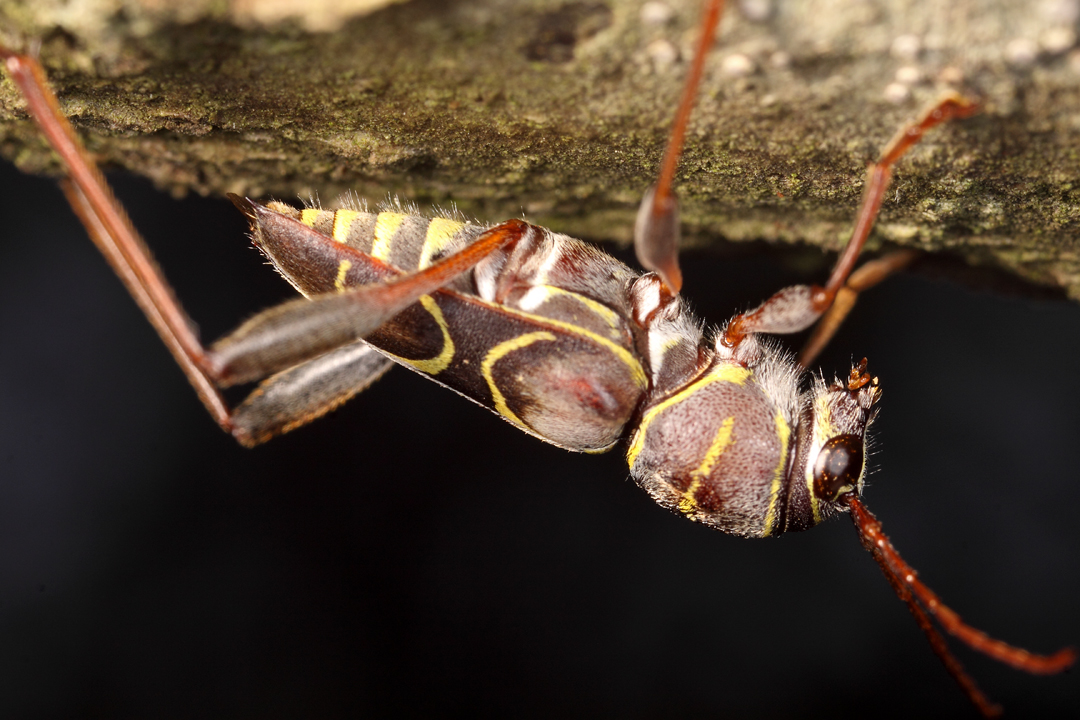
Memories of summer – Neoclytus scutellaris

Neoclytus scutellaris | 9 July 2011, Wayne Co., Missouri

During the short, cold days of winter it’s nice to take a break from the curatorial activities that dominate the season and look back on some of the insects seen during the previous summer. This is Neoclytus scutellaris, a longhorned beetle associated almost exlusively with dead/dying oaks in the eastern U.S. The species is sometimes confused with the very similar N. mucronatus but is distinguished by the transverse yellow band on the pronotum and its host (the latter being associated with hickory and hackberry).

Copyright © Ted C. MacRae 2011

Swift Tiger Beetle: Species on the Brink

ResearchBlogging.orgIn July 2008, Chris Brown and I made a spur-of-the-moment trip to Hitchcock Preserve near Council Bluffs, Iowa, where only a week earlier Cylindera celeripes (Swift Tiger Beetle), one of North America’s most enigmatic tiger beetles, had just been discovered. Reportedly once common in the blufftop prairies of western Iowa and further west in eastern Nebraska and Kansas, this tiny (6–8 mm in length), flightless beetle has suffered severe population declines over the past 100 years. Only small numbers of individuals have been encountered outside of the type locality (Fort Riley, Kansas) in recent years, and in Nebraska the species is now considered extirpated (Spomer et al. 2008). Our reasons for going to Iowa had to do with our as yet unsuccessful effort to find the species in northwestern Missouri as part of our broader studies of the state’s tiger beetle fauna. Although it had never been recorded from Missouri, we felt there was some chance it might be found in the tiny loess hilltop prairie remnants still remaining in the state at the southern terminus of the Loess Hills landform. We reasoned our failure to find the species might be related to its very small size and rapid running capabilities (giving them more the appearance of small ants or spiders than tiger beetles), limited temporal occurrence, and tendency to hide amongst the bases of grass clumps (Pearson et al. 2006). If we could find the species at a locality where they were known to occur, perhaps an improved search image and better understanding of their precise microhabitat preferences would help us locate the species in Missouri.
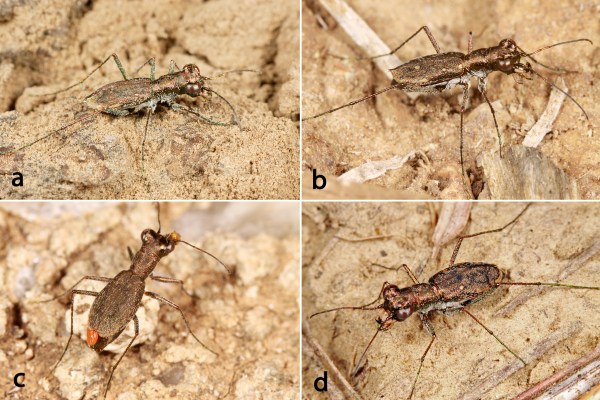
Fig. 1. Cylindera celeripes (LeConte) adults at: a) Hitchcock Nature Center, Pottawattamie Co., Iowa (13.vii.2008); b) Alabaster Caverns State Park, Woodward Co., Oklahoma (10.vi.2009); c) same locality as “b”, note parasite (possibly Hymenoptera: Dryinidae) protruding from abdomen and ant head attached to right antenna; d) Brickyard Hill Natural Area, Atchison Co., Missouri (27.vi.2009). Photos by C.R.Brown (a) and T.C.MacRae (b-d).

We didn’t realize it at the time, but that trip marked the beginning of a two-year study that would not only see us succeed in finding C. celeripes in Iowa, but also discover new populations in Missouri and northwestern Oklahoma (Figs. 1a–d). With so much new information about the species and the long-standing concerns by many contemporary cicindelid workers about its status, it seemed appropriate to conduct a comprehensive review of the historical occurrence of this species to establish context for its contemporary occurrence and clarify implications for its long term protection and conservation. This was accomplished through compilation of label data from nearly 1,000 specimens residing in the collections of contemporary tiger beetle workers, all of the major public insect museums in the states of Iowa, Kansas, Missouri, Nebraska, Oklahoma, and Texas, and the collections at the U.S. National Museum and Florida State Collection of Arthropods. Collectively, this material is presumed to represent the bulk of material that exists for the species, representing nearly all localities recorded for the species and time periods in which it has been collected.

Label data confirmed the historical abundance of this species, especially in the vicinity of Manhattan and Fort Riley, Kansas; Lincoln and Omaha, Nebraska; and Council Bluffs, Iowa. Hundreds of specimens were routinely collected in the native grassland habitats around these areas during the late 1800s and early 1900s, their abundance documented by entomologists in both journal articles and private letters. One of the most interesting examples of the latter was by Nebraska collector F. H. Shoemaker, who wrote the following in a 1905 letter to R. H. Wolcott:

There is another trip, down the river to the big spring by the railroad track near Albright, then across the river (the heronry route) where we collect hirticollis, repanda, vulgaris [= tranquebarica], cuprascens, and – vat you call ‘im? – celeripes! I took 147 of the latter in an hour and a half Sunday, and the supply was undiminished.
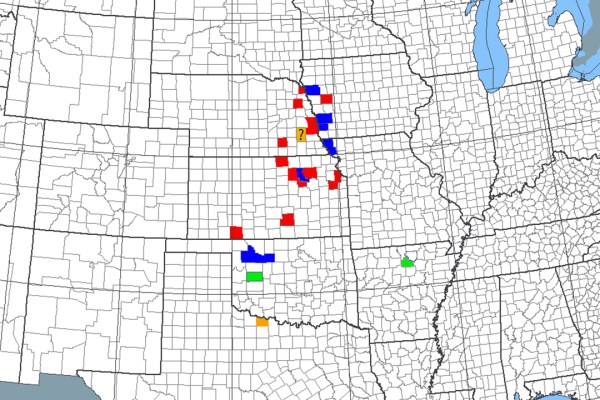
Fig. 8. Historical and currently known geographical occurrence of Cylindera celeripes by county. Red = last record prior to 1920; orange = last record 1941–1960 (“?” = questionable record); green = last record 1991–1996; blue = last record 2005–2011.

Although the recent collections of C. celeripes from near Council Bluffs and through the years near Fort Riley show that the species has managed to persist in these areas, there is little question that it is far less abundant and widespread now than it was in the early 20th century (Fig. 8).  Not only are the areas in which present day populations are known to occur limited, but the numbers of individuals seen in them are very low. In Missouri, the species was listed immediately after its discovery in the state as a species of conservation concern with a status of S1 (= “critically imperiled”) due to the highly restricted occurrence of suitable habitat (loess hill prairie) in the state and small populations observed within them. The situation is even worse in Nebraska, where the species has not been seen for nearly 100 years despite dedicated searches by expert contemporary tiger beetle workers such as Matt Brust and Steve Spomer. Considering the near-complete elimination of suitable native grassland habitats by conversion to agriculture and degradation of the few existing remnants due to encroachment by woody vegetation and invasive exotics, the likelihood of finding extant populations of C. celeripes in Nebraska seems remote. Only in the Red Hills of northwestern Oklahoma does the species appear to be secure due to the extensiveness of suitable areas of habitat and robust numbers of individuals observed within them at the present time. An enigmatic record exists from Arkansas, based on a single individual collected near Calico Rock in 1996. This individual represents a significant extension of the known geographical range of the species, but repeated attempts to find the species at that locality during the past year were not successful.

The persistence of populations, albeit small, in multiple areas, along with the occurrence of robust populations in northwestern Oklahoma, makes it unlikely that C. celeripesqualifies for listing as a threatened or endangered species at the federal level. Nevertheless, the limited availability of suitable habitat in many areas and low population numbers found within them clearly suggest that conservation measures are warranted at the state level, especially in Iowa, Kansas and Missouri, to prevent its extirpation from these states. In these states, land management practices should be implemented at sites known to support populations of the beetle in an effort to maintain and expand the native grassland habitats upon which they rely. These include various disturbance factors such as mechanical removal of woody vegetation, judicious use of prescribed burning, and selective grazing (taking care to do so in a manner that minimizes impacts to beetle populations).

REFERENCES:

MacRae, T. C. and C. R. Brown. 2011. Historical and contemporary occurrence of Cylindera (s. str.) celeripes (LeConte) (Coleoptera: Carabidae: Cicindelinae) and implications for its conservation. The Coleopterists Bulletin 65(3):230–241 DOI: 10.1649/072.065.0304

Pearson, D. L., C. B. Knisley and C. J. Kazilek. 2006. A Field Guide to the Tiger Beetles of the United States and Canada. Oxford University Press, New York, 227 pp.

Spomer, S. M., M. L. Brust, D. C. Backlund and S. Weins.  2008. Tiger Beetles of South Dakota & Nebraska. University of Nebraska, Department of Entomology, Lincoln, 60 pp.

Copyright © Ted C. MacRae 2011

Isn’t she splendid?!

Cicindela splendida | Bald Hill Glade Natural Area, Ripley Co., Missouri

This gorgeous female Cicindela splendida emerged recently from one of my rearing containers.  She was one of several 3rd instar larvae that I collected this past June from their burrows in a dolomite glade in southeastern Missouri.  I had suspected they might represent this species because of the bright, metallic sheen on their heads and decided to rear them out to find out for sure.  Rearing tiger beetles is fun and easy—all you have to do is fill a container with native soil, make a “starter” burrow¹ and drop them in. In this case, I also partially sunk a native rock into the soil in the center of the container, something I have started doing recently as it gives the emerged adult an elevated and more visually appealing surface on which to perch than the soil should I desire to take photographs.

¹ Larvae will dig new burrows on their own, but starter burrows allow you to place the burrow where you want it.  They are essential if more than one larva is introduced to the container, as wandering larvae will fight when they encounter each other. I like to start the burrow in a corner of the container (a pencil works great for this) and push down to the bottom of the container so I can see into the burrow from outside to monitor the larva as it develops.  After introducing the larva to its burrow, I push the soil around the entrance to seal it lightly to keep the larva from immediately crawling back out.  The larva will eventually reopen the burrow but generally accepts it, digging it out further to its liking and shaping the entrance to precisely fit the size and shape of its head.

Reared from 3rd instar larva, burrow in sparsely vegetated clay exposure of dolomite glade.

With tiger beetle rearing, feeding time is fun time! Our lab rears insects for testing in abundance, and there are always leftovers. Really just about any insect that can be pulled into the burrow will be acceptable as prey, but lepidopteran caterpillars are my favorite. I use mostly early instar tobacco hornworm larvae, choosing the size as appropriate for the size of the tiger beetle larva—the big ones (e.g. 3rd instar Tetracha) can handle caterpillars 35-40 mm in length and 6-8 mm in diameter, while neonates must be used for the smallest ones (e.g. 1st instar Cylindera celeripes and C. cursitans). I find it endlessly entertaining to sneak up on the larva sitting at the entrance of its burrow, slowly position a caterpillar above the burrow entrance with forceps, and dangle it to entice the tiger beetle larva to lurch out, grab the caterpillar, and drag it down into its burrow—all in a split second! If the larva drops down from the burrow entrance during my approach I just drop the caterpillar into the burrow (though this isn’t nearly as much fun).

Copyright © Ted C. MacRae 2011

Different Jaws for Different Jobs

Arrhenodes minutus (oak timberworm) | Wayne Co., Missouri

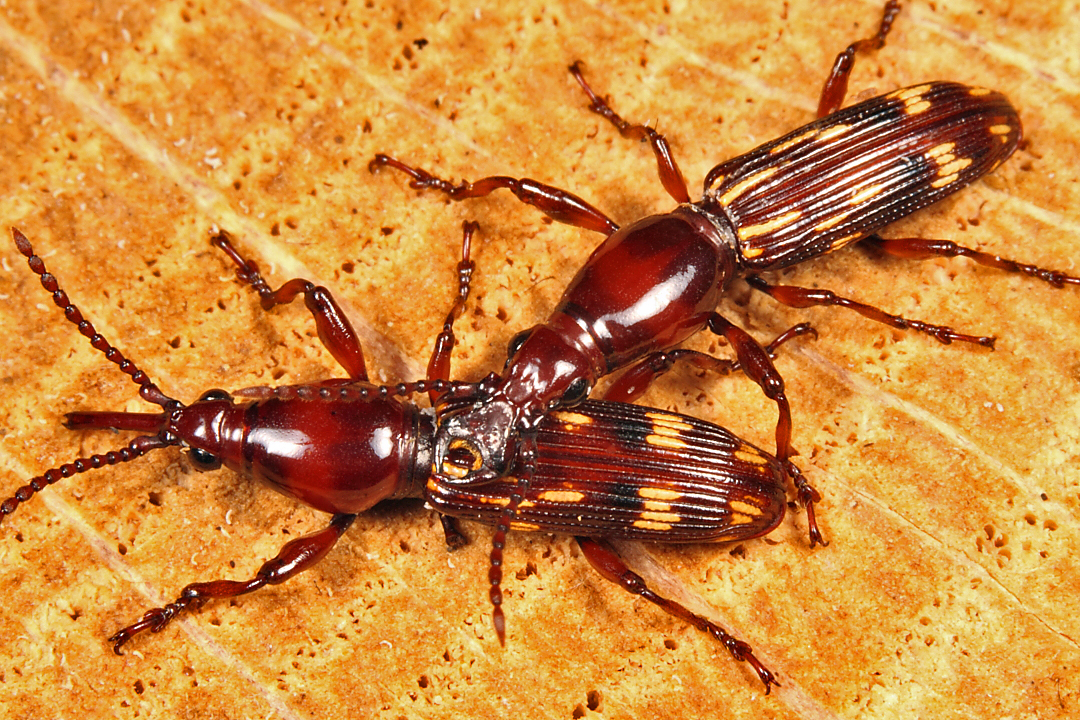
If you’re interested in wood boring beetles and live in the eastern  U.S. like I do, you’re sure to encounter sooner or later the region’s sole¹ “primitive weevil” (family Brentidae), the oak timberworm (Arrhenodes minutus).  This beetle develops as a larva in the wood of living trees exposed by wounding, creating numerous small “worm holes” that can occasionally degrade the value of wood grown for timber.  Females are presumably attracted to volatiles given off by wounded wood for oviposition, thus they are also commonly attracted to the trunks and stumps of trees harvested for lumber or cut for some other reason.  Cut trees are also highly attractive to wood boring beetles in the families Buprestidae and Cerambycidae—my primary taxa of interest, so I’ve seen more than a few oak timberworms over the years, including this male and female that I found on the cut stump of a large black oak (Quercus velutina) in Sam A. Baker State Park, Wayne Co., Missouri.

¹ Actually, there are three other species in eastern North America as well, but all are Neotropical species that occur no further north than the southern tip of Florida (Thomas 1996).

Female - beak thin and elongate

Male - beak short w/ robust mandibles

An interesting feature of oak timberworms and related species of primitive weevils is the rather extreme sexual dimorphism exhibited in the shape and function of the mandibles.  Mandibular sexual dimorphism is actually quite common across many groups of beetles, but in most cases the males simply have proportionately larger mandibles than females due to their use in sexual combat (think stag beetles, for example).  Oak timberworm males also have enlarged mandibles for combat with other males (males are territorial and guard females during oviposition).  The females, however, rather than simply having smaller yet similarly shaped versions of the male mandibles, instead have tiny little mandibles at the end of a greatly narrowed and elongated rostrum (beak).  This is because, unlike most other beetles in which the female mandibles lack a specific purpose, female oak timberworms use their mandibles to “drill” holes into the wood in which they will insert their eggs.  Different forms for different functions!

Mate-guarding behavior

I have read reports of males assisting females in removing her beak if stuck in the wood while drilling an egg hole by “stationing himself at a right angle with her body and pressing his heavy prosternum against the tip of her abdomen, her stout fore legs thus serving as a fulcrum and her long body as a lever” (Riley 1874, as quoted in Thomas 1996), making this a rare instance of tool use by insects.  I have not observed this behavior myself, but it is common to find the males in various mate guarding positions over the female as pictured above.

REFERENCE:

Riley, C. V. 1874. The northern brenthian—Eupsalis minutus (Drury). (Ord. Coleoptera; Fam. Brenthidae). Sixth Annual Report on the Noxious, Beneficial, and Other Insects, of the State of Missouri. Began and Carter, Jefferson City, Missouri, 169 pp.

Thomas, M. C. 1996. The primitive weevils of Florida (Coleoptera: Brentidae: Brentinae). Florida Department of Agriculture & Consumer Services, Division of Plant Industry, Entomology Circular No. 375, 3 pp.

Copyright © Ted C. MacRae 2011