Rough Green Snake

My string of good herp luck looks like it might continue in 2010.  You may recall the super-aggressive prairie rattlesnake and uncooperative dusty hognosed snake that I featured in 2008 (or not – my readership was rather minuscule back then), followed by the juvenile Osage copperhead, gorgeous male eastern collard lizard, bizarre Texas horned lizards, death-feigning western hognosed snake, super rare Florida scrub lizard, and – finally – cute little western pygmy rattlesnake in 2009. All but the copperhead and collared lizard were first-time sightings for me, and now in 2010 I have yet another first-time sighting to present – the rough green snake (Opheodrys aestivus aestivus).

Rough green snake (Opheodrys aestivus aestivus)

My friend Rich and I spotted this long and slender snake during our early April hike of the lower Wappapello Section of the Ozark Trail (soon after photographing the jumping spider). We would never have seen it, so effective was its green camouflage, had it not been disturbed by our close approach along the trail and tried to flee.  The moist bottomland habitat where we found it was thick with greenbrier (Smilax sp.), making tracking the snake a thorny affair, but I managed to head it off and start taking a few photos of it.  It was surprisingly calm during the early part of the photo session, but I just wasn’t getting the lighting and exposure that I wanted.  Eventually, it started fleeing again, and my efforts to rip through the greenbriers to stay close became too much for my arms to bear.  When it started climbing a tree, I said “enough is enough” and captured him, brought him back out to the comfort and openness of the trail, and had Rich hold him while I worked on getting some better photographs.  The one above is my favorite of the bunch.

Rough green snakes are found in Missouri primarily south of the Missouri River in the Ozark Highlands, where they feed on insects such as grasshoppers, crickets, and especially smooth caterpillars.  A second green snake occurs in Missouri as well, the smooth green snake (Opheodrys vernalis), which differs from the rough green snake by having smooth scales and a more northern distribution within the state. Sadly, the smooth green snake has not been seen in the state for a number of years now, probably because of loss of habitat resulting from the near complete agricultural conversion of that part of the state.

Photo Details: Canon 100 mm macro lens on Canon 50D, ISO 400, 1/60 sec, f/4.5, Canon MT-24EX flash w/ Sto-Fen diffusers. Minimal post-processing.

Copyright © Ted C. MacRae 2010

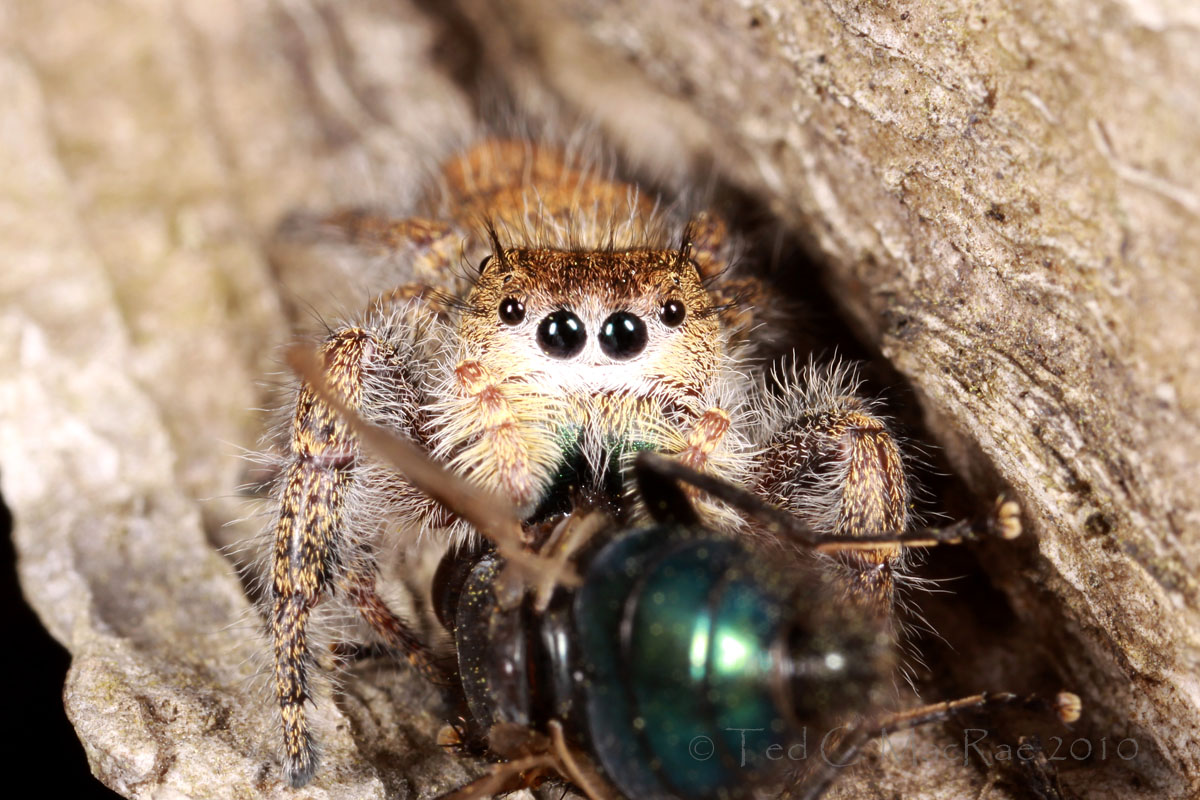
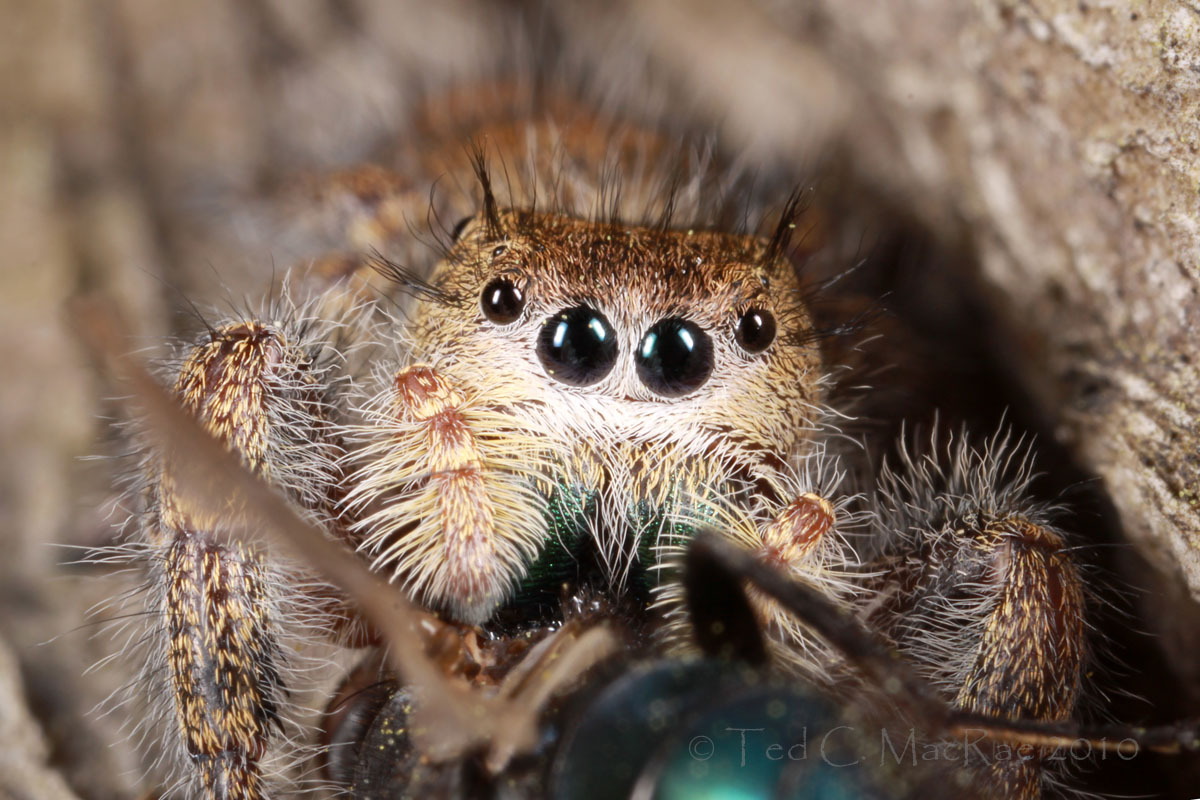
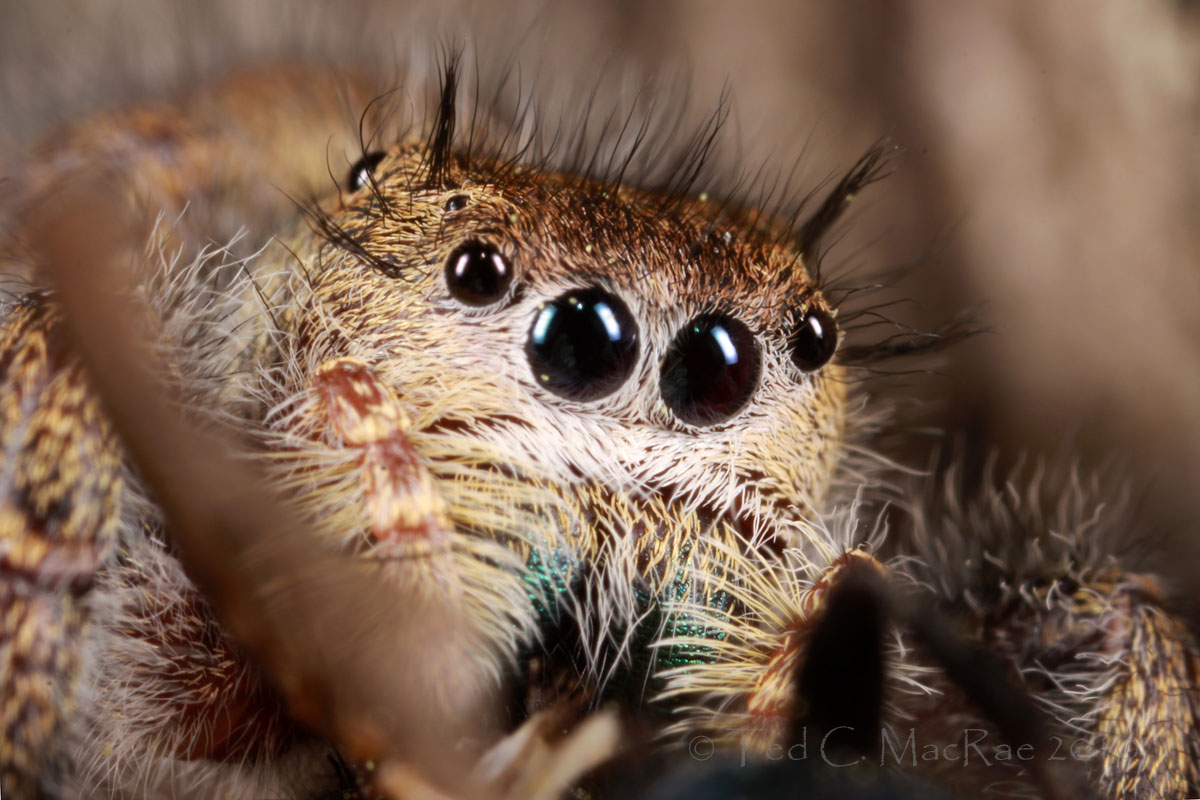
My first jumping spider

As a long-time professional and avocational entomologist, I find beauty and fascination in all manner of joint-legged creatures. Of course, beauty is in the eye of the beholder, and most people don’t exactly share my passion for these animals. Sure, butterflies enjoy almost universal approval, but beetles are just too crunchy, flies too filthy, wasps too aggressive, and cockroaches… well, eww! Even crabs and lobsters, tasty as they are, just move too robotically to engender any feelings of affection. None of these groups, however, seem to be as universally reviled as spiders – scuttling blurs of leg and fur with beady little eyes, just waiting to launch a sneak attack with their venomous gnashers. Few other coin-sized animals can cause an otherwise lucid adult to run screaming from their bathroom with such terror.

Except jumping spiders! Jumping spiders (family Salticidae) possess many of the same traits that condemn other spiders to the ranks of the creepy – hair and venom and lots of eyes; yet they have other unique qualities that make them nevertheless endearing, almost cuddly, to all but the most ardent of arachnophobes. Their human-like “face” featuring two large, forward-facing eyes and inquisitive nature give them a charisma that almost invites interaction. Approach any other spider, and it scampers back into the nearest crevice. Jumping spiders, on the other hand, turn and face the intruder – you can almost see them sizing you up – perhaps even moving forward a little to have a better look. It makes them seem, well… intelligent. Add to that their stunning diversity (~5,000 species), dazzling colors, and the sometimes impressively elongated choppers of the males, and you’ve got the perfect recipe for charm. Bouncy, furry, smart, cute, and big bright eyes – almost sounds like a kitten!

The result of all this charm is that jumping spiders are wildly popular subjects for macrophotography. Accordingly, there has been a veritable explosion of online photographs of jumping spiders, dominated by close-ups of that irresistible face. These shots here represent my first attempt to photograph one of these endearing creatures, and while I’m happy with them considering my relative newness to the field, they are a far cry from the spectacular images being produced by some other photographers. Perhaps the best of these is Thomas Shahan, whose focus-stacked facial shots of these spiders are among the most stunning that you will find. Another photographer who has produced some excellent photographs of Malaysian jumping spiders is Kurt at Up Close with Nature. Perhaps someday my jumping spider photographs will be considered on par with those that these two gentlemen are producing – if that day comes, you can say it began right here!

I’m a beetle-man, so except for a brief attempt at ant taxonomy my area of expertise lies with the Coleoptera. Nevertheless, perusing the well-stocked archives at BugGuide leads me to believe that the individual I photographed is a subadult female in the genus Phidippus – perhaps something in the putnami species-group.  I found her on a lower branch of sweetgum (Liquidamber styraciflua) in a wet-mesic bottomland forest along the Black River in Missouri’s southeastern Ozarks feeding on a blow fly (family Calliphoridae).  While relatively drably-colored compared to many other species in the family, a glimpse of her bright blue-green chelicerae (fangs) can still be seen.  I tried to get her to drop her prey to get a better look at the fangs, but she wasn’t having anything to do with that – mealtime is mealtime!

Photo Details: Canon MP-E 65 mm 1-5X macro lens on Canon 50D, ISO 100, 1/250 sec, f/13-14, MT-24EX flash 1/8 power w/ Sto-Fen diffusers. Minimal cropping and post-processing.

Copyright © Ted C. MacRae 2010

Add to FacebookAdd to DiggAdd to Del.icio.usAdd to StumbleuponAdd to RedditAdd to BlinklistAdd to TwitterAdd to TechnoratiAdd to Yahoo BuzzAdd to Newsvine

Email to a friend

Pseudomethoca simillima – a model for Enoclerus ichneumoneus?

Pseudomethoca simillima (family Mutillidae) - the model?

Enoclerus ichneumoneus (family Cleridae) - the mimic?

Last week, I posted the above photograph of Enoclerus ichneumoneus (orange-banded checkered beetle) and mentioned its possibly mimetic appearance to velvet ants in the family Mutillidae (order Hymenoptera).  By some stroke of serendipity, I encountered a species of Mutillidae the very next day in Missouri’s southeastern lowlands that seems to be a good candidate for one of, if not the, model species that E. ichneumoneus might have evolved to resemble.  Several individuals were encountered as they zigzagged urgently on dry sand deposits along the Mississippi River (where I had hoped, unsuccessfully, to find another locality for our intergrade population of Cicindela scutellaris).  Comparison of the individual in the photo with specimens in my collection (all identified by mutillid expert Kevin Williams, Utah State University) suggests this is Pseudomethoca simillima, and the photo is also a good match with other photographs of the species at BugGuide.  One thing that bothers me with the idea of this being a model for E. ichneumoneus is that I have not seen P. methoca commonly in Missouri (I have only three specimens in my collection), while E. ichneumoneus is one of our most common clerids.  There is another mutillid species in Missouri – Dasymutilla quadriquttata – that also seems to have potential as a model for E. ichneumoneus and that I have encountered much more commonly in the state.  However, D. quadriguttata is somewhat larger than E. ichneumoneus.  At any rate, other than the statement by Mawdsley (1994) that E. ichneumoneus seems to mimic mutillids, I can’t find that any more specific information has been recorded about the possible model(s) for that species.

As a caveat, I shall add that this mutillid was the… most… uncooperative… insect… that I have ever tried to photograph!  They really never stop moving, so you have to track the moving insect through the lens and fire shots when you think you’ve got it centered and focused.  Most of the time you don’t!  Using the Canon 1-5X macro lens for this did not make things any easier.  I tracked this female for quite a while and fired off a number of shots, only to get this one that I thought was fairly decent (and still just missed the focus on the near side of the pronotum).

Speaking of mutillids, I simply must photograph my specimen of Dasymutilla gloriosa (sometimes called the thistledown velvet ant) – you will not believe it!

Photo Details:
Pseudomethoca simillima: Canon MP-E 65 mm 1-5X macro lens on Canon 50D, ISO 100, 1/250 sec, f/14, MT-24EX flash 1/8 power w/ Sto-Fen diffusers. Minimal cropping and post-processing.
Enoclerus ichneumoneus: Canon 100mm macro lens on Canon 50D, ISO 100, 1/250 sec, f/14, MT-24EX flash 1/4 power w/ Sto-Fen diffusers. Minimal cropping and post-processing.

REFERENCE:

Mawdsley, J. R. 1994. Mimicry in Cleridae (Coleoptera).  The Coleopterists Bulletin 48(2):115-125.

Copyright © Ted C. MacRae

Add to FacebookAdd to DiggAdd to Del.icio.usAdd to StumbleuponAdd to RedditAdd to BlinklistAdd to TwitterAdd to TechnoratiAdd to Yahoo BuzzAdd to Newsvine

Email to a friend

Revision of the Formicidae of North America

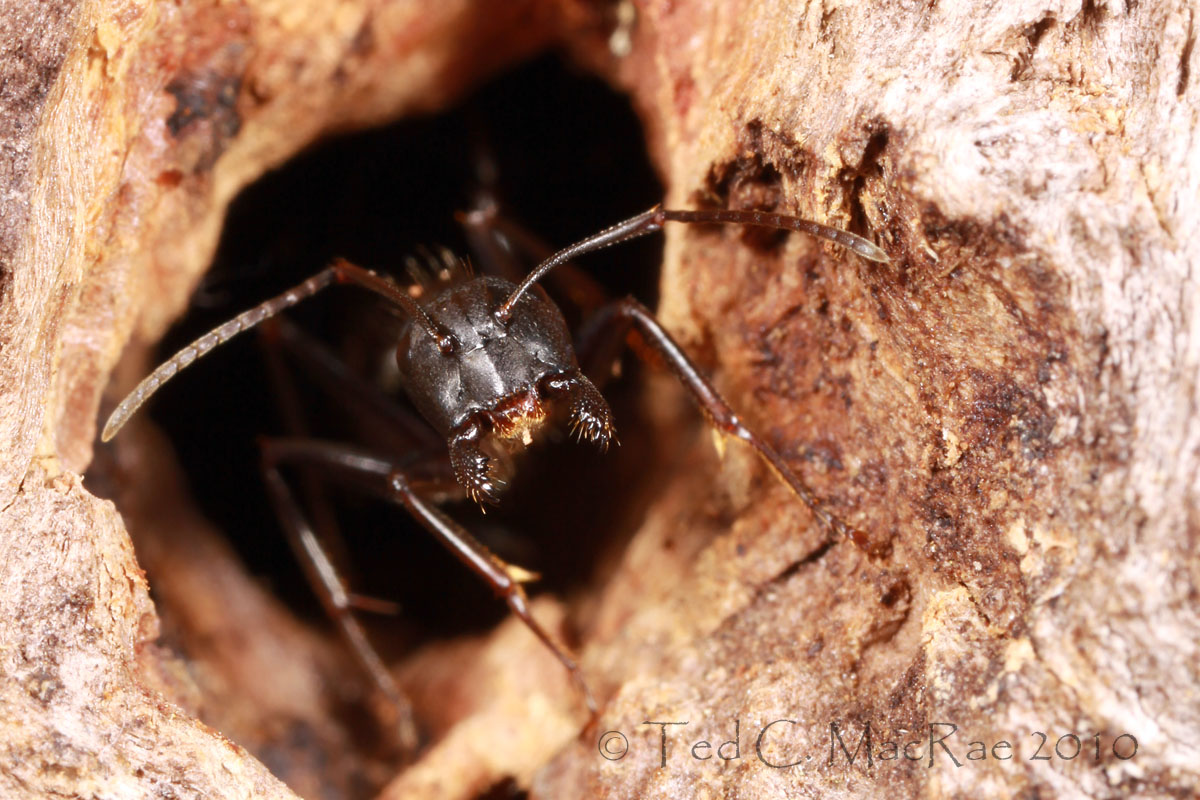
Formica meganigra guarding a nest entrance.

I recently came across this ant in the southeastern Missouri Ozarks sitting in a hole in the trunk of a standing dead black oak (Quercus velutinus) tree, apparently guarding the entrance to its nest. This big black ant is frequently associated with dead wood; however, this is the first time I’ve noticed one guarding the entrance to its nest. Other workers coming back to the nest were greeted by this individual by a quick rubbing of antennae and then allowed to pass. The close approach of my camera apparently was not very welcome by the ant, who responded by showing off his *her* impressive choppers.

In trying to determine the species name for this ant, it became clear to me that myrmecologists have made things far more complicated than they really need to be. When I was a kid, ant identification was easy – there were black ants and red ants, and within those two main guilds some were big, some were not so big, and some were really small.  Peter Yeeles alluded to this traditional classification in a recent comment at Fall to Climb, which the Geek herself later modified to recognize ants that were neither black nor red.  In that classification, this is clearly a big black ant; however, the myrmecologists have unnecessarily split this species up into multiple genera and species based on inconsequential characters such as punctures on the head, clypeal notches, hairy scapes, etc.  I propose to bring a measure of sanity back to ant identification in North America with a revised key to the family (below).  It is based on the traditional classification but also recognizes the introduction in recent years of an alien species that stings and has colonized a large part of the southern United States (we didn’t have those when I was a kid).  In offering this simplified classification, it is my hope that school children across the country – naturally curious about ants and other insects – will no longer have their budding interest squashed by the ponderous, complex ant identification system that has become so fashionable in recent years.

Photo Details: Canon MP-E 65mm 1-5X macro lens on Canon 50D, ISO 100, 1/250 sec, f/14, MT-24EX flash 1/8 power w/ Sto-Fen diffusers.

Revised Key to Formicidae of North America

.
1 Color black . . . . . . . . . . . . . . . . . . . . . . . . . . . . . . . . . . . . . . . . . . . . . . 2
1′ Color not black . . . . . . . . . . . . . . . . . . . . . . . . . . . . . . . . . . . . . . . . . . . 4
2 (1) Enormous. . . . . . . . . . . . . . . . . . . . . . Formica meganigra (big black ant)
2′ Not enormous. . . . . . . . . . . . . . . . . . . . . . . . . . . . . . . . . . . . . . . . . . . . 3
3 (2′) Regular size . . . . . . . . . . . . . . . . . . . . . . . . . . . Formica nigra (black ant)
3′ Tiny. . . . . . . . . . . . . . . . . . . . . . . . . . Formica micronigra (little black ant)
4 (1′) Color red. . . . . . . . . . . . . . . . . . . . . . . . . . . . . . . . . . . . . . . . . . . . . . . . 5
4′ Color yellow . . . . . . . . . . . . . . . . . . . . . . . . . . . . . . . . . . . . . . . . . . . . . 6
5 (4) Can sting. . . . . . . . . . . . . . . . . . . . . . . . . . . . Solenopsis invicta (fire ant)
5′ Can’t sting. . . . . . . . . . . . . . . . . . . . . . . . . . . . . . Formica rubra (red ant)
6 (4′) Regular size. . . . . . . . . . . . . . . . . . . . . . . . . . . Formica flava (yellow ant)
6′ Tiny . . . . . . . . . . . . . . . . . . . . . . . . . Formica microflava (little yellow ant)

Copyright © Ted C. MacRae 2010

Add to FacebookAdd to DiggAdd to Del.icio.usAdd to StumbleuponAdd to RedditAdd to BlinklistAdd to TwitterAdd to TechnoratiAdd to Yahoo BuzzAdd to Newsvine

Email to a friend

Orange-banded checkered beetle

As a student of woodboring beetles for more than a quarter-century now, I’ve had occasion to encounter a goodly number of checkered beetles (family Cleridae) – both in the field and as a result of rearing them from dead wood.  Checkered beetles are not as commonly encountered as other woodboring beetle families such as Buprestidae and Cerambycidae, and they also generally lack the size, diversity, and popularity with coleopterists that those aforementioned beetle families enjoy.  However, despite these shortcomings as a group, checkered beetles are among the most brightly colored and boldly patterned of beetles.  Unlike the beetles with which they often found, checkered beetles are not actually themselves woodboring beetles, but rather predators of such (particularly bark beetles in the weevil subfamily Scolytinae).

This particular species, Enoclerus ichneumoneus, is one of the more conspicuous members of the family in eastern North America.  Although the genus to which it belongs is the largest of the family (32 species in North America north of Mexico), the wide orange band across the middle of the elytra and elongate scutellum make this species distinctive and unlikely to be confused with any other.  I found this individual along the Ozark Trail in southern Missouri on a recently fallen mockernut hickory (Carya alba) – a number of other adult buprestid and cerambycid species were also found on this tree, all of which were mating, searching for mates, or laying eggs within the cracks and fissures on this new-found resource.  In the past I have encountered large numbers of adults of this species on dead willow (Salix caroliniana) from which I later reared an even larger number of a small willow-associated buprestid, Anthaxia viridicornis.  Whether the buprestid larvae served as prey for E. ichneumoneus is difficult to say, but no other potential prey beetle species were reared from the wood.

The bright, distinctive colors exhibited by many checkered beetles might seem to suggest aposematic, or warning, coloration to discourage predation; however, the question of checkered beetle palatability to predators has not been adequately studied (Mawdsley 1994).  The colors and patterns of many species, especially in the genus Enoclerus, seem to mimic species of velvet ants (family Mutillidae) and true ants, but other beetles (e.g. species of Chrysomelidae and Tenebrionidae) and even flies have also been suggested as models.  Still other checkered beetle species seem to be more cryptically than mimetically marked, and there are several tribes whose members seem to be chiefly nocturnal and are thus mostly somber-colored.

Of the 37 genera occurring in North America north of Mexico, I have in my collection representatives of more than 100 species in 23 of those genera.  The majority of that material has been reared from dead wood collected for rearing Buprestidae and Cerambycidae – much of it coming from Texas and Arizona as well as here in Missouri.

Photo Details: Canon 100mm macro lens on Canon 50D, ISO 100, 1/250 sec, f/14, MT-24EX flash 1/4 power w/ Sto-Fen diffusers, photo lightly cropped.

REFERENCE:

Mawdsley, J. R. 1994. Mimicry in Cleridae (Coleoptera).  The Coleopterists Bulletin 48(2):115-125.

Copyright © Ted C. MacRae

Add to FacebookAdd to DiggAdd to Del.icio.usAdd to StumbleuponAdd to RedditAdd to BlinklistAdd to TwitterAdd to TechnoratiAdd to Yahoo BuzzAdd to Newsvine

Email to a friend

Taum Sauk Mountain – Missouri’s High Point

Although spring is now well underway in the middlin’ latitudes of Missouri, it was only a few short weeks ago that winter was still with us.  For my last winter hike of the season, I returned to perhaps my favorite stretch of my favorite trail in all of Missouri – the Mina Sauk portion of the Taum Sauk Trail on Taum Sauk Mountain.  Located in the rugged St. Francois Mountains (the “epicenter” of the Ozark Highlands), Taum Sauk Mountain is Missouri’s highest peak.  I say “peak” with a bit of reservation – at 1,772 feet it hardly compares with the high peaks of the Rocky Mountains or even the much mellower Appalachians (and certainly not with those of my beloved Sierra Nevada).  Nevertheless, unlike the remainder of the Ozark Highlands, the St. Francois Mountains are true mountains initially formed through a series of volcanic events occurring well over a billion years ago.  They, and the rest of the Ozark Highlands, have been shaped to their current form by repeated cycles of uplift and subsequent erosion.  

During their Precambrian prime, the St. Francois Mountains reached heights of 15,000 feet (the “ancient” Appalachians, in the meantime, were still just a twinkle in Mother Earth’s eye).  Rain and wind and the vastness of time have reduced them to nubs, leaving only the most ancient of volcanic rocks as testament to their former glory.  Although most of what is now the Ozark Highlands was inundated repeatedly later in the Palaeozoic (laying down the sediments that were then uplifted and “carved” to their current shape), the highest peaks of the St. Francois Mountains may be among the few areas in the United States never to have been completely submerged under those ancient seas.  Standing atop Taum Sauk Mountain, it is tempting to visualize today’s craggy terrain as a fossil of that ancient landscape – the peaks representing the former islands of rhyolite, their slopes barren and lifeless in stark contrast with the exploding diversity of bizarre life forms appearing in the tropical waters that surrounded them.

The sterile, volcanic rocks of the St. Francois Mountains support an abundance of open, rocky glades – especially on their peaks and southern and western slopes – that are home to a number of plants and animals more typically found in the tallgrass prairies further west.  Indian grass (Sorghastrum nutans) and little bluestem (Schizachyrium scoparium) thrive in clumps between the large, pink boulders that are strewn across the landscape and which provide shelter and sunning spots for animals ranging from the charismatic eastern collared lizard (Crotaphytus collaris) to the smaller but no less beautiful splendid tiger beetle (Cicindela splendida).  The surrounding forest is historically an open woodland with a rich, herbaceous understory and widely-spaced, drought-tolerant trees such as shagbark hickory (Carya ovata), post oak (Quercus stellata), and blackjack oak (Quercus marilandica).  These woodlands and glades are a fire-mediated landscape dependent upon periodic burns to maintain their vegetative character.

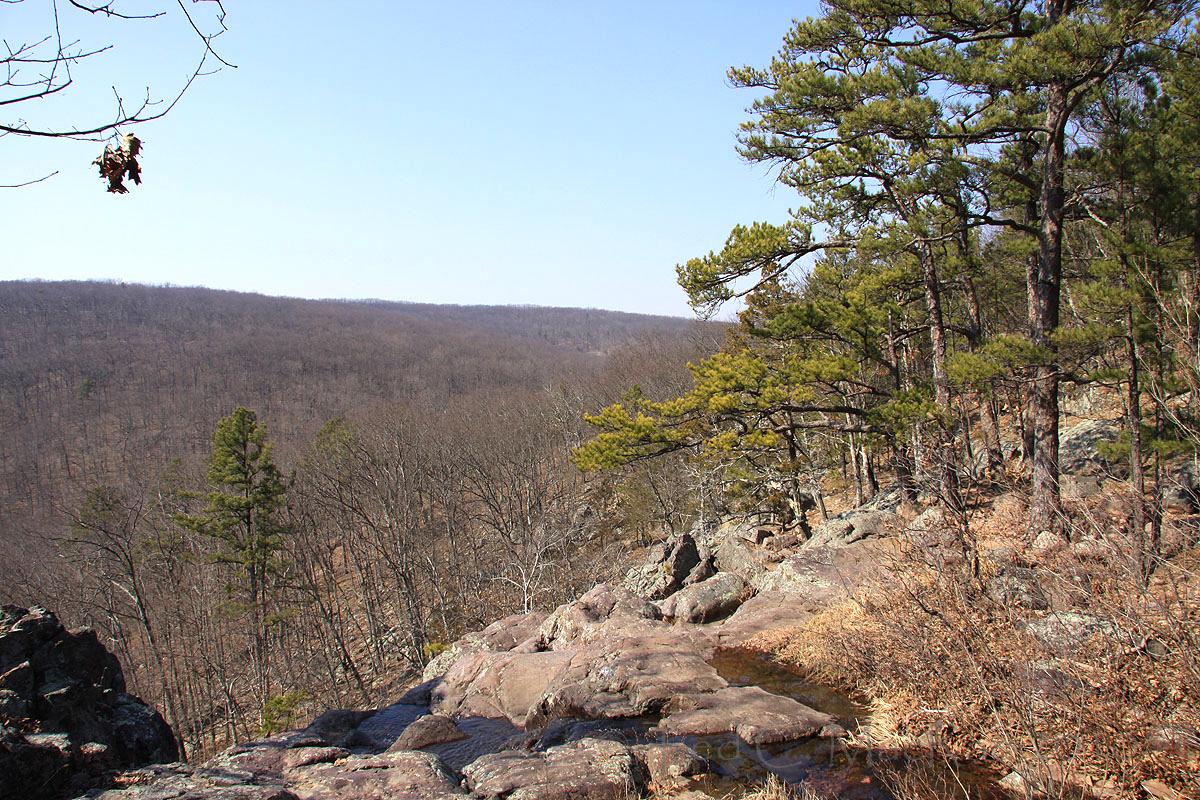
A trail begins at “High Point”, marking the summit of Taum Sauk Mountain and the highest point in Missouri.  A granite slab next to the summit rock documents the elevation at 1,772.68 feet MSL (Mean Sea Level).  The Mina Sauk Falls Trail, a rugged three-mile loop that joins the Taum Sauk Section of the Ozark Trail, leads to the tallest wet-weather waterfall in Missouri, Mina Sauk Falls.  During periods of high water flow, water gushes over the edge and drops 132 feet over a series of rocky ledges.  Water was flowing lightly during my late winter visit; nevertheless, looking out from above the falls (see photo above) offers one of the most spectacular vistas available in Missouri.  A rather difficult hike down the side of the mountain to the bottom of the falls is also well worth the effort, although clear views of the entire falls are difficult to find in the dense, moist forest below (it was here that I photographed the spectacular Ozark Witch Hazel).

A second unique geological feature lies about a mile farther down the Ozark Trail – Devil’s Toll Gate.  The rocks stand 30 feet high on either side of this eight-foot-wide, 50-foot-long fissure.  The gap probably began as a vertical fracture in the rock that has been enlarged by subsequent weathering. Over time the fissure will continue to widen, as the rocks on either side lose height.

Returning to High Point at the end of the hike, I noticed that the summit was a little higher than when I started my hike – whether this was through additional uplift of the underlying mountain or a depositional event I cannot say.  Nevertheless, I estimated Missouri’s new highest elevation to be approximately 1,773.01 feet MSL!

Copyright © Ted C. MacRae 2010

Add to FacebookAdd to DiggAdd to Del.icio.usAdd to StumbleuponAdd to RedditAdd to BlinklistAdd to TwitterAdd to TechnoratiAdd to Yahoo BuzzAdd to Newsvine

Email to a friend

Friday Flower – Ozark Witch Hazel

Spring is beginning its “march” across the nation, and in typical fashion the month started out with the promise of pleasant weather but is throwing a few tantrums before giving way to April. For most folks in the lower Midwest, spring began a week or so ago when daffodils began popping up from nowhere and dotting the suburban and semirural landscapes with their yellow smiles. Forsythia are also set to burst forth, their appearance temporarily put on hold by this latest cold/wet snap, but when they do most people here will be satisfied that spring has finally come. For me, spring comes much earlier, and it’s not planted ornamentals that mark its beginning, but native trees.  Silver maples (Acer saccharinum) and American elms (Ulmus americana) are first, bursting open in the very first warm days of early March.  These are followed by the sugar maples (A. saccharum) and red maples (A. rubrum) that are in full bloom now, which will themselves give way to the redbuds (Cercis canadensis) and serviceberrys (Amelanchier arborea) that will close out the month before flowering dogwood (Cornus florida) dominates the area’s understories in April.

There is one tree in this part of the country, however, that shows its amazing blooms in January and February while winter’s grip is still strong.  Ozark witch hazel (Hamamelis vernalis) is restricted to the Ozark Highlands of Missouri and Arkansas, where it grows along the rocky creeks and streams that dissect this ancient landscape.  I have long wanted to see its striking blooms, but despite my many wintertime hikes throughout the Ozarks, I have never found myself in the right place at the right time – until a few weeks ago when I hiked the Mina Sauk Trail at Taum Sauk Mountain State Park.  I found these plants growing below Mina Sauk Falls and along Taum Sauk Creek below, and even though it was the first weekend of March (and the very first warm day of the season), many of the plants had already passed their peak bloom.  Fortunately, I was able to find these several plants with flowers still in good shape.

There is only one other species in the genus – eastern witch hazel (Hamamelis virginiana).  Although distributed widely across eastern North America, it is restricted in Missouri to these same St. Francois Mountains where I saw H. vernalis.  The two species are very similar by the characteristics of their foliage but can be easily distinguished by floral characters.  Hamamelis virginiana blooms in fall rather than winter, and its flowers, while nearly twice the size, rarely show the amount of red on the inner calyx that is seen in this species.  Hamamelis vernalis flowers are also quite fragrant, having what has been described as a “vanilla” scent.  The photographs here show the rather unusual color range of the flowers of this species, which can vary from orange to deep red to deep yellow.  I suspect that flower color also changes with age, in that petals are initially deep red and later fade to yellow, as in the photo below.  It’s difficult to explain why H . vernalis is restricted to the Ozark Highlands while H. virginiana occurs so broadly, but the Ozarks are a well-known refugium for a number of other plants and animals, especially Ice Age relicts.

Sitting on a rhyolite ledge overlooking Taum Sauk Creek as I ate lunch, I wondered about the pollination biology of a plant that flowers during winter.  It was a warm day – certainly an unusual occurrence during the period in which this plant flowers – and even still it was too early in the season for a lot of insect activity.  I watched one of the nearby plants as I ate to see what insects came to the flowers, and for a time all I saw were a couple of European honey bees.  Clearly, the plant did not evolve in association with this now ubiquitous insect.  I continued watching, and at last I saw a native insect visiting the flowers – a large species of hover fly (family Syrphidae), perhaps something in the genus Helophilus.  After taking a few more photographs (unfortunately, none of the fly), another of the same species visited the plant.  Flies in general are famous for appearing during warm days in winter, and I wonder if the unusually extended bloom period of this species is intended to take advantage of those few, unpredictable days during winter when temperatures are sufficient for flies to become active.

Photo Details: Canon 100mm macro lens on Canon EOS 50D
Photo 1: ISO 100, 1/200 sec, f/11, MT-24EX flash w/ Sto-Fen-Puffer diffusers.
Photo 2: ISO 200, 1/200 sec, f/5.6, ambient light.
Photo 3: ISO 100, 1/60 sec, f/9, flash w/o diffusers.
Photo 4: ISO 200, 1/250 sec, f/5.6, ambient light.

Copyright © Ted C. MacRae 2010

Add to FacebookAdd to DiggAdd to Del.icio.usAdd to StumbleuponAdd to RedditAdd to BlinklistAdd to TwitterAdd to TechnoratiAdd to Yahoo BuzzAdd to Newsvine

Email to a friend

The Inexorable March of Spring!

Granted, the progress of spring seems to advance in halting baby steps with occasional falls onto its muddy bottom, rather than as a determined forward march, but spring is welcome, no matter how it arrives. When little green tips start poking up and there’s a bit of that “spring smell” in the air, I simply must get out and catch up on the status of Nature — the old-fashioned way (she doesn’t have a Facebook account). Over the last week, I’ve gone forth in search of signs that everything else living is about as tired of winter as I am, and wants to get this spring show on the road! There is already so much happening, I can’t recount it all here — A partial list of unphotographed notables: owls breeding; hawks nesting; woodcocks doing their silly, repetitive and almost invisible (because it’s nearly dark) courtship displays; wood ducks on forest ponds; year-round resident songbirds reestablishing territories; spring peepers, chorus frogs, wood frogs and southern leopard frogs singing, especially in the fishless ponds; winter crane flies and midges swarming in sun flecks in the woods; wild filberts, silver and red maples flowering, etc…

Formica pallidefulva sniffs the spring air


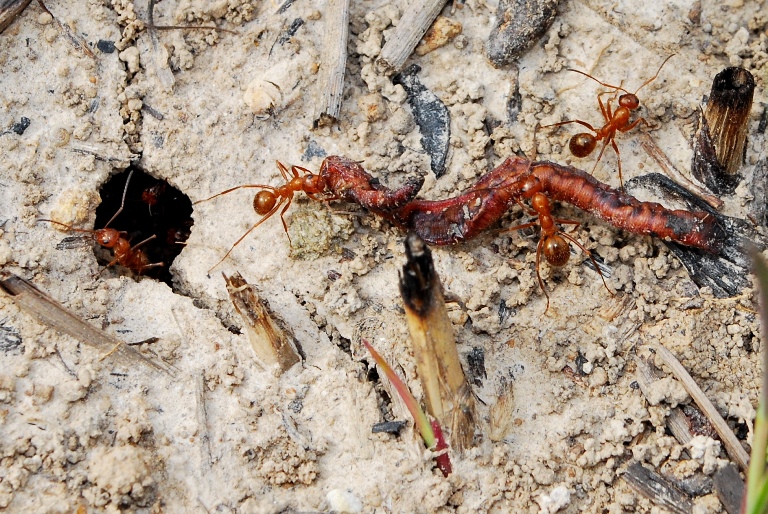
Of course, I look for the first ants out at this time of year, though with the exception of 10 March, when the temperature exceeded 70F, they haven’t been notably active. However, that afternoon I encountered, among others, a worker of Formica pallidefulva poking its head out cautiously to sniff the spring air. This is one of my favorite local ants — largish (5-6mm), abundant, active in daylight even when it’s hot, usually shiny bronzy red to red-brown, usually with a darker gaster (the apparent abdomen of ants) around here, but ranging from a beautiful reddish gold (in the deep South) to almost pure black-coffee brown (New England and southern Canada) across its wide geographic occurrence (Rocky Mountain foothills of Wyoming to New Mexico, all the way east to Québec and Florida). It has the added charm of being the host species to a wide range of social-parasitic and dulotic (“slave-making”) ants both in its own and in another closely related genus, with which it lives in temporary or permanent mixed colonies (as with the Polyergus illustrated in my last post). The image below of these ants bringing home a charred earthworm was taken almost one year ago, as one of Shaw Nature Reserve’s prairie areas was beginning to resprout after a prescribed burn a few weeks earlier. Ants will take their food raw or cooked!
Formica pallidefulva with charred earthworm


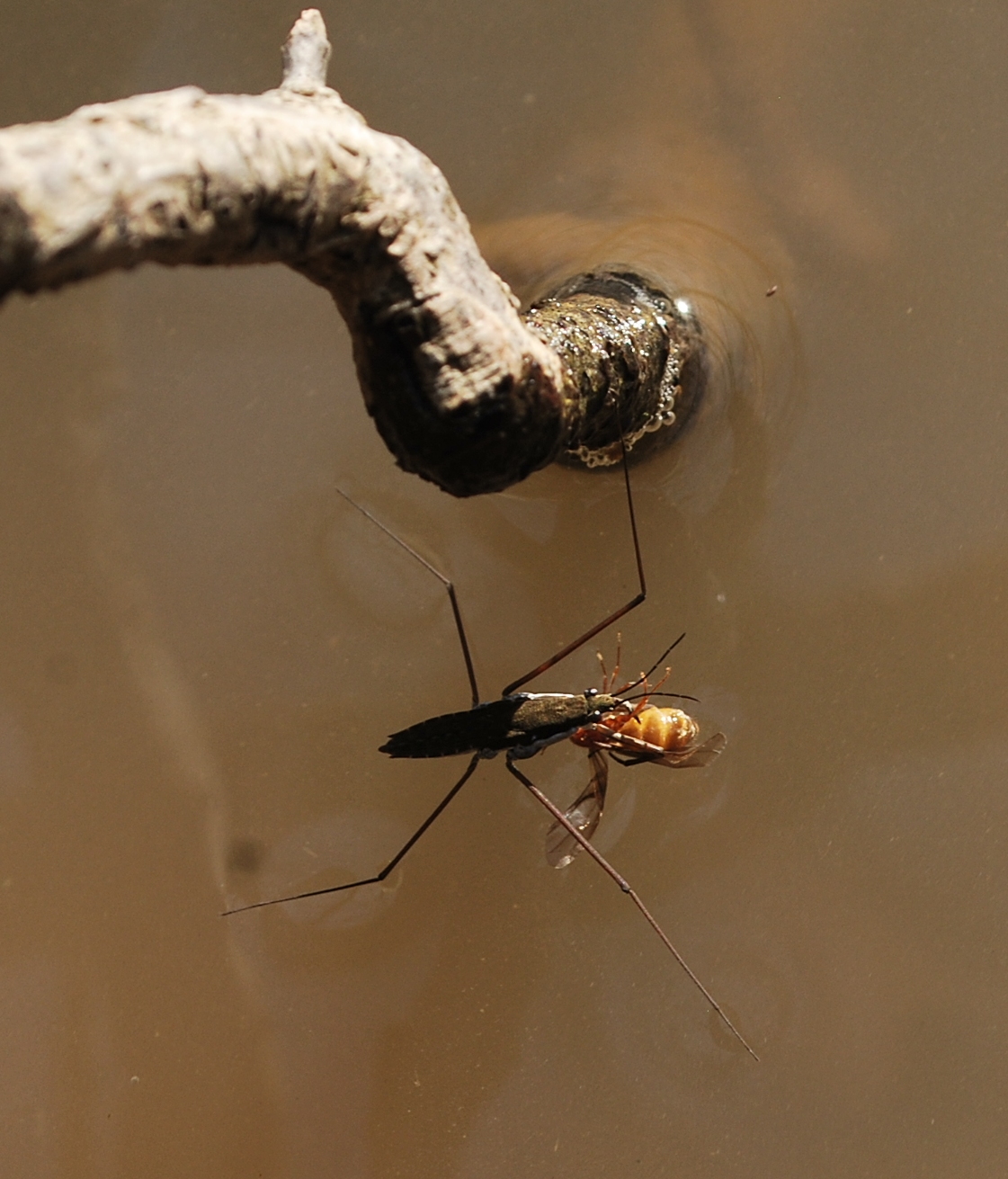
Prenolepis imparis alate in the clutches of a gerrid

Another ant I mentioned last time I was with you, Prenolepis imparis, has the distinction of being the only ant in our fauna that has mating flights while there is still a good chance of frost in the forecast for the next few weeks. In this picture of a mating pair at  BugGuide, note the size difference that inspires their name “imparis”, Latin for disparate. Any time after mid-February when it is sunny and not too windy, and the temperature rises above 65F, the winged males and females reared the preceeding fall, fly out to partake of a grand insectan orgy. Typically, they have big flights on the first couple of appropriately warm days, then some smaller ones (i.e., fewer individuals participating) over the next few weeks. The flying males look like gnats, bobbing up and down in drifting swarms, a few feet off the ground over a shrub, near a woodland edge or in a sunny opening. (One of my co-workers got into the midst of a group of such swarms once when we were conducting a prescribed burn in a wooded area, and I recall her commenting she “felt like Pigpen with all the little bugs flying around”!) The much larger, golden-brown females lift slowly off the ground, fly ploddingly (or is it seductively?) through the male swarms, are there mobbed by the tiny fellows, and then glide away and slightly downward, mating in flight with the winner of the males’ tussling. Rather clumsy fliers, the females do not always land in a good spot, as occurred to this hapless one that ended up as a feast for a water strider. Those that survive break off their wings, dig a burrow, seal themselves in, and raise a small brood of workers on food produced in their own bodies (like say, milk in mammals or “cropmilk” in doves and some other birds.)

But lest you to think I only have eyes for ants, I feel indeed fortunate to have encountered a tarantula this week, of the same species as Ted recently posted and I didn’t even have to go to Oklahoma for it. This bedraggled individual was at the mouth of its completely flooded burrow in what is most often a very dry habitat — a dolomite glade. Stunned and muddy at the time, my guess is this creature, belonging to a resilient and ancient lineage, will dry off, clean up, and saunter away as soon as she warms up.

Aphonopelma hentzi in flooded burrow


And speaking of emerging from flooded burrows, how about this handsome fellow, a male three-toed box turtle, his sex revealed by his bright orange and red markings, coming up for a breather? In truth, it was perhaps only just warm enough to make him need air, but not really enough so for him to be up and about, so he just sat there, nearly immobile, looking pretty, notwithstanding mud and leaves glued onto his shell.
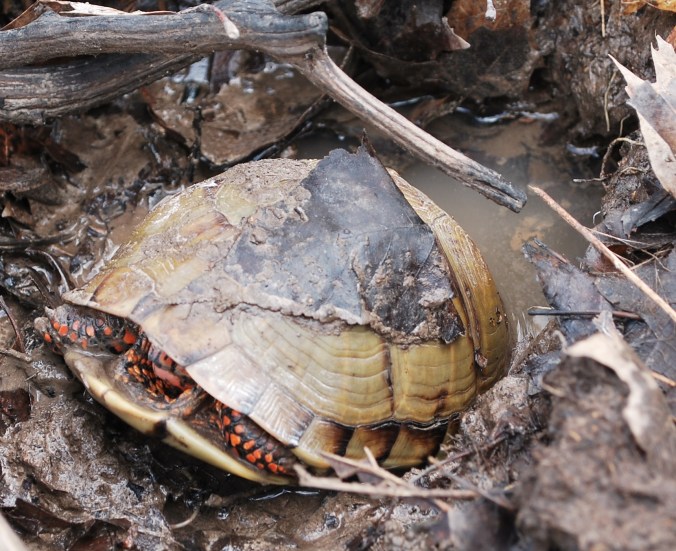
Male box turtle emerges


Copyright © James C. Trager 2010

Add to FacebookAdd to DiggAdd to Del.icio.usAdd to StumbleuponAdd to RedditAdd to BlinklistAdd to TwitterAdd to TechnoratiAdd to Yahoo BuzzAdd to Newsvine

Email to a friend