Why is this male carrion beetle “biting” one of the female’s antennae?

American carrion beetles (Necrophila americana) aggregating at sap flow on the trunk of an oak (Quercus sp.) tree.

American carrion beetles (Necrophila americana) aggregation at sap flow on trunk of oak (Quercus sp.) tree.

Earlier this spring I came upon an interesting aggregation of insects at a sap flow at the base of the trunk of a large oak (Quercus sp.) tree. Sap flows are famous for the diversity of insects that are attracted to them (e.g., see my previous post, Party on a pin oak), although the mix of species present can vary from sap flow to sap flow. In this case, the majority of insects present were American carrion beetles (Necrophila americana)¹ (order Coleoptera, family Silphidae), a species encountered much more often on animal carcasses (in fact, the genus name literally translates to “attracted to corpses“) but also occasionally attracted to sap flows (Evans 2014). This is not surprising to me, as I have seen adults regularly in the fermenting bait traps (Champlain & Knull 1932) that I have set out over the years (although I have been unable to find any reference to such attraction in the literature). I had never seen such an aggregation of these beetles before or even yet had the chance to photograph them (although I have photographed its Ceti Eel-like larva), so I paused to setup the camera and take a few photographs.

¹ Not to be confused with the federally endangered American burying beetle (Nicrophorus americanus).

Necrophila americana mating pair.

Necrophila americana mating pair.

Among the many single adults present was a mating pair, which I selected as my subjects. As I was photographing the pair, I noticed the male had a firm grasp of one of the female’s antennae within his mandibles. As I watched them through the lens, I saw the male suddenly release his hold of the female’s antenna, move backward on top of her, and begin using his own antennae to stroke her pronotum (sadly I was unable to snap a photograph at that time). As suddenly as he had released it, the male moved forward and grabbed hold of the female’s antenna once again. It seemed unlikely to me that this represented an act of aggression, but instead must be an important part of their courtship behavior. The female, for her part, did not seem to be bothered too much by the grasping and continued to slowly lumber about around the sap flow as the male went through his routine under my voyeuristic watch.

The male has a firm grasp of the female's antenna.

The male has a firm grasp of the female’s antenna.

Intrigued by this behavior, I searched for other photos of mating/coupled carrion beetles—easy to do considering the many pages of photographs of this species at BugGuide. While the great majority of those photos are of individual beetles, I found this photo and this one of coupled pairs, each also clearly showing the male firmly grasping one of the female’s antennae with his mandibles. Neither photo makes mention of the antennal grasping, but a little further searching did turn up this YouTube video of coupled American carrion beetles, again clearly showing the male grasping of the female’s antenna and even leading the videographer to comment, “Disturbingly, it even appears that this male is threatening to lop off the female’s left antenna if she refuses to mate!” Of course, retribution seems not to be a common behavior among insects, and in looking into this further I found a short note by Anderson (1989) in which the behavior is recorded not only for N. americana but also another silphid, Oiceoptoma noveboracense. Apparently mating actually occurred during the time the male had released his hold of the female’s antenna and was stroking her pronotum with his antennae. He further noted that the antennal grasping behavior continues until eggs and larvae are present at a carcass, at which time it is no longer observed. This suggests that the behavior represents an especially proactive form of “mate guarding” by which males actively ensure their paternity of the offspring of the particular female with which they were mating.

REFERENCES:

Anderson, R. S. 1989. Potential phylogenetic utility of mating behavior in some carrion beetles (Coleoptera: Silphidae: Silphinae). The Coleopterists Bulletin 43(1):18 [pdf].

Champlain, A. B. & J. N. Knull. 1932. Fermenting bait traps for trapping Elateridae and Cerambycidae (Coleop.). Entomological News 43(10):253–257.

Evans, A. V. 2014. Beetles of Eastern North America. Princeton University Press, Princeton, New Jersey, 560 pp. [Google Books].

© Ted C. MacRae 2015

Multiple Megarhyssa males

Today while hiking at Hilda Young Conservation Area (north-central Jefferson County, Missouri), I encountered a declining sugar maple (Acer saccharum) with lots of woodboring insect holes in the trunk. As I approached I noticed numerous giant ichneumon wasps in the genus Megarhyssa flying about the trunk and resting on its surface. Giant ichneumons belong to the family Ichneumonidae and are, as the name suggests, the largest members of the family in North America. Interestingly, all of the wasps that I initially saw were males. I have never seen male giant ichneumon wasps before, and certainly not in such numbers, so this was quite exciting. We have two species of giant ichneumons here in Missouri—M. atrata and M. macrurus, the females of which I have seen only rarely, but I couldn’t immediately decide which of these two species the males represented. I looked up higher on the trunk, and there I saw a female M. macrurus in the act of oviposition, so I decided that the males must also represent this species. However, one of the males was smaller and differently colored than the others, having more brown than black on the body and the wings clear with a well developed spot on the costal margin. The other males were noticeably larger and had more black than brown on the body and the wings smoky with only a narrow spot on the costal margin. After a little bit of digging, I know believe that the smaller male is also M. macrurus—the same species as the ovipositing female, while the larger males all represent the larger species M. atrata.

Megarhyssa macrurus (male) | Hilda Young Conservation Area, Jefferson Co., Missouri

Megarhyssa macrurus (male) | Hilda Young Conservation Area, Jefferson Co., Missouri

Megarhyssa atrata (male) | Hilda Young Conservation Area, Jefferson Co., Missouri

Megarhyssa atrata (male) | Hilda Young Conservation Area, Jefferson Co., Missouri

As I watched the males that had landed on the trunk of the tree, I observed both the M. macrurus male and one of the M. atrata males to bend their abdomen forward beneath their body rub the tip of the abdomen against the bark, a behavior called “tergal stroking”, and at times inserted the tip of the abdomen into cracks in the bark in an almost prehensile-looking manner. These behaviors belong to a suite of behaviors exhibited by male Megarhyssa aggregations. Previously thought to be function in early insemination of as-yet-unemerged females, the precise function of these behaviors remains unknown but seems somehow related to enabling sex discrimination of emerging wasps and/or increasing the rate at which virgin females are encountered (Matthews et al. 1979).

All species of Megarhyssa parasitize the woodboring larvae of Pigeon horntails (Tremex columba) (order Hymenoptera, family Siricidae), which the females reach by inserting their long, thin ovipositor deep into the wood where the horntail larvae live. Multiple species of giant ichneumons occurring in the same area at the same time and utilizing the same resource seems to violate a basic ecological concept; the competitive exclusion principle, which states that two species competing for the same resource cannot coexist at constant population values because one species will always eventually outcompete the other. In the case of Megarhyssa, it seems that size differences between the species allow them to share a common resource (horntail larvae), as females of the larger M. atrata have longer ovipositors than the smaller M. macrurus, thus allowing them to penetrate deeper into the wood to parasitize horntail larvae that M. macrurus females cannot reach. By the same token, M. macrurus females tend to parasitize horntail larvae tunnel at shallower depths and that tend not to be utilized by M. atrata females.

REFERENCE:

Matthews, R. W., J. R. Matthews & O. Crankshaw. 1979. Aggregation in male parasitic wasps of the genus Megarhyssa: I. Sexual discrimination, tergal stroking behavior, and description of associated anal structures behavior. The Florida Entomologist 62(1):3–8 [pdf].

© Ted C. MacRae 2015

A little extra cash

Earlier this month the Webster Groves Nature Study Society (WGNSS) sponsored their second Nature Photo Contest. I’ve been a member of this group since I first moved to St. Louis after college in the early 1980s—primarily as a participant in the Entomology Natural History Group but for the past six years also as board member and editor of the Society’s newsletter, Nature Notes. The photo contest was run much like the first one in 2013, again with nice cash prizes for the winners, except two things: 1) the categories were a little different (see below), and 2) I was tapped to be one of the three judges in the two categories that I did not submit photos. The categories were:

  • Invertebrates
  • Vertebrates
  • Plants & Fungi
  • Natural Communities
  • Seasons

I submitted two photos each to the first three categories—the maximum allowed in both cases. One limitation for me was that the photographs had to be taken in Missouri or an adjacent state. Remarkably, during the past few years I’ve taken most of my photos in places further afield—primarily in the western U.S. in states such as California, Colorado, New Mexico, and Nevada. I have many photographs from earlier years, but frankly I don’t consider much of that body of work to be photo contest worthy. Still, I was able to come up with a few more recent photographs that I thought would be competitive.

How did it go for me? Pretty good, with two of my photos taking cash-winning prizes (see below). This may not be as good as I did last time, when I won one 1st place, one 2nd place, and one 3rd place—the last of these also voted by the audience as the Grand Prize winner. Nevertheless, the cash award is much welcomed and will be put to good use. Remarkably, it turns out that two winning photographs have never been posted at this site, so here they are:


3rd Place—Vertebrates

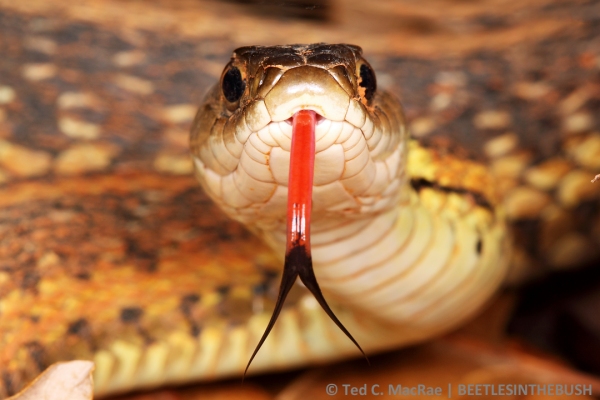
Eastern garter snake (Thamnophis sirtalis)

Eastern garter snake, Thamnophis sirtalis | Ozark Trail, Wappapello Section, Wayne Co., Missouri

The judges regarded that it represents the true “essence” of a snake. Technically they liked the position of and focus on the tongue, the contrasting red color working well in the composition, with the blurred, winding body of the snake adding depth in a cleaner fashion than a cluttered jumble of leaves. I can’t tell you how many shots I took hoping to get one with the tongue in the perfect position—knowing all along that at any moment the snake could stop flicking it or decide to make a run for it


2nd Place—Plants & Fungi

Dicentra cucullaria

Dutchman’s breeches, Dicentra cucullaria | Battle of Athens State Park, Clark Co., Missouri

Unfortunately, I didn’t get a chance to hear the judges’ feedback regarded this photo, as I was busy judging the photos in the ‘Natural Communities’ and ‘Seasons’ categories. This photo also took many shots, even though I didn’t have to worry about the subject not cooperating. Flash on white is tricky—not enough and you don’t get the stark contrast with the black background; too much and you end up blowing the highlights and losing the delicate detail. Add to that trying to get the subject perfectly symmetrical within the frame (I wanted to achieve this ‘for real’ and not through subsequent cropping), and I probably took close to two dozen shots before I felt like I had it right.

Perhaps you noticed that neither of the photos were in the ‘Invertebrates’ category. This just goes to show that the amount of interest in and effort one puts into a certain type of photography does not guarantee success—or prevent success in photographing other, less-familiar subjects. For my part I am pleased that any of my photographs were deemed good enough to receive a cash prize and thank WGNSS for giving local nature photographers the opportunity to have their work recognized and rewarded.

© Ted C. MacRae 2015

Flower ants? Check again!

Last spring while hiking the North Fork Section of the Ozark Trail in southern Missouri (Howell Co.), I made sure to check the abundant flowering dogwood (Cornus florida) blossoms that were in gorgeous peak bloom at the time (early May). I’ve learned to check flowers of dogwood whenever I can, as they are quite attractive to a variety of insects but especially those groups of longhorned beetles (family Cerambycidae) that tend to frequent flowers as adults. In the case of flowering dogwood, most of the cerambycids that I encounter belong to two genera: Molorchus and Euderces. Both of these genera are known for their great resemblance to small ants, no doubt representing examples of Batesian mimicry (where a harmless species adopts the appearance or warning signals of a harmful species to gain protection from predators).

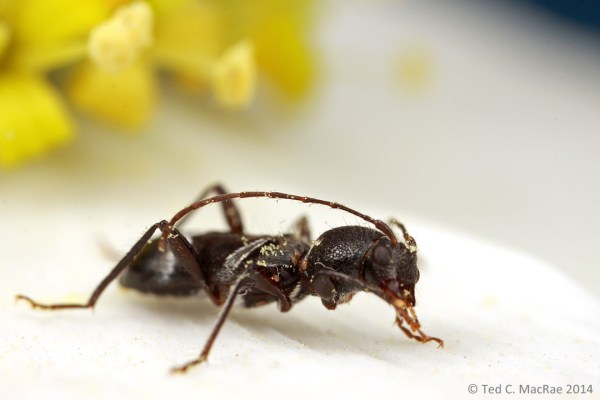
Tilloclytus geminatus

Tilloclytus geminatus on Cornus florida | North Fork Section, Ozark Trail, Howell Co., Missouri

During this particular hike I was determined to photograph Molorchus bimaculatus, common in Missouri during early spring on a great variety of flowering trees. On this day, however, the tiny (<10 mm length) beetles were rather scarce, and I had been frustrated in my attempts to get good photographs of the few that I had found. I’ve seen enough of these beetles over the years that I can recognize them quickly for what they are without the need to closely examine every “ant” that I see. So when I saw an “ant” that was too big and convex in profile to be Molorchus I almost discounted it as a true ant. Something about it, however, gave me pause, and when I looked closer I saw that it was, indeed, a longhorned beetle. But, it was not Molorchus, nor was it Euderces. Instead, it was the species Tilloclytus geminatus—an exciting find!

Tilloclytus geminatus

Adults in profile greatly resemble ants of the same size.

Tilloclytus geminatus has been recorded only sporadically from across the eastern U.S., where it has been reared from a variety of deciduous hardwoods (Craighead 1923, Rice et al. 1985). Perry (1975) did report rearing this species from Pinus virginiana (along with several other species normally associated with hardwoods); however, that record likely represents an ‘‘overflow’’ host (Hespenheide 1969) that is not typical of the species’ normal host preferences. I myself had never seen the species until the years after I published my checklist of Missouri cerambycids (MacRae 1994), having succeeded in rearing adults from a variety of previously unrecorded hardwood hosts that I collected at several localities across southern Missouri (MacRae & Rice 2007). It remains, for me, an infrequently encountered species—perhaps part of this a result of being overlooked due to its effective ant mimicry.

Tilloclytus geminatus

The anterior, oblique markings give the illusion of a constricted “waist”, while the posterior, transverse markings resemble the “sheen” of a shiny abdomen.

Unlike Molorchus and Euderces, this species has not been frequently associated with flowers as adults. In fact, the only report I am aware of is that of Rice et al. (1985), who reported adults on flowers of hawthorn (Crataegus sp.). Perhaps this additional find on Cornus is indicative of a true adult attraction to flowers by T. geminatus, although a single adult provides only weak support. However, a related ant-mimicking longhorned beetle—Cyrtophorus verrucosus—has been collected on flowers of roughleaf dogwood (Cornus drummondii) (MacRae 1994) as well as flowering dogwood (Scheifer 1998a). The floral attraction of ant-mimicking cerambycids may be more characteristic of species in the subfamily Cerambycinae, as only one flower record exists (Physocarpus opulifolius) for Psenocerus supernotatus (Wheeler & Hoebeke 1985) and none exist for Cyrtinus pygmaeus, both in the subfamily Lamiinae rather than Cerambycinae and the only other true ant-mimicking species in Missouri of which I am aware.

REFERENCES:

Craighead, F. C. 1923. North American cerambycid larvae. A classification and the biology of North American cerambycid larvae. Dominion of Canada, Department of Agriculture, Technical Bulletin No. 27 (new series), 239 pp. [Internet Archive].

Hespenheide, H. A. 1969. Larval feeding site of species of Agrilus (Coleoptera) using
a common host. Oikos 20:558–561 [JSTOR].

MacRae, T. C. 1994. Annotated checklist of the longhorned beetles (Coleoptera: Cerambycidae and Disteniidae) known to occur in Missouri. Insecta Mundi 7(4) (1993):223–252 [pdf].

MacRae, T. C. & M. E. Rice. 2007. Distributional and biological observations on North American Cerambycidae (Coleoptera). The Coleopterists Bulletin 61(2): 227–263 [pdf].

Perry, R. H. 1975. Notes on the long-horned beetles of Virginia, part III (Coleoptera: Cerambycidae). The Coleopterists Bulletin 29(1):59 [JSTOR].

Rice, M. E., R. H. Turnbow Jr. & F. T. Hovore. 1985. Biological and distributional observations on Cerambycidae from the southwestern United States (Coleoptera). The Coleopterists Bulletin 39(1):18–24 [pdf].

Schiefer, T. L. 1998a. A preliminary list of the Cerambycidae and Disteniidae (Coleoptera) of Mississippi. Transactions of the American Entomological Society 124(2):113–131 [JSTOR].

Wheeler, A. G., Jr. & E. R. Hoebeke. 1985. The insect fauna of ninebark, Physocarpus opulifolius (Rosaceae). Proceedings of the Entomological Society of Washington 87(2):356–370 [BioStor].

© Ted C. MacRae 2015

What’s black and white and red all over?

Last September, labmate and fellow insect collecting enthusiast Stephen Penn and I visited the dolomite glades of the White River Hills in extreme southwestern Missouri. Our main quarry was tiger beetles, specifically a disjunct population of the large and impressive Prairie Tiger Beetle (Cicindelidia obsoleta vulturina) that lives only on the glades in this area and adjacent Arkansas. I was hoping to find additional localities for the beetles in the more western parts of the region where it’s precise distribution in Missouri is less well known. First, however, I wanted to make sure the beetle was out, so we started at the westernmost of its known locations—Chute Ridge Glade at Roaring River State Park. As we picked our way through dry-mesic woodland bordering the more open glades, a large, dead chinquapin oak (Quercus muehlenbergii) with sloughing bark caught my eye. One never knows what might be encountered under bark, regardless of the season, and as I pulled away the very first slab of bark I was rewarded with the sight of what must be North America’s most beautiful assassin bug, Microtomus purcis.

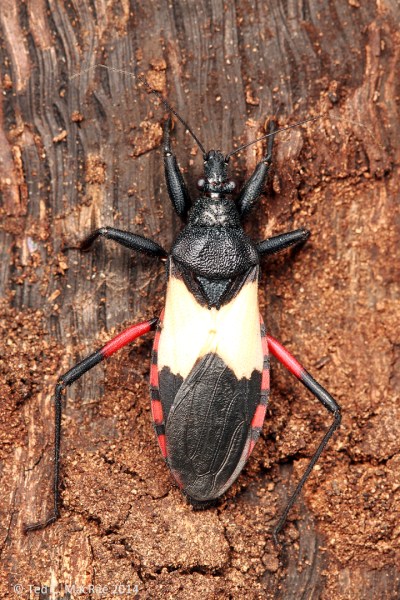
Microtomus purcis

Microtomus purcis (Drury, 1782) | Barry Co., Missouri

Sometimes called the “bark assassin bug”, this species is not quite as large as the better known “wheel bug” (Arilus cristatus) but makes up this by its spectacular coloration—black with the base of the wings prominently marked creamy-white and parts of the abdomen and hind legs bright red. One would think such a conspicuously  marked assassin bug with a bite powerfully painful enough to back up its apparent warning coloration could brazenly venture out during the day with little to fear. To the contrary, this species seems best known for its habit of hiding under bark during the day and venturing out only at night, during which time it is sometimes attracted to lights (Slater & Baranowski 1978, Eaton & Kaufman 2007). A majority of BugGuide photos of the species also mention finding them under bark or apparently attracted to lights.¹

¹ I was especially amused by this particular photo for which the contributor states, “While holding it, the bug pierced my finger nail with its proboscis. The pain was searing and I have a small blood stain under the nail.” I’ll admit it—I, too, learned firsthand how painful the bite of an assassin bug can be when I picked one up, in my case Melanolestes picipes, with plans to include it in my Entomology 101 collection.

Sunset on the glade

Sunset on the glade | Pilot Knob Conservation Area, Stone Co., Missouri

I, in fact, have only seen this species once before—also in Missouri and again under bark, although that time was during the winter, thus causing me to think this was its overwintering habit. I placed the individual in a glass vial and brought it indoors to “revive” it, but to my disappointment when I checked on it a few days later it was dead. Froeschner (1944) reported this species (under its older name, Hammacerus purcis) was “not uncommon” in Missouri, though apparently confined to the Ozark Highlands south of the Missouri River. Adult records in Missouri extended from September to March, with small nymphs being found during November and December, but BugGuide records include summer months as well. If I want to see this species more than twice in 30 years, I supposed I am going to have to spend more time peeling bark, or checking lights.

REFERENCES:

Eaton, E. R. & K. Kaufman. 2007. Kaufman Field Guide to Insects of North America. Houghton Mifflin Harcourt, New York, 391 pp. [Amazon preview].

Froeschner, R. C. 1944. Contribution to a synopsis of the Hemiptera of Missouri, Pt. III. Lygaeidae, Pyrrhocoridae, Piesmidae, Tingidae, Enicocephalidae, Phymatidae, Ploiariidae, Reduviidae, Nabidae. The American Midland Naturalist 31(3):638–683 [JSTOR preview].

Slater, J. A. & R. M. Baranowski. 1978. How to Know the True Bugs. The Pictured Key Nature Series, William C. Brown Company Publishers, Dubuque, Iowa, x + 256 pp. [Amazon description].

© Ted C. MacRae 2015

Missouri Master Naturalists Seminar

Missouri Master Naturalist Confluence Chapter Seminar | December 9, 2014. Photo by Lee Phillion.

Speaking to the Missouri Master Naturalist Confluence Chapter, December 9, 2014. Photo by Lee Phillion.

Earlier this week I had the privilege of speaking to the Confluence Chapter of the Missouri Master Naturalist Program, the members of which are all graduates of the Missouri Master Naturalist Program. This community-based natural resource education and volunteer service program, sponsored by the Missouri Department of Conservation and the University of Missouri Extension Service, seeks to engage Missourians in the stewardship of our state’s natural resources through science-based education and volunteer community service. To accomplish such, members support conservation efforts and natural resource education in their local communities.

Since I’ve studied the insect fauna of Missouri for many years now, especially in its threatened and endangered natural communities, I thought a talk on this subject might be of interest to the group. I decided to focus on some of the work I’ve done in two of our state’s most critically imperiled natural communities: loess hilltop prairies in the northwest corner of the state and sand prairies in the southeastern lowlands—with a talk titled, “From Hilltops to Swamps: Insects in Missouri’s Rarest Prairies”. The presentation provided an overview of each of these natural communities, the circumstances that have led to their rarity in Missouri, and the insects associated with them with special emphasis on species that are dependent upon these natural communities for survival. For those who might be interested, I’ve posted a PDF version of the presentation here.

From Hilltops to Swamps: Insects in Missouri’s Rarest Prairies

Truth be told, it was one of the most enjoyable seminars I’ve ever given, due mostly to a wonderfully engaged audience of about 70 people. It was a perfect opportunity for me to promote awareness of insects and the need to consider them in conservation efforts with an audience whose members are at the forefront of the citizen science effort within our state. I extend my heartiest thanks to Leslie Limberg for giving me the opportunity to speak, Lee Phillion for sending me photos from the event, including the one posted above, and—most importantly—the members of the audience for the warm welcome they extended to me and the interest they showed during my presentation.

© Ted C. MacRae 2014

Missouri’s largest planthopper

Although I have long dedicated myself to beetles, I must confess that my first love was the so-called “Homoptera”—that now defunct order containing some really cool bugs (cicadas and hoppers—i.e., leafhoppers, treehoppers, planthoppers, froghoppers, armadillohoppers, etc.) and some not-so-cool bugs (aphids, whiteflies, mealybugs, and their kin)¹. Perhaps you already sense that it was only the cicadas and hoppers that I really liked, the other mentioned groups being… well… boring from my perspective as a collector (overwhelming numbers of tiny, soft-bodied, sessile insects that required preservation in alcohol or on slides²). Even within the “cool” homopterans, however, some groups interested me more than others. Leafhoppers were okay, but my interest in them derived mostly from the fact that they were the subject of my thesis work. Treehoppers, on the other hand, were my favorite because they were just so adorably bizarre, and cicadas also fascinated me due to their size and behavioral charisma.

¹The homopterans have since been subsumed within the larger order Hemiptera (true bugs)—an irritating but necessary consequence of molecular studies that have shown rather conclusively that hoppers and cicadas are more closely related to the other true bugs than they are to the group containing aphids, whiteflies and mealybugs.

²So, not only are they boring to curate, but they directly caused the first order of insects in which I became interested to be completely dismantled!

Poblicia fuliginosa on Silphium terebinthinaceum (prairie dock)| Barry Co., Missouri.

Poblicia fuliginosa on Silphium terebinthinaceum | Barry Co., Missouri.

The planthoppers also interested me, although many of the various families contained within the group seemed not much different to me than leafhoppers. One family, however, stood out—the Fulgoridae. Much larger than the other planthoppers, they seemed like a cross between a planthopper and a small cicada (okay, a very small cicada)—combining the hopping capabilities of the former with the size (almost) of the latter. I only rarely encountered these bugs in Missouri; actually it was only a single species that I ever found—Poblicia fuliginosa, one of only two species in the family known to occur as far north as Missouri (Bartlett 2014). Moreover, when I did find them, they were extraordinarily wary and difficult to approach and collect. Vernon Brou, in a comment at this species’ BugGuide page, describes their capture-avoidance capabilities perfectly:

These are nearly impossible to capture by hand netting, they are rocket propelled. A most [frustratingexercise in futility.—Vernon Antoine Brou, Jr., pers. comm. to Mike Quinn, 2012.

The abdomen is brightly colored red (barely visible in this photo).

The abdomen is brightly colored red (barely visible in this photo).

This past fall, while on a collecting trip in the White River Hills of extreme southwestern Missouri, I chanced upon a few individuals perching on the stems of prairie dock (Silphium terebinthinaceum) in a dolomite glade. Remembering how wary they were in my previous encounters, I figured I had little chance of successfully photographing any of them. I love a challenge, however, and with the help of field mate Stephen Penn I managed to get the shots shown here. Getting within the range of focus generally caused the insects to dart around to the backside of the stem. I took advantage of this behavior by getting myself set and focusing the camera on the bug (even though it was behind the stem) and then having Stephen move his insect net slowly toward the bug from the side to get it to dart back around the stem away from the net… right into my field of view! The first individual we tried to photograph took off rather quickly (rocket-propelled!), but fortunately we found another individual in the same clump of stems and succeeded in getting some shots.

In the second photo the bright red abdomen is barely visible on the underside of the insect. The entire abdomen is, in fact, bright red in obvious contrast to the otherwise dark and somber coloration of the insect. I’ve searched the literature but can find no mention of the function of the red abdomen, but I presume it serves a flash coloration function similar to the bright green abdomen of some jewel beetles to confuse potential predators by its visibility in flight and then sudden disappearance when the insect lands and folds its wings over the abdomen. I suppose an aposematic function is also possible given the red coloration, but I’m not aware that any hoppers are known to be chemically protected, and the fact that the red abdomen is seen only during flight also suggests a non-chemically based function.

REFERENCES:

Bartlett, C. R. 2014 (and updates). Planthoppers of North America. Available at: http://canr.udel.edu/planthoppers (accessed 12 November 2014).

© Ted C. MacRae 2014

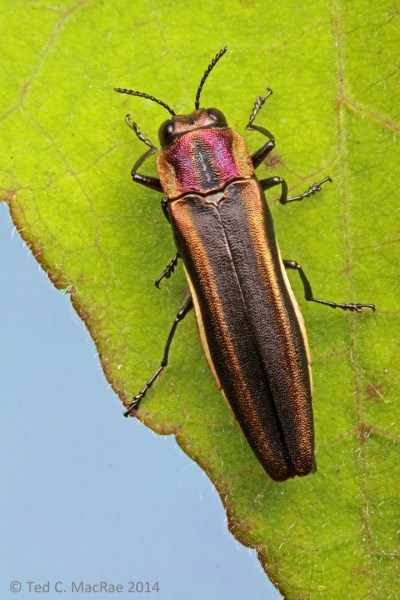
North America’s Most Beautiful Agrilus Jewel Beetle

For the past few years I’ve spent the summers traveling once a month or so from my home near St. Louis to research plots in western Tennessee. I enjoy these trips immensely—not only are my research and the colleagues that I spend time with fun, but I also get to keep an eye on the progression of the season in one of Missouri’s most interesting (and threatened) natural communities: the southeastern lowlands. Spring sees the emergence of an unusual population of the Festive Tiger Beetle (Cicindela scutellaris) in the area’s critically imperiled sand prairies; summer harks the appearance of the diminutive and almost-impossible-to-see Ant-like Tiger Beetle (Cylindera cursitans) in the ribbons of wet bottomland forest that line the Mississippi River; autumn is graced by the sight of stunningly beautiful amorpha borers (Megacyllene decora) in wet areas hosting mixed stands of false indigo (Amorpha fruticosa) and goldenrod (Solidago spp.); and all season long a variety of seldom-seen insects (e.g., longhorned beetles that look like stag beetles) are attracted to ultraviolet lights set up in the area’s increasingly scarce natural habitats.

Hairy mallow (Hibiscus lasiocarpus), host for Agrilus concinnus

Hairy mallow (Hibiscus lasiocarpus), host for Agrilus concinnus

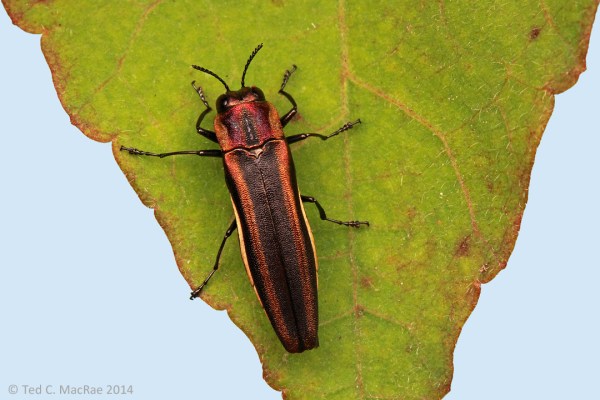
Another phenological event that I look forward to in the southeastern lowlands is the blooming period of hairy mallow (Hibiscus lasiocarpus). Starting in July and reaching its peak in early to mid-August, the enormous white (and sometimes pink) flowers explode across the landscape at a time when precious few other flowers can be found, conspicuously flagging any ground where water tends to stand. It is not the flowers themselves, however, that pique my interest, but rather a beautiful (and, until recently, rare) jewel beetle (family Buprestidae)—Agrilus concinnus—that becomes active on the plants while they are in flower. In fact, of the nearly 200 species belonging to the genus in North America, I consider A. concinnus to be perhaps the most beautiful!

Agrilus concinnus | Stoddard Co., Missouri

Agrilus concinnus | Stoddard Co., Missouri

I first saw this species in Missouri’s southeastern lowlands nearly 30 years ago. At that time, I didn’t know that the mating pair that I had found on low vegetation represented a species considered to be one of the rarest of the genus in North America (having been recorded only from Florida, Georgia, Illinois, and Texas and not yet known from Missouri) and whose host plant and biology were completely unknown. Over the course of several years following this first find, fellow buprestophile Gayle Nelson (now deceased) and I were able to document the occurrence of this species also in Kansas (MacRae & Nelson 2003) and confirm its association with plants in the genus Hibiscus (MacRae 2006). We also determined that adults of this species exhibited an unusually late seasonal occurrence, peaking in late July and early August, compared to the spring adult activity period of most other eastern North American species in the genus. As a result of these efforts, one of North America’s rarest and least known jewel beetles was no longer regarded as either. A more detailed summary of my experiences with this beetle can be found in a newsletter article that I wrote a while back (MacRae 2004).

Hibiscus lasiocarpus

Plants in peak bloom signals the adult activity period of the beetle.

Of course, those were the days before I began photographing insects, so despite the abundance with which I have seen this species in past years, I still lacked photographs of it. I first made an effort to photograph adults two years ago while on one of my research plot trips, but 2012 was characterized by a severe drought in the central U.S.—precious few potential host plants were found at the locality where I first collected these beetles, and those that were present were severely stunted and in poor shape due to the drought. Conditions were much more favorable last year (2013), but again no beetles were seen during an early August visit. This past season was again favorable for growth of the host plants, and though my visit during early August again looked like it was not going to pay off, I eventually scared up an adult and watched it as it flew to another plant. I would see four adults on the day—not a lot, but enough to make sure that I got photographs showing how spectacularly beautiful they are!

Agrilus concinnus

Adults perch, mate, and feed on the upper leaf surfaces.

REFERENCES:

MacRae, T. C. 2004. Beetle bits: Hunting the elusive “hibiscus jewel beetle”. Nature Notes, Journal of the Webster Groves Nature Study Society 76(5):4–5 [pdf].

MacRae, T. C. 2006. Distributional and biological notes on North American Buprestidae (Coleoptera), with comments on variation in Anthaxia (Haplanthaxia)viridicornis (Say) and A. (H.) viridfrons Gory. The Pan-Pacific Entomologist 82(2):166–199 [pdf].

MacRae, T. C. & G. H. Nelson. 2003. Distributional and biological notes on Buprestidae (Coleoptera) in North and Central America and the West Indies, with validation of one species. The Coleopterists Bulletin 57(1):57–70 [pdf].

© Ted C. MacRae 2014