Orange and black on gold

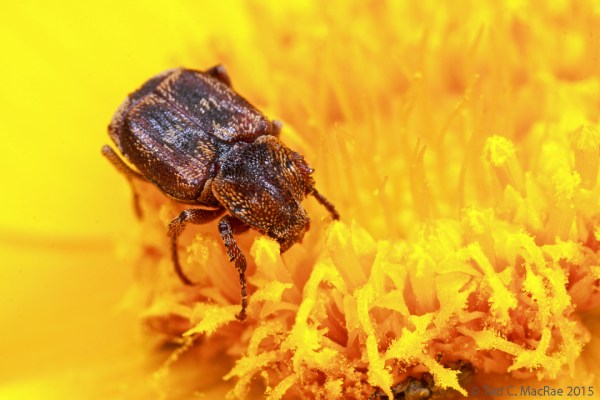
Trigonopeltastes delta on goldenrod (Solidago sp.) flowers | Stoddard Co., Missouri

Trigonopeltastes delta on goldenrod (Solidago sp.) flowers | Stoddard Co., Missouri

The spectacular amorpha borer, Megacyllene decora, was not the only black-and-gold colored beetle that I saw on the flowers of goldenrod (Solidago sp.) a few weeks ago. In addition were several delta flower scarabs, Trigonopeltastes delta. This species is much more commonly encountered than the amorpha borer—not only geographically but also throughout the season on a greater diversity of flowers. Nevertheless, I had failed in my previous attempt to photograph the species at the very same locality just a few weeks earlier due to the much higher summer temperatures and resultant flightiness of the beetles.

Trigonopeltastes delta
In the case of this beetle, the scientific name almost completely describes the beetle—the genus name being derived from the Greek words trigon (i.e., triangle, triangular) and pelt, (i.e., a shield), referring to the triangular and shield-shaped pronotum, and the species name based on the Greek letter Δ (“Delta”) in reference to the distinctive white triangle on the pronotum that resembles it. I mentioned the diversity of flowers on which adults of this beetle can be found. Pascarella et al, (2001) found this species on 13 different plant species (including mass aggregations numbering in the thousands on inflorescences of Sabal palm, Sabal palmetto) in their study of flower-visiting insects in the Everglades National Park. In Missouri, I see these beetles most commonly on Queen Anne’s lace (Daucus carota) and several other plants with white inflorescences such as American feverfew (Parthenium integrifolium), New Jersey tea (Ceanothus americanus), wild hydrangea (Hydrangea arborescens), and—most recently—hairy mallow (Hibiscus lasiocarpos). Interestingly, on this day there was an abundance of white-flowered snakeroot (Eupatorium sp.) in bloom at the same site, but I only saw the beetles on the yellow-flowered goldenrod.

Trigonopeltastes delta
It has been suggested that the Delta pattern on the pronotum and orange-and-black coloration of the elytra combine to mimic the appearance of paper wasps in the genus Polistes. Paper wasps are frequent visitors to many of the same flowers that these beetles frequent; however, the much smaller size of the beetles might suggest mimicry of aculeate hymenopterans (stinging wasps and bees) in general rather than paper wasps specifically. A more unusual type of mimicry has also been suggested in that a rear view of the beetle with its large, white, triangular pygidium seems to resemble the head of a hornet. Supporting this idea is the habit of the beetles to raise and hold their long hind legs in the air when disturbed in a manner that makes them resemble a hornet’s antennae!

Defensive posture with hind legs raised above abdomen.

Defensive posture with hind legs raised above abdomen (iPhone photo).

REFERENCE:

Pascarella, J. B., Waddington, K. D. & P. R. Neal. 2001. Non-apoid flower-visiting fauna of Everglades National Park, Florida. Biodiversity and Conservation 10(4):551–566 [abstract & pdf link].

© Ted C. MacRae 2014

Amorpha borer on goldenrod

Megacyllene decora (amorpha borer) | Stoddard Co., Missouri

Megacyllene decora (amorpha borer) | Stoddard Co., Missouri

One of my favorite longhorned beetle species is the amorpha borer, Megacyllene decora. Like its close relative, the locust borer—M. robiniae, this large, beautiful, black and yellow beetle is a classic harbinger of fall by virtue of its late-season adult activity period and affinity to flowers of goldenrod (Solidago) and snakeroot (Eupatorium). Compared to the locust borer, however, it is larger, chunkier, and more boldly marked, and despite the commonness of goldenrod flowers it is far less commonly encountered than the locust borer due to the more restricted habitat preferences of the larval host plant (false indigo—Amorpha fruticosa).

Megacyllene decora
The beetle in these photos is one of two that I found in late September at a site in the lowlands of southeastern Missouri. I’ve not seen the beetle at this site before, but I knew it must occur here because of the stands of false indigo that I noted during an earlier visit to the site. Considering the large number of plants present, two beetles is much less than I would have expected to see (in fact, both beetles were found in a single patch of goldenrod). I have previously featured this species (see A classic fall ‘bycid) from a site about 50 miles east of this one. At that site also only a few beetles were seen despite an abundance of larval host plants (but the adults occurring on snakeroot flowers instead of goldenrod). Only twice have I seen this species in numbers that I would consider plentiful (both times in western Missouri).

Megacyllene decora
Amorpha borers and locust borers are part of a larger complex of black and yellow insects that visit goldenrod flowers in the fall. These include a variety of bees, wasps, and other beetles (e.g., the delta flower scarab, Trigonopeltastes delta—family Scarabaeidae), but perhaps the most abundant is the goldenrod soldier beetle, Chauliognathus pensylvanicus—family Cantharidae (also called the Pennsylvania leatherwing). One can presume that any or all of these species serve as models for the longhorned beetles—bees and wasps are obviously protected from most predators by their ability to sting, and the bodies of soldier beetles are chemically protected by cantharidin, a highly toxic terpenoid that causes blistering and irritation of mucous membranes at low doses and can be fatal at higher doses. As the mimics, amorpha borers and locust borers could be expected to be less abundant than the models. However, considering how difficult-to-see these beetles can be when sitting on goldenrod flowers, their black-and-yellow coloration seems as though it could just as easily serve a cryptic function. It is even possible that mimicry and crypsis both have contributed to evolution of these beetle’s coloration.

Ted C. MacRae 2014

A truly disturbed garden spider

Argiope trifasciata vibrating web in response to disturbance.

Argiope trifasciata shaking its web in response to being approached.

This past weekend I made a trip to the White River Hills region in extreme southwestern Missouri. My goal was to find additional localities of the prairie tiger beetle (Cicindelidia obsoleta vulturina), which inhabits dolomite glades in the area and is disjunct from the main distribution in Texas and Oklahoma. As I was checking a particularly large glade complex in Roaring River State Park, I came upon this banded garden spider (Argiope trifasciata) that had spun its web across the span of branches from a gum bumelia tree (Sideroxylon lanuginosum). As I approached the spider the web began moving back and forth quite vigorously, and it occurred to me that there was not nearly enough wind for the web to be shaking to such degree. I stood still, and eventually the shaking stopped and the web became still again. To test whether it was really the spider shaking the web intentionally, I raised my net to one side and drew it closer to the spider, and once again the web began shaking back and forth just as vigorously as before. I watched the spider closely as the web shook, and I could see that the spider was actually flexing its two front pairs of legs back and forth to cause the shaking. It was clear at this point that the spider was doing this in response to my approach, probably as a defensive reaction to a perceived threat.

I suppose I have seen this behavior before but always assumed the web was just shaking in the breeze. Not until this time, with no wind to speak of and the web shaking quite rapidly, did it become clear to me that this was actually an intentional behavior exhibited by the spider. Eisner (2005) also notes this behavior, stating that Argiope spiders often engage…

…in a bobbing action, whereby through a quick flexion of its legs it sets the web into vibration, making itself a blurred target that is hard to grasp.

The photos used to make this animated gif were not easy to get. The spider was situated in a rather high and awkward-to-reach spot, and the iPhone had difficulty focusing on the spider while it was in motion. I overcame these problems by setting myself in a stable position, holding the iPhone in place, zooming the screen slightly (about 33%) and locking focus on the spider while it was still, and then asking my field buddy (Steve Penn) to approach the spider to trigger shaking. Once it began shaking it was a matter of holding down the shutter while keeping myself and the camera still long enough for a sufficient burst of photos (eight photos were used in this gif).

REFERENCE:

Eisner, T. 2005. For the Love of Insects. Harvard University Press, Cambridge, Massachusetts, 448 pp. [Google Books].

© Ted C. MacRae 2014

Not quite adult

For the past few years I’ve had research plots in northwestern Tennessee. Each summer, once a month or so, I make the 5-hour drive to the site and spend the afternoon taking data. Any normal person would then check in to their hotel room in town, watch television, and make the drive back to St. Louis the next morning. Of course—I’m not normal, I’m an entomologist! The southeastern lowlands of Missouri, where over the years I’ve found (and continue to find) a number of good spots for collecting insects, are tantalizing close. Instead of retiring immediately to my hotel room, I’d rather head back to the lowlands and find a good spot for setting up a blacklight. It might be midnight before I finally get to a hotel room, but it’s all worth it. Some of the most interesting insects that I’ve featured here during the past few years have come to blacklights on one of these trips, including the primitive longhorned beetles Parandra glabra and Mallodon dasystomus and adult male bagworms, Thyridopteryx ephemeraeformis.

Subadult female, poss. Maccaffertium sp. | Mississippi Co., Missouri

Subadult female mayfly (prob. Maccaffertium sp.) | Mississippi Co., Missouri

Most of the spots I’ve found are located along the Mississippi River, a downside of which is the overwhelming abundance of aquatic insects that are often attracted to the lights. Caddisflies (order Trichoptera) are the worst, sometimes swarming the lights with such frenetic abundance that to check the sheets one must button the collar, hold the breath, dash in quickly to look at the sheet, and retreat just as quickly lest the fluttering hordes find their way up the nostrils, down the ear canals, and into the eyes. Mayflies (order Ephemeroptera) also can be attracted in great numbers, although they tend to be, fortunately, much calmer and better behaved on the sheet than their trichopteran counterparts. Normally, I pay little attention to these insects other than what is required to avoid breathing them—their abundance almost makes them unnoticeable. On one particular night in early August, however, my eyes caught the soft glow of a ghostly-white insect sitting on the underside of a leaf some yards away from the light. I looked closer to see it was a mayfly, and so pale was its coloration that I knew it would make for a striking photograph against the black night sky.

The reason for its milky-white coloration is due to a unique aspect of mayfly developmental biology—they are the only insects to develop fully functional wings before their final molt to adulthood. This stage, called the sub-adult or subimago, emerges from the water where it spent the past year as a nymph (also called a naiad) and flies to nearby vegetation, but it is still not mature. One additional molt is required, wings and all, before the insect finally reaches adulthood and can spend the few remaining hours of its life in single-minded pursuit of a mate. Sub-adult mayflies are distinguished from their adult counterparts by their paler coloration and opaque rather than clear wings. We can also tell that this individual is a female because no claspers are visible at the tip of the abdomen (which males possess for mating) and its relatively small eyes (the eyes of males almost completely cover their head).

My thanks to Dr. Robert Sites, who initially suggested this might be a species in the family Heptageniidae, and to Roger Rohrbeck for confirming my subsequent identification as probably belonging to the genus Maccaffertium.

© Ted C. MacRae 2014

Digger wasps in action

Bicyrtes quadrifasciatus

Bicyrtes quadrifasciatus digging a burrow | Stoddard Co., Missouri

Here is an animated gif that I made from a series of photographs of the digger wasp, Bicyrtes quadrifasciatus (ID courtesy of Doug Yanega), digging a burrow in a sand bank in extreme southeastern Missouri (it’s amazing what you can do with an iPhone and a free internet app!). A large number of these wasps had colonized the sand bank, and as I photographed this one individual busily digging its burrow, others repeatedly flew up and investigated. The digging individual would disappear briefly down into the burrow, and each time it returned to the surface with a fresh load of sand another wasp would fly up to it and investigate. The digging individual never seemed to pay much attention to the investigating wasp, so I’m not sure if these other wasps were looking for a potential mate or perhaps even trying to usurp the burrow.

The cumulative noise from all of the flying wasps was really quite remarkable—indeed, the noise is what drew my attention to the sand bank in the first place. A video of the colony with my commentary can be seen here. I did see one wasp that had returned to its burrow carrying prey (apparently a stink bug in the family Pentatomidae). I touched the wasp thinking that it would drop the prey and fly away, as another digger wasp, Cerceris fumipennis, does with its buprestid prey when disturbed. This would have given me a chance to confirm the prey identity. Unfortunately, the wasp kept hold of the prey and flew off with it.

© Ted C. MacRae 2014

Pretty, little, no-name spider

I don’t like posting photographs of unidentified “bugs” (insects, spiders, etc.). There are times, however, when my best efforts are thwarted and I’m left with the choice to admit defeat or relegate the photos indefinitely to the “archives”. In this case, the subject in the photos is just cute to hide. I found this bright red spider on the blossom of a flowering dogwood (Cornus florida) this past spring while hiking the North Fork Section of the Ozark Trail near Blue Hole Hollow in Howell Co., Missouri. While I am fairly certain that it belongs to the family Linyphiidae (dwarf and sheetweb spiders), I cannot decide if it is the former or the latter. Among the dwarf spiders (subfamily Erigoninae), it resembles some members of the genus Ceraticelus, while among the sheetweb spiders (subfamily Linyphiidae) it seems a good match for the genus Florinda (as suggested by Bug Eric). Whatever its identity, it is one of the prettiest and most brightly colored little spiders I have seen. (Photographed on 4 May 2014 with a Canon MP-E 65 mm 1-5X lens.)

Edit 8/22/14, 12:20 p.m.—I now believe this to be an orb weaver (family Araneidae), albeit a very small one (only ~8 mm in length); specifically something in the genus Hypsosinga. Take a look at this photo of H. rubens, which seems to be a near perfect match for the individual in these photos.

Ceraticelus minutus?Ceraticelus minutus? Ceraticelus minutus? Ceraticelus minutus? Ceraticelus minutus?

© Ted C. MacRae 2014

A time of reckoning

The sun shall be turned to darkness and the moon to blood, before the day of the Lord comes, the great and magnificent day.

A "super moon" watches over a parasitized hornworm caterpillar.

A “super moon” watches over a parasitized hornworm caterpillar.

I’m not normally one to quote Bible passages, but this line from Acts 2:20 seems appropriately ominous for the predicament of this poor hornworm caterpillar. The white objects on its back are the cocoons of tiny parasitic wasps in the family Braconidae who spent their entire lives inside the body of the growing caterpillar slowly eating away the inner tissues of the caterpillar, eventually consuming all but the most essential of its internal organs before exiting the skin and spinning their tiny, silken cocoons. Inside the cocoons the tiny grubs transformed into adult wasps, chewed their way out through the tip of the cocoon, and flew off to mate and find more hornworm caterpillars to parasitize. Its unwelcome guests now gone, this poor caterpillar has nothing to do but to sit and await its inevitable demise (which I suspect the caterpillar will not regard as such a “great and magnificent day”).

I found this caterpillar resting on a vine climbing a tree along the Mississippi River in southeast Missouri after setting up an ultraviolet light nearby and noticing the softly glowing cocoons. I was going to photograph it in situ, but I’ve learned that choice of background can have a dramatic effect on insect photographs, and the jumble of weeds and tree bark that would have comprised the background had I photographed the caterpillar where it sat seemed decidedly boring. I looked up and saw the blood red moon (a so called “super moon”) rising above the river in the eastern sky and decided to give it a try. The above photograph is actually a composite of two photographs—one of the caterpillar taken with flash and fairly normal camera settings, and another of the moon itself with aperture, shutter speed, and ISO all adjusted for very low light conditions (at least to the extent possible without a tripod). While this may not qualify in some people’s minds as a “real” photograph, it is nevertheless a true representation of what I actually saw, as I also made a number of attempts to capture both the insect and the moon in a single exposure. Since it is impossible to have both the insect (very close) and the moon (very far) in focus at the same time, the resulting photograph has a different, though still striking, effect, as shown in the photograph below:

IMG_6919_enh_1080x720

A more surrealistic version of the above photograph, with both caterpillar and moon captured in a single exposure.

This second photograph is actually much harder to take, as the moon does not appear in the viewfinder as the small, discrete, fuzzy-edged object resulting in the image, but rather as a large, blinding light that is difficult to place within the composition and know exactly where it will end up (at least, without a lot of trial and error). Add to that the fact that my camera image and histogram display panel is, at the moment, not functional, forcing me to “guess” if I had the right settings (in a situation where I’m well outside of my ‘normal’ settings for flash macrophotography). I’m a little surprised that I ended up with any usable photographs at all!

I’ve tried this type of photography with the sun as well—those interested to see how those photographs turned can find them at Sunset for another great collecting trip and Under Blood Red Skies.

© Ted C. MacRae 2014

One-shot Wednesday: Mallodon dasystomus

Mallodon dasystomus | southeast Missouri (Mississippi Co.)

Mallodon dasystomus | southeast Missouri (Mississippi Co.)

Today’s (slightly belated) edition of “One-shot Wednesday” features a beetle that I saw just about this time last year while blacklighting along the Mississippi River in the southeastern lowlands of Missouri. Mallodon dasystomus¹ is a prionid longhorned beetle (family Cerambycidae, subfamily Prioninae) that is sometimes called the “hardwood stump borer”. It is perhaps one of the most widely distributed members of its group, occurring across the southern tier of the U.S. down through Mexico and Central America as far as northern South America.

¹ Until recently the specific epithet was consistently misspelled in most of the literature as “dasytomus“. A closer look at the Greek root words dasus (δασύς), meaning “hairy”, and stoma (στόμα), meaning “mouth”, shows the misspelling to be nonsensical. I, myself, am guilty of using the wrong spelling in my checklist of Missouri longhorned beetles (MacRae 1994), although I can claim to have been “going with the flow”.

Despite the beetle’s wide geographical range, I searched for it both eagerly and unsuccessfully during the 1980s as I was gathering data for my checklist of Missouri longhorned beetles (MacRae 1994). I eventually published that checklist and included the species on the basis of a few specimens seen in other collections, but I never encountered it for myself until some years later during a visit to Cave Creek Canyon in southeast Arizona. As noted by Linsley et al. (1961), this species is common there and is associated with large, partially dead Arizona sycamores (Platanus wrightii). Although nearly 20 years ago, I still recall seeing the large beetles crawling high up on the trunks and sitting in their emergence holes with only their massively-mandibled heads protruding as they tantalizingly waved their antennae about.

That experience would directly lead to my eventually finding this species for myself in Missouri. Shortly after returning to the state in the mid-90s, I was driving along a road in the state’s southeastern lowlands when I passed a very large, half-dead American sycamore (Platanus occidentalis). Even at a speed of 40 mph I could see the large emergence holes that immediately reminded me of what I had seen in Arizona, so I hit the brakes, made a quick U-turn, and came back to look at the tree a little more closely. I was convinced the holes were made by this species, and my hunch was proven when I eventually found several beetle carcasses on the ground around the base of the tree. I returned the following weekend with a chainsaw, cut several one-cubic-foot sections of wood from the dead portion of the massive tree’s trunk (with landowner permission), and eventually reared a nice series of adults from the wood. Having uncovered the association of this species with sycamore in the state, I was able to find the species also in several other locations in southeastern Missouri, but I have not managed to find the species in any areas north of the southeastern lowlands in Missouri despite the common occurrence of the host tree.

The beetle in the above photograph landed on the foliage of a large silver maple (Acer saccharinum) next to the ultraviolet light I had setup in wet bottomland forest along the Mississippi River, and wanting to ensure that I got at least one in situ photo of the beetle that is where I shot it. I did try to move it to the trunk of a large, dead sycamore nearby for a more realistically representative photo of how these beetles are usually encountered, but the beetle became quite agitated when I moved it and my considerable patience was never rewarded. I popped it into a vial in hopes of photographs the next morning, but conditions were not to the beetle’s liking and it expired before I had another chance to photograph it. Just the other night I setup a blacklight in a spot not too far from where I saw this beetle in hopes of getting another chance to photograph it. That effort was not successful, but I did find a longhorned beetle species that I had not seen in nearly 30 years! I was successful in photographing that species but (please excuse the teaser) will save those photos for a future post.

REFERENCES:

Linsley, E. G., J. N. Knull & M. Statham. 1961. A List of Cerambycidae from the Chiricahua Mountain Area, Cochise County, Arizona (Coleoptera). American Museum Novitates 2050:1–34 [full text, pdf].

MacRae, T. C. 1994. Annotated checklist of the longhorned beetles (Coleoptera: Cerambycidae and Disteniidae) known to occur in Missouri. Insecta Mundi 7(4) (1993):223–252 [pdf].

© Ted C. MacRae 2014