Life at 8X—Guide to lepidopteran eggs on soybean

Most of you are aware of my passion for beetles, but in reality that is just my evenings-and-weekends gig. By day, I am an agricultural entomologist conducting research on insect pests of soybean. I’m not sure how many latent soybean entomologists there may be among readers of this blog, but for this installment of “Life at 8X” I thought it would be interesting to feature eggs of several of the more important lepidopteran species that infest soybean in the U.S. Soybean is primarily a New World crop, and of the many lepidopteran species that attack soybean on these two continents, most belong to the great family Noctuidae (owlet moths). The species shown here include the most important species in North America, and in some cases South America as well.

See this post for details on photographic technique; however, note that most of the photos in this post that were shot at 8X have been cropped slightly (~10–15%) for composition (should I call this post “Life at 9X”?).


Anticarsia gemmatalis. Velvetbean caterpillar (“oruga de las leguminosas” in Argentina; “lagarta-da-soja” in Brazil) has long been the most important lepidopteran soybean pest throughout the New World. In North America its attacks are confined to the lower Mississippi River delta and southeastern Coastal Plain, but in South America nearly 100% of the soybean growing area is subject to attack. Eggs of this species are laid almost exclusively on leaf undersides throughout the canopy and are intermediate in size compared to the other species shown below (~7,000 eggs per gram). They are distinctive in their slightly flattened spherical shape and turn pinkish as they age and the developing larva takes form inside the egg.
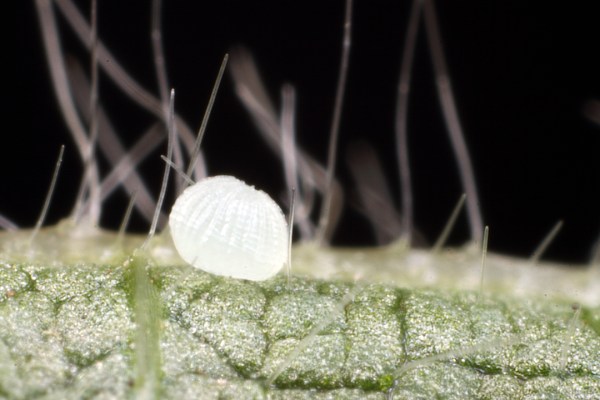
Anticarsia gemmatalis—velvetbean caterpillar


Chrysodeixis includens (=Pseudoplusia includens). Soybean looper (“oruga medidora falsa” in Argentina; “lagarta falsa-medideira” in Brazil) was until recently primarily a North American pest with the same southern occurrence as velvetbean caterpillar. In recent years, however, it has gained importance in Brazil and northern Argentina as well, with its impact magnified by the capacity to develop resistance against most of the insecticides that have been used to control it. The egg of this species is quite small (~10,000 eggs per gram) and are are irregularly spherical with a somewhat translucent, crystalline appearance. Like velvetbean caterpillar, eggs of this species are laid almost exclusively on the leaf undersides, but the moths exhibit a clear preference for the middle or upper canopy depending upon plant growth stage.

Chrysodeixis includens (= Pseudoplusia includens)—soybean looper


Helicoverpa zea. Soybean podworm is better known in other crops as corn earworm, cotton bollworm, or tomato fruitworm (a testament to its polyphagous nature), and in South America the common names are even more diverse depending on both crop and country (“gusano bellotero,” “gusano cogollero del algodón,” “gusano elotero,” “isoca de la espiga en maíz,” or simply “bolillero” in Argentina; “lagarta-da-espiga-do-milho” or “broca-grande-do-fruto in Brazil). While it has long been considered a secondary pest of soybean in North America, recent years have seen a marked increase in its incidence across the mid-south growing areas. Unlike the above two insects, larvae of this species feed not only on foliage but also directly on pods, typically breaching the pod wall and consuming the developing seeds inside. This method of feeding not only causes direct yield impacts but also affords some protection to larvae from insecticide applications.

Also unlike the first two insects, eggs of this species can be laid anywhere on the plant—leaves (upper or lower surface), petioles, stems, pods, and even flowers. The eggs are rather large compared to the other species shown here (~3,500 eggs per gram) and assume a distinctive barrel shape when laid on the leaf. The creamy-white coloration, often with a light brown ring below the apex, is also distinctive compared to the previous two species. Eggs laid on pods tend to be attached to trichomes (hairs) rather than the pod surface, in which case they take on an almost perfectly spherical shape.

Helicoverpa zea—soybean podworm
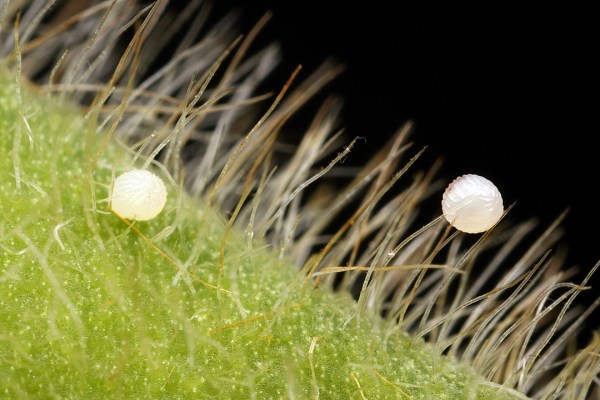
Helicoverpa zea eggs on soybean pod


Heliothis virescens. Like the previous species, tobacco budworm has only recently gained attention as a pest of soybean. This importance, however, seems to be confined to Brazil (where it is known as “lagarta-das-maçãs”), while in North America it is usually found in combination with H. zea at minor levels. This is bad news for South American farmers; like soybean looper, tobacco budworm has developed resistance to all the insecticides that have been used against it in significant quantities. The oviposition and feeding behaviors of this species are very similar to those of H. zea, with eggs again laid on all parts of the plant and being very similar in appearance to those of H. zea except their slightly smaller (approx. 5,000 eggs per gram). In practical terms, eggs and young larvae of H. virescens and H. zea can be reliably distinguished only through species-specific immunoassay (Greenstone 1995) or feeding disruption bioassay using a diagnostic concentration of Bacillus thuringiensis ( Bailey et al. 2001).

Heliothis virescens—tobacco budworm

Heliothis virescens eggs on soybean pod.

As with H. zea, H. virescens eggs laid on pods tend to be stuck to hairs and assume a spherical shape.

This H. virescens egg has apparently died—note the shriveling and uniform black coloration.


Spodoptera frugiperda. Fall armyworm is a minor pest of soybean that rarely reaches economically damaging levels. However, its incidence in South America (where it is called “oruga militar tarde in Argentina and “lagarta-militar” in Brazil) has increased somewhat with the adoption of no-till cultivation of soybean. The species prefers grass hosts, but when these are knocked down by applications of post-emergence herbicides the larvae then move onto the soybean plants and continue feeding. Unlike any of the above species, eggs are laid in distinctive masses that are covered by abdominal setae and wing scales for protection. These eggs are also small (~8,500 eggs per gram), exhibit much finer and more numerous ridges than the above species, and are often colored orange, pink, or light green.

Spodoptera frugiperda—fall armyworm

Individual eggs inside the mass are covered by abdominal setae and wing scales.


REFERENCES:

Bailey, W. D., C. Brownie, J. S. Bacheler, F. Gould, G. G. Kennedy, C. E. Sorenson & R. M. Roe. 2001. Species diagnosis and Bacillus thuringiensis resistance monitoring of Heliothis virescens and Helicoverpa zea (Lepidoptera: Noctuidae) field strains from the southern United States using feeding disruption bioassays. Journal of Economic Entomology 94 (1):76–85.

Greenstone, M. H. 1995. Bollworm or budworm? Squashblot immunoassay distinguishes eggs of Helicoverpa zea and Heliothis virescens (Lepidoptera: Noctuidae). Journal of Economic Entomology 88(2):213–218.

Copyright © Ted C. MacRae 2012

“Sunflower looper” – Rachiplusia nu

Rachiplusia nu ''oruga medidora'' | Santa Fe Province, Argentina

With a planted area approaching 20 million hectares, soybean has become Argentina’s most important agricultural crop.  Most of the planted area is located within the so-called “Humid Pampas” region of central Argentina (Buenos Aires, Córdoba, Santa Fe and Entre Rios Provinces), but the crop continues to expand in the northestern part of the country as well (Chaco, Tucumán and Salta Provinces).  More than any other crop in Argentina (except perhaps cotton), soybean is attacked by a tremendous diversity of insects.  The most important of these are the defoliating Lepidoptera, primarily species in the family Noctuidae.  Anticarsia gemmatalis (velvetbean caterpillar) is the most consistent and widespread defoliator, but an increasingly important species in Argentina is Rachiplusia nu (“oruga medidora del girasol,” or sunflower looper).

Eggs are laid primarily on the undersides of leaves

Rachiplusia nu belongs to the noctuid subfamily Plusiinae, the larvae of which can be recognized by having three pairs of prolegs and the “looping” manner by which they walk.  Chrysodeixis includens¹ (soybean looper), much better known because of its status as a major pest of soybean in the southeastern United States (and of growing importance in Brazil as well), also belongs to this group, and in fact the larvae of the two species are quite similar in appearance.  While R. nu is the primary plusiine species affecting soybean in Argentina, C. includens has appeared with increased frequency on soybean in Argentina in recent years, primarily in the more northern, subtropical growing regions adjacent to those areas in Brazil where it is now a major pest of the crop.

¹ Although still widely referred to in the literature as Pseudoplusia includens, the genus Pseudoplusia was synonymized under Chrysodeixis some eight years ago by Goater et al. (2003).  More recently the synonymy was accepted and formally applied to the North American fauna by Lafontaine and Schmidt (2010). 

Neonate larva on soybean

Despite their similarity of appearance, larvae of the two species can be rather conclusively distinguished by the shape of their spinneret (Angulo and Weigert 1975).  This is not a very convenient character for use in the field, however, leading to misidentifications in areas where the two species co-occur.  This is not an insignificant problem, as the two species exhibit differing susceptibilities to pesticides labeled for their control (C. includens especially having become resistant to a number of pesticides).  The result is control failures and subsequent application of even more pesticides in an effort by farmers to protect their crops.  While not as conclusive as the shape of the spinneret, in my experience R. nu larvae (at least older larvae) tend to have a darker, smoky-blue cast to the color (compared to the bright yellow-green of C. includens) and rather distinct patches of tiny black asperites on the thoracic ventors that are not apparent in C. includens.

Younger larvae consume only the lower surface between veins, resulting in ''window paning''

As the common name implies, soybean is not the only crop attacked by R. nu.  Early season infestations tend to occur in alfalfa and flax, after which the populations spread to soybean and sunflower.  The latter crop especially is heavily attacked by this insect, primarily in the drier western regions in Córdoba Province.  Dry conditions seem to favor an increase in the populations of this species, while moist conditions promote increased incidence of pathogenic fungi that are very effective at suppressing R. nu larval populations.

Older larvae consume entire tissues but still avoid veins, resulting in a ''skeletonized'' appearance

Like many defoliating lepidopterans, eggs tend to be laid on the undersides of leaves, where the larvae begin feeding after they hatch.  Young larvae consume only the lower epidermal layer of the foliage between the veins, leading to an appearance in the foliage called “window paning”.  As they larvae grow they begin consuming the entire tissue layer but still preferentially avoid vascular tissue, resulting in a skeletonized appearance to the foliage.  A single larvae can consume more than 100 cm² of soybean foliage, which translates to several trifoliates.  As a result, it doesn’t take many larvae to cause significant loss of foliage on the plant.  Soybean has the ability to compensate for loss of foliage due to increased photosynthesis in lower foliage exposed by feeding in the upper part of the plant, but losses exceeding around 15% during the later reproductive stages of plant growth are enough to significantly reduce yields (and it is during these reproductive stages of growth that R. nu infestations tend to occur).

Rachiplusia nu adult | Buenos Aires Province, Argentina

Rachiplusia nu is the most widely distributed of three South American species in the genus, occurring in Argentina, Bolivia, Brazil, Chili, Paraguay, Peru and Uruguay, while a fourth species, R. ou, is widely distributed throughout North and Central America (Barbut 2008).  Unlike R. nu, its North American counterpart R. ou has not gained status as a pest of soybean or other crops.

In a BitB Challenge first, nobody was able to correctly ID the larva of this species beyond the level of subfamily.  This, despite the huge Argentina hint bomb that I dropped when I posted the challenge and my well-known vocation as a soybean entomologist.  I figured the answer would be forthcoming as quickly as one could Google the search phrase “Argentina soybean Plusiinae” (which, in fact, shows the following except for the very first result “Pseudoplusia includens is the most common soybean Plusiinae in the Americas (Herzog, 1980). Rachiplusia nu in southern Brazil, Uruguay and Argentina, and…” [emphasis mine]). Most participants guessed, predictably, soybean looper, while only a few were fooled into guessing Geometridae (the true loopers, and distinguished by having only two pairs of prolegs).  As a result, I’m not declaring a winner for ID Challenge #14, although the appropriate points will still be awarded (when I get around to assigning them, that is.  Hey, I’m working in Argentina right now—it was enough for me just to get this post out!).

REFERENCES:

Angulo, A. O. and G. T. H. Wiegert. 1975. Estados inmaduros de lepidópteros noctuidos de importance economica en Chile y claves para su determinación. Sociedad Biologico Concepción, Publicación Especial 1:1–153.

Barbut, J. 2008. Révision du genre Rachiplusia Hampson, 1913 (Lepidoptera, Noctuidae, Plusiinae). Bulletin de la Société entomologique de France113(4):445–452.

Goater, B., L. Ronkay and M. Fibiger. 2003. Noctuidae Europaeae. Vol. 10, Catocalinae, Plusiinae. Entomological Press, Sorø, 452 pp.

Lafontaine, J. D. and B. C. Schmidt. 2010. Annotated check list of the Noctuoidea (Insecta, Lepidoptera) of North America north of Mexico. ZooKeys 40: 1–239.

Copyright © Ted C. MacRae 2011

Brazil Bugs #16 – Royal Moth Larva

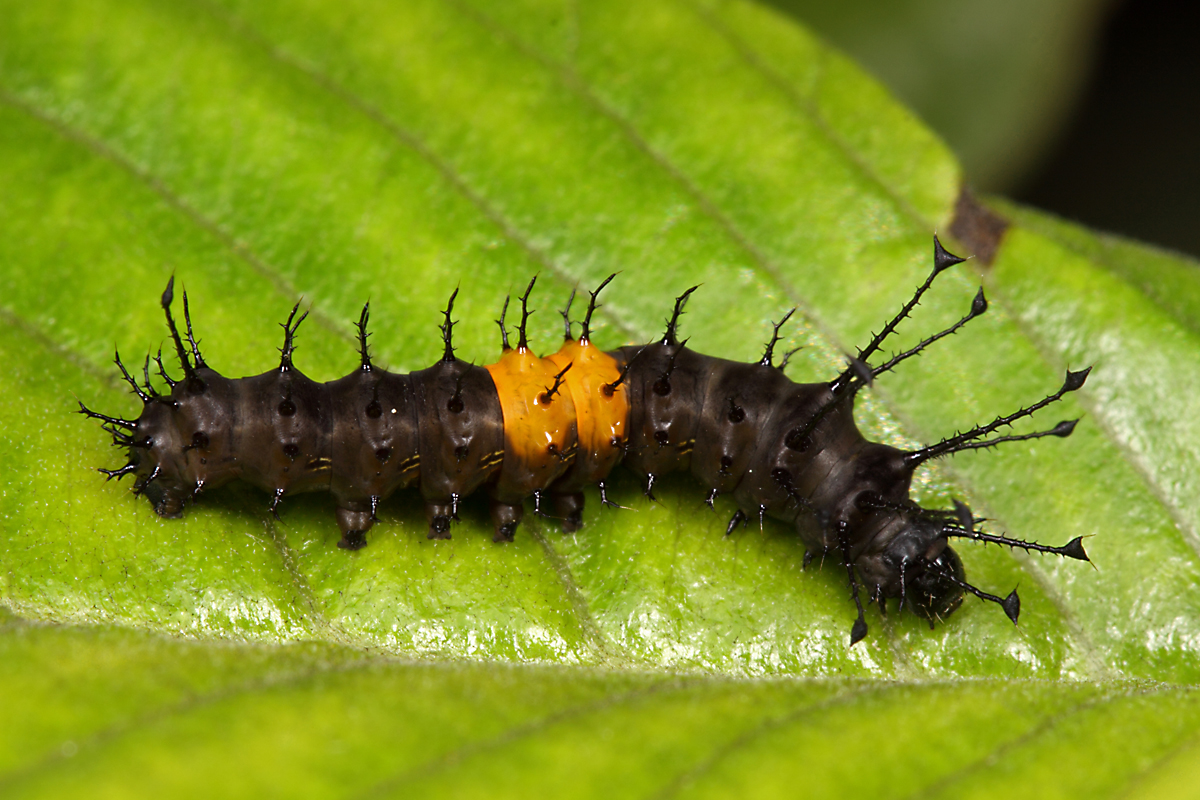
Citheronia laocoon? 1st instar larva | Campinas, Brazil

I was sure Super Crop Challenge #6 would be a win for the house, but Troy Bartlett scored an impressive points sweep by correctly deducing that the structures shown were the spines of an early instar caterpillar of “something akin to a hickory horned devil (Citheronia regalis).”  I found this caterpillar feeding on the foliage of a small tree in the Ciudad Universitaria (Distrito Barão Geraldo) area of Campinas, Brazil last January.  I must confess that I spent considerable time trying to identify it myself before I finally threw in the towel and called on the experts for help.  The spines made me think it must be some kind of nymphalid butterfly larva, although I had never seen such “fly swatter” clubs at the ends of the spines, so I sent the photo to Phillip Koenig, a local butterfly expert who has collected extensively in Ecuador.  He, too, was puzzled and forwarded the photo to Charley Eiseman, who himself didn’t know what to make of it and forwarded it on to Keith Wolfe, a lepidopterist who specializes in butterfly immatures.  After stumping his Brazilian contacts, Keith had the idea that perhaps it wasn’t a late-instar larva—as we all had assumed (this larva was a good 15–20 mm in length), but rather one in an early stadium.  A quick search of several standard websites revealed this to be the L1 or L2 larva of a species of Citheronia (Saturniidae, Ceratocampinae).  To support his ID, he provided links to larval photos of C. splendens (Arizona) and C. lobesis (Central America).  The L1 larva of both of these species bears the same “fly swatter” spines, and the latter is remarkably similar in color pattern as well.

In trying to determine what species of Citheronia occur in southeast Brazil, I came across this link with photos of a caterpillar from southern Brazil—the L1 looking nearly identical—that was eventually identified as the common Brazilian species C. laocoon.  Troy suggested C. brissotii—another good possibility as that species is found from southeastern Brazil through Uruguay to Argentina.  However, in perusing a number of online sources, it appears there are several other species of Citheronia that also occur in Brazil, so a species ID for the larva in this photo may not be possible.

Troy’s win vaults him into 3rd place in the current session overalls, but steady Tim Eisele took 2nd place with 6 pts and takes over the session lead.  Newcomer Roy rounds out the podium in 3rd place with 5 points.  Dave’s pity points are nothing to sneeze at, as they helped him retain sole possession of 2nd place in the overall standings (let that be a lesson to those who don’t play because they’re “stumped”!).  There will be at least two more challenges in the current session before a winner is crowned, so look for an opportunity to shake up the standings in the near future.

Copyright © Ted C. MacRae 2011

Monday Moth – Polka-dot Wasp Moth

Syntomeida epilais - polka-dot wasp moth

It’s been a while since I’ve done a Monday Moth post, so I thought I’d feature one of the prettier specimens in my very limited Lepidoptera collection.  This is Syntomeida epilais (polka-dot wasp moth), one of four species in the genus that occurs in the United States.  This particular specimen was collected by me way back in the mid-1980s (I was not quite yet the discriminating beetle collector that I am now) in Everglades National Park (yes, I had a permit).  The bright, contrasting coloration obviously screams aposematism (warning coloration), and in fact the tissues of the adult moths of this species are chock-full of several cardiac glycosides sequestered by the larva from its now preferred food plant, oleander (Nerium oleander).  Add to it their somewhat wasp-like appearance, and there should be no question to any would-be predator that these moths are a bad idea.  Wasp moths are related at the tribal level to another group of wasp-like moths called maidens which are restricted to the Old World.  I featured one of these from South Africa last year in the post, Monday Moth – Simple Maiden (Amata simplex).

If the cardiac gycosides stored in the tissues of this moth aren’t enough to cause gastric distress, trying to digest the higher taxonomic history of this group surely will.  Back in my school days, this moth belonged to the family “Ctenuchidae.”  As best I understand it, this group was later subsumed into the tiger moth family “Arctiidae” – itself later subsumed within the borg of all moth families, the Noctuidae.  In the most recent classification I’ve found, the arctiine moths have been pulled back out of the Noctuidae and combined with the former “Lymantriidae” (propelled to infamy by the gypsy moth) to form the family Erebidae (Lafontaine and Schmidt 2010).  Are you ready to purge yet? It’s still not clear to me whether this latest incarnation represents a consensus monophyletic unit, but it really doesn’t matter – whenever I see wasp moths, maidens, and especially the ctenucha moths that are so common in my area on goldenrod flowers during the fall, “ctenuchid” will still be the first name that comes to my mind.

REFERENCE:

Lafontaine, J. D. and B. C. Schmidt.  2010.  Annotated check list of the Noctuoidea (Insecta, Lepidoptera) of North America north of Mexico.  ZooKeys 40:1–239.  doi: 10.3897/zookeys.40.414

Copyright © Ted C. MacRae 2011


Brazil Bugs #1

ID Challenge #3 update: I knew this would be a hard one, and so far nobody has figured this one out (only one commenter got the right order!).  I’ve released the comments gotten so far so you can see where things stand, and maybe with the additional information (and my pointing out an important clue) it will be enough for one of you to arrive at a full ID.  Further comments are still being moderated until I decide to close the challenge.  Right now the points are there for the taking!


This past Monday I embarked on an extended business trip to Brazil.  “Wow, Brazil!” – you say, and while getting to travel to an exotic tropical locality on my company’s dime definitely rocks, I do have to justify the trip by actually working.  Add that to the time involved with planes, automobiles, and hotel transfers, and there is precious little time for more esoteric activities such as photographing insects.  It is Brazil, however, and summer at that, so whatever time does become available over the next ten days, I’ll be on it!  I’m stationed in Campinas, about 2 hours north of São Paulo, and this evening I had my first opportunity to break out the camera and do a little exploring around the hotel grounds during the waning hours of daylight. I’m not normally one to take short walks just looking for any random insect to photograph, but hey – it’s Brazil!  I also don’t normally like to post photographs of insects without knowing much about them – especially their identity. But hey, it’s Brazil!  I think I’ll be lucky to figure out most things to family, although I might be able to drill down a little further on occasion.  With that prelude, I hope you’ll indulge me these random postings over the next 10 days or so, primarily photographs but perhaps accompanied by a little bit of text.

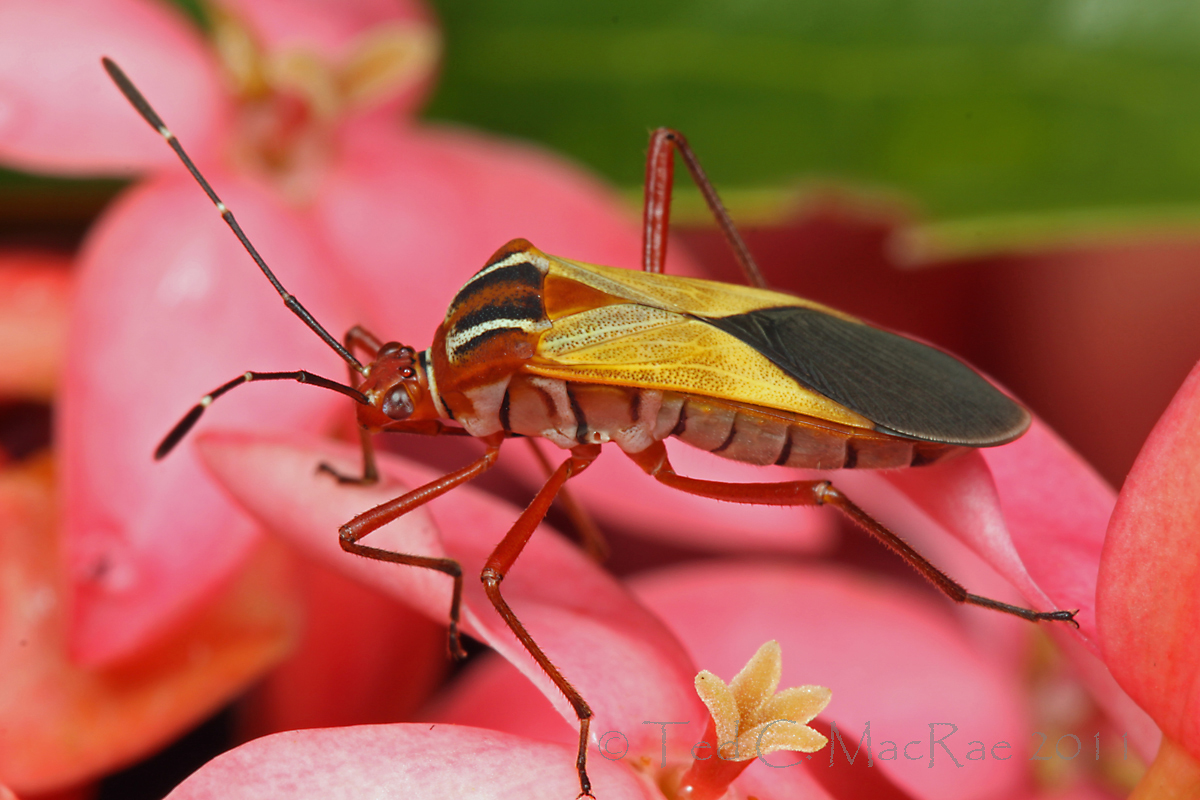
Coreidae?

At first I thought this was a member of the hemipteran family Pyrrhocoridae (red bugs), as some North American species have similar coloration; however, members of that family apparently lack ocelli, which this insect clearly possesses. This would seem to indicate instead some species of Lygaeidae (seed bugs), but the forewing membrane with numerous veins arising from a transverse basal vein and presence of what appears to be a distinct metathoracic scent gland opening suggest instead some “unleaf-footed” species of leaf-footed bug (Coreidae). Whatever its identity, I would imagine it is quite distasteful, based on what clearly seems to be aposematic coloration and the fact that there were numbers of these bugs hanging out quite conspicuously on these flowers.

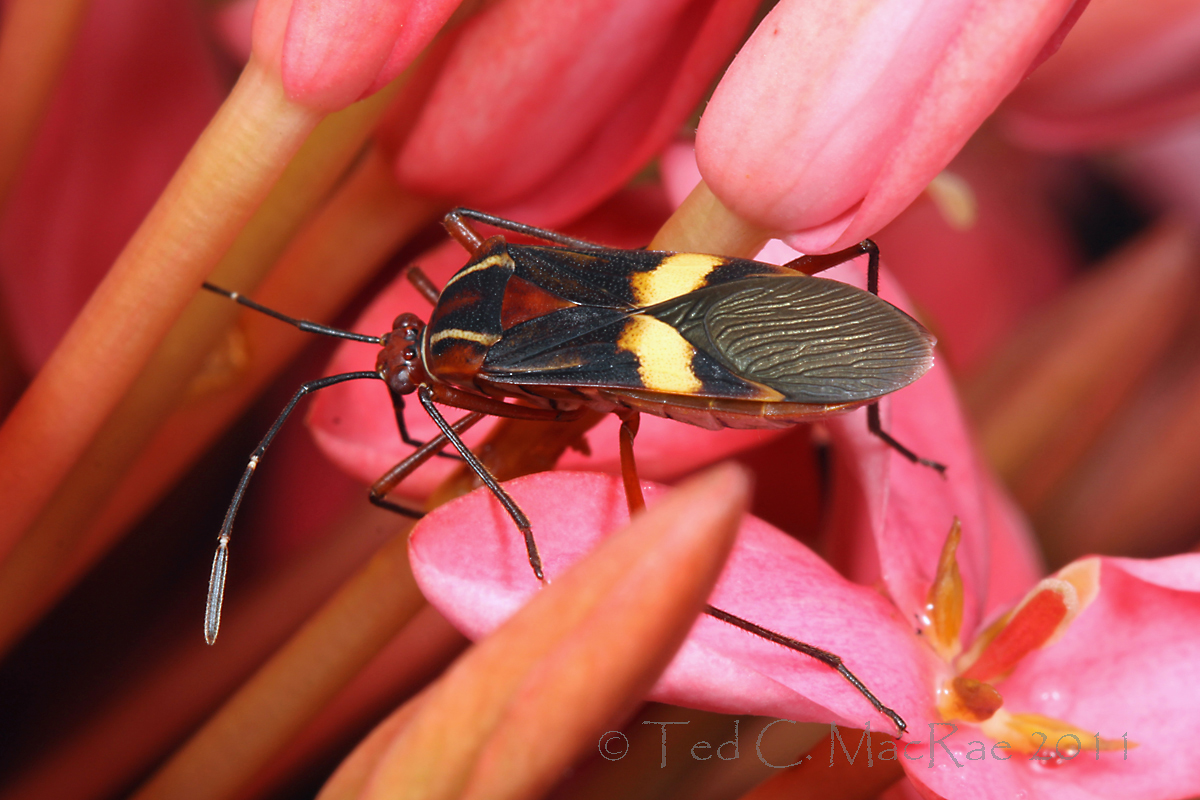
Same species?

This individual was differently colored than the others, but otherwise it seemed structurally and behaviorally identical.  Is it merely a highly melanized individual?  Maybe a case of sexual dimorphism, and I only saw this one individual of one of the sexes?  Maybe it truly is a different species – it is Brazil, afterall!

Pseudoplusia includens?

Daylight began to slip away much too soon, and I was about to pack it up when  I noticed some blurs at the flowers.  I realized that moths had begun to visit the flowers in the obscurity of dusk and became determined to photograph one, despite the fact that they never actually landed on the flowers but hovered in front of them instead.  It was quite difficult to even get them framed in the viewfinder, and on those few occasions when I managed to do this it was all but impossible to spend any time trying to focus – I used the lamp on the flash unit to help me see the moth, then just framed and quickly took the shot.  This one actually turned out not too bad – a little bit of blur in the wings but otherwise acceptable enough to let me tentatively identify it as Pseudoplusia includens (soybean looper).  Brazil is well on its way to becoming the world’s largest producer of soybean, and the caterpillars of these moths are enjoying the bounty!

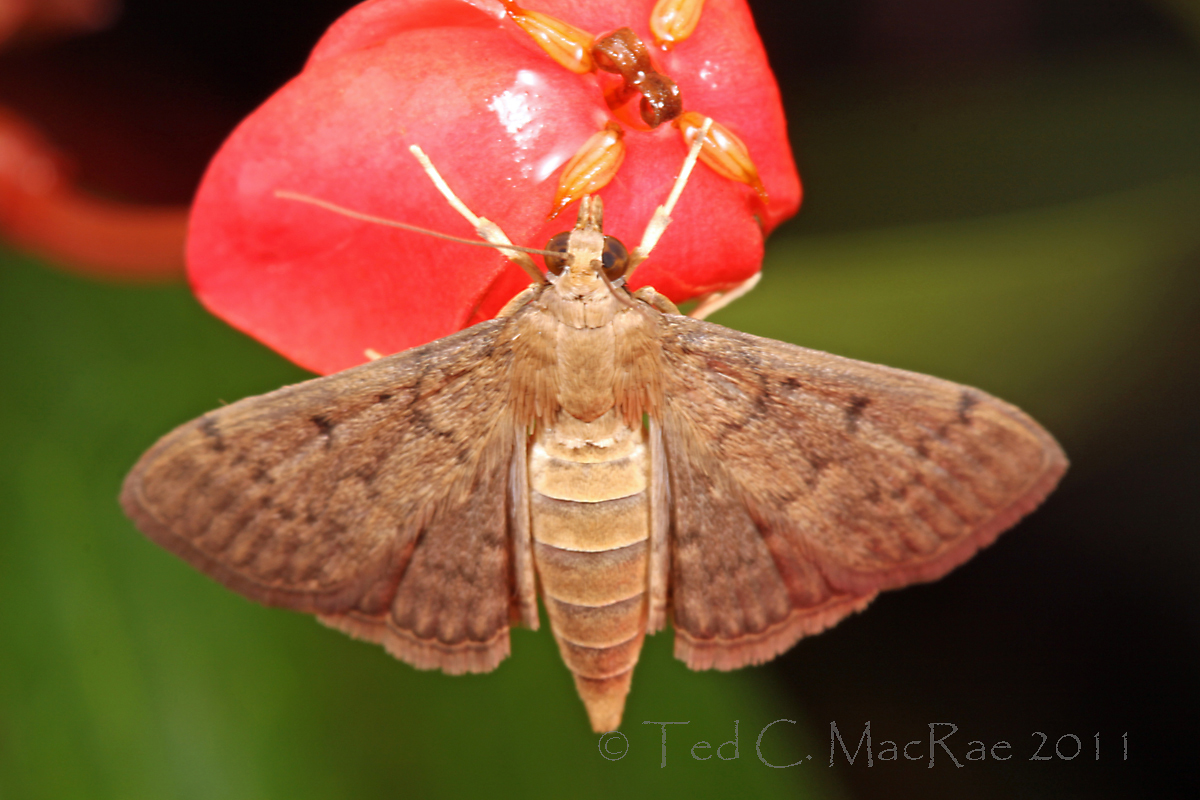
Family Crambidae, possibly Herpetogramma phaeopteralis (ID by Chris Grinter)

I saw one last moth before the final traces of daylight disappeared – I don’t have any idea about its identity, but it’s a pretty picture nonetheless.  It has the generic look of the large family Noctuidae, so that’s what I’m gonna go with until somebody tells me differently.  Edit 1/20/11 – Somebody just told me differently!  According to Chris Grinter, this is a species of Crambidae, possibly Herpetogramma phaeopteralis (tropical sod webworm).  Thanks, Chris!

I don’t know the name of the plant whose flowers these insects were visiting, but the hotel staff has promised to ask their gardener in the morning and let me know – now that’s service!

Copyright © Ted C. MacRae 2011

BitB Top 10 of 2010

Welcome to the 3rd Annual BitB Top 10, where I pick my 10 (more or less) favorite photographs of the year.  My goal for 2010 was to continue the progress that I began the previous year in my quest to become a bona fide insect macrophotographer.  I’m not in the big leagues yet, but I have gotten more comfortable with using my equipment for in situ field photographs and am gaining a better understanding of lighting and the use of flash.  I also began experimenting with different lighting techniques (e.g. white box) and diffusers and am putting more effort into post-processing techniques to enhance the final appearance of my photographs.  I invite you to judge for yourself how successful I’ve been toward those goals by comparing the following selections with those from 2009 and 2008 – constructive feedback is always welcome:


Best Tiger Beetle

Cicindela denverensis - green claybank tiger beetle

From ID Challenge #1 (posted December 23).  With numerous species photographed during the year and several of these dramatic “face on” shots, this was a hard choice.  I chose this one because of the metallic colors, good focus throughout the face, and evenly blurred “halo” of hair in a relatively uncluttered background.


Best Jewel Beetle

Buprestis rufipes - red-legged buprestis

From Special Delivery (posted July 13).  I didn’t have that many jewel beetles photos to choose from, but this one would have risen to the top no matter how many others I had.  The use of a white box shows off the brilliant (and difficult-to-photograph) metallic colors well, and I like the animated look of the slightly cocked head.


Best Longhorned Beetle

Desmocerus palliatus - elderberry borer

From Desmocerus palliatus – elderberry borer (posted November 18).  I like the mix of colors in this photograph, and even though it’s a straight dorsal view from the top, the partial dark background adds depth to the photo to prevent it from looking “flat.”


Best “Other” Beetle

Enoclerus ichneumoneus - orange-banded checkered beetle

From Orange-banded checkered beetle (posted April 22).  The even gray background compliments the colors of the beetle and highlights its fuzziness.  It was achieved entirely by accident – the trunk of the large, downed hickory tree on which I found this beetle happened to be a couple of feet behind the twig on which it was resting.


Best Non-Beetle Insect

Euhagenia nebraskae - a clearwing moth

From Euhagena nebraskae… again (posted October 21).  I photographed this species once before, but those photos failed to capture the boldness of color and detail of the scales that can be seen in this photo.


Best “Posed” Insect

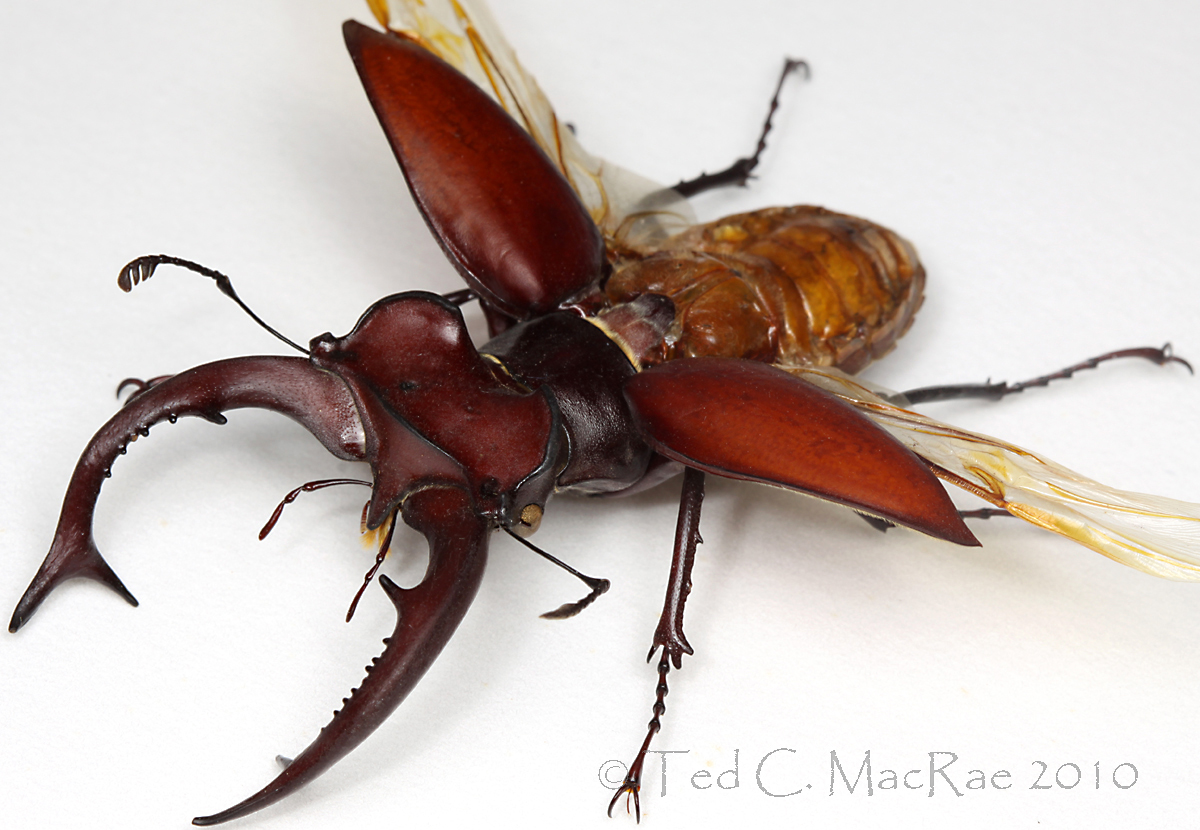
Lucanus elaphus - giant stag beetle

From North America’s largest stag beetle (posted December 30).  I’ve just started experimenting with photographing posed, preserved specimens, and in fact this male giant stag beetle represents only my second attempt.  It’s hard to imagine, however, a more perfect subject than this impressively stunning species.


Best Non-Insect Arthropod

Scolopendra heros - giant desert centipede

From North America’s largest centipede (posted September 7).  Centipedes are notoriously difficult to photograph due to their elongate, narrow form and highly active manner.  The use of a glass bowl and white box allowed me to capture this nicely composed image of North America’s most spectacular centipede species.


Best Wildflower

Hamamelis vernalis - Ozark witch hazel

From Friday Flower – Ozark Witch Hazel (posted March 26).  The bizarre form and striking contrast of colors with the dark background make this my favorite wildflower photograph for the year.


Best Non-Arthropod

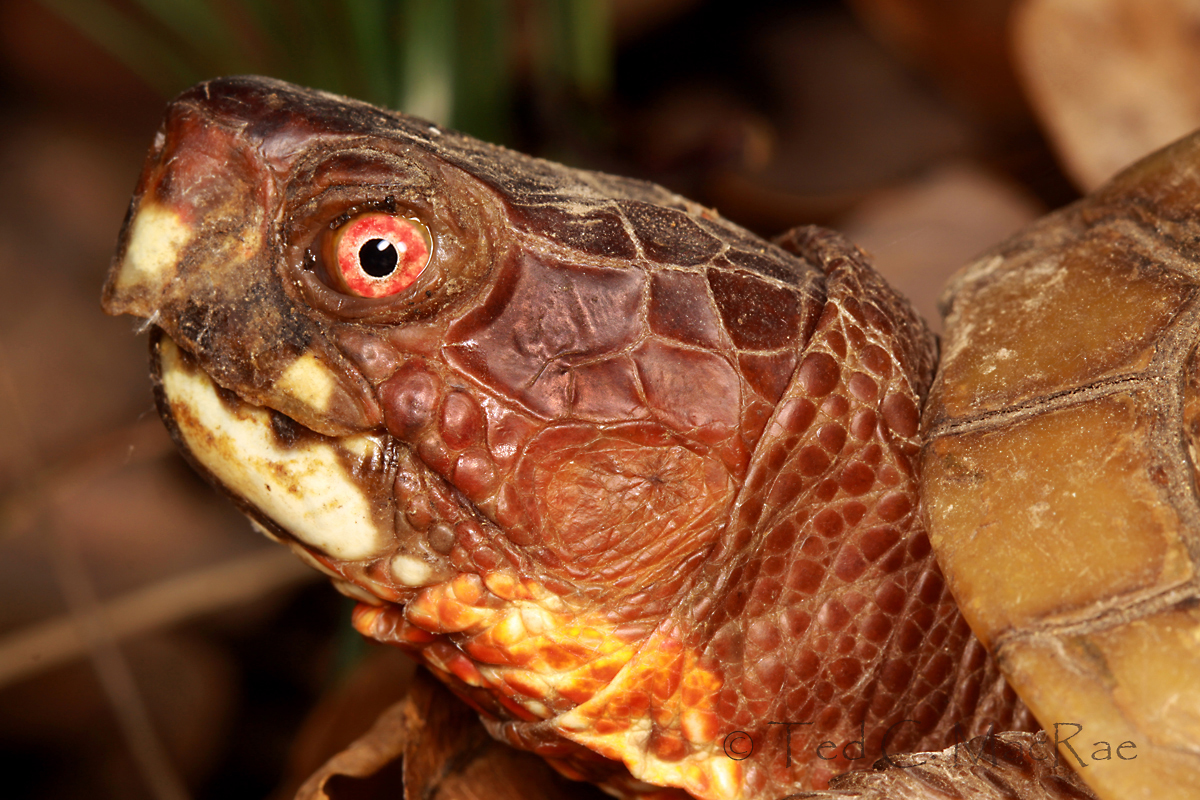
Terrapene carolina triunguis - three-toed box turtle

From Eye of the Turtle (posted December 10).  I had a hard time deciding on this category, but the striking red eye in an otherwise elegantly simple photograph won me over.  It was also one of two BitB posts featured this past year on Freshly Pressed.


Best “Super Macro”

Phidippus apacheanus - a jumping spider

From Jeepers Creepers, where’d ya get those multilayered retinae? (posted October 5).  I’m not anywhere close to Thomas Shahan (yet!), but this super close-up of the diminutive and delightfully colored Phidippus apacheanus is my best jumping spider attempt to date.  A new diffuser system and increasing comfort with using the MP-E lens in the field at higher magnification levels should allow even better photos this coming season.


Copyright © Ted C. MacRae 2011

Tiny little slivers of life

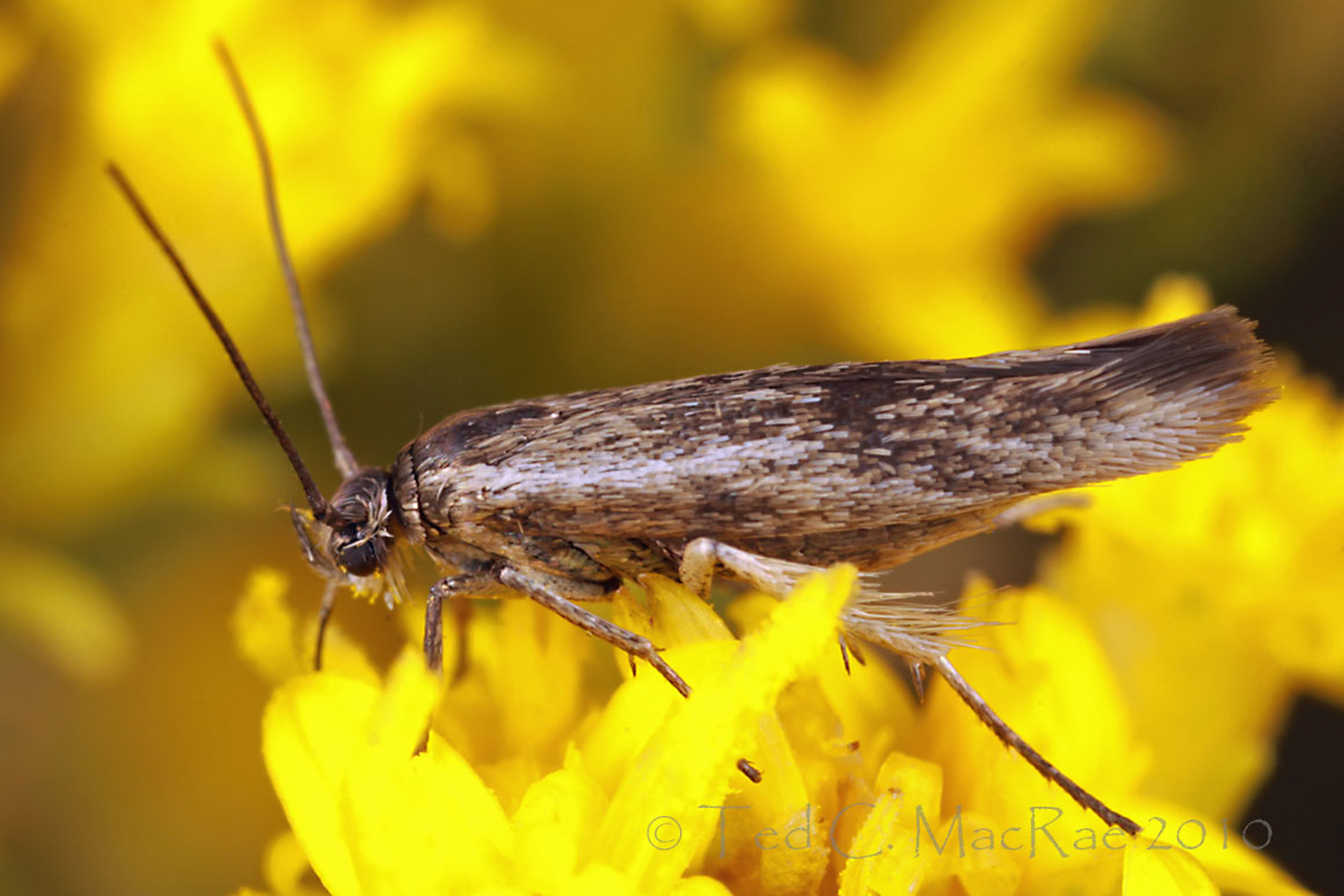
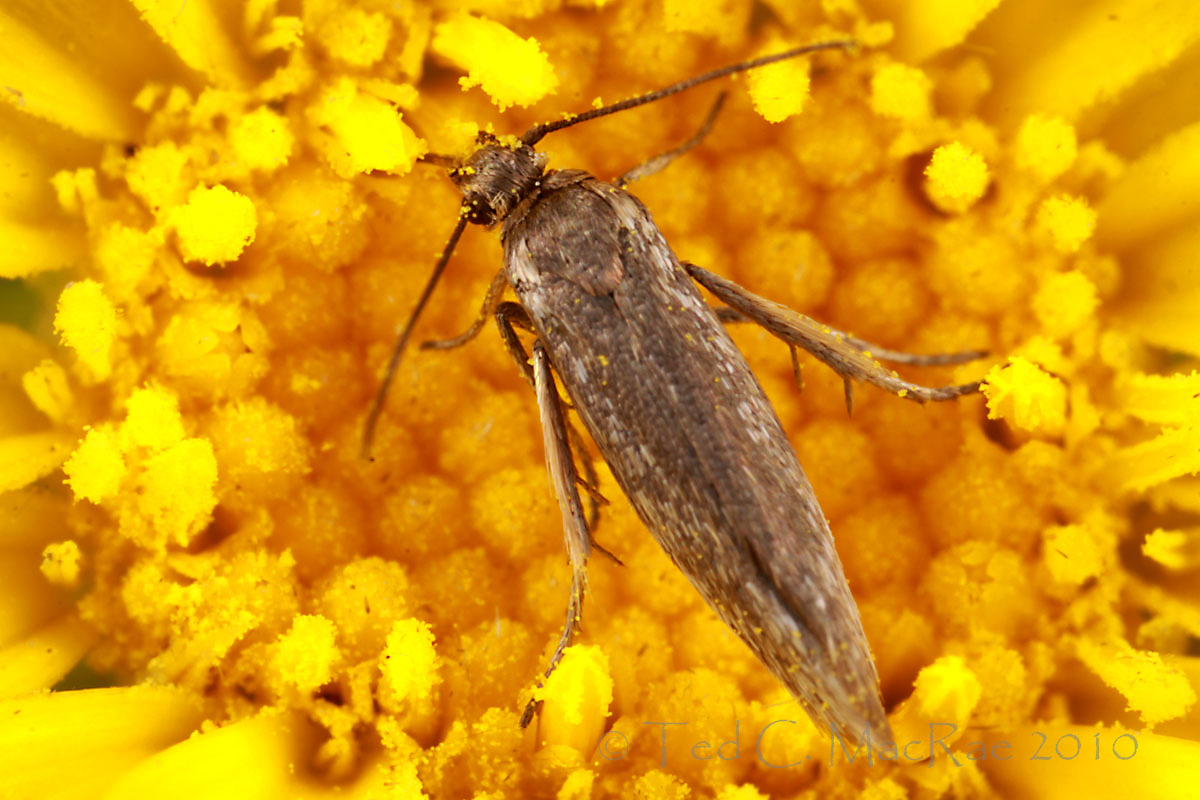
Day 1 of the 2010 Fall Tiger Beetle Trip™ had been an unqualified success.  Not only did we achieve our top goal of the trip – seeing good numbers of the recently discovered South Dakota population of Cicindela pulchra (beautiful tiger beetle), but we also saw C. nebraskana (prairie long-lipped tiger beetle) and a variety of other interesting insects in the nearby Nebraska Pine Ridge.  For Day 2, our destination was Monroe Canyon on the north face of the Pine Ridge escarpment, but on the way there we decided to check out some roadside clay banks in the town of Crawford.  Despite their appearance as perfect tiger beetle habitat, all we saw was a single individual of the normally ubiquitous C. purpurea audubonii (Audubon’s tiger beetle).  The area looked quite dry, and in fact there was little insect life of any kind present… or so I thought.  As I stood there looking out onto the embankment while deciding my next move, I glanced down at a nearby composit shrub with small yellow flowers.  These are often attractive to a variety of beetles (Crossidius longhorned beetles would be nice!), but I saw none.  I started to move on, but before I did I noticed some tiny little slivers of life moving about on the flowers.  Kneeling down to take a closer look, I saw that they were moths – in fact, they were some of the smallest moths that I had ever seen, and the shrub was covered with them.  Now, I may pride myself on my broad-based entomology knowledge, but when it comes to microlepidopterans there is a decided gap in that knowledge.  I really had no idea what they might be, but for some reason the combination of their unknown identity and tiny size became for me an irresistible photographic challenge (made truly challenging by the unrelenting prairie wind).  I’m fortunate that Chris also became distracted photographing something – any other collecting partner surely would have grown impatient waiting for me to finally be satisfied I’d gotten some good shots.

As far as I can tell, these moths represent something in the genus Scythris or perhaps Neoscythris.  These are the so-called flower moths, placed either in the family Scythrididae (Microleps.org and Moth Photographers Group) or subfamily Scythridinae of the Xylorictidae (BugGuide.net and Tree of Life).  According to Microleps.org, the life histories of relatively few scythridid species have been determined – the few that have showing a preference for feeding (usually internally, e.g., as leaf miners) on members of the Asteraceae.  There are images of several species of Scythrididae at the aforementioned sites; however, it’s a large group, and the individuals in these photos don’t appear to match any of the illustrated species.  Perhaps Chris Grinter or some other microlepidopterophile will chance upon this post and either confirm or further elucidate the identity of these individuals. 

Photo Details: Canon 50D w/ MP-E 65mm 1-5X macro lens (ISO 100, 1/250 sec, f/13), Canon MT-24EX flash w/ Sto-Fen + GFPuffer diffusers. Typical post-processing (levels, minor cropping, unsharp mask).

Copyright © Ted C. MacRae 2010

Euhagena nebraskae… again

Euhagena nebraskae - male

Earlier this year I showed a photograph of a mating pair of the clearwing moth (family Sesiidae) species, Euhagena nebraskae – seen last year in the Gypsum Hills of south-central Kansas on a cold, early-October day.  It was an okay photograph, made interesting primarily by nicely showing the high degree of sexual dimorphism seen in these moths.  Still, I wasn’t completely happy with the photo, wishing I had gotten a closer photograph of just the male with his highly bipectinate antennae and wispy, white thoracic tufts.  I got my wish on the first day of my recent fall tiger beetle collecting trip, seeing just this single male in the Pine Ridge area of northwestern Nebraska.  Despite the relatively warmer temperatures, he perched cooperatively atop a dried flower head and allowed me to photograph him to my heart’s content.

p.s. this one you really should click on to see the larger version, because the hair-like thoracic scales and flattened marginal scales on the wings are quite remarkable.

Photo Details: Canon 50D w/ 100mm macro lens (ISO 100, 1/250 sec, f/16), Canon MT-24EX flash w/ Sto-Fen + GFPuffer diffusers. Typical post-processing (levels, minor cropping, unsharp mask).

Copyright © Ted C. MacRae 2010