Haldeman’s shieldback katydid (Pediodectes haldemani)

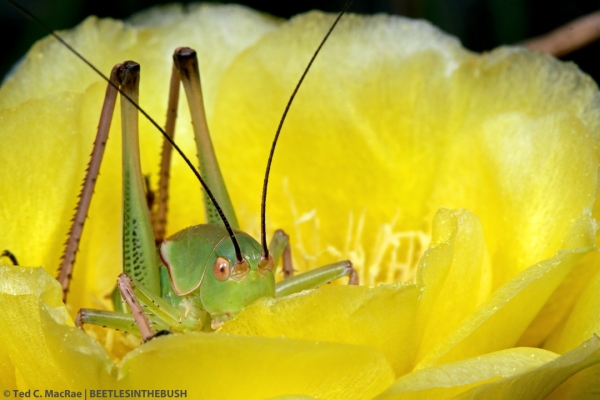
During my visit to Gloss Mountain State Park (Woodward Co., Oklahoma) this past June, I found an area of prickly pear cactus (Opuntia macrorhiza) on the west flats below the main mesa. A few days earlier I had seen cactus beetles in the genus Moneilema (family Cerambycidae) associated with these plants at another nearby location, so I began checking the plants to look for any sign of these beetles. Sadly I did not find any, but the plants were in full bloom and were being visited by flower longhorns in the genus Typocerus (mostly just T. octonotatus). After having collected a small series, I approached one particular cactus plant and found this enormous katydid sitting inside the flower. Katydids normally secrete themselves in a more cryptic manner, using foliage backdrops with which they can blend owing to their green coloration. This particular katydid, however, not only lacked the leaf-like wings that many species possess but also exhibited rather strikingly contrasting dark red markings over its body that made it quite conspicuous as it sat in the yellow flower. I approached carefully so as not to spook it and took a few photographs, but as I did so it became apparent to me that it did not find my actions alarming and would allow me to take whatever photographs I wished.
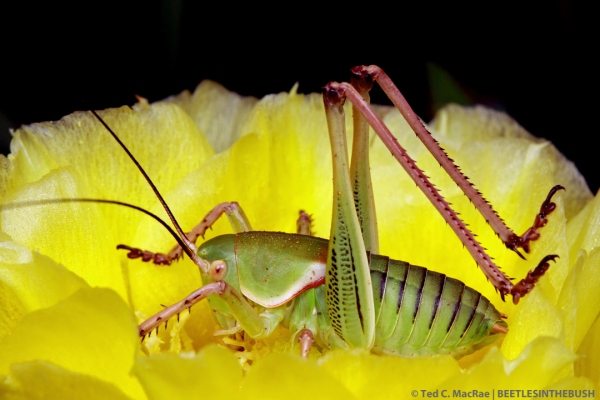
Pediodectes haldemani in flower of Opuntia phaecantha | Gloss Mountains State Park, Woodward Co., Oklahoma

Pediodectes haldemani on Opuntia macrorhiza | Gloss Mountain State Park, Woodward Co., Oklahoma

Almost whatever photographs, that is. I really wanted to get a super-close, full-frontal shot of the face, but it sat unbudgingly in the flower with its face buried in the stamens and masked by the inner petals of the flower. I could have tried peeling away the petal, but I was sure that fiddling my fingers that close to its face would spook it, and even if I did manage to peel back the petal then I would still have stamens blocking the view that I wanted. In the end, I decided that this slightly more distant shot of the whole body was a pleasing enough composition.
Pediodectes haldemani

Peek-a-boo!

I presume this individual represents Haldeman’s shieldback katydid (Pediodectes haldemani) in the family Tettigoniidae. This is not surprising, since the type locality of the species (Barber Co., Kansas) is just a few miles to the north and right smack dab in the middle of the Great Plains distribution of the species. BugGuide mentions that species identification from photos alone can be difficult in the genus Pediodectes, as color patterns vary individually and with age, and also since adults are wingless it can be difficult to tell if an individual is a nymph or adult. Nevertheless, distribution maps in Singing Insects of North America show three species that can potentially occur in this part of Oklahoma, and the photos shown here are a dead ringer for P. haldemani. I am also apparently not the first person to photograph this species at Gloss Mountain State Park.

Copyright © Ted C. MacRae 2013

The ever-increasing diversity of Oklahoma beetles

My idea to return to Oklahoma’s Gloss Mountains this spring actually began taking shape during last year’s fall visit to the area, when I found a single Chrysobothris octocola adult on a dead mesquite (Prosopis glandulosa) branch. While common across the southwestern U.S. in association with this plant, its occurrence in the Gloss Mountains represented a northeastern range extension and new state record for Oklahoma! On that same trip I also collected an interesting beetle in the family Rhipiphoridae representing the species Toposcopus wrightii—also not previously recorded in the literature from Oklahoma. Combined with finding Acmaeodera macra here the previous year, it was becoming clear to me that area held good potential for other more typically southwestern species of wood boring beetles. Although I had by then visited the area several times, most of these visits were more focused on tiger beetles rather than wood boring beetles. If I could find such interesting species of wood boring beetles when I wasn’t focused on them, imagine what I might find if I timed a visit in late spring when such species should be at their peak of adult activity.

Chrysobothris quadrilineata | Gloss Mountains State Park, Major Co., Oklahoma

Chrysobothris quadrilineata | Gloss Mountains State Park, Major Co., Oklahoma (new state record).

Of course, success came quickly during this early June visit. I immediately found C. octocola common on the mesquite and would collect a nice series of voucher specimens before the day was over, and the second species I encountered, also on mesquite, was the longhorned beetle Plionoma suturalis—another new state record! I spent a bit of time working the mesquite, and when I had collected a sufficient series of both species, I turned my attention to the eastern red-cedars (Juniperus virginiana) in the area. Actually, I had had my eye on the red-cedars since last fall, when I noticed that nearly every tree had dead branches mixed in amongst the living branches. Closer examination revealed the workings of jewel beetle larvae in all of these dead branches, and a few larvae typical of the genus Chrysobothris were cut from one of the branches. A common species in the Great Plains associated with Juniperus is C. ignicollis, but these larvae looked rather big to represent that species, so I bundled up some dead branches and brought them back home for rearing but forgot to check on them before I left on this trip. At any rate, I walked up to one of the red-cedars, placed my beating sheet under a dead branch, gave the branch a whack with the handle of my net, and onto the sheet fell a rather robust Chrysobothris that I didn’t immediately recognize. I knew it wasn’t C. ignicollis, a much smaller species that I have collected on numerous occasions, so I thought maybe it could be C. texana, another western Juniperus-associate that I’ve collected less commonly. Still, the robust body and broad, distinct elytral and pronotal ridges had me second guessing that identification (especially after I found some individuals that looked more like what I remembered C. texana looking like). Over the next two days I beat hundreds (literally!) of dead juniper branches, finding many C. ignicollis but every now and then getting also one of these big, robust individuals.

Chrysobothris quadrilineata

Adults were beaten from dead branches on live Juniperus virginiana (new adult host).

After returning home, I checked my heavily annotated copy of Fisher (1942) and quickly determined the robust specimens as representing C. quadrilineata—a rather uncommon species and one that I’d never collected before. Described by LeConte in 1860 from New Mexico and recorded early in the 20th century from Arizona, Nevada and California, it has in more recent years been found to occupy a rather wide distribution across the western U.S., including Texas (Barr & Westcott 1976), Colorado, Oregon, South Dakota (Nelson et al. 1982), and Utah (Nelson 1987). Notice one state that is not in that list—Oklahoma! That’s right, another new state record! I later found photographs of this species on BugGuide taken in the very same area a year earlier (7 June 2012).

Chrysobothris quadrilineata

Adults also emerged from dead J. virginiana branches collected Sept. 2012 (first reported larval host).

When I returned home, I also checked the rearing cans and found several adults had emerged from the branches I collected last September. The only host associations that have been recorded for this species are adults collected on Juniperus californica (Linsley & Ross 1940) and J. pachyphloea [= J. deppeana] (Barr & Westcott 1976). Thus, J. virginiana not only represents a new host record for the species but is also the first known larval host. Considering how broadly distributed across the western U.S. this species is, it seems likely that it utilizes a number of Juniperus spp. throughout its range.

REFERENCES:

Barr, W. F. & R. L. Westcott. 1976. Taxonomic, biological and distributional notes of North American Chrysobothris, with description of a new species from California (Coleoptera: Buprestidae).  The Pan-Pacific Entomologist 52(2):138–153.

Fisher, W. S. 1942. A revision of North American species of buprestid beetles belonging to the tribe Chrysobothrini. U. S. Department of Agriculture, Miscellaneous Publication 470, 1–275.

Linsley, E. G. & E. S. Ross. 1940. Records of some Coleoptera from the San Jacinto Mountains, California.  The Pan-Pacific Entomologist 16(2):75–76.

Nelson, G. H. 1987. Additional notes on the biology and distribution of Buprestidae (Coleoptera) in North America, II.   The Coleopterists Bulletin 41(1):57–65.

Nelson, G. H., D. S. Verity & R. L. Westcott. 1982. Additional notes on the biology and distribution of Buprestidae (Coleoptera) of North America.  The Coleopterists Bulletin 35(2) [1981]:129–152.

Copyright © Ted C. MacRae 2013

“Rare jewel beetles discovered in Mexico by team of scientists!”

I hope you’ll excuse the hyperbolic title, but such has been my impression with some of the headlines I’ve seen recently in the popular media regarding newly described insect taxa in various parts of the world. The “discovery” of new species in far away, tropical lands sounds exciting and ground-breaking to many people, who envision teams of scientists wearing pith helmets and cargo shorts machete-slashing their way through miles of virgin forest before stumbling into a secret biodiversity hot-spot, their weeks of toil and sweat finally paying off by becoming the first white men to lay eyes upon a bounty of strange, exotic, never-before-seen creatures. In reality, new species of insects are not at all hard to find—in fact, depending on where you go it can be downright easy. Admittedly the chances are greater in the tropics, where many areas remain little explored, but even in well-studied North America new species turn up regularly. This includes popularly collected beetles in the very well-studied eastern U.S., where I’ve already described one new jewel beetle (family Buprestidae) and one new longhorned beetle (family Cerambycidae) from right here in my home state of Missouri (MacRae 2000, 2003) and am in the process of describing another new jewel beetle. No, finding new species is easy—recognizing them as such is the hard part. That’s not to say that new species cannot be recognized when first encountered, but I suspect that a majority of new insect species aren’t actually “discovered” until they’ve been brought back from the field, curated, and sat in a cabinet for years or decades—unrecognized for what they really are due to resemblance to known species until somebody comes along and examines them more critically.

Such is the case with two jewel beetle species that Chuck Bellamy and I describe in a paper just published in The Pan-Pacific Entomologist (MacRae & Bellamy 2013). I joined Chuck on several trips to Mexico in 1992 and again from 2004–2006 to explore the tropical thorn woodlands in the southern states of Oaxaca, Puebla, Guerrero and Michoacán. Jewel beetle diversity is high in these still relatively intact woodlands, with a number of new species already having been described from the area in recent years, and all-told we collected well over 100 species. At least a dozen or more of these look to be new, and considering that the Mexican jewel beetle fauna as a whole includes more than 800 known species the actual number could greatly exceed 1,000. The two described in this most recent paper resemble the common, widespread species Actenodes calcaratus. This big, beautiful jewel occurs from the southwestern U.S. through Mexico and Central America to northern South America, developing as larvae in dead wood of a variety of fabaceous hosts. We collected several of what we thought was this species during our trips, but a number of subtle but consistent differences in punctation and surface sculpturing emerged as we began comparing them more critically against A. calcaratus from other locations. The coup de grâce, however, was the coloration of the male face—normal bronze in A. calcaratus (Fig. 5) and similar to the female (Fig. 6), but flash-green in male A. scabrosus (Fig. 2) and green-violaceous in male A. michoacanus (Fig. 8). It’s quite remarkable that both of these species differ from their more widespread relative by subtle morphological characters but such striking sexually dimorphic facial coloration, and we subsequently found a similar situation with another species in the genus (A. undulatus) that otherwise bears little resemblance to A. calcaratus.

Figs. 1–9. Actenodes spp. 1–3. Actenodes scabrosus. 1–2. Male holotype. 1. Dorsal habitus. 2. Frontal view. 3. Female paratype (Guerrero). 4–6. A. calcaratus. 4–5. Male (MEXICO, Guerrero, Hwy 95, 5 km S Milpillas, 7.vii.1992, "big dead tree", G. H. Nelson [FSCA]). 4. Dorsal habitus. 5. Frontal view. 6. Female (MEXICO, Hwy 95, 2 km S Milpillas, 6.vii.1992, on Acacia farnesiana, G. H. Nelson [FSCA]), frontal view. 7–9. A. michoacanus. 7–8. Male holotype. 7. Dorsal view. 8. Frontal view. 9. Female paratype, frontal view. All scale bars = 5 mm.

Figs. 1–9. Actenodes spp. 1–3. Actenodes scabrosus. 1–2. Male holotype. 1. Dorsal habitus. 2. Frontal view. 3. Female paratype (Guerrero). 4–6. A. calcaratus. 4–5. Male (MEXICO, Guerrero, Hwy 95, 5 km S Milpillas, 7.vii.1992, “big dead tree”, G. H. Nelson [FSCA]). 4. Dorsal habitus. 5. Frontal view. 6. Female (MEXICO, Hwy 95, 2 km S Milpillas, 6.vii.1992, on Acacia farnesiana, G. H. Nelson [FSCA]), frontal view. 7–9. A. michoacanus. 7–8. Male holotype. 7. Dorsal view. 8. Frontal view. 9. Female paratype, frontal view. All scale bars = 5 mm.

In the case of both of these new species, the first specimens were actually collected more than 40 years ago but remained “hidden” among specimens of A. calcaratus until we examined the collections containing them more closely. While it might seem that the striking male facial coloration both of these species exhibit should have resulted in their quick recognition as undescribed species, even seemingly obvious characters such as this can be overlooked when an otherwise great resemblance to a common, widespread species prevents their critical examination.

REFERENCES:

MacRae, T. C. 2000. Review of the genus Purpuricenus Dejean (Coleoptera: Cerambycidae) in North America. The Pan-Pacific Entomologist 76(3):137–169.

MacRae, T. C. 2003. Agrilus (s. str.) betulanigrae MacRae (Coleoptera: Buprestidae: Agrilini), a new species from North America, with comments on subgeneric placement and a key to the otiosus species-group in North America. Zootaxa 380:1–9.

MacRae, T. C. & C. L. Bellamy. 2013. Two new species of Actenodes Dejean (Coleoptera: Buprestidae) from southern Mexico, with distributional and biological notes on Buprestidae from Mexico and Central America. The Pan-Pacific Entomologist 89(2):102–119.

Copyright © Ted C. MacRae 2013

“Blue-sky” tips and tricks

For the past two years I’ve been working to refine my “blue-sky” technique for insect macrophotographs. This refers to careful balancing of camera and flash settings to achieve full-flash illumination of the subject while still allowing enough ambient illumination from the sky to produce a natural looking blue background. The use of flash, of course, is almost a necessity in insect macrophotography, as it’s nearly impossible to take hand-held photographs of insects, especially small ones, using only ambient light—there just isn’t enough of it to adequately illuminate the subject while using fast shutter speeds to prevent motion blur and high aperture settings to achieve acceptable depth-of-field. Flash illumination, however, has a drawback (actually several, but let’s focus on one)—if there isn’t something else close enough behind the subject to reflect light from the flash, the background will be jet black. In some cases this is perfectly fine, and it is almost always preferred over a cluttered background of jumbled branches and foliage. However, it usually doesn’t work well with darkly colored insects, and to me it gives the undesirable impression that the photo was taken at night. I suppose I could carry around colored cards to place behind the subjects that I photograph, but as a photographer who prides himself on the ability to take in situ field photographs of insects in their native habitats, something about the ‘artificiality’ of colored cards prevents me from resorting to them. A leaf placed behind the subject may be an acceptable alternative, but is usually possible only with quite small subjects (due to the size of the leaf needed) and is virtually impossible in dry, western habitats.

cf. Eremochrysa punctinervis | Gloss Mountains, Major Co., Oklahoma

cf. Eremochrysa punctinervis | Gloss Mountains, Major Co., Oklahoma

It’s hard to recommend specific camera settings for blue sky background, as they must be determined experimentally in each situation. The above photo of what I take to be Eremochrysa punctinervis (a green lacewing in the family Chrysopidae—identification via Frank & Slosser 1996) was taken with a 100mm macro lens set at f/16 and with ISO bumped up slightly to 320 (I normally use ISO 100–200) and shutter speed decreased slightly to 1/160 sec (I normally use 1/200 to 1/250 sec). The higher ISO makes the camera sensor more sensitive to light and the slower shutter speed allows more time for ambient light to reach the sensor. When aimed at the brightest part of the sky (next to but not right at the sun), these settings allowed sufficient light to register this beautiful shade of blue on the camera sensor. The ambient light alone is still not sufficient to illuminate the subject—if the photograph had been taken with these settings but without flash, the background would still be blue, but the subject and branch on which it is sitting would be nearly black! Only a flash pulse occurring while the shutter is open can provide enough light to fully illuminate the subject when the aperture setting is that high. In essence, the photo combines two exposures—a flash-illuminated subject and an ambient-illuminated sky.

Eremochrysa punctinervis | Gloss Mountains, Major Co., Oklahoma

Same photo before cloning out antennal shadowing

One problem that can be encountered when using this technique is the effect of wind. Holding the subject up against the sky exposes it to even the slightest of breezes, which can cause movement of delicate body parts such as the long antennae of this subject. What looks like blurring of the antennae is actually shading of the sky by the antennae as they fluttered in the wind. The antennae themselves were “frozen” by the very short flash pulse—much shorter than the 1/160 sec exposure, but they blocked enough light from the sky during the 1/160 sec exposure to darken the part of the background over which they moved. In the case of the finished photo shown at the beginning of the post, it was a relatively simple matter to use Photoshop’s cloning tool to remove the shadowing. Nevertheless, even more desirable is to avoid the need for such post-processing manipulations to begin with—waiting for a pause in the wind or moving to a more protected location would have obviated the need for PS cleanup.

REFERENCE:

Frank, W. A. & J. E. Slosser. 1996. An Illustrated Guide to the Predaceous Insects of the Northern Texas Rolling Plains. Texas Agricultural Experiment Station, Cotton DVD, Publication #MP-1718, 24 pp.

Copyright © Ted C. MacRae 2013

Cover photo for the June 2013 issue of The Coleopterists Bulletin

Eurhinus cf. adonis on Solidago chilensis | Chaco Province, Argentina

Did anybody think that weevil photograph on the cover of the June 2013 issue of The Coleopterists Bulletin (vol. 67, no. 2) looked familiar? If so, it’s  because you saw it first in my April 28, 2013 post,  This is Eurhinus cf. adonis (ID courtesy of Charles O’Brien), which I photographed near La Escondida in Chaco Province, Argentina on flowers of Solidago chilensis. This photo reminds me that I need to pay more attention to portrait-style photographs, as landscape oriented photos don’t often fit very well on magazine and journal covers.

Beyond being my first cover for The Coleopterists Bulletin (and I hope not the last), the issue contains a number of papers that I will be studying with interest. These include a paper describing new species of Chrysobothris (Buprestidae) from the West Indies with notes on others, a checklist of longhorned beetles (Cerambycidae) from Montana, and the synonymization of Megacyllene comanchei under M. angulifera—all by Mike Ivie and colleagues (I did have the privilege of reviewing the Chrysobothris paper, and my Megacyllene comanchei“—now M. angulifera—specimens were among those examined). Also of interest to me is a paper about wood-boring beetle emergence (including Buprestidae and Cerambycidae) from ponderosa pines killed by mountain pine beetle and fire in the Black Hills of South Dakota. Finally, Brett Ratcliffe has included a primer on best writing and curatorial practices for describing a new species of beetle—as a somewhat but not highly practiced alpha taxonomist, this should be an interesting read for me that will hopefully give me a chance to correct any nascent bad habits that I may be developing. Scarabaeologists and weevil specialists should be equally pleased with this issue, with a half-dozen or more papers in each group filling most of the remaining pages.

Copyright © Ted C. MacRae

A chalcidid jewel beetle parasitoid wasp

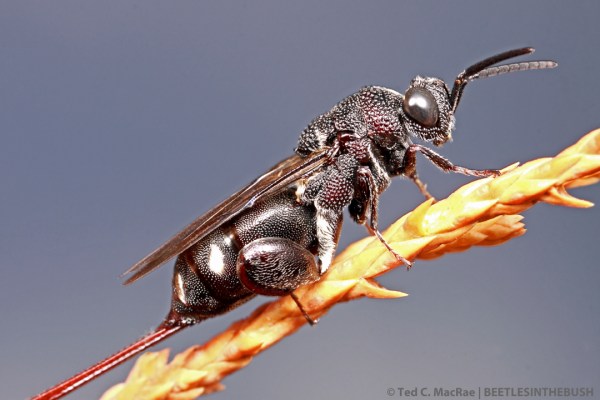
Acanthochalcis nigricans | Gloss Mountains State Park, Major Co., Oklahoma

Acanthochalcis nigricans | Gloss Mountains State Park, Major Co., Oklahoma

As a student of jewel beetles with an interest in their larval host plant associations, rearing has been an important tool for my studies. Through the years, I’ve retrieved literally hundreds of batches of dead wood from the field and placed them in rearing containers that I keep in my garage. It’s hard work, but the several thousand jewel beetles that I’ve reared from these batches, many representing new distributions, host associations, and even new species (e.g., MacRae 2003) clearly suggest it has been worth the effort. Of course, jewel beetles are not the only insects that emerge from this wood. Numerous other insects have shown up in the rearing containers as well, mostly beetles in other families associated with dead wood such as longhorned beetles, powderpost beetles, checkered beetles, etc. Non-beetles have been reared as well, mostly representing parasitic hymenopterans, and in this group my favorite are the chalcidid wasps (family Chalcididae). Chalcidids and some of their close relatives are instantly recognizable by their greatly swollen and toothed hind femora. Most species in this family are parasitoids of Lepidoptera and Diptera, but some parasitize other insects, including jewel beetles and especially those in the genus Chrysobothris. I have reared a few hundred of these wasps over the years, representing at least a dozen or more species and currently being identified by fellow buprestophile Henry Hespenheide. Once identified, it will be an easy matter to associate these specimens with the Chrysobothris beetles that emerged with them from the same batch of wood. From this, we anticipate that any number of new parasitic wasp/beetle host associations will be revealed.

Among chalcidid wasps, the large size and very long ovipositor distinguish this genus.

Among chalcidid wasps, the large size and very long ovipositor distinguish this genus.

The chalcidid wasp featured in this post was not reared, but rather was encountered in the field during my recent collecting trip to northwestern Oklahoma. In fact, it was the very first insect that I encountered at the very first site that I stopped at—Gloss Mountains State Park. Although the wasp was photographed on a dead branch of eastern red-cedar (Juniperus virginiana), I first saw it on a dead branch of mesquite (Prosopis glandulosa). Based on its long ovipositor and large size (~19 mm in length, including the ovipositor), I presume this to be one of the two Acanthochalcis species commonly encountered in North America, with the presence of white pubescent patches on its abdomen identifying it as A. nigricans, occurring across the southwestern U.S. from Kansas and Oklahoma to California (A. unispinosa, ranging from Texas to California, lacks these pubescent patches). This species is a known associate of Chrysobothris jewel beetles, including C. femorata and C. edwardsii (Universal Chalcidoidea Database), but in this case I believe it is associated with C. octocola—an equally large jewel beetle that I first encountered on the mesquite at this very spot last fall (a new state record!). I beat quite a few more C. octocola adults from dead mesquite branches during this trip but didn’t find any other Chrysobothris spp. associated with the mesquite. That said, it is possible that the wasp is associated with the larger of two species of Chrysobothris that I beat from the eastern red-cedar at the site (forgive me for being coy about the identity of the beetle right now, as it will be the subject of a future post). However, since all of the wasps I saw that day were originally seen on or flying around dead mesquite branches I’m betting on C. octocola.

The white abdominal pubescent patches distinguish this species from A. unispinosa.

The white abdominal pubescent patches distinguish this species from A. unispinosa.

REFERENCE:

MacRae, T. C. 2003. Agrilus (s. str.) betulanigrae MacRae (Coleoptera: Buprestidae: Agrilini), a new species from North America, with comments on subgeneric placement and a key to the otiosus species-group in North America. Zootaxa 380:1–9.

Copyright © Ted C. MacRae 2013

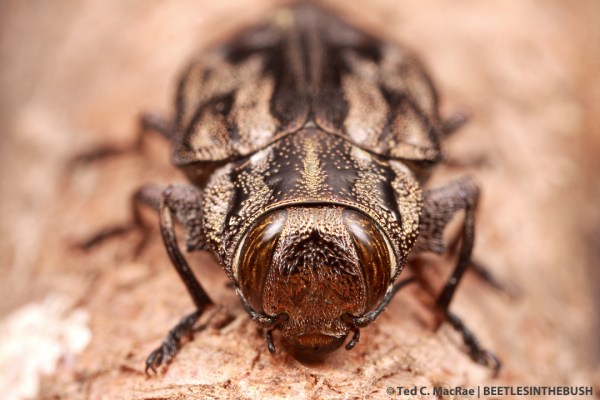
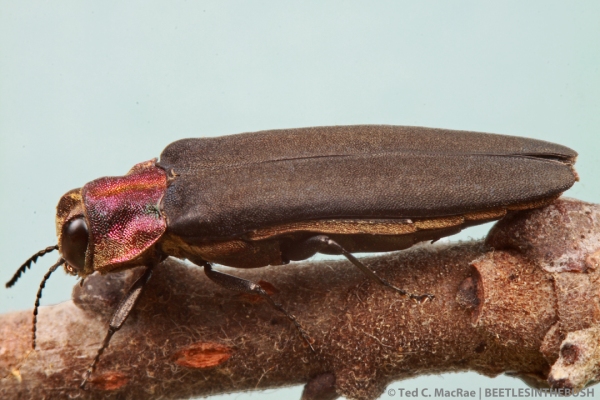
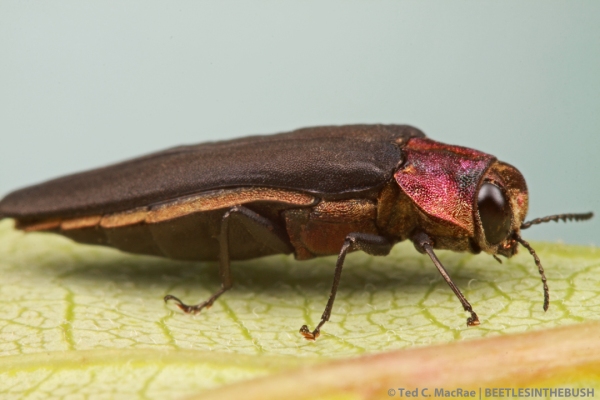
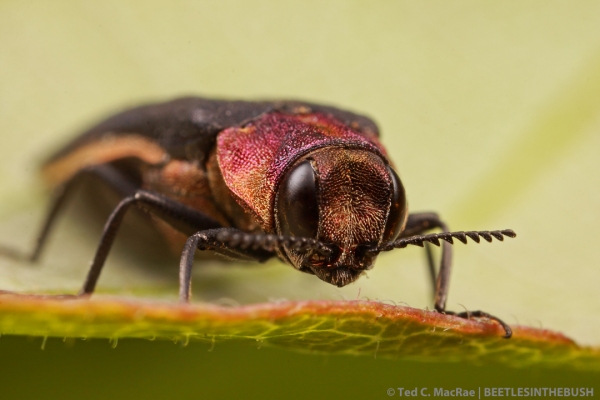
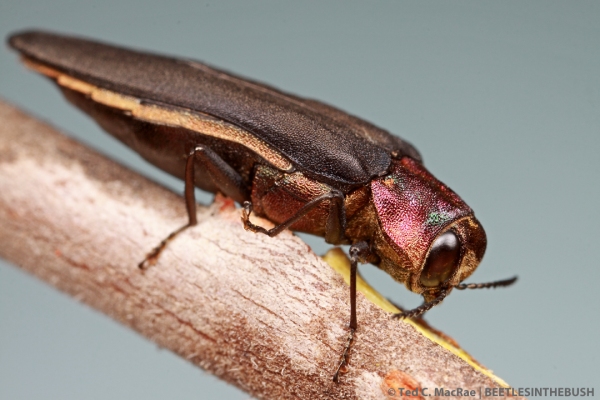
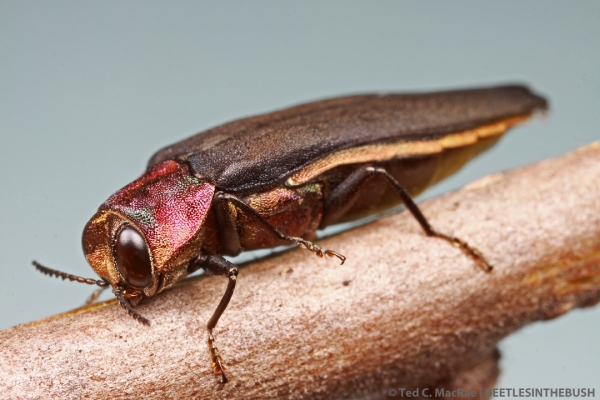
Agrilus fuscipennis on Persimmon

Agrilus fuscipennis

Agrilus fuscipennis may not be the largest or the prettiest member of the genus occurring in Missouri (that honor is reserved for Agrilus concinnus, or “hibiscus jewel beetle”—MacRae 2004). Nevertheless,  it comes pretty darned close! Add to that the fact that it is among our most seldom encountered jewel beetles, and you can understand how excited I was to see this species on my sheet after beating a small persimmon (Diospyros virginiana) tree last weekend at Hercules Glades Wilderness in the White River Hills of extreme southwestern Missouri. In fact, I have only collected this species three times previously—all single specimens beaten from persimmon, and all back in the 1980s!

Agrilus fuscipennis

Jewel beetles are unquestionably popular among insect collectors, due no doubt in large part to their vivid, metallic colors. I think the family, however, would be even more popular were it not for the genus Agrilus. Fully one in five species of jewel beetles belongs to this genus, which at nearly 3,000 described species and counting (Bellamy 2008) is perhaps the largest genus in the entire animal kingdom. As might be expected, such hyperdiversity has resulted in taxonomic quagmire, with species limits difficult to define and many hardly distinguishable except by examination of male genitalia (MacRae 2003). Additionally, in contrast to the rest of the family which is generally recognized as containing some of the most spectacularly beautiful beetles in the world, the most species of Agrilus are small, usually less than 8 mm in length and often as small as only 4–5 mm, and also lack the vivid colors (at least, to the naked eye) for which the rest of the family is so noted.

Agrilus fuscipennis

Agrilus fuscipennis is one of several species that buck this general Agrilus theme. While not forming a discrete taxonomic group within the genus, they are all unified by the following characteristics: 1) relatively large for the genus (A. fuscipennis measures 12–14 mm length), 2) vivid red pronotum and black elytra, and 3) mine the lower trunks, crown and main roots of living rather than dead host plants. For A. fuscipennis the larval host is persimmon, and other similar species include A. vittaticollis on serviceberry (Amelanchier) and A. concinnus on wild hibiscus (Hibiscus). These other species also are not very commonly encountered, at least in my experience, perhaps partly because they are not as easily reared from their hosts as species that develop as larvae in dead wood (the latter can be easily reared by retrieving infested wood from the field and placing in containers to trap emerging adults).

Agrilus fuscipennis

In the interest of full disclosure, these photos were taken in the studio after returning home. Although the persimmon branch is real, the “blue sky” is actually just a colored index card. I prefer to photograph insects in the field, especially with insects such as tiger beetles where it is desirable to include elements of the insect’s natural habitat in the photograph. However, I don’t have a problem with studio photography if field photographs prove too difficult or time-consuming or present too high a risk of escape by a prize specimen. My normal protocol for the latter is to place the first individual in a vial and continue to search for another that I will then try to photograph in the field. If that doesn’t work then I still have the first individual as a backup for studio photographs. In the case of this beetle, I found it on the very first clump of persimmon that I beat but never saw another despite beating persimmon for the rest of the afternoon (just like the three I found separately back in the 80s)! I have plans to photograph A. concinnus later this summer on its Hibiscus host plant in southeastern Missouri—hopefully I will succeed in getting true field photographs of that species.

Agrilus fuscipennis

REFERENCES:

Bellamy, C. L. 2008. World catalogue and bibliography of the jewel beetles (Coleoptera: Buprestoidea), Volume 4: Agrilinae: Agrilina through Trachyini. Pensoft Series Faunistica 79:1–722.

MacRae, T. C. 1991. The Buprestidae (Coleoptera) of Missouri.  Insecta Mundi 5(2):101–126.

MacRae, T. C. 2004. Beetle bits: Hunting the elusive “hibiscus jewel beetle”. Nature Notes, Journal of the Webster Groves Nature Study Society 76(5):4–5.

Copyright © Ted C. MacRae 2013

Flatfaced longhorn: Leptostylus transversus

Leptostylus transversus | Holly Ridge Conservation Area, Stoddard Co., Missouri

Leptostylus transversus | Holly Ridge Conservation Area, Stoddard Co., Missouri

The longhorned beetle subfamily Lamiinae is one of the few subfamilies in the beetle world to have its own common name—flatfaced longhorns. This photo of one of its members, Leptostylus transversus, doesn’t show the character very well, but as with all members of the subfamily the face is completely vertical, a condition called “orthognathous” (mouthparts directed downwards), while all other longhorned beetles exhibit a more prognathous (mouthparts directed forward) condition. (A third possible condition, opisthognathous, refers to mouthparts directed backwards, a condition not occurring in longhorned beetles but common in leafmining species of jewel beetles and leaf beetles.)

I beat this individual this past May from dead branches at Holly Ridge Conservation Area in Stoddard Co., Missouri. Leptostylus transversus belongs to the tribe Acanthocinini, one of the largest tribes in the family and incredibly diverse in the tropics. Most members of this tribe are colored like mottled bark, as is this one, with many also exhibiting tubercles, erect setae or tufts of setae that combine to give the beetles a rather warty appearance. I presume the combination of coloration and irregular outline contributes to their overall cryptic appearance.

When I studied the longhorned beetle fauna of Missouri (MacRae 1994), this was one of the most common species that I encountered (268 specimens from throughout Missouri were examined). Despite its abundance, two interesting features were noted for this species. Firstly, it exhibits a distinctly bimodal temporal occurrence, with most of the specimens I examined being captured either during March through June or September through October and almost none during July or August. I am not aware or many (any?) other species, at least in Missouri, that exhibit such a strongly bimodal occurrence. There are several possible explanations, such as the occurrence of two generations per year or an adult “aestivation” (summer hibernation) period, but I think it more likely that adults emerge primarily during late summer and fall, overwinter as adults, and then become active again the following spring. This latter suggestion seems to be supported by reared specimens in my collection, the great majority of which have emerged from their hosts after mid-August.

The second interesting feature of this species is its extreme polyphagy. Many longhorned beetles are quite polyphagous, but most still utilize primarily angiosperms or gymnosperms and not both. Leptostylus transversus, on the other hand, shows no preference for either group—specimens in my collection have been reared from the angiosperms Amelanchier arborea (serviceberry), Carya ovata (shagbark hickory) and Diospyros virginiana (persimmon) and the gymnosperms Juniperus virginiana (eastern red-cedar), Pinus echinata (shortleaf pine), and P. sylvestris (Scots pine). In fact, even most species that prefer gymnosperms tend to utilize either pine or juniper but not both.

REFERENCE:

MacRae, T. C. 1994. Annotated checklist of the longhorned beetles (Coleoptera: Cerambycidae and Disteniidae) known to occur in Missouri. Insecta Mundi 7(4) (1993):223–252.

Copyright © Ted C. MacRae 2013