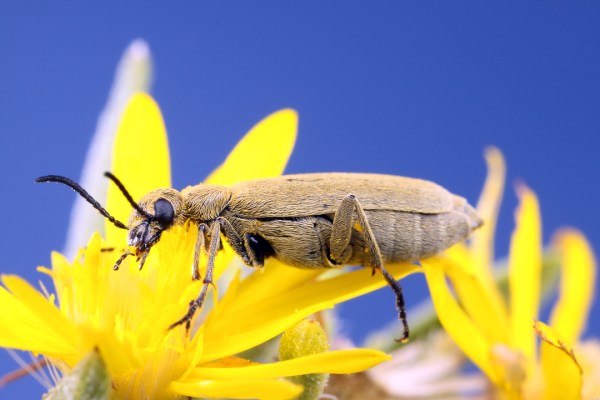
Photographing the Limestone Tiger Beetle

Seeing and photographing the beautifully black Prairie Tiger Beetles (Cicindelidia obsoleta vulturina) in southwestern Oklahoma was a lot of fun, but by Day 5 I was ready to look for one of my top goals for the trip—Cicindelidia politula (Limestone Tiger Beetle). Occurring primarily in Texas (but also sneaking up into Oklahoma), this would be my first attempt to search for the species. I had gotten a few localities in northern Texas from trusty colleagues, and I knew the beetles occurred on limestone outcroppings in dry to xeric upland habitats (Pearson et al. 2006)—usually starting in late September.  Nevertheless, I always get a little apprehensive when I drive long distances to look for tiger beetles I’ve never seen before. Will I recognize it? What if I find another, similar looking but more common species and assume I’ve found it? Will the season be right? Many species, especially those associated with xeric habitats, depend on timely rains to make their appearance. Will I find the proper microhabitat? There are sometimes seemingly minor details that can make a habitat suitable or not for a particular species.
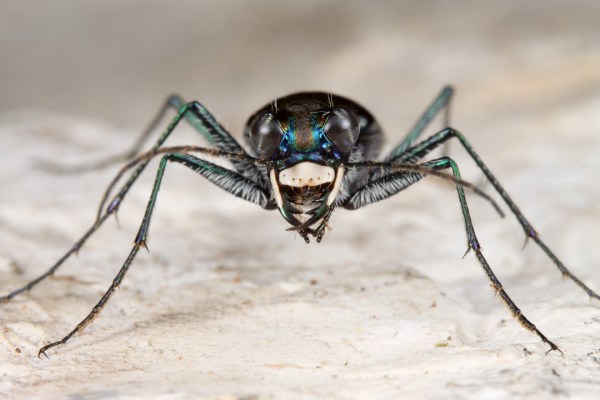
Cicindelidia politula politula | Montague Co., Texas

As can be seen by the above photo, I did succeed in finding the species. However, it wasn’t easy, and for the better part of Day 5 I wondered if I would even be able to capture a specimen, much less succeed in photographing the species in its native habitat. I actually saw the first individual of this species in Oklahoma—sitting on the very first exposed limestone rock at the very first locality I went to. My rule for photographing tiger beetles that I’ve never seen before is to collect the first individual and keep it alive in a vial. In the event I never see another individual or fail in my attempts to photograph them in the field, the first individual becomes my voucher specimen and studio backup. Fortunately, I rarely have to resort to studio shots, but in this case I muffed my attempt to capture the specimen! I searched the locality for a good hour and never saw another one until I circled back to where I started, and there it was again (it just had to be the same one). Believe it or not, I muffed the capture attempt once again! That was my last chance at the Oklahoma site, so it was a rather dejected 2-hour drive south to Montague Co. in northern Texas—knowing that I’d seen it and had my shot at it (two shots, actually) but still found myself empty-handed.

A serviceable photo, but like most of confined individuals it suffers from lack of ”pizzazz.”

My luck improved in Montague Co., although not right away or that much when it did. I had just about given up at this second locality when I saw one. This time I used the stalk-and-slap technique followed by a quick pounce to seal down the net around its perimeter and prevent escape by the beetle (they are real good at quickly finding the tiniest gap between the net rim and the ground and then zipping away in a flash). This time I succeeded in capturing the beetle and thus had my voucher, but my pounce was a little too rough on the beetle, resulting in an extruded genital capsule. This made it completely unusable for photographs (imagine a big orange blob sticking out of the butt of the beetle—not good, photographically!). Of course, finding a beetle at the site caused me to spend more time searching, but I never saw another beetle there.

The shiny black to blue-black elytra with white markings absent or limited to the apices are characteristic for the species.

At this point I had a decision to make—if I drove to the next locality on my list (2-hour drive), I probably would not arrive with enough time before sunset to find beetles. I decided not to waste the remaining daylight and instead just bushwhack where I was to look for similar roadside habitats and drive on after sunset. I found another good habitat fairly quickly, and within minutes after starting the search I saw one—and missed it! But then I saw another one—and missed it, too! Now my confidence was shaken, as neither of the two techniques I use most commonly for capturing tiger beetles were working. When I used the “stalk-and-slap” method the beetles always found a gap on the rough, rocky ground and got away, and when I used the “tap-and-sweep” method the beetles would hunker down at first and then fly right after the net passed over them. I would miss a total of eight (eight!) beetles before I finally (finally!) caught one, and then I would miss three more beetles afterwards! That single beetle is shown in the above photographs, which were taken after placing the beetle on a large, flat limestone rock that I laid on the bed in my hotel room that night (carrying that huge limestone rock into the hotel room was an experience!).

I really dislike photographing confined insects. Even if one prepares a wholly natural looking set and manages to cajole the subject into standing still, they rarely look quite right. I do like the first photo in the series, just because it’s a well composed face shot, but I’m not so fond of the more ‘classic’ view of the beetle represented by the second photo. Technically it’s an adequate photo that shows the beetle and all of its salient characters; however, it lacks, well… oomph, because the beetle isn’t really doing anything—the photo tells no natural history story. Still, an adequate photo that lacks oomph is better than no photo at all, so I made the best of my opportunity to take studio shots of the one good beetle I had and hoped for better luck the next day.

Exposed limestone road bank in Johnson Co., Texas—perfect habitat for Cicindelidia politula

The next day brought the luck that I was looking for. I was close to the next locality on my list when I saw a road bank with exposed limestone that just seemed to call out, “Search me!” I stopped and began searching, and within a few minutes I saw the first beetle—and missed it! Arghhh, not again! I would actually miss a few more before I finally caught one, so by now my confidence was destroyed. It’s been a long since I’ve had this much trouble catching tiger beetles, and if I was having this much trouble catching them, how on earth could I even contemplate trying to photograph them. However, the nice thing about finding a spot where beetles are out in numbers is the opportunity to try again—practice makes perfect. I decided my previous attempts had all been a little too lackadaisical and started buckling down and really concentrating on my technique. Not surprisingly, I started having success in capturing the elusive beetles (tap-and-sweep worked best), and after a time I felt like I had a good enough feel for the beetle’s behavior to begin trying for field photographs.

Cicindelidia politula politula | Johnson Co., Texas

Not surprisingly, given how difficult they were to catch, this also proved to be one of the most difficult species of tiger beetle that I’ve ever tried to photograph. Like many other tiger beetles that live in hot, xeric, open habitats they were extremely wary and difficult to approach, a behavior that was exacerbated by the now midday sun. Their escape flights were not very far, but far enough that if I’d already gotten into a prone position I had to get up and start all over again. The task was made even more difficult by the hard, jagged, rough-edge rocks on which I had to lay and crawl—ouch! Several individuals are represented in the field photographs shown here, each of which I had to “work” for some amount of time before I was able to finally get close enough to start taking photos (and representing only a few of the many individuals that I actually spent time “working”). Usually, the first photos of an individual are never very good but start the process of getting the beetle accustomed to my presence and the periodic flash of light. Eventually, if I’m lucky, it settles down and resumes normal searching and thermoregulatory behaviors, and I can then get as close as I want and really work the angles for a variety of compositions. I no longer try to approach beetles from the ‘proper’ angle; they turn so much while moving about that it’s easier to just wait for them to assume desired angles as they move about and be ready to shoot when it happens. Field photography of unconfined tiger beetles in their native habitat is hard and time consuming, but the results are well worth the effort. Compare the staged photos of the Montague Co. individual with the field photos from Johnson Co. What marvelous displays of active beetles engaged in natural behaviors in their native habitat the latter represent!
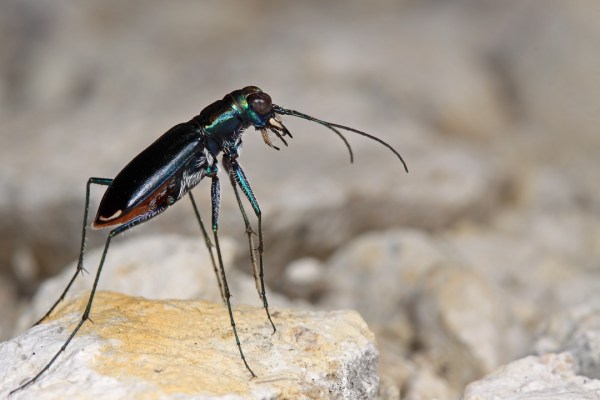
By midday the adults start ”sun-facing” to minimize thermal exposure in their hot, xeric habitats.

After getting several good photos of the beetle in its habitat, I decided it was time to try for some really close photos and added a full set of extension tubes to the camera. A set of tubes with a 100mm macro lens provides close to 2X magnification, but it also reduces the available working distance—a real challenge with wary tiger beetles under a midday sun! I spent quite a bit of time trying to get close enough to take advantage of the additional magnification, but I wasn’t successful until I encountered the individual in the photos below shade-seeking at the base of a yucca plant. Shade-seeking beetles tend to stay put and not move as much (although they still rarely just sit there).
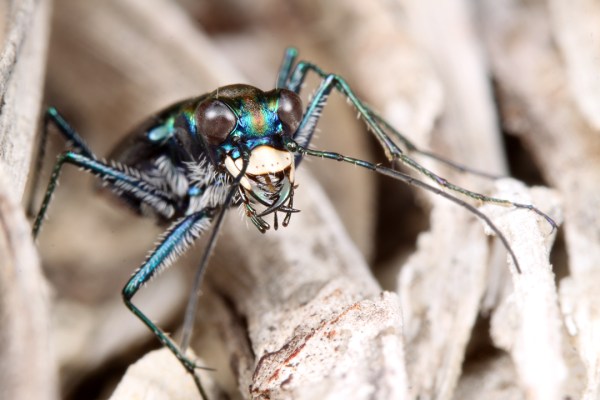
Shade-seeking is another strategy to avoid the midday heat.

I worked this beetle for several minutes and managed to get a number of shots, each closer than the previous and culminating in the nice portrait below.

The ”pièce de résistance”—Cicindelidia politula politula at 2X life size!

My photographic appetite now completely satiated, I spent the rest of the day searching for (and finding) additional localities for the species in the area. I found them more often associated with older, level exposures that had at least a small amount of vegetation. In contrast, newer or steeply sloped exposures or those completely devoid of vegetation rarely had beetles associated with them. I had now spent two days working on C. politula, but the results—both as a collector and as a photographer—made it time well spent. I felt like I “understood” the beetle. However, with only two days left in the trip, it was time to start working my way back towards Missouri and focusing on the few additional goals I still had for the trip.

REFERENCE:

Pearson, D. L., C. B. Knisley and C. J. Kazilek. 2006. A Field Guide to the Tiger Beetles of the United States and Canada. Oxford University Press, New York, 227 pp.

Copyright © Ted C. MacRae 2012

Inchworm, Inchworm, Oh So Small

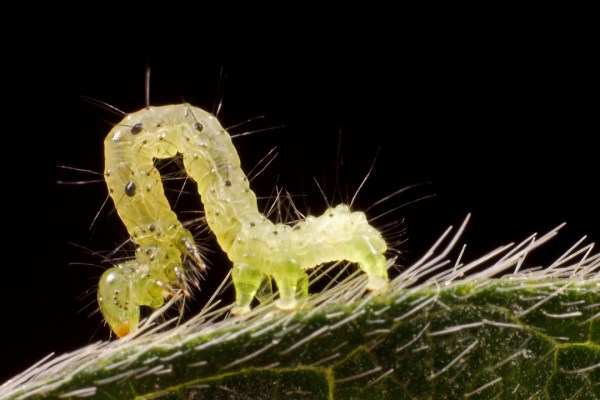
Soybean looper (Chrysodeixis includens) | 3rd-instar larva

Okay, I know this is not a real “inchworm” (generally restricted to caterpillars in the family Geometridae), but this young larva of a soybean looper (Chrysodeixis includens, family Noctuidae) is just too cute to not have an equally cute name. I believe it is an early 3rd instar, based on its small size (~7mm in length), lightly colored head capsule, and distinct bristles around the head and on the body—1st instars have a black head capsule, while 2nd instars have a light brown head capsule, and in both the bristles on the body are smaller and not as distinct.

This larva hatched from an egg laid on soybean by a laboratory-reared adult.

Copyright © Ted C. MacRae 2012
Dressed in black

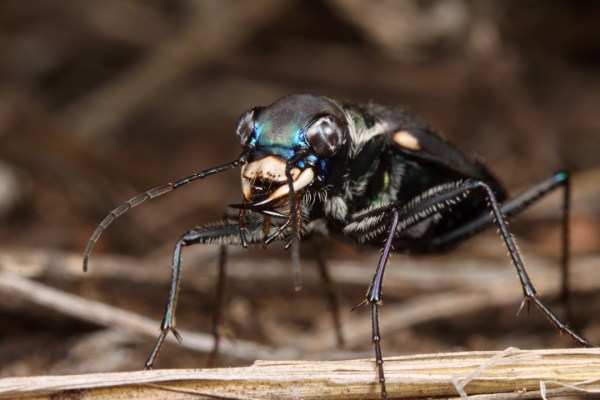
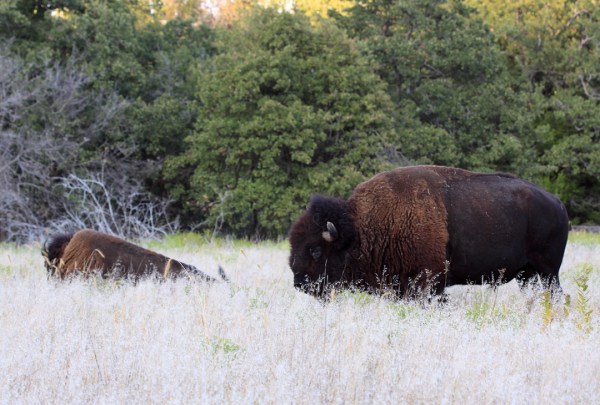
The first three days of this year’s Fall Tiger Beetle Trip had been fun, and finding a new state record jewel beetle and an unusual seasonal activity record for another were definitely icing on the cake. Still, tiger beetles (at least adults) had been notably absent, with my hunch that Cicindela pulchra (Beautiful Tiger Beetle) might occur in the Red Hills of northwestern Oklahoma not playing out. My next goal was to go down to northern Texas and look for Cicindelidia politula (Limestone Tiger Beetle)—a species I have not yet encountered in the field. When I saw that the route south took me through the Wichita Mountains of southwestern Oklahoma, I recalled seeing this photo of Cicindelidia obsoleta vulturina (Prairie Tiger Beetle) on BugGuide taken in these very mountains during the fall. I have seen on many occasions the greenish Missouri / Arkansas disjunct population of this subspecies, but I had not yet seen the main population and its decidedly black individuals, so this became my quarry for Day 4 of the trip. I had nothing more to go on for a locality than “Wichita Mountains NWR” and a sense of its habitat preferences based on my own experience with the MO/AR disjuncts, so after arriving at the refuge I began to look for access to a 2-track leading to higher, unforested ground (reminiscent of the dolomite glades of southwestern Missouri). I quickly found a parking lot with a 2-track leading from it, so I pulled off, geared up, and set out on what I figured was surely a wild goose chase. The track looked good, but no beetles were seen, and after walking about a half-mile I happened to look up and see this not too far ahead:

American bison | Wichita Mountains National Wildlife Refuge, Oklahoma

Call me chicken, but bison can and will charge without warning. Even though they seemed unconcerned by my presence, I wasn’t with anybody that I knew I could outrun 🙂 and decided that a cautious, tip-toeing retreat would the best course of action (even taking the above photo—uncropped, I might add—made me nervous). What now? I was quickly back at the car and not sure what to do next when I saw a foot path leading into a cedar woods, behind which the land rose up to treeless heights. I decided that might be a good place to explore—as long as I didn’t run into any bison along the way! As I was hiking through the woodland—an open, obviously long ago planted grove of eastern red cedar (Juniperus virginiana)—I passed by a small opening and almost by instinct veered into the opening to have a look. As soon as I stepped into the opening I saw the unmistakable escape flight of two large tiger beetles—what the…?! No doubt about it, they were C. o. vulturina, and they had been hanging out by a fairly fresh bovid chip (bison or cow, I don’t know). (I have seen this behavior also with the MO/AR disjuncts.) I watched them land and decided which one I would try to photograph. I guess I picked right, because the following photo was among the first few that I got:

Cicindelidia obsoleta vulturina (prairie tiger beetle) | Wichita Mountains National Wildlife Refuge, Oklahoma

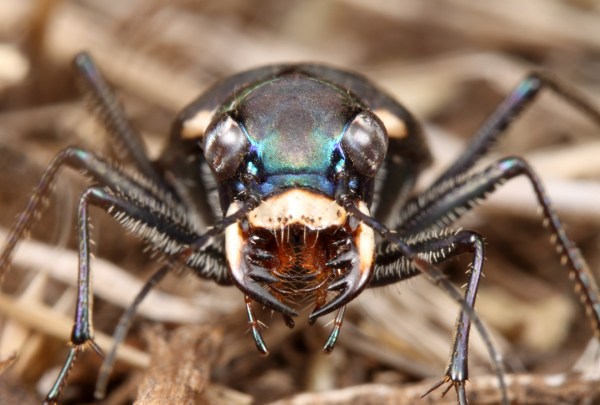
Despite the jet-black dorsal surface (which contrasts with the green to greenish-black to bronzy dorsal surface of the MO/AR disjuncts), these were colorful beetles with gorgeous metallic blue genae (cheeks) and intense violaceous tibia (lower legs). This first individual was quite cooperative (usually it’s the tenth or more beetle that I try to photograph that actually allows me to do so), so I spent a bit of time trying to coax it back to the bovid chip from which it flew. Eventually I succeeded in this and took a few more photos, the following of which I liked the best:

Shade seeking next to a bovid chip.

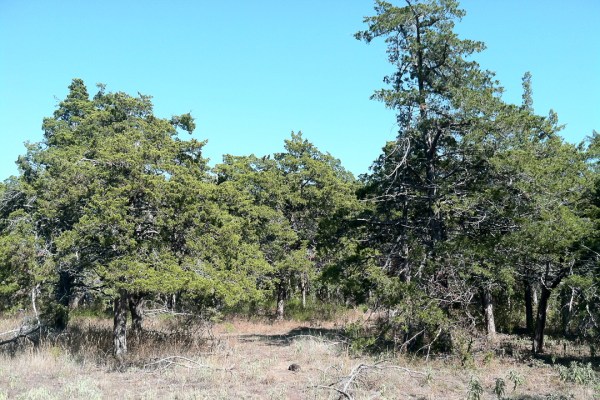
I’m still a bit puzzled about the habitat in which I found these beetles. I would have considered it an anomaly had I not seen two beetles at the same time and then subsequently seen a mating pair in almost the exact same spot. Prairie tiger beetles are known for their preference of open grassland habitats rather than woodlands, and indeed I saw more individuals back along the 2-track that I had abandoned earlier (once I got the courage to stray down it again later in the day). The photo below shows almost the entirety of the opening where I found the beetles, with the bovid chip located on the ground in the lower center of the photo:

An unusually wooded habitat for Cicindelidia obsoleta vulturina.

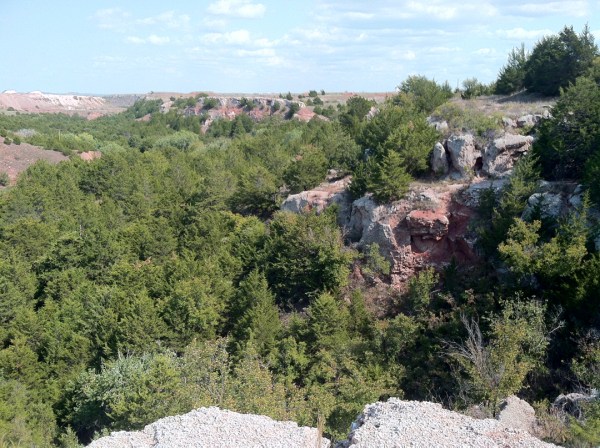
Seeing these two individuals in the small woodland opening gave me greater optimism that I would be able to find more on the grassy higher slopes above the cedar grove. I crossed the creek and climbed to the top of the first ridge, passing through what seemed to be ideal habitat for the beetle but seeing none. Although igneous in origin, the rocky landscape reminded me very much of the dolomite glades that lace through the White River Hills of southwestern Missouri and that harbour robust populations of this beetle (but occurring nowhere else in the state).

Rocky grasslands extend towards Mt. Scott.

After posting one of these landscape photos on my Facebook page, I got a comment from Thomas Shahan saying he had been to the area recently and seen a “dark Cicindela” atop nearby Elk Mountain. Low and behold, the beetle in the photo that he included was none other than this subspecies, so at least now I know they do occur in this more expected habitat despite my not having seen them on this day.

Failing to find the beetle on higher ground, and wanting to try for even closer photographs, I returned to “the opening” and immediately found another individual to photograph. A female, she may (or may not) have been the partner to the male I photographed earlier, but at any rate she was not nearly as cooperative. I chased her back and forth through the opening for about a half-hour before I finally got close enough to get a shot (my use of tube extensions required that I get even closer than before). As typically happens, however, she gradually became more and more accustomed to my presence, and eventually I was able to get a few photos with the beetle in fairly relaxed, candid poses. The following are my favorites:

A less trusting individual relunctantly allows herself to be photographed.

She looks angry, but in reality I caught her mandibles half open in the midst of chewing movements.

After photographing these individuals, I returned to the car and decided to wander (tentatively) down the 2-track that I had to abandon earlier in the day. This time I fouund the beetles easily, seeing perhaps half a dozen individuals in just the first quarter-mile. My wanderings, however, were once again cut short when I came around a tree bank and saw those same two bison, much closer to the road this time. I really wanted to get a better photograph than the one above, but common sense at first prevented me from getting any closer. I studied the two magnificent behemoths looking for any sign of annoyance, and seeing none I began to creep ever so tiny a bit closer. Eventually my heart rose too high in my throat to approach any closer, and I snapped the following photo and began a hasty, horse-eyed retreat—not even knowing for sure if the shot was good but feeling a little too proud of myself and my stupidity courage!

A little too close for comfort!

Copyright © Ted C. MacRae 2012
9th Annual Fall Tiger Beetle Trip: Day 3.2

My plan to retrieve beetle-infested wood in Oklahoma’s Glass Mountains has morphed from a quick stop to an all-morning affair, and by the time I loaded up the bundles it was well past noon. Fortunately, my next planned stop—Alabaster Caverns State Park—was only about a 90-minute drive, meaning I would still have plenty of time to give the area a good look. Unlike the Glass Mountains, with its gypsum-capped, flat-topped mesas rising above the surrounding landscape, Alabaster Caverns is level ground fissured by deep, rugged canyons that have eroded through the gypsum cap into the soft, underlying red clay. Nevertheless, both sites are part of the same Gypsum/Red Hills geological formation, so their associated flora and entomofauna are also similar. It was during my original visit to Alabaster Caverns back in 2009 that I found robust populations of Cylindera celeripes (Swift Tiger Beetle), and in October of the following year I discovered its previously unknown larva. My originally intent in coming here this time was to look for Cicindela pulchra (Beautiful Tiger Beetle), but since I had failed to find this species in the Glass Mountains I had little optimism that I would find it here as well. Still, it’s a beautiful park and I was anxious to see some of the canyon areas that I had not explored on previous visits, after which my trip would take a turn to the south.

Alabaster Caverns State Park, Woodward Co., Oklahoma

As I expected, no amount of searching on the flats above showed any evidence of C. pulchra, and I saw pretty much the same assortment of beetles visiting the yellow-flowered Heterotheca stenophylla (stiffleaf false goldenaster) and Gutierezzia sarothrae (broom snakeweed) blooming in profusion that I had seen on Day 2 at Gloss Mountains State Park. Since I had neglected to photograph the gray blister beetle (family Meloidae, genus Epicauta) that I was seeing so commonly the day before, I decided I should go ahead and take advantage of the opportunity while I had it. As I mentioned in my Day 2 post, these beetles were seen almost exclusively on Gutierezzia, and shown below are two of the better photos that I ended up with.

Epicauta sp. | Alabaster Caverns State Park, Woodward Co., Oklahoma

Mouthparts at 3X—love that pollen!

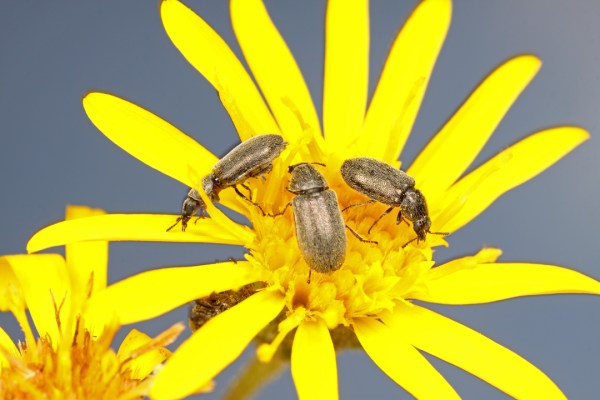
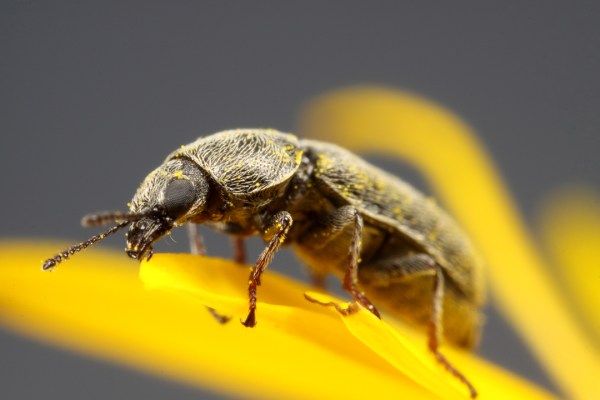
Another species that I saw very commonly were tiny little beetles feeding exclusively on the Heterotheca flowers. Measuring less than 5mm in length, a majority of flowers had at least one of these small gray beetles, and sometimes as many as four or five. Just based on appearance I suspected they represented something in or related to the soft-winged flower beetles (family Melyridae), and in fact they are a dead ringer for the species Listrus senilis(compare to these photos of the MCZ type specimen). This species seems to occur abundantly throughout the Great Plains (Mawdsley 1999) as far south as Texas (BugGuide). The small size of these beetles made them much more difficult to photograph, so my ‘keeper’ rate was lower than for the Epicauta beetle, but a few turned out okay:

Listrus senilis on Heterotheca stenophylla | Alabaster Caverns State Park, Woodward Co., Oklahoma

Listrus senilis at 5X—another pollen lover!

The most significant find of the day, however, was also the most unexpected—I saw numerous individuals of an Acmaeodera jewel beetle feeding on the Heterotheca flowers. Why is this so unexpected? Because throughout most of North America members of the genus Acmaeodera are almost exclusively active as adults during spring and early summer. Those occurring in southeastern Arizona are found more during July and August, a result of the summer monsoon season, but truly fall-active species are limited to a few occurring in the Lower Rio Grande Valley of south Texas. When I saw the first one I presumed it was a late season straggler, but then I saw another, and another. It was clear by their numbers that now is their activity period. I do not know what species they represent, but I took numerous photos and will post them once I have made an identification. It remains to be seen whether this is an unusual habit for a known species (more likely) or a previously unknown species (less likely, though new species of Acmaoeodera continue to be discovered routinely in the U.S.)—stay tuned!

REFERENCE:

Mawdsley, J. R. 1999. Redescription and notes on the biology of Amecocerus senilis (LeConte) (Coleoptera: Melyridae: Dasytinae). Journal of the New York Entomological Society 107(1):68-72.

Copyright © Ted C. MacRae 2012
The Pan-Pacific Entomologist 88(2)—Penrose Memorial issue

It is with great pleasure that I announce the publication of The Pan-Pacific Entomologist Penrose Memorial issue (volume 88, number 2), mailed 14 September 2012. Published by the Pacific Coast Entomological Society, this issue is dedicated to the memory of the late Richard L. Penrose (1943–2011); long time member of the guild of California coleopterists. As Managing Editor, I had the distinct honor and pleasure of overseeing the assembly and production of this issue; however, it is only from the selfless efforts of many individuals that this issue came to fruition. I would like to thank the PCES Executive and Editorial Boards, the contributing authors and the reviewers for their participation in making this issue possible. Three individuals deserve special mention for their particularly stellar efforts: Richard Westcott (Oregon Department of Agriculture) and Chuck Bellamy (California Department of Food and Agriculture) for their dogged persistence in promoting the idea and recruiting contributing authors, and Floyd W. Shockley (Smithsonian Institution), who as the journal’s Coleoptera Subject Editor oversaw the review, revision and acceptance of the bulk of the papers appearing in this coleopcentric issue.

If you are not a PCES member, now is a good time to join. Membership is only $25/year ($12.50 for students) and includes four quarterly issues of The Pan-Pacific Entomologist. Following are the contents of the Penrose Memorial issue with hyperlinks to online versions through BioOne. Abstracts & References are open access, while Full Text and PDF versions are available to BioOne subscribers.

The Pan-Pacific Entomologist 88(2)
Contents

Richard L. Penrose
Ted C. MacRae
The Pan-Pacific Entomologist 88(2):i–i
Citation | Full Text | PDF (83 KB)

BIOGRAPHICAL SKETCH

Richard Lynn Penrose (11 January, 1943–17 March 2011): Biographical sketch and memories
Richard L. Westcott and Richard E. Morel
The Pan-Pacific Entomologist 88(2):105–116
Citation | Full Text | PDF (1903 KB)

PAPERS

A new species of Cregya LeConte (Coleoptera: Cleridae: Peloniinae) from Florida, U.S.A. and Puebla, México
Jacques Rifkind
The Pan-Pacific Entomologist 88(2):117–121
Abstract & References | Full Text | PDF (107 KB)

Synetocephalus penrosei Gilbert & Clark (Chrysomelidae: Galerucinae: Luperini), a new species from California, U.S.A
Arthur J. Gilbert and Shawn M. Clark
The Pan-Pacific Entomologist 88(2):122–129
Abstract & References | Full Text | PDF (1970 KB)

Distribution and phenology of Rhagoletis fausta (Osten Sacken 1877) and Rhagoletis indifferens Curren 1932 (Diptera: Tephritidae) in California
Robert V. Dowell and Richard L. Penrose
The Pan-Pacific Entomologist 88(2):130–150
Abstract & References | Full Text | PDF (573 KB)

Acmaeodera penrosei Westcott (Coleoptera: Buprestidae), a new species from Chiapas, Mexico
Richard L. Westcott
The Pan-Pacific Entomologist 88(2):151—153
Abstract & References | Full Text | PDF (238 KB)

A new species of Trichoxys Chevrolat (Cerambycidae: Cerambycinae: Clytini) from Mexico, with a key to known species
Steven W. Lingafelter and James E. Wappes
The Pan-Pacific Entomologist 88(2):154—162
Abstract & References | Full Text | PDF (2333 KB)

Three new species of the genus Dysphenges Horn 1894 (Coleoptera: Chrysomelidae: Galerucinae: Alticini) from the United States
Arthur J. Gilbert and Edward G. Riley
The Pan-Pacific Entomologist 88(2):163–172
Abstract & References | Full Text | PDF (1826 KB)

Notes on distribution and host plants of Cerambycidae (Coleoptera) from southern México
Ted C. MacRae, Larry G. Bezark, and Ian Swift
The Pan-Pacific Entomologist 88(2):173–187
Abstract & References | Full Text | PDF (135 KB)

Hybopteroides, a new genus in the Cryptobatida group of subtribe Agrina, with three new species and notes on their way of life (Insecta: Coleoptera, Carabidae, Lebiini)
Terry L. Erwin and George E. Ball
The Pan-Pacific Entomologist 88(2):188–201
Abstract & References | Full Text | PDF (1702 KB)

A new species of sap beetle (Coleoptera: Nitidulidae) from Baja California Sur, Mexico, with a review of the genus Lobiopa Erichson
Andrew R. Cline and Scott A. Kinnee
The Pan-Pacific Entomologist 88(2):202–211
Abstract & References | Full Text | PDF (304 KB)

Addition of two new species and a previously unknown female to the ammoplanine complex, and a species of Pulverro Pate, 1937 is entered into synonymy (Hymenoptera: Crabronidae)
Norman J. Smith
The Pan-Pacific Entomologist 88(2):212–221
Abstract & References | Full Text | PDF (234 KB)

Dactylotrypes longicollis (Wollaston) (Coleoptera: Curculionidae: Scolytinae): an exotic bark beetle new to California and North America
James R. LaBonte and Curtis Y. Takahashi
The Pan-Pacific Entomologist 88(2):222–230
Abstract & References | Full Text | PDF (1390 KB)

Diurnal flight response of the walnut twig beetle, Pityophthorus juglandis Blackman (Coleoptera: Scolytidae), to pheromone-baited traps in two northern California walnut habitats
Steven J. Seybold, Jennifer A. King, Daren R. Harris, Lori J. Nelson, Shakeeb M. Hamud, and Yigen Chen
The Pan-Pacific Entomologist 88(2):231–247
Abstract & References | Full Text | PDF (1105 KB)

An analysis of the larval instars of the walnut twig beetle, Pityophthorus juglandis Blackman (Coleoptera: Scolytidae), in northern California black walnut, Juglans hindsii, and a new host record for Hylocurus hirtellus
Paul L. Dallara, Mary L. Flint, and Steven J. Seybold
The Pan-Pacific Entomologist 88(2):248–266
Abstract & References | Full Text | PDF (600 KB)

Penroseius lienosus, a new monotypic genus of Coraebini from Madagascar (Coleoptera: Buprestidae: Agrilinae)
C. L. Bellamy
The Pan-Pacific Entomologist 88(2):267–273
Abstract & References | Full Text | PDF (521 KB)

SCIENTIFIC NOTES

First occurrence of the goldspotted oak borer parasitoid, Calosota elongata (Hymenoptera: Eupelmidae), in California
Laurel J. Haavik, Tom W. Coleman, Yigen Chen, Michael I. Jones, Robert C. Venette, Mary L. Flint, and Steven J. Seybold
The Pan-Pacific Entomologist 88(2):i-i
Citation | Full Text | PDF (44 KB)

Recent collecting reveals new state records and geographic extremes in the distribution of the walnut twig beetle, Pityophthorus juglandis Blackman (Coleoptera: Scolytidae), in the United States
Steven J. Seybold, Tom W. Coleman, Paul L. Dallara, Norman L. Dart, Andrew D. Graves, Lee A. Pederson, and Sven-Erik Spichiger
The Pan-Pacific Entomologist 88(2):i-i
Citation | Full Text | PDF (325 KB)

Copyright © Ted C. MacRae 2012
9th Annual Fall Tiger Beetle Trip: Day 3.1

I’d had a very enjoyable 2nd day on this year’s fall tiger beetle trip, but I couldn’t say it had been particularly successful. My primary reason for coming to the Glass Mountains in northwestern Oklahoma was to confirm a hunch that the stunningly beautiful Cicindela pulchra (Beautiful Tiger Beetle) might occur in the flats below the area’s red mesas. My hunch was based on the similarity of habitat to the nearby Red Hills in south-central Kansas, where the species does famously occur (MacRae 2006b). I’ve been here several times now and never found the species, and that did not change this time either. I did end up finding larval burrows and collecting the larvae of several other tiger beetle species (including the wonderfully ginormous Amblycheila cylindriformis), but again I could only consider this a moderate success. During the day, however, I had noted that eastern red-cedar (Juniperus virginiana) in the area was suffering branch and leader die back. Nearly every tree had at least one or more affected branches, and when I cut into a few of them I found evidence of fresh larval galleries of what I presumed were jewel beetles in the genus Chrysobothris. There are several species in this genus that breed in dead Juniperus, but I’m not familiar with any that attack living plants so pervasively as I was seeing here. Moreover, only a few of these species have been recorded from Oklahoma, so I made a mental note to return to the area in the morning and collect examples of dead/dying branches before driving to my Day 3 destination. I’ll put these up in rearing containers when I return home in an attempt to rear our the adult beetles.

Infested red-cedars atop main mesa.

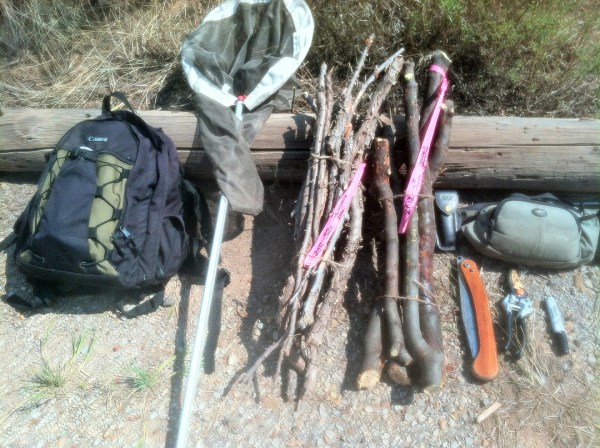
If you’ve never collected wood for rearing beetles before, all I can say is that it is hard and strenuous work. You have to get pretty good at discriminating infested wood in the field, because you don’t want to expend the effort to cut, de-twig, section, bundle, and carry back to the car batches of wood that don’t end up producing beetles. It was a little more effort than I anticipated to get a good sampling of Juniperus branches due to the hardness of the wood and dullness of my hand saw, along with not considering that I would have to hike up to the top of the mesa and then carry the wood all the way back down. Still, there is something enjoyable about this activity for me—perhaps because I’ve done so much in the past and reared so many great species as a result, and I’ll be anxious to see what species I am able to rear from this batch of wood and if they represent any significant new records.

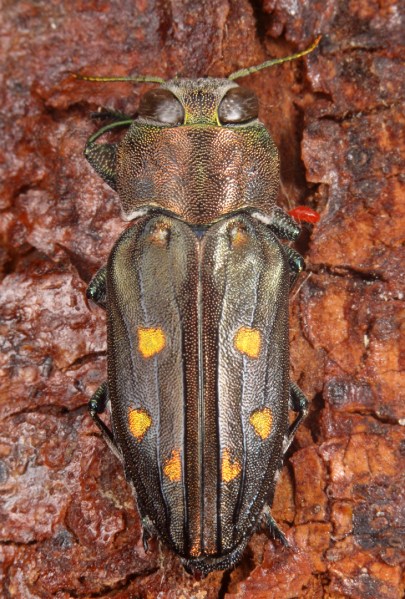
Returning to the car with the wood, I passed by a mesquite tree (Prosopis glandulosa)—a common denizen of the desert southwest but probably near its northeastern limit of distribution here—and noticed bleeding on the main branches. A little bit of slicing with my knife confirmed my suspicion that this was also the work of jewel beetles in the genus Chrysobothris. In the desert southwest, these trees are attacked commonly by one species in particular, C. octocola, and I wondered if this might be the work of that beetle. I also had my suspicions that this species had not yet been recorded from Oklahoma (I later confirmed that it has not), and since I was already hot and sweaty from collecting the Juniperus wood I figured I might as well use my remaining strength to hack out a few limb sections with bleeding and bring them back as well. As I did this, what did I see on one of the branches but the critter itself! I had a decision to make—stop what I was doing and get out the camera to try to take photos (and risk the beetle flying away), or secure the beetle for now, continue with my hack job, and take photos later. I opted for the latter.

Chrysobothris octocola on stressed Prosopis glandulosa | Major Co., Oklahoma

I have to be honest—the beetle found the day’s travels too much to handle, and by the time I was able to take some photographs it was close to dead. As a result, these photos show the beetle in that dreadful flat-on-its-belly pose that I so detest. Still, only the most observant would know the beetle is not alive and well, and a reasonable photo of a dying beetle is better than no photo at all, no matter how live the beetle may be.

This individual represents a new state record for Oklahoma

As I mentioned, this species has not been previously recorded as occurring in Oklahoma, so this individual represents a new state record and an expansion of its known distributional range. That’s publishable data, so I’ll be adding the record to a manuscript currently in progress that details new distributional and biological observations for nearly 100 North American species. It’s the latest in a string of such papers that I begun under the tutelage of the late Gayle Nelson (Nelson and MacRae 1990, Nelson et al. 1996) and am now carrying on the tradition (MacRae and Nelson 2003, MacRae 2006b). 

A successful morning of wood collecting.

By the time I had finished cutting up and bundling the wood and hauling everything back to the truck, it was already well past noon. My quick little morning stop had consumed nearly half the day. However, with one new state record already under my belt and the possibility of others still hiding within the cedar and mesquite branches that I’d collected, I’d have to say this was already the most successful days of the trip. I couldn’t help notice the irony that, as with Day 1, the most significant find of the day was a jewel beetle on a trip that was supposed to be focused on tiger beetles. Hey, I’ll take success in any taxon on any trip.

REFERENCES:

Nelson, G. H., and T. C. MacRae. 1990. Additional notes on the biology and distribution of Buprestidae (Coleoptera) in North America, III. The Coleopterists Bulletin 44(3):349–354.

Nelson, G. H., R. L. Westcott and T. C. MacRae. 1996. Miscellaneous notes on Buprestidae and Schizopodidae occurring in the United States and Canada, including descriptions of previously unknown sexes of six Agrilus Curtis (Coleoptera). The Coleopterists Bulletin 50(2):183–191.

MacRae, T. C., and G. H. Nelson. 2003. Distributional and biological notes on Buprestidae (Coleoptera) in North and Central America and the West Indies, with validation of one species. The Coleopterists Bulletin 57(1):57–70.

MacRae, T. C. 2006a. Distributional and biological notes on North American Buprestidae (Coleoptera), with comments on variation in Anthaxia (Haplanthaxia) viridicornis (Say) and A. (H.) viridfrons Gory. The Pan-Pacific Entomologist 82(2):166–199.

MacRae, T. C. 2006b. Beetle bits: The “beautiful tiger beetle”. Nature Notes, Journal of the Webster Groves Nature Study Society 78(4):9–12.

Copyright © Ted C. MacRae 2012

9th Annual Fall Tiger Beetle Trip: Day 2

I didn’t mind my late start to the 9th Annual Fall Tiger Beetle Trip—my first stop on Day 1 was only ~30 miles south of St. Louis, so I would get in a good chunk of collecting on the day even though I didn’t leave the house until after noon. I didn’t find the longhorned beetle, Ataxia hubbardi, that I was looking for (and haven’t seen now for more than 23 years), but I did manage to see good numbers of the always impressive jewel beetle, Dicerca pugionata, and a very large, impressive male tarantula (walking on water!). After that, however, the trip would make a very early diversion from its original itinerary. The light drizzle that pestered me all day at Victoria Glades steadily turned to rain as I traveled south towards northern Arkansas, and checking the weather forecast further reduced my optimism as rain was predicted for the next two days. The tiger beetles that I so enjoy are creatures of the sun, and rather than spend the next two days being chased around the Ozark Highlands looking for dry ground, I made a snap call and bolted straight for northwestern Oklahoma, where I had planned to go after two days in northern Arkansas and southwestern Missouri (collecting populations of the disjunct Prairie Tiger Beetle, Cicindelidia obsoleta vulturina, for molecular analysis by a collaborator). It was hard driving—five hours on dark, rainy roads to get to Springfield for the night, and another six hours to get to my first destination; Gloss Mountains State Park. I have been here several times over the past few years, discovering resident populations of three very interesting tiger beetles: Cylindera celeripes (Swift Tiger Beetle), Dromochorus pruinina (Frosted Dromo Tiger Beetle), and Amblychelia cylindricollis (Great Plains Giant Tiger Beetle). I did not expect to see any of these species on this trip, as they are all summer species (although I did hold out hope that I might find a few stragglers, especially of the last one). Instead, I was playing a hunch that Cicindela pulchra (Beautiful Tiger Beetle) might be found here because of the similarity of the Red Hills habitat to that just north in south-central Kansas where the species famously occurs (MacRae 2006).

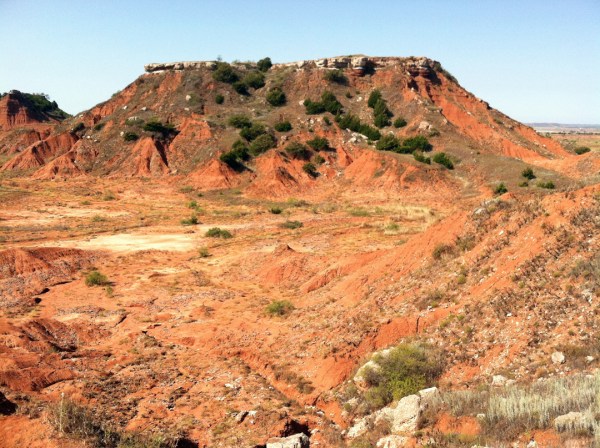
Gloss Mountains State Park, Major Co., Oklahoma

It was worth the drive, as driving west got me out of rain and once past Enid, OK the cloud cover began to break up. By the time of my early afternoon arrival at Gloss Mountains State Park, skies were blue and temps were in the low 70s. Unfortunately, despite these perfect conditions my hunch that C. pulchra might occur here did not prove to be true. Nevertheless, it was a fruitful day as I collected two larvae each of all three of the above tiger beetle species (including 2nd instars of the presently undescribed C. celeripes and 3rd instars of the frightfully enormous A. cylindriformis—what an impressive creature!), photographed several beetles on yellow asteraceous flowers—two of which I show below, saw another male tarantula, and found an adult female of the truly impressive lubber grasshopper, Brachystola magna, that will become my daughters’ newest pet and has already been named ‘Bertha’ by them. My wanderings through the prairie at night with a lamp on my head did not produce any A. cylindricollis adults, but the views of the Milky Way in the dark, cloudless sky above amidst the overwhelming silence of a vast prairie cloaked in darkness were nothing short of spectacular.

Caps of gypsum over soft red clay have resulted in a landscape of flat-topped mesas.

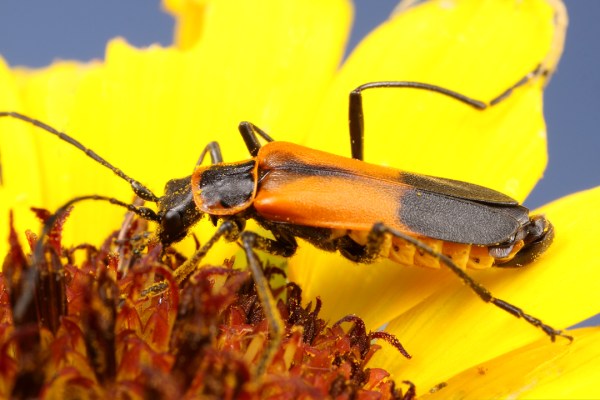
Here are two of the beetles that I photographed on the day. This first one is a soldier beetle (family Cantharidae) that is a dead ringer for Chauliognathus limbicollis. I couldn’t find any indication that this species is known from Oklahoma—all of the BugGuide photos of this species were taken in Arizona, while the admittedly outdated key to species in the tribe Chauliognathini (Fender 1964) gives only more western states (Arizona, Colorado, New Mexico and Texas) in its distribution. Still, I saw the species not uncommonly as it fed on yellow asteraceous flowers.

Chauliognathus limbicollis on yellow asteraceous flower | Glass Mountains, Oklahoma

Another beetle that I photographed on flowers of Heterotheca subaxillaris (stiffleaf false goldenaster) was this small blister beetle (family Meloidae) that seems to be a member of the great genus Epicauta. I won’t even attempt a species ID due to the size and difficult taxonomy of this genus; however, this was the only example of this species that I saw amidst abundant individuals of another solid gray species that seemed to prefer the flowers of Gutierezzia sarothrae (broom snakeweed) over H. subaxillaris.

Epicauta sp. on Heterotheca subaxillaris flower | Glass Mountains, Oklahoma

During the day, I found some trees infested with jewel beetle larvae (presumably in the genus Chrysobothris), so I will return in the morning of Day 3 to harvest the wood and bring it back to put up in rearing containers in an attempt to rear out the adults. Afterwards, I will be off to my next destination—Alabaster Caverns State Park.

REFERENCES:

Fender, K. M. 1964. Tbe Chauliognathini of America North of Mexico (Coleoptera—Cantharidae), Part 2. Northwest Science 38(3):95–106.

MacRae, T. C. 2006. Beetle bits: The “beautiful tiger beetle”. Nature Notes, Journal of the Webster Groves Nature Study Society 78(4):9–12.

Copyright © Ted C. MacRae 2012