A Horridus Birthday

For many years now, I’ve celebrated my birthday each year with the “season-opener-birthday-bug-collecting-trip.”  This happens regardless of what day of the week it falls (although two years ago I did get roped into a business trip – I made up for it by stumbling into a quick but thoroughly enjoyable tour of Pipestone National Monument before my flight back home).  Last year I made sure I got the day off and had a nice, festive (tiger beetle) birthday.  For this past April 23rd, a Friday, I celebrated my 29th birthday (for the 2-dozenth time!) by grabbing long-time field companion Rich and shooting down to Sam A. Baker State Park in the Ozark Highlands of southeastern Missouri.  My goal for the trip was to find the very uncommon Cladrastis kentukea (American yellowwood), a small tree that is known to occur in Missouri only in the White River Hills of the extreme southwest and in a few localities in and near Sam Baker State Park.  Actually, it wasn’t the tree so much that I was after, but a small jewel beetle – Agrilus cladrastis – that utilizes this plant exclusively for its larval host. To date, the only Missouri specimens of this species have been collected by the late, great Gayle Nelson on yellowwood in the White River Hills, and I wanted to see if I might be able to find it in southeastern Missouri as well.  April is still too early to encounter active adults, but my plan was to: 1) find examples of the tree, 2) collect dead wood from them, and 3) cut living branches to leave in situ for infestation this season and retrieval the next.  Long story short, I succeeded on all three counts (though I won’t know for a few weeks whether the wood I brought back actually harbors any as yet unemerged adults – finger crossed!).
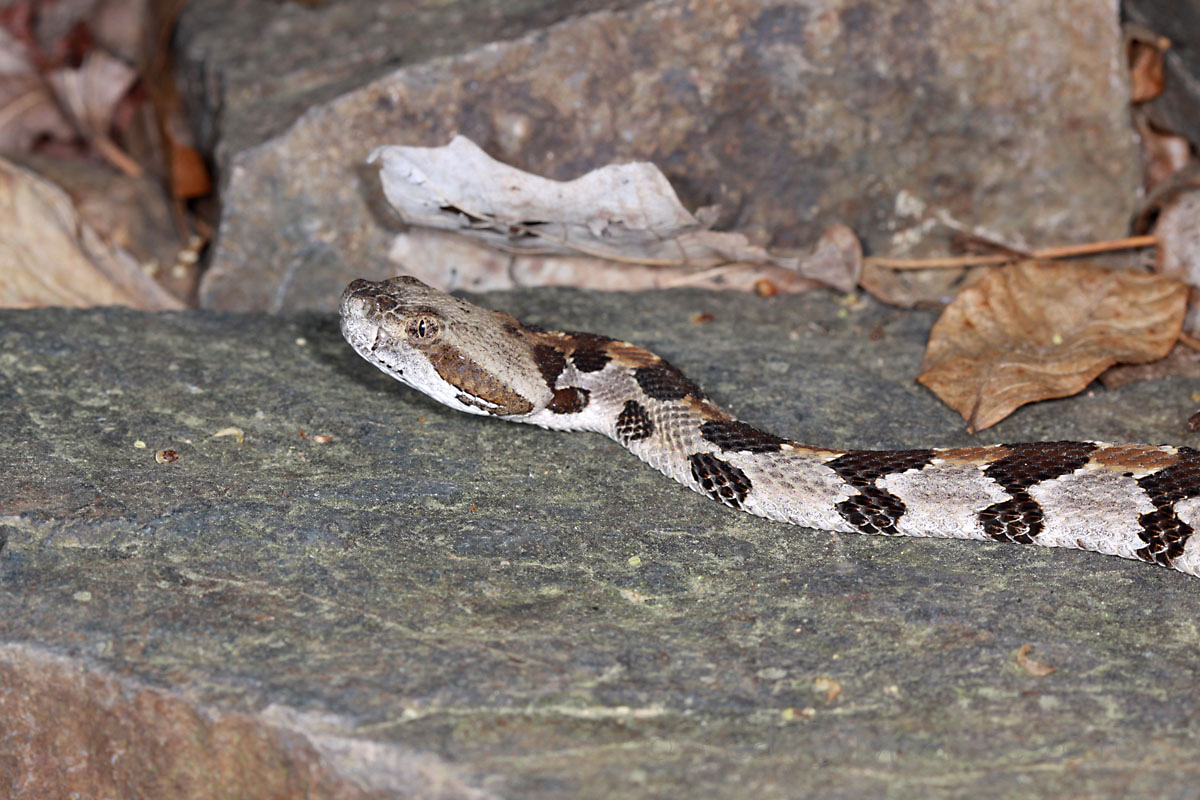
The area where we expected to find the tree was steep, rocky slopes overlooking Big Creek on the north side of the park.  Rich and I were hiking a trail below the slopes, and I had gotten a little bit ahead of him when I saw a 30″ long snake stretched straight out across the trail.  Recognizing it immediately as one of our venomous species, but not quite sure which one, I blurted out, “Wow, what a gorgeous snake!”  Rich, a better herpetologist than I, shouted from a distance back, “What kind?”  In the few seconds during which this exchange was taking place, it all registered – the dark stripe behind the eye, the bold markings (too dark for a copperhead, too big for a western pygmy rattlesnake, too widely spaced for a massasauga), the black tail (not yellow-green like a juvenile copperhead), and a tiny little one-chambered rattle!  I yelled back, “A young timber rattler!”  Rich got there promptly, and we decided that it must be a yearling based on the time of year, its length, and the size of the rattle.

I have seen a few timber rattlesnakes (Crotalus horridus) in Missouri over the years, but never like this.  My previous sightings have all been fleeting glimpses after hearing them shooting into the underbrush to escape my close approach – me oblivious to their presence until it was too late.  This young snake, by contrast, didn’t flinch as I approached (carefully), set down the backpack, and assembled the camera to begin taking photographs.  As I began taking a few photos of the head area (from a respectful distance – the vision of that terrifyingly aggressive prairie rattlesnake from two years ago still lingers), it became agitated and started moving for cover.  Rich wasn’t too anxious to head it off at the pass, but I wasn’t satisfied with the shots that I’d gotten so far, so I grabbed my net to block it from disappearing into the litter.  That caused it to pause just long enough for me to get back into position and frame a shot… that I couldn’t get off before it started moving again!  We did this a few times until it finally just crawled right into the net – now what?!  I carried the net over to some large rocks on the side of the trail and used them to flip the net and dump out the snake, which immediately headed for cover underneath the rocks.  I figured the photo shoot was over then, but the space under the rocks was not deep, and after a bit of probing for escape routes the snake eventually settled into a money pose and I was able to snap away with glee – what do you think?
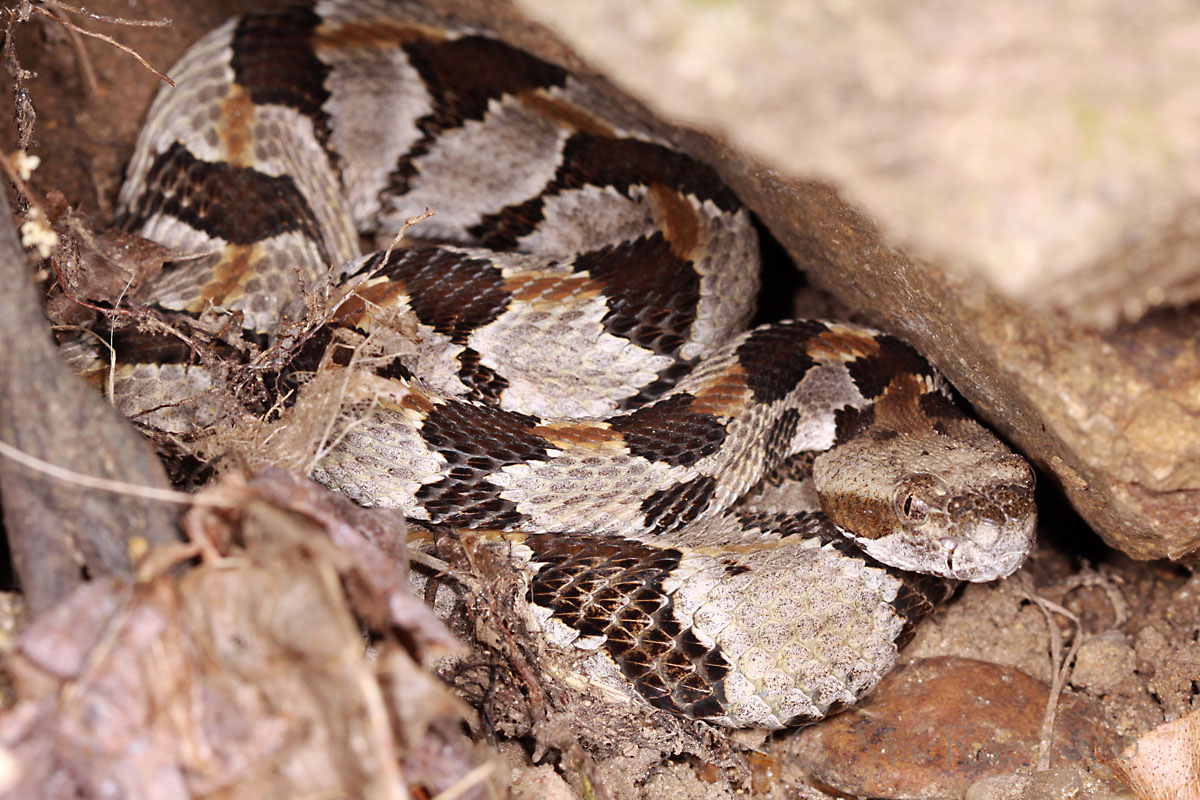
Missouri has five venomous snake species, all of which are pit vipers with three being rattlesnakes.  I’ve featured two of these in previous posts – the Osage copperhead and the western pygmy rattlesnake.  Both of these species occur throughout the Ozark Highlands, although the latter is more common in the southwestern part of the state.  The third rattlesnake species in Missouri, eastern massasauga, is rare in wet habitats scattered across northern Missouri, while the cottonmouth (or water moccasin) is limited to stream, river, and swamp habitats in the southern Ozarks and southeastern lowlands.  Many internet references list the western massasauga also as occurring in Missouri, but this subspecies is not included in the most recent Snakes of Missouri (Biggler and Johnson 2004).  Within Missouri, timber rattlesnakes have a statewide distribution, but they have been extirpated by humans from many areas and now occur as small populations in scattered locations across the state.  The same is true in other parts of their range as well, particularly along the western and northern limits.  It is thus a rare and exciting treat to see one of these magnificent animals, although the reasons for its rarity are both sobering and maddening.

REFERENCE:

Briggler, J. and T. R. Johnson.  2004. Snakes of Missouri. Missouri Department of Conservation, Jefferson City, 16 pp.

Copyright © Ted C. MacRae 2010

Add to FacebookAdd to DiggAdd to Del.icio.usAdd to StumbleuponAdd to RedditAdd to BlinklistAdd to TwitterAdd to TechnoratiAdd to Yahoo BuzzAdd to Newsvine

Email to a friend

Hitchin’ A Ride

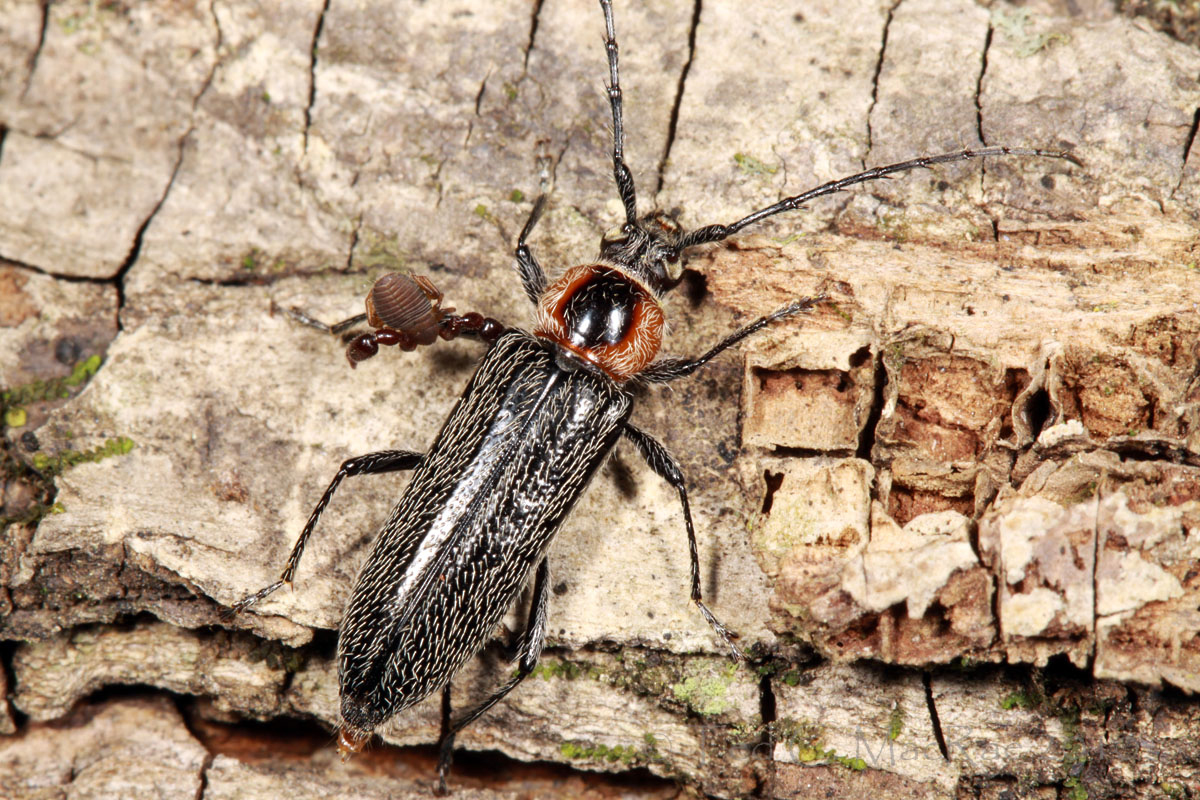
One of the more common species of longhorned beetles (family Cerambycidae) in Missouri, and throughout the eastern U.S., is Stenosphenus notatus.  Despite its commonness, however, it is a species that is easily overlooked because of its very early seasonality, emerging during the first warm days of spring (late March here in Missouri) and disappearing by the time the bulk of longhorned beetle species become active during late spring and early summer.  I found this individual on a recently fallen mockernut hickory (Carya alba) during the 2nd week of April, as Rich and I hiked the lower portion of the Wappapello Section of the Ozark Trail in southern Missouri (along with several other wood boring beetles species such as Dicerca lurida, Megacyllene caryae, and the woodboring beetle predator Enoclerus ichneumoneus).  Longhorned beetles display a variety of host fidelities, ranging from highly polyphagous to strictly monophagous – this species falls near though not quite at the latter end of the spectrum, being associated almost exclusively with the genus Carya (hickories and pecan).  I have reared adults from dead branches and trunk sections of not only C. alba, but also C. aquatica (water hickory), C. laciniosa (shellbark hickory), and C. ovata (shagbark hickory) (MacRae 1994, MacRae and Rice 2007).  Linsley (1963) also records Celtis (hackberry) as a host, but I have not seen the species myself in association with plants of that genus, nor have I seen other literature references to such – I suspect this may, in fact, be an incidental adult association rather than indicative of a true larval host (an all too common problem in interpreting literature on woodboring beetle host plants).

The very early spring occurrence of this insect can be traced to a peculiarity of its life cycle shared by few other cerambycid species in the eastern U.S. – overwintering in the adult stage.  Most eastern U.S. longhorned beetles overwinter within the host wood as either partially or completely grown larvae.  Warming temperatures in the spring trigger resumption of growth in the former and a transformation to the pupal stage in the latter, which emerge as adults a few weeks later during mid-late spring.  In contrast, S. notatus – which requires two seasons to complete its development – pupates in the latter part of the second season and transforms into the adult before the onset of winter.  When warm temperatures return in spring, the adults are ready to emerge and search out fresh hickory wood that has died within the past few months on which to lay their eggs and begin the cycle anew.

As I photographed this individual, I noticed an object attached to its left mesothoracic (middle) leg.  Zooming in on the object showed it to be a pseudoscorpion – a type of arachnid (relative of spiders, mites, and true scorpions) in the order Pseudoscorpiones.  I have not the resources nor the expertise to attempt a more specific ID, but its attachment to the beetle almost surely represents an example of phoresy – defined as a phenomenon in which “one animal seeks out and attaches to the outer surface of another animal for a limited time during which the attached animal (termed the phoretic) ceases feeding and ontogenesis, such attachment presumably resulting in dispersal from areas unsuitable for further development, either of the individual or its progeny” (Farish and Axtell 1971).  Pseudoscorpions have been reported attached to insects from several orders, primarily Diptera but also beetles and including longhorned beetles (Perry et al. 1974, Haack and Wilkinson 1987).  Many species of pseudoscorpions develop beneath the bark of dead trees and prey upon the many other small insects and mites found there, and it would be reasonable to presume that their most effective means of dispersal to new habitats (i.e., dead trees) would be by “hitching a ride” with adult woodboring beetles as they emerge and fly to these new sites.  As obvious as this explanation might seem, few data have actually been generated to demonstrate it is actually the case, and several competing hypotheses such as accidental boarding (hitching a ride by accident), obligate symbiosis (the pseudoscorpions live exclusively on the beetles), and phagophily (preying upon other beetle associates such as mites) have been offered as alternative explanations. However, at least one fairly recent investigation on the pseudoscorpion, Cordylochernes scorpioides, a frequent inhabitant under the elytra of the giant harlequin beetle, Acrocinus longimanus (family Cerambycidae), does seem to not only support the dispersal hypothesis, but also suggests that large male C. scorpioides even defend a beetle’s abdomen as a strategic site for intercepting and inseminating dispersing females (Zeh and Zeh 1992).

REFERENCES:

Farish, D. J. and R. C. Axtell. 1971. Phoresy redefined and examined in Macrocheles muscaedomesticae (Acarina: Macrochelidae). Acarologia 13:16–29.

Haack, R. A. and R. C. Wilkinson. 1987. Phoresy by Dendrochernes Pseudoscorpions on Cerambycidae (Coleoptera) and Aulacidae (Hymenoptera) in Florida. American Midland Naturalist 117(2):369–373.

Linsley, E. G. 1963. The Cerambycidae of North America. Part IV. Taxonomy and classification of the subfamily Cerambycinae, tribes Elaphidionini through Rhinotragini. University of California Publicatons in Entomology 21:1–165, 52 figs.

MacRae, T. C. 1994. Annotated checklist of the longhorned beetles (Coleoptera: Cerambycidae and Disteniidae) known to occur in Missouri. Insecta Mundi 7(4) (1993):223–252.

MacRae, T. C. and M. E. Rice. 2007. Distributional and biological observations on North American Cerambycidae (Coleoptera). The Coleopterists Bulletin 61(2):227–263.

Perry, R. H., R. W. Surdick and D. M. Anderson. 1974. Observations on the biology, ecology, behavior, and larvae of Dryobius sexnotatus Linsley (Coleoptera: Cerambycidae). The Coleopterists Bulletin 28(4):169–176.

Zeh, D. W. and J. A. Zeh. 1992. On the function of harlequin beetle-riding in the pseudoscorpion, Cordylochernes scorpiones (Pseudoscorpionida: Chernetidae). Journal of Arachnology 20: 47––51.

Copyright © Ted C. MacRae 2010

Add to FacebookAdd to DiggAdd to Del.icio.usAdd to StumbleuponAdd to RedditAdd to BlinklistAdd to TwitterAdd to TechnoratiAdd to Yahoo BuzzAdd to Newsvine

Email to a friend

Friday Flower – Pawpaw

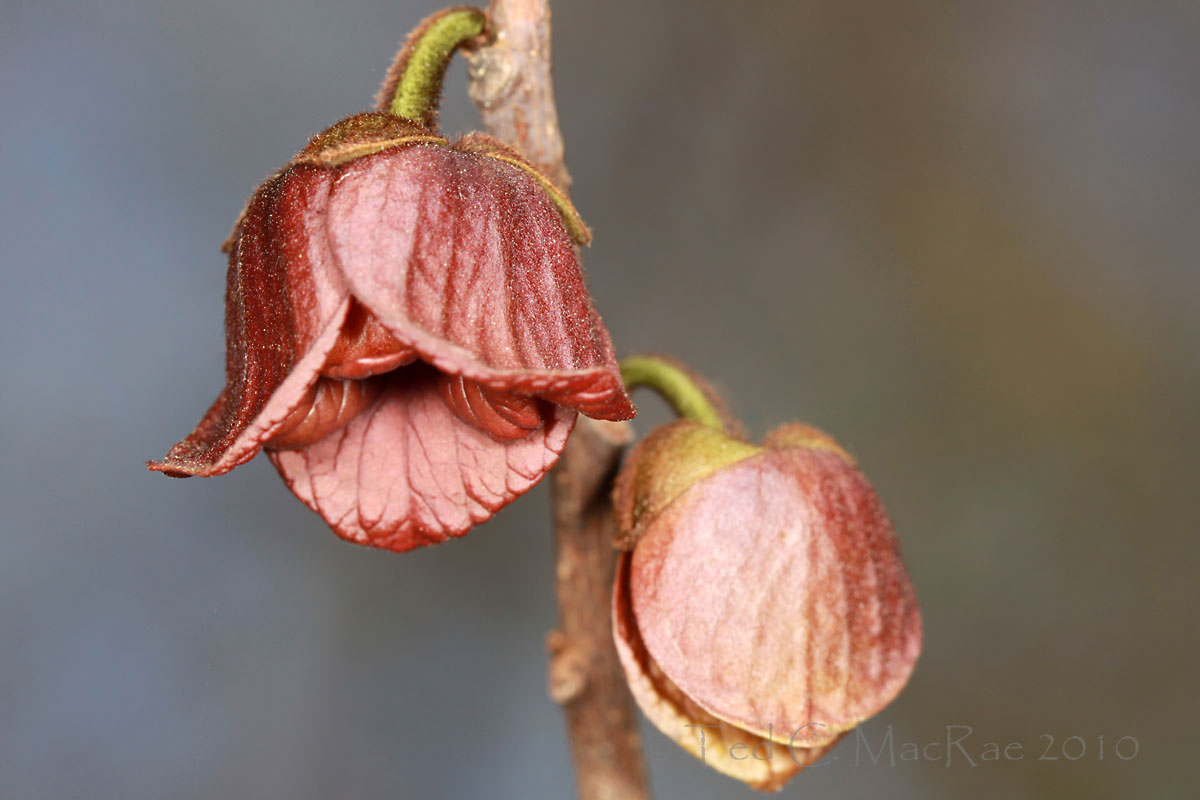
As my friend Rich and I stood in the verdent understory admiring the spectacular panicles of red buckeye punctuating the green lushness, a small brown flower on a leafless branch above me caught my eye.  “Pawpaw!” I exclaimed, perhaps partly in amazement that it took us awhile to notice the trees that were, in fact, all around us.  Pawpaw (Asimina triloba) is a member of the only temperate genus in the otherwise exclusively tropical and subtropical family Annonaceae (Custard Apple Family).  Although not nearly as restricted in occurrence in Missouri as the red buckeyes with which they were growing, they are nevertheless always a treat to see. Scattered throughout the state, they can be found growing in bottomland forests, ravines in mesic upland forests, along woodland streams, and at bases of bluffs (Yatskievych 2006).

Pawpaws are, of course, famous for their large edible fruits, sometimes called Indian bananas, Missouri bananas, Michigan bananas, [insert eastern state here] bananas, etc.  Technically, however, the pawpaw fruit is a berry, since it is derived from a single pistil and has multiple seeds embedded within the pulpy matrix.  I’ve not tried the fruit myself, not for lack of desire but rather an inability to find them when they ripen in fall before the birds and mammals get to them.  Some effort has been made to cultivate the plant for fruit production, but low fruit set seems to be a persistent problem due to reproductive self-incompatibility.

Pawpaw also famously serves as the larval food plant for the zebra swallowtail butterfly, Eurytides marcellus (family Papilionidae).  Beyond this, however, there seem to be not many insects associated with the plant.  I have collected dead wood of pawpaw in an effort to determine the species of wood-boring beetle species that are associated with it.  The only species I’ve reared is the longhorned beetle, Elaphidion mucronatum (whose common name “spined oak borer” belies the fact that it is one of the most polyphagous of all North American species), and two other longhorned beetles, Eupogonius pauper and Urgleptes querci (also highly polyphagous), have also been reported being reared from dead wood of this plant.  I have not associated any jewel beetles with pawpaw, nor have any such associations been reported in the literature.  It would appear that woodboring beetles are not fond of the soft, weak wood of pawpaw, perhaps due to the plant’s annonaceous acetogenins with known pesticidal qualities (Ratnayake et al. 1993) (acetogenins are also under investigation as anti-cancer drugs).  Other poisonous compounds, chiefly alkaloids, are found in various parts of the plant, especially the seeds and bark, and likely play a role in herbivore defense. Insect pollinators also seem to be infrequent, as I have not noted any insects on its flowers. Most members of the family are pollinated by beetles (Yatskievych 2006), but the meat-colored, downward-facing, not-so-sweet-smelling flowers of pawpaw suggest pollination by flies, perhaps those attracted to carrion.

REFERENCE:

Ratnayake, S., J.K. Rupprecht, W.M. Potter, and J.L. McLaughlin. 1993. Evaluation of the pawpaw tree, Asimina triloba (Annonaceae), as a commercial source of the pesticidal annonaceous acetogenins. p. 644-648. In: J. Janick and J.E. Simon (eds.), New Crops. Wiley, New York.

Yatskievych, G. 2006. Steyermark’s Flora of Missouri, Volume 2. The Missouri Botanical Garden Press, St. Louis, 1181 pp.

Copyright © Ted C. MacRae 2010

Add to FacebookAdd to DiggAdd to Del.icio.usAdd to StumbleuponAdd to RedditAdd to BlinklistAdd to TwitterAdd to TechnoratiAdd to Yahoo BuzzAdd to Newsvine

Email to a friend

Beetle Collecting 101: Dress for Success

For most of the nearly 3 decades that I’ve been collecting insects, beetles have been my primary interest – first longhorned beetles, then jewel beetles, and now more recently tiger beetles (each taxon an addition, not a replacement!). During that time, I’ve learned a thing or two about the art of collecting – some of which I’ve figured out for myself, much more a result of my good fortune to have spent time in the field with the likes of Gayle NelsonChuck Bellamy, and a number of other learned entomologists.  In view of this, I thought there might be interest in an occasional post on some aspect of my approach to collecting beetles. With that, I introduce my new series, “Beetle Collecting 101,” and since it all starts in the field, this first installment will consider my basic outfit for field collecting. Although my focus is beetles (and specific groups of beetles at that), this basic outfit is widely applicable across most insect groups. There are a number of additional items that I can and do bring into the field with me at various times depending on location and season or for specific collecting techniques (e.g., beating, blacklighting, pitfall/bait trapping, etc.) that won’t be covered here – these additional items could be covered in future posts if this post indicates sufficient interest. Other future post ideas I had include rearing, specimen processing (everything from pinning and labeling to batch processing and storage methods), and collection organization/curation. Comments and suggestions welcome.

Beetle Collecting 101: Dress for Success

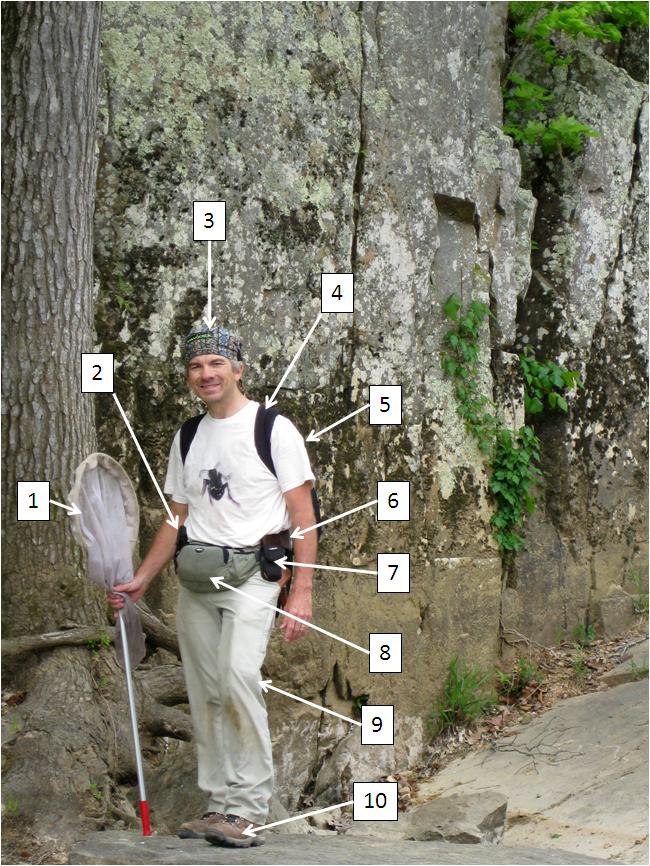
A well-dressed entomologist. Photo by Rich Thoma.

Beyond the needed equipment, the primary considerations for my field outfit are lightweight, comfortable, and protective.  I can spend hours away from the truck in extreme conditions or rugged terrain (or both!), so I want clothing that stays comfortable no matter how much I exert myself.  It is also tempting to carry more equipment than is necessary – this only adds weight and limits the ground that can be covered.

  1. Insect net – duh!  This is an absolute necessity for nearly all but the purely flightless species.  I highly recommend an extendable net handle – I keep mine collapsed (3′ length) for normal use and extend it out to 6′ when stalking tiger beetles or other wary, flighty species.  The collapsed net handle is also a good length and weight to serve as a beating stick when I am carrying a beating sheet (not shown).  I use an aerial net bag, since I don’t do much sweeping anymore – match the bag to your interests.  Of the three common ring diameters for aerial nets, I find the 15″ to be more effective than the 12″, while the 18″ is a little unwieldy.  Green fabric is said to be not as visible to insects as white, thereby allowing closer approach before they attempt to flee, but I do not have any experience with this.  I have collected quite a lot of beetles with my white net bag and appreciate the ability to see the contrast of the insect inside the bag when attempting to remove it.
  2. Hunting knife.  If you’re interested in wood-boring beetles, you’ll want to be able to slice into dead branches suspected of harboring insects.  I like the classic folding Buck Knives Ranger and attach it to the strap of my waist pack (#8) rather than my belt so that it will move with the pack when I swing the pack around backside.
  3. Hat.  If the sun doesn’t bother you, the flies will.  Wear something light and comfortable that will absorb sweat – I like my 2-decades old Mombosok for this (and because I be stylin’!), but those with greater sun sensitivity (or who live in tropical environments) might do better with a brimmed hat.
  4. Backpack.  Before my camera carrying days, this was a Camelbak hydration pack with a good-sized but not overly large water reservoir and zippered pouches with newspaper for placing host plant samples for pressing.  A backpack isn’t really necessary for short forays or mild conditions but is essential for hiking longer distances in hot/dry climates where there is real risk of dehydration.  Many regard backpacks as uncomfortable; however, I find slinging water containers attached to the waist equally annoying and also cumbersome to deal with when crouching or laying.  These days, however, I carry full camera gear in my backpack (camera body, multiple lenses, extension tubes, flash unit).  This adds weight, but it only took a day or two during my first field trip to get used to it.  I still use the camera pack for carrying water, as the front compartment has room for two water bottles or a Camelbak bladder, and my pack also contains a separate zippered compartment where I can still place plant samples for pressing.
  5. Lightweight t-shirt.  I used to wear buttoned fishing shirts over an undershirt, thinking the undershirt would keep perspiration off my skin, while the pockets on the outer shirt would come in handy for holding small items.  In reality, things fall out of the front pockets, and both under- and outer layers would become soaked with sweat.  Now I wear simple 100% cotton t-shirts – artfully emblazoned with an image of Cicindela ancosisconensis by Kirk Betts at The Wild Edge (and leaving no doubt to curious onlookers as to what I am up to).  I find these simple  shirts to be the most comfortable in the most extreme conditions.
  6. Hand axe.  Again, if you’re interested in beetles that live in wood, an axe will be handy for chopping into wood too large or hard to sample with a hunting knife.  Smaller is better (to limit weight), and rather than using a leather holster (which will become soaked with sweat and stretched out), I simply slip the handle under the strap of my waist pack and let the head of the axe rest on the strap to hold it in place.
  7. GPS Unit.  You do record GPS coordinates for your specimens, don’t you?!  I just got a new one for my birthday (Garmin Oregon 450t) with computer download capabilities – no more manual transcribing of data!  Again, I attach it to my waist pack strap rather than my belt.
  8. Waist pack.  I use the very compact Eagle Creek Wayside, with two zippered pouches and an unzippered side pouch to hold all my vials and small tools.  I’ve tried a number of different methods for holding these items – they fall out of shirt pockets whenever you bend over, are not readily accessible when in a backpack, and do not stay organized in a non-compartmented pack.  I have developed a system of vials that serve as both killing bottles and storage containers (this alone could be the subject of another post) – 4-dram vials for most specimens and 8-dram for larger ones.  This waist pack holds 8 small and 6 large vials in the front pouch – with the two sizes kept separate by a divider.  Being able to carry numerous vials allows me to segregate insects by host plant or ecological association, and most importantly, vials in this pouch stay organized so I can easily find the proper vial when I need it.  The larger rear pouch is roomy enough to hold two small olive bottles (for the occasional behemoths or blacklighting), forceps, aspirator, and miscellaneous other items – or, if I’m in the mood to collect wood for rearing (also could be the subject of another post), pruning shears, small folding saw, twine, flagging tape, and permanent marker.  A small side pouch is perfect for keeping a hand lens and an eye dropper bottle of ethyl acetate killing agent at the ready.  Also, the pack easily swings around to my backside when I need to crouch or lay prostrate (e.g., when photographing tiger beetles).
  9. Lightweight polyester/cotton outdoor pants.  I’m fond of the Columbia line of products, but whatever brand you choose, make sure they are lightweight, have a relaxed fit (to allow crouching) and dry quickly (no denim jeans for me!).  The last thing I want is chafing from sweat-soaked pants – yikes!  (Let’s just say lesson learned the hard way).
  10. Hiking boots.  Again, lightweight and comfortable are key, and because of the sometimes rugged terrain I traverse I like mid-ankle support so I can watch for bugs instead of constantly watching my feet.  The lighter the boot, the longer you’ll be able to hike with comfort, and leather uppers will provide greater protection from thorns.

I hope you’ve found some useful tips here.  If you have your own techniques or experiences with field outfits, I’d love to hear them.  Also, if you have subjects that you would like covered in future issues of “Beetle Collecting 101,” please do let me know.

Copyright © Ted C. MacRae 2010

Add to FacebookAdd to DiggAdd to Del.icio.usAdd to StumbleuponAdd to RedditAdd to BlinklistAdd to TwitterAdd to TechnoratiAdd to Yahoo BuzzAdd to Newsvine

Email to a friend

CotS #50 – the Mantis Shrimp Edition

Circus of the Spineless turns 50 (issues) this month, and this special edition is hosted by Mike Bok at Arthropoda.  This is Mike’s first blog carnival hosting gig, but there is nothing rookie about his presentation – the 19 submissions are skillfully organized with visual appeal and just  enough hook to invite clicking.  Stop on by and see a sampling of the latest in invertebrate blogging (and don’t forget to tip the waiter).

As a caveat, I feel I’ve been a bit remiss in not featuring Mike’s blog when I first found it a few months ago, as it has quickly became one of the regular stops on my rounds.  Mike is a graduate student at University of Maryland, and while his primary  interest is in the mantis shrimp visual system, his posts span the breath of the Arthropoda (my phavorite phylum!).  I enjoy his generally casual tone while covering fairly academic subject matter.  One thing I’ve learned after reading Arthropoda for awhile – mantis shrimp are hecka cool!  If you don’t believe me, check out this video of the pseudopupil of a mantis shrimp eye in action (look for it at 0:14-0:18).

Copyright © Ted C. MacRae 2010

Add to FacebookAdd to DiggAdd to Del.icio.usAdd to StumbleuponAdd to RedditAdd to BlinklistAdd to TwitterAdd to TechnoratiAdd to Yahoo BuzzAdd to Newsvine

Email to a friend

Monday Moth – Trichaeta pterophorina

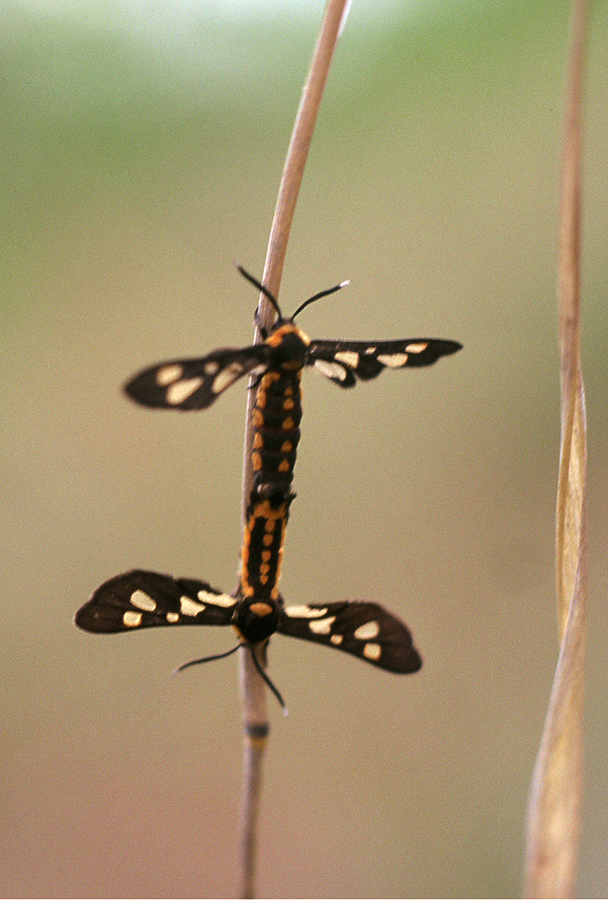
 Trichaeta pterophorina – Borakalalo National Park, South Africa

Another photo from the South Africa files, and one that continues the mimicry theme that has been featured in several recent posts. It’s not a great photograph – the focus is off – but the colors these moths sport are dazzling, and there is a nice symmetry to their tail-to-tail mating position.

Roy Goff, author of the website African Moths, tells me this species is the Simple Maiden (Amata simplex) in the family Arctiidae (whose ~2,000 species worldwide are increasingly considered a subfamily of the already enormous Noctuidae) [update 6/20/2012—Martin in a comment considers these moths to actually represent Trichaeta pterophorina in the same subfamily].  Its gestalt – greatly resembling a stinging wasp – brings to mind the so-called “wasp moths” of North America (subtribe Euchromiina); however, maidens belong to the exclusively Old World Syntomina.  Like the wasp moths, most maidens are exceptionally colorful and exhibit clearly aposematic patterns.  While these might seem to be textbook examples of Batesian mimicry, most species in this group are also protected by distasteful secondary plant compounds that they sequester through feeding, making them Mullerian rather than Batesian mimics.  These compounds are not only acquired by larvae from their food plants, but also by adult moths who imbibe them from fluid regurgitated through their proboscis onto dried parts of plants containing the compounds and into which they dissolve.

Their aposematism is not limited to strictly visual cues.  An Australian species, Amata annulata, is known to regularly emit ultrasonic clicks when flying, thought to be aposematic behavior to warn bats of its distastefulness in the same way that that its coloration warns daytime predators. Additional defensive characters that have been described for species in the group include frothing and extrusion of defensive processes. Clearly, maidens are leaders in the arms race among the insects!

Copyright © Ted C. MacRae 2010

Add to FacebookAdd to DiggAdd to Del.icio.usAdd to StumbleuponAdd to RedditAdd to BlinklistAdd to TwitterAdd to TechnoratiAdd to Yahoo BuzzAdd to Newsvine

Email to a friend

Friday Flower: Red Buckeye

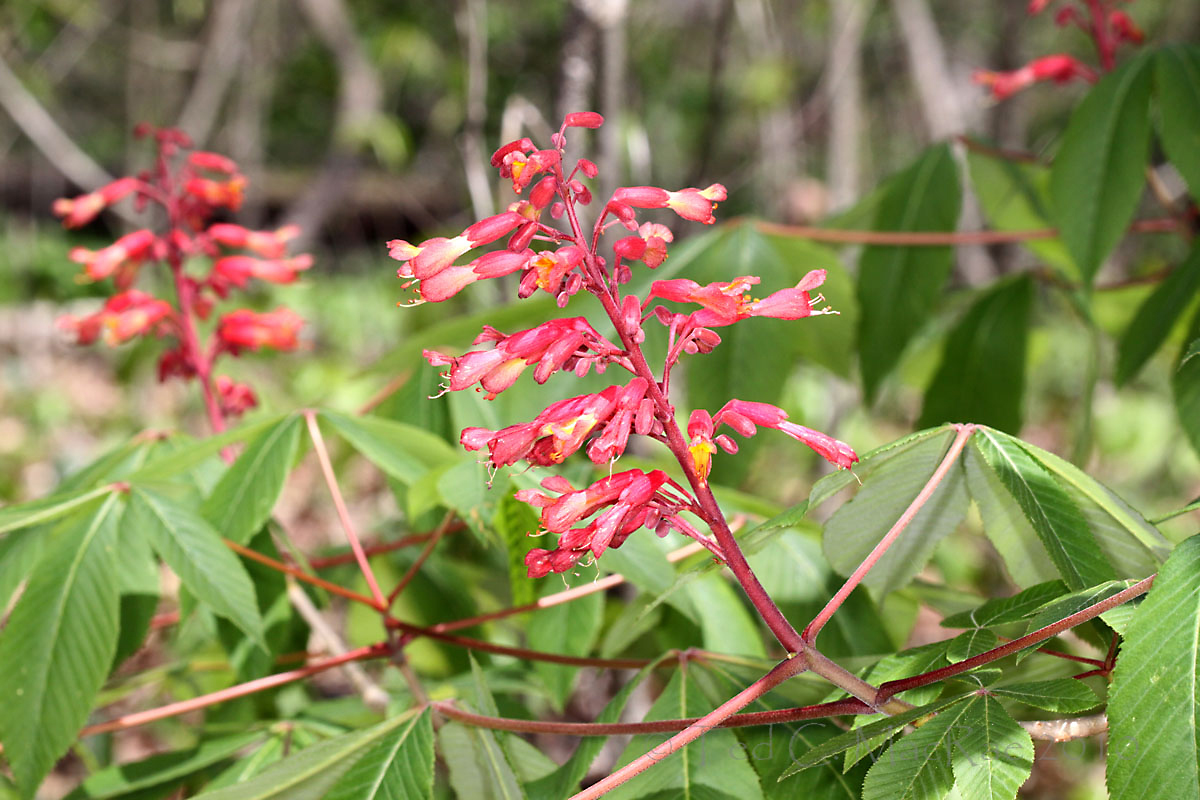
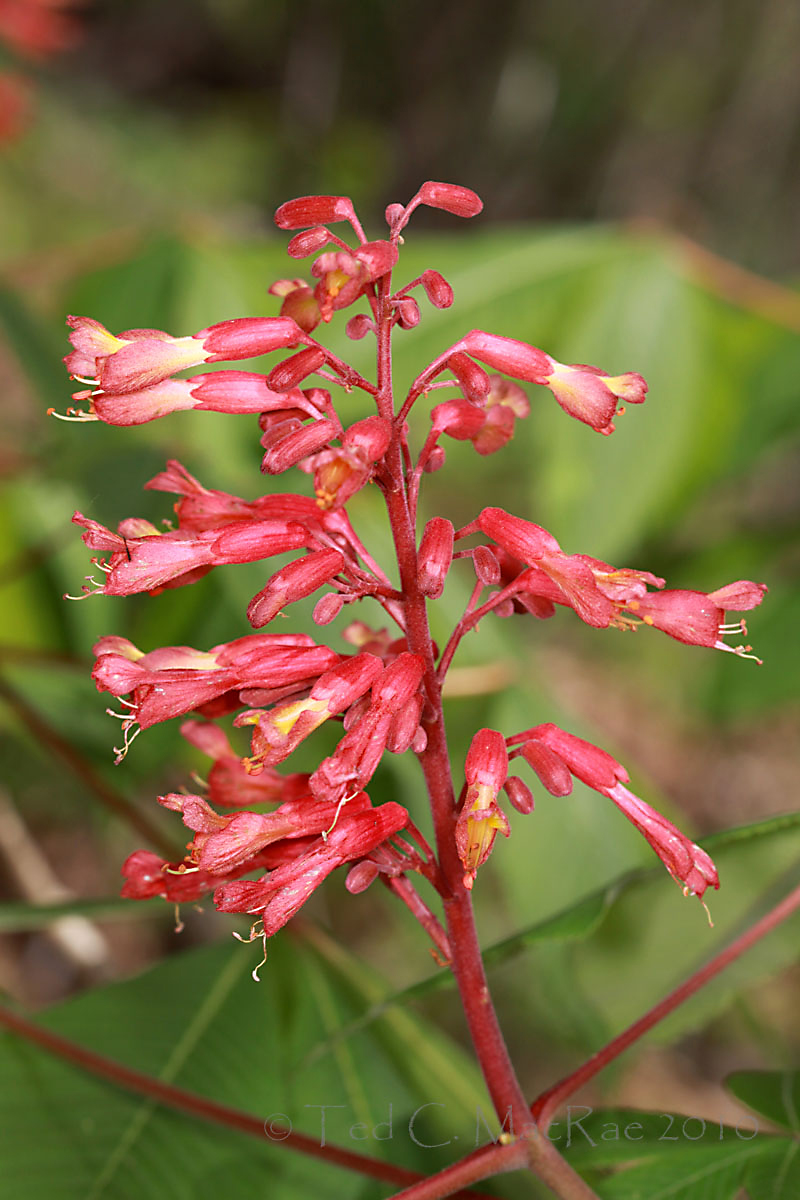
Beetles, spiders, and snakes were not the only delights that Rich and I saw as we hiked the lower stretch of the Ozark Trail’s Wappapello Section in early April.  Entering the rich, moist, east-facing slopes overlooking the Black River valley, the oaks and hickories were still in the early stages of bud break. A lush, green understory, however, spread out before us, punctuated by the striking inflorescences of red buckeye, Aesculus pavia (family Hippocastanaceae). Among the first trees to bloom in spring, red buckeye is unmistakable in the field due to its red flowers and palmately divided leaves.

Red buckeye is native to the southeastern U.S., just reaching Missouri in the southeastern Ozarks (though cultivated further north). This makes it less well-known than the more widely distributed Ohio buckeye, Aesculus glabra (absent only from the southeastern lowlands and northwestern corner of the state, and easily distinguished by its white inflorescences, larger size, and spreading growth habit).  Like that species, the seeds and young foliage especially are poisonous if eaten due to glycosidic alkaloids and saponins.  Native Americans roasted, peeled and mashed the nuts into a meal called “Hetuck.”

I first encountered this species in 2001 along Fox Creek in the White River Hills of extreme southwestern Missouri.  It was one of several species that I had selectively “cut” and left in situ for a season to allow infestation by wood boring beetles.  I retrieved the wood the following spring and reared five species of longhorned beetles (family Cerambycidae) from the dead branches, including Astyleiopus variegatus, Hyperplatys maculata, Leptostylus transversus, Lepturges angulatus, and the prize – the very uncommonly encountered Lepturges regularis. All of these represented new larval host records; however, it was not until after I published those records (MacRae and Rice 2007) that I realized the plant itself was not known by Steyermark (1963) to occur naturally outside of the southeastern Ozark Highlands.

Speaking of early spring flowers, many such delights can be found at Berry Go Round #27 which is now up at Mary Farmer’s A Neotropical Savanna. It’s not just spring ephemerals, however, as another Missouri blogger and I show that winter has it’s own botanical charms. Stop by and enjoy the feast!

REFERENCES:

MacRae, T. C. and M. E. Rice. 2007. Distributional and biological observations on North American Cerambycidae (Coleoptera). The Coleopterists Bulletin 61(2):227–263.

Steyermark, J. A. 1963. Flora of Missouri.  The Iowa State University Press, Ames, 1728 pp.

Copyright © Ted C. MacRae 2010

Add to FacebookAdd to DiggAdd to Del.icio.usAdd to StumbleuponAdd to RedditAdd to BlinklistAdd to TwitterAdd to TechnoratiAdd to Yahoo BuzzAdd to Newsvine

Email to a friend

Rough Green Snake

My string of good herp luck looks like it might continue in 2010.  You may recall the super-aggressive prairie rattlesnake and uncooperative dusty hognosed snake that I featured in 2008 (or not – my readership was rather minuscule back then), followed by the juvenile Osage copperhead, gorgeous male eastern collard lizard, bizarre Texas horned lizards, death-feigning western hognosed snake, super rare Florida scrub lizard, and – finally – cute little western pygmy rattlesnake in 2009. All but the copperhead and collared lizard were first-time sightings for me, and now in 2010 I have yet another first-time sighting to present – the rough green snake (Opheodrys aestivus aestivus).

Rough green snake (Opheodrys aestivus aestivus)

My friend Rich and I spotted this long and slender snake during our early April hike of the lower Wappapello Section of the Ozark Trail (soon after photographing the jumping spider). We would never have seen it, so effective was its green camouflage, had it not been disturbed by our close approach along the trail and tried to flee.  The moist bottomland habitat where we found it was thick with greenbrier (Smilax sp.), making tracking the snake a thorny affair, but I managed to head it off and start taking a few photos of it.  It was surprisingly calm during the early part of the photo session, but I just wasn’t getting the lighting and exposure that I wanted.  Eventually, it started fleeing again, and my efforts to rip through the greenbriers to stay close became too much for my arms to bear.  When it started climbing a tree, I said “enough is enough” and captured him, brought him back out to the comfort and openness of the trail, and had Rich hold him while I worked on getting some better photographs.  The one above is my favorite of the bunch.

Rough green snakes are found in Missouri primarily south of the Missouri River in the Ozark Highlands, where they feed on insects such as grasshoppers, crickets, and especially smooth caterpillars.  A second green snake occurs in Missouri as well, the smooth green snake (Opheodrys vernalis), which differs from the rough green snake by having smooth scales and a more northern distribution within the state. Sadly, the smooth green snake has not been seen in the state for a number of years now, probably because of loss of habitat resulting from the near complete agricultural conversion of that part of the state.

Photo Details: Canon 100 mm macro lens on Canon 50D, ISO 400, 1/60 sec, f/4.5, Canon MT-24EX flash w/ Sto-Fen diffusers. Minimal post-processing.

Copyright © Ted C. MacRae 2010