Friday Flower: Crystallofolia (“Frost Flowers”)

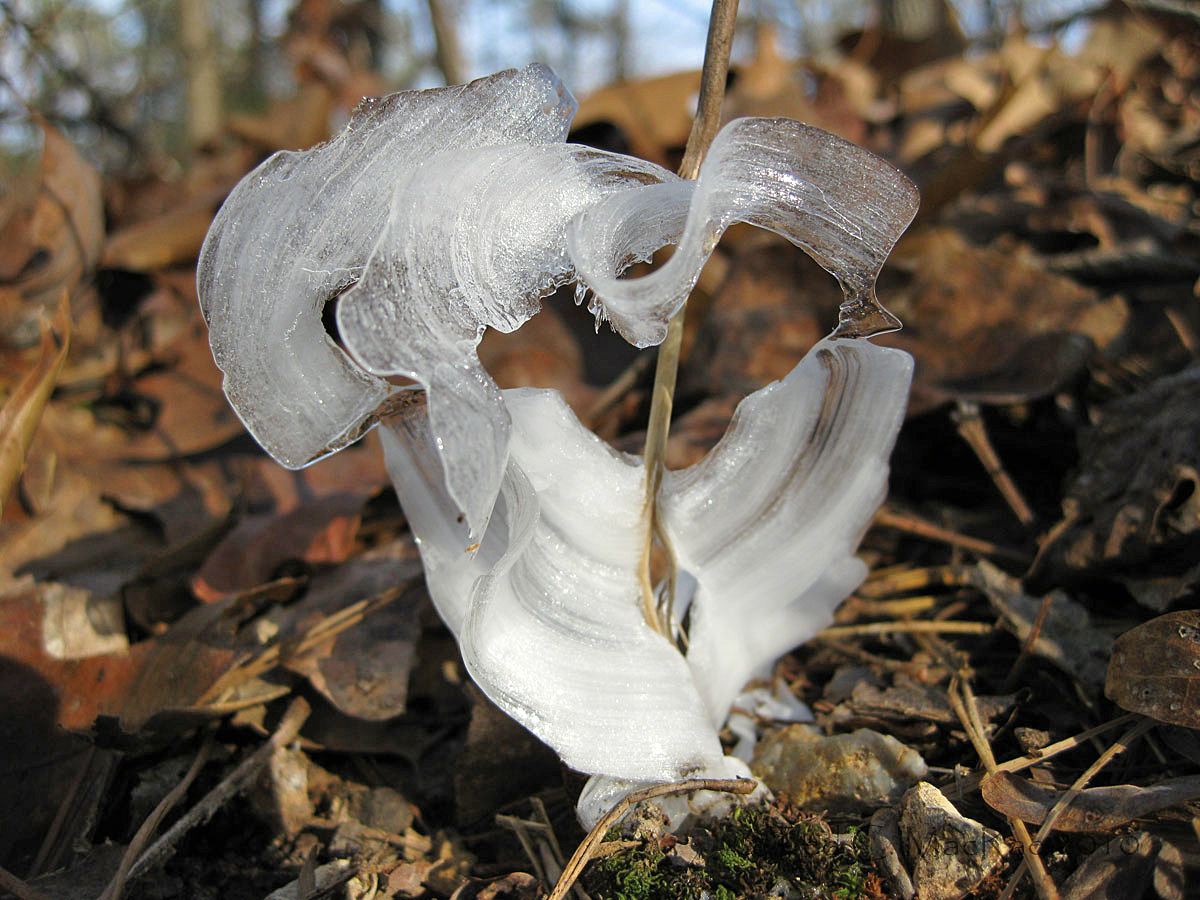
Crystallofolia (frost flowers) on dittany (Cunila origanoides).

While hiking the middle stretch of the Ozark Trail’s Wappapello Section, my friend Rich and I witnessed a bounty of crystallofolia, or “frost flowers”.  These fragile, yet exquisite formations are, of course, not flowers at all, nor are they true frost (which forms directly from water vapor without first condensing), but rather are thin layers of ice that form as water is drawn from cracks in plant stems and freezes upon contact with cold air.  As the water continues to be drawn from the plant by capillary action, newly forming ice pushes older ice further out, creating delicate, folded, curling ribbons of ice that resemble many-layered flower petals.  Air trapped within the ice upon freezing imparts a frothy white appearance.

Frost flowers are not an uncommon phenomenon, and I have seen them on more than a few occasions during my frequent off-season hikes.  However, never before had either Rich or I seen the numbers that we saw during our hike on this, the second day of the New Year.  Frost flowers are normally encountered during the first hard freezes of fall when the ground is not yet frozen.  Water in the stems of certain plants expands as a result of the freezing air temperatures, causing vertical cracks to form along the length of the stem through which the ice ribbons are extruded. The formations are rather ephemeral, usually melting or sublimating away by late morning in fall’s typically mild daytime temperatures.  As fall progresses to winter, water stores in the plant stems become depleted after several freezes or locked up when the ground itself freezes, and as a result frost flowers are rarely seen later than December in Missouri. However, it has been a wet and mild fall and early winter, and after an extended period of moisture during December, Missouri was finally gripped by a severe cold spell with lows in the single digits and daytime highs remaining down in the teens and 20s.  The saturated, yet unfrozen ground provided a good source of moisture for plant stems to draw upon, and continuous subfreezing air temperatures allowed frost flowers to persist throughout the days and attain remarkable size. The photo above was taken in late afternoon as a sinking sun shone brightly on the west-facing slope where this formation was seen, persisting in all its fragile glory.

In Missouri, frost flowers are primarily associated with dittany (Cunila origanoides), species of Verbesina (V. virginica, white crownbeard; and V. alternifolia, yellow ironweed), and camphor weed (Pluchea camphorata).  Frost flowers are rarely seen on any other plant in Missouri, and I don’t know what it is about these plants and not others that make them suitable for frost flower formation.  Dittany is a daintly little member of the Lamiaceae, and as such has square stems – perhaps the angles on the stem are prone to splitting.  However, there are many other lamiaceous plants and non-lamiaceous square-stemmed plant species in Missouri that do not form frost flowers.  Likewise, Verbesina and Pluchea belong to the Asteraceae and do not have square stems.  They are, however, larger, more robust plants with thick, pithy stems that may be capable of holding a large amount of water and mature late in the season after most other plants have already dried up, perhaps allowing them to retain sufficient moisture in the stem late enough in the season to allow frost flower formation when conditions are right.  The majority of the frost flowers we saw were on dittany – dainty, delicate, fragile formations 2-3 inches across. However, at the end of the hike, as we were exploring the area around the parking lot, we found a stand of Verbesina (I suspect V. alternifolia), with which some of the most enormous and robust frost flowers that I have ever seen were associated.  Following are additional views of some of the more impressive formations we saw and the plants they were associated with.

Frost flowers on dittany - shaded, protected areas produced the largest formations.

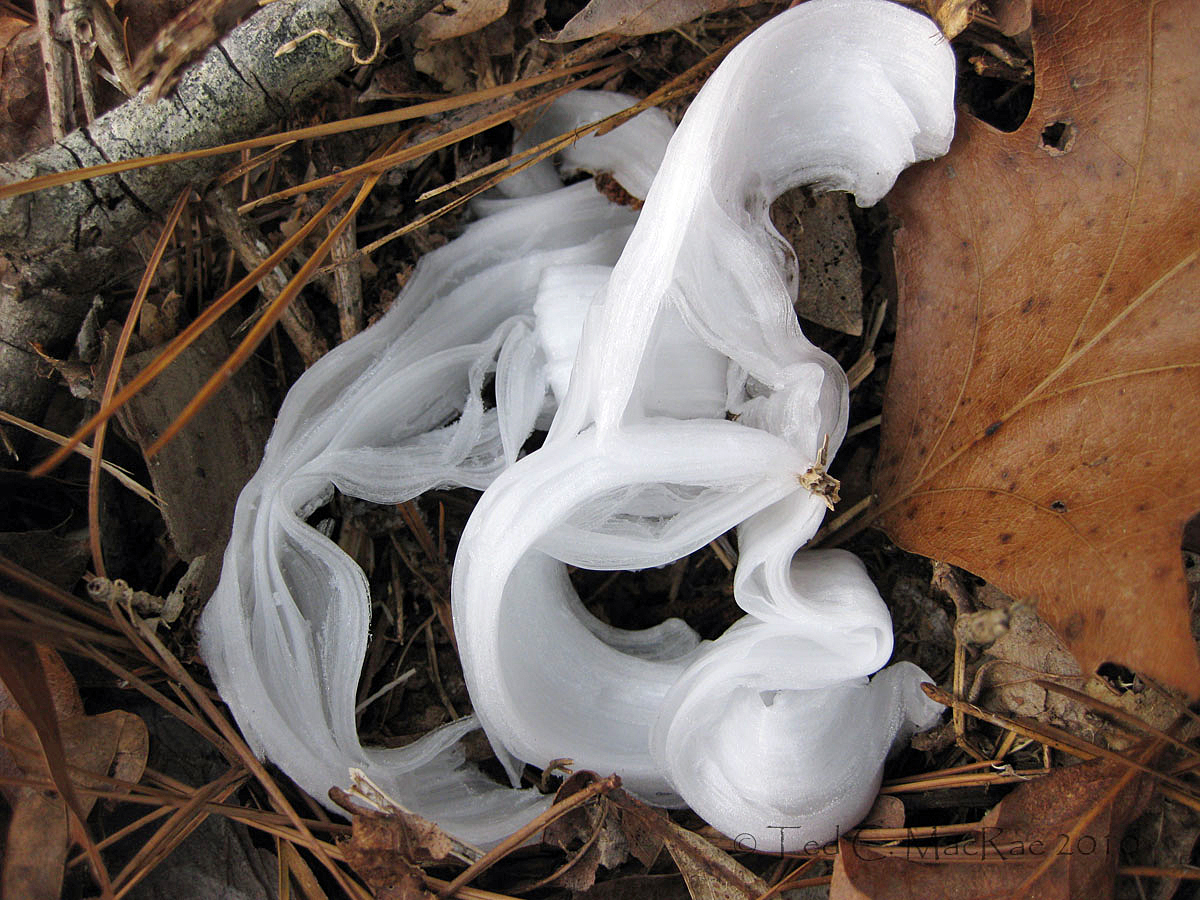
Partial thawing during ribbon formation causes exquisite twists and turns.

Like snowflakes, each frost flower is one-of-a-kind.

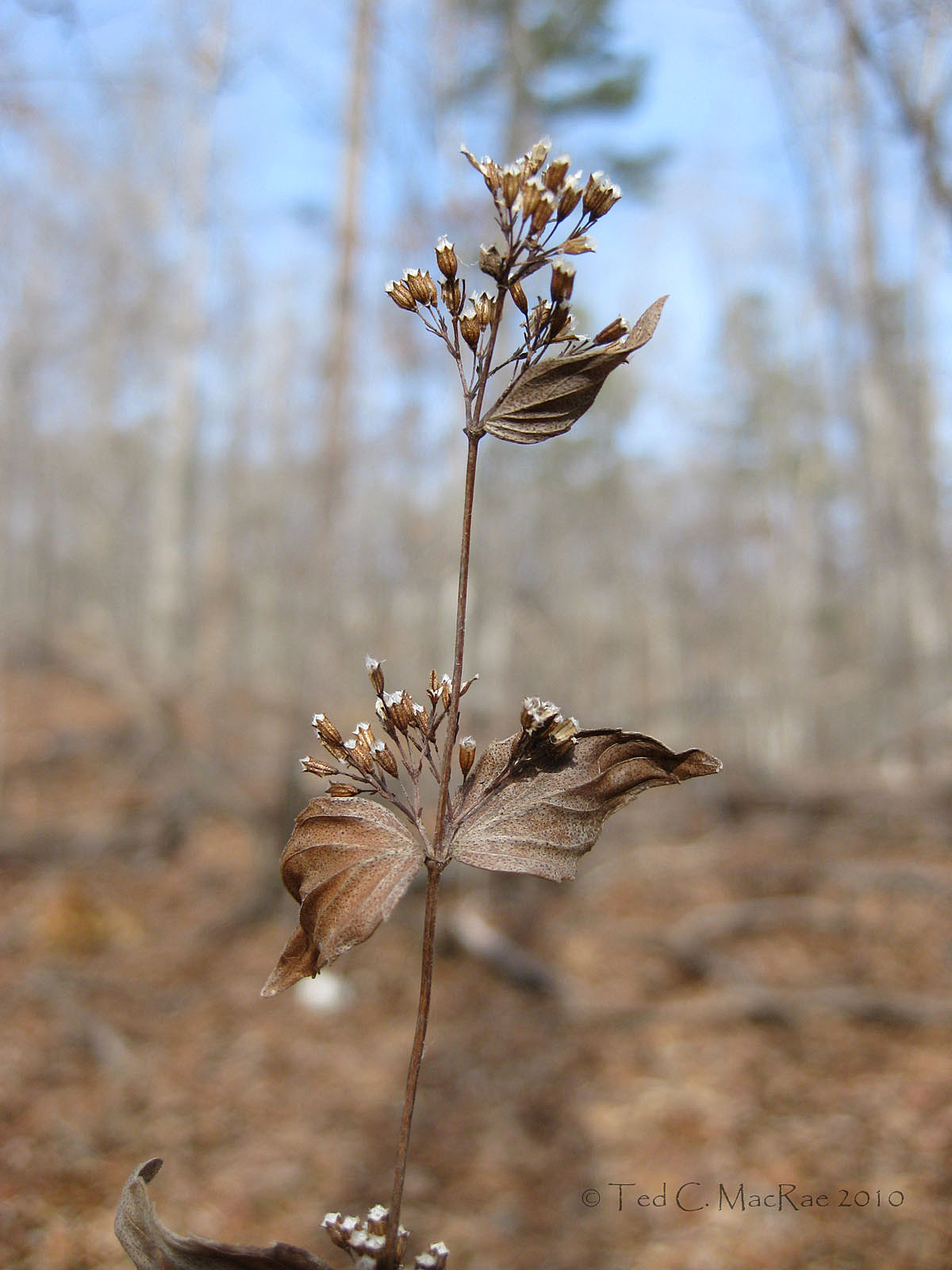
Dittany (Cunila origanoides) dried stem, leaves, and fruits.

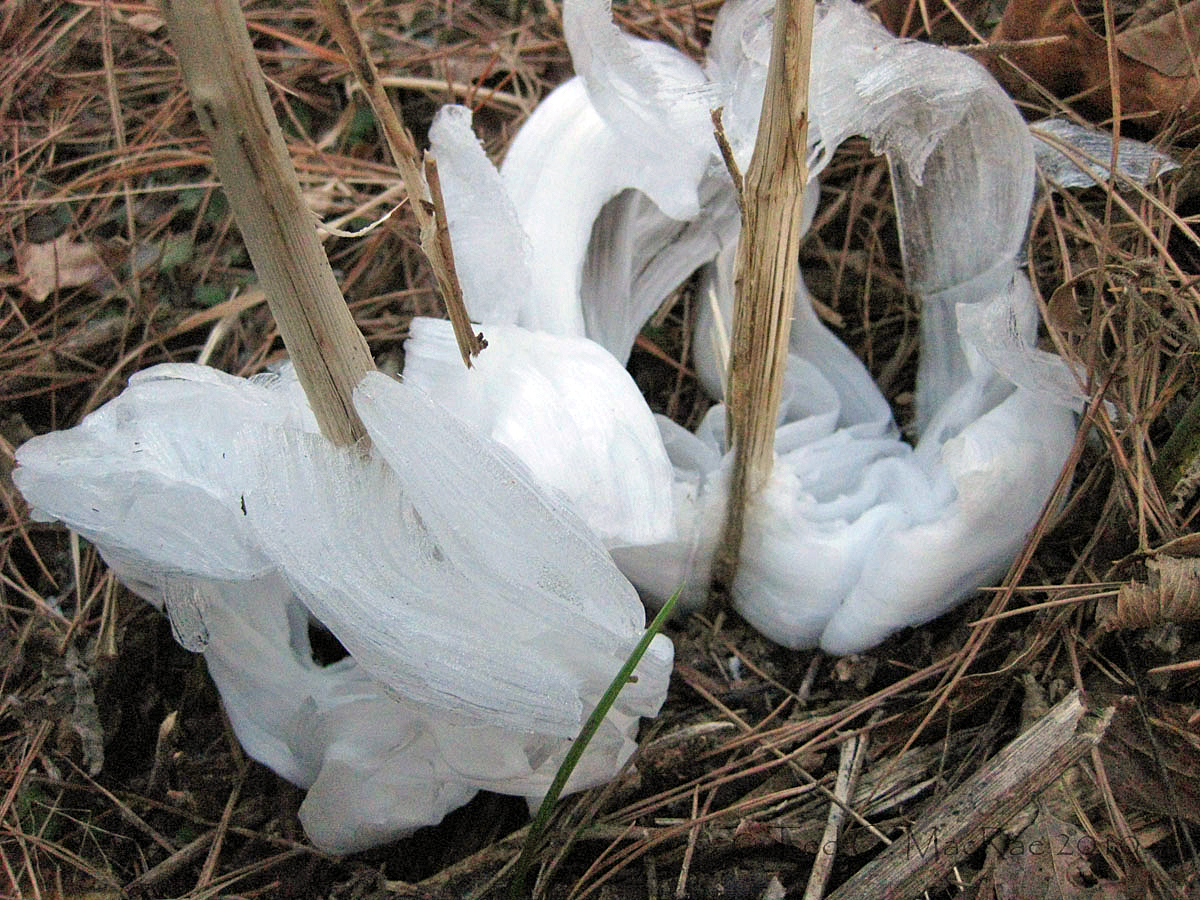
Verbesina sp. frost flowers were enormous - this one was approx. 5 inches wide.

Dried fruits of Verbesina sp. (poss. alternifolia).

Copyright © Ted C. MacRae 2009

Add to FacebookAdd to DiggAdd to Del.icio.usAdd to StumbleuponAdd to RedditAdd to BlinklistAdd to TwitterAdd to TechnoratiAdd to Yahoo BuzzAdd to Newsvine

Email to a friend

House of Herps #2

House of HerpsWelcome to the 2nd issue of House of Herps, the monthly blog carnival devoted exclusively to reptiles and amphibians.  The brainchild of Amber Coakley, (Birder’s Lounge), and Jason Hogle (xenogere), this new blog carnival had an auspicious start with the inaugural issue and its 21 contributions – an impressive level of participation for a new carnival.  This month the carnival moves off-site, and I am honored to serve as the first off-site host.  The enthusiasm continues with issue #2, for which I received 22 submissions from 18 contributors.  Ever the taxonomist, I present them to you below grouped by traditional classification¹.

¹ It should be noted that modern classification has “evolved” substantially from this traditional classification due to the advent of DNA molecular analyses. For example, lizards are a paraphyletic grouping, and even the class Reptilia has been subsumed within a broader class containing dinosaurs and birds. I stick with the traditional classification here for reasons of familiarity and convenience.

Class AMPHIBIA (Amphibians)
-Order CAUDATA (Salamanders)

California Giant Salamander (Dicamptodon ensatus).  At the nature of a man, Ken talks about not one, but two close encounters last fall with this otherwordly-looking creature.  The first one he saw was a monster of a salamander, measururing a whopping 12 inches (30 cm) in length as it brazenly lounged on a mountain bike trail.  Remaining docile for photographs, imagine Ken’s surprise when the salamander started barking at him when he picked it up to move it to safer ground!  In his second encounter, he got to watch one chomp down on a banana slug – mmm tasty! 

-Order ANURA (Frogs)

Upland Chorus Frog (Pseudacris feriarum).  At Anybody Seen My Focus?, Joan normally only gets to hear the breeding season calls of the chorus frog and his friends who have taken up residence in the water-filled bathtub that serves as a planter in her greenhouse, usually bobbing under the water upon any approach.  But on this occasion, he agreed to photographs, even allowing a final closeup.

Gulf coast toad (Bufo nebulifer).  At Dolittle’s Domain, Dr. Doolittle marvels at one of the many toads that she has found parked under the outside light all night (along with the bats and armadillos) during the cold darkness of December.  Rather than fleeing the camera flash in the face, he simply hunkered down trying to make himself flatter, apparently thinking that would make him invisible and not realizing that he just looked fatter!

Northern Cricket Frog (Acris crepitans).  HoH‘s own Jason weaves artful writing with stunning photographs to distinguish one of the smallest land vertebrates in North America at xenogere.  Despite their ubiquity, these little frogs often go unnoticed due to the smallness of their size, their impressive leap, and their extreme variability.  Get a good look at one, however, and you might notice a key feature or two.
American Bullfrog (Rana catesbeiana).  At Willow House Chronicles, barefootheart looks at frogs on the opposite end of the size spectrum, in fact North America’s largest frog living in an increasingly naturalized man-made pond in eastern Ontario.  These behemoths are more frequently heard than seen by their distinctive “yelp” and splash in response to being approached.  If you are lucky enough to get as good a look as barefootheart did, you might be able to distinguish male from female by looking at its eyes, ears, and throat.

Class REPTILIA (Reptiles)
-Order TESTUDINES (Turtles)

Common Snapping Turtle (Chelydra serpentina).  We have three contributions dealing with these grizzled, ancient, grotesquely beautiful reptiles.  The first one comes from Michelle at Rambling Woods, who shows us how it is possible to tame your pet common snapper (but only to a certain degree).  If her story isn’t enough, she also presents a short video clip on the common snapping turtle (Baby snapping turtleREMEMBER – don’t ever try to catch or hold a snapping turtle with your bare hands!).  In another post, HoH‘s own Amber talks about her attempts to rescue a snapping turtle at Birder’s Lounge.  Fortunately for Amber, the little guy was just a tot – not nearly big enough to prune a digit and thwart Amber’s display of compassion.  It’s amazing how a creature so dinosaurian at maturity can still be so cute as a youngster.  In the third contribution about these fascinating creatures, Marge at Space Coast Beach Buzz talks about her snap (get it?) decision to adopt one of these animals, only to change her mind after discovering its true identity (and before losing any fingers).

Green Sea Turtle (Chelonia mydas).  David at Living Alongside Wildlife notes that while green iguanas falling from trees were a popular news report from the unusual cold snap experienced in the southeatern U.S. last month, they were not the only reptiles so adversely affected.  Sea turtles, populations of which have already been compromised by loss of nesting sites, fishing practices, and trash pollution, also found the coastal waters too cold for normal function.  While natural hardships may be nature’s way, he argues (quite effectively) that it is our responsibility to help mitigate their effects considering the perilous position in which we’ve placed these majestic animals to begin with.

Eastern Box Turtle (Terrapene carolina).  Two contributors submitted posts about these lovable oafs.  At A DC Birding Blog, John posted a photo of a box turtle seen at Brigantine Beach.  He wonders if their always disgruntled look is a result of him disturbing from their activities.  These turtles are easily identified by their bright markings – usually dark brown or olive-colored with bright orange or yellow patterns, dome-shaped carapace, and hinged plastron (bottom part).  Individual turtles have unique designs on their shells, making them identifiable in the field.  Turtles can get worms, believe it or not, and Celeste at Celestial Ramblings adds them to the growing list of animals that she has had to de-worm (including herself, ick!).  Step-by-step instructions and explicit photos combine to show that this is not an easy job, requiring no less than three people – “just another day at the office.”  Hmm – cats look easier!
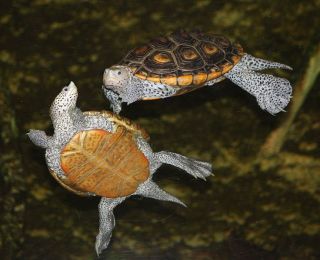
Diamondback terrapin (Malaclemys terrapin).  The diamondback terrapin is the only species of turtle in North America that spends its life in brackish water (salty but less so than sea water).  At Kind of Curious, John describes efforts by The Wetlands Institute to prevent vehicle mortality caused by terrapins crossing roads in their attempt to reach higher ground for laying eggs.

-Order SQUAMATA
–Suborder LACERTILIA (Lizards)

Common collared lizardCommon Collared Lizard (Crotaphytus collaris).  From Jill at Count Your Chicken!  We’re Taking Over! comes this delightful encounter with one of North America’s most charismatic lizards.  I’ve had my own experiences with these guys, but I’ve never gotten one to crawl on my hat or – even better – gotten one to pose with me for a photograph!

Prairie Lizard (Sceloporus consobrinus).  Near my backyard, Marvin at Nature in the Ozarks presents a nice compendium of this species complimented with beautiful photographs.  Marvin not only discusses identification, distribution, life cycle, habitat, and food, but also comments on the recent DNA molecular analyses that have resulted in a reclassification of the former polytopic “fence lizard” and split up the many subspecies into full-fledged species – a man after my taxonomic heart!

“Culebrilla ciega” (Iberian Worm Lizard) (Blanus cinereus).  Javier at macroinstantes writes an artful blog focusing on natural history of the Iberian Peninsula (it is written in Spanish, but Google can easily translate to English for those who need it).  In this post, he presents extraordinary photographs of this subterranean reptile that is endemic to the Iberian Peninsula.  Traditionally classified in the family Amphisbaenidae, it is now considered to belong to its own family the Blanidae.

“Lagartija de Valverde” (The Spanish Algyroides) (Algyroides marchi).  Javier (macroinstantes) also writes about this small lizard that was only discovered in 1958.  With a global range limited to a few mountain streams in a mountainous area of southern Spain covering less than 2,000 km², it is clasified as endangered on the IUCN Red List.  Like so many of the world’s reptiles, its severely fragmented population is suffering declines due to continuing habitat degradation.

–Suborder SERPENTES (Snakes)

Western Rattlesnake (Crotalus viridis).  On the Colorado front range, Sally at Foothills Fancies had three encounters with this aggressive species on her property.  Fortunately, Sally has a “nonagression treaty” with rattlesnakes and allows them to go about their business as much as possible.  Those that get too close for comfort are humanely relocated rather than simply dispatched.  Sadly, many of Sally’s neighbors are not quite so understanding.

Texas Indigo Snake (Drymarchon corais erebennus).  These snakes do not have any such nonaggression treaty, and David at Living Alongside Wildlife contributes another piece illustrating the rattlenake-eating capabilities for which Indigo snakes are famous.  The photographs in the post show a large individual consuming a Western Diamondback Rattlesnake. David explains how these snakes are often identified as blacksnakes and reveals the characters visible on predator and prey that allow their correct identification.

Black Rat Snake (Elaphe obsoleta).  Right here in my home state, Shelly at Natural Missouri characterizes black rat snakes as one of the most commonly encountered snakes in Missouri.  Large snakes reaching up to 6 feet in length, they often end up in basements and cellars in the fall in search of a place to spend the winter – just in time for Halloween!  These snakes are often needlessly killed because of their resemblance to the venomous cottonmouth or water moccasin that they superficially resemble.  However, Shelly has the same nonaggression treaty with these snakes that Sally has with rattlesnakes (although her husband is not quite so sympathetic). 

-Order CROCODILIA (Crocodilians)

American Alligator (Alligator mississippiensis).  David at Living Alongside Wildlife also contributed two pieces on North America’s largest reptile.  In his post Gatorzilla, he examines commonly e-mailed pictures and text about so-called “giant” alligators, debunking myths about 25 foot long monsters, clarifying the identity of misidentified Nile crocodiles, and exposing cases of camera trickery.  In his post Mommy Dearest, he recounts his nervewracking experience when he stumbled upon an alligator nest while knee deep in a south Georgia swamp at night.  Worse, the babies had hatched!  Read the post to see if David got out of there with both of his legs.

GENERAL HERPETOLOGY

Sometimes simply the act of looking for herps is as enjoyable as the herps that are found.  However, it has been a tough January for Bernard at Philly Herping.  A particularly cold snap in the first half of what is already the coldest month of the year made herping at his favorite cemetary a lesson in futility.   I hope you notice the irony – cemetary?, no sign of life?, cold-bloodedness (okay, okay – ectothermic)?

I hope you’ve enjoyed this issue of House of Herps.  The February issue moves over to xenogere, where Jason’s considerable carnival hosting talents are sure to be on full display.  Submit your slimy, scaley, cold-blooded contributions by Febrary 15, and look for the issue to appear by February 18.

Copyright © Ted C. MacRae 2010

Add to FacebookAdd to DiggAdd to Del.icio.usAdd to StumbleuponAdd to RedditAdd to BlinklistAdd to TwitterAdd to TechnoratiAdd to Yahoo BuzzAdd to Newsvine

Email to a friend

Habitat Partitionining in Tiger Beetles

Cicindela willistoni estancia

Cicindela willistoni estancia. Photo by David Melius.

ResearchBlogging.orgThe latest issue of CICINDELA (December 2009, vol. 41, no. 4) contains an interesting paper by David A. Melius titled, “Post-monsoonal Cicindela of the Laguna del Perro region of New Mexico.” This paper continues a theme that I have touched on a few times in recent posts regarding the partioning of resources by multiple species of tiger beetles utilzing the same habitat. The author reports on the results of two visits to the Laguna del Perro salt lake region of New Mexico (Torrance County) in July 2009, during which time he recorded a total of eight tiger beetle species in the area. As in many other parts of the arid west, tiger beetles in this region are highly dependent upon summer monsoonal rains to trigger adult emergence (Pearson et al. 2006), resulting in multiple species occupying a given habitat during the relatively short post-monsoonal period. However, according to the competitive exclusion principle (Hardin 1960), two species cannot stably coexist in the same habitat and compete for the same resources—one of the two competitors will always overcome the other unless resources are partitioned to avoid competition.

Cicindela willistoni estancia

Cicindela willistoni estancia. Photo by David Melius.

Tiger beetles that occupy the the same habitats employ a variety of mechanisms for avoiding direct competition. One of these is partitioning the environment into different “microhabitats.” One of the earliest reports of this was by noted American ecologist Victor Shelford, who reported that adult tiger beetles on the southern shores of Lake Michigan occupied different habitats from water’s edge to oak forest floor (Shelford 1907). Similarly, Choate (2003) found three sympatric species of tiger beetles in a coastal mudflat region in South Carolina, each of which utilized a different portion of the salt marsh. I myself have noted multiple species occupying the same habitat in Oklahoma’s Salt Plains National Wildlife Refuge, on a coastal salt marsh in Florida, and in the White River Hills of southwestern Missouri.

In the present study, the author noted distinct preferences among the eight species for different microhabitats within and adjacent to the salt flats, including 1) thick, wet mud immediately adjacent to the water, 2) damp, soft sand 10-20 m from the water and devoid of vegetation, and 3) dry to damp sand further away from the water with salt-tolerant plants. Nearby roadside habitats were also noted as an additional microhabitat. The species found and their preferred niches were:

  • Cicindela fulgida rumppii, exclusively in vegetated dry sand areas around the salt flats.
  • Cicindela (Cicindelidia) nigrocoerulea, mostly 10-20m from the water’s edge, a few also in roadside habitat.
  • Cicindela (Cicindelidia) punctulata chihuahuae, exclusively in roadside habitats.
  • Cicindela (Cicindelidia) willistoni estancia, mostly along the water’s edge.
  • Cylindera terricola cinctipennis, exclusively in dry grassy areas away from the water.
  • Ellipsoptera nevadica, exclusively along the water’s edge.
  • Eunota togata fascinans, unvegetated areas near and 10-20m from the water’s edge.
  • Habroscelimorpha circumpicta johnsoni, limited to roadside habitats and vegetated dry sand areas around the salt flats.

These microhabitat partitions can be visualized below. Note that although eight total species were collected, only 2-4 occur within each particular microhabitat and that all eight species were limited to just 1 or 2 microhabitats, resulting in unique species-guilds for each.

Some differences were also noted in species present during the different trips, suggesting that species occurring within the same microhabitat are also utilizing differences in temporal occurrence to further minimize competition. Differences in size among the different species were noted as well – for example, of the four species occurring in the vegetated, dry-damp sand microhabitat, Cylindera terricola is notably smaller and Habroscelimorpha circumpicta notably larger than the others. Since mandible length of adult tiger beetles is highly correlated with preferred prey size (Pearson et al. 2006), this likely results in utilization of different prey, further partioning resources within the different microhabitats.

I thank David A. Melius (Albequerque, New Mexico) for allowing me to include his stunning photographs of Cicindela willistoni estancia in this post.

REFERENCES:

Choate, P. M., Jr. 2003. A Field Guide and Identification Manual for Florida and Eastern U.S. Tiger Beetles.  University Press of Florida, Gainesville, 224 pp.

Hardin, G. 1960. The competitive exclusion Principle. Science 131:1292-1297.

Melius, D. A. 2009. Post-monsoonal Cicindela of the Laguna del Perro region of New Mexico. CICINDELA 41(4):81-89.

Pearson, D. L., C. B. Knisley and C. J. Kazilek. 2006. A Field Guide to the Tiger Beetles of the United States and Canada. Oxford University Press, New York, 227 pp.

Shelford, V. E. 1907. Preliminary note on the distribution of tiger beetles (Cicindela) and its relation to plant succession. Biological Bulletin of the Marine Biological Laboratory at Woods Hole 14:9-14.

Copyright © Ted C. MacRae 2009

Add to FacebookAdd to DiggAdd to Del.icio.usAdd to StumbleuponAdd to RedditAdd to BlinklistAdd to TwitterAdd to TechnoratiAdd to Yahoo BuzzAdd to Newsvine

Email to a friend

Mass Grave

My friend Rich and I have begun hiking the Wappapello Section of the Ozark Trail this winter in our quest to eventually hike all 350 miles of the Ozark Trail in Missouri (to this point we had completed ~230 miles).  The Wappapello Section is the southeasternmost of all the sections, lying almost entirely in Wayne County and traversing rugged terrain in the Mark Twain National Forest along the west side of Wappapello Lake as it courses north to Sam A. Baker State Park.  The U.S. Corps of Army Engineers built and manages Wappapello Lake primarily for flood control in the rich farmlands the lie just downstream in the Mississippi Alluvial Plain in extreme southeastern Missouri.  Because of this, stretches of the Ozark Trail are subject to frequent inundation.

Such was the case the day after Thanksgiving, when Rich and I tackled the northernmost 10-mile stretch of this section. Because of the flooding, we had to bushwhack to higher ground for a significant portion of the hike. This sounds easier than it was—elevational relief in this rugged southeastern portion of the Ozark Highlands is as much as 500 ft, with steep grades and thick leaf litter atop loose, cherty soils. We did our best to stay oriented using a basic contour map and the experience we’ve gained over the years in judging terrain.

Sometimes, diversions from the trail lead to unexpected discoveries. On an earlier hike, we had gotten lost trying to find our starting point (not a designated trailhead)—we drove through hill and dale and ended up on a losing 2-track that was quite obviously not where we wanted to be. While turning the vehicle around in the tight space between the trees, we noticed something white peeking out from under a black plastic tarp, and upon investigation discovered the clean and nearly complete skeleton of a horse (or mule? These are the Ozarks, afterall). A shattered left occiput and lead projectile protruding through the right maxilla of the skull told the story of this sad beast’s demise. Despite its gruesome origins, I simply cannot resist clean, whole skulls of any kind, so I placed it in the vehicle before we resumed our search for the trail. It now rests permanently in my “museum” and has been named Horace (sitting next to an even cleaner skull of a feral hog that I found a few years earlier—named Boris. Get it? Horace the horse and Boris the boar?).

On this day, as we blazed our own trail on higher ground roughly parallel to the actual trail, we happened upon the gruesome scene shown in these two photographs. Natural historians that we are, we began conducting our own “crime scene” reconstruction—first determining the identity of the remains, then hypothesizing the reason for their placement there based on what we could observe about them. As far as we could tell, the remains of at least three individuals were present, each in a different state of decay from the others and with no apparent evidence of trauma. Rich and I are pretty sure we know what these are, and we have our own ideas about how they got here and why, but I’d be interested in hearing what others think (click photos to embiggen).

This scene made me a little nervous—not because skeletons give me the creeps, but because the Ozark Highlands have a reputation for harboring what many people insultingly refer to as “hillbillies.” The stereotype that this term engenders—i.e., a barefoot man with a long beard and ragged clothes, banjo in one hand and shotgun in the other—may be an extreme and unfair caricaturization. Nevertheless, the presence of this mass grave, with apparently no effort to conceal it, made at least the shotgun part of that image seem a little too real for comfort.

Copyright © Ted C. MacRae 2010

Add to FacebookAdd to DiggAdd to Del.icio.usAdd to StumbleuponAdd to RedditAdd to BlinklistAdd to TwitterAdd to TechnoratiAdd to Yahoo BuzzAdd to Newsvine

Email to a friend

BitB Best of 2009

In my first post of 2009, I looked back at the photographs I had posted during 2008 and picked some of my personal favorites. I hesitated then to call myself a photographer (and still do), but I at least now have suitable equipment to aid in my progress toward that eventual goal. I have learned much over the past six months in my first attempt at serious insect macrophotography (prioritizing in situ field photographs of unmanipulated subjects as a matter of personal choice).  Through this, I’ve come to realize the following skills to be the most important for success:  

  1. Composition
  2. Understanding lighting
  3. Knowing how to use a flash
  4. Knowledge of the subject

I’ll give myself a “A” in the last of these, but in the other areas I still have much to learn. With this caveat, and for the last post of 2009, I offer the following twelve photographs as my final choices for the 2nd Annual “Best of BitB”:  

Best beetle

Cylindera celeripes (swift tiger beetle), Woodward Co., Oklahoma

From Revisiting the Swift Tiger Beetle – Part 1 (June 30).  A decent enough photograph, especially considering that I’d had my camera for about a month when I took it.  However, the discovery of robust populations of this formerly rare and enigmatic species throughout northwestern Oklahoma (and later also in northwestern Missouri) was the most significant find of the 2009 field season, and this photograph is the best capture of that moment.

Best fly

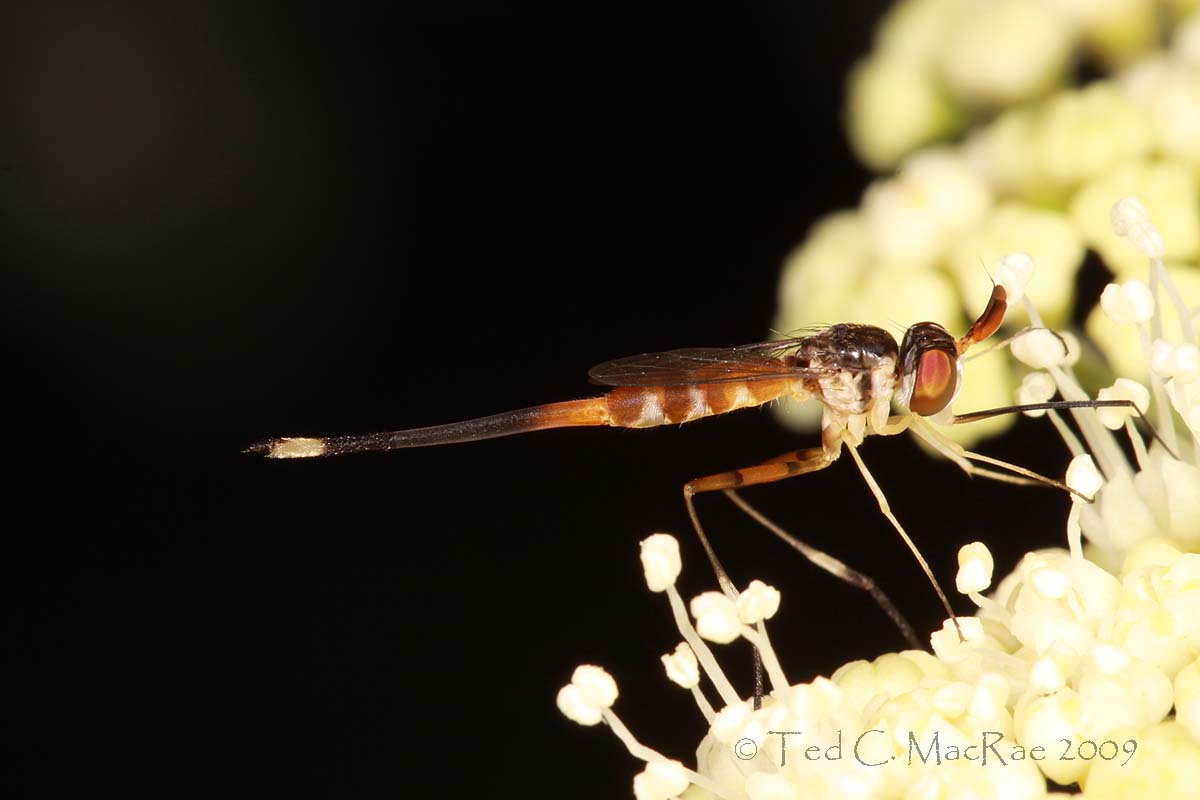
Stylogaster neglecta, a species of thickheaded fly

From Overlooked, needle-bellied, thick-headed fly (Aug 14).  One of my first good “black background” shots.  The white tip of the abdomen compliments the white flower stamens against the background.

Best “true” bug

Beameria venosa, a prairie obligate cicada

From North America’s smallest cicada (Aug 4).  So many different shades of green with white frosting on the bug’s body.  I tried taking this shot in portrait and it just didn’t work—I liked this landscape shot much better.

Best predator

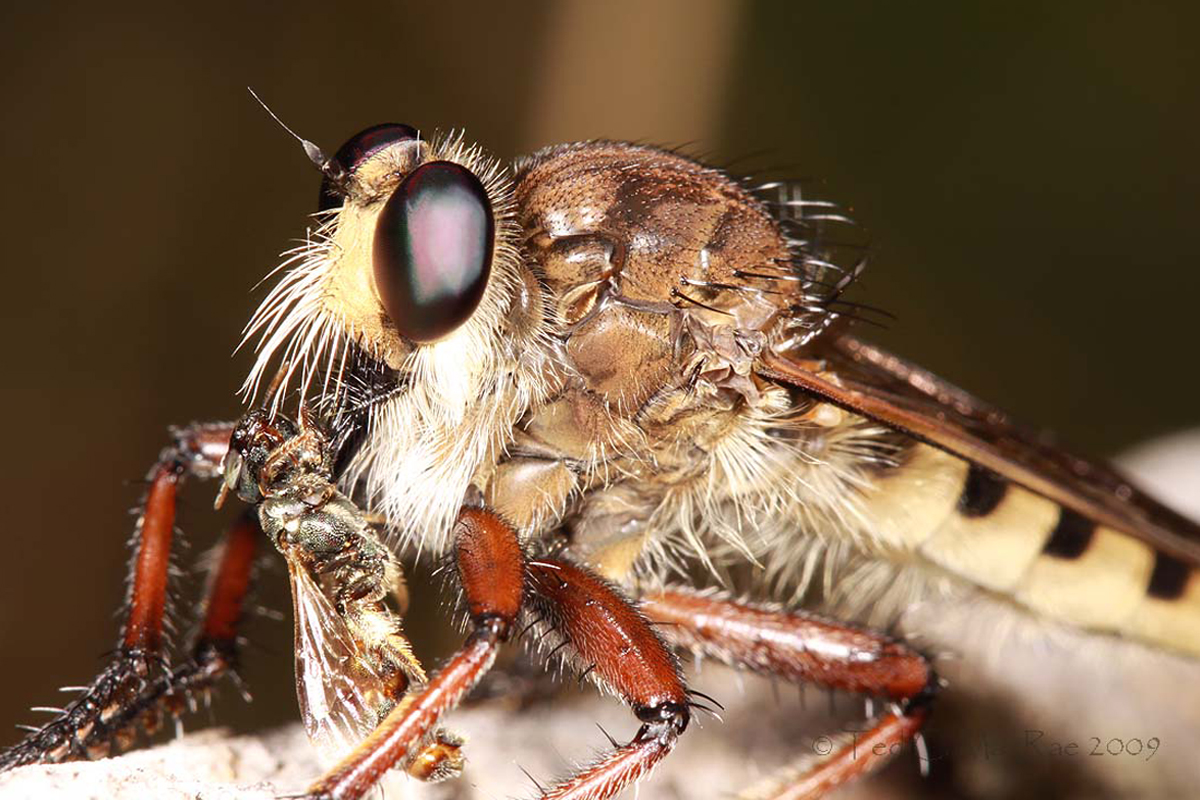
Promachus hinei (Hines giant robber fly) & Ceratina sp. (small carpenter bee) prey

From Prey bee mine (Sept 14).  Robber flies are immensely photogenic, especially those in the genus Promachus due to their prominent “beards.”

Best camoflauge

Dicerca obscura on bark of dead persimmon

From The “obscure” Dicerca (June 19).  Sparkling and gaudy as specimens in a cabinet, the coloration of many jewel beetles actually helps them blend almost perfectly with the bark of their preferred tree hosts.

Best immature insect

Tetracha floridana (Florida metallic tiger beetle) 3rd-instar larva

From Anatomy of a Tiger Beetle Larva (Oct 22).  “Otherwordly” is invariably the first word that comes to mind when someone sees a tiger beetle larva for the first time.  I was lucky enough to get this one in profile with a nice view of its abdominal hump and its curious hooks.

Best arachnid

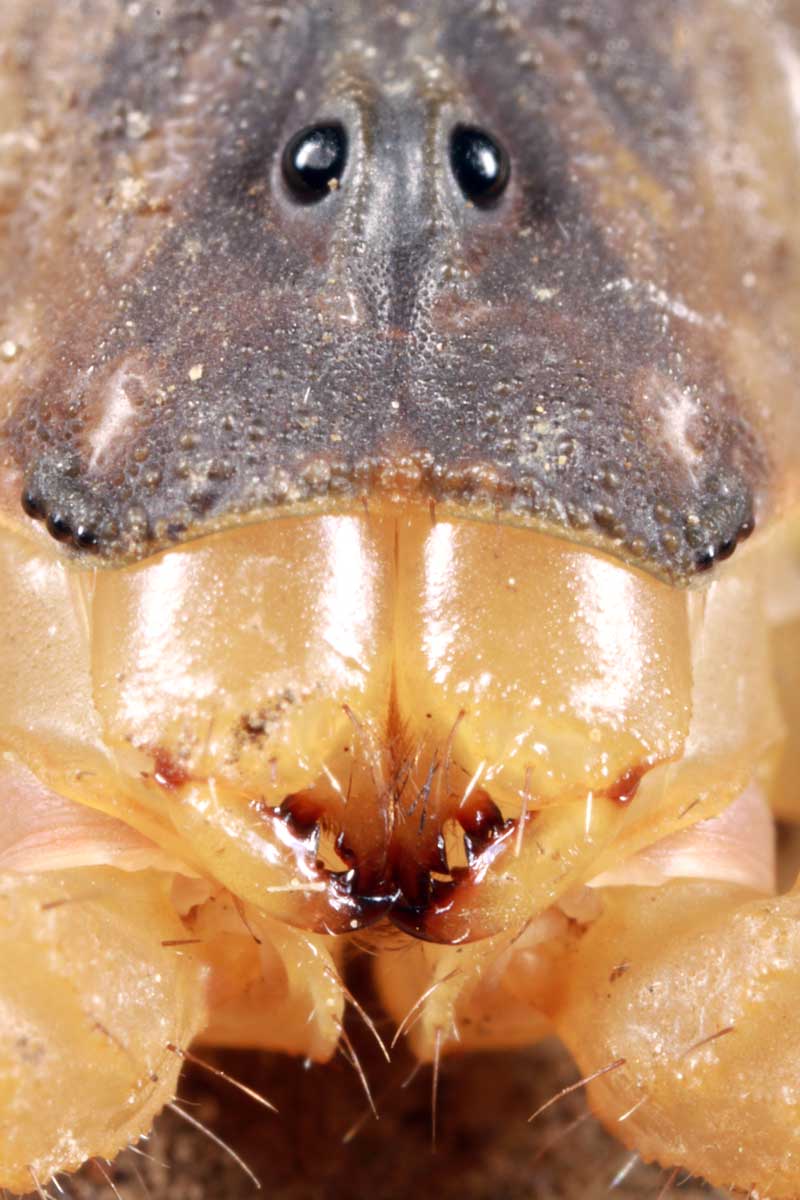
Centruroides vittatus (striped bark scorpion)

From A face only a mother could love (Oct 6).  Despite some minor depth-of-field problems with this photograph, I’m fascinated by its “smile.”

Best reptile

Eastern collared lizard (Crotaphytus collaris collaris) adult male

From North America’s most beautiful lizard (July 10).  A simply spectacular lizard—all I had to do was frame it well and get the flash right.

Best wildflower

Spiranthes magnicamporum (Great Plains ladies

From Great Plains Ladies’-tresses (Dec 7).  Few flowers are as photogenic as orchids, even native terrestrials with minute flowers such as this one.  I like the frosty texture of the lip and the starkness of the white flower on the black background.

Best natural history moment

Thermoregulatory behavior by Ellipsoptera hirtilabris (moustached tiger beetle)

From Tiger Beetles Agree—It’s Hot in Florida! (Dec 18). I chose this photo for the classic “stilting” and “sun-facing” thermoregulatory behaviors exhibited by this tiger beetle on a blistering hot day in Florida.

Best closeup

Megaphasma denticrus (giant walkingstick)

From North America’s longest insect (Aug 21).  I haven’t tried a whole lot of super close-up photographs yet.  I liked the combination of blue and brown colors on the black background.

Best Landscape

Sand Harbor Overlook, Lake Tahoe, Nevada

From Sand Harbor Overlook, Nevada (March 23).   My choice for “best landscape” again comes from Lake Tahoe.  This is not a great photo technically—I was still using a point-and-shoot and had to deal with foreground sun.  However, none of the other photos I took during my March visit to the area captivate me like this one.  I like the mix of colors with the silhouetted appearance of the trees on the point.

Copyright © Ted C. MacRae 2009

Add to FacebookAdd to DiggAdd to Del.icio.usAdd to StumbleuponAdd to RedditAdd to BlinklistAdd to TwitterAdd to TechnoratiAdd to Yahoo BuzzAdd to Newsvine

Email to a friend

Badges are up at AIF

Sidebar badges are now available at An Inordinate Fondness (AIF).  Several styles are offered, each available in three ready-to-use sizes plus the original if custom sizing is desired.  Help promote AIF by placing the badge of your choice in your blog sidebar—all available styles and sizes, as well as detailed instructions for use, can be found at AIF Badges.  Here is the one that I’m using:

All beetle images © Robert Perger, http://www.coleop-terra.com/

As a reminder, the first issue of AIF will appear at the homesite in mid-February.  The deadline for submissions is February 15, but submitting earlier is highly encouraged.  Also, we have hosts lined up for Issues #2 (March) and #4 (May) but not #4 in April.  If you would like to host the April issue—or any other future issue, please send an email indicating the month of your choice.

Copyright © Ted C. MacRae 2009

Add to FacebookAdd to DiggAdd to Del.icio.usAdd to StumbleuponAdd to RedditAdd to BlinklistAdd to TwitterAdd to TechnoratiAdd to Yahoo BuzzAdd to Newsvine

Email to a friend

Tiger Beetles at Florida’s “Road to Nowhere”

(continued from the previous post, Tiger Beetles Agree—It’s Hot in Florida!)

During the time that I explored the pine sandhill habitat at Withlacoochee State Forest in Citrus County, I kept close watch for any individuals amongst the dozens and dozens of Cicindela abdominalis (Eastern Pinebarrens Tiger Beetle) that I encountered that might exhibit the deeply pitted rather than smooth elytral surface that would identify it as the closely related Florida-endemic, Cicindela scabrosa (Scabrous Tiger Beetle).  However, no such individuals would be seen (my first tiger beetle failure of the trip), and having already spent more than two hours at the site I decided it was time to move on the the “Road to Nowhere.”

"Road to Nowhere," 11.1 mi S Jena on Hwy 361, Dixie Co., Florida

The Road to Nowhere is a tidal marsh (also known as “coastal salt marsh”) near Steinhatchee in Dixie County (11.1 mi S Jena on Hwy 361).  Although I was not aware of it prior to my August visit, this locality has achieved legendary status among tiger beetle enthusiasts because of the great number of species that can be seen there—as many as 6–10 species in the right season.  Being a coastal wetland with moist, saline substrates, these would include such species as Cicindela trifasciata ascendens (Ascendent Tiger Beetle), Habroscelimorpha severa (Saltmarsh Tiger Beetle), the rarely collected H. striga (Elusive Tiger Beetle), and Eunota togata togata (White-cloaked Tiger Beetle), in addition to Ellipsoptera marginata (Margined Tiger Beetle) and E. hamata lacerata (Gulf Beach Tiger Beetle) which I had already found a few days earlier.  As I found the highway leading to the spot and begain to drive its upper reaches, I looked longingly at the barren sand exposures along the sides of the road thinking that C. scabrosa, already known from the area (Choate 2003) must be there.  However, it was well into the afternoon hours by then, and having already failed to find the species at Withlacoochee State Forest, I decided I should press on and see what the Road to Nowhere had to offer.

Cicindela (Cicindelidia) trifasciata ascendens—Ascendent Tiger Beetle

Almost immediately I began seeing tiger beetles.  The first species I saw was C. trifasciata ascendens—rather common on areas of the flats close to the water’s edge.  I recognized them instantly, as I had not only seen this species some years ago in south Texas, but also in southern Missouri as a lone vagrant (Brown and MacRae 2005).  The dark brown dorsal coloration and thin, sinuous, S-shaped middle maculation are diagnostic for the species (Pearson et al. 2006).  While it was by now late afternoon, the heat of the day had not yet begun to subside, and the beetles were extremely active and flighty.  The difficulty in approaching them closely enough for photographs was exacerbated by the wet, muddy substrate and incessant drone of tenacious mosquitoes intent on breaching my invisible shield of DEET.  Eventually, however, and only due to one decidedly more cooperative individual (above), I succeeded in getting a few shots with which I was happy. 

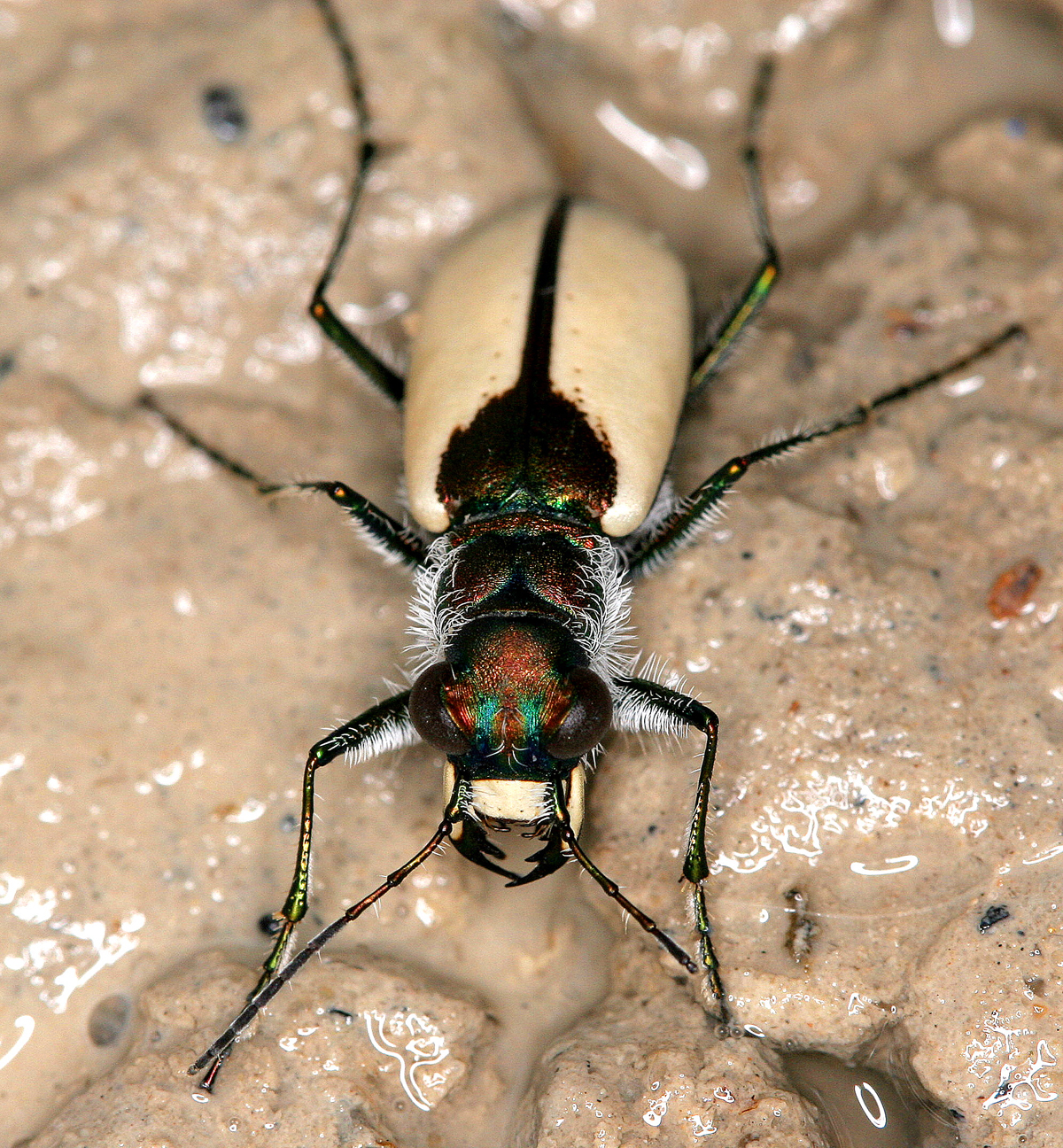
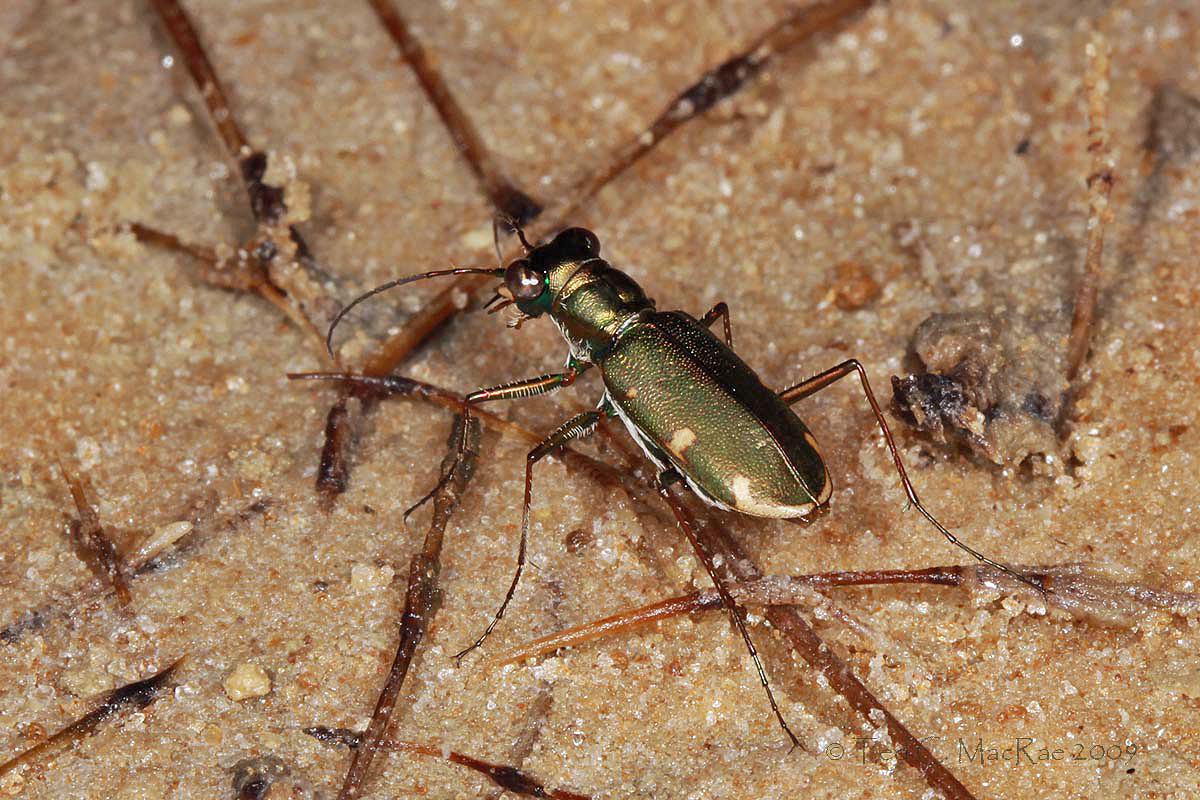
Habroscelimorpha severa—Saltmarsh Tiger Beetle

Far less common than C. trifasciata ascendens, but equally skittish, was the impressive H. severa.  I have also seen this species before in south Texas, though not in great numbers, and its shiny green surface with maculations reduced to small spots at the middle and rear of the elytra are unmistakealbe.  It was the hardest to approach of the species I saw, and the above (only slightly cropped) photograph is as close as I was able to get (it is also the only photograph from the field session that was good enough and close enough to keep).  This species tends to be most active in the morning and again in the evening, so most of my late-day efforts focused on this species—in fact, it was almost too dark to see by the time I finally quit my attempts at photographing the species.  I brought back one live individual and took some “studio” photographs after I returned home, but I’m still not any happier with them than this lone field shot.

Ellipsoptera hamata lacerata—Gulf Beach Tiger Beetle (reduced maculations)

When I first saw the species represented by the individual in the above photograph, I had not a clue as to its identity—the dark elytra with only a marginal band was unlike anything I would have expected to see.  Quickly thumbing through my “bible” (Pearson et al. 2006), I kept stopping at the plate containing Cicindela marginipennis (Cobblestone Tiger Beetle).  I knew this was impossible, as that species is restricted to several disjunct cobblestone habitats further north.  I collected the specimen for a voucher, keeping it alive for studio photographs, but it wasn’t long before I saw another similar-looking individual.  I decided I must be overlooking something, so after getting photographs and collecting the specimen for another voucher I went back through Pearson.  This time I focused only on the species that could possibly occur here, and realized that it was simply E. hamata lacerata with its normally diffuse middle elytral maculations highly reduced (traces of the middle band can be seen in the photograph).

Ellipsoptera marginata—Margined Tiger Beetle

Ellipsoptera marginata was the most abundant species at this location, and on this day I succeeded in getting a nice photograph of a female with her distinctively downbent elytral apices (see closeup photograph in this post).  This species is very similar to E. hamata, with which it co-occurs along the Gulf Coast of peninsular Florida, but can be immediately recognized by the bent elytral apices (female) or distinct tooth on the underside of the right mandible (male).  Both of these species are distinguished from all other species in the genus by the diffuse middle maculation of the elytra. 

At least two additional species occur at this site, one of which (E. togata) I saw but a single individual of and was unable to photograph, and the other (H. striga) which I did not see.  In fact, the Road to Nowhere is apparently “the” spot for finding the latter species, which occurs predominantly at night and is seen primarily by its attraction to ultraviolet lights.  While I would have liked to stay after dark and setup lights to see this species, I had neither the time nor the equipment to do this.  It may, after all, have been too late in the season anyway—since my visit I’ve heard stories from other tiger beetle aficionados who say the whole area can be filled with collectors from all over the country with their blacklights and bucket traps and someone yelling “striga!” every hour or so.  No such scene developed during my visit, so I suspect my visit was on the late side of the season and that the 5 species I did see represents a pretty good day regardless.  The long drive back to St. Petersburg marked the end of my tiger beetle exploits in Florida, at least for this year.

For another tiger beetling experience at Road to Nowhere, read this post by Doug Taron, who visited the site even later in the season (October).  Although he didn’t see as many tiger beetles, he does provide some interesting details regarding the shady origins of this place.

Photo Details: Canon EOS 50D, ISO 100, 1/250 sec.
Habitat: Canon 17-85mm zoom lens (landscape, 66mm), f/9, natural light.
Insects (except E. marginata): Canon 100mm macro lens (manual), f/22–25, MT-24EX flash w/ Sto-Fen diffusers.
E. marginata: Canon MP-E 65mm 1–5X macro lens (manual), f/16, MT-24EX flash w/ Sto-Fen diffusers.

REFERENCES:

Brown, C. R. and T. C. MacRae. 2005.  Occurrence of Cicindela (Cicindelidia) trifasciata ascendens (Coleoptera: Cicindelidae) in Missouri. Cicindela 37(1–2):17–19.

Choate, P. M., Jr. 2003. A Field Guide and Identification Manual for Florida and Eastern U.S. Tiger Beetles.  University Press of Florida, Gainesville, 224 pp.

Pearson, D. L., C. B. Knisley and C. J. Kazilek. 2006. A Field Guide to the Tiger Beetles of the United States and Canada. Oxford University Press, New York, 227 pp.

Copyright © Ted C. MacRae 2009

Add to FacebookAdd to DiggAdd to Del.icio.usAdd to StumbleuponAdd to RedditAdd to BlinklistAdd to TwitterAdd to TechnoratiAdd to Yahoo BuzzAdd to Newsvine

Email to a friend

Tiger Beetles Agree—It’s Hot in Florida!

Florida is known for its rich assemblage of tiger beetles—27 species in all, including four endemics (Choate 2003).  However, late summer is generally considered not the best time of year for seeing this diversity, since adult populations of most species begin to wane as the intensity of the summer heat reaches its peak.  I knew the timing of my family vacation in early August might be a bit off; however, considering I had never looked for tiger beetles in Florida before, I remained optimistic that I still might encounter some interesting species.  My optimism was quickly rewarded—in one afternoon of exploring the small coastal preserve just outside the back door of my sister-in-law’s condo, I found Ellipsoptera marginata (Margined Tiger Beetle), its sibling species E. hamata lacerata (Gulf Beach Tiger Beetle), and several 3rd-instar larvae in their burrows that proved to be the Florida endemic Tetracha floridana (Florida Metallic Tiger Beetle).  Good fortune would continue when I made a one-day trip to the interior highlands in a successful bid to find Florida’s rarest endemic, Cicindela highlandensis (Highlands Tiger Beetle), finding also as a bonus the splendidly camouflaged and also endemic Ellipsoptera hirtilabris (Moustached Tiger Beetle).  Five species, including three endemics, in just over a day of searching!  I had one more day to sneak off and do what I love most, and I wanted to make the most of it. 

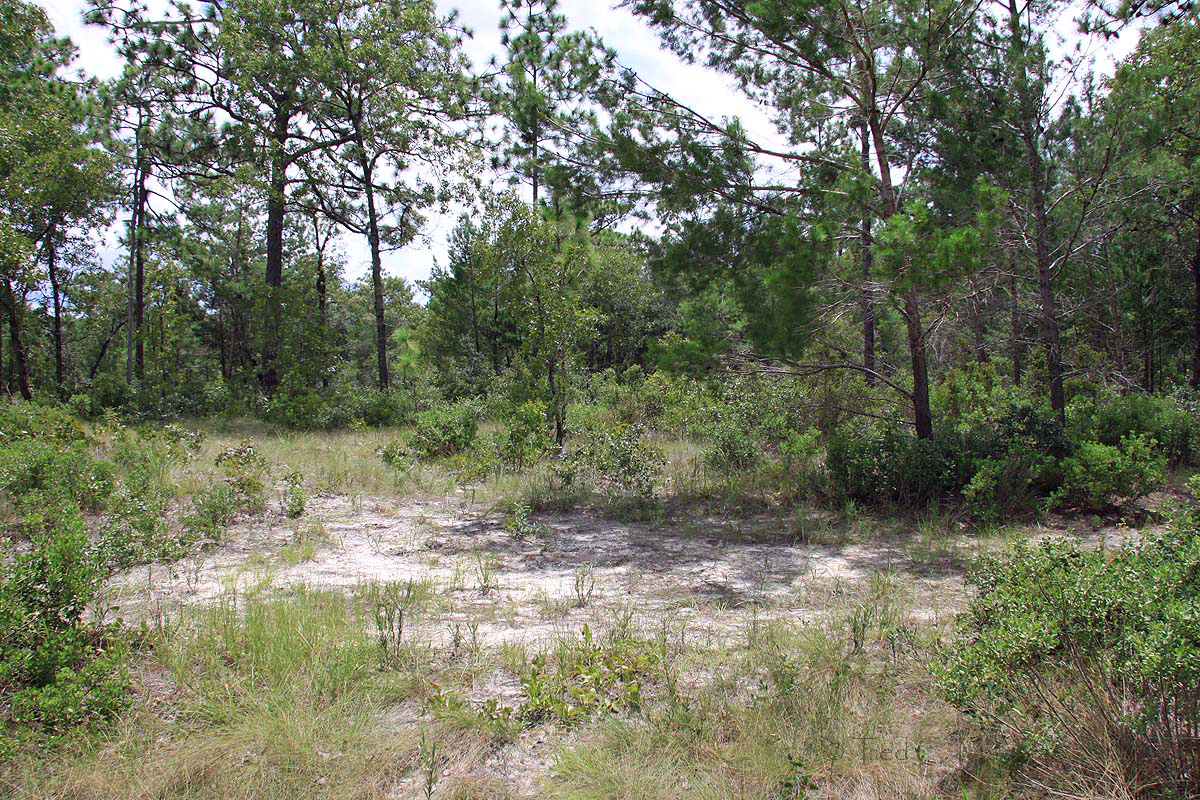
Pine sandhill habitat, Withlachoochee State Forest—Citrus Tract

Among the suggestions given to me by my colleagues, the most promising-sounding was the “end of the road,” a Gulf Coast salt marsh near Steinhatchee in Dixie County where I was told as many as 6-10 species of tiger beetles could be seen at once.  I didn’t know it at the time, but this particular location has achieved legendary status among tiger beetle enthusiasts (Doug Taron recently wrote about his experience, calling it the Road to Nowhere).  A 200+ mile drive from my base near St. Petersburg, it would take the better part of 5 hours to drive there, and not wanting to put all of my eggs in one basket, I looked for potential stops along the way.  About midway along the drive was Withlacoochee State Forest, where one of my colleagues had told me I might still find the fairly widespread Cicindela abdominalis (Eastern Pinebarrens Tiger Beetle) and its close relative, C. scabrosa (Scabrous Tiger Beetle)—the fourth Florida endemic.  My plan was to leave early in the morning and spend a few hours at Withlacoochee before driving the rest of the way to finish out the day at Steinhatchee. 
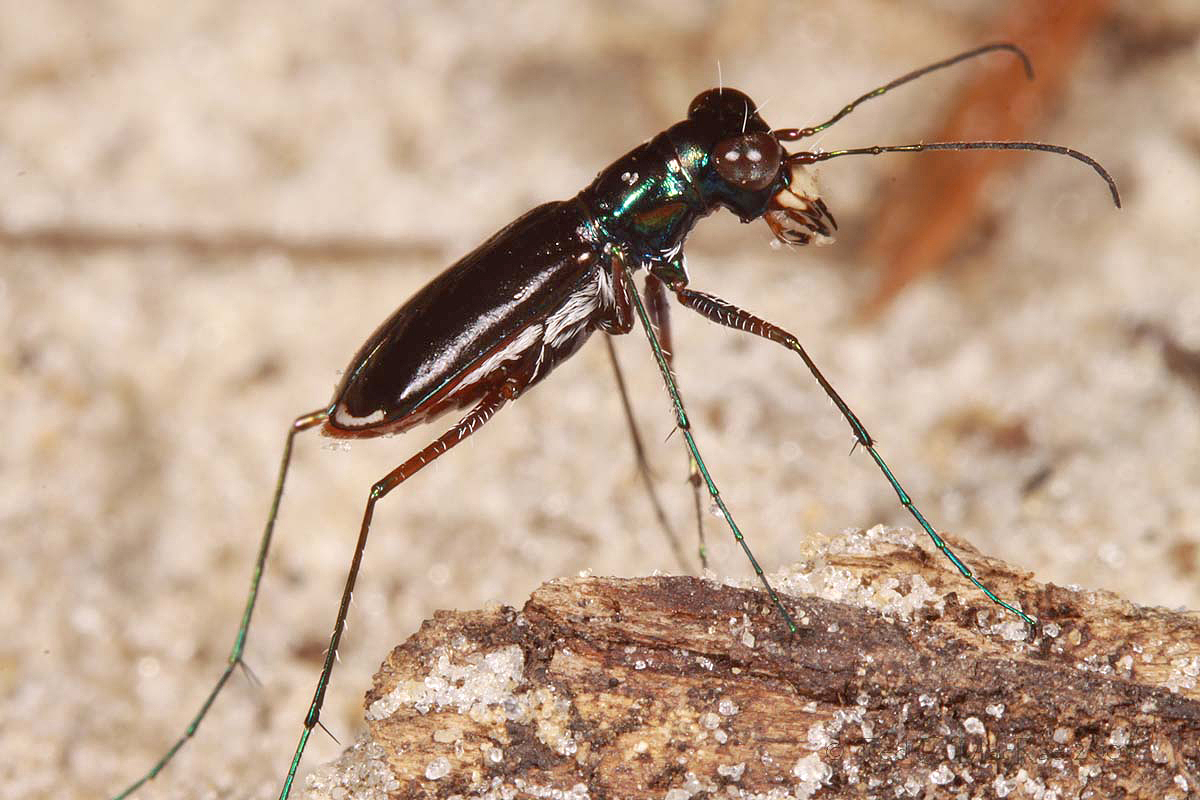
"Stilting" by Cicindela abdominalis (Eastern Pinebarrens Tiger Beetle)

It took some time to find my bearings upon arriving, but after some discussion with the decidedly forestry-oriented staff at the headquarters, it seemed that the Citrus Tract was where I wanted to be.  I was looking for the sand barren and pine sandhill habitats that these species require, and the staff’s description of the northern edge of the tract as having lots of sand and “not very good for growing trees” suggested this might be the place.  Pine sandhill (also called “high pine”) is a pyrophytic (fire-dependent) plant community characterized by sandy, well-drained soils, a widely-spaced longleaf pine (Pinus palustris) and turkey oak (Quercus laevis) canopy, and an herbaceous layer dominated by wiregrass (Aristida stricta).  I quickly found such habitat in the area suggested, and it wasn’t long before I found the first of the two species—C. abdominalis—rather commonly along a sandy 2-track leading through the area.  For those of you who see a distinct resemblance of this species to the rare C. highlandensis that I highlighted from my trip to the central highlands, this is no coincidence.  Cicindela abdominalis is very closely related to that species, the latter distinquished by an absence of flattened, white setae on the sides of the prothorax and the abdomen and by the highly reduced or absent elytral maculations (Choate 1984).  Dense white setae and distinct apical elytral maculations are clearly visible in the individuals shown in these photographs. 

Stilting is often accompanied by "sun-facing" for additional thermoregulation

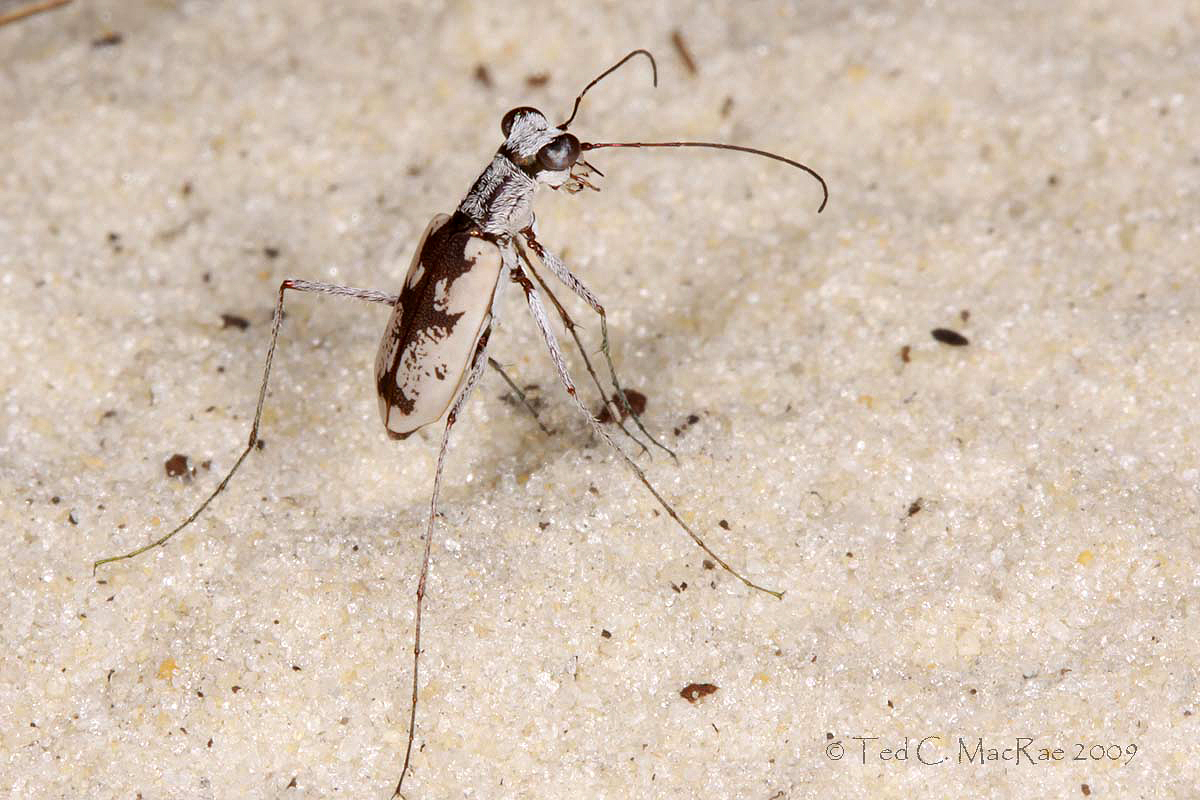
It was a blistering hot day (just as every other day on the trip had been so far), and it wasn’t only me who felt that way.  Tiger beetles, of course, are ectothermic and rely upon their environment for their body temperature.  Despite this, they are able to regulate body temperatures to some degree by using a range of behavioral adaptations intended to mitigate the effects of high surface temperatures and intense sunlight.  The photos above show one of these behaviors, known as stilting.  In this behavior, the adult stands tall on its long legs to elevate its body above the thin layer of hotter air right next to the soil surface and as far off the sand as possible (Pearson et al. 2006).  As the heat of the day intensifies and the zone of hot air at the soil surface broadens, stilting alone may be insufficient to prevent overheating. When this happens, the beetles combine stilting with sun-facing, a behavior in which the front part of the body is elevated with the head oriented towards the sun. This position exposes only the front of the head to the sun’s direct rays, thus minimizing the body surface area exposed to incident radiation.

Stilting and sun-facing by Ellipsoptera hirtilabris (Moustached Tiger Beetle)

I was also fortunate to have another chance at photographing the beautiful and marvelously-camouflaged Ellipsoptera hirtilabris (Moustached Tiger Beetle), which, in similar fashion to C. highlandensis, I found co-occurring with C. abdominalis in rather low numbers. As before, they were extremely wary and difficult to approach, especially in the extreme heat of the day, and all of my best efforts to get a good shot of the species in its “classic” pose were frustrated. The photo above was about as close as I could get to any of these beetles when they were out in the open before they would flee; however, it nicely demonstrates the use of stilting combined with sun-facing during the hottest part of the day.

"Shade seeking" is another behavioral response to intense heat.

Another behavioral response to extreme heat is shade-seeking—adults may either remain active, shuttling in and out of shaded areas, or avoid exposed areas altogether and become inactive.  One thermoregulatory behavior for extreme heat that I did not observe was daytime-burrowing, in which adults construct temporary shallow burrows during the hottest hours of the day. Although I did not observe this behavior by either species at Withlacoochee, I have seen it commonly among several species in sandy habitats here in Missouri and in the Sandhills of Nebraska (e.g., Cicindela formosa, Cicindela limbata, Cicindela repanda, Cicindela scutellaris, Cicindela tranquebarica, Ellipsoptera lepida).

There was one disappointment on the day—I did not see C. scabrosa.  However, I still had the “end of the road” to explore, so I remained happy with the now six species I had encountered and optimistic about finding additional species later in the day… 

Photo Details: Canon EOS 50D, ISO 100.
Habitat: Canon 17-85mm zoom lens (landscape, 17mm), 1/100 sec, f/10, natural light.
Insects: Canon 100mm macro lens (manual), 1/250 sec, f/16–18 (C. abdominalis) or f/20–22 (E. hirtilabris), MT-24EX flash w/ Sto-Fen diffusers.

REFERENCES: 

Choate, P. M., Jr.  1984.  A new species of Cicindela Linnaeus (Coleoptera: Cicindelidae) from Florida, and elevation of C. abdominalis scabrosa Shaupp to species level.  Entomological News 95:73–82.

Choate, P. M., Jr. 2003. A Field Guide and Identification Manual for Florida and Eastern U.S. Tiger Beetles.  University Press of Florida, Gainesville, 224 pp.

Pearson, D. L., C. B. Knisley and C. J. Kazilek. 2006. A Field Guide to the Tiger Beetles of the United States and Canada. Oxford University Press, New York, 227 pp.

Copyright © Ted C. MacRae 2009

Add to FacebookAdd to DiggAdd to Del.icio.usAdd to StumbleuponAdd to RedditAdd to BlinklistAdd to TwitterAdd to TechnoratiAdd to Yahoo BuzzAdd to Newsvine

Email to a friend