Litaneutria minor – agile ground mantid

Litaneutria minor - agile ground mantid

Have you ever seen a mantid that lives exclusively on the ground?  Most mantids are ambush predators, hiding amongst the bushes while patiently waiting for unsuspecting prey to happen within striking range.  However, a few small groups of mantids have adopted a different strategy – running down their prey!  One such group is the ground mantids, represented in the U.S. by two genera – Litaneutria and Yersiniops.  These small mantids, cryptically colored brown or gray, occur in desert and grassland habitats across the western U.S.  This particular individual was seen in the expansive shortgrass prairie atop the Pine Ridge in northwestern Nebraska.  The rounded eyes and brown coloration identify it as as a member of the genus Litaneutria (the tops of the eyes are pointed in Yersiniops, giving them a “horned” appearance, and they tend to be more gray).  Two species of Litaneutria are found in the U.S. – this one, L. minor, occurring broadly throughout the Great Plains and western U.S. into southwestern Canada (it is Canada’s only native mantid), while a second species, L. obscura, is restricted to the desert southwest.¹  Several common names have been applied to L. minor, including lesser ground mantid, minor ground mantid, and agile ground mantid.  While the first two represent more precise literal translations of the scientific name, I like the latter which well describes the ability of these mantids to hop over rocks and dart swiftly through sparse prairie vegetation in pursuit of prey or to evade predators (and inexperienced collectors!).  Despite its small size (total length less than 1.5″), the presence of wings – albeit small – indicate this is an adult. All females of this species are brachypterous (short-winged), but most males are as well.  However, males apparently have a small spot at the base of the forewings, which seems lacking in this individual, and a smoother pronotum – also not readily apparent in this individual, so I’m guessing that this is an adult female. 

¹ BugGuide and many other web sources list five additional U.S. species in the genus (including L. borealis, described from northwestern Nebraska).  However, Vickery and Kevan (1983) note that these were all synonymized under L. minor by Hebard in 1935 (sorry – I couldn’t find that reference).

“Mantid” vs. “mantis” vs. “praying mantis.”  It has become common to use the terms “mantid” and “mantis” (or even “praying mantis”) interchangeably.  However, in its strictest sense the term “mantis” is most properly applied to species of the genus Mantis – of which Mantis religiosa – the European mantid or praying mantis, introduced to the U.S. in the late 19th century (either accidentally on a shipment of nursery plants or deliberately for pest control – depending on the source) is the most widely recognized.  The term “mantid” refers to any species in the suborder Mantodea as a whole.

Carnivorous cockroaches!  When I was in college back in the late 1970s, mantids and most other “orthopteroid” insects had long been considered suborders of a single order, the Orthoptera.  Around that time began a great dismantling of the Orthoptera, pared down to only the grasshoppers, crickets, and katydids while the other former suborders (mantids, walkingsticks, cockroaches, etc.) were raised to full order status.  The walkingsticks (Phasmida), grylloblattids (Grylloblattodea), and gladiators (Mantophasmatodea) all continue to enjoy their elevated status (Tree of Life Web Project 2003); however, a close relationship has been established between the mantids, cockroaches, and termites² (Kristensen 1991), resulting in the sinking of all three former orders into a single order, the Dictyoptera (Tree of Life Web Project 2002) (and not to be confused with the lycid beetle genus Dictyoptera).  Mantids, thus, can be considered derived cockroaches with morphological specializations for predation!

² Long accorded an order of their own – the Isoptera, recent molecular phylogenetic studies have placed termites not only with the cockroaches, but within them (Ware et al. 2008).  Just as mantids can be considered cockroaches that evolved as predators, termites can be considered cockroaches that evolved to eat wood (with the help of cellulose-digesting gut symbionts)!

Photo Details: Canon 50D w/ MP-E 65mm 1-5X macro lens (ISO 100, 1/250 sec, f/13), Canon MT-24EX flash w/ Sto-Fen + GFPuffer diffusers. Typical post-processing (levels, minor cropping, unsharp mask).

REFERENCES:

Kristensen, N. P. 1991. Phylogeny of extant hexapods. Pp. 125–140 in Insects of Australia: A Textbook for Students and Research Workers. Volume I and II. Second Edition. I. D. Naumann, P. B. Carne, J. F. Lawrence, E. S. Nielsen, J. P. Spradberry, R. W. Taylor, M. J. Whitten and M. J. Littlejohn eds. Carlton, Victoria, Melbourne University Press.

Tree of Life Web Project. 2002. Dictyoptera. Version 01 January 2002 (temporary). http://tolweb.org/Dictyoptera/8253/2002.01.01 in The Tree of Life Web Project, http://tolweb.org/

Tree of Life Web Project. 2003. Neoptera. Version 01 January 2003 (under construction). http://tolweb.org/Neoptera/8267/2003.01.01 in The Tree of Life Web Project, http://tolweb.org/

Vickery, V. R. and D. K. M. Kevan. 1983. A monograph of the orthopteroid insects of Canada and adjacent regions. Lyman Entomological Museum and Research Laboratory Memoir 13:216–237.

Ware, J. L., J. Litman, K.-D. Klass, and L. A. Spearman. 2008. Relationships among the major lineages of Dictyoptera: the effect of outgroup selection on dictyopteran tree topology. Systematic Entomology 33(3):429–450.

Copyright © Ted C. MacRae 2010
Cicindela nebraskana – Prairie Long-lipped Tiger Beetle

Cicindela nebraskana - the prairie long-lipped tiger beetle

We were only halfway through Day of five days in the field and had already achieved Goal of the trip.  Despite that, it took a few hours before Chris and I were ready to tear ourselves away from our first stop in Fall River Co., South Dakota, where we were treated to the sight of glittering, wine-red adults of Cicindela pulchra bejeweling the charcoal-colored shale slopes.  However, the list of species that we wanted to see over the next several days was long, and eventually our pulchra-fever abated (barely) enough to head south to the Pine Ridge in Sioux Co., Nebraska to look for A-list Species Cicindela nebraskana.  Sioux Co., Nebraska is the type locality for this species (thus the name), but in reality it is a more western species whose distribution just barely sneaks into the northwestern corner of Nebraska (Pearson et al. 2006, Spomer et al. 2008).  I first saw this species at this very site two years ago, seeing only a handful of individuals and managing one harshly-sunlit, point-and-shoot image of one of them.  To my knowledge, this remains the only known field photograph of this species.

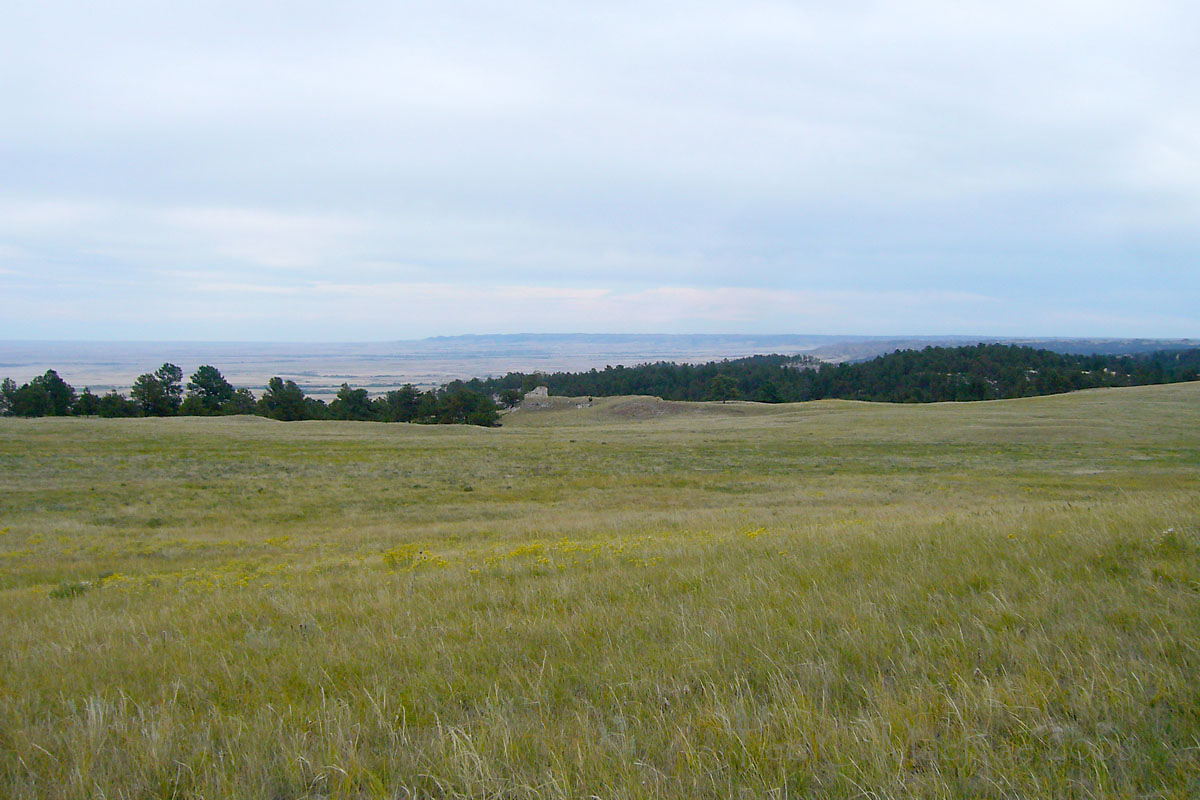
Shortgrass prairie atop the Pine Ridge, Sioux Co., Nebraska (photo taken September 2008).

This time, with a Canon 50D camera and 100mm macro lens in my backpack, I was much better equipped for vastly improved field photographs, but in contrast to the numerous individuals of C. pulchra that we saw earlier in the day, only a single C. nebraskana would turn up after intensive searching by Chris, Matt Brust, and myself in the vast shortgrass prairie sitting at the type locality atop the Pine Ridge.  I didn’t find it – Matt did – and the general rule with rare tigers is to capture the first individual rather than try to photograph it.  If no others are seen, photographing it later in a terrarium of native soil is better than trying to photograph it in the field and risk letting it escape.  Matt gave it to Chris, and at the end of the day when we realized we were not going to see another one, we prepared a terrarium of native soil, taking care to keep the surface as intact as possible so that an accurate replication of the field situation could be created when we photographed it later.

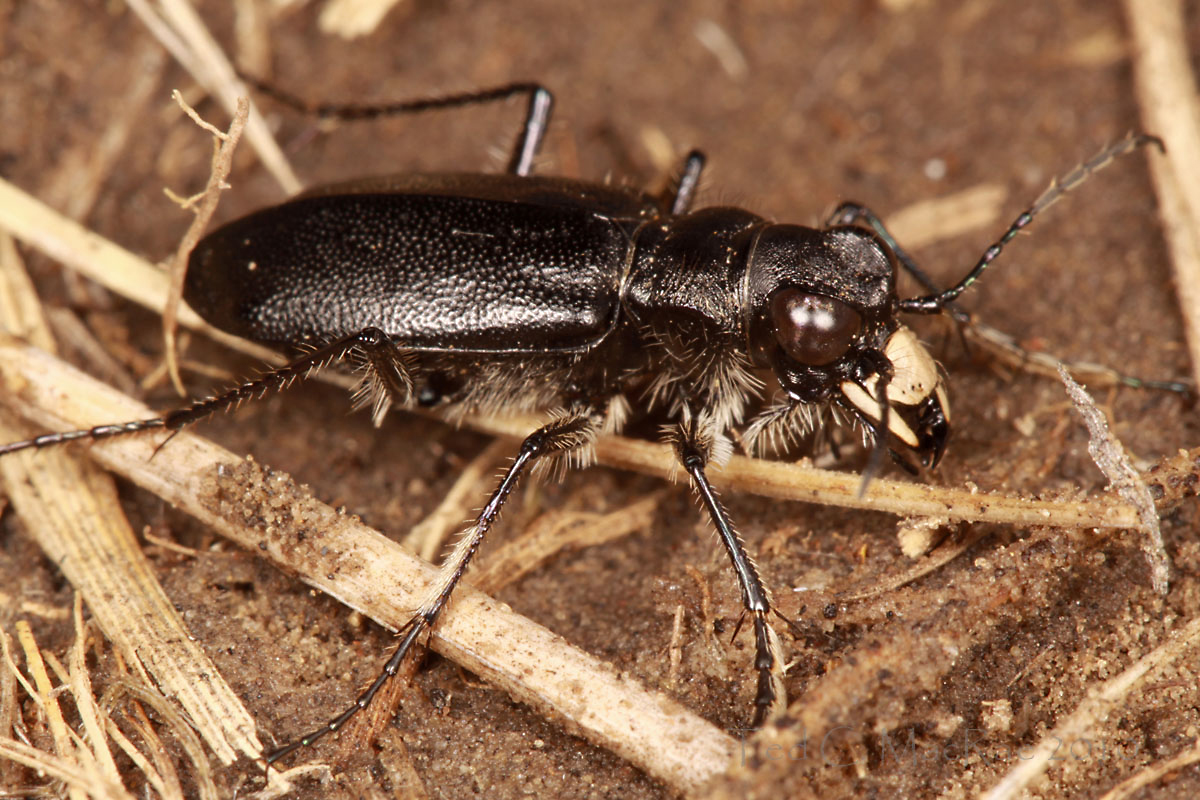
Tiger beetles "hunker down" when fatigued.

Although I prefer actual field photographs, the nice thing about photographing tiger beetles in confinement is… well, they don’t run away!  That’s not to say it is easy.  While they do settle down if left undisturbed for a while, once you start messing with them they quickly become agitated and start running in circles around the terrarium perimeter.  Much finger prodding is necessary to get them away from the edge and into a good spot for photographs, and rarely do they stay put for long.  When they finally do settle down, they tend to “hunker down” in a most unflattering pose (as above) – lacking the appearance of alertness that gives the true field photos their life.

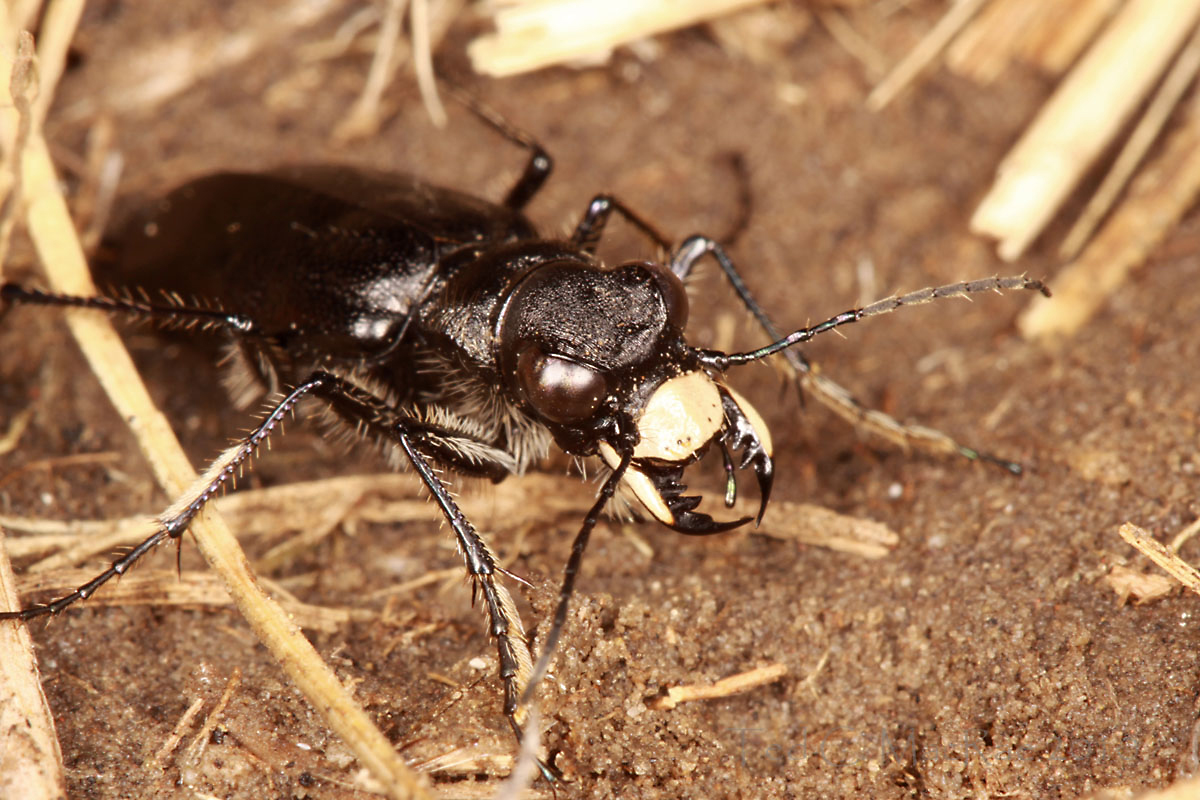
A ferocious pose is struck after judicious prodding of the face and touching of the antennae.

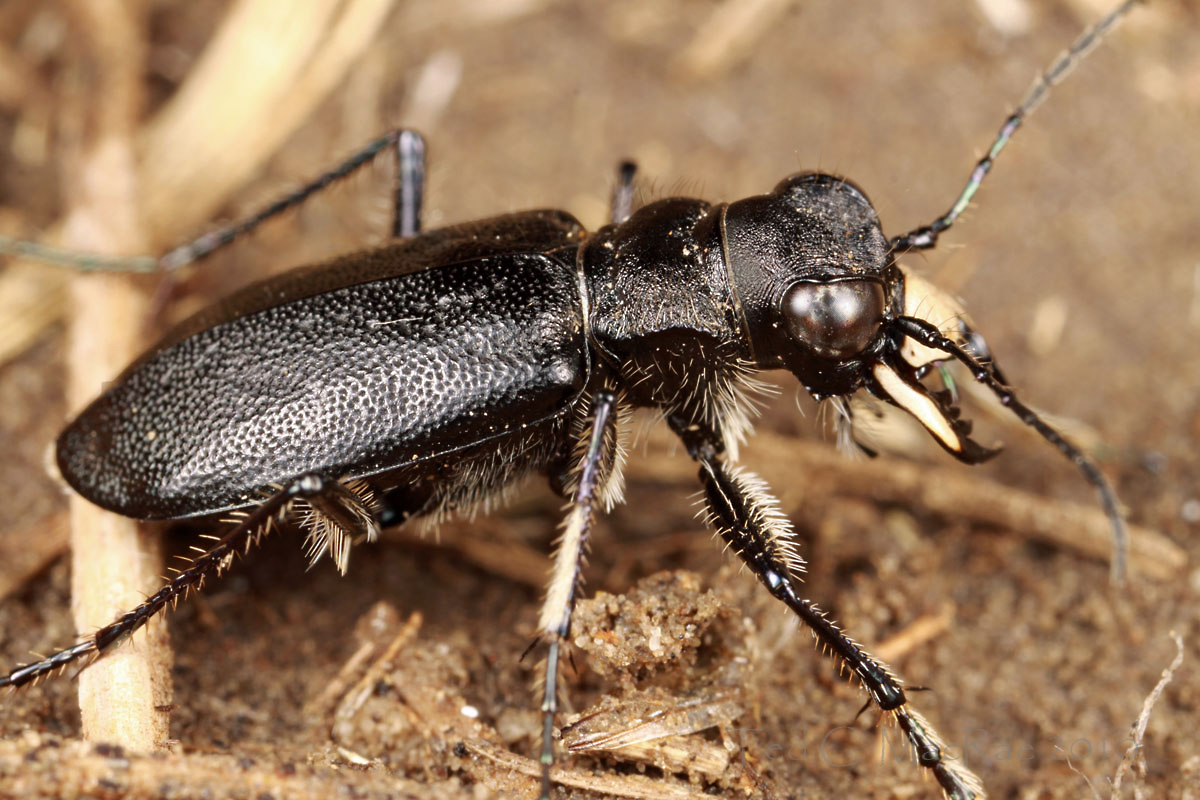
I’m a persistent (syn. stubborn) sort, however, and I’ve learned that I can wear them down and poke and prod them out of their hunker.  Just a light poke at the face will often make them back up and lift their front slightly – poke again and they often open their jaws half-cocked – a light touch on the tip of one antennae and they’ll turn slightly.  With practice and patience, hunkered down beetles can be coaxed into some remarkably aggressive-looking poses.  I like the last of these photos in particular because the oblique, jaws half-cocked pose shows off two nice features of this species – the quite long labrum (upper lip) compared to most other tiger beetle species, and the bright white labrum and mandibles of the males of this species (in females they are partially or completely dark).  The long labrum and jaws give this species a very long-faced appearance that distinguishes it immediately from the black morphs of Cicindela purpurea audubonii that occur with much greater frequency in the same habitats as C. nebraskana.

Photo Details:
1: Canon 50D w/ MP-E 65mm 1-5X macro lens (ISO 100, 1/250 sec, f/13), Canon MT-24EX flash w/ Sto-Fen + GFPuffer diffusers.
2: Panasonic DMC-FX3 (ISO 100, 1/400 sec, f/5.6), natural light.
3-4: Canon 50D w/ 100mm macro lens (ISO 100, 1/250 sec, f/16), Canon MT-24EX flash w/ Sto-Fen + GFPuffer diffusers.
All photos: Typical post-processing (levels, minor cropping, unsharp mask).

REFERENCES:

Pearson, D. L., C. B. Knisley and C. J. Kazilek. 2006. A Field Guide to the Tiger Beetles of the United States and Canada. Oxford University Press, New York, 227 pp.

Spomer, S. M., M. L. Brust, D. C. Backlund and S. Weins.  2008. Tiger Beetles of South Dakota & Nebraska.University of Nebraska, Department of Entomology, Lincoln, 60 pp.

Copyright © Ted C. MacRae 2010

Halloween ID challenge answer – Argiope trifasciata

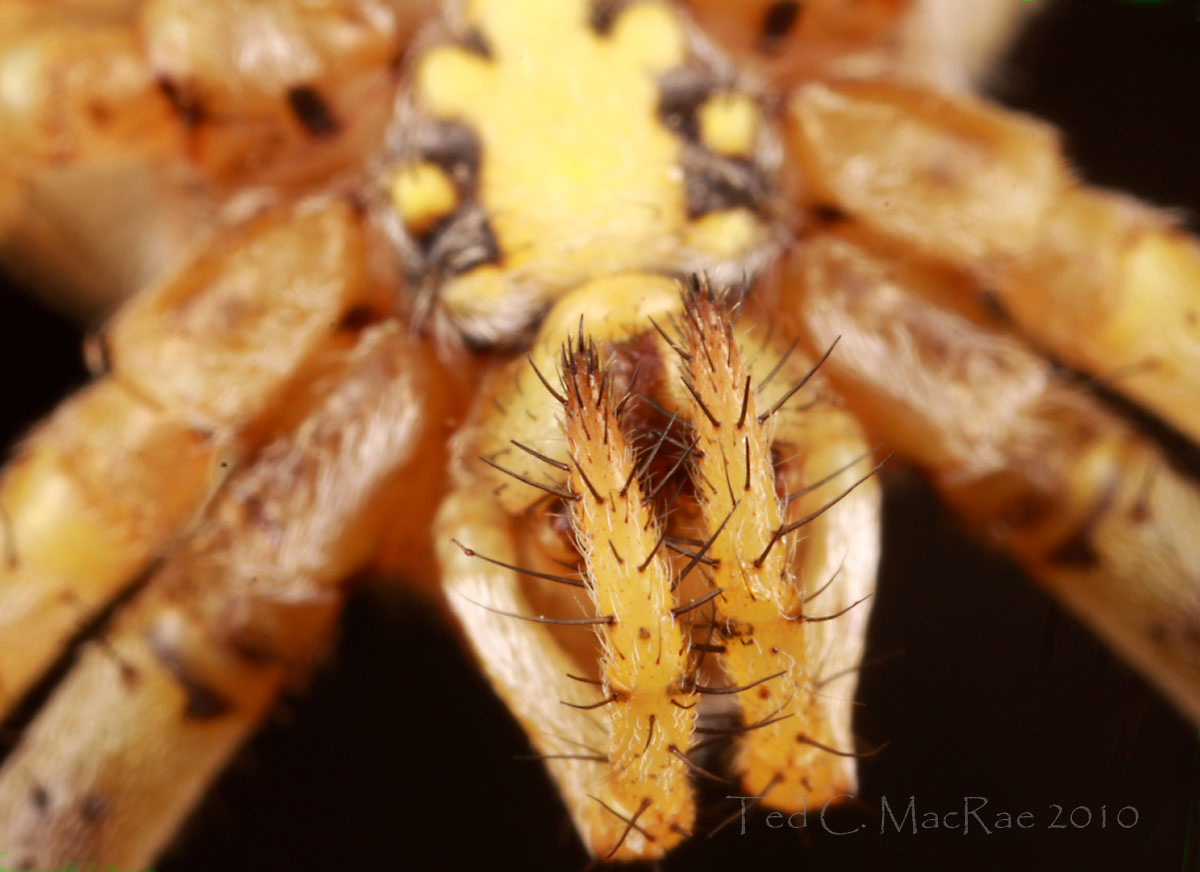
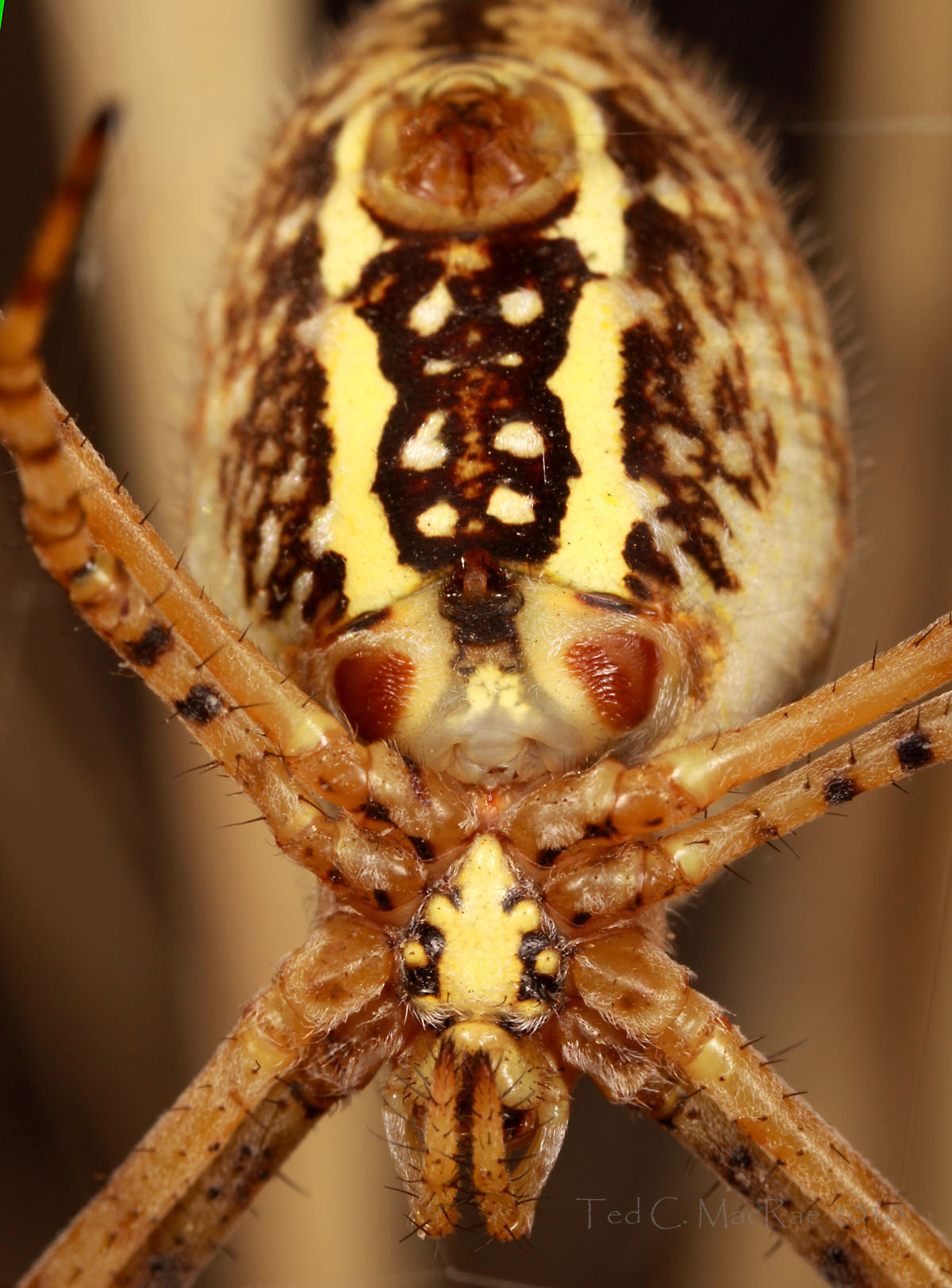
Here is another photo of the spider in the previous post with a closer view of its spiny pedipalps (mouth feeler thingys).  Troy Bartlett and BitB’s own James Trager got it right – the spider is, indeed, Argiope trifasciata, the banded garden spider (a.k.a. banded garden orbweaver, banded argiope, whitebacked garden spider, etc.).   I figured the genus would be easy, but the species might be a little tricky – at least for those in North America who might be tempted to conclude it was the larger A. aurantia (black and yellow garden spider, etc.).  The broken banding on the femora and generally lighter ventral coloration are usually enough to distinguish A. trifasciata from its more conspicuous congener.  Argiope trifasciata is also distinguished as one of the few truly cosmopolitan arthropod species, occurring naturally on all continents except Antarctica.

Both Troy and Dave Walter mentioned the conspicuous stabilimentum (heavy zig-zagging pattern) that Argiope spiders are perhaps best known for and that they often add to the center of their otherwise cryptic webs. Originally thought to possess a web-stabilizing function (hence the name), a variety of alternative explanations have since been proposed.  These include camouflage (to break up the body outline of the spider and make it less visible to predators), web protection (to make the web more visible to birds and prevent them from flying into and damaging it), prey luring (since it reflects ultraviolet light efficiently), thermal protection (by providing a shield against the sun), and a repository for excess silk.   An alternative hypothesis that I had not heard of but mentioned by Dave is that they serve as sponges for accumulating water for the spider to drink.  Webs with stabilimenta are more common and larger in exposed versus sheltered locations, and a recent study by Blackledge and Wenzel (1999) using A. aurantia found that webs with a stabilimentum suffered significantly less damage from birds (45% on average) than those without, but that they also caught fewer insects (34% on average).  The presence or absence of a stabilimentum, however, was not a significant factor in predation of the spiders by birds.  This implies not only a web protective function for the stabilimentum, but that there is an evolutionary trade-off between web protection and foraging success.  These authors concluded that variation in stabilimenta might be accounted for by a cost—benefit trade-off and that the decision by the spider to include a stabilimentum when building a web may be influenced by external factors such as prey density and web exposure.

Specific to A. trifasciata, a less well known but equally interesting aspect of its behavior is the use of web orientation for thermoregulation.   Tolbert (1979), in a study conducted in the southeastern US, found that web orientation was non-random during the hottest part of the summer, when spiders largely occupied east-west oriented webs with their silver/white dorsal surfaces facing south and their dark ventral surfaces facing north, and during October when the situation was reversed.  Orientation of the white/silver dorsal surface towards the sun presumably is done to help lower body temperatures, while orienting the ventral surface of the spider, which changes from silver to black as the spider reaches maturity, would maximize solar radiation for heat gain.  In contrast, Ramirez et al. (2003) found the species in coastal southern California never oriented their webs in a non-random fashion – rather, they always oriented them along an east-to-west axis with the mostly dark ventral surface of their abdomens facing south.  They suggested that dealing with a high heat load is not a significant problem in the predominantly cool environment of coastal southern California and that staying warm is the greater challenge for this mostly fall active species.

I’ll give 6 points to Troy for agreeing with me on everything, 4 to Dave for playing Devil’s advocate with the species and his unique alternative stabilimentum hypothesis, and 2 points to James for agreeing with Troy’s species ID. 🙂

Photo Details: Canon 50D w/ MP-E 65mm 1-5X macro lens (ISO 100, 1/250 sec, f/14), Canon MT-24EX flash w/ Sto-Fen + GFPuffer diffusers. Typical post-processing (levels, minor cropping, unsharp mask).

REFERENCES:

Blackledge, T. A. and J. W. Wenzel. 1999. Do stabilimenta in orb webs attract prey or defend spiders? Behavioral Ecology 10(4):372–376.

Ramirez, M. G., E. A. Wall and M. Medina. 2003. Web orientation of the banded garden spider Argiope trifasciata (Araneae, Araneidae) in a California coastal population. The Journal of Arachnology 31:405–411.

Tolbert, W. W.  1979. Thermal stress of the orb-weaving spider Argiope trifasciata (Araneae).  Oikos 32(3):386–392.

Copyright © Ted C. MacRae 2010

Halloween ID challenge

Class and order are gimmes – can you name the family, genus, and species? Common name? Something significant about its biology or behavior?

Photographed 25.ix.2010 in shortgrass prairie habitat atop the Pine Ridge in Sioux Co., Nebraska.

Photo Details: Canon 50D w/ MP-E 65mm 1-5X macro lens (ISO 100, 1/250 sec, f/11), Canon MT-24EX flash w/ Sto-Fen + GFPuffer diffusers. Typical post-processing (levels, minor cropping, unsharp mask).

Copyright © Ted C. MacRae 2010

Phreaky Phalangid

While searching through shortgrass prairie atop the Pine Ridge in northwestern Nebraska in hopes of finding Cicindela nebraskana (prairie long-lipped tiger beetle), this harvestman caught my eye.  Harvestmen are, of course, arachnids related to spiders, but they lack fangs and poison or silk glands and are placed the separate order Opiliones (Phalangida when I was in school).  Admittedly, I haven’t paid much attention to harvestmen before now, but this one seemed different from any I’d seen before – nearly black with relatively short legs and distinctive orange intersegmental articular membranes at the base of the legs.  Harvestmen are known to employ chemical defenses through special repugnatorial glands that produce phenols, quinones, ketones, and/or alcohols, and this individual seemed to display a clear example of aposematic coloration to warn any potential predators of its distastefulness.

Trachyrhinus favosusAlthough beetles are my focus, I normally try to do my own identifications in other groups as well.  However, some rather persistent searching through the extensive harvestman holdings at BugGuide failed to turn up a good match.  In gestalt it seemed to belong to the family Sclerosomatidae, but even that was just guessing on my part.  So, I did what I’ve done only a few times before and posted the photos to BugGuide’s ID Request.  A day and a half later I had my answer – Trachyrhinus favosus.  BugGuide Contributing Editor V. Belov had sent the photos to harvestman expert Marshal Hedin, who had this to say in response:

Cokendolpher describes males as ‘body ranging from solid black…’ with bases of femora ‘yellow-brown’. The species is also known from western Nebraska. Cool.

I was pleased to learn that these photographs represented a new species for BugGuide and no longer felt bad about not being able to find a good match.  Further, my leanings toward the family Sclerosomatidae had been confirmed.  According the Cokendolpher (1981), T. favosus ranges in a narrow band from North Dakota south to north-central Texas and is active only during fall.  I had intended to try to get an even closer photograph, but after taking the second photograph above I accidentally disturbed the critter and then watched in amazement as it began bouncing up and down vigorously.  This apparently is a defensive behavior that functions to blur the body form.  I watched it bounce and became even more amazed as it began calmly walking away while continuing its vigorous bouncing – quite a spectacle!

Photo Details: Canon 50D w/ MP-E 65mm 1-5X macro lens (ISO 100, 1/250 sec, f/13), Canon MT-24EX flash w/ Sto-Fen + GFPuffer diffusers. Typical post-processing (levels, minor cropping, unsharp mask).

REFERENCE

Cokendolpher, J. C.  1981. Revision of the genus Trachyrhinus Weed (Opiliones, Phalangioidea).  Journal of Arachnology 9:1–18.

Copyright © Ted C. MacRae 2010

Euhagena nebraskae… again

Euhagena nebraskae - male

Earlier this year I showed a photograph of a mating pair of the clearwing moth (family Sesiidae) species, Euhagena nebraskae – seen last year in the Gypsum Hills of south-central Kansas on a cold, early-October day.  It was an okay photograph, made interesting primarily by nicely showing the high degree of sexual dimorphism seen in these moths.  Still, I wasn’t completely happy with the photo, wishing I had gotten a closer photograph of just the male with his highly bipectinate antennae and wispy, white thoracic tufts.  I got my wish on the first day of my recent fall tiger beetle collecting trip, seeing just this single male in the Pine Ridge area of northwestern Nebraska.  Despite the relatively warmer temperatures, he perched cooperatively atop a dried flower head and allowed me to photograph him to my heart’s content.

p.s. this one you really should click on to see the larger version, because the hair-like thoracic scales and flattened marginal scales on the wings are quite remarkable.

Photo Details: Canon 50D w/ 100mm macro lens (ISO 100, 1/250 sec, f/16), Canon MT-24EX flash w/ Sto-Fen + GFPuffer diffusers. Typical post-processing (levels, minor cropping, unsharp mask).

Copyright © Ted C. MacRae 2010

2 days, 6 localities, 10 species…

Here’s an updated itinerary for the 7th Annual Fall Tiger Beetle Trip that fellow cicindelophile Chris Brown and I are in the midst of. We’ve spent the past two days visiting six localities in Nebraska and South Dakota. So far, we’ve found a total of 10 species – including every species we had hoped to see at this point in the trip. The list so far (in chronological order) is:

  • Cicindela (s. str.) tranquebarica kirbyi – ho hum, we’ll see this in several places.
  • Cicindela (s. str.) purpurea audubonii – über common Great Plains species, although the black form is always a treat to see.
  • Cicindela (s. str.) pulchra – YEAH! Seen in good numbers at one of the new South Dakota localities discovered in 2008 by Matt Brust (our personal chaperone for the day). Marvelous field photographs.
  • Cicindela (s. str.) fulgida – Only one seen, but Chris got a nice series of field photographs (I’ve seen good numbers of this species from my previous trips to this area in 2008 and in Oklahoma last year).
  • Cicindela (s. str.) nebraskana – Another “A list” species for the trip, but we’ve only seen one so far.
  • Cicindela (Cicindelidia) punctulata punctulata – also known as Cicindela ubiquita.
  • Cicindela (s. str.) scutellaris scutellaris – even though this is a common Great Plains species in any sandy area, I never tire of its dazzling red elytra and blue/green head and pronotum.
  • Cicindela (s. str.) lengi – The third species on our “A list” that we’ve seen, with some real nice field photographs from Monroe Canyon.
  • Cicindela (s. str.) formosa generosa – another common Great Plains species.
  • Cicindela (s. str.) denverensis – I didn’t expect to see this one on the trip (just a single individual at Monroe Canyon), but I’ll take it!

Tomorrow we’ll hit a Wyoming location where Cicindela (s. str.) decemnotata is known to hang out – a species I’ve not yet seen, either alive or preserved. Most sources regard this species as closely related to C. denverensis, but Matt thinks it is actually more closely related to C. fulgida due to similarity in form and shine but green instead of purple. Afterwards, in a major addition to our planned itinerary (hence the updated Google Map), we’ll go into northwestern Colorado to look for two very cool subspecies of the otherwise widespread species – C. formosa gibsoni and C. scutellaris yampae. If we’re lucky we’ll also see the delicate little sand lover, Cicindela (s. str.) limbata, but if we don’t see it there then we should see it the next day when we finish out the trip back in the Nebraska Sand Hills just east of Alliance. But before that, we’ll veer back up into Wyoming and look around in the high elevations east of Laramie in hopes of finding Cicindela (s. str.) longilabris laurentii. That one may be a stretch, but if we are successful then we have the potential to see a total of 15 species – that would be a trip high for me (literally and figuratively).

Copyright © Ted C. MacRae 2010

First tiger of the trip…

Tiger salamander, that is! Chris and I spent Thursday evening and all of Friday driving across Missouri, up along the Loess Hills into Iowa, across the Missouri River into Nebraska, and all the way through mile after surreal mile of the vast Sand Hills before dropping down the Pine Bluff escarpment into Chadron, Nebraska. We expected the fun would start the next morning, when we would meet up with Matt Brust and travel to ‘secret’ spots in the Badlands for our first tiger beetle target, the gloriously beautiful Cicindela pulchra. As we unloaded our bags from the truck and headed towards the motel entrance, we spotted this gorgeous tiger salamander (Ambystoma tigrinum) ambling across the parking lot. Wow – I had never seen a tiger salamander before now, but still there was no question in my mind what we had just found. Immediately we knew we wanted to get photographs, and the motel parking lot seemed the most inhospitable of places for this poor fellow, so I hurriedly made a makeshift terrarium using one of the containers I had brought along for keeping adult tiger beetles and placed him in it. He was dry, so as soon as we got in the room I wetted him down and added a petri dish of water to the habitat.

Actually, I knew I wanted more than photographs, as I had the impression that these largest of all North American salamanders are also among the easiest to keep as pets. I knew that my daughters would enjoy such an experience (not to mention myself!). First, however, I wanted to make sure that 1) tiger salamanders were not listed as a species of conservation concern in Nebraska, 2) my taking or possessing this individual was legal, and 3) I knew exactly what I would be getting into if I were to keep it. Google to the rescue! I found the Nebraska Game & Parks website, which states:

A fishing permit is required to take, or attempt to take, fish, bullfrogs, snapping turtles, tiger salamanders or mussels by any method.

A link at the site directed me to a page where I could purchase a 1-Day Nonresident Fishing Permits ($9.50 – proceeds go to support Nebraska Game and Fisheries programs) – enter my credit card number, download the PDF, and now I’m legal.

A little more Googling revealed this excellent series of videos with information on caring for tiger salamanders as pets , and I was sold. I’ll wait until I get home next week and let the kids decide what to name it, and I’m hopeful it will live a long, sluggish life getting fat on fall armyworms, corn earworms, and tomato hornworms.

Photo Details: Canon 50D w/ 100mm macro lens (ISO 100, 1/250 sec, f/11), Canon MT-24EX flash (F.E.C. -2/3) w/ Sto-Fen + GFPuffer diffusers. Typical post-processing (levels, minor cropping, unsharp mask).

Copyright © Ted C. MacRae 2010