North America’s largest centipede

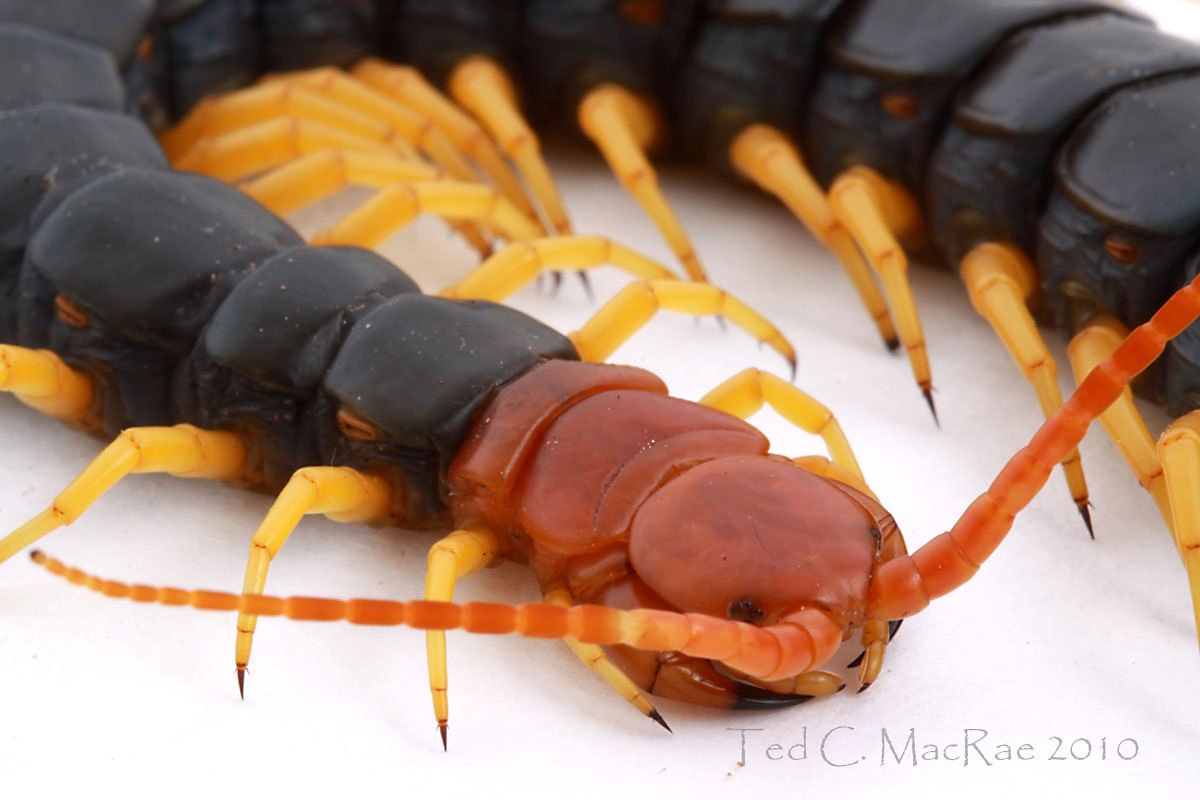
As I prowled the remote mixed-grass prairie of northwestern Oklahoma in the middle of the night, an enormous, serpentine figure emerged frenetically from a clump of grass and clambered up the banks of the draw I was exploring.  Although I was still hoping for my first glimpse of the Great Plains giant tiger beetle, I was keeping a watchful eye out for anything that moved within the illuminated tunnel of my headlamp due to the potential for encountering prairie rattlesnakes (perhaps the most aggressive of North America’s species).  This was clearly no snake, but at up to 8″, Scolopendra heros (giant desert centipede) easily matches some smaller snakes in length.  Also called the giant Sonoran centipede and the giant North American centipede, it is North America’s largest representative of this class of arthropods (although consider its South American relative, S. gigantea – the Peruvian or Amazonian giant centipede, whose lengths of up to 12″ make it the largest centipede in the world).

Although I had never before seen this species alive, I recognized it instantly for what it was.  Many years ago I was scouting the extreme southwest corner of Missouri for stands of soapberry (Sapindus saponaria), a small tree that just sneaks inside Missouri at the northeasternmost limit of its distribution, in hopes of finding dead branches that might be infested with jewel beetles normally found in Texas.  I had heard that these centipedes also reach their northeastern extent in southwestern Missouri, and just a few miles from the Arkansas and Oklahoma borders I found a road-killed specimen.  I stood there dejected looking at it – too flattened to even try to salvage for the record.

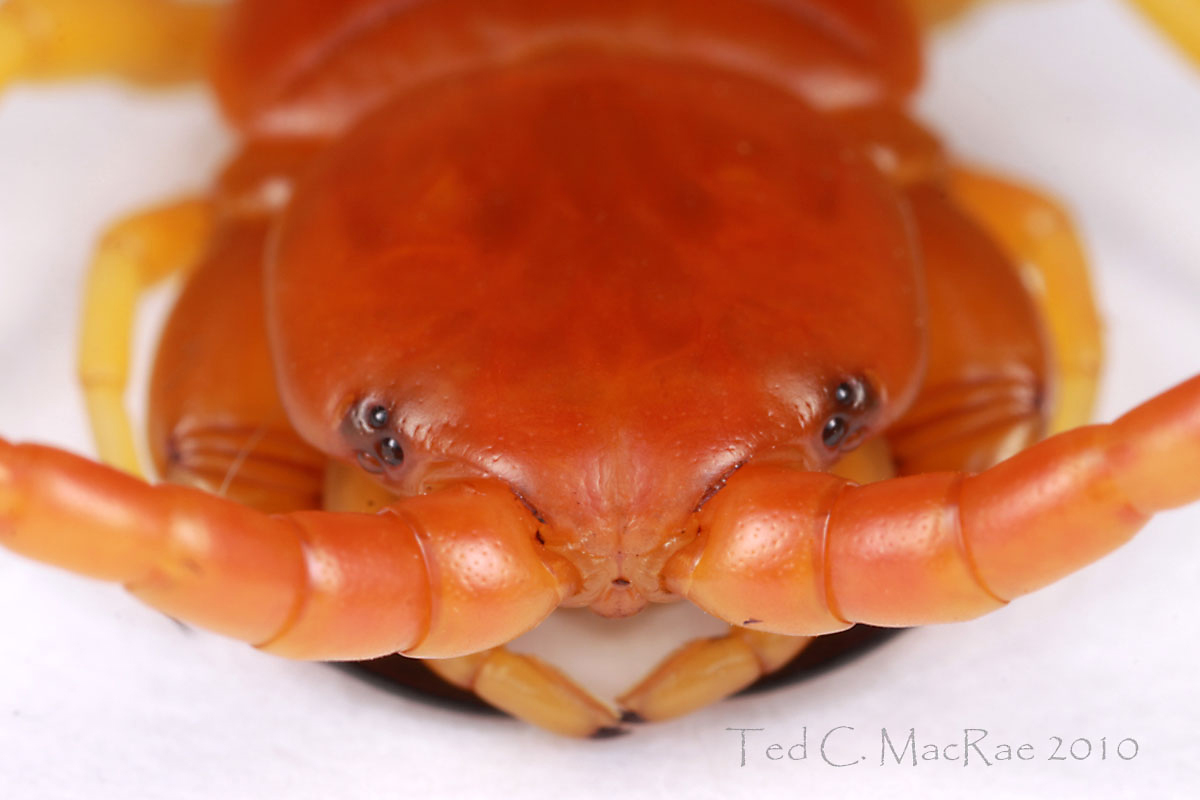
Centipedes, of course, comprise the class Chilopoda, which is divided into four orders.  The giant centipedes (21 species native to North America) are placed in the order Scolopendromorpha, distinguished by having 21 or 23 pairs of legs and (usually) four small, individual ocelli on each side of the head (best seen in bottom photo).  The three other orders of centipedes either lack eyes (Geophilomorpha) or possess compound eyes (Scutigeromorpha and Lithobiomorpha).  These latter two orders also have only 15 pairs of legs (shouldn’t they thus be called “quindecipedes”?).  Among the scolopendromorphs, S. heros is easily distinguished by its very large size and distinctive coloration.  This coloration varies greatly across its range, resulting in the designation of three (likely taxonomically meaningless) subspecies.  This individual would be considered S. h. castaneiceps (red-headed centipede) due to its black trunk with the head and first few trunk segments red and the legs yellow.  As we have noted before, such striking coloration of black and yellow or red nearly always indicates an aposematic or warning function for a species possessing effective antipredatory capabilities – in this case a toxic and very painful bite.

The individual in these photographs is not the first one I saw that night, but the second.  I had no container on hand to hold the first one and not even any forceps with which to handle it – I had to watch in frustration as it clambered up the side of the draw and disappear into the darkness of the night.  Only after I returned to the truck to retrieve a small, plastic terrarium (to fill with dirt for the giant tiger beetles that I now possessed) did I luck into seeing a second individual, which I coaxed carefully into the container.  It almost escaped me yet again – I left the container on the kitchen table when I returned home, only to find the container knocked onto the floor the next morning and the lid askew.  I figured the centipede was long gone and hoped that whichever of our three cats that knocked the container off the table didn’t experience its painful bite.  That evening, I noticed all three cats sitting in a semi-circle, staring at a paper shredder kept up against the wall in the kitchen.  I knew immediately what had so captured their interest and peeked behind the shredder to see the centipede pressed up against the wall. The centipede had lost one of its terminal legs but seemed otherwise none the worse for wear – its terrarium now sits safely in my cat-free office, and every few days it enjoys a nice, fat Manduca larva for lunch.

There are a number of online “fact sheets” on this species, mostly regarding care in captivity for this uncommon but desirable species.  I highly recommend this one by Jeffrey K. Barnes of the University of Arkansas for its comprehensiveness and science-focus.

Photo Details: Canon 50D (ISO 100, 1/250 sec) w/ Canon MT-24EX flash in white box.
Photos 1-2: Canon 100mm macro lens (f22), indirect flash.
Photo 3: Canon MP-E 65mm 1-5X macro lens (f/13), direct flash w/ Sto-Fen + GFPuffer diffusers.
Post-processing: levels, minor cropping, unsharp mask.

Copyright © Ted C. MacRae 2010

North America’s largest tiger beetle (I think!)

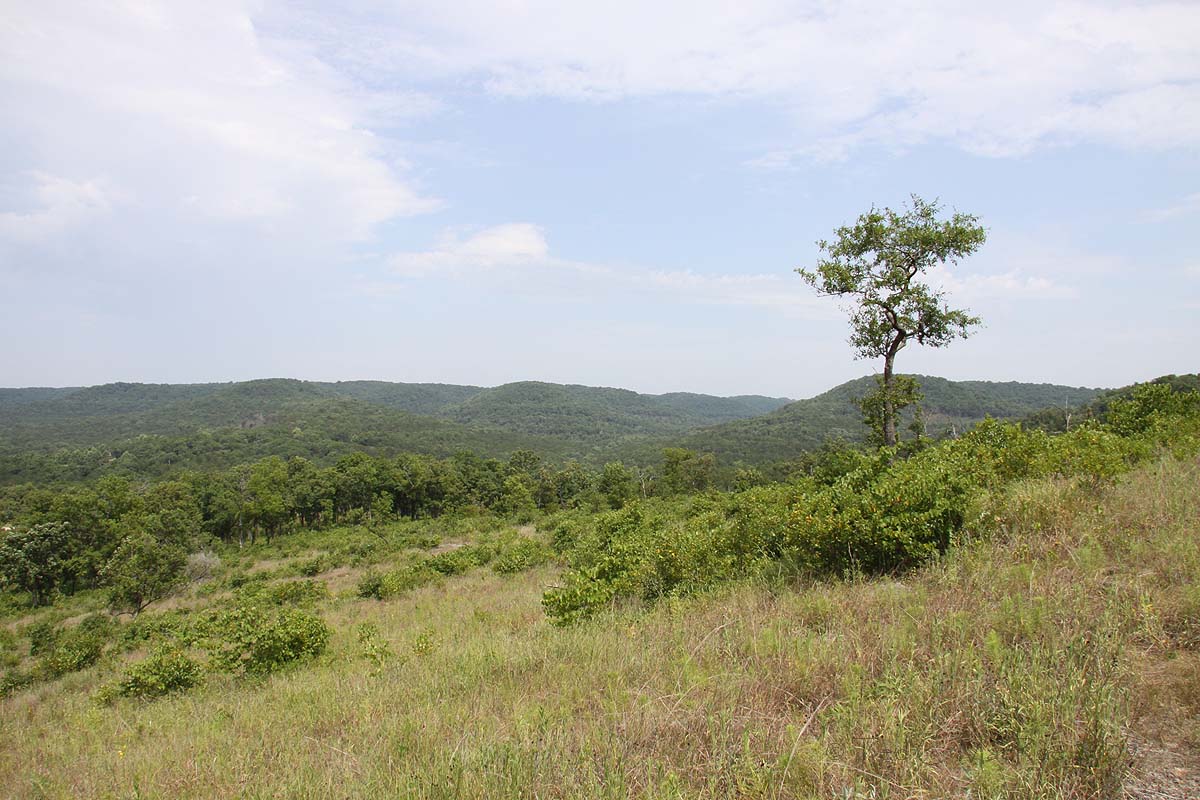
The generous among us might call it serendipity, while the rest of us would just call it luck.  By whatever name, I had it in spades in June last year when I made my first visit to the Glass Mountains of northwestern Oklahoma.  My original plan was to go to Tallgrass Prairie Preserve in eastern Oklahoma at the end of what proved to be a resoundingly successful day at Alabaster Caverns State Park.  However, soaking rains moved into the area and continued rumbling eastward across the plains towards the preserve, forcing a quick change of itinerary.  I decided to wait it out in the state’s western reaches, a “hunch” telling me that the red clay/gypsum hills in nearby Major County might be a fruitful place for hunting tiger beetles.  Sunny skies the next morning were a good sign, and my hunch was rewarded later that day when I discovered a previously unknown (and fortunately robust) population of the rare Cylindera celeripes (swift tiger beetle), making not just the day but the entire trip more successful than I could have ever imagined.  Icing on the cake came when I found decent numbers of the more secure but nevertheless uncommon Dromochorus pruinina (frosted dromo tiger beetle) also in the area.

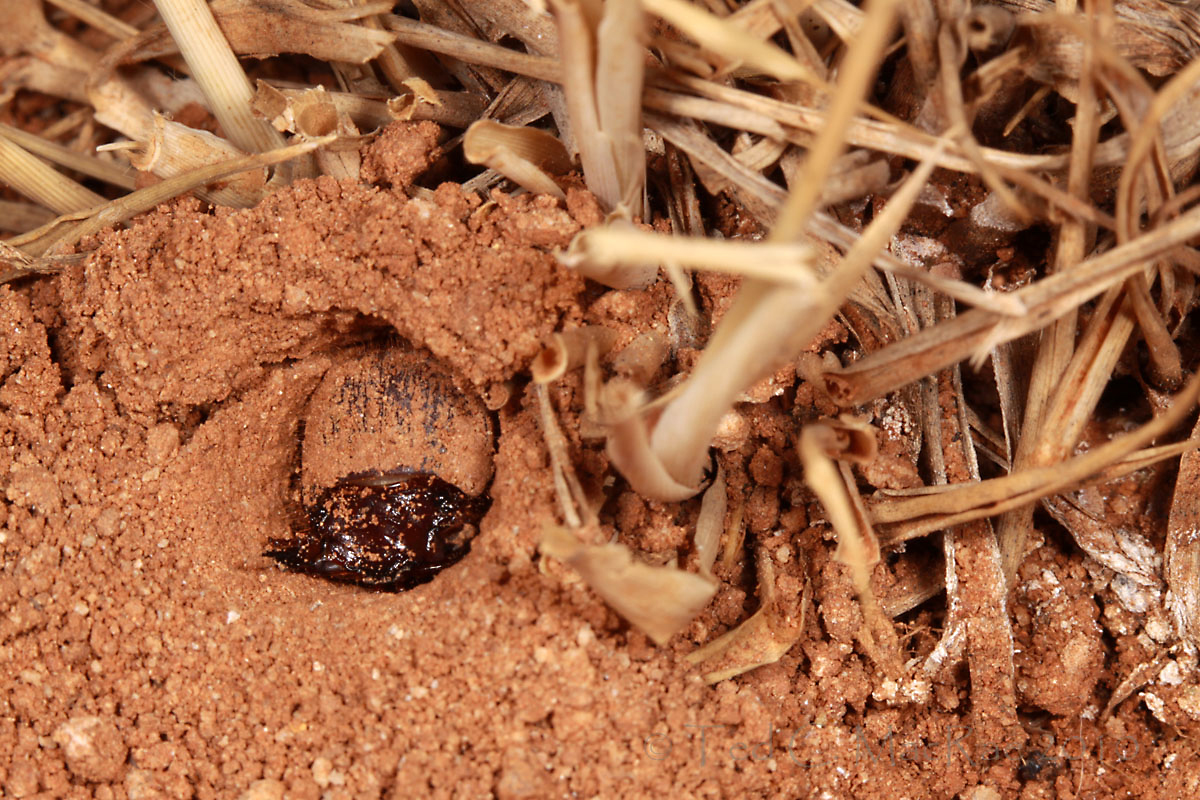
Another find I made that day that I’ve mentioned on occasion but not talked about at length was a single, rather large tiger beetle larva.  I found several burrows at the base of a talus slope at the edge of a small ravine where many adult C. celeripes were scurrying, and though I tried with many, out of only one did I manage to “fish” its occupant with a blade of grass.  I didn’t know which species it represented, but its large size and occurrence in clay soil brought to mind two species – Cicindela pulchra (beautiful tiger beetle) and C. obsoleta (large grassland tiger beetle).  Both of these Great Plains species reach their eastern limit of distribution in this part of Oklahoma (Pearson et al. 2006), and their status as the largest species of the genus (and its former subgenera) in North America seemed to make them the leading candidates for this enormous larva.  There was one other possibility – Amblycheila cylindriformis (Great Plains giant tiger beetle), another Great Plains species at its eastern limit in western Oklahoma and (as the common name implies) the largest tiger beetle in all of North America.  However, to consider that species seemed too much wishful thinking.  From my understanding, larvae of that elusive species reach an incredible 45 mm in length and dig burrows  on steep slopes or at the mouths of rodent burrows that extend vertically to depths of up to 1.5 m or more (Brust et al. 2005).  Surely I could not have so casually stumbled upon such a grand grub!

I placed the larva in a terrarium of native soil and brought it back with me, and for one year now I have waited – feeding it a regular diet of the fat noctuid caterpillars that we rear so abundantly in our lab.  For a full year, I’ve watched it nab caterpillar after caterpillar, disappearing mysteriously for days on end, and just as mysteriously reappearing at the top of its burrow.  I knew getting a closer look at it would help in my attempts to determine its identity, but every time I approached with a camera it dodged down into its burrow and beat my patience.  Sometimes I would see it sitting about a centimeter below the burrow entrance – just waiting for a caterpillar to crawl by but refusing to expose itself to the lens.  I gradually decided it was likely C. pulchra, as I had seen that species in similar habitat not too far north in Barber County, Kansas.  So strong was my suspicion that I even made another trip out to the Glass Mountains in October of last year, expecting to see the fall-active adults bejeweling the exposed flats below the red clay slopes, their wine-red elytra and purple-margined bodies all aglitter under the crisp, autumn sun.  No such sight was beheld, however – my hopes dashed by the season’s sudden cold and wet turn, and with the terrarium containing the larva by then tucked away in a cool incubator for a winter’s rest, it would be several months before I would see the larva once again sitting at the top of its burrow.

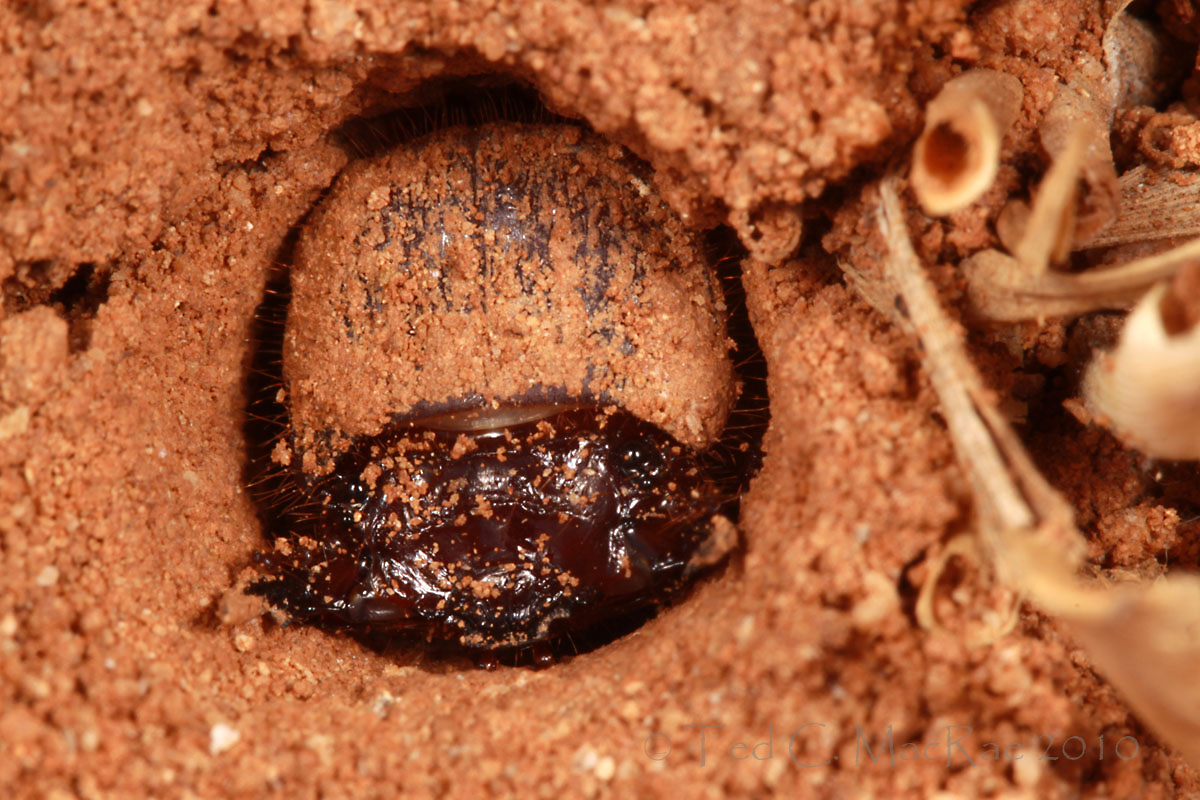
In late March I pulled the terrarium out of the incubator, and within a week the larva reopened its burrow.  I fed it a few times, and then one day I saw that it had dug a new, larger  burrow – measuring a full 10 mm in diameter!  This seemed extraordinarily large for any species of Cicindela, so I resolved once again to photograph it and determine its identity.  For days I stalked it, keeping the terrarium just outside my office door where I could keep an eye on it, yet every time I approached within two feet or so it would drop down out of sight.  I decided to stop feeding it – perhaps hunger would overwhelm its patience and prompt it to return to the top of its burrow more quickly after retreating.  That seemed to work, as one day the larva came back up after only a few minutes – and I was ready!  Already  in position, I flashed off multiple shots as soon as it reappeared, moving slowly and deliberately between shots to avoid spooking it again, and managed to get a nice series from varying distances.  As a testament to its enormous size, all of the photos shown here were taken with the standard 100mm macro lens (1X maximum) – not the 65mm 1-5X beast that I needed for these shots of the super-tiny C. celeripes.

Thinking that the larva likely represented C. pulchra, I compared the photos to this photo taken by Matt Brust of a 3rd-instar larva of C. pulchra and immediately noted the differently shaped pronotum of my larva and its distinctly projecting anterolateral angles.  Compare to C. pulchra, in which the angles are in line with the median part of the anterior margin – it is clearly not that species.  It isn’t C. obsoleta either, as that species has the anterolateral angles of the pronotum even less projecting than C. pulchra (Drew and Van Cleave 1962).  Apparently I needed to rethink my assumption that it belonged to Cicindela or its close relatives – none that occur in Oklahoma are simply large enough!  Tetracha virginica is large enough, but I knew it wasn’t that species since it lacked the white margined pronotum distinctive of species in that genus (as can be seen in this post on the larva of Tetracha florida).  That left only A. cylindriformis, distinguishable from all other tiger beetle genera occurring in Oklahoma by the second (lower) pair of eyes distinctly smaller than the first (Hamilton 1925, Drew and Van Cleave 1962, Pearson et al. 2006) – clearly seen in the third photo above.  Matt Brust has also photographed the larva of A. cylindriformis – it’s not a close shot of the head and pronotum, but in general aspect my larva seems to match it well enough.

All that is left is to actually succeed in rearing this larva to adulthood.  These beasts may require up to three to four years to develop (Brust et al. 2005), although this is likely influenced by latitude and prey abundance.  I suspect it was a second instar larva when I collected it, and that it dug its new burrow this spring after molting to the third (and final) instar.  Hopefully by keeping it in a nice, warm growth chamber and feeding it generously with fat caterpillars, I can minimize the time to pupation and perhaps see the adult sometime later this summer.  If/when that happens, you can be sure to see a follow up to this post.

Photo Details: Canon 50D (ISO 100, 1/250 sec, f/16-18), Canon 100mm macro lens, Canon MT-24EX flash (1/4 ratio) w/ Sto-Fen diffusers. Post-processing: contrast and unsharp mask (no cropping).

REFERENCES:

Brust, M. L., S. M. Spomer and W. W. Hoback.  2005. Tiger Beetles of Nebraska.  University of Nebraska at Kearney.  http://www.unk.edu (Version 5APR2005).

Drew, W. A. and H. W. Van Cleave.  1962. The tiger beetles of Oklahoma (Cicindelidae).  Proceedings of the Oklahoma Academy of Science 42:101–122.

Hamilton, C. C.  1925. Studies on the morphology, taxonomy, and ecology of the larvae of Holarctic tiger beetles (family Cicindelidae).  Proceedings of the U.S. National Museum 65 (Art. 17):1–87.

Pearson, D. L., C. B. Knisley and C. J. Kazilek. 2006. A Field Guide to the Tiger Beetles of the United States and Canada. Oxford University Press, New York, 227 pp.

Copyright © Ted C. MacRae 2010

Add to FacebookAdd to DiggAdd to Del.icio.usAdd to StumbleuponAdd to RedditAdd to BlinklistAdd to TwitterAdd to TechnoratiAdd to Yahoo BuzzAdd to Newsvine

Email to a friend

North America’s second-rarest pine

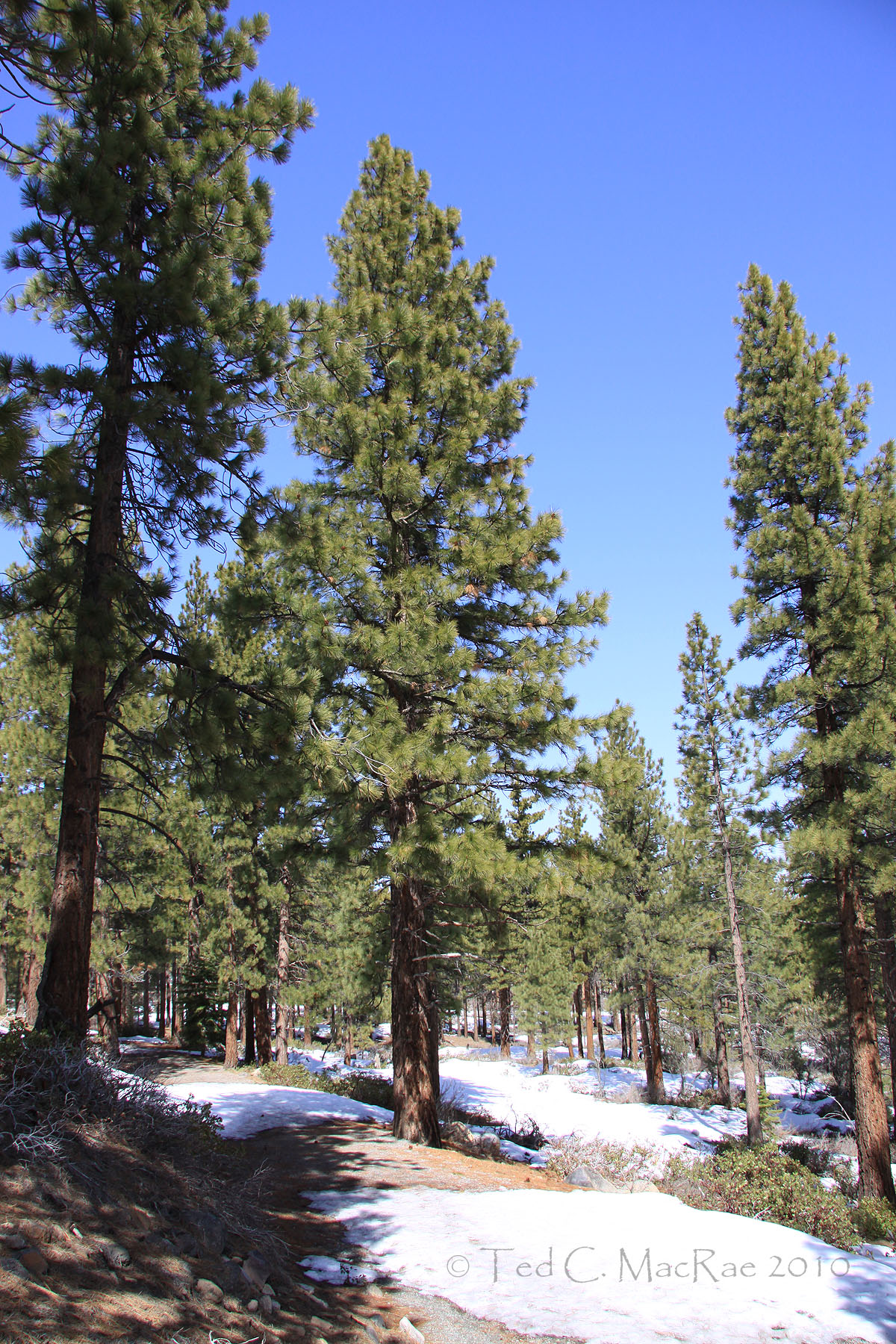
Jeffrey (L) and Washoe (R) pines at Galena Creek Park

During last year’s trip to Lake Tahoe, I made it a goal to find all of the 11 conifer species occurring naturally in the Lake Tahoe Basin.  It took some effort, some good references (Arno 1973, Graf 1999, Lanner 1999, and Peterson 1975), and the help of an especially knowledgeable associate at the U.S.D.A. Forest Service headquarters in South Lake Tahoe, but I succeeded in my quest and later wrote two posts covering the Lake Tahoe conifers (Trees of Lake Tahoe – The Pines, Trees of Lake Tahoe – The “Other” Conifers).  In the first of the posts covering the six species of pines, I added the following footnote:

Two additional species of pine – Washoe pine (Pinus washoensis) and single-leaf pinyon pine (P. monophylla) – are often treated as occurring in the Lake Tahoe area. However, they are of sporadic occurrence on the eastern slopes of Mount Rose, and thus do not occur within the Tahoe Basin proper.

Of these, I am quite familiar with single-leaf pinyon pine.  Widespread on isolated mountain ranges throughout the Great Basin into eastern and southern California and Baja California Norte, I have encountered it during many of my field trips out west and reared a number of buprestid species from its tough, scrubby branches (including 2 specimens of the rarely encountered Phaenops piniedulis).  The other species, Washoe pine, was a new one on me, and it is, in fact, the second-rarest species of pine in all of North America (Torrey pine, Pinus torreyana, being the rarest).  Well, that was all it took to make me commit to finding this species on this year’s return to Lake Tahoe.

Washoe pine cones surround a larger Jeffrey pine cone.

Washoe pine grows only in a few locations, primarily in northern California with the best stands found in the Warner Mountains in Modoc County.  In the Tahoe area, Washoe pine grows only on the eastern slope of Mt. Rose in Nevada, where it is limited to the upper reaches of Galena Creek (Graf 1999, Lanner 1999).  It is apparently very similar to Jeffrey pine (P. jeffreyi) – the most common pine in the Tahoe area – but seems to be more closely related to ponderosa pine (P. ponderosa), which occurs at lower elevations and barely makes it up to the Tahoe area (some authorities even question the distinctiveness of this species, instead considering it a high elevation variety of ponderosa pine).  All three species are 3-needled and grow into tall, pyramidal trees with widely spaced horizontal branches.  Like ponderosa pine, the bark of mature trees forms broad yellowish plates separated by black fissures (the bark of Jeffrey pine is often more reddish with plate more narrowly separated).  The resin of Washoe pine is also chemically similar to that of ponderosa pine, both of which differ from the heptane-producing resin of Jeffrey pine.  However, Washoe pine cones more closely resemble those of Jeffrey pine, being somewhat smaller but sharing the “inward-curved” prickles on the scale tips that make them easy to handle (those of ponderosa pine point outwards, making them very prickly to handle).

Ponderosa (L) and Washoe (R) pine cones. Note smaller size and outward-pointing spines of ponderosa pine cone.

Jeffrey (L) and Washoe (R) pine cones. Both have inward-pointing spines, but Washoe pine cone is smaller and more loosely built.

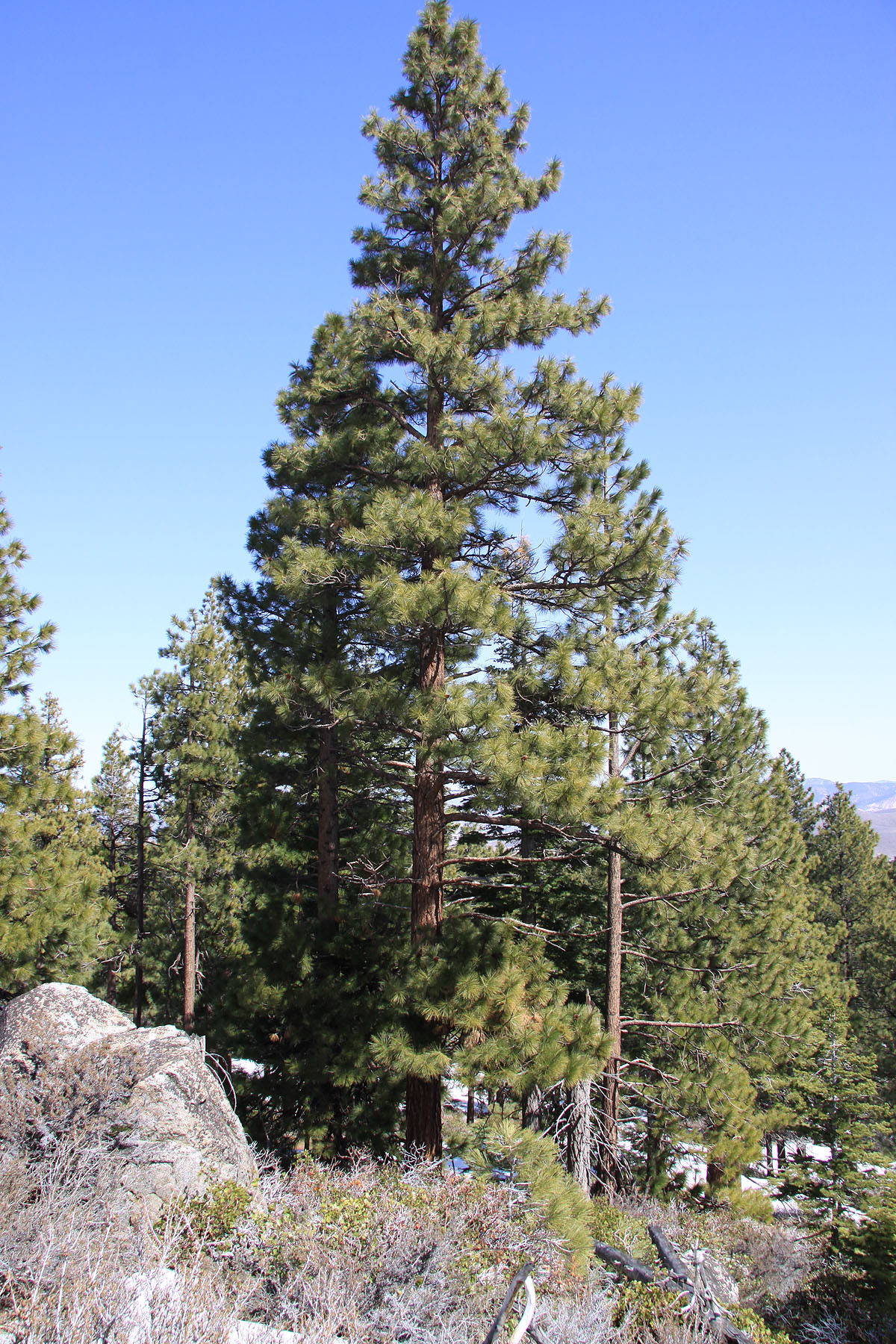
None of my references had any specific locality information for Washoe pine beyond what I’ve stated above, but a little bit of Google snooping through conservation action plan documents revealed that the species occurred at Galena Creek Park, so early in the morning daughter Madison and I made the one-hour drive from South Lake Tahoe to the park.  Arriving at the park, I was disappointed to find nobody manning the headquarters, no maps in the park information board – indeed, no information whatsoever about the occurrence of Washoe pine within the park and where it might be found.  The only clue that there was something special about the pines at this place were the wooden signs around the parking and picnic areas stating “Collection of pine cones prohibited.” I reasoned that it would be very difficult to distinguish the species by its needles, bark, or form, but that the pine cones should be easier to distinguish. I also had no idea whether the pines would occur close to the parking area or if we would need to hike into the area to find them.  So, we just began picking up pine cones.  For a time, all of the pine cones seemed to be typical Jeffrey pine (abundant in the area) with an occasional ponderosa pine (just making up the 6,200′ of elevation in this area).  Ever concerned that I might be missing a subtle difference, I studied each “Jeffrey” pine cone carefully looking for any reason to regard it as truely smaller than normal.  Within about 15 minutes, however, we found it!  Picking up the pine cone, it had the compact build and inward-pointing spines of a Jeffrey pine, but it was smaller and a little more loosely built.  I looked at the trees above and could see no difference from what I would expect for a Jeffrey pine.  Further looking revealed numerous cones of the same type – each tree we found them under was otherwise indistinguishable from Jeffrey pine (at least to this eastern U.S.-based wannabe botanist).  Nevertheless, it was clear that we had found Washoe pine, and that it was quite abundant within this small watershed that we were exploring.  Jeffrey pine was also common in the watershed, and an occasional ponderosa pine could be found.  I took photos of mature individuals of each of the three species, identified conclusively by way of the cones found underneath them, to show how similar in appearance the three species are.

Pinus ponderosa

Pinus jeffreyi

Pinus washoensis

Madison and I later hiked out of the watershed into the higher elevations of Mt. Rose (from where these ants were photographed) – we noticed that almost immediately upon hiking out of the watershed the Washoe and ponderosa pines disappeared, and only Jeffrey pines were seen.  Although I have seen it many times before, I was still hoping to see single-leaf pinyon pine, but none were seen.

REFERENCES:

Arno, S. F. 1973. Discovering Sierra Trees. Yosemite Association, Yosemite National Park, California, 89 pp.

Graf, M.  1999. Plants of the Tahoe Basin.  Flowering Plants, Trees, and Ferns.  A Photographic Guide. California Native Plant Society Press, Berkeley, 308 pp.

Lanner, R. M.  1999. Conifers of California.  Cachuma Press, Los Olivos, California, 274 pp.

Peterson, P. V., and P. V. Peterson, Jr.  1975. Native Trees of the Sierra Nevada.  University of California Press, Berkeley, 147 pp.

Copyright © Ted C. MacRae 2010

North America’s largest jewel beetle

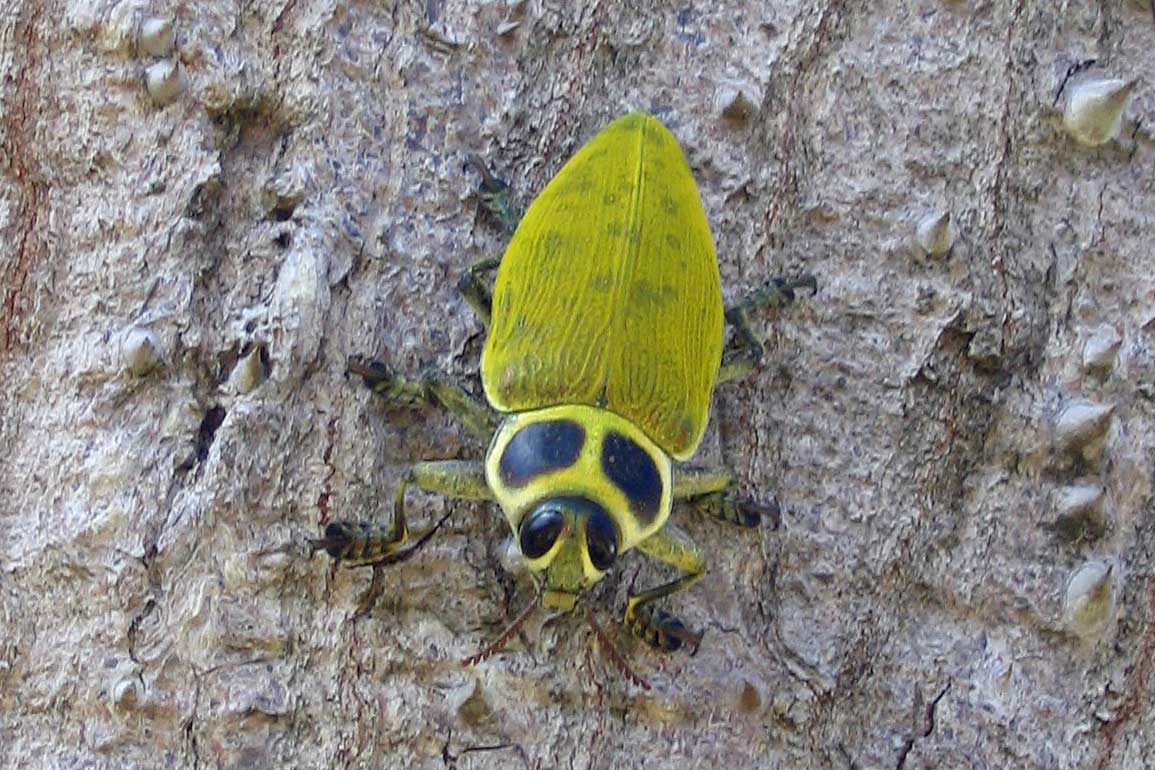
Euchroma gigantea in Jamaica. Photo © Steve Meyer


In recent weeks I’ve featured a few jewel beetles that I have encountered amongst specimens sent to me for identification (see “Aaack!-maeodera” and “Acmaeodera carlota in northern Arizona“).  While the new distributions and even unknown species that they represent are fascinating from a scientific perspective, their diminutive size (~6 mm in length) probably makes them less than spectacular to the non-specialist.  The family Buprestidae does, however, contain some very large species, including a few that qualify as bona fide giants.  One such species, Euchroma gigantea (Giant Metallic Ceiba Borer Beetle), occurs from Mexico through Central America, the West Indies, and most of South America.  At a maximum of 65mm in length, it is not only North America’s largest jewel beetle, but also the largest jewel beetle in the entire Western Hemisphere.

My colleague Steve Meyer encountered and photographed this individual in Negril, Jamaica.  Although its scientific name translates to “colorful giant”, the beetle in the photo is especially so due to the delicate, waxy bloom covering its elytra. This bloom is secreted by the adult after transforming from the pupa and prior to emerging from its larval host, giving it a bright yellow-green appearance.  After the beetle emerges and becomes active, the bloom is quickly rubbed off and the beetle takes on the shiny, iridescent purple-green color by which it is more familiar.  The presence of bloom on this individual suggests that it had just emerged from the trunk of the kapok tree (Ceiba pentandra) on which it was sitting.  Kapok and other large trees in the family Bombacaceae serve as hosts for larval development for this species (Hespenheide 1983).

Indigenous peoples in Central and South America have long utilized the dazzlingly colored elytra of these beetles to create beautiful natural jewelry and adorn their clothes and textiles.  The species is also eaten in both the larval and adult stages – Tzeltal-Mayans in southern Mexico (Chiapas) roast the adults when available, and the Tukanoans (northwestern Amazon) also eat the larvae (Dufour 1987). I have eaten a few insects in my day, but none as thick and massively juicy as the grub of this species must be. Holometabolous larvae typically contain a rather high percentage of fat (up to 66% dry weight) to meet the demands of pupal development and adult reproduction, and I suspect this makes the larvae quite tasty (especially when roasted). If there is any insect in the world that I really, really, really want to eat – it is the larva of this one!

REFERENCES:

Dufour, D. L.  1987.  Insects as food:  A case study from the northwest Amazon.  American Anthropologist 89(2):383–397.

Hespenheide, H. A.  1983.  Euchroma gigantea (Eucroma, giant metallic ceiba borer), p. 719.  In: D. H. Janzen [ed.], Costa Rican Natural History, University of Chicago Press, Chicago.

Copyright © Ted C. MacRae 2010

North America’s most beautiful longhorned beetle

I’ve written a few posts in recent weeks highlighting some of the more interesting finds encountered during two visits this past July to the White River Hills region of extreme southwestern Missouri. It’s a land of extremes, with deeply dissected layers of limestone/dolomite bedrock supporting xeric glades, dry woodlands and riparian watercourses. The hilltop glades (“balds”), in particular, feature prominently in the region’s natural and cultural history and are the most extensive system of such habitat in Missouri. They support a number of plants and animals more characteristic of the grasslands of the south-central U.S., such as the recently featured Megaphasma denticrus and Microstylus morosum, North America’s longest insect and largest robber fly, respectively. Sadly, the glades in this region are much reduced in size and quality compared to their pre-settlement occurrence, primarily due to overgrazing and suppression of fire. These anthropogenic forces have combined to reduce overall vegetational diversity and accelerate encroachment by woody species (chiefly eastern red-cedar, Juniperus virginiana). Nevertheless, there still remain several high quality glade remnants in the area, and the public agencies charged with their conservation are increasingly utilizing mechanical removal of woody growth, controlled burns, and managed grazing in an effort to simulate the natural forces that mediated this landscape for thousands of years.

IMG_0871_1200x800

Chute Ridge Glade, Roaring River State Park, Barry Co., Missouri

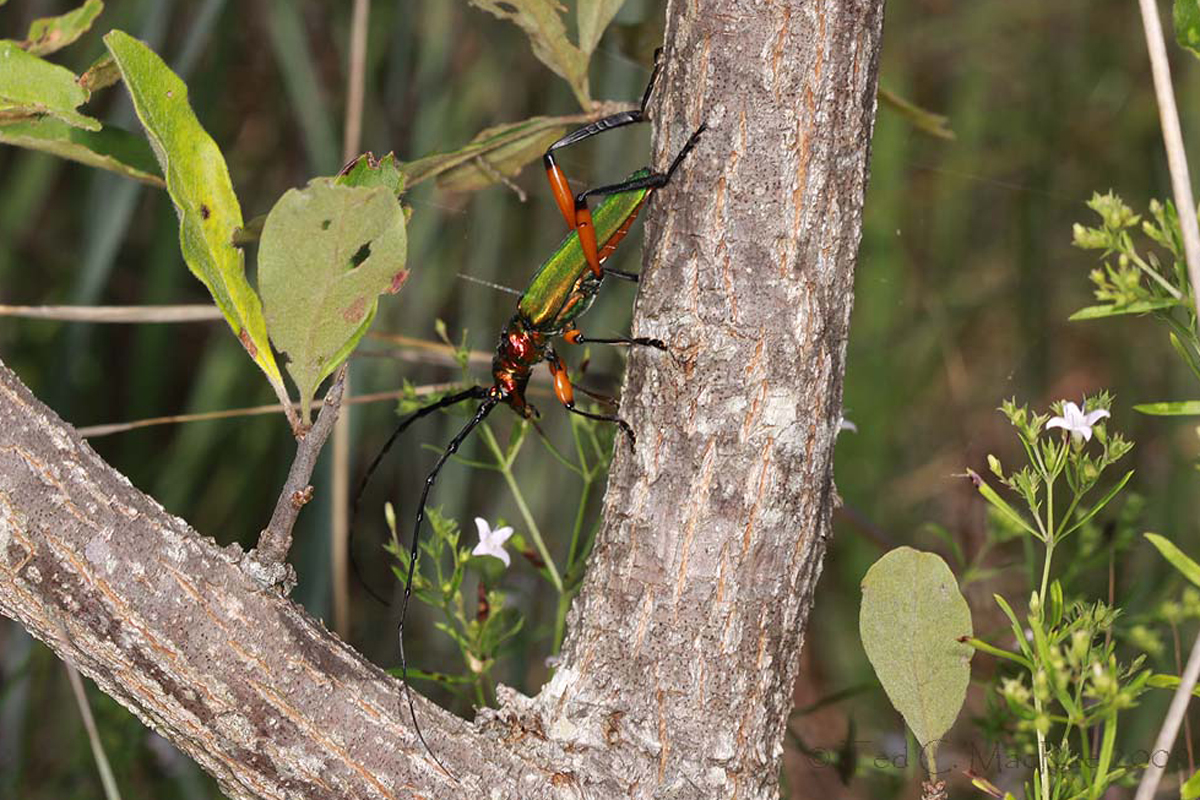
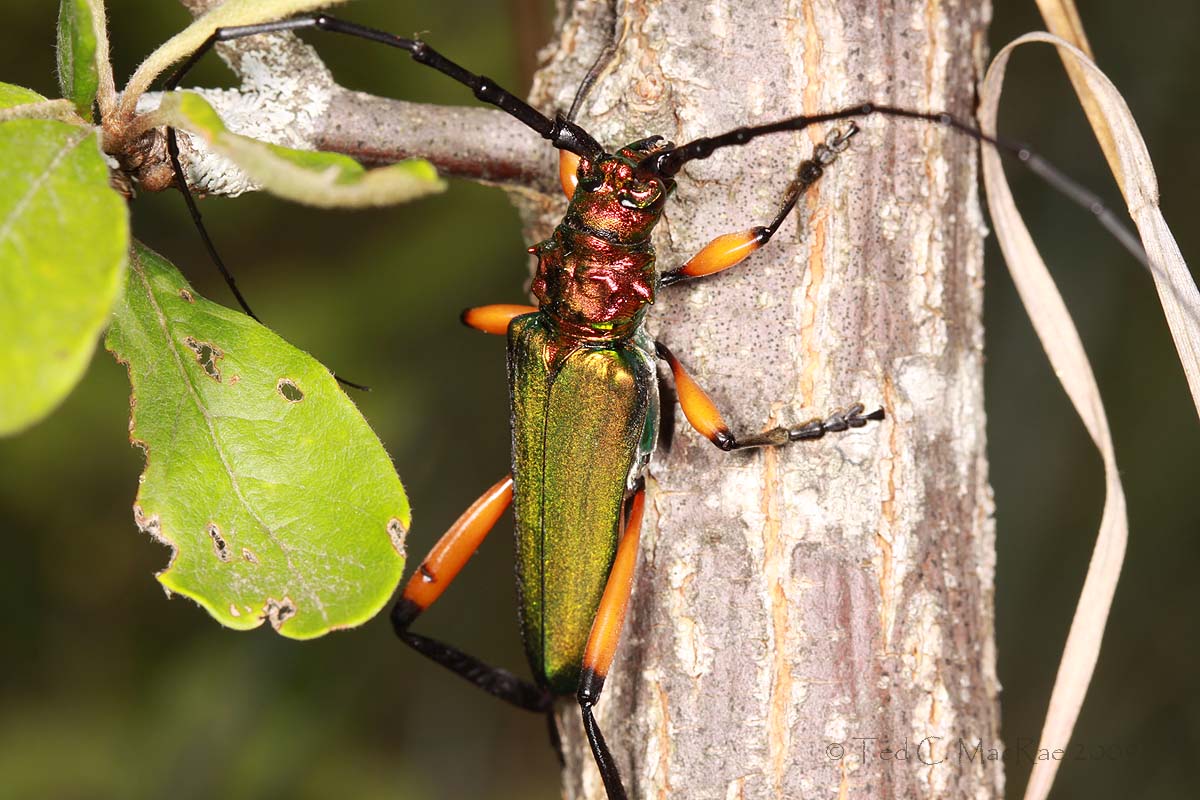
My reason for returning to the White River Hills this year was simple—find and photograph the magnificent longhorned beetle, Plinthocoelium suaveolens (family Cerambycidae). This species, occurring across the southern U.S. from Florida and Georgia west to New Mexico and Arizona, is truly one of North America’s most beautiful longhorned beetles due to its large size, brilliant iridescent green coloration, and super-elongate wildly-contrasting orange and black legs.  Until recently, this species was known in Missouri only from sporadic records across the southern part of the state (MacRae 1994). I knew of its association with gum bumelia (Sideroxylon lanuginosum [= Bumelia lanuginosa], also called gum bully and woolly buckthorn), which was first noted by Missouri’s first State Entomologist, C. V. Riley (1880) and later discussed in detail by Linsley and Hurd (1959) and Turnbow and Hovore (1979); however, my repeated searches over the years whenever I encoutered this plant came up empty.  A few years ago, Chris Brown and I were conducting a survey of tiger beetles in the White River Hills and noted the relatively common occurrence of bumelia on these glades.  Bumelia, like P. suaveolens, is one of only a few North American representatives of a largely tropical group, and it is one of the few woody species naturally adapted to the xeric conditions found on these glades.  Recalling the association of P. suaveolens with this plant, and also recalling that adults could be attracted to fermenting baits of the type described by Champlain and Knull (1932), we placed fermenting bait traps on several glades in the area and succeeded in trapping a number of individuals during the month of July.  When I began searching the bumelia trees at these glades, I found adults perching on the lower trunks of several trees. It was the first time I’d seen live individuals of this species in Missouri.  At the time I was not a photographer, and that experience became one of the many moments that I would later look back upon and think, “If only I’d taken a picture of that!”  Thus, at the end of June this year, having successfully found Cylindera celeripes in Missouri on the first day of a planned 3-week search, my attention immediately turned to the new goal of finding P. suaveolens and photographing it on its host plant.

IMG_0929_1200x800

Sideroxylon lanuginosum (gum bumelia) at Blackjack Knob, Taney Co., Missouri

I knew this wouldn’t be easy—the beetles were not abundant when I had last observed them, and those that I did find were quite wary to my approach.  Getting within striking distance with a net was one thing; doing so with a camera and macro lens would be another thing entirely.  In my first trip to the area (early July), I went to Chute Ridge Glade, a magnificently restored glade in Roaring River State Park where I had seen the greatest number of individuals before.  I was full of optimism on that first day as I zigzagged across the rough terrain from one bumelia tree to the next, but my optimism began to wane as I cautiously approached each tree and saw nothing.  Within an hour, I’d looked at every bumelia tree I could find on the glade and not even seen a beetle, much less attempted a photograph.  It would take a 2-hour drive along twisting back roads to reach the other sizeable glade complex where I had seen beetles before (Blackjack Knob in Taney County), and another hour of searching on several dozen trees would again yield nothing.  By now I was feeling rather frustrated—the day’s oppressive heat and humidity had taken its toll, and my 4.5-hour drive from St. Louis was looling like it would be for naught.  I had noted that the bumelia flowers were almost but not quite open yet—perhaps it was too early in the season still?  
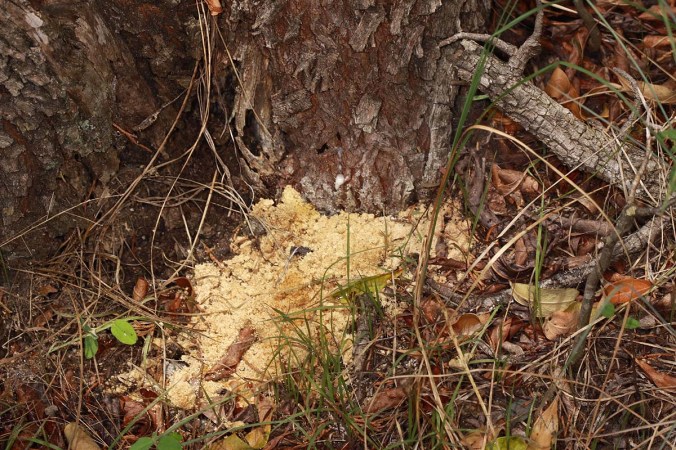
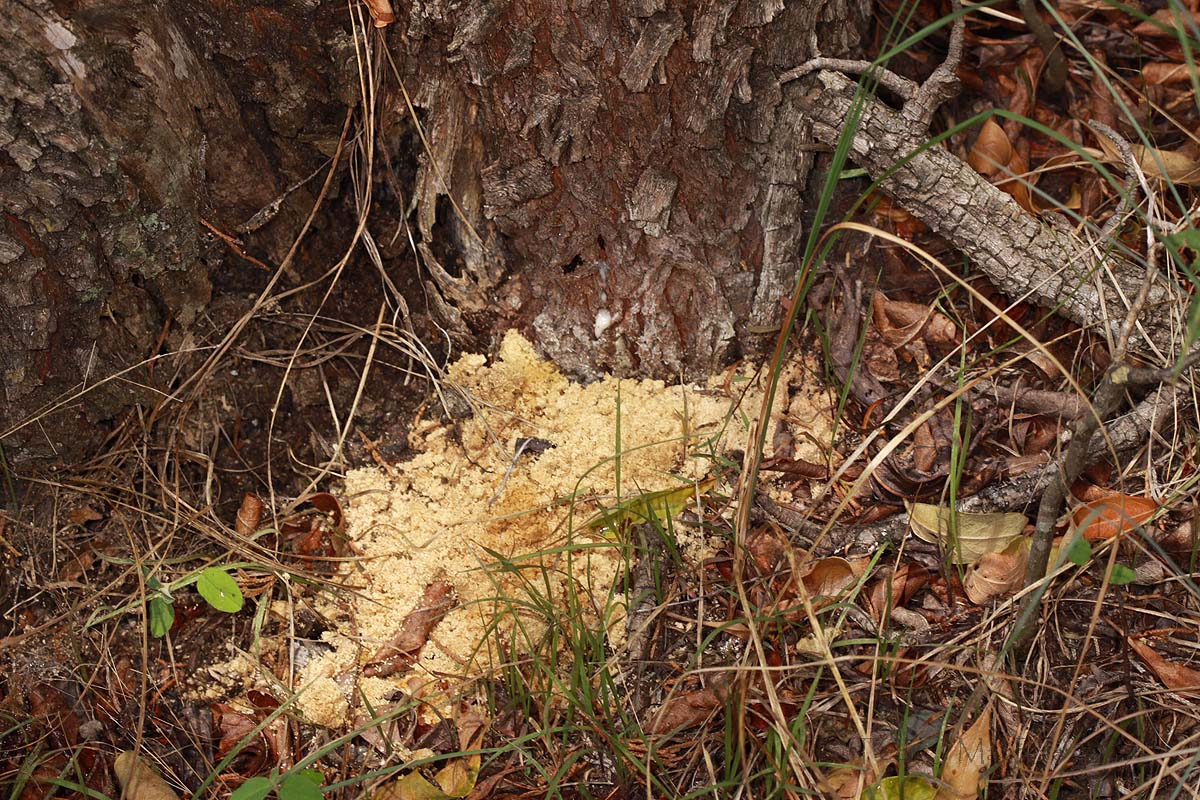
Plinthocoelium suaveolens larval frass pile at the base of living Sideroxylon lanuginosa

Plinthocoelium suaveolens larval frass pile at trunk base of living Sideroxylon lanuginosum

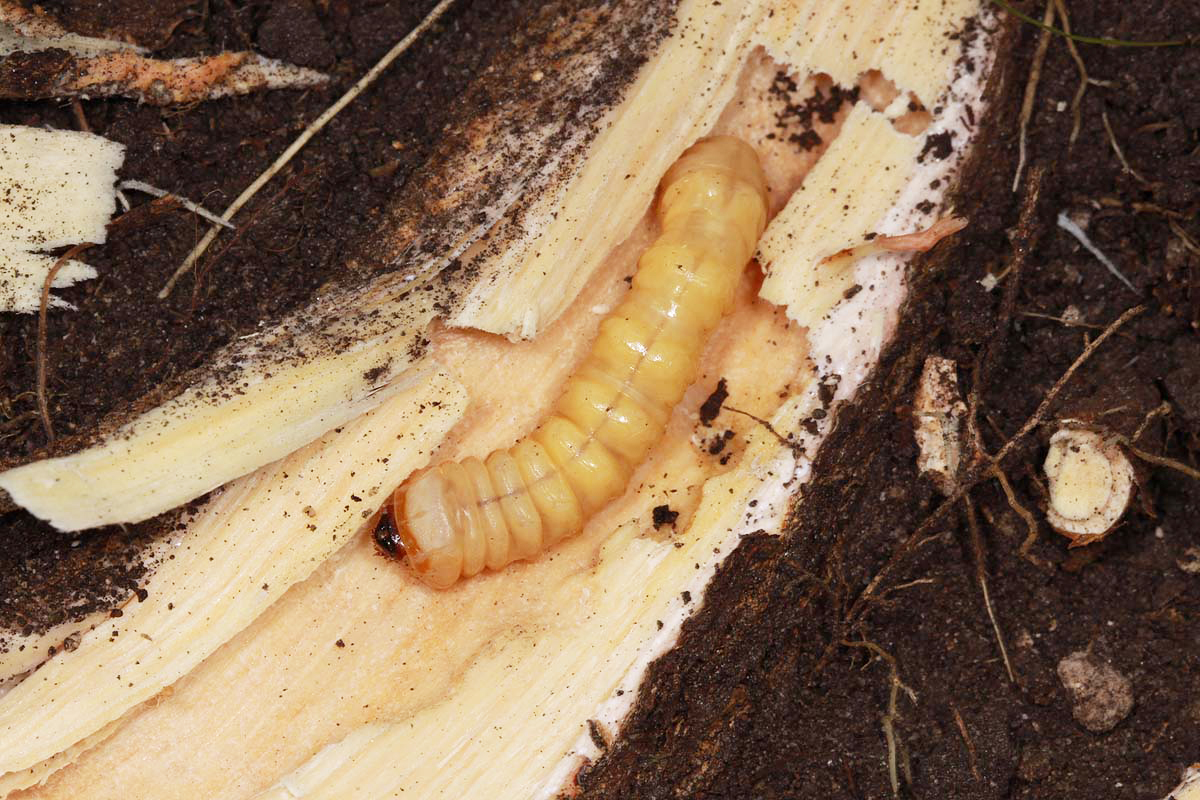
The remnant glades at Blackjack Knob are more extensive than those at Chute Ridge, so many more trees still awaited examination—if I could only muster the energy!  I trudged back to the truck, guzzled a nice, cold Powerade, and started off in another direction.  I looked at a number of trees and still had seen no sign of the beetle, but on one particular tree I noticed an enormous pile of sawdust on the ground at the base of the tree.  I looked at it more closely and saw that it had the rough, granular texture so characteristic of longhorned beetle larvae that like to keep their galleries clean, and its bright, moist  color suggested that it was being ejected by a larva tunneling through living wood.  I looked up into the tree above the pile to find where it was coming from but could find no ejection hole.  I checked the base of the trunk itself and still couldn’t find anything.  Then I started poking into the pile and felt a root.  Further poking revealed a soft spot on the root, and I immediately knew that I had found a P. suaveolens larval gallery—no other cerambycid species is known to bore in roots of living Sideroxylon, especially one as large as this based on the size of the frass pile.  I hurried back to the truck and grabbed my hatchet, returned to the tree, and scraped away the soil above the root to find an obvious ejection hole a few inches away from the base of the trunk.  I started chipped into the root at the ejection hole and found a large, clean gallery extending down the center of the root away from the trunk.  About 18” away from the trunk I found it—a large, creamy-white cerambycid larva.

Plinthocoelium suavelones larva in root of living Sideroxylon lanuginosa

Plinthocoelium suaveolens larva in root of living Sideroxylon lanuginosum

Plinthocoelium suavelones larva in root of living Sideroxylon lanuginosa

Plinthocoelium suaveolens larva in root of living Sideroxylon lanuginosum

Finding a P. suaveolens larva was gratifying, but it wasn’t what I had come here to do, which was photograph the adult. After placing the larva live in a vial for preservation later on (dropping into scalding water to “fix” the proteins and prevent discoloration when stored in 70% ethanol), I continued searching the trees for adults.  I found one tree on which the flowers were just barely beginning to open and collected a few of the pedestrian species of scarabs that are attracted to bumelia flowers in droves when fully open (e.g. Cotinis nitidus and Trigonopeltastes delta)—for the record.  There was still no sign of adult Plinthocoelium, and I was on the verge of calling it a day when I approached another tree and saw it!  I froze, then slowly geared up with the camera and started stalking slowly towards it.  It was not in a very convenient location, down low on the trunk and partially screened by foreground vegetation.  I got close enough to start attempting some shots—not ideally composed, but just to ensure that I had something before I tried to get any closer.  After the third shot, however, it became alarmed and started to flee, and I had no choice but to capture it for a “studio backup.”  That taste of success gave me the motivation to resume my search, but no additional beetles were seen before a dropping sun put an end to the day.

Plinthocoelium suaveolens on lower trunk of living Sideroxylon lanuginosum

Plinthocoelium suaveolens on lower trunk of living Sideroxylon lanuginosum

Not entirely satisfied with the shots that I’d gotten, I returned to Blackjack Knob the following day and also searched some of the extensive habitat at nearby Hercules Glades Wilderness.  I wouldn’t see another beetle the entire day, although encountering a nice series of Cicindela rufiventris (red-bellied tiger beetle) was some consolation for suffering the day’s oppressive heat and humidity.  I still had the live beetle, so I placed my hopes on getting better photographs of the beetle in confinement after returning home.  That would not come to pass—the beetle refused to sit obligingly on the stick I placed in the large screen cage, and instead clung to the cage itself.  For days I watched it, giving it honey-water for sustenance and waiting for an opportunity to photograph it on the stick on which it refused to sit.  It became clear to me that studio photographs, at least in the manner I was attempting, would not be possible.  Not entirely satisfied with having seen only a single beetle on my trip, and thinking that I may have been too early based on the flowering phenology of the bumelia host trees, I did what any dedicated entomologist would do—I made a second trip to the area two weeks later!

I didn’t mess with Chute Ridge Glade this time, instead making a beeline for Blackjack Knob right away.  Unfortunately, the weather was uncooperatively drizzley (I would have preferred hot and humid to rain!).  Nevertheless, daughter Madison and I made our way to the glades and began inspecting the trees that I had just examined two weeks earlier.  I noted immediately that the bumelias were now in full flower, and it wasn’t long before I saw the first adult flying into these flowers.  Exciting for sure, and this was a good sign to see an active adult despite the drizzly weather, but the situation of the beetle on a high branch left no possibility for photographs (and only with a rather acrobatic swing of my fully extended net handle amidst a jumble of dead branches was I able to capture it).  This same scenario would replay several times over the next two hours before rain finally drove us back to the car.  In total, we saw half a dozen active adults, but in each case they were seen flying to flowers on high branches and could not be photographed.  Despite that disappointment, I’ll never forget the spectacularity of seeing these beetles in flight—shimmering green and bold orange, with legs and antennae spread wide in all directions.  I was also fortunate to find another tree with a fresh frass pile at its base indicating an active larva.  This time, I cut the tree some inches above the ground and extracted the trunk base and root intact for transplanting into a large soil box upon my return home.  The appearance of new frass on the soil surface afterwards confirmed that I had gotten the root containing the larva and that it had survived the extraction and transplanting.  Hopefully I will be able to successfully rear this individual to adulthood.

Despite the rain, we then went back to Hercules Glades Wilderness to see if luck would follow suite there as it had at Blackjack Knob.  It didn’t, as rain continued to doggedly pursue us, but the day was not a total loss as daughter and I got in a nice 7-mile hike through some of Missouri’s most ruggedly scenic terrain and were rewarded with the sighting of a western pygmy rattlesnake.  The next day was sunny, much to our delight, and I considered going back to Blackjack Knob where we had seen a good number of adults the previous day.  In the end, I decided I’d played that card and rather than continue trying for photographs I’d rather see if the beetle could be found at another glade complex further to the east at Long Bald Glade Natural Area in Caney Mountain Conservation Area.  Things didn’t look promising, as I found bumelia trees occurring only sporadically across the main glade complex—with no sign of the beetles.  Nevertheless, we enjoyed the day and spent a bit of time chasing after some enormous robber flies that later proved to be Microstylum morosum, a new record for Missouri and a significant northeastern range extension.  I thought that would be the highlight of the day, but as we were heading back to the car I spotted a small glade relict on the other side of the road.  It was overgrown and encroached, apparently not receiving the same management attention as the glades in the main complex. Regardless, I went over to check it out and immediately spotted several bumelia trees amongst the red-cedars, and within minutes I saw a beetle—low on the trunk of a very small bumelia tree!  Once again I froze, then slowly geared up with the camera and began my ultra-cautious approach (remember, this was only my second photo chance after a combined four days in the field).  Like last time, I took one shot while still some distance away, then moved in for closer attempts.  Unlike last time, there was no bothersome vegetation cluttering the view, and when I moved in for closeups the beetle turned around, crawled up the trunk a short distance, and then paused.  I snapped off a small series of shots while it sat there, and then suddenly it became alarmed and flew away.  Though still not perfect, these photographs were better than the previous ones I had obtained (check out the pronotal armature in the last photo!), and the finding of this species at Long Bald Glades also represented a new county record.

Plinthocoelium suaveolens on trunk of living Sideroxylon lanuginosum

Plinthocoelium suaveolens on trunk of living Sideroxylon lanuginosum

Plinthocoelium suaveolens on trunk of living Sideroxylon lanuginosum

Plinthocoelium suaveolens on trunk of living Sideroxylon lanuginosum

Missouri populations are assignable to the nominotypical subspecies (southeastern U.S.), which is distinguished from subspecies plicatum (Texas, New Mexico, Arizona, and northern Mexico) by the bronze or cupreous tints and weak transverse rugae on the pronotum (Linsley 1964).  The distributional ranges of the two subspecies intermingle in northeastern Texas.

Photo details:
All photos: Canon 100mm macro lens on Canon EOS 50D
Photo 1 (Chute Ridge Glade): normal mode, ISO-400, 1/250 sec, f/16, natural light.
Photo 2 (Sideroxylon lanuginosum): landscape mode, ISO-100, 1/160 sec, f/6.3, natural light.
Photos 3 (P. suaveolens larval frass pile), 6—8 (P. suaveolens adult): manual mode, ISO-100, 1/250 sec, f/9-11, MT-24EX flash 1/2 power through diffuser caps (photo 7 slightly cropped).
Photos 4—5 (P. suaveolens larva): manual mode, ISO-100, 1/60 sec, f/14 (closeup f/25), MT-24EX flash 1/2 power through diffuser caps.

REFERENCES:

Champlain, A. B. and J. N. Knull.  1932.  Fermenting bait traps for trapping Elateridae and Cerambycidae (Coleop.).  Entomological News 43(10):253–257.

Linsley, E. G. 1964.  The Cerambycidae of North America. Part V. Taxonomy and classification of the subfamily Cerambycinae, tribes Callichromini through Ancylocerini.  University of California Publicatons in Entomology, 22:1—197, 60 figs., 1 pl.

Linsley, E. G. and P. D. Hurd, Jr.  1959.  The larval habits of Plinthocoelium suaveolens plicatum (LeConte).  Bulletin of the Southern California Academy of Sciences 58(1):27–33.

MacRae, T. C. 1994. Annotated checklist of the longhorned beetles (Coleoptera: Cerambycidae and Disteniidae) known to occur in Missouri. Insecta Mundi 7(4) (1993):223–252.

MacRae, T. C. and M. E. Rice. 2007. Distributional and biological observations on North American Cerambycidae (Coleoptera). The Coleopterists Bulletin 61(2): 227–263.

Riley, C. V.  1880.  Food habits of the longicorn beetles or wood borers.  The American Entomologist 3(10):237–239.

Turnbow, R. H. Jr. and F. T. Hovore.  1979.  Notes on Cerambycidae from the southeastern U. S.  Entomological News 90(5):219–229.

Copyright © Ted C. MacRae 2009

Add to FacebookAdd to NewsvineAdd to DiggAdd to Del.icio.usAdd to StumbleuponAdd to RedditAdd to BlinklistAdd to TwitterAdd to TechnoratiAdd to Furl

North America’s largest robber fly

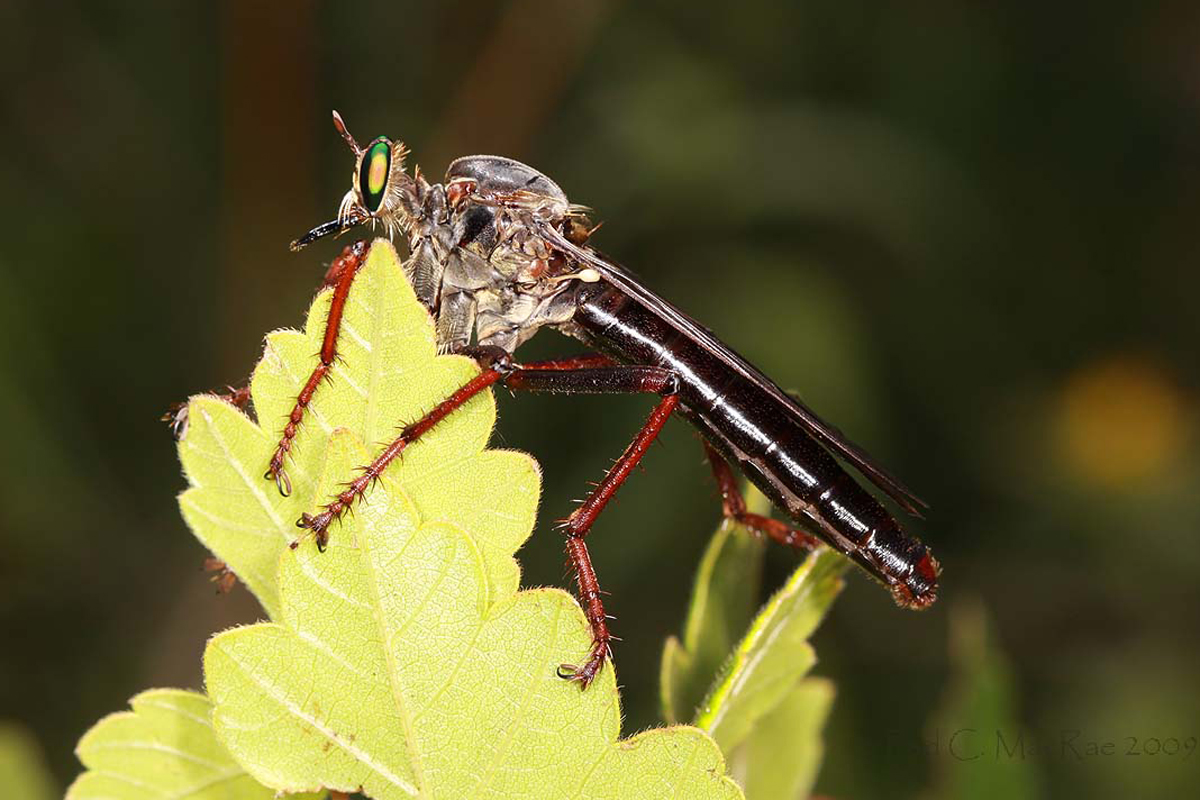
Female Microstylum morosum perched on fragrant sumac (Rhus aromatica) bush

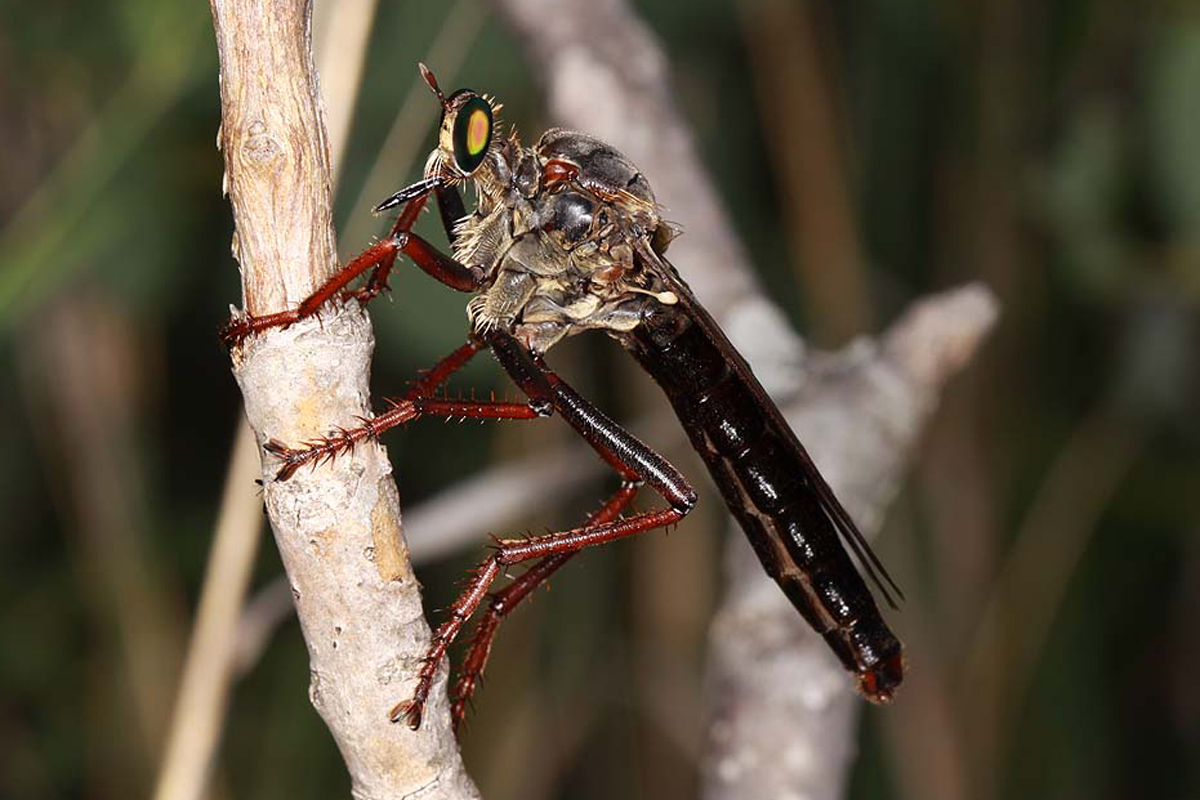
Female Microstylum morosum perched on fragrant sumac (Rhus aromatica)

A few days ago, I featured Promachus hinei, one of the so-called “giant robber flies” and a common inhabitant of the glades and grasslands that dot Missouri’s largely forested landscape. That individual was seen at Long Bald Glade Natural Area in Caney Mountain Conservation Area, one of the many limestone glades that are a prominent feature of extreme southwestern Missouri’s White River Hills, as it snacked on a small carpenter bee (Ceratina sp.) and posed obligingly for a series of super close-up photographs. Promachus and its congeners are impressively large; however, I would see an even larger robber fly that day. I didn’t know what it was at the time, but I knew that never before had I seen such a magnificent fly, with its large, shimmering, emerald eyes, streamlined body almost devoid of setae (hairs), and ludicrously large size. These monsters were actually quite common at the glade, so I failed to appreciate the significance of what I was seeing as I chased one after another – more intent on securing photographs than specimens. This was not an easy task – they were extremely wary, rarely allowing me to approach within 12 feet no matter how cautiously and slowly I moved. Not one to back down from such a challenge (remember, I stalk tiger beetles), I persisted, traversing the rough, rock-strewn terrain amidst clumps of big bluestem (Andropogon gerardii), Indian grass (Sorghastrum nutans), and fragrant sumac (Rhus aromatica) until, at last, I got within striking distance of the impressive female shown in these photos. Taking flight before I felt assured of a good shot, I followed her repeated long, loping escape flights until I was able to get another few shots and she disappeared for good.

Same individual as in previous photo after flying to another perch.

Same individual as in previous photo after flying to another perch.

It didn’t take long after I returned home to figure out what I had seen, as there is really nothing that can be mistaken for Microstylum morosum, North America’s largest robber fly (Back 1909)¹. At 35–40 mm of length, this individual didn’t quite match the astounding 50-mm upper body length for the species (that’s 2 inches, folks!). Nonetheless, it was an impressive beast indeed! It is not surprising that North America’s largest robber fly should be a species of Microstylum, as it is this same genus that contains the world’s largest robber fly – the aptly named M. magnum from Madagascar, with a body length of 60 mm and an almost preposterous wingspan of up to 84 mm (that’s over 3 inches folks!). I don’t know if any flies exist that are larger than this, but certainly none can be more imposing.  While I’m happy with the photos that I did obtain, I must confess some disappointment that I wasn’t able to get more than these basic lateral profile shots.  Of the several photographs of this species that can be found on the web, this female, photographed by Greg Lavaty of Houston, Texas, is (in my humble opinion) certainly the most stunning.

¹ Puzzled by the use of the prefix “micro” in the genus name – hardly seeming appropriate for such an enormous fly – I asked Eric Fisher (retired, California Department of Food and Agriculture) about the name’s derivation, to which he replied, “The name refers to the quite small ‘stylus’ of the antenna apex; Macquart specifically mentions this character in his 1838 original description of the genus. (This is not a very helpful diagnostic character, as many asilids share this feature…).”

Even more significant than its size, however, was its very occurrence on this glade. Like Ospriocerus abdominalis, which I had seen just a few weeks earlier in the Loess Hills of extreme northwestern Missouri, M. morosum is a denizen of the Great Plains, and also like that species it has until now not been known from Missouri. That’s right – another new state record!  Unlike O. abdominalis, however, the Missouri occurrence of M. morosus represents a significant northeastern extension of its known range.  The species was long considered a Texas endemic until Beckemeyer and Charlton (2000) confirmed its occurrence in southeastern Arizona and documented significant range extensions into Oklahoma, Kansas, extreme southeastern Colorado, and extreme northeastern New Mexico.  Its eastern distributional limit was thought to occur along a north-south line from Douglas County, Kansas to Mayes County, Oklahoma to Brazoria County, Texas; however, Warriner (2004) documented its occurrence some 200 miles east of this line in the blackland prairies of southwestern Arkansas.  The occurrence of M. morosum in the White River Hills of Missouri represents yet another significant eastern extension of its known range – Long Bald Glade lies 185 miles NNE of the collection site in Arkansas and 155 miles ENE of the nearest known record in Mayes County, Oklahoma (Locust Grove), making it the easternmost known locality for this species.

As in Arkansas, where the collection site represents one of the highest quality blackland prairie remants in the state, Long Bald Glade represents a high quality remnant of the limestone glades that once occurrred much more extensively within Missouri’s White River Hills.  Like the blackland prairie of Arkansas, the limestone glades of the White River Hills have been dramatically reduced since EuroAmerican settlement due to land use conversion, and fire suppression and overgrazing of the remaining tracts have resulted in significant woody encroachment – chiefly by eastern red-cedar (Juniperus virginiana) – and loss of vegetational diversity. This has caused dramatic reductions in populations of the many Great Plains plant and animal species that are found here and nowhere else in the state.  Considering the overall distribution of M. morosum, it is unlikely that it occurs more extensively within Missouri than the White River Hills, emphasizing the importance of continued conservation and restoration activities in this unique part of Missouri.  However, since the White River Hills extend into northwestern Arkansas, M. morosum may occur in that part of Arkansas as well as the southwestern part of the state.

I thank Eric Fisher and Herschel Raney for confirming the identity of this species and its status as a new record for Missouri.

Photo details: Canon 100mm macro lens on Canon EOS 50D (manual mode), ISO-100, 1/250 sec, f/10-11, MT-24EX flash 1/2 power through diffuser caps.

REFERENCES:

Back, E. A. 1909. The robberflies of America, north of Mexico, belonging to the subfamilies Leptograstrinae and Dasypogoninae. Transactions of the American Entomological Society 35:137–400.

Beckemeyer, R. J. and R. E. Carlton.  2000.  Distribution of Microstylum morosum and M. galactoides (Diptera: Asilidae): significant extensions to previously reported ranges.  Entomological News 111(2):84–96.

Warriner, M. D.  2004.  First Arkansas record of the robber fly Microstylum morosum (Diptera: Asilidae).  The Southwestern Naturalist 49(1):83–84.

Copyright © Ted C. MacRae 2009

Add to FacebookAdd to NewsvineAdd to DiggAdd to Del.icio.usAdd to StumbleuponAdd to RedditAdd to BlinklistAdd to Ma.gnoliaAdd to TechnoratiAdd to Furl

North America’s smallest rattlesnake

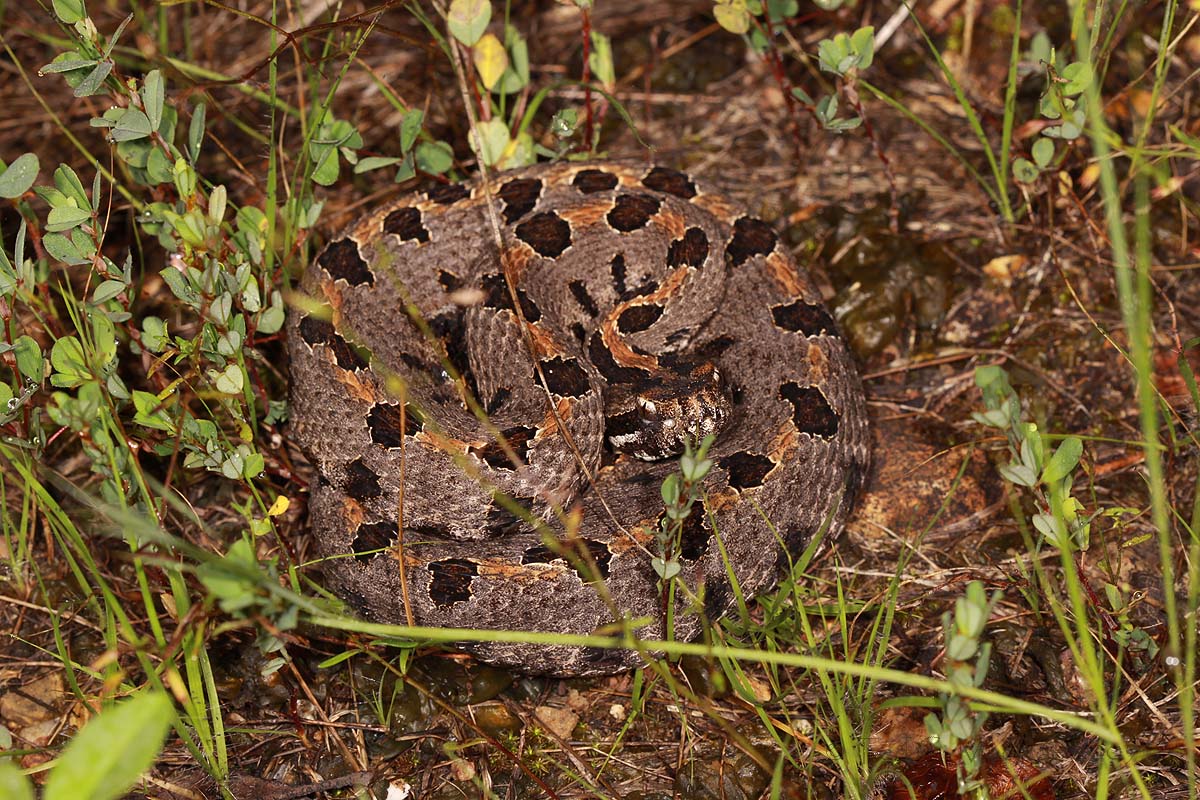
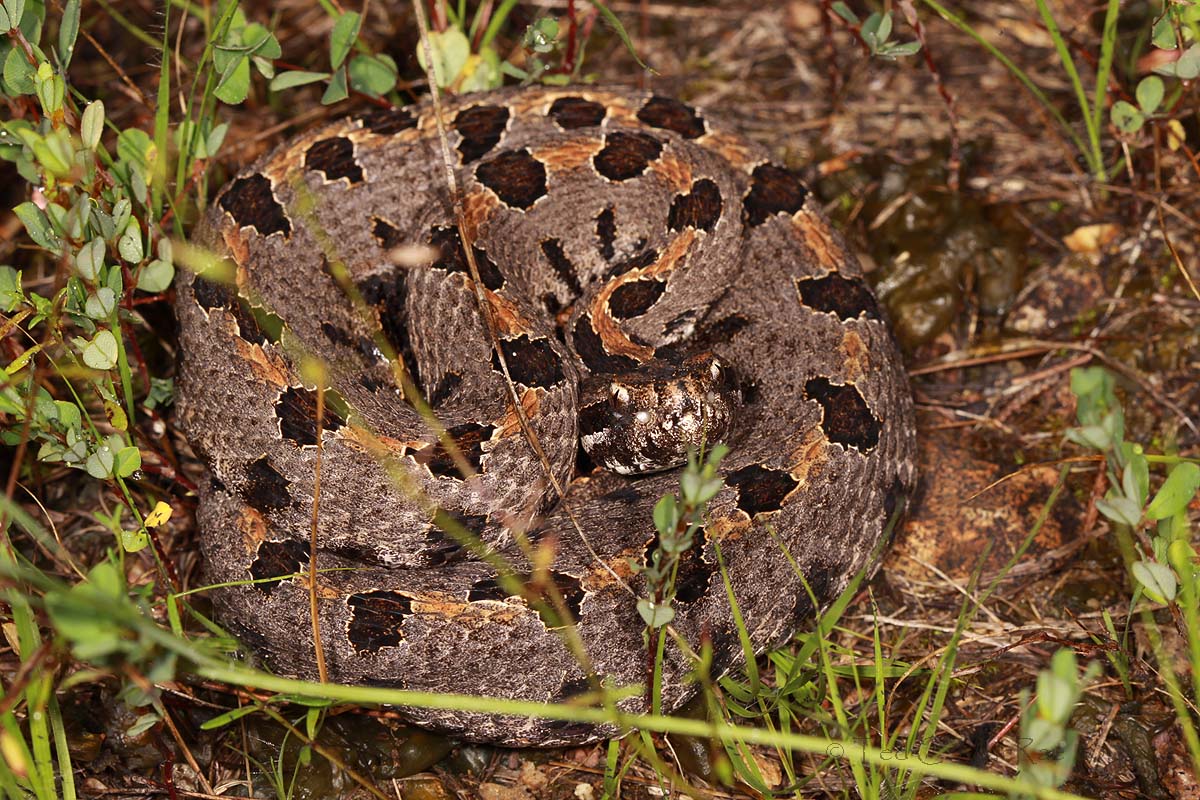
Despite tramping through the brush with great frequency during most of my life, I haven’t really seen that many noteworthy reptiles.  I don’t know whether its because I’ve failed to actually encounter them or whether my singleminded obsession with insects above all other things natural has instead prevented me from seeing what was right in front of me.  Regardless of the reason, all that has seemed to change during the past two seasons (strangely coincident with my decision to start carrying a camera), and I now seem to be enjoying a bit of a reptile bonanza.  Last summer I featured a super-aggressive prairie rattlesnake from a trip to the Black Hills of South Dakota and an uncooperative dusty hognosed snake from Missouri’s critically imperiled sand prairies (both first-time sightings for me).  The reptilian treats continued this year – I saw my first juvenile Osage copperhead in May to go along with the several adults that I’ve encountered, and shortly afterwards during a June trip to northwestern Oklahoma I was treated to a gorgeous male eastern collard lizard, two Texas horned lizards, and a much more cooperative western hognosed snake (the last two being first-time sightings for me).  There was another herp that I saw during that Oklahoma trip, but I did not feature it here because I had stupidly declined to strap the camera bag to my back during a quick look at a roadside habitat.  That sighting was another first-timer for me – a western pygmy rattlesnake (Sistrurus miliaris streckeri).  I’m no herp expert, so wasn’t sure what it was at the time, but I later learned that its small size and distinctive markings were quite diagnostic.

IMG_1014_1200x800
Western pygmy rattlesnake – Sistrurus miliarius streckeri

Amazingly, I encountered this same species again just a few weeks later during a visit to the White River Hills of extreme southwestern Missouri.  It was during the second of two trips to the region to search for the stunningly beautiful bumelia longhorned beetle, Plinthocoelium suaveolens plicatum (family Cerambycidae), and the weather during that day – continuous drizzle and low, threatening clouds – had not been at all conducive for finding such a sun loving beetle.  After searching an area where I knew the beetles occurred, without success, daughter Madison and I resigned that the drizzle was here to stay and decided to pass the rest of the day with some hiking at one of Missouri’s most spectacularly wild and beautiful places, Hercules Glades Wilderness.  A splendid mix of post oak savannahs and limestone glades intersperses through the oak/hickory forests in these rugged hills, creating some of Missouri’s most scenic vistas.  Near the end of the hike at the edge of one of these glades on the high point of Coy Bald, I saw this little individual coiled up underneath an eastern red-cedar (Juniperus virginiana) tree.  Unlike the terrifyingly aggressive prairie rattlesnakes I encountered in South Dakota last fall, this snake seem to be relying upon its cryptic coloration to avoid detection, rattling only after I had approached quite closely… or maybe it was only then I could actually hear the rattle, which was barely audible and sounded much like the buzz of a small katydid.

Pygmy rattlesnakes are the smallest rattlesnakes in North America, growing to around 15-25 inches long – this individual looked to be about 18-20 inches in length.  They are one of only two U.S. species in the primitive rattlesnake genus Sistrurus – the other being the larger wet prairie inhabiting massasauga (S. catenatus).  All other rattlesnakes (28 species, 13 in the U.S.) belong to the genus Crotalus (Smith et al. 2001).  Western pygmy rattlesnakes are not really a western U.S. species, but rather the westernmost subspecies of this southeastern U.S. species (with subspecies miliarius and streckeri occupying the northeastern and southeastern portions, respectively, of its range).  In Missouri, it is not nearly as common as the timber rattlesnake (Crotalus horridus), occurring only in the extreme southern Ozarks along the border with Arkansas and up into the St. Francois Mountains of the eastern Ozarks (Johnson 1997).  Although no known human deaths have ever been caused by this species, known locally as the “ground rattler,” it is nevertheless poisonous and worthy of respect.  I must admit to having been lulled a little bit by its calmness – much like the juvenile copperhead I photographed in May – and found myself tempted to approach ever closer for photographs.  The photograph below represents the closest that I was able to get before it began “striking” at me – whether these were bluff strikes intended to frighten or actual attempts to bite I do not know.  Suffice it to say that I “got the message” and ended my attempts to get even closer.  Daughter Madison watched in nervous amazement as all this was going on, and afterwards I tried to impress upon her young, virgin mind what a rare and wonderful experience we’d just had.  Perhaps I succeeded, as this was the first story she told to her head-shaking mother upon our return home the following evening!

IMG_1016_1200x800

Photo details: Canon 100mm macro lens on Canon EOS 50D, ISO 100, 1/250 sec, f/9-10, MT-24EX flash 1/2 power through diffuser caps.

REFERENCES:

Johnson, T. R. 1997. The Amphibians and Reptiles of Missouri. Missouri Department of Conservation, Jefferson City, 368 pp.

Smith, H. M., E. D. Brodie, D. M. Dennis and S. Barlowe. 2001. Reptiles of North America: A Guide to Field Identification. Golden Field Guide from St. Martin’s Press, New York, 240 pp.

Copyright © Ted C. MacRae 2009

Add to FacebookAdd to NewsvineAdd to DiggAdd to Del.icio.usAdd to StumbleuponAdd to RedditAdd to BlinklistAdd to Ma.gnoliaAdd to TechnoratiAdd to Furl

North America’s longest insect

This past June might be the most successful month entomologically that I’ve ever had.  The excitement of discovering a robust population of Cylindera celeripes (swift tiger beetle) (previously considered one of North America’s rarest tiger beetles) in northwestern Oklahoma lasted only two weeks before being eclipsed by our long-awaited success at finding this same species also in Missouri.  Icing on the cake was provided by finding Ellipsoptera macra (sandy stream tiger beetle) – the last tiger beetle species we had yet to encounter in Missouri, and significant new records for the tiny prairie cicada, Beameria venosa, and the impressive robber fly, Ospriocerus abdominalis, in Missouri’s critically imperiled loess hilltop prairies.  With that rapid-succession-success, my thoughts immediately turned to another of Missouri’s unique natural communities – the dolomite glades of the White River Hills in the extreme southwestern part of the state.  In fact, I had already been yearning to return to the White River Hills, having last visited some years ago and recalling – from the perspective now as an insect photographer – the many photogenic insect species that I’ve encountered there.  Chief among them is Plinthocoelium suaveolens (bumelia borer), a spectacularly beautiful longhorned beetle of neotropical affinity that must be seen to be believed and which I had observed here several years ago in fair numbers as they perched on the lower trunks of their presumed larval host, Sideroxylon (= Bumelia) lanuginosa of the family Sapotaceae.  I had even mentioned to my colleague Chris Brown, as we began the first day of our planned multi-weekend search for C. celeripes and C. macra in northwestern Missouri, that my dream scenario was that we would find both celeripes and macra on that first weekend, negating the need for additional survey the following weekends, in which case we could shoot down to the White River Hills to look for Plinthocoelium.  Who knew how prescient that comment would be!

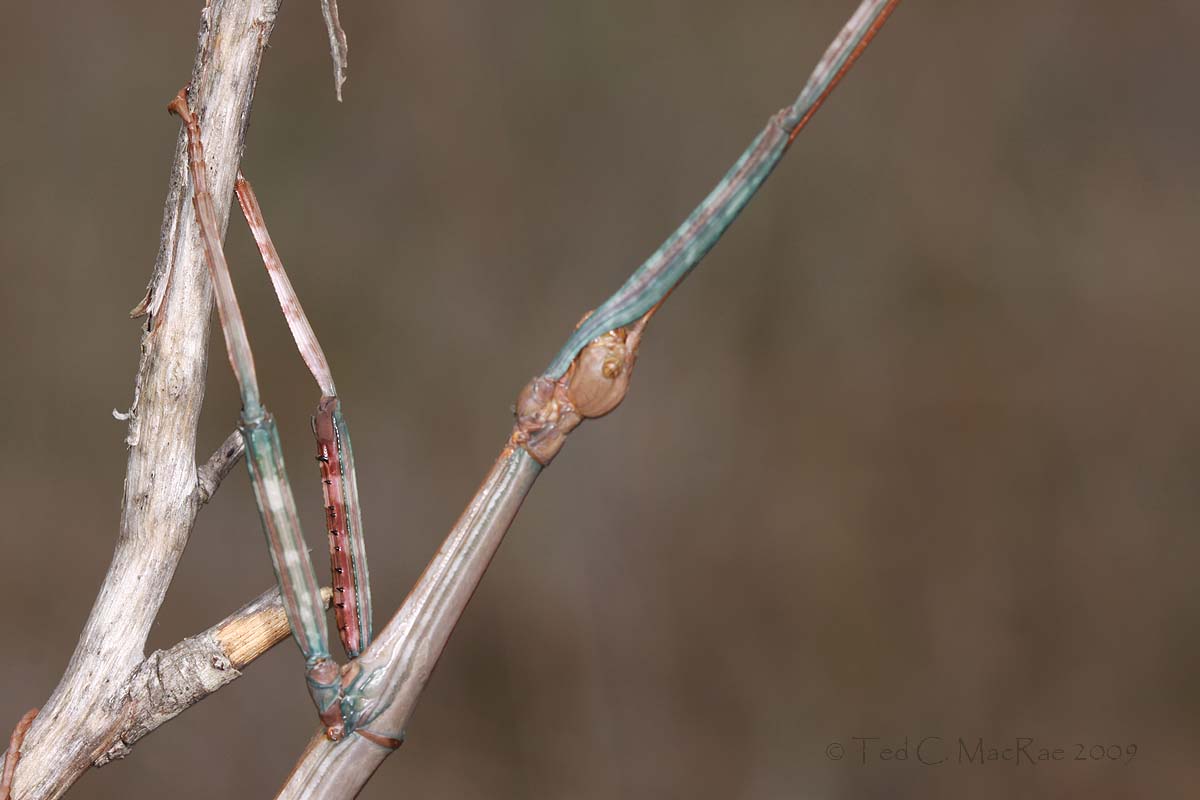
Megaphasma denticrus - giant walkingstick

Megaphasma denticrus - giant walkingstick

I won’t keep you in suspense – I succeeded in finding and photographing Plinthocoelium, although (happily) there is more to the story than just that.  I’ll share that experience here soon, but first I want to discuss another insect I saw on the first of my two July visits to the White River Hills – Megaphasma denticrus¹ (giant walkingstick).  As implied by its common name, this walkingstick is enormous – females (typically larger than males) can reach lengths of 150+ mm (that’s 6 inches, folks!), making it officially the longest insect species in all of North America.  IMG_0909_1200x800The female I feature here was solidly in that range, and with her front legs held outstretched in front of her (as pictured above), total length exceeded 8 inches.  Of course, this pales in comparison to a related species from Borneo, individuals of which have been documented measuring more than 18 inches in length!  The giant walkingstick is distributed primarily in the south-central U.S. – especially Texas, although records do exist from as far north and east as Iowa, Wisconsin, and Indiana (Arment 2005). I have encountered this species a few times before – always in the White River Hills, but Arment (2005) also records the species from several other counties in the Ozark Highlands across southern Missouri and Arkansas.  In addition to its great size, both sexes of this species can be distinguished from other walkingsticks by the rows of numerous teeth on the underside of the middle (meso-) femur (easily seen in the enlarged view of Photo 2 above) and by the very long antennae (longer than the front femur).  Color is variable – other individuals I have seen are tan with bright red dorsal stripes on the thoracic segments.

¹ Formerly classified with grasshoppers and their kin in the order Orthoptera, walkingsticks are now placed their own order, Phasmatodea, the name being derived from the Greek phasma (apparition, ghost) in reference to their cryptic appearance and behavior (the alternative spellings Phasmodea and Phasmida are improper formations from the Greek root – see Grimaldi and Engel 2005).  The genus name, Megaphasma, thus means “giant walkingstick.”  The specific epithet, denticrus, is derived from the Latin den (tooth) and crus (leg), presumably a reference to the toothed underside of the mesofemur. Many authors, including even some taxonomists (e.g., Beamer 1932), have mispelled the name as “dentricus” – nonsensical in Latin – with some even using both spellings in the same paper (e.g., Maginnis et al. 2008)!

Of course, an outstanding feature of this species, and all walkingsticks in general, is its uncanny resemblance to sticks and twigs.  This cryptic appearance is further augmented behaviorally by the habit of “swaying” back and forth to simulate movement in a gentle breeze.  I must confess that I did not even notice this large female individual – less than two feet away on a low branch – until she started moving about.  Once spotted, a walkingstick of this size would seem to be a tasty – and defenseless – morsel for some avian predator; however, they have another defensive tactic up their sleeve – autotomy (i.e., the ability to shed appendages in response to predatory attack). IMG_0913_1200x800While it may seem that their long, delicate-looking legs are simply “pulled off” by the predator, fortuitously allowing the walkingstick to clamber to safety, leg shed is actually controlled by the central nervous system in response to external stimuli (e.g., grabbing of the leg).  Breakage occurs at predetermined abcission points, which are rapidly sealed after shedding to prevent excessive loss of body fluids.  I experienced this first hand – lacking any container large enough to hold the enormous female, I gently placed her into my net and gingerly carried her back to the truck, only to find a hind leg already shed by the time I got back.  I decided the effort to glue one (or more) legs in place to acheive a well-curated specimen exceeded my interest in starting a collection of this particular group of insects, so I let her go.  Presumably she crawled away to safety, though sadly no longer the ‘perfect’ specimen that I first encountered.

Photo details:
Photo 1 (full insect): Canon 100mm macro lens on Canon EOS 50D (auto mode), ISO 200, 1/320 sec, f/5.6, natural light.
Photos 2 (midrange) and 3 (closeup): same except (manual mode), ISO 100, 1/60 (Photo 2) or 1/250 (Photo 3) sec, f/10 (Photo 2) or f/20 (Photo 3), MT-24EX flash 1/4 power w/ diffuser caps.

REFERENCES:

Arment, C. 2005. Stick Insects of the Continental United States and Canada: Species and Early Studies. Coachwhip Publications, Landisville, Pennsylvania, 202 pp.

Beamer, R. H. 1932. The giant walking-stick (Megaphasma dentricus (Stal.)) found in Kansas. Journal of the Kansas Entomological Society 5(1):28.

Grimaldi, D. and M. S. Engel. 2005. Evolution of the Insects. Cambridge University Press, New York, xv + 755 pp.

Maginnis, T. L., Cool, C. L. and J. L. Muniz. 2008. Some observations on the mating behavior of the giant walkingstick, Megaphasma dentricus (Orthoptera: Phasmidae). Texas Journal of Science 60(1):57-62.

Copyright © Ted C. MacRae 2009

Add to FacebookAdd to NewsvineAdd to DiggAdd to Del.icio.usAdd to StumbleuponAdd to RedditAdd to BlinklistAdd to Ma.gnoliaAdd to TechnoratiAdd to Furl