9th Annual Fall Tiger Beetle Trip: Day 3.1

I’d had a very enjoyable 2nd day on this year’s fall tiger beetle trip, but I couldn’t say it had been particularly successful. My primary reason for coming to the Glass Mountains in northwestern Oklahoma was to confirm a hunch that the stunningly beautiful Cicindela pulchra (Beautiful Tiger Beetle) might occur in the flats below the area’s red mesas. My hunch was based on the similarity of habitat to the nearby Red Hills in south-central Kansas, where the species does famously occur (MacRae 2006b). I’ve been here several times now and never found the species, and that did not change this time either. I did end up finding larval burrows and collecting the larvae of several other tiger beetle species (including the wonderfully ginormous Amblycheila cylindriformis), but again I could only consider this a moderate success. During the day, however, I had noted that eastern red-cedar (Juniperus virginiana) in the area was suffering branch and leader die back. Nearly every tree had at least one or more affected branches, and when I cut into a few of them I found evidence of fresh larval galleries of what I presumed were jewel beetles in the genus Chrysobothris. There are several species in this genus that breed in dead Juniperus, but I’m not familiar with any that attack living plants so pervasively as I was seeing here. Moreover, only a few of these species have been recorded from Oklahoma, so I made a mental note to return to the area in the morning and collect examples of dead/dying branches before driving to my Day 3 destination. I’ll put these up in rearing containers when I return home in an attempt to rear our the adult beetles.

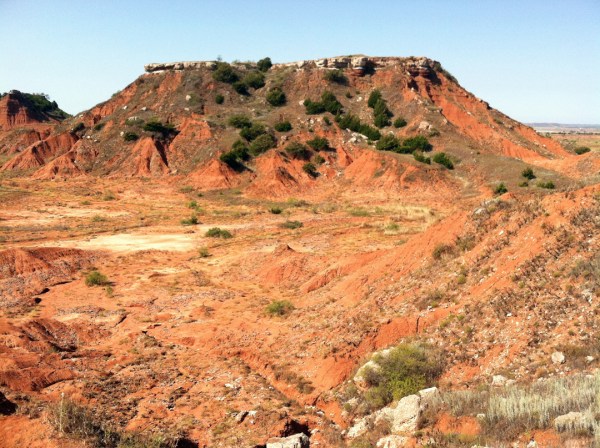
Infested red-cedars atop main mesa.

If you’ve never collected wood for rearing beetles before, all I can say is that it is hard and strenuous work. You have to get pretty good at discriminating infested wood in the field, because you don’t want to expend the effort to cut, de-twig, section, bundle, and carry back to the car batches of wood that don’t end up producing beetles. It was a little more effort than I anticipated to get a good sampling of Juniperus branches due to the hardness of the wood and dullness of my hand saw, along with not considering that I would have to hike up to the top of the mesa and then carry the wood all the way back down. Still, there is something enjoyable about this activity for me—perhaps because I’ve done so much in the past and reared so many great species as a result, and I’ll be anxious to see what species I am able to rear from this batch of wood and if they represent any significant new records.

Returning to the car with the wood, I passed by a mesquite tree (Prosopis glandulosa)—a common denizen of the desert southwest but probably near its northeastern limit of distribution here—and noticed bleeding on the main branches. A little bit of slicing with my knife confirmed my suspicion that this was also the work of jewel beetles in the genus Chrysobothris. In the desert southwest, these trees are attacked commonly by one species in particular, C. octocola, and I wondered if this might be the work of that beetle. I also had my suspicions that this species had not yet been recorded from Oklahoma (I later confirmed that it has not), and since I was already hot and sweaty from collecting the Juniperus wood I figured I might as well use my remaining strength to hack out a few limb sections with bleeding and bring them back as well. As I did this, what did I see on one of the branches but the critter itself! I had a decision to make—stop what I was doing and get out the camera to try to take photos (and risk the beetle flying away), or secure the beetle for now, continue with my hack job, and take photos later. I opted for the latter.

Chrysobothris octocola on stressed Prosopis glandulosa | Major Co., Oklahoma

I have to be honest—the beetle found the day’s travels too much to handle, and by the time I was able to take some photographs it was close to dead. As a result, these photos show the beetle in that dreadful flat-on-its-belly pose that I so detest. Still, only the most observant would know the beetle is not alive and well, and a reasonable photo of a dying beetle is better than no photo at all, no matter how live the beetle may be.
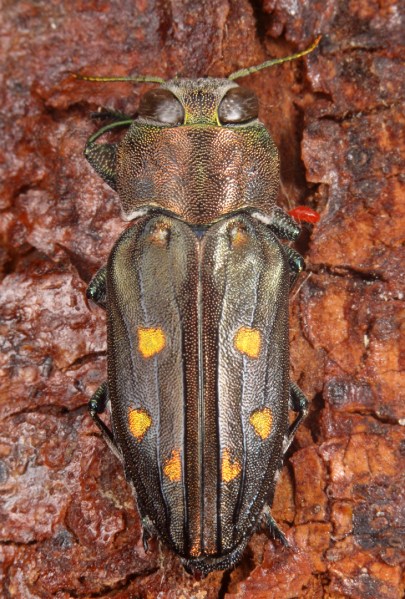
This individual represents a new state record for Oklahoma

As I mentioned, this species has not been previously recorded as occurring in Oklahoma, so this individual represents a new state record and an expansion of its known distributional range. That’s publishable data, so I’ll be adding the record to a manuscript currently in progress that details new distributional and biological observations for nearly 100 North American species. It’s the latest in a string of such papers that I begun under the tutelage of the late Gayle Nelson (Nelson and MacRae 1990, Nelson et al. 1996) and am now carrying on the tradition (MacRae and Nelson 2003, MacRae 2006b). 
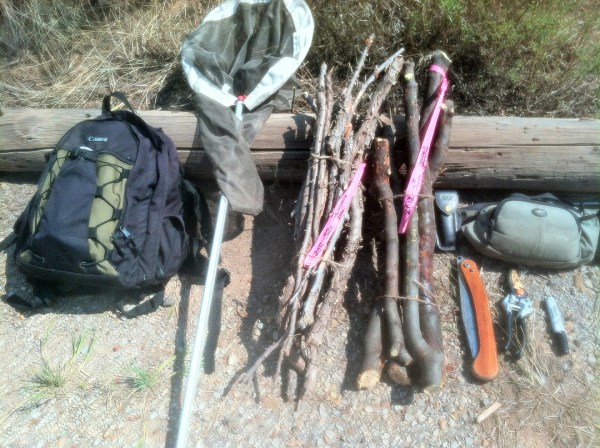
A successful morning of wood collecting.

By the time I had finished cutting up and bundling the wood and hauling everything back to the truck, it was already well past noon. My quick little morning stop had consumed nearly half the day. However, with one new state record already under my belt and the possibility of others still hiding within the cedar and mesquite branches that I’d collected, I’d have to say this was already the most successful days of the trip. I couldn’t help notice the irony that, as with Day 1, the most significant find of the day was a jewel beetle on a trip that was supposed to be focused on tiger beetles. Hey, I’ll take success in any taxon on any trip.

REFERENCES:

Nelson, G. H., and T. C. MacRae. 1990. Additional notes on the biology and distribution of Buprestidae (Coleoptera) in North America, III. The Coleopterists Bulletin 44(3):349–354.

Nelson, G. H., R. L. Westcott and T. C. MacRae. 1996. Miscellaneous notes on Buprestidae and Schizopodidae occurring in the United States and Canada, including descriptions of previously unknown sexes of six Agrilus Curtis (Coleoptera). The Coleopterists Bulletin 50(2):183–191.

MacRae, T. C., and G. H. Nelson. 2003. Distributional and biological notes on Buprestidae (Coleoptera) in North and Central America and the West Indies, with validation of one species. The Coleopterists Bulletin 57(1):57–70.

MacRae, T. C. 2006a. Distributional and biological notes on North American Buprestidae (Coleoptera), with comments on variation in Anthaxia (Haplanthaxia) viridicornis (Say) and A. (H.) viridfrons Gory. The Pan-Pacific Entomologist 82(2):166–199.

MacRae, T. C. 2006b. Beetle bits: The “beautiful tiger beetle”. Nature Notes, Journal of the Webster Groves Nature Study Society 78(4):9–12.

Copyright © Ted C. MacRae 2012

9th Annual Fall Tiger Beetle Trip: Day 2

I didn’t mind my late start to the 9th Annual Fall Tiger Beetle Trip—my first stop on Day 1 was only ~30 miles south of St. Louis, so I would get in a good chunk of collecting on the day even though I didn’t leave the house until after noon. I didn’t find the longhorned beetle, Ataxia hubbardi, that I was looking for (and haven’t seen now for more than 23 years), but I did manage to see good numbers of the always impressive jewel beetle, Dicerca pugionata, and a very large, impressive male tarantula (walking on water!). After that, however, the trip would make a very early diversion from its original itinerary. The light drizzle that pestered me all day at Victoria Glades steadily turned to rain as I traveled south towards northern Arkansas, and checking the weather forecast further reduced my optimism as rain was predicted for the next two days. The tiger beetles that I so enjoy are creatures of the sun, and rather than spend the next two days being chased around the Ozark Highlands looking for dry ground, I made a snap call and bolted straight for northwestern Oklahoma, where I had planned to go after two days in northern Arkansas and southwestern Missouri (collecting populations of the disjunct Prairie Tiger Beetle, Cicindelidia obsoleta vulturina, for molecular analysis by a collaborator). It was hard driving—five hours on dark, rainy roads to get to Springfield for the night, and another six hours to get to my first destination; Gloss Mountains State Park. I have been here several times over the past few years, discovering resident populations of three very interesting tiger beetles: Cylindera celeripes (Swift Tiger Beetle), Dromochorus pruinina (Frosted Dromo Tiger Beetle), and Amblychelia cylindricollis (Great Plains Giant Tiger Beetle). I did not expect to see any of these species on this trip, as they are all summer species (although I did hold out hope that I might find a few stragglers, especially of the last one). Instead, I was playing a hunch that Cicindela pulchra (Beautiful Tiger Beetle) might be found here because of the similarity of the Red Hills habitat to that just north in south-central Kansas where the species famously occurs (MacRae 2006).

Gloss Mountains State Park, Major Co., Oklahoma

It was worth the drive, as driving west got me out of rain and once past Enid, OK the cloud cover began to break up. By the time of my early afternoon arrival at Gloss Mountains State Park, skies were blue and temps were in the low 70s. Unfortunately, despite these perfect conditions my hunch that C. pulchra might occur here did not prove to be true. Nevertheless, it was a fruitful day as I collected two larvae each of all three of the above tiger beetle species (including 2nd instars of the presently undescribed C. celeripes and 3rd instars of the frightfully enormous A. cylindriformis—what an impressive creature!), photographed several beetles on yellow asteraceous flowers—two of which I show below, saw another male tarantula, and found an adult female of the truly impressive lubber grasshopper, Brachystola magna, that will become my daughters’ newest pet and has already been named ‘Bertha’ by them. My wanderings through the prairie at night with a lamp on my head did not produce any A. cylindricollis adults, but the views of the Milky Way in the dark, cloudless sky above amidst the overwhelming silence of a vast prairie cloaked in darkness were nothing short of spectacular.

Caps of gypsum over soft red clay have resulted in a landscape of flat-topped mesas.

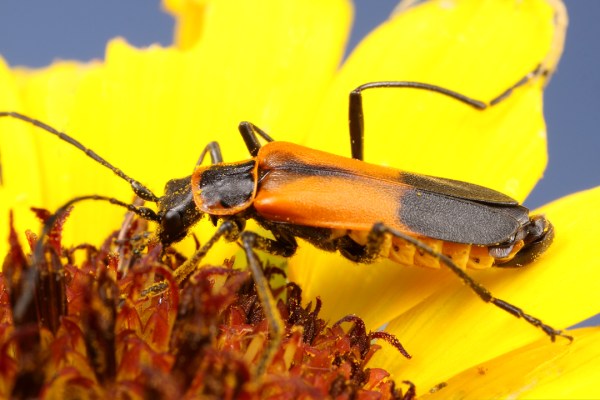
Here are two of the beetles that I photographed on the day. This first one is a soldier beetle (family Cantharidae) that is a dead ringer for Chauliognathus limbicollis. I couldn’t find any indication that this species is known from Oklahoma—all of the BugGuide photos of this species were taken in Arizona, while the admittedly outdated key to species in the tribe Chauliognathini (Fender 1964) gives only more western states (Arizona, Colorado, New Mexico and Texas) in its distribution. Still, I saw the species not uncommonly as it fed on yellow asteraceous flowers.

Chauliognathus limbicollis on yellow asteraceous flower | Glass Mountains, Oklahoma

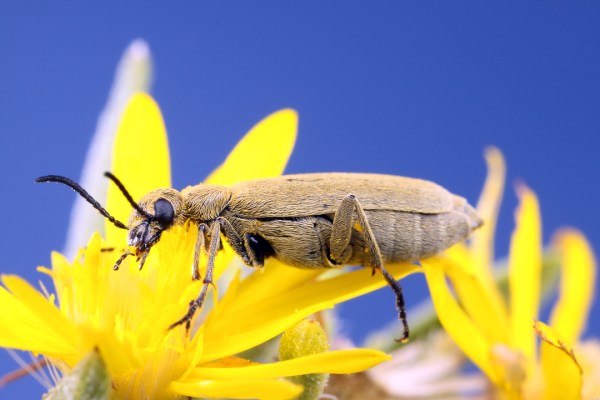
Another beetle that I photographed on flowers of Heterotheca subaxillaris (stiffleaf false goldenaster) was this small blister beetle (family Meloidae) that seems to be a member of the great genus Epicauta. I won’t even attempt a species ID due to the size and difficult taxonomy of this genus; however, this was the only example of this species that I saw amidst abundant individuals of another solid gray species that seemed to prefer the flowers of Gutierezzia sarothrae (broom snakeweed) over H. subaxillaris.

Epicauta sp. on Heterotheca subaxillaris flower | Glass Mountains, Oklahoma

During the day, I found some trees infested with jewel beetle larvae (presumably in the genus Chrysobothris), so I will return in the morning of Day 3 to harvest the wood and bring it back to put up in rearing containers in an attempt to rear out the adults. Afterwards, I will be off to my next destination—Alabaster Caverns State Park.

REFERENCES:

Fender, K. M. 1964. Tbe Chauliognathini of America North of Mexico (Coleoptera—Cantharidae), Part 2. Northwest Science 38(3):95–106.

MacRae, T. C. 2006. Beetle bits: The “beautiful tiger beetle”. Nature Notes, Journal of the Webster Groves Nature Study Society 78(4):9–12.

Copyright © Ted C. MacRae 2012
Swift Tiger Beetle: Species on the Brink

ResearchBlogging.orgIn July 2008, Chris Brown and I made a spur-of-the-moment trip to Hitchcock Preserve near Council Bluffs, Iowa, where only a week earlier Cylindera celeripes (Swift Tiger Beetle), one of North America’s most enigmatic tiger beetles, had just been discovered. Reportedly once common in the blufftop prairies of western Iowa and further west in eastern Nebraska and Kansas, this tiny (6–8 mm in length), flightless beetle has suffered severe population declines over the past 100 years. Only small numbers of individuals have been encountered outside of the type locality (Fort Riley, Kansas) in recent years, and in Nebraska the species is now considered extirpated (Spomer et al. 2008). Our reasons for going to Iowa had to do with our as yet unsuccessful effort to find the species in northwestern Missouri as part of our broader studies of the state’s tiger beetle fauna. Although it had never been recorded from Missouri, we felt there was some chance it might be found in the tiny loess hilltop prairie remnants still remaining in the state at the southern terminus of the Loess Hills landform. We reasoned our failure to find the species might be related to its very small size and rapid running capabilities (giving them more the appearance of small ants or spiders than tiger beetles), limited temporal occurrence, and tendency to hide amongst the bases of grass clumps (Pearson et al. 2006). If we could find the species at a locality where they were known to occur, perhaps an improved search image and better understanding of their precise microhabitat preferences would help us locate the species in Missouri.

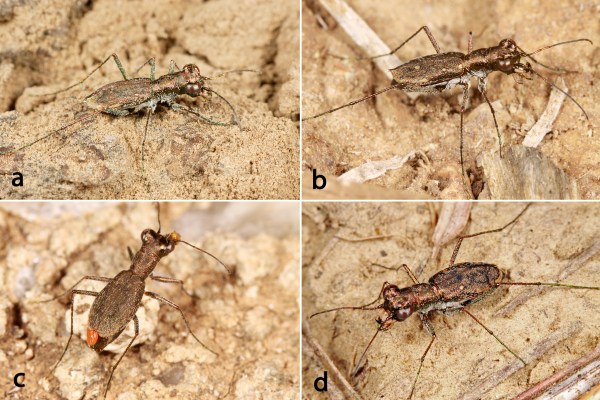
Fig. 1. Cylindera celeripes (LeConte) adults at: a) Hitchcock Nature Center, Pottawattamie Co., Iowa (13.vii.2008); b) Alabaster Caverns State Park, Woodward Co., Oklahoma (10.vi.2009); c) same locality as “b”, note parasite (possibly Hymenoptera: Dryinidae) protruding from abdomen and ant head attached to right antenna; d) Brickyard Hill Natural Area, Atchison Co., Missouri (27.vi.2009). Photos by C.R.Brown (a) and T.C.MacRae (b-d).

We didn’t realize it at the time, but that trip marked the beginning of a two-year study that would not only see us succeed in finding C. celeripes in Iowa, but also discover new populations in Missouri and northwestern Oklahoma (Figs. 1a–d). With so much new information about the species and the long-standing concerns by many contemporary cicindelid workers about its status, it seemed appropriate to conduct a comprehensive review of the historical occurrence of this species to establish context for its contemporary occurrence and clarify implications for its long term protection and conservation. This was accomplished through compilation of label data from nearly 1,000 specimens residing in the collections of contemporary tiger beetle workers, all of the major public insect museums in the states of Iowa, Kansas, Missouri, Nebraska, Oklahoma, and Texas, and the collections at the U.S. National Museum and Florida State Collection of Arthropods. Collectively, this material is presumed to represent the bulk of material that exists for the species, representing nearly all localities recorded for the species and time periods in which it has been collected.

Label data confirmed the historical abundance of this species, especially in the vicinity of Manhattan and Fort Riley, Kansas; Lincoln and Omaha, Nebraska; and Council Bluffs, Iowa. Hundreds of specimens were routinely collected in the native grassland habitats around these areas during the late 1800s and early 1900s, their abundance documented by entomologists in both journal articles and private letters. One of the most interesting examples of the latter was by Nebraska collector F. H. Shoemaker, who wrote the following in a 1905 letter to R. H. Wolcott:

There is another trip, down the river to the big spring by the railroad track near Albright, then across the river (the heronry route) where we collect hirticollis, repanda, vulgaris [= tranquebarica], cuprascens, and – vat you call ‘im? – celeripes! I took 147 of the latter in an hour and a half Sunday, and the supply was undiminished.

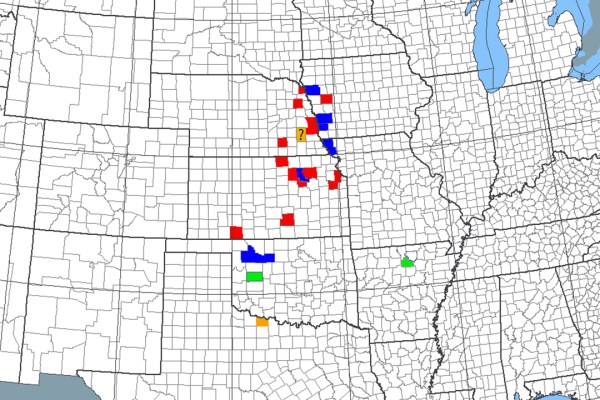
Fig. 8. Historical and currently known geographical occurrence of Cylindera celeripes by county. Red = last record prior to 1920; orange = last record 1941–1960 (“?” = questionable record); green = last record 1991–1996; blue = last record 2005–2011.

Although the recent collections of C. celeripes from near Council Bluffs and through the years near Fort Riley show that the species has managed to persist in these areas, there is little question that it is far less abundant and widespread now than it was in the early 20th century (Fig. 8).  Not only are the areas in which present day populations are known to occur limited, but the numbers of individuals seen in them are very low. In Missouri, the species was listed immediately after its discovery in the state as a species of conservation concern with a status of S1 (= “critically imperiled”) due to the highly restricted occurrence of suitable habitat (loess hill prairie) in the state and small populations observed within them. The situation is even worse in Nebraska, where the species has not been seen for nearly 100 years despite dedicated searches by expert contemporary tiger beetle workers such as Matt Brust and Steve Spomer. Considering the near-complete elimination of suitable native grassland habitats by conversion to agriculture and degradation of the few existing remnants due to encroachment by woody vegetation and invasive exotics, the likelihood of finding extant populations of C. celeripes in Nebraska seems remote. Only in the Red Hills of northwestern Oklahoma does the species appear to be secure due to the extensiveness of suitable areas of habitat and robust numbers of individuals observed within them at the present time. An enigmatic record exists from Arkansas, based on a single individual collected near Calico Rock in 1996. This individual represents a significant extension of the known geographical range of the species, but repeated attempts to find the species at that locality during the past year were not successful.

The persistence of populations, albeit small, in multiple areas, along with the occurrence of robust populations in northwestern Oklahoma, makes it unlikely that C. celeripesqualifies for listing as a threatened or endangered species at the federal level. Nevertheless, the limited availability of suitable habitat in many areas and low population numbers found within them clearly suggest that conservation measures are warranted at the state level, especially in Iowa, Kansas and Missouri, to prevent its extirpation from these states. In these states, land management practices should be implemented at sites known to support populations of the beetle in an effort to maintain and expand the native grassland habitats upon which they rely. These include various disturbance factors such as mechanical removal of woody vegetation, judicious use of prescribed burning, and selective grazing (taking care to do so in a manner that minimizes impacts to beetle populations).

REFERENCES:

MacRae, T. C. and C. R. Brown. 2011. Historical and contemporary occurrence of Cylindera (s. str.) celeripes (LeConte) (Coleoptera: Carabidae: Cicindelinae) and implications for its conservation. The Coleopterists Bulletin 65(3):230–241 DOI: 10.1649/072.065.0304

Pearson, D. L., C. B. Knisley and C. J. Kazilek. 2006. A Field Guide to the Tiger Beetles of the United States and Canada. Oxford University Press, New York, 227 pp.

Spomer, S. M., M. L. Brust, D. C. Backlund and S. Weins.  2008. Tiger Beetles of South Dakota & Nebraska. University of Nebraska, Department of Entomology, Lincoln, 60 pp.

Copyright © Ted C. MacRae 2011

Amblycheila cylindriformis on white

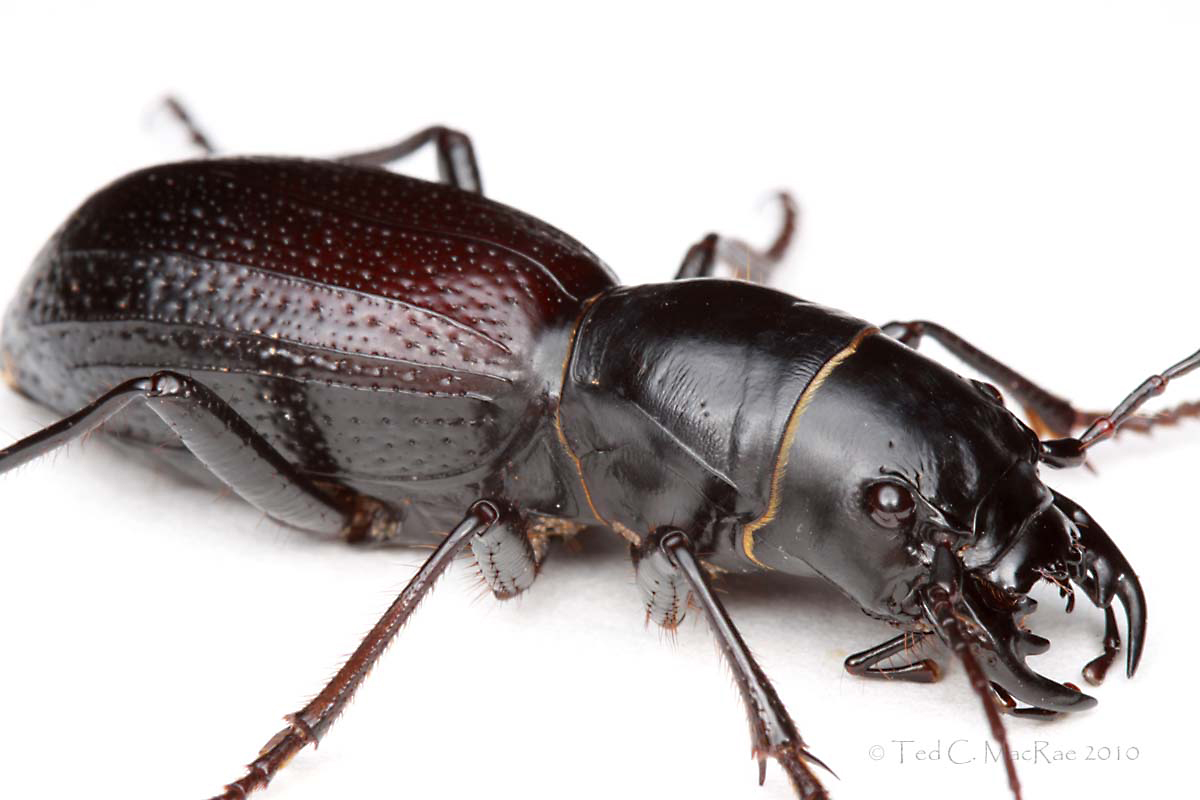
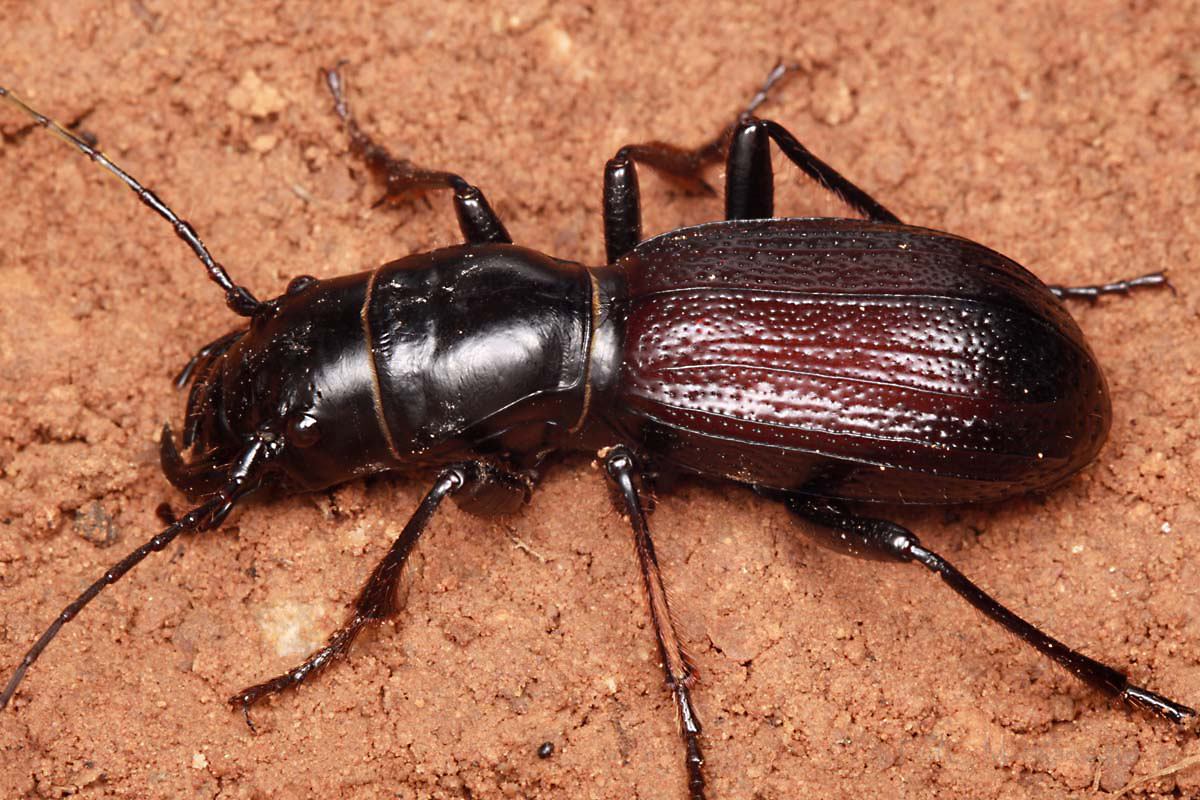
It’s been four months now since I went to the Glass Mountains of northwestern Oklahoma on a hunch to look for Amblycheila cylindriformis (Great Plains giant tiger beetle).  The five adults that I brought back from that night are still alive in a terrarium of native soil, but to this point they have refused to lay eggs.  Despite feeding them regularly with fat Maduca larvae, there is obviously still something they need that I am not providing.  I’ve suspected that perhaps the terrarium that I have them in is too small, and I’ve also noted in the literature that larval burrows are often found clustered near the entrance of mammal burrows.  With this in mind, I combined the native soil from three separate terraria into one larger, deeper terrarium, packed the soil lightly, and used a spoon to create an artificial mammal burrow entrance.  Not long after placing the adults in their new home they began digging at the back of the burrow, eventually creating two separate tunnels leading in opposite directions (and fortunately against the container walls so that I can see inside the tunnels).  I was optimistic at first that finally I had given them what they wanted, but since digging the burrows they’ve just sat in them.  Perhaps they “know” that winter is coming and are just looking to hole up for now, so I suppose I’ll go ahead and place the terrarium in the 10°C incubator with the rest of my larval and adult rearing containers and wait until next spring to see what happens.

In the meantime, I thought I would share these recent photographs of one of them.  I had been wanting to take photographs of this species in a white box, which I have used with a few other species to generate some rather striking photographs (e.g., Gromphadorina portentosa, Buprestis rufipes, Scolopendron heros, Eleodes suturalis). The photographs in this post might look like they were taken in a white box, however, they were not.  I’ve been spending a lot of time lately trying to come up with a diffuser setup that is convenient for field photographs of wild insects in their native habitats.  Kurt’s do-it-yourself concave diffuser and Alex’s tracing paper diffuser work great with the Canon MT-24EX Macro Twin Lite Flash and the Canon MP-E 65mm f/2.8 1-5X Macro Lens, but as I mentioned in a previous post they do not work so well with the Canon EF 100mm f/2.8 Macro USM Lens and its longer working distance… or so I thought!  I’ve come up with a modified version of the concave diffuser that seems to be what I am looking for – it is easy to use, adds virtually no weight to the camera, is completely portable for field use, can be used with both the 65mm and 100mm macro lenses, and – best of all – costs virtually nothing.  The photographs in this post were taken with the first prototype, and now that the basic design and general dimensions seem to work I’ll try to make a more durable version. It’s simply a larger version of the concave diffuser – I found some very thick polypropylene foam that is sturdy enough to hold its shape but flexible enough to curl back and over the top of the flash heads, where the corners are held in place by Velcro. Essentially it forms a large “soft box” type diffuser in front of both flash heads. I cut the bottom inch off of a a 500-mL polypropylene beaker, then cut that in half and cut out all but a quarter inch of the bottom to form a sturdy but transluscent frame to hold the polypropylene foam against the flash head bracket on the front of the lens. Right now the foam is held in place by tape, but hot glue should do a better job, and the diffuser bracket is attached to the flash head bracket with Velcro. The whole rig comes off in a flash and lays mostly flat in the camera bag.

If this diffuser proves successful, it will eliminate the need for the different flash head extender brackets that I was considering.  I really didn’t want to go that route because even the cheapest models are rather costly, and all of them add bulk to the camera and create problems for those who need to switch lenses frequently (such as I do).  Of course, the real test is – does it achieve the desired result?  I’m quite happy with these initial photographs – the lighting is quite even due to the large “apparent” size of the light source, and the annoying double specular highlights that are the hallmark of the MT-24EX are much less apparent (though still slightly discernible).  The closest shots are at 1:1, while those of the entire beetle are between 1:1.5 and 1:2.  They are among the largest beetle species that I have photographed, so the range of magnifications used here pretty much covers the entire range that I typically use with this lens.  Wildflowers often require smaller mags and longer working distances, so it remains to be seen whether this diffuser/lens combination will be useful for them as well. 

All of the photographs in this post were taken with the 100mm macro lens (ISO100, 1/250 sec, F16) and direct MT-24EX macro twin flash using this new diffuser.  The beetle was placed on white filter paper and covered with a clear glass bowl until it settled against the side of it.  Once the beetle was quiet, I gently lifted the bowl and used micro-forceps to gently tug its legs into more appealing positions – surprisingly this did not cause it to become alarmed and try to flee (as long as I didn’t accidentally brush against one of its antennae!).  For the last photograph, I placed the beetle back in its terrarium and used the same techniques to get the beetle in a good position. 

Copyright © Ted C. MacRae 2010

The real Eleodes suturalis

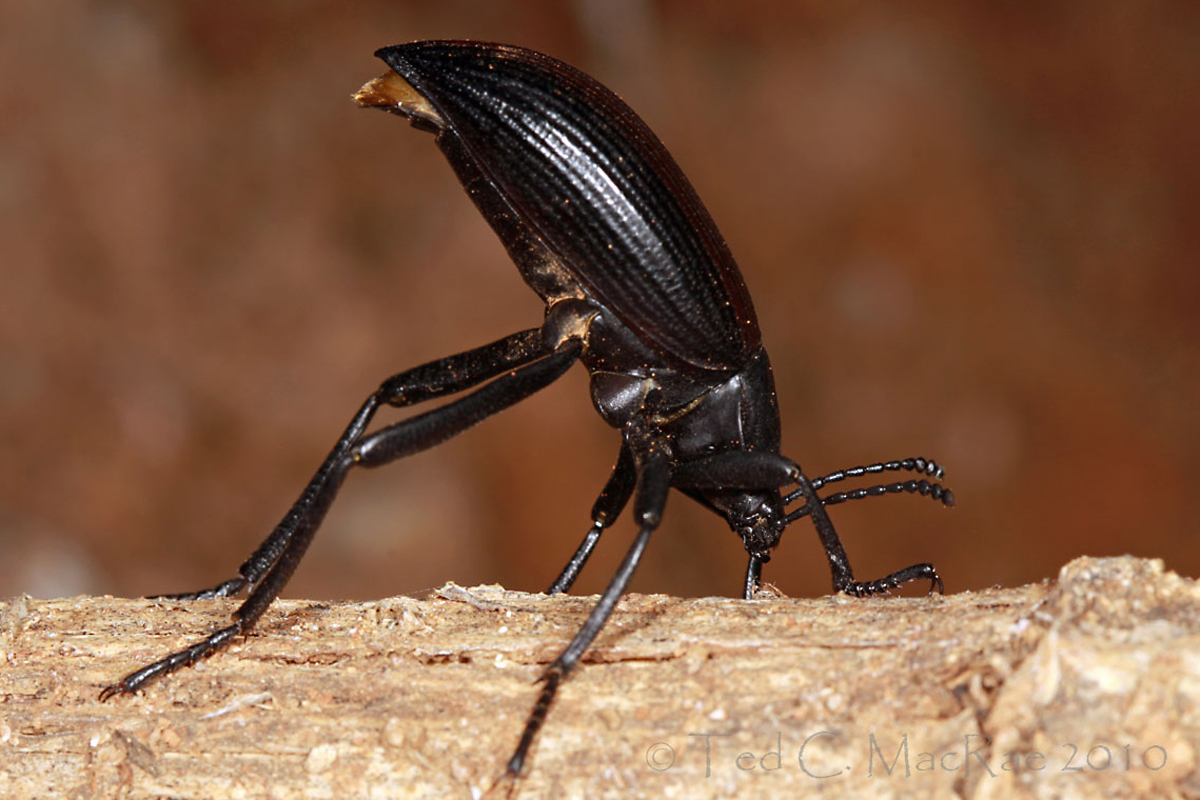
I recently posted a photograph of a clown beetle (Eleodes hispilabris) (family Tenebrionidae) that I found last July in the Glass Mountains of northwestern Oklahoma.  I had encountered that individual while stumbling through the mixed-grass prairie in the middle of the night in search of the Great Plains giant tiger beetle (Amblycheila cylindriformis).  Although I eventually found the latter species, it took a few hours, during which time I was forced to examine numerous individuals of another clown beetle, Eleodes suturalis – perhaps the most conspicuously common clown beetle in the Great Plains.  I didn’t bother to take photographs of them, focused as I was on my tiger beetle search and owing to the fact that this was not the first time I’d encountered that species in abundance (the first time being many, many years ago as they crossed the highway en masse just a few miles north of the Glass Mountains in Barber Co. Kansas).  In fact, I was becoming rather annoyed with them due to their great similarity in size and coloration to the object of my desire¹, and only when I found the previously photographed individual doing the defensive “head stand” so characteristic of the group did I relent and break out the camera for a series of shots (not easy in the dark of night).

¹ Wrigley (2008) even suggested a mimetic association for Amblycheila cylindriformis and Eleodes suturalis due to their similarity in size, shape and coloration (black with a reddish-brown sutural stripe).

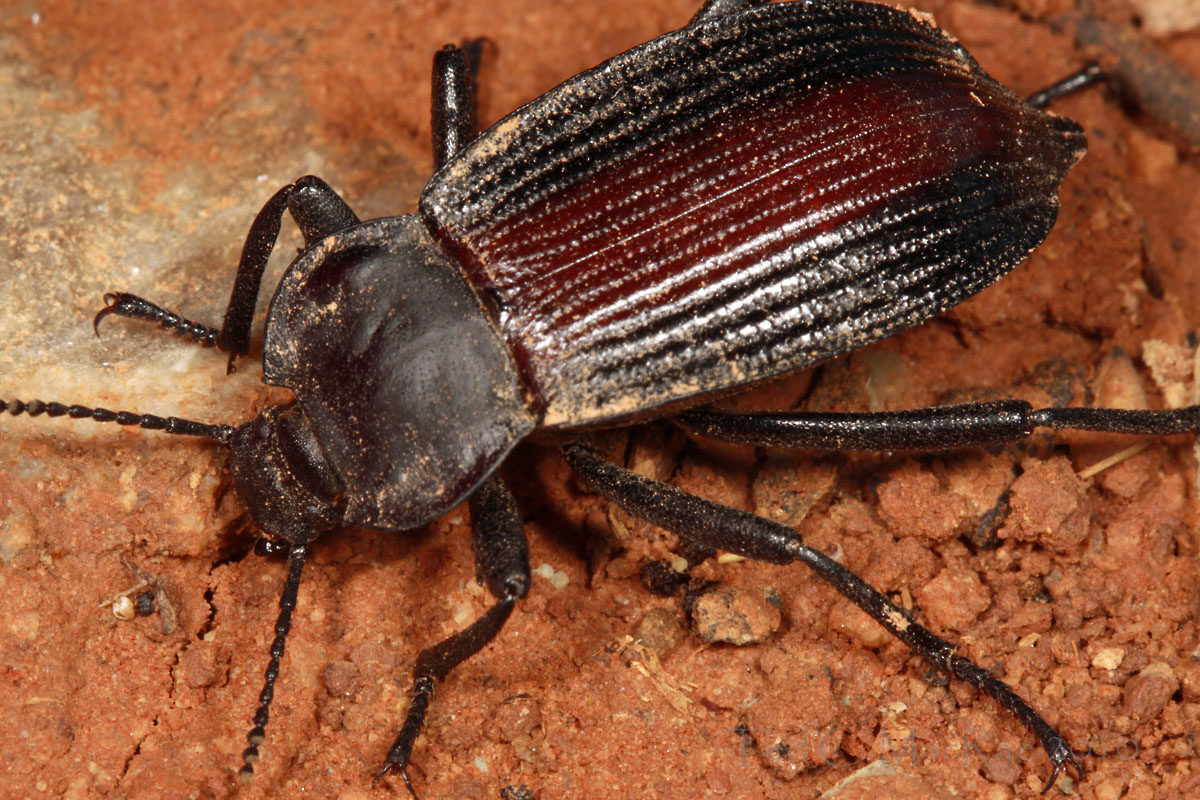
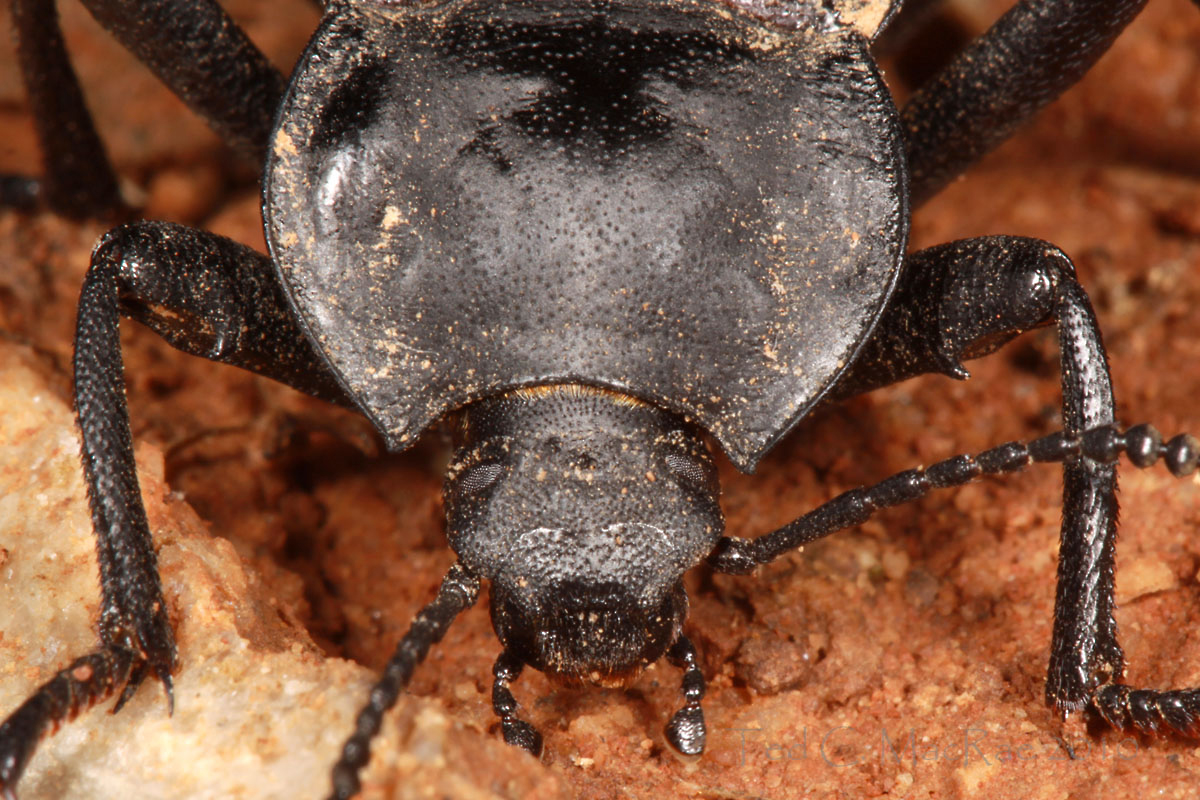
Of course, that individual turned out not to be E. suturalis, but the closely related species E. hispilabris, a fact that I did not realize until several days later as I was examining the photographs more closely. Fortunately, I happened to bring home with me a live individual of what truly represents E. suturalis, which I show in these photographs.  I’m not sure exactly why I brought a live one home with me – I’ve done more and more of this in recent years, mostly just to observe them and see what they do.²  I think in this case, I was intrigued by the possible mimetic association between this species and A. cylindriformis and wanted an individual for comparison with the several live A. cylindriformis individuals that I also brought back with me.

² The singular focus on collecting “specimens” that I had during my younger years seems to be giving way to a desire to know more about species as living entities and not just their external morphology.

Unlike E. hispilabris (my identification of which I only consider tentative), there can be little doubt that the individual in these photographs represents E. suturalis.  No other clown beetle in the Great Plains exhibits the sharply laterally carinate elytra and broadly explanate (spread outward flatly) pronotum (Bernett 2008).  The reddish-brown sutural stripe of the distinctly flattened elytra is also commonly seen in this species, although occasional individuals of a few other clown beetle species exhibit the stripe as well (including E. hispilabris, which likely was the reason I assumed it represented E. suturalis).  All of the characters mentioned above can be seen in the photographs shown here.  However, I nevertheless find the photos rather unsatisfying.  If you think you know why, feel free to comment, otherwise you can wait for the “better” photos…

Photo Details: Canon 50D w/ 100mm macro lens (ISO 100, 1/250 sec, f/18), Canon MT-24EX flash w/ Sto-Fen diffusers. Typical post-processing (levels, minor cropping, unsharp mask).

REFERENCES:

Bernett, A. 2008. The genus Eleodes Eschscholtz (Coleoptera: Tenebrionidae) of eastern Colorado. Journal of the Kansas Entomological Society 81(4):377–391.

Wrigley, R. A.  2008. Insect collecting in Mid-western USA, July 2007.  The Entomological Society of Manitoba Newsletter 35(2):5–9.

Copyright © Ted C. MacRae 2010

North America’s largest centipede

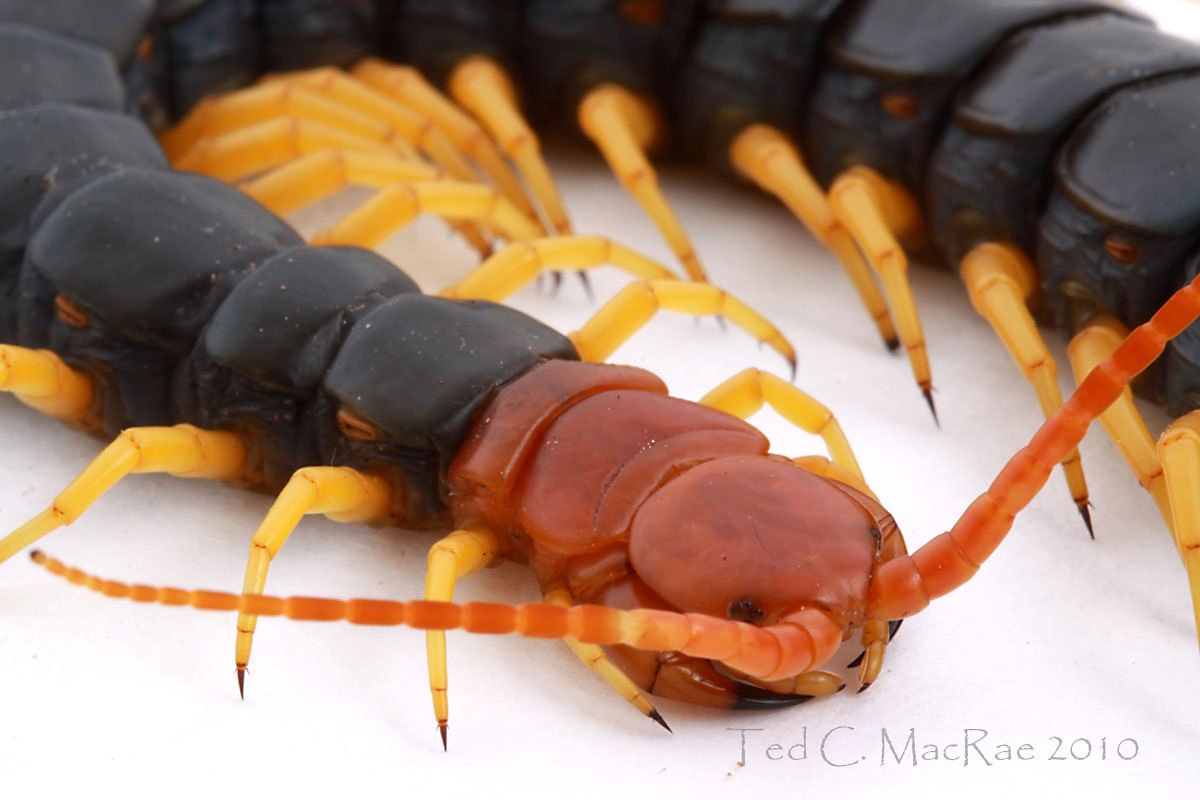
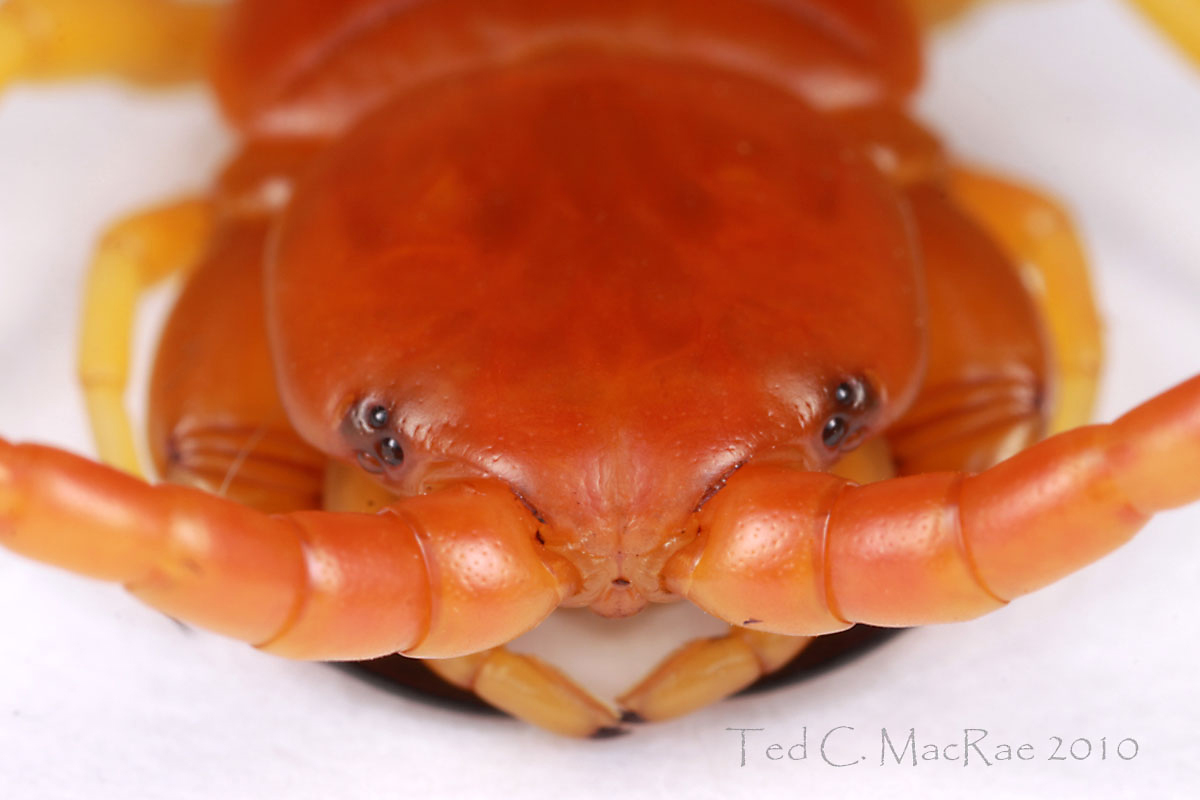
As I prowled the remote mixed-grass prairie of northwestern Oklahoma in the middle of the night, an enormous, serpentine figure emerged frenetically from a clump of grass and clambered up the banks of the draw I was exploring.  Although I was still hoping for my first glimpse of the Great Plains giant tiger beetle, I was keeping a watchful eye out for anything that moved within the illuminated tunnel of my headlamp due to the potential for encountering prairie rattlesnakes (perhaps the most aggressive of North America’s species).  This was clearly no snake, but at up to 8″, Scolopendra heros (giant desert centipede) easily matches some smaller snakes in length.  Also called the giant Sonoran centipede and the giant North American centipede, it is North America’s largest representative of this class of arthropods (although consider its South American relative, S. gigantea – the Peruvian or Amazonian giant centipede, whose lengths of up to 12″ make it the largest centipede in the world).

Although I had never before seen this species alive, I recognized it instantly for what it was.  Many years ago I was scouting the extreme southwest corner of Missouri for stands of soapberry (Sapindus saponaria), a small tree that just sneaks inside Missouri at the northeasternmost limit of its distribution, in hopes of finding dead branches that might be infested with jewel beetles normally found in Texas.  I had heard that these centipedes also reach their northeastern extent in southwestern Missouri, and just a few miles from the Arkansas and Oklahoma borders I found a road-killed specimen.  I stood there dejected looking at it – too flattened to even try to salvage for the record.

Centipedes, of course, comprise the class Chilopoda, which is divided into four orders.  The giant centipedes (21 species native to North America) are placed in the order Scolopendromorpha, distinguished by having 21 or 23 pairs of legs and (usually) four small, individual ocelli on each side of the head (best seen in bottom photo).  The three other orders of centipedes either lack eyes (Geophilomorpha) or possess compound eyes (Scutigeromorpha and Lithobiomorpha).  These latter two orders also have only 15 pairs of legs (shouldn’t they thus be called “quindecipedes”?).  Among the scolopendromorphs, S. heros is easily distinguished by its very large size and distinctive coloration.  This coloration varies greatly across its range, resulting in the designation of three (likely taxonomically meaningless) subspecies.  This individual would be considered S. h. castaneiceps (red-headed centipede) due to its black trunk with the head and first few trunk segments red and the legs yellow.  As we have noted before, such striking coloration of black and yellow or red nearly always indicates an aposematic or warning function for a species possessing effective antipredatory capabilities – in this case a toxic and very painful bite.

The individual in these photographs is not the first one I saw that night, but the second.  I had no container on hand to hold the first one and not even any forceps with which to handle it – I had to watch in frustration as it clambered up the side of the draw and disappear into the darkness of the night.  Only after I returned to the truck to retrieve a small, plastic terrarium (to fill with dirt for the giant tiger beetles that I now possessed) did I luck into seeing a second individual, which I coaxed carefully into the container.  It almost escaped me yet again – I left the container on the kitchen table when I returned home, only to find the container knocked onto the floor the next morning and the lid askew.  I figured the centipede was long gone and hoped that whichever of our three cats that knocked the container off the table didn’t experience its painful bite.  That evening, I noticed all three cats sitting in a semi-circle, staring at a paper shredder kept up against the wall in the kitchen.  I knew immediately what had so captured their interest and peeked behind the shredder to see the centipede pressed up against the wall. The centipede had lost one of its terminal legs but seemed otherwise none the worse for wear – its terrarium now sits safely in my cat-free office, and every few days it enjoys a nice, fat Manduca larva for lunch.

There are a number of online “fact sheets” on this species, mostly regarding care in captivity for this uncommon but desirable species.  I highly recommend this one by Jeffrey K. Barnes of the University of Arkansas for its comprehensiveness and science-focus.

Photo Details: Canon 50D (ISO 100, 1/250 sec) w/ Canon MT-24EX flash in white box.
Photos 1-2: Canon 100mm macro lens (f22), indirect flash.
Photo 3: Canon MP-E 65mm 1-5X macro lens (f/13), direct flash w/ Sto-Fen + GFPuffer diffusers.
Post-processing: levels, minor cropping, unsharp mask.

Copyright © Ted C. MacRae 2010

Trichodes bibalteatus in Oklahoma

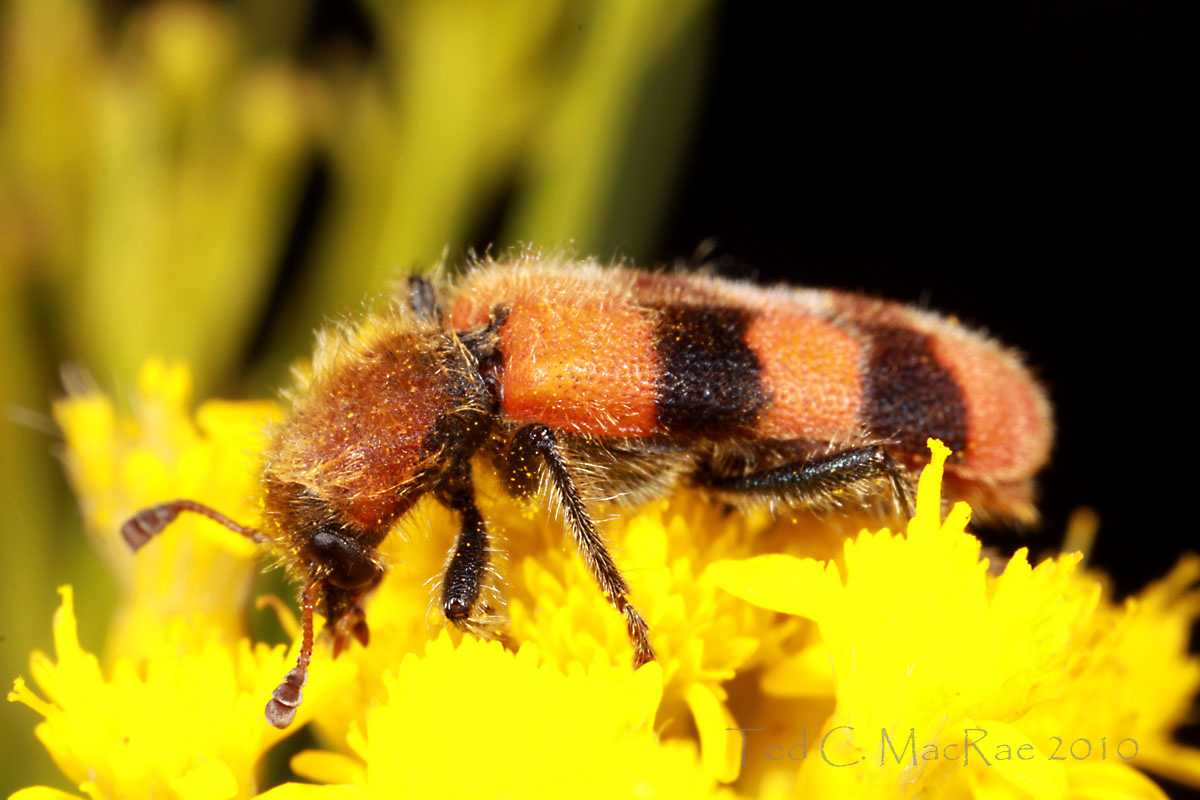
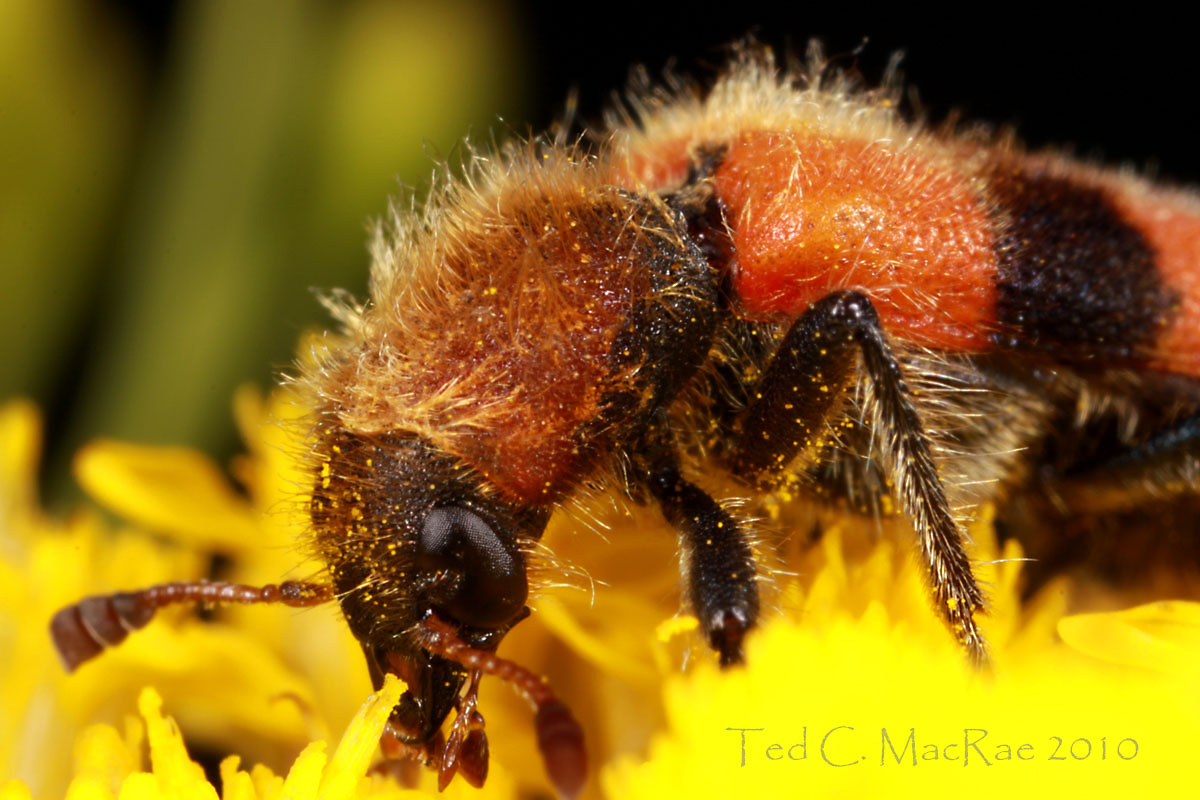
Among checkered beetles (family Cleridae), the genus Trichodes contains among the largest and most strikingly-colored species.  The 11 North American species of this predominantly Holarctic genus are primarily western in distribution, although two species (T. nuttalli and T. apivorus) do occur in the eastern U.S.  The individual in these photos was one of several I encountered feeding on the flowers of a yellow composite in the Gloss Mountains of northwestern Oklahoma during early July.  I take them to represent the species T. bibalteatus based on their close resemblance to the holotype of that species from the LeConte Collection in the Museum of Comparative Zoology at Harvard University.  While these photographs are admittedly far from perfect, they were about the best I could manage at the time considering the gusty post-storm winds that I encountered atop the mesa where these beetles were found (along with my continuing difficulty in achieving proper exposure with subjects on bright yellow flowers).

The striking colors of adult Trichodes and their frequent association with flowers for feeding and mating belies a more treacherous aspect of their life history.  While adults may serve as important pollinators of native plant species (Mawdsley 2004), they also lay their eggs on flowers.  The larvae that hatch from these eggs don’t eat the flower itself, but rather attach themselves to bees and wasps that visit the flower as they gather pollen for provisioning their own nests (Linsley & MacSwain 1943).  The larvae hitch a ride back to the hymenopteran’s nest, where they then prey on the developing brood and usurp pollen provisions for themselves.

Photo Details: Canon 50D w/ MP-E 65mm 1-5X macro lens (ISO 100, 1/250 sec, f/16), Canon MT-24EX flash (1/8 ratio) w/ Sto-Fen + GFPuffer diffusers. Typical post-processing (levels, minor cropping, unsharp mask).

REFERENCE:

Linsley, E. G. & J. W. MacSwain. 1943. Observations on the life history of Trichodes ornatus (Coleoptera, Cleridae), a larval predator in the nests of bees and wasps. Annals of the Entomological Society of America 36:589–601.

Mawdsley, J. R. 2004. Pollen transport by North American Trichodes Herbst (Coleoptera: Cleridae). Proceedings of the Entomological Society of Washington 106(1):199-201.

Copyright © Ted C. MacRae 2010

Clown beetle surprise

As I slowly scanned my flashlight through the darkness across the mixed-grass prairie in the Glass Mountains of northwestern Oklahoma last July, there was one thing that I hoped not to see (prairie rattlesnake, unless from afar) and one thing that I hoped more than anything to see (Great Plains giant tiger beetle, Amblycheila cylindriformis). Fortunately, I encountered none of the former and found several of the latter.  It took awhile before I saw the first one, but in the meantime I saw all too abundantly the clown beetle, Eleodes suturalis.  A member of the family Tenebrionidae, this species is one of the most conspicuous components of the Great Plains beetle fauna.  Adults are commonly encountered walking about the grasslands or crossing roads, especially after summer rains.  I recall my first encounter with this species when I made my first insect collecting trip to the Great Plains in 1986, marveling as I literally watched hundreds of individuals crossing a remote highway in southwestern Kansas.  Now, they were just an annoyance – close enough in size and appearance to the object of my search that I had to pause and look at each one I encountered to verify its identity.¹

¹ In fact, a mimetic association has been suggested for Amblycheila cylindriformis and Eleodes suturalis due to their similarity in size, shape and coloration (black with a reddish-brown sutural stripe) (Wrigley 2008).  This may be true, as Eleodes suturalis is an abundant species capable of defending itself with noxious sprays that contain benzoquinone and other hydrocarbons, while Amblycheila cylindriformis is a much rarer species (as mimics tend to be) that lacks defensive compounds.

After finding a few of the Amblycheila, I encountered this particular individual clinging to a root sticking out of the side of a wash.  My closer look caused it to immediately assume its characteristic defensive headstand pose (from which the name ‘clown beetle’ comes), so I decided to take a few photographs (not an easy task at night).  The photos have been sitting on my hard drive since, but in examining them more closely, I realized that this particular beetle is not E. suturalis.  Rather, it is one of several similar appearing species that co-occur with E. suturalis in the Great Plains and sometimes resemble it due to their large size, sulcate elytra, and occasional presence of a similar reddish-brown sutural stripe.  From these species, E. suturalis is at once distinguished by its broadly explanate (flanged) pronotum and laterally carinate, distinctly flattened elytra.  This individual clearly exhibits more rounded elytra and as best as I can tell keys to E. hispilabris – distinguished from E. acuta and E. obscurus by possessing a normal first tarsal segment (not thickened apically) on the foreleg (Bennett 2008).  Presumably this and the other related species of Eleodes also possess chemical defenses similar to E. suturalis – an example of Müllerian mimicry where multiple species exhibit similar warning coloration or behavior (in this case headstanding) along with genuine anti-predation attributes.

Photo Details: Canon 50D (ISO 100, 1/250 sec, f/14), Canon 100mm macro lens, Canon MT-24EX flash (1/4 ratio) w/ Sto-Fen diffusers. Post-processing: levels, unsharp mask, slight cropping.

REFERENCES:

Bernett, A. 2008. The genus Eleodes Eschscholtz (Coleoptera: Tenebrionidae) of eastern Colorado. Journal of the Kansas Entomological Society 81(4):377–391.

Wrigley, R. A.  2008. Insect collecting in Mid-western USA, July 2007.  The Entomological Society of Manitoba Newsletter 35(2):5–9.

Copyright © Ted C. MacRae 2010