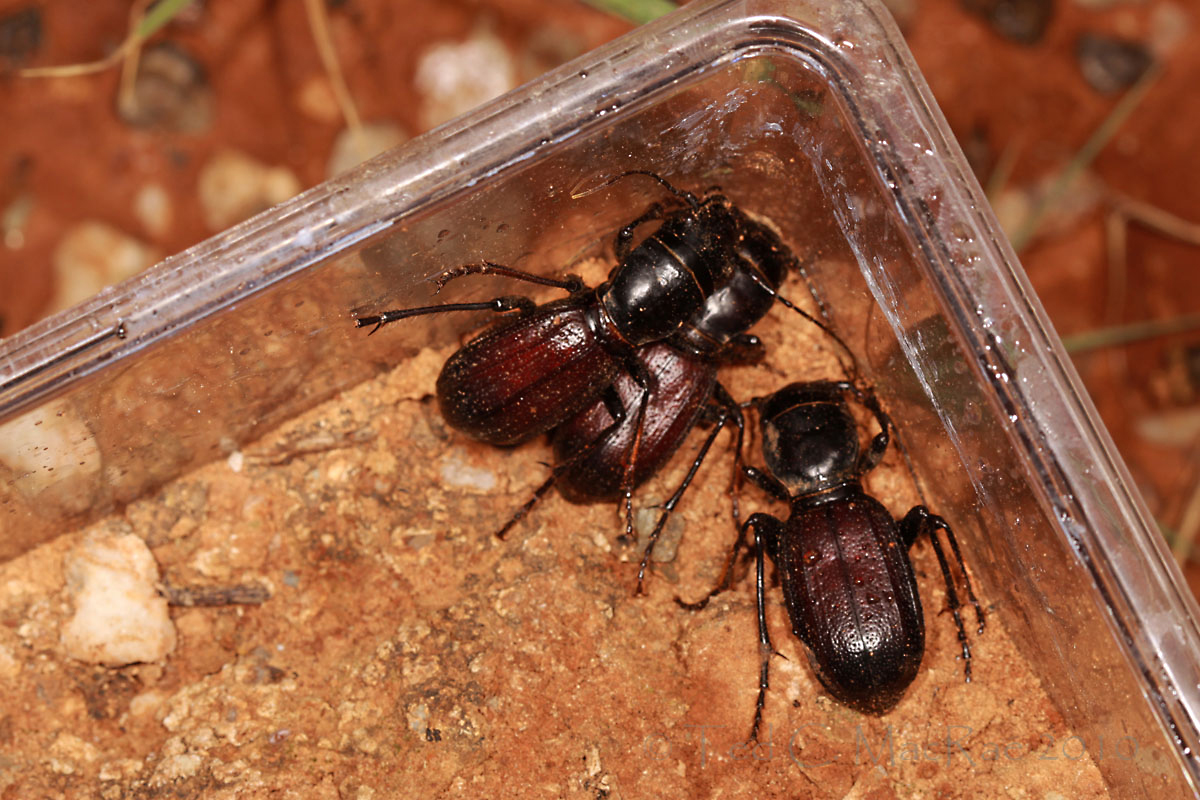
What’s so special about this beetle?

Regular readers of this blog might recognize this as the swift tiger beetle, Cylindera celeripes. This tiny, flightless beetle was once common in the central Great Plains; however, the species has experienced dramatic declines over the past century due to near complete destruction of its preferred prairie habitats.  By the time I first became interested in this species a few years ago, the Flint Hills of Kansas were its last known stronghold.

But that’s not what’s so special about this beetle.

My colleague Chris Brown and I began looking for this species as part of a survey of Missouri tiger beetles.  Although not previously known from the state, historical records from loess hilltop prairie habitats in southwestern Iowa suggested that it might be found in extreme northwestern Missouri at the southern terminus of the Loess Hills landform.  Earlier searches in this part of the state by us and others had turned up empty; however, it was easy to imagine that the beetles had eluded detection due to their small size, cryptic resemblance to ants, and limited temporal occurrence.  In an effort to understand more specifically its habitat preferences and gain a better search image for the species, we visited one of the historical Iowa localities in 2008 and succeeded in finding the species ourselves for the first time.

But that’s not what’s so special about this beetle.

Armed with this experience, Chris and I conducted another dedicated search for this species in Missouri during 2009, targeting the largest and highest quality loess hilltop prairie remnants remaining in the state.  At last, our efforts were rewarded when we found beetles in several loess hilltop prairie remnants in Atchison and Holt Counties.  Their numbers were not high at any of the sites, but the finds nevertheless represented a new state distribution for a species that has only seen contractions to its known range for many years now.

But that’s not what’s so special about this beetle.

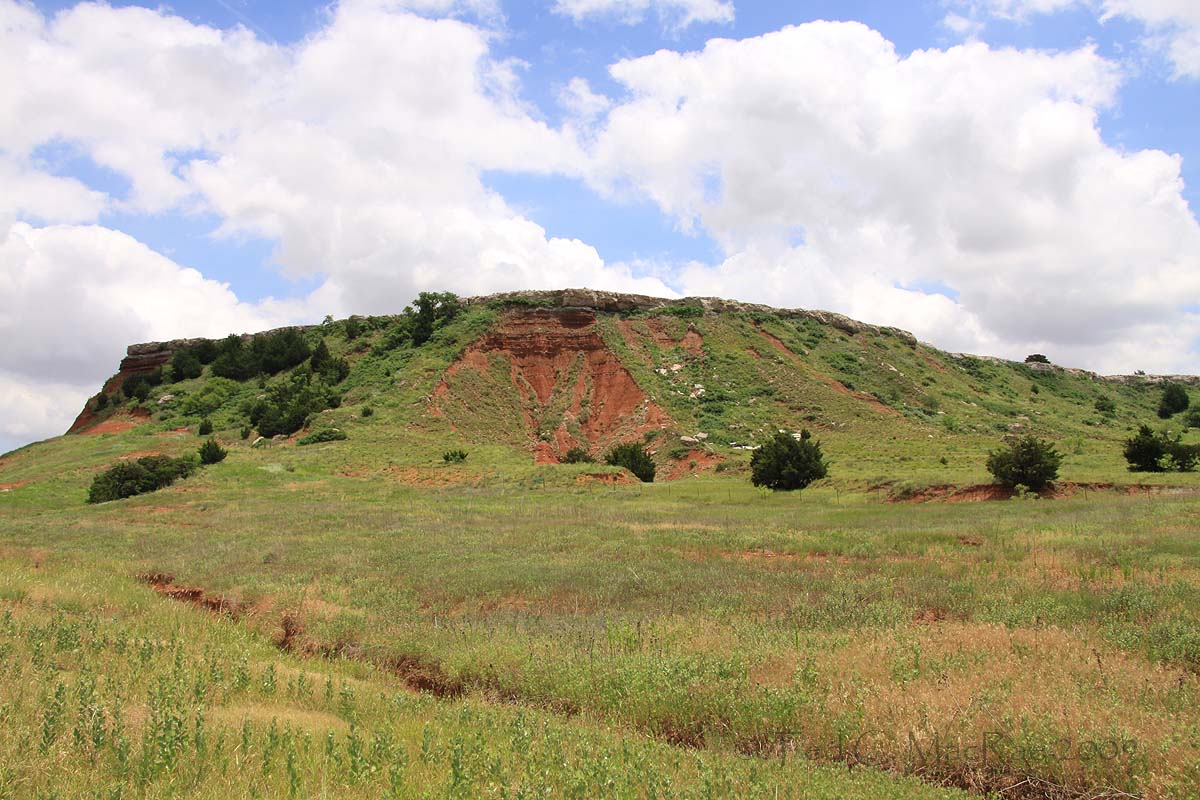
A few weeks before finding the beetle in Missouri, I had an opportunity to visit Alabaster Caverns State Park in northwestern Oklahoma, where BugGuide contributor Charles Lewallen had photographed the species in 2003.  I not only succeeded in finding the species at the original locality but determined also that its population there was quite robust.  Indeed, on the same trip I discovered robust populations at several nearby localities, suggesting that the species occurrs commonly throughout the red clay/gypsum hills of northwestern Oklahoma.  Further observations of the species in northwestern Oklahoma last month seem to confirm this.  The beetle in these photographs comes from Alabaster Caverns, but that’s not what’s so special about it.

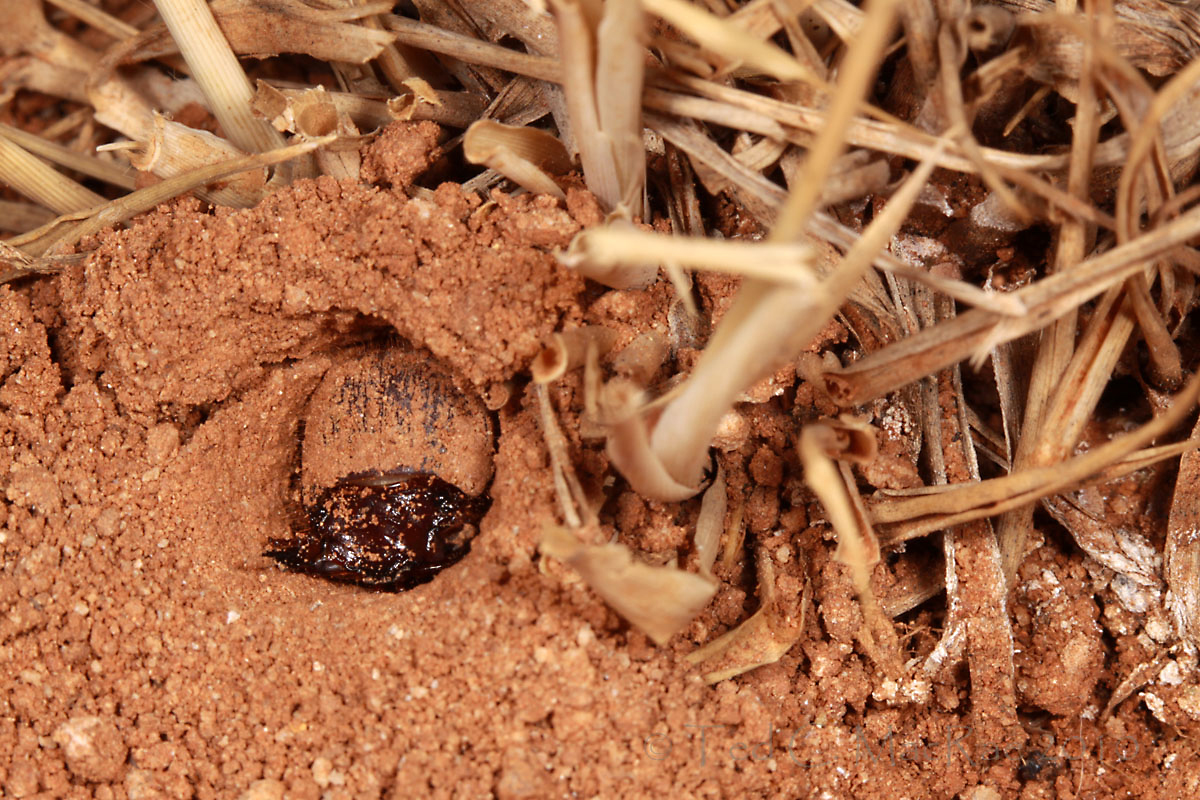
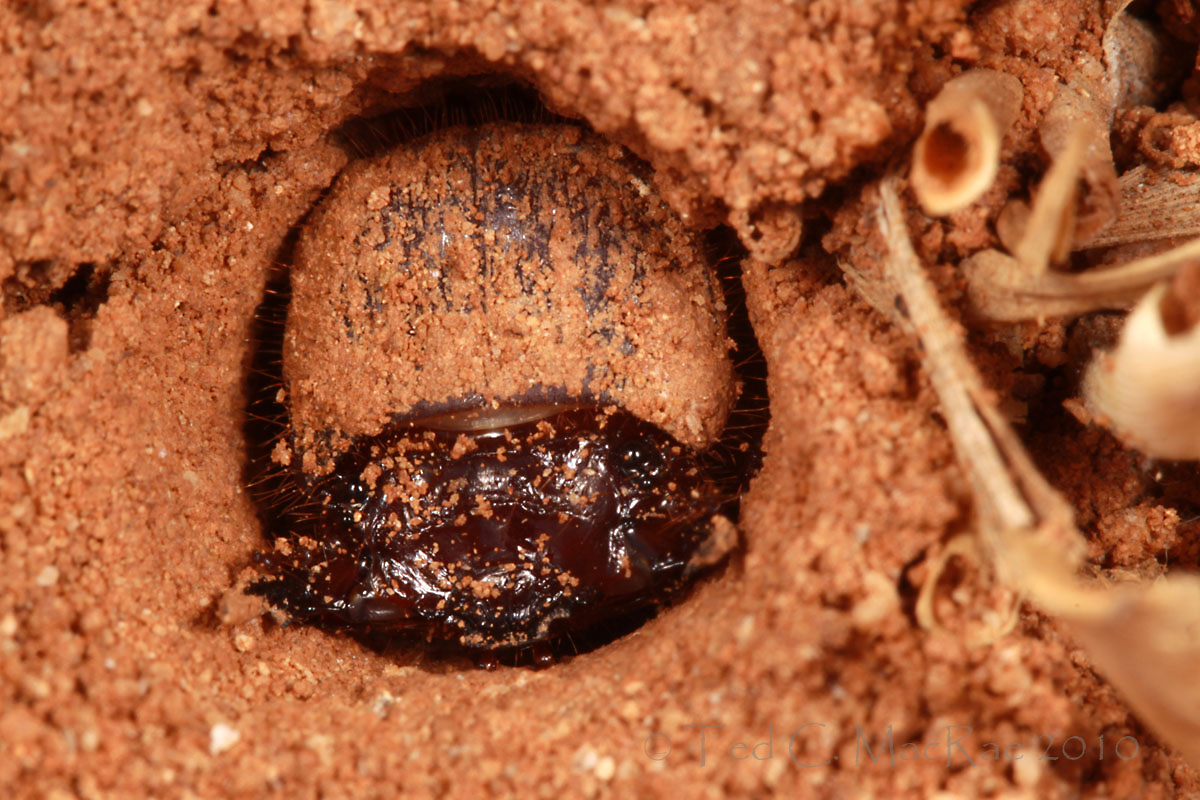
What is so special about it is that it’s the first ever reared individual of this species!  For those of you wondering why this is significant, until now the immature stages of this species have remained completely unknown.  A few contemporary students of the group have tried to rear the species, but the adults are delicate and do not travel well – indeed, my own first attempt to rear the species when I found it in Iowa was not successful.  However, when I found the Alabaster Caverns population, I placed ~12 adults in a small terrarium into which I had placed a chunk of native soil and moistened with water.  The adults survived well in this terrarium over several days of travel, and once back in the lab I kept them alive for several weeks by feeding them small caterpillars and fruit flies.  When larval burrows began to appear I fed them periodically with very small caterpillars and rootworm larvae, inserting them into individual burrows and sealing the burrow entrance to prevent their escape.  Additional prey larvae were inserted into burrow entrances as they were reopened, and the soil in the terrarium was moistened whenever its surface became quite dry.  By late October, all of the burrows had become inactive, and I wasn’t sure if the larvae had died or were just overwintering.  Nevertheless, I placed the terrarium in a cool (10°C) incubator, where it remained until this past March when I pulled it out of the incubator and returned it to warmer temperatures.  Within days, larval burrows reappeared, and I knew then that I had a decent chance of rearing the species to adulthood.  In early July, the beetle in these photographs emerged from its burrow – the first ever reared swift tiger beetle!  Several more adults emerged during the following 2-3 weeks.

While this rearing was in progress, I managed to find larvae of this species on a return trip to Alabaster Caverns last October.  Both 2nd- and 3rd-instar larvae were collected and preserved to go along with the preserved 1st-instar larva that I had extracted from the rearing container when larvae first began to appear.  While these preserved specimens are all that I need to complete a manuscript describing the larval instars, having reared the species completely from egg to adult as well will provide a most gratifying conclusion for that manuscript.

Copyright © Ted C. MacRae 2010

Add to FacebookAdd to DiggAdd to Del.icio.usAdd to StumbleuponAdd to RedditAdd to BlinklistAdd to TwitterAdd to TechnoratiAdd to Yahoo BuzzAdd to Newsvine

Email to a friend

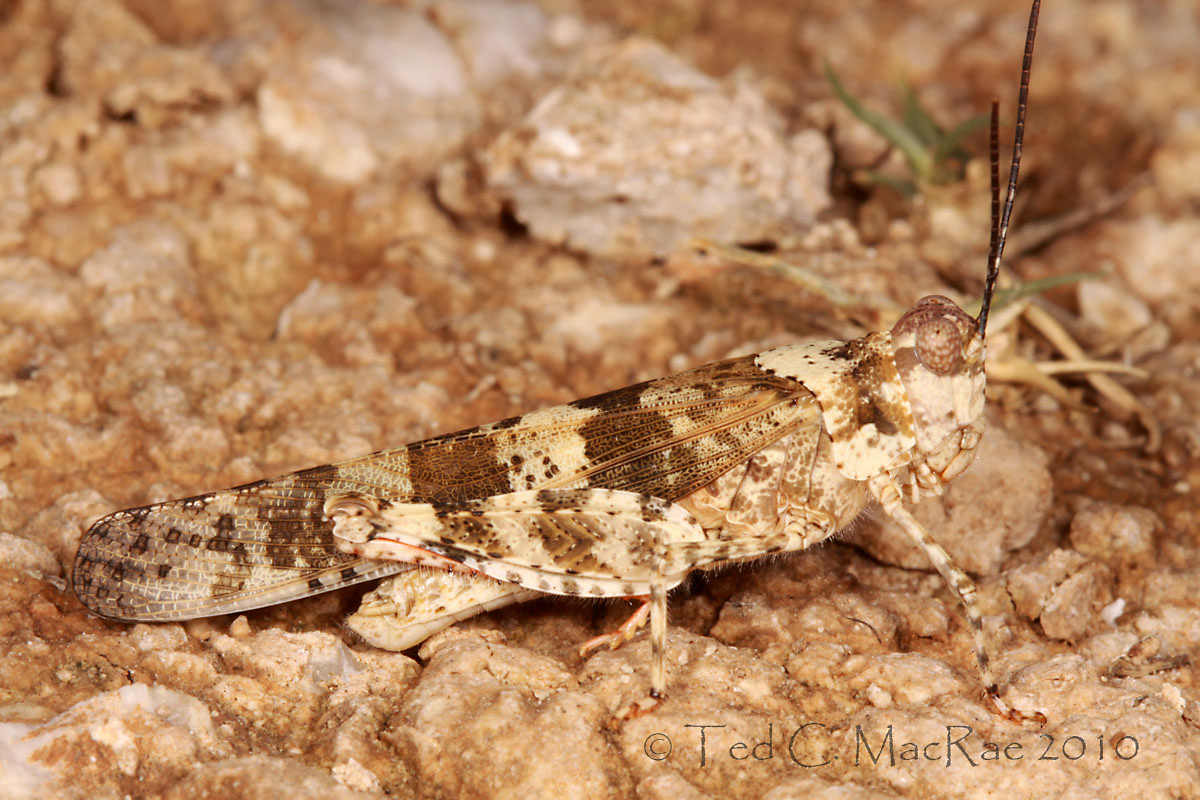
What’s more difficult to see…

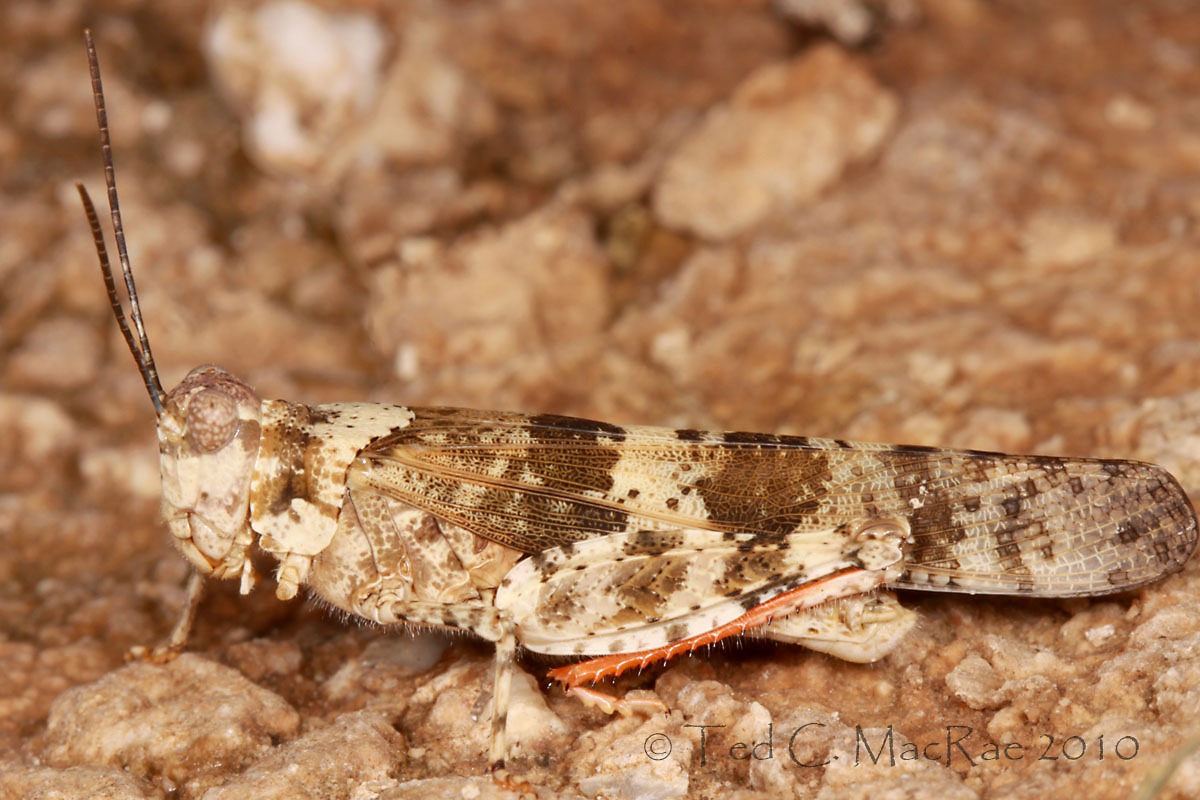
…than a Trimerotropis latifasciata (broad-banded grasshopper) adult on lichen-encrusted clay exposures?


Answer: A T. latifasciata nymph on lichen-encrusted clay exposures.


My thanks to David J. Ferguson for confirming my initial ID as a species of Trimerotropis and provisionally placing these individuals as T. latifasciata.  Of course, I’m not at all an expert in grasshopper identification, but I recognized these individuals, found atop the red, flat-topped mesa of Gloss Mountain State Park in northwestern Oklahoma, for their great similarity to T. saxatilis (lichen grasshopper), a striking, more greenish species (at least here in Missouri) that I had hoped to but did not see during my visit to Lichen Glade Natural Area back in late May (it may have been too early in the season for them).  At first I thought these individuals might represent that species, considering the abundance of lichens that encrusted the clay exposures atop the mesa.  However, according to David the red hind tibia (seen in the photo below of a different adult – sans left front leg), longer wings, occurrence on clay (rather than rock or sand), and location in the Great Plains make T. latifasciata the most tenable choice.

Like T. saxatilis and other species of the genus, T. latifasciata provides a marvelous example of the use of camouflage (i.e., blending in with surroundings) – a form of crypsis – to avoid detection by predators.  Finding this species only strengthens my desire to find (and photograph) T. saxatilis – speckled green, white and black – amidst the green lichens that encrust the red igneous outcroppings of the St. Francois Mountains some 100 miles south of St. Louis.

Photo Details: Canon 50D w/ 100mm macro lens, (ISO 100, 1/250 sec, f/18-20, Canon MT-24EX flash (1/4 ratio) w/ Sto-Fen diffusers, and typical post-processing (levels, minor cropping, unsharp mask).

Copyright © Ted C. MacRae 2010

Add to FacebookAdd to DiggAdd to Del.icio.usAdd to StumbleuponAdd to RedditAdd to BlinklistAdd to TwitterAdd to TechnoratiAdd to Yahoo BuzzAdd to Newsvine

Email to a friend

The marvelously monstrous Microstylum morosum

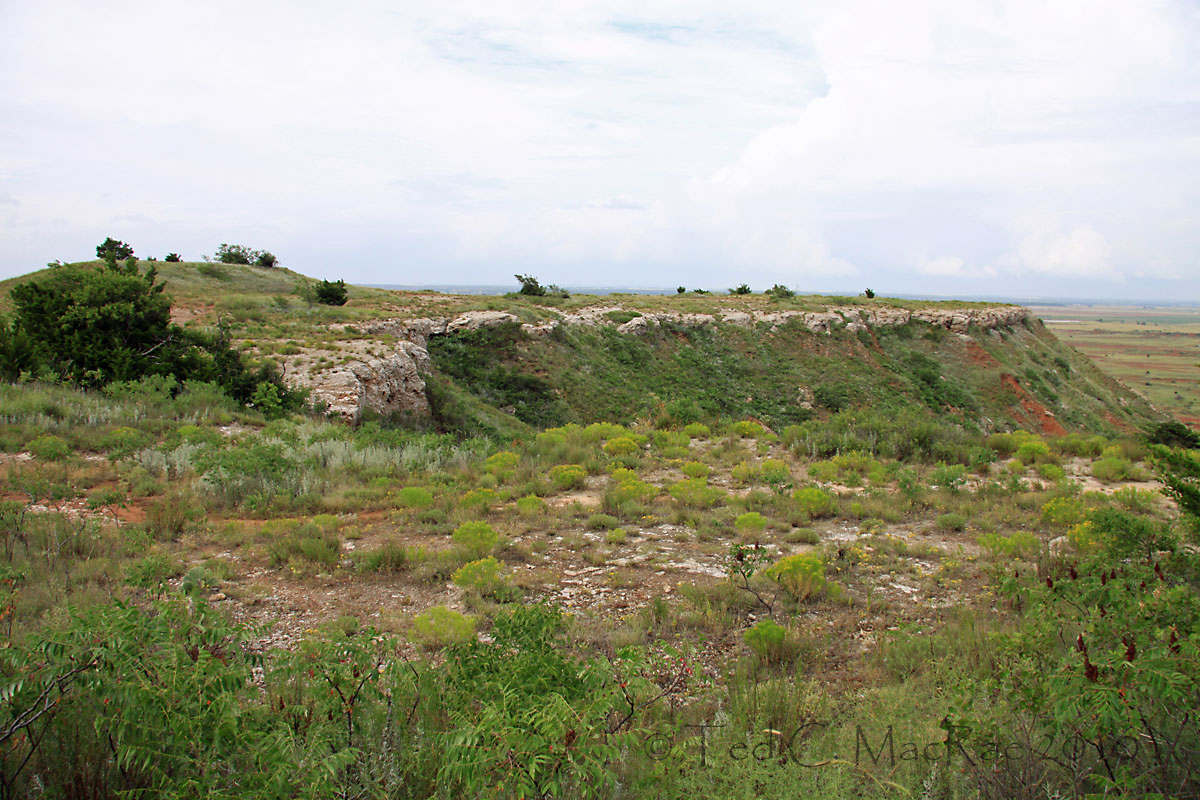
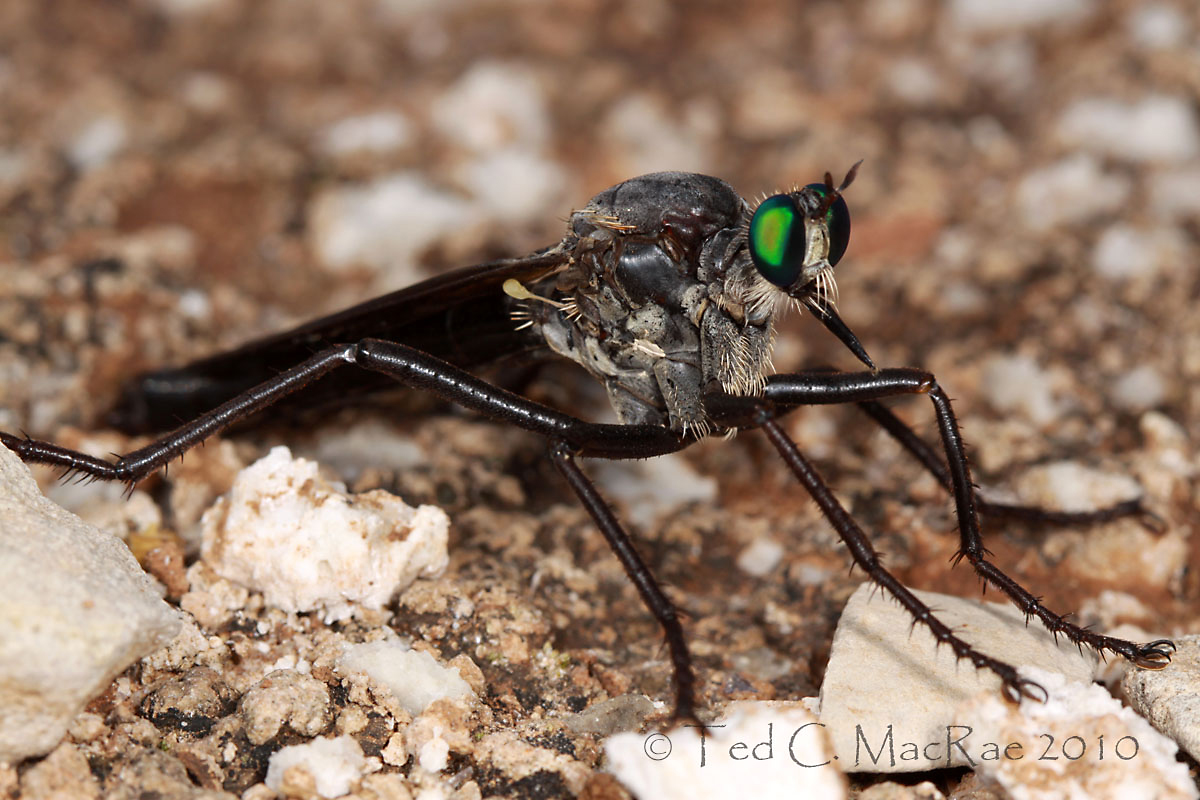
A few weeks ago, while waiting to begin my nocturnal hunt for the Great Plains giant tiger beetle (Amblycheila cylindriformis) in northwestern Oklahoma, I spent the daytime atop one of the red flat-topped mesas that meander through the area in nearby Gloss Mountain State Park.  Although my trip was all about seeing this giant of a tiger beetle in the wild for the first time (I could hardly wait for dusk to begin my search), I found enough splendid insects of other types atop the mesa to occupy my interest until that time.  One of these was the still-robust population of the Swift Tiger Beetle (Cylindera celeripes) that I discovered last summer and delighted in photographing yet again, while another was North America’s largest robber flyMicrostylum morosum!  I had just finished photographing one of the tiger beetles near the edge of the mesa when I turned and saw one of these impressively large flies sitting calmly on the ground nearby.

I first encountered this species last year in southwestern Missouri (a new state record!), so there was no question about its identity.  I also remembered how skittish they were and how difficult it was to get even the two mediocre photographs that I included in the resultant post.  Expecting the same, I kept my eye on the ground-sitter while preparing the camera and approached it with extreme caution.  To my surprise, it showed no sign of being alarmed or wanting to take flight.  I crouched down low and marveled at its monstrous impressiveness as I took frame after ever closer frame – eventually zeroing in on the head and its stunningly magnificent emerald-green eyes.

Satisfied that somewhere in the dozen and a half frames that I shot was at least one or two winners, I sat up and probed towards it with my finger to see how quickly it took flight.  It just sat there tenaciously until my touch caused it to finally take wing.  Winds were gusty atop the mesa, which may have accounted for its cooperativeness.  Standing up, I noted a few scattered eastern redcedars (Juniperus virginiana) in the mixed-grass prairie at the highest point of the mesa.  I recalled that robber flies are fond of “hilltopping” – a mating strategy whereby males fly to the highest point in their immediate landscape to defend a small territory or perch that provides a good vantage for spotting females and competing males (see Hilltopping by Eric Eaton at Bug Eric for a good discussion about this) – and my own experience with this species in Missouri and the way it tended to perch in the trees scattered across the upper part of the rocky, dolomite glade where I found them.  I wandered up to the redcedars, and as soon as I came close enough to one of them I saw another individual take flight – looking like some super-sized mosquito with it’s long legs spread wide as it clumsily flew to another tree.  As it turned out, I saw a number of individuals and mating pairs perching and flying among the trees on top of the mesa, each more spectacular than the previous.

Until recently, Microstylum morosum was considered a Texas-endemic.  However, Beckemeyer and Carlton (2000) documented this species to be much more broadly distributed in the southern Great Plains (from Texas up into Oklahoma and Kansas and west into New Mexico, Arizona, and Colorado), and Warriner (2004) recorded it shortly afterwards in Arkansas.  Although the species apparently occurs throughout Oklahoma (Beckemeyer and Carlton recorded from 13 counties across the state), my observation of it in Major County does seem to represent a new county record for the species.  There is another U.S. species in the genus, M. galactodes, and it has also been recorded from Oklahoma (the closest record is in nearby Woodward County).  However, it is easily distinguished by its generally smaller size, milky white wing membranes, reddish-brown body, and head and thoracic dorsum evenly covered with whitish pruinescence, while M. morosum has the wings and body black to brown and thoracic pruinescence restricted to the lateral margins (Beckemeyer and Carlton 2000).  I’m not sure I would have recognized that species for what it was had I seen it, but if it is anywhere near as impressive as M. morosum then I hope I have the fortune to find it someday as well.

Photo Details:
Landscape: Canon 50D w/ 17-85mm wide-angle lens (17mm), ISO 100, 1/100 sec, f/10, ambient light. Typical post-processing (levels, unsharp mask).
Insects: Canon 50D w/ 100mm macro lens, ISO 100, 1/250 sec, f/10 (photo 1), f/18 (photo 2), Canon MT-24EX flash (1/4 ratio) w/ Sto-Fen diffusers. Typical post-processing (levels, minor cropping, unsharp mask).

REFERENCES:

Beckemeyer, R. J. and R. E. Carlton.  2000. Distribution of Microstylum morosum and M. galactoides (Diptera: Asilidae): significant extensions to previously reported ranges.  Entomological News 111(2):84–96.

Warriner, M. D.  2004. First Arkansas record of the robber fly Microstylum morosum (Diptera: Asilidae).  The Southwestern Naturalist 49(1):83–84.

Copyright © Ted C. MacRae 2010

Add to FacebookAdd to DiggAdd to Del.icio.usAdd to StumbleuponAdd to RedditAdd to BlinklistAdd to TwitterAdd to TechnoratiAdd to Yahoo BuzzAdd to Newsvine

Email to a friend

Vicarious Friday Beetle Blogging

Despite the fact that I have a beetle blog and Alex has an ant blog, it is the latter where the regular series Friday Beetle Blogging resides (hmm, I wonder if I should start a Myrmecine Monday series?).  Alex has perhaps the best science-based entomoblog out there, so I’m thrilled to contribute today’s edition – check it out: Friday Beetle Blogging – the Swift Tiger Beetle.

Copyright © Ted C. MacRae 2010

Add to FacebookAdd to DiggAdd to Del.icio.usAdd to StumbleuponAdd to RedditAdd to BlinklistAdd to TwitterAdd to TechnoratiAdd to Yahoo BuzzAdd to Newsvine

Email to a friend

Amblycheila success!

I love it when a plan comes together!

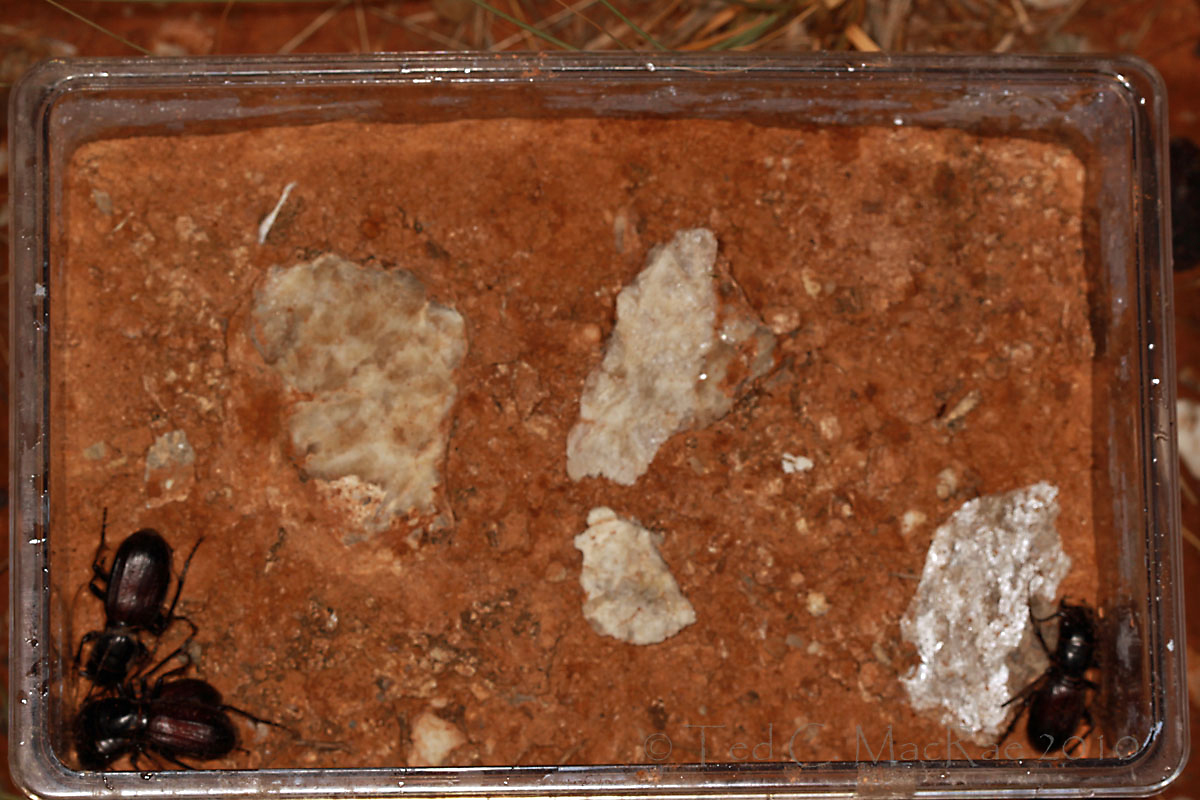
Another one was caught after these photos for a total of five individuals. They’ve been setup for now in a container of native soil. I hope you’ll forgive these rather rushed photos – they were hurriedly taken at half past midnight with rain beginning to fall. Details and much better photographs will, of course, be forthcoming.

I don’t think I have ever worked as hard for five specimens as I did tonight!

Copyright © Ted C. MacRae 2010

Add to FacebookAdd to DiggAdd to Del.icio.usAdd to StumbleuponAdd to RedditAdd to BlinklistAdd to TwitterAdd to TechnoratiAdd to Yahoo BuzzAdd to Newsvine

Email to a friend

The Power of Impulse

Glass Mountains, Oklahoma

Since figuring out a couple weeks that I had the larva of North America’s largest tiger beetle (Amblycheila cylindriformis, or Great Plains giant tiger beetle) in a rearing tub in the lab, I haven’t been able to think about anything except how cool it would be to go back out to the Glass Mountains in northwest Oklahoma (where I collected the larva last June) and look for the adults.  I have every reason not to do this trip – I just spent a long weekend up in northwest Missouri on follow up surveys for our newly discovered population of Cylindera celeripes (swift tiger beetle) (my second such trip in the past three weeks¹), and in a mere week and a half I leave for a 2-week trip to France.  Bills need to be paid, the grass needs cutting, and (as of today) a broken spoke needs to be repaired.  My collecting trips are normally planned far in advance – their timing and frequency part of a delicate balance between the goals I set for the season and the responsibilities that go along with having a job and a family.

¹ More on this in an upcoming post.

But for Amblycheila, it’s now or never – at least for this season, and the thought of waiting until next year before I can take my first valid shot at finding this species in the wild (and perhaps a previously unrecorded population, at that²) is just too unbearable.  So here I am, halfway to the Glass Mountains on as impulsive a trip as I’ve taken in a long time, hoping that my hunch pays off and I’ll find the strikingly large adults of A. cylindriformis lumbering below the flat-topped mesas in the mixed grass prairie where a little more than a year ago I was collecting its enormous larva. It’s a drive-collect-drive trip, and if successful I won’t be the first person to photograph them, even well, but it will nevertheless fulfill my longtime desire to locate this species in the wild and see it with my own eyes – a far more gratifying experience than looking at the lone dead specimen acquired long ago through trade that sits in my cabinet. Wish me luck!

² Drew and Van Cleave (1962) saw only a single specimen from the state in neighboring Woodward Co., although this is now a rather old reference.

REFERENCES:

Drew, W. A. and H. W. Van Cleave.  1962. The tiger beetles of Oklahoma (Cicindelidae).  Proceedings of the Oklahoma Academy of Science 42:101–122.

Copyright © Ted C. MacRae 2010

Add to FacebookAdd to DiggAdd to Del.icio.usAdd to StumbleuponAdd to RedditAdd to BlinklistAdd to TwitterAdd to TechnoratiAdd to Yahoo BuzzAdd to Newsvine

Email to a friend

North America’s largest tiger beetle (I think!)

The generous among us might call it serendipity, while the rest of us would just call it luck.  By whatever name, I had it in spades in June last year when I made my first visit to the Glass Mountains of northwestern Oklahoma.  My original plan was to go to Tallgrass Prairie Preserve in eastern Oklahoma at the end of what proved to be a resoundingly successful day at Alabaster Caverns State Park.  However, soaking rains moved into the area and continued rumbling eastward across the plains towards the preserve, forcing a quick change of itinerary.  I decided to wait it out in the state’s western reaches, a “hunch” telling me that the red clay/gypsum hills in nearby Major County might be a fruitful place for hunting tiger beetles.  Sunny skies the next morning were a good sign, and my hunch was rewarded later that day when I discovered a previously unknown (and fortunately robust) population of the rare Cylindera celeripes (swift tiger beetle), making not just the day but the entire trip more successful than I could have ever imagined.  Icing on the cake came when I found decent numbers of the more secure but nevertheless uncommon Dromochorus pruinina (frosted dromo tiger beetle) also in the area.

Another find I made that day that I’ve mentioned on occasion but not talked about at length was a single, rather large tiger beetle larva.  I found several burrows at the base of a talus slope at the edge of a small ravine where many adult C. celeripes were scurrying, and though I tried with many, out of only one did I manage to “fish” its occupant with a blade of grass.  I didn’t know which species it represented, but its large size and occurrence in clay soil brought to mind two species – Cicindela pulchra (beautiful tiger beetle) and C. obsoleta (large grassland tiger beetle).  Both of these Great Plains species reach their eastern limit of distribution in this part of Oklahoma (Pearson et al. 2006), and their status as the largest species of the genus (and its former subgenera) in North America seemed to make them the leading candidates for this enormous larva.  There was one other possibility – Amblycheila cylindriformis (Great Plains giant tiger beetle), another Great Plains species at its eastern limit in western Oklahoma and (as the common name implies) the largest tiger beetle in all of North America.  However, to consider that species seemed too much wishful thinking.  From my understanding, larvae of that elusive species reach an incredible 45 mm in length and dig burrows  on steep slopes or at the mouths of rodent burrows that extend vertically to depths of up to 1.5 m or more (Brust et al. 2005).  Surely I could not have so casually stumbled upon such a grand grub!

I placed the larva in a terrarium of native soil and brought it back with me, and for one year now I have waited – feeding it a regular diet of the fat noctuid caterpillars that we rear so abundantly in our lab.  For a full year, I’ve watched it nab caterpillar after caterpillar, disappearing mysteriously for days on end, and just as mysteriously reappearing at the top of its burrow.  I knew getting a closer look at it would help in my attempts to determine its identity, but every time I approached with a camera it dodged down into its burrow and beat my patience.  Sometimes I would see it sitting about a centimeter below the burrow entrance – just waiting for a caterpillar to crawl by but refusing to expose itself to the lens.  I gradually decided it was likely C. pulchra, as I had seen that species in similar habitat not too far north in Barber County, Kansas.  So strong was my suspicion that I even made another trip out to the Glass Mountains in October of last year, expecting to see the fall-active adults bejeweling the exposed flats below the red clay slopes, their wine-red elytra and purple-margined bodies all aglitter under the crisp, autumn sun.  No such sight was beheld, however – my hopes dashed by the season’s sudden cold and wet turn, and with the terrarium containing the larva by then tucked away in a cool incubator for a winter’s rest, it would be several months before I would see the larva once again sitting at the top of its burrow.

In late March I pulled the terrarium out of the incubator, and within a week the larva reopened its burrow.  I fed it a few times, and then one day I saw that it had dug a new, larger  burrow – measuring a full 10 mm in diameter!  This seemed extraordinarily large for any species of Cicindela, so I resolved once again to photograph it and determine its identity.  For days I stalked it, keeping the terrarium just outside my office door where I could keep an eye on it, yet every time I approached within two feet or so it would drop down out of sight.  I decided to stop feeding it – perhaps hunger would overwhelm its patience and prompt it to return to the top of its burrow more quickly after retreating.  That seemed to work, as one day the larva came back up after only a few minutes – and I was ready!  Already  in position, I flashed off multiple shots as soon as it reappeared, moving slowly and deliberately between shots to avoid spooking it again, and managed to get a nice series from varying distances.  As a testament to its enormous size, all of the photos shown here were taken with the standard 100mm macro lens (1X maximum) – not the 65mm 1-5X beast that I needed for these shots of the super-tiny C. celeripes.

Thinking that the larva likely represented C. pulchra, I compared the photos to this photo taken by Matt Brust of a 3rd-instar larva of C. pulchra and immediately noted the differently shaped pronotum of my larva and its distinctly projecting anterolateral angles.  Compare to C. pulchra, in which the angles are in line with the median part of the anterior margin – it is clearly not that species.  It isn’t C. obsoleta either, as that species has the anterolateral angles of the pronotum even less projecting than C. pulchra (Drew and Van Cleave 1962).  Apparently I needed to rethink my assumption that it belonged to Cicindela or its close relatives – none that occur in Oklahoma are simply large enough!  Tetracha virginica is large enough, but I knew it wasn’t that species since it lacked the white margined pronotum distinctive of species in that genus (as can be seen in this post on the larva of Tetracha florida).  That left only A. cylindriformis, distinguishable from all other tiger beetle genera occurring in Oklahoma by the second (lower) pair of eyes distinctly smaller than the first (Hamilton 1925, Drew and Van Cleave 1962, Pearson et al. 2006) – clearly seen in the third photo above.  Matt Brust has also photographed the larva of A. cylindriformis – it’s not a close shot of the head and pronotum, but in general aspect my larva seems to match it well enough.

All that is left is to actually succeed in rearing this larva to adulthood.  These beasts may require up to three to four years to develop (Brust et al. 2005), although this is likely influenced by latitude and prey abundance.  I suspect it was a second instar larva when I collected it, and that it dug its new burrow this spring after molting to the third (and final) instar.  Hopefully by keeping it in a nice, warm growth chamber and feeding it generously with fat caterpillars, I can minimize the time to pupation and perhaps see the adult sometime later this summer.  If/when that happens, you can be sure to see a follow up to this post.

Photo Details: Canon 50D (ISO 100, 1/250 sec, f/16-18), Canon 100mm macro lens, Canon MT-24EX flash (1/4 ratio) w/ Sto-Fen diffusers. Post-processing: contrast and unsharp mask (no cropping).

REFERENCES:

Brust, M. L., S. M. Spomer and W. W. Hoback.  2005. Tiger Beetles of Nebraska.  University of Nebraska at Kearney.  http://www.unk.edu (Version 5APR2005).

Drew, W. A. and H. W. Van Cleave.  1962. The tiger beetles of Oklahoma (Cicindelidae).  Proceedings of the Oklahoma Academy of Science 42:101–122.

Hamilton, C. C.  1925. Studies on the morphology, taxonomy, and ecology of the larvae of Holarctic tiger beetles (family Cicindelidae).  Proceedings of the U.S. National Museum 65 (Art. 17):1–87.

Pearson, D. L., C. B. Knisley and C. J. Kazilek. 2006. A Field Guide to the Tiger Beetles of the United States and Canada. Oxford University Press, New York, 227 pp.

Copyright © Ted C. MacRae 2010
Add to FacebookAdd to DiggAdd to Del.icio.usAdd to StumbleuponAdd to RedditAdd to BlinklistAdd to TwitterAdd to TechnoratiAdd to Yahoo BuzzAdd to Newsvine

Email to a friend