2025 WGNSS Photo Contest

Last night the Webster Groves Nature Study Society (WGNSS) held its biennial nature photo contest, and I was fortunate to grab two placings with the following photographs.

2nd place (Invertebrates)

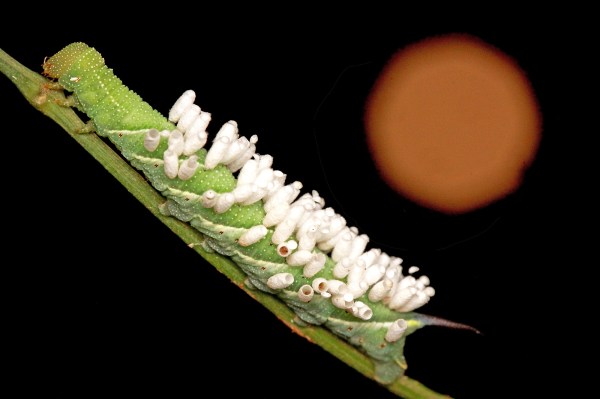
A tobacco hornworm (Manduca sexta) caterpillar that has been parasitized by braconid wasps (Cotesia sp.). The wasps developed inside the caterpillar as grubs, consuming all but the most vital of organs to avoid killing it before they completed their development. They then exited the caterpillar’s body and spun small white silken cocoons in which to pupate and eventually emerge as adults. The adult wasps have already emerged, and though the caterpillar is still alive, it will die before it can complete its development and become an adult moth. The caterpillar was photographed at night in front of a so-called “supermoon” rising in the eastern sky. This is a single exposure image—-not a composite photograph—with the camera focused on the caterpillar (illuminated by flash) but its settings adjusted to also detect ambient light from the distant moon. The moon is necessarily out of focus due to depth-of-field constraints. Photographed 11 Aug 2014 in Mississippi Co., Missouri at the Hwy 62 bridge over the Mississippi River.

Honorable Mention (Plants and Fungi)

A single blossom on the inflorescence of clasping milkweed (Asclepias amplexicaulis). This uncommon species is scattered throughout Missouri but is especially fond of habitats with dry sand substrates. It can be easily identified by its erect, glabrous stems, sessile, clasping leaves, and pinkish flowers. Photographed 23 April 2012 in Scott Co., Missouri at Sand Prairie Conservation Area.

©️ Ted C. MacRae 2025

“BioBlitzing” Schoolcraft Prairie

It’s been a few months since I’ve been on a WGNSS field trip, so I was anxious to attend this past weekend’s joint trip between the Entomology and Nature Photography Groups to visit a private restored tallgrass prairie remnant located in extreme southwestern Washington County and named after Henry Schoocraft, who famously chronicled his journey through the Missouri Ozarks in the early 1800s and passed within a few miles of this spot (if you’ve not yet read Schoolcraft’s journal, I highly recommend this natural history classic!). The landowner, a restoration ecologist for Shaw Nature Reserve, has been using prescribed burns and selective thinning over the past several years to restore the 70-acre tract of upland forest, former cropland, and grassland remnants to their presettlement character. Stupidly, I did not bring my main camera, preferring to focus instead on collecting rather than photography. In hindsight, I would have been much better served had I had my camera, as the beetle groups that I study (Buprestidae and Cerambycidae) tend to be scarce at this time of season in Missouri, while interesting subjects for photography in other insect groups abound. As far as photos go, my iPhone would have to suffice.

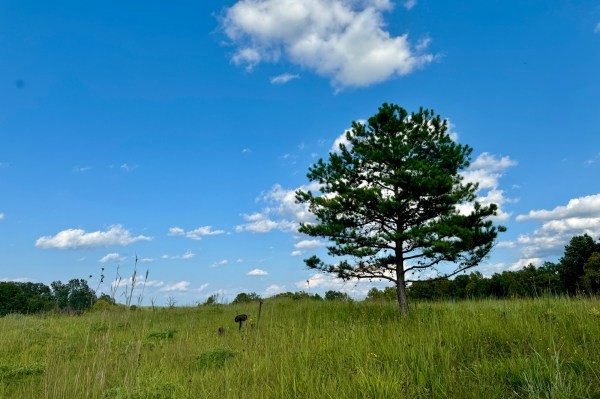
A lone Pinus echinata (shortleaf pine) in restored tallgrass prairie remnant.

We arrived a bit after mid-afternoon and spent the bulk of the remaining daylight hours in the prairie remnant. Florally, it was one of the most diverse prairies I’ve ever seen, especially in this part of the Missouri Ozarks. One plant in bloom that was new to me was Liatris scariosa (devil’s bite blazingstar), distinguished from the similar L. aspera (also in bloom) by its flower heads on long stalks and with mostly flat phyllaries.

Liatris scariosa (devil’s bite blazingstar—family Asteraceae) in restored tallgrass prairie remnant.

The first insect of interest that I found was the white fluffy early-instar caterpillar of Megalopyge crispata (black-waved flannel moth). The hairs of all species in this genus are venomous in the larval stage, and interestingly the later instars of a related species (M. opercula) resemble a tiny Trump toupee (look it up!).

Megalopyge crispata (black-waved flannel moth—family Megalopygidae) early-instar caterpillar on foliage of Carya tormentosa (mockernut hickory) in restored tallgrass prairie remnant.

Also present were Neotibicen auriferus (prairie dog-day cicada), whose whining, metallic songs filled the air. Normally very skittish and difficult to approach, I managed to snag one on the trunk of a small persimmon tree in the middle of the prairie.

Neotibicen auriferus (plains dog-day cicada—family Cicadidae) captured while singing on trunk of Diospyros virginiana (persimmon) in restored tallgrass prairie remnant.
Atalopedes huron (Huron skipper—family Hesperiidae) perched on foliage of Rhus copallina (shiny sumac) in restored tallgrass prairie remnant.

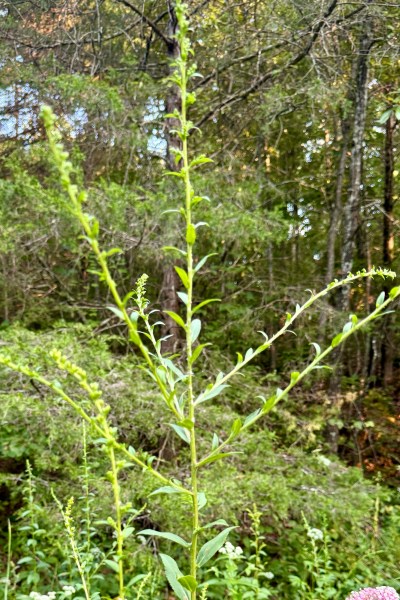
As afternoon progressed to evening, I went back down from atop the ridge and visited a small calcarous fen—a unique wetland habitat created by seepage of calcareous groundwater that results in saturated, low-oxygen soil. Fens often support unique plants, and in this one I found Solidago patula (swamp goldenrod). I’ve never seen this plant before, so I was a bit disappointed it was not yet in bloom, but I marveled at an enormous, darkly colored banded fishing spider (Dolomedes vittatus) sitting on one of the plants.

Solidago patula (swamp goldenrod—family Asteraceae) in small calcareous fen.
Dolomedes vittatus (banded fishing spider—family Pisauridae) on Solidago patula (swamp goldenrod) in small calcareous fen.

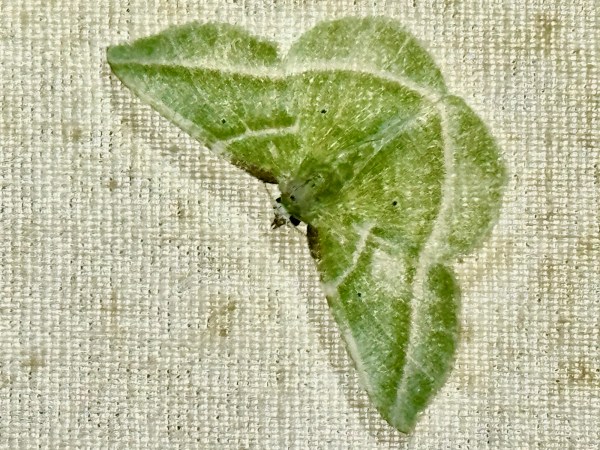
After dinner we set up several light stations, including one up in the restored prairie remnant. Despite the warm, humid conditions, I had little optimism that we would see much of interest at the lights due to the near-full moon shining brightly in the cloudless sky. This was mostly true, although I did collect a few ceresine treehoppers and weevils from the lights. Additionally, a few small but pretty moths warranted a photograph or two.

Pyrausta tyralis (coffee-loving pyrausta moth—family Crambidae) at ultraviolet light in restored tallgrass prairie remnant.
Dichorda iridaria (showy emerald moth—family Geometridae) at ultraviolet light in restored tallgrass prairie remnant.

The truly interesting finds, however, would come in the form of caterpillars on the foliage of nearby trees. Three species of slug moths (family Limacodidae)—among the most bizarre-looking of caterpillars, and all of which can sting—would be found. Two of them were new to me—a beautifully lichen-colored Euclea delphinii (spiny oak slug moth), and the nearly amorphous Apoda y-inversa (yellow-colored slug moth). The third species was the striking Parasa indetermina (stinging rose slug moth)—always a treat to see!

Euclea delphinii (spiny oak slug—family Limacodidae) caterpillar on foliage of Quercus stellata (post oak) in restored tallgrass prairie remnant.
Apoda y-inversa (yellow-collared slug moth—family Limacodidae) caterpillar on foliage of Quercus stellata (post oak) in restored tallgrass prairie remnant.
Parasa indetermina (stinging rose moth—family Limacodidae) caterpillar on foliage of Quercus marilandica (blackjack oak) in restored tallgrass prairie remnant.

Other striking caterpillars were found as well: Amorpha juglandis (walnut sphinx) and Ceratomia catalpae (catalpa sphinx)—adults of each also visiting the lights, Anisota virginiensis (pink-striped oakworm), Automeris io (io moth), Acronicta radcliffei (Radcliffe’s dagger moth), and Halysidota tessellaris (banded tussock moth). Some of these were photographed in situ, but most were brought back to camp for photographs under more controlled conditions.

Amorpha juglandis (walnut sphinx—family Sphingidae) caterpillar on foliage of Juglans nigra (black walnut) in dry-mesic upland oak/hickory forest.
Acronicta radcliffei (Radcliffe’s dagger moth—family Noctuidae) on foliage of Prunus serotina (black cherry) in dry-mesic oak/hickory forest.
Halysidota tessellaris (banded tussock moth—family Erebidae) on foliage of Carya tomentosa (mockernut hickory) in restored tallgrass prairie remnant.

Another interesting observation near the light in the prairie was a Neoconocephalus ensiger (sword-bearing conehead katydid—family Tettigoniidae) final-instar nymph molting to adulthood. At the time that I photographed it, the antennae were pulled taught—almost but not completely pulled free from the exuviae.

Neoconocephalus ensiger (sword-bearing conehead katydid—family Tettigoniidae) final-instar nymph molting to adulthood at night in restored tallgrass prairie remnant.

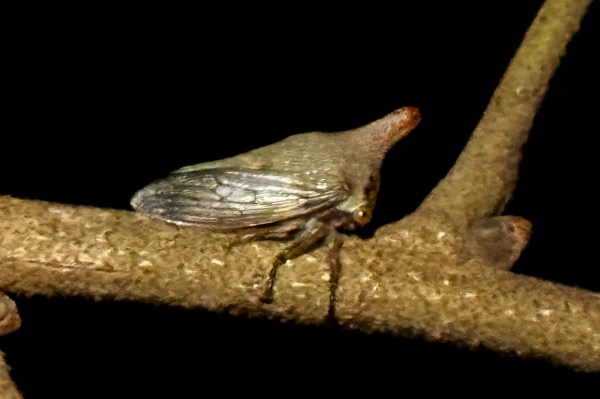
A final observation of a small treehopper (Platycotis vittata) on a Quercus stellata (post oak) twig—after which I called it a night (it was around 2 am!).

Platycotis vittata (family Membracidae) on twig of Quercus stellata (post oak) in dry-mesic oak/hickory forest.

©️ Ted C. MacRae 2024

Four for four

I had a good showing at this year’s WGNSS (Webster Groves Nature Study Society) Photo Contest—held last night at the Webster Groves Public Library. All four photos that I entered—one each in four different categories—were selected for a prize: 1st place in the Invertebrates category, 2nd place in the Bonus category (Missouri Species of Conservation Concern), 3rd place in the Vertebrates category, and Honorable Mention in the Plants and Fungi category. There was a fifth category (Habitats and Landscapes), but I don’t take many landscape photos (at least, not with my “real” camera) so did not submit to that category. Three of the four photos are now eligible (along with 13 others) for the Grand Prize (the bonus category is not included in the grand prize competition), which will be selected via popular vote at the WGNSS Spring Banquet, to be held next month at the Piper Palm House in Tower Grove Park.


1st Place – Invertebrates

The spotted orb weaver (Neoscona crucifera) builds an impressively large web each night, which it consumes in the morning before hiding during the day. Despite their size, they are not aggressive and are of no medical significance. This female was photographed at Pinewoods Lake Recreation Area in Carter Co., Missouri on 11 August 2015.

2nd Place – Bonus (Missouri Species of Conservation Concern)

The swift tiger beetle (Cylindera celeripes) was unknown to occur in Missouri until it was discovered in the critically imperiled loess hilltop prairies of extreme northwestern Missouri in 2010 by Ted MacRae and Chris Brown. The species was designated a Missouri Species of Conservation Concern due to the critically imperiled nature of the habitat in which it lives, and detailed surveys since its discovery in the state have shown the species to be limited to just four loess hilltop prairie remnants – all under conservation management – in Holt and Atchison Counties. This individual was photographed on a sparsely vegetated red clay/gypsum exposure in mixed-shortgrass prairie at Alabaster Caverns State Park in Woodward Co., Oklahoma on 10 June 2009.

3rd Place – Vertebrates

The eastern hognose snake (Heterodon platirhinos) is famous for their variety of defensive behaviors, ranging from the innocuous (puffing their neck and hissing) to the repugnant (vomiting) to the extreme (feigning death). This individual was photographed at Sam A. Baker State Park in Wayne Co., Missouri, on 23 April 2012.

Honorable Mention – Plants & Fungi

The flesh-colored flowers of pawpaw (Asimina triloba) are pollinated by flies more typically attracted to fermenting substances rather than “typical” flower-loving flies seeking pollen and nectar, which they attract by emitting yeasty-smelling fermentation volatiles — rare in floral scent blends.These pawpaw flowers were photographed in mesic forest on an east-facing slope along the lower Wappapello Section of the Ozark Trail in Wayne Co., Missouri on 10 April 2010.

©️ Ted C. MacRae 2023

2019 WGNSS Nature Photo Contest

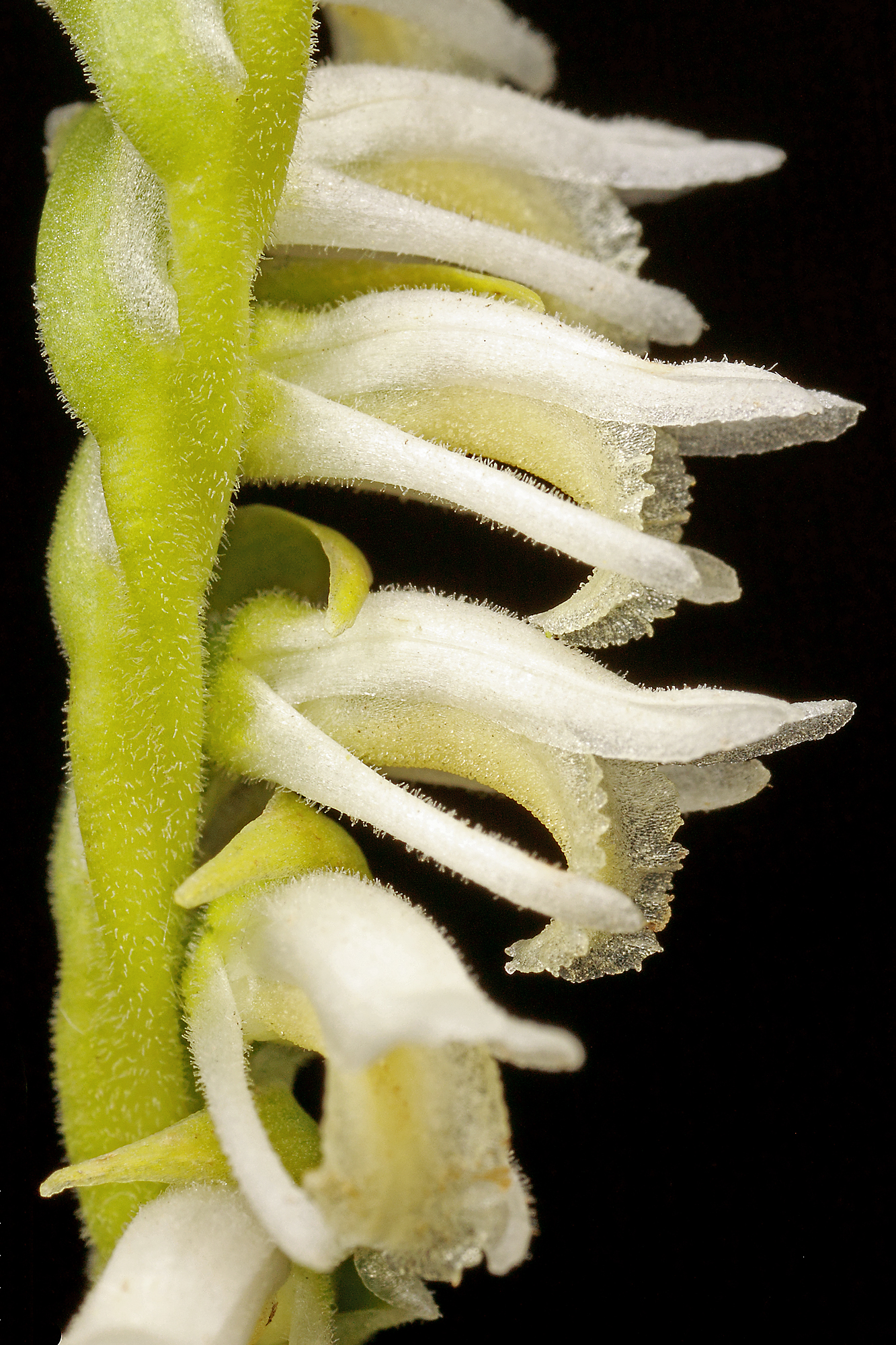
Last night the Webster Groves Nature Study Society (WGNSS) held their 2019 Nature Photo Contest, and I was fortunate to have a 1st place winner in the ‘Plants and Fungi’ category! This photograph of grassleaved lady’s tresses orchid (Spiranthes vernalis) flowers was taken at Taberville Prairie Natural Area in St. Clair Co., Missouri. Like other species of lady’s tresses orchids, their tubular flowers are arranged in a spiral along the inflorescence and cross-pollinated primarily by long-tongued bees (e.g. bumblebees, Bombus spp., and megachilid bees) (van der Cingel 2001).

Spiranthes vernalis (spring lady's tresses)

Grassleaved lady’s tresses orchid (Spiranthes vernalis), Taberville Prairie Natural Area, St. Clair Co., Missouri.

Spiranthes is one of the more complex genera of North American orchids, with seven species known to occur in Missouri (Summers 1985), and like almost all orchids, their pollination biology is fascinating! The flowers are “protandrous”, i.e., they are functionally male when they first open and become functionally female as they age. Since they open sequentially from the base of the inflorescence as it grows, this results in female flowers on the lower portion of the inflorescence and male flowers on the upper portion.  Thus, bee pollinators tend to act as pollen donors when visiting lower flowers and pollen recipients when visiting upper flowers.  Male pollinia are attached to the bee’s proboscis as it tries to access the nectar secreted into the base of the floral tube and then come in contact with the female stigma in the next flower that the bee visits.  Bees generally start at the bottom of an inflorescence when visiting a plant and then spiral up to the top before flying to the next plant.  Such “acropetal movement” is likely a result of the tendency for nectar rewards to be greater in the lower flowers, and it ultimately promotes cross-fertilization between neighboring plants.

This was the 4th edition of the contest, which has been held every other year since the inaugural edition in 2013. I’ve earned 2nd and 3rd place honors in the plants category each time before; however, this was my first win in that category. In addition to plants, I also had entries in the ‘Invertebrates’ (restricted to photos taken in Missouri or one of its contiguous states) and ‘Travel’ (open to photos taken anywhere in the world) categories, with one photo each making it to the final round of judging. You’ve seen them both before—Neotibicen superbus (below left—photographed at Mincy Conservation Area, Taney Co., Missouri) and Agrilus walsinghami (below right—photographed at Davis Creek Park, Washoe Co., Nevada). In the end, however, they both got beat out by the competition, so I only had the one winning photograph this time. Nevertheless, it was a 1st place winner, so I am very satisfied.

The WGNSS Nature Photo Contest has quickly become one of the organization’s marquee events, with the number of entries, caliber of competition, and attendance all exceeding the previous three editions. My thanks to the judges who volunteered their time, the attendees who supported the event, and especially to Bill Duncan, Chair of WGNSS’s Nature Photography Group (and an expert nature photographer in his own right), who worked hard to make this event the success that it was (and took home some well-deserved wins of his own). I look forward to the next competition in 2021!

REFERENCES:

Summers, B.  1981.  Missouri Orchids.  Missouri Department of Conservation, Natural History Series No. 1, 92 pp.

van der Cingel, N. A.  2001.  An Atlas of Orchid Pollination: America, Africa, Asia and Australia. A. A. Balkema, Rotterdam, Netherlands, 296 pp.

© Ted C. MacRae 2019

A little extra cash

Earlier this month the Webster Groves Nature Study Society (WGNSS) sponsored their second Nature Photo Contest. I’ve been a member of this group since I first moved to St. Louis after college in the early 1980s—primarily as a participant in the Entomology Natural History Group but for the past six years also as board member and editor of the Society’s newsletter, Nature Notes. The photo contest was run much like the first one in 2013, again with nice cash prizes for the winners, except two things: 1) the categories were a little different (see below), and 2) I was tapped to be one of the three judges in the two categories that I did not submit photos. The categories were:

  • Invertebrates
  • Vertebrates
  • Plants & Fungi
  • Natural Communities
  • Seasons

I submitted two photos each to the first three categories—the maximum allowed in both cases. One limitation for me was that the photographs had to be taken in Missouri or an adjacent state. Remarkably, during the past few years I’ve taken most of my photos in places further afield—primarily in the western U.S. in states such as California, Colorado, New Mexico, and Nevada. I have many photographs from earlier years, but frankly I don’t consider much of that body of work to be photo contest worthy. Still, I was able to come up with a few more recent photographs that I thought would be competitive.

How did it go for me? Pretty good, with two of my photos taking cash-winning prizes (see below). This may not be as good as I did last time, when I won one 1st place, one 2nd place, and one 3rd place—the last of these also voted by the audience as the Grand Prize winner. Nevertheless, the cash award is much welcomed and will be put to good use. Remarkably, it turns out that two winning photographs have never been posted at this site, so here they are:


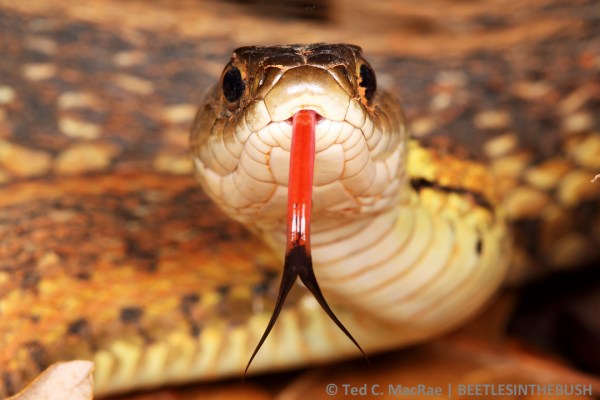
3rd Place—Vertebrates

Eastern garter snake (Thamnophis sirtalis)

Eastern garter snake, Thamnophis sirtalis | Ozark Trail, Wappapello Section, Wayne Co., Missouri

The judges regarded that it represents the true “essence” of a snake. Technically they liked the position of and focus on the tongue, the contrasting red color working well in the composition, with the blurred, winding body of the snake adding depth in a cleaner fashion than a cluttered jumble of leaves. I can’t tell you how many shots I took hoping to get one with the tongue in the perfect position—knowing all along that at any moment the snake could stop flicking it or decide to make a run for it


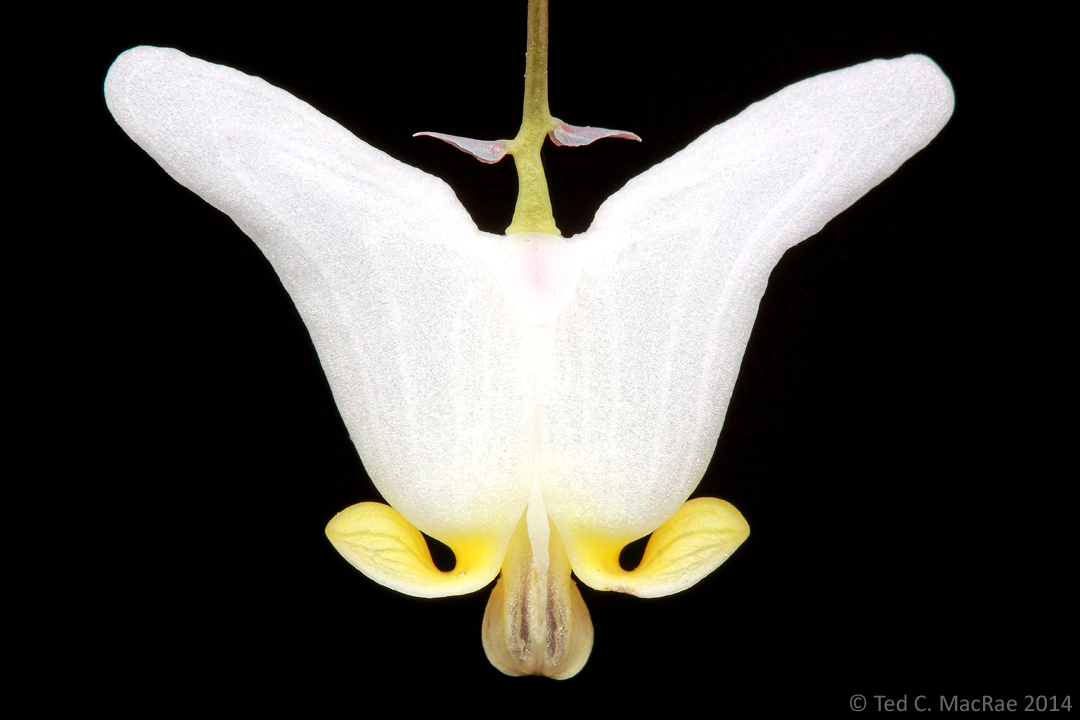
2nd Place—Plants & Fungi

Dicentra cucullaria

Dutchman’s breeches, Dicentra cucullaria | Battle of Athens State Park, Clark Co., Missouri

Unfortunately, I didn’t get a chance to hear the judges’ feedback regarded this photo, as I was busy judging the photos in the ‘Natural Communities’ and ‘Seasons’ categories. This photo also took many shots, even though I didn’t have to worry about the subject not cooperating. Flash on white is tricky—not enough and you don’t get the stark contrast with the black background; too much and you end up blowing the highlights and losing the delicate detail. Add to that trying to get the subject perfectly symmetrical within the frame (I wanted to achieve this ‘for real’ and not through subsequent cropping), and I probably took close to two dozen shots before I felt like I had it right.

Perhaps you noticed that neither of the photos were in the ‘Invertebrates’ category. This just goes to show that the amount of interest in and effort one puts into a certain type of photography does not guarantee success—or prevent success in photographing other, less-familiar subjects. For my part I am pleased that any of my photographs were deemed good enough to receive a cash prize and thank WGNSS for giving local nature photographers the opportunity to have their work recognized and rewarded.

© Ted C. MacRae 2015

Best of BitB 2014

Welcome to the 7th Annual “Best of BitB”, where I pick my favorite photographs from the past year. Before I do this, however, let me briefly recap the year 2014. The trend of increasing travel each year continued, with more days spent on the road than in any prior year. Travel for work over the past few years has settled into a familiar routine—touring soybean fields in Argentina in late February and early March, working in my own field trials at (previously three, now four) sites in Illinois and Tennessee from late May through late September, touring more soybean fields at sites across the southeastern U.S. during mid-September, returning to Argentina in October to finalize plans for field trials in the upcoming season, and—finally—attending/presenting at the Entomological Society of America (ESA) Meetings (this year in Portland, Oregon). This heavy travel load makes scheduling my own insect collecting trips a bit tricky, but I’m a persistent sort! In late May I traveled to Tennessee and Georgia with fellow buprestophile Joshua Basham and lab mate Nadeer Youseff to collect several rare jewel beetles, then in late June I collected prionids and jewel beetles in Colorado, New Mexico, and Oklahoma with Jeff Huether. In addition to these longer trips, I also managed to take advantage of my work travel to check out interesting natural habitats along the way to and from my field sites. I continue to give the occasional entomology seminar as well, speaking in March at “Day of Insects” in Ames, Iowa and here in St. Louis to the Entomology Natural History Group of the Webster Groves Nature Study Society in April and the Missouri Master Naturalists Confluence Chapter in December. On top of all this, I still managed to vacation with my family in Lake Tahoe during March and in Cabo San Lucas, Mexico during late July.

I say all this to highlight the fact that after all these years I still consider myself an entomologist with a camera rather than a bona fide insect photographer. The reason for this is that the science of entomology itself remains my primary focus—photography is simply one of the tools that I have come to use in my pursuit of the discipline. I don’t mean to imply that I don’t continue to work on my photography style and technique—because I do. But my style and technique are not goals in of themselves; rather, they are means to an end—that end being my entomological studies. With that said, I present my favorite BitB photographs from 2014. As in previous years, my photos are largely hand-held, in situ field shots that are intended to tell a natural history story in a (hopefully) aesthetic manner. Links to original posts are provided for each photo selection, and I welcome any comments you may have regarding which (if any) is your favorite and why—such feedback will be helpful for me as I continue to hone my craft. If you’re interested, here are my previous years’ picks for 2008, 2009, 2010, 2011, 2012 and 2013. Once again, thank you for your readership, and I hope to see you in 2015!


Paraselenis tersa? female guarding her eggs | Cordoba Prov., Argentina

Paraselenis tersa (Boheman, 1854) | Cordoba Prov., Argentina

From Tortoise beetles on the job (posted April 20). This photograph of a tortoise beetle female over her egg mass illustrates maternal guarding behavior—rare in insects. The perfect lateral profile shot and clean, blue sky background also give the photo a pleasing aesthetic quality.


Who likes mole crickets?

Scapteriscus borellii Giglio-Tos, 1894 | Emanuel Co., Georgia

From Who likes mole crickets? (posted June 6). This has to be the most comical expression ever on the face of an insect!
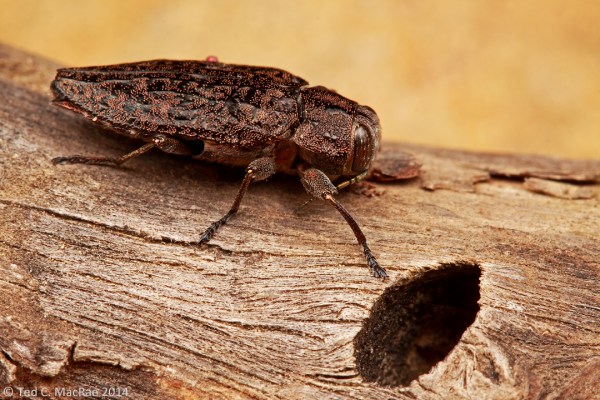

Chrysobothris orono Frost, 1920 | South Cumberland State Park, Tennessee

Chrysobothris orono Frost, 1920 | South Cumberland State Park, Grundy Co., Tennessee

From Chrysobothris orono in Tennessee (posted July 29). I found this rare jewel beetle for the first time this year with the help of Josh Basham and Nadeer Youseff. The beetle itself is beautiful enough, but photographing it on a pine root with a presumed adult emergence hole adds considerable natural history interest to the photo. Rock substrate behind the root adds a pleasingly blurred background.


Buprestis (Stereosa) salisburyensis Herbst, 1801 | South Cumberland State Park, Tennessee.

Buprestis (Stereosa) salisburyensis Herbst, 1801 | South Cumberland State Park, Tennessee.

From The Buprestis tree (posted August 10). This was another of several jewel beetles that I found for the first time after more than three decades of collecting this group. I like the value contrast in this photo from the striking, metallic colors of the beetle against the nicely blurred cinnamon-colored pine bark of the tree on which it is sitting.
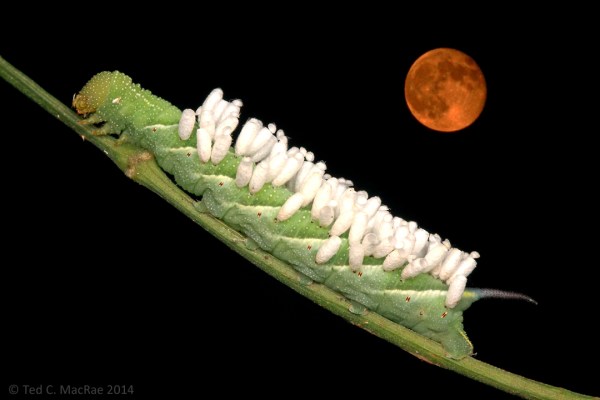

A "super moon" watches over a parasitized hornworm caterpillar.

A “super moon” watches over a parasitized hornworm caterpillar.

From A time of reckoning (posted August 13). I fully admit this is a composite photograph. Nevertheless, it is a faithful recreation of a true sight, and I don’t consider the use of composite techniques to overcome equipment shortcomings to be unethical. There is a haunting symmetry between the blood red moon—considered by some as a sign of the second coming—and the sad, parasitized caterpillar waiting for its inevitable demise.


The greatly expanded palps are thought to mimic beetle mandibles or spider pedipalps.

Phyllopalpus pulchellus Uhler, 1864 | Hickman Co., Kentucky

From My, what busy palps you have! (posted September 2). I’ve become quite fond of insect photos with the subject “peering” at me, the photographer”, from some unusual vantage point. The “pupils” in the eyes of this red-headed bush cricket give the insect an almost quizzical look.


Acmaeodera immaculata Horn, 1881 | vic. Vogel Canyon, Otero Co., Colorado.

Acmaeodera immaculata Horn, 1878 | vic. Vogel Canyon, Otero Co., Colorado.

From Sunset beetles (posted September 30). Taking photos of insects at sunset is a challenging and ephemeral experience—one has only a few minutes to take advantage of the unusual and serene colors it offers, while at the same time trying to determine the best camera and flash settings to use in the rapidly fading light. Of the several that I’ve tried, this one is my favorite because of the softly complimentary colors of the beetle, the flower upon which it is sitting, and the dying orange sky behind it. If I had to choose, I would probably pick this one as my favorite of the year because of the unusual and serene colors.


Megacyllene decora (Olivier, 1795) | Stoddard Co., Missouri

Megacyllene decora (Olivier, 1795) | Stoddard Co., Missouri

From Amorpha borer on goldenrod (posted October 5). I featured this very same species in Best of BitB 2012 but can’t resist choosing this second attempt at photographing the spectacularly beautiful adult—this time on goldenrod. As with the previous version this is a true in situ field photograph, hand held and using the left-hand technique to achieve precise composition against a clear blue sky—difficult to do with an insect of this size and using a 100-mm lens, but well worth the effort.


Buprestis (Knulliobuprestis) confluenta Say, 1823 | Woods Co., Oklahoma

Buprestis (Knulliobuprestis) confluenta Say, 1823 | Woods Co., Oklahoma

From A Buprestis hat-trick! (posted October 14). I didn’t take near as many of the classic “frontal portraits” this year, but this one of a jewel beetle that had eluded me for more than 30 years until this past June is perhaps my favorite of them all.


Agrilus concinnus  Horn, 1891 | Stoddard Co., Missouri

Agrilus concinnus Horn, 1891 | Stoddard Co., Missouri

From North America’s Most Beautiful Agrilus Jewel Beetle (posted October 19). There was a time when this beetle was considered one of North America’s rarest species of jewel beetle. Several years worth of hunting by me and others revealed this beetle’s association with mallow and its unusually late adult activity period—the two combining to make this beetle “seem” rare. This year I succeeded in photographing the spectacular adult beetle.
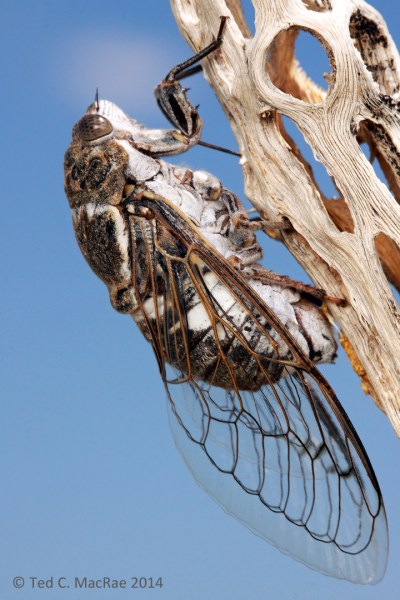

Cacama valvata female ovipositing

Cacama valvata (Uhler, 1888) | Vogel Canyon, Otero Co., Colorado

From Scorching plains, screaming cactus (posted December 5). Insect photos are always better when they also show some aspect of the subject’s natural history. I was lucky to find this female cactus dodger cicada in the act of ovipositing into the dry stem of cholla cactus—in a position where I could get a perfect lateral profile with a clean, blue sky background.
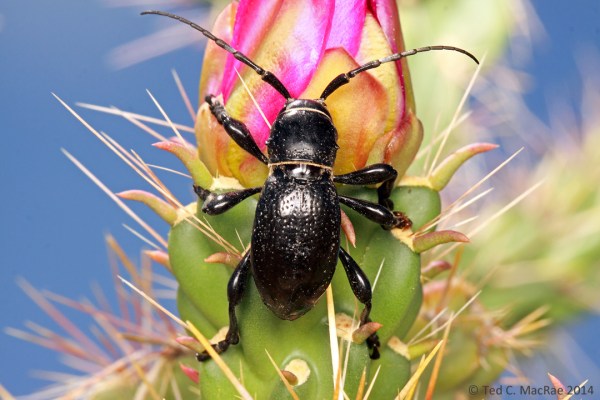

Moneilema armatum LeConte, 1853 | Vogel Canyon, Otero Co., Colorado

Moneilema armatum LeConte, 1853 | Vogel Canyon, Otero Co., Colorado

From Cactus beetle redux (posted December 20). Cactus beetles can be difficult to photograph, but sometimes they cooperate by nicely posing on a pleasing pink flower bud with a blue sky in the background and the cactus spines forming a nice, fuzzy “halo” around the jet black beetle. There were surprisingly few cactus spines impaled in the control unit of my flash after this photo session.


I hope you’ve enjoyed this 2014 version of “Best of BitB” and look forward to seeing everyone in 2015.

Copyright © Ted C. MacRae 2015
Cactus beetle redux!

Moneilema armatum LeConte, 1853 | Vogel Canyon, Otero Co., Colorado

Moneilema armatum LeConte, 1853 | Vogel Canyon, Otero Co., Colorado

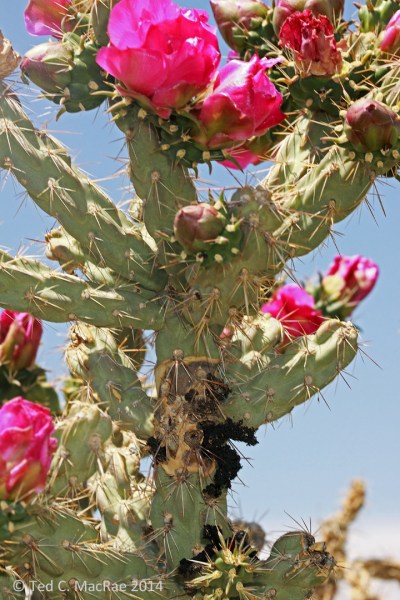
On my most recent Great Plains collecting tripcactus dodger cicadas weren’t the only residents of the cholla cactus (Cylindropuntia imbricata) that studded the open grasslands in southeastern Colorado—cactus beetles (Moneilema spp.) also were found, though in lesser numbers than their frenetic, screeching neighbors (perhaps the reason for their scarcity?!). I’ve covered cactus beetles before, posing the question, “How do you photograph cactus beetles?” The answer was, of course, “Very carefully!” That is certainly true in most cases, but not all.

Moneilema armatum LeConte, 1853 | Vogel Canyon, Otero Co., Colorado

The clumsy, flightless adults rely on their host’s vicious spines for protection.

Cactus beetles are found almost exclusively on opuntioids (chollas and prickly pear cacti), and while most opuntioids are rather viciously spined the plants themselves vary tremendously in structure. Prickly pears (Opuntia spp.), on which I previously photographed these beetles, generally grow in low, dense clumps, their flattened pads often forming a tangle of well-armed hiding places for the beetles. Such is not the case with chollas, which are generally taller, more erect, and have a much more open structure of well spaced, cylindrical stems. The beetles on these plants still enjoy a great amount of protection by the long, barbed spines that cover the stems, but to entomologists/photographers like me they are still much more easily collected and photographed. In this particular case, no special techniques were needed to get nice close-up photos against a clear blue sky other than crouching down a bit and being careful not to lean too close to the plant. That is not to say, of course, that photographing insects on cholla is completely without risk, as this photo showing the spines impaled in my flash unit afterwards will attest (but better the flash unit than poking the lens!).

The hazards of photographing cactus beetles.

The hazards of photographing cactus beetles.

The cactus beetle in these photographs appears to be an armed cactus beetle, Moneilema armatum, by virtue of the small but distinct lateral spines on its pronotum, lack of pubescence on the elytra, and relatively smooth pronotum lacking large punctures except along the apical and basal margins. These shiny black beetles occur in the western Great Plains from Colorado and Kansas south through New Mexico, Oklahoma, and Texas into northern Mexico. Adults and larvae seem to prefer chollas over prickly pears—adults feeding on the surface and larvae tunneling within the stems. I suspect the adult feeding helps provide nutrition for egg maturation in addition to creating an oviposition site, and plants infested with larvae often appear unthrifty and exhibit black masses of hardened exudate along their stems (Woodruff 1966).

Hardened black masses of plant exudate indicate larval feeding within the stems.

Hardened black masses of plant exudate indicate larval feeding within the stems.

REFERENCES:

Linsley, E. G. and J. A. Chemsak. 1984. The Cerambycidae of North America, Part VII, No. 1: Taxonomy and classification of the subfamily Lamiinae, tribes Parmenini through Acanthoderini. University of California Publications in Entomology 102:1–258 [preview].

Woodruff, R. E. 1966. A cactus beetle new to the eastern United States (Coleoptera: Cerambycidae). Florida Department of Agriculture, Division of Plant Industry, Entomology Circular No. 53, 2 pp. [pdf].

© Ted C. MacRae 2014

I got Thomas Shahan to image my Chrysochroa corbetti!

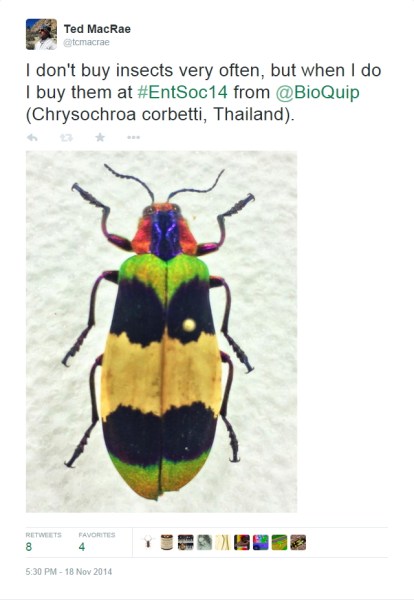
Chrysochroa-corbetti-TwitterThose who follow me on Twitter know that I attended Entomology 2014 last month in Portland, Oregon. As with other scientific conferences, live tweeting of the talks and associated events was all the rage. I may not have been the most prolific “tweeter”, but I did do my share, and one of my tweets involved a rather spectacular preserved specimen of the jewel beetle, Chrysochroa corbetti. The quick iPhone snapshot attached to the tweet was sufficient to prove that the beetle is pure eye candy, but still it did not do full justice to its stunning beauty:

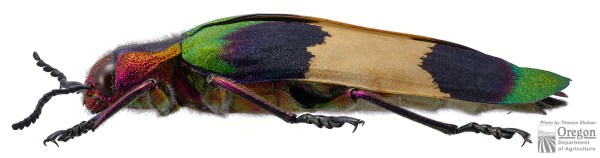
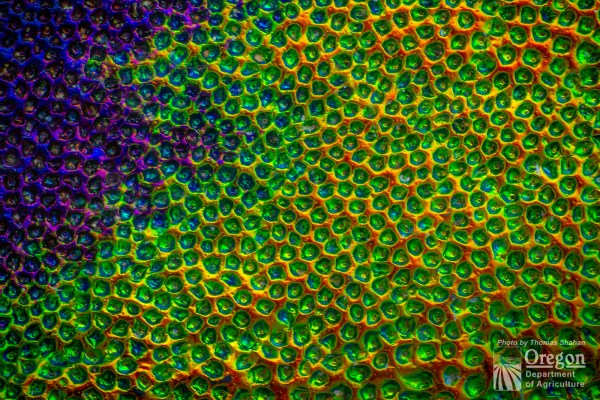
Fortunately, while I was at the meetings I ran into Thomas Shahan—already an icon among insect macrophotographers for his seemingly impossible portraits of jumping spiders, tiger beetles, and other insects. I had planned to spend a couple of days in Salem after the meetings to visit my friend and longtime buprestophile Rick Westcott. As it happens, Thomas is currently a Digital Imaging Specialist at the Oregon Department of Agriculture where Rick spent his entire career as an entomologist. When I showed my specimen to Thomas, he kindly agreed to make some focus-stacked images of the specimen using his lab’s photographic setup. I think you can now agree that this is one of the most spectacular jewel beetles around, and I think you’ll also agree that these images by Thomas are perhaps the most stunning of this oft-photographed species. Be sure to check out the last photo—a 10× close-up of the dorsal elytral detail at the interface between the green and blue areas. Simply stunning!

Chrysochroa (Chroodema) corbetti (Kerremans, 1893) | Thailand

Chrysochroa (Chroodema) corbetti (Kerremans, 1893) | Thailand

Chrysochroa corbetti lateral view

Chrysochroa corbetti lateral view

Chrysochroa corbetti ventral view

Chrysochroa corbetti ventral v

Chrysochroa corbetti dorsal elytral detail (10X)

Chrysochroa corbetti dorsal elytral detail (10X)

© Ted C. MacRae 2014